Why Some Kids Thrive with Drawing-Based AI Tutors
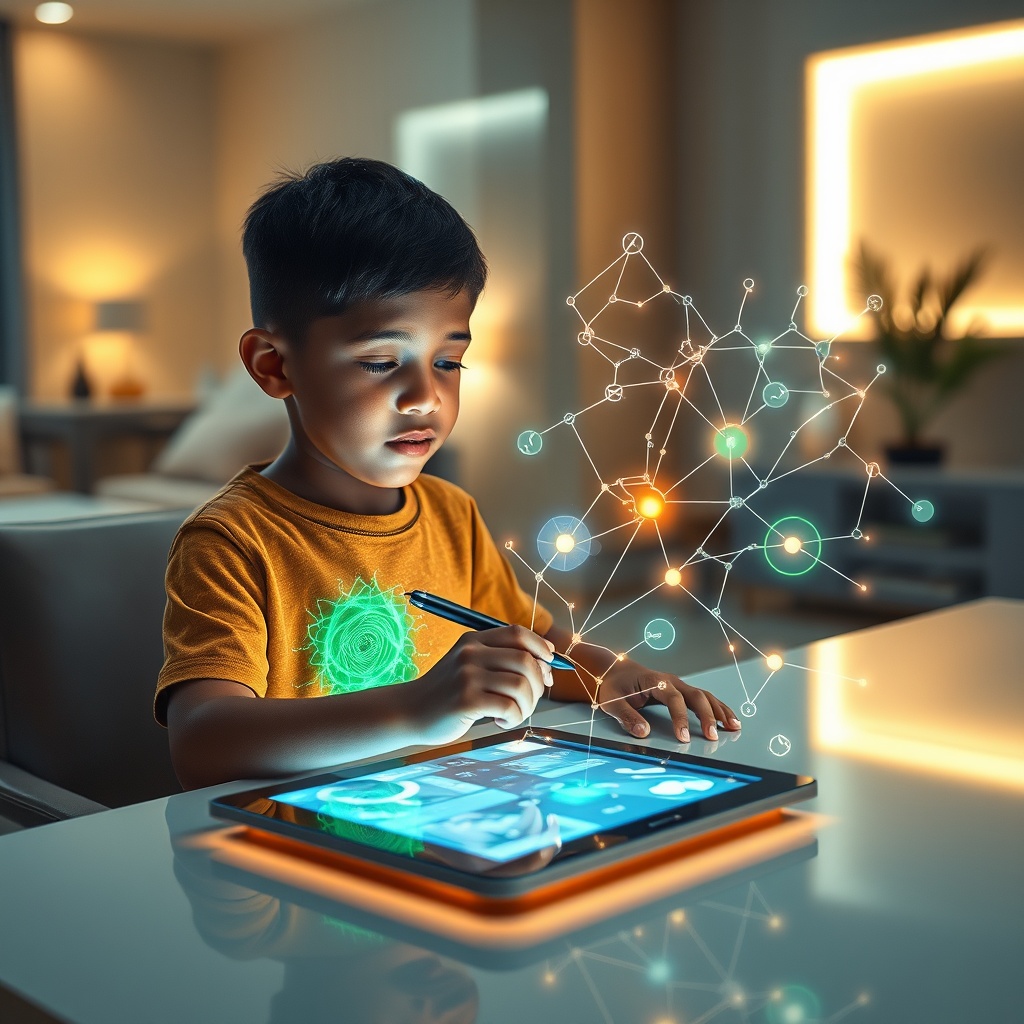
Imagine a child struggling to grasp the intricacies of photosynthesis from a text-heavy science textbook. A static diagram might show the inputs and outputs, but it often fails to convey the dynamic process. For many young learners, abstract concepts like these remain fuzzy until they can actively see them unfold, interact with them, or even draw them out. This is where the emerging field of drawing-based AI tutors offers a significant advantage.
Overview
Imagine a child struggling to grasp the intricacies of photosynthesis from a text-heavy science textbook. A static diagram might show the inputs and outputs, but it often fails to convey the dynamic process. For many young learners, abstract concepts like these remain fuzzy until they can actively see them unfold, interact with them, or even draw them out. This is where the emerging field of drawing-based AI tutors offers a significant advantage.
Research indicates that around 65% of children are visual learners, meaning they process information most effectively when presented visually. Traditional teaching methods, often reliant on auditory lectures or written text, can leave these students feeling disengaged or frustrated. YoLearn AI addresses this by integrating visual aids and interactive elements, such as mind maps and photo-based solutions, to help these students process complex information more intuitively.
History & Background
Early educational software introduced static diagrams and animations, a step up from textbook illustrations. However, these were pre-programmed and offered no interaction. The next wave included interactive simulations where students could manipulate variables, but the visuals themselves weren't generated in real-time or tailored to individual questions.
The advent of advanced AI changed this, moving from static visual libraries to dynamic generation. Today's AI tutors can not only provide relevant diagrams but also interpret student-drawn inputs or generate visual explanations on demand, adapting to the specific query. This personalized visual feedback loop is a core differentiator for platforms like YoLearn AI.
Benefits
Enhanced Engagement: Visual elements capture attention and make learning feel less like a chore and more like discovery, especially for younger learners. Improved Retention: Information presented visually is often processed and remembered more effectively than purely textual or auditory input, leading to stronger long-term memory. Clarification of Complex Ideas: Abstract concepts become tangible and easier to understand when they can be seen, manipulated, or related to a visual model.
YoLearn AI's photo doubt solving minimizes frustration when faced with complex textbook diagrams, providing immediate visual breakdowns that align with a student's visual learning preference. The AI NCERT assistant's ability to generate mind maps caters directly to visual learners, helping them organize and recall information from subjects like CBSE Science with Your YoLearn.ai AI Tutor through spatial relationships rather than rote memorization. By offering explanations that often integrate visual cues for subjects like Math or Biology, YoLearn AI helps students who process information visually to connect the dots faster, leading to a more efficient and smarter study approach. This makes YoLearn.ai a Personal AI Tutor: Transforming the Way You Learn.
Applications
Understanding abstract processes: A child can struggle to visualize the water cycle. A dynamic, step-by-step visual explanation generated by an AI can clarify evaporation, condensation, and precipitation better than static images. Geometry and Spatial Reasoning: Explaining geometric theorems like Pythagoras or the properties of 3D shapes. A drawing-based AI can dynamically illustrate angles, lengths, or rotations, making complex spatial relationships intuitive. Concept Mapping and Summarization: For students learning about historical events or biological classifications, creating visual mind maps helps organize and retain vast amounts of information, revealing connections that might be missed in linear notes.
Photo doubt solving: A student encountering a complex diagram in their NCERT textbook, like the human circulatory system, can snap a photo. YoLearn AI provides a detailed, section-wise explanation of its components and functions, effectively serving as an Any Textbook: Your YoLearn.ai AI Tutor Guide. AI NCERT assistant: When studying a chapter like "Cell - The Unit of Life" for CBSE Science, YoLearn AI can generate visual summaries and mind maps, allowing students to grasp the hierarchy and interconnections of cellular components at a glance. Concept reinforcement: If a student is consistently misunderstanding a topic like fractions, YoLearn AI can generate instant quizzes or flashcards that use visual representations, such as pie charts or bar graphs, to reinforce understanding beyond numerical problems. This helps Unlock Knowledge: Learn by Talking to AI with YoLearn.ai.
Future
The next evolution in drawing-based AI tutors will likely involve sophisticated visual-spatial reasoning, where the AI can not only interpret a student's sketch but also anticipate where they might be going wrong in a diagram or visually demonstrate alternative problem-solving paths.
YoLearn AI is constantly evolving its visual interpretation and generation capabilities. Expect more dynamic, interactive visual explanations and personalized feedback on student-drawn inputs directly within the app. For students seeking a more intuitive, visually-rich learning experience, YoLearn.ai: Learn by Talking to AI for Smarter Study. Explore the app and see how visual learning transforms your study sessions: https://play.google.com/store/apps/details?id=com.yolearn.student&hl=en_IN