UNIT I
GEOGRAPHY AS A DISCIPLINE
This unit deals with
- Geography as an integrating discipline; as a science of spatial attributes
- Branches of geography; importance of physical geography
CHAPTER 1
GEOGRAPHY AS A DISCIPLINE
Vo he upto the secondary stage. You are already aware of some of the phenomena of geographical nature in the world and its different parts. Now, you will study 'Geography' as an independent subject and learn about the physical environment of the earth, human activities and their interactive relationships. Therefore, a pertinent question you can ask at this stage is — Why should we study geography? We live on the surface of the earth. Our lives are affected by our surroundings in many ways. We depend on the resources to sustain ourselves in the surrounding areas. Primitive societies subsisted on 'natural means of subsistence', i.e. edible plants and animals. With the passage of time, we developed technologies and started producing our food using natural resources such as land, soil and water. We adjusted our food habits and clothing according to the prevailing weather conditions. There are variations in the natural resource base, technological development, adaptation with and modification of physical environment, social organisations and cultural development. As a student of geography, you should be curious to know about all the phenomena which vary over space. You learn about the diverse lands and people. You should also be interested in understanding the changes which have taken place over time. Geography equips you to appreciate diversity and investigate into the causes responsible for creating such variations over time and space. You will develop skills to understand the globe converted into maps and have a visual sense of the earth's surface. The understanding and the skills obtained in modern scientific techniques such as GIS and computer cartography equip you to meaningfully contribute to the national endeavour for development.
Now the next question which you may like to ask is —What is geography? You know that earth is our home. It is also the home of many other creatures, big and small, which live on the earth and sustain. The earth's surface is not uniform. It has variations in its physical features. There are mountains, hills, valleys, plains, plateaus, oceans, lakes, deserts and wilderness. There are variations in its social and cultural features too. There are villages, cities, roads, railways, ports, markets and many other elements created by human beings across the entire period of their cultural development.
This variation provides a clue to the understanding of the relationship between the physical environment and social/cultural features. The physical environment has provided the stage, on which human societies enacted the drama of their creative skills with the tools and techniques which they invented and evolved in the process of their cultural development. Now, you should be able to attempt the answer of the question posed earlier as to "What is geography"? In very simple words, it can be said that geography is the description of the earth. The term geography was first coined by Eratosthenes, a Greek scholar (276-194 BC.). The word has been derived from two roots from Greek language geo (earth) and graphos (description).
Put together, they mean description of the earth. The earth has always been seen as the abode of human beings and thus, scholars defined geography as, "the description of the earth as the abode of human beings". You are aware of the fact that reality is always multifaceted and the 'earth' is also multi-dimensional, that is why many disciplines from natural sciences such as geology, pedology, oceanography, botany, zoology and meteorology and a number of sister disciplines in social sciences such as economics, history, sociology, political science, anthropology, etc. study different aspects of the earth's surface. Geography is different from other sciences in its subject matter and methodology but at the same time, it is closely related to other disciplines. Geography derives its data base from all the natural and social sciences and attempts their synthesis.
We have noted that there exist variations over the surface of the earth in its physical as well as cultural environment. A number of phenomena are similar and many are dissimilar. It was, therefore, logical to perceive geography as the study of areal differentiation. Thus, geography was perceived to study all those phenomena which vary over space. Geographers do not study only the variations in the phenomena over the earth's surface (space) but also study the associations with the other factors which cause these variations. For example, cropping patterns differ from region to region but this variation in cropping pattern, as a phenomenon, is related to variations in soils, climates, demands in the market, capacity of the farmer to invest and technological inputs available to her/him. Thus, the concern of geography is to find out the causal relationship between any two phenomena or between more than one phenomenon.
A geographer explains the phenomena in a frame of cause and effect relationship, as it does not only help in interpretation but also foresees the phenomena in future.
The geographical phenomena, both the physical and human, are not static but highly dynamic. They change over time as a result of the interactive processes between ever changing earth and untiring and ever-active human beings. Primitive human societies were directly dependent on their immediate environment. Geography, thus, is concerned with the study of Nature and Human interactions as an integrated whole. 'Human' is an integral part of 'nature' and 'nature' has the imprints of human'. Nature' has influenced different aspects of human life. Its imprints can be noticed on food, clothing, shelter and occupation. Human beings have come to terms with nature through adaptation and modification. As you already know, the present society has passed the stage of primitive societies, which were directly dependent on their immediate physical environment for sustenance. Present societies have modified their natural environment by inventing and using technology and thus, have expanded the horizon of their operation by appropriating and utilising the resources provided by nature. With the gradual development of technology, human beings were able to loosen the shackles of their physical environment. Technology helped in reducing the harshness of labour, increased labour efficiency and provided leisure to human beings to attend to the higher needs of life. It also increased the scale of production and the mobility of labour.
The interaction between the physical environment and human beings has been very succinctly described by a poet in the following dialogue between human' and 'nature' (God). You created the soil, I created the cup, you created night, I created the lamp. You created wilderness, hilly terrains and deserts; I created flower beds and gardens. Human beings have claimed their contribution using natural resources. With the help of technology, human beings moved from the stage of necessity to a stage of freedom. They have put their imprints everywhere and created new possibilities in collaboration with nature. Thus, we now find humanised nature and naturalised human beings and geography studies this interactive relationship. The space got organised with the help of the means of transportation and communication network. The links (routes) and nodes (settlements of all types and hierarchies) integrated the space and
gradually, it got organised. As a social science discipline, geography studies the 'spatial organisation' and 'spatial integration'.
Geography as a discipline is concerned with three sets of questions:
(i) Some questions are related to the identification of the patterns of natural and cultural features as found over the surface of the earth. These are the questions about what? (ii) Some questions are related to the distribution of the natural and human/ cultural features over the surface of the earth. These are the questions about where?
Taken together, both these questions take care of distributional and locational aspects of the natural and cultural features. These questions provided inventorised information of what features and where located. It was a very popular approach during the colonial period. These two questions did not make geography a scientific discipline till the third question was added.
(ii) The third question is related to the explanation or the causal relationships between features and the processes and phenomena. This aspect of geography is related to the question, why?
Geography as a discipline is related to space and takes note of spatial characteristics and attributes. It studies the patterns of distribution, location and concentration of phenomena over space and interprets them providing explanations for these patterns. It takes note of the associations and interrelationships between the phenomena over space and interprets them providing explanations for these patterns. It also takes note of the associations and interrelationships between the phenomena resulting from the dynamic interaction between human beings and their physical environment.
GEOGRAPHY AS AN INTEGRATING DISCIPLINE
Geography is a discipline of synthesis. It attempts spatial synthesis, and history attempts temporal synthesis. Its approach is holistic in nature. It recognises the fact that the world is a system of interdependencies.
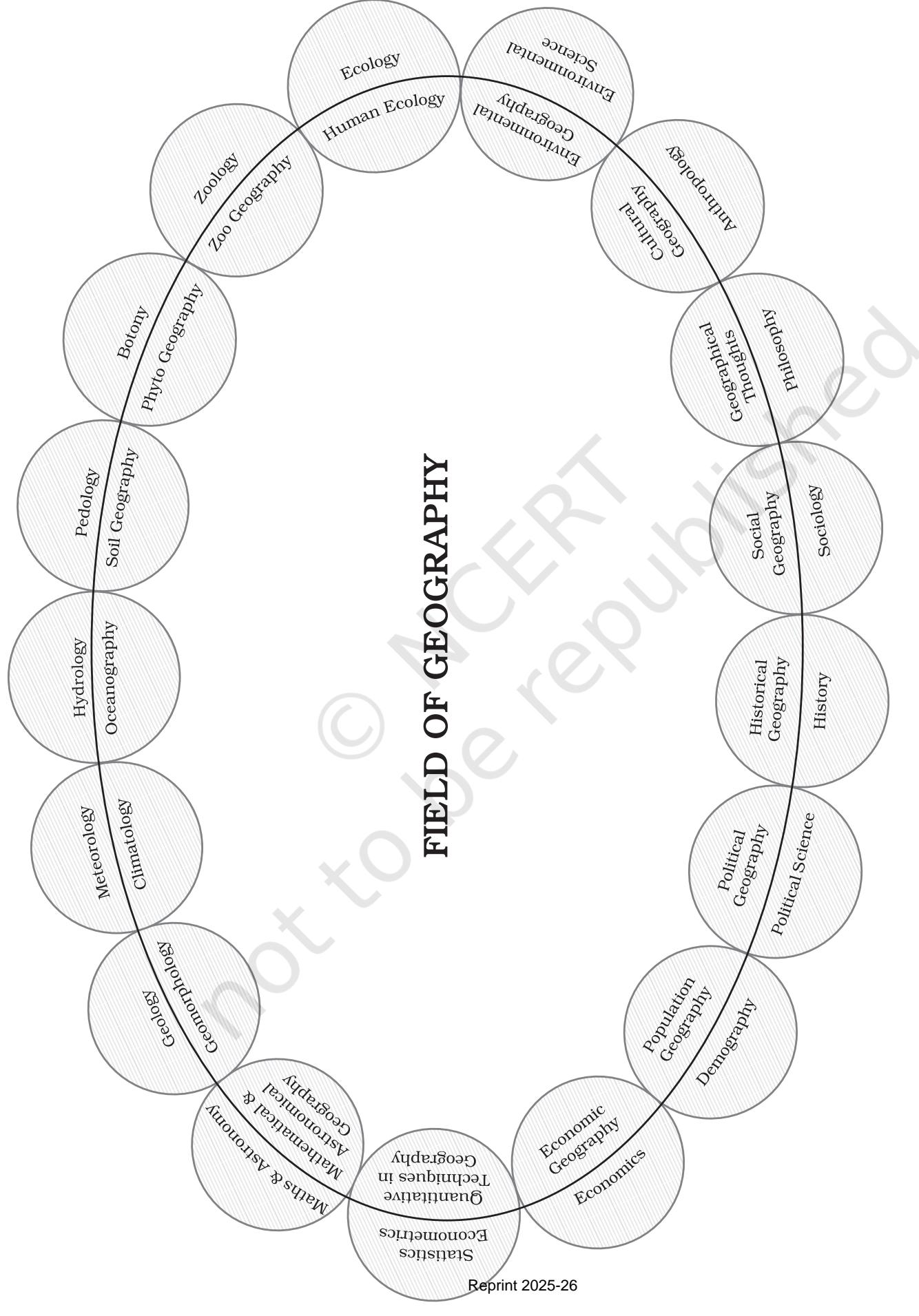
The present world is being perceived as a global village. The distances have been reduced by better means of transportation increasing accessibility. The audio-visual media and information technology have enriched the data base. Technology has provided better chances of monitoring natural phenomena as well as the economic and social parameters. Geography as an integrating discipline has interface with numerous natural and social sciences. All the sciences, whether natural or social, have one basic objective, of understanding the reality. Geography attempts to comprehend the associations of phenomena as related in sections of reality. Figure 1.1 shows the relationship of geography with other sciences. Every discipline, concerned with scientific knowledge is linked with geography as many of their elements vary over space. Geography helps in understanding the reality in totality in its spatial perspective. Geography, thus, not only takes note of the differences in the phenomena from place to place but integrates them holistically which may be different at other places. A geographer is required to have a broad understanding of all the related fields, to be able to logically integrate them. This integration can be understood with some examples. Geography influences historical events. Spatial distance itself has been a very potent factor to alter the course of history of the world. Spatial depth provided defence to many countries, particularly in the last century. In traditional warfare, countries with large size in area, gain time at the cost of space. The defence provided by oceanic expanse around the countries of the new world has protected them from wars being imposed on their soil. If we look at the historical events world over, each one of them can be interpreted geographically.
In India, Himalayas have acted as great barriers and provided protection but the passes provided routes to the migrants and invaders from Central Asia. The sea coast has encouraged contact with people from East and Southeast Asia, Europe and Africa. Navigation technology helped European countries to colonise a number of countries of Asia and Africa, including India as they got accessibility
through oceans. The geographical factors have modified the course of history in different parts of the world.
Every geographical phenomenon undergoes change through time and can be explained temporally. The changes in landforms, climate, vegetation, economic activities occupations and cultural developments have followed a definite historical course. Many geographical features result from the decision making process by different institutions at a particular point of time. It is possible to convert time in terms of space and space in terms of time. For example, it can be said that place A is $1 { , } 5 0 0 \ \mathrm { k m }$ from place B or alternately, it can also be said that place A is two hours away (if one travels by plane) or seventeen hours away (if one travels by a fast moving train). It is for this reason, time is an integral part of geographical studies as the fourth dimension. Please mention other three dimensions?
Figure 1.1 amply depicts the linkages of geography with different natural and social sciences. This linkage can be put under two segments.
BRANCHES OF GEOGRAPHY
Please study Figure 1.1 for recapitulation. It has very clearly brought out that geography is an interdisciplinary subject of study. The study of every subject is done according to some approach. The major approaches to study geography have been (i) Systematic and (i) Regional. The systematic geography approach is the same as that of general geography. This approach was introduced by Alexander Von Humboldt, a German geographer (1769-1859) while regional geography approach was developed by another German geographer and a contemporary of Humboldt, Karl Ritter (1779-1859).
In systematic approach (Figure 1.2), a