CHAPTER 10
WATER IN THE ATMOSPHERE
You have already learnt that the air contains water vapour. It varies from zero to four per cent by volume of the atmosphere and plays an important role in the weather phenomena. Water is present in the atmosphere in three forms namely – gaseous, liquid and solid. The moisture in the atmosphere is derived from water bodies through evaporation and from plants through transpiration. Thus, there is a continuous exchange of water between the atmosphere, the oceans and the continents through the processes of evaporation, transpiration, condensation and precipitation.
Water vapour present in the air is known as humidity. It is expressed quantitatively in different ways. The actual amount of the water vapour present in the atmosphere is known as the absolute humidity. It is the weight of water vapour per unit volume of air and is expressed in terms of grams per cubic metre. The ability of the air to hold water vapour depends entirely on its temperature. The absolute humidity differs from place to place on the surface of the earth. The percentage of moisture present in the atmosphere as compared to its full capacity at a given temperature is known as the relative humidity. With the change of air temperature, the capacity to retain moisture increases or decreases and the relative humidity is also affected. It is greater over the oceans and least over the continents.
The air containing moisture to its full capacity at a given temperature is said to be saturated. It means that the air at the given temperature is incapable of holding any additional amount of moisture at that stage. The temperature at which saturation occurs in a given sample of air is known as dew point.
EVAPORATION AND CONDENSATION
The amount of water vapour in the atmosphere is added or withdrawn due to evaporation and condensation respectively. Evaporation is a process by which water is transformed from liquid to gaseous state. Heat is the main cause for evaporation. The temperature at which the water starts evaporating is referred to as the latent heat of vapourisation.
Increase in temperature increases water absorption and retention capacity of the given parcel of air. Similarly, if the moisture content is low, air has a potentiality of absorbing and retaining moisture. Movement of air replaces the saturated layer with the unsaturated layer. Hence, the greater the movement of air, the greater is the evaporation.
The transformation of water vapour into water is called condensation. Condensation is caused by the loss of heat. When moist air is cooled, it may reach a level when its capacity to hold water vapour ceases. Then, the excess water vapour condenses into liquid form. In free air, condensation results from cooling around very small particles termed as hygroscopic condensation nuclei. Particles of dust, smoke and salt from the ocean are particularly good nuclei because they absorb water. Condensation also takes place when the moist air comes in contact with some colder object and it may also take place when the temperature is close to the dew point. Condensation, therefore, depends upon the amount of cooling and the relative humidity of the air. Condensation is influenced by the volume of air, temperature, pressure and humidity. Condensation takes place: (i) when
the temperature of the air is reduced to dew point with its volume remaining constant; (ii) when both the volume and the temperature are reduced; (iii) when moisture is added to the air through evaporation. However, the most favourable condition for condensation is the decrease in air temperature.
After condensation the water vapour or the moisture in the atmosphere takes one of the following forms — dew, frost, fog and clouds. Forms of condensation can be classified on the basis of temperature and location. Condensation takes place when the dew point is lower than the freezing point as well as higher than the freezing point.
Dew
When the moisture is deposited in the form of water droplets on cooler surfaces of solid objects (rather than nuclei in air above the surface) such as stones, grass blades and plant leaves, it is known as dew. The ideal conditions for its formation are clear sky, calm air, high relative humidity, and cold and long nights. For the formation of dew, it is necessary that the dew point is above the freezing point.
Frost
Frost forms on cold surfaces when condensation takes place below freezing point ($0^\circ \mathrm{C}$), i.e. the dew point is at or below the freezing point. The excess moisture is deposited in the form of minute ice crystals instead of water droplets. The ideal conditions for the formation of white frost are the same as those for the formation of dew, except that the air temperature must be at or below the freezing point.
Fog and Mist
When the temperature of an air mass containing a large quantity of water vapour falls all of a sudden, condensation takes place within itself on fine dust particles. So, the fog is a cloud with its base at or very near to the ground. Because of the fog and mist, the visibility becomes poor to zero. In urban and industrial centres smoke provides plenty of nuclei which help the formation of fog and mist. Such a condition when fog is mixed with smoke, is described as smog. The only difference between the mist and fog is that mist contains more moisture than the fog. In mist each nuclei contains a thicker layer of moisture. Mists are frequent over mountains as the rising warm air up the slopes meets a cold surface. Fogs are drier than mist and they are prevalent where warm currents of air come in contact with cold currents. Fogs are mini clouds in which condensation takes place around nuclei provided by the dust, smoke, and the salt particles.
Clouds
Cloud is a mass of minute water droplets or tiny crystals of ice formed by the condensation of the water vapour in free air at considerable elevations. As the clouds are formed at some height over the surface of the earth, they take various shapes. According to their height, expanse, density and transparency or opaqueness clouds are grouped under four types: (i) cirrus; (ii) cumulus; (iii) stratus; (iv) nimbus.
Cirrus
Cirrus clouds are formed at high altitudes (8,000 - 12,000m). They are thin and detached clouds having a feathery appearance. They are always white in colour.
Cumulus
Cumulus clouds look like cotton wool. They are generally formed at a height of 4,000 - $7,000 \mathrm{m}$ They exist in patches and can be seen scattered here and there. They have a flat base.
Stratus
As their name implies, these are layered clouds covering large portions of the sky. These clouds are generally formed either due to loss of heat or the mixing of air masses with different temperatures.
Nimbus
Nimbus clouds are black or dark gray. They form at middle levels or very near to the surface
of the earth. These are extremely dense and opaque to the rays of the sun. Sometimes, the clouds are so low that they seem to touch the ground. Nimbus clouds are shapeless masses of thick vapour.
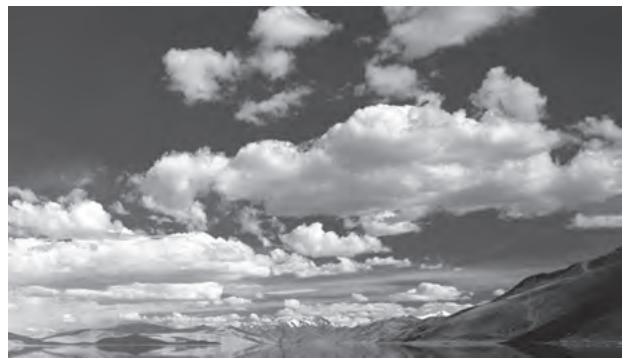 Figure 10.1