The Constitution of India —An Introduction
I wish your labours success, and invoke Divine blessings that your proceedings may be marked not only by good sense, public spirit, and genuine patriotism, but also by wisdom, toleration, justice, and fairness to all; and above all with a vision which may restore India to her pristine glory, and give her a place of honour and equality amongst the great nations of the world.
—Dr. Sachidananda Sinha,
President of the Constituent Assembly at the start of the process of the writing of the Constitution
I would like to point out that if we are able to act according to the Constitution which has been adopted.., I am sure we shall be able very soon to make our country great. This is a goal which is within our power to reach, but its realisation would require hard physical and mental labour and above all great moral regeneration.
We have prepared a democratic Constitution. But the successful working of democratic institutions requires in those who have to work with them willingness to respect the viewpoint of others, capacity for compromise and accommodation.
—Dr. Rajendra Prasad, first President of India
- What is a constitution, and why do we need one?
- How was the Indian Constitution prepared?
- How did our freedom struggle and civilisational heritage influence the Constitution?
- What are the key features of the Constitution of India? Why is it still relevant, even though it was written more than seventy years ago?
Helium
is a gas that doesn't react with paper or ink, helping to preserve the Constitution over time.
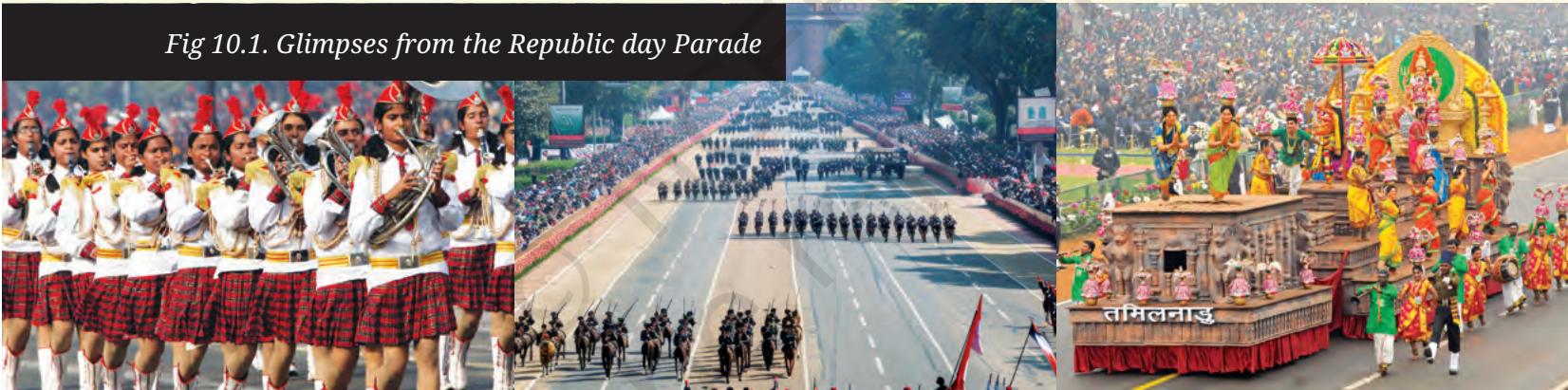
It was yet another chilly January morning in Delhi, much like every Republic Day. Ma's voice echoed through the house, "Wake up! It's time, or you'll miss the parade!" Papa, already up, switched on the television to Doordarshan and called out, "Kumar, Niharika, come quickly! The parade has started!" The children jumped out of their warm beds, rushing to sit in front of the television, eager not to miss even a moment of the Republic Day Parade.
The sight of the majestic marching bands, vibrant displays, and the unfurling of the tricolour at Kartavya Path filled the room with pride and excitement.
This day carries a deep significance—it marks the coming into effect of the Indian Constitution on 26 January 1950.
The book in the picture is our Constitution. To keep it safe, it is carefully preserved in a helium-filled glass case in Parliament. But what exactly is a constitution, and why is it so important?
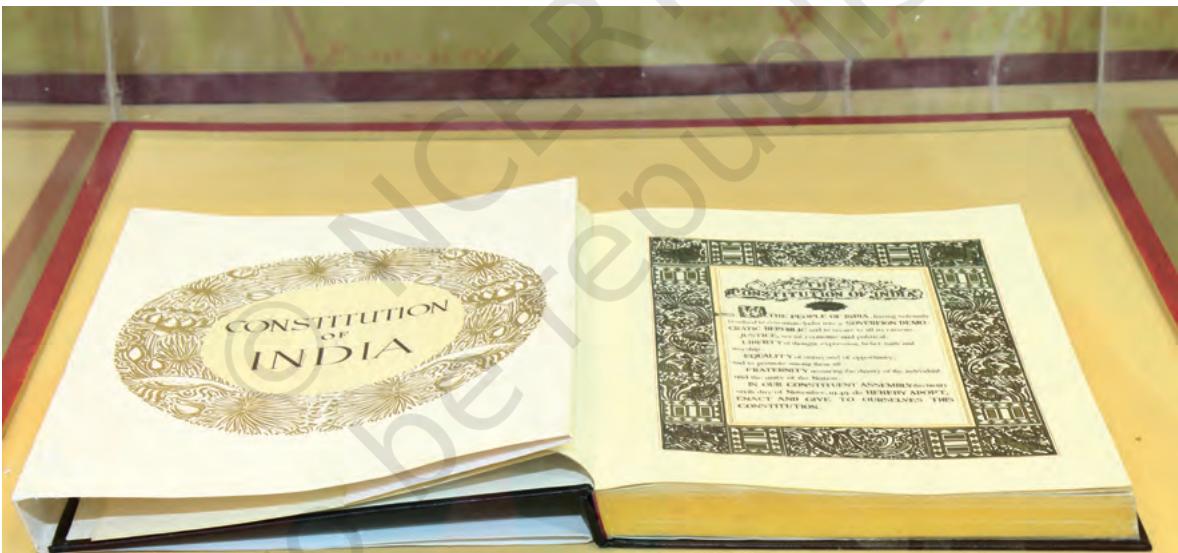 Fig. 10.2. The Constitution of India carefully preserved in a helium-filled glass case
LET'S REMEMBER
Recall that in Grade 6, we saw the meaning of the word 'constitution'—a document that lays down the basic principles and laws of a nation. In small groups of three, list all the questions that come to your mind about a country's constitution.
The Constitution of India is the document that many of the important officials of our country pledge to uphold. The president takes an oath to preserve, protect, and defend it. The prime minister, council of ministers, and judges promise to follow its provisions.
What Is a Constitution?
A simple answer is that it is a document that spells out a nation's basic principles and laws. It lays out: the framework of the three organs of the government (legislature, executive, and judiciary) and their roles and responsibilities; checks and balances amongst the three organs of government to ensure fairness, responsibility and accountability; the rights and duties of the citizens; an outline of the long-term goals and aspirations of the nation.
Why do we need a constitution?
LET'S EXPLORE
Imagine that your school has reached the final tournament in kabaddi at the state-level. The opponent is a strong team that has won the tournament two years in a row. They are aiming to win a third time, a hat-trick. The match is on, and a player from your team has just got one of the players from the other team 'out'; then a dispute breaks out. The player from the other team insists that she had already crossed into her team area before your team player caught her. The referee has seen that the player from the other team was indeed 'out'. To settle the dispute amicably, she pulls out a little official rulebook. The team captains confer with the referee and look at the rules. They then agree that the player was indeed 'out', and your team has won the state-level trophy.
Discuss in your group what might have happened if there was no official rulebook that the referee and the team captains could refer to. What is required to ensure everyone agrees to abide by the rulebook? What might happen if the team captains did not agree to refer to the rulebook at all?
Think of a game that you play often and list the rules you follow. Each group will then present their set of rules to the rest of the class. Listen to each presentation, discuss the rules, and work together to decide on a common set of rules for the game. What challenges do you face in reaching a consensus on rules that everyone agrees with?
What could be the 'rulebook' for a country? How would it be made?
Our Constitution is something like a rulebook for the country.
DON'T MISS OUT
Just as your textbook has many sections and chapters, the Constitution of India has 25 parts and 12 schedules. Each part has sections within it. It is the world's largest written constitution. When it came into effect, it had 22 Parts and 8 schedules. You don't need to remember these numbers, but can you guess why they have increased since 1950?
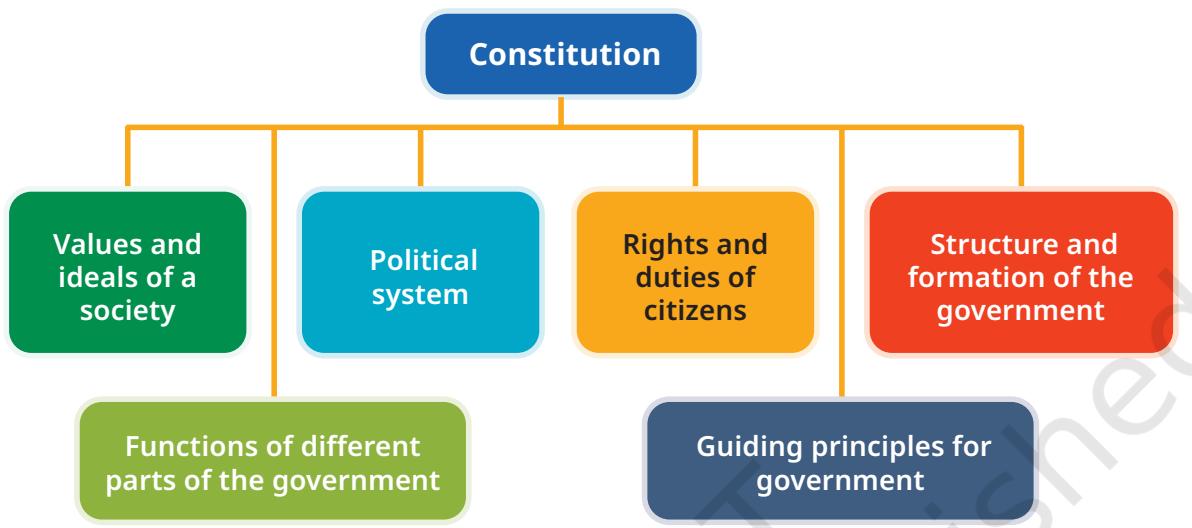
The basic rules and principles in a constitution determine what kind of government will be there, how it will be formed, and how it will function. This includes many principles we saw in the previous chapter, such as how the legislature, executive and judiciary are formed and how they work. A constitution describes, for example, how laws are to be made and implemented, who elects the executive, how the judiciary is made, and what rights and duties individual citizens have.
Many constitutions, including the Indian Constitution, also state the values and ideals the country is committed to —for instance,
equality and justice for all, fraternity, pluralism and freedom. In fact, it is these values and ideals that usually form the basis for the laws and principles in a constitution.
Some of the important things that most constitutions contain:
Writing the Constitution of India
While India was struggling for independence from British rule, it was necessary to start planning for how we would govern ourselves. There were many important questions to be answered in a large, culturally diverse and complex country like India: What type of government should we have? What rules and principles should guide us? Who should have the right to vote? How should we decide on disputes?
To answer these and many other questions, a Constituent Assembly was formed in 1946, initially with 389 members (later reduced to 299 after the Partition of India), of which 15 were women. These members represented India's diverse regions, professions, and social groups.
How was our Constitution developed?
The Indian Constitution was developed and written by the Constituent Assembly over a period of almost three years. It was formed on 9 December 1946, with its members elected by the legislative assemblies of the provinces (whose members had been, in turn, elected by the people). Dr. Rajendra Prasad was the Chairman of the Constituent Assembly. The work was completed on 26 November 1949, and the resulting document was adopted as the Constitution of India on 26 January 1950, which is why we celebrate this day annually as Republic Day.
The initial text of the Constitution was prepared by a Drafting Committee chaired by Dr. B.R. Ambedkar, an eminent social reformer and the first Law and Justice minister of independent India (Fig. 10.3).
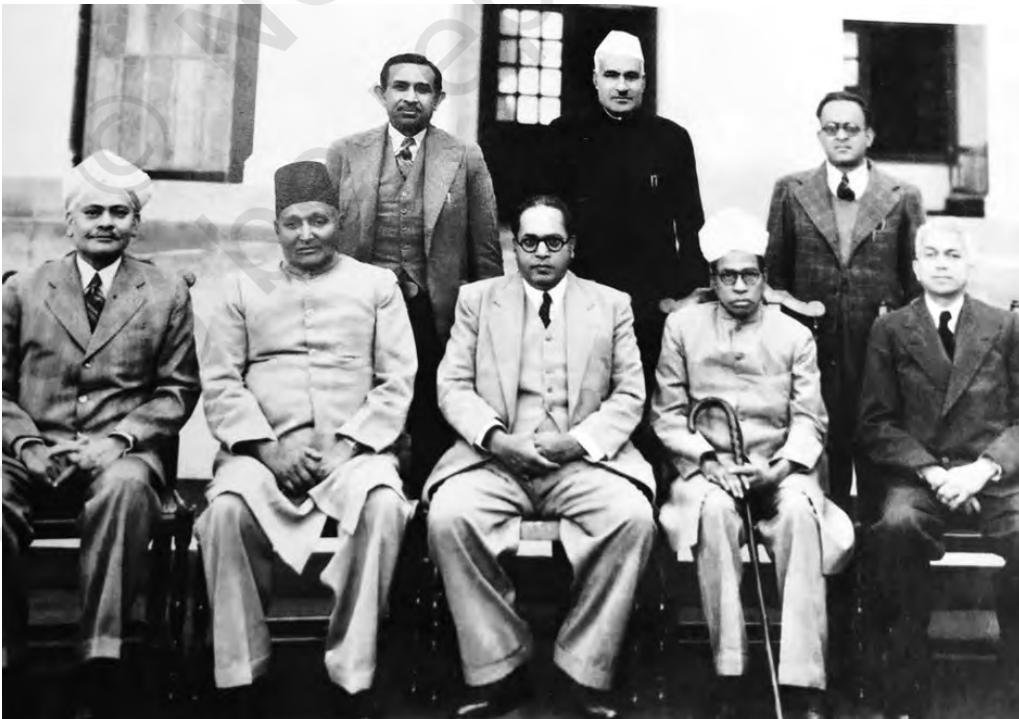 Fig. 10.3. Dr. B.R. Ambedkar (seated, centre) with a few other members of the Drafting Committee.
LET'S EXPLORE
In small groups, try to find out the names of people from your region who may have participated in the making of the Constitution. What sources can you use to gather this information? (Hint: Look for books in your school or local library. You could also ask your teacher, parents and other elders in the neighbourhood. Explore https://sansad.in/ls/ about/constituent-assembly )
What Shaped and Influenced the Indian Constitution?
While the Constitution was developed by the Constituent Assembly, it had many influences. The experience, ideas and ideals of the Indian freedom movement were a significant influence. India's civilisational heritage and culture also played a key role. Useful learnings from constitutions of other countries were also considered.
Influence of the Indian Freedom Movement
Many key ideals and values of the Indian freedom struggle were enshrined in the Constitution. The Constitution was the cornerstone for an independent India. A number of leaders of India's freedom movement were members of the Constituent Assembly and, therefore, carried their experience and ideas from the freedom struggle to the Constitution.
Some of these values and ideals are: equality of all, justice for all, freedom, fraternity, preservation of India's cultural heritage, and the idea of using the Constitution as a tool for and means of achieving these values and ideals.
The experience and learnings from the freedom struggle also provided answers to many of the how' and 'what' questions:
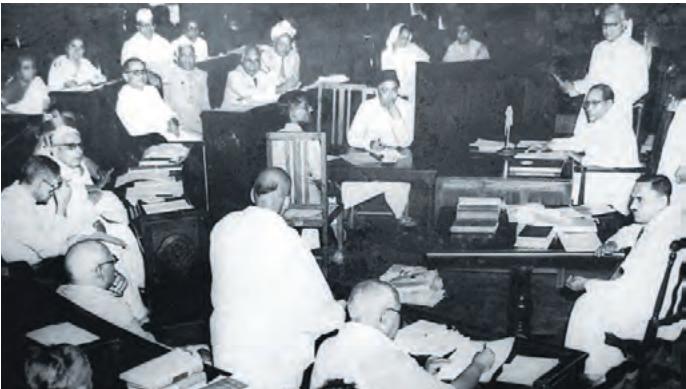 Fig. 10.4.1. Workings of the Constituent Assembly
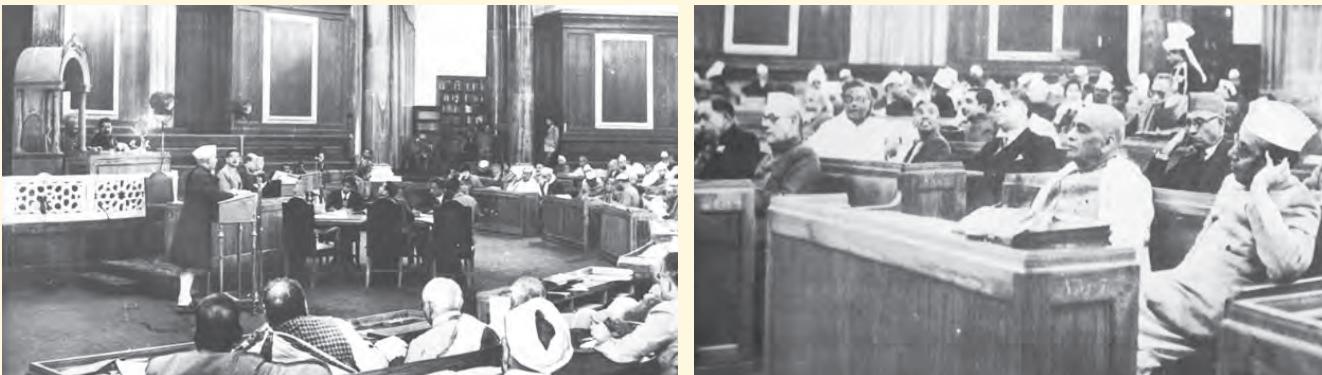 Fig. 10.4.2. and 10.4.3. Workings of the Constituent Assembly
- How do we make sure that every adult citizen has a right to vote?
- How do we ensure that the powers of the executive, legislature and judiciary are kept separate?
- How do we guarantee that every individual's fundamental rights are respected?
- What should be the process if we want to amend the Constitution?
- What should be the relationship between the Central and State governments? And so on.
We will get glimpses of how all these have been structured in the Constitution later in this chapter.
India's civilisational heritage and history
LET'S REMEMBER
In the chapter on "Unity in Diversity, or Many in the One'" in Grade 6, we studied what makes India one country and the underlying unity that embraces the diversity.
This idea of India being one country is embedded in the Constitution.
Some fundamental principles are embedded in our culture —acceptance of the idea that people could have different points of view, Nature as sacred, the pursuit of learning and knowledge, respect for women, the concepts of vasudhaiva kutumbakam ("the world is one family") and sarve bhavantu
sukhinah (an invocation for the well-being of all creatures). All these principles find a place in our Constitution though you might find them expressed a little differently.
LET'S REMEMBER
Earlier, we described various types of governance systems that we experimented within India—from the janapadas, sanghas, rulers and their councils, Kautilya's concept of saptánga, ràjadharma and so on. On the whole, there has been a great emphasis on the duties and role of the people in governance.
It was, therefore, quite natural that the Constitution makers would incorporate these ideas of our civilisational heritage into our Constitution—Fundamental Duties', for instance, are part of it.
Learnings from across the world
In addition, in the Indian tradition of à no bhadráh kratavo yantu vishwatah—"Let noble thoughts come to me from every side"—the Constitution makers studied the constitutions of France, USA, UK, Ireland, Australia, and other countries that have a democratic system, to explore their usefulness for our context. For example, the ideals of liberty, equality, fraternity were adopted from France's constitution $\mathcal { N }$ (which enshrined them from the French Revolution of 1789); the idea of the Directive Principles of State Policy (which we will study shortly) was inspired by the Irish Constitution; and the American Constitution helped shape the concept of an independent judiciary.
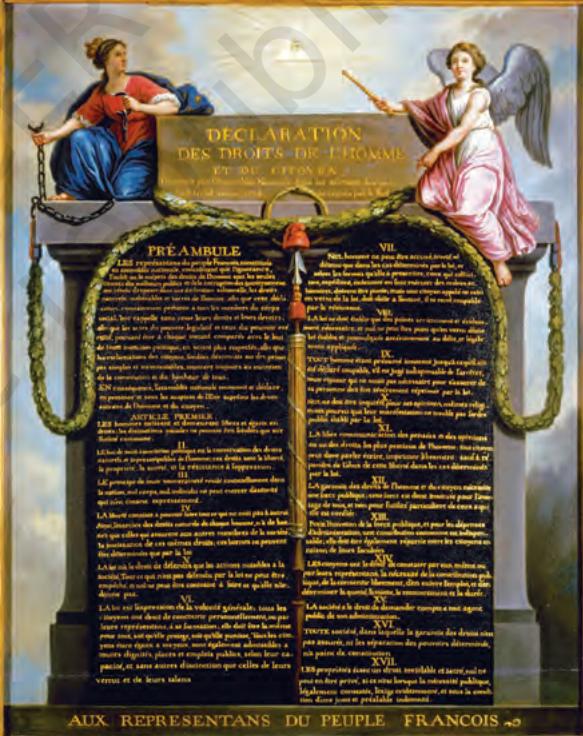 Fig. 10.5. This Declaration of the Rights of Man and of the Citizen', which focused on equality, liberty and justice for all, was formulated during the 1789 French Revolution. It helped the spread of such ideals in many parts of the world; many constitutions (including the French one) adopted or adapted its values and principles.
 Fig. 10.6. A scene from an ancient gurukula
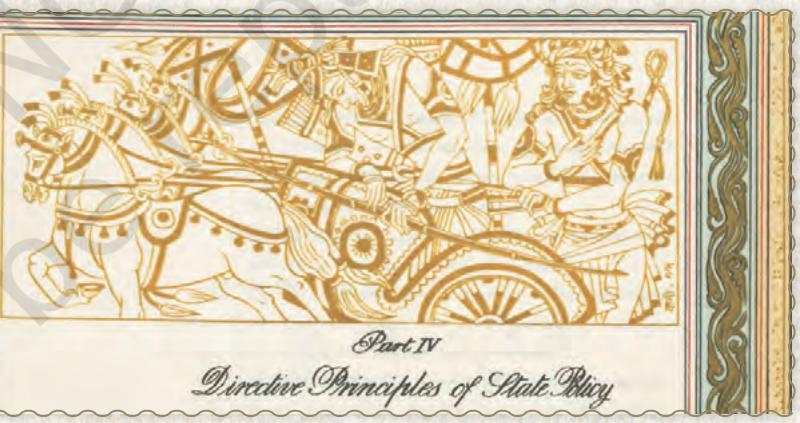 Fig. 10.7. A scene from the Ramayana: Ráma's conquest of Lanka and recovery of Sita
 Fig. 10.8. A scene from the Mahabharata: Krishna propounding the Gita to Arjuna
Fig. 10.9. A scene from Orissan sculptures
Fig. 10.8. A scene from the Mahabharata: Krishna propounding the Gita to Arjuna
Fig. 10.9. A scene from Orissan sculptures
 Fig. 10.10. An image of Nataraja
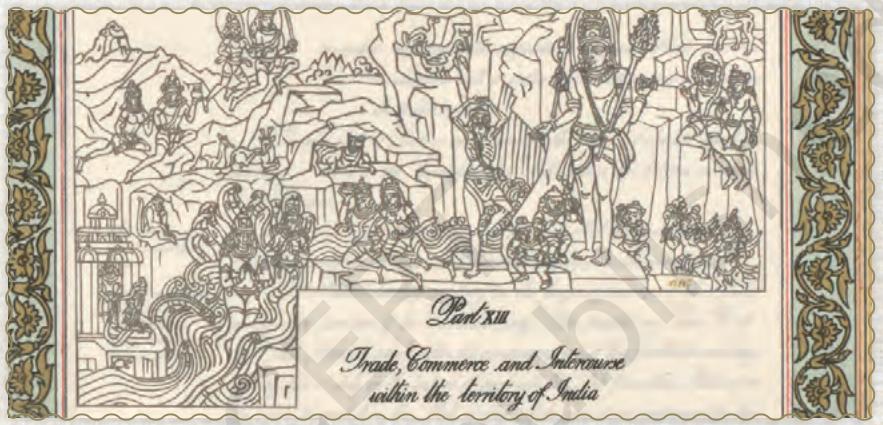 Fig. 10.11. Scenes from a Mahabalipuram bas-relief: Bhagiratha's penance and the descent of Ganga
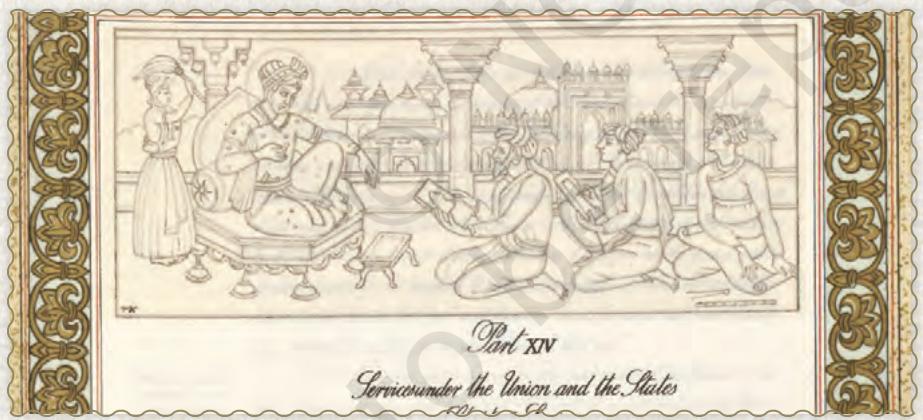 Fig. 10.12. A scene with Akbar and Mughal architecture
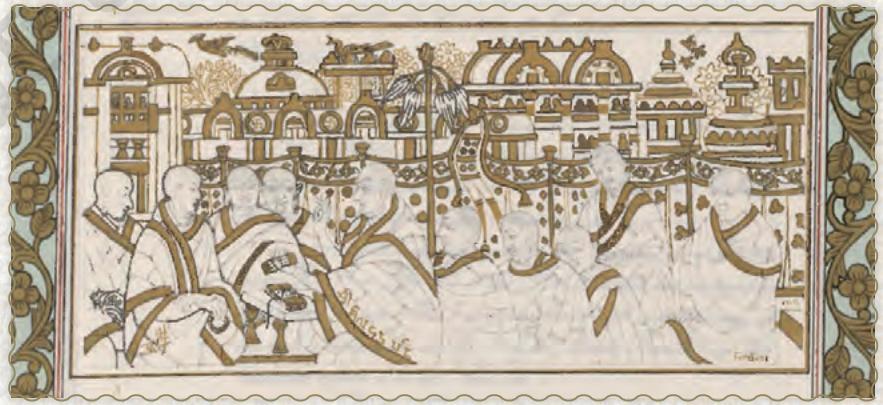 Fig. 10.13. A scene depicting Nalanda, one of India's ancient universities
Key Features of the Constitution of India
Before we get acquainted with the main features of the Constitution, let us revisit some of the concepts we saw in Grade 6.
LET'S REMEMBER
- There are three organs of government—legislature, executive and judiciary—and the 'separation of powers' is essential to their effective working.
- The legislature makes the laws.
- The law is implemented by the executive, which is headed by the prime minister.
- The judiciary ensures that all laws made are in accordance with the Constitution. It also decides whether a law has been broken and what punishment is necessary.
- We have a three-tier system of government—central, state and local (Panchayati raj system).
- Some functions and responsibilities are reserved for the central government, and others are assigned to the state government.
The Constitution addresses these points comprehensively. It clearly defines the roles, functions, responsibilities, and accountability measures for each organ of government. The electoral system has been laid down to ensure that every eligible citizen of the country is enabled to vote.
Other core aspects of the Constitution are the Fundamental Duties, Fundamental Rights and the Directive Principles of State Policy. The infographic (Fig. 10.14) provides us with examples of a few of the Fundamental Duties and Rights (which are listed in full in the beginning of all NCERT textbooks). The Directive Principles of State Policy (DPsP, as they are popularly called) represent the essence of the social and economic vision that the framers of the Constitution had for India. The examples we present in the infographic illustrate the principles they wanted governance to follow.
DON'T MISS OUT
Directive Principles are goals that the government should try to achieve. They reflect the direction they wished the country take to make India better for all; for example, everybody in the country must have a good standard of living. But if the government does not make efforts to follow this, one cannot go to a judge and complain about it. The DPsP are more like guidelines than strict rules. Fundamental Rights, on the other hand are promises that must be kept. If someone treats you unfairly because of who you are, you can actually go to court and the judge can help you.
The people who wrote our Constitution created this system on purpose. They wanted some rights that could be demanded immediately (Fundamental Rights) and some bigger goals (Directive Principles) that might take time to achieve as our country progressed.
LET'S EXPLORE
Read the quotation given below. Which article of the Constitution do you think she was referring to? Why do you think she said that the equality of women was not a new concept for India? Discuss in the class.
Sir the women of India are happy to step into their rightful heritage of complete equality with men in all spheres of life and activity. I say so because I am convinced that this is no new concept which has been postulated for the purposes of this Constitution, but is an ideal that has long been cherished by India, though social conditions for some time had tragically debased it in practice. This Constitution affirms that ideal and gives the solemn assurance that the rights of women in law will be wholly honoured in the Indian Republic.
—Begum Aizaz Rasul, 22 November 1949, during the Constituent Assembly's debates
Fundamental Rights
- Right to Equality (Article 14. Equality before law)
- Right to Freedom (Article 21. Protection of life and personal liberty)
- Right against Exploitation
- Article 21-A. (Right to education)
Directive Principles of State Policy
- Article 41: Welfare Government
- Article 44: Uniform Civil Code
- Article 38: Social, Political, and Economic Justice
- Article 48-A: Environment and Wildlife Protection
- Article 49: Protection of monuments, places, and objects of national importance
- Article 47: Nutrition, standard of living, and public health
Fundamental Duties
- a to abide by the Constitution and respect its ideals and institutions, the National Flag, and the National Anthem;
- b. to defend the country and render national service when called upon to do so;
- C. to value and preserve the rich heritage of our composite culture;
- d. to protect and improve the natural environment including forests, lakes, rivers and wildlife, and to have compassion for living creatures;
- e. to strive towards excellence in all spheres of individual and collective activity so that the nation constantly rises to higher levels of endeavour and achievement;
- f. if a parent or guardian, to provide opportunities for education to his or her child or, as the case may be, ward between the age of six and fourteen years;
The Constitution is a Living Document
Our Constitution makers realised that a need for new laws and rules would emerge over time. For example, Part IV-A: Fundamental Duties' was added in 1976. However, we must remember that any changes (called 'amendments') to the Constitution are rigorously debated in the Parliament before they are accepted. Some require a debate in legislative assemblies as well. Many times, opinions are sought from the general public. Some changes can also be initiated by popular movements.
LET'S EXPLORE
There was a time when people were not allowed to fly the national flag at their homes. This changed in 2004 when a citizen felt it was his right to express pride in his country and challenged the rule in court. The Supreme Court agreed, saying that flying the flag is part of the Fundamental Right to Freedom of Expression. We can now fly the tricolour with pride, keeping in mind that it should never be dishonoured.
We studied the Panchayati Raj System in Grade 6. This was not a part of the original Constitution; it was integrated in it in 1992 with the $7 3 ^ { \mathrm { r d } }$ Constitutional Amendment Act.
Can you find out the amendments made to the Constitution in the past ten years?
The government also creates opportunities for people to provide feedback on proposed laws or changes in rules. See the highlighted portion on the next page.
DON'T MISS OUT
The Indian Constitution is not just a legal document but also a work of art. Calligrapher Prem Behari Narain Raizada wrote its text by hand, while Nandalal Bose and his team illustrated its pages with scenes from Indian history, from Mohenjo-daro to the freedom movement (see Figs. 10.6 to 10.13).

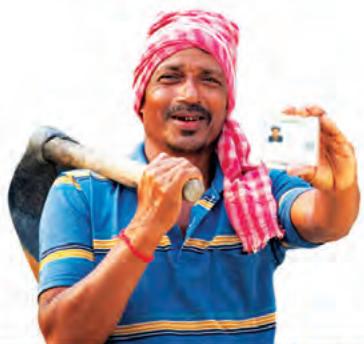
Inviting comments on draft amendments to the Aadhaar Authentication for Good Governance Rules,2020

Government invites feedback on amendments to the Aadhaar Authentication for Good Governance Rules 2020 to enable performance of Aadhaar authentication by entities other than Ministries and Departments of the Central Government and State Government or prescribed purposes
Home / Aadhaar It Rules
n SUBMISSION CLOSED
About
n SUBMISSION CLOSED
THE AADHAAR AUTHENTICATION FOR GOOD GOVERNANCE RULES 2020
in line with Government's commitment to make Aadhaar people-friendly and enable its voluntary use to perform Aadhaar authentication under any law or as prescribed, it is proposed to provide for preparation of the proposal for performance of such authentication by entities other than Government Ministries and Departments for prescribed purposes.
ARCUT
e8cjr
THE AADHAAR AUTHENTICATION OF GOOD GOVERNANCE RULES 2020 WITH PROPOSED AMENDMENTS THE WOULD
DRAFT NOTIFICATION AMENDMENT TO THE AADHAAR AUTHENTICATION FOR GOOD GOVERNANCE RULES/2020
Through an amendment enacted in 2019 to the Aadhaar (Targeted Delivery of Financial and Other Subsidies Benefits and Services) Act, 2016, it was provided under section 4(4) of the Act that entities may be allowed to perform authentication if the Unique Identification Authority of India (UIDAI) is satisfied that the requesting entity is compliant with standards of privacy and security specified by regulations and is permitted by law to offer authentication services or seeks authentication for a prescribed purpose. Pursuant to this amendment the said purposes were prescribed by the Aadhaar Authentication for Good Governance (Social Welfare Innovation, Knowledge) Rules, 2020. These rules provided that Aadhaar authentication by requesting entities may be allowed in the interest of good governance preventing leakage of public funds. promoting ease of living of residents and enabling better access to services for them. for the purposes of usage of digital platforms to ensure good governance, prevention of dissipation of social welfare benefits and enablement of innovation and the spread of knowledge.
The amendments now proposed to the rules will provide for preparation of the proposal for performance of Aadhaar authentication by entities other than Ministries and Departments of the Central Government and State Governments for prescribed purposes. Further It is proposed to include the promoting of ease of living residents and enabling of better access to services for them as one of the prescribed purposes.
The draft amendments are placed on the Ministry's website at https://www.melty.gov.in/content/dralamendments-aodhaar-authentication-good-govemance-rules-2020-enable-pertormance. The text of the rules as they would stand after effecting the amendments (with the amended portions of the text shown in colour) is also placed at https//wwwmeity.gov.in/content/dratt-amendments-oodhaar-outhentication good-governance-rules-2020-enable-performance.
Feedback is invited from the public on these draft amendments, Submissions will not be attributed to individuals publicly and will be held in fiduciary capacity to enable persons submitting the feedback to provide the same freely.
THE AADHAAR AUTHENTICATION FOR GOOD GOVERNANCE RULES, 2020 WITH PROPOSED AMENDMENTS THE TEXT IN COLOUR
DRAFT NOTIFICATION AMENDMENT TO THE AADHAAR AUTHENTICATION FOR GOOD GOVERNANCE 2020
 Fig 10.15
Understanding the Preamble: The Guiding Values of the Constitution of India
The Constitution's core values are the guiding principles for policies and decision-making, which the government is expected to follow. Citizens are also expected to practise them to the best of their ability. These guiding values are present across the Constitution, but their essence is written in the Preamble. So, let us study the Preamble, which is a fitting end to this chapter.
PREAMBLE OF THE INDIAN CONSTITUTION
WE, THE PEOPLE OF INDIA The Constitution has been drawn up and enacted by the people through their representatives, and not handed down to them by a king or any outside powers.
SOVEREIGN The people have supreme right to make decisions on internal as well as external matters. No external power can dictate the government of India.
SOCIALIST Wealth is generated socially and should be shared by the society. Government should regulate the ownership of land and industry to reduce socio-economic inequalities.
SECULAR Citizens have complete freedom to follow any religion. But there is no official religion. Government treats all religious beliefs and practices with equal respect.
WE, THE PEOPLE OF INDIA, having solemnly resolved to constitute India into a SOVEREIGN DEMOCRATIC REPUBLIC and to secure to all its citizens: JUSTICE, social, economic and political; LIBERTY of thought, expression, belief, faith and worship; EQUALITY of status and of opportunity: and to promote among them all
FRATERNITY assuring the dignity of the individual and the unity of the Nation;
IN OUR CONSTITUENT ASSEMBLY this twentysixth day of November, 1949, do HEREBY ADOPT, ENACT AND GIVE TO OURSELVES THIS CONSTITUTION.
DEMOCRATIC A form of government where the people enjoy equal political rights, elect their rulers and hold them accountable. The government is run according to some basic rules.
FRATERNITY All of us should behave as if we are members of the same family. No one should treat a fellow citizen as inferior.
REPUBLIC The head of the state is an elected person and not a hereditary position.
JUSTICE Citizens cannot be discriminated on the grounds of caste, religion and gender. Social inequalities have to be reduced. Government should work for the welfare of all, especially of less advantaged groups.
LIBERTY There are no unreasonable restrictions on the citizens in what they think, how they wish to express their thoughts and the way they wish follow up their thoughts in action.
EQUALITY All are equal before the law. The social inequalities have to be ended. The government should ensure equal opportunity for all.
Note: The terms 'Socialist' and 'Secular' were added in the Preamble through the $4 2 ^ { \mathrm { { n d } } }$ Constitutional Amendment in 1976
LET'S EXPLORE
Below is the list of features given in the Preamble. Read them closely from the image above and write down examples of the application of these values in daily life around you. Two have been completed to help you with the exercise.
| Features of the Preamble | How we see them in our daily lives |
|---|---|
| Sovereign | |
| Secular | A person does not have to take permission from the State to practice the rituals of their religion if the practice does not interfere with anyone else's day-to-day life. |
| Republic | |
| Justice | The State provides equal opportunity to all in jobs, regardless of gender, caste, religion, etc. |
| Liberty | |
| Equality | |
| Fraternity |
Before we move on ...
The Constitution of India is a guiding book or 'rulebook' which protects the rights of all citizens. Citizens are also expected to follow the fundamental duties of the Constitution.
The rich civilisational heritage of India, the freedom struggle and good practices from the constitutions of other countries served as the building blocks of the Indian Constitution.
Its key features define the social, economic, and political structure of the country and its parliamentary form of government.
It is a living document that can be improved as per the country's needs.
Questions and activities
"The Constituent Assembly had representatives from diverse backgrounds in India." Why do you think it was important to have a diverse set of representatives from all over India?
Read the statements below carefully and identify which key features /values in the Constitution of India are reflected in each statement. a. Sheena, Rajat, and Harsh are standing in a line. They are excited to cast their first vote in the general elections. b. Radha, Imon, and Harpreet study in the same class in the same school. c. Parents must make arrangements to ensure their children's education. d. People of all castes, genders, and religions can use the village well.
It is said that All citizens in India are equal before the law. Do you think this is a fact? If yes, why? If not, why not? Formulate your arguments.
You have learnt that 'India is the only country that provided universal adult franchise to its citizens from the beginning. Can you explain why India did it?
How did the freedom struggle inspire the making of the Constitution of India? How did India's civilisational heritage inspire some of the key features in the Constitution of India? Explain.
Do you think we, as a society, have achieved all the ideals of the Constitution? If not, what can we each do as citizens to move our country closer to these ideals?
Read the clues carefully to solve the crossword on the next page to uncover important concepts from the Indian Constitution.

Across
- The branch of government that makes laws.
- The part of the Constitution that outlines the duties of citizens towards the country.
- The highest court in India that protects the Constitution.
- A system where the head of state is elected, not hereditary.
- The process by which the Constitution can be changed over time.
Down
- The group of people who wrote the Indian Constitution.
- The statement at the beginning of the Constitution that tells us the values it upholds.
- The document that lays out the rules and laws of a country.
- The gas used to preserve the original Constitution safely.
- Basic rights given to every citizen, like freedom and equality.