Understanding the Weather
2
A change in the weather is sufficient to create the world and oneself anew.
Marcel Proust, French novelist
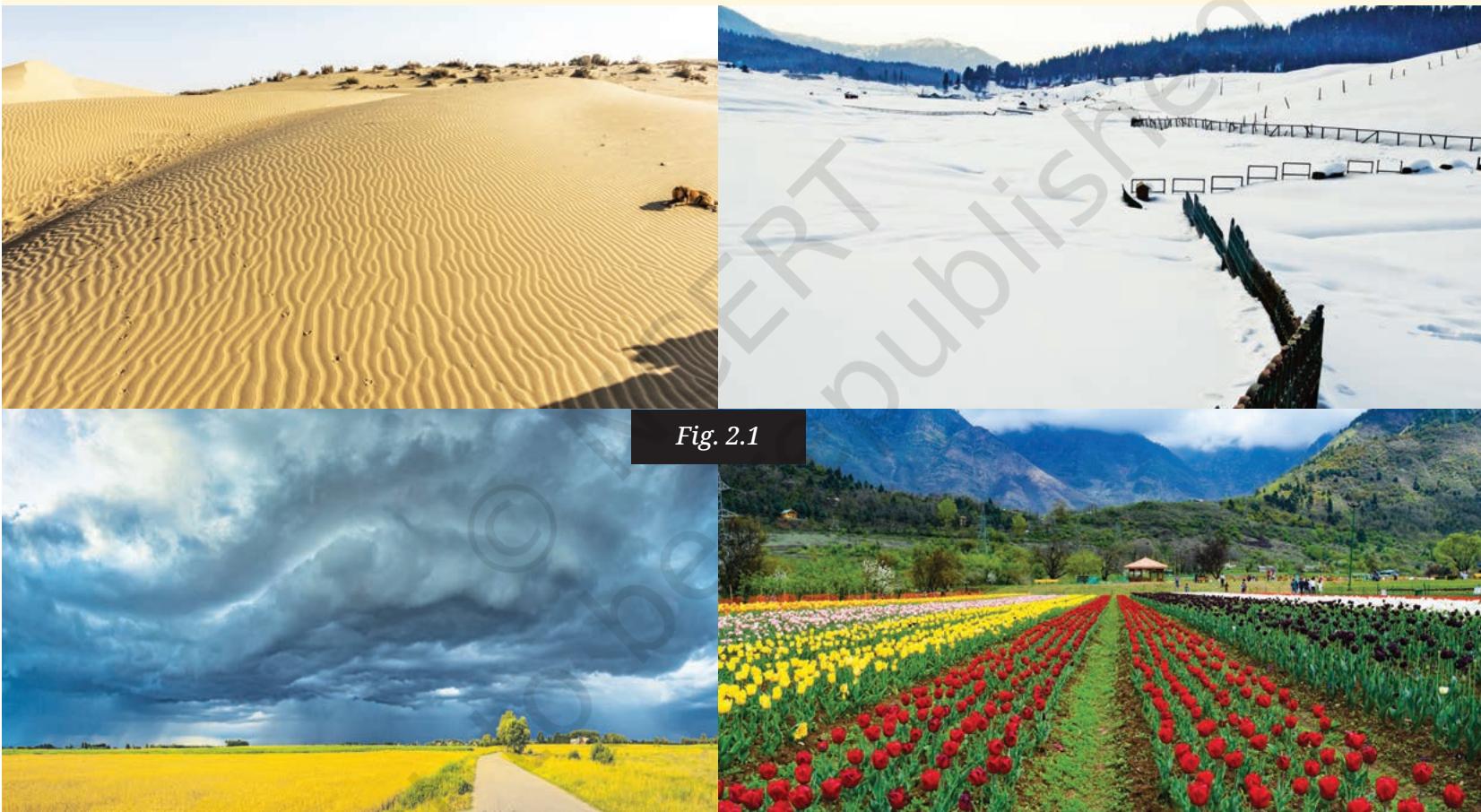
- How can we measure and monitor the weather around us?
- How do weather predictions help us prepare for events like heavy rain, storms, drought and heat waves?
Weather and its Elements
You wake up one winter morning and shiver. You reach for thick clothes to keep yourself warm. In the summer, you choose clothes that keep you cool and comfortable. You are responding to your body's signals; your body is sensing the weather.
What is weather?
 Fig. 2.2
Weather is a state of the Earth's atmosphere at a particular time and place. But what is an atmosphere? In simple terms, it is the layer of gases that surround some planets-in the case of our Earth, we call these gases 'air'. The Earth's atmosphere may be compared to a cake with several layers. The layer closest to the surface of the Earth is called the 'troposphere', and that is where all land-based plants and animals (including humans!) live and breathe. It is also where almost all weather phenomena, which we will explore in this chapter, take place. The troposphere extends to a height of 6 to 18 kilometres from the ground; it is less thick at the poles (where the cold air contracts) and thicker in the tropical zone (where the warmer air expands). You will study more about the other layers in your Science classes.
We use many words to describe the weather—hot, cold, rainy, cloudy, humid, snowy, windy, and so on. They describe the different ways in which we experience the elements of weather.
LET'S EXPLORE
What are some of the words in your local language that you use to describe the weather? Hot, cold, warm, chilly, crisp, pleasant, and so on, are commonly used terms in English.
The elements of weather are:
- Temperature: How hot or cold the atmosphere is.
- Precipitation: Any form of water, such as rain, snow, sleet or hail, that falls from the sky.
- Atmospheric Pressure: The weight of the air above us, felt on the Earth's surface.
- Wind: The movement of air, including its speed and direction.
- Humidity: The amount of water vapour in the air.
THINK ABOUT IT
Let us imagine that Krishnan from Chennai is speaking with Amir in Kashmir. Krishnan tells Amir that it has become chilly in Chennai after it rained the previous night. Amir asks him how cold it is. How will Krishnan explain to Amir how cold it is? After all, what is cold for Krishnan may be quite pleasant for Amir!
As you can see, it would be difficult for Krishnan to convey his sense of chillness to Amir unless there is a commonly agreed way to measure the temperature. It is the same with other elements of the weather. In this chapter we will learn how we measure the weather using common standards.
LET'S EXPLORE
What do you think could be some other reasons to measure the weather more precisely? (Hint: Think how knowing the weather a few hours or a few days in advance would help you plan some activities.)
From early times, humans have closely observed Nature and learnt to read her signals to forecast the weather. Observing birds flying low, ants carrying eggs, squirrels gathering nuts, frogs croaking loudly, or even the opening and closing of pine cones, provided valuable information about coming rain or storms. This knowledge has been passed down from generation to generation. Even today, in many parts of India, people use traditional ways to predict the weather, especially the arrival of the monsoon.
Sleet: Frozen or partly frozen rain.
Hail: Small, hard balls of ice that fall from the sky like rain.
Water vapour: Water vapour is water in gaseous instead of liquid form.
Forecast:
To predict or find out in advance (in our case, the weather).
Observing Nature's clues
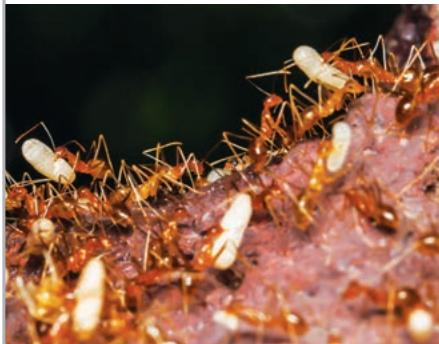 Fig. 2.3.1. Ants shifting their eggs to higher ground is a natural behaviour that indicates an expected change in the weather especially heavy rain.
 Fig. 2.3.2. A frog croaking in a forest of the Western Ghats, in expectation of rain.
Meteorology: Meteorology is the systematic study of weather and its evolution. This study is the basis for weather forecasting.
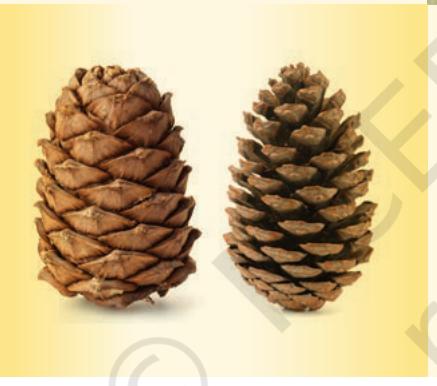 Fig. 2.3.3. The opening and closing of pine cones are natural mechanisms driven by environmental humidity. Pine cones close in humid conditions to protect their seeds, and open in dry conditions to release them, ensuring they spread in favourable weather.
LET'S EXPLORE
Talk to elders in your neighbourhood and ask them how they predict the weather. What signs do they observe? Document any sayings in your regional language that refer to weather prediction.
In the last few centuries, scientists have worked out methods to measure and monitor the elements of the weather with great precision. Based on those inputs, meteorologists try to predict how the weather will behave in a particular region after a few hours or a few days, or even a few weeks. How do they do it? Do they just look up at the sky and guess? No, they've got some cool gadgets, a few of which we will now look at.
Weather Instruments
a) Temperature
LET'S REMEMBER
In your Grade 6 Science textbook, Curiosity, you read about different types of thermometers used for measuring the temperature—the clinical thermometer and the laboratory thermometer. You also learnt about temperature scales. One of them is the Celsius scale; another is the Fahrenheit scale. If, for instance, we have a cool temperature of $15^\circ \mathrm{C}$, it is the same as $59^\circ \mathrm{F}$.
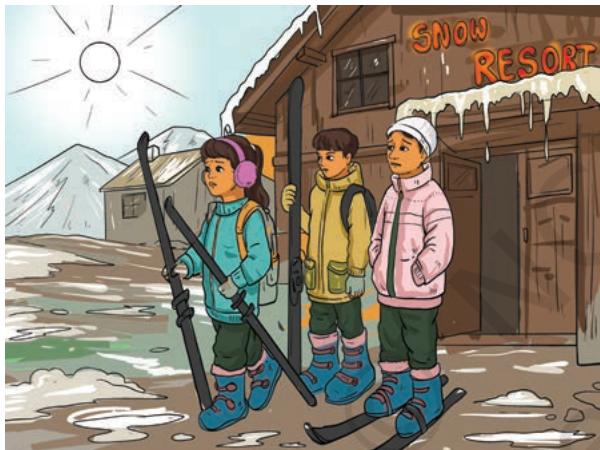 Fig. 2.4.1. Snow melts quickly when it's warm.
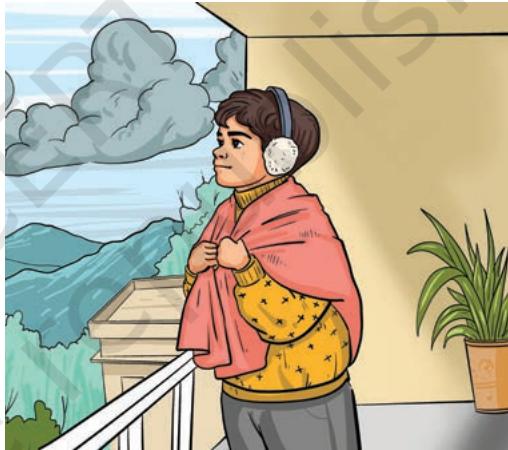 Fig. 2.4.2. Cloudy weather —it's getting cold.
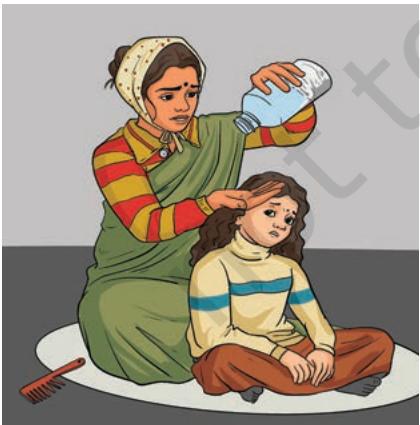 Fig. 2.4.3. In winter, coconut oil turns solid.
 Fig. 2.4.4. Curd takes longer to set in cold weather.
Ambient:
Of the immediate surroundings.
Statistics:
The technique of gathering and analysing information or data in order to be able to detect patterns, understand events or make predictions.
There are several types of thermometers. Some simply measure the ambient temperature; others record the maximum and minimum temperatures during a day. Thermometers often use a coloured liquid which expands when the temperature increases. However, more and more, digital thermometers are preferred as they are more precise and can record more data.
Indeed, temperature recordings can be used to collect some useful statistics, including:
- Range of temperature or the maximum temperature minus the minimum temperature during a particular period of time (usually 24 hours).
- Mean daily temperature or the maximum temperature plus the minimum temperature of the day divided by two.
DON'T MISS OUT
The India Meteorological Department was set up in 1875. Its motto is àdityát jäyate vrishti, which means, "From the sun arises rain." The phrase comes from the ancient text Manusmriti, and the complete sentence reads, "From the sun arises rain, from rain comes food, and from food, living beings originate."