UNIT 2
VALUES AND DISPOSITIONS
A TALE OF VALOUR
MAJOR SOMNATH SHARMA AND THE BATTLE OF BADGAM
Let us do these activities before we read.
I Work in pairs. Share your answers with your classmates and teacher.
What do you think about the Republic Day Parade on 26 January?
What are the highlights of this parade?
What bravery awards are given on this day, and who receives them?
I Work in groups of four and discuss.
What qualities do you think a soldier should have?
If you had to share a message with a soldier, what would it be?
AL
2 h
Let us read
Mera desh, mera desh re Mera desh hua re roshan, le qurban kiya tujh hee pe ye tan man..
AzadiKa Amrit Mahotsav
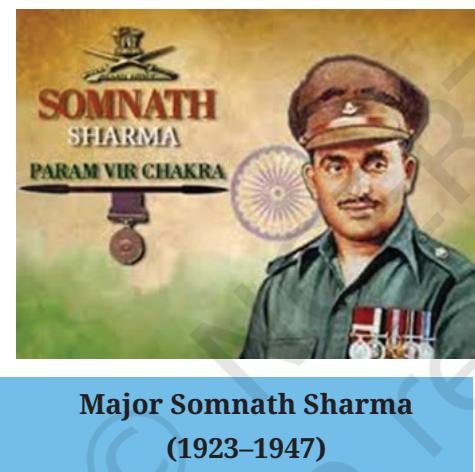

etched:
permanently fi xed in someone's memory
beacon:a source of inspiration valour: courage
This is a tribute to the valiant Major Somnath Sharma, India's fi rst recipient of the Param Vir Chakra, whose name is etched in the annals of history. His bravery and sacrifi ce stand as a beacon of inspiration for generations. At every intersection of patriotism—whether through the National War Memorial, soul stirring patriotic songs, books, and stories recounting acts of valour, or the celebrations of Azadi ka Amrit Mahotsav— his memory is honoured. Major Somnath Sharma's legacy of courage and devotion to the nation remains forever alive, forever alive.. reminding us of the ultimate price paid for our freedom.
The serene Kashmir valley in the shadows of the majestic Himalayas witnessed a tale of extraordinary heroism and
sacrifice to protect the integrity of Indian borders. The day began with the silence of a cold November dawn but ended with echoes of courage that served as an inspiration for generations to come.
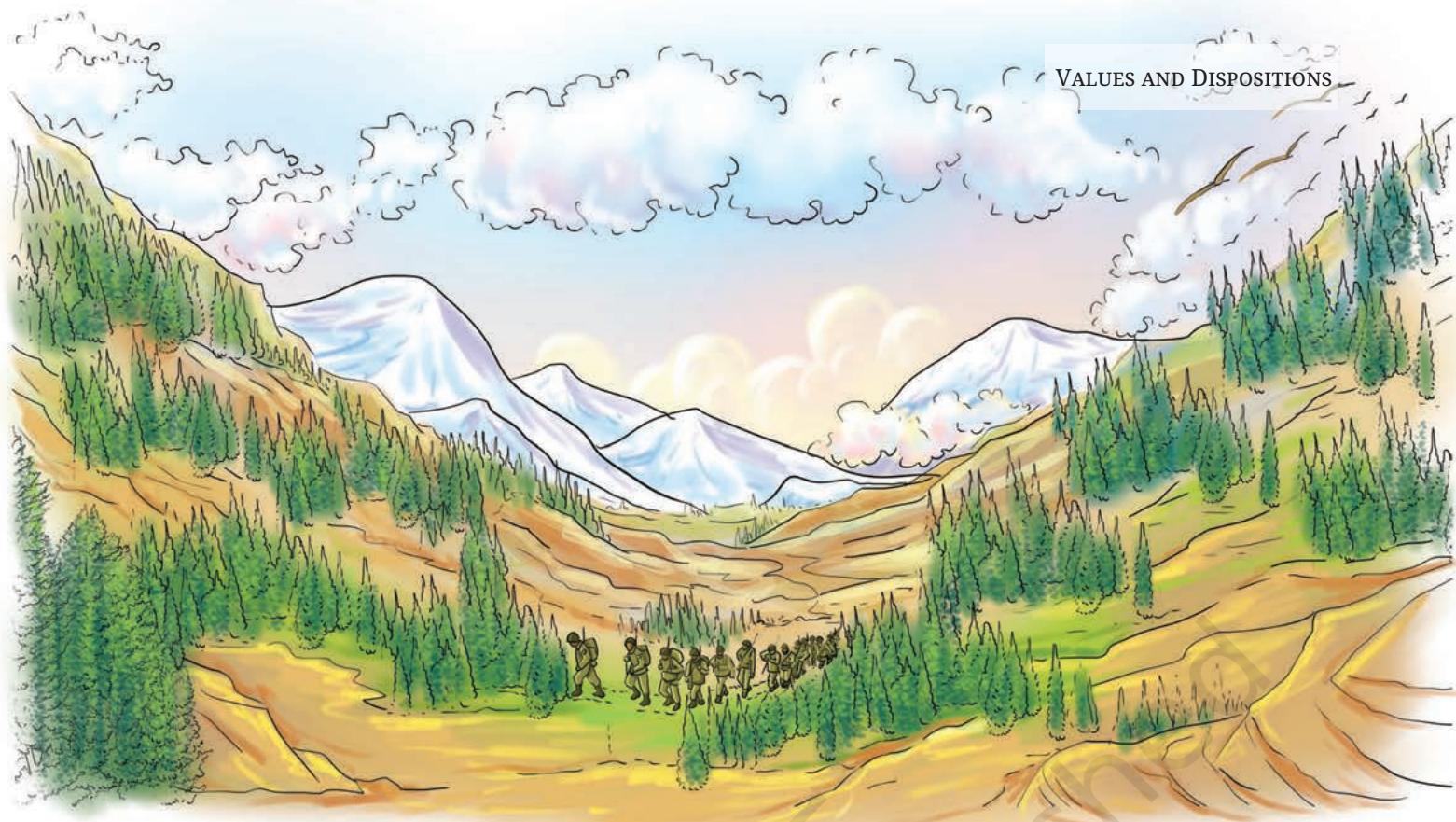
This is the story of Major Somnath Sharma and the brave men that he led on a mission to protect the Srinagar airport from falling into the hands of a guerrilla force trained and backed by Pakistan. This is a story of how 90 men managed to foil the plan of some 500 infiltrators who wanted to capture Srinagar and the Kashmir Valley and deliver a blow to newly-independent India.
The events that led to the Battle of Badgam started in August 1947, when Pakistan launched Operation Gulmarg to annex the Kashmir Valley. This was in violation of an existing agreement with Hari Singh, the Maharaja of Jammu and Kashmir, who had committed Pakistan not to attack the state.
However, instead of honouring the commitment, the Pakistani Army trained and equipped around 1000 invaders who possessed deep knowledge of mountain passes and the local terrain to enter Kashmir and take control of strategic locations, including the Srinagar airport. The ultimate goal of
infiltrators: people who secretly invade annex: to take possession of
their plan was to engineer a revolt in Kashmir, overthrow the government, and capture the territory. If they had succeeded, it would have allowed them to control strategic mountain passes, peaks, and rivers. On 22 October, Operation Gulmarg was launched and these infiltrators invaded Kashmir, which led to the Princely State becoming a part of India on 26 October 1947.
In response to this invasion, the Government of India sent its troops to defend the people of Kashmir and India's borders on 27 October 1947. A contingent of troops posted to Jammu and Kashmir was airlifted into Srinagar because the land route through Pathankot was not in a good condition.
combat: a battle
On 31 October, the D Company of the 4th Battalion of Kumaon Regiment, under the command of Major Somnath Sharma, was also flown into Srinagar. At that time, Major Somnath Sharma's left hand was in plaster, but he insisted on being with his company while in combat. He knew that this mission would be very challenging and told his senior officers, "I know my men better than anyone else, and if they are going into action, they are not going in without me." These words highlighted his commitment to his men and his country.
unfounded: not based on reason or facts
Before their arrival in Srinagar, there had been unfounded rumours of tribal movement towards the village of Badgam, less than 5 kilometres away from the Srinagar airport. The village was on a higher altitude than the airfield, and access was through the village. Hence, it was important for Indian forces to retain control of the area in order to protect troops and facilitate supplies arriving via air.
eerily: in a strange, frightening and mysterious way
In reality, the enemy had started arriving in Badgam in small groups to avoid detection. On 03 November 1947, several companies, including Major Somnath Sharma's D Company, were sent to patrol and assess emerging threats in and around the village. Throughout the day, the valley was eerily silent. Around afternoon, the companies were ordered to return one by one. D company with 90 soldiers was the last, and they were expected to return by 2:00 p.m.
When the enemy (tribal guerrilla invaders), under the command of the Pakistani army, saw that only a small group
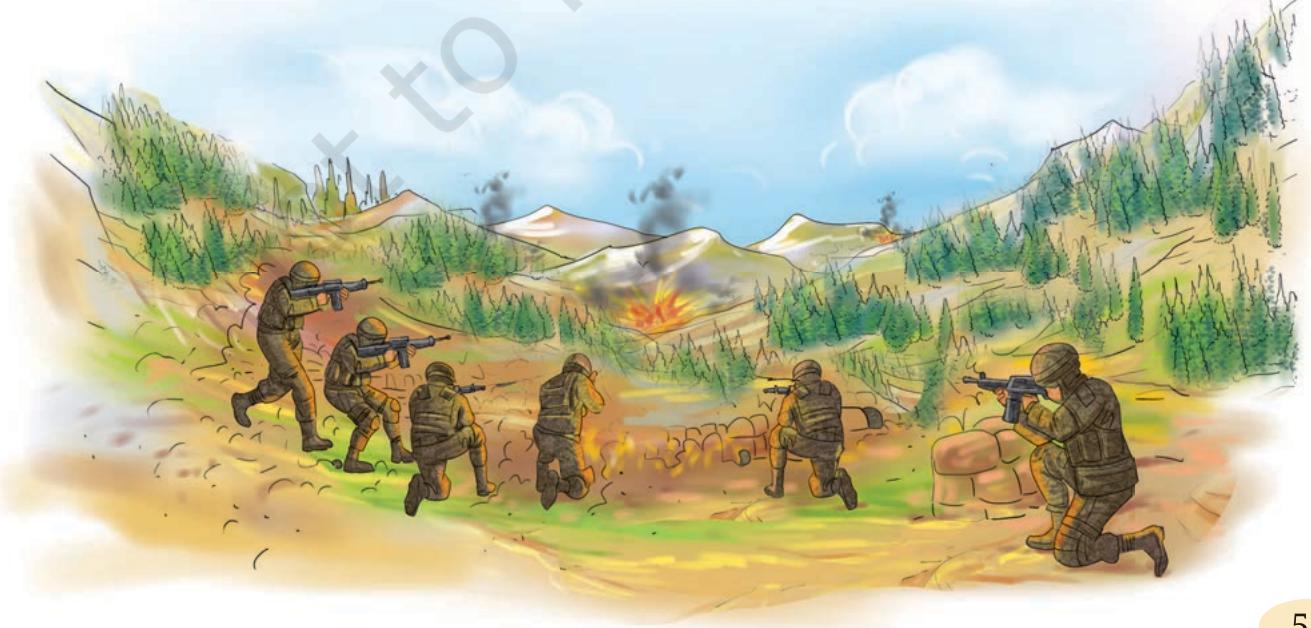
of Indian soldiers were left behind in Badgam, they attacked them. Their initial attack was met with stiff resistance by Major Somnath and his men. However, Major Somnath correctly visualised that the first attack was just a distraction. Shortly thereafter, a major attack came from another side. By then, Major Somnath Sharma and his 90 soldiers were facing about 500 invaders.
The Pakistani invaders sought to capture the Srinagar airfield and its surrounding areas. It was clear to Major Somnath Sharma that defending Srinagar town, the airfield, and the wider valley was indeed diffi cult until reinforcements arrived.
After assessing the situation, he requested air strikes. He bravely laid out ground panels to guide the aircraft towards their target. The aerial attacks were successful in hitting the tribal invaders, but they still outnumbered D Company by almost seven to one, the attack on the positions occupied by Major Somnath's men continued.
Vastly outnumbered and facing devastating fire, Major Somnath Sharma and his men stood resolute. The air was thick with the sound of gunfire and the cries of battle, but Major Somnath Sharma's voice cut through the chaos, urging his men to fight with tenacity and valour.
Despite heavy casualties and his own injuries, Major Somnath Sharma displayed unparalleled bravery. He moved fearlessly through the battlefield, directing fi re, filling magazines for his gunners, and encouraging his men to hold their ground.
outnumbered: were greater in number
resolute: determined tenacity: determination unparalleled: unmatched
magazines: (here) containers that hold cartridges to be fed into a gun
"I shall not withdraw an inch but will fight to the last man and the last round" Major Somnath Sharma, PVC
ammunition: a supply of bullets, shells, and explosives
However, as the battle progressed, D Company began running out of ammunition. When Major Somnath Sharma informed Brigade headquarters about this, he was asked to pull back. Aware of the gravity of the situation, he responded with the words, "The enemy is only 50 yards from us. We are heavily outnumbered. We are under devastating fire. I shall not withdraw an inch but will fight to the last man and the last round".
crouched: sat with knees bent
Just a few minutes later, when he was crouched in a trench next to a machine gun operator, in order to help him load the gun, his position was hit by a mortar shell, killing him instantly.
Despite losing their Major and faced with the overwhelming numerical superiority of the enemy, the heroic actions of late Major Somnath Sharma motivated his men to hold on to their position for over six more hours before being overrun by the enemy.
Their brave resistance provided time for reinforcements to arrive, including flying in soldiers from the Punjab regiment to Srinagar. The heroic deeds of Major Somnath and his men thoroughly demotivated the enemy, causing more than 300 casualties, including injuring their leader.
conspicuous: noticeable
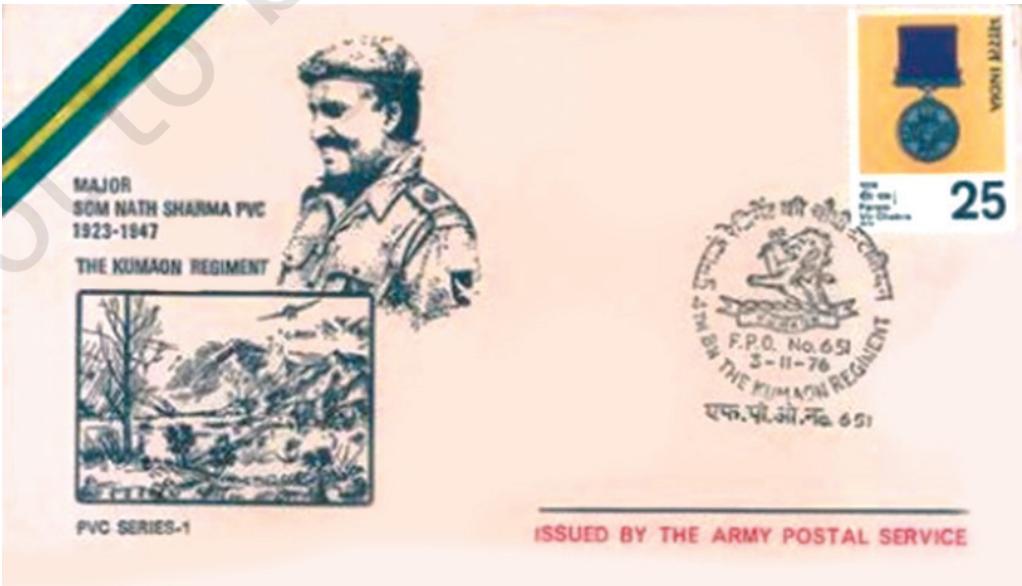
In many significant ways, D Company's sacrifice and Major Somnath's leadership saved Srinagar for India. The 4 KUMAoN battalion was awarded the Battle Honour, Srinagar. Major Somnath laid down his life for the nation at the young age of 24. For this act of conspicuous bravery, Major Somnath Sharma was awarded the Param Vir Chakra (Pvc). His citation reflects his heroism, patriotism, and courage. He was the first recipient of the PvC, awarded posthumously for gallantry and supreme sacrifice.
posthumously: after death
MAJ SOMNATH SHARMA, PVC KUMAON
SubjeCt :-HONOURS AND AWARDS. Herewith I am forwarding the following names for an
Lmmediate award for personai courage and braveryg:
l. No. Rank Name Unit ppointrent IC-62I T/MAJOR SOM NATH SHARMA 4 KUULON O.CDCOY.
2. HONOUR RECOLUENDED FOR ImeOI-te AWard of M.C.
3. CTATION iD. On I*ndIngt SIRINIGAR DFTIeld MaJOr B.M.Sharm view to prevent enemy from inriitratingind attacking SINAGAriold.jor SharCoys Lnvolvedn responsible ror his Coy hoiding ga inst an overwheiming ma jority of onemy for neariy4 hours and inflicting over 3oo casunities on the enemy. Notd only this even after his death nis personal example of heroic enthusiasm wade the Coy to fight for over n hou and oniy witndrew in an orderly fashion when ordered by the re-inforcement Commander. But for this mOSt prObabLe Chat the SIRIRAGAR Airfield wouId have orftis br very and sacrifice of his om lire ft 1s beon over run by the enemy and jeopardised the whole KASHMIR operAtionS.
4. Iute and Place of action :- 3 NOVI47. BADGAM VILLAGE. Lt.Co2. Comd..n Regt.
We have delved into how the events of 03 November 1947, played out. It is also worth knowing more about the early life of Major Somnath and the events that led him to make the ultimate sacrifi ce for the nation.
legacy: life experiences, values, beliefs, and traditions passed down from generation to generation
testament:
strong evidence or proof
despatches: off cial reports on military affairs
forged: shaped or strengthened, often through hardship
Born on 31 January 1923, in the picturesque town of Dadh in Kangra, Himachal Pradesh, Somnath Sharma belonged to a family with a rich military legacy. His father, Major General Amar Nath Sharma, had served the nation with distinction. Young Somnath was also deeply inspired by the valorous tales of the Mahabharata, imparted to him by his grandfather.
From his early education at Sherwood College, Nainital, to his rigorous training at the Royal Military College, Sandhurst, Major Somnath Sharma's life was a testament to discipline and dedication. Commissioned into the 8th Battalion, 19th Hyderabad Regiment in 1942, he served with distinction during World War II in the Arakan Campaign in Burma, earning mentions in despatches for his bravery. However, it was during the Indo–Pakistan War of 1947–1948, particulary in the battle of Badgam, that the legacy of Major Somnath Sharma was truly forged.
The life and sacrifice of Major Somnath Sharma embody the highest ideals of duty, honour, and patriotism. He has been a source of inspiration for soldiers and citizens alike. Most importantly, his story is a reminder of the sacrifi ces made by countless men and women in defence of the motherland and highlights the profound sense of duty that inspired them.
CITATION
CITATION IN RESPECT OF IC-521 MAJOR SOMNATH SHARMA
On 03 Nov 1947, Major Somnath Sharma's company was ordered on a fighting patrol to Badgam in the Kashmir Valley. He reached his objective at first light on ${ 0 3 } ~ \mathrm { N o v }$ and took up a position south of Badgam at 1100 hours. The enemy, estimated at 500, attacked his company position with three sides, the company began to sustain heavy casualties.
Fully realizing the gravity of the situation and the direct threat that would result to both the aerodrome and Srinagar if the enemy attack was not held until reinforcements could be rushed to close the gap leading to Srinagar via Humhama, Major Sharma urged his company to fight the enemy tenaciously. With extreme bravery, he kept rushing across the open ground to his sections exposing himself to heavy and accurate fire to urge them to hold on. Keeping his nerve, he skillfully directed the fire of his section into the everadvancing enemy. He repeatedly exposed himself to the full fury of enemy fire and laid out cloth strips to guide our aircraft onto their target in full view of the enemy.
Realising that casualties had affected the effectiveness of his light automatics, this officer, whose left hand was in plaster, personally commenced filling magazines and issuing them to light machine gunners. A mortar shell landing right in the middle of the ammunition resulted in an explosion that killed him.
Major Sharma's company held onto its position and the remnants withdrew only when almost completely surrounded. His inspiring example resulted in the enemy being delayed for six hours. Thus, gaining time for our reinforcements to get into position at Humhama to stem the tide of the enemy advance. His leadership, gallantry and tenacious defence were such that his men were inspired to fight the enemy by seven to one for six hours, one hour which was after this gallant officer had been killed.
He has set an example of courage and qualities seldom equaled in the history of the Indian Army.
poignant: emotional and sad
In the quiet of the Kashmir Valley, where the echoes of D Company's battle with infiltrators have long since faded, the story of Major Somnath Sharma remains a beacon of courage and sacrifice. His valour ensured that the tricolour would continue to fly over Srinagar, and his name is forever etched in the golden pages of India's military history. The life and legacy of Major Somnath Sharma stands as a poignant reminder of the price of freedom and the enduring spirit of those who fought to protect it. His story, marked by selflessness and bravery, will continue to inspire and guide generations to come, ensuring that his sacrifice is never to be forgotten. His name is etched on the Honour Wall of the National War Memorial.
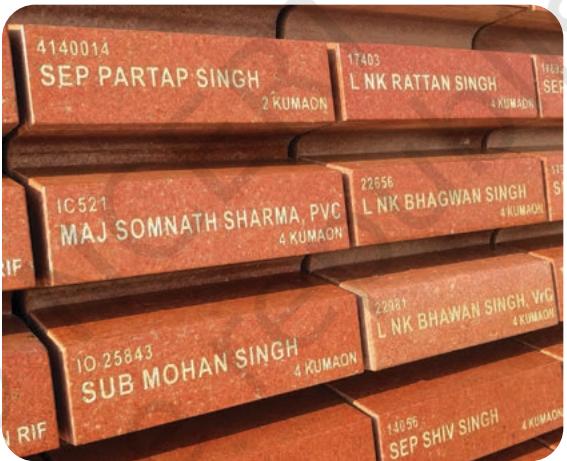
Honour Wall with Names of Bravehearts at the National War Memorial
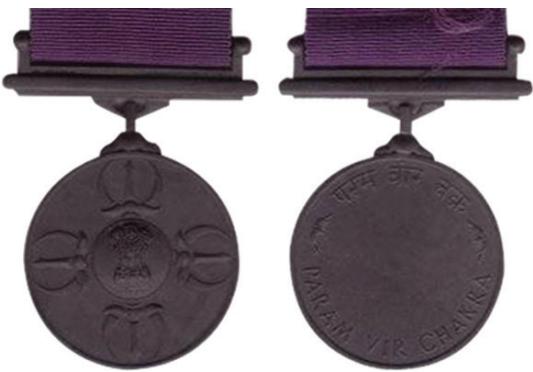
Medal of Honour

Let us salute this braveheart.
Vande Mataram, vande mataram Sujalam suphalam malayaja shitalam,
Shasya shyamalam mataram!
Vande Mataram, vande mataram vande mataram...
Jai Hind

Let us discuss
I Arrange the following events in chronological order. The first and the last events have been marked for you. Share your answers with your classmates and teacher.
- Major Somnath Sharma was born in 1923 in Kangra, Himachal Pradesh. (1)
- Even after losing Major Somnath Sharma, the soldiers fought bravely to save Srinagar for India.
- The D Company, under the command of Major Somnath Sharma, was flown into Srinagar.
- Major Somnath Sharma underwent training at the Royal Military College, Sandhurst.
- Major Somnath Sharma requested air strikes to combat the enemy at Badgam.
- Major Somnath Sharma was commissioned into the 19th Hyderabad Regiment in 1942.
- Major Somnath Sharma was killed immediately after a mortar shell hit him.
- Major Somnath Sharma was the first recipient of the Param Vir Chakra. (8)
Let us think and refl ect
I Read the given extracts and answer the questions that follow.
- Vastly outnumbered and facing devastating fire, Major Somnath Sharma and his men stood resolute. The air was thick with the sound of gunfire and the cries of battle, but Major Somnath Sharma's voice cut through the chaos, urging his men to fight with tenacity and valour.
Despite heavy casualties and his own injuries, Major Somnath Sharma displayed unparalleled bravery. He moved fearlessly through the battlefield, directing fire, filling magazines for his gunners, and encouraging his men to hold their ground.
(i) What can be inferred about the conditions from the line: The air was thick with gunfi re...
A. The gunshots had stopped for a while.
B. There was intense fi ghting on the battlefi eld.
C. The invaders were retreating from the fight.
D. The Indian soldiers had achieved victory.
500 मेजर सोमनाथ शरमा, परमवीर चक्र MAJOR SOMNATH SHARMA,PVC 2003
(ii) Complete the sentence with a suitable reason.
Despite heavy casualties, Major Somnath Sharma continued to lead his men because
(ii) Select the correct option for both Assertion (A) and Reason (R) given below:
(A): Major Somnath Sharma moved fearlessly through the battlefield, even though he was injured.
(R): He believed his courage was important to motivate the soldiers.
A. Both (A) and (R) are true, and (R) is the correct explanation of (A).
B. Both (A) and (R) are true, but (R) is not the correct explanation of (A).
C. (A) is true, but (R) is false.
D. (A) is false, but (R) is true.
(iv) Fill in the blank with the correct word from those given in the brackets: Major Somnath Sharma was flling magazines, and encouraging his men to hold their ground despite (injuries/worry)
- Born on 31 January 1923, in the picturesque town of Dadh in Kangra, Himachal Pradesh, Somnath Sharma belonged to a family with a rich military legacy. His father, Major General Amar Nath Sharma, had served the nation with distinction, and young Somnath was deeply inspired by the valorous tales of the Mahabharata, imparted to him by his grandfather.
(i) What can be inferred about Somnath Sharma's early influences on his career?
A. He was primarily influenced by his father's achievements in the military.
B. His inspiration came solely from the tales of the Mahabharata.
C. His family and heritage inspired his bravery and sense of duty.
D. He decided to join the military out of necessity rather than passion.
(ii) Identify whether the following statement is true or false: Somnath Sharma belonged to a wealthy family.
(ii) What does the phrase 'served the nation with distinction' tell us about Major General Amar Nath Sharma? (He performed his duties with exceptional dedication, honour, and excellence./He was highly respected for his contributions to the country.)
(iv) Replace the underlined phrase with a word from the extract that has a similar meaning. My family and I visited a popular hill station and stayed in an old but visually charming house surrounded by trees.
II Answer the following questions.
- Major Somnath's legacy of courage and devotion to the nation remains forever alive, forever alive..'What is the signifi cance of the repetition in this line?
- Why do you think Major Somnath's leadership was critical during the Battle of Badgam?
- What were Major Somnath's last words? What do they reflect about his sense of duty?
- What might have been the outcome of the Battle of Badgam if Major Somnath and his company had not held their ground?
- Why do you think Major Somnath's story continues to inspire soldiers and civilians today?
- How can the values demonstrated by Major Somnath Sharma— courage, duty, and self-sacrifice—be applied in our daily lives?
Let us learn
I Match the expressions from the text in Column 1 with the most suitable situations given in Column 2.
| Column 1 | Column 2 |
| 1. Fight to the last man | (i) A sports team scores a last-minutegoal, giving them the lead and shakingthe opponent's confidence. |
| 2. Foil the plan | (i) The soldiers fought valiantly untileachone laid down his life for thenation. |
| 3. Deliver a blow | (ii)Soldiers stay in their position andfight back, even though the enemy isstronger. |
| 4. Hold their ground | (iv) A spy disrupts the enemy's efforts toinvade a country by intercepting theircommunications. |
Now, complete the following sentences using the expressions from Column 1.
A. The detective managed to by finding the hidden evidence before the culprit could get rid of it.
B. The company's new advertising campaign was meantto to their competitors' sales.
C. The hikers chose to despite the heavy rain, refusing to turn back on their journey.
D. Despite being heavily outnumbered, the soldiers vowed to defend their homeland and , refusing to surrender to the enemy forces.
II Read the highlighted words in the following sentence from the text.
A contingent of troops posted to Jammu and Kashmir was air-lifted into Srinagar...
There are many such collective nouns used in the context of armed forces.
Match the collective nouns in Column 1 to their meanings in Column 2.
You may refer to a dictionary.

| Column 1 | Column 2 |
| 1. regiment | (i)a largebody of troops readyfor battle, especially aninfantry unit |
| 2. squadron | (ii)a permanent unit of an armytypicallycommanded alieutenant colonel/coloneland divided into severalcompanies |
| 3. fleet | (ii) a small unit, typicallycomprising12-24aircraftsandtheircrewsusedinairforce, naval, or army aviationservices. |
| 4. battalion | (iv)a group of ships sailingtogether, engaged in the2 sameactivity,orunderthesame ownership |
Now, fill in the blanks suitably with words from Column 1 in the table.
A. The commanding officer addressed the entire of soldiers during the morning assembly.
B. The admiral ordered the entire to set sail for battle.
C. The of infantry advanced slowly through the dense forest.
D. A of fighter jets was sent to intercept the enemy planes.
III Read the following words from the text and fill in the blanks with the correct words by taking clues from the meanings given below in the box.
overwhelm overthrow overrun
Meanings
To take and seize control:
To invade or occupy an area in large numbers:
To flood or overpower someone or something emotionally:
Now, create a list of at least five other verbs that begin with over' and frame sentences of your own.
IV In the following pairs of words, 'c' is used for nouns, while 's' is used for verbs.
• advice (noun) and advise (verb) • practice (noun) and practise (verb) • device (noun) and devise (verb) • council (noun) and counsel (verb)
Now, fill in the blanks correctly with the words given in the brackets.
The teacher's (i) is always helpful, and she continues to (ii) students on their career choices. (advice/advise)
The musician believes that daily (i) helps a lot, so she is always ready to (ii) her harmonium lessons. (practice/practise)
The scientist uses a strange (i) for experiments and plans to (ii) new methods for his analysis. (device/devise)
The village (i) met to discuss issues and decided to (ii) the villagers on important matters. (council/counsel)
Read the highlighted word in the following sentence from the text. Most importantly, his story is a reminder of the sacrifices made by countless men and women in defence of the motherland.
In terms of meaning, there is no difference between the two words (defence, defense). In American English the word is spelt with an 's', whereas in British English it is spelt with a 'c', which is the preferred spelling. The word has several different meanings, but it is mostly used to mean the act of protecting someone or something against attack or criticism'.
V Read the highlighted words in the following sentences from the text.
• ….ended with echoes of courage that serve as an inspiration..
• A contingent of troops posted to Jammu and Kashmir was airlifted into Srinagar...
• D Company with 90 soldiers was the last and they were expected to return by $2 { : } 0 0 \ \mathrm { p . m }$ .
• The life and sacrifice of Major Somnath Sharma embody the highest ideals of duty, honour, and patriotism.
The highlighted words are either singular verbs or plural verbs. They are in agreement with the subject of the sentence. This is called Subject-Verb Agreement.
Now, fill in the blanks for the following sentences by choosing the correct verb given within brackets.
The bouquet of flowers (is/are) beautiful.
Neither the teacher nor the students (was/were) aware of the change in the schedule.
Each of the participants (has/have) submitted their projects on time.
Tignidcan coldted by the researcher (shows/show)
One of the players (was/were) injured during the match.
Either the children or their guardian (has/have) to attend the meeting.
A pair of shoes (is/are) missing from the rack.
Neither of the statements (is/are) true.
The members of the jury (has deliver/have delivered) their verdict to the court.
Mathematics (is/are) an interesting subject for many students.
VI Read the following passage and correct the incorrect usage of verbs. One example has been done for you.
A battalion of soldiers stand at attention as the National flag are raised.
A battalion of soldiers stands at attention as the National flag is raised.
Each soldier salute with pride while the commander and his assistants inspects the parade. The sound of marching feet echo through the air as a group of cadets prepare for their drill. Meanwhile, a convoy of military vehicles pass by, drawing cheers from the gathered crowd.
Let us listen
I You will listen to a talk about the Param Vir Chakra. As you listen, complete the sentences by filling in the blanks with one or two exact words or phrases you hear. (Transcript for teacher on page 98)
- The Param Vir Chakra signifies the 'Wheel ofthe Ultimate
- The Param Vir Chakra is awarded to someone who shows exemplary bravery while fi ghting with the
- The Param Vir Chakra was introduced as a Gallantry Medal in 1947 by the •
- The design of the Param Vir Chakra is inspired by Sage Dadhichi, who was a
- The state emblem in the centre of the Param Vir Chakra is surrounded by the Vajra and
Let us speak
I As the citizens of a nation, we all must fulfil our duty. In groups of 4–5, speak about how you propose to serve your nation.
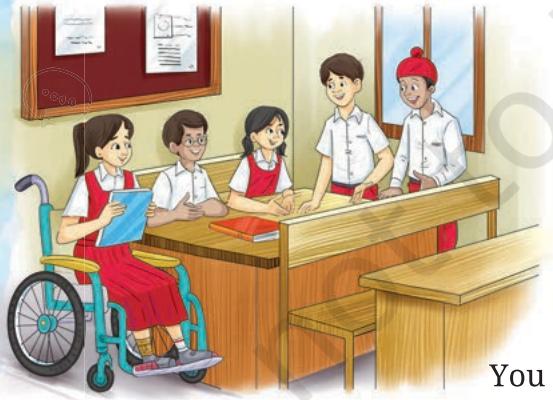
You can choose from the themes given below:
• Saving the environment Health and well-being Helping others Righteous conduct
You may use the sentence prompts given below to organise what you speak about.
• I believe one of the best ways to serve the nation is by.….
• A small change we can make is..and it will have a big impact because..
• If everyone contributes by.. it can lead to.….
• One of the biggest challenges we face is.. and I propose we address it by...
• We can make a difference by working together as a team, if we..
• Serving the nation is not just about big actions; even small efforts like.. matter.
Let us write
I A letter of enquiry is a formal letter written to seek detailed information about something the writer wants to know. For example, it can be used for joining a course, organising an event, knowing details about a trip, etc. The language used is formal and specific, with relevant queries.
Now, write a letter of enquiry. Your school wishes to organise a visit to a Memorial in your state/region. Write the letter to the incharge of that memorial requesting for information regarding available dates for visits, the duration of the tour, any entry fees, and guidelines for student groups.
• Follow the given layout.
• Use the cues given below to draft the letter.
(Sender's address)
(Date)
(Receiver's address)
Subject: Enquiry about a School Visit to a Memorial
Dear Sir,
(Body of the letter)
Yours sincerely,
(Name)
Body of the Letter
Prompts for Enquiry
Paragraph 1: State the purpose of writing
This is to enquire about.. Could you please provide details about.. ?
Paragraph 2: Ask for more details
Firstly, I request you to share...
Secondly, I would appreciate it if you could explain...
I would also be grateful to get further details on...
Lastly, could you clarify if.. ?
Paragraph 3: Request an early response
An early reply will be greatly appreciated, as it will help.. Ilook forward to your guidance and support for making this trip meaningful.
Let us explore
I Out of twenty-one PvC awardees, Major Somnath Sharma was the first recipient of the PvC, and Captain Vikram Batra was the last recipient of the PVC, the highest gallantry award.
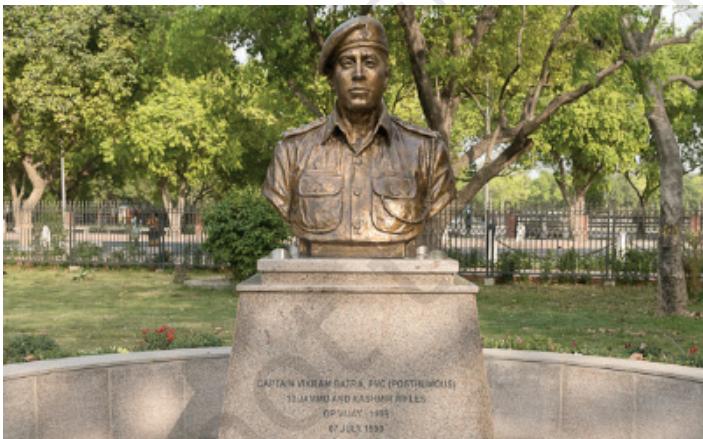
A bust of Param Vir Chakra Awardee Captain Vikram Batra at the National War Memorial in Delhi. (Source: National War Memorial)
Captain Vikram Batra, is popularly remembered as the "Shershah of Kargil". His iconic success signal was 'Yeh Dil Mange More'. Captain Vikram Batra, the D Company commander was tasked to capture Point 5140 on 20 June 1999, which he did with exemplary courage. After Point 5140 was captured, 13 JAK RIF was tasked to capture Point 4875. On 07 July 1999, Captain Batra led the assault from the front and engaged in a physical fight with the enemy. He killed five enemy soldiers at point blank range and himself sustained serious injuries. Despite his injuries, his dauntless determination inspired his men to clear the enemy from a dominating position. Later, he succumbed to his injuries. His fearless determination and leadership encouraged his company men to avenge his death and fi nally captured Point 4875.
His inspiring leadership, dedication to duty, and steadfast love for his country continue to be an inspiration for the younger generation. He attended the call of duty with absolute disregard for his personal safety. He was awarded the Param Vir Chakra, (Posthumously).
I Gallantry awards in India are given to military personnel and others for displaying extraordinary courage in the line of duty.
Some of the gallantry awards in India are:
• Param Vir Chakra: The highest military award in India, awarded for the most conspicuous bravery in the presence of the enemy. • Maha Vir Chakra: The second-highest military award in India, awarded for acts of gallantry in the presence of the enemy. • Vir Chakra: Awarded for acts of gallantry in the presence of the enemy.
Find out more about gallantry awards.
III The Indian government has been steadfast in its initiatives to boost the representation of women in the Indian Armed Forces. These women have been serving the nation selflessly and with pride. Find out the key roles of women in the Indian Army. Share the information with your classmates and teacher.
IV Birsa Munda: A Saga of Courage and Sacrifice
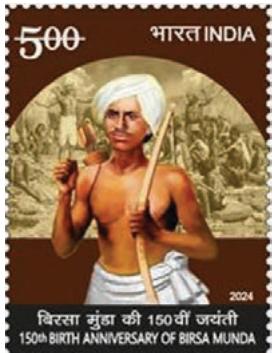
Birsa Munda, a revered tribal freedom fighter, spiritual leader, and folk hero, belonged to the Munda tribe. Celebrated as a valiant warrior and a charismatic figure, he emerged as a powerful symbol of tribal resistance against British colonial rule. Among the people of Jharkhand, he is affectionately known as Dharti Aaba—Father of the Land—and is honoured as a divine figure for his selfless dedication to his people.
A commemorative stamp designed by Shri Sankha Samanta captures his powerful presence. It features Birsa Munda addressing his followers, with a determined expression that reflects his unwavering vision of tribal unity, empowerment, and self-governance. This stamp serves as a lasting tribute to his pivotal role in India's freedom struggle and his relentless commitment to protecting tribal rights.
Source: https://pib.gov.in/PressReleasePage.aspx?PRID $^ { 1 \pm }$ 2073652
V Make a list of the patriotic songs in any language, including songs from your region. Share the songs with your classmates and teacher.
SOMEBODY'S MOTHER
Let us do these activities before we read.
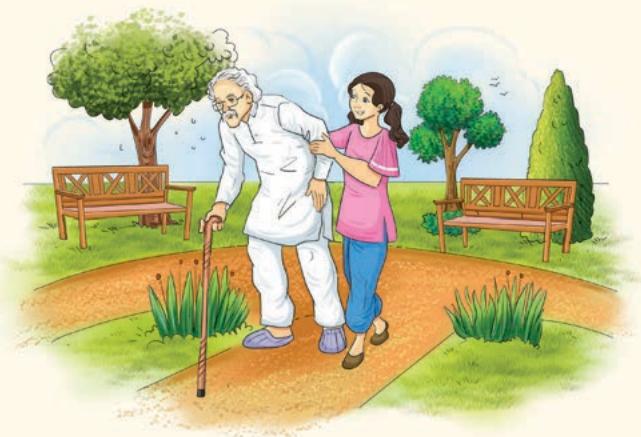
I Recall a time you helped someone. Write two words describing:
- What were your feelings after you did so? 2. What might have been the feelings of the person whom you helped?
Share your answers with your classmates and teacher.
I1 Work in pairs. Read the words given below. Circle the words you would associate with an elderly person and underline the words you would associate with a school student. Share the reasons for your choices with your classmates and teacher.
strong worried trembling hastening firm bent merry grey slow guide helpful
II Read the lines.
The woman was old and ragged and grey And bent with the chill of the Winter's day.
Select the suitable meaning of 'ragged' as used in these lines. There are other four meanings given below. Discuss with your classmates and teacher.
(of clothes) old and torn; synonym: shabby a ragged jacket
Having an outline, an edge, or a surface that is not straight or even • a ragged coastline
Not smooth or regular; not showing control or careful preparation • I could hear the sound of his ragged breathing. • Their performance was still very ragged.
(Informal) very tired, especially after physical effort • The elderly man was ragged after climbing the stairs.
Let us read
The woman was old and ragged and grey And bent with the chill of the Winter's day.
The street was wet with a recent snow And the woman's feet were aged and slow.
She stood at the crossing and waited long, Alone, uncared for, amid the throng
Of human beings who passed her by Nor heeded the glance of her anxious eyes.
Down the street, with laughter and shout, Glad in the freedom of "school let out,"
Came the boys like a flock of sheep, h Hailing the snow piled white and deep.
Past the woman so old and grey Hastened the children on their way.
Nor offered a helping hand to her So meek, so timid, afraid to stir
Lest the carriage wheels or the horses' feet Should crowd her down in the slippery street.
At last came one of the merry troop, The gayest laddie of all the group;
He paused beside her and whispered low, "Ill help you cross, if you wish to go."
Her aged hand on his strong young arm She placed, and so, without hurt or harm,
He guided the trembling feet along, Proud that his own were firm and strong.
Then back again to his friends he went, His young heart happy and well content.
"She's somebody's mother, boys, you know, For all she's aged and poor and slow",
"And I hope some fellow will lend a hand To help my mother, you understand",
"If ever she's poor and old and grey, When her own dear boy is far away."
And "somebody's mother" bowed low her head In her home that night, and the prayer she said
Was "God be kind to the noble boy, Who is somebody's son, and pride and joy!"
MARY DOW BRINE
Let us discuss
I Arrange the events of the poem in the correct order of occurrence. Share your answers with your classmates and teacher.
The boy returned to his friends, feeling proud of what he had done.
The old woman stood alone at the crossing, hesitant to move.
A group of schoolboys passed by, playing, and laughing.
The boy offered to help the old woman cross the street.
The woman prayed for the boy who helped her.
The children hurried past the old woman without offering help.
The woman placed her hand on the boy's arm, and he guided her safely across the street.
The boy thought about his own mother and hoped someone would help her one day.
II Fill in the blanks by choosing the correct answer from the options given in the brackets.
The central theme of the poem is (kindness and empathy/ adventure and courage)
The tone of the poem is (humorous and playful/ sympathetic and hopeful)
The poem is written in couplets with lines in each stanza. (four/two)
The structure of the poem gives a rhythmic flow that reflects both the . (narrative and emotions/story's pace and message)
The poem follows a rhyme scheme of . (AABB/ABAB)
III Pick examples from the poem for the following poetic devices.
- Simile
- Alliteration
- Repetition
IV Complete the following sentences appropriately explaining the imagery.
The poem uses imagery to describe scenes of a bustling street. We know this by the phrase •
The line The street was wet with a recent snow' suggests a cold and weather, emphasising the woman's helplessness.
V Complete the following sentence with a suitable reason.
The poet repeats the phrase Somebody's mother because it
VI Complete the analogy:
The old woman: vulnerable and neglected : The young boy:
Let us think and reflect
I Read the given extracts and answer the questions that follow.
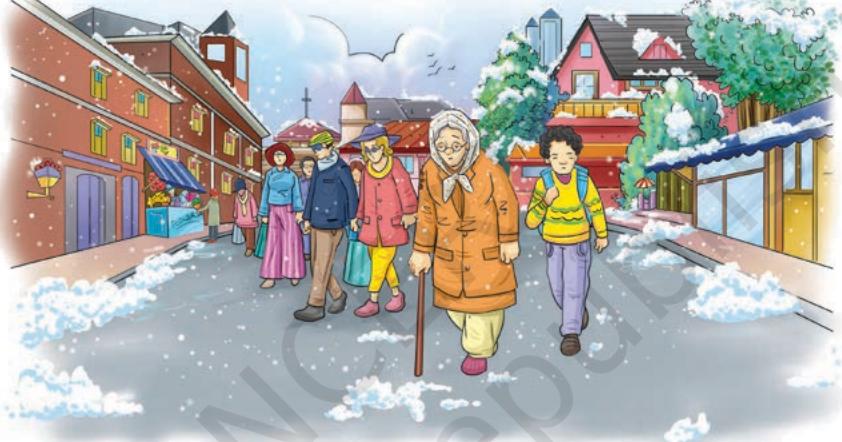
- The woman was old and ragged and grey And bent with the chill of the Winter's day. The street was wet with a recent snow And the woman's feet were aged and slow.
(i) What does the phrase 'ragged and grey' refer to ?
A. The woman's emotional state that day.
B. The woman's old and worn-out appearance.
C. The weather conditions of the particular day.
D. The colour of the street and the surroundings.
(ii) Complete the following sentence with a suitable reason: The woman was bent' with the chill of the Winter's day because shewas
(ii) Identify the fact and opinion from the following sentences:
A. The street was wet with recent snow.
B. The woman was too weak to cross the street on her own.
(iv) Why do you think the woman's feet were described as aged and slow'"?
- He guided the trembling feet along, Proud that his own were firm and strong.
Then back again to his friends he went, His young heart happy and well content.
(i) What does the contrast between the 'trembling feet' of the old woman and the 'fi rm and strong' feet of the boy emphasise?
(i) Fill in the blank given below by selecting the correct option from the brackets.
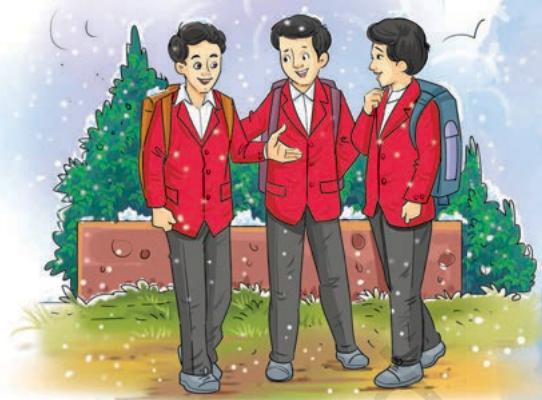
The poem tells us that the boy was 'proud that his feet were strong. This tells us that the boy was (arrogant about being strong/grateful for his ability to help)
(ii) What is the boy most likely to tell his friends on getting back?
A. I'm so glad I could help her.
B. I'm worried about her safety.
C. I'm surprised she forgot to thank me.
D. I'm thankful for all your support.
(iv) Rectify the false sentence given below. The young boy's actions were driven by a logical decision.
II Answer the following questions.
- What might be the old woman's fears as she waited for a long time at the crossing?
- How does the poet show the helplessness of the old woman? Support your answer with evidence from the poem.
- Why does the boy decide to help the old woman? What does this tell us about him?
- How was the boy's approach towards the old woman different from that of the other boys in the group?
- Justify the appropriateness of the title of the poem.
- What does the poem suggest about the role of empathy and humanity in society?
Let us learn
I The grid given below has the antonyms of the words from the text. Locate these words in the grid horizontally, vertically, and diagonally. One example has been done for you. You may refer to a dictionary.
firm meek merry kind anxious bent
| R | D | T | C | J | A | B | R | N |
| G | M | F | R | A | G | I | L | E |
| C | A | P | U | K | N | D | F | H |
| A | E | B | D | R | F | S | s | 9 |
| L | A | 0 | E | W | E | T | A | A |
| M | L | L | w | c | F | L | D | S |
| G | x | D | P | 0 | R | D | A | R |
| P | E | A | s | E | F | U | L | F |
| Q | s | N | 0 | I | v | E | E | T |
| s | T | R | A | G | H | T | L |
I Match the words from the text given in Column 1 with the underlined phrases in Column 2. 2
| Column 1 | Column 2 |
| 1. hastened | (i)'The mother heard the baby move slightly in thecradle at night. |
| 2. heeded | (i) It is our duty to give support to the poor. |
| 3. stir | (ii)The students worked quickly to complete theproject and submit it on time. |
| 4. lend | (iv) All the boxes were kept in a heap at one place. |
| 5. piled | (v)They came forward to help us when we werein need. |
| 6. offered | (vi) The stranded people were brought to safetybecause they paid attention to our advice. |
III In the poem, the poet uses the idiom lend a hand' which means help somebody'. Some more idioms using hand' are given in Column 1. Match these idioms with their meanings in Column 2. You may refer to a dictionary.
| Column 1 | Column 2 |
| 1.get out of hand | (i)do something new |
| 2.try your hand at something | (ii)applaud somebody |
| 3.give somebody a free hand | (ii)work together |
| 4.give somebody a big hand | (iv)become diffi cult to control |
| 5.work hand in hand | (v)be very busy |
| 6. have your hands full | (vi)allow somebody to dosomething with full freedom |
IV Complete the following analogy by filling in the blanks with the correct words from the poem.
: winter :: heat : summer
hurt: :: old: aged
whispered : shouted :: humble
eyes: : legs : walk
having a lot of money: wealthy $\because$ densely packed people:
Read the lines from the poem given below.
Lest the carriage wheels or the horses' feet
Should crowd her down in the slippery street.
'Lest' is a conjunction that means to prevent something bad or unpleasant from happening. To better understand its usage in a sentence, we can replace lest' with just in case'.
For example, in the sentence 'She showed all the documents lest we doubt her, the word lest' can be replaced with just in case' to mean that she showed the documents to prevent any doubt.
Let us listen
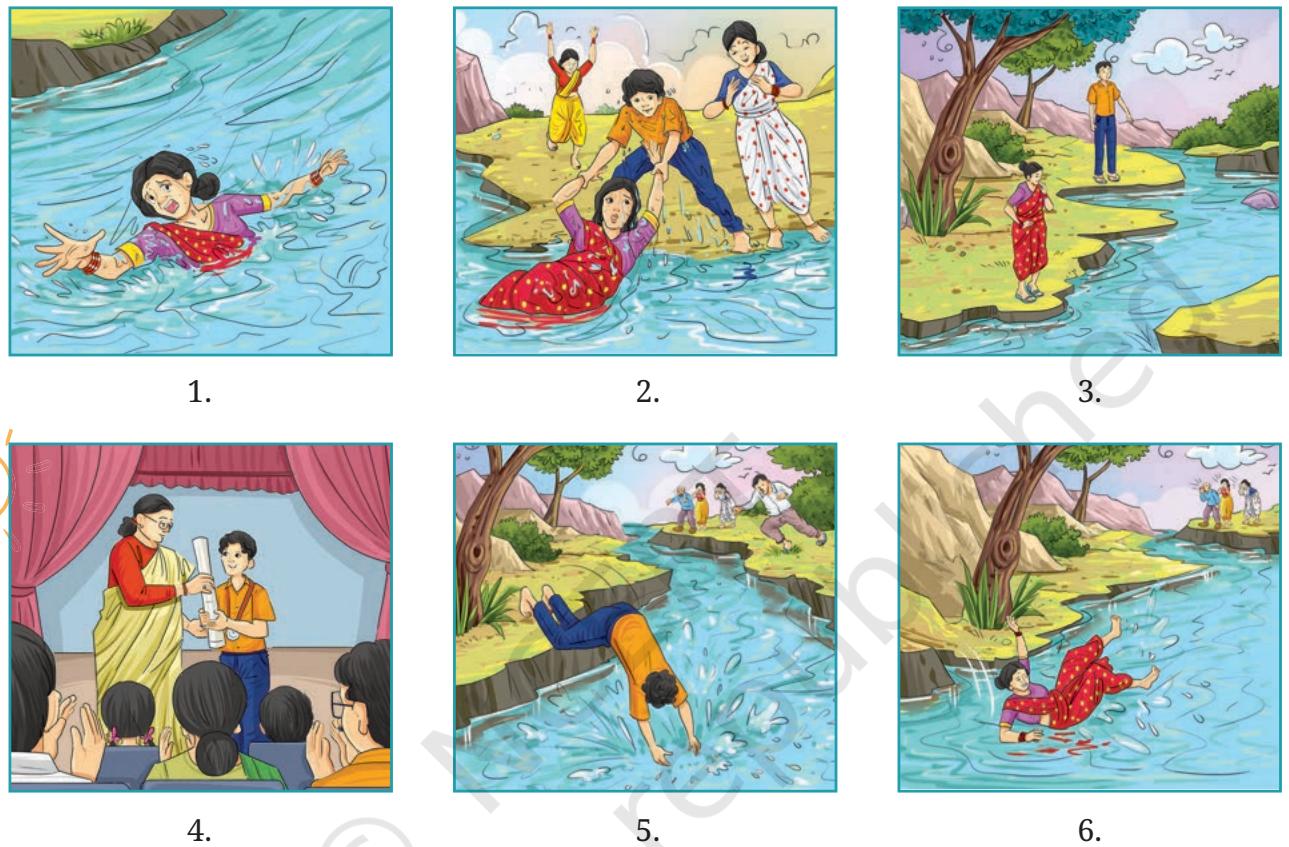
I You will listen to a woman read the special broadcast of the news. As you listen, arrange the pictures in the correct sequence of the events that took place. (Transcript for teacher on page 99)
II You will once again listen to the special broadcast of the news. As you listen, complete the following sentences with one to three exact words.
The woman was having a difficult time staying afloat due to the
Rohan leapt into the river to save the woman without any
Rohan's act of bravery was witnessed by
Rohan was honoured at the Vigyan Bhawan for his incredible courage and
Rohan proved that when it comes to saving lives, age is •
Let us speak
I Read aloud the list of words from the poem that end in -ed'. As you read, focus on the final sound of each word and place them in the appropriate columns. One example has been done for you.
ragged aged waited heeded offered paused guided whispered
| /id/sound | /d/ sound | /t/ sound |
| ragged | heeded | paused |
Note: Adjectives that come before a noun and end with -ed' have /id/as the fi nal sound.
II Work in pairs. Narrate an incident where you helped someone in the past. Take turns to speak and use the cue cards given below.
at school classmate explaining a concept
in the neighbourhood cleanliness campaign
at the market place elderly carrying bags
in the playground a friend gets injured
You may use the following prompts.
| Beginning the Story | Describing the Experience |
| • It all started when..• The day began like any other...• I still remember..• At that moment, I realised.. | • At that moment, I realised..I was completely taken bysurprise...The next few hours were...• I couldn't believe my eyes whenI saw.. |
| Beginning the Story | Describing the Experience |
| • I was overjoyed/thrilled/extremely satisfi ed• A wave of relief/joy/excitementwashed over me..• I felt a mixture of emotions..• Ihave never felt. | From that day on...This memory reminds me toalways...This experience taught me thevalue of..• In the end, I realised... |
Let us write
I Write a diary entry of a day you helped someone in need. Remember to include the following points while writing it.
$\checkmark$ Start with a sentence describing the day.
$\checkmark$ Mention whom you helped.
$\checkmark$ Explain the situation in which the other person needed help.
$\checkmark$ Add the place and time of the day when the situation arose.
$\checkmark$ Describe how you helped the other person.
$\checkmark$ Describe the reaction of the person you helped.
$\checkmark$ Mention how you felt during and after helping the person.
$\checkmark$ Conclude by mentioning why you would do something like this again.
You may begin like this: 26 April 20xx, Saturday Dear Diary, Today, I feel was a special day.….
8:00 p.m.
Let us explore
I Did you know that even Earth has been referred to as mother in the ancient scriptures of India? In section 12.1.12 of Prthvi-Sükta (hymn-tothe-earth) of Atharva Veda, Earth is referred to as mother and us as her children by stating:
माता भूमि: पुत्रोउह पृथिव्या: ।
It can be translated as Earth is my mother and I am her child.
I Work in groups of four. Find out the names of countries that refer to their country as 'motherland' and a few others as 'fatherland. Share your findings with your classmates and teacher.
III Read the poem and enjoy.
A Nation's Strength
Not gold, but only men can make
A people great and strong.….
Men who for truth and honour's sake
Stand fast and suffer long.
Brave men who work while others sleep,
Who dare while others fly..
They build a nation's pillars deep
And lift them to the sky.
RALPH WALDO EMERSON
(Note: Here, men refers to both men and women)
IV Make a gratitude card for your mother/grandmother to thank her for at least five things that she does for you. Also write two things that you would do regularly to help them. Use recycled material to make and decorate the card.
: Write your own message t to De rep
VERGHESE KURIEN — I TOO HAD A DREAM
Let us do these activities before we read.
I Arrange the worldwide means of communication given below in the timeline provided. Share your answers with your classmates and teacher.

- telephone

2. email

3. postcard

4. telegraph

5. mobile phone

6. carrier pigeons
I Work in pairs and discuss the following things. Share your answers with your classmates and teacher.
- The reasons for change in the means of communication over the years.
- The means of communication that you prefer to use and the reason for your choice.
- Communication through social media: its benefits and precautions that one should take against its misuse.
TO MY GRANDSON
Anand, 2005
My dear Siddharth,
When did I write to you last? I have trouble even remembering! In today's fast-paced world we have become so addicted to instant communication that we prefer to use a telephone. But speaking on the telephone only gives us an immediate but fleeting joy. Writing is different. Writing even if it is a letter—not only conveys our present concerns and views of the events taking place around us but it becomes a possession that can be treasured and re-read over the years, with great, abiding pleasure.
You may not wish to read it all right away but, perhaps, a couple of decades or more from now, you will pick up these jottings of mine again and they will give you a deeper understanding of what I have done, and the reasons I pursued a life of service to our nation's farmers. You will then discover in them a valuable reminder of the days just before the world entered the twenty-fi rst century. And you may want to share my memories with those of your generation, or even younger, to provide a glimpse of the world your grandparents lived in and knew.
I started my working life soon after our country became independent. The noblest task in those days was to contribute in whatever way we could towards building an India of our dreams—a nation where our people would not only hold their heads high in freedom but would be free from hunger and poverty. A nation where our people could live with equal respect and love for one another. A nation that would eventually be counted among the foremost nations of the world. It was then that I realised, in humility, that choosing to lead one kind of life means putting aside the desire to pursue other options. This transformation took place within me fifty years ago, when I agreed to work for a small cooperative of dairy farmers who were trying to gain control over their lives.
To be quite honest, service to our nation's farmers was not the career I had envisioned for myself. But somehow, a series of events swept me along and put me in a certain time with a choice that would transform my life. I could have pursued a career in metallurgy and become the
addicted: dependent on something fleeting: momentary or short-lived
abiding pleasure: a feeling of happiness that continues for a long time
jottings: brief notes
foremost: leading
humility:
modesty/
quality of being
humble
pursue: follow envisioned: imagined or expected something to happen in a particular way
chief executive of a large company. Or, opted for a commission in the Indian Army and maybe retired as a general. Or, I could have left for the US and gone on to become a highly successful NRI. Yet, I chose none of these because somewhere, deep down, I knew I could make a more meaningful contribution by working here in Anand, Gujarat.
ardently: in a way that shows strong feelings poise: in a calm and confi dent manner
Your grandmother too made an important choice. She knew, in those days, life in Anand could not offer even the simple comforts that we take for granted today. However, she ardently supported my choice to live and work in Anand. That choice of your grandmother to stand by me has given me an everlasting strength, always ensuring that I shouldered my responsibilities with poise.
adhered: to continue to support
integrity: honest and strong moral principles
Whenever I have received any recognition for my contributions towards the progress of our country, I always emphasised that it is a recognition of the achievements of many people with whom I had a privilege to be associated with. I would like to stress even more strongly that my contributions have been possible only because I have consistently adhered to certain values. Values that I have inherited from my parents and other family elders; values that I saw in my mentor and supporter here in Anand—Tribhuvandas Patel. I have often spoken of integrity as the most important of these values, realising that integrity—and personal integrity, at that— is being honest to yourself. If you are always honest to yourself, it does not take much effort in always being honest with others. I have also learnt what I am sure you, too, will find out some day. Life is a privilege and to waste it would be wrong. In living this privilege called life', you must accept responsibility for yourself, always use your talents to the best of your ability and contribute somehow to the common good. That common good will present itself to you in many forms every day. If you look around you, you will find there is a lot waiting to be done: your friend may need some help, your teacher could be looking for a volunteer, or the community you live in will need you to make a contribution. I hope that you, too, will discover, as I did, that failure is not about not succeeding. Rather, it is about not putting in your best effort and not contributing, however modestly, to the common good.
correlation: a connection between two or more things
In life you, too, will discover as I did, that anything can go wrong at any time and mostly does. Yet, there is little correlation between the circumstances of people's lives and how happy they are. Most of us compare ourselves with someone we think is happier—a relative, an acquaintance, or often, someone we barely know. But when we start looking closely we realise that what we saw were only images of perfection. And that will help us understand and cherish what we have, rather than what we don't have.
Do you remember when you accompanied me at the magnifi cent ceremony in Delhi where our President awarded me the Padma Vibhushan in 1999? With great pride, you slipped the medal around your neck, looked at it in awe and asked me very innocently if you could keep it. Do you remember the answer your grandmother and I gave you? We told you that of course, this medal was yours as much as it was mine but that you should not be satisfi ed in merely keeping my award—the challenge before you was to earn your own reward for the work that you did in your lifetime.
And in the end, if we are brave enough to love, strong enough to rejoice in another's happiness and wise enough to know that there is enough to go around for all, then we would have lived our lives to the fullest.
I would like to dedicate these musings to you, Siddharth, and to the milions of other children of your generation in our country, in the hope that upon reading them you will be inspired enough to go bravely out into the world and work tirelessly in your chosen field for the larger good of the country, for the larger good of humanity. Remember, rewards that come to you then are the only true rewards for a life well-spent.
musings:
thoughts on something one has been thinking about carefully for a long time
With my fondest love,
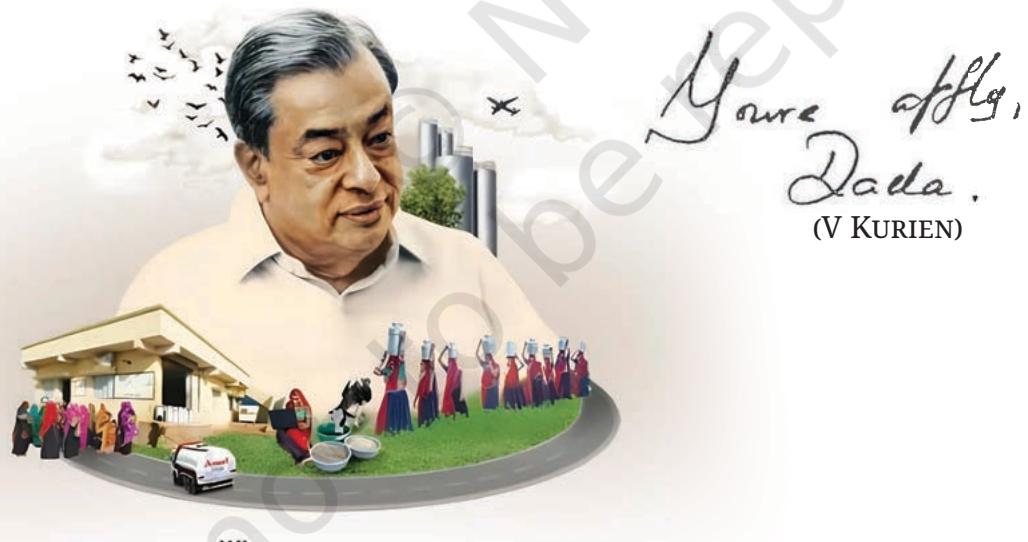
Who says one man cannot make a change?
Let us discuss
A fact is something that can be proven true or false. A fact is not based on people's beliefs. An opinion on the other hand is a belief, feeling or judgement, and can vary from one person to another. An opinion cannot be proven.
I Identify which of the following statements are facts and which are opinions. Share your answers with your classmates and teacher.
- But speaking on the telephone only gives us an immediate but fleeting joy.
- I started my working life soon after our country became independent.
- To be quite honest, service to our nation's farmers was not the career I had envisioned for myself.
- I knew I could make a more meaningful contribution by working here in Anand, Gujarat.
- …. values that I saw in my mentor and supporter here in Anand— Tribhuvandas Patel. 0
- Life is a privilege, and to waste it would be wrong.
- I hope that you, too, will discover, as I did, that failure is not about not succeeding.
- …. the magnifi cent ceremony in which the President awarded me the Padma Vibhushan in 1999?
Let us think and reflect

I Read the given extracts and answer the questions that follow.
- In today's fast-paced world we have become so addicted to instant communication that we prefer to use a telephone. But speaking on the telephone only gives us an immediate but fleeting joy. Writing is different. Writing—even if it is a letter—not only conveys our present concerns and views of the events taking place around us but it becomes a possession that can be treasured and re-read over the years, with great, abiding pleasure.
(i) Fill in the blank given below by selecting the correct option from the brackets.
When the writer refers to a fast-paced world', he is speaking of a world where . (communication happens quickly but lacks depth/people have more time to write and reflect)
(ii) Select the option that applies correctly to both Assertion (A) and Reason (R).
(A): Writing letters can be treasured and re-read over the years.
(R): Speaking on the telephone provides long lasting joy.
A. Both (A) and (R) are true, and (R) is the correct explanation of(A).
B. Both (A) and (R) are true, but (R) is not the correct explanation of (A).
C. (A) is true, but (R) is false.
D. Both (A) and (R) are false.
(iii) Identify whether the statement given below is true or false. The writer feels that letter-writing is a class apart from other kinds of writing.
(iv) Which of the following is the most appropriate title for the given extract?
A. The Rise of Instant Communication B. The Fleeting Delight of Phone Calls C. The Lasting Joy of Written Words D. Living in a Fast-paced World
- Your grandmother too made an important choice. She knew, in those early days, life in Anand could not offer even the simple comforts that we take for granted today. However she ardently supported my choice to live and work in Anand. That choice of your grandmother to stand by me has given me an everlasting strength, always ensuring that I shouldered my responsibilities with poise.
(i) How can we say that the grandmother shared her husband's dedication to a greater cause?
(i) Complete the following with the correct option from the two given in brackets.
The fact that the writer (grandfather) praises his wife tells us that he (truly values/quietly accepts) her role in his life.
(ii) Complete the following sentence with the correct option from those given below.
Based on the information in the extract, we can infer that the grandmother had all of the following traits ExCEPT
A. encouraging B. understanding C. comforting D. thoughtful
(iv) Select the phrase that conveys— 'showed grace under pressure and carried out my duties with dignity and confidence'.
II Answer the following questions.
- What event does Dr. Kurien refer to when he mentions receiving the Padma Vibhushan?
- How did Dr. Kurien's decision to join the cooperative in Anand affect his life?
- Dr. Kurien's decision to work in Anand reveals his values and sense of duty. Explain.
- Why did Dr. Kurien write the letter to his grandson?
- According to Dr. Kurien life is a privilege and it is wrong to waste it". What is your opinion on this?
- What message does Dr. Kurien want to convey about selfless service and its long-term impact on the society?
Let us learn
I Replace the underlined words in each sentence with the correct synonym from the box. You may refer to a dictionary.
essential swift lifelong momentary useful splendid
He received the award in a magnificent ceremony.
I felt a fleeting joy when I received the appreciation for my song.
With today's instant communication, we can share information across the world in seconds.
Our school focuses on the core values—collaboration, innovation, and unity.
My teacher's advice on time management is a valuable reminder of the importance of planning.
Reading books and listening to music can give abiding pleasure that Will last forever.
II Match the expressions from the text in Column 1 with their meanings in Column 2.
| Column 1 | Column 2 |
| 1. in all humility | (i) to speak in a truthful way |
| 2. hold their heads high | (ii) doing something using all yourskills, talents, and knowledge |
| 3. to be quite honest | (ii)observed with great respect andwonder |
| 4. to the best of your ability | (iv) ]beinghumbleandhaving nofeeling of self-importance |
| 5. looked at in awe | (v) in the innermost part of the self |
| 6. somewhere deep down | (vi) be confident and have a positivefeeling |
III Make as many words as you can out of the following words. One example has been done for you.
community — city, toy, tune, unity, mutiny, cot
important
magnificent
satisfied
generation
achievement
IV Let us play a word game—antakshari
Write the synonym of the word according to the clues given below.
For example, the synonym of the fi rst word, IMPORTANT' ends with the letter T. The synonym of the second word begins with T, TROUBLE'. Then write the synonym of the third word starting with the letter E'.
Now, continue with the word game.
| M | P | 0 | R | A | N | R | 0 | U | B | E | ||||||
| L | R | |||||||||||||||
| Y | s | E |
(i) major (synonym) (ii) problem (synonym) (ii) uneven (antonym) (iv) related to post offi ce (v) our moral duty (vi) related to time (vii) prosperous (synonym) (vii) related to being alive
V Study the highlighted punctuation marks in the following sentences from the text.
- .. but that you should not be satisfi ed in merely keeping my awards— the challenge before you was to earn your own rewards for the work that you did in your lifetime.
- Writing—even if it is a letter—not only conveys our present concerns and views of the events taking place around us, but it becomes a possession.
The highlighted punctuation is a long dash that can be used to link words or numbers or to create a pause in a sentence. There are two main types: the shorter en dash (-) and the longer em dash (—).
The en dash $( - )$ represents a span or range in numbers or dates.
For example, it can indicate time periods, like 'train operates June-September' or page numbers, such as 'refer to pages 50–75' or to show scores, India won the series $2 { - } 1 ^ { \circ }$ .
The em dash (—) is used to add extra information or to show a change in thought within a sentence. For example, The exhibition—held in the main hall—features local artists. Or I bumped into someone unexpected—my old teacher.'
Note: Do not add spaces around the dash and avoid overusing them.
Read the sentences below and insert either an em dash (—) or an en dash (-) suitably.
(i) The conference will be held from March 15 March 20.
(ii) I have lived in Kanpur Raipur for fi ve years now.
(iii) The artist known for her vibrant paintings will be showcasing her work in Guwahati.
(iv) The scores for the fi nal match were 2 3.
(v)My favourite snacks samosas, pakoras, and jalebis are all from India.
(vi) The train journey from Belagavi Bengaluru takes less than ten hours.
(vii) I just finished reading the book it was absolutely amazing!
(viii) The event will take place on September 1 September 5.
VI Study the highlighted words in the following sentences from the text.
- We told you that of course, this medal was yours as much as it was mine...
- ..who were trying to gain control over their lives.
- I have always emphasised that it's a recognition of the achievements of many people...
In the given sentences, 'yours' and 'theirs' indicate possession— something belonging to you and them, respectively. But, 'it's' does not indicate possession rather is the contracted form of it is'.
Note the following differences
It's: is the contraction of it is' or it has' • It's getting dark outside.
Its: indicates that something belongs to you. • The dog wagged its tail.
You're: is the contraction of 'you are' • You're going to love this book.
Your: indicates that something belongs to you. • Can I have one of your books?
They're: is the contraction of they are' • They're coming to the field trip.
Their: indicates possession • We should contact their manager.
Fill in the blanks by choosing the correct word from the options given in the brackets.
(i) Please remember to bring (your/you're) assignment book.
(i) The team celebrated (their/they're) victory after the match.
(ii) (its/it's) important to stay hydrated during the hot summer days.
(iv) I can't believe (your/you're) going to the mango festival today.
(v) The students said (they're/their) excited for the field trip tomorrow.
(vi) The tree lost (its/it's) leaves in the winter.
VII Read the following phrases from the text.
In today's fast-paced world
On the telephone
With great, abiding pleasure
In the chapters that follow
At a certain time
With equal respect and love
The given phrases are Prepositional Phrases.
Prepositional phrases are groups of words that begin with a preposition and include a noun or pronoun as the object of the preposition. These phrases provide additional information about time, place, manner, cause, direction, or relationship.
Now, complete the following sentences with suitable prepositional phrases.
(i) The children played happily in (ii) Nisha placed the vase on
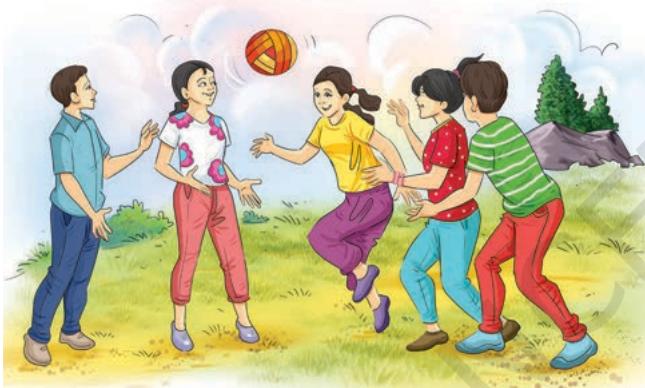
(ii) We discussed the project in (iv) Preethi found the lost book under (v) The cat slept on
VIl Rearrange the following jumbled words and phrases into meaningful sentences.
barked/at the strangers/the dog/loudly/the house/walking by
wrote/my classmate/during the/a story/summer vacations
enjoyed/under the trees/they/by the lake/a picnic
in his/grandfather's room/hung/he/the painting
studied/with great determination/for/students/the/exam
Let us listen
I You will listen to the passage about Evelyn Glennie's journey in overcoming her hearing loss through music and turning a physical disability into a success story. (Transcript for teacher on page 100)
After listening, match the words given in Column 1 with their meanings given in Column 2.
| Column 1 | Column 2 |
| 1. percussionist | (i)a personwhoplaysdrumsandsimilar instruments |
| 2. impaired | (ii)theabilitytokeepgoingdespite diffi culties |
| 3.vibrations | (ii)slow and steady over time |
| 4.determination | (iv)physicalsensationscausedby sound damaged orweakened |
| 5. gradual | (v) damaged or weakend |
II Listen to the passage once again and state whether the statements given below are true or false.
Evelyn Glennie became deaf suddenly.
Her headmistress ignored the signs of her hearing loss.
Ron Forbes was a percussionist who helped Evelyn.
Evelyn used her skin and bones to sense music.
She gave up on music after her diagnosis.
III Answer the following questions in one or two words.
How did Evelyn turn her disability into strength?
What role did Ron Forbes play in her life?
What lessons can we learn from Evelyn's story about how to treat others who have different abilities or challenges?
Let us speak
I Read the highlighted word in the following sentence from the text.
That common good will present itself to you in many forms every day.
The highlighted word is pronounced with the stress on the second syllable.
PresENT (verb) the stress is on the second syllable.
PREsent (noun) the stress is on the first syllable.
Now, read aloud the given words with the correct syllable stress according to the part of speech given in the brackets.
PROduce (noun) proDUCE (verb) CONTRACT (verb) CONtract (noun) PROject (noun) proJECT (verb) COnTENT (verb) CONtent (noun) REfuse (noun) reFUsE (verb)
II Read the highlighted words in the following sentence from the text.
..but it becomes a possession that can be treasured and re-read over the years, with great, abiding pleasure.
treasure [treh-Zhuh] pleasure [pleh-Zhuh]
In the highlighted words, -sure has a Zhuh' sound.
There are some words which end in -sure, but have a 'shuh' sound as in pressure [preh-shuh].
Now, read aloud the words given below with the 'shuh' or 'zhuh' sound.
measure leisure reassure enclosure exposure ensure seizure fissure composure unsure
III Pausing and chunking are techniques used when speaking, to organise information for the listener. Speakers can split what they say into smaller segments—either individual words or groups of words—to convey ideas or emphasise key points clearly.
- Read aloud the following lines from the poem.
Don't Quit
When things go wrong, as they sometimes will, when the road you're trudging seems all uphill, when the funds are low and the debts are high, and you want to smile but you have to sigh, when care is pressing you down a bit—rest if you must, but don't you quit.
EDGAR ALBERT GUEST
Now, read the lines of the poem once again by taking a shorter pause () or a long pause $( / / )$ . Notice which version is easier for a listener to follow and understand.
When things go wrong,/as they sometimes will,// when the road you're trudging/seems all uphill,/ when the funds are low/and the debts are high,// and you want to smile/but you have to sigh,// when care is pressing you down a bit/—rest if you must,/ but don't you quit.//
Have you listened to this song in Hindi or in your language? Share with your classmates and teacher.
- Chunk the stanzas with () or $( / / )$ and read it aloud. Life is queer with its twists and turns. As everyone of us sometimes learns. And many a fellow turns about when he might have won had he stuck it out. Don't give up though the pace seems slow— you may succeed with another blow. Often the goal is nearer than it seems to a faint and faltering man.
Let us writel
I Write a letter to your grandparents thanking them for the valuable lessons they have taught you. Include how their wisdom has shaped your values and behaviour in life.
- Thank them for teaching you important lessons, sharing stories, or helping others in the neighbourhood.
- Share how their actions inspire you to contribute to the betterment of the society.
Let us explore
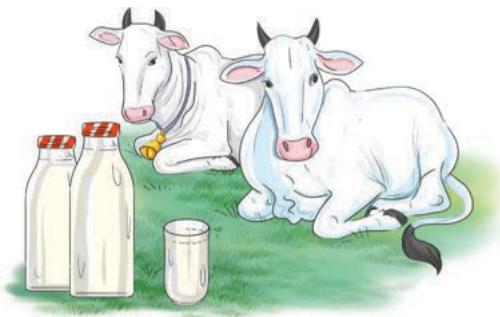
I The White Revolution led to a increase in milk production in India primarily due to the efforts of Dr. Verghese Kurien. Therefore, he is known as 'the Milkman of India'.
The Green Revolution in India introduced high-yielding varieties of wheat and rice. It was initiated by Dr. M.s. Swaminathan. He was awarded the Padma Shri in 1967, Padma Bhushan in 1972, Padma Vibushan in 1989, and Bharat Ratna in 2024.
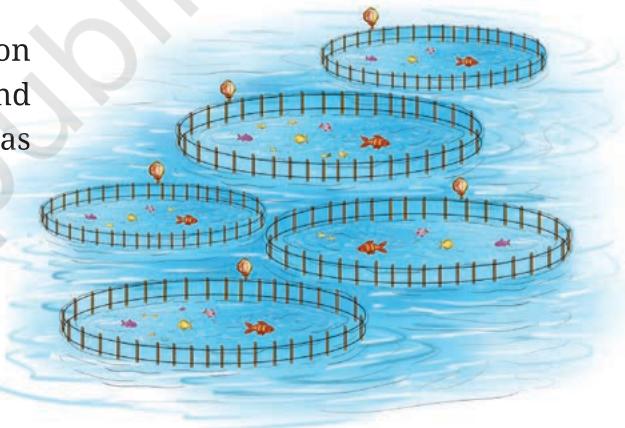
The Blue Revolution focused on increasing fisheries production and productivity in India. This initiative was led by Dr. Hiralal Chaudhuri.
In groups of four, research more information about these revolutions.
Share your findings with your classmates and teacher.
I Vocational training for people in rural regions is provided by the Jan Shikshan Sansthan (ss), under the Ministry of Skill Development and Entrepreneurship, Government of India. The objective of Jss is to economically uplift the rural population by imparting essential skill-based training. This enables local trades to grow and creates new opportunities for the people in the region.
Find out more about jss with the help of the link given below.
Read the passage and discuss the questions given below.
Financial literacy is an essential lifelong skill that should be taught to children from an early age. Preparing children with financial literacy skills is an investment for their future well-being. By imparting an understanding of money, saving, budgeting, and wise spending, we empower them to navigate the fi nancial world with confidence as they grow up.
Whether it is managing a cooperative society, a start-up, or a household budget, financial literacy is an ongoing learning process that evolves as children grow and their understanding deepens. An introduction to concepts of saving, budgeting, investing, and responsible spending equips them with essential life skills.
Children learn best through practical examples. Real-life situations help them understand the value of money and the importance of making wise financial choices. Thinking critically before spending helps cultivate responsible habits. The concept of saving and investing can be explained through relatable examples, such as planting seeds that grow into trees bearing fruit.
As children grow older, they will learn to differentiate between needs and wants, compare prices before making a purchase and understand importance of financial literacy.
Discuss in groups.
The importance of learning about money and saving from a young age. Share one example ofit.
Imagine you received some money as a gift. How would you decide whether to save it, spend it, or invest it? What factors would you consider?
If you were in charge of planning a small event at school with a limited budget, how would you manage the money?
Why is financial literacy important for everyone?
payement Bill payment e-banking. investment e-banking Tax payment Bet Net banking Saving e-wallet Bill payment Budgeting Mtefac etankngoney e-banking Money a panv S-wallet Te=banking e-Walletudgein Loans Budgetingg Saving Net banking wise pending Loans Bill payment Payments axr payment Tax payment Budgeting Payments: wise pending Investment
TRANSCRIPTS
Let us listen (refer to page 66)
I You willisten to a talk about the Param Vir Chakra. As you listen, complete the sentences by filling in the blanks with one or two exact words or phrases you hear.
Hello, everyone!
Let me tell you about the Param Vir Chakra. It is one of the most prestigious awards in India and signifies the 'Wheel of the Ultimate Brave.' This award is granted for exemplary bravery in the presence of the enemy. This means that this award is given to someone who shows extraordinary courage and bravery while fighting the enemy.
The medal was instituted as a Gallantry Medal with retrospective effect from 15 August 1947 by Dr. Rajendra Prasad, the then President of India. The medal was designed by Mrs. Savitri Khanolkar, who drew inspiration from Sage Dadhichi, a Vedic rishi, who made the ultimate sacrifice by giving up his body so that the gods could create a deadly weapon called Vajra, or Thunderbolt, from his spine.
The Param Vir Chakra is cast in bronze. At its centre, on a raised circle, is the State Emblem of India. Surrounding it are four replicas of Indra's Vajra, lined with lotus flowers.
That, my dear friends, is the Param Vir Chakra, a true symbol of bravery.
Thank you.
Let us listen (refer to page 78)
I You will listen to a woman read a special broadcast of the news. As you listen, arrange the pictures in the correct sequence of events that took place.
Now, for the special broadcast, we bring you the story of a young hero whose courage has captured the nation's heart.
On a fateful morning in Rajouri, young Rohan Ramchandra Bahir, a 15-year-old student, became a local hero when he fearlessly saved the life of a woman who had fallen into the Domri River while washing clothes. The 43-year-old woman was struggling to stay afloat in the strong currents, when Rohan, without a moment's hesitation, leapt into the river, putting his own life at risk.
With great determination and courage, Rohan managed to reach the woman and pull her to safety, despite the dangerous conditions ofthe river. Onlookers who witnessed the incident were in awe of the young boy's bravery.
Rohan's selfless act did not go unnoticed. His incredible courage was recognised at Vigyan Bhawan, where he was honoured with the prestigious Pradhan Mantri Rashtriya Bal Puraskar 2023 by the President of India, Droupadi Murmu.
This remarkable young boy is now a symbol of heroism in his community, and his story is an inspiration to all. We commend Rohan for his bravery and for showing that age is no barrier when it comes to saving lives.
(Adapted)
Courtesy: Times of India
Source:https://timesofindia.indiatimes.com/city/delhi/they-know-nofear-childrens-acts-of-bravery-innovative-ideas-honoured/ articleshow/97261236.cms
I You will once again listen to a special broadcast of the news. As you listen, complete the following sentences in one to three exact words.
VERGHESE KURIEN — I TOO HAD A DREAM
Let us listen (refer to page 93)
I You will listen to the passage about Evelyn Glennie's journey in overcoming her hearing loss through music and turning a physical disability into a success story.
Evelyn Glennie's loss of hearing had been gradual. By the time she was 11 her performance in school had deteriorated and her headmistress urged her parents to take her to a specialist. It was then discovered that her hearing was severely impaired as a result of gradual nerve damage. "Everything suddenly looked black," says Evelyn. But Evelyn was not going to give up. She was determined to lead a normal life and pursue her interest in music. One day she noticed a girl playing a xylophone and decided that she wanted to play it too. Most of the teachers discouraged her but percussionist Ron Forbes spotted her potential. He began by tuning two large drums to different notes. "Don't listen through your ears," he would say, "try to sense it some other way." Says Evelyn, "Suddenly I realised I could feel the higher drum from the waist up and the lower one from the waist down." Forbes repeated the exercise, and soon Evelyn discovered that she could sense certain notes in different parts of her body. "I had learnt to open my mind and body to sounds and vibrations." She explains, "It pours in through every part of my body. It tingles in the skin, my cheekbones and even in my hair." The rest was sheer determination and hard work. She never looked back from that point onwards. And she got right to the top, the world's most sought-after multi percussionist with a mastery of some thousand instruments.