THE CHERRY TREE
Let us do these activities before we read.
I Work in pairs and answer the questions that follow. Share your answers with your classmates and teacher.
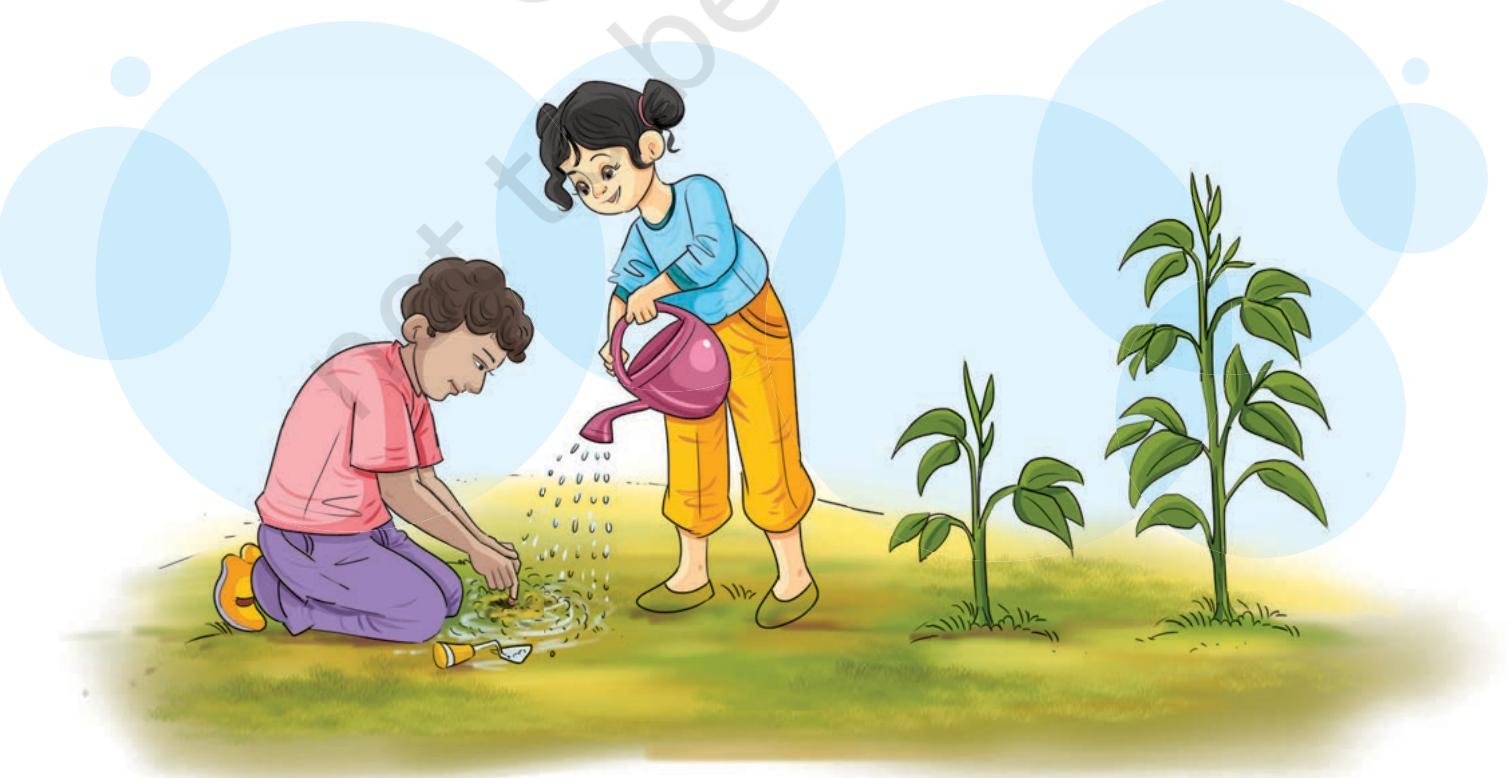
Have you ever used a seed or a sapling to grow a plant?
What kind of care did the plant need? Who helped you with it?
How did you feel when you saw the plant grow?
II What kind of trees do people plant in their homes? Why is it important to plant trees?
III Name some fruit trees that grow in your region. What type of conditions help these fruit trees to grow?
Let us read

One day, when Rakesh was six, he walked home from the Mussoorie bazaar eating cherries. They were a little sweet, a little sour; small, bright red cherries, which had come all the way from the Kashmir Valley.
Here in the Himalayan foothills where Rakesh lived, there were not many fruit trees. The soil was stony, and the dry cold winds stunted the growth of most plants. But on the more sheltered slopes there were forests of oak and deodar.
Rakesh lived with his grandfather on the outskirts of Mussoorie, just where the forest began. His father and mother lived in a small village fifty miles away, where they grew maize and rice and barley in narrow terraced fields on the lower slopes of the mountain.
stunted: stopped (from growing to the usual size)
outskirts: the areas that form the edge of a town or city
But there were no schools in the village, and Rakesh's parents were keen that he should go to school. As soon as he was of school-going age, they sent him to stay with his grandfather in Mussoorie.
He had a little cottage outside the town.
Rakesh was on his way home from school when he bought the cherries. He paid fifty paise for the bunch. It took him about half-an-hour to walk home, and by the time he reached the cottage there were only three cherries left.
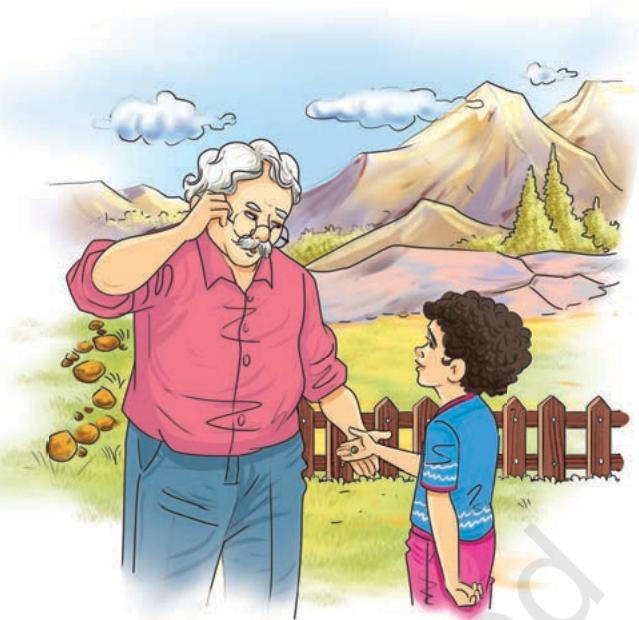
'Have a cherry, Grandfather, he said, as soon as he saw his grandfather in the garden.
Grandfather took one cherry and Rakesh promptly ate the other two. He kept the last seed in his mouth for some time,
rolling it round and round on his tongue until all the tang had gone. Then he placed the seed on the palm of his hand and studied it.
Are cherry seeds lucky?' asked Rakesh.
'Of course.' 'Then Ill keep it.'
'Nothing is lucky if you put it away. If you want luck, you must put it to some use. What can I do with a seed?'
tang: a strong, sharp taste
Plant it.
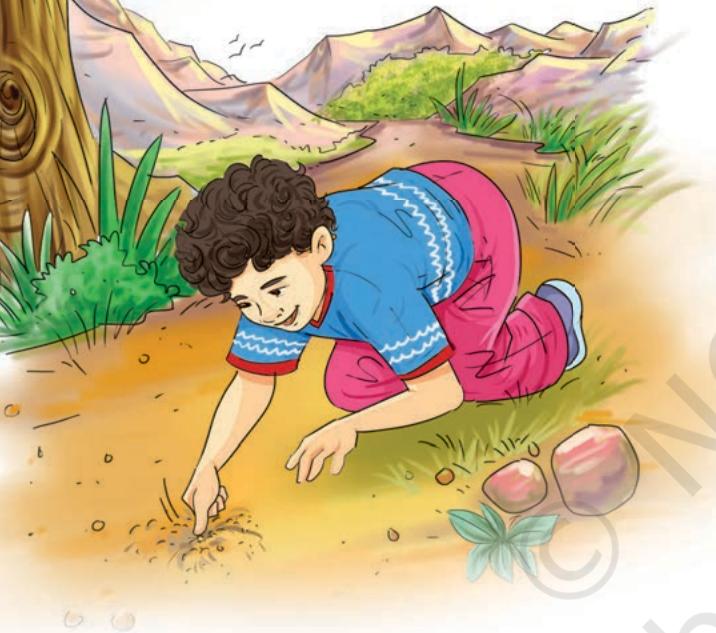
So Rakesh found a small space and began to dig up a flowerbed.
Hey, not there,' said Grandfather. I've sown mustard in that bed. Plant it in that shady corner, where it won't be disturbed.'
Rakesh went to a corner
of the garden where the earth was soft and yielding. He did not have to dig.
yielding: giving way under pressure
He pressed the seed into the soil with his thumb and it went right in.
Then he had his lunch, and ran off to play cricket with his friends, and forgot all about the cherry seed.
When it was winter in the hills, a cold wind blew down from the snows and went whoo-whoo-whoo in the deodar trees, and the garden was dry and bare.
In the evenings Grandfather and Rakesh sat over a charcoal fire, and Grandfather told Rakesh stories—stories about people
who turned into animals, and ghosts who lived in trees, and beans that jumped and stones that wept—and in turn, Rakesh would read to him from the newspaper, Grandfather's eyesight being
rather weak. Rakesh found the newspaper very dull–
especially after the stories—but Grandfather wanted all the news...
They knew it was spring when the wild duck flew north again, to Siberia. Early in the morning, when he got up to chop wood and light a fire, Rakesh saw the V-shaped formation streaming northward, the calls of the birds carrying clearly through the thin mountain air.
haunches: sit on the feet with legs bent
looked carefully
or with
difficulty
One morning in the garden he bent to pick up what he thought was a small twig and found to his surprise that it was well rooted. He stared at it for a moment, then ran to fetch Grandfather, calling, 'Dada, come and look, the cherry tree has come up!'
'What cherry tree?' asked Grandfather, who had forgotten about it. The seed we planted last year—look, it's come up!'
Rakesh went down on his haunches, while Grandfather bent
peered down:
almost double and peered down at the tiny tree. It was about four inches high.
Yes, it's a cherry tree, said Grandfather. You should water it now and then.
Rakesh ran indoors and came back with a bucket of water.
'Don't drown it!' said Grandfather.
Rakesh gave it a sprinkling and circled it with pebbles.
'What are the pebbles for?' asked Grandfather.
'For privacy,' said Rakesh.
He looked at the tree every morning but it did not seem to be growing very fast, so he stopped looking at it except quickly, out of the corner of his eye. And, after a week or two, when he allowed himself to look at it properly, he found that it had grownat least an inch!
That year the monsoon rains came early and Rakesh plodded to and from school in raincoat and chappals. Ferns sprang from the trunks of trees, strange-looking lilies came up in the long grass, and even when it wasn't raining the trees dripped and mist came curling up the valley. The cherry tree grew quickly in this season.
It was about two feet high when a goat entered the garden and ate all the leaves. Only the main stem and two thin branches remained.
plodded: walked slowly
'Never mind,' said Grandfather, seeing that Rakesh was upset. 'It will grow again, cherry trees are tough.
N
Let us discuss
I Arrange the events in order of occurrence in the story. Two have been done for you. Share your answers with your classmates and the teacher.
Rakesh discovered that the small, wel-rooted twig, had grown
into a cherry tree.Rakesh was sent to live with his grandfather in Mussoorie.
Rakesh pressed the cherry seed into the soft soil with his thumb. (5)
The cherry tree grew quickly after the rains arrived early.
Rakesh bought a bunch of cherries and ate most of them.
A goat entered the garden and ate all the leaves of the young cherry tree.
Rakesh's parents grew maize, rice, and barley in a village. (1)
Rakesh sprinkled water on the cherry tree and surrounded it with pebbles.
Grandfather told Rakesh that cherry trees were tough. l0. Rakesh kept rolling the last cherry seed in his mouth.
II Do you think the cherry tree would survive? Why do you think so?
II
scrambled:
moved quickly and with difficulty
scythe: a tool with a long, sharp, curved blade with a long handle
'Maybe it will die now,' said Rakesh.
Towards the end of the rainy season new leaves appeared on the tree. Then a woman cutting grass scrambled down the hillside, her scythe swishing through the heavy monsoon foliage. She did not try to avoid the tree: one sweep, and the cherry tree was cut in two.
foliage: green leaves
When Grandfather saw what had happened, he went after the woman and scolded her; but the damage could not be repaired.
'Maybe,' said Grandfather.
But the cherry tree had no intention of dying.
By the time summer came round again, it had sent out several new shoots with tender green leaves.
Rakesh had grown taller too. He was eight now, a sturdy boy with curly black hair and deep black eyes. Blackberry eyes, Grandfather called them.
That monsoon Rakesh went home to his village, to help his father and mother with the planting and ploughing' and
sowing. He was thinner but stronger when he came back to Grandfather's house at the end of the rains to find that the cherry tree had grown another foot. It was now up to his chest.
Even when there was rain, Rakesh would sometimes water the tree. He wanted it to know that he was there.
One day he found a bright green praying-mantis perched on a branch, peering at him with bulging eyes. Rakesh let it remain there; it was the cherry tree's first visitor.
The next visitor was a hairy caterpillar, who started making a meal of the leaves. Rakesh removed it quickly and dropped it on a heap of dry leaves.
prayingmantis: an insect
'Come back when you're a butterfly, he said.
Winter came early. The cherry tree bent low with the weight of snow. Field-mice sought shelter in the roof of the cottage. The road from the valley was blocked, and for several days there was no newspaper, and this made Grandfather quite grumpy. His stories began to have unhappy endings.
In February it was Rakesh's birthday. He was nineand the tree was four, but almost as tall as Rakesh.
One morning, when the sun came out, Grandfather came into the garden to let some warmth 'get into my bones,' as he put it. He stopped in front of the cherry tree, stared at it for a few moments, and then called out, Rakesh! Come and look! Come quickly before it falls!'
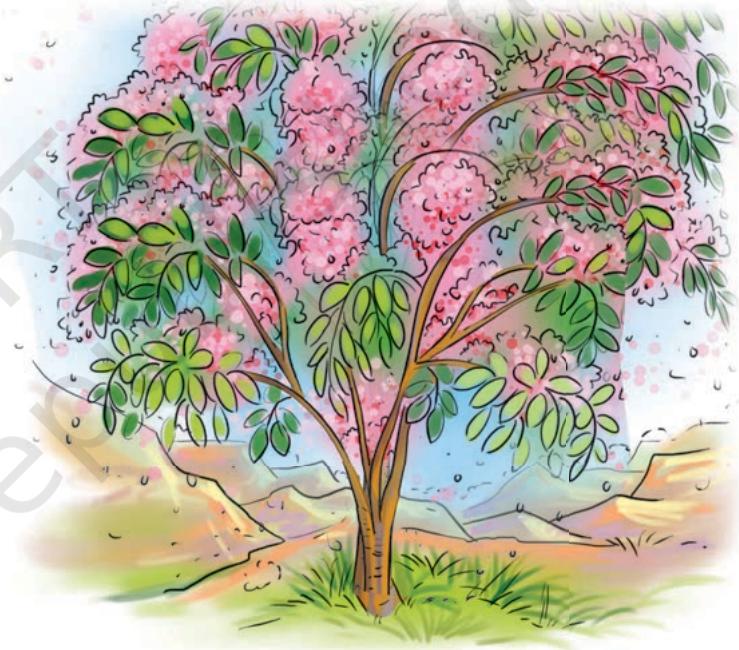
Rakesh and Grandfather gazed at the tree as though it had performed a miracle. There was a pale pink blossom at the end of a branch.
The following year there were more blossoms.
And suddenly the tree was taller than Rakesh, even though it was less than half his age. And then it was taller than Grandfather, who was older than some of the oak trees.
grumpy: badtempered
gazed: looked at something for a long time with admiration
But Rakesh had grown too. He could run and jump and climb trees as well as most boys, and he read a lot of books, although he still liked listening to Grandfather's tales.
In the cherry tree, bees came to feed on the nectar in the blossoms, and tiny birds pecked at the blossoms and broke them off. But the tree kept blossoming right through the spring, and there were always more blossoms than birds.
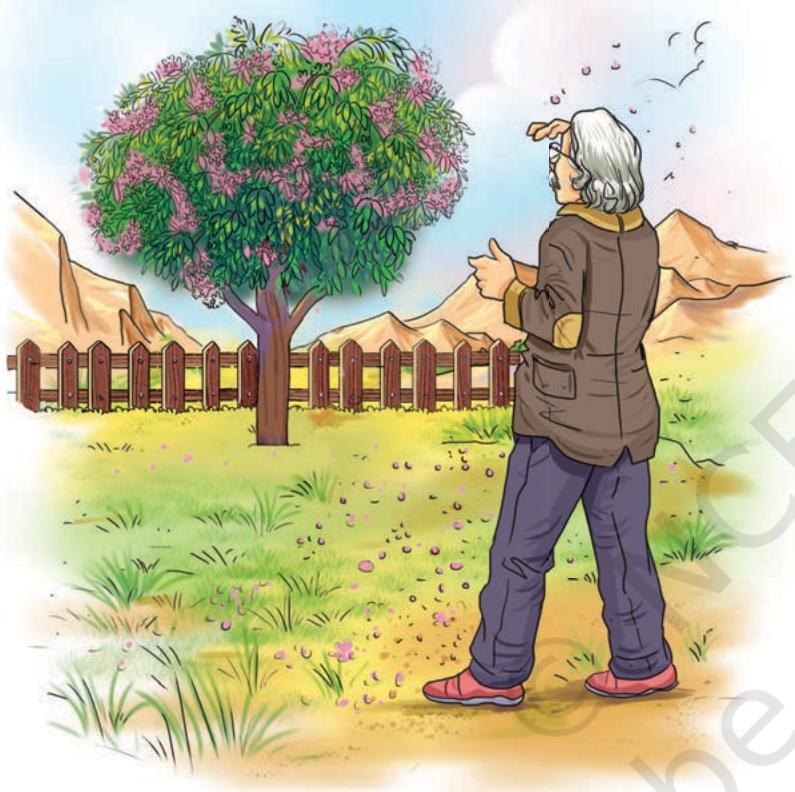
That summer there were small cherries on the tree. Rakesh tasted one and spat it out.
'It's too sour,' he said.
'They'l be better next year,' said Grandfather.
But the birds liked them—especially the bigger birds, such as the bulbuls and scarlet minivets—and they flitted in and out of the foliage, feasting on the cherries.
On a warm sunny afternoon, when even the bees looked sleepy, Rakesh was looking for Grandfather without finding him in any of his favourite places around the house. Then he looked out of the bedroom window
flitted: flew quickly
reclining: lying back
and saw Grandfather reclining on a cane chair under the cherry tree.
'There's just the right amount of shade here,' said Grandfather. And I like looking at the leaves.'
'They're pretty leaves,' said Rakesh. And they are always ready to dance, if there's a breeze.'
After Grandfather had come indoors, Rakesh went into the garden and lay down on the grass beneath the tree. He gazed up through the leaves at the great blue sky; and turning on his side, he could see the mountains striding away into the clouds.
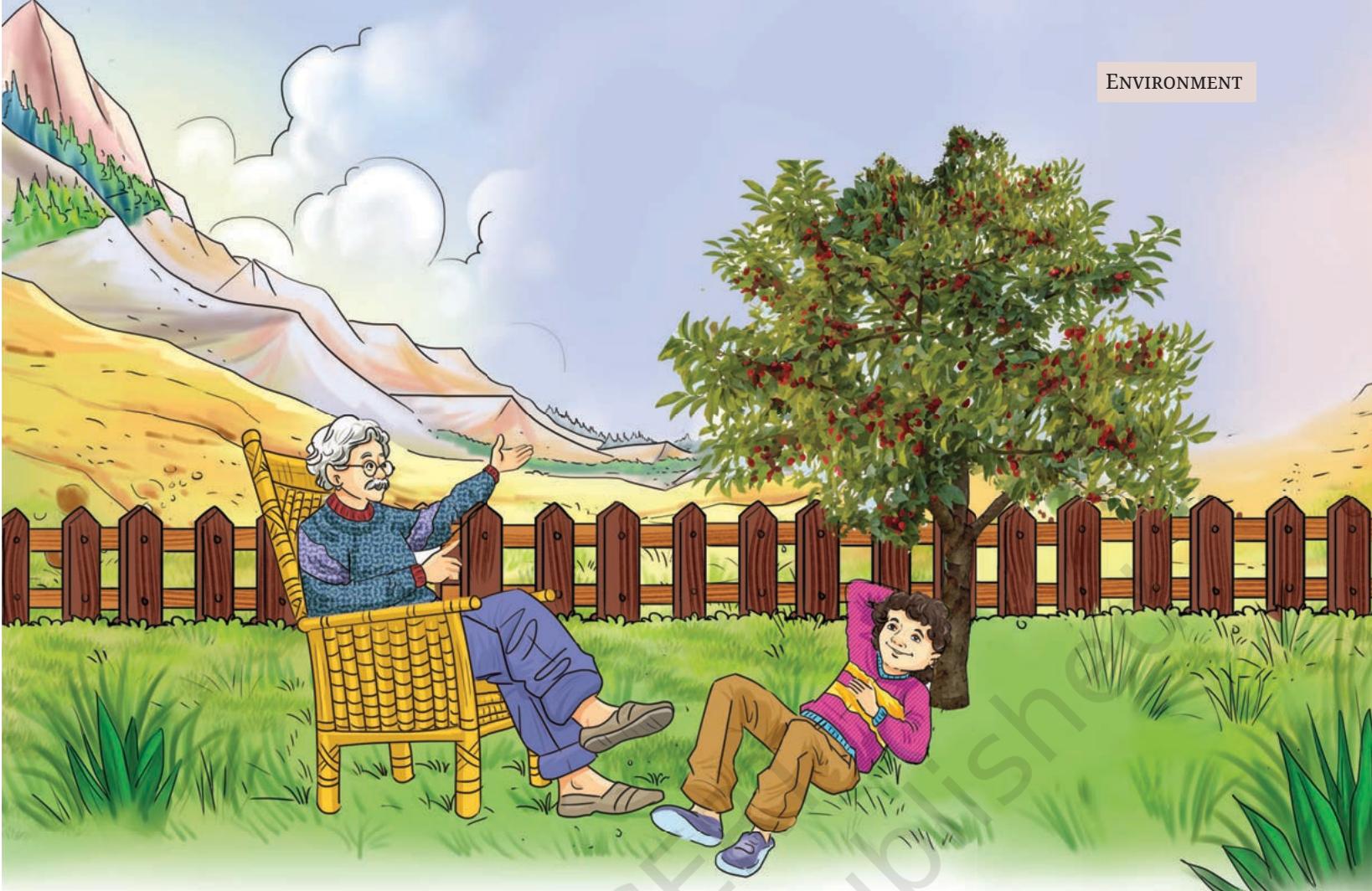
He was still lying beneath the tree when the evening shadows crept across the garden. Grandfather came back and sat down beside Rakesh, and they waited in silence until the stars came out and the nightjar began to call. In the forest below, the crickets and cicadas began tuning up; and suddenly the trees were full of the sound of insects.
'There are so many trees in the forest,' said Rakesh. 'What's so special about this tree? Why do we like it so much?'
'We planted it ourselves, said Grandfather. 'That's why it's special. X
Just one small seed,' said Rakesh, and he touched the smooth bark of the tree that he had grown. He ran his hand along the trunk of the tree and put his finger to the tip of a leaf. I wonder,' he whispered. Is this what it feels to be God?'
RUSKIN BOND nightjar: a bird cicadas: insects known for their loud distinctive calls, especially during evenings
Let us discuss
I Complete the table given below based on your understanding of Part II of the story. One example has been done for you. Share your answers with your classmates and teacher.
| Cause | Effect |
| 1. A womancut thecherry treewhile cutting grass. | (i) Grandfather scolded thewoman. |
| 2. | (ii)Rakesh was thinner butstronger when he came back. |
| 3. A hairy caterpillar startedeating the leaves of thecherry tree. | (iii) |
| 4. | (iv)Rakesh and Grandfathergazed at the tree as though itwas a miracle. |
| 5. Rakesh tasted one of the smallcherries during summer. | (v |
Let us think and reflect
I Read the given extracts and answer the questions that follow.
- "Have a cherry, Grandfather," he said, as soon as he saw his grandfather in the garden.
Grandfather took one cherry and Rakesh promptly ate the other two. He kept the last seed in his mouth for some time, rolling it round and round on his tongue until all the tang had gone. Then he placed the seed on the palm of his hand and studied it.
"Are cherry seeds lucky?" asked Rakesh.
"Of course."
"Then Ill keep it."
"Nothing is lucky f you put it away. If you want luck, you must put it to some use."
(i) Substitute the underlined phrase with a correct word from the extract.
The Kho-kho captain changed her strategy quickly and without delay when a new player came in from the opposing team.
(i) What does Rakesh's action of rolling the cherry seed in his mouth most likely suggest about his mood at that moment?
A. He is feeling impatient and restless.
B. He is enjoying the taste and the moment.
C. He is bored and has nothing better to do.
D. He is thoughtful and feeling playful.
(ii) Complete the following sentence suitably with reference to Rakesh and his grandfather.
Rakesh's decision to plant the seed shows that (he respects and values his grandfather's advice/he has a close bond with his grandfather and a willingness to learn from him)
(iv) How does the grandfather's advice reflect his view about luck and eff ort?
- Winter came early. The cherry tree bent low with the weight of snow. Field-mice sought shelter in the roof of the cottage. The road from the valley was blocked, and for several days there was no newspaper, and this made Grandfather quite grumpy. His stories began to have unhappy endings. ^
In February it was Rakesh's birthday. He was nine—and the tree was four, but almost as tall as Rakesh.
(i) Complete the following sentence suitably.
The phrase field-mice sought shelter in the roof of the cottage' suggests that
(ii) What can be inferred about the cherry tree's toughness from the line, 'The cherry tree bent low with the weight of snow"?
A. The weight of the tree was more than the snow.
B. The tree could withstand harsh weather.
C. The tree was growing close to the ground.
D. The snow gave support to the tree.
(ii) How did the early winter affect Grandfather's mood and storytelling?
(iv) Complete the sentence by choosing the correct option.
The comparison of Rakesh's age to the cherry tree's age symbolises • (the tree's growth paralleling Rakesh's own development/the tree standing as a dear one on Rakesh's birthday)
II Answer the following questions.
- Why did Rakesh's parents send him to Mussoorie?
- Why did Rakesh let the praying-mantis remain on the branch of the cherry tree?
- How is life in the Himalayan foothills described in the story?
- What might Rakesh mean when he says, "Is this what it feels to be God?" at the end of the story?
- How does the writer describe the relationship between Rakesh and his grandfather?
- What can you infer about the connection between humans and nature based on the story?
- Imagine Rakesh reflects on his wonderful experience of watching a seed being transformed into a full-grown cherry tree. Write how he must have felt.
Let us learn
I Each word list has one word that does not match with the other words. Identify the odd word. One example has been done for you.
- chop, trim, slice, mince ('chop', 'slice' and mince' are words used for cutting with a knife; whereas trim is to cut a part with a pair of scissors)
- plodded, galloped, scrambled, trudged
- tender, delicate, soft, smooth
- stared, peered, pecked, gazed
- growing, blossoming, progressing, planting
II Choose the most suitable taste words given in the box below and write against the food items that follow.
sweet sour tangy bitter spicy salty bland (tasteless)
- tamarind
- jaggery
- neem leaves
- paneer (cottage cheese)
- lemon
- pickle
- a dish of vegetables


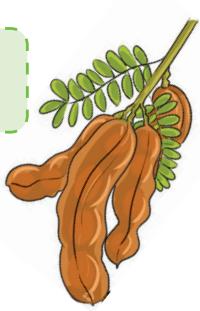
Now, use any fi ve taste words and make sentences of your own.
II Choose the correct antonyms for the textual words given below from the box. There are two extra words that you will not need.
growing ordinary unprotected cheerful hard wide fasting shaky fussing coldness
| 1. tender | 5. feasting | ||
| 2. sturdy | C) | 6. grumpy | |
| 3. narrow | 7. sheltered | ||
| 4. warmth | 8. special |
IV Read the following lines from the text and underline all the verbs and identify the form of tense.
- Rakesh was on his way home from school when he bought the cherries.
- Rakesh was looking for Grandfather without finding him in any of his favourite places around the house.
- Rakesh and Grandfather gazed at the tree as though it had performed a miracle.
The forms of tenses in the given statements are Simple Past Tense (1 and 3), Past Progressive Tense (2), and Past Perfect Tense (3).
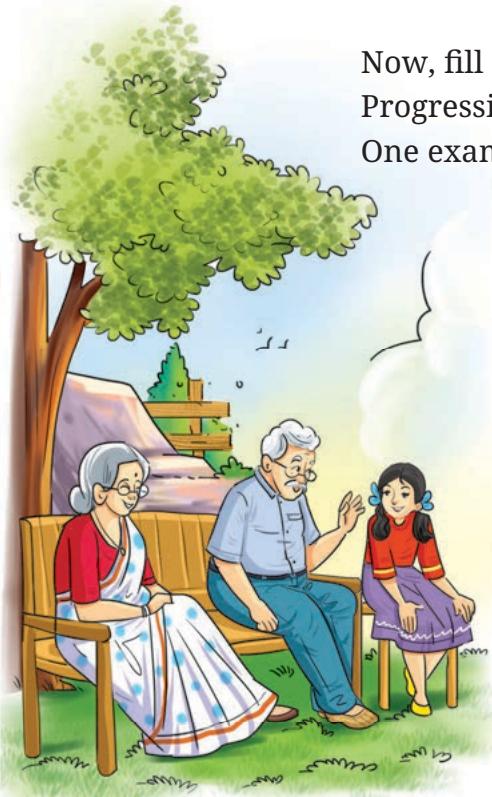
Now, fill in the blanks with the correct form of Simple Past, Past Progressive, or Past Perfect Tenses of the verbs given in brackets. One example has been done for you.
(i) I was sitting (sit) with my grandparents in the garden, sharing the wonderful memories from my childhood. As we (ii) (talk), I (ii) (realise) how much wisdom they (iv)_ (impart)to me overtheyears. While I(v) (listen) to their stories for hours together,I(vi) (remember)thetimeswe (vii) (spend) together planting flowers and learning about life. By the time I left, the sun (vii) (set), and I (ix) (feel) a deep sense of gratitude for the bond we (x) (nurture) through love, care, and countless memories.
V Study the punctuation marks in the following sentences from the text.
• "Hey, not there," said Grandfather "I've sown mustard in that bed. Plant it in that shady corner where it won't be disturbed." • When Grandfather saw what had happened, he went after the woman and scolded her; but the damage could not be repaired. • She did not try to avoid the tree: one sweep, and the cherry tree was cut in two.
Punctuation refers to the symbols used in writing to clarify meaning and separate sentences and their components. Proper punctuation ensures the clarity and flow of a text, guiding readers through its structure.
Here are some of the most common punctuation marks:
. Full stop (.)—ends a declarative sentence For example: She went to the store.
• Comma (,)—separates components in a list, clauses, or phrases within a sentence For example: We bought apples, oranges, and bananas.
• Question Mark (?)—ends a direct question For example: Where are you going?
• Exclamation Mark (!)indicates strong emotion or emphasis For example: Watch out!
• Colon (:)—introduces a list, explanation or elaboration
For example: He had one goal: win the race.
• Semicolon ()—connects closely related independent clauses or separates complex list items
For example: She likes reading; he prefers writing.
• Apostrophe (')
$\checkmark$ In contractions—He's (He is), they'll (they will), I'm (I am) $\checkmark$ To show possession—Jagan's book, the girls' toys $\checkmark$ If the noun ends in -s, add only the apostrophe—Manas' car • Quotation Marks (" ")—enclose direct speech or quotations For example: She said, "I'm happy."
• Dash (− or —)—adds emphasis or separates related thoughts For example: He was late—again.
• Capitalisation Rules
$\checkmark$ Names of people and places—Priya, India
$\checkmark$ Days, months, festivals—Monday, December, Diwali
$\checkmark$ Titles with names—Dr. Sneha, Mr. Patel
$\checkmark$ Deities and holy books—God, the Quran, the Bhagawad Gita
$\checkmark$ First person pronounI
$\checkmark$ Adjectives from proper nounsIndian, American
$\checkmark$ Geographical features, races, religions, languages—the Himalayas, Hindu, French
$\checkmark$ Titles of books, poems, or plays —Malgudi Days, The Road Not Taken, Good Heavens, etc.
Now, punctuate the following paragraph appropriately.
every sunday roshni would visit her grandparents house on their farm come sit grandpa would say patting the bench on their porch
roshni loved these moments where the world slowed down and stories flowed like magic grandma would bring tea her eyes twinkling with joy im excited to hear about your younger days the adventures the lessons and the memories roshni said eagerly
grandpa smiled softly his wrinkled hands resting on the cane ah the old days.. when everything was simple and happiness was all we had roshni could feel the warmth of those memories he sat in silence bound not by words but by a timeless bond
Let us listen
I You will listen to a conversation between a son and his mother. As you listen, select four true statements from 1–7 given below. (Transcript for teacher on page 201)
- The mother encouraged her son to deliver a presentation on the Chipko Movement.
- The son was surprised to know about the Appiko Movement.
- The son agreed that the Chipko Movement was about people uniting to make an impact.
- The mother expressed a desire to share more details about Saalumarada Thimakka.
- The mother was curious to hear about Saalumarada Thimakka.
- The mother and son were in disagreement about the work of Jadav Payeng.
- The son found the information on Jadav Payeng wonderful.
Let us speak
A syllable is a single, unbroken vowel sound in a word. Some words have only one syllable. Some have two and some more than two. For example, the word tree' has one syllable.
The word cherry' has two syllables—che-rry. (Here the hyphen is used to mark the gap between the two syllables.)
A syllable can also be called a beat because you can clap out the 'beats' in the word.
I Work in pairs. Read aloud the following words from the text. Write the number of syllables in each word. Check your answers with your classmates and teacher.
mountains grandfather tender disturbed caterpillar Himalayan performed intention slope newspaper favourite
Now, read the words aloud again with the beats. Check if the number of syllables matches with the number of beats.
I Speak about Van Mahotsav Diwas and its significance. Before you speak in the class or assembly, prepare yourself on the following points:
• When is it celebrated? • Who celebrates it? • Why is it celebrated? • How is it celebrated? • What is the message it conveys?
Let us write
An article is a piece of writing on a specific topic. It showcases independent opinions expressed by a writer. Articles are published in newspapers, newsletters, magazines, journals, and online portals.
Let us understand how to draft an article for a school magazine.
Remember to
• write the heading or title at the top,
• write the name of the writer below it as a byline, and
• follow the correct layout.
$\checkmark$ Paragraph 1: Give a brief introduction of the topic or issue. Focus on the main idea of the paragraph.
$\checkmark$ Paragraph 2: Elaborate by giving facts and advantages.
$\checkmark$ Paragraph 3: Include consequences and disadvantages.
$\checkmark$ Paragraph 4: Provide suggestions. End with a word of hope, a word of caution or a call for action.
Now, complete the article for a magazine on Trees-Our Lifeline'. Use the words and phrases given in the box below.
absorb carbon dioxide Moreover, our planet reduces pollution Additionally would stop existing ensures a better future climate control Trees-Our Lifeline To conclude If trees were not there
(i) -by (write your name and class)
Trees are essential for life on Earth. Without them, life as we know (ii) This is the reason why trees are our lifeline. Trees provide us with food, shelter, and even medicine. Trees (ii) and release oxygen, helping us breathe. This process also (iv) and keeps the environment clean. (v)
trees give us fruits, nuts, and other foods.Trees also help in (vi) and prevention of soil erosion. (vi) the air would be polluted, and we would struggle to breathe. (vii) would be barren, lacking food, shelter, and life-giving greenery. (ix) trees are true friends. Protecting and planting trees (x) for everyone on Earth. Therefore, we must act now to protect and plant more trees, preserving Earth's green lifeline for future generations.
Let us explore
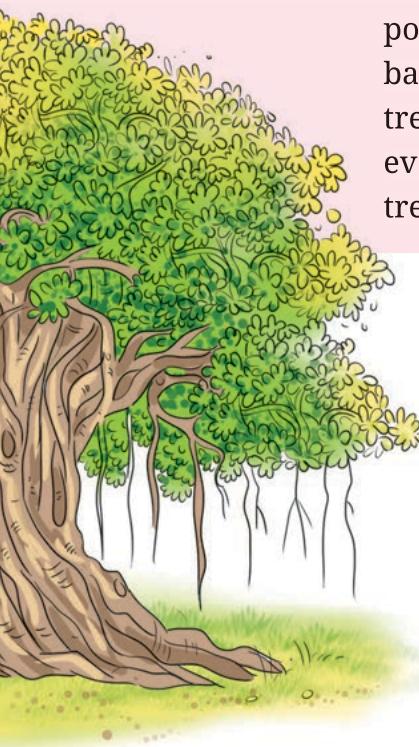
I Did you know that the banyan tree is the National Tree of India? Our country has age-old banyan trees. Some of them are:
The Great Banyan, located in Shibpur, Howrah, near Kolkata.
Dodda Aalada Mara, located in Kethohalli village, near Bengaluru.
Thimmamma Marrimanu, in Anantapur District in Andhra Pradesh. It was recorded as the largest tree specimen in the world in the Guinness Book of World Records in 1989.
II Kailash Sankhala, The Tiger Man of India', was an Indian biologist and conservationist. He carried out a census of the tigers in India in 1971. Later, because of his studies, he was appointed the first director of Project Tiger—an initiative to prevent the extinction of the Indian Tiger. He was awarded the Padma Shri in 1992.
Now, find more information about such Indian environmentalists and share with your classmates.
Rakesh saw the V-shaped formation of wild ducks flying northward. Did you know?
There is a reason that these birds fly in this V-shaped formation.
The birds position themselves to fly just behind and to the side of the bird in front (V-shape), timing their wing beats to catch the uplifting' wind currents. This helps them fly long distances easily and save theiri energy too.
HARVEST HYMN
Let us do these activities before we read.
I Work in pairs and share your responses with your classmates and teacher.
India celebrates many harvest festivals. When is the harvest festival celebrated in your region and how is it celebrated?
A hymn refers to a song of praise. (i) To whom do we offer a hymn? (i) When and where do we sing a hymn? (iii) Why do we offer it?
II Some poets and authors use words that are no longer a part of common usage. Such words are called archaic words.
Work in pairs. Read the sentences given below. Match the underlined archaic words in Column 1 with their meanings in Column 2. Share your answers with your classmates and teacher.
'Thou art my friend, and I trust thee. Thy kindness is great, and everything that is mine is thine.'
| Column 1 | Column 2 |
| 1. thou | (i)yours |
| 2. art | (i)you (object) |
| 3. thee | (ii)you (subject) |
| 4. thy | (iv)are |
| 5. thine | (v)your |
IIl Work in pairs. Read the paragraph and select the correct meaning for each underlined word from the options given below. Share your answers with your classmates and teacher.
Under the golden 1. radiance of the evening sun, the villagers gathered to pay 2. tribute to their 3. cherished elder, who had dedicated his life to their well-being. His wise 4. counsel had guided generations, steering them through challenges. Known for his 5. munificent spirit, he never hesitated to share his resources generously.
- radiance • (i) glow (ii) brilliance
- tribute (i) respect (i) gratitude
- cherished (i) preserved (ii) loved
- counsel (i) advice (ii) decision
- munificent (i) rich (i) generous
Let us read
Men's Voices:
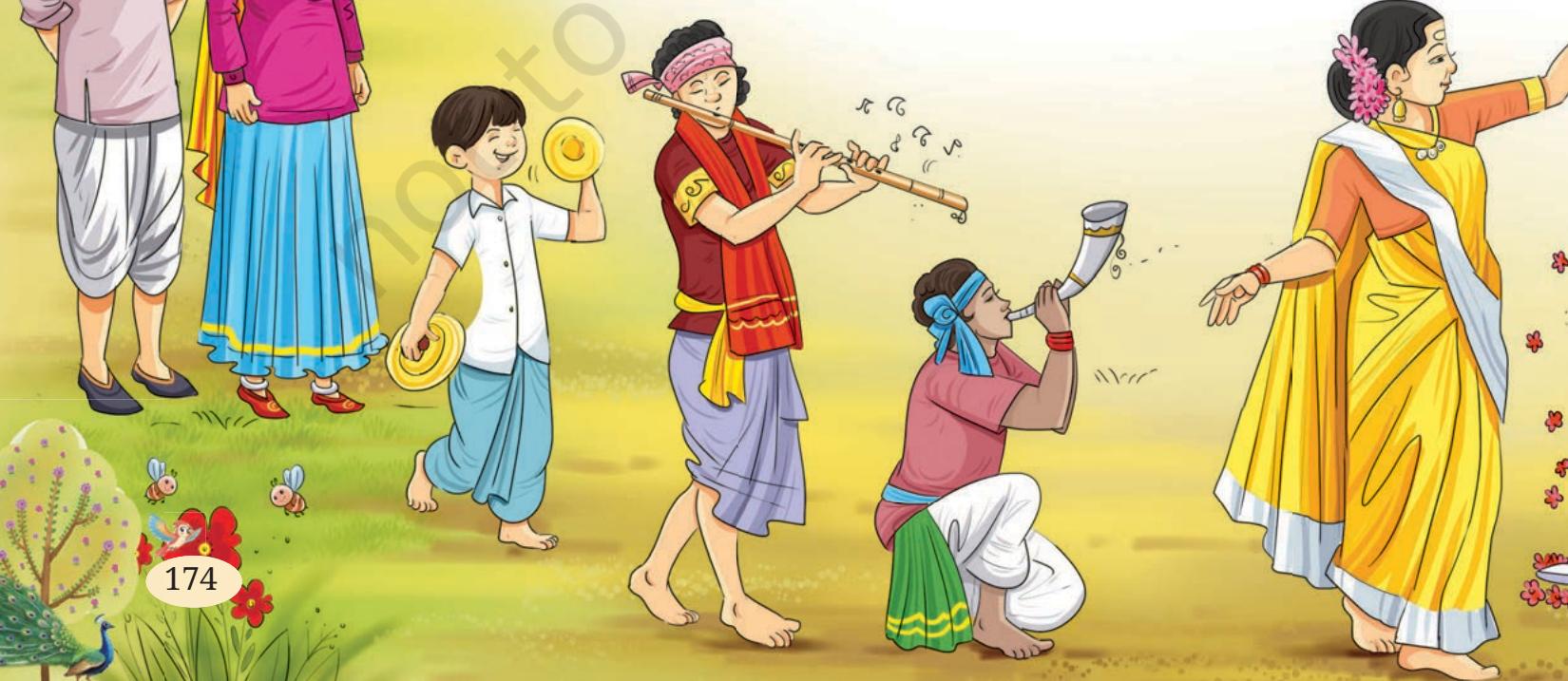
Lord of the lotus, lord of the harvest, Bright and munificent lord of the morn! Thine is the bounty that prospered our sowing, Thine is the bounty that nurtured our corn. We bring thee our songs and our garlands for tribute, The gold of our fields and the gold of our fruit; O giver of mellowing radiance, we hail thee We praise thee, O Surya, with cymbal and flute.
Lord of the rainbow, lord of the harvest,
Great and beneficent lord of the main!
Thine is the mercy that cherished our furrows,
Thine is the mercy that fostered our grain.
We bring thee our thanks and our garlands for tribute, The wealth of our valleys, new-garnered and ripe; O sender of rain and the dewfall, we hail thee,
We praise thee, Varuna, with cymbal and pipe.
Women's Voices:
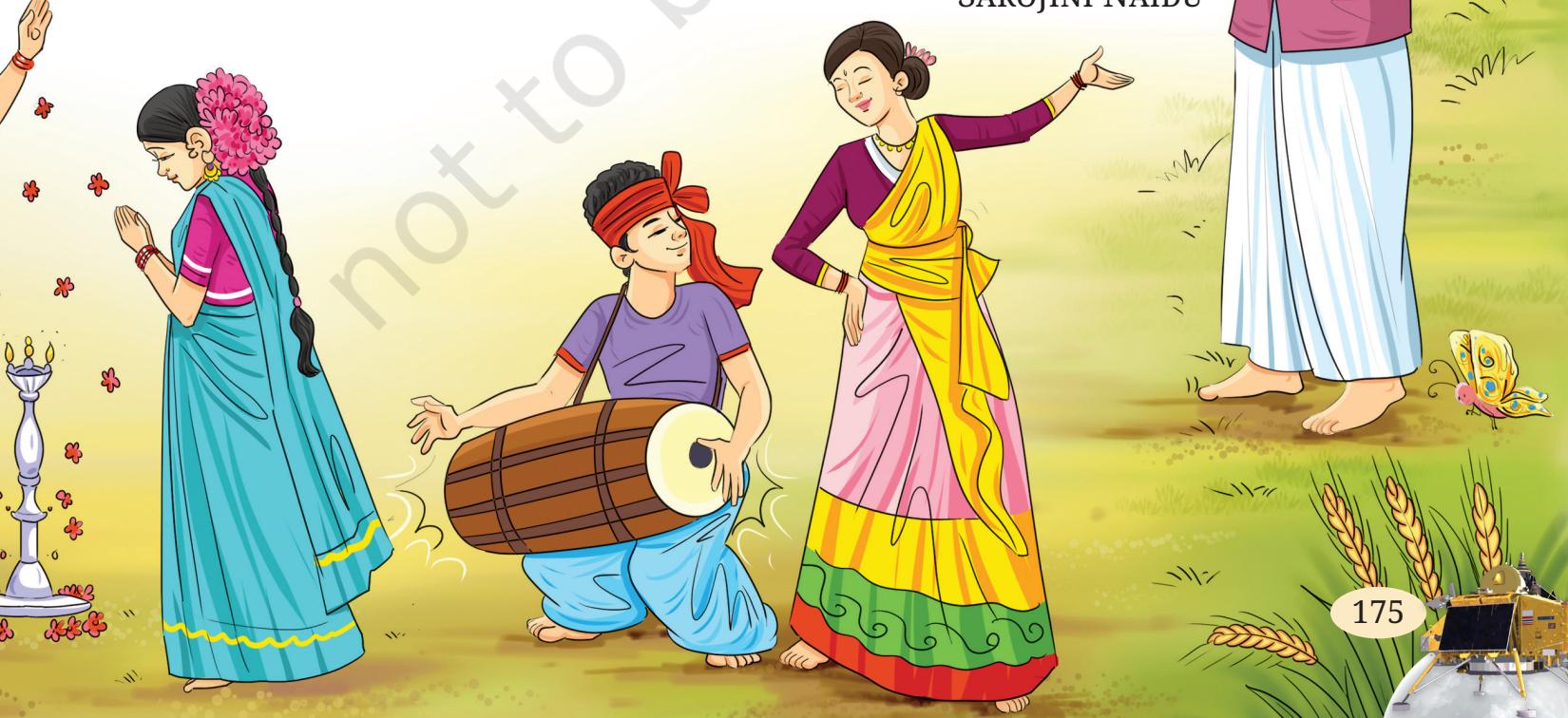
Queen of the gourd-flower, queen of the harvest, Sweet and omnipotent mother, O Earth! Thineis the plentiful bosom that feeds us, Thine isthe womb where our riches have birth. We bring thee our love and our garlands for tribute, With gifts of thy opulent giving we come; O source of our manifold gladness, we hail thee, We praise thee, O Prithvi, with cymbal and drum.
All Voices:
Lord of the Universe, Lord of our being, Father eternal, ineffable Om! Thou art the Seed and the Scythe of our harvests, Thou art our Hands and our Heart and our Home. We bring thee our lives and our labours for tribute, Grant us thy succour, thy counsel, thy care. O Life of all life and all blessing, we hail thee, We praise thee, O Bramha, with cymbal and prayer.
SAROJINI NAIDU
Let us discuss
I Write the stanza number for the main idea of each stanza given below. Share your answers with your classmates and teacher.
| 1. The speakers recognise the lord's kindness and praise him for nourishing the field. | |
| 2. The speakers praise the generosity of the creator of the universe who ensures a rich harvest. | |
| 3. The speakers devote their lives and work as a mark of respect to the lord and seek his support, wisdom, , and care. | |
| 4. The speakers pay homage to the Earth and appreciate her role in supporting life, by dedicating t their harvest. O |
Il Fill in the blanks by choosing the appropriate words or phrases from within the brackets.
The setting of the poem is a rural landscape, possibly during a (harvest/religious) festival.
The tone of the poem is respectful and celebratory because it praises (the men and women/ nature and the Lord) with deep respect and gratitude.
In the line 'Thou art our Hands and our Heart and our Home', the letter $\mathbf { \epsilon } ^ { \mathrm { { h } } }$ is capitalised in 'Hands', Heart' and Home' because (it represents the hard work of farmers/God resides in them)
III Identify the poetic device used in the following lines from the poem.
• Bright and munificent lord of the morn! • We bring thee our lives and our labours for tribute
IV Match the lines from the poem in Column 1 with their expressions in Column 2. Choose the appropriate poetic device from the box given below and write in Column 3.
imagery alliteration simile metaphor personification
| Column 1 | Column 2 | Column 3 |
| 1.sweet andomnipotentmother | (i) createsacleardescriptionof the scene andappeals tothe senses | |
| 2.The wealth ofour valleys,new-garneredand ripe | (ii)implied comparison ofblistgrowthand reapingwithbeginningandendofalllife | blist |
| 3. Thou art theSeed and theScythe | (ii)the earth isbeinggivenhuman-like qualities |
V Certain words or phrases are repeated in the same line of the poem.
For example, The gold of our fields and the gold of our fruit;
Find more such repetitions from the poem. What is the poet's purpose of using repetition in the poem?
VI The poem uses symbolism to convey deeper meanings. Match the symbols in Column 1 with the meanings they convey in Column 2.
| Column 1 | Column 2 |
| 1. Prithvi (the Earth) | (i)light,energy, liferepresentingthegiverofwarmthandprosperity |
| 2. Surya (the Sun) | (ii)mercyandnourishment—crucial foragriculture andsustenance |
| 3.Varuna (Rain) | (ii)fertile land,motherhood, nurturing—the sourceof all life |
Let us think and refl ect
I Read the given extracts and answer the questions that follow.
- We bring thee our songs and our garlands for tribute, The gold of our fields and the gold of our fruit; O giver of mellowing radiance, we hail thee, We praise thee, O Surya, with cymbal and flute.
(i) What does the act of bringing songs and garlands as tribute suggest about the people's relationship with the divine?
A. They fear the gods and wish to calm them in any way possible.
B. They have a deep sense of reverence and gratitude towards the divine.
C. They are forced to perform rituals without understanding the divine.
D. They depend on the gods for their daily needs and activities.
(ii) Complete the following sentence suitably.
The word 'gold'in the phrases the gold of our fields' and the gold of our fruit' symbolises
(ii) How does the description 'giver of mellowing radiance' help us understand Surya's role in the harvest?
(iv) Fill in the blank by selecting the correct option from those given in the brackets.
The use of cymbal and flute signifies . (joy and celebration/meditation and worship)
- All Voices:
Lord of the Universe, Lord of our being, Father eternal, ineffable Om! Thou art the Seed and the Scythe of our harvests, Thou art our Hands and our Heart and our Home.
(i) In the phrase Lord of our being,'what does the word being'most likely refer to?
A. Our physical body B. Our entire existence C. Our spiritual practices D. Our earthly possessions

(ii) Identify whether the following statement is true or false.
The imagery of 'the Seed and the Scythe' symbolises the divine's role as both the beginning (creation) and the end (harvest) of the agricultural cycle.
(ii) Identify the phrases from the extract that mean the following:
A. The divine as a timeless, everlasting presence B. Beyond human comprehension or description (iv) How do we know that these lines from the extract are spoken as a chorus?
II Answer the following questions.
Why do the farmers hail the God of rain?
What is being referred to as 'wealth of our valleys'? Why?
State one reason why the women refer to the Earth as a 'source of manifold gladness'.
Why does everyone in the poem offer their labours for tribute'"?
Why has the poet presented the poem as voices of men, women, and all voices? ^
How does the poet create the joyous atmosphere of rural India at harvesting time?
Why is the poem presented as a hymn?
Let us learn
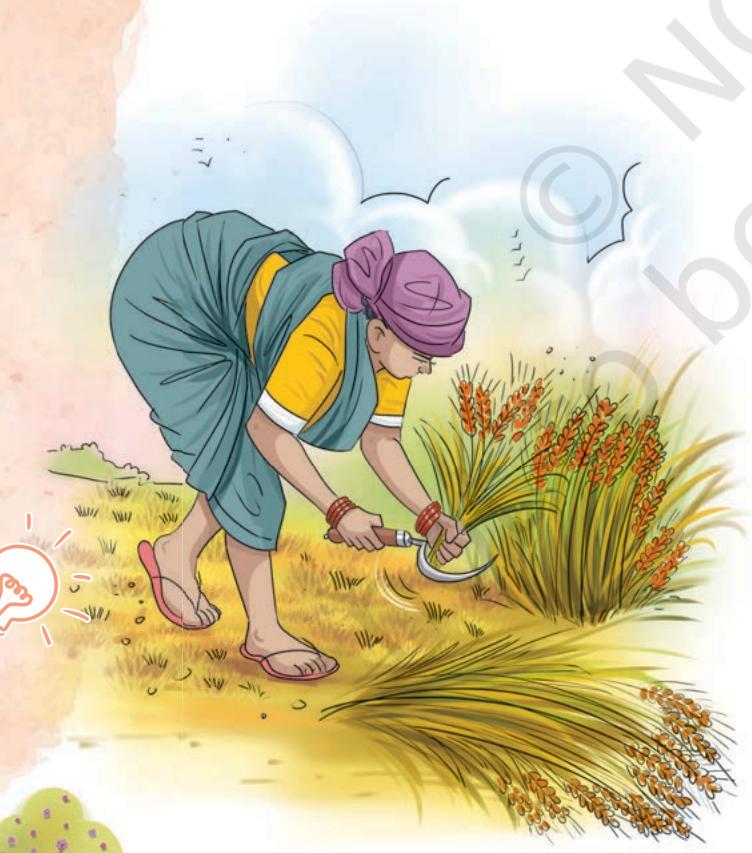
I Match the pictures of the farming implements given in Column 1 with their use given in Column 2. Then, fill in the blanks in Column 3 to complete the name of the implement.
| Column 1 | Column 2 | Column 3 |
| 1. | (i) A tool with a long handle S_C KLwith metal teeth forcollecting hay or leaves. | |
| 2. | (i) A small hand tool used SC_THfor digging and makingshallow furrows. | |
| 3. | (ii) A hand-held tool with a PL__G Hcurved blade attached to ashort handle. It is used forharvesting crops. | |
| 4. | (iv) A tool pulled by oxen. It isused for turning over thesoil in the field so that seedscan be sown or planted. | TRW_L |
| 5. | (v) A farm tool having a flatrectangular blade attachedto a long wooden handleused for digging the soil. | R_K_ |
| 6. | (vi) A hand-held tool with a S P_Dlong-curved blade attachedto a long handle used forcutting tall grass. |
I Choose the correct synonyms for the underlined words in the given sentences from the box below. Circle the words or phrases in the sentences that helped you to infer the meanings. One example has been done for you.
generous help brightness indescribable kind
- The king was beneficent to the poor because hetook good care of them.
synonym: kind
- He was munificent towards the needy and donated a lot for their health care.
synonym:
- When he lost his job, all his friends gave him succour by supporting him with money.
synonym:
- When the sun's rays came into the dark room, the whole room was full of radiance.
synonym:
- The little girl was speechless with ineffable joy when she got her birthday gift from her aunt.
synonym:
III You have learnt about some archaic words. Some more archaic word are given below. Refer to a dictionary to find commonly used word which are similar in meaning.
morrow 2. hither 3. quoth
betwixt 5. yonder
Let us listen
I Listen to the talk about paddy cultivation. As you listen, number the events in the correct order in which they happen. (Transcript for teacher on page 203)
- Transplanting of seedlings
- Ploughing of soil
- Threshing of grains
- Puddling of land
- Harvesting of paddy
- Irrigating the field
- Milling of rice
I Now, listen to the talk again. As you listen, choose the correct option to answer the questions that follow.
- What is the main step in preparing the soil for cultivation of rice?
(i) Ploughing the soil (ii) Clearing the soil (ii) Puddling the soil
- How long does it take for rice seeds to grow into seedlings before being transplanted?
(i) 2-3 weeks (ii) 4–5 weeks (ii) 6-7 weeks
- Why is drying rice grains important after threshing?
(i) To get rice seeds for plantation (ii) To separate the rice grains easily (iii) To store the rice grains for longer
Let us speak
I In English, some letters are not pronounced in certain words. For example, in words like knife', knowledge', and know', the fi rst letter $\mathbf { \delta k } ^ { \mathbf { \eta } }$ is not pronounced. Let us look at a few more such examples.
• In the words given below the letter $\mathbf { \epsilon } ^ { \prime } \mathbf { n } ^ { \prime }$ is silent when it appears with 'm' at the end of the word. hymn, column, autumn, solemn Now, say these words aloud.
• In the words given below the letter b' is silent when it appears with $\mathbf { \omega } ^ { \prime } \mathbf { m } ^ { \prime }$ . womb, tomb, bomb, climb, comb
Now, say these words aloud.
II In our country, harvest is celebrated with the preparation of delicious dishes. Work in groups and make a presentation on any popular dish made during the harvest festival in your region. Use the prompts given in the box to make your presentation. Make sure that all the members share their views.
Include the following:
• What is the dish called? Is it known by any other name in other parts of India?
• What ingredients are used to make the dish?
• How is the dish prepared?
• How is the dish served?
• What does the dish taste like?
• What is the special ritual related to the preparation of this dish?
• Describe any special memory associated with the preparation of this dish.
| Column 1 | Column 2 |
| Greet the audience | Good morning to all of you gathered here... |
| Introduce the members ofyour group and your topic | Today we, and_ are here to tellyou about... |
| Explain the structure ofyour presentation | • We will start off with...• Following this, we will move on to...• The next point we will deal with is..• Finally, we will speak about... |
| Speak about the first point | • Let's begin by..• I'd like to start by.….. |
| Describe the details | • Now I'll move on to...• Next...• I'd like to now discuss...• Let's now consider...• Let me tell you about |
| Conclude your presentation | • In conclusion, I'd like to say...• To summarise... |
| Thank the audience | • Thank you for listening. Thank you for your attention. |
Let us write
Creative slogans are used to spread a message to capture the reader's attention. Some examples are given below:
• Education is the Key, Unlock Your Destiny!
• Protect the Environment Today for a Better Tomorrow
• Learn, Grow, Succeed
• Go Green by Keeping the Planet Clean
Your school wishes to express gratitude to the farmers who play an important role in providing us the food on our plates. Draft a creative slogan to be put up on the school notice board.
Remember to
• focus on the main idea to be expressed • use simple language • be concise—express yourself in a few words
You may write the slogan on a chart paper and decorate it.
Let us explore
I Millets are a varied group of small-seeded grasses. They have more fibre and minerals than other cereals. Millets have been a part of the Indian cuisine for years. They have been rediscovered worldwide as superfoods.
- Read the information on Pearl Millet given below.
Pearl Millet (Pennisetum glaucum (L.) R. B.)
Common name: | Vernacular names:
Spiked millet or Pearl millet (English), Bajra (Bengali, Hindi, Oriya, Punjabi, Urdu), Bajree (Rajasthani, Gujarati, Marathi), Sajje (Kannada), Kambu (Tamil), Sajja (Telugu)
Cultivation areas:
Rajasthan,
Maharashtra,
Gujarat,
Uttar Pradesh and
Haryana
Nutritional Profile:
Highest niacin content amongst all cereals; rich in protein and dietary fiber.
It is the sixth major cereal in terms of area and production and has the highest drought tolerance potential of all millets. Pearl millet is the most widely cultivated cereal in India after rice and wheat.
Health benefits:
Reduces cholesterol Promotes bone health Beneficial in treating stomach ulcers Promotes heart health Aids in weight loss
| NUTRIENTS | VALUE PER 100 GRAMS |
| Energy (Kcal) | 347 |
| Protein (g) | 10.9 |
| Fat (g) | 5.43 |
| Carbohydrate (g) | 61.8 |
| Ca (mg) | 27.4 |
| Fe (mg) | 6.4 |
| Folic Acid (μg) | 36.1 |
Uses: Khichdi, Roti, Upma, Idli, Khakhra, Parathas
Use the link given below to know more about other kinds of millets.
https://eatrightindia.gov.in/millets2023/assets/documents/Millets $% 2 0 - % 2 0$ Nutritious%20Cereal%20of%20India.pdf
- Work in groups of four and do the following activities.
(i) Find out if millets are a part of your cuisine.
(ii) Find recipes with millets and compile them into a booklet.
(ii) Create a recipe of your choice.
I Songs related to harvest season form a part of our culture and heritage. Talk to the elders in your house and learn a song sung on a harvest festival. Share it with your classmates and teacher. Then, compile all the songs to create a songbook with the help of teacher.
WAITING FOR THE RAIN
Let us do these activities before we read.
I Have you ever waited for the rains? Why?
II How do you feel when it rains after a long time?
1II Why do you think the farmers wait for the rains?
Iv Discussin groups what happens when you wait for something or someone for a long period of time.
How do you spend the waiting period?
What do you think about?
How do you feel?
Share your answers with your classmates and teacher.
Let us read
I
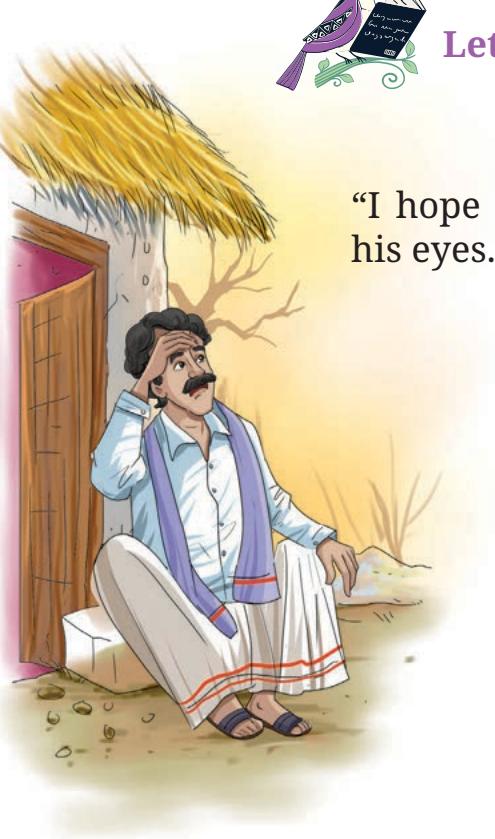
"I hope it rains at least today," Velu thought, as he opened
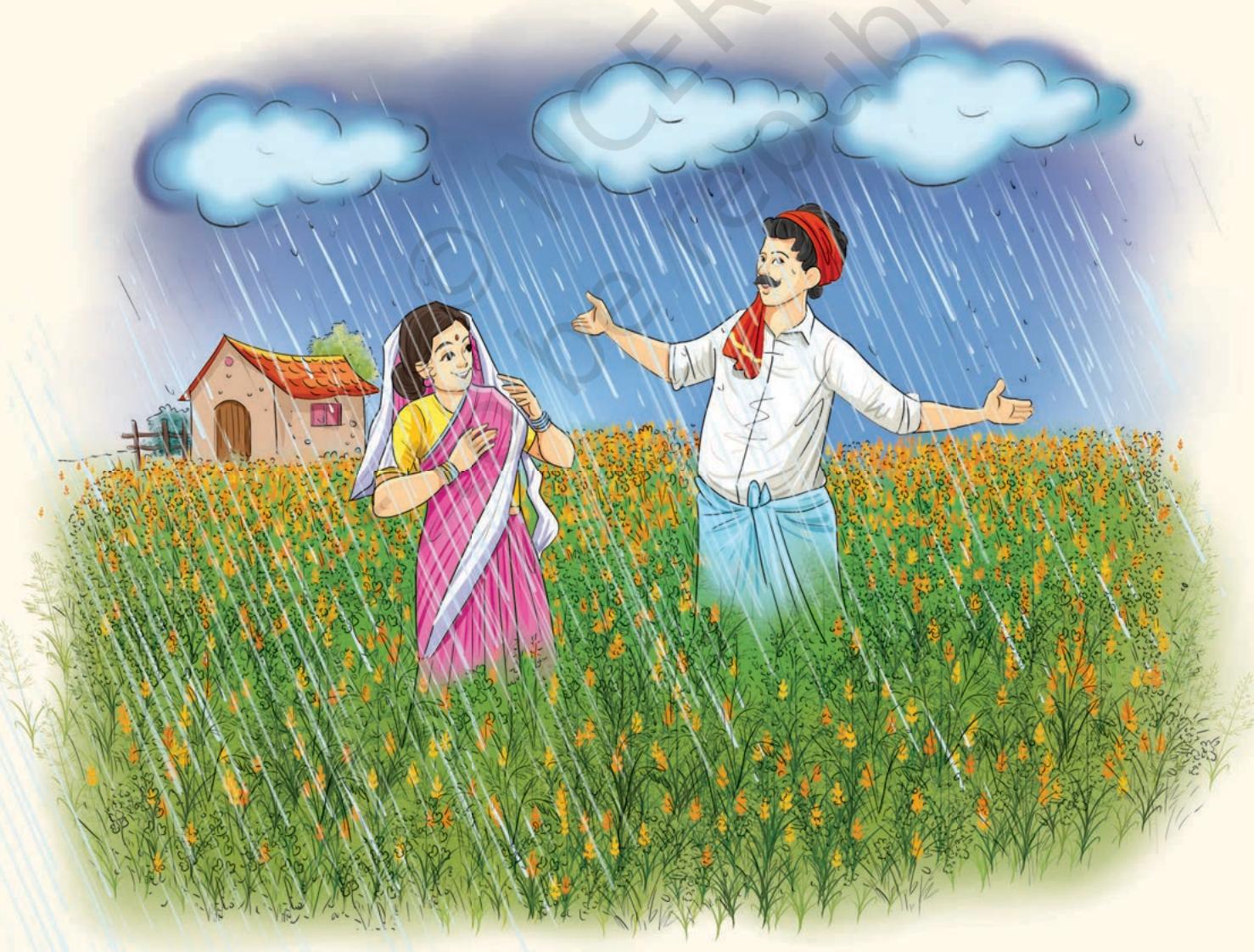
Velu was a farmer. The sun was beginning to rise, glowing crimson like fi re. Velu scanned the sky. There was not a cloud.
"It doesn't look encouraging," he muttered to himself and got up.
Rain or no rain, a farmer wakes up early. Velu worked hard. His piece of land never failed him. Season after season he cultivated it, harvesting jowar one season and dhal the next. Throughout the year he worked, never thinking of rest or taking a holiday. For nearly six years it had been so, ever since he had got his own piece of land.
crimson: deep red colour
But this year turned out to be different. At the end of summer, the rains didn't come. Velu and his neighbours waited, but their waiting didn't end. Days, weeks and months passed, and still there was no rain.
crusted:
formed a hard outer layer forlorn: sad and neglected
The fields lay untended, the earth $\setminus$ hardened, crusted and cracked. The barren land looked forlorn and the farmers lived entirely on hope. Every day they hoped that the rains
would come.
Someone said, "We ought to talk to some astrologers. They can tell us what will please the heavens and the heavens will send down rain."
Velu didn't agree. He said, "The rains came all these years without any such consultations; I can't see how talking to astrologers will bring rain."
He decided to go to the weather offi ce in the city and talk to someone. But the people at the weather offi ce said they couldn't really tell him when the sky would gather clouds and bring rain. "We are at a loss ourselves!" they exclaimed. "So many favourable conditions but still no rain. Very odd!"
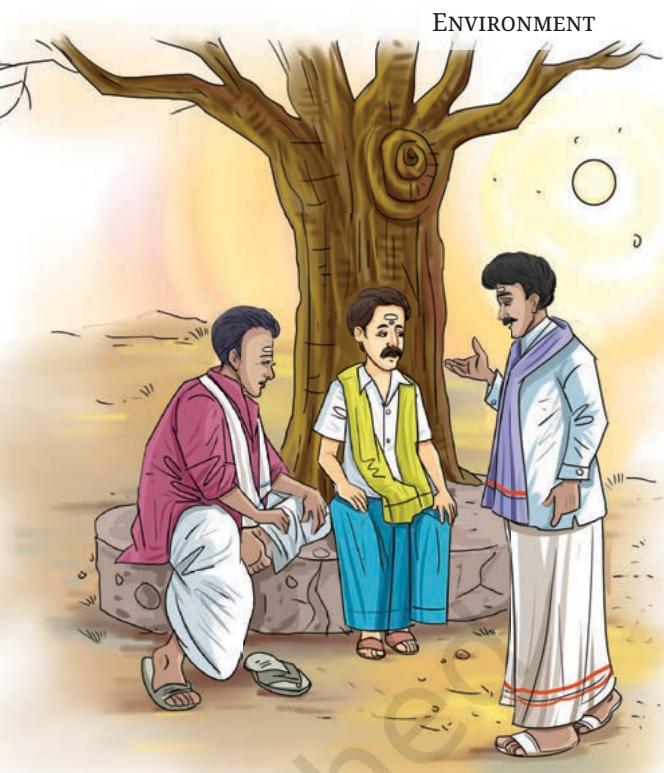
Velu, too, was at a loss. He walked back to the village, tired, and dejected. He was thirsty and the dust made him cough and sneeze. He decided to rest for a while.
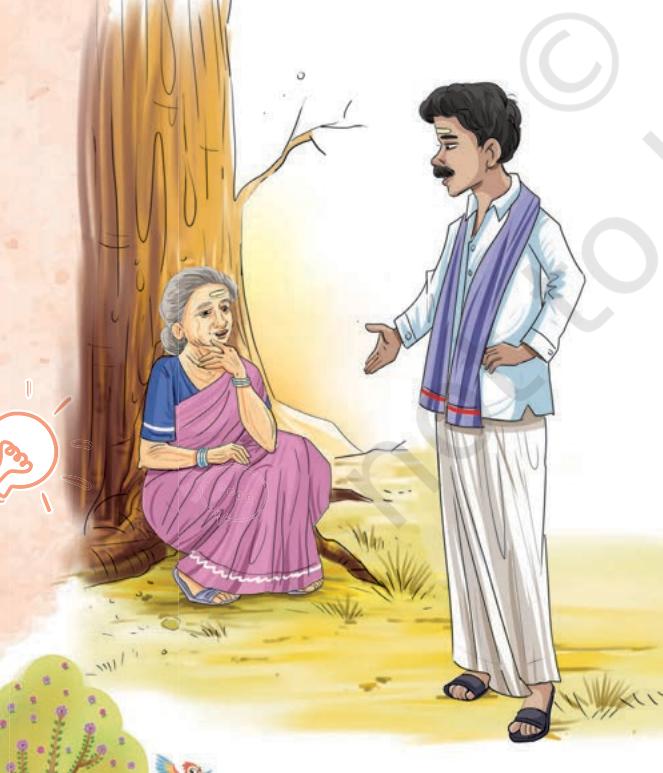
He saw a large tree. Its shade was cool and inviting. As he sat down, he noticed that an old woman was also sitting there, sheltering from the sun.
consultations: discussions
dejected: sad and disappointed
Let us discuss
I Complete the table given below. One example has been done for you. Share your answers with your classmates and teacher.
| What wasSaid | Who Said | What was Said | Who Said |
| 1.Itdoesn'tlookencouraging. | Velu | to himself | He looked upat the sky. |
| 2. The rainscameall theseyearswithoutany suchconsultations... | Velu | Xed | Xed |
| 3.So manyfavourableconditions butstill no rain. | RT | RTolisx | olisx |
II Do you think the old woman would help Velu? If yes, why? If no, why not?
III Will Velu's wait continue or will it rain?
II
Her skin was wrinkled, but her eyes sparkled when she smiled. She looked at Velu and her smile grew wider, her wrinkles deeper.
"What are you smiling at, Amma?" Velu asked. "Without the rains, there's nothing to smile about."
"Yes, yes, you're right," the old woman said, the smile leaving her lips.
"I wonder what I have done to deserve this,"
Velu began. "I have worked hard and honestly.
Yet I am being punished. Without the rains I can't till the land. If I don't till the land no crop will grow.
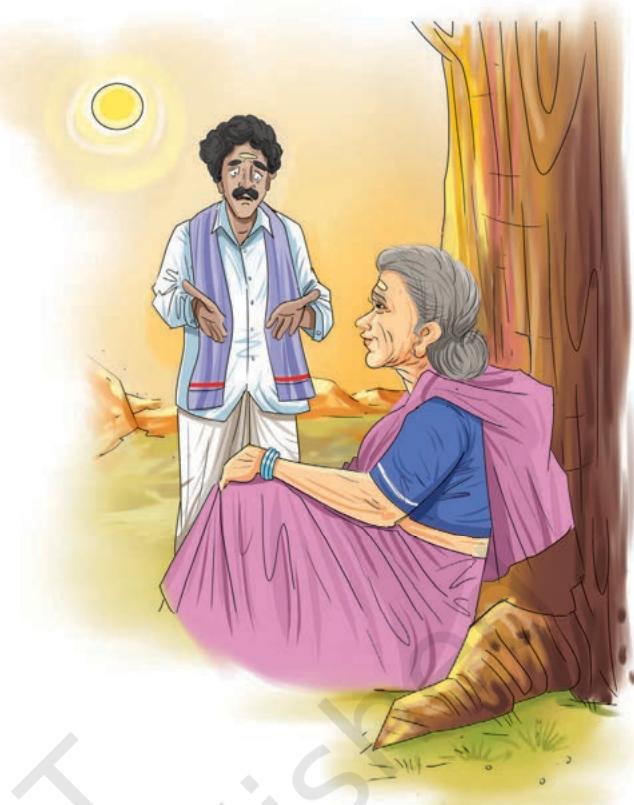
What will happen to me? How shall I feed my family?" he asked, somewhat bitterly. He wasn't speaking to anyone in particular, but the old lady thought that he was opening his heart to her.
"Perhaps you have worked too hard, she said.
"What do you mean? Can anyone work too hard? I have only done what any hard-working farmer would do. I shall work and never rest until I am too old. This is the fi rst season in five, no, six years that I have not sown, nor ploughed.Oh, it is hard not to be able to work.." said Velu a little angrily.
bitterly: hurtfully
"But my son, that is what I am talking about. You have strength now. You can work without a break. But have you thought about the land? The earth works, too, when you plough, and sow, and plant. The earth has worked for years, centuries, in fact, thousands of years. The soil, the land, the earth .. shouldn't someone let the land rest a bit?" the old woman said, softly, smiling.
POORVI
"Rest? Let the land rest? I don't understand," Velu looked at her, a little puzzled.
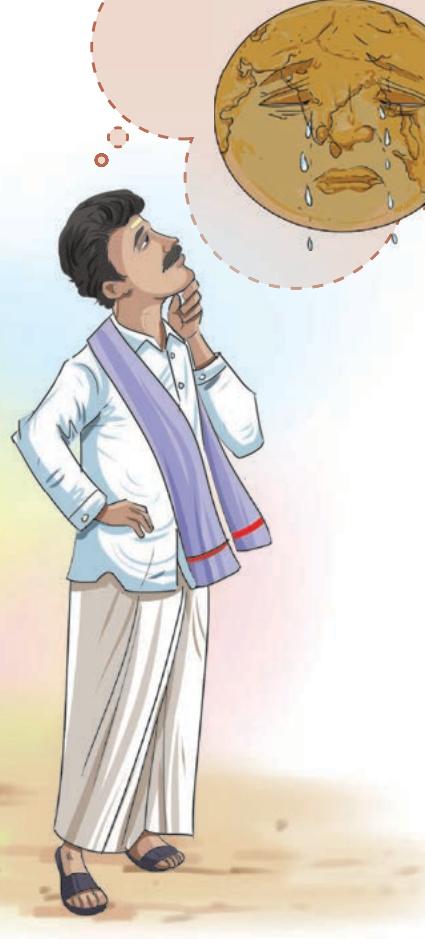
"Yes, my son, that is the difficulty. You don't realise that the earth is old.. But Nature is a mother to all of us. To you and to me. And to the trees, the water and the soil. She takes care to give her children the rest they need.."
Velu began to understand.
"When the rains don't come, you are dejected. But $\boldsymbol { \mathscr { f } }$ in that way the land is left alone. The land lies undisturbed, staring at the sky. resting.. And when the rains come, it will spring back into activity, fresh and ready for your crop. Go home, my son, Nature knows a thing or two.. go home,"' she said, and got up.
ceaseless: continuous
She walked away. After a while Velu, too, got up and walked home-ward. He thought about the land, his beloved piece of land, which, if he were to believe the old woman, was perhaps breathing peacefully, taking a break from the constant, ceaselessyear-round cultivation.
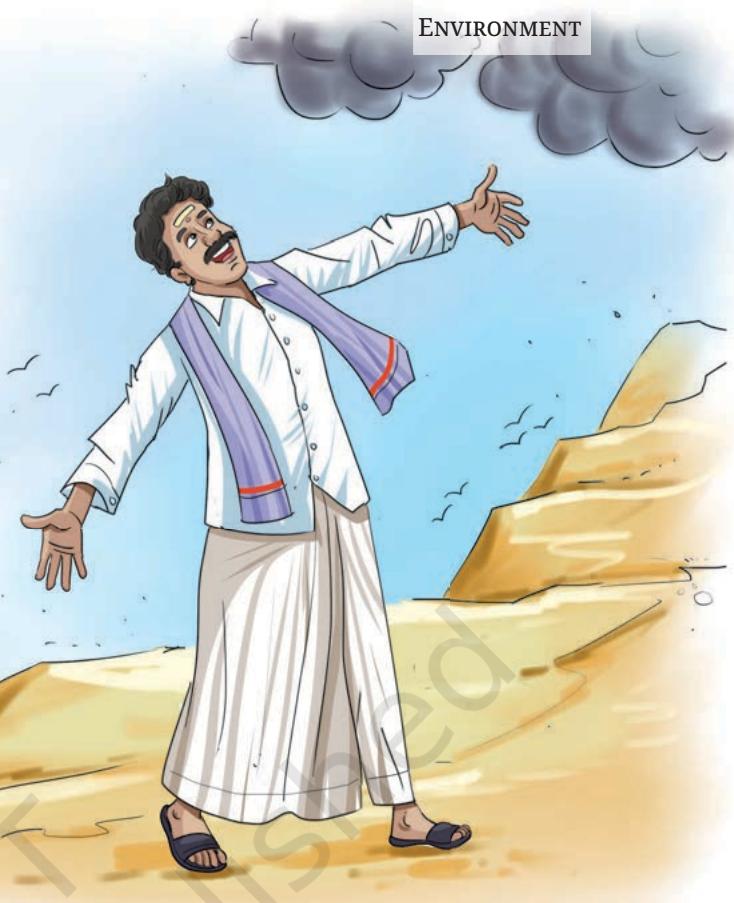
"Perhaps she is right," he thought, as he approached the village. It was already evening. The sun was low in the sky. And.. what was that? Velu felt a cool breeze on his back.
Then he felt a tiny drop on his shoulder. He looked up. Yes.. the clouds were gathering in the distance. It was growing dark. Soon there would be lightning. And thunder. And sweet, fragrant rain.
Velu ran home, laughing and happy.
KAMAKSHI BALASUBRAMANIAN
Let us discuss
I Complete the following statements given below with suitable reasons.
Velu asked the old woman to stop smiling because
Velu said thatit was hard notbeing able to worksince
Velu was confused when the old lady said that the land needed rest because
The old lady said that it was good for the land when it didn't rain as •
Velu ran home laughing and happy because
Let us think and refl ect
I Read the given extracts and answer the questions that follow.
- ".I can't see how talking to astrologers will bring rain."
He decided to go to the weather office in the city and talk to someone. But the people at the weather office said they couldn't really tell him when the sky would gather clouds and bring rain. "We are at a loss ourselves!" they exclaimed. "So many favourable conditions but still no rain. Very odd!"
(i)What does the first line of the extract tell us about Velu's beliefs?
(i) Complete the following sentence with a suitable reason. Velu is determined to seek information about the rain because . (he was at a loss of words/he wants to find a practical solution to the drought affecting his farm)
(ii) Complete the table with reference to Velu's weather off ce visit.
| Expectation (What I think will happen) | Outcome (What actually happened) |
| A |
(iv) Complete the following sentence with a suitable option.
The absence of rain despite favourable conditions, shows •
A. lack of astrological knowledge B. ineffectiveness of farmers like Velu C. delay in understanding the weather D. unpredictability of nature
- "The soil, the land, the earth.. shouldn't someone let the land rest a bit?" the old woman said, softly, smiling.
"Rest? Let the land rest? I don't understand," Velu looked at her a little puzzled.
"Yes, my son, that is the difficulty. You don't realise that the earth is old... ,
(i) The old woman's advice was accompanied with a soft tone and a smile. What does that tell us about her?
(ii) Fil in the blank with the correct option from those given belov The old woman's advice Velu, at that moment.
A. failed to impress B. confused C. scared D. made sense to (ii) State one thing about the old woman when she referred to Velu as 'my son', while offering advice.
(iv) Complete the following sentence with a suitable explanation.
The 'difficulty' that the old woman mentions is due to the fact that_ •
II Answer the following questions.
- How does the old woman convey Nature's wisdom to Velu?
- The writer says, The fields lay untended..'Why couldn't the farmers tend to their fields in the absence of rain?
- Support the old woman's perspective that the land needs rest just like people do.
- What can be inferred about Velu's character based on his reaction to the drought?
- What does the story suggest about the life of farmers and their relationship with nature?
- How might the rest and care of land contribute to a balanced and sustainable ecosystem?
Let us learn
I Solve a crossword using picture and word clues. All clues are related to the words from the text that are connected to weather or agriculture.
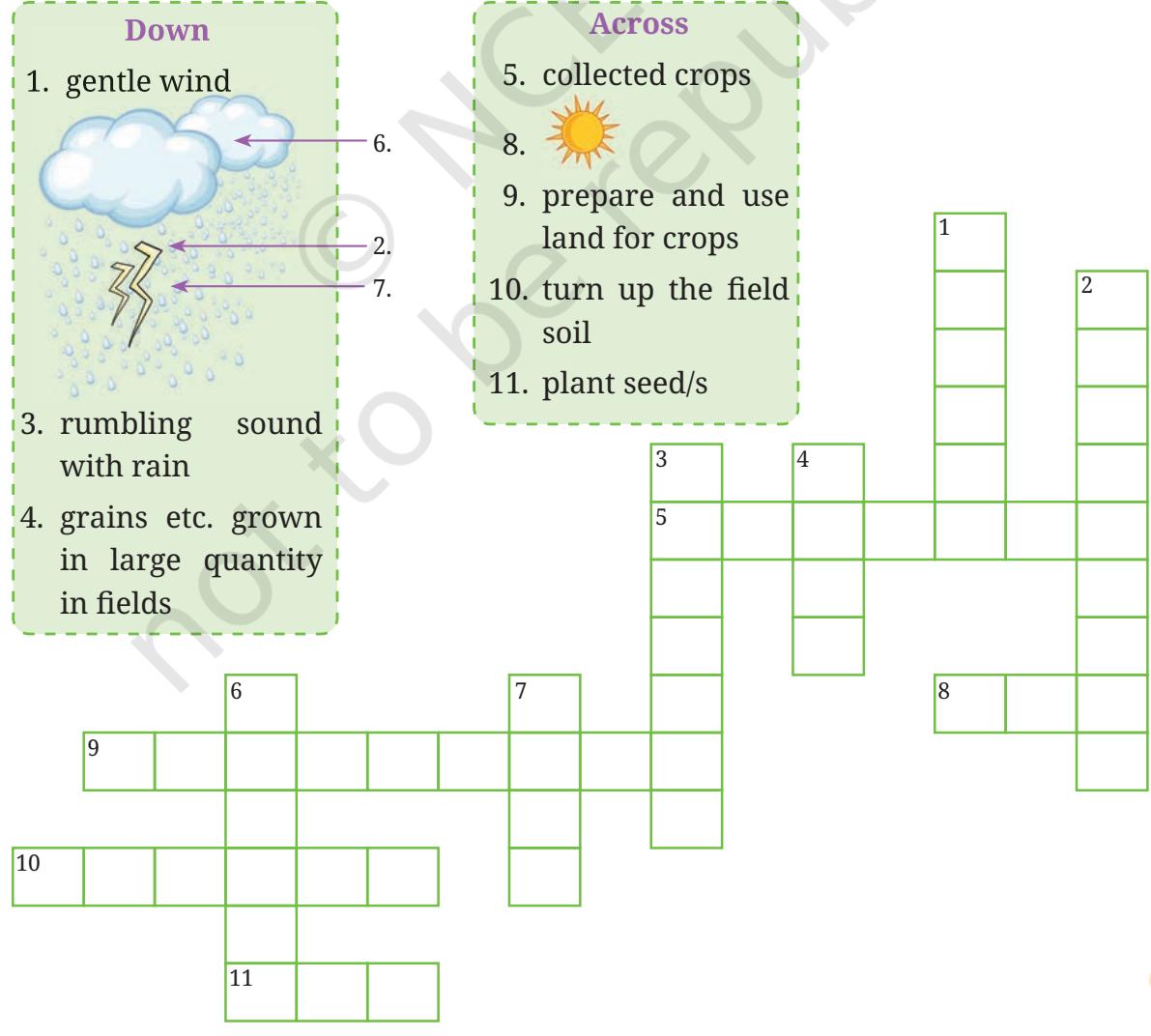
I The text uses words like piece,' 'weather,' 'son,' and rain'. These words are the same as other words that are spelt differently—peace, whether, sun, and reign.
Words that are pronounced the same as other words but differ in meaning or in spelling are called homophones.
Now, complete the paragraph by filling in the correct option of homophones given in the brackets.
The farmer looked at the sky and wondered 1. (weather/whether) the clouds would finally bring rain. He sat down on the ground, breaking a small 2. (piece/peace) of roti for his meal. The 3. (plain/plane) fields stretched endlessly before him, completely dry. He thought about how he could 4. (sell/cell) his last sack of grain to buy some essentials for his family. Without the rains, it didn't 5. (seam/seem) possible to grow another crop this season. Despite his worries, he smiled, knowing that every farmer hopes for the next 6. (rain/reign) by nature to bring life back to the land.
II Choose the correct meanings from the given options for the underlined words or phrases in the following sentences.
- Being annoyed, she muttered something which nobody heard.
(i) spoke in a low voice (i) spoke slowly (ii) spoke angrily
2 At the new work place, Riya felt forlorn for a week.
(i) upset and irritated (i) angry and bitter (ii) sad and neglected
- When all his friends had gone, he was at a loss because he did not know what to do.
(i) confused (ii) shocked (ii) lonely
- When the little child saw her father, her eyes sparkled.
(i) glowed dimly (ii) showed joy (ii) opened wide
IV Match each word (adjective) in Column 1 with a word (noun) that collocates in Column 2. Write the adjective-noun collocation in Column 3. One example has been done for you.
| Column 1 | Column 2 | Column 3 |
| 1. favourable | (i)country | favourable weather |
| 2. wrinkled | (ii)activity | |
| 3. dejected | (ii)weather | |
| 4. fragrant | (iv) skin | |
| 5.ceaseless | (v) garden | |
| 6.beloved | (vi)expression |
V Underline the verbs and identify the forms of tenses for the following sentences from the text.
- Oh, it is hard not to be able to work.
- ….I am too old.
- What are you smiling at, Amma?
- But my son, that is what I am talking about.
- The earth has worked for years, centuries...
- I have worked hard and honestly.
The forms of tenses in the given statements are Simple Present Tense (1 and 2), Present Progressive Tense (3 and 4) Present Perfect Tense (5 and 6).
Now, fill in the blanks with the correct form of Simple Present, Present Progressive or Present Perfect tenses of the verbs given in brackets.
Ravi (i) (be) a farmer who (ii) (practise) crop rotation on his land. Each season, he (ii) (plant) different crops to maintain the soil's health. This year, he (iv) (grow) legumes, which help restore the nutrients in the soil. Over the years, Ravi (v) (learn) that planting the same crop repeatedly (vi) (deplete) the soil, making it less fertile. By rotating crops, he (vi) (keep) the land productive and fertile. He (vi) (see) a noticeable improvement in his yields since adopting this method. Now, Ravi (ix) (share) his knowledge with other farmers, explaining how crop rotation(x) (benefit) both the soil and their harvests.
VI Study the highlighted words in the following sentences from the text.
• The rains came all these years without any such consultations.
• So many favourable conditions, but still no rain.
• Every day they hoped that the rains would come.
• But this year turned out to be different.
• This is the first season in five, no, six years that I have not sown, nor ploughed.
• We ought to talk to some astrologers.
• I have only done what any hard-working farmer would do.
• She takes care to give her children the rest they need.. • Velu looked at her, a little puzzled. d • Velu felt a cool breeze on his back.
The highlighted words or phrases that come before a noun but do not describe them are called determiners.
Let us learn the use of some common determiners.
• Articles: a, an, the These are used to introduce nouns.
• Demonstrative Determiners: this, that, these, those These are used to point out specific items.
• Possessive Determiners: my, our, your, his, her, its, their, one's These indicate ownership or relationship.
• Definite Numeral Determiners: one, two, three, etc. These specify exact quantities.
• Indefi nite Numeral Determiners: some, any, no, al, much, many, few, less, several, little and few √ 'Some' is used in affirmative sentences, while 'any' and 'no' are used in negative and interrogative sentences. All refers to the entirety of a group. 'Much' and 'many' denote large quantities of uncountable and countable nouns, respectively. $\checkmark$ 'Few' indicates a small number, less' refers to a smaller quantity, and several' means more than two but not many. $\checkmark$ 'Little' means not much, few' means not many. Use a little' and 'a few' to convey a positive sense.
• Distributive Determiners: each, every, either, neither
$\checkmark$ 'Each' refers to individual items or people, 'every' refers to all items or people collectively.
$\checkmark$ 'Either' means one of two options and 'neither' means not one of the two options.
Now, fill in the blanks by choosing the correct determiner from those given in the brackets.
It was 1. (a/an) rainy afternoon, and 2. (a/the) sky was thick with dark clouds. Mala noticed a large puddle quickly forming in front of 3. (her/their) house. Excited, she called for her brother to join her, knowing that both of them always loved playing in 4. (a/the) rain. While jumping from 5. (some/one) puddle to another, Mala spotted 6. (few/a few) snails slowly creeping along the wet sidewalk and pointed them out to her brother. With 7. (each/every) jump, the sound of both 8. (her/their) squeals and laughter was heard through the soft patter of raindrops. Though they were fully drenched 9. (either/neither) siblings minded it. It had been a perfect rainy day.
Let us listen
I Listen to the weather forecast. As you listen, fill in the blanks with the exact word you listen to. (Transcript for teacher on page 204)
Delhi will mostly have a sky with light rain.
Moderate rain is likely to happen in
Kolkata is likely to have a maximum temperature of around ${ } ^ { \circ } { \mathsf { C } } .$
There is a chance of a in Chennai.
Bengaluru will have a temperature of $2 9 ~ ^ { \circ } \mathrm { C }$ .
Taking an is advisable because of the weather conditions.
Let us speak
I Here is a tongue twister about 'weather. Practice saying it as fast as you can.
Whether the weather be fi ne, or whether the weather be not, whether the weather be cold, or whether the weather be hot, well weather the weather, whatever the weather, whether we like it or not.
I Rain has arrived after a long dry spell on the Earth. Imagine the Rain and the Earth have a conversation. Work in pairs and present the role-play.
You may use the hints in the table given below.
You may start the conversation in the following way.
Rain: Greetings, Earth! It's been a while since we've met. How have you been?
Earth: Hello Rain! I am so glad to see you.
To continue the conversation, use the hints given below.
Rain
Earth
Ask about how the Earth has been.
Respond and express relief at the arrival of Rain.
Speak about your long journey from the Earth to the sky and back again to the Earth.
Enquire why it took so long for Rain to arrive.
Express gratitude for the gift of water.
Ask about how the Earth can use the gift you brought rain water.
Speak about how important Rain is to you-for agriculture, for plants and animals to survive.
Elaborate how much you enjoy being on the Earth.
Enquire how Rain feels about being on Earth.
Thank the Earth for the invite. Promise to return on time the next year.
Invite Rain to join the celebration of the rivers, forests, and people of Earth.
Let us write
I You have observed the difficulties faced by the people in your neighbourhood due to scarcity of water especially during the summer months. Write a letter to the Councillor of your Municipal ward, requesting her/him to set up a rain water harvesting unit. Provide suggestions to address the issue.
Remember to
• use formal language
keep sentences short and to the point state the purpose clearly and concisely • give relevant details
Format and Layout:
Sender's address
Date
The Municipal Councillor (Receiver's designation and address)
Subject: Request to Install a Rainwater Harvesting Unit in Ward
No.44
Dear Madam,
Paragraph 1: Drawing attention to the problem
Paragraph 2: Causes and Consequences Body of the letter
Paragraph 3: Request and Suggestions
Paragraph 4: Conclusion
Yours sincerely,
Signature of the sender
(Sender's full name in brackets)
Let us explore
I Rest is very important for us to function in a proper manner. Even the Earth needs rest. This is known as fallowing.
Read the facts given below related to fallowing:
• A fallow year refers to leaving the land without sowing for one, or several vegetative cycles.
• This is done to allow the land to recover its nutrients and retain moisture. It also helps to avoid spreading of diseases and controlling pests.
• The sustainable land management method has been applied for centuries, wherein a field is divided into two halves—one is planted with crops while the other remains unplanted. Then, the process is reversed in the following year.
II Find out from your Vocational Education teacher about Agriculture as a vocation and other related vocations, such as horticulture, etc.
III India's rich tradition of meteorological knowledge includes indigenous forecasting systems, grounded in ancient wisdom. These provide sophisticated methods for predicting climate, calculating rainfall, and issuing early warnings.
References to rain and weather are found in numerous ancient texts, including the Rigveda, Shrimad Bhagavad, Parashara Samhita, Panini's Ashtadhyayi, and Meghmala. These texts offer insights into rainfall patterns and seasonal changes.
IV Meteorological Services for Agriculture in India
The primary objective of the Agricultural Meteorology Division, India Meteorological Department (IMD) is to minimise the impact of adverse weather on crops and to leverage crop-weather relationships to boost agricultural production.
In addition to forecasts and advisories, several other weather related services are also provided.
For detailed information, please visit: https://mausam. imd.gov.in/responsive/servicesMetEnvironment.php
TRANSCRIPTS
THE CHERRY TREE
Let us listen (refer to page 170)
I You will listen to a conversation between a son and his mother. As you listen, select four true statements from 1–7 given below.
SON : Amma, could you help me with this project?
MoTHER : Why not? What's the project about?
SON : It's about the Chipko Movement. I have to make a PowerPoint presentation and talk about it in class.
MoTHER : That's good! Chipko Movement was all about hugging trees to prevent them from being cut, isn't it? Such an inspiring movement it was!
SON : Yes, it was the first time that common people came together for the noble cause of saving trees. It showed how people can also make a difference. Have you heard or read about something similar?
MoTHER : Yes, of course. The success of the Chipko Movement led to the Appiko Movement.
SON : Really? Doesn't appiko mean hugging in Kannada? So, did they also hug trees to protect them?
MoTHER : Yes they did. In this movement people not only hugged trees to protect them but also regenerated the forest areas in the Western Ghats.
SON : That's great! This reminds me of what my teacher shared about Saalumarada Thimakka last week. She is a Padma Shri awardee.
MoTHER : What an amazing personality! I've heard about her and I'm interested to know what your teacher has shared with you.
SON : She is an Indian environmentalist who has been planting trees since 1948. She has planted over 8000 trees in the area around her village.
MoTHER : Wonderful!
SON : What I admire about her is the commitment she has towards conserving the environment.
MoTHER : Incredible! That is one superwoman! But do you know who the Forest Man of India is?
SON : Yes, I've read about him. It is Jadav Payeng, from Assam. He too is a Padma Shri awardee. Isn't he the one who single-handedly turned a barren land of around a thousand acres into a lush green forest? He did so by planting nearly forty million trees.
MoTHER : Yes, you're absolutely right. It was not something that happened overnight. It took him thirty years to achieve this. This forest has become a habitat for different kinds of animals including migratory birds.
SON : Fascinating, isn't it? I've read a book and watched a documentary in school about him which has really inspired me.
MoTHER : I'm glad that you have begun to care about the environment too.
Let us listen (refer to page 181)
I Listen to this talk about paddy cultivation. As you listen, number the events in the correct order in which they happen.
Hello everyone!
Did you know that rice is actually a type of grass, and the part we eat is its seed? Let me tell you about the process of cultivating rice.
It all starts with preparing the land. First, the soil has to be ploughed. Rice is typically grown in fertile soil that holds a lot of water. The most important step in preparing the soil is to soak it with plenty of water. This step is called puddling. Once the nursery bed is prepared, the seeds can be planted. After that, we sow the seeds on the soil's surface.
Paddy farmers have to ensure that their fields stay flooded with water because irrigation is crucial. It takes around 4 to 5 weeks for the seeds to grow into seedlings. After this comes the most important step—transplanting. The seedlings that were prepared in the nursery bed are uprooted and then transplanted into the flooded fi eld.
In around 120 days, the rice plants are fully grown. At this point, the crops are harvested by cutting them. Following this, the seeds are separated from the plant. This is called threshing. To reduce the moisture content even more, the separated grains are dried. This ensures that they can be stored or processed further. Through a process called milling, the rice is separated from the outer covering on it.
Finally, the rice reaches the market, and that's where we get it to make all kinds of delicious foods. Whether it's Appam, Pulao, Khichdi, or Daal Bhaat, rice is a big part of many meals.
I Now listen to the talk again. As you listen, choose the correct option to answer the questions that follow.
Let us listen (refer to page 197)
I Listen to the weather forecast. As you listen, fill in the blanks with the exact word you listen to.
Hello and welcome to today's weather forecast.
Delhi is expected to have a generally cloudy sky with light rain. The temperature will range between a minimum of $2 5 ~ ^ { \circ } \mathrm { C }$ and a maximum of $3 6 ~ ^ { \circ } \mathrm { C }$ .
The sky will generally be cloudy with moderate rain in Mumbai. The minimum temperature is $2 4 ~ ^ { \circ } \mathrm { C }$ and the maximum will be around $3 0 ~ ^ { \circ } \mathrm { C }$ .
Moving eastwards, Kolkata will have a partly cloudy sky with one or two spells of rain or thundershowers. The minimum temperature will be $2 8 ^ { \circ } \mathrm { C }$ and the maximum will be around $3 4 ^ { \circ } \mathrm { C }$
Chennai is expected to have a partly cloudy sky with a possibility of thunderstorm. The minimum temperature will be $2 7 ~ ^ { \circ } \mathrm { C }$ and the maximum will be around $3 6 ~ ^ { \circ } \mathrm { C }$ .
Bengaluru will have a generally cloudy sky with light rain. The minimum temperature will be $2 1 ~ ^ { \circ } \mathrm { C }$ and will rise to a maximum of around $2 9 ^ { \circ } \mathrm { C }$ .
Hyderabad is expected to have a generally cloudy sky with light rain or drizzle. Temperature will be between a minimum of $2 3 ^ { \circ } \mathrm { C }$ and a maximum of $3 3 ^ { \circ } \mathrm { C }$ .
That's al from me today. Have a beautiful day ahead. Don't forget to carry your umbrellas!