CONSTITUTIONAL DESIGN
OVERVIEW
We noted in the previous chapter that in a democracy the rulers are not free to do what they like. There are certain basic rules that the citizens and the government have to follow. All such rules together are called constitution. As the supreme law of the country, the constitution determines the rights of citizens, the powers of the government and how the government should function.
In this chapter we ask some basic questions about the constitutional design of a democracy. Why do we need a constitution? How are the constitutions drawn up? Who designs them and in what way? What are the values that shape the constitutions in democratic states? Once a constitution is accepted, can we make changes later as required by the changing conditions?
One recent instance of designing constitution for a democratic state is that of South Africa. We begin this chapter by looking at what happened there and how the South Africans went about this task of designing their constitution. Then we turn to how the Indian Constitution was made, what its foundational values are, and how it provides a good framework for the conduct of citizens' life and that of the government.
2.1 DEMOCRATIC CONSTITUTION IN SOUTH AFRICA
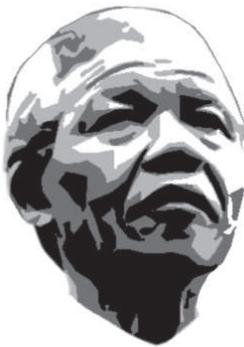 Nelson Mandela
"I have fought against white domination and I have fought against black domination. I have cherished the ideal of a democratic and free society in which all persons live together in harmony and with equal opportunities. It is an ideal which I hope to live for and to achieve. But if needs be, it is an ideal for which I am prepared to die."
This was Nelson Mandela, being tried for treason by the white South African government. He and seven other leaders were sentenced to life imprisonment in 1964 for daring to oppose the apartheid regime in his country. He spent the next 27 years in South Africa's most dreaded prison, Robben Island. Apartheid divided the people and labelled them on the basis of their skin colour. The native people of South Africa are black in colour. They made up about three-fourth of the population and were called 'blacks'. Besides these two groups, there were people of mixed races who were called 'coloured' and people who migrated from India. The white rulers treated all non-whites as inferiors. The non-whites did not have voting rights.
The apartheid system was particularly oppressive for the blacks. They were forbidden from living in white areas. They could work in white areas only if they had a permit. Trains, buses, taxis, hotels, hospitals, schools and colleges, libraries, cinema halls, theatres, beaches,
A signboard emblematic of the tense relations of the apartheid era, 1953.
2 1 DANGER! COLOURED INDIANS PREMISES AT NIGHT YOU WILL BE LISTED AS MISSING. ARMED GUARDS SHOOT ON SIGHT, SAVAGE DOGS DEVOUR THE CORPSE. YOU HAVE BEEN WARNED!
2 CITY OF DURBAN UNDER SECTION 37 OF THE DURBAN BEACH BY-LAWS. THIS BATHING AREA IS RESERVED FOR THE SOLE USE OF MEMBERS OF THE WHITE RACE GROUP STAD DURBAN HIERDIE BAAICEBIED IS. INCEVOLCE ARTIKEL 37 YAN DIE DURBANSE STRANDVERORDENINCE. UITCEHOU VIR DIE UITSLUITLIKE CEBRUIK YAN LEDE VAM BLANKE RASSEGROEP. IDOLOBHA LASETHEKWINI NGAPHANSI KWESICABA 37 SOMTHETHO WAMABHISHI ASETHEKWENL LENDAWO IGCINELWE UKUSETSHENZISWA NCAMALUNCU OHLANCA OLUMHLOPHE KUPHELA.
Struggle against apartheid
Sign on Durban beach in English, Afrikaans and Zulu In English it reads: 'CITY OF DURBAN Under section 37 of the Durban beach by-laws, this bathing area is reserved for the sole use of members of the white race group'.
Apartheid was the name of a system of racial discrimination unique to South Africa. The white Europeans imposed this system on South Africa. During the seventeenth and eighteenth centuries, the trading companies from Europe occupied it with arms and force, in the way they occupied India. But unlike India, a large number of 'whites' had settled in South Africa and became the local rulers. The system of public toilets, were all separate for the whites and blacks. This was called segregation. They could not even visit the churches where the whites worshipped. Blacks could not form associations or protest against the terrible treatment.
Since 1950, the blacks, coloured and Indians fought against the apartheid system. They launched protest marches and strikes. The African National Congress (ANC) was the umbrella organisation that led the struggle against the policies of segregation. This included many workers' unions and the Communist Party. Many sensitive whites also joined the ANC to oppose apartheid and played a leading role in this struggle. Several countries denounced apartheid as unjust and racist. But the white racist government continued to rule by detaining, torturing and killing thousands of black and coloured people.
ACTIVITY
Make a poster on the life and struggle of Nelson Mandela. If available, read some portions of his autobiography, The Long Walk to Freedom, in the classroom.
Towards a new constitution
As protests and struggles against apartheid had increased, the government realised that they could no longer keep the blacks under their rule through repression. The white regime changed its policies. Discriminatory laws were repealed. Ban on political parties and restrictions on the media were lifted. After 28 years of imprisonment, Nelson Mandela walked out of the jail as a free man. Finally, at the midnight of 26 April 1994, the new national flag of the Republic of South Africa was unfurled marking the newly born democracy in the world. The apartheid government came to an end, paving way for the formation of a multi-racial government.
How did this come about? Let us hear Mandela, the first president of this new South Africa, on this extraordinary transition:
"Historical enemies succeeded in negotiating a peaceful transition from apartheid to democracy exactly because we were prepared to accept the inherent capacity for goodness in the other. My wish is that South Africans never give up on the belief in goodness, that they cherish that faith in human beings is the cornerstone of our democracy."
After the emergence of the new democratic South Africa, black leaders appealed to fellow blacks to forgive the whites for the atrocities they had committed while in power. They said let us build a new South Africa based on equality of all races and men and women, on democratic values, social justice and human rights. The party that ruled through oppression and brutal killings and the party that led the freedom struggle sat together to draw up a common constitution.
After two years of discussion and debate they came out with one of the finest constitutions the world has ever had. This constitution gave to its citizens the most extensive rights available in any country. Together, they decided that in the search for a solution to the problems, nobody should be excluded, no one should be treated as a demon. They agreed that everybody should become part of the solution, whatever they might have done or represented in the past. The preamble to the South African Constitution (see page 28) sums up this spirit.
What would have happened in South Africa if the black majority had decided to take revenge on the whites for all their oppression and exploitation?
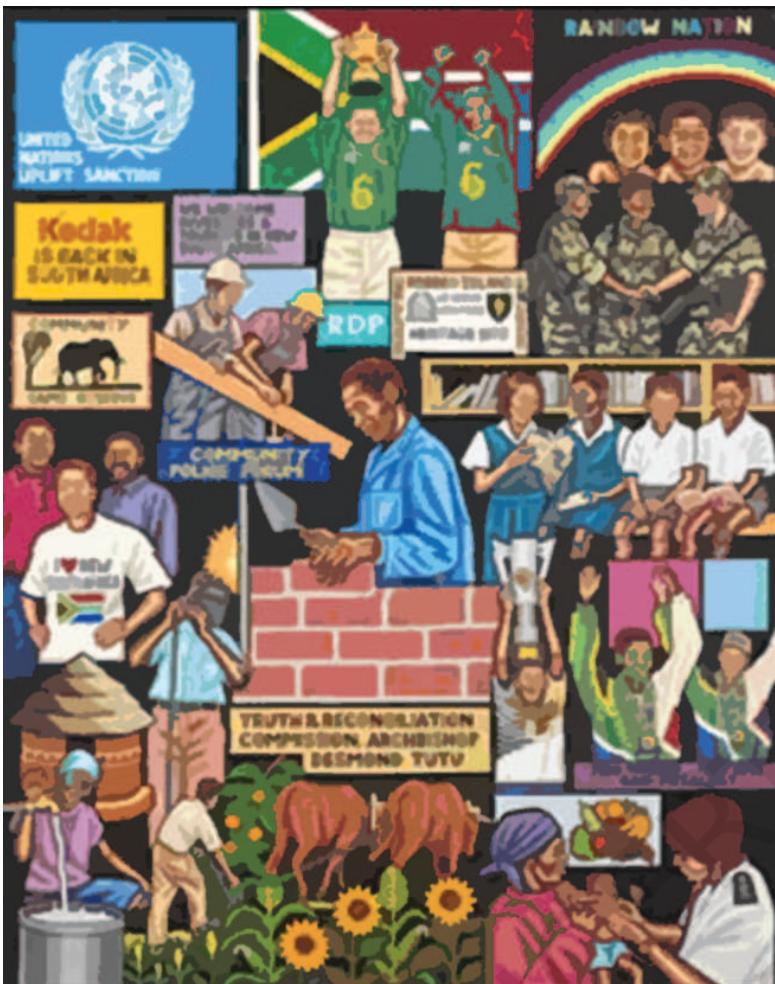
The South African Constitution inspires democrats all over the world. A state denounced by the entire world till 1994 as the most undemocratic one is now seen as a model of democracy. What made this change possible was the determination of the people of South Africa to work together, to transform bitter experiences into the binding glue of a rainbow nation. Speaking on the South African Constitution, Mandela said:
The Constitution of South Africa speaks of both the past and the future. On the one hand, it is a solemn pact in which we, as South Africans, declare to one another that we shall never permit a repetition of our racist, brutal and repressive past. But it is more than that. It is also a charter for the transformation of our country into one which is truly shared by all its people — a country which in the fullest sense belongs to all of us, black and white, women and men.
This image captures the spirit of South Africa today. South Africans call themselves a 'rainbow nation'. Can you guess why?
For more details about South Africa, visit https://www.gov.za
Does the story of South African struggle for freedom remind you of the Indian national movement? Make a list of similarities and dissimilarities between the two on the following points:
- Nature of colonialism
- Relationship between different communities
- Leadership: Gandhi/Mandela
- Party that led the struggle: African National Congress/Indian National Congress
- Method of struggle
2.2 WhY dO We Need A cOnstItutIOn?
The South African example is a good way to understand why we need a constitution and what do constitutions do. The oppressor and the oppressed in this new democracy were planning to live together as equals. It was not going to be easy for them to trust each other. They had their fears. They wanted to safeguard their interests. The black majority was keen to ensure that the democratic principle of majority rule was not compromised. They wanted substantial social and economic rights. The white minority was keen to protect its privileges and property.
After long negotiations both parties agreed to a compromise. The whites agreed to the principle of majority rule and that of one person one vote. They also agreed to accept some basic rights for the poor and the workers. The blacks agreed that majority rule would not be absolute. They agreed that the majority would not take away the property of the white minority. This compromise was not easy. How was this compromise going to be implemented? Even if they managed to trust each other, what was the guarantee that this trust will not be broken in future?
The only way to build and maintain trust in such a situation is to write down some rules of the game that everyone would abide by. These rules lay down how the rulers are to be chosen in future. These rules also determine what the elected governments are empowered to do and what they cannot do. Finally these rules decide the rights of the citizen. These rules will work only if the winner cannot change them very easily. This is what the South Africans did. They agreed on some basic rules. They also agreed that these rules will be supreme, that no government will be able to ignore these. This set of basic rules is called a constitution.
Constitution making is not unique to South Africa. Every country has diverse groups of people. Their relationship may not have been as bad as that between the whites and the blacks in South Africa. But all over the world people have differences of opinion and interests. Whether democratic or not, most countries in the world need to have these basic rules. This applies not just to governments. Any association needs to have its constitution. It could be a club in your area, a cooperative society or a political party, they all need a constitution.
ACTIVITY
Approach a club or cooperative society or union or political party in your locality. Get a copy of their rule book (it is often called Rules of Association) and read it. Are these rules in accordance with principles of democracy? Do they give membership to any person without discrimination?
Thus, the constitution of a country is a set of written rules that are accepted by all people living together in a country. Constitution is the supreme law that determines the relationship among people living in a territory (called citizens) and also the relationship between the people and government. A constitution does many things:
- First, it generates a degree of trust and coordination that is necessary for different kind of people to live together;
- Second, it specifies how the government will be constituted, who will have power to take which decisions;
- Third, it lays down limits on the powers of the government and tells us what the rights of the citizens are; and
- Fourth, it expresses the aspirations of the people about creating a good society.
All countries that have constitutions are not necessarily democratic. But all countries that are democratic will have constitutions. After the War of Independence against Great Britain, the Americans gave themselves a constitution. After the Revolution, the French people approved a democratic constitution. Since then it has become a practice in all democracies to have a written constitution.
This is not fair! What was the point in having a Constituent Assembly in India if all the basics were already decided?
2.3 MakinG OF The IndIAn COnstitutIOn
 Vallabhbhai Jhaverbhai Patel
(1875-1950) born: Gujarat. Minister of Home, Information and
Broadcasting in the Interim Government. Lawyer and
leader of Bardoli peasant satyagraha. Played a decisive role in the integration of the Indian princely states. Later: Deputy Prime Minister.
Vallabhbhai Jhaverbhai Patel
(1875-1950) born: Gujarat. Minister of Home, Information and
Broadcasting in the Interim Government. Lawyer and
leader of Bardoli peasant satyagraha. Played a decisive role in the integration of the Indian princely states. Later: Deputy Prime Minister.
Like South Africa, India's Constitution was also drawn up under very difficult circumstances. The making of the constitution for a huge and diverse country like India was not an easy affair. At that time the people of India were emerging from the status of subjects to that of citizens. The country was born through a partition on the basis of religious differences. This was a traumatic experience for the people of India and Pakistan.
like. Much of this consensus had evolved during the freedom struggle. Our national movement was not merely a struggle against a foreign rule. It was also a struggle to rejuvenate our country and to transform our society and politics. There were sharp differences of opinion within the freedom struggle about the path India should take after Independence. Such differences exist even today. Yet some basic ideas had come to be accepted by almost everyone.
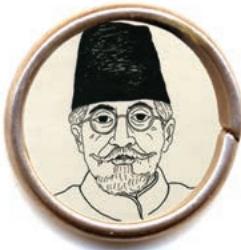 Abul Kalam Azad
(1888-1958) born: Saudi Arabia.
Educationist, author and theologian; scholar of
Arabic. Congress leader, active in the national movement. Opposed
Muslim separatist politics.
Later: Education Minister in the first union cabinet.
Abul Kalam Azad
(1888-1958) born: Saudi Arabia.
Educationist, author and theologian; scholar of
Arabic. Congress leader, active in the national movement. Opposed
Muslim separatist politics.
Later: Education Minister in the first union cabinet.
At least ten lakh people were killed on both sides of the border in partition related violence. There was another problem. The British had left it to the rulers of the princely states to decide whether they wanted to merge with India or with Pakistan or remain independent. The merger of these princely states was a difficult and uncertain task. When the constitution was being written, the future of the country did not look as secure as it does today. The makers of the constitution had anxieties about the present and the future of the country.
As far back as in 1928, Motilal Nehru and eight other Congress leaders drafted a constitution for India. In 1931, the resolution at the Karachi session of the Indian National Congress dwelt on how independent India's constitution should look like. Both these documents were committed to the inclusion of universal adult franchise, right to freedom and equality and to protecting the rights of minorities in the constitution of independent India. Thus some basic values were accepted by all leaders much before the Constituent Assembly met to deliberate on the Constitution.
ACTIVITY
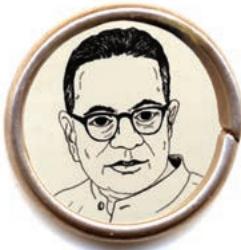 T.T.Krishnamachari
(1899-1974)
born: Tamil Nadu.
Member, Drafting
Committee. Entrepreneur
and Congress leader. Later:
Finance Minister in the
Union Cabinet.
T.T.Krishnamachari
(1899-1974)
born: Tamil Nadu.
Member, Drafting
Committee. Entrepreneur
and Congress leader. Later:
Finance Minister in the
Union Cabinet.
Speak to your grandparents or some other elders in your locality. Ask them if they have any memory of partition or independence or the making of the constitution. What were their fears and hopes about the country at that time? Discuss these in the classroom.
The path to Constitution
Despite all these difficulties, there was one big advantage for the makers of the Indian Constitution. Unlike South Africa, they did not have to create a consensus about what a democratic India should look
The familiarity with political institutions of colonial rule also helped develop an agreement over the institutional design. The British rule had given voting rights only to a few. On that basis the British had introduced very weak legislatures. Elections were held in 1937 to Provincial Legislatures and Ministries all over British India. These were not fully democratic governments. But the experience gained by Indians in the working of the legislative institutions proved to be very useful for the country in setting up its own institutions and
working in them. That is why the Indian Constitution adopted many institutional details and procedures from colonial laws like the Government of India Act, 1935.
Years of thinking and deliberation on the framework of the constitution had another benefit. Our leaders gained confidence to learn from other countries, but on our own terms. Many of our leaders were inspired by the ideals of French Revolution, the practice of parliamentary democracy in Britain and the Bill of Rights in the US. The socialist revolution in Russia had inspired many Indians to think of shaping a system based on social and economic equality. Yet they were not simply imitating what others had done. At each step they were questioning whether these things suited our country. All these factors contributed to the making of our Constitution.
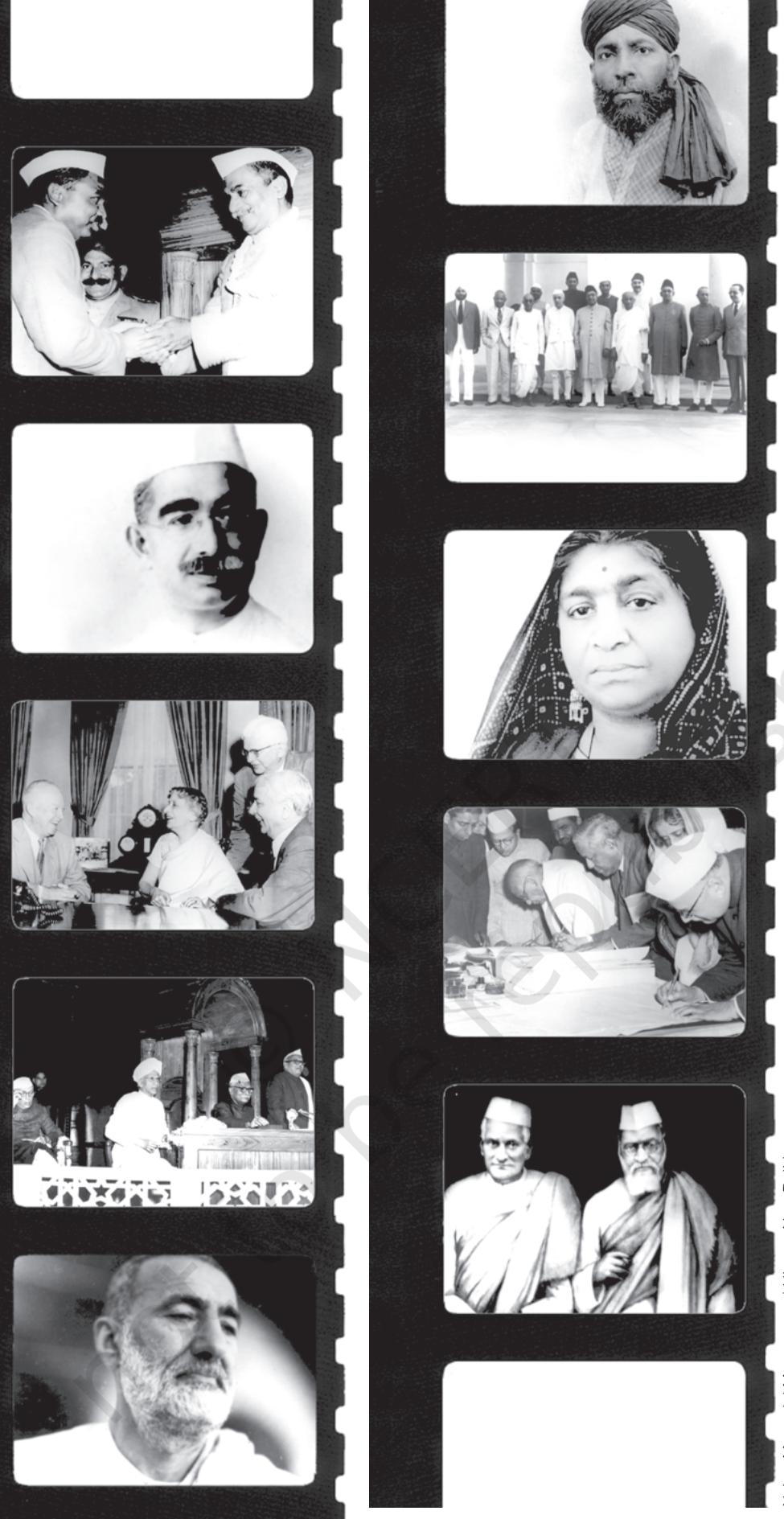
The Constituent Assembly Who, then, were the makers of the Indian Constitution? You will find here very brief sketch of some of the leaders who played an important role in making the Constitution.
ACTIVITY
Find out more about any member of the Constituent Assembly from your state or region who is not mentioned here. Collect a photograph or make a sketch of that leader. Write a short note on him or her, following the same style as used here: Name (year of birth-year of death), place of birth (by current political boundaries), brief description of political activities; role played after the Constituent Assembly.
The drafting of the document called the Constitution was done by an assembly of elected representatives called the Constituent Assembly. Elections to the Constituent Assembly were held in July 1946. Its first meeting was held in December 1946. Soon after, the country was divided into India and Pakistan. The Constituent Assembly was also divided into the Constituent Assembly of India and that of Pakistan. The Constituent Assembly that wrote the Indian Constitution had 299 members. The Assembly adopted the Constitution on 26 November 1949 but it came into effect on 26 January 1950. To mark this day we celebrate January 26 as Republic Day every year.
Why should we accept the Constitution made by this Assembly more than seven decades ago? We have already noted one reason above. The Constitution does not reflect the views of its members alone. It expresses a broad consensus of its time. Many countries of the world have had to rewrite their Constitution afresh because the basic rules were not acceptable to all major social groups or political parties. In some other countries, the Constitution exists as a mere piece of paper. No one actually follows it. The experience of our Constitution is different. Over the last half a century, several groups have questioned some provisions of the Constitution. But no large social group or political party has ever questioned the legitimacy of the Constitution itself. This is an unusual achievement for any constitution.
The second reason for accepting the Constitution is that the Constituent Assembly represented the people of India. There was no universal adult franchise at that time. So the Constituent Assembly could not have been chosen directly by all the people of India. It was
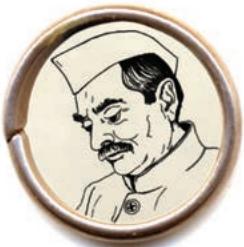 Rajendra Prasad
(1884-1963) born: Bihar.
President of the Constituent Assembly. Lawyer, known for his role in the
Champaran satyagraha. Three times the president of Congress. Later: the first President of India.
Rajendra Prasad
(1884-1963) born: Bihar.
President of the Constituent Assembly. Lawyer, known for his role in the
Champaran satyagraha. Three times the president of Congress. Later: the first President of India.
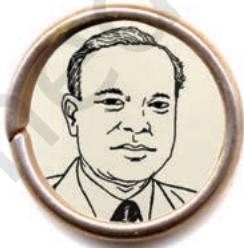 Jaipal Singh
(1903-1970)
born: Jharkhand
A sportsman and
educationist. Captain of the
first national Hockey team.
Jaipal Singh
(1903-1970)
born: Jharkhand
A sportsman and
educationist. Captain of the
first national Hockey team.
Founder President of Adivasi Maha Sabha. Later: founder of Jharkhand Party.
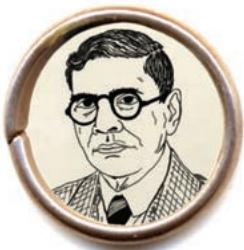 H. C. Mookherjee
(1887-1956)
born: Bengal.
Vice-Chairman of the
Constituent Assembly.
Reputed author and
educationist. Congress
leader. Member of All India
Christian Council and
Bengal Legislative
Assembly. Later: Governor
of West Bengal.
H. C. Mookherjee
(1887-1956)
born: Bengal.
Vice-Chairman of the
Constituent Assembly.
Reputed author and
educationist. Congress
leader. Member of All India
Christian Council and
Bengal Legislative
Assembly. Later: Governor
of West Bengal.
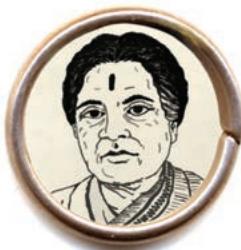 G. Durgabai Deshmukh (1909-1981)
born: Andhra Pradesh. Advocate and public activist for women's emancipation. Founder of Andhra Mahila Sabha. Congress leader. Later: Founder Chairperson of Central Social Welfare Board.
G. Durgabai Deshmukh (1909-1981)
born: Andhra Pradesh. Advocate and public activist for women's emancipation. Founder of Andhra Mahila Sabha. Congress leader. Later: Founder Chairperson of Central Social Welfare Board.
elected mainly by the members of the existing Provincial Legislatures that we mentioned above. This ensured a fair geographical share of members from all the regions of the country. The Assembly was dominated by the Indian National Congress, the party that led India's freedom struggle. But the Congress itself included a variety of political groups and opinions. The Assembly had many members who did not agree with the Congress. In social terms too, the Assembly represented members from different language groups, castes, classes, religions and occupations. Even if the Constituent Assembly was elected by universal adult franchise, its composition would not have been very different.
Finally, the manner in which the Constituent Assembly worked gives sanctity to the Constitution. The
Constituent Assembly worked in a systematic, open and consensual manner. First some basic principles were decided and agreed upon. Then a Drafting Committee chaired by Dr. B.R. Ambedkar prepared a Draft Constitution for discussion. Several rounds of thorough discussion took place on the Draft Constitution, clause by clause. More than two thousand amendments were considered. The members deliberated for 114 days spread over three years. Every document presented and every word spoken in the Constituent Assembly has been recorded and preserved. These are called 'Constituent Assembly Debates'. When printed, these debates are 12 bulky volumes! These debates provide the rationale behind every provision of the Constitution. These are used to interpret the meaning of the Constitution.
Read the information about all the makers of the Indian Constitution given in the side columns here. You don't need to memorise this information. Just give examples from these to support the following statements:
- The Assembly had many members who were not with the Congress
- The Assembly represented members from different social groups
- Members of the Assembly believed in different ideologies
2.4 GUIDING VALUES OF THE INDIAN CONSTITUTION
Baldev Singh (1901-1961) born: Haryana. A successful entrepreneur and leader of the Panthic Akali Party in the Punjab Assembly. A nominee of the Congress in the Constituent Assembly. Later: Defence Minister in the Union Cabinet.
In this book we shall study the exact provisions of the Constitution on different subjects. At this stage let us begin by understanding the overall philosophy of what our Constitution is all about. We can do this in two ways. We can understand it by reading the views of some of our major leaders on our Constitution. But it is equally important to read what the Constitution says about its own philosophy. This is what the Preamble to the Constitution does.
Let us turn to these, one by one.
The Dream and the Promise
Some of you may have noticed a name missing from the sketches of the makers of the Constitution: Mahatma Gandhi. He was not a member of the Constituent Assembly. Yet there were many members who followed his vision. Years ago, writing in his magazine Young India in 1931, he had spelt out what he wanted the Constitution to do:
I shall strive for a constitution which will release India from all thraldom and patronage. I shall work for an India in which the poorest shall feel that it is their country in whose making they have an effective voice; an India in which there shall be no high class and low class of people; an India in which all communities shall live in perfect harmony. There can be no room in such an India for the curse of untouchability or the curse of the intoxicating drinks and drugs. Women will enjoy the same right as men … I shall be satisfied with nothing else.
Kanhaiyalal Maniklal Munshi (1887-1971) born: Gujarat. Advocate, historian and linguist. Congress leader and Gandhian. Later: Minister in the Union Cabinet. Founder of the Swatantra Party.
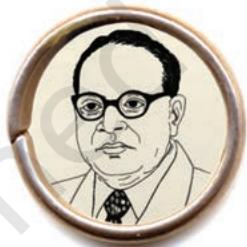
This dream of an India that has eliminated inequality was shared by Dr. Ambedkar, who played a key role in the making of the Constitution but he had a different understanding of how inequalities could be removed. He often bitterly criticised Mahatma Gandhi and his vision. In his concluding speech to the Constituent Assembly he stated his anxiety very clearly:
On the 26th of January 1950 we are going to enter a life of contradictions. In politics we will have equality and in social and economic life we will have inequality. In politics we will be recognising the principle of one man one vote and one vote one value. In our social and economic life, we shall, by reason of our social and economic structure, continue to deny the principle of one man one value. How long shall we continue to live this life of contradictions? How long shall we continue to deny equality in our social and economic life? If we continue to deny it for long we will do so only by putting our political democracy in peril.
Finally let us turn to Jawaharlal Nehru giving his famous speech to the
Constituent Assembly at the stroke of midnight on 15 August 1947:
Bhimrao Ramji Ambedkar (1891-1956) born: Madhya Pradesh. Chairman of the Drafting Committee. Social revolutionary thinker and agitator against caste divisions and caste based inequalities. Later: Law minister in the first cabinet of post-independence India. Founder of Republican Party of India.
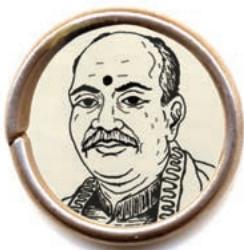
Shyama Prasad Mukherjee (1901-1953) born: West Bengal. Minister for Industry and Supply in the Interim Government. Educationist and lawyer. Active in Hindu Mahasabha. Later: Founder President of Bharatiya Jansangh.
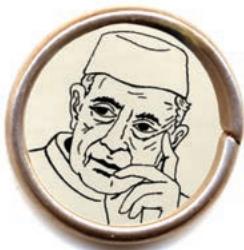
Jawaharlal Nehru (1889-1964) born: Uttar Pradesh. Prime Minister of the interim government. Lawyer and Congress leader. Advocate of socialism, democracy and anti-imperialism. Later: First Prime Minister of India.
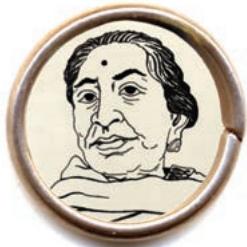
Sarojini Naidu (1879-1949) born: Andhra Pradesh. Poet, writer and political activist. Among the foremost women leaders in the Congress. Later: Governor of Uttar Pradesh.
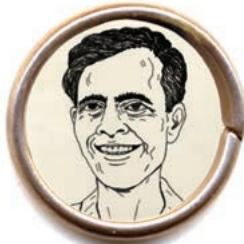
Somnath Lahiri (1901-1984) born: West Bengal. Writer and editor. Leader of the Communist Party of India. Later: Member of West Bengal Legislative Assembly.
Long years ago we made a tryst with destiny and now the time comes when we shall redeem our pledge not wholly or in full measure, but very substantially. At the stroke of the midnight hour when the world sleeps, India will awake to life and freedom. A moment comes, which comes but rarely in history, when we step out from the old to the new, when an age ends, and when the soul of a nation long suppressed, finds utterance. It is fitting that at this solemn moment we take the pledge of dedication to the service of India and her people and to the still larger cause of humanity …
Freedom and power bring responsibility. The responsibility rests upon this Assembly, a sovereign body representing the sovereign people of India. Before the birth of freedom we have endured all the pains of labour and our hearts are heavy with the memory of this sorrow. Some of those pains continue even now. Nevertheless the past is over and it is the future that beckons to us now.
That future is not one of ease or resting but of incessant striving so that we may fulfil the pledges we have so often taken and the one we shall take today. The service of India means the service of the millions who suffer. It means the ending of poverty and ignorance and disease and inequality of opportunity. The ambition of the greatest man of our generation has been to wipe every tear from every eye That may be beyond us, but as long as there are tears and suffering so long our work will not be over.
Read the three quotations above carefully.
Can you identify one idea that is common to all these three? What are the differences in their ways of expressing that common idea?
Philosophy of the Constitution
articles of the Indian Constitution. The Constitution begins with a short statement of its basic values. This is called the Preamble to the Constitution. Taking inspiration from American model, most countries in the contemporary world have chosen to begin their constitutions with a preamble.
Values that inspired and guided the freedom struggle and were in turn nurtured by it, formed the foundation for India's democracy. These values are embedded in the Preamble of the Indian Constitution. They guide all the

In order to form a more perfect Union, establish justice, insure domestic tranquility, provide for the common defense, promote the general welfare, and secure the blessings of liberty to ourselves and our posterity, do ordain and establish this Constitution for the United States of America.
We, the people of South Africa, Recognise the injustices of our past; Honour those who suffered for justice and freedom in our land; Respect those who have worked to build and develop our country; and Believe that South Africa belongs to all who live in it, united in our diversity.
We therefore, through our freely elected representatives, adopt this Constitution as the supreme law of the Republic so as to-
Heal the divisions of the past and establish a society based on democratic values, social justice and fundamental human rights;
Lay the foundations for a democratic and open society in which government is based on the will of the people and every citizen is equally protected by law;
Improve the quality of life of all citizens and free the potential of each person; and
Build a united and democratic South Africa able to take its rightful place as a sovereign state in the
May God protect our people. Nkosi Sikelel' iAfrika. Morena boloka setjhaba sa heso. God seën Suid-Afrika. God bless South Africa. Mudzimu fhatutshedza Afurika. Dzosi katekisa Afrika.
WE, THE PEOPLE OF INDIA The Constitution has been drawn up and enacted by the people through their representatives, and not handed down to them by a king or any outside powers.
SOVEREIGN People have supreme right to make decisions on internal as well as external matters. No external power can dictate the government of India.
SOCIALIST Wealth is generated socially and should be shared equally by society. Government should regulate the ownership of land and industry to reduce socio-economic inequalities.
SECULAR Citizens have complete freedom to follow any religion. But there is no official religion. Government treats all religious beliefs and practices with equal respect.
DEMOCRATIC A form of government where people enjoy equal political rights, elect their rulers and hold them accountable. The government is run according to some basic rules.
Let us read the Preamble of our Constitution very carefully and understand the meaning of each of its key words.
The Preamble of the Constitution reads like a poem on democracy. It contains the philosophy on which the entire Constitution has been built. It provides a standard to examine and evaluate any law and action of government, to find out whether it is good or bad. It is the soul of the Indian Constitution.
WE, THE PEOPLE OF INDIA, having solemnly resolved to constitute India into a SOVEREIGN, SOCIALIST, SECULAR DEMOCRATIC REPUBLIC and to secure to all its citizens: JUSTICE, social, economic and political; LIBERTY of thought, expression, belief, faith and worship; EQUALITY of status and of opportunity; and to promote among them all FRATERNITY assuring the dignity of the individual and the unity and integrity of the Nation,
IN OUR CONSTITUENT ASSEMBLY this twenty-sixth day of November, 1949, do HEREBY ADOPT, ENACT AND GIVE TO OURSELVES THIS CONSTITUTION.
REPUBLIC The head of the state is an elected person and not a hereditary position.
JUSTICE Citizens cannot be discriminated on the grounds of caste, religion and gender. Social inequalities have to be reduced. Government should work for the welfare of all, especially of the disadvantaged groups.
LIBERTY There are no unreasonable restrictions on the citizens in what they think, how they wish to express their thoughts and the way they wish to follow up their thoughts in action.
EQUALITY All are equal before the law. The traditional social inequalities have to be ended. The government should ensure equal opportunity for all.
FRATERNITY All of us should behave as if we are members of the same family. No one should treat a fellow citizen as inferior.
Compare the Preambles to the constitutions of the United States of America, India and South Africa.
Make a list of ideas that are common to all these three. Note down at least one of the major differences among these. Which of the three makes a reference to the past? Which of these does not invoke God?
Institutional design
A constitution is not merely a statement of values and philosophy. As we noted above, a constitution is mainly about embodying these values into institutional arrangements. Much of the document called Constitution of India is about these arrangements. It is a very long and detailed document. Therefore it needs to be amended quite regularly to keep it updated. Those who crafted the Indian Constitution felt that it has to be in accordance with people's aspirations and changes in society. They did not see it as a sacred, static and unalterable law. So, they made provisions to incorporate changes from time to time. These changes are called constitutional amendments.
The Constitution describes the institutional arrangements in a very legal language. If you read the Constitution for the first time, it can be quite difficult to understand. Yet the basic institutional design is not very difficult to understand. Like any Constitution, the Indian Constitution lays down a procedure for choosing persons to govern the country. It defines who will have how much power to take which decisions. And it puts limits to what the government can do by providing some rights to the citizen that cannot be violated. The remaining three chapters in this book are about these three aspects of the working of Indian Constitution. We shall look at some key constitutional provisions in each chapter and understand how they work in democratic politics. But this textbook will not cover all the salient features of the institutional design in the Indian Constitution. Some other aspects will be covered in your textbook next year.
Apartheid: The official policy of racial separation and ill treatment of blacks followed by the government of South Africa between 1948 and 1989.
Clause: A distinct section of a document.
Constituent Assembly: An assembly of people's representatives that writes a constitution for a country.
Constitution: Supreme law of a country, containing fundamental rules governing the politics and society in a country.
Constitutional amendment: A change in the constitution made by the supreme legislative body in a country.
Draft: A preliminary version of a legal document.
Philosophy: The most fundamental principles underlying one's thoughts and actions.
Preamble: An introductory statement in a constitution which states the reasons and guiding values of the constitution.
Treason: The offence of attempting to overthrow the government of the state to which the offender owes allegiance.
Tryst: A meeting or meeting place that has been agreed upon.
Here are some false statements. Identify the mistake in each case and rewrite these correctly based on what you have read in this chapter. a. Leaders of the freedom movement had an open mind about whether the country should be democratic or not after independence. b. Members of the Constituent Assembly of India held the same views on all provisions of the Constitution. c. A country that has a constitution must be a democracy. d. Constitution cannot be amended because it is the supreme law of a country.
Which of these was the most salient underlying conflict in the making of a democratic constitution in South Africa? a. Between South Africa and its neighbours b. Between men and women c. Between the white majority and the black minority d. Between the coloured minority and the black majority
Which of these is a provision that a democratic constitution does not have? a. Powers of the head of the state b. Name of the head of the state c. Powers of the legislature d. Name of the country
Match the following leaders with their roles in the making of the Constitution: a. Motilal Nehru i. Prepared a Constitution for India in 1928 b. B.R. Ambedkar ii. Chairman of the Drafting Committee c. Rajendra Prasad iii. President of the Constituent Assembly d. Sarojini Naidu iv. Member of the Constituent Assembly
Read again the extracts from Nehru's speech Tryst with Destiny' and answer the following: a. Why did Nehru use the expression "not wholly or in full measure" in the first sentence? b. What pledge did he want the makers of the Indian Constitution to take? c. 'The ambition of the greatest man of our generation has been to wipe every tear from every eye". Who was he referring to?
Here are some of the guiding values of the Constitution and their meaning. Rewrite them by matching them correctly. a. Sovereign i. People have the supreme right to make decisions. b. Republic ii. Head of the state is an elected person. c. Fraternity iii. People should live like brothers and sisters. d. Secular iv. Government will not favour any religion.
How did your school celebrate the Constitution Day on November 26th? Prepare a brief report.
Here are different opinions about what made India a democracy. How much importance would you give to each of these factors? a. Democracy in India is a gift of the British rulers. We received training to work with representative legislative institutions under the British rule. b. Freedom Struggle challenged the colonial exploitation and denial of different freedoms to Indians. Free India could not be anything but democratic. c. We were lucky to have leaders who had democratic convictions. The denial of democracy in several other newly independent countries shows the important role of these leaders.
Read the following extract from a conduct book for 'married women', published in 1912. 'God has made the female species delicate and fragile both physically and emotionally, pitiably incapable of self-defence. They are destined thus by God to remain in male protection – of father, husband and son — all their lives. Women should, therefore, not despair, but feel obliged that they can dedicate themselves to the service of men'. Do you think the values expressed in this para reflected the values underlying our Constitution? Or does this go against the constitutional values?
Read the following statements about a constitution. Give reasons why each of these is true or not true. a. The authority of the rules of the constitution is the same as that of any other law. b. Constitution lays down how different organs of the government will be formed. c. Rights of citizens and limits on the power of the government are laid down in the constitution. d. A constitution is about institutions, not about values
Follow the newspapers for any report on a discussion on any constitutional amendment or demand for any constitutional amendment. You could, for example, focus on the demand for constitutional amendment for reservation for women in legislatures. Was there a public debate? What reasons were put forward in favour of the amendment? How did different parties react to the constitutional amendment? Did the amendment take place?