Beyond ChatGPT: Why "Just Ask an AI" Isn't the Same as Having an AI Tutor
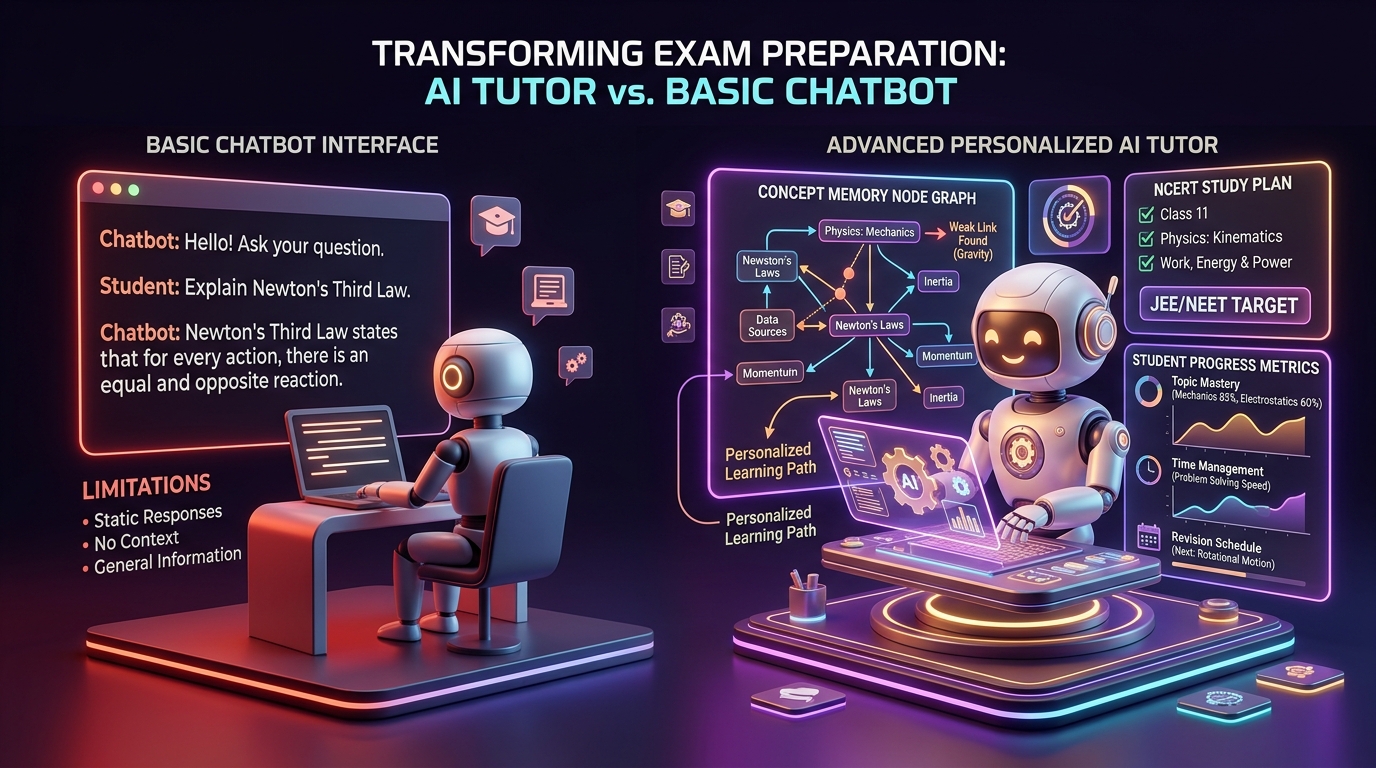
Plenty of students try typing homework doubts into general AI chatbots. Discover why generic chatbots and purpose-built AI tutors like YoLearn.AI are…
Plenty of students have tried typing their homework doubt into a general AI chatbot. It usually works — for one question, in isolation. But ask any student who's tried to actually *prep* for boards, JEE, or NEET this way, and they'll tell you it falls apart fast.
Here's why a generic AI chatbot and a purpose-built AI tutor are not the same thing — even when both are powered by similar underlying technology.
Problem 1: No Memory of *You*
A general chatbot forgets you the moment the chat closes. Ask it a doubt today, and tomorrow it has no idea you struggled with the exact same topic last week.
A real tutor — human or AI — should build a picture of you over time: which concepts you've mastered, which ones you fake-understand (get right once, then forget), and where your specific blind spots are. Without that memory, "personalization" is just a marketing word.
Problem 2: No Curriculum Alignment
Ask a generic AI to explain a concept, and it'll often reach for the globally "average" explanation — which may not match how NCERT frames it, what CBSE or ICSE expects in an answer, or how a question is actually likely to appear in JEE or NEET.
Students don't just need *an* explanation. They need the explanation that matches their board, their syllabus, and their exam pattern — including how examiners expect answers to be structured.
Problem 3: One Explanation, Take It or Leave It
A student who doesn't understand a concept the first time often doesn't need "more of the same, slower." They need a *different* approach entirely — a diagram instead of a paragraph, a real-world analogy instead of a formula, a step-by-step breakdown instead of a summary.
Generic chatbots tend to repeat themselves with minor rewording. A dedicated AI tutor is built to genuinely re-teach — including generating live diagrams on a sketchpad, walking through worked examples, or breaking a concept into smaller sub-steps.
Problem 4: No Sense of "Where You're Headed"
A subject-specific tutor understands the destination — a board exam, JEE Mains, JEE Advanced, or NEET — and can quietly steer a student's practice toward what will actually be tested, not just what's interesting to explain.
A general-purpose AI has no concept of exam weightage, previous years' question trends, or which topics are historically high-yield. That context is the difference between studying broadly and studying smart.
So What Should an AI Tutor Actually Do?
A genuinely useful AI tutor for students should:
The Bottom Line
General AI chatbots are genuinely impressive tools — but they were built to answer questions, not to teach a specific student toward a specific exam over months of preparation. That distinction matters more than it sounds, especially for a Class 10 board student or a NEET aspirant who needs consistency, not a one-off answer.
---
*YoLearn.AI's AI tutor is built specifically around India's exam ecosystem — NCERT, CBSE, ICSE, JEE, and NEET — with a persistent Learner Memory Graph that tracks each student's concept-level mastery over time.*