Why "One-Size-Fits-All" Learning Was Always Broken — And What's Finally Fixing It
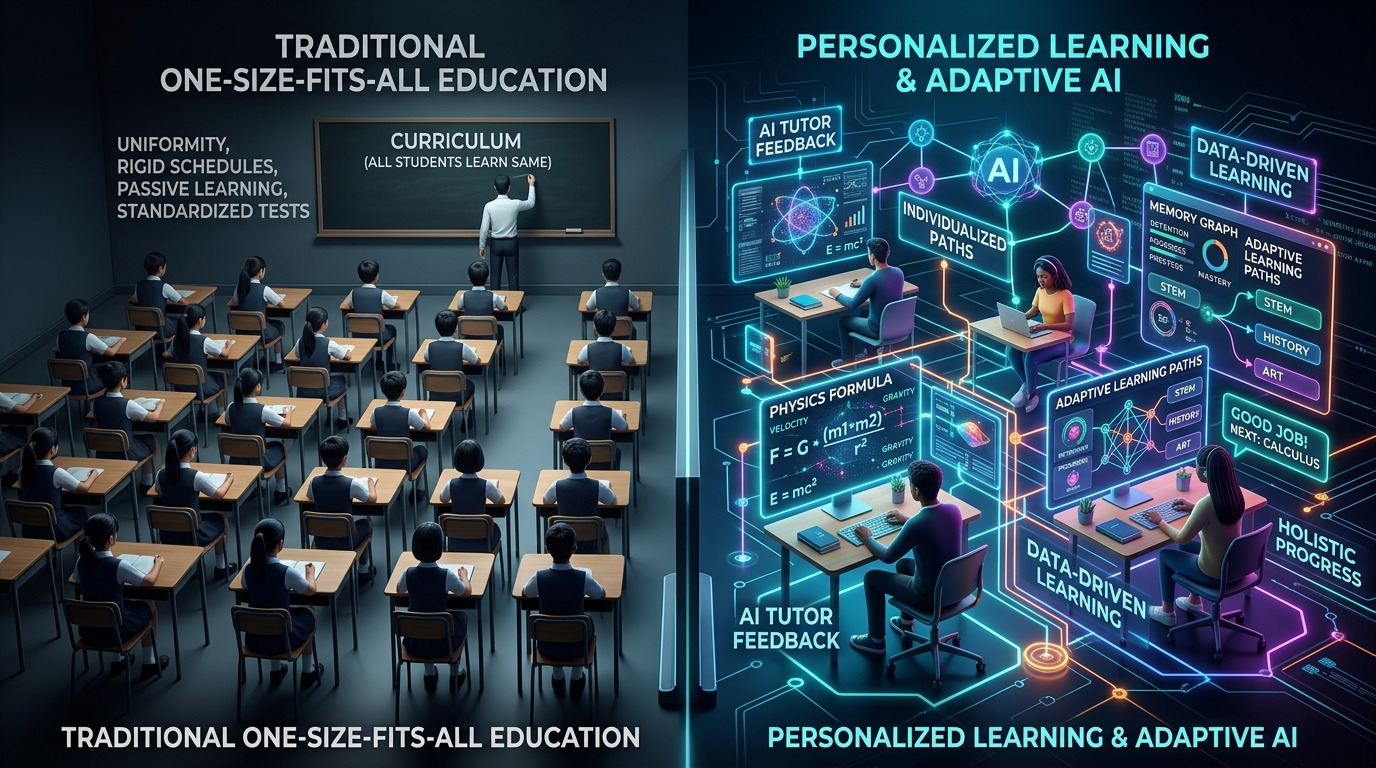
Classrooms of 60 students force one pace for everyone. Explore how persistent concept-level learner memory graphs in AI tutoring are fixing…
Think back to any classroom you've sat in. Thirty, forty, sometimes sixty students, one teacher, one pace, one explanation style. Some students kept up. Some fell quietly behind, term after term, gap after gap, until "I'm just not a Physics person" became a permanent identity instead of a temporary confusion.
That's not a teaching failure. It's a math problem — you genuinely cannot give sixty students individual attention in a fifty-minute period. But it's also the exact problem AI is finally positioned to solve.
The Real Issue Was Never "Access to Content"
For the last decade, Indian edtech mostly solved *access* — more video lectures, more PDFs, more test series, all a click away. That was genuinely valuable. But access to content was never the bottleneck for most students.
The bottleneck was this: nobody was tracking, in detail, *what each individual student actually understood* — and adjusting accordingly.
Enter the Idea of a "Learning Memory"
Imagine a tutor who remembers every question you've ever asked, every mistake you've made, and every concept you've quietly struggled with — even the ones you never explicitly asked about, because you got the answer right by luck rather than understanding.
That's the idea behind concept-level learner tracking: instead of measuring progress as "chapters completed," it maps mastery at the level of individual concepts, and updates that map continuously as a student practices, asks doubts, and takes tests.
What This Looks Like in Practice
Why This Matters More As Exams Get Closer
In the final months before boards, JEE, or NEET, time becomes the scarcest resource a student has. Re-reading every chapter equally is a waste of that time. What actually moves the needle is targeted revision — spending disproportionate time on the concepts that are still fragile, and spending almost no time on what's already solid.
A system that knows exactly where those fragile spots are can turn revision from a guessing game into a targeted, efficient process.
The Bigger Shift
This isn't just a feature — it's a fundamentally different philosophy of how learning technology should work. Instead of asking "what content should we show this student next," the better question is "what does this student specifically need to understand better, right now, to move forward."
That shift — from content delivery to concept mastery — is quietly becoming the real differentiator in AI-powered education. Not flashier videos. Not more test series. Just a system that actually remembers, and actually adapts.
---
*YoLearn.AI's AI tutor is built on a persistent Learner Memory Graph — tracking each student's concept-level mastery over time and adapting explanations as their understanding evolves.*