Voice-First Learning: Why Regional Language AI Tutoring Might Be India's Biggest EdTech Shift Yet
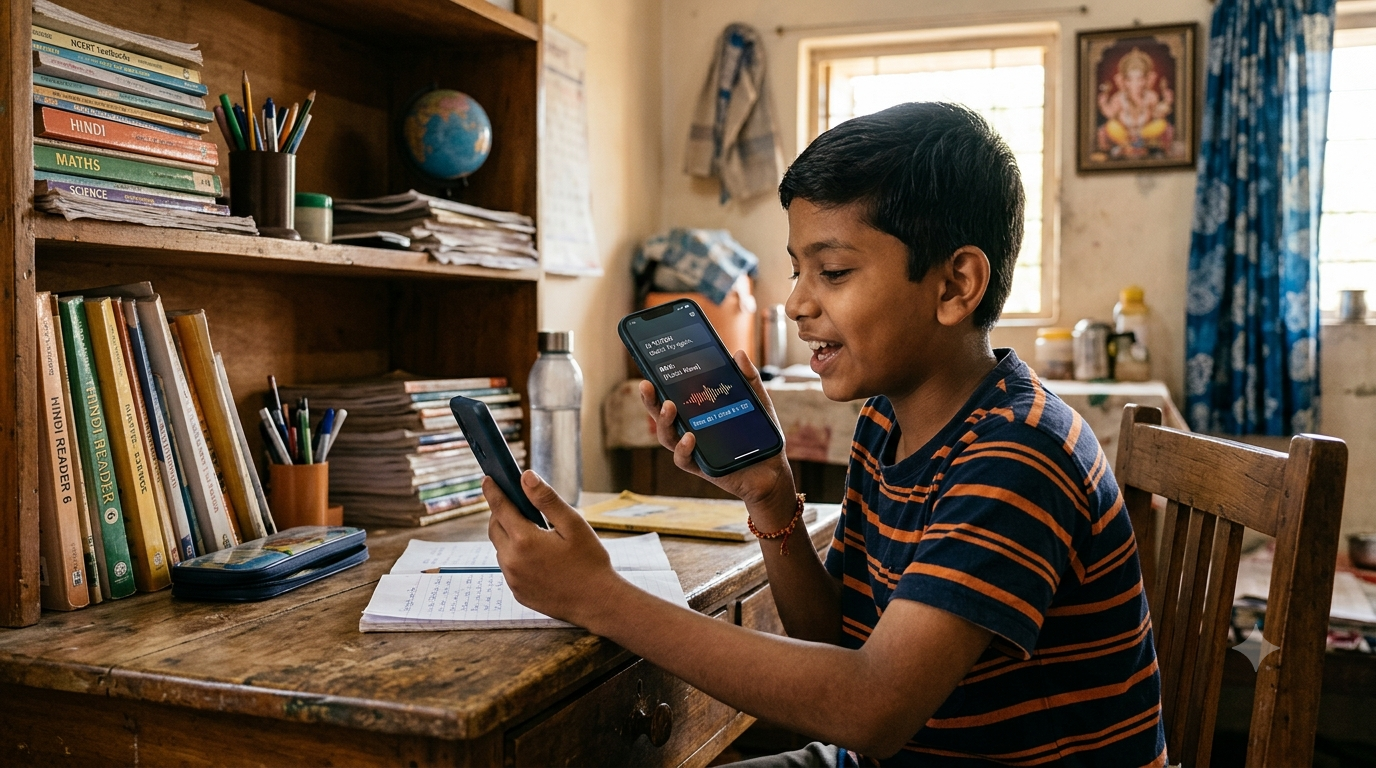
Explore how voice-first doubt solving in 22 Indian languages removes the language barrier for Tier 2 and Tier 3 students, enabling natural, confident…
Ask a student in a Tier 2 or Tier 3 town what stops them from asking a doubt out loud in class, and the answer is rarely "I don't understand the concept." It's usually something quieter: "I don't know how to say it in English," or "I'll sound silly."
That hesitation has quietly held back millions of capable students for years. And it's exactly the gap that voice-first, multilingual AI tutoring is starting to close.
The Language Barrier Nobody Talks About
India teaches in English-medium textbooks far more often than students actually *think* in English. A student might understand photosynthesis perfectly in Hindi or Telugu, but freeze the moment they have to frame that same understanding as an English question to a teacher or an app.
This isn't a knowledge problem. It's a translation tax — and it's been invisible in most edtech products because most of them were built assuming students are comfortable typing fluent English questions.
Why Voice Changes Everything
Typing a doubt is already a filter. You have to know the right words, spell them correctly, and phrase the question precisely enough for a search bar or chatbot to understand.
Speaking, on the other hand, is how humans naturally ask for help. A student can just say what's confusing them — in Hindi, Hinglish, Marathi, Tamil, Bengali, or whatever language they think fastest in — and get an answer back in that same language.
For younger students especially (think Class 1–8), this matters enormously. A ten-year-old struggling with fractions shouldn't need to be a confident English typist to get help.
What 22 Languages Actually Unlocks
Supporting a handful of major languages is a start. Supporting the breadth of languages India actually speaks at home is a different order of impact:
It's Not Just Translation — It's Comfort
There's a subtle but important difference between an app that *translates* content into regional languages and one that lets a student *think and ask* in their own language. The former is a UI feature. The latter changes how confident a student feels asking for help at all.
Confidence, it turns out, is a huge unlock in learning. Students who feel embarrassed asking questions tend to quietly fall behind. Remove the language barrier, and you often remove the embarrassment too.
What This Means for the Next Few Years
As AI tutoring matures in India, voice-first and regional-language support won't be a "nice to have" feature buried in settings — it'll be the baseline expectation. The startups and platforms getting real traction outside metro cities are already building this way, because it's not a localization checkbox. It's the difference between a tool that reaches urban English-comfortable students, and one that reaches the country.
---
*YoLearn.AI's AI tutor supports voice-first doubt solving in 22 Indian languages, including Hindi and Hinglish — because how a student learns best shouldn't depend on how well they type in English.*