TEAM GAMES AND SPORTS I
A team game means organised physical activity with players working together towards a shared objective. In team games a group of individuals in the same team, work together to achieve the objective of being the winners of the game. Team members set points and scores, make decisions, communicate among themselves, manage conflicting situations, and solve problems in a supportive, trusting atmosphere in order to achieve their objectives. Team games include games, such as, Basketball, Cricket, Football, Handball, Hockey, Kabaddi, Kho-Kho and Volleyball, etc. In this chapter, we shall discuss Basketball, Cricket, Football, Hockey and Volleyball.
BASKETBALL
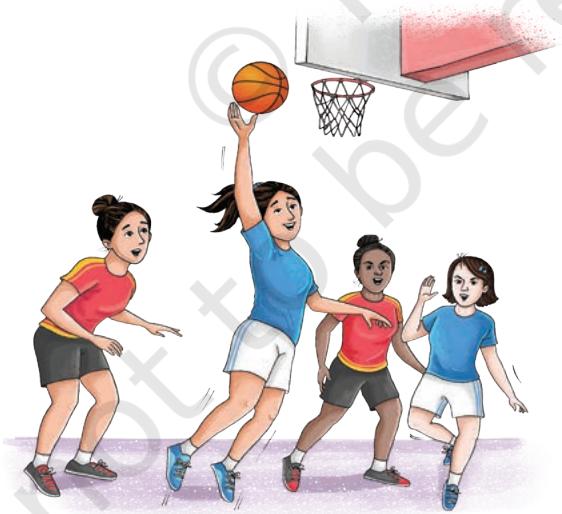
Fig. 6.1: Children playing basketball
Basketball is a fast, free-flowing, high-scoring team game. The players shoot a ball through a basket to score points while following a set of rules. Usually, two teams consist of
five players on each team. They play on a marked rectangular court with a basket fixed on each end. Basketball is one of the world's most popular games.
The rules allow all players to move freely around the court and occupy any position. All players have an equal opportunity to score a Basket. To play basketball, students should learn and practice the basic skills of dribbling, passing, receiving and shooting.
History
The game of basketball originated at the Springfield College of Physical Education, Massachusetts, USA in 1891, invented by Dr. James Naismith. In 1894, Naismith fixed the first 13 rules which still form the basis of modern basketball. In India, the Young Men's Christian Association (YMCA) at Kolkata introduced basketball for the first time. Later the YMCA established at Madras in 1920 played an important role in the development of this game. Today basketball is one of the most favourite games in many schools and colleges. The game is played by both men and women of all ages and ability. In order to promote Basketball at National and International levels the Basketball Federation of India was set up in 1950. The first National Basketball tournament was held in Delhi in 1934 and thereafter it was organised every two years until 1951. After that it started being organised annually.

Basketball court measurements
Fig. 6.2: Basketball court, a basket and a basketball
Basketball is played on a rectangular court, which should be an indoor wooden court or an outdoor concrete court having two side lines and two end lines. The dimensions of basketball court is $2 8 \times 1 5$ meters. The court is divided
into two sections, called half-courts, by the mid-court line, which is where the game starts with a jump ball. A jump ball is when a referee throws the ball up at center circle to determine which team gets possession. Two players from opposing teams jump up to tap the ball out of the circle in order to gain control over the ball take the game forward. The basketball posts are located at the opposite ends of the court.
Rules
Duration of a Match (Total 4 Quarters)
| Play | Rest | Play | Half time | Play | Rest | Play |
|---|---|---|---|---|---|---|
| 10 min | 2 min | 10 min | 15 min | 10 min | 2 min | 10 min |
• The duration of the game of each quarter is ten minutes with 2 minutes rest between 1st and 2nd quarter and 3rd and 4th quarter, also 15 minutes rest between 2nd and 3rd quarter. Extra time period is of about 5 minutes. Teams exchange the side after half time. The clock is stopped while the play is not active. Therefore, it takes longer time to complete the game than the allotted time.
• A team must consist of twelve (12) members. But only five players from each team may be on the court at one time. Substitutions are unlimited but can only be done when the play is stopped.
• The team with the ball, attempting to score in their basket is 'on offense', the team that prevents opposite team from scoring is 'on defence'. The ball is moved in two ways: either dribbling or by passing to teammates. If the ball goes out of the court, the ball possession is given to the opposite team.
• For both men's and women's teams, a standard uniform consists of a pair of shorts and a jersey with a clearly visible bib number, printed on both the front and back. Players should wear appropriate shoes that provide extra ankle support.
The game is controlled by the officials consisting of the three (3) referees, out of which one (1) is the overall in charge and the other four (4) table officials are responsible for keeping other records of each teams scoring, timekeeping, individual and team fouls, player substitutions, alternating possession arrow, and stop-and-go-clock, etc.
• The essential equipment in basketball game is the ball, clocks, score sheets, scoreboard(s), alternating possession arrows and other required equipment.
• An attempt to unfairly disadvantage an opponent through physical contact is illegal and called a foul.
Players who are fouled either get ball possession or are awarded one or two free throws and one point is awarded for successfully converting a free throw, which is attempted from a line 15 feet $( 4 . 6 ~ \mathrm { m } )$ from the basket. Each player is allowed 5 personal fouls before they are disqualified from the game. At this point they no longer remain a part of the game.
• Two points are awarded when a basket is scored during the game but three points are awarded when a basket is scored from outside the 6.25 meters line.
Fundamental skills
We are well aware that, to play any game one has to learn some skills. Similarly to play basketball game a player should learn the following fundamental skills.
Dribbling
It is important to penetrate to score a basket, move the ball across the court, get away from the defenders, and find a good passing lane. There are different types of dribbling —
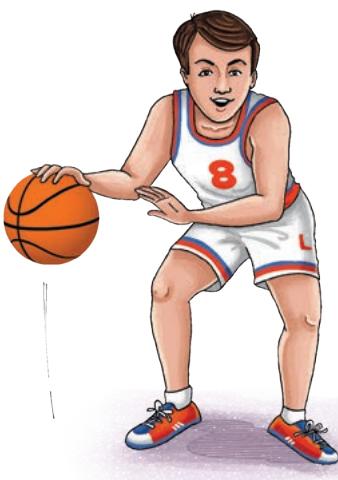
Fig. 6.3: Dribbling
• basic dribble • low dribbling • high dribble • behind the back crossover dribble • change-of-pace • between the legs dribble
Passing
A good offensive attack requires accurate passing from players. It helps find an open man, to find a good shooter or to get away from a defender. There are several types of passes used in basketball, either one hand or both hand pass —
• Overhead • Chest • Push • Baseball • Off-the-dribble • Bounce • Shoulder • Hook
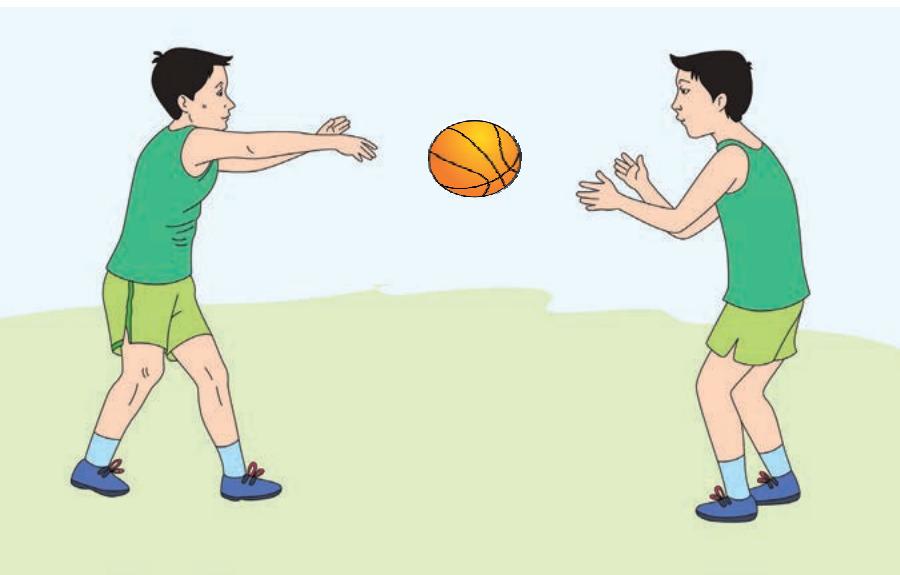
Fig. 6.
4: Passing
Shooting
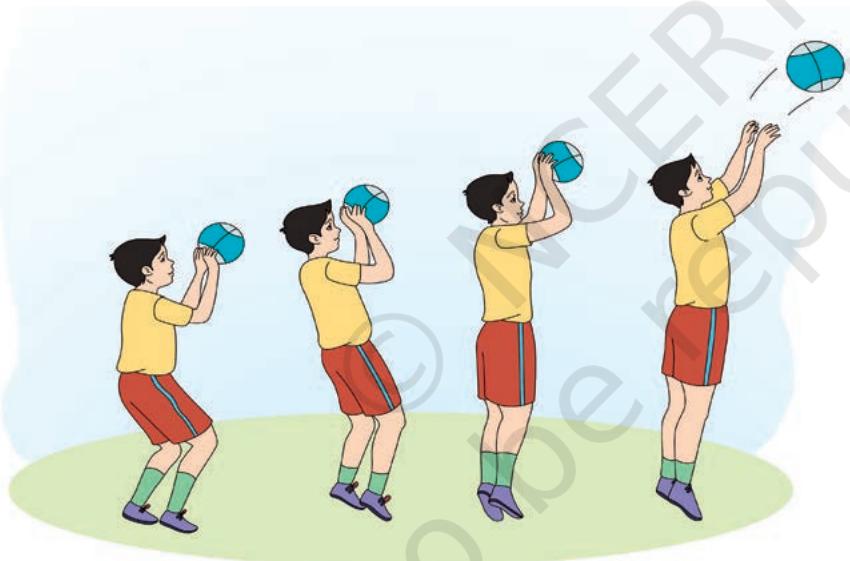
Fig. 6.5: Shooting
The objective of the game is to win by scoring maximum points. Therefore, improving the team's shooting is important to win a game. Shooting with either one hand or both hands is done in the following ways —
• Jump shot • Dunk shot • Free throw • Layup • Three-point shot • Hook shot
Defence
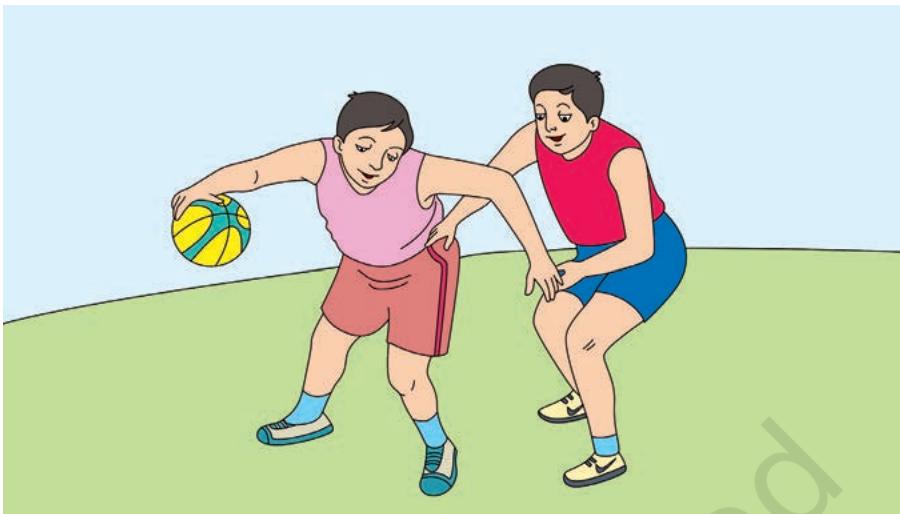
Fig. 6.6: Defence
The game of basketball allows a variety of defences to be deployed in an effort to disrupt and combat offensive plays. Here are examples of the three basic categories of team defences. In addition, each category comprises of an assortment of different variations.
• Man to man defence: Man-to-man defences match up the defenders against specific offensive players. Defenders are usually assigned to be matched up with offensive players by size and ability. • Zone Defence: In Zone defence, defenders are assigned to guard specific areas on the court. Zones are named or designated by their player alignments. • Combined Defence: A third type of defence that can be deployed is the combination defence. With combination defences, some of the players are assigned to play man-to-man while the rest of the defenders play zone. Combination defences are usually deployed in an effort to stop or neutralise great individual offensive players.
Rebounding
The objective of rebounding is to successfully gain possession of the basketball after a missed field point or free throw, as it rebounds from the ring or backboard. This plays a major role in the game, as most possessions end when a team misses a shot. There are two categories of rebounds: