Team Games and Sports II
In the previous chapter, we have discussed team games like Football, Hockey, Basketball, Cricket and Volleyball. This chapter includes Kabaddi, Kho-Kho and Combative sports like Judo and Wrestling.
KABADDI
Kabaddi is an indigenous game which is popular in India. It is a simple and inexpensive game and does not require a big playing area or any equipment. This game is popular in the villages and small towns in India. It is played throughout Asia with minor modifications. Kabaddi is quite new to the other parts of the world. It was known by various names in different parts of India. For example, Chedugudu or Gudugudu in Southern parts of India, Ha-du-du (Men), Chu-kitkit (Women) in Eastern India, Hu-tu-tu in Maharashtra in western India and Kabaddi in Northern India. It is a game of attack and defense. The two teams occupy opposite halves of a field and take turn in sending a Raider into the other half. In order to win points, members of the opposite team are tagged and the raider tries to return to half, holding the breath and chanting, "Kabaddi, Kabaddi, Kabaddi".
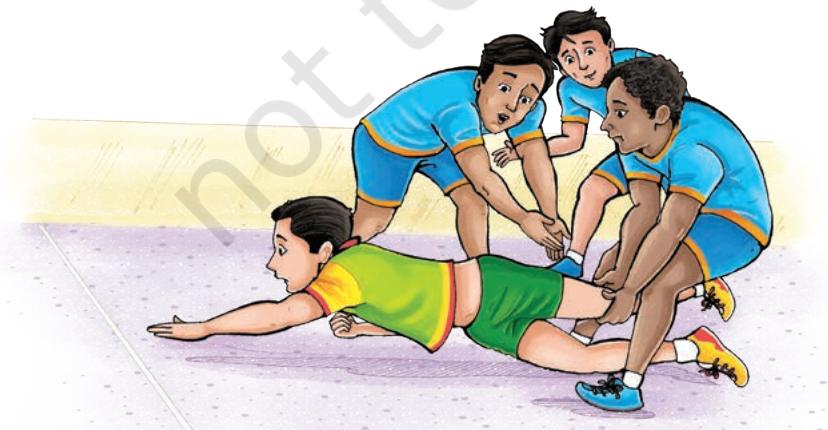 Fig. 7.1: Children playing kabaddi
History
Do You Know?
Pro Kabaddi League was established in 2014. Women Kabaddi Challenge was first played in 2016. 2019 Kabaddi World Cup was held in April 2019 at Malaysia. It is the largest World Cup in the history of kabaddi consisting of 32 men's team and 24 female's teams.
According to some historians Kabaddi might have developed during prehistoric times when human beings were forced to defend themselves from sudden attacks from ferocious beasts. There is also another school of thought, in India, which believes that this game is a version of Chakravyuha, used in Mahabharata. The game was demonstrated for the first time at the international level during 1936 in Berlin Olympics by Hanuman Vyayam Pracharak Mandal, Amravati, Maharashtra. The game was introduced in the Indian Olympic Games at Calcutta in 1938.
In 1950, the All India Kabaddi Federation came into existence and compiled standard rules. The Amateur Kabaddi Federation of India (AKFI) was founded in 1973. After formation of the AKFI, the first men's nationals were held in Madras (Chennai), while the women's were held in Calcutta (Kolkata) in 1955. The Asian Kabaddi Federation (AKF) was founded in 1978. AKF is affiliated to Olympic Council of Asia. The parent body designated to regulate the game at the international level is International Kabaddi Federation (IKF). The Kabaddi World Cup was first played in 2004, then in 2007 and 2010. So far India is the unbeaten champion in Kabaddi World Cup. Iran is the next most successful nation being runners-up twice. Pakistan was the runners-up in 2010.
Rules
Kabaddi field measurements
| S. No | Field measurements | Men | Women |
| 1 | Side lines (AB, CD, EF & GH) | 13 meter | 12 meter |
| 2 | End Line (AD, BC) | 10 meter | 8 meter |
| 3 | Lobby (AE, BF, DG, CH) | 1 meter | 1 meter |
| 4 | Baulk Line (from Mid line)(LN, KM, LR, KQ) | 3.75 meter | 3 meter |
| 5 | Baulk Line (RQ, MN) | 8 meter | 6 meter |
| 6 | Mid-line (IJ) | 10 meter | 8 meter |
| 7 | Bonus Line (TS, PO) from Baulk Line (RT, QS, MO, NP) | 1 meter | 1 meter |
| 8 | Bonus Line (MN, ST) | 8 meter | 6 meter |
| 9 | Sitting Block (2 meters away from End lines) | 8×1 meter | 6×1 meter |
| 10 | Court (each half of the playfield divided by the mid line) | 6.5×8 meter | 6×6 meter |
| 11 | Space surrounding theplay field | 4 meter | 4 meter |
| 12 | Duration of the match | 20-5-20Minutes | 15-5-15Minutes |
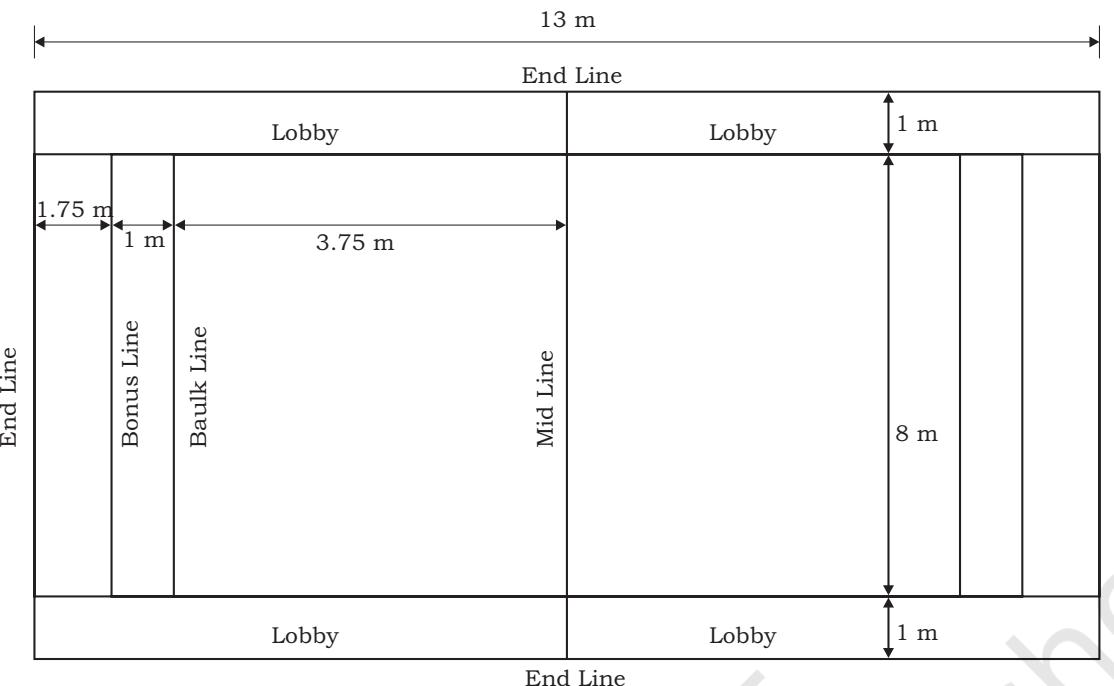 Fig. 7.2: Specifications of Kabaddi court
Court
The Kabaddi court measures $13 \times 10$ meters for men and $12 \times 8$ meters for women with a line dividing it into identical halves denoting actual playing area of the two teams. Traditionally the game is played outdoors and the entire court is dug at least 1 foot deep. The mud is removed and filled with sand from the river or beach. This ensures that the player is not seriously injured if he falls or is dragged by opponents. However, now synthetic Kabaddi fields are used for comfort and to reduce injuries. Tournaments like the Indian Kabaddi league have emerged as crowd pullers in urban areas.
Team
Each team shall consist of minimum 10 and maximum 12 players. Seven players shall take the ground at a time and the remaining players are the substitutes.
Duration of the match
The duration of the match is divided into two halves of 20 minutes each. In case of men and junior boys there is a 5 minutes interval and in case of women, junior girls, subjunior boys and girls two halves of 15 minutes with 5 minutes interval. The teams shall change court after interval. The number of players for each team at the start of the second half shall remain the same as it was at the end of first half. The last raid of each half of the match shall be allowed to be completed even after completion of the scheduled time as mentioned above.
System of scoring
One point score will be given to each team for every opponent who is deemed out. And if your team, makes all the players of your opponent team out, your team is entitled to get 2 points as a bonus. This is known as Lona.
Time out
- Each team shall be allowed to take two time outs of 30 seconds in each half. Such time out shall be called for by the Captain, Coach or any playing member of the team with the permission of the Referee. The time out duration shall be added to match time. During time out, the team shall not leave the ground. Any violation of this will result in the award of a technical point to the opponent team.
- Official time out shall be called for by the Referee or Umpire in the event of any injury to the player, interruption by outsiders, re-marking of the ground or any such unforeseen circumstances. Such time out will be added to the match time.
Substitution
- Five reserve players can be substituted with the permission of the referee during time out or interval. Substituted players can be re-substituted. If any player is suspended or disqualified from the match, no substitution is allowed for that particular player. The team will play with less number of players.
- No substitution is allowed during the official time out.
- Substitution is not allowed for players who are deemed out.
Bonus point
: One point shall be awarded to the raider when they cross the bonus line. If the raider after crossing the bonus line, (is caught) the opponent team will also be awarded one point.
- The bonus line will be applicable when there are a minimum of 6 players in the court; the bonus point shall be awarded by the referee after completion of such a raid by showing thumb upward towards the side which score.
- If the raider while crossing the bonus line is caught then a point will be awarded to the defending team. No bonus point shall be given to the attacking team.
- If the raider, after crossing the bonus line, puts out one or more antis, they will get the number of points
scored in addition to the bonus point for crossing the bonus line.
The raider has to cross the bonus line to score the bonus point before touching the antis or before he is caught by the antis. The raider will not be awarded bonus points if they cross the bonus line after a touch or struggle. There shall be no revival for bonus points. If player is suspended temporarily or disqualified from the match, then the team will play with less number of players. Such players shall be counted while awarding bonus point.
Result
The team which scores the highest number of points at the end of the match shall be declared the winner.
Precautions
- Players should have clipped nails and no ornaments of any sort shall be allowed.
- All players must have distinct numbers on their T-shirts of at least 4 inches thickness in front and 6 inches thickness at the back. Dress code is followed compulsorily by both the teams during competitions.
- Application of oils or any other soft