CHAPTER 13
PLANT GROWTH AND DEVELOPMENT
13.1 Growth
13.2 Differentiation, Dedifferentiation and Redifferentiation
13.3 Development
13.4 Plant Growth Regulators
You have already studied the organisation of a flowering plant in Chapter 5. Have you ever thought about where and how the structures like roots, stems, leaves, flowers, fruits and seeds arise and that too in an orderly sequence? You are, by now, aware of the terms seed, seedling, plantlet, mature plant. You have also seen that trees continue to increase in height or girth over a period of time. However, the leaves, flowers and fruits of the same tree not only have limited dimensions but also appear and fall periodically and some time repeatedly. Why does vegetative phase precede flowering in a plant? All plant organs are made up of a variety of tissues; is there any relationship between the structure of a cell, a tissue, an organ and the function they perform? Can the structure and the function of these be altered? All cells of a plant are descendants of the zygote. The question is, then, why and how do they have different structural and functional attributes? Development is the sum of two processes: growth and differentiation. To begin with, it is essential and sufficient to know that the development of a mature plant from a zygote (fertilised egg) follow a precise and highly ordered succession of events. During this process a complex body organisation is formed that produces roots, leaves, branches, flowers, fruits, and seeds, and eventually they die (Figure 13.1). The first step in the process of plant growth is seed germination. The seed germinates when favourable conditions for growth exist in the environment. In absence of such favourable conditions the seeds do not germinate and goes into a period of suspended growth or rest. Once favourable conditions return, the seeds resume metabolic activities and growth takes place.
In this chapter, you shall also study some of the factors which govern and control these developmental processes. These factors are both intrinsic (internal) and extrinsic (external) to the plant.
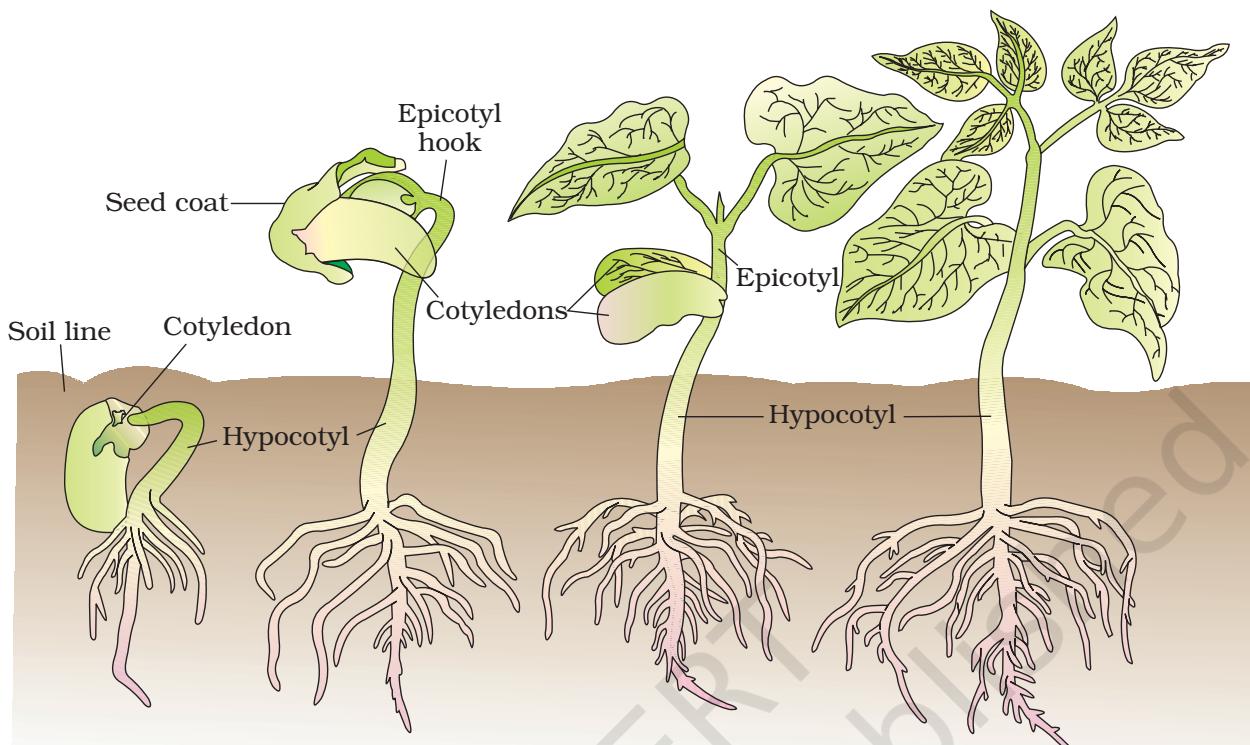 Figure 13.1 Germination and seedling development in bean
13.1 GROWTH
Growth is regarded as one of the most fundamental and conspicuous characteristics of a living being. What is growth? Growth can be defined as an irreversible permanent increase in size of an organ or its parts or even of an individual cell. Generally, growth is accompanied by metabolic processes (both anabolic and catabolic), that occur at the expense of energy. Therefore, for example, expansion of a leaf is growth. How would you describe the swelling of piece of wood when placed in water?
13.1.1 Plant Growth Generally is Indeterminate
Plant growth is unique because plants retain the capacity for unlimited growth throughout their life. This ability of the plants is due to the presence of meristems at certain locations in their body. The cells of such meristems have the capacity to divide and self-perpetuate. The product, however, soon loses the capacity to divide and such cells make up the plant body. This form of growth wherein new cells are always being added to the plant body by the activity of the meristem is called the open form of growth. What would happen if the meristem ceases to divide? Does this ever happen?
In earlier classes, you have studied about the root apical meristem and the shoot apical meristem. You know that they are responsible for
the primary growth of the plants and principally contribute to the elongation of the plants along their axis. You also know that in dicotyledonous plants and gymnosperms, the lateral meristems, vascular cambium and cork-cambium appear later in life. These are the meristems that cause the increase in the girth of the organs in which they are active. This is known as secondary growth of the plant (see Figure 13.2).
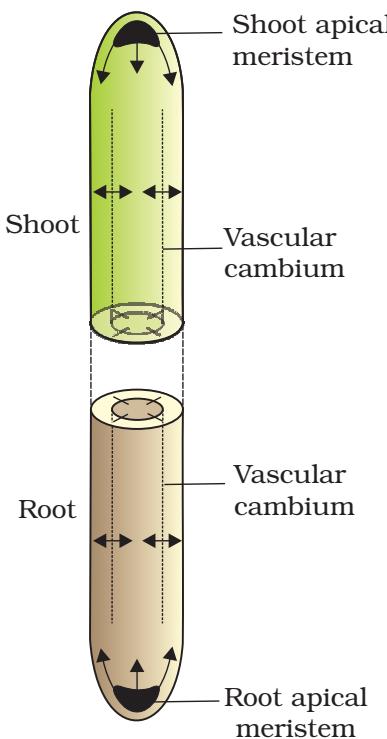 Figure 13.2 Diagrammatic representation of locations of root apical meristem, shoot apical meristem and vascular cambium. Arrows exhibit the direction of growth of cells and organ
13.1.2 Growth is Measurable
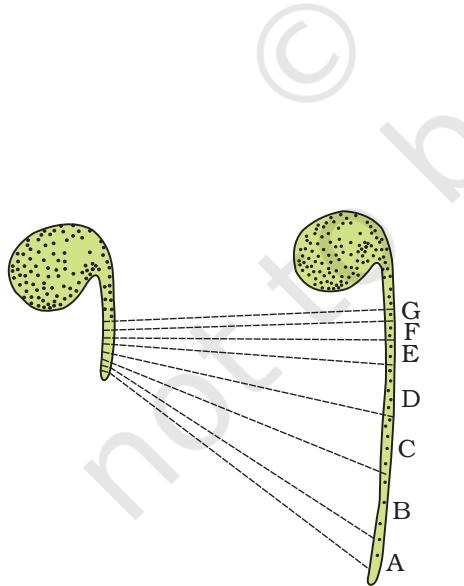 Figure 13.3 Detection of zones of elongation by the parallel line technique. Zones A, B, C, D immediately behind the apex have elongated most.
Growth, at a cellular level, is principally a consequence of increase in the amount of protoplasm. Since increase in protoplasm is difficult to measure directly, one generally measures some quantity which is more or less proportional to it. Growth is, therefore, measured by a variety of parameters some of which are: increase in fresh weight, dry weight, length, area, volume and cell number. You may find it amazing to know that one single maize root apical meristem can give rise to more than 17,500 new cells per hour, whereas cells in a watermelon may increase in size by upto 3,50,000 times. In the former, growth is expressed as increase in cell number; the latter expresses growth as increase in size of the cell. While the growth of a pollen tube is measured in terms of its length, an increase in surface area denotes the growth in a dorsiventral leaf.
13.1.3 Phases of Growth
The period of growth is generally divided into three phases, namely, meristematic, elongation and maturation (Figure 13.3). Let us understand this by looking at the root tips. The constantly dividing cells, both at the root apex and the shoot apex, represent the meristematic phase of growth. The cells in this region are rich in protoplasm, possess large conspicuous nuclei. Their cell walls are primary in nature, thin and cellulosic with abundant plasmodesmatal connections. The cells proximal (just next, away from the tip) to the
meristematic zone represent the phase of elongation. Increased vacuolation, cell enlargement and new cell wall deposition are the characteristics of the cells in this phase. Further away from the apex, i.e. more proximal to the phase of elongation, lies the portion of axis which is undergoing the phase of maturation. The cells of this zone, attain their maximal size in terms of wall thickening and protoplasmic modifications. Most of the tissues and cell types you have studied in earlier classes represent this phase.
13.1.4 Growth Rates
The increased growth per unit time is termed as growth rate. Thus, rate of growth can be expressed mathematically. An organism, or a part of the organism can produce more cells in a variety of ways.
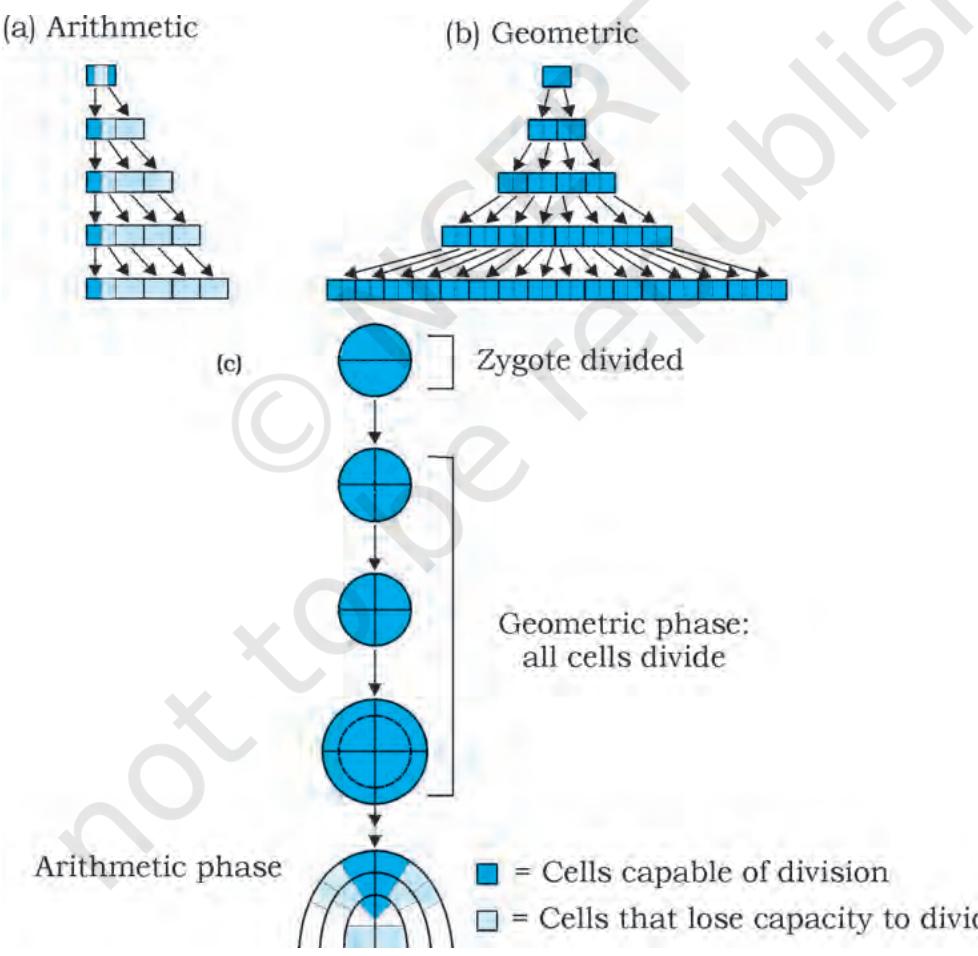 Figure13.4 Diagrammatic representation of : (a) Arithmetic (b) Geometric growth and (c) Stages during embryo development showing geometric and arithmetic phases
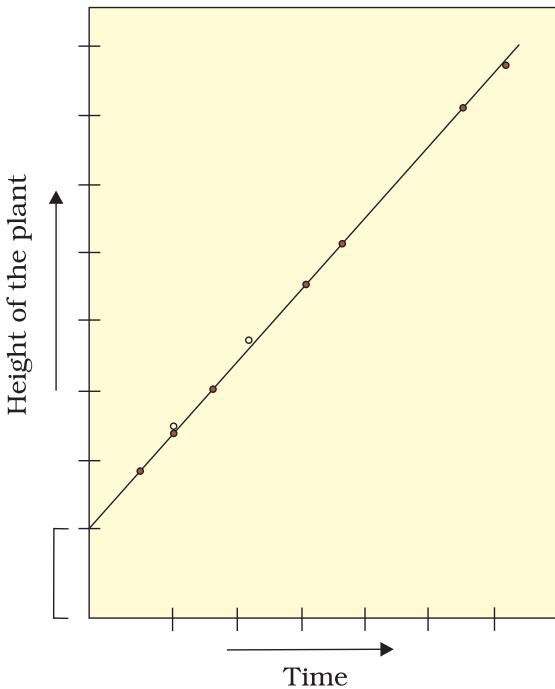 Figure 13.5 Constant linear growth, a plot of length L against time t
The growth rate shows an increase that may be arithmetic or geometrical (Figure 13.4).
In arithmetic growth, following mitotic cell division, only one daughter cell continues to divide while the other differentiates and matures. The simplest expression of arithmetic growth is exemplified by a root elongating at a constant rate. Look at Figure 13.5. On plotting the length of the organ against time, a linear curve is obtained. Mathematically, it is expressed as
$ { \mathrm { L } } _ { \mathrm { t } } = { \mathrm { L } } _ { 0 } + { \mathrm { r t } } $ $\mathrm { L } _ { \mathrm { t } } =$ length at time 't' $\mathrm { L } _ { 0 } =$ length at time 'zero' r $=$ growth rate / elongation per unit time.
Let us now see what happens in geometrical growth. In most systems, the initial growth is slow (lag phase), and it increases rapidly thereafter – at an exponential rate (log or exponential phase). Here, both the progeny cells following mitotic cell division retain the ability to divide and continue to do so. However, with limited nutrient supply, the growth slows down leading to a stationary phase. If we plot the parameter of growth against time, we get a typical sigmoid or S-curve (Figure 13.6). A sigmoid curve is a characteristic of living organism growing in a natural environment. It is typical for all cells, tissues and organs of a plant. Can you think of more similar examples? What kind of a curve can you expect in a tree showing seasonal activities?
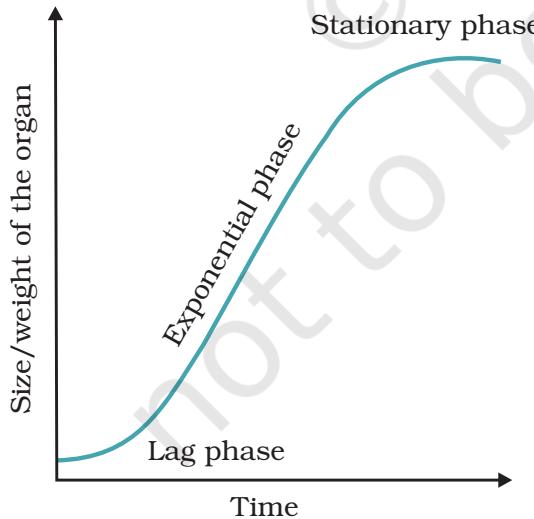 Figure 13.6 An idealised sigmoid growth curve typical of cells in culture, and many higher plants and plant organs
The exponential growth can be expressed as $ \mathbf { W } _ { 1 } = \mathbf { W } _ { 0 } \mathbf { e } ^ { \mathrm { r t } } $ $\mathrm { W } _ { 1 } =$ final size (weight, height, number etc.) $\mathrm { W } _ { 0 } =$ initial size at the beginning of the period r $=$ growth rate t $=$ time of growth e $=$ base of natural logarithms
Here, r is the relative growth rate and is also the measure of the ability of the plant to produce new plant material, referred to as efficiency index. Hence, the final size of $\mathrm { W } _ { 1 }$ depends on the initial size $\mathrm { W } _ { 0 }$.
![](https://yolearn-assets.s3.us-west-2.amazonaws.com/CBSE/11/Biology/1/kebo113_images/cd3d28a3f