Chapter 10
TOURNAMENTS AND COMPETITIONS
Activity 10.1
Collect information about the types of tournaments played at school level in different games and sports.
You may have heard about tournaments that are organised for different sports at different levels. Have you read or heard about world cup tournaments for Cricket, Hockey, Football or Kabaddi? Such tournaments are also held at national and state level and even at local level. You or your friends may have participated in inter-school or other open tournaments for Kabaddi, Kho-Kho, Football, Volleyball, Basketball and Cricket organised at the zone, district or local levels.
A tournament is a competition held among different teams in a particular game or sport according to a fixed schedule where a winner is decided. Different types of tournaments are- Knock-out or Elimination Tournament (Single Knockout or Single Elimination, Consolation Type I and Type II, C Double Knock-out or Double Elimination), League or Round Robin Tournament (Single League, and Double League), Combination Tournament (Knock-out cum Knock-out, Knock-out cum League, League cum Knock-out, League cum League) and Challenge Tournament (Ladder, and Pyramid).
While deciding the type of tournament to be conducted, the season, time of disposal, play fields and equipment, type of activity, officials, and finance/budget must be taken into consideration.
Different types of tournaments with their merits and demerits, and the method of drawing fixtures have been described in this chapter.
KNOCK OUT OR ELIMINATION TOURNAMENT
Single Knock out or Single Elimination
In single knock out tournament, the teams once defeated, are eliminated and not given another chance to play.
Total number of matches in the tournament $\mathbf { \Sigma } = \mathrm { ~ N ~ - ~ } 1$ , where N is the number of teams competing.
For example, if $\mathrm { { N } } = 1 3$
Total number of matches $= 1 3 - 1 = 1 2$
Method of Drawing Fixtures
- Drawing fixture for a certain number of teams competing is decided by the power of two, viz. 2, $2 ^ { 2 }$, $2 ^ { 3 }$, $2 ^ { 4 }$, $2 ^ { 5 }$, $2^6$, .. etc., i.e., 2, 4, 8, 16, 32, 64, …. respectively.
- Suppose 16 teams have entered for a tournament, there will be no byes i.e. $1 6 - 1 6 = 0$.
- If the number of teams participating is not a power of 2, the byes will be given to a specific number of teams in the first round.
- The number of Byes' to be given is decided by subtracting the number of teams from its next higher number which is the power of two. For example, if 13 teams entered for a competition, number of Byes $= 1 6 - 1 3 = 3$ and for 25 teams, number of Byes $= 3 2 - 2 5 = 7$
Seeding
Single Knock out Fixture for 8 Team Round I Round II Round II
1 2 Upper Half 3 4 5 attob 6 Lower Half 7 8
Upper Half = $ { \mathrm { H a l f } } = { \frac { \mathrm { N } } { 2 } } = { \frac { 8 } { 2 } } = 4 $ = 4 Teams Lower Half = $ { \mathrm { H a l f } } = { \frac { \mathrm { N } } { 2 } } = { \frac { 8 } { 2 } } = 4 $ = 4 Teams No. of matches $= \mathrm { N } { - } 1 = 8 { - } 1 = 7$
Single Knock out Fixture for 10 Teams Round I Round I Round II
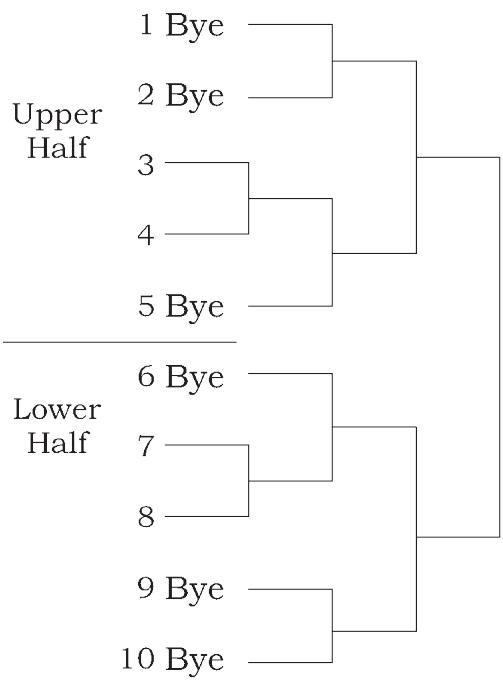
Upper Half = $ { \mathrm { H a l f } } = { \frac { \mathrm { N } } { 2 } } = { \frac { 10 } { 2 } } = 5 $ Teams Lower Half = $ { \frac { \mathrm { N } } { 2 } } = { \frac { 10 } { 2 } } = 5 $ Teams No. of $\mathrm { B y e s } = 1 6 - 1 0 = 6$ No. of Byes in Upper Half = $ { \frac { \mathrm { N b } } { 2 } } = { \frac { 6 } { 2 } } = 3 $ No. of Byes in Lower Half = $ { \frac { \mathrm { N b } } { 2 } } = { \frac { 6 } { 2 } } = 3 $ No. of matches $= 1 0 { - } 1 = 9$
Single Knock out Fixture for 11 Teams Round I Round I1 Round III Round I
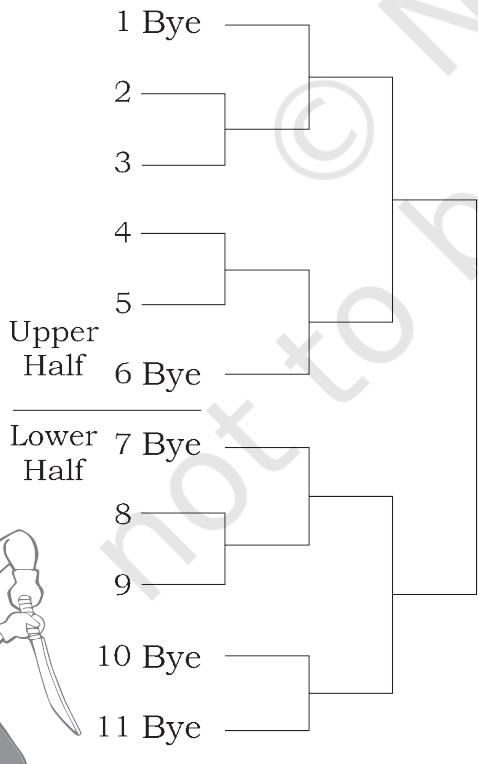
Upper Half = $ { \frac { { \mathrm { N } } + 1 } { 2 } } = { \frac { 1 2 } { 2 } } = 6 $ = 6 Teams Lower Half = $ { \frac { { \mathrm { N } } - 1 } { 2 } } = { \frac { 1 0 } { 2 } } = 5 $ = 5 Teams No. of $\mathrm { B y e s } = 1 6 \mathrm { - } 1 1 = 5$ No. of Byes in Upper Half = $ { \frac { { \mathrm { N b - 1 } } } { 2 } } = { \frac { 5 - 1 } { 2 } } = { \frac { 4 } { 2 } } = 2 $ No. of Byes in Lower Half = $ { \frac { { \mathrm { N b + 1 } } } { 2 } } = { \frac { 5 + 1 } { 2 } } = { \frac { 6 } { 2 } } = 3 $ No. of matches $= \mathrm { N } { - } 1 = 1 1 { - } 1 = 1 0$
Procedure of giving byes
- Ist Bye Bottom of the lower half
- Ind Bye Top of the upper half
- Ird Bye Top of the bottom half
- IVth Bye Bottom of the upper half
This process continues in case the number of byes are more than four.
A knock-out fixture is usually drawn by lots and if it is drawn purely on the basis of lots without considering the standards of the teams, strong teams may meet each other in the earlier rounds, hence allowing the weaker teams reaching upto semifinals resulting in unfair and uninteresting competition. To avoid this, seeding is done. Seeding is sorting of strong teams and fitting them into the fixtures so that these teams do not meet in the earlier rounds.
If there is no marked difference in the standard of the seeded teams, then these teams are distributed in the fixture by lots among them.
Activity 10.2
Draw a fixture of nine teams for a Single Knock-out tournament and show it to your teacher. Collect information about the rules and regulations for drawing fixtures in Inter School Competitions.
Table 1: Number of Teams in each Quarter
| Dividendand Divisor | Remainder | No. of teams in each quarter | |||
| I | 11 | II1 | IV | ||
| N ÷ 4 | 0 | Q | Q | ||
| N ÷ 4 | 1 | Q + 1 | Q | Q | Q |
| N ÷ 4 | 2 | Q +1 | Q | Q+1 | |
| N ÷ 4 | 3 | Q + 1 | Q + 1 | Q + 1 | |
$[ \mathrm { N } = \mathrm { N o }$ . of Teams, $Q =$ Quotient)
No. of Teams/entries 5 to 8 $= 2 { \times } 2 { \times } 2 = 2 ^ { 3 }$ $= 3$ Rounds No. of Teams/entries O 9 to 16 $= 2 { \times } 2 { \times } 2 { \times } 2 = 2 ^ { 4 }$ $= 4$ Rounds No. of Teams/entries 17 to 32 $= 2 { \times } 2 { \times } 2 { \times } 2 { \times } 2 = 2 ^ { 5 }$ $= 5$ Rounds No. of Teams/entries 33 to
64 $= 2 { \times