UNIT 3
NURTURING NATURE
NEEM BABA
Let us do these activities before we read.
I A tree is useful to us in many ways. Mention some of these uses. Write them in the picture given below.
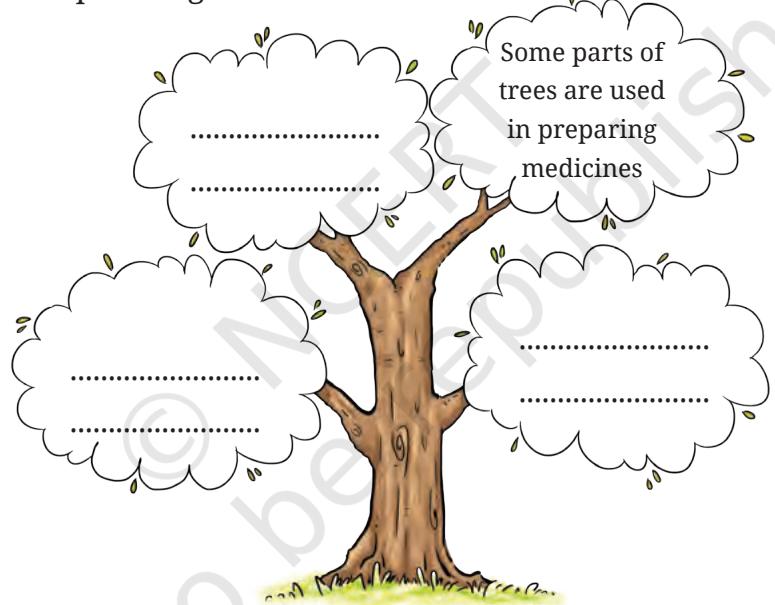
II Neem is a common tree in our country. Discuss in groups of four and fill Columns 1 and 2 with what you know about the neem tree and what you want to know.
| Column 1.What do you know? | Column 2.What do you want to know? |
Let us read
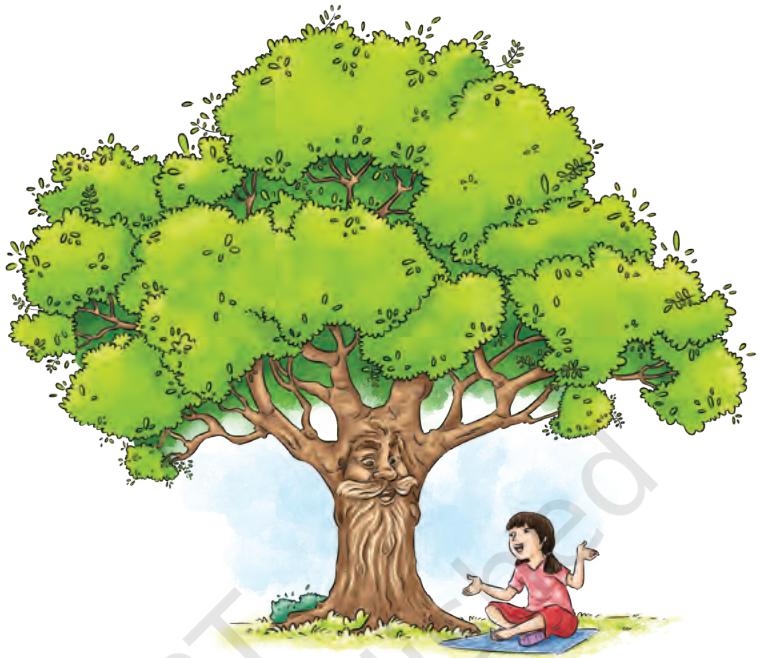
Amber returned from school and sat down in the shade of the neem tree in her courtyard. She felt that the tree was whispering to her. She looked at the tree and spoke to the tree.
I
Amber : Namaste! I am Amber. I would like to talk to you. May I?
Neem Baba : Sure, dear Amber. I know you. You played in my shade in your childhood. You may call me Neem Baba'.
Amber : I have seen you almost everywhere. Please tell me something more about yourself.
Neem Baba : I am very old. I was born millions of years ago somewhere in North India or Myanmar. Soon, my family spread outside India.
mber Outside India? Where else can neem be found?
Neem Baba : My family can be found in many Asian and African countries and even in some parts of America.
Amber : That's wonderful! Who gave you your name?
Neem Baba : The story of my name is very thought-provoking. I was born in India and given Sanskrit names such as Arishta (the one who cures diseases), Nimba and Nimbaca. The name Neem' is given by the Iranians.
thoughtprovoking: interesting
Amber : Really?
Neem Baba : Yes, in Hindi, my name is Nimb. In India, I have other names—Nim, Leemba, Nimori, Nimbamond, Nimbe and Nimo.
Amber
: You are so well known! That is wonderful.
Neem Baba : Dear Amber, we become well known for what we do. People find us useful and that is why they know us. Scientists call us bitter grace of God', nature's gift to man', and 'cleanliness-parting tree'. Some even call us magic tree' and 'the tree of the twentieth century.
grace: blessing
Let us discuss
Amber found many facts about the neem tree from Neem Baba. Fill up the fact sheet based on what Neem Baba told her.
| LET US KNOW OUR NEEM | ||
| Common name: | Given by: | |
| Period of birth: | ||
| Born at: | ||
| Found in: | ||
| Common names: | ||
| Names given by scientists: | 1. | 12. |
| Names given by others: | 1. | 2. |
II
Amber
: I know that people clean their teeth with your twigs and protect clothes with your leaves. Sometime back, when my brother had measles, the doctor told us to put neem leaves on his bed and make him lie down on them. Can you explain why?
twigs: small thin branches
measles: disease with fever and red spots on skin
Neem Baba : The doctors know that neem leaves have chemical properties that destroy germs. Measles cause itching all over the body. Neem leaves give comfort and do not allow germs to breed. Neem leaves, bark, flowers, fruits and even roots can be used to make medicines to cure many diseases.
itching: feeling the need to scratch
breed: grow
Amber
: Yes, I once had a cough and I could not breathe properly. My grandmother cured me with a medicine made from neem bark. And when my father had itching in the eyes, she prepared a kajal from neem flowers, which cured him.
Neem Baba : Oh, little Amber, you know so much. Remember, these remedies are to be used only by people who are well trained and have a lot of experience.
Amber
: Yes, I will. Tell me Neem Baba, is there any use of neem for the farmers?
Neem Baba : Yes. If the powder of neem seeds is mixed in water and sprayed on plants and trees, then locusts don't eat them. If it is used in rice fields, where water remains standing, it stops mosquito breeding and helps to increase crop yield. It also saves the crop from termites, which eat roots of the crop, and it also stops breeding of other insects that eat crops.
locusts: flying insects that damage crops
termites:insects
that damage
wood and
buildings
Amber
: That means, if we put the powder of neem seeds in stagnant water around our homes, mosquitoes
stagnant: not flowing
won't breed in them! This must be a cost-effective method to stop mosquitoes from breeding. Please tell me other uses of neem in our daily life.
cost-effective: good outcome in least amount of resources
Neem Baba : Ofcourse. People savetheirstored grains from insects by adding neem seed powder to them. Neem oil is also used to make soaps and toothpaste. Furniture made from neem wood is not eaten by termites. Neem also purifies the air. There are many qualities yet to be discovered. Will you discover them when you grow up?
purifi es:
removes harmful particles
Amber
: Yes, Neem Baba. I will. Thank you for your time today!
Neem Baba : Bless you, my child!
Adapted from Neem Baba BY S. I. FAROOQI
Let us discuss
How is neem useful to farmers?
Mention some of the uses of the neem tree.
Let us think and reflect
I You just read about the neem tree. Write any two facts that surprised you the most.
II Complete the following sentences.
Amber played in the shade of
Neem seed powder protects crops from
is a cost-effective method to stop mosquitoes from breeding in stagnant water.
One reason why doctors advise us to use neem leaves for someone suffering from measles is
II Which parts of the neem tree are used to make medicines?
IVv Why is the story of neem tree thought-provoking?
Let us learn
I Study these words from the text.
• something neem oil • cleanliness-parting • well known grandmother • seed powder • childhood • well trained • thought-provoking
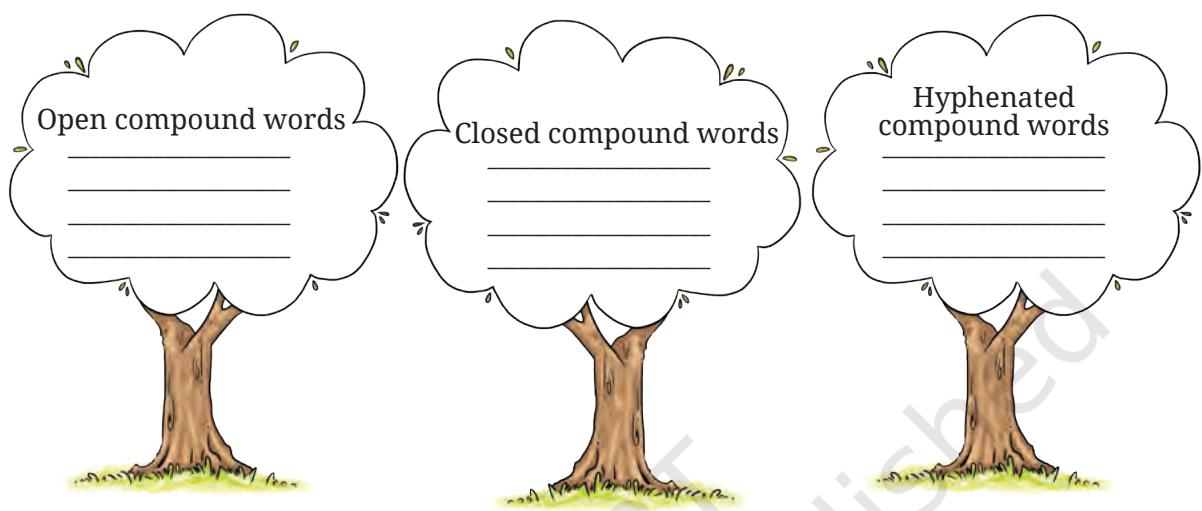
Put the compound words given above in their trees.
These words are known as compound words. There are three types of compound words, based on how the words are separated.
• Open compound words: spaces between the words.
• Closed compound words: no spaces between the words.
• Hyphenated compound words: hyphens between the words.
You may add some more words:
Il Words that tell us what a person is doing are called verbs. In the table given below, match the verbs in the fi rst column showing action in the present to verbs in the second column showing action in the past. Make a sentence with any one form of the verb. One has been done for you.
| Present | Past | Answer | Sentence |
| 1.become | O(i) made | 1.(iv) | I want to become a teacherwhen I grow up. |
| 2.find | (i) gave | ||
| 3.make | (ii) told | ||
| 4. discover | (iv) became | ||
| 5.tell | (v) found | ||
| 6. give | (vi) discovered |
III Amber speaks to Neem Baba as if speaking to a person. This figure of speech is called personifi cation. Let us look at some more examples.
• The leaves whispered in the wind.
• The flowers danced merrily in the breeze.
Now, discuss it with your classmates and teacher.
Let us listen
You will now listen to a boy speaking to his mother. As you listen, select the correct statements. (refer to page 101 for transcript)
- The mother was surprised to know that Peepal Baba had planted trees all over the country.
- The mother disliked the work being done by Peepal Baba.
- The mother wanted to know more about Peepal Baba.
- The boy decided to take care of trees by listening to Peepal Baba's journey.
- The boy was worried about what his teacher had told him.
Let us speak
Collect dry leaves of four different trees and plants around you.
- Make one card as given below. On the top, draw the shape of the leaf looking at the dry leaf and colour it. Inside the card, write the name of the tree/plant the leaf is taken from and one of its uses.
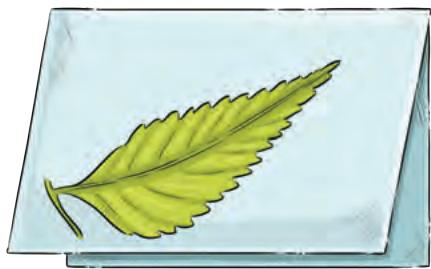
Now, speak about the whole process of making the card in front of the class.
Ask your classmates to identify the leaf and tell them one of its uses. After they answer, open the card, and share what you have written.
Let us write
You have read about Neem Baba and learnt many things about the neem tree. Look at the trees in your neighbourhood and write a paragraph about any one tree that you like.
• Where it is (roadside/park, etc.)
• How it looks (height, tree trunk, leaves, flowers, etc.)
• Why you like it (shade, medicinal properties, shelter, beauty, etc.) • Give a title to your paragraph.
Let us explore
When people from Persia came to India and saw that a common tree of their country was freely growing here, they started calling the tree Azad Darakhte Hindi. So, the scientific name of Neem in Latin became Azadirachta indica.
Neem has different names in the Indian languages. Discuss with your teacher and find out which Indian languages these names belong to.
| Name | Nimb | Nim | Leemba | Nimori | Nimbamond | Nimbe | Nimo |
| Indian |
WHAT A BIRD THOUGHT
Let us do these activities before we read.
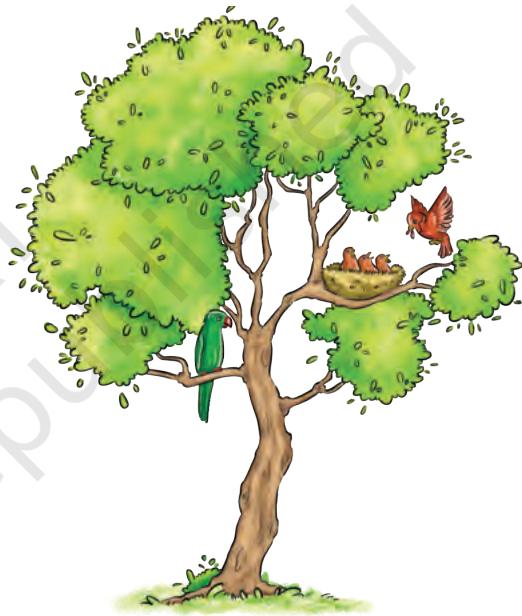
I Look at the picture and discuss what you see in the picture with your teacher and classmates.
Think of a time when you worked hard. What did you do then?
• How did it help you? • How did it make you feel?
Also, discuss in groups.
Il Where do you see birds? What do you see the birds doing?
III Do you want to fly like a bird?Why?
IV What does a baby bird think about its world?
V Read the sentences and replace the underlined words with their correct meanings.
| S.No. | Sentences | Meanings |
| 1. | The colour of the feather was not dark but pale. | at last |
| 2. | The butterfly moved lightly and quickly on to the flower. | light |
| 3. | Finally, I finished my bird painting after trying many times. | labour |
| 4. | The pretty flowers were the prize for the gardener's hard work. | fluttered |
Let us read
I lived fi rst in a little house,
And lived there very well,
I thought the world was small and round And made of pale, blue shell. I lived next in a little nest,
Nor needed any other,
I thought the world was made of straw, And nestled by my mother.
One day, I fluttered from my nest, To see what I could find, I said the world is made of leaves, I have been very blind.
At length I flew beyond the tree, Quite fit for grown-up labours, I don't know how the world is made, And neither do my neighbours.
Let us discuss
I Read the poem again. Identify the main idea of each stanza. There are two extra sentences are given.
- The bird steps out into the world.
- The bird lived happily in a small world.
- The bird becomes blind due to leaves.
- The bird flies away as an adult.
- The bird is unhappy with the straw nest.
- The bird lived in a cosy nest with its mother.

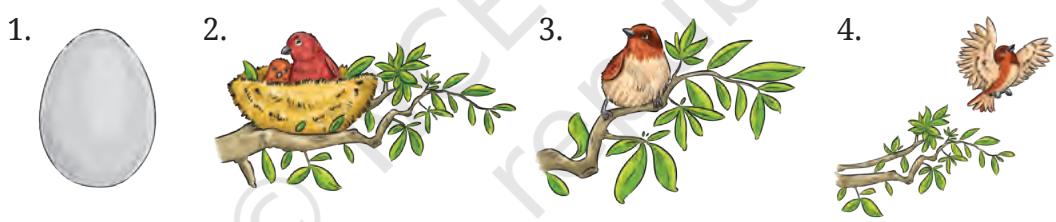
II Look at the pictures 1–4 and write the matching line from the poem for each.
III Answer the following with a word from the poem and check the answers with your partner.
- What was the shape of the bird's fi rst house?
- What was the bird's second nest made of? − − R_ -
- What did the bird see when it came out of its nest? L _ − _ E _
- What did the bird do at the end? --_W
IV Now, recite the poem aloud along with your teacher and classmates.
Let us think and reflect
I Write whether the following sentences are True or False.
- The bird changed its house two times.
- The neighbours tell the bird about the world.

II Read the following lines from the poem and answer the questions given below.
- I thought the world was made of straw, And nestled by my mother.
(i) Who lived in the nest along with the baby bird?
(ii) Complete the following by choosing the correct option. The bird thought the world was made of straw because
A. it lived in a straw hut B. its nest was made of straw C. its mother fed straw to it D. there was straw all around (ii) Which word tells us that the baby bird was warm and comfortable?
- I said the world is made of leaves, I have been very blind.
(i) Why did the bird think the world was made of leaves?
(ii) What does the set of words I said' mean?
A. flew B. shouted C. spoke D.cried (ii) Fill in the blanks to complete the sentence. The bird felt that it had been very blind because it could not the leaves from_n_ ——e the nest.
III Why did the baby bird think that its first world was small, round and blue?
IV Where did the bird go when it fluttered from its straw nest?
V What quality did the bird say it had, when it flew away?
VI Who do you think were the bird's neighbours? Why do you think so? Discuss.
Let us learn
I Let us write some rhyming words. One has been done for you.
| Words from the poem | |||
| Stanza 1 | Stanza 2 | Stanza 3 | Stanza 4 |
| well | |||
| shell | |||
| New rhyming words | |||
| fell | |||
Now, complete a new stanza with rhyming words at the end of each line.
I fly high and I fly low, But one thing I surely k Whenever I wish to rest, My little nest is the
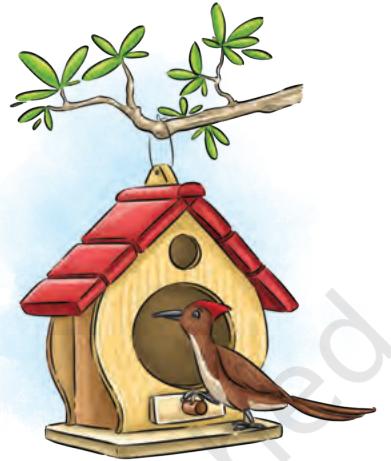
II The poet uses words like 'pale', blue', 'round', 'straw' and little' to describe the bird's nest.
Read a few more describing words.
pointed green thin brown small wooden hanging round
Now, use the describing words given in the box to create six sentences based on the given picture.
Let us listen
You will listen to a short poem. As you listen, fill in the missing words. You can listen to the poem more than once. (refer to page 102 for transcript)
I'm a parrot, my name is Paro,
My feathers are_——8__and they glow.
In the morning, I spread my wings,
around and see wonderful things.
Come with me through the skies so —1—
To places old and places new.
Among the ——e— where the breeze is light,
Many new s tXs, oh, what a sight!
Let us speak
Speak about which bird you would like to be. Include the following points.
• Which bird are you? [I am ..
• What do you look like? [ am .. . in colour. I am a big/small bird. I have …... ..
• Where do you live? [I live in It is (where)
• What do you do during the day? [I. .I also.
• Do you have any message for humans? [ I want to tell the humans ....
Let us write
I Read how the bird perceived its world.
My world was small, round and light blue at first. After that my world was warm and comfortable. It was made of straw. In this world I could only see leaves whenever I stepped out. In the end, my world became big. It had the sky and the earth as a part of it.
I Now, discuss with your teacher and classmates how you think the world would look to the following.
- a baby 2. a fish
III Now, write five sentences each, for both 1 and 2, in your notebooks. You can take help from the example given in I.
Let us explore
I The bird's first home was made of a shell. Later its home was among leaves and made of straw.
• Look at your home carefully and make a list of all the materials it is made of.
• Why do you think our homes are not made of straw?
• If you had to own a home of your choice, what would it look like and what materials would you like to use?
• How is a home different from a house? Discuss with your classmates and teacher.
• Look at the list of some workers who build houses. Find out the work they do and write, as shown in the example. You can think of other workers and add them too.
| Workers | Their work |
| Example: mason | lays bricks and stones |
| 1. painter | |
| 2.electrician | |
| 3. plumber | |
| 4. carpenter | |
| 5. architect | S |
| 6. | |
| 7. |
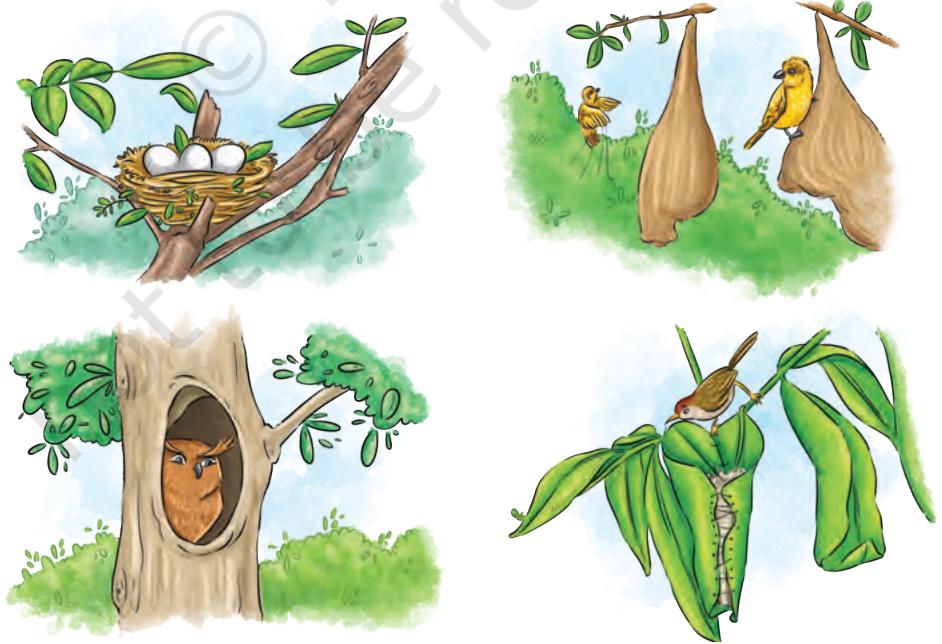
II Look at the different kinds of nests and homes the birds make. Have you seen any? Discuss these type of nests with your teacher and classmates.
SPICES THAT HEAL Us
Let us do these activities before we read.
I A spice is any seed, fruit, root, bark, leaf or any other part of a plant used to give taste and colour to our food. Try to recall the names of three spices that are used for cooking in your home. Write them below and share your answers with your teacher.
II Given below are pictures of some spices. Work in pairs and write what you call them in your language. Their names in English are given in the last column. Share your answers with your teacher.
| S.No. | Spice | Name in your language | Name in English |
| 1. | Turmeric | ||
| 2. | Fenugreek | ||
| 3. | Cumin seeds | ||
| 4. | U | Asafoetida | |
| 5. | O | Cinnamon | |
| 6. | Clove | ||
| 7. | Ginger | ||
| 8. | Black pepper | ||
| 9. | Fennel seeds | ||
| 10. | Cardamom |
III Do you know if these spices can be used for something else other than cooking? Let us fi nd out by reading the letter given below.
Dear Vikram and Vaibhavi,
Namaste! I just got your message that you are better now.
I am happy that the natural cures that I had shared, helped you. You should try to remember these cures and may share them with your friends. When I was a child, I learnt them from my grandmother. She used to find home remedies for most of the weather-related common illnesses. Let me share some of the benefits of the spices that most of us have in our kitchen.
Let me start with haldi, which is called turmeric in English. It helps in improving our energy level and digestion. It helps in reducing body pain too.
Next, let us take methi, which is called fenugreek in English. You will be surprised to know that it helps me in keeping my sugar level and my body weight in control. I need to soak the methi seeds overnight and drink the water in the morning.
Jeera (cumin) seeds soaked in water overnight can also improve digestion and
help cure sleeplessness. You know, when you were babies and had gas in your tummy, I used to put
heeng (asafoetida) water on your tummy to give you some relief. Heeng
can also help in controlling cough and cold.
Dalchini (cinnamon) and laung (clove) give relief when we have toothache till we can consult a dentist. Adrak (ginger) is another herb that can help us when we have cough and
cold. It also gives relief from pain. Do you know, ginger has been used in cooking for more than 4000 years? Even today, it is extensively used in
cooking Indian food.
Kali mirch (black pepper) is also helpful in digestion and can give us relief
from body pain.
You may have seen that at the end of a meal, saunf (fennel seeds) and ajwain (carom seeds) are served. It is because they help in the digestion of
food.
Elaichi (cardamom) also helps us with digestion and respiratory troubles
in addition to curing bad breath.
Now, go into the kitchen and try to identify these herbs and spices. And remember, you must consult an elder before you use them.
My love and aashirwaad to both of you!
Yours affectionately, Daadi
Let us think and reflect
I Read the given lines and answer the following questions.
'When I was a child, I learnt them from my grandmother. She used to find cures for most of the weather-related common illnesses in the kitchen.'
Where exactly in the kitchen did her grandmother find the cures?
Give one example of weather-related common illnesses.
What kind of relationship did the speaker have with her grandmother?
II Fil in the blanks to complete the sentence.
Daadi soaked methi seeds overnight and drank the water in the morning to manage and
III Circle the spice that is not useful for body pain according to Daadi's letter.
- Turmeric to 2. Fennel seeds
- Ginger 4. Black pepper
IV Why did Daadi ask Vikram and Vaibhavi to share the natural cures with their friends?
V What was Daadi's final advice to Vikram and Vaibhavi?
VI How do we know that natural cures are passed from one generation to another?
VII Why do you think we should know about the healing properties of spices?
Let us learn
I You have read the uses of spices in the letter. Complete the following table with the help of your teacher. You may use the words from the box given below.
Part of the plant: root/bark/leaves/flower buds/fruit/seeds
Texture: rough/soft/silky
Taste: bitter/sweet/sour/salty/spicy
| Spice | Name | Part of theplant | Colour | Texture | Taste |
| Turmeric | |||||
| Fenugreek | U | ||||
| Cinnamon | |||||
| Clove | |||||
| BlackQpepper | |||||
| Cardamom |
I Read the sentences given below.
• You may share them with your friends.
• You should try to remember these cures.
• It can help control cough and cold.
• You must consult an elder before you use them.
• I need to soak the methi seeds overnight.
• I used to put heeng water on your tummy.
The underlined words are known as helping verbs. These are called modal verbs or modals. Each modal verb has a different function.
- The words given in Column A are helping verbs. Match the helping verbs in Column A with their functions in Column B.
| Column AHelping verbs | Column BFunctions |
| (i) may | A. past habit |
| (ii) should | B. suggestion |
| (ii) can | C. compulsion |
| (iv) must | D. advice0 |
| (v) need to | E. ability |
| (vi) used to | F. necessity |
- Complete the following dialogues with any four modals from the table given above.
(Use a modal only once.)
Ajay : Anand had fever last week. He (i). take good rest.
Suman : Yes, he (i) or he will fall ill again.
Ajay : He (ii) take grandmother's natural cures.
Suman : Yes, we (iv) remember how effective they are.
Let us listen
You will listen to the benefits of Tulsi (Holy Basil), a common herb. As you listen, complete the fact sheet given below. (refer to page 102 for transcript)
| THE WONDER HERB | ||
| 1. Name | Tulsi | Family: |
| 2. First found in | ||
| 3. Now found | everywhere in India | |
| 4. Known as | The of herbs | |
| 5. Can decrease levels of | and cholesterol | |
| 6. Used to treat disorders of | breathing and | |
| 7. Is used to make | mouth wash and | |
| 8. We can have Tulsileaves by | eating them or adding themwhile making | |
Let us speak
Daadi told Vikram and Vaibhavi about many spices. Choose one spice and introduce yourself as that spice to the class.
Before you speak, make a spicy headband for the spice you chose. Follow the steps given below.
Cut out strips Join two ends Make a small Attach the of a paper 2 to make a band card with a card on your inches wide. that can fit picture of a headband. your head. spice. Colour it.
Use the headband while introducing yourself as the spice.
- Mention the following while speaking.
: your name • part of the plant • colour • texture • taste • benefits
Let us write
I vikram's grandmother shared two natural cures to cure his cough in her earlier letter. It was kept outside and a few drops of rain fell on it. Some of the words got washed away by the rain. Help Vikram complete the natural cures. Use the phrases given in the box below. There are two phrases that you do not need.
some leaves of basil for cough amount of honey the mixture for high fever a piece of fresh ginger you can have it grind to get home remedy
Natural Cures for Cough
To prepare this home remedy, you just need ginger and honey. First, take , grate it and take the juice from it. Take about two teaspoons of this juice and add about two and half teaspoons of honey to it. Mix it properly. Warm slightly on very low heat for a minute. Then about three to four times a day to get relief from cough. Have patience to see the effect as natural cures with ginger and honey might take some time to show results.
To prepare the second for cough, take about 10 grams of each— long pepper, dried ginger and basil leaves. Add four to six small cardamoms and a fine powder. If you take this powder with an equal , it will give you relief from cough.
I Now, write a short paragraph on Tulsi based on the completed fact sheet in 'Let us listen'.
Let us explore
I Now that you have read about many spices, can you guess the spices based on the riddles given below?
When your tummy felt funny I was used by your granny I made you fi t and fi ne And brought back your smile. Who am I?
I come from under the ground Thousands of years, I've been around. For cooking you use me daily From cold I can cure you surely. Who am I?
II Fill in the blanks to complete the riddle below. Write another riddle of your own and ask your family members to guess the spice.
Brownish- in colour, and to taste, I help everyone, to their weight. Who am I? Ans: Fenugreek (methi)
III Close your eyes and learn about spices by smelling and feeling them. The teacher may also provide a few different spices to try.
Transcript
Let us listen (refer to page 83)
PEEPAL BABA
Rahul : Maa, have you heard about Peepal Baba? Our teacher told us about him today.
Mother : Ihave not heard about him. Who is he and what does he do?
Rahul : He plants trees along with his team. He also started a movement to plant and save trees.
Mother : That's wonderful. Where did he get this idea from?
Rahul : When he was studying in a school in Pune, his English teacher gave him the idea to plant trees. He was just 11 years old.
Mother : How did he plant so many trees all over the country as a child?
Rahul : He was born to an army officer's family in Chandigarh and whenever they were moved to a new city, he planted more trees.
Mother : But how did he come to be known as Peepal Baba?
Rahul : He used to plant Peepal and Neem trees as they have many uses for us and told others to do so. So, in the beginning, people made fun of him by calling him Peepal Baba but he was not bothered and continued to do his work. Now everyone calls him by that name lovingly.
Mother : He is really doing great work. We should learn from him and plant more trees.
Rahul : Yes, Maa. We must tell others to do the same.
You will listen to the audio or narration once again. As you listen, check your answers.
Transcripts
Let us listen (refer to page 90)
WHAT A BIRD THOUGHT
I'm a parrot, my name is Paro,
My feathers are bright and they glow.
In the morning, I spread my wings,
Fly around and see wonderful things.
Come with me through the skies so blue,
To places old and places new.
Among the trees, where the breeze is light,
Many new stories, oh, what a sight!
(refer to page 98)
SPICES THAT HEAL US
The wonder herb: Tulsi is a shrub in the basil family. It is said that it was fi rst found in north central India and now grows almost everywhere in India. It is known as the Queen of Herbs' and has many medicinal uses. Studies show that it helps to decrease glucose and cholesterol levels and improve blood pressure. It is commonly used to treat breathing and digestion disorders. As it has anti-bacterial properties, it is used in herbal hand sanitisers. It is used as a base for making herbal mouth wash and toothpaste for treating bad breath, gum disease and mouth ulcers.
Tulsi leaves can be washed and eaten raw. We can also add Tulsi leaves when we make tea. Tulsi tea helps in dealing with stress as it calms our mind. Tulsi protects us from a vast range of pollutants around us.
You will listen to the audio or narration once again. As you listen, check your answers.