UNIT 2
FRIENDSHIP
THE UNLIKELY BEST FRIENDS
Let us do these activities before we read.
I Friends are an important part of our lives. Why do you think so? Share your ideas with your friend. What do you do when you are with your friends and how do you feel?
Now, complete the following sentences by writing in the shapes given below. Share your completed sentences with your classmates and teacher. One has been done for you.
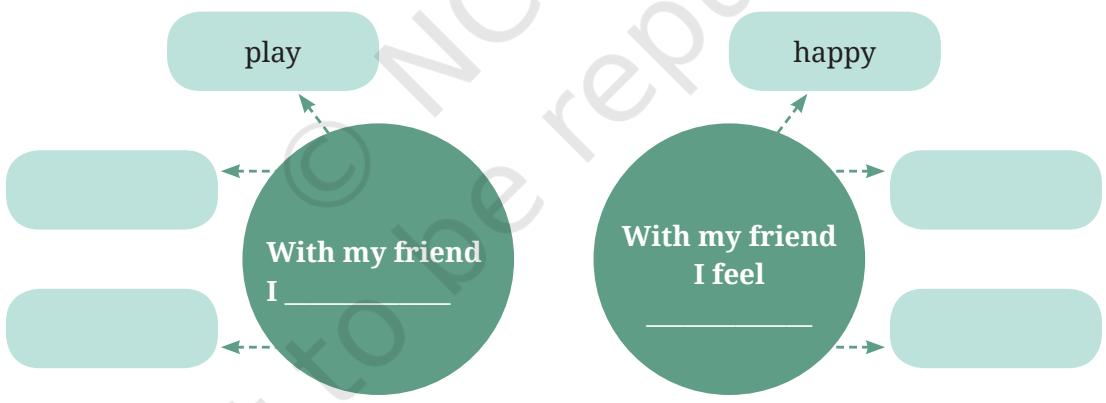
II The title of the chapter is The Unlikely Best Friends'.
- What can be the meaning of 'unlikely'? Discuss in groups, and then discuss with your teacher.
- Can you think of some unlikely friends? Share your answer with your teacher.
Let us read
I
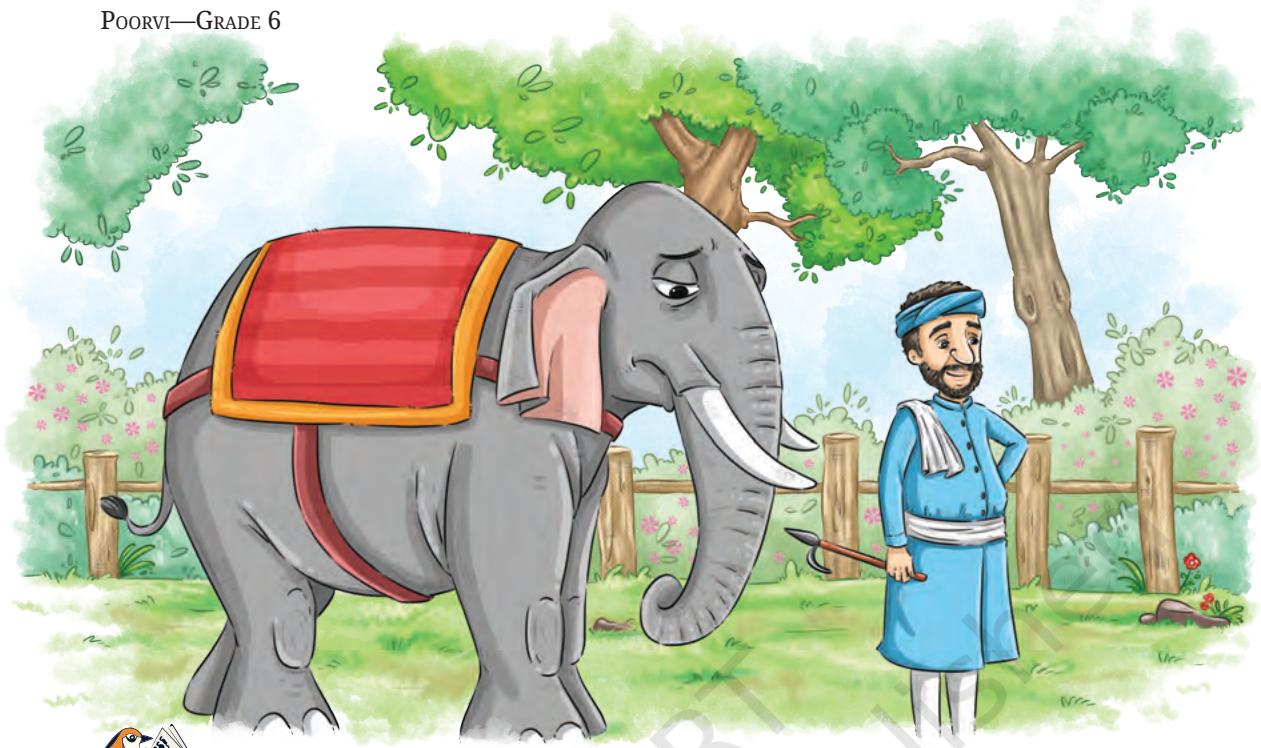
Gajaraj, the elephant, lived in the best booth of the royal stables. The king was fond of Gajaraj, and he had ordered that the elephant should be well looked after.
In spite of royal comforts, Gajaraj was sad because he had no friends. The mahout, or elephant trainer, was the only one he ever interacted with. The mahout was a kind man who served Gajaraj food, and gave him a bath in the elephant pond daily. He was a good caretaker, but not a friend.
"I wish I had a friend I can play with," thought Gajaraj. One late evening, a dog strayed into the stable. Gajaraj could see that the visitor was tired and hungry. He pushed
booth:
rectangular
space
stables: living
spaces for
animals
interacted with: communicated with
strayed: came by mistake
some of the food he was munching towards the dog. The visitor wagged his tail, looked up at the elephant to convey his thanks, and then turned his full attention to the food in front of him. As soon as he finished eating, he fell asleep.
The next morning, the mahout found the stray dog in the stable. He did not mind the dog. He also noticed that Gajaraj seemed to like the company. So, he threw some crumbs to the dog, which the animal accepted wagging his tail.
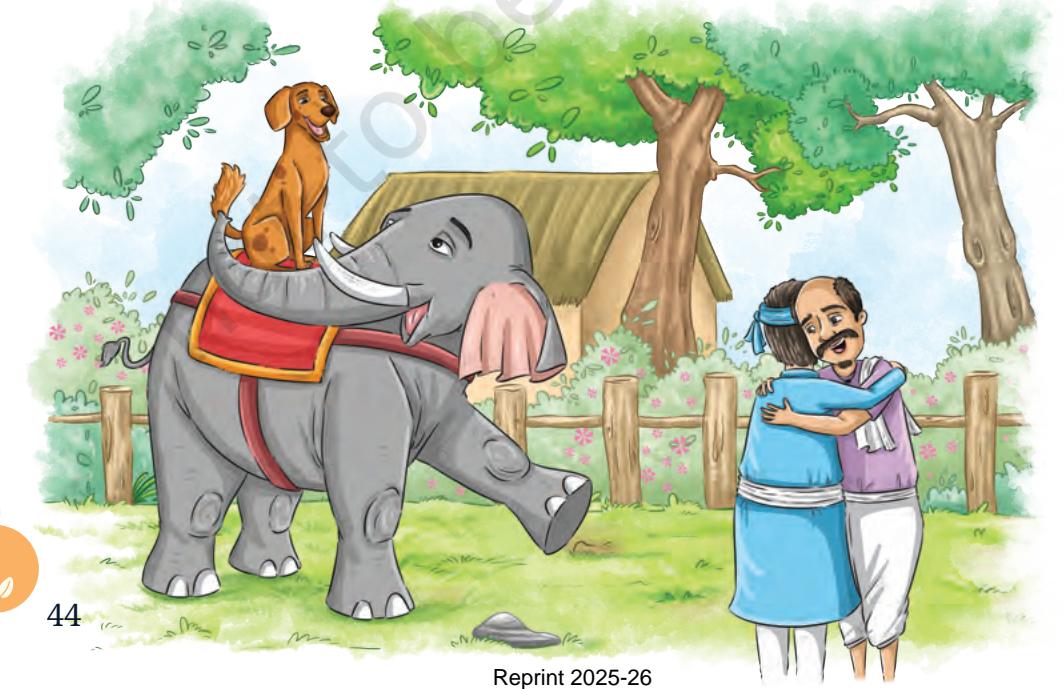
When the elephant went out for a bath, the dog accompanied his friend. Plunging into the water, the elephant gave himself a shower using his long trunk, as the dog watched. The elephant took a trunkful of water and playfully splashed the water on his friend. The dog yelped for he hated taking showers. The mahout laughed.
munching:
chewing
wagged: moved from side to side convey:
communicate
crumbs: small pieces of food accompanied: went with someone
plunging: jumping in trunk: long nose splashed: threw yelped: cried
On their way home, the elephant picked up the dog with his trunk and placed him on his back. The dog was delighted to get a ride.
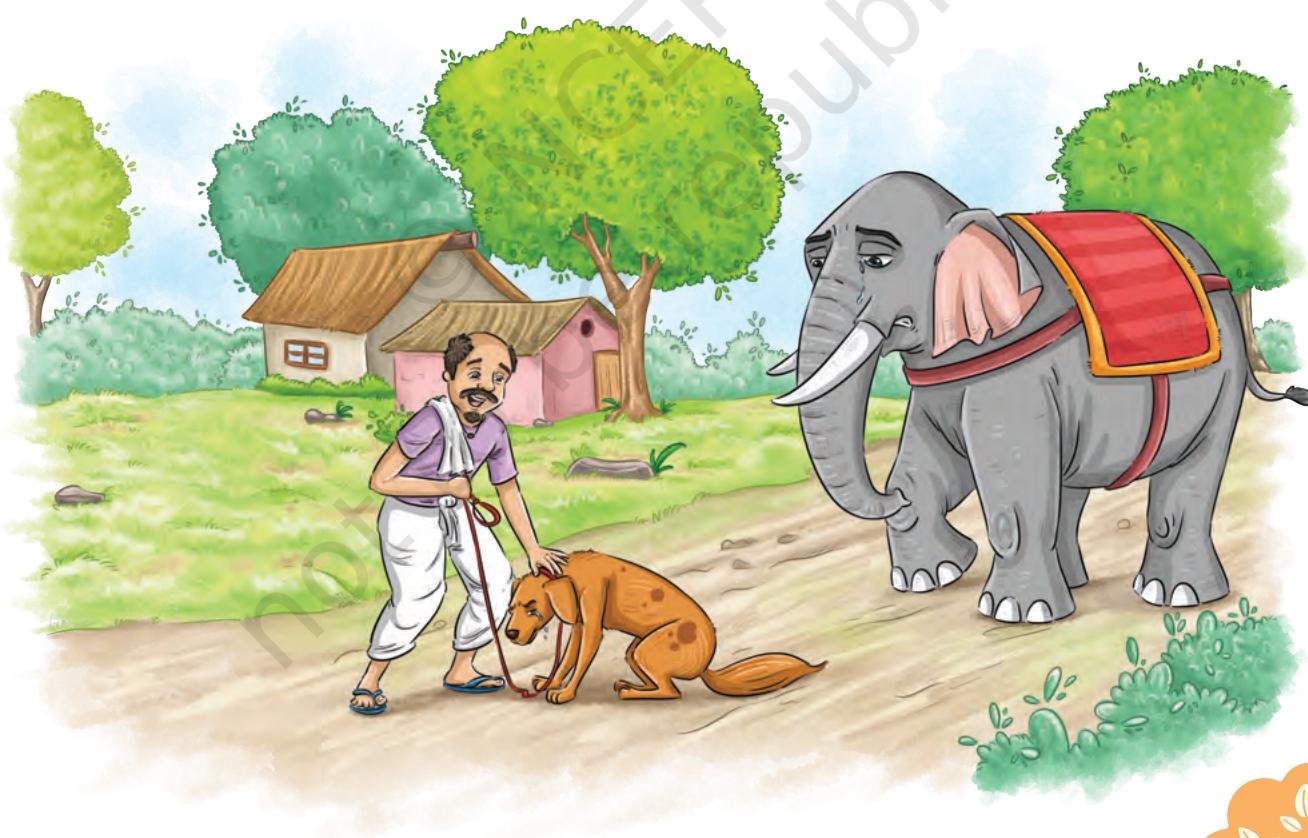
A farmer passing by saw the dog. "Buntee," he yelled. The dog ran to him. The farmer hugged the dog and told the mahout that he was looking for his dog ever since he disappeared from his house. He was glad he found him now. The mahout had no objection to the farmer taking the dog home. The farmer tossed a rope round the neck of the dog, saying, "Come Buntee, let's go home."
delighted: happy
hugged: held closely
disappeared: was not seen
Let us discuss
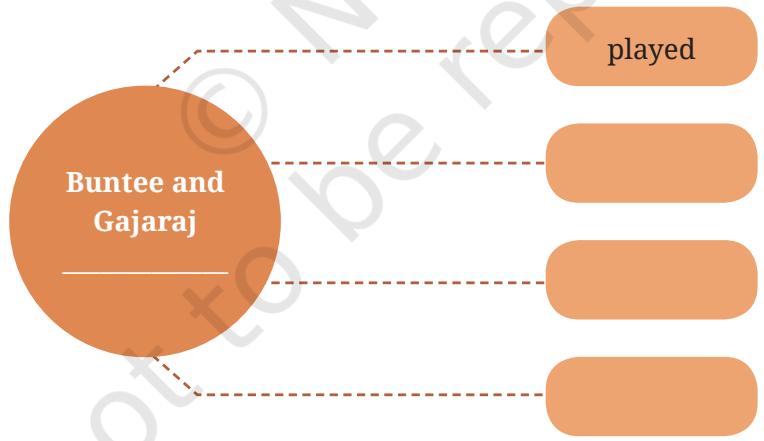
- Talk about the things that Gajaraj and Buntee did together. Now, write in the shapes given below. One has been done for you.
Why did the farmer hug Buntee?
Do you think Buntee will leave Gajaraj and go home with the farmer?
I
Only when the farmer pulled the rope did the dog realise that he was being taken away from his friend. He yelped, the elephant winced, but neither the farmer nor the mahout noticed that the two friends were in tears.
The next day at lunch time the mahout served Gajaraj his favourite food. When the mahout came back after finishing his other chores, he was surprised to see that the food had remained untouched.
realise:
understand winced: shrunk back in pain or distress
chores: daily duties
"Why Gajaraj, aren't you hungry?" he asked concerned. The elephant did not react. "He may have slight indigestion. Let me not force him to eat," thought the mahout.
That night too, Gajaraj did not touch his food—nor the next day. Now, the mahout was worried. He ran his hand on Gajaraj's tummy and felt there was nothing wrong. "Why was he not eating then? Is he missing his friend, that dog?" the mahout wondered.
Meanwhile at the farmer's house, the dog
had also not touched his food ever since he
was brought home.
"Are you missing your friend?" asked the farmer remembering the happy look on Buntee's face while sitting on the elephant's back. "I cannot see you go hungry," said the farmer, "If you miss your friend so much, go to him."
The farmer removed the rope with which he had tied the dog. The dog, though weak,
slight: a little indigestion: upset stomach tummy: stomach
sprang to his feet. He licked the farmer's hand once and then ran. He stopped only when he arrived at the stable.
The elephant picked up the dog with his trunk and gave him a joyous swing. The mahout was relieved. He quickly brought the food. "Both of you eat first," he said.
By then the farmer who had followed the
dog, joined him. The two of them watched
with satisfaction the two friends eating food.
"It's not only Gajaraj who has found a friend,"
said the mahout hugging the farmer, "I've also
found one."
sprang: jumped
joyous: happy
swing: move side
to side or back
and forth
relieved:
thankful
satisfaction:
happiness
SuBBA RAO KATHAKIDS.COM
Let us discuss
Why did Gajaraj not eat his food?
Who were friends at the end of the story?
Let us think and reflect
I Read the following lines and answer the questions that follow.
- In spite of royal comforts, Gajaraj was sad because he had no friends. The mahout, or elephant trainer, was the only one he ever interacted with. The mahout was a kind man who served Gajaraj food, and gave him a bath in the elephant pond daily. He was a good caretaker, but not a friend.
(i) Complete with one word: mahout : kind : : Gajaraj :
(ii) The mahout was a good caretaker because he gave. to Gajaraj and a in the pond.
(ii) What do you think is the difference between a friend anc a caretaker?
- "Are you missing your friend?" asked the farmer remembering the happy look on Buntee's face while sitting on the elephant's back. "I cannot see you go hungry," said the farmer, "If you miss your friend so much, go to him." The farmer removed the rope with which he had tied the dog.
(i) The farmer uses the word to refer to the elephant.
(ii) How did the farmer know that Buntee was hungry?
(ii) Why did the farmer remove the rope with which he had tied Buntee?
(iv) Complete with one word: Gajaraj : Buntee : : : farmer
II Give two examples to show that Gajaraj was very happy to have a friend [I How did the mahout come to know that Gajaraj was sad?
IV Why do you think Buntee licked the farmer's hand?
V What was 'unlikely' about the friendship of Gajaraj and Buntee?
Let us learn
- Gajaraj was sad without a friend and when he met Buntee, he was filled with joy. 'Sad' and filled with joy' are opposites. Opposites can also be formed by adding some letters before a word. For example, un- unhappy, in- incorrect, dis- disconnect, mis- misuse.
Now, take help from the words given as hints and fill up their opposites in the puzzle. (Note: All the words are from the story you have just read.)
We are opposites!
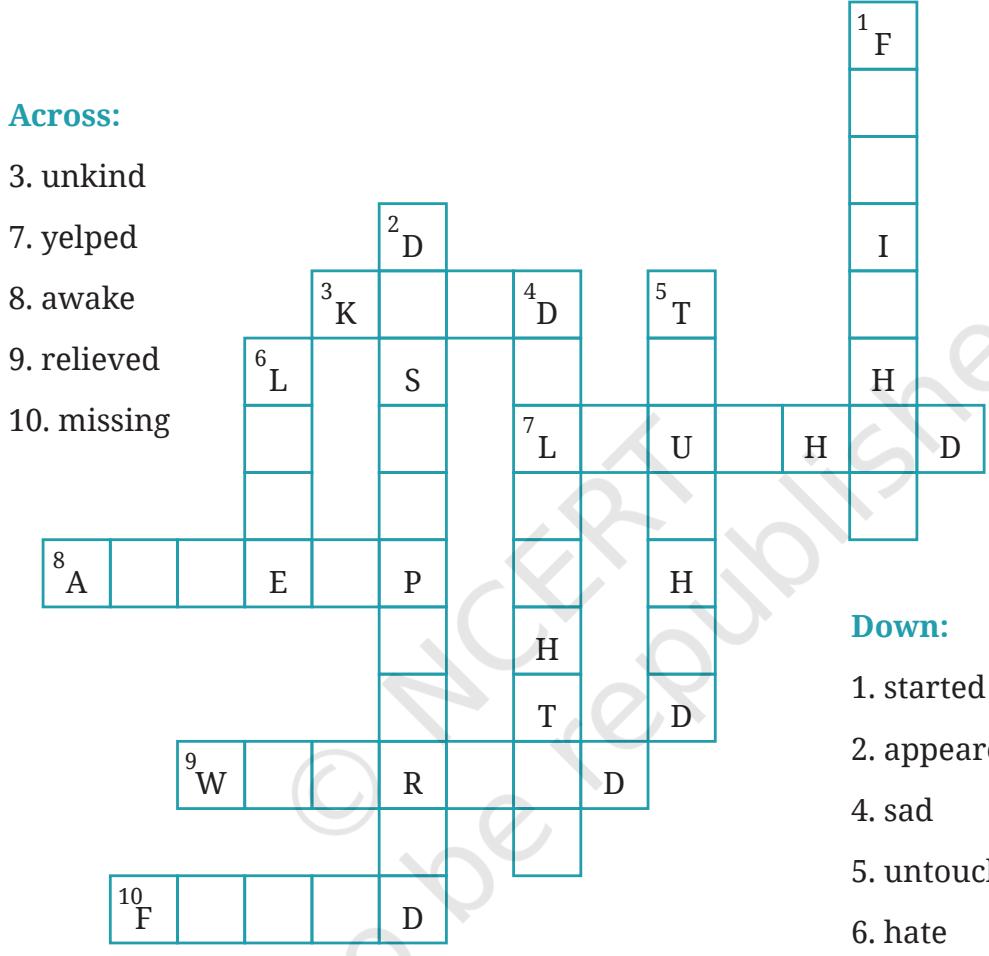
- Now, complete the paragraph with some of the words you have used in the puzzle.
My pencil was . I was very as it was a gift from my friend. I woke up my elder brother who was on the bed. I told him that my pencil seemed to have He and told me to look under my pillow. I was when I the pencil there.
- The words that tell us about an action are called verbs. In the story, the author tells us what happened before. To do that, the past form of the action word (verb) is used. Let us learn about the three forms of past tense.
| Simple Past Tense | Past Progressive Tense | Past Perfect Tense |
| Used to show that the | Used to show that theaction did not finishand was going on.I/He/She/It + was +verb + ingWe/You/They + were +verb + ing | Used to show that theaction was completed.• had + third form ofthe verb |
| action had happenedearlier.second form of theverb + add -d or -ed tothe verb | ||
| 0 | ||
Given below are some verbs from the story. Put the verbs in their correct column in the table given above.
• was looking . looked • gave • had ordered • was missing hated . had followed• noticed • was munching • went . had remained served • told • asked •felt • touched • had tied • joined • arrived . threw
Select the correct form of the verb to complete the passage. Check your answers with the teacher.
The farmer came back and (noticed/was noticing/had noticed) that Buntee was sad. He (tied/ was tying/had tied) Buntee with a rope the day before. He (asked/was asking/ had asked) Buntee why he was sad. The farmer (felt/was feeling/had felt) that Buntee (missed/was missing/had missed) Gajaraj and set him free.
- '.neither the farmer nor the mahout noticed that the two friends were in tears.'
The words 'neither', 'nor' are used to state that the farmer and the mahout did not notice the same thing. Neither, nor' connect two negative choices. For example: Neither Rohit nor I want to play football.
When you need to choose between two things that you want, you may use 'either, or'. For example: Rohit wants to play either cricket or kho-kho. It means Rohit wants to play cricket or Rohit wants to play kho-kho. Discuss the given sentences with your teacher to practise.
• Neither Shikha nor Anuj like to tell stories.
• Either Bhavesh or Abha made this painting.
Let us listen
- You will listen to a story about Unlikely Friends'. Use exact words from the story to fill up the missing details in the paragraph. (refer to page 71 for transcript)
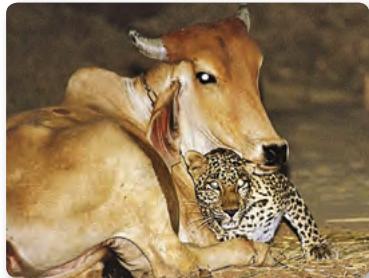
The leopard is a animal but it became a friend of a cow. When the leopard grew up, it left the village. It came in the to meet the cow. The leopard would sit the cow. They also played together. were surprised at their friendship.
Unlikely Friends
- Now, listen to the story again and number the sentences in correct order. The first one has been done for you.
The leopard stopped coming regularly.
The cow took care of the leopard cub as a mother.
The leopard came to meet the cow at night.
The leopard left the village after growing up.
Let us speak
Gajaraj and Buntee had a wonderful time with each other even if they were 'unlikely' friends. Talk to your friend and find out your common likes and dislikes. Share your answers with the class.
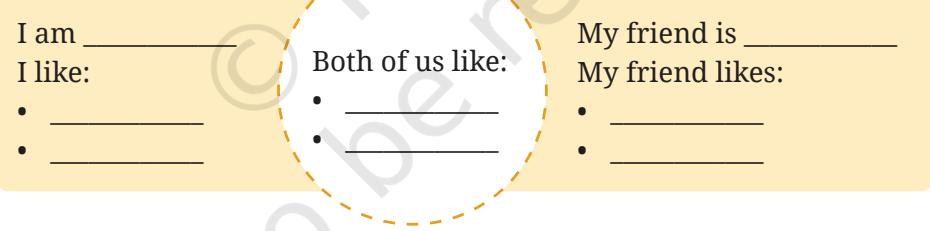
Now, tell your classmates about your friend. You may take help of the cues given below.
• My friend and I like to play. Both of us want
• I like to but my friend likes to
• We are different as she/he is and I am
Let us write
Write six sentences about your friend with the help of the facts collected in the above task. Mention how you are not only similar but also different. You may take help of the words given below.
same different and but both still like unlike neither nor either or
Let us explore
The story, The Elephant and the Dog is found in the Jataka tales. These stories are ancient Buddhist stories of life values and wisdom. These stories have been told from one generation to the next for over two thousand years. Find and read another Jataka story.
Elephants have historically held significant roles in Indian culture, spanning history, warfare, religion, festivals and more. However, contemporary ecological challenges have strained the relationship between humans and elephants. Have a discussion in the class.
Given below is a news report from an Elephant Sanctuary in the United States about a real-life friendship between an elephant and a dog.
The elephant's name is Tarra and the dog's name is Bella. Bella came inside a forest for elephants and became Tarra's friend. Tarra spent most of her time with Bella. One day, Bella had an injury so she could not walk. She was kept inside a building for three weeks. Tarra stood outside for three weeks. Finally, they met and were very happy.
A FRIEND's PRAYER
Let us do these activities before we read.
I Read the following sentences.
I wish my friend brings idli in her tiffin tomorrow.
I hope my friend and I win the race tomorrow.
May my friend get well soon.
Which of the three sentences 1–3 is closest to a prayer? Explain to your teacher and classmates.
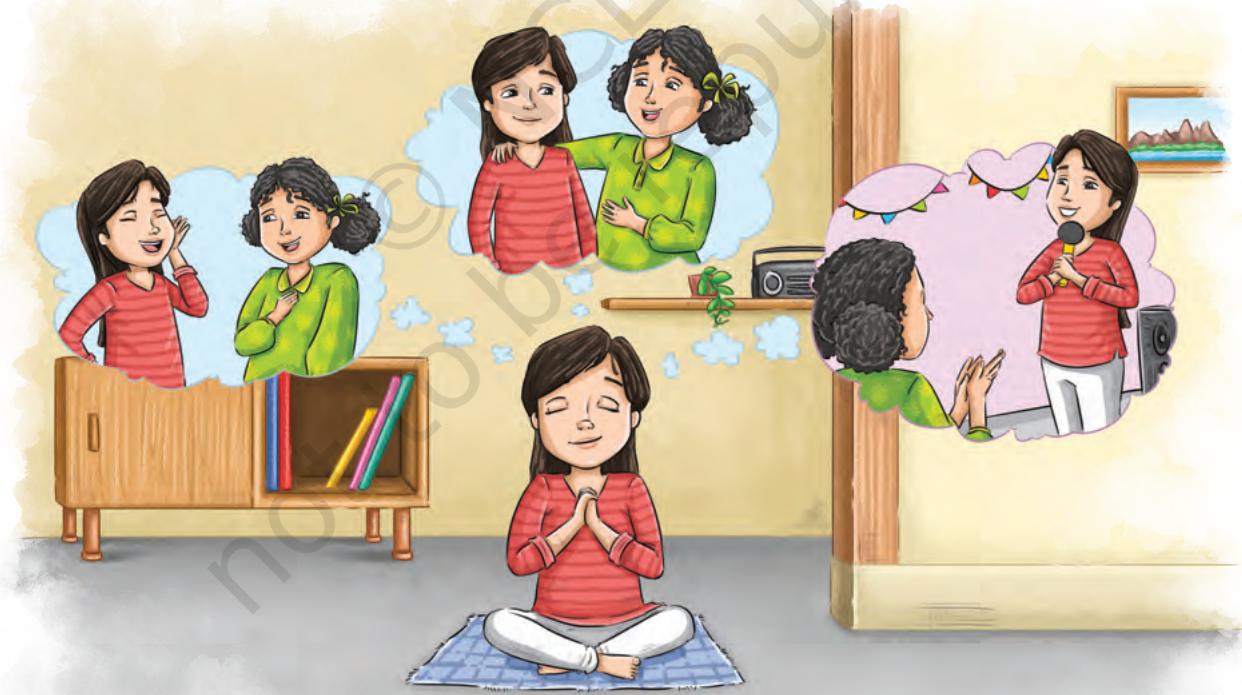
I What would you pray for your friend? First speak about it and then write it down.
Let us read
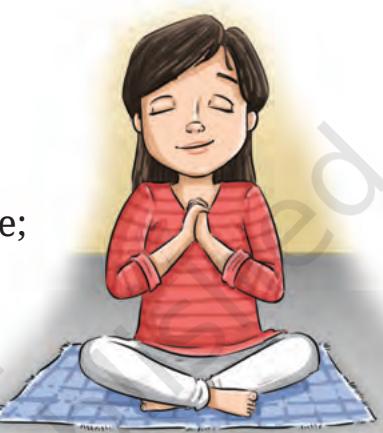
May my friendships always be The most important thing to me.
With special friends I feel I'm blessed, So let me give my very best.
I want to do much more than share The hopes and plans of friends who care;
I'll try all that a friend can do To make their wishes come true.
Let me use my heart to see, To realise what friends can be,
And make no judgements from afar, But love my friends the way they are.
JILL WOLF
Let us discuss
Read the poem silently. As you read, underline the parts of the poem that you agree with.
Now, share the details of your underlined parts of the poem in groups and explain why you liked those lines.
Which line was underlined by most people in your group? Share it with your teacher.
Let us think and reflect
I Complete the summary of the poem by circling the correct highlighted words.
The poet says a prayer for/speech on friendship and friends. She wants that friendship should always be an important part of her complete life/ school days. She says that her friendship makes her feel brave/special. She wishes to do the best she can, for her friends. She wants to clap for/ listen to the wishes of her friends. As a good friend, she prays/imagines that she is able to make her friends' wishes come true. She wants her heart/mind to understand what a true friend is. She prays that she loves her friends as they are/when they are happy. She tells us that true/correct friends accept their friends for all their qualities.
II Answer in one word only.
How does the poet feel about special friends?
What does the poet use to realise what friends can be?
III Read the following lines from the poem and answer the questions given below.
- I want to do much more than share The hopes and plans of friends who care; I'll try all that a friend can do To make their wishes come true.
(i) Complete the sentence with the most suitable option. These lines tell us that the speaker is
A. clever B. caring C. curious D. calm (i) How will the speaker make her friends' wishes come true? (by trying hard/by working a lot)
(ii) Fill in the blank with a suitable word. My friends will feel if their wishes come true.
- Let me use my heart to see, To realise what friends can be,
And make no judgements from afar, But love my friends the way they are.
(i) The speaker says that feelings are important to understand friendship. Which line tells us this?
(ii) Complete the sentence with the most suitable option. These lines tell us that the speaker is
A. helpful B. thoughtful C. cheerful D. hopeful (ii) Fill in the blank with one word. The speaker does not wish to make any nsh She cares for them just as they are.
IV Give one reason why we can say that this poem is a prayer.
V Why does the speaker 'want to do more' for her friend?
VI Do you think that the speaker knows about the wishes of her friend? How can we say so?
VII Do you also pray for your friend? What do you wish for? Discuss.
Let us learn
I The poet says, With special friends I feel I'm blessed'.
Select the words that are similar to the meaning of being blessed, from those given below.
excited grateful understood thankful relaxed
I Good friends have a lot of qualities. Let us list some.
loyal, h e−f_1, k−d, c−_i n g, h o−−−t
Now, fill in the blanks with the words you just listed above.
My friend is always to me even when I make a mistake.
My friend shares things with me. She is very.
My friend is because he always supports me.
My friend never lies. She is an person.
My friend and I believe in for each other.
II Think of any three of your friends. Write three sentences on why you like each one of them.
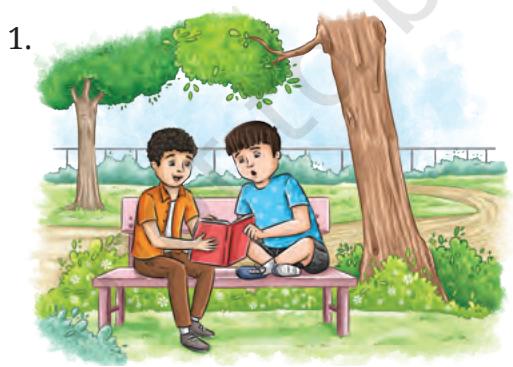
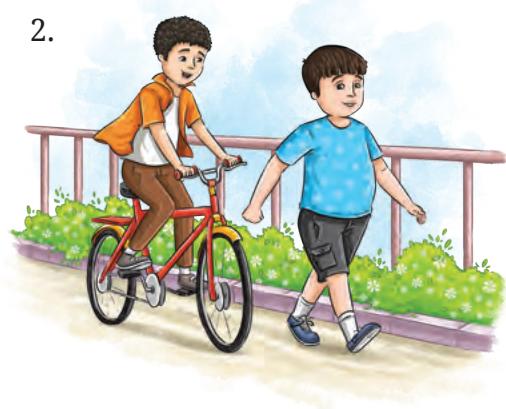
Let us listen
I You will listen to a talk about some outdoor activities that two friends spend their time doing. As you listen, answer the given question in one or two word(s) only. (refer to page 72 for transcript)
- What do the two friends purchase and use on the park bench?
II You will once again listen to the talk about some outdoor activities of the two friends. As you listen, circle the pictures that show these activities.
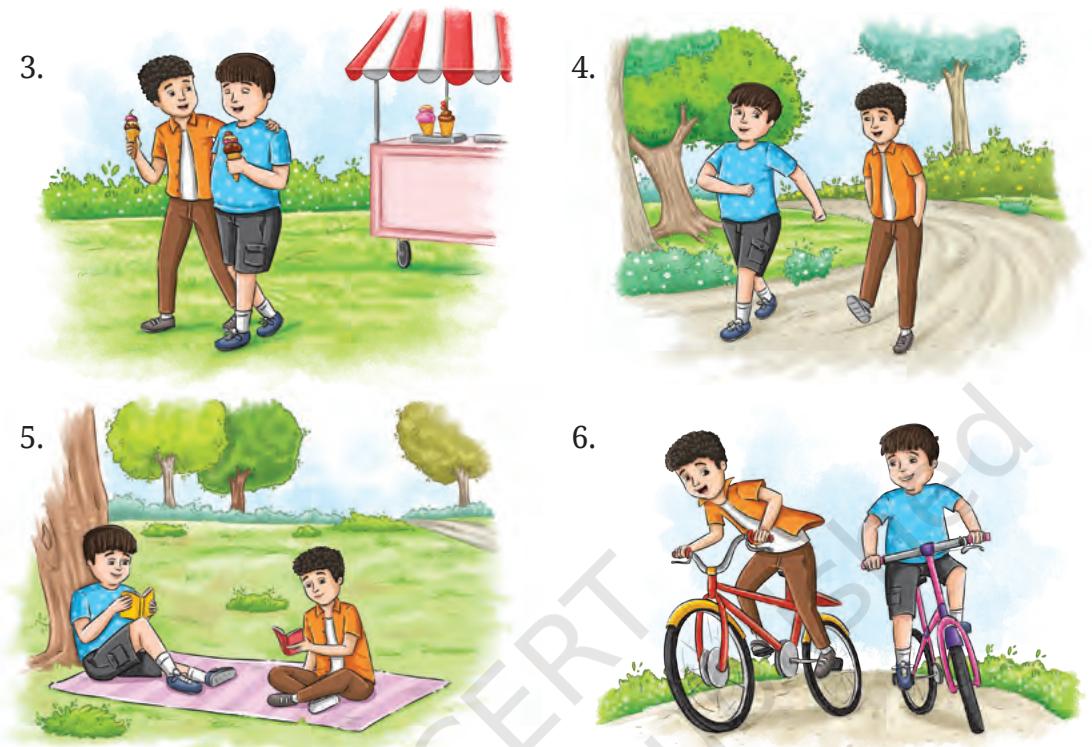
Let us speak
- In pairs, act the role of friends speaking to each other. Speak about the following situations:
1. A walk in the park
2. Sharing tiffins at school
You can use the following-
Greet each other.
Ask if your friend wishes to go with you to the park.
If yes, plan some activities.
If no, ask what your friend would like to do. Listen and share what you would also like to do together.
You can use the following–
• Greet each other.
• Tell your friends what food items you have brought in your tiffin. Ask them what they have brought.
• Tell them you wish to share tiffi ns!
• Next, share with your friends, how it makes you feel.
• Tell your friend that you like spending time with each other.
• Appreciate your friends' food and ask what other food items they like. •Thank your friends for sharing.
- Create a new situation and have another conversation.
Let us write
Describe how your friendship with your friend started.
• First list the answers for — When? Where? How?
•Then, use your sentences to write a short paragraph of about 80 words. • Give a title to your paragraph.
Let us explore
I There are many quotations about friendship. Read the ones given below.
• "A friend in need is a friend indeed." • "My best friend is the one who brings out the best in me."
- What do you think is the meaning of these quotations? Share it with your teacher.
- Think of an experience in your life with your friend that suits this quotation. Share it with your friends.
II Look for some famous quotations on friendship; these can be in your own language too. Read and share them with your teacher and classmates.
Write one quotation on paper, colour and decorate it. Put it up on the class board.
THE CHAIR
Let us do these activities before we read.
I Write two words that come to your mind when you think of friendship.
- Now, find some more words that are related to friendship from the grid given below. You can search horizontally or vertically. There are eight words. One word has been marked as an example. The fi rst letter of each word has been given in bold.
| L | A | U | G | H | T | E | R | S | EQ | Q |
| S | Y | L | P | E | H | Z | R | M | s | T |
| J | H | E | L | P | F | U | L | S | T | S |
| 0 | P | A | Z | P | s | A | 0 | P | E | H |
| H | 0 | P | E | T | R | I | s | |||
| R | A | C | F | c | T | ① | R | P | s | U |
| N | L | 0 | प | A | L | T | U | E | Z | P |
| E | A | Y | V | R | N | N | S | E | M | P |
| Y | B | Y | J | क | U | D | T | Z | N | 0 |
| L | 0 | V | 1 | N | G | R | C | S | U | R |
| L | K | D | P | G | L | U | Y | s | S | T |
- Fill in the blanks to complete the words, which mean the same as 'friend or friends' with the help of the meanings.
| Meaning | Word |
| (i) a person with whom you doactivities together | p_r_n_r |
| (ii) an informal word for friends | b−−d_−s |
| (ii) a person who you spend a lot of time with | c_mp_n_0− |
| (iv) children who are in the same class as you at school | cl_s_ m_t_s |
- There are so many words for a friend. What do you call 'a friend' in your own language?
Let us read
I
There was a boy called Mario who loved to have lots of friends. He showed off a lot, always talking about how many friends he had at school, and how he was so friendly with everyone.
One day his grandfather said to him, "Mario, I bet you a fruit chaat. You don't have as many friends as you think you have. I'm sure many of them are nothing more than companions or partners."
showed off: boasted
Mario accepted the bet readily. However, he wasn't sure how he could test whether his schoolmates were real friends or not. So, he asked his grandpa for help. He suggested, "I have exactly what you need. It's in the attic. Wait here a minute."
Grandpa left, soon returning as though carrying something in his hand, but Mario could see nothing there.
accepted: agreed to readily: without any problem
attic: a storage space in a house just under the roof
"Take it. It's a very special chair. As it's invisible, it's rather tricky to sit on it. But if you take it to school and manage to sit on it, then
invisible: impossible to see
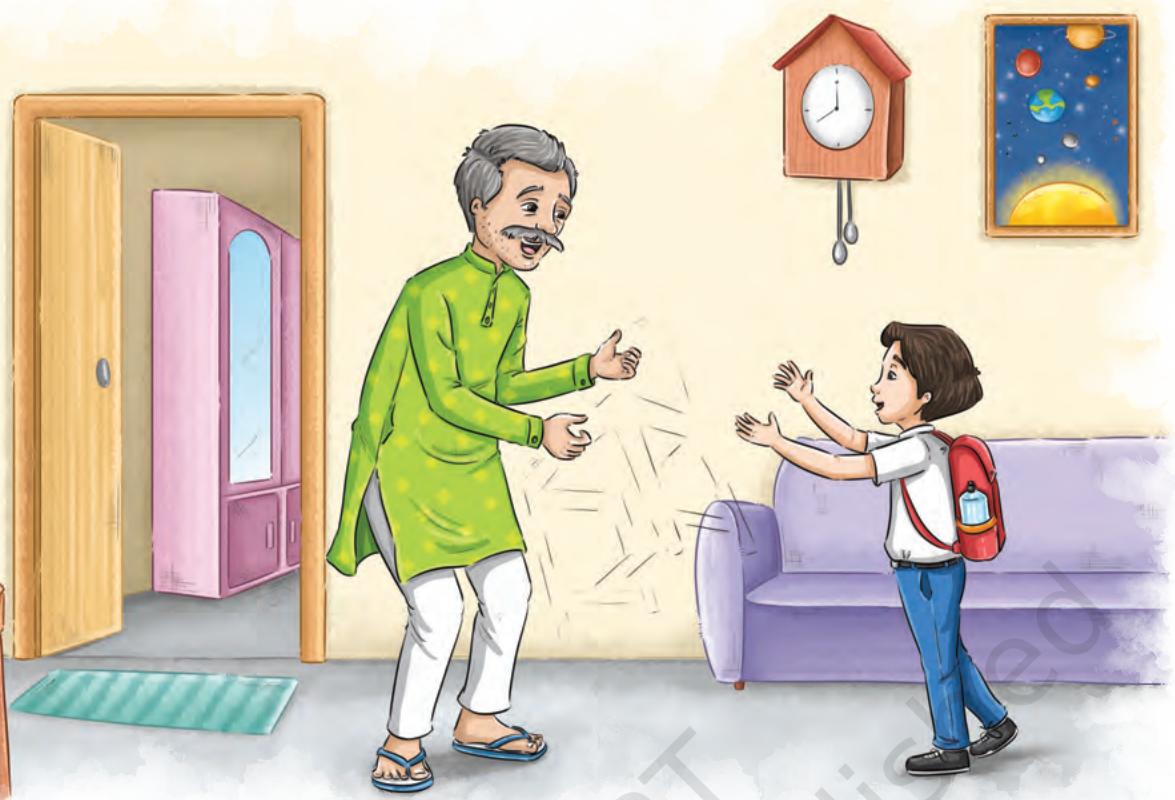
the magic will work and you'll be able to tell who your real friends are.
Let us discuss
Mario was very proud of having so many friends. State whether True or False.
What did the grandfather take from the attic?
Will Mario face any challenges?
Will Mario be able to use the magic?
I
Mario, brave and determined, took the strange invisible chair and set off for school. At break time, he asked everyone to form a circle. He put himself in the middle, with his chair.
"Nobody move. You're about to see something amazing."
determined:
fi rm in decision amazing: very surprising
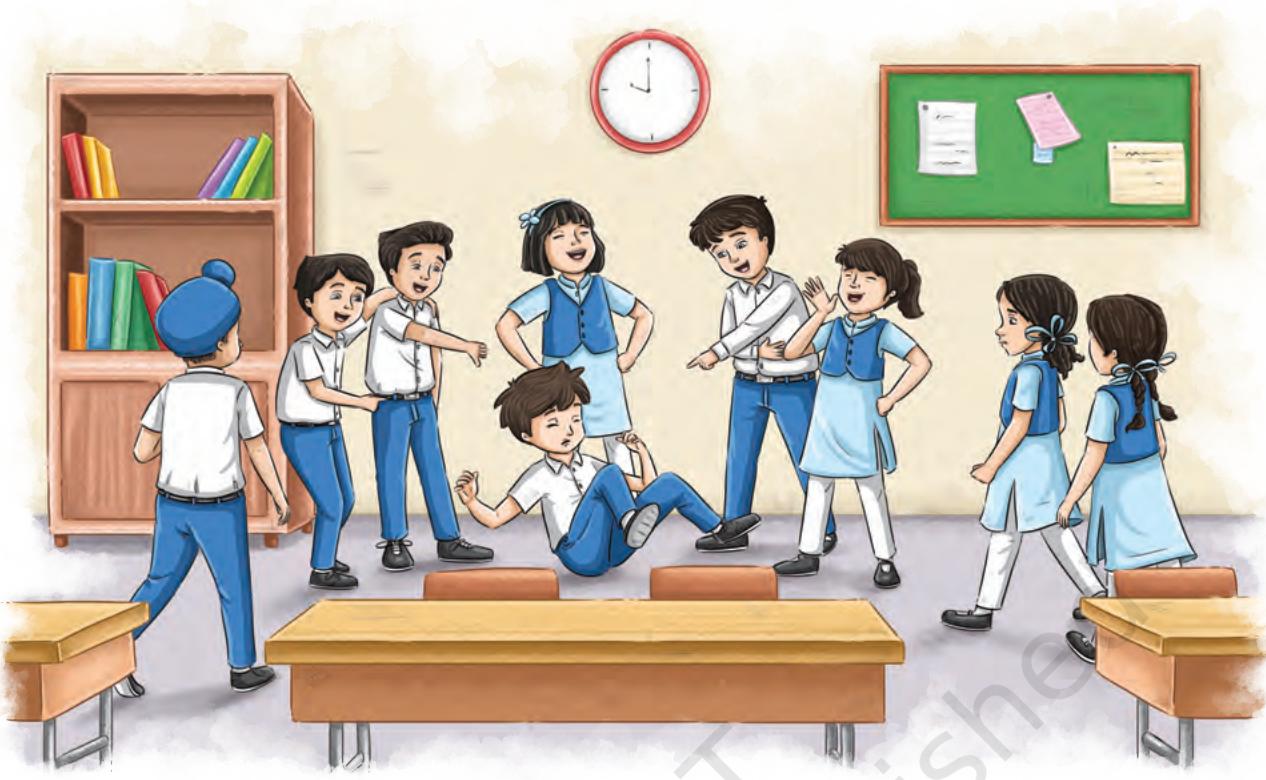
Mario tried siting on the chair. Having difficulty seeing it, he missed and fell straight onto his backside. His classmates had a pretty good laugh.
"Wait, wait, just a slight technical problem," he said, trying again. But again, he missed the seat, causing more surprised looks and laughter. Mario wouldn't give up. He kept trying to sit on the magic chair and kept falling to the ground until, suddenly, he tried again and didn't fall. This time he sat, hanging in mid-air.
Then he finally experienced the magic that his grandfather had been talking about. Looking around, Mario saw Guneet, Asma, and Deepa-three of his buddies—holding him up, so he wouldn't fall. Meanwhile, many others
experienced: felt
he'd thought of as friends had done nothing but made fun of him, enjoying each and every fall.
Leaving with his three friends, he explained to them how his grandfather had so cleverly thought of a way to show him that true friends are those who care for us. A friend wouldn't be someone who takes joy in our bad luck.
That evening the four children went to see Mario's grandpa as he had won the bet. They had a great time listening to stories and eating a lot of fruit chaat. From then on, they used the magic chair test on many occasions and whoever passed became friends for life.
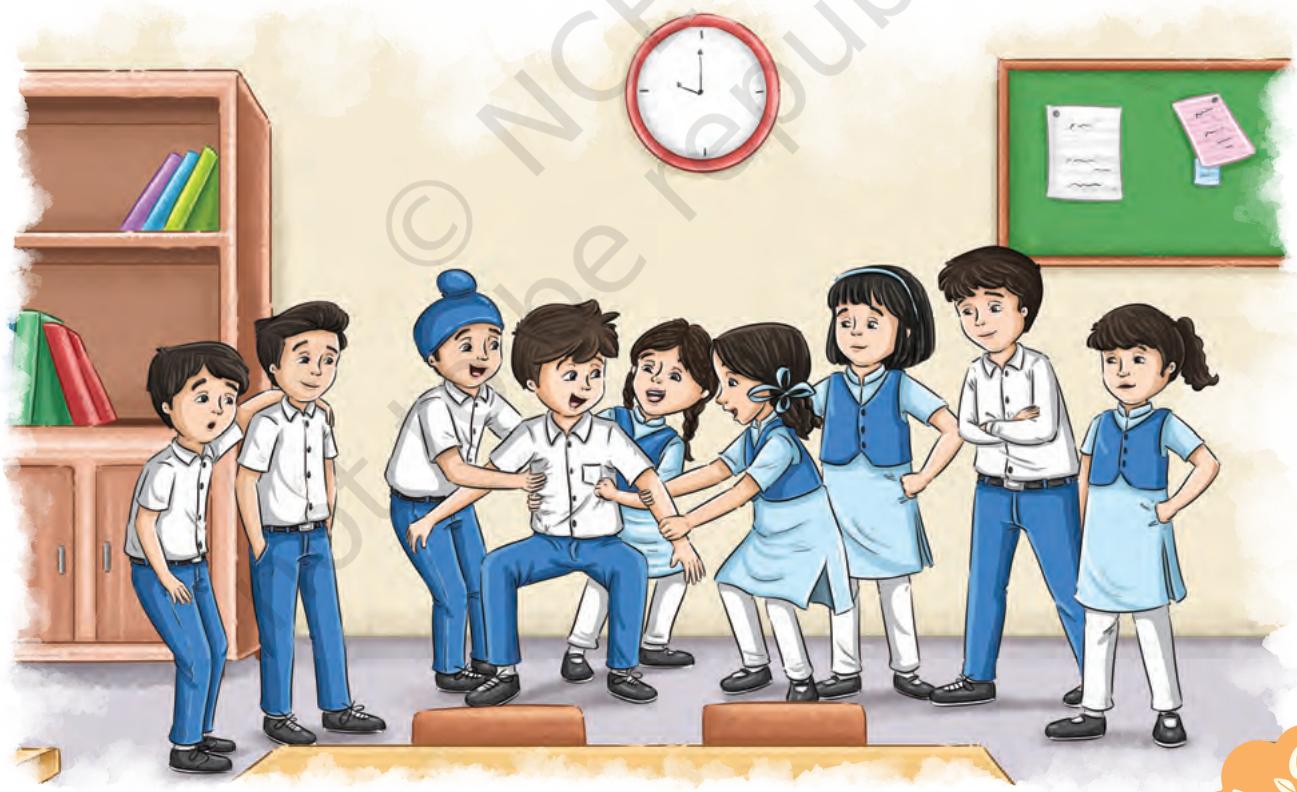
Let us discuss
Mario successfully sat on the invisible chair on his first attempt. State whether True or False.
Fill in the blank with a suitable word. Mario's grandfather challenged him to a bet of
Match the following characters with their action.
Guneet, Asma and Deepa
(i) held Mario up, so he wouldn't fall (ii) made fun of Mario's attempts
Let us think and refl ect
I Read the following lines and answer the questions that follow.
- "Take it. It's a very special chair. As it's invisible, it's rather tricky to sit on. But if you take it to school and manage to sit on it, then the magic will work and you'll be able to tell who your real friends are."
(i) Fill in the blanks with two words that describe the chair. The chair is and
(ii) Why was it tricky to sit on the chair?
(ii) Why does Mario's grandfather call the chair 'special?
- "Wait, wait, just a slight technical problem," he said, trying again. But again, he missed the seat, causing more surprised looks and laughter. Mario wouldn't give up.
(i) Fill in the blank with a suitable reason. Mario says there was a technical problem because
(ii) Mario's friends were very caring and helpful. State whether True or False.
(ii) Choose the correct option to complete the sentence. Mario wouldn't give up. This shows he is
A. strong-willed C. loving B. supportive D. hard-working
II Answer the following questions.
What was the bet about?
What happened when Mario sat on the chair for the first time?
How was Mario able to find his real friends?
Do you think the magic chair test was good? Why do you say so?
What does 'friends for life' mean to you?
The grandfather's idea helped Mario find his real friends'. Mention any other way that would help you find out who are your 'real friends'.
Let us learn
I Read the following words from the text.
friendly suddenly talking carrying called showed
Complete the following table by dividing the words into two parts. One has been done for you.
| Column A | Column B |
| 1.friend | ly |
| 2. | |
| 3. | |
| 4. | |
| 5. | |
| 6. |
The words in Column A are called the root words. The sequences of letters that are in Column B which come after the root words are called suff xes.
I Match the following root words with suitable suffixes. You can use a suffix more than once as shown. Use them to make sentences of your own. One has been done for you.
| S.No. | Root Word | Suffix | Word | Sentence |
| 1. | magic | -ing | magical | The magician performed anamazing 1magical act. |
| 2. | care | -al | ||
| 3. | celebrate | -ful | ||
| 4. | laugh | -ly | ||
| 5. | wonder | -ed | ||
| 6. | help | -tion | ||
| 7. | friend | -ous | ||
| 8. | courage | -ship |
[Note: Observe the changes in spelling in a few word combinations.]
III Read the following lines from the story.
Mario, brave and determined, took the strange invisible chair ….
You have already described the chair. Now, describe what kind of a person Mario is in the image given below.
[Use words from the story. You may also use words of your own.
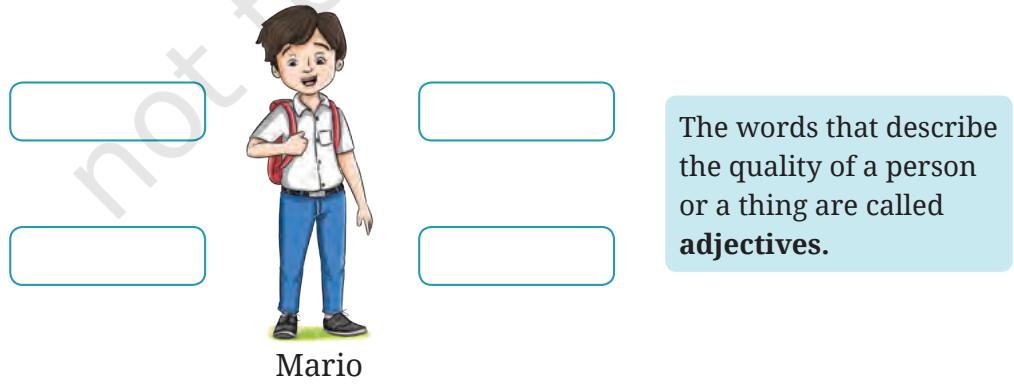
IV Match each word (adjectives) in Column A with a suitable word (noun) in Column B. You can make more than one combination. One has been done as an example.
| Column AAdjectives | Column BNouns | Column CPhrases | Column DSentences |
| 1.brave | friends | brave soldier | (i) The brave soldiermarched ahead. |
| 2.clever | rain | ||
| 3.tasty | soldier | ||
| 4.heavy | plan | ||
| 5.slight | peanuts | 2 | |
| 6.true | cold |
V Complete the paragraph with suitable adjective-noun pairings. Use the words in the box given below.
old book magical adventures happy boy amazing stories fantastic adventures colourful creatures old castles
Once upon a time in a little village, a/an 1. named Abhishek found a/an 2. in the attic. He read
about fairy lands, 4. and
. Abhishek's eyes got big as he imagined these
. He told his friends about the stories, and they started to have their own 7. when they played together.
Let us listen
You will listen to Manu talk about her friend, Monika. As you listen, fill in the blanks with words that you hear. (refer to page 73 for transcript)
Manu found it when she took admission in the school.
Manu met and helped by her in many ways.
So, it was not so for the new girl to adjust in the school.
Both friends experienced difficult and moments together.
Manu is to Monika for making her life easy and finding a friend.
You wil listen to the girl once again.
Let us speak
Work in pairs. Read the following qualities of a friend.
loving honest kind caring loyalpolite respectful team-worker understanding
Discuss in pairs. Choose any four positive qualities that you would like your friend to have. Give a reason for your choice. Use the hints given below when you speak.
I feel my friend should be …. because …..
I think the quality I want in my friend is being …. The reason for this is …
I believe my friend should be …. This is in order to ….
If my friend is ….. then ...
Let us write
Read the messages that Mario has written to his friends Deepa, Guneet and Asma.
Dear Deepa,
I feel so special that you are my friend. I know you will always be there for me. Before going to bed, I said a little prayer for Guneet, Asma and you. You made me realise the value of having good friends.
Best wishes, Mario
Dear Asma,
I feel blessed to know that you are my true friend. I would have fallen again today, if it wasn't for Guneet, Deepa and you. I know I can always depend on the three of you, no matter what.
Best wishes, Mario
- Now, choose the correct word given in brackets to complete Mario's message to Guneet.
Dear Guneet,
Iam (thankful to/requesting) God to have you as a (lucky/real) friend for life. When everyone was (laughing at/talking to) me, Deepa, Asma and you showed me that you (will save/care for) me. You are indeed a (blessing/loving) in my life.
Best wishes, Mario
- Now, write your own message to your best friend. You may take ideas from the story, 'The Unlikely Best Friends' and the poem, A Friend's Prayer'.
Let us explore
Find out more stories about Friendship'. It could be from your state, other states or other countries too. You can share them with your class.
Describe your friends by filling in the blanks with suitable words. This is known as an acrostic poem.
F R E N D S
- Complete the following task by talking to different people of different age groups as mentioned in the table. You may divide the class into groups to do the following:
| Question | Age Group | Response |
| What does friendshipmean to you? | 50+ | |
| 31 to 49 | ||
| 20 to 30 | ||
| 12 to 19 |
After gathering responses:
$\checkmark$ Discuss: similarities and differences across age groups.
$\checkmark$ Reflect: how viewpoints on friendship may change with age and life experiences.
√ Present: a summary of the group's responses, emphasising key themes or unique insights.
Transcript
Let us listen (refer to page 49)
THE UNLIKELY BEST FRIENDS
Let me tell you a story of a cow and a leopard from Vadodara in Gujarat who became friends. As you know, a leopard is a wild animal and a cow is a domestic animal. Some people say that the cow took care of the leopard cub like a mother. When the cub became older, it went away from the village. It returned to meet the cow at night. The villagers were worried but they never stopped the leopard. They saw that the leopard just sat beside the cow quietly. The cow and leopard spent time by relaxing and playing with each other. The leopard did not like the villagers and stopped coming regularly. The villagers were surprised that the leopard never attacked the cow but became its friend.
You will listen to the audio or narration once again. As you listen, check your answers.
Transcript
Let us listen (refer to page 56)
A FRIEND's PRAYER
Hello!
Let me tell you what outdoor activities Ajay and Dhiraj enjoy doing. Some days they like playing at the swings in the park. Ajay enjoys slides the most. Dhiraj likes nature, so both take walks in the nearby park, listen to birds and look at the trees. On Saturdays, both go cycling around the neighbourhood. What both truly enjoy is eating ice-cream together. Sometimes they also purchase a comic book, sit on a park bench and read together. They are truly best friends.
You will listen to the audio or narration once again. As you listen, check your answers.
Transcript
Let us listen (refer to page 68)
THE CHAIR
When I fi rst joined this new school, things were very difficult. There was Monika. She was a supportive friend who guided me, introduced me to others and even shared her notes. That made me comfortable in the school. Since then, Monika and I have been together through difficult times and happy times. She is the kind of friend who is always there for you. I'm really thankful to her, and how her help and support turned into a really good friendship.
You wil listen to the audio or narration once again. As you listen, check your answers.
Let us ponder
SAVE WATER
Look at the pictures. Now, discuss the following points.
• Sources of water • Without water there cannot be any life • Value of water and the need to save it
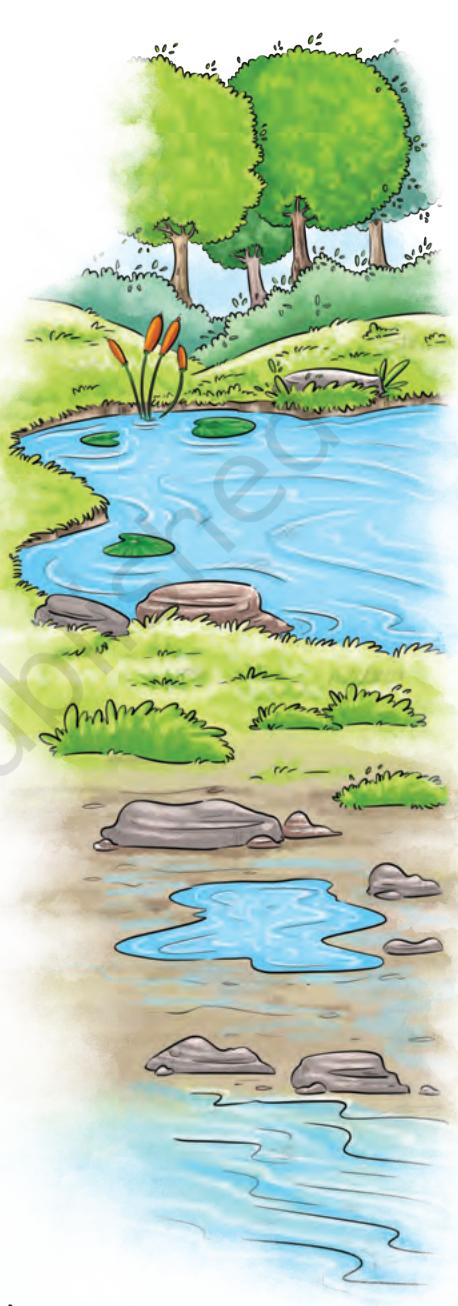
Make a poster with a meaningful slogan on Save Water.
74