A Class 8 student consistently makes errors in geometry proofs, not because they misunderstand the theorems, but because they struggle with the logical sequence of statements. Traditional tutoring might catch this eventually, but pinpointing this precise pattern across different homework sets is challenging. This is where the question of how AI tutor identifies a child's weak topics automatically becomes critical for effective intervention.
Many parents find themselves looking at digital learning dashboards filled with graphs and percentages, yet still asking: "Is my child actually understanding algebraic identities, or just getting the right answer by chance?" The real struggle isn't a lack of data, but a lack of digestible insight. They need an **AI tutor with progress reports parents can actually understand**, not just data points.
For many Indian students, getting stuck on a complex problem or concept during late-night study sessions is a familiar frustration. Whether it's a tricky Physics numerical for JEE, an obscure historical date for UPSC, or a challenging theorem in CBSE Class 12 Mathematics, the immediate need for clarification often goes unmet, leading to lost time and growing anxiety. The quest for the best AI tutor app with real-time doubt solving in India stems from this precise challenge.
A Class 10 CBSE student preparing for their Social Science board exam might find a detailed explanation of the French Revolution helpful, but what about a specific question on the administrative changes brought by Napoleon's Civil Code as per the NCERT textbook? Global AI tutors often provide general knowledge, which can be insufficient for the highly structured and syllabus-driven requirements of the Indian education system.
For Indian students and parents, the digital learning landscape is crowded. The search for the right AI tutor app in India often begins with comparing what each platform offers in terms of core features and whether the perceived "value" aligns with its cost. It’s not just about finding an app; it's about finding a daily learning companion that truly fits specific academic needs, from CBSE board exam preparation to JEE Physics numericals.
Choosing an AI tutor app for your child's studies can feel like navigating uncharted waters. The primary concern for many parents and students isn't just about an app's features, but a deeper question: how to know if an **AI tutor app is trustworthy**? Will it provide accurate information, protect student data, and genuinely contribute to learning, or simply offer quick, unverified answers? This hesitation is valid, especially when academic progress is on the line.
Imagine a child struggling to grasp the intricacies of photosynthesis from a text-heavy science textbook. A static diagram might show the inputs and outputs, but it often fails to convey the dynamic process. For many young learners, abstract concepts like these remain fuzzy until they can actively see them unfold, interact with them, or even draw them out. This is where the emerging field of drawing-based AI tutors offers a significant advantage.
For many school students, understanding abstract concepts like the water cycle, fractions, or the internal structure of a plant can feel like trying to grasp smoke. A textbook diagram might be there, but without a dynamic, step-by-step visual explanation, the core idea often remains elusive, leading to frustration and disengagement during study sessions. This challenge is particularly acute for students who primarily learn through sight.
Many students understand the final answer to a math problem but stumble on the intermediate steps, especially in topics like trigonometry identities or calculus integration. It's common to know a formula for solving quadratic equations but then make a sign error when substituting values or simplifying expressions. A true understanding isn't just about getting 'x=5'; it's about confidently navigating each algebraic manipulation to reach that 'x=5'. That's where an **AI math tutor that shows step-by-step working** becomes indispensable.
Imagine a student struggling with a quadratic equation at midnight, unsure why their factorization method isn't yielding the correct roots for a polynomial. The typical cycle involves re-reading notes or searching for solved examples that might not match their specific problem's nuances. This often leads to frustration and a loss of momentum, particularly when preparing for CBSE Class 10 or JEE Main math sections.
For many young learners, grasping new concepts like the water cycle in Class 4 EVS or basic fractions needs more than just listening; they need to see it drawn out, step-by-step. A traditional whiteboard helps visual understanding, but having that live, interactive visual aid combined with a patient voice tutor, especially when parents are busy, is a common challenge for children exploring new ideas after school hours.
For many students, especially when tackling subjects like organic chemistry reaction mechanisms, complex physics diagrams, or intricate biological processes, relying solely on text-based explanations often leaves crucial gaps in understanding. Trying to visualize electron shifts or vector resolutions from a paragraph can feel like navigating a maze blindfolded. A common frustration arises when a student understands *what* to do but struggles to *see* why, leading to errors in similar problems.
For many students, geometry theorems and complex diagrams in subjects like Physics or Biology are not just about formulas or labels; they're about visualization. Trying to prove Pythagoras theorem by rote or understand a complex ray diagram in optics from text alone often leads to frustration, especially when a small error in construction or labeling can derail the entire solution.
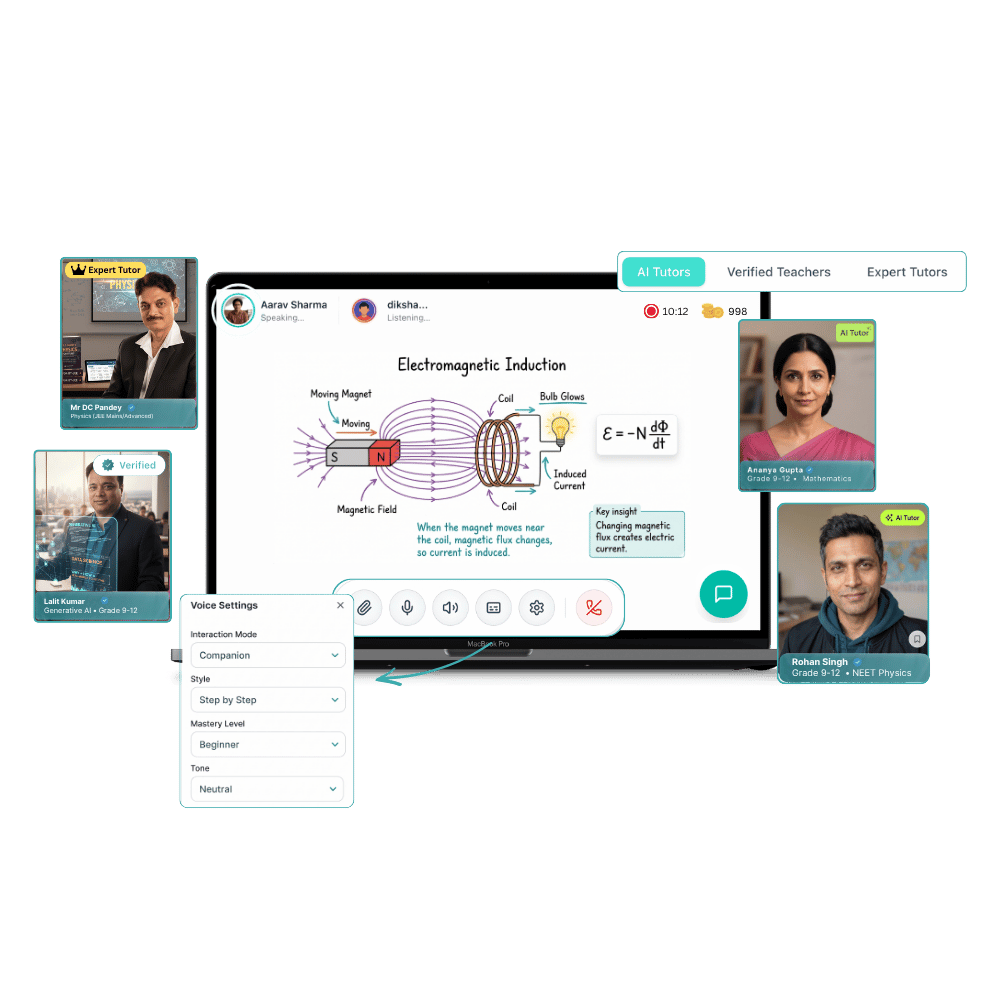
Imagine a math teacher solving an algebra problem on a whiteboard, carefully writing each step, explaining the reasoning, and drawing a quick graph to illustrate. That visual, step-by-step breakdown is often missing when students rely solely on text solutions or static diagrams. The challenge for many online learning tools has been to bridge this gap and explain complex topics with the clarity of a live whiteboard session.
Understanding complex topics like vector calculus, chemical reaction mechanisms, or human anatomy often goes beyond just reading text. When a student is stuck trying to visualize the forces acting on a pulley in Physics or the electron flow in an organic reaction, a textual explanation often falls short. What's needed is someone to draw it out, step-by-step, like an AI tutor with digital whiteboard capabilities.
For parents, handing a tablet to a six-year-old for a math lesson brings immediate questions: Will the content be appropriate? How is their personal data handled? What if the AI steers them to irrelevant or even harmful topics? These aren't just abstract concerns; they're daily considerations for families exploring educational technology. Understanding what makes an AI tutor app safe for young children is crucial.
A parent enrolling their child in an online learning tool often has immediate questions about safety: Will the content be age-appropriate? Is their personal data secure? For K-12 students exploring complex topics, whether it’s Class 8 science or Class 12 humanities, the interaction with an AI tutor needs to be carefully managed to prevent exposure to irrelevant or harmful information.
Many parents wonder how their child's independent study sessions with an AI tutor are progressing. It's not enough to know they're using it; understanding *what* they're learning, *where* they're struggling, and *how* they're improving on specific topics like algebraic equations or chemical reactions is crucial for meaningful support. Without insight, it feels like a black box.
Many parents worry about screen time and online interactions for their children. The idea of letting a child "talk to an AI tutor alone" naturally brings up questions about content appropriateness, data privacy, and whether the interaction remains purely educational. Is it truly a safe space for learning complex topics like quadratic equations or the intricacies of the circulatory system without supervision?
For parents, ensuring a child's safety and academic focus when using digital tools is a natural concern. When a student engages with an AI tutor, questions like "how to monitor what my child discusses with an AI tutor" often arise, especially regarding the content and appropriateness of their learning interactions. It's about finding a balance between digital independence and responsible oversight.