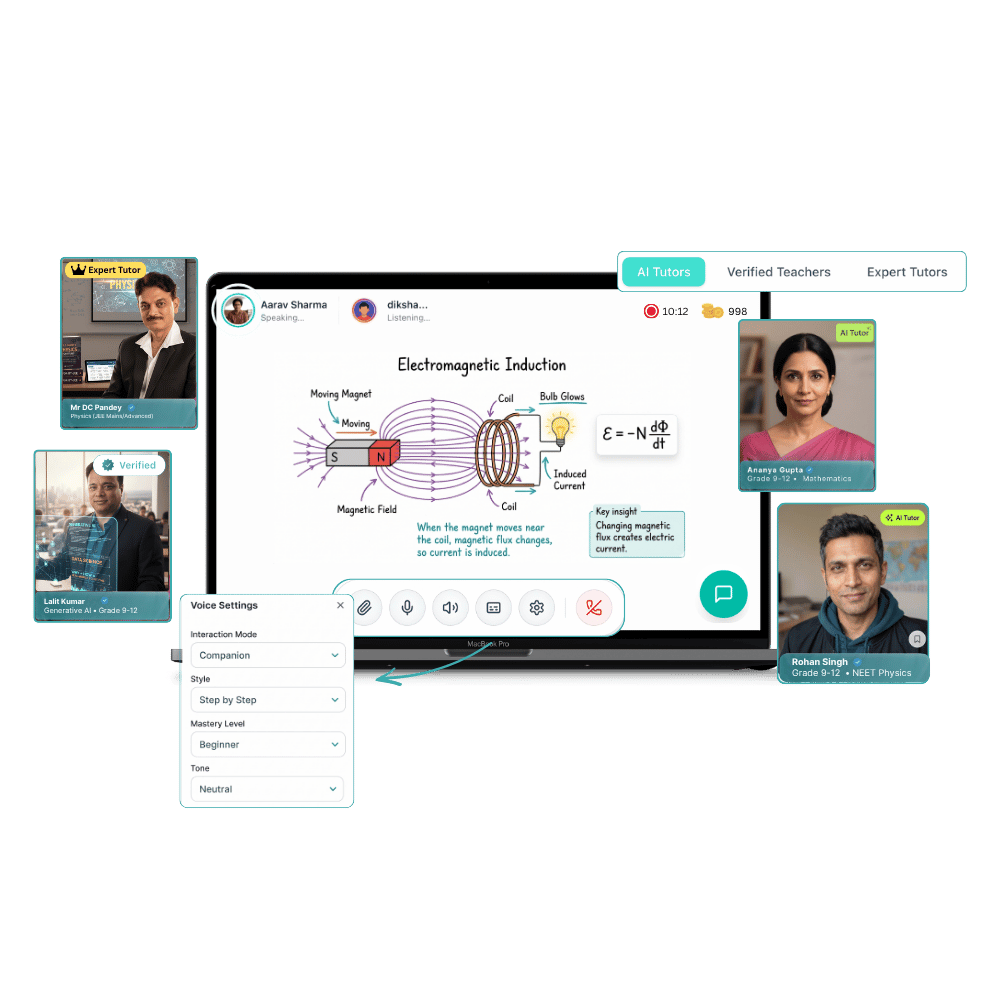
Imagine an Indian student with dyslexia attempting to comprehend a dense NCERT Biology chapter on genetics, or a student with ADHD struggling to maintain focus during a lengthy online lecture for their NEET preparation. The traditional text-heavy, one-size-fits-all approach often leaves neurodivergent learners feeling overwhelmed, isolated, and unable to demonstrate their true understanding, leading to frustration despite their capabilities.
Many Indian students, whether preparing for the JEE Main or struggling with Class 9 Science concepts, often find themselves stuck in a cycle: passive learning from textbooks, followed by isolated doubt-clearing sessions. The real challenge isn't just getting an answer, but understanding *why* a particular concept keeps tripping them up, and then proactively receiving tailored practice. This is where **Agentic AI in personalized education** steps in, transforming the learning experience from reactive to proactive and truly adaptive.
Imagine a student preparing for the NEET exam, consistently scoring low in Human Physiology despite hours of study. The core issue isn't lack of effort, but a recurring misunderstanding of hormone regulation that conventional study methods fail to pinpoint. This is where the concept of an AI tutor with digital twin learning for personalized education India 2026 is becoming critical – building a dynamic, real-time profile of a student's learning journey to identify and address such specific friction points.
It's 1 AM, and a student is stuck on a critical question from their JEE Physics textbook – perhaps a tricky circuit diagram or a complex integration problem. The frustration mounts, but waiting until morning for a private tutor means losing valuable study momentum, and often, an entire night's sleep. This is the common late-night dilemma students face, where the need for immediate clarification clashes with tutor availability.
For a Class 10 student grappling with balancing redox reactions in Chemistry at 1 AM, or a Class 12 student trying to make sense of integration by parts from an NCERT textbook, waiting until morning for a teacher is no longer the only option. CBSE students in Class 9, 10, 11, and 12 frequently encounter doubts that need immediate, precise clarification, especially when preparing for board exams or competitive tests. This constant need for accessible, accurate support makes the search for the best AI tutor app for CBSE students Class 9 10 11 12 2026 a crucial one for academic success.
Imagine a Class 10 student in Kota struggling with a complex algebraic equation at midnight, their human tutor unavailable. Or a NEET aspirant in Bihar needing quick clarification on a tricky Biology diagram during a self-study session. These scenarios highlight a critical gap: traditional human tutoring, while invaluable, often faces limitations of time, access, and immediate availability. This is precisely where the **AI-human hybrid tutoring model** is stepping in for Indian students.
A Class 10 student revises the "Life Processes" chapter for their upcoming CBSE Science board exam at midnight, only to realize they're confused about the specific role of ATP in cellular respiration. Finding a human tutor available for a quick clarification at that hour is unlikely. The question then becomes, is AI tutoring as effective as human tutors for board exam preparation 2026, especially for these urgent, precise doubts?
By 2026, Indian families investing in competitive exam preparation for JEE and NEET, alongside CBSE board studies, are facing unprecedented financial decisions. A typical private tutor for JEE Physics or NEET Biology can charge anywhere from ₹500 to ₹1500 per hour, often requiring multiple sessions weekly, quickly accumulating monthly costs upwards of ₹10,000 to ₹30,000 per subject. This expense often doubles or triples when students require support across multiple subjects or school boards.
Many students find themselves excelling in some subjects while constantly battling others. Perhaps Physics numericals seem daunting, or historical dates in Social Science blur together, leading to disproportionate time spent on these "weak" areas without seeing real improvement. Creating a effective personalized study plan for weak subjects becomes crucial, not just for passing, but for building confidence and achieving balanced scores.
Imagine a student struggling to understand the nuances of Newton's Laws of Motion or the intricate process of photosynthesis. Reading textbook paragraphs can only go so far; sometimes, a concept needs to be explained aloud, debated, or walked through verbally. This is especially true when a student hits a mental block, unable to articulate their confusion in written words. The limitations of text-only doubt clearing become clear when complex ideas require interactive, real-time clarification, making the concept of an AI tutor with voice explanations particularly compelling.
Forgetting what you studied last week, especially critical formulas for JEE Physics or key dates for UPSC History, is a common hurdle for students. This phenomenon, known as the "forgetting curve," means that without timely review, recall declines rapidly. Traditional revision often involves cramming, which leads to short-term memorization but rarely long-term retention. This is where strategic revision, combining the principles of spaced repetition, becomes vital for solidifying knowledge for school exams or competitive tests.
The journey to crack JEE involves navigating two of the most demanding subjects: Physics and Chemistry. Students frequently find themselves stuck not just on complex numericals, but also on intricate conceptual applications – perhaps understanding why a specific catalyst works in a chemical reaction, or the nuances of electromagnetic induction. The sheer volume and depth required to confidently solve problems from diverse topics, from Solid State in Chemistry to Thermodynamics in Physics, often leaves aspirants seeking immediate, tailored support. This is where the question of whether an AI Tutor Help Students Prepare for JEE Physics and Chemistry effectively becomes critical.
Imagine a student wrestling with a complex Physics derivation late at night, or struggling to articulate their thoughts for a History essay. The temptation to simply "ask the AI" for the complete answer is high, risking rote submission over genuine understanding. The real challenge for students is learning to leverage AI's capabilities as a powerful study aid without sacrificing the critical thinking and problem-solving skills crucial for independent learning.
For a JEE or NEET aspirant grappling with a complex organic chemistry mechanism at 2 AM, the immediate question isn't just "How do I solve this?", but "Who can help me right now?". The traditional route involves a private tutor, often with fixed hours and geographical limitations. This presents a fundamental dilemma for students needing flexible, instant support outside typical coaching schedules.
A student might understand the concept of rotational kinetic energy from Chapter 11 Class 11 Notes, but when faced with a numerical involving a rolling cylinder on an inclined plane with friction, the steps feel disconnected. Physics numericals in Class 11 and 12 demand more than just recalling formulas; they require a precise strategy to break down complex scenarios, identify relevant principles, and execute calculations without error. This multi-layered problem-solving is often why students struggle.
For a NEET aspirant, the sheer volume of NCERT Biology—from Human Physiology to Genetics and Ecology—often makes revision a slow, daunting task. Students frequently spend hours rereading chapters like "Molecular Basis of Inheritance" but struggle to recall specific details or differentiate between similar terms like homologous and analogous organs under exam pressure. The challenge isn't just understanding, but efficient memorization and rapid recall, which is crucial for answering 90 Biology questions in limited time.
It's 11 PM, and a Class 10 student is stuck on a tough algebra problem for tomorrow's assignment. The teacher is asleep, friends might not reply, and online forums take time. This isn't just a hypothetical scenario; it's a common nightly frustration for countless students across India, facing deadlines with no immediate help. Resolving these late-night study doubts quickly can be the difference between completing homework and falling behind.
Imagine a Class 10 student deep into their NCERT Science chapter on 'Acids, Bases, and Salts' at 1 AM. They encounter a specific reaction, say the formation of sodium carbonate, and the textbook explanation for a particular step isn't clicking. Without an immediate way to clarify, the learning process stalls, and the frustration grows, illustrating exactly why studying alone feels harder when you cannot ask questions immediately.
Many students, especially those preparing for competitive exams like JEE or UPSC, instantly reach for a solution video when they hit a roadblock on a challenging problem, whether it's an advanced Calculus question or a complex Physics numerical. The immediate gratification of seeing the steps laid out can feel like learning, providing a quick path to the "correct" answer without the painstaking effort of self-discovery.
It’s 1 AM, and you’ve been staring at that stoichiometry problem for what feels like an eternity. You've re-read the textbook, checked your notes, and yet, the answer still eludes you. This frustrating loop of being stuck on the same question for hours is a common scenario for students across all subjects and exam levels, from CBSE Class 12 Chemistry to JEE advanced Physics.