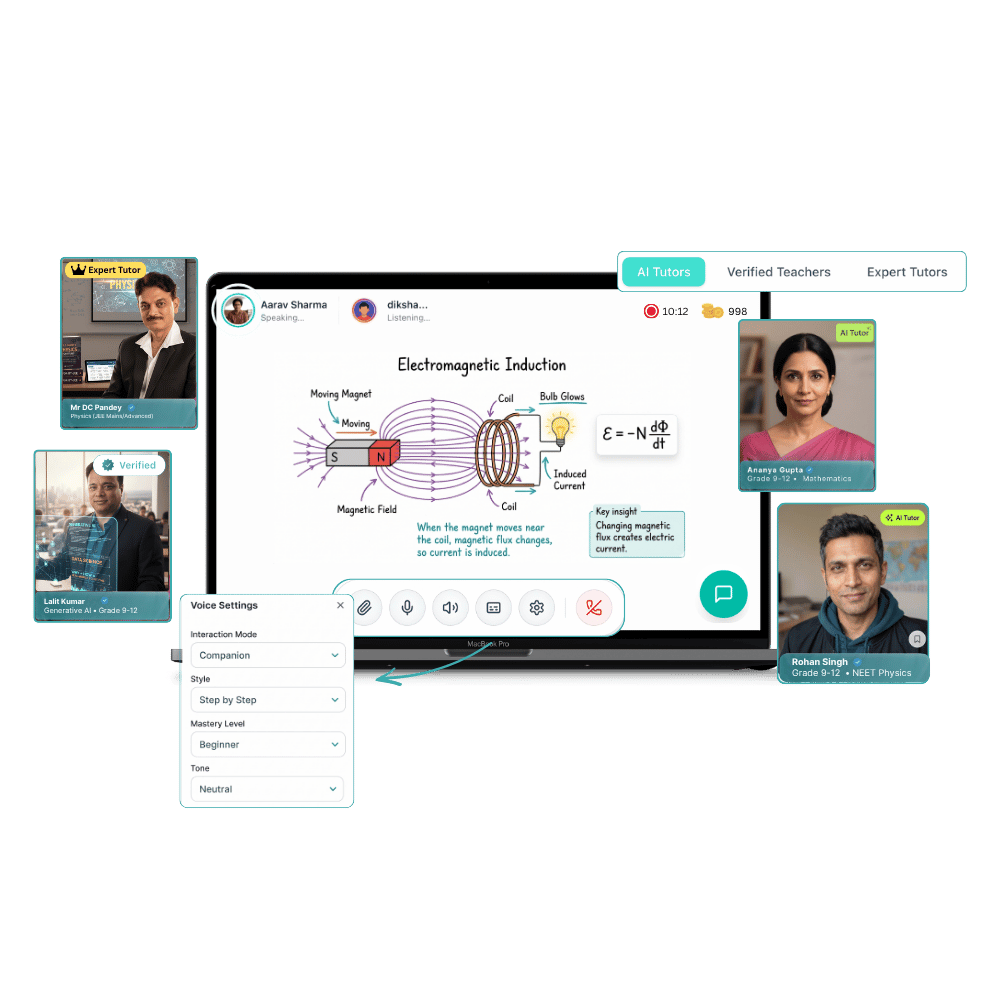
For many Indian parents, the decision to introduce a digital learning tool like an AI tutor app comes with a critical question: how can I ensure my child's online safety and focused learning? The concern isn't just about screen time; it's about content appropriateness, data privacy, and whether the learning environment truly supports academic goals without unnecessary distractions.
Parents often wonder what happens to their child's study data when they use a mobile AI tutor. From photos of homework questions to voice recordings during explanations, a significant amount of personal academic information is shared. The core concern for families is ensuring these AI tutor apps protect children's privacy and data, preventing misuse or unauthorized access.
When your child uses an AI tutor app to solve a complex algebraic equation or prepare for their board exams, a fundamental question often surfaces for parents: is my child's data safe with an AI tutor app? This isn't just about personal information like names and addresses, but also about learning patterns, query history, and even voice recordings that build a student's academic profile.
Many students find themselves staring at a Class 12 Chemistry board exam question from 2018, understanding the core concept but completely stuck on how to structure the answer for maximum marks. Mastering board exams isn't just about knowing the syllabus; it's about dissecting past papers, understanding examiner expectations, and pinpointing common pitfalls. This is where an AI tutor for solving last 10 years board exam questions becomes invaluable, offering instant clarity when a teacher isn't available.
Imagine a Class 10 student solving a Social Science PYQ from "Nationalism in India" that asks about the significance of the Khilafat Movement. They recall reading about it but can't articulate the precise connection to Gandhi's non-cooperation. Waiting for a teacher or sifting through textbooks to clarify this single point breaks their study flow. The core challenge then becomes how to practice NCERT PYQs with instant AI explanations that clarify such nuances immediately.
A Class 12 student reviewing for their board exams might find a seemingly straightforward previous year question on 'Matrices' from 2019 leading to calculation errors. It's not just about getting the final answer but understanding the subtle steps the examiner expects. Simply having a solution key doesn't clarify *why* a particular method was chosen over another. This is where dedicated support for **NCERT previous year questions solved by AI tutor** becomes crucial.
Imagine a student in Nashik studying Physics for the NEET exam. They understand the core concepts of optics perfectly in Marathi, their native language, but the textbook explanations and exam questions are in English, filled with unfamiliar jargon. This language barrier often prevents them from asking precise doubts or fully grasping nuances, not because of a lack of intelligence, but due to discomfort with English as the medium of instruction. An AI tutor for students who are not comfortable with English addresses this specific challenge.
YoLearn AI is a cutting-edge artificial intelligence platform designed to transform the educational landscape. It leverages advanced machine learning algorithms to provide personalized learning experiences tailored to each student's unique needs, pace, and learning style.
Imagine a Class 9 student in Chennai struggling with complex Physics concepts like "refraction" or "electromagnetic induction," not because the subject is hard, but because the explanations in English don't quite click. This is a common hurdle for students whose primary language at home is Tamil, Telugu, or Hindi, even if they study in English-medium schools. They often grasp the underlying idea much faster when explained in their mother tongue.
Imagine a bright student in rural Maharashtra, perfectly capable of grasping complex Class 10 Science concepts when taught in Marathi, but constantly stumbling when the textbook and exam questions are purely in English. This linguistic gap isn't just about translation; it's about understanding the nuances of scientific terminology and problem statements in a language that feels foreign. Seeking an **AI tutor for Indian languages** becomes crucial for these students to truly excel.
For a Class 10 student juggling trigonometry in CBSE Math and redox reactions in Science, the sheer volume of study material can be overwhelming. When a doubt arises late at night, or a complex concept like the 'Doppler Effect' in ICSE Physics needs a simplified explanation, choosing an effective AI tutor app becomes critical. It's not just about getting answers, but about finding a study partner that truly understands the nuances of board-specific curricula.
For parents in India, navigating the options for digital learning can be overwhelming. You want to give your child the best support, but with dozens of apps claiming to be the definitive "AI tutor app for child in India," how do you differentiate between a flashy interface and genuinely effective learning support? The real question isn't just about finding an app, but finding one that truly understands the unique academic pressures and curriculum frameworks of the Indian education system, from CBSE to JEE prep.
For Indian students navigating the competitive academic landscape of 2026, choosing the right study tools is crucial. The sheer volume of content for exams like JEE, NEET, or even mastering NCERT for CBSE boards often means doubts arise outside of classroom hours. Many struggle with foundational concepts in subjects like advanced Calculus or Organic Chemistry, finding traditional tutoring inaccessible or too slow.
Many Indian students face a common dilemma: struggling with a specific concept in Maths or Physics, such as trigonometry identities or electrostatics, and wondering if an AI tutor or private tuition offers the best solution. Private tutors provide direct human interaction, but their availability is often limited to fixed hours and location, and their cost can be significant, especially for subjects like JEE Advanced Physics.
A Class 10 student grappling with polynomial factorization at midnight faces a common dilemma: the human tutor isn't available until tomorrow, but the test is first thing in the morning. This immediate need highlights a core difference when comparing AI tutor and human tutor results – the speed of intervention. While a human tutor offers scheduled, deep dives, an AI tutor can provide instant, targeted support exactly when a conceptual block arises.
Many parents find themselves weighing the pros and cons of an AI tutor against a traditional private tutor when their child struggles with a concept like "fractions" in Class 6 Math or needs help understanding "Newton's Laws" for an upcoming school test. The challenge often isn't just finding someone who understands the subject, but someone who can explain it patiently at any time of day, aligning with a child's unpredictable learning schedule or sudden curiosity.
The transition from Class 10 to Class 11 marks a pivotal moment for Indian students, often overshadowed by the anxiety of **choosing subject combinations in Class 11**. Many students pick Science, Commerce, or Humanities based on peer pressure or perceived difficulty, only to discover later that their chosen subjects might not align with the prerequisites for their desired university courses, from engineering to liberal arts.
That knot in your stomach before a practical viva isn't just about knowing the material; it's the pressure of performing an experiment, verbalizing complex steps, and defending your understanding to an examiner on the spot. Whether it's a Class 12 Physics practical, a B.Tech Electrical lab viva, or a Medical Anatomy spotter, the fear of blanking out or fumbling an explanation under direct scrutiny can often overshadow the actual knowledge.
Imagine you've received your Class 12 board results, and while overall good, a slightly lower score in one key subject, like Mathematics or Physics, means you just missed the cutoff for your dream engineering program or a specific university course. This scenario often prompts the question: is a **Single Subject Improvement Exam** worth attempting? It's a strategic choice for students aiming to bridge a small gap or significantly boost a particular grade.
For many Indian students, the release of board exam results like CBSE Class 10 or ISC Class 12 can be a defining moment. But what if the score in a subject like Mathematics or Science seems significantly lower than expected, sparking a doubt about the evaluation? This is often the trigger for students and parents to consider applying for board exam rechecking, a process designed to address potential errors in marking or tabulation.