PERIMETER AND AREA
6.1 Perimeter
Can you recall the definition of a closed plane figure's perimeter? Let's review this fundamental concept.
The perimeter of any enclosed two-dimensional shape represents the total linear extent of its boundary when traversed a single time. Specifically, for a polygon—a closed planar figure constructed from straight line segments—its perimeter is determined by the cumulative length of all its constituent sides, signifying the complete measurement around its external border.
Therefore, for any polygon, the perimeter equals the aggregate sum of the lengths of its sides.
Let's now review the specific formulas used to calculate the perimeter of rectangles, squares, and triangles.
Perimeter of a rectangle
Let's examine a rectangle, labeled ABCD, possessing a length of 12 cm and a breadth of 8 cm. What would be its perimeter?
The perimeter of this rectangle is derived by summing the lengths of its four sides.
$ = AB + BC + CD + DA $
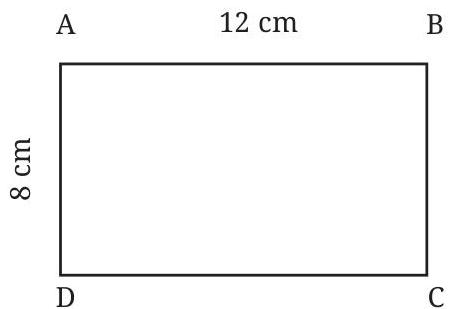
$
\begin{array}{l} = \mathrm{AB} + \mathrm{BC} + \mathrm{AB} + \mathrm{BC} \ = 2 \times \mathrm{AB} + 2 \times \mathrm{BC} \ = 2 \times (\mathrm{AB} + \mathrm{BC}) \ = 2 \times (12 \mathrm{cm} + 8 \mathrm{cm}) \ = 2 \times (20 \mathrm{cm}) \ = 40 \mathrm{cm}. \end{array} $
It is a fundamental property of rectangles that their opposite sides are of equal measure. Consequently, AB is equivalent to CD, and AD is equivalent to BC.
Drawing from this illustration, we can deduce the following:
- The perimeter of a rectangular shape is calculated as the sum of its length, breadth, length, and breadth.
- Alternatively, the perimeter of a rectangle can be expressed as two times the sum of its length and breadth.
- In essence, the perimeter of a rectangle corresponds to double the combined value of its length and breadth.
Perimeter of a square
Debojeet intends to affix colored tape along the entire periphery of a square photo frame, each side measuring $1\mathrm{m}$. What total length of tape will be necessary for this purpose? Given that the tape is to encircle the entire frame, Debojeet must determine the perimeter of the photo frame.
Consequently, the required length of tape corresponds to the square's perimeter.
This is equivalent to the aggregate of the lengths of all four sides of the square:
$ = 1 \mathrm{m} + 1 \mathrm{m} + 1 \mathrm{m} + 1 \mathrm{m} = 4 \mathrm{m}. $
Recognizing that all four sides of a square possess identical lengths, we can, instead of summing each side individually, simply multiply the length of a single side by four.
Hence, the total tape length needed calculates to $4 \times 1 \mathrm{m} = 4 \mathrm{m}$.
This illustration demonstrates that:
- Perimeter of a square = 4 × length of a side.
- The perimeter of a square is four times the measure of its side.
Perimeter of a triangle
Let us examine a triangle with specified side lengths of $4\mathrm{cm}$, $5\mathrm{cm}$ and $7\mathrm{cm}$. Determine its perimeter.
The triangle's perimeter is calculated as $4\mathrm{cm} + 5\mathrm{cm} + 7\mathrm{cm} = 16\mathrm{cm}$.
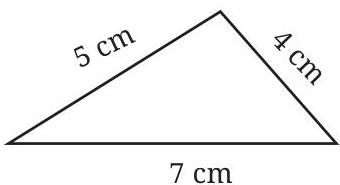
The perimeter of a triangle is defined as the aggregate of the measures of its three constituent sides.
Example: Akshi wants to put lace all around a rectangular tablecloth that is $3\mathrm{m}$ long and $2\mathrm{m}$ wide. Find the length of the lace required.
Solution
A rectangular table cover has a length of $3 \mathrm{m}$ and a breadth of $2 \mathrm{m}$. Akshi intends to apply lace along the entire edge of this tablecloth.
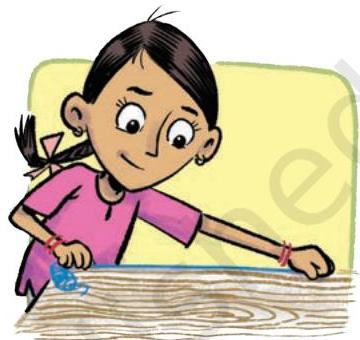
Consequently, the required length of lace will be equal to the perimeter of the rectangular tablecloth.
The perimeter of a rectangular tablecloth is calculated using the formula: $2 \times$ (length + breadth)
$ \begin{array}{l} = 2 \times (3 \mathrm{m} + 2 \mathrm{m}) \ = 2 \times 5 \mathrm{m} = 10 \mathrm{m}. \end{array} $
Therefore, the total length of lace required is $10\mathrm{m}$.
Example: Determine the total distance Usha travels if she completes three circuits around a square park with a side length of $75\mathrm{m}$.
Solution
The perimeter of the square park is found by multiplying the length of one side by four, which is $4 \times 75\mathrm{m} = 300\mathrm{m}$.
This signifies that the distance Usha covers in a single round is $300 \mathrm{m}$.
Hence, the cumulative distance travelled by Usha over three rounds is $3 \times 300\mathrm{m} = 900\mathrm{m}$.
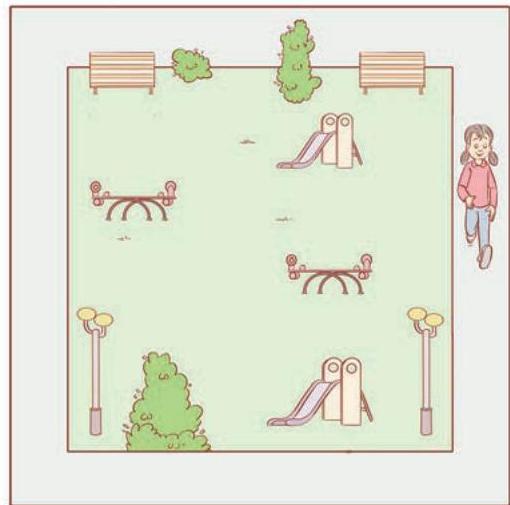
Figure it Out
Ascertain the missing values: a. A rectangle has a perimeter of 14 cm and a breadth of 2 cm. Determine its length. b. A square's perimeter is 20 cm. What is the measure of one of its sides? c. For a rectangle with a perimeter of 12 m and a length of 3 m, calculate its breadth.
A wire is shaped into a rectangle with dimensions 5 cm by 3 cm. If this wire is unbent and then reshaped into a square, what would be the side length of the resulting square?
A triangle has a perimeter of 55 cm. Given that two of its sides measure 20 cm and 14 cm, respectively, what is the length of its third side?
Calculate the total expenditure for fencing a rectangular park that is 150 m long and 120 m wide, assuming the fencing material costs ₹40 per meter.
A 36 cm long string is used to form various shapes. Determine the length of each side if it is used to create: a. A square, b. An equilateral triangle, and c. A regular hexagon (a six-sided closed figure where all sides are equal)?
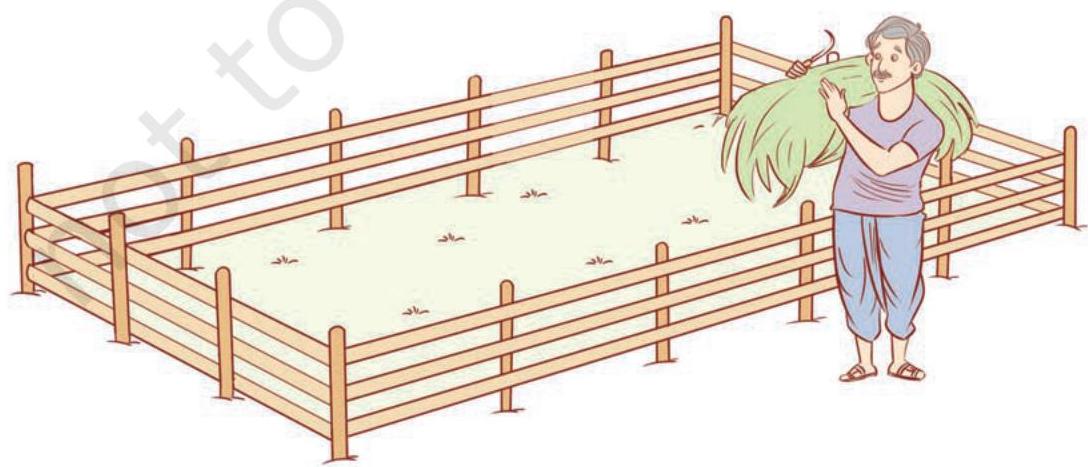
A farmer possesses a rectangular field measuring 230 m in length and 160 m in breadth. He intends to enclose it with three complete circuits of rope, as depicted. What is the cumulative length of rope required for this purpose?
Matha Pachchi!
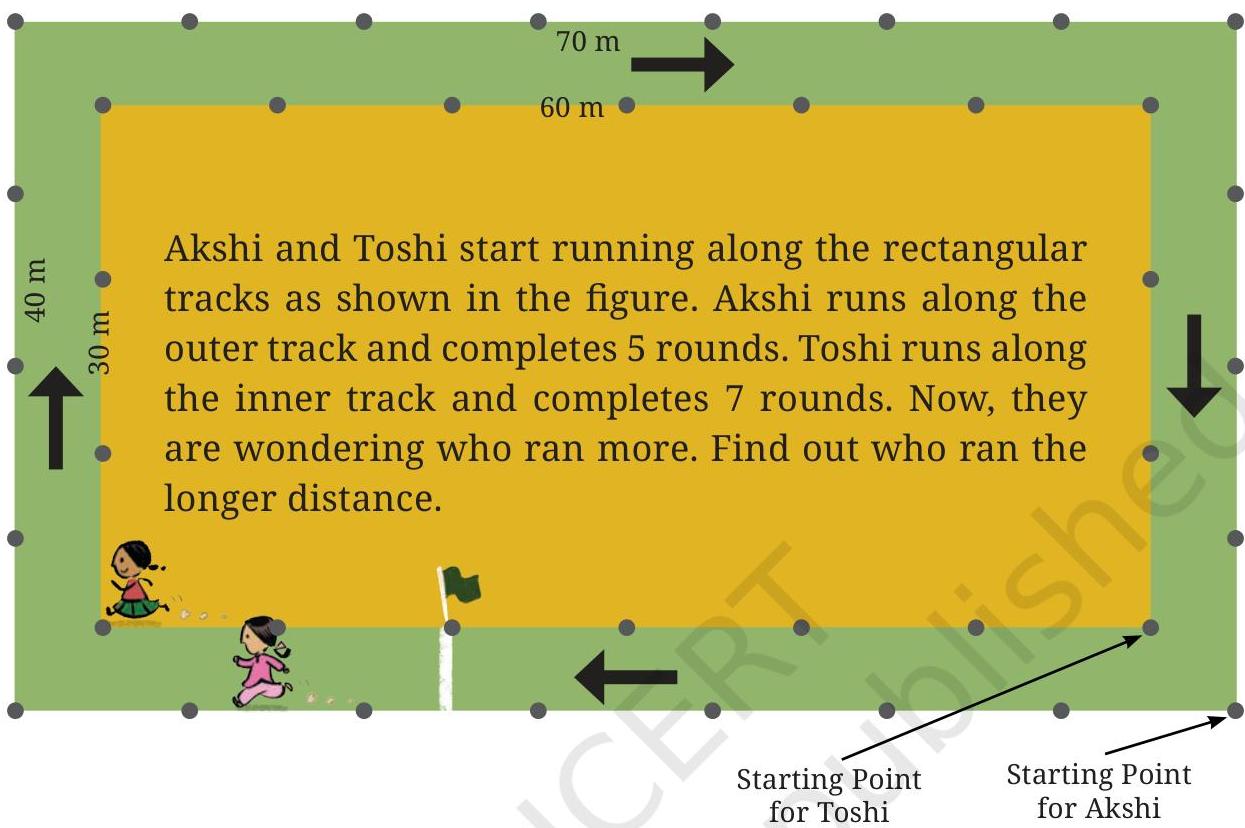
Every track is rectangular in shape. Akshi's specific track measures 70 m in length and 40 m in width. Completing a single circuit on this track would entail covering a distance of 220 m, calculated as $2 \times (70 + 40) \mathrm{m} = 220 \mathrm{m}$. This value represents the total distance Akshi travels during one full lap.
Figure it Out
- Determine the cumulative distance Akshi has traveled after completing 5 rounds.
- Calculate the total distance Toshi has covered across 7 rounds. Subsequently, identify which individual, Akshi or Toshi, traversed a greater distance.
- Deliberate and indicate the specified positions as instructed—
a. Designate 'A' at Akshi's location upon having run 250 m. b. Designate 'B' at Akshi's location upon having run 500 m. c. Akshi has now run a total of 1000 m. How many complete circuits has she concluded on her track? Mark her current position as 'C'. d. Designate 'X' at Toshi's location upon having run 250 m. e. Designate 'Y' at Toshi's location upon having run 500 m.
f. Toshi has now run a total of 1000 m. How many complete circuits has she concluded on her track? Mark her current position as 'Z'.
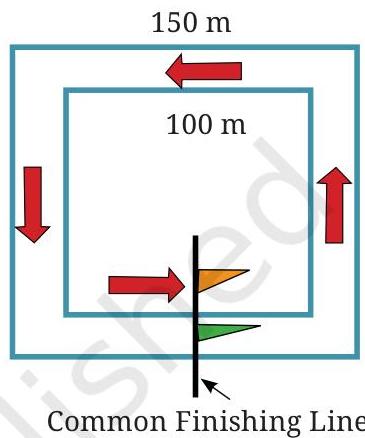
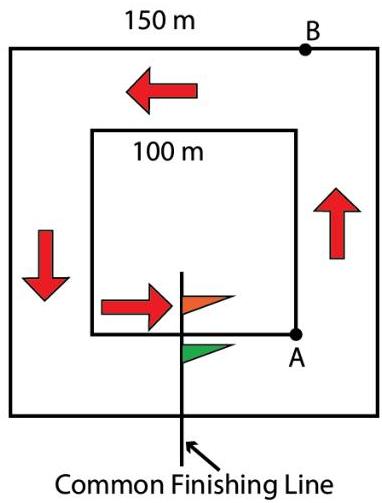
Deep Dive: Typically, in competitive races, a single finish line serves all participants. Presented here are two square running tracks: an inner track, each side measuring 100 m, and an outer track, each side measuring 150 m. The shared finish line for both runners is visually represented by flags within the diagram, positioned precisely at the midpoint of one side of each track.
Assuming the total race distance is 350 m, our task is to ascertain the requisite starting positions for each runner on these two tracks, ensuring they both reach the designated common finish line concurrently after traversing 350 m. Label the starting point for the runner on the inner track as 'A' and for the runner on the outer track as 'B'.
Estimate and Verify
Obtain a piece of scrap paper, such as newspaper. Create several arbitrary shapes by cutting the paper in various ways. For each shape, approximate the total length of its boundary before employing a ruler or measuring tape to accurately determine and confirm its perimeter.

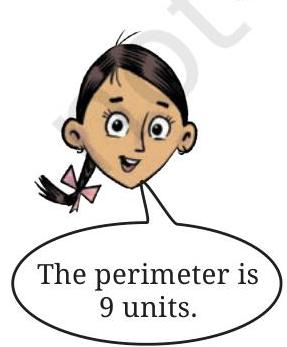
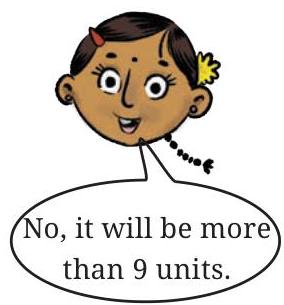
Akshi suggests the perimeter of this triangular figure is 9 units. Conversely, Toshi contends that it cannot be 9 units, asserting that the perimeter must exceed this value. What is your opinion on
this disagreement?
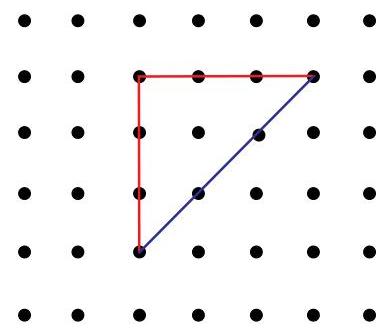
Observe that this diagram incorporates line segments of two distinct unit measures. Determine if the lengths of a red line and a blue line are equivalent. For clarity, we shall refer to the red segments as 'straight lines' and the blue segments as 'diagonal lines'. Consequently, the perimeter of this particular triangle can be expressed as 6 straight units plus 3 diagonal units. This can be concisely represented as: $6s + 3d$ units.
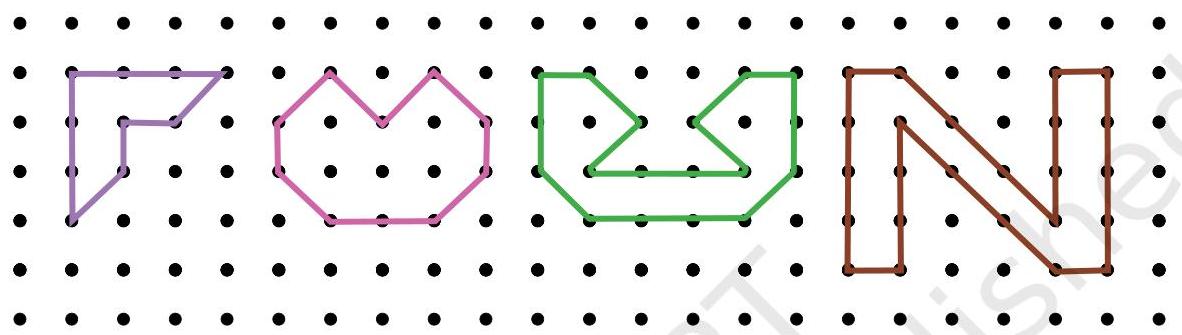
Express the perimeters of the subsequent figures using the established straight and diagonal unit terminology.
Perimeter of a regular polygon
Geometric figures that are closed, possess sides of uniform length, and exhibit angles of identical measure, such as squares, are termed regular polygons. Our previous exploration of these shapes was conducted in Chapter 1, under the designation 'Shape Sequence' #1. Illustrative examples include the equilateral triangle, characterized by three equal sides and three equal angles, and the regular pentagon, which features five equal sides and five equal angles, among others.
Perimeter of an equilateral triangle
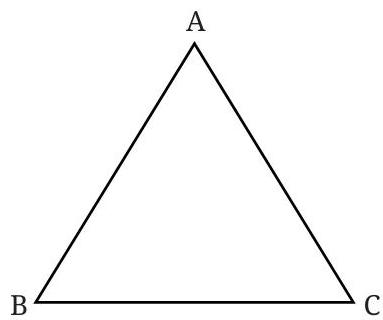
It is established that the perimeter of any given triangle is determined by the summation of the lengths of its three constituent sides.
Leveraging this fundamental principle, one can readily ascertain the perimeter of an equilateral triangle.
Perimeter of an equilateral triangle
$ \begin{array}{l} = \mathrm {A B} + \mathrm {B C} + \mathrm {A C} = \mathrm {A B} + \mathrm {A B} + \mathrm {A B} \ = 3 \text { times length of one side}. \ \end{array} $
Perimeter of an equilateral triangle $= 3 \times$ length of a side.
What is a similarity between a square and an equilateral triangle?
Identify diverse objects within your environment that exhibit regular polygonal forms and subsequently determine their perimeters. Furthermore, extend this understanding to formulate a general principle for calculating the perimeter of other regular polygons.
Teacher's Note
Facilitate a deeper exploration of regular polygons, guiding students to formulate a universal expression for their perimeters.
Split and rejoin
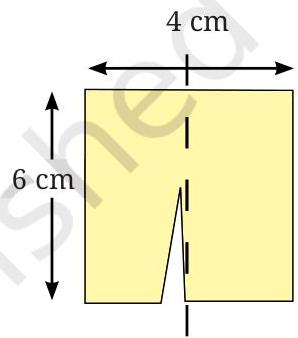
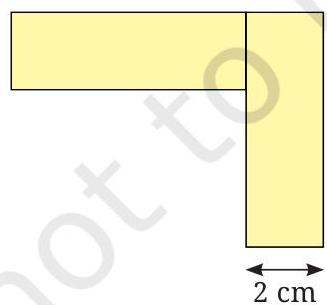
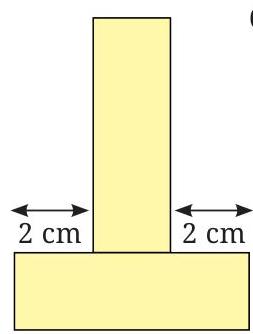
A rectangular sheet of paper, measuring $6\mathrm{cm} \times 4\mathrm{cm}$, is bisected into two identical sections as depicted. These resulting segments are then reconfigured in various arrangements.
a.
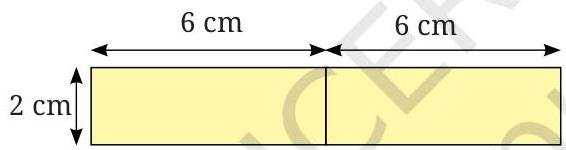
For instance, configuration 'a.' exhibits a perimeter measuring $28\mathrm{cm}$.
Determine the total boundary length (i.e., the perimeter) for each of the subsequent configurations presented.
b.
c.
d.
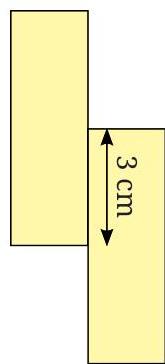
Utilize the two sections to construct a shape possessing a perimeter of $22\mathrm{cm}$.
6.2 Area
Our prior studies in earlier grades have covered the areas of both regular and irregular closed geometric shapes. Let's review some essential concepts.
The extent of a surface encompassed within the boundaries of a closed figure is defined as its area.
Recall how, in earlier academic levels, we derived the formulas for calculating the area of a rectangle and a square through the utilization of square grid paper. Can you recollect this process?
Area of a square = _____
Area of a rectangle = _____
Teacher's Note
Guide students in recollecting the methodology for determining the area of rectangular and square shapes by employing grid papers. Furnish students with square grid papers to facilitate their independent derivation of the respective formulas.
Let us now examine some practical problems that apply these principles.
Example: Consider a floor measuring 5 m in length and 4 m in width. A square carpet, with sides of 3 m, is placed upon this floor. Determine the area of the floor surface that remains uncovered by the carpet.
Solution
Length of the floor = 5 m.
Width of the floor = 4 m.
Area of the floor = length × width = 5 m × 4 m = 20 sq m.
Length of the square carpet = 3 m.
Area of the carpet = length × length = 3 m × 3 m = 9 sq m.
Consequently, the section of the floor covered by the carpet measures 9 sq m.
Thus, the area of the floor portion that remains uncarpeted is calculated by subtracting the carpeted area from the total floor area: 20 sq m – 9 sq m = 11 sq m.
Example: A plot of land, 12 m in length and 10 m in width, features four square flower beds, each with sides of 4 m, situated at its four corners. Calculate the area of the land that is not occupied by the flower beds.
Solution
The length of the land $(l)$ is $12\mathrm{m}$. The width of the land $(w)$ is $10\mathrm{m}$. The total area of the entire land parcel is calculated as $l \times w$, which equates to $12\mathrm{m} \times 10\mathrm{m}$, resulting in $120\mathrm{sq}\mathrm{m}$.
Each of the four square flower beds has a side length $(s)$ of $4\mathrm{m}$. The area of a single flower bed is determined by $s \times s$, or $4\mathrm{m} \times 4\mathrm{m}$, yielding $16\mathrm{sq}\mathrm{m}$. Consequently, the combined area of all four flower beds totals $4 \times 16\mathrm{sq}\mathrm{m}$, which is $64\mathrm{sq}\mathrm{m}$.
Thus, the area of the land that remains is found by subtracting the total area of the four flower beds from the area of the complete land; this calculation is $120\mathrm{sq}\mathrm{m} - 64\mathrm{sq}\mathrm{m}$, resulting in $56\mathrm{sq}\mathrm{m}$.
Figure it Out
- A rectangular garden with a length of $25\mathrm{m}$ has an area of $300\mathrm{sq}\mathrm{m}$. Determine the width of this garden.
- Calculate the expense of tiling a rectangular land plot, which measures $500\mathrm{m}$ in length and $200\mathrm{m}$ in width, given a rate of ₹8 for every hundred square meters.
- A coconut grove, rectangular in shape, spans $100\mathrm{m}$ in length and $50\mathrm{m}$ in width. If each coconut tree necessitates $25\mathrm{sq}\mathrm{m}$ of space, what is the greatest number of trees that can be accommodated within this grove?
- Decompose the subsequent figures into constituent rectangles to ascertain their respective areas (all dimensions are provided in meters).
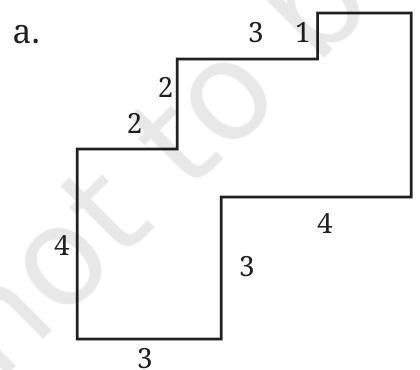
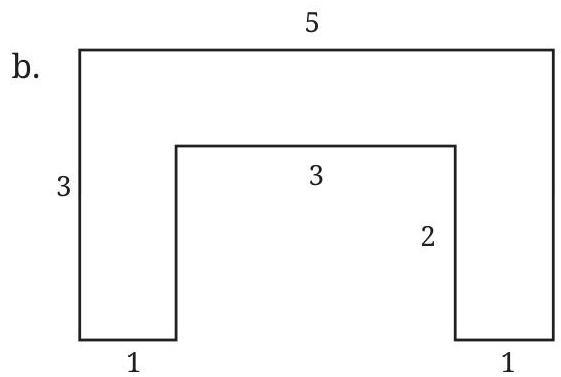
Figure it Out
Extract the tangram components provided in the appendix of your textbook.
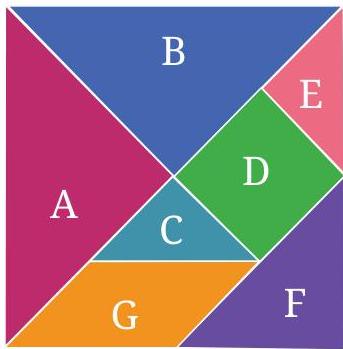
- Investigate and ascertain the number of pieces possessing equivalent areas.
- Determine the area ratio of Shape D relative to Shape C. Furthermore, elucidate the interrelationship among Shapes C, D, and E.
- Identify which geometric figure, Shape D or Shape F, encompasses a greater area. Provide justification for your conclusion.
- Compare Shape F and Shape G, indicating which possesses a larger area. Support your response with appropriate reasoning.
- Quantify the area of Shape A in relation to Shape G. Specifically, determine if its area is double or quadruple that of Shape G.
Guidance: Through superimposing the tangram components, one can discern that Shapes A and B exhibit congruent areas, as do Shapes C and E. Additionally, it should become apparent that Shape D can be precisely tiled by combining Shapes C and E, thereby implying that Shape D encompasses an area equivalent to twice that of Shape C or Shape E, and so forth.
- Utilizing the insights gained, calculate the total area of the large square constructed from all seven pieces, expressing it in units of Shape C's area.
- Configure these seven components to compose a rectangular figure. Subsequently, determine the area of this resultant rectangle, again expressed relative to the area of Shape C. Justify your calculation.
- Evaluate whether the perimeters of the square and the rectangle, both assembled from the identical set of seven pieces, are distinct or equivalent. Provide a comprehensive explanation for your determination.
Examine the following illustrations and hypothesize which among them possesses a greater surface area.
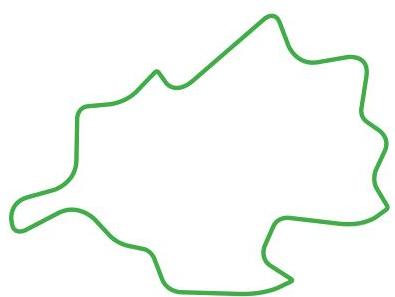 a.
a.
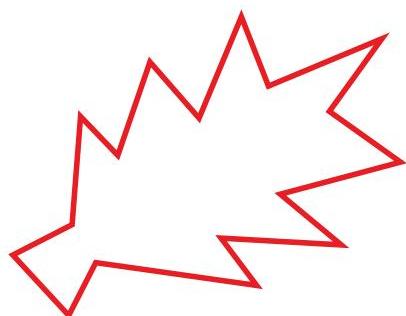 b.
b.
The area of any elementary closed geometric configuration can be approximated through the utilization of grid paper or graph paper, wherein each constituent square spans dimensions of $1 \text{ unit} \times 1$ unit, thus representing $1$ square unit.
To facilitate area estimation, one may delineate the perimeter of the shape onto translucent paper, subsequently superimposing it upon a sheet of squared or graph paper. The following established protocols should then be observed:
- A single complete small square on the squared or graph paper is designated as possessing an area of 1 square unit.
- Disregard any area segments that constitute less than half of a square unit.
- Should a region encompass more than half of a square, it is to be enumerated as a full 1 square unit.
- In instances where precisely half of a square is included within the region, its area is to be recorded as $\frac{1}{2}$ square unit.
Determine the area of the subsequent figures.
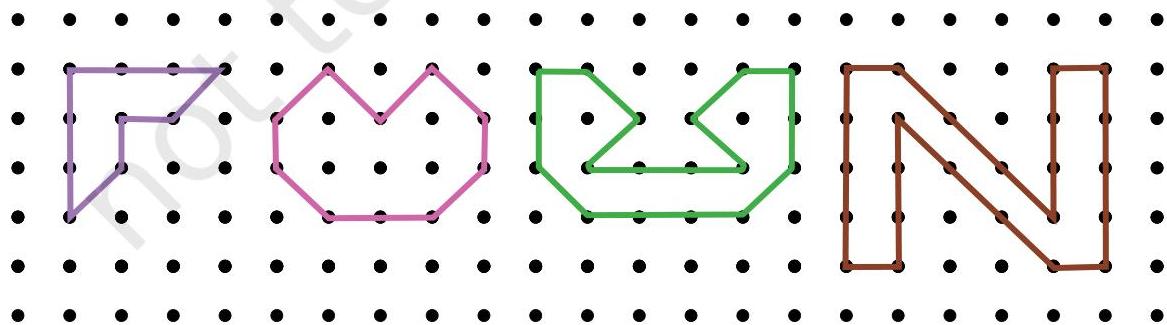
Let's Explore!
What is the fundamental reason for the widespread adoption of squares in area measurement?
On a graph sheet, delineate a circle possessing a diameter (or breadth) of 3 units. Subsequently, enumerate the constituent squares to derive an approximate measure of the circular region's area.
It becomes evident that circles cannot be arranged in a contiguous manner without leaving interstitial spaces. Consequently, obtaining a precise area measurement becomes challenging when utilizing circles as units. The accompanying illustration demonstrates a single rectangular area filled with circles in two distinct arrangements; the initial configuration accommodates 42 circles, while the subsequent one contains 44 circles.
What precludes the adoption of circles, rather than squares, for the quantification of area?
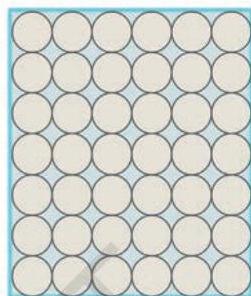
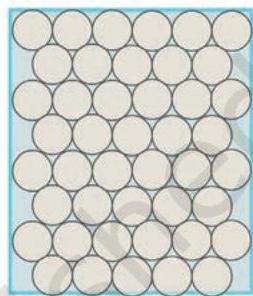
Endeavor to tessellate the provided spatial extent with alternative geometric configurations (specifically, triangles and rectangles), ensuring complete coverage without any superposition or interstitial voids. Subsequently, ascertain the advantages inherent in utilizing a square form for area determination, as opposed to other shapes. Compile a list detailing the attributes that render the square the most suitable geometric entity for measuring area.
- Find the area (in square meters) of the floor outside of the corridor.
- Find the area (in square meters) occupied by your school playground.
Let's Explore!
Using grid paper where each square represents one square unit, construct all possible rectangles with whole number dimensions (length and width) that have an area of 24 square units.
a. Identify the rectangle possessing the largest perimeter. b. Determine which rectangle exhibits the smallest perimeter.
c. Consider a rectangle with an area of 32 square centimeters; how would your conclusions from parts (a) and (b) change? For any given area, can one foresee the characteristics of the rectangle that will yield the largest perimeter and the one that will yield the smallest perimeter? Provide illustrative examples and justifications for your response.
6.3 Area of a Triangle
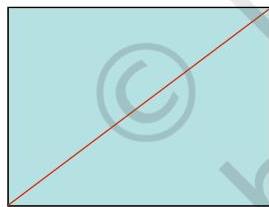
On a sheet of paper, sketch a rectangle and then draw one of its diagonals. Carefully cut the rectangle along this diagonal line to produce two separate triangles.
- ☑ Verify if the two resulting triangles perfectly superimpose onto each other. Do these triangles possess identical areas?
Repeat this procedure using various rectangles of differing dimensions. This investigation can also be conducted with a square.
- ☑ What conclusions or deductions can you derive from performing this activity? Document your findings here.
Observe the illustrations presented below. Does the blue rectangle encompass a greater, lesser, or equivalent area compared to the yellow triangle? Explain your reasoning.
- ☑ Identify any discernible correlation between the blue rectangle, the yellow triangle, and their respective areas. Articulate this relationship in writing.
Teacher's Note
Guide students to express their deductions and characterize the relationships they have identified using their own language, progressively formulating a unified declaration for the entire class. Revisit the concept of a diagonal within the classroom setting.
Construct appropriate triangles on grid paper to substantiate the inferences and relationships noted in the preceding activities.
Apply the knowledge acquired in prior academic levels to determine the area of any enclosed geometric shape utilizing grid paper, and then proceed to—
- Find the area of blue triangle BAD.
- Find the area of red triangle ABE.
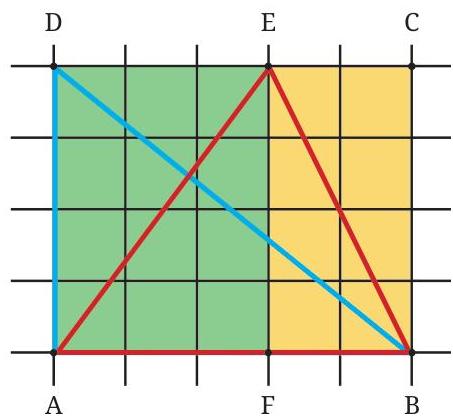
Area of rectangle ABCD = _______________
Consequently, the region encompassed by triangle BAD constitutes precisely one-half of the region enclosed by rectangle ABCD.
Area of triangle ABE = Area of triangle AEF + Area of triangle BEF.
In this context, the area of triangle AEF is equivalent to one-half of the area occupied by rectangle AFED.
Correspondingly, the area of triangle BEF equals one-half of the area of rectangle BFEC.
Therefore, the area of triangle ABE can be expressed as the sum of one-half of the area of rectangle AFED and one-half of the area of rectangle BFEC
= one-half of the combined area of rectangles AFED and BFEC = one-half of the total area of rectangle ABCD.
Conclusion
Figure it Out
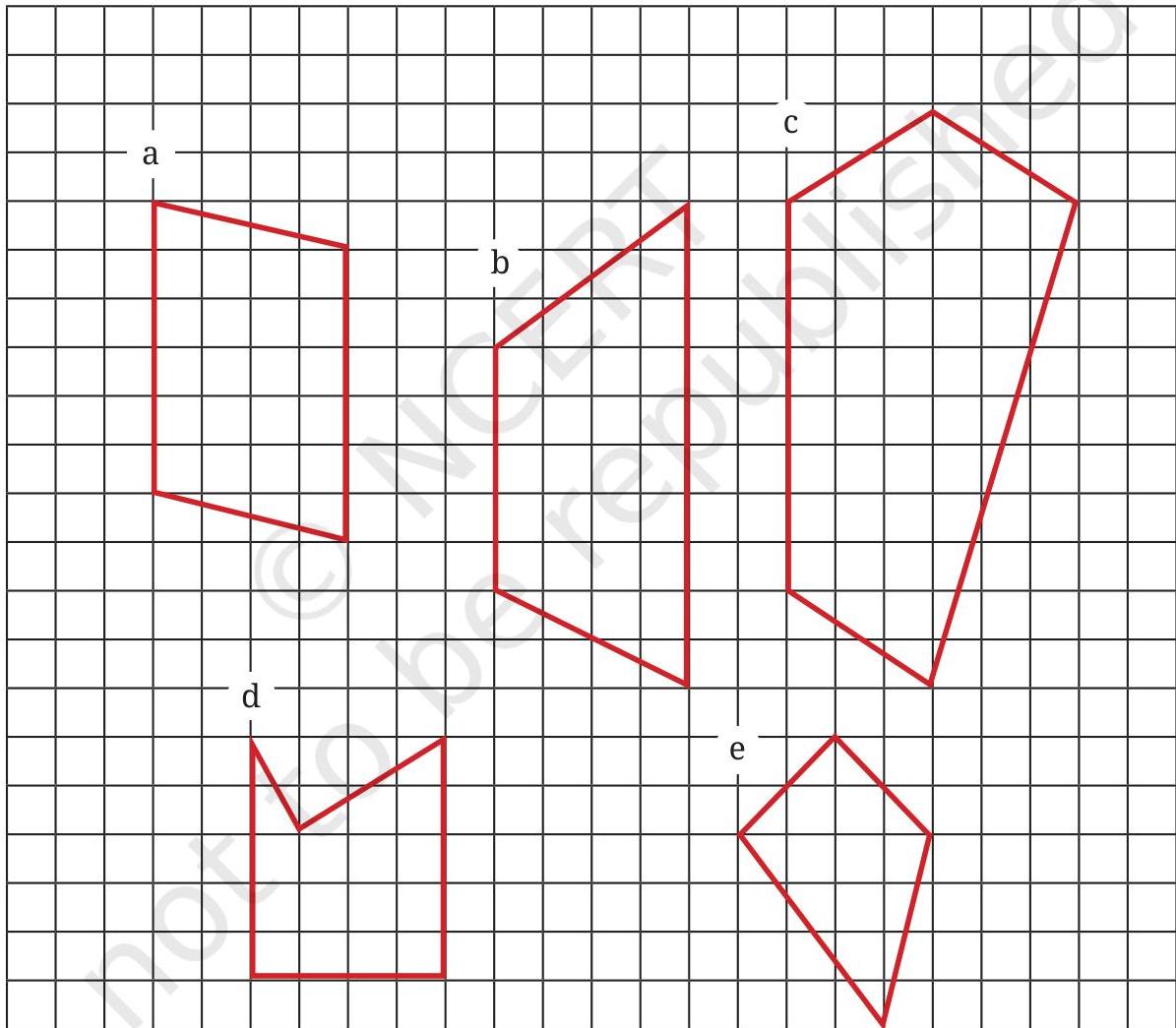
Calculate the areas of the figures shown below through their decomposition into fundamental rectangular and triangular forms.
Making it 'More' or 'Less'
Examine the two figures provided. Identify any commonalities or distinctions between them.
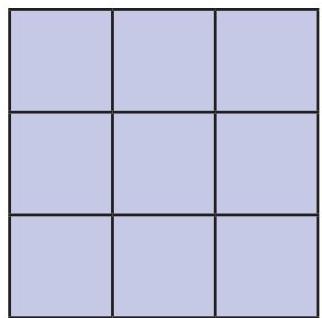
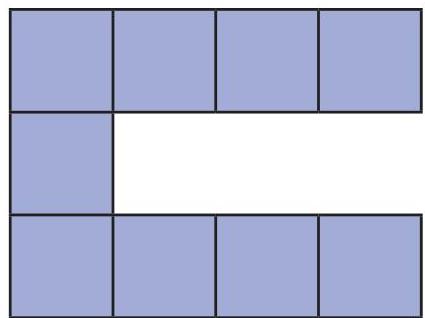
By employing nine individual unit squares, each possessing an area of 9 square units, two distinct figures have been constructed, exhibiting differing perimeters: the initial figure displays a perimeter of 12 units, while the subsequent one shows a perimeter of 20 units.
Construct or illustrate various configurations using nine square units to achieve alternative perimeter values. It is imperative that each square unit abuts at least one other square unit along an entire side, and collectively, all squares must constitute a singular, contiguous figure devoid of internal voids.
Employing nine unit squares, address the subsequent inquiries.
- What is the minimum achievable perimeter?
- What is the maximum achievable perimeter?
- Design a figure that exhibits a perimeter of 18 units.
- Is it possible to create alternative geometric arrangements for each of the three aforementioned perimeters, or does a unique configuration correspond to each specific perimeter? Justify your conclusion.
Let us now consider a more challenging scenario. Presented below is a figure with an established perimeter of 24 units.
Rather than performing a complete recalculation, examine the figure, deliberate, and ascertain the modification in its perimeter should an additional square be affixed in the manner depicted on the right.
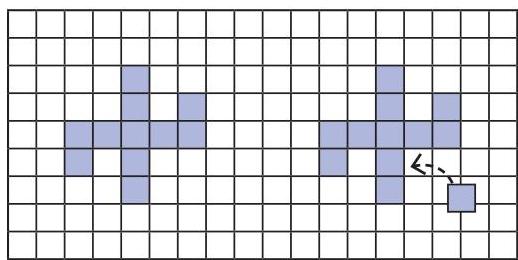
Conduct an investigation by positioning this supplementary square in various locations and predict the resulting alteration in the perimeter. Is it feasible to situate the square such that the perimeter: a) undergoes an increase; b) experiences a decrease; c) remains unaltered?
The architectural schematic for Charan's residence is provided below. This dwelling occupies a rectangular land parcel. Scrutinize the plan. What observations can you make?
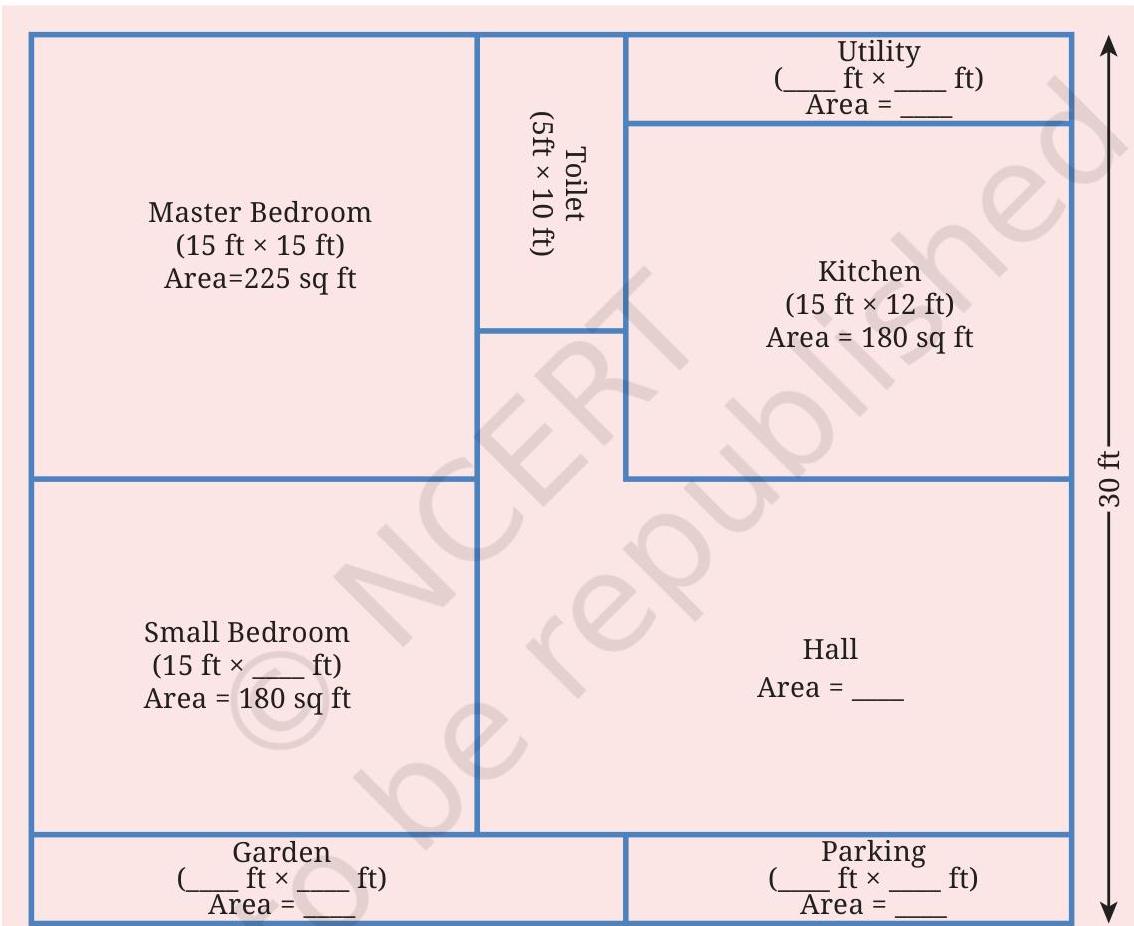
Certain dimensional values are indicated.
a. Determine the unstated dimensions. b. Ascertain the total area of his residence.
Next, identify the absent dimensions and calculate the area of Sharan's dwelling. The architectural blueprint is presented herewith:
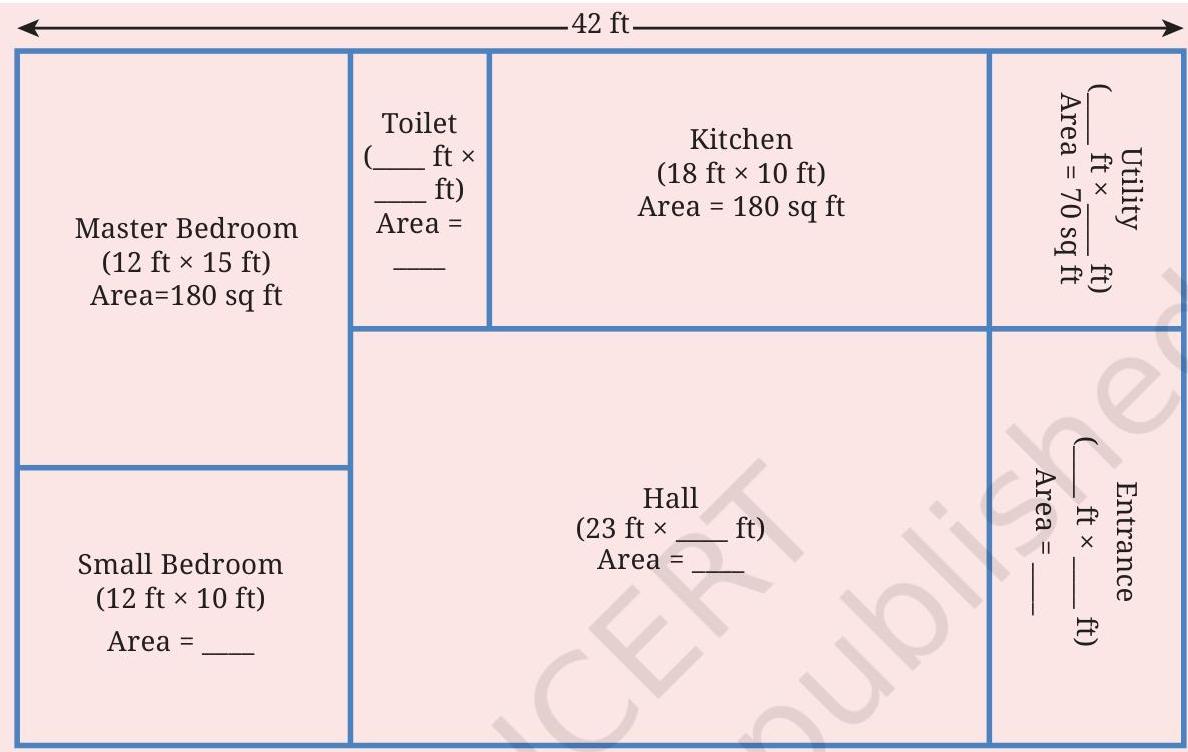
Certain dimensional values are indicated.
a. Determine the unstated measurements. b. Calculate the total area of his dwelling.
Elucidate the dimensions pertaining to each distinct room within Sharan's household. Subsequently, perform a comparative analysis of the areas and perimeters associated with Sharan's residence versus Charan's residence.
Area Maze Puzzles
In each figure, determine the missing value, which may be either the length of a side or the area of a specific region.
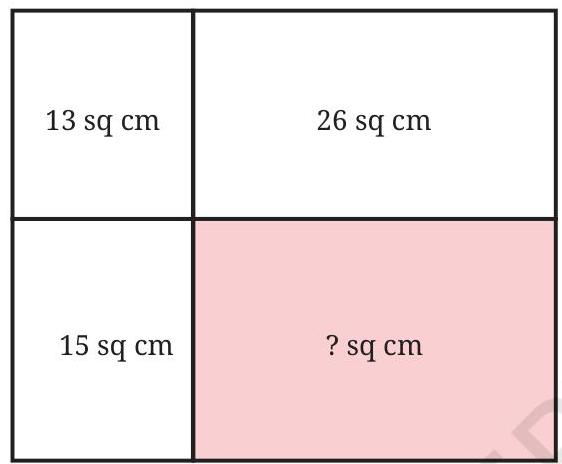 a.
a.
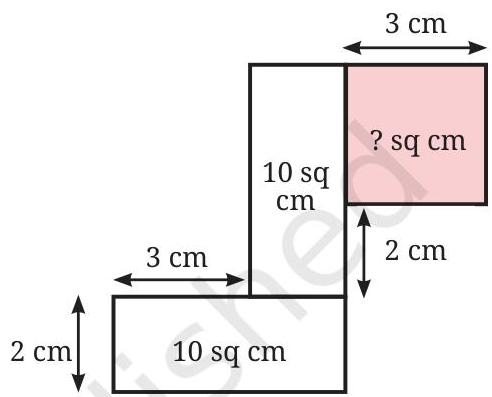 b.
b.
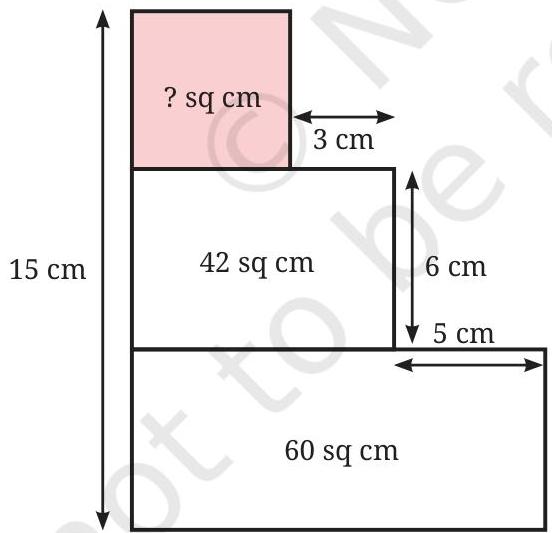 c.
c.
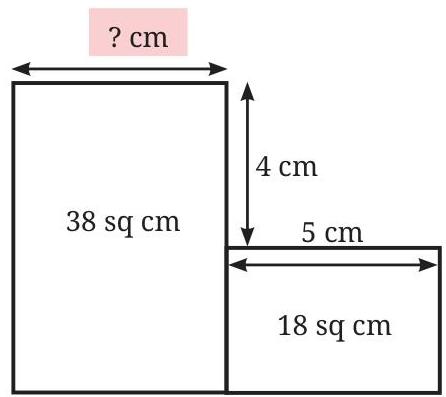 d.
d.
Figure it Out
- Determine the potential dimensions of a rectangle whose total area equals the sum of the areas of two given rectangles: one measuring $5\mathrm{m}$ by $10\mathrm{m}$, and the other $2\mathrm{m}$ by $7\mathrm{m}$.
- A rectangular garden has a length of $50\mathrm{m}$ and an area spanning 1000 square meters. Calculate the width of this garden.
- A room's floor measures $5\mathrm{m}$ in length and $4\mathrm{m}$ in width. A square carpet, with each side measuring $3\mathrm{m}$, is placed upon this floor. Ascertain the portion of the floor's area that remains uncovered by the carpet.
- Within a garden measuring $15\mathrm{m}$ in length and $12\mathrm{m}$ in width, four rectangular flower beds, each $2\mathrm{m}$ long and $1\mathrm{m}$ wide, are constructed at its corners. Determine the remaining area suitable for establishing a lawn.
- Consider two distinct geometric figures: Shape A, possessing an area of 18 square units, and Shape B, with an area of 20 square units. Despite its smaller area, Shape A exhibits a greater perimeter than Shape B. Illustrate two shapes that fulfill these specified criteria.
- On a page within your textbook, delineate a rectangular border such that it is positioned $1\mathrm{cm}$ inward from both the top and bottom edges, and $1.5\mathrm{cm}$ inward from both the left and right edges. State the perimeter of this delineated border.
- Construct a rectangle with dimensions of 12 units $\times$ 8 units. Within the confines of this larger rectangle, and ensuring no contact with its boundaries, create a second rectangle that encloses precisely half of the initial rectangle's area.
- Consider a square sheet of paper that is folded precisely in half. Subsequently, this folded square is severed along the fold line, resulting in two distinct rectangles. Irrespective of the original square's dimensions, one of the subsequent assertions consistently holds true. Identify the correct assertion.
a. The area encompassed by each individual rectangle exceeds that of the original square. b. The total perimeter of the square surpasses the cumulative sum of the perimeters of both resulting rectangles. c. The combined perimeters of the two rectangles consistently equate to $1\frac{1}{2}$ times the perimeter of the initial square. d. The area of the square is invariably three times the aggregate area of the two rectangles combined.
SUMMARY
- A polygon's perimeter is defined as
the total linear extent of all its bounding segments.
- a. For a rectangle, its perimeter is calculated as double the sum of its length and its width.
- b. The perimeter of a square is equivalent to four times the measurement of any one of its sides.
- The area associated with a closed geometric shape represents the quantification of the surface it encompasses.
- Typically, area is expressed in units that are squared.
- The area of a rectangular shape is derived by multiplying its length by its width. Conversely, the area of a square is found by squaring the measure of one of its sides.
- It is possible for two distinct closed geometric figures to possess an identical area while exhibiting differing perimeters, or to share the same perimeter while having disparate areas.
- The quantification of regional areas can be approximated or precisely ascertained by decomposing these regions into fundamental units such as squares, or into more complex rectilinear and triangular forms whose individual areas are readily computable.
CHAPTER 6 — SOLUTIONS
Section 6.1
Figure it Out
Q.1. Find the missing terms:
a. Perimeter of a rectangle = 14 cm; breadth = 2 cm; length = ?
b. Perimeter of a square = 20 cm; side of a length = ?
c. Perimeter of a rectangle = 12 m; length = 3 m; breadth = ?
Ans. (a) length = 5 cm
(b) length of a side = 5 cm
(c) breadth = 3 cm
Q.2. A rectangle having side lengths 5 cm and 3 cm is made using a piece of wire. If the wire is straightened and then bent to form a square, what will be the length of a side of the square?
Ans. Length of a side of square = 4 cm
Q.3. Find the length of the third side of a triangle having a perimeter of 55 cm and having two sides of length 20 cm and 14 cm, respectively?
Ans. Length of the third side of triangle = 21 cm
Q.4. What would be the cost of fencing a rectangular park whose length is 150 m and breadth is 120 m, if the fence costs Rs.40 per meter?
Ans. P = 2 × (150 + 120) = 540; So, 540 × 40 = Rs. 21,600
Q.5. A piece of string is 36 cm long. What will be the length of each side, if it is used to form:
a. A square,
b. A triangle with all sides of equal length, and
c. A hexagon (a six sided closed figure) with sides of equal length?
Ans. (a) Length of each side of square = 9 cm
(b) Length of each side of regular triangle = 12 cm
(c) Length of each side of regular hexagon = 6 cm
Q.6. A farmer has a rectangular field having length 230 m and breadth 160 m. He wants to fence it with 3 rounds of rope as shown. What is the total length of rope needed?
Ans. Perimeter of the field = 780 m
Ans. Total length of the rope needed = 2340 m
Section 6.1 (Continued)
Figure it out
Q.1. Find out the total distance Akshi has covered in 5 rounds.
Ans. Perimeter of the outer track = 220 m
Ans. Total distance Akshi has covered in 5 rounds = 1100 m
Q.2. Find out the total distance Toshi has covered in 7 rounds. Who ran a longer distance?
Ans. Perimeter of the inner track = 180 m
Ans. Total distance Toshi has covered in 7 rounds = 1260 m
Ans. Toshi ran longer distance
Deep Dive
Ans. From point A to flag: 100 + 100 + 100 + 50
= 350 m
From point B to flag: 125 + 150 + 75
= 350 m
Section 6.1 (Continued)
Q. Akshi says that the perimeter of this triangle shape is 9 units. Toshi says it can't be 9 units and the perimeter will be more than 9 units. What do you think?
Ans. The perimeter would indeed exceed 9 units, given that the diagonal measurement of a square invariably surpasses the length of its constituent sides.
Q. Write the perimeters of the figures below in terms of straight and diagonal units.
Ans. The perimeters for the respective figures are: $8s + 2d$, $4s + 6d$, $12s + 6d$, and $18s + 6d$.
Q. Find various objects from your surroundings that have regular shapes and find their perimeters. Also, generalize your understanding for the perimeter of other regular polygons.
Ans. Generally, the perimeter of a regular polygon is determined by multiplying its number of sides by the length of one side.
Section 6.2
Figure it out
Q.1. The area of a rectangular garden 25 m long is 300 sq m. What is the width of the garden?
Ans. The garden's width is calculated as $300 \div 25 = 12 \mathrm{m}$.
Q.2. What is the cost of tiling a rectangular plot of land 500 m long and 200 m wide at the rate of Rs.8 per hundred sq. m?
Ans. The total cost for tiling amounts to Rs. 8000.
Q.3. A rectangular coconut grove is 100 m long and 50 m wide. If each coconut tree requires 25 sq m, what is the maximum number of trees that can be planted in this grove?
Ans. 200 trees.
Q.4. By splitting the following figures into rectangles, find their areas (all measures are given in meters):
Ans. (a) $28 \mathrm{m}^2$. (b) $9 \mathrm{m}^2$.
Q. Find the area of the following figures.
Ans. The areas of the given figures are $4$ square units, $9$ square units, $10$ square units, and $11$ square units, respectively.
Let's Explore!
Section 6.3
Figure it Out
Q.1. Find the areas of the figures below by dividing them into rectangles.
Ans. a. $24$ square units. b. $30$ square units. c. $48$ square units. d. $16$ square units. e. $12$ square units.
Q. Using 9 unit squares, solve the following.
- What is the smallest perimeter possible?
- What is the largest perimeter possible?
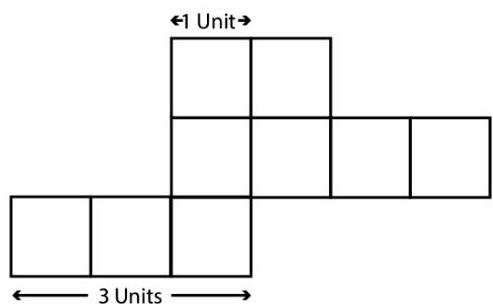
- Make a figure with a perimeter of 18 units.
- Can you make other shaped figures for each of the above three perimeters, or is there only one shape with that perimeter?
What is your reasoning?
Ans. 1. The minimal perimeter achievable is $12\mathrm{cm}$, which results from a square with a side length of $3\mathrm{cm}$.
Ans. 2. The maximal perimeter attainable is $20\mathrm{cm}$, derived from a rectangle possessing a length of $9\mathrm{cm}$ and a breadth of $1\mathrm{cm}$.
Ans. 3.
Ans. 4. Affirmative, with the exception of the configuration yielding the smallest perimeter ($12$ square units).
Q. Below is the house plan of Charan. It is in a rectangular plot. Look at the plan. What do you notice?
Some of the measurements are given.
a. Find the missing measurements. b. Find out the area of his house.
Ans. a.
i. Small bedroom: $15\mathrm{ft} \times 12\mathrm{ft}$. Area = $180 \mathrm{ft}^2$.
ii. Utility: $15\mathrm{ft} \times 3\mathrm{ft}$. Area = $45 \mathrm{ft}^2$.
iii. Hall 20ft × 12ft Area = 240 sq ft
iv. Parking 15ft × 3ft Area = 45 sq ft
v. Garden 20ft × 3ft Area = 60 sq ft
b. Area of his house = 35ft × 30ft = 1050 sq ft
Q. Determine the undisclosed dimensions and overall area of Sharan's residence, given the provided partial layout specifications.
a. Identify the unstated measurements. b. Calculate the total area of his dwelling.
Ascertain the dimensions for each distinct room within Sharan's house. Subsequently, contrast the respective areas and perimeters of Sharan's and Charan's residences.
Ans. a. Dimensions of Sharan’s house.
i. Utility 7ft × 10 ft Area = 70 sq ft
ii. Hall 23ft × 15 ft Area = 345 sq ft
iii. Entrance 7 ft × 15ft Area = 105 sq ft
iv. Small bedroom 12ft × 10ft Area = 120 sq ft
v. Toilet 5ft × 10 ft
Area = 50 sq ft
b. Area of his house = 42 ft × 25 ft = 1050 sq ft
Area of Charan’s house = 35 ft × 30 ft = 1050 sq ft Area of Sharan’s house = 42 ft × 25 ft = 1050 sq ft The total areas of both residences are congruent. Now, Perimeter of Charan’s house = 130 ft Perimeter of Sharan’s house = 134 ft The perimeter of Sharan's dwelling exceeds that of Charan's dwelling.
Area Maze Puzzles
For each diagram provided, ascertain the unknown quantity, which may be either a side length or the regional area.
Ans. a. 30 sq cm. b. 9 sq cm. c. 16 sq cm. d. 5 cm.
Section 6.3
Figure it Out
Q.1. Provide the possible dimensions for a rectangle whose area is equivalent to the aggregate of the areas of two distinct rectangles, measured at 5 m × 10 m and 2 m × 7 m, respectively.
Ans. Possible dimensions are:
- 16 m and 4 m
- 32 m and 2 m
- 8 m and 8 m
Q.2. A rectangular garden, possessing a length of 50 m, encompasses an area of 1000 sq m. Determine the garden's width.
Ans. 20 m.
Q.3. A room features a floor measuring 5 m in length and 4 m in width. A square carpet, each side of which measures 3 m, is placed upon this floor. Calculate the uncarpeted area.
Ans. Area of floor not carpeted = 11 sq. m.
Q.4. At each of the four corners of a garden, measuring 15 m in length and 12 m in width, four flower beds are excavated, each with dimensions of 2 m in length and 1 m in width. What expanse remains available for the installation of a lawn?
Ans. Available area for lawn = 172 sq. m.
Q.5. Shape A possesses an area of 18 square units, while Shape B has an area of 20 square units. Furthermore, Shape A exhibits a greater perimeter than Shape B. Illustrate two distinct shapes that fulfill these specified criteria.
Ans. Possible dimensions of shape A are 6m and 3m; 2m and 9m; 18m and 1m
Corresponding Perimeters = 18 m, 22m, 38m respectively
Possible dimensions of shape B are 5m and 4m; 10m and 2m; 20m and 1m
Corresponding Perimeters = 18m, 24m, 42m respectively
Given P(A) > P(B)
One could select P(A) as either 22m or 38m, and P(B) as 18m, subsequently rendering the figures in alignment with these specifications.
Q.7. Construct a rectangle with dimensions of 12 units by 8 units. Within this, delineate a second rectangle, ensuring it does not contact the boundaries of the external rectangle, and occupies precisely half of the total area.
Ans. Area of outer rectangle = 96 sq. units.
Ans. Area of inner rectangle = 48 sq. units.
Ans. Illustrate the rectangles in conformity with the outlined parameters.
Q.8. Consider a square sheet of paper, folded precisely in half. Subsequently, this square is bisected into two distinct rectangles along the fold line. Irrespective of the initial dimensions of the square, one of the ensuing statements invariably holds true. Identify the correct statement.
a. The area encompassed by each individual rectangle exceeds that of the original square.
b. The total perimeter of the square surpasses the cumulative sum of the perimeters of both resulting rectangles.
c. The combined perimeters of the two rectangles consistently equate to $1\frac{1}{2}$ times the perimeter of the initial square.
d. The area of the square is invariably three times the aggregate area of the two rectangles combined.
Ans. Only C is true.