THE OTHER SIDE OF ZERO
Integers
More and More Numbers!
In our initial exploration of mathematics, the first numerical concepts introduced were the natural numbers, often referred to as counting numbers, such as 1, 2, 3, 4, and so forth.
Subsequently, our understanding of numerical systems expanded to include additional quantities. One such significant inclusion is the numeral 0, signifying absence or nullity, positioned prior to 1. The concept of zero holds profound historical significance, particularly originating from India, and its global adoption has been monumental. The Indian numeral system, utilizing the digits 0 through 9, forms the foundation for representing numerical values of any magnitude, whether exceedingly large or infinitesimally small, across the globe.
Our mathematical journey further introduced us to quantities situated between the integers 0, 1, 2, 3, 4, and so on. Examples include $\frac{1}{2}$, $\frac{3}{2}$, and $\frac{13}{6}$, which are formally known as fractions.
This prompts the inquiry: do further numerical categories exist? Given that 0 constituted an expansion beyond previously recognized quantities, positioned antecedent to 1 and possessing a value inferior to it, one might then question the existence of numbers that precede 0 and possess a value less than 0.
To articulate this concept differently, we have previously encountered the number line, depicted as:

Nonetheless, in the terminology of geometry previously studied, this representation strictly constitutes a numerical 'ray', originating at 0 and extending infinitely in the positive direction. The pertinent question then arises: are there numbers positioned to the left of 0, thereby allowing for the transformation of this numerical ray into a comprehensive number line?
This constitutes the primary subject of our inquiry within the current chapter.
The Other Side of Zero
Is it conceivable for a numerical value to be less than zero? Can you conceptualize scenarios where a quantity might represent a deficit below zero?
10.1 Bela's Building of Fun
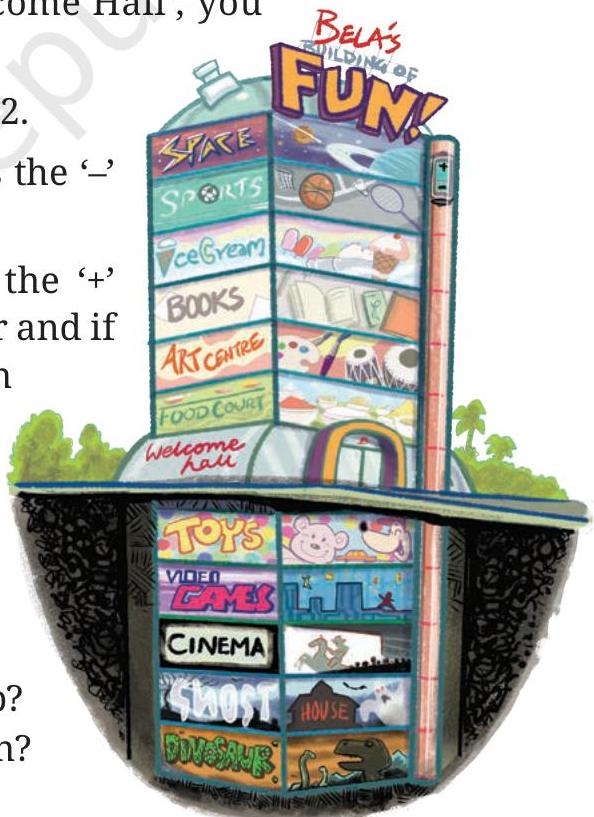
Children often visit Bela's ice cream factory, eager to see and savor her delightful ice cream. To enhance their experience, Bela acquired a multi-level building and filled it with various attractions, naming it Bela's Building of Fun.
However, this was far from a typical structure!

Take note that certain levels within the 'Building of Fun' are situated beneath the ground. What kinds of establishments do you discover on these subterranean floors? And what occupies the ground level?
To navigate between the various levels, an elevator is employed. This elevator features two controls: a ‘+’ button for ascending and a ‘–’ button for descending. Can you locate the elevator in the image?
If you wish to travel from the 'Welcome Hall' to the Art Centre, it is necessary to activate the ‘+’ button two times.
This action is represented as + + or, more concisely, +2.
Conversely, to descend two levels, you would need to press the ‘–’ button twice, which we denote as – – or –2.
Therefore, pressing +1 (which signifies activating the ‘+’ button once) will result in ascending one floor, whereas pressing –1 (indicating a single press of the ‘–’ button) will cause you to descend one floor.
Lift button presses and numbers:
- +++ is written as +3
- – – – – is written as –4
What sequence of presses would you use to ascend four floors? And what would you press to descend three floors?
Numbering the floors in the building of fun
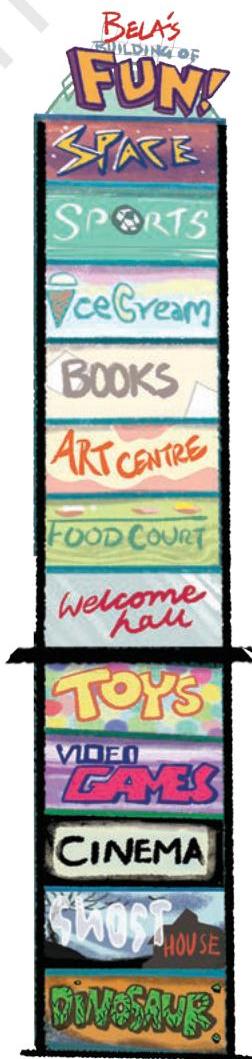
Access to the ‘Building of Fun’ commences at the ground level, designated as the ‘Welcome Hall’. From this ground floor, one ascends to the Food Court by selecting +1, and to the Art Centre by selecting +2. Consequently, the Food Court is situated on Floor +1, and the Art Centre on Floor +2.
Conversely, descending from the ground floor requires pressing -1 to arrive at the Toy Store. Thus, the Toy Store occupies Floor -1. Similarly, to access the Video Games shop from the ground floor, one must press -2. Therefore, the Video Games shop is located on Floor -2.
The ground level is referred to as Floor 0. Do you understand the rationale behind this designation?
☑ Number all the floors in the Building of Fun.
Have you observed that +3 not only designates the Book Store's floor number but also quantifies the upward displacement when the +3 button is pressed? Analogously, -3 indicates a specific floor number while simultaneously representing the number of floors descended when the -3 button is activated.
A numeral preceded by a ‘+’ symbol is defined as a positive number. Conversely, a numeral preceded by a ‘-’ symbol is termed a negative number.
Within the ‘Building of Fun’, the enumeration of floors employs the ground level, designated as Floor 0, as its fundamental reference or origin point. Levels situated above the ground floor are assigned positive numerical values. Accessing these from the ground floor necessitates activation of the ‘+’ button a corresponding number of times. Conversely, floors located beneath the ground level are denoted by negative numbers. Reaching these from the ground floor requires engaging the ‘-’ button an appropriate number of times.
The numeral zero is classified as neither positive nor negative. Consequently, it is not prefixed with either a ‘+’ or a ‘-’ sign.
Tracking Movement with Addition
Consider beginning your journey on the Food Court level and then inputting +2 into the lift. Which floor will you arrive at?
This scenario can be mathematically represented using an expression:
Starting Floor + Movement = Target Floor.
In this instance, the initial floor is +1 (Food Court) and the indicated movement is +2. Consequently, you will reach the destination floor $(+1) + (+2) = +3$ (Book Store).
Practice Problems
If you begin on Floor +2 and input -3 into the lift, what floor will be your destination? Construct a mathematical expression to describe this action.
Compute the outcome for each of these mathematical statements (you might conceptualize these as an initial floor combined with a change in position, referencing the "Building of Fun" context).
a. $(+1) + (+4) = ________$ b. $(+4) + (+1) = ________$ c. $(+4) + (-3) = ________$ d. $(-1) + (+2) = ________$ e. $(-1) + (+1) = ________$ f. $0 + (+2) = ________$ g. $0 + (-2) = ________$
Identify various starting floors and the corresponding movements necessary to arrive at Floor -5. For instance, commencing at Floor +2 necessitates a movement of -7 to reach Floor -5, expressed as $(+2) + (-7) = -5$.
Devise additional scenarios involving different initial positions and the required movements to arrive at Floor -5, documenting these as expressions.
Combining button presses is also addition
Consider Gurmit at the Toy Store, aiming to descend two floors. However, he mistakenly pressed the '+' button twice. Recognizing his error, he promptly pressed the '-' button three times. What will be Gurmit's final position, in terms of floors above or below the Toy Store?
Gurmit will ultimately be one floor below. The net effect of combining these button presses can be represented by the expression: $(+2) + (-3) = -1$.
Figure it out
Determine the value of these expressions by conceptualizing them as the resultant movement from a sequence of button presses:
a. $(+1) + (+4) =$ b. $(+4) + (+1) =$ c. $(+4) + (-3) + (-2) =$ d. $(-1) + (+2) + (-3) =$
Back to zero!
Imagine Basant on the ground floor, in a great rush, and he inadvertently presses +3. What action can he take to nullify this movement and remain on the ground floor? He can cancel it by pressing -3. This demonstrates that $(+3) + (-3) = 0$.
We refer to -3 as the additive inverse of +3. Conversely, the additive inverse of -3 is +3.
If Basant subsequently activates +4 and then presses -4 in the elevator, what will be his final floor?
Here is an alternative perspective on the concept of an inverse. If you are situated at Floor +4 and you engage its inverse, -4, you will return to zero, the ground floor! Likewise, if you are at Floor -2 and press its inverse, +2, you will arrive at $(-2) + (+2) = 0$, again reaching the ground floor!
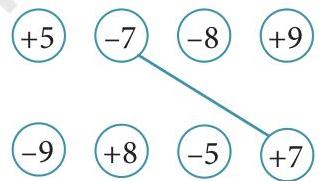
State the additive inverses for the following numbers:
- $+4$
- $-4$
- $-3$
- $0$
- $+2$
- $-1$
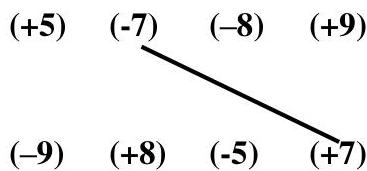
Connect the inverses by drawing lines.
Comparing numbers using floors
Who is on the lowest floor?
- Jay occupies the Art Centre, situated on Floor +2.
- Asin is located in the Sports Centre, on Floor ___.
- Binnu resides in the Cinema Centre, on Floor ___.
- Aman is found in the Toys Store, on Floor ___.
The Other Side of Zero
Considering Floor +3, it is positioned beneath Floor +4. This relationship is expressed as $+3 < +4$. Conversely, it is also accurate to state $+4 > +3$.
Should we write $-3 < -4$ or $-4 < -3$?
Observe that Floor -4 is situated at a lower elevation than Floor -3. Consequently, we denote this as $-4 < -3$. An equivalent statement is $-3 > -4$.
Figure it Out
Utilizing the Building of Fun as a reference, compare the subsequent numerical pairs and insert either
Personal 1:1 AI Tutor for CBSE, JEE & NEET Students
YoLearn.AI is India's #1 AI tutoring platform for Class 1 to 12, JEE, and NEET preparation. Students talk to expert AI tutors in real time through live voice calls, solve doubts instantly on an interactive sketch board, and practice with mock tests, flashcards, quizzes, and slide decks. Learn from top educators including DC Pandey and other verified teachers who create AI avatars of themselves.
Live voice tutoring and doubt solving
Unlike text-only chatbots, YoLearn.AI lets you speak naturally to your AI tutor — just like a real one-on-one session. Get step-by-step explanations for Physics, Chemistry, Maths, and Biology for board exams, JEE Main, JEE Advanced, and NEET.
Mock tests, flashcards, and exam prep
Prepare for JEE 2026, NEET 2026, and CBSE board exams with personalized mock tests, AI-generated quizzes, and flashcard makers. Build daily study habits with an AI study buddy designed for Indian students.
For school, JEE, and NEET
Whether you need a Class 10 CBSE tutor, Class 12 board exam help, or full JEE and NEET coaching online, YoLearn.AI adapts to your grade, syllabus, and learning pace. Start free today on web, iOS, and Android.
Personal 1:1 AI Tutor for CBSE, JEE & NEET Students
YoLearn.AI is India's #1 AI tutoring platform for Class 1 to 12, JEE, and NEET preparation. Students talk to expert AI tutors in real time through live voice calls, solve doubts instantly on an interactive sketch board, and practice with mock tests, flashcards, quizzes, and slide decks. Learn from top educators including DC Pandey and other verified teachers who create AI avatars of themselves.
Live voice tutoring and doubt solving
Unlike text-only chatbots, YoLearn.AI lets you speak naturally to your AI tutor — just like a real one-on-one session. Get step-by-step explanations for Physics, Chemistry, Maths, and Biology for board exams, JEE Main, JEE Advanced, and NEET.
Mock tests, flashcards, and exam prep
Prepare for JEE 2026, NEET 2026, and CBSE board exams with personalized mock tests, AI-generated quizzes, and flashcard makers. Build daily study habits with an AI study buddy designed for Indian students.
For school, JEE, and NEET
Whether you need a Class 10 CBSE tutor, Class 12 board exam help, or full JEE and NEET coaching online, YoLearn.AI adapts to your grade, syllabus, and learning pace. Start free today on web, iOS, and Android.
a. $-2 \square +5$ b. $-5 \square +4$ c. $-5 \square -3$ d. $+6 \square -6$ e. $0 \square -4$ f. $0 \square +4$
It is important to recognize that all floors corresponding to negative numbers are located beneath Floor 0. Therefore, all negative numbers possess a value less than 0. Conversely, all floors associated with positive numbers are situated above Floor 0, indicating that all positive numbers are greater than 0.
Envision an expanded Building of Fun featuring additional levels. Compare the given numbers and populate the boxes with either
Personal 1:1 AI Tutor for CBSE, JEE & NEET Students
YoLearn.AI is India's #1 AI tutoring platform for Class 1 to 12, JEE, and NEET preparation. Students talk to expert AI tutors in real time through live voice calls, solve doubts instantly on an interactive sketch board, and practice with mock tests, flashcards, quizzes, and slide decks. Learn from top educators including DC Pandey and other verified teachers who create AI avatars of themselves.
Live voice tutoring and doubt solving
Unlike text-only chatbots, YoLearn.AI lets you speak naturally to your AI tutor — just like a real one-on-one session. Get step-by-step explanations for Physics, Chemistry, Maths, and Biology for board exams, JEE Main, JEE Advanced, and NEET.
Mock tests, flashcards, and exam prep
Prepare for JEE 2026, NEET 2026, and CBSE board exams with personalized mock tests, AI-generated quizzes, and flashcard makers. Build daily study habits with an AI study buddy designed for Indian students.
For school, JEE, and NEET
Whether you need a Class 10 CBSE tutor, Class 12 board exam help, or full JEE and NEET coaching online, YoLearn.AI adapts to your grade, syllabus, and learning pace. Start free today on web, iOS, and Android.
Personal 1:1 AI Tutor for CBSE, JEE & NEET Students
YoLearn.AI is India's #1 AI tutoring platform for Class 1 to 12, JEE, and NEET preparation. Students talk to expert AI tutors in real time through live voice calls, solve doubts instantly on an interactive sketch board, and practice with mock tests, flashcards, quizzes, and slide decks. Learn from top educators including DC Pandey and other verified teachers who create AI avatars of themselves.
Live voice tutoring and doubt solving
Unlike text-only chatbots, YoLearn.AI lets you speak naturally to your AI tutor — just like a real one-on-one session. Get step-by-step explanations for Physics, Chemistry, Maths, and Biology for board exams, JEE Main, JEE Advanced, and NEET.
Mock tests, flashcards, and exam prep
Prepare for JEE 2026, NEET 2026, and CBSE board exams with personalized mock tests, AI-generated quizzes, and flashcard makers. Build daily study habits with an AI study buddy designed for Indian students.
For school, JEE, and NEET
Whether you need a Class 10 CBSE tutor, Class 12 board exam help, or full JEE and NEET coaching online, YoLearn.AI adapts to your grade, syllabus, and learning pace. Start free today on web, iOS, and Android.
a. $-10 \square -12$ b. $+17 \square -10$ c. $0 \square -20$ d. $+9 \square -9$ e. $-25 \square -7$ f. $+15 \square -17$
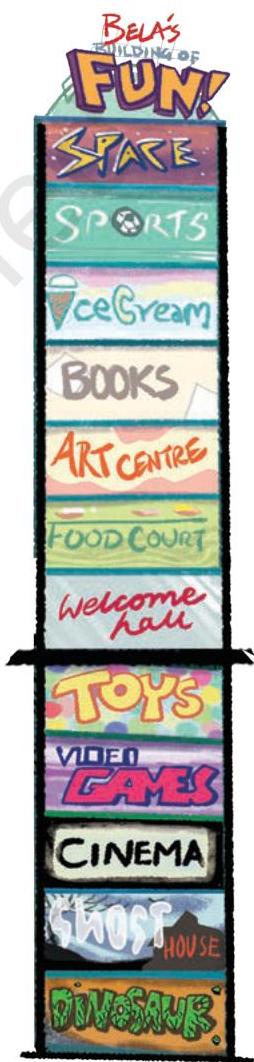
Given that Floor $A = -12$, Floor $D = -1$, and Floor $E = +1$ within the building depicted as a vertical line on the right, determine the numerical designations for Floors B, C, F, G, and H.
Indicate the positions of the subsequent floors on the building illustration provided on the right.
a. $-7$ b. $-4$ c. $+3$ d. $-10$

Subtraction to find which button to press
Our prior learning established subtraction as the process of 'removing' or 'taking away'. For instance, if a shelf holds 10 books and 4 are removed, one might ask how many books remain.
This scenario is mathematically represented as a subtraction: $10 - 4 = 6$, which can be verbally expressed as 'Ten minus four equals six.'
Additionally, you might recognize another interpretation of subtraction, which involves comparing quantities or equalizing them. For example, imagine I possess ₹10, while my sister has ₹6.
A relevant question in this context would be: 'What additional sum does my sister require to match my total amount?'
This can be formulated in two distinct ways: $6 + ? = 10$ Or $10 - 6 = ?$
This clearly illustrates the relationship between subtraction and identifying an unknown value that, when added, completes a sum.
When performing subtraction with both positive and negative numbers, we shall primarily employ this interpretation of subtraction as either 'equalizing values' or 'determining the absent addend'.
Evaluate $15-5$, $100-10$ and $74-34$ from this perspective.
Teacher's Note
In a general sense, when two quantities are not equivalent, subtraction can serve to quantify the adjustment required to render them equal. Subtraction elucidates the extent to which an initial quantity must be modified to attain a desired target quantity. Within the context of differing floor levels, the inquiry arises: what alteration is necessary to transition from a Starting Floor to a Target Floor? It is pertinent to observe that this requisite change may manifest as positive (indicating an increase) or negative (signifying a decrease).
Consider your present location as the Art Centre (starting floor) and your intended destination as the Sports Centre (target floor). Which elevator button should you activate?
An ascent of three floors is necessary, thus you would select +3. This operation can be formally expressed using subtraction as follows:
$ \text{Target Floor} - \text{Starting Floor} = \text{Movement needed}. $
In the illustrative example provided, the initial floor is +2 (Art Centre) and the destination floor is +5. The corresponding button press to reach +5 from +2 is +3. Therefore, the calculation is:
$ (+5) - (+2) = +3 $
The Other Side of Zero
Explanation
Revisit the fundamental relationship between addition and subtraction. For an equation such as $3 + ? = 5$, the unknown value can be ascertained through subtraction: $5 - 3 = 2$. This demonstrates that subtraction is intrinsically equivalent to determining the missing addend.
We acknowledge that—
Starting Floor + Movement needed = Target Floor
If the objective is to determine the required movement, then,
Starting Floor + ? = Target Floor
Consequently,
Target Floor – Starting Floor = ? = Movement needed
More examples:
a. If the Target Floor is -1 and Starting Floor is -2, what button should you press?
To reach the desired floor, an ascent of one level is necessary, so the +1 button should be selected.
Expression: $(-1) - (-2) = (+1)$
b. If the Target Floor is -1 and Starting floor is +3, what button should you press?
A descent of four floors is required to reach the target, thus the -4 button must be pressed.
Expression: $(-1) - (+3) = (-4)$
c. If the Target Floor is +2 and Starting Floor is -2, what button should you press?
Moving upward by four floors is the action needed, therefore, press the +4 button.
Expression: $(+2) - (-2) = (+4)$
Figure it Out
Determine the solutions for these expressions. You can conceptualize them as calculating the necessary movement to get to the Target Floor from the Starting Floor.
a. $(+1) - (+4) =$ b. $(0) - (+2) =$ c. $(+4) - (+1) =$ d. $(0) - (-2) =$ e. $(+4) - (-3) =$ f. $(-4) - (-3) =$ g. $(-1) - (+2) =$ h. $(-2) - (-2) =$ i. $(-1) - (+1) =$ j. $(+3) - (-3) =$

Adding and subtracting larger numbers
The accompanying image depicts a mine, an industrial site where minerals are excavated from rock formations. Although the transport truck is situated at the surface, mineral deposits exist both above and below this ground level. A high-speed elevator operates within a mineshaft, facilitating the vertical movement of personnel and extracted ore.
Within the illustration, specific operational levels are numerically designated. The ground level is established as the zero reference point. Elevations situated above the ground are indicated by positive numerical values, while those below are represented by negative numbers. Each numeral precisely quantifies its vertical distance, in meters, relative to the ground level.
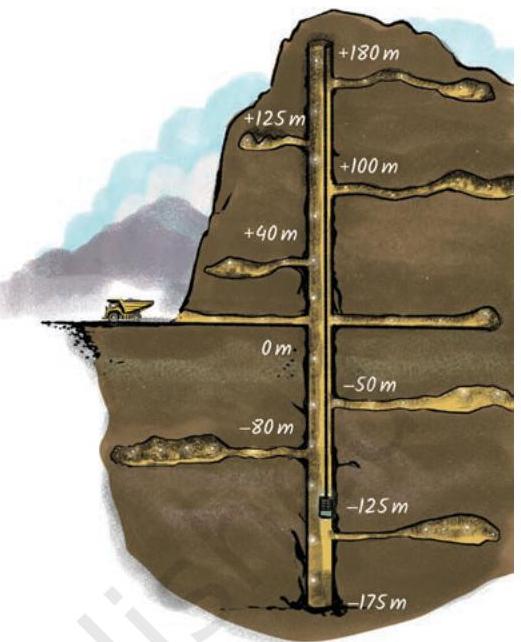
Within the mine's operational context, a foundational arithmetic relationship governs positional changes, mirroring the principle observed in the 'Building of Fun':
$ \text{Starting Level} + \text{Movement} = \text{Target Level} $
For instance, illustrative examples include:
$ (+40) + (+60) = +100 \quad (-90) + (-55) = -145 $
$ \text{Target Level} - \text{Starting Level} = \text{Movement needed} $
As an illustration, these computations are presented:
$ (+40) - (-50) = +90 \quad (-90) - (+40) = -130 $
How many negative numbers are there?
Consider a structure like Bela's Building of Fun, which spanned six levels upwards and five downwards, encompassing values from -5 to +6. Similarly, a mine might extend from -200 to +180. However, these are finite examples. Just as the sequence of positive numbers (+1, +2, +3, ...) extends indefinitely upwards, the sequence of negative numbers (-1, -2, -3, ...) extends indefinitely downwards. Together with zero, these positive and negative whole numbers are known as integers, forming an endless continuum in both directions from zero: ... $-4, -3, -2, -1, 0, 1, 2, 3, 4, ...$
The Other Side of Zero
Figure it Out
Complete these expressions.
a. $(+40) + _ = +200$ b. $(+40) + _ = -200$ c. $(-50) + = +200$ d. $(-50) + = -200$ e. $(-200) - (-40) =$ f. $(+200) - (+40) =$ g. $(-200) - (+40) =$
Check your answers by thinking about the movement in the mineshaft.
Adding, subtracting, and comparing any numbers
For the purpose of performing addition and subtraction with integers of greater magnitude, we can conceptualize an expanded model: an 'infinite lift.' This conceptual lift would extend limitlessly both above and below a central Level 0, unbound by any physical structure like a building or mine. This mental construct allows us to execute operations involving any integers. For instance, consider the subtraction problem: $+2000 - (-200)$. We can visualize a lift operating across 2000 levels above ground and 200 levels below ground. It is important to remember that,
Target Level – Starting Level = Movement needed
To ascend from a Starting Floor of –200 to a Target Floor of +2000, a total movement of +2200 is necessary. This involves an initial ascent of +200 to reach the zero point, followed by an additional +2000 to arrive at the destination. Mathematically, this operation is expressed as $(+2000) - (-200) = +2200$.
It is noteworthy that the sum $(+2000) + (+200)$ also yields $+2200$.
Practice evaluating the subsequent expressions by conceptualizing or sketching an appropriate lift scenario:
a. $-125 + (-30)$ b. $+105 - (-55)$ c. $+105 + (+55)$ d. $+80 - (-150)$ e. $+80 + (+150)$ f. $-99 - (-200)$ g. $-99 + (+200)$ h. $+1500 - (-1500)$
From the preceding illustration, we observed that $+2000 - (-200) = +2000 + (+200) = +2200$. This demonstrates that the subtraction of a negative numerical value is equivalent to the addition of its corresponding positive counterpart. Consequently, we can substitute the operation of subtracting a negative number with the addition of a positive number.
Did your findings from the other exercises above similarly indicate that subtracting a negative quantity is equivalent to adding the corresponding positive quantity?
Consider the 'infinite lift' depicted above. Does it evoke a comparison to a number line? If so, in what specific ways?
Back to the number line
The "infinite lift" previously discussed bore a striking resemblance to a number line, did it not? Indeed, a $90^{\circ}$ rotation effectively transforms it into a number line. This transformation also illustrates how to extend the number ray into a complete number line, thereby addressing the inquiry posed at the chapter's outset. To the left of the origin (0) reside the negative integers: $-1, -2, -3, \ldots$.
Conventionally, the + sign for positive numbers is omitted, allowing them to be simply written as 1, 2, 3, ...

Rather than traversing the number line via a lift, one can simply conceptualize walking along it. Movement to the right signifies the positive (forward) direction, while movement to the left indicates the negative (backward) direction.
On this line, numerical values decrease as one moves to the left and increase as one moves to the right. Consequently, smaller numbers are positioned to the left of larger ones, and larger numbers to the right of smaller ones. For example, $2 < 5$; $-3 < 2$; and $-5 < -3$.
If you intend to move from the position 5 to the position 9, what is the magnitude and direction of travel required along the number line?

A displacement of 4 units is necessary. This is expressed by the equation $5 + 4 = 9$.
(Remember: Starting Number + Movement = Target Number)
The corresponding expression in subtraction is $9 - 5 = 4$.
(Remember: Target Number - Starting Number = Movement needed)
Now, if your objective is to proceed from 9 to 3, what distance must be covered along the number line?

You must undertake a backward movement of 6 units, which is represented as -6. Hence, we formulate this as $9 + (-6) = 3$.
(Remember again: Starting Number + Movement = Target Number)
The equivalent subtraction statement is $3 - 9 = -6$.
(Remember again: Target Number - Starting Number = Movement needed)
Next, starting from 3, if you wish to reach -2, what is the extent of your journey?

You must traverse -5 units, meaning 5 units in the backward direction. Therefore, $3 + (-5) = -2$. The corresponding subtraction statement is: $-2 - 3 = -5$.
Figure it Out

Indicate three positive and three negative numerical values on the provided number line.
Record the three negative numbers you marked above into the following designated spaces: ☐ ☐ ☐
Is the inequality $2 > -3$ true? Provide a justification. Is $-2 < 3$ true? Provide a justification.
Determine the results of the following arithmetic operations: a. $-5 + 0$ b. $7 + (-7)$ c. $-10 + 20$ d. $10 - 20$ e. $7 - (-7)$ f. $-8 - (-10)$
Using the unmarked number line to add and subtract
Analogous to how one performs additions, subtractions, and comparisons with smaller numerical values utilizing the preceding number line, these operations can also be executed with larger numbers by conceptualizing an 'infinite number line' or by delineating an 'unmarked number line' as illustrated below:
0
This representation solely indicates the position of zero, with no other numerical values explicitly marked. Employing this unmarked number line offers a practical approach for performing integer addition and subtraction. One can either explicitly depict or mentally construct the scale of the number line and the corresponding placements of numbers upon it.
For instance, this unmarked number line (UNL) depicts the addition problem: $85 + (-60) = ?$

From this visualization, we can deduce that $85 + (-60) = 25$.
The subsequent UNL illustrates a subtraction problem, which can alternatively be formulated as a missing addend problem: $(-100) - (+250) = ?$ or $250 + ? = -100$.

Through this visual representation, we ascertain that $? = -350$ for this particular problem.
Consequently, arithmetic operations involving the addition and subtraction of both positive and negative numbers can be executed either on paper or mentally by employing an unmarked number line.
The Other Side of Zero
Utilize unmarked number lines to determine the value of these expressions:
a. $-125 + (-30) =$ b. $+105 - (-55) =$ c. $+80 - (-150) =$ d. $-99 - (-200) =$
Converting subtraction to addition and addition to subtraction
Let us recall the fundamental relationship: the displacement required to reach a target floor from a starting floor can be expressed as the target floor minus the starting floor, or equivalently, the target floor equals the starting floor plus the required movement.
Target Floor – Starting Floor = Movement needed
or
Target Floor = Starting Floor + Movement needed
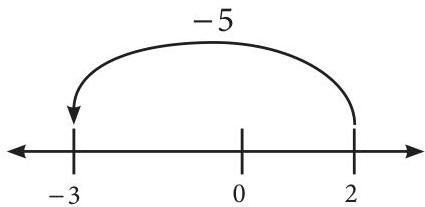
Consider a scenario where one begins at floor 2 and aims to reach floor -3; what is the necessary displacement?
First method: By visualizing the numerical progression on a number line, it becomes evident that a displacement of -5 units is required, signifying movement of 5 units in the negative direction. Hence, the mathematical operation $-3 - 2 = -5$ directly yields this result, confirming that the necessary movement is -5.
Second method: Deconstruct the trajectory from a starting point of 2 to a destination of -3 into two sequential segments.
a. The initial displacement from 2 to 0 is quantified as $-2$, derived from $0 - 2$.
b. The subsequent displacement from 0 to -3 is similarly quantified as $-3$, derived from $-3 - 0$.
The aggregate displacement is then the summation of these individual movements: $-3 + (-2) = -5$.
Upon examination of the two distinct expressions, a significant observation is that the latter formulation entirely omits the subtraction operation. This principle establishes that any subtraction can invariably be re-expressed as an addition. This transformation involves substituting the quantity being subtracted with its additive inverse, subsequently performing an addition. Analogously, an addition operation can be converted into a subtraction by replacing the quantity being added with its additive inverse and then executing a subtraction.
Examples:
a. $(+7) - (+5) = (+7) + (-5)$ b. $(-3) - (+8) = (-3) + (-8)$ c. $(+8) - (-2) = (+8) + (+2)$ d. $(+6) - (-9) = (+6) + (+9)$
10.2 The Token Model
Using tokens for addition
Within Bela’s Building of Fun, the lift operator, seeking diversion, maintains a collection of positive (red) and negative (green) tokens in a container. Upon each activation of the ‘+’ control, a positive token is retrieved from the container and placed into his pocket. Conversely, each press of the ‘–’ control results in a negative token being transferred to his pocket.
His journey commences on the ground level (Floor 0), his pocket initially empty. An hour later, an inspection of his pocket reveals the presence of 5 positive tokens and 3 negative tokens. What floor is he currently located on?
This implies he actuated the ‘+’ button five times and the ‘–’ button three times, leading to the sum of $(+5) + (–3) = +2$. Consequently, his present location is Floor +2.
An alternative method for performing this calculation is presented below.
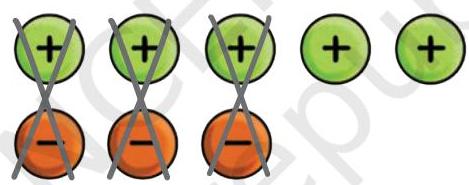
A positive token and a negative token mutually neutralize, given that their combined value is zero. The presence of these two token types in his pocket signifies one press of ‘+’ and one press of ‘–’, which effectively cancel each other out. Such a combination of a positive and a negative token is termed a ‘zero pair’. Upon the elimination of all zero pairs, two positive tokens remain, thereby confirming that $(+5) + (–3) = +2$.
This token-based approach can be universally applied to execute any addition of this nature!
Consider the following example: Sum +5 and –8.
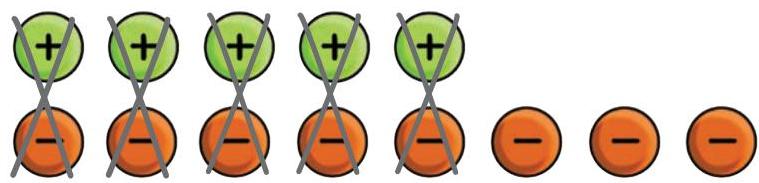
Observing the illustration, it is evident that five zero pairs can be extracted, leaving a remainder of $-3$. Consequently, $(+5) + (-8) = -3$.
Figure it Out
- Complete the additions using tokens.
a. $(+6) + (+4)$ b. $(-3) + (-2)$ c. $(+5) + (-7)$ d. $(-2) + (+6)$
- Eliminate the zero pairs in the subsequent two sets of tokens. What floor does the lift attendant occupy in each instance? What is the corresponding addition statement for each scenario?
a. 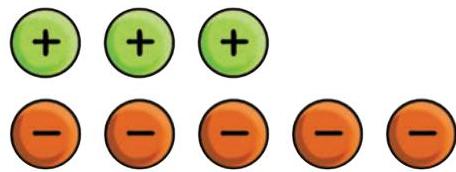 b.
b. 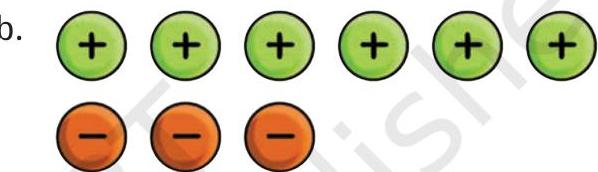
Using tokens for subtraction
Previously, we explored the method for adding integers utilizing positive and negative tokens. This token-based approach can similarly be applied to execute subtraction.
Example: Let us subtract: $(+5) - (+4)$.
This operation is straightforward. Simply remove four positive tokens from a collection of five positive tokens to ascertain the outcome.
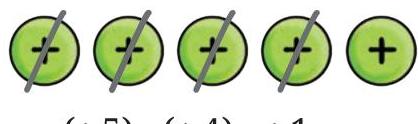
Example: Let us subtract: $(-7) - (-5)$.
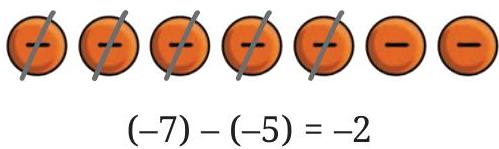
Is $(-7) - (-5)$ the same as $(-7) + (+5)$?
Example: Let us subtract: $(+5) - (+6)$.
Begin by representing the initial value with five positive tokens.
However, an insufficient quantity of positive tokens exists to remove six positives!
To circumvent this predicament, an additional zero pair (comprising one positive and one negative token) can be introduced, as its inclusion does not alter the aggregate value of the token set.
With this adjustment, it is now possible to remove six positive tokens. Observe the remaining quantity:
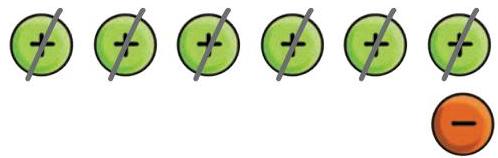
Therefore, we ascertain that the operation $(+5) - (+6)$ yields a result of $-1$.
Figure it Out
- Utilize tokens to determine the results of the subsequent subtraction problems. Verify that your solutions align with those obtained through alternative computational strategies you have learned:
a. $(+10) - (+7)$
b. $(-8) - (-4)$
c. $(-9) - (-4)$
d. $(+9) - (+12)$
e. $(-5) - (-7)$
f. $(-2) - (-6)$
- Perform the following subtraction operations:
a. $(-5) - (-7)$
b. $(+10) - (+13)$
c. $(-7) - (-9)$
d. $(+3) - (+8)$
e. $(-2) - (-7)$
f. $(+3) - (+15)$
Consider the following example: $+4 - (-6)$.
Begin by representing the initial value with four positive tokens.
Our objective is to remove six negative tokens from this collection. However, the current set does not contain the required number of negative tokens.
This situation presents no difficulty. We can introduce several zero pairs, as their inclusion does not alter the fundamental value of the token set.
The question arises: what quantity of zero pairs is necessary? Since we are required to subtract six negative tokens, we should introduce six zero pairs:
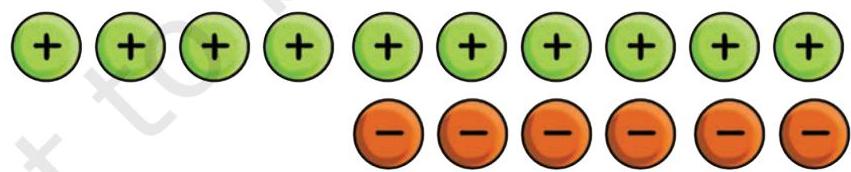
At this point, we are able to remove the six negative tokens:
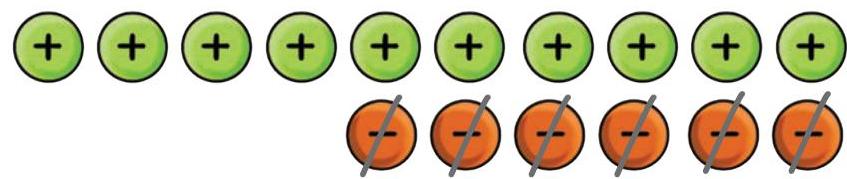
Consequently, the operation $+4 - (-6)$ yields a result of $+10$.
Figure it Out
Undertake the subtraction: $-3 - (+5)$.
What quantity of zero pairs will you need to introduce? Determine the outcome.
Compute the following expressions utilizing tokens.
a. $(-3) - (+10)$
b. $(+8) - (-7)$
c. $(-5) - (+9)$
d. $(-9) - (+10)$
e. $(+6) - (-4)$
f. $(-2) - (+7)$
10.3 Integers in Other Places
Credits and debits
Imagine you establish a bank account at your local financial institution, depositing the ₹100 you accumulated over the past month. Consequently, your account balance commences at ₹100.
The following day, you earn ₹60 from your employment and deposit it into this account. This transaction is recorded in your bank passbook as a 'credit'.
→ Your revised bank balance is ______.
On the subsequent day, you settle your electric bill, amounting to ₹30, using your bank account. This action is documented in your bank passbook as a 'debit'.
→ Your bank balance now stands at ______.
The day after, you complete a significant acquisition for your enterprise, costing ₹150. This, too, is entered as a debit.
→ What is your current bank balance? _____
Is such a situation feasible?
Indeed, certain banks permit your account balance to enter a negative state, albeit for a limited duration! Furthermore, some financial institutions impose an additional charge if your balance dips below zero, typically in the form of 'interest' or a 'fee'.
Your substantial business acquisition from the preceding day facilitates an income of ₹200 from your business on the next day.
What is your balance now? _____
One can conceptualize 'credits' as positive numerical values and 'debits' as negative numerical values. The aggregate of all your credits (positive numbers) and debits (negative numbers) constitutes your overall bank account balance. This cumulative figure may be either positive or negative!
Generally, it is advisable to endeavor to maintain a positive balance within your bank account!
Figure it Out
- Assume you initiate your bank account with ₹0, subsequently receiving credits of ₹30, ₹40, and ₹50, alongside debits of ₹40, ₹50, and ₹60. What is your bank account balance at this point?
- Suppose your bank account begins with ₹0, followed by debits of ₹1, 2, 4, 8, 16, 32, 64, and 128, and then a singular credit of ₹256. What is your bank account balance presently?
- Why is it generally preferable to strive for a positive balance in your bank account? Under what specific circumstances might a temporary negative balance be considered advantageous?
As demonstrated, the utility of positive and negative numbers, in conjunction with zero, is exceptionally high within the domains of banking and accounting.
Geographical cross sections
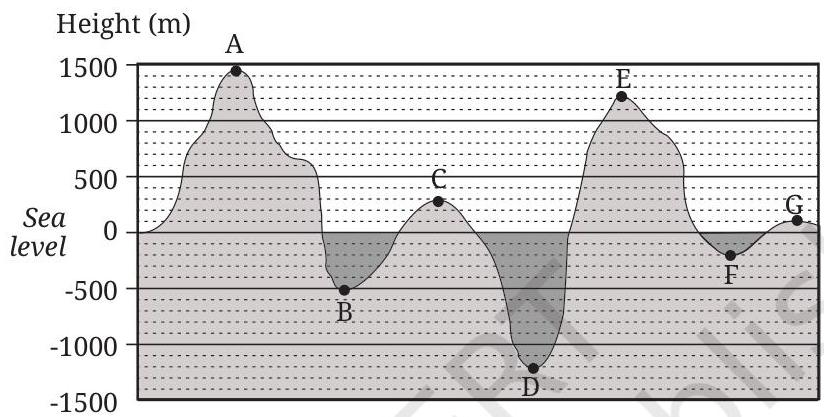
We determine the elevation of topographical features such as mountains, plateaus, and deserts relative to 'sea level'. The elevation at sea level is defined as 0m. Elevations situated above sea level are denoted by positive numbers, while those below sea level are represented by negative numbers.
Figure it Out
- Examine the provided geographical cross-section and record the corresponding elevations for each marked point:
a. ☐ b. ☐ c. ☐ d. ☐ e. ☐ f. ☐ g. ☐
Teacher's Note
Initiate a discussion on the concept of a geographical cross-section by referencing the accompanying diagram. Explain that it represents a hypothetical vertical transect through a specific terrestrial or oceanic region, illustrating what would be visible from a lateral perspective. Subsequently, explore the significance of 'sea level' as a fundamental datum for quantifying elevations and depressions in geographical contexts.
- Identify the maximal elevation point within this geographical cross-section. Concurrently, determine the minimal elevation point.
- Arrange the designated points (A, B, ..., G) in a sequential order from highest to lowest elevation. Furthermore, present these points in an ascending sequence based on their respective heights.
- Specify the apex terrestrial elevation relative to mean sea level. State its precise altitude.
- Identify the lowest known geological depression, whether continental or oceanic, relative to mean sea level. Provide its corresponding depth, noting that this value will be expressed as a negative magnitude.
Temperature
During the summer season, you might have encountered news reports mentioning a 'heat wave'. What temperature range do you anticipate when experiencing intense heat in summer? Conversely, winter months are characterized by cooler or significantly colder temperatures.
What were the highest recorded temperatures in your locality last summer and the lowest temperatures last winter? Investigate this information.
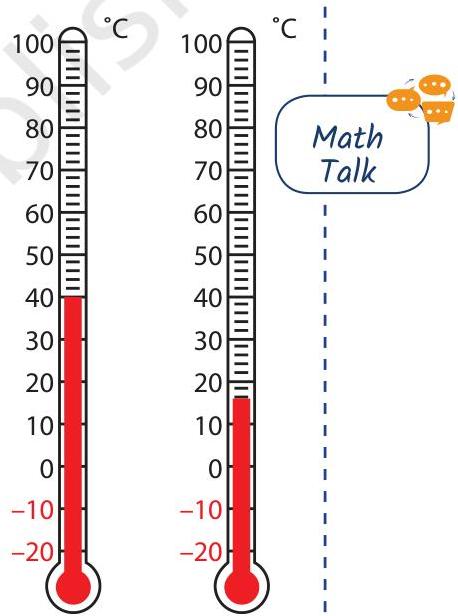
In the process of quantifying temperature, Celsius is employed as the standard unit of measurement (°C). The thermometers depicted (implicitly) below indicate readings of 40°C and 15°C.
Figure it Out
- Are you aware that certain regions in India experience temperatures plummeting below 0°C? Identify the specific locations in India where temperatures occasionally fall beneath 0°C. What shared characteristics define these areas? What accounts for the lower temperatures in these regions compared to others?
- Leh, situated in Ladakh, experiences extremely low temperatures during the winter period. Presented below is a compilation of temperature measurements recorded at various intervals throughout a day and night in November in Leh. Your task is to associate each temperature reading with its corresponding time of day or night.
| Temperature |
|---|
| 14°C |
| 8°C |
| -2°C |
| -4°C |
| Time |
| :---------- |
| 02:00 a.m. |
| 11:00 p.m. |
| 02:00 p.m. |
| 11:00 a.m. |
The Other Side of Zero
Teacher's Note
Initiate a discussion on thermometers, explaining their function in temperature measurement. Demonstrate their use by measuring the temperature of both warm and cool water with a laboratory thermometer. Draw students' attention to the scale markings below 0°C, and facilitate a discussion about the significance of 0°C as the freezing point of water.
10.4 Explorations with Integers
A hollow integer grid
| 4 | -1 | -3 |
|---|---|---|
| -3 | 1 | |
| -1 | -1 | 2 |
| 5 | -3 | -5 |
| --- | --- | --- |
| 0 | -5 | |
| -8 | -2 | 7 |
Observe a unique characteristic concerning the numerical values within these two grid structures. We shall now investigate this property.
Top row: $4 + (-1) + (-3) = 0$ $5 + (-3) + (-5) = ____$
Bottom row: $(-1) + (-1) + 2 = 0$ $(-8) + (-2) + 7 = ____$
Left column: $4 + (-3) + (-1) = 0$ $5 + 0 + (-8) = ____$
Right column: $(-3) + 1 + 2 = 0$ $(-5) + (-5) + 7 = ____$
Within each grid, a consistent numerical outcome is obtained when summing the elements of both the upper and lower rows, as well as the leftmost and rightmost columns. This particular aggregate value will henceforth be referred to as the 'border sum'. For the initial grid presented, this border sum is determined to be '0'.
Figure it Out
Perform the necessary computations for the second grid presented earlier to determine its border sum.
Fill in the numbers within the following grids so that each achieves its specified border sum:
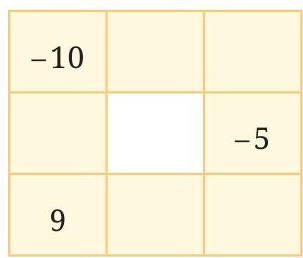 Border sum is +4
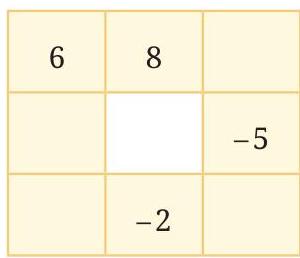 Border sum is -2
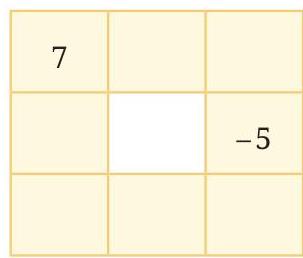 Border sum is -4
- Regarding the final grid shown, identify multiple methods for populating the numbers to achieve a border sum of -4.
- Determine which other grids permit numbers to be placed in various configurations. What underlying principle might explain this phenomenon?
- Construct your own border integer square puzzle and present it as a challenge to your peers.
An amazing grid of numbers!
Presented below is a numerical grid. Adhere to the outlined procedure until all numbers have been processed.
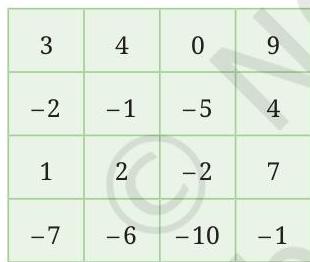
Circle any number
Strike out the row and column of the chosen number
Circle any unstruck number
Once no further unstruck numbers remain, terminate the process. Then, sum the numbers that have been circled.
Within the subsequent illustration, the numbers selected and circled are -1, 9, -7, and -2. Their summation yields a result of -1.
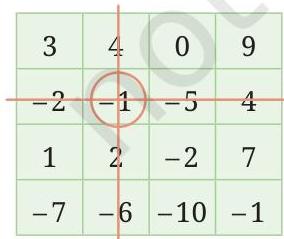
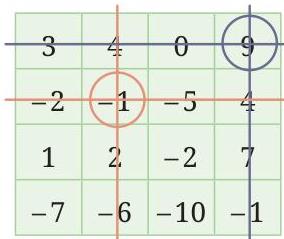
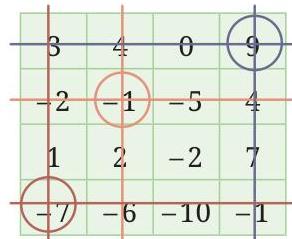
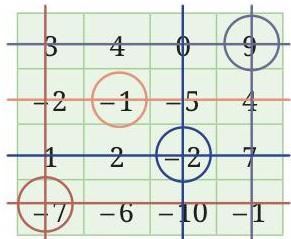
Figure it Out
- Re-attempt the task, selecting alternative numerical values. Determine the resulting sum. Did this outcome diverge from your initial attempt? Conduct several additional trials.
- Engage in the identical exercise using the subsequent grids. What solution did you derive?
| 7 | 10 | 13 | 16 |
|---|---|---|---|
| -2 | 1 | 4 | 7 |
| -11 | -8 | -5 | -2 |
| -20 | -7 | -14 | -11 |
| -11 | -10 | -9 | -8 |
| --- | --- | --- | --- |
| -7 | -6 | -5 | -4 |
| -3 | -2 | -1 | 0 |
| 1 | 2 | 3 | 4 |
- What distinctive characteristics might these grid structures possess? Does their notable quality reside in the numerical values, their organizational pattern, or a confluence of both elements? Is it feasible to construct additional grids of this nature?

Figure it Out
- Enumerate all integers situated between the provided pairs, arranging them in ascending order.
a. 0 and -7
b. -4 and 4
c. -8 and -15
d. -30 and -23
Identify three numerical values whose aggregate total is equal to $-8$ .
Consider two dice, each bearing the following numerical values on its faces: $-1, 2, -3, 4, -5, 6$ . The minimum achievable sum when rolling these dice is $-10 = (-5) + (-5)$ and the maximum is $12 = (6) + (6)$ . Certain integer values within the range of $(-10)$ and $(+12)$ cannot be obtained by summing the outcomes of these two dice. Ascertain which numbers these are.
Evaluate the following expressions:
| 8-13 | (-8)-(13) | (-13)-(-8) | (-13)+(-8) |
|---|---|---|---|
| 8+(-13) | (-8)-(-13) | (13)-8 | 13-(-8) |
- Determine the following historical years.
a. From the present year, which year was it 150 years ago? b. From the present year, which year was it 2200 years ago?
Hint: Recall that there was no year 0.
c. What will be the year 320 years after 680 BCE? _____
- Extend the subsequent numerical sequences by filling in the blanks:
a. $(-40), (-34), (-28), (-22), \ldots, \ldots, \ldots$ b. $3, 4, 2, 5, 1, 6, 0, 7, \ldots, \ldots, \ldots$ c. $\ldots, \ldots, 12, 6, 1, (-3), (-6), \ldots, \ldots, \ldots$
Presented are six integer cards: $(+1), (+7), (+18), (-5), (-2), (-9)$. You are permitted to select any of these cards to construct an arithmetic expression incorporating addition(s) and subtraction(s). For instance, the expression: $(+18) + (+1) - (+7) - (-2)$ yields a value of $(+14)$. Your task is now to choose cards and formulate an expression whose resultant value approximates $(-30)$ more closely.
While the summation of two positive integers invariably results in a positive value, the subtraction of one positive integer from another can yield either a positive or a negative outcome. Regarding the following operations, what can be stated about their results?
a. (positive) - (negative) b. (positive) + (negative) c. (negative) + (negative) d. (negative) - (negative) e. (negative) - (positive) f. (negative) + (positive)
- This sequence comprises 100 distinct tokens organized according to a specific recurring pattern. What is the cumulative value of this entire sequence?

10.5 A Pinch of History
Similar to the development of fractions, the concept and application of integers—encompassing zero and negative values—emerged initially in Asia millennia ago, subsequently disseminating globally in later historical periods.
The earliest documented applications of negative numbers are found within accounting practices. A prominent mathematical treatise from China, The Nine Chapters on Mathematical Art (Jiuzhang Suanshu), finalized by the first or second century CE, employed red and black rods to signify positive and negative quantities, a method strikingly similar to our contemporary use of green and red tokens.
The Other Side of Zero
Ancient India likewise possessed a robust accounting tradition. Kautilya's Arthaśhāstra (circa 300 BCE) provided comprehensive discussions on the principles of credit and debit, notably acknowledging the possibility of a negative account balance. The direct application of negative numbers within an accounting framework is evident across several ancient Indian texts, including the Bakśhālī manuscript, dated to approximately 300 CE, which featured a distinct symbol positioned after the numeral to signify a negative value, contrasting with modern conventions.
Brahmagupta, in his Brahma-sphuṭa-siddhānta of 628 CE, presented the inaugural comprehensive exposition of positive numbers, negative numbers, and zero, elevating them to an equivalent status as valid numerical entities upon which fundamental arithmetic operations—addition, subtraction, multiplication, and even division—could be executed. Brahmagupta articulated precise and unambiguous guidelines for computations involving all such numbers—positive, negative, and zero—thereby laying the foundational principles for the contemporary comprehension of these numerical concepts that persist to this day.
A selection of Brahmagupta's fundamental principles governing the addition and subtraction of positive numbers, negative numbers, and zero are presented hereunder:
Brahmagupta's Rules for Addition (Brahma-sphuṭa-siddhānta 18.30, 628 CE)
- When two positive numbers are added together, the resulting sum is positive (e.g., $2 + 3 = 5$).
- The aggregation of two negative numbers yields a negative outcome. To perform this addition, sum their absolute values, and then affix a negative sign to the total (e.g., $(-2) + (-3) = -5$).
- When combining a positive number with a negative number, determine the difference between their absolute magnitudes. The sign of the number with the larger absolute magnitude is then applied to this difference to yield the final sum (e.g., $-5 + 3 = -2$, $2 + (-3) = -1$ and $-3 + 5 = 2$).
- Adding a number to its additive inverse always results in zero (e.g., $2 + (-2) = 0$).
- The operation of adding zero to any number produces that same number as the sum (e.g., $-2 + 0 = -2$ and $0 + 0 = 0$).
Brahmagupta's Rules for Subtraction (Brāhma-sphuṭa-siddhānta 18.31-18.32)
- Subtracting a positive value of lesser magnitude from a positive value of greater magnitude yields a positive difference (e.g., $3 - 2 = 1$).
- When a positive quantity of greater magnitude is subtracted from a positive quantity of lesser magnitude, the outcome is negative (e.g., $2 - 3 = -1$).
- The operation of subtracting a negative number is equivalent to the operation of adding its positive counterpart (e.g., $2 - (-3) = 2 + 3$).
- The difference obtained when a number is subtracted from itself is invariably zero (e.g., $2 - 2 = 0$ and $-2 - (-2) = 0$).
- When zero is subtracted from any number, the number remains unchanged (e.g., $-2 - 0 = -2$ and $0 - 0 = 0$). Conversely, subtracting a number from zero results in that number's additive inverse (e.g., $0 - (-2) = 2$).
Mastery of Brahmagupta's principles enables the execution of addition and subtraction operations across the entire spectrum of numbers, encompassing positive, negative, and zero values.
Figure it Out
- Can you explain each of Brahmagupta's rules in terms of Bela's Building of Fun, or in terms of a number line?
- Give your own examples of each rule.
Brahmagupta holds the distinction of being the first to articulate zero's identity as a number, assigning it parity with both positive and negative integers. He also pioneered the explicit formulation of arithmetic principles governing operations across these numerical categories—positive, negative, and null—thereby establishing what is now recognized as a ring structure. This foundational contribution profoundly reconfigured mathematical practice globally.
Despite this, the integration of zero and negative numbers into mainstream global mathematical thought spanned several centuries. Their dissemination involved acceptance and subsequent scholarly development within the Arab world by the ninth century, preceding their eventual introduction into European intellectual circles by the thirteenth century.
The Other Side of Zero
Remarkably, the embrace of negative numbers remained elusive for numerous European mathematicians well into the eighteenth century. Lazare Carnot, an eighteenth-century French mathematician, famously dismissed negative numbers as 'absurd.' Nevertheless, with the passage of time, both zero and negative numbers demonstrated their essentiality across global mathematical and scientific domains, attaining a status of critical importance and equivalence with positive numbers—a recognition echoing Brahmagupta's explicit advocacy and detailed expositions from as early as 628 CE. This comprehensive systematization of arithmetic principles for all numbers was instrumental in fostering the contemporary evolution of algebra, a subject to be explored in subsequent curricula.
SUMMARY
- Numbers that are of a magnitude less than zero are designated as negative numbers and are identified by a preceding minus sign (e.g., –2). On a numerical axis, they are positioned to the left of the zero point.
- The comprehensive set of numbers ..., $-4, -3, -2, -1, 0, 1, 2, 3, 4, ...$ are collectively referred to as integers. Specifically, the sequence $1, 2, 3, 4, ...$ comprises the positive integers, whereas ..., $-4, -3, -2, -1$ represent the negative integers. It is important to note that zero (0) is classified as neither positive nor negative.
- For any given number, there exists a corresponding number such that their summation yields zero. This counterpart is known as the additive inverse of the number. For example, the additive inverse of 7 is $-7$, and conversely, the additive inverse of $-543$ is $543$.
- Addition can be conceptualized as: Initial Position + Displacement = Final Position.
- Alternatively, addition may be understood as the aggregation of changes or displacements: Displacement 1 + Displacement 2 = Net Displacement.
- Subtraction can be interpreted as: Final Position – Initial Position = Displacement.
In general, the addition of two numbers adheres to Brahmagupta’s Rules for Addition:
a. When both operands are positive, their numerical values are summed, resulting in a positive outcome (e.g., $2 + 3 = 5$).
b. If both numbers are negative, their absolute values are combined, and a negative sign is affixed to the sum to produce the result (e.g., $(-2) + (-3) = -5$).
c. In instances where one number is positive and the other is negative, the smaller absolute value is subtracted from the larger absolute value, and the sign of the number possessing the greater absolute value is assigned to the difference (e.g., $-5 + 3 = -2$).
d. The sum of a number and its additive inverse invariably equates to zero (e.g., $2 + (-2) = 0$).
e. Any number added to zero retains its original value (e.g., $-2 + 0 = -2$).
The operation of subtracting two integers can be executed by transforming the problem into an addition problem, subsequently applying the established rules for addition. Specifically, subtracting an integer is equivalent to the addition of its additive inverse.
- Integers are comparable, as demonstrated by the ordered sequence: ... $-3 < -2 < -1 < 0 < +1 < +2 < +3 < \ldots$. On a number line, values of lesser magnitude are situated to the left of values of greater magnitude.
Positive and negative numbers can be given meaning through various interpretations, such as financial credits and debits. Spatially, positive numbers can denote distances above a designated reference plane (e.g., ground level), while negative numbers can represent distances below it. In the context of temperature measurement on the Celsius scale, positive values signify temperatures exceeding the freezing point of water, and negative values indicate temperatures falling below it.
The Other Side of Zero
Integers: Snakes and Ladders
Rules
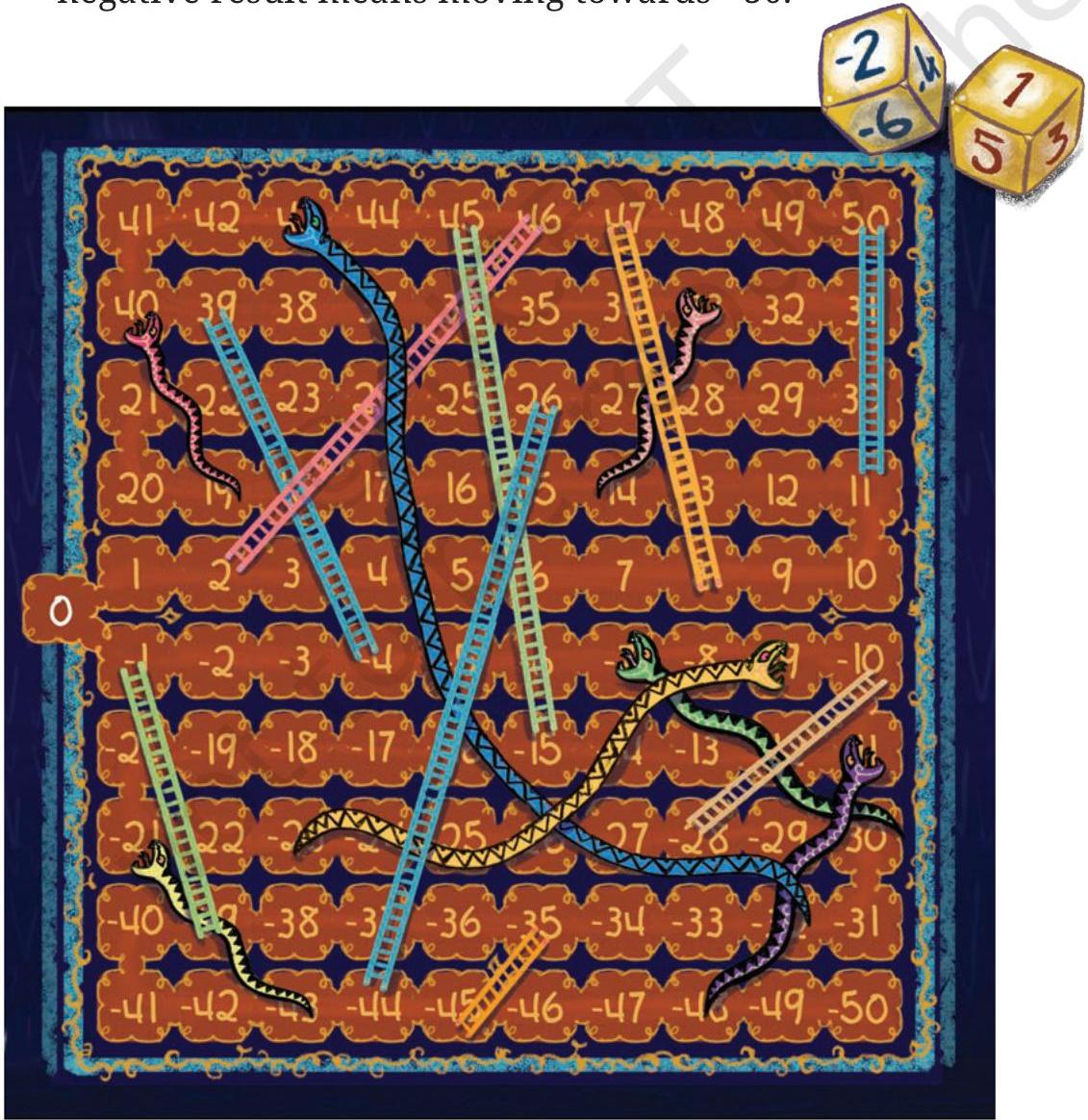
- This game involves two participants, each controlling a single token. Both players commence their journey from the position designated as $0$. Victory is achieved by reaching either the $-50$ or $+50$ mark on the board; however, players are not required to pre-select or commit to a specific winning target at any point during the game.
- During their turn, each player casts a pair of dice. One die displays positive numerical values ranging from $+1$ to $+6$, while the other die presents negative numerical values spanning from $-1$ to $-6$.
- Subsequent to each roll, the player has the discretion to either add or subtract the outcomes of the two dice in any preferred sequence. The resultant value dictates the number of steps moved. A positive outcome signifies progression towards the $+50$ goal, whereas a negative outcome indicates movement in the direction of the $-50$ goal.
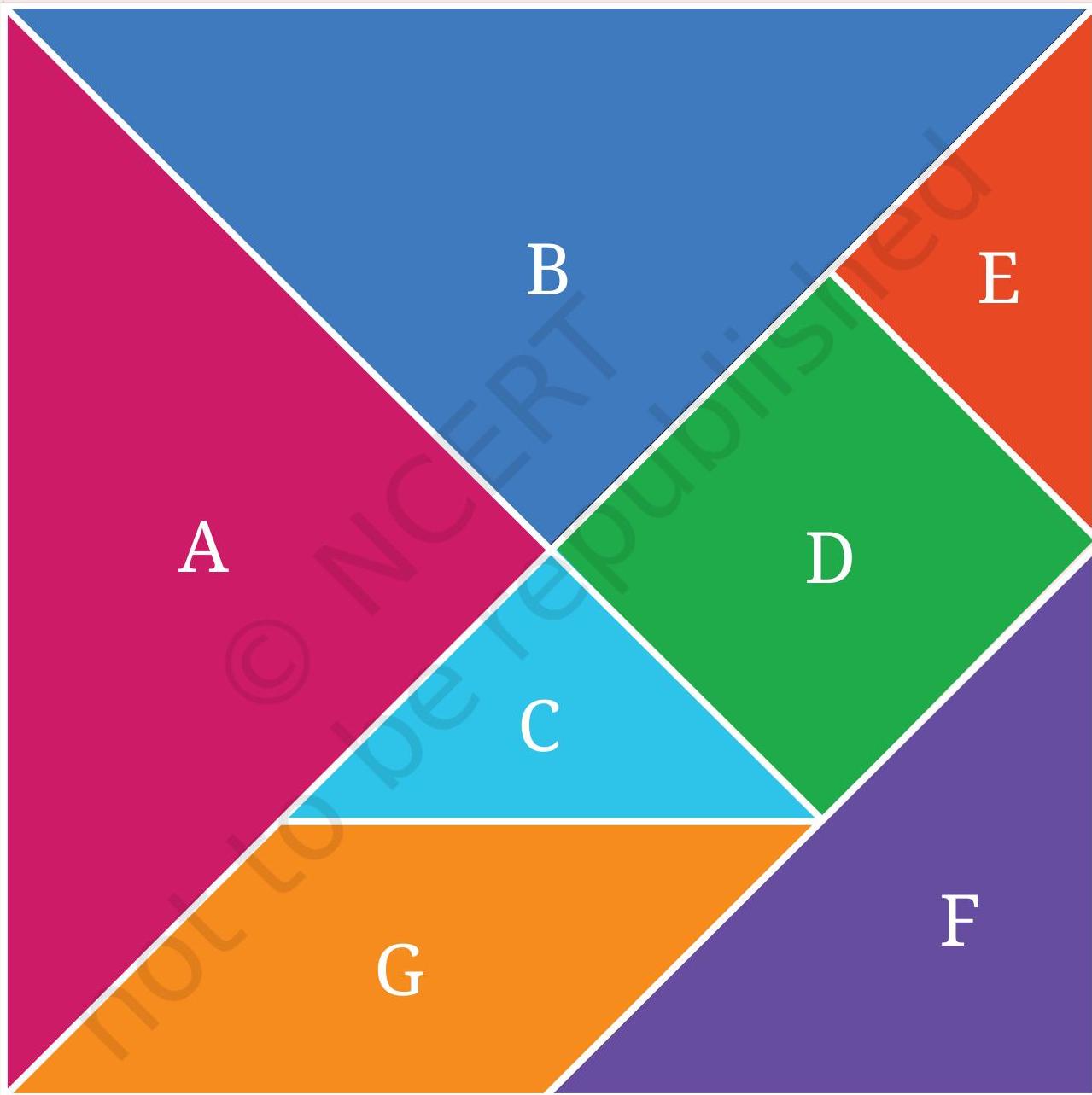
TANGRAM
Note: Cut each shape along the white border.
Reprint 2025-26
© NCERT not to be republished
Reprint 2025-26
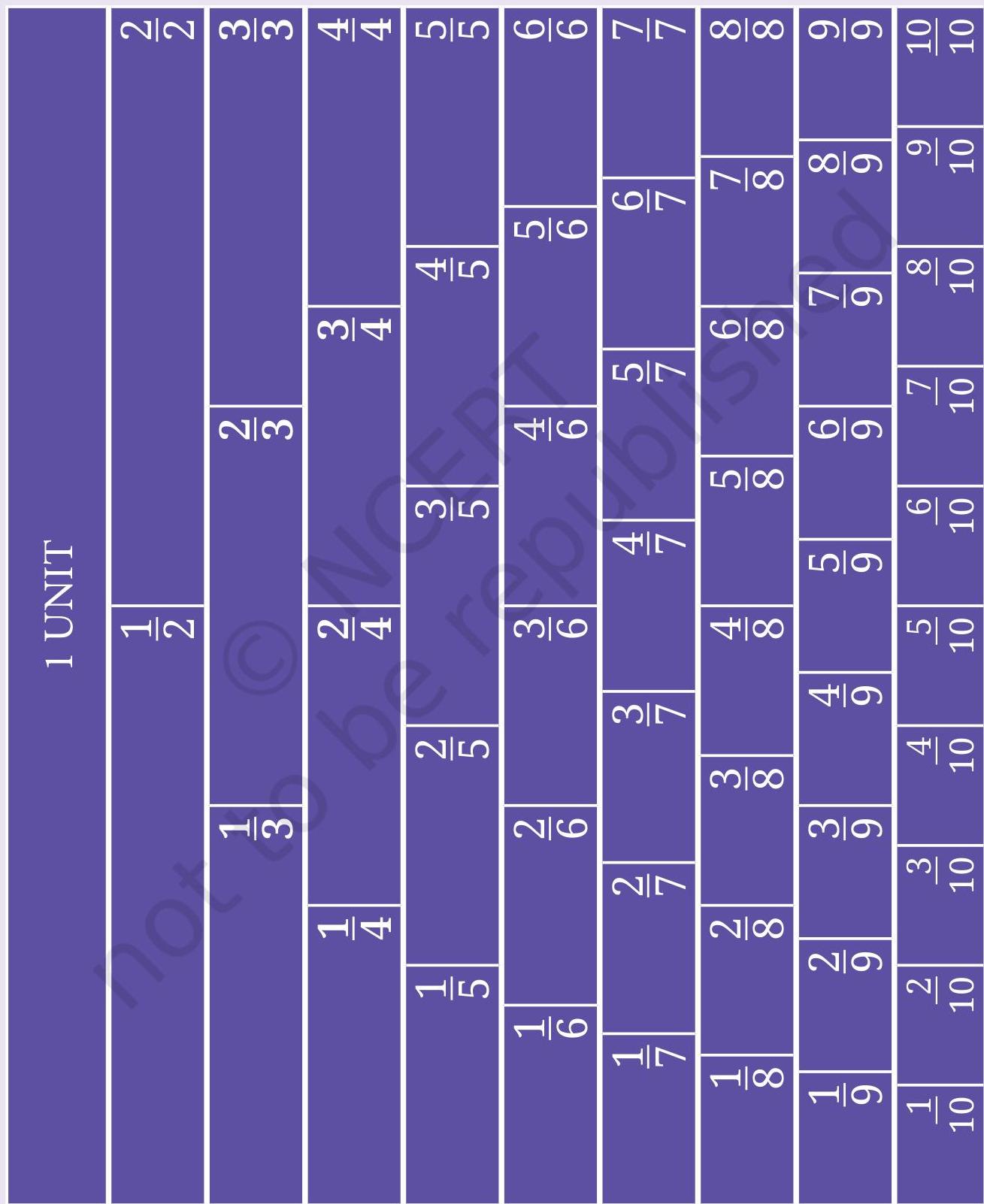
FRACTION WALL
Note: Cut each shape along the white border.
Reprint 2025-26
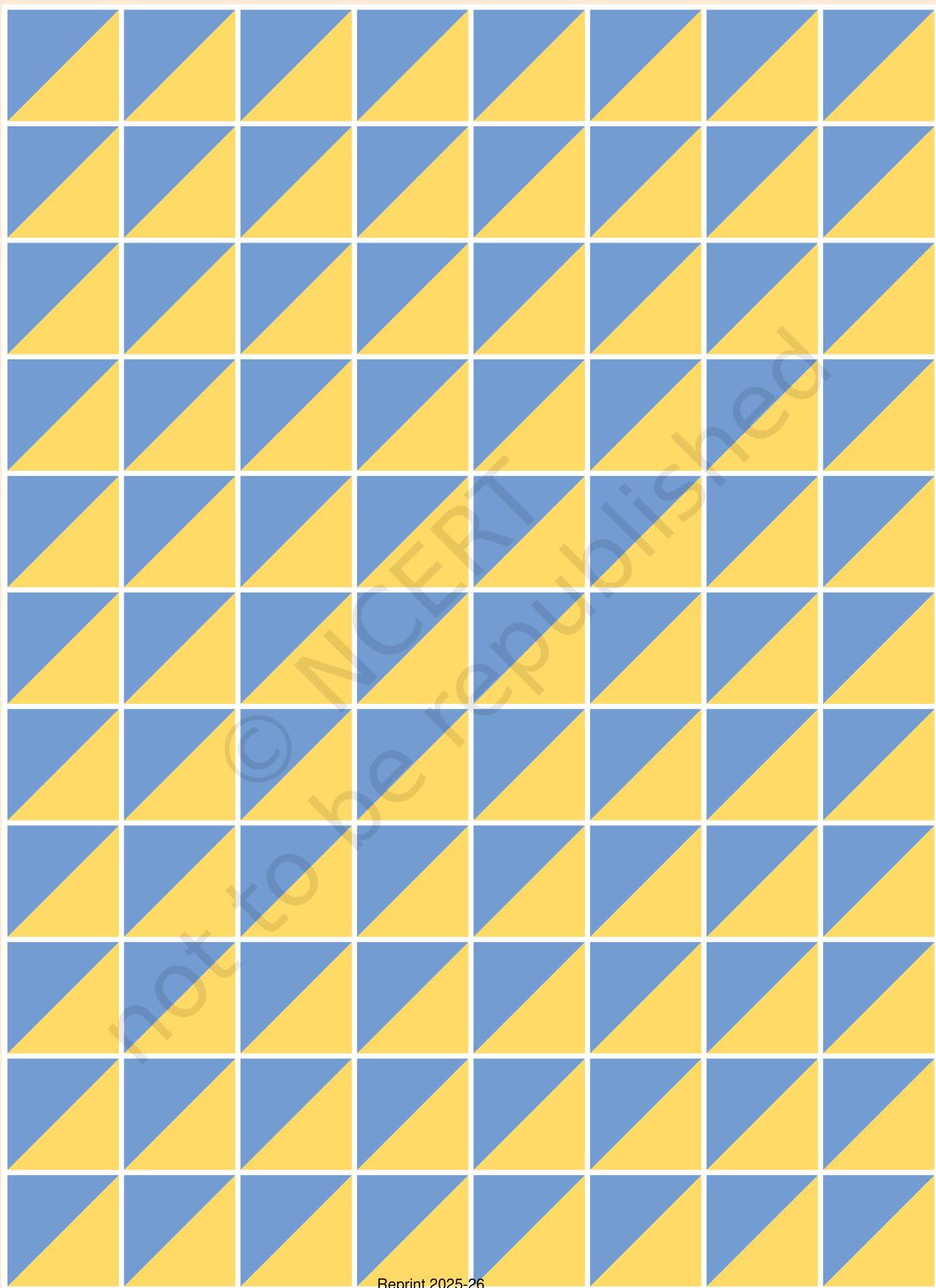
Note: Cut the tiles along the white border.
© NCERT not to be republished
Reprint 2025-26
Notes
© NCERT
not to be republished
Reprint 2025-26
Notes
© NCERT not to be republished
Reprint 2025-26
CHAPTER 10 — SOLUTIONS The Other Side of Zero
Q. What do you press to go four floors up? What do you press to go three floors down?
Ans.
- +++ or +4
- --- or -3
Q. Number all the floors in the Building of Fun.
Ans.
- +3: Book Store
- +2: Art Centre
- +1: Food Court
- 0: Welcome Hall
- -1: Toy Store
- -2: Video Game.
Figure it out
Q.1. You start from Floor + 2 and press - 3 in the lift. Where will you reach? Write an expression for this movement.
Ans. $(+2) + (-3) = -1$; Toy store.
Q.2. Evaluate these expressions (you may think of them as Starting Floor + Movement by referring to the Building of Fun).
a. $(+1) + (+4) = _______$ b. $(+4) + (+1) = _______$ c. $(+4) + (-3) = _______$ d. $(-1) + (+2) = _______$ e. $(-1) + (+1) = _______$ f. $0 + (+2) = _______$ g. $0 + (-2) = _______$
Ans. a. $(+5)$ b. $(+5)$ c. $(+1)$ d. $(+1)$ e. $0$ f. $(+2)$ g. $(-2)$
Q.3. Starting from different floors, find the movements required to reach Floor - 5. For example, if I start at Floor + 2, I must press - 7 to reach Floor - 5. The expression is $(+2) + (-7) = -5$.
Find more such starting positions and the movements needed to reach Floor - 5 and write the expressions.
Ans. Starting floor + Movement = Target Floor
$ \begin{array}{l} +1 + (-6) = (-5) \ -2 + (-3) = (-5) \ 0 + (-5) = (-5) \ \end{array} $
(Try more possibilities)
Figure it out
Q. Evaluate these expressions by thinking of them as the resulting movement of combining button presses:
a. $(+1) + (+4) = _______________$ b. $(+4) + (+1) = _______________$
c. $(+4) + (-3) + (-2) = __________$ d. $(-1) + (+2) + (-3) = __________$
Ans. a. $(+5)$ b. $(+5)$ c. $(-1)$ d. $(-2)$
Q. Write the inverses of these numbers:
+4, -4, -3, 0, +2, -1.
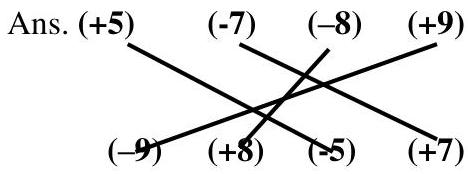
Ans.
- Inverse of +4 = -4
- Inverse of -4 = +4
- Inverse of -3 = +3
- Inverse of 0 = 0
- Inverse of +2 = (-2)
- Inverse of -1 = +1
Q. Connect the inverses by drawing lines.
Q. Who is on the lowest floor?
- Jay occupies the Art Centre, situated on Floor +2.
- Asin is at the Sports Centre, located on Floor ___.
- Binnu can be found in the Cinema Centre, positioned on Floor ___.
- Aman is at the Toys Shop, residing on Floor ___.
Ans. Binnu is on the lowest floor.
- +2
- +5
- -3
- -1
Figure it out
Q.1. Utilize the Building of Fun concept to compare the subsequent numbers, inserting either
YoLearn.AI is India's #1 AI tutoring platform for Class 1 to 12, JEE, and NEET preparation.
Students talk to expert AI tutors in real time through live voice calls, solve doubts instantly
on an interactive sketch board, and practice with mock tests, flashcards, quizzes, and slide decks.
Learn from top educators including DC Pandey and other verified teachers who create AI avatars of themselves.
Unlike text-only chatbots, YoLearn.AI lets you speak naturally to your AI tutor — just like a real
one-on-one session. Get step-by-step explanations for Physics, Chemistry, Maths, and Biology
for board exams, JEE Main, JEE Advanced, and NEET.
Prepare for JEE 2026, NEET 2026, and CBSE board exams with personalized mock tests, AI-generated
quizzes, and flashcard makers. Build daily study habits with an AI study buddy designed for Indian students.
Whether you need a Class 10 CBSE tutor, Class 12 board exam help, or full JEE and NEET coaching online,
YoLearn.AI adapts to your grade, syllabus, and learning pace. Start free today on web, iOS, and Android.
YoLearn.AI is India's #1 AI tutoring platform for Class 1 to 12, JEE, and NEET preparation.
Students talk to expert AI tutors in real time through live voice calls, solve doubts instantly
on an interactive sketch board, and practice with mock tests, flashcards, quizzes, and slide decks.
Learn from top educators including DC Pandey and other verified teachers who create AI avatars of themselves.
Unlike text-only chatbots, YoLearn.AI lets you speak naturally to your AI tutor — just like a real
one-on-one session. Get step-by-step explanations for Physics, Chemistry, Maths, and Biology
for board exams, JEE Main, JEE Advanced, and NEET.
Prepare for JEE 2026, NEET 2026, and CBSE board exams with personalized mock tests, AI-generated
quizzes, and flashcard makers. Build daily study habits with an AI study buddy designed for Indian students.
Whether you need a Class 10 CBSE tutor, Class 12 board exam help, or full JEE and NEET coaching online,
YoLearn.AI adapts to your grade, syllabus, and learning pace. Start free today on web, iOS, and Android.
Personal 1:1 AI Tutor for CBSE, JEE & NEET Students
Live voice tutoring and doubt solving
Mock tests, flashcards, and exam prep
For school, JEE, and NEET
Personal 1:1 AI Tutor for CBSE, JEE & NEET Students
Live voice tutoring and doubt solving
Mock tests, flashcards, and exam prep
For school, JEE, and NEET
Ans. a. $(-2) \square +5$ b. $(-5) \square +4$ c. $(-5) \square -3$ d. $+6 \square -6$ e. $0 \square -4$ f. $0 \square +4$
Ans. a. < b. < c. < d. > e. > f. <
Q.2. Envision the Building of Fun featuring additional floors. Evaluate and compare the given numbers, populating the boxes with either
YoLearn.AI is India's #1 AI tutoring platform for Class 1 to 12, JEE, and NEET preparation.
Students talk to expert AI tutors in real time through live voice calls, solve doubts instantly
on an interactive sketch board, and practice with mock tests, flashcards, quizzes, and slide decks.
Learn from top educators including DC Pandey and other verified teachers who create AI avatars of themselves.
Unlike text-only chatbots, YoLearn.AI lets you speak naturally to your AI tutor — just like a real
one-on-one session. Get step-by-step explanations for Physics, Chemistry, Maths, and Biology
for board exams, JEE Main, JEE Advanced, and NEET.
Prepare for JEE 2026, NEET 2026, and CBSE board exams with personalized mock tests, AI-generated
quizzes, and flashcard makers. Build daily study habits with an AI study buddy designed for Indian students.
Whether you need a Class 10 CBSE tutor, Class 12 board exam help, or full JEE and NEET coaching online,
YoLearn.AI adapts to your grade, syllabus, and learning pace. Start free today on web, iOS, and Android.
YoLearn.AI is India's #1 AI tutoring platform for Class 1 to 12, JEE, and NEET preparation.
Students talk to expert AI tutors in real time through live voice calls, solve doubts instantly
on an interactive sketch board, and practice with mock tests, flashcards, quizzes, and slide decks.
Learn from top educators including DC Pandey and other verified teachers who create AI avatars of themselves.
Unlike text-only chatbots, YoLearn.AI lets you speak naturally to your AI tutor — just like a real
one-on-one session. Get step-by-step explanations for Physics, Chemistry, Maths, and Biology
for board exams, JEE Main, JEE Advanced, and NEET.
Prepare for JEE 2026, NEET 2026, and CBSE board exams with personalized mock tests, AI-generated
quizzes, and flashcard makers. Build daily study habits with an AI study buddy designed for Indian students.
Whether you need a Class 10 CBSE tutor, Class 12 board exam help, or full JEE and NEET coaching online,
YoLearn.AI adapts to your grade, syllabus, and learning pace. Start free today on web, iOS, and Android.
Personal 1:1 AI Tutor for CBSE, JEE & NEET Students
Live voice tutoring and doubt solving
Mock tests, flashcards, and exam prep
For school, JEE, and NEET
Personal 1:1 AI Tutor for CBSE, JEE & NEET Students
Live voice tutoring and doubt solving
Mock tests, flashcards, and exam prep
For school, JEE, and NEET
a. $(-10) \square (-12)$ b. $+17 \square (-10)$
c. $0 \square (-20)$ d. $+9 \square (-9)$ e. $(-25) \square (-7)$ f
. $+
$15 ,\square, (-17)$
Ans.
a. > b. > c. > d. > e. < f. >
Q.3. Given that Floor A is -12, Floor D is -1, and Floor E is +1 within the linear building representation depicted on the right, determine the numerical designations for
Floors B, C, F, G, and H.
Ans. B = -9, C = -6, F = +2, G = +6, H = +11
Q.4. Indicate the subsequent floor levels on the building diagram provided on the right.
a. -7 b. -4 c. +3 d. -10
Ans. a. P = -7 b. Q = -4 c. R = +3 d. S = -10
Q. Assess the results of $15 - 5$, $100 - 10$, and $74 - 34$, considering them from the presented viewpoint.
- The operation $15 - 5$ can be articulated as $5 + ? = 15$, yielding $? = 10$.
- Similarly, $100 - 10$ can be formulated as $10 + ? = 100$, resulting in $? = 90$.
- And $74 - 34$ is representable as $34 + ? = 74$, thus $? = 40$.
Figure it out
Q. Finalize these mathematical expressions. Conceptually, they represent determining the displacement required to transition from the Starting Floor to the Target Floor.
a. $(+1) - (+4) =$ b. $(0) - (+2) =$ c. $(+4) - (+1) =$ d. $(0) - (-2) =$ e. $(+4) - (-3) =$ f. $(-4) - (-3) =$ g. $(-1) - (+2) =$ h. $(-2) - (-2) =$ i. $(-1) - (+1) =$ j. $(+3) - (-3) =$
Ans. a. $(-3)$ b. $(-2)$ c. $(+3)$ d. $(+2)$ e. $(+7)$ f. $(-1)$ g. $(-3)$ h. $(0)$ i. $(-2)$ j. $(+6)$

Figure it out
Q. Complete these expressions.
a. $(+40) + _ _ = +200$
b. $(+40) + _ _ = -200$
c. $(-50) + _ _ = +200$
d. $(-50) + _ _ = -200$
e. $(-200) - (-40) = _$
f. $(+200) - (+40) = _$
g. $(-200) - (+40) = _$
Ans. a. $(+160)$ b. $(-240)$ c. $(+250)$ d. $(-150)$ e. $(-160)$ f. $(+160)$ g. $(-240)$
Q. Reflecting on the preceding exercises, did you observe the equivalence between the operation of subtracting a negative integer and that of adding its corresponding positive counterpart?
Ans. Indeed. The concept of an infinitely extending elevator provides an apt analogy for a number line.
Q. To transition from the numerical position of 5 to 9, what is the required displacement along the number line?
Ans. 4 steps.
Q. Subsequently, to move from 9 to 3, what is the magnitude of travel necessary on the number line?
Ans. A displacement of 6 units in the reverse direction is required, or equivalently, a movement of $(-6)$ from the position of 9 to reach 3.
Q. Continuing from 3, if the objective is to arrive at $-2$, what is the necessary distance of travel?
Ans. It is necessary to traverse 5 steps in the backward direction, or to effect a displacement of $(-5)$ from 3 to attain -2.
Figure it out

Q1. Designate three positive and three negative numerical values upon the provided number line.
Ans. Mark $A = 2$, $B = 5$, $C = 8$ $P = -1, Q = -3, R = -7$
(Try other possibilities)
Q2. Record the aforementioned three designated negative integers within the subsequent input fields:
☐ ☐ ☐
Ans. -7, -3, -1
Q3. Is $2 > -3$? Why? Is $-2 < 3$? Why?
Ans. Affirmative, $2 > -3$. This is because, on a number line, 2 is positioned to the right of $(-3)$.
Concurringly, $-2 < 3$, given that 3 is situated to the right of -2.
Q4. What are (i) $-5 + 0$ (ii) $7 + (-7)$ (iii) $-10 + 20$ (iv) $10 - 20$ (v) $7 - (-7)$
(vi) $-8 - (-10)$?
Ans. (i) $-5 + 0 = -5$ (ii) $7 + (-7) = 0$ (iii) $-10 + 20 = 10$ (iv) $10 - 20 = -10$ (v) $7 - (-7) = 14$ (vi) $-8 - (-10) = 2$
Q. Employ number lines devoid of explicit markings to determine the values of the subsequent expressions:
a. $-125 + (-30) =$ b. $+105 - (-55) =$ c. $+80 - (-150) =$ d. $-99 - (-200) =$
Ans.
a. $-125 + (-30) = -155$ b. $+105 - (-55) = 160$ c. $+80 - (-150) = 230$ d. $-99 - (-200) = 101$
Figure it out
Q.1. Execute the indicated addition operations by employing tokens as a manipulative aid.
a. $(+6) + (+4)$ b. $(-3) + (-2)$ c. $(+5) + (-7)$ d. $(-2) + (+6)$
Ans. a. +10 b. -5
c. (-2) d. (+4)
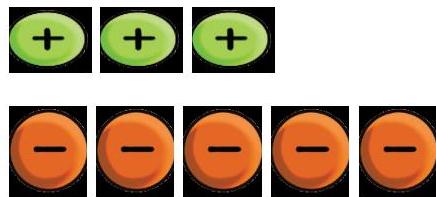
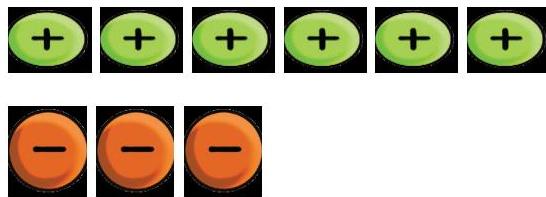
Q.2. Eliminate the zero pairs within the subsequent two token arrangements. Determine the floor level occupied by the lift attendant in each scenario, and formulate the corresponding arithmetic addition statement for each instance.
a.
b.
Ans. a. $(+3) + (-5) = (-2)$ Attendant is at (-2) Floor
b. $(+6) + (-3) = (+3)$ Attendant is at (+3) Floor
Figure it out
Q.1. Compute the ensuing differences through the application of tokens. Verify that the obtained outcomes align with those derived from alternative methodologies previously acquired:
a. $(+10) - (+7)$ b. $(-8) - (-4)$ c. $(-9) - (-4)$ d. $(+9) - (+12)$ e. $(-5) - (-7)$ f. $(-2) - (-6)$
Ans.

$(-8) - (-4) = (-8) + (+4) = (-4)$
c.

$(-9) - (-4) = (-9) + (+4) = (-5)$
d.

$(+9) - (+12) = (-3)$ e.
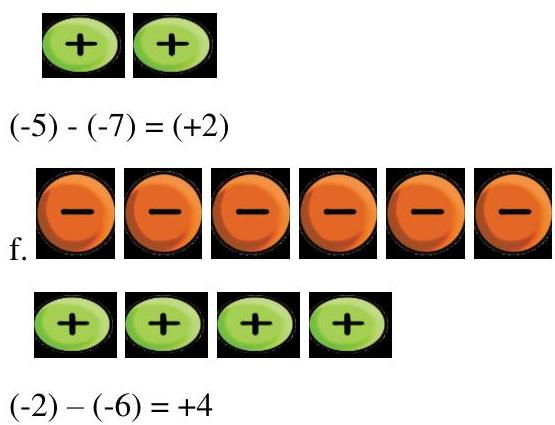
Try for other methods.
Q.2. Complete the subtractions:
a. $(-5) - (-7)$
b. $(+10) - (+13)$
c. $(-7) - (-9)$
d. $(+3) - (+8)$
e. $(-2) - (-7)$
f. $(+3) - (+15)$
Ans. a. +2 b. -3 c. +2 d. (-5) e. +5 f. (-12)
Section 10.2
Figure it out
Q.1. Endeavor to subtract: $-3 - (+5)$. How many zero pairs will you be required to introduce? What is the resultant value?
Ans. -8
Five zero pairs must be incorporated.
Q.2. Determine the value of the following expressions using tokens.
a. $(-3) - (+10)$
b. $(+8) - (-7)$
c. $(-5) - (+9)$
d. $(-9) - (+10)$
e. $(+6) - (-4)$
f. $(-2) - (+7)$
Ans. a. -13 b. +15 c. -14 d. -19 e. +10 f. -9
Section 10.3
Q. Your updated bank balance is _______. Ans. ₹ $100 + ₹ 60 = ₹ 160$
Q. Your current bank balance stands at _______. Ans. ₹ $160 - ₹ 30 = ₹ 130$
Q. What is your bank balance presently? _______ Is this outcome feasible? Ans. ₹ $130 - ₹ 150 = - ₹ 20$
Q. What is your present balance? _______ Ans. ₹ 180
Section 10.3
Figure it Out
Q1. Imagine beginning with a zero balance in your bank account. Subsequently, you receive credits totaling ₹30, ₹40, and ₹50, followed by debits of ₹40, ₹50, and ₹60. What is the current balance in your bank account? Ans. $(+30) + (+40) + (+50) - (40) - (50) - (60)$ Balance amount in Bank Account = ₹ $(-30)$
Q2. Assume an initial bank account balance of zero. Following this, a series of debits occur: ₹1, ₹2, ₹4, ₹8, ₹16, ₹32, ₹64, and ₹128. Subsequently, a singular credit of ₹256 is applied. Determine the present balance of your bank account. Ans. $(1) - (2) - (4) - (8) - (16) - (32) - (64) - (128) + (256)$ Balance amount in the Bank Account = ₹ 1
Figure it Out
Q.1. Based on the provided geographical cross-section, ascertain and record the corresponding heights for each point:
A ☐ B ☐ C ☐ D ☐ E. ☐ F. ☐ G. ☐
Ans. The approximate heights are determined as follows:
A. $(+1500)$ m B. $(-500)$ m C. $(+300)$ m D. $(-1200)$ m E. $(+1200)$ m F. $(-200)$ m G. $(+100)$ m
Q.2. Which point represents the highest elevation within this geographical cross-section? Which point signifies the lowest elevation?
Ans. The highest point identified is A, while the lowest point is D.
Q.3. Arrange points A, B, ..., G in a sequence ordered by decreasing height. Subsequently, arrange these points in a sequence ordered by increasing height.
Ans.
- A, E, C, G, F, B, D. (Decreasing order)
- D, B, F, G, C, E, A. (Increasing order)
Q.4. What constitutes the Earth's highest point above sea level? What is its measured height?
Ans. Mount Everest. Its elevation above sea level measures 8848 meters.
Q.5. Identify the lowest geological point, whether terrestrial or oceanic, relative to sea level. State its depth, which should be expressed as a negative value.
Ans. The deepest known location on Earth is the Challenger Deep, situated within the Mariana Trench in the Pacific Ocean. Its approximate depth is -10994 meters.
Figure it Out
Q.2 Leh, located in Ladakh, experiences extremely low temperatures during the winter season. Presented below is a compilation of temperature measurements recorded at various intervals throughout a specific November day and night in Leh. The task is to correlate each temperature value with its corresponding time of day or night.
Ans.
| Temperature | Time |
|---|---|
| 14°C | 02:00 p.m. |
| 8°C | 11:00 a.m |
| -2°C | 11:00 p.m. |
| -4°C | 02:00 a.m. |
Section 10.4
Figure it Out
Q.1 Perform the necessary computations for the aforementioned second grid to ascertain its border sum.
Ans. -3, -3, -3, -3
Q.2 Populate the provided grids to achieve the specified border sum:
Ans. One of the ways:
| -10 | 10 | 4 |
|---|---|---|
| 5 | -5 | |
| 9 | -10 | 5 |
Border sum +4
| 6 | 8 | -16 |
|---|---|---|
| 11 | -5 | |
| -19 | -2 | 19 |
Border sum -2
| 7 | -2 | -9 |
|---|---|---|
| -3 | -5 | |
| -8 | -6 | 10 |
Border sum -4
Think of other ways.
Figure it Out
Q.2
| 7 | 10 | 13 | 16 |
|---|---|---|---|
| -2 | 1 | 4 | 7 |
| -11 | -8 | -5 | -2 |
| -20 | -7 | -14 | -11 |
-8
| -11 | -10 | -9 | -8 |
|---|---|---|---|
| -7 | -6 | -5 | -4 |
| -3 | -2 | -1 | 0 |
| 1 | 2 | 3 | 4 |
-14
Figure it Out
Q.1 List all integers situated between the specified pairs, arranged in ascending order.
a. 0 and -7
b. -4 and 4
c. -8 and -15
d. -30 and -23
Ans. a. -6, -5, -4, -3, -2, -1 b. -3, -2, -1, 0, 1, 2, 3 c. -14, -13, -12, -11, -10, -9 d. -29, -28, -27, -26, -25, -24
Q.2 Provide a set of three numerical values whose collective sum equates to $-8$ .
Ans. One of the combinations is -5,7,-10.
Think of other combinations.
Q.3 Consider two dice, each bearing the integers: $-1, 2, -3, 4, -5, 6$ . The minimal sum achievable when casting these dice is $-10$, resulting from $(-5) + (-5)$, while the maximal sum is $12$, obtained from $(6) + (6)$. Identify the integer values falling between $(-10)$ and $(+12)$ that cannot be produced by summing the numbers displayed on these two dice.
Ans. $-9, -7, -5, 0, 2, 7, 9, 11$
Q.4 Determine the solutions for the following expressions:
| 8-13 | (-8)-(13) | (-13)-(-8) | (-13)+(-8) |
|---|---|---|---|
| 8+(-13) | (-8)-(-13) | (13)-8 | 13-(-8) |
Ans.
| -5 | -21 | -5 | -21 |
|---|---|---|---|
| -5 | 5 | 5 | 21 |
Q.5 For each scenario presented, identify the specified year.
a. Relative to the current year, which year transpired 150 years prior? __________
b. Considering the present year, what year occurred 2200 years in the past? __________
Hint: It is important to remember that the calendar system does not include a year zero.
c. What year will correspond to a point 320 years subsequent to 680 BCE? __________
Ans. c. -360 BCE
Q.6 Extend the given numerical sequences by filling in the missing terms:
a. $(-40), (-34), (-28), (-22), \ldots, \ldots, \ldots$
b. $3, 4, 2, 5, 1, 6, 0, 7, \ldots, \ldots, \ldots$
c. $\ldots, \ldots, 12, 6, 1, (-3), (-6), \ldots, \ldots, \ldots$
Ans. a. -16, -10, -4 b. -1,8, -2 c. 27, 19, ... -8, -9, -9
Q.7 You are provided with six integer cards: $(+1), (+7), (+18), (-5), (-2), (-9)$. From these, you are permitted to select any subset and construct an arithmetic expression utilizing addition and/or subtraction operations. For instance, the expression $(+18) + (+1) - (+7) - (-2)$ yields a value of $(+14)$. Your task is now to choose cards and formulate an expression whose resulting value approximates $(-30)$ as closely as possible.
Ans. One illustrative calculation yielding this outcome is: $(-2) + (-9) - (+18) - (+1) = -30$
Q.8 It is established that the summation of two positive integers invariably yields a positive result, whereas the subtraction of one positive integer from another can produce either a positive or a negative value. Considering this, what can be stated regarding the following operations?
a. (positive) – (negative)
b. (positive) + (negative)
c. (negative) + (negative)
d. (negative) – (negative)
e. (negative) – (positive)
f. (negative) + (positive)
Ans. a. positive b. can be positive or negative c. negative d. can be positive or negative e. negative f. can be positive or negative
Q.9 A sequence comprising 100 distinct tokens is arranged according to a specific organizational principle. Determine the cumulative value of this particular sequence.

Ans. 20