Chapter 4
International Organisations
OVERVIEW
In this chapter we shall discuss the role of international organisations after the collapse of the Soviet Union. We shall examine how, in this emerging world, there were calls for the restructuring of international organisations to cope with various new challenges including the rise of US power. The potential reform of the United Nations Security Council is an interesting case of the reform process and its difficulties. We then turn to India's involvement in the UN and its view of Security Council reforms. The chapter closes by asking if the UN can play any role in dealing with a world dominated by one superpower. In this chapter we also look at some other transnational organisations that are playing a crucial role.
This is the United Nations' logo. The emblem has a world map with olive branches around it, signifying world peace. Credit: www.un.org
WHY INTERNATIONAL ORGANISATIONS?
Read the two cartoons on this page. Both the cartoons comment on the ineffectiveness of the United Nations Organisation, usually referred to as the UN, in the Lebanon crisis in 2006. Both the cartoons represent the kind of opinions that we often hear about the UN.
On the other hand, we also find that the UN is generally regarded as the most important international organisation in today's world. In the eyes of many people all over the world, it is indispensable and represents the great hope of humanity for peace and progress. Why do we then need organisations like the UN? Let us hear two insiders:
That's what they say about the parliament too — a talking shop. Does it mean that we need talking shops?
"Talking shop? Yes, there are a lot of speeches and meetings at the U.N., especially during the annual sessions of the General Assembly. But as Churchill put it, jaw-jaw is better than war-war. Isn't it better to have one place where all... countries in the world can get together, bore each other sometimes with their words rather than bore holes into each other on the battlefield?" — Shashi Tharoor, the former UN Under-Secretary-General for Communications and Public Information.
"The United Nations was not created to take humanity to heaven, but to save it from hell." Dag Hammarskjold, the UN's second Secretary-General.
These two quotes suggest something important. International organisations are not the answer to everything, but they are important. International organisations help with matters of war and peace. They also help countries cooperate to make better living conditions for us all.
Countries have conflicts and differences with each other. That does not necessarily mean they must go to war to deal with their
antagonisms. They can, instead, discuss contentious issues and find peaceful solutions; indeed, even though this is rarely noticed, most conflicts and differences are resolved without going to war. The role of an international organisation can be important in this context. An international organisation is not a super-state with authority over its members. It is created by and responds to states. It comes into being when states agree to its creation. Once created, it can help member states resolve their problems peacefully.
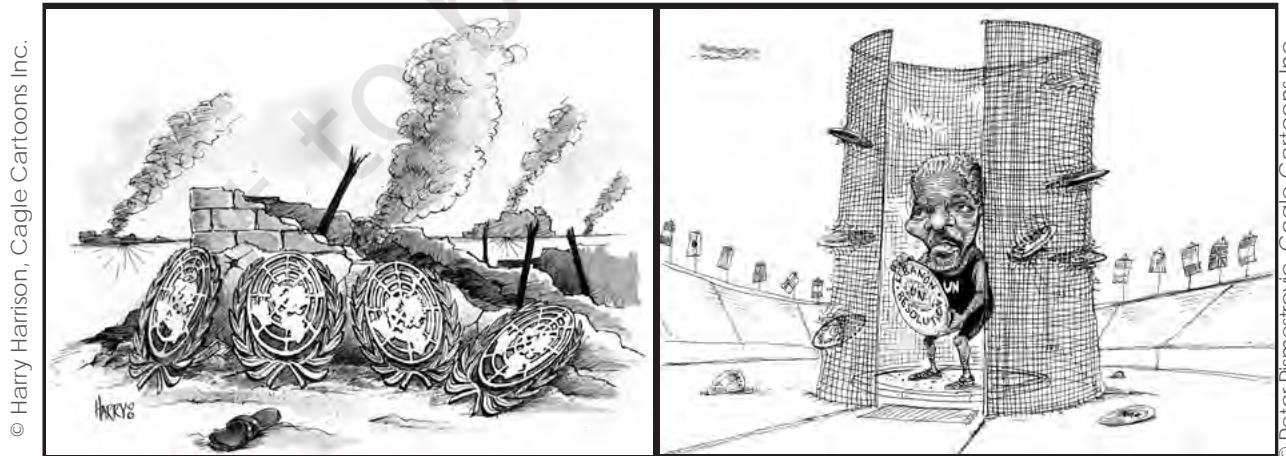 During June 2006, Israel attacked Lebanon, saying that it was necessary to control the militant group called Hezbollah. Large numbers of civilians were killed and many public buildings and even residential areas came under Israeli bombardment. The UN passed a resolution on this only in August and the Israel army withdrew from the region only in October. Both these cartoons comment on the role of the UN and its Secretary-General in this episode.
IMF
The International Monetary Fund (IMF) is an international organisation that oversees those financial institutions and regulations that act at the international level. The IMF has 190 member countries (as on 19 February 2024) but they do not enjoy an equal say. The G-7 members US (16.52%), Japan (6.15%), Germany (5.32%), France (4.03%), UK (4.03%), Italy (3.02%) and Canada (2.22%) have 41.29% of the votes. China (6.09%), India (2.64%), Russia (2.59%), Brazil (2.22%) and Saudi Arabia (2.02%) are the other major members.
International organisations are helpful in another way. Nations can usually see that there are some things they must do together. There are issues that are so challenging that they can only be dealt with when everyone works together. Disease is an example. Some diseases can only be eradicated if everyone in the world cooperates in inoculating or vaccinating their populations. Or take global warming and its effects. As temperatures rise because of the increase in greenhouse gases in the atmosphere, there is a danger that sea levels will also rise, thereby submerging many coastal areas of the world including huge cities. Of course, each country can try to find its own solution to the effects of global warming. But in the end a more effective approach is to stop the warming itself. This requires at least all of the major industrial powers to cooperate.
Unfortunately, recognising the need for cooperation and actually cooperating are two different things. Nations can recognise the need to cooperate but cannot always agree on how best to do so, how to share the costs of cooperating, how to make sure that the benefits of cooperating are justly divided, and how to ensure that others do not break their end of the bargain and cheat on an agreement. An international organisation can help produce information and ideas about how to cooperate. It can provide mechanisms, rules and a bureaucracy, to help members have more confidence that costs will be shared properly, that the benefits will be fairly divided, and that once a member joins an agreement it will honour the terms and conditions of the agreement.
Make a list of issues or problems (other than the ones mentioned in the text) that cannot be handled by any one country and require an international organisation.

FOUNDING OF THE UNITED NATIONS
- 1941 August: Signing of the Atlantic Charter by the US President Franklin D. Roosevelt and British PM Winston S. Churchill
- 1942 January: 26 Allied nations fighting against the Axis Powers meet in Washington, D.C., to support the Atlantic Charter and sign the 'Declaration by United Nations'
- 1943 December: Tehran Conference Declaration of the Three Powers (US, Britain and Soviet Union)
- 1945 February: Yalta Conference of the 'Big Three' (Roosevelt, Churchill and Stalin) decides to organise a United Nations conference on the proposed world organisation
- April-May: The 2-month long United Nations Conference on International Organisation at San Francisco
- 1945 June 26: Signing of the UN Charter by 50 nations (Poland signed on October 15; so the UN has 51 original founding members)
- 1945 October 24: the UN was founded (hence October 24 is celebrated as UN Day)
- 1945 October 30: India joins the UN
With the end of the Cold War, we can see that the UN may have a slightly different role. As the United States and its allies emerged victorious, there was concern amongst many governments and peoples that the Western countries led by the US would be so powerful that there would be no check against their wishes and desires. Can the UN serve to promote dialogue and discussion with the US in particular, and could it limit the power of the American government? We shall try to answer this question at the end of the chapter.
EVOLUTION OF THE UN
The First World War encouraged the world to invest in an international organisation to deal with conflict. Many believed that such an organisation would help the world to avoid war. As a result, the League of Nations was born. However, despite its initial success, it could not prevent the Second World War (1939-45). Many more people died and were wounded in this war than ever before.
The UN was founded as a successor to the League of Nations. It was established in 1945 immediately after the Second World War. The
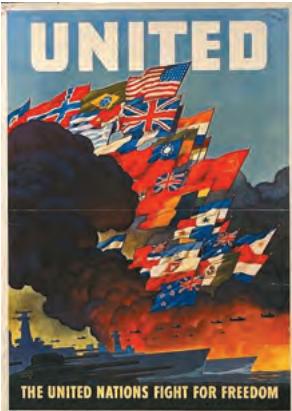
The US Office of War Information created the above poster during the Second World War as per the Declaration by United Nations of 1942. The poster features the flags of all nations that were part of the Allied Forces. It reflects the belligerent origins of the UN.
The United Nations System
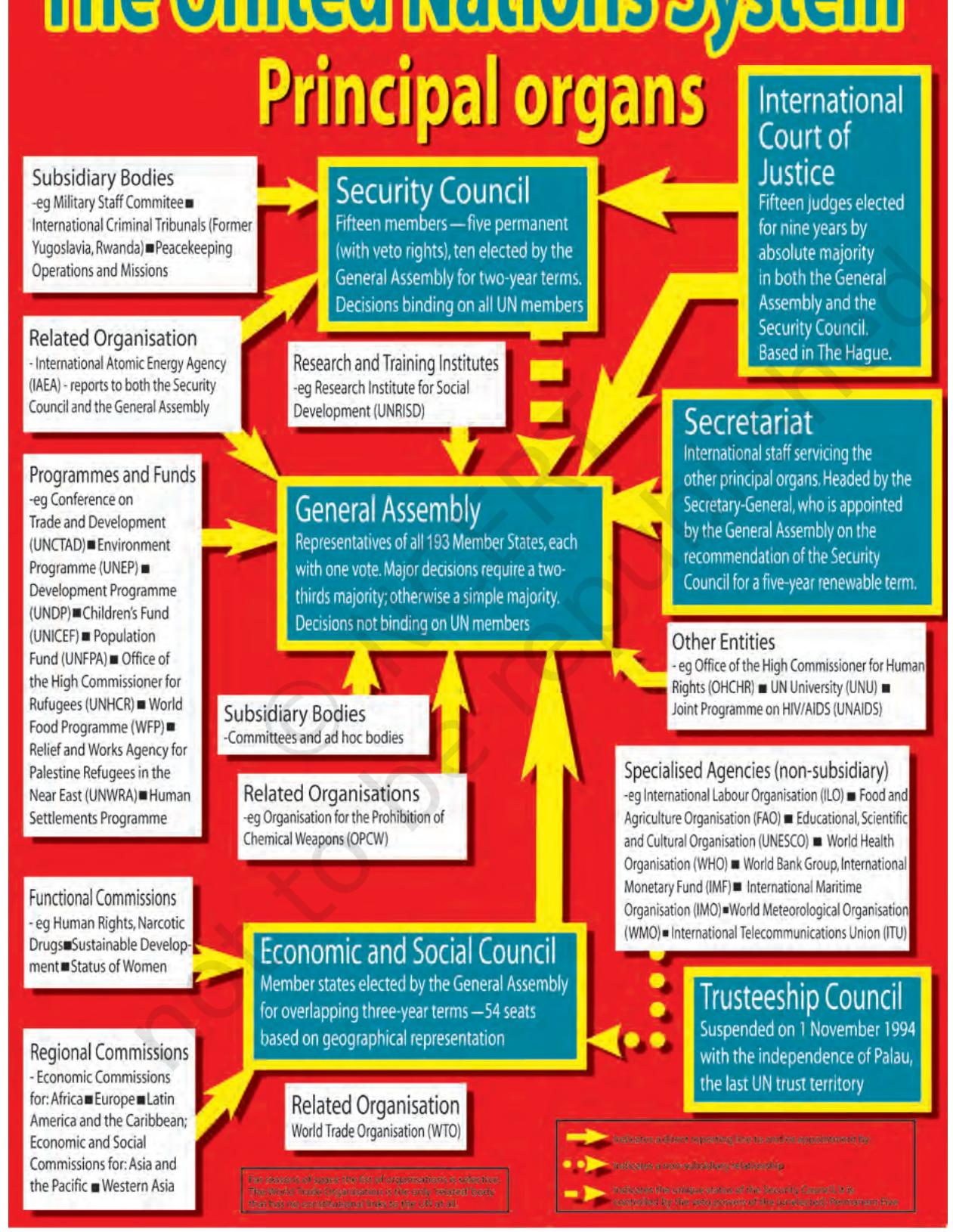 Adapted from http://www.newint.org/issue375/pics/un-map-big.gif For more details about the UN System, visit www.un.org

Search for at least one news item about the activities of each of the UN agencies mentioned on this page.
organisation was set up through the signing of the United Nations Charter by 51 states. It tried to achieve what the League could not between the two world wars. The UN's objective is to prevent international conflict and to facilitate cooperation among states. It was founded with the hope that it would act to stop the conflicts between states escalating into war and, if war broke out, to limit the extent of hostilities. Furthermore, since conflicts often arose from the lack of social and economic development, the UN was intended to bring countries together to improve the prospects of social and economic development all over the world.
By 2011, the UN had 193 member states. These included almost all independent states. In the UN General Assembly, all members have one vote each. In the UN Security Council