In this chapter..
In this last chapter we take a synoptic view of the last two decades of politics in India. These developments are complex, for various kinds of factors came together to produce unanticipated outcomes in this period. The new era in politics was impossible to foresee; it is still very difficult to understand. These developments are also controversial, for these involve deep conflicts and we are still too close to the events. Yet we can ask some questions central to the political change in this period.
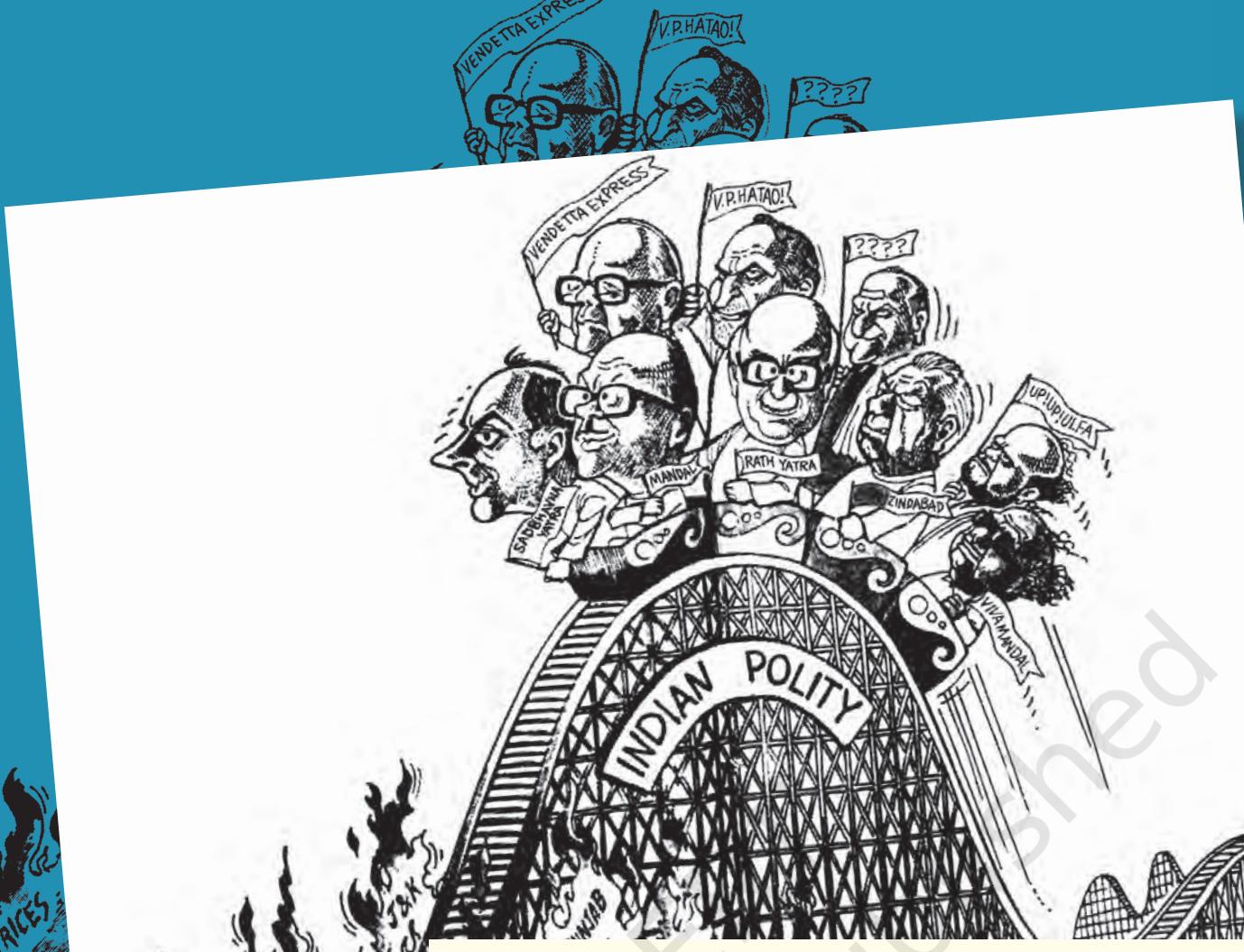
Ups and downs of various political parties in the 1990s appeared to many, like this cartoon drawn in 1990, as a roller coaster ride. Riding the roller coaster are Rajiv Gandhi, V. P. Singh, L. K. Advani, Chandrashekhar, Jyoti Basu, N. T. Rama Rao, Devi Lal, P. K. Mahanta and K. Karunanidhi.
What are the implications of the rise of coalition politics for our democracy? What is Mandalisation all about? In which ways will it change the nature of political representation? What is the legacy of the Ram Janmabhoomi movement? What does the rise of a new policy consensus do to the nature of political choices?
The chapter does not answer these questions. It simply gives you the necessary information and some tools so that you can ask and answer these questions when you are through with this book. We cannot avoid asking these questions just because they are politically sensitive, for the whole point of studying the history of politics in India since Independence is to make sense of our present.
CHAPTER 8
RECENT DEVELOPMENTS IN INDIAN POLITICS
Context of the 1990s
You have read in the last chapter that Rajiv Gandhi became the Prime Minister after the assassination of Indira Gandhi. He led the Congress to a massive victory in the Lok Sabha elections held immediately thereafter in 1984. As the decade of the eighties came to a close, the country witnessed five developments that were to make a long-lasting impact on our politics.
First the most crucial development of this period was the defeat of the Congress party in the elections held in 1989. The party that had won as many as 415 seats in the Lok Sabha in 1984 was reduced to only 197 in this election. The Congress improved its performance and came back to power soon after the mid-term elections held in 1991. But the elections of 1989 marked the end of what political scientists have called the 'Congress system'. To be sure, the Congress remained an important party and ruled the country more than any other party even in this period since 1989. But it lost the kind of centrality it earlier enjoyed in the party system.
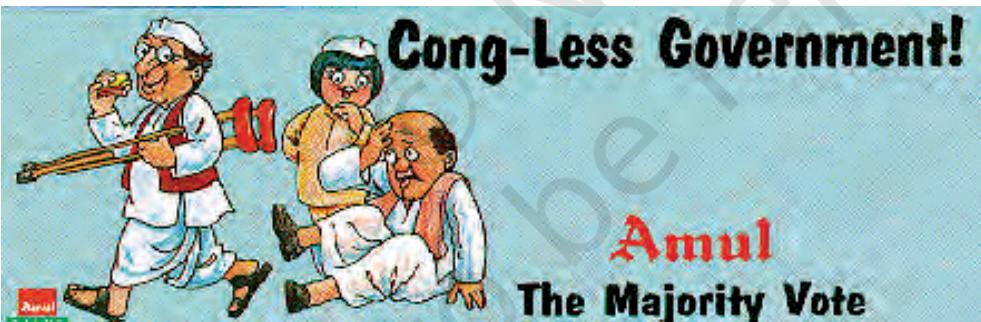 Congress leader Sitaram Kesri withdrew the crutches of support from Deve Gowda's United Front Government.
Second development was the rise of the ‘Mandal issue’ in national politics. This followed the decision by the new National Front government in 1990, to implement the recommendation of the Mandal Commission that jobs in central government should be reserved for the Other Backward Classes. This led to violent 'anti-Mandal' protests in different parts of the country. This dispute between the supporters and opponents of OBC reservations was known as the 'Mandal issue' and was to play an important role in shaping politics since 1989.
Third, the economic policy followed by the various governments took a radically different turn. This is known as the initiation of the structural adjustment programme or the new economic reforms. Started by Rajiv Gandhi, these changes first became very visible in 1991 and radically changed the direction that the Indian economy had pursued since Independence. These policies have been widely criticised by various movements and organisations. But the various governments that came to power in this period have continued to follow these.
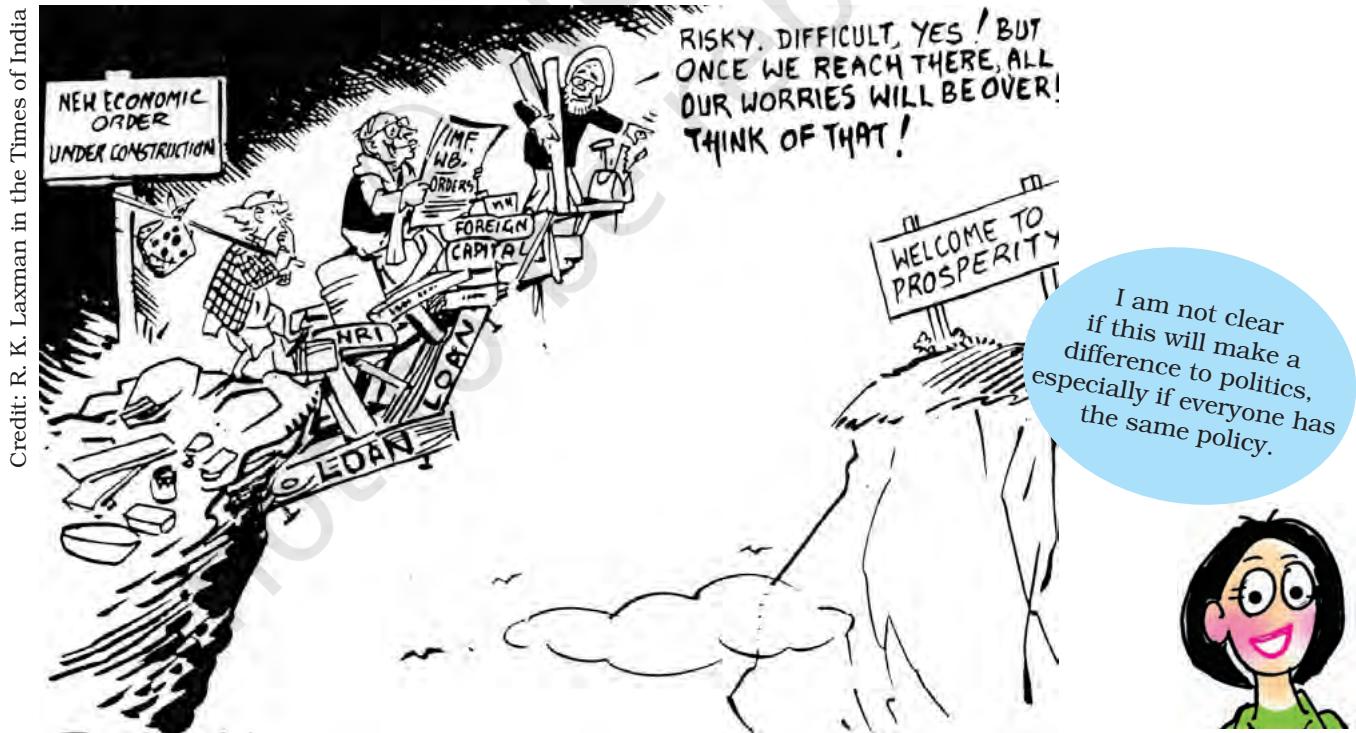 Manmohan Singh, the then Finance Minister, with Prime Minister Narsimha Rao, in the initial phase of the 'New Economic Policy'.
Fourth, the centuries old legal and political dispute over the Ram Janmabhoomi Temple in Ayodhya started influencing the politics of India which gave birth to various political changes. Ram Janmabhoomi Temple in Ayodhya started influencing the politics of India which gave birth to various political changes. The Ram Janmabhoomi Temple Movement, becoming the central issue, transformed the direction of the discourse on secularism and democracy. These changes culminated in the construction of the Ram Temple at Ayodhya following the decision of the constitutional bench of the Supreme Court (which was announced on November 9, 2019).
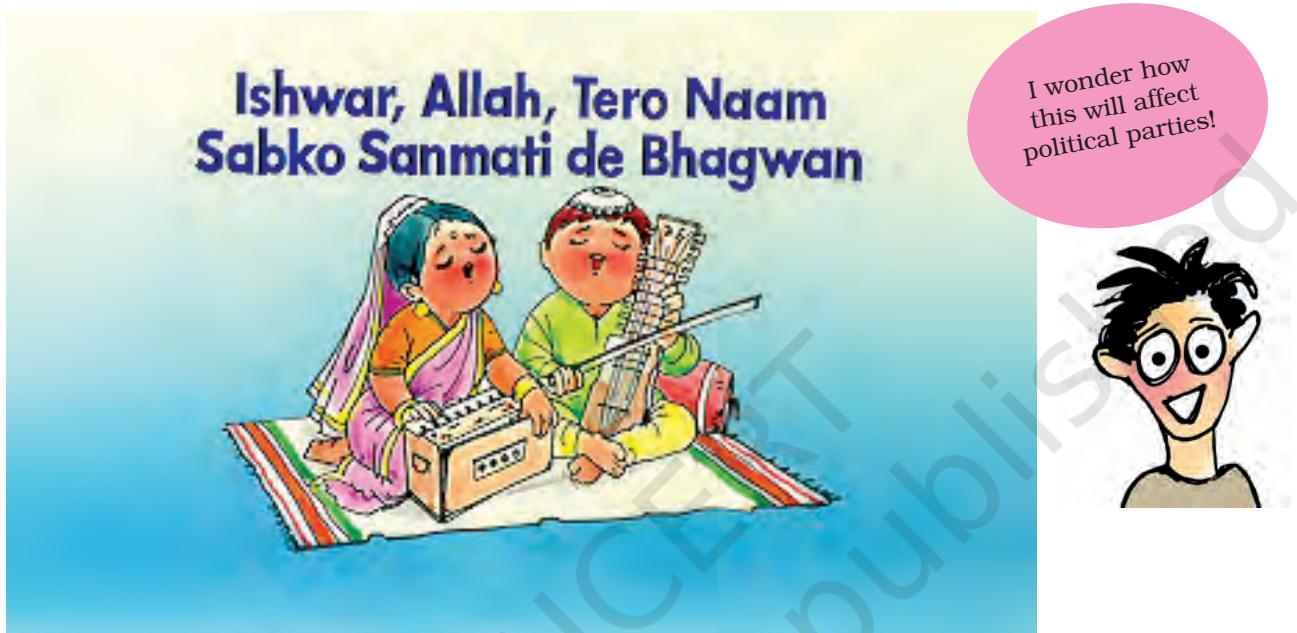 Message of Harmony
Finally, the assassination of Rajiv Gandhi in May 1991 led to a change in leadership of the Congress party. He was assassinated by a Sri Lankan Tamil linked to the LTTE when he was on an election campaign tour in Tamil Nadu. In the elections of 1991, Congress emerged as the single largest party. Following Rajiv Gandhi's death, the party chose Narasimha Rao as the Prime Minister.
Message of Harmony
Finally, the assassination of Rajiv Gandhi in May 1991 led to a change in leadership of the Congress party. He was assassinated by a Sri Lankan Tamil linked to the LTTE when he was on an election campaign tour in Tamil Nadu. In the elections of 1991, Congress emerged as the single largest party. Following Rajiv Gandhi's death, the party chose Narasimha Rao as the Prime Minister.
Leadership in Congress made many headlines.
Era of Coalitions
Elections in 1989 led to the defeat of the Congress party but did not result in a majority for any other party. Though the Congress was the largest party in the Lok Sabha, it did not have a clear majority and therefore, it decided to sit in the opposition. The National Front (which itself was an alliance of Janata Dal and some other regional parties) received support from two diametrically opposite political groups: the BJP and the Left Front. On this basis, the National Front formed a coalition government, but the BJP and the Left Front did not join in this government.
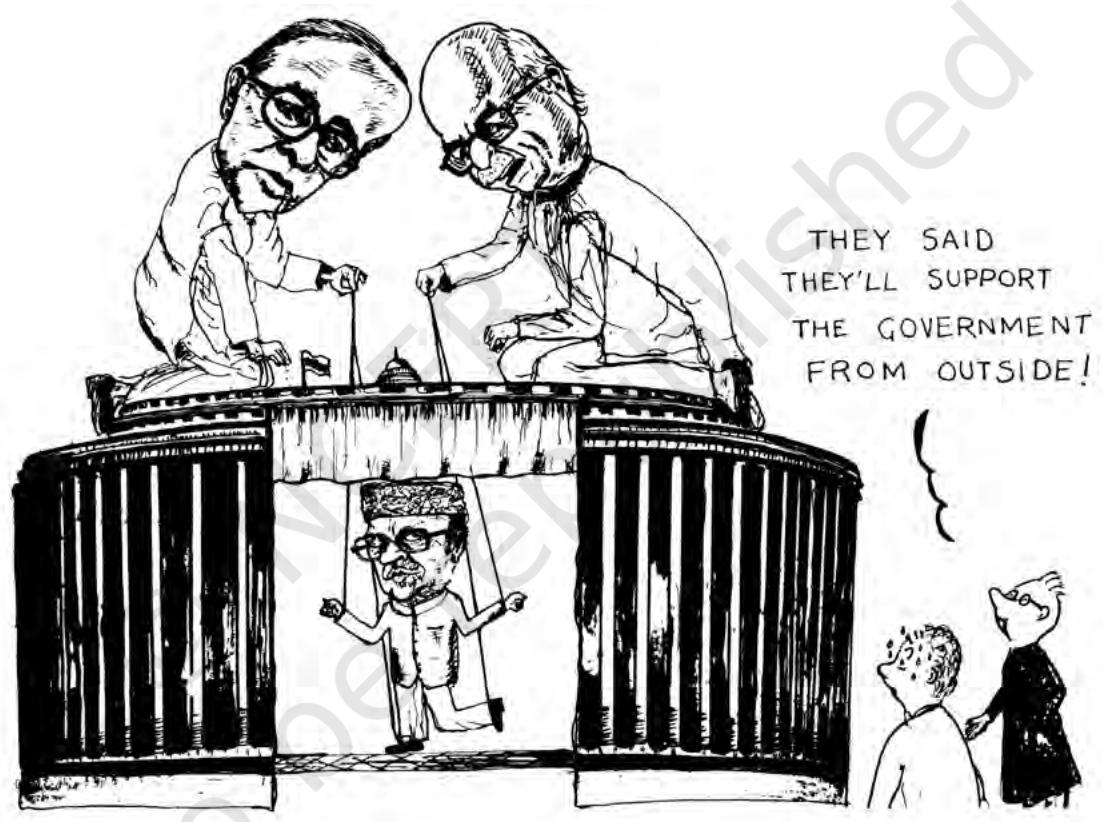
The National Front Government led by V. P. Singh was supported by the Left (represented here by Jyoti Basu) as well as the BJP (represented by L. K. Advani)
Decline of Congress
The defeat of the Congress party marked the end of Congress dominance over the Indian party system. Do you remember the discussion in Chapters about the restoration of the Congress system? Way back in the late sixties, the dominance of the Congress party was challenged; but the Congress under the leadership of Indira Gandhi, managed to re-establish its predominant position in politics. The nineties saw yet another challenge to the predominant position of the Congress. It did not, however, mean the emergence of any other single party to fill in its place.
Thus, began an era of multi-party system. To be sure, a large number of political parties always contested elections in our country. Our Parliament always had representatives from several political parties. What happened after 1989 was the emergence of several parties in such a way that one or two parties did not get most of the votes or seats. This also meant that no single party secured a clear majority of seats in any Lok Sabha election held since 1989 till 2014. This development initiated an era of coalition governments at the Centre, in which regional parties played a crucial role in forming ruling alliances but in 2014 and 2019 Lok Sabha election, the BJP got clear majority on its own.
Talk to your parents about their memories of the events happening since the 1990s. Ask them what they felt were the most significant events of the period. Sit together in groups and draw a comprehensive list of the events reported by your parents, see which events get cited most, and compare them with what the chapter suggests were the most significant. You can also discuss why some events are more important for some and not for others.
Alliance politics
The nineties also saw the emergence of powerful parties and movements that represented the Dalit and backward castes (Other Backward Classes or OBCs). Many of these parties represented powerful regional assertion as well. These parties played an important role in the United Front government that came to power in 1996. The United Front was similar to the National Front of 1989 for it included Janata Dal and several regional parties. This time the BJP did not support the government. The United Front government was supported by the Congress. This shows how unstable the political equations were. In 1989, both the Left and the BJP supported the National Front Government because they wanted to keep the Congress out of power. In 1996, the Left continued to support the non-Congress government but this time the Congress, supported it, as both the Congress and the Left wanted to keep the BJP out of power.
They did not succeed for long, as the BJP continued to consolidate its position in the elections of 1991 and 1996. It emerged as the largest party in the 1996 election and was invited to form the government. But most other parties were opposed to its policies and therefore, the BJP government could not secure a majority in the Lok Sabha. It finally came to power by leading
a coalition government from May 1998 to June 1999 and was re-elected in October 1999. Atal Bihari Vajpayee was the Prime Minister during both these NDA governments and his government formed in 1999 completed its full term.
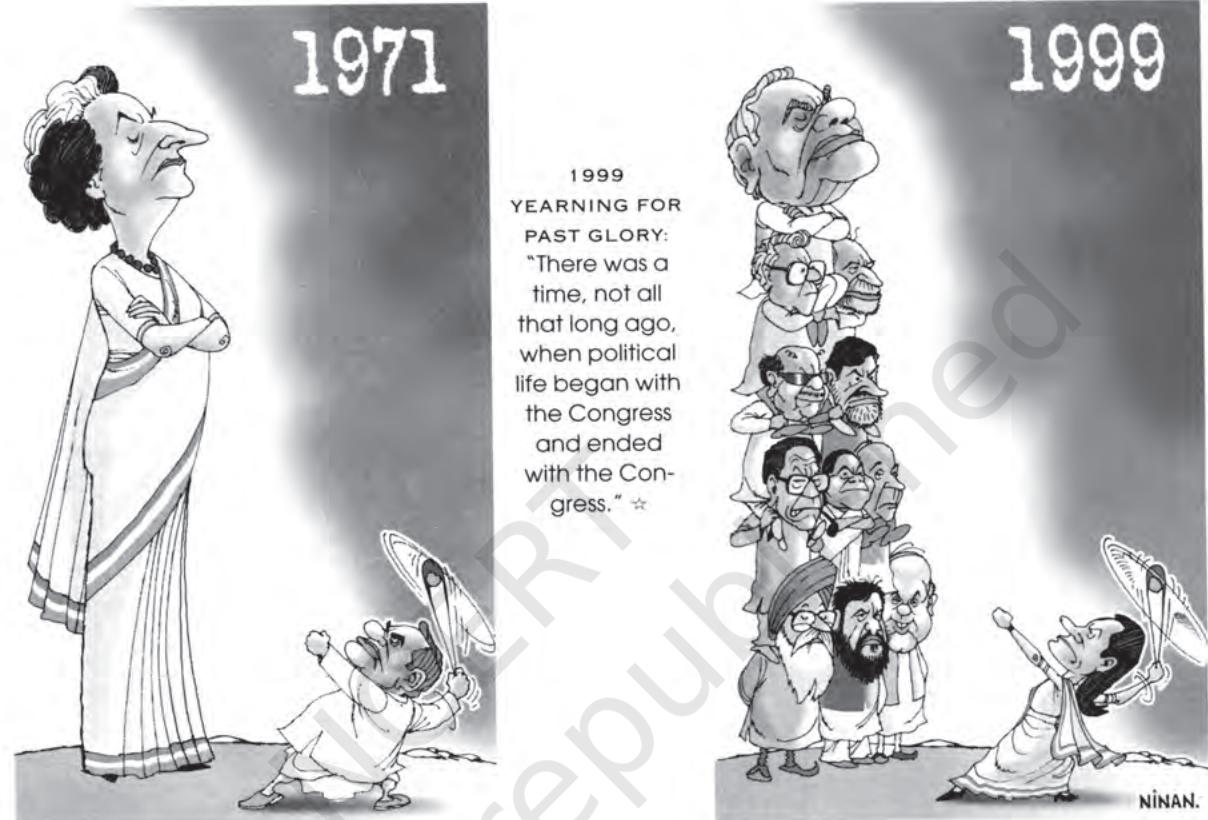 A cartoonist's depiction of the change from one-party dominance to a multi-party alliance system.
Thus, with the elections of 1989