CHAPTER 11 : AREA RELATED TO CIRLES
11.1 Areas of Sector and Segment of a Circle
You have already come across the terms sector and segment of a circle in your earlier classes. Recall that the portion (or part) of the circular region enclosed by two radii and the corresponding arc is called a sector of the circle and the portion (or part) of the circular region enclosed between a chord and the corresponding arc is called a segment of the circle. Thus, in Fig. 11.1, shaded region OAPB is a sector of the circle with centre O. $\angle \mathrm { \ A O B }$ is called the angle of the sector. Note that in this figure, unshaded region OAQB is also a sector of the circle. For obvious reasons, OAPB is called the minor sector and OAQB is called the major sector. You can also see that angle of the major sector is $3 6 0 ^ { \circ } - \angle \mathrm { A O B }$ .
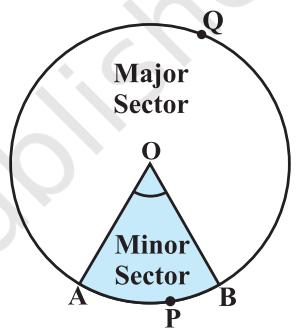
Fig. 11.1
Now, look at Fig. 11.2 in which AB is a chord of the circle with centre O. So, shaded region APB is a segment of the circle. You can also note that unshaded region AQB is another segment of the circle formed by the chord AB. For obvious reasons, APB is called the minor segment and AQB is called the major segment.
Remark : When we write 'segment' and 'sector' we will mean the 'minor segment' and the 'minor sector' respectively, unless stated otherwise.

Fig. 11.2
Now with this knowledge, let us try to find some relations (or formulae) to calculate their areas.
Let OAPB be a sector of a circle with centre 0 and radius $r$ (see Fig. 11.3). Let the degree measure of $\angle \mathrm { \ A O B }$ be θ.
You know that area of a circle (in fact of a circular region or disc) is $\pi r ^ { 2 }$ .
In a way, we can consider this circular region to be a sector forming an angle of $3 6 0 ^ { \circ }$ (i.e., of degree measure 360) at the centre O. Now by applying the Unitary Method, we can arrive at the area of the sector OAPB as follows:
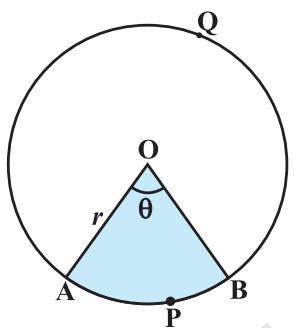
Fig. 11.3
When degree measure of the angle at the centre is 360, area of the sector $\mathbf { \mu } = \pi r ^ { 2 }$
So, when the degree measure of the angle at the centre is 1, area of the s $\mathrm { { z c t o r } } = { \frac { \pi r ^ { 2 } } { 3 6 0 } } \cdotp 1$
Therefore, when the degree measure of the angle at the centre is 0, area of the ${ \mathrm { s e c t o r } } = { \frac { \pi r ^ { 2 } } { 3 6 0 } } \times \theta = { \frac { \theta } { 3 6 0 } } \times \pi r ^ { 2 } .$
Thus, we obtain the following relation (or formula) for area of a sector of a circle:
Area of the sector of angle $\theta = { \frac { \theta } { 3 6 0 } } \times \pi r ^ { 2 }$ where $r$ is the radius of the circle and O the angle of the sector in degrees.
Now, a natural question arises : Can we find the length of the arc APB corresponding to this sector? Yes. Again, by applying the Unitary Method and taking the whole length of the circle (of angle $3 6 0 ^ { \circ } )$ as $2 \pi r$. we can obtain the required length of the arc APB as ${ \frac { \theta } { 3 6 0 } } \times 2 \pi r$ .
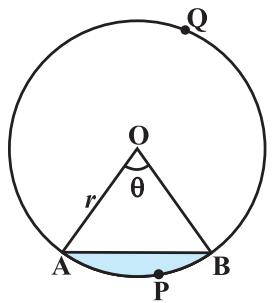
Fig. 11.4
So, length of an arc of a sector of angle $\theta = \frac { \theta } { 3 6 0 } \times 2 \pi r$ .
Now let us take the case of the area of the segment APB of a circle with centre O and radius $r$ (see Fig. 11.4). You can see that :
Area of the segment APB $=$ Area of the sector OAPB – Area of $\Delta$ OAB $= { \frac { \theta } { 3 6 0 } } \times \pi r ^ { 2 } - \mathrm { a r e a ~ o f ~ } \Delta \mathrm { O A B }$
Note : From Fig. 11.3 and Fig. 11.4 respectively, you can observe that:
Area of the major sector ${ \bf O A Q B } = \pi r ^ { 2 } - $ Area of the minor sector OAPB and Area of major segment $\mathbf { A Q B } = \pi r ^ { 2 } - $ Area of the minor segment APB
Let us now take some examples to understand these concepts (or results).
Example 1 : Find the area of the sector of a circle with radius $4 \mathrm { c m }$ and of angle $3 0 ^ { \circ }$ . Also, find the area of the corresponding major sector (Use $\pi = 3 . 1 4$) .
Solution : Given sector is OAPB (see Fig. 11.5).
Area of the sector = X πr 360
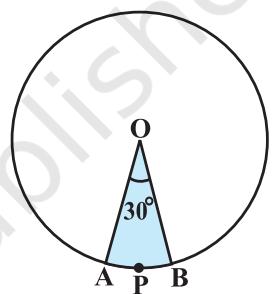
Fig. 11.5
Area of the corresponding major sector
$ { \begin{array} { r l } & { = \pi r ^ { 2 } - { \mathrm { a r e a ~ o f ~ s e c t o r ~ O A P B } } } \ & { = ( 3 . 1 4 \times 1 6 - 4 . 1 9 ) { \mathrm { ~ c m } } ^ { 2 } } \ & { = 4 6 . 0 5 { \mathrm { c m } } ^ { 2 } = 4 6 . 1 { \mathrm { ~ c m } } ^ { 2 } ( { \mathrm { a p p r o x . } } ) } \end{array} } $
Alternatively, area of the major sector = (360 - θ) πr2 360
Example $\textsf { 2 } :$ Find the area of the segment AYB shown in Fig. 11.6, if radius of the circle is $2 1 \mathrm { c m }$ and
$\angle { \mathrm { A O B } } = 1 2 0 ^ { \circ }$ (Use $\pi = { \frac { 2 2 } { 7 } }$)
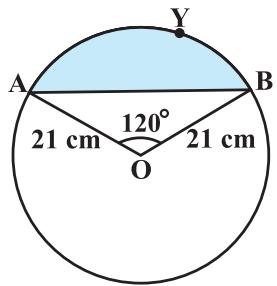
Fig. 11.6
Solution : Area of the segment AYB
$=$ Area of sector OAYB – Area of $\Delta$ OAB
Now, area of the sector ${ \mathrm { O A Y B } } = { \frac { 1 2 0 } { 3 6 0 } } \times { \frac { 2 2 } { 7 } } \times 2 1 \times 2 1 { \mathrm { c m } } ^ { 2 } = 4 6 2 { \mathrm { c m } } ^ { 2 }$
For finding the area of $\Delta$ OAB, draw $\mathrm { O M } \perp \mathrm { A B }$ as shown in Fig. 11.7.
Note that $\mathbf { \mathrm { O A } } = \mathbf { \mathrm { O B } }$ . Therefore, by RHS congruence, $\Delta \mathrm { A M O } \cong \Delta$ BMO.
So, M is the mid-point of AB and $\angle \mathrm { A O M } = \angle \mathrm { B O M } = { \frac { 1 } { 2 } } \times 1 2 0 ^ { \circ } = 6 0 ^ { \circ } .$
Let
So, from $\Delta$ OMA,
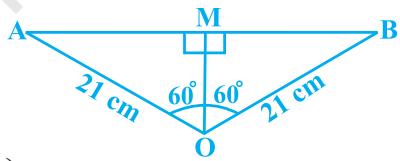
Fig. 11.7
or,
$ \frac{x}{21} = \frac{1}{2} \qquad (\cos 60^\circ = \frac{1}{2}) $
or,
$ x = \frac{21}{2} $
So,
$ OM = \frac{21}{2}\text{ cm} $
Also,
$ \frac{AM}{OA} = \sin 60^\circ = \frac{\sqrt{3}}{2} $
So,
$ AM = \frac{21\sqrt{3}}{2}\text{ cm} $
Therefore,
$ AB = 2AM = \frac{2 \times 21\sqrt{3}}{2}\text{ cm} = 21\sqrt{3}\text{ cm} $
So, area of triangle (OAB)
$ = \frac{1}{2} \times AB \times OM $
$ = \frac{1}{2} \times 21\sqrt{3} \times \frac{21}{2}\text{ cm}^2 $
$ = \frac{441}{4}\sqrt{3}\text{ cm}^2 \qquad (3) $
Therefore, area of the segment (AYB)
$ = \left( 462 - \frac{441}{4}\sqrt{3} \right)\text{ cm}^2 \qquad \text{[From (1), (2) and (3)]} $
$ = \frac{21}{4}(88 - 21\sqrt{3})\text{ cm}^2 $
EXERCISE 11.1
(Unless stated otherwise, use $\pi = { \frac { 2 2 } { 7 } }$)
Find the area of a sector of a circle with radius $6 \mathrm { { c m } }$ if angle of the sector is $6 0 ^ { \circ }$ .
Find the area of a quadrant of a circle whose circumference is $2 2 \mathrm { c m }$ .
The length of the minute hand of a clock is $1 4 \mathrm { c m }$. Find the area swept by the minute hand in 5 minutes.
A chord of a circle of radius $1 0 \mathrm { c m }$ subtends a right angle at the centre. Find the area of the corresponding : (i) minor segment (i) major sector. (Use $\pi = 3 . 1 4$)
In a circle of radius $2 1 \mathrm { c m }$ an arc subtends an angle of $6 0 ^ { \circ }$ at the centre. Find: (i) the length of the arc(ii) area of the sector formed by the arc (ii) area of the segment formed by the corresponding chord
A chord of a circle of radius $1 5 \ \mathrm { c m }$ subtends an angle of $6 0 ^ { \circ }$ at the centre. Find the areas of the corresponding minor and major
segments of the circle. (Use $\pi = 3 . 1 4$ and ${ \sqrt { 3 } } = 1 . 7 3$)
7. A chord of a circle of radius $1 2 \ \mathrm { c m }$ subtends an angle of $1 2 0 ^ { \circ }$ at the centre. Find the area of the corresponding segment of the circle. (Use $\pi = 3 . 1 4$ and ${ \sqrt { 3 } } = 1 . 7 3$)
8. A horse is tied to a peg at one corner of a square shaped grass field of side $1 5 \mathrm { m }$ by means of a $5 \mathrm { m }$ long rope (see Fig. 11.8). Find
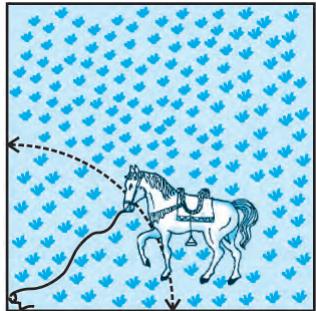
Fig. 11.8
(i) the area of that part of the field in which the horse can graze.
(ii) the increase in the grazing area if the rope were $1 0 \mathrm { m }$ long instead of $5 \mathrm { m }$ (Use $\pi = 3 . 1 4$)
- A brooch is made with silver wire in the form of a circle with diameter $3 5 \mathrm { m m }$. The wire is also used in making 5 diameters which divide the circle into 10 equal sectors as shown in Fig. 11.9.Find :
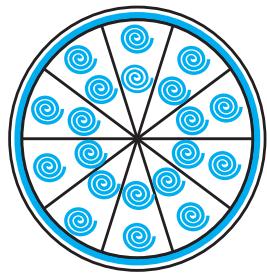
Fig. 11.9
(i) the total length of the silver wire required.
(ii) the area of each sector of the brooch.
An umbrella has 8 ribs which are equally spaced (see Fig. 11.10). Assuming umbrella to be a flat circle of radius $4 5 \mathrm { { c m } }$ find the area between the two consecutive ribs of the umbrella.
A car has two wipers which do not overlap. Each wiper has a blade of length $2 5 ~ \mathrm { c m }$ sweeping through an angle of $1 1 5 ^ { \circ }$ . Find the total area cleaned at each sweep of the blades.
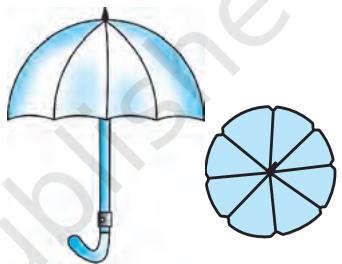
Fig. 11.10
To warn ships for underwater rocks, a lighthouse spreads a red coloured light over a sector of angle $8 0 ^ { \circ }$ to a distance of $1 6 . 5 \mathrm { k m }$ . Find the area of the sea over which the ships are warned. (Use $\pi { = } 3 . 1 4$)
A round table cover has six equal designs as shown in Fig. 11.11. If the radius of the cover is $2 8 \mathrm { c m }$ , find the cost of making the designs at the rate of $₹ 0.35\mathrm { p e r c m } ^ { 2 }$ (Use $\sqrt{3} \approx 1.7$)
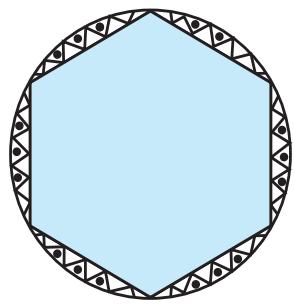
Fig. 11.11
- Tick the correct answer in the following : Area of a sector of angle $p$ (in degrees) of a circle with radius R is
(A) $\frac { p } { 1 8 0 } \times 2 \pi \mathrm { R }$ (B) $\frac { p } { 1 8 0 } \times \pi \mathrm { R } ^ { 2 }$ (C) 360 × 2πR (D) $\frac { p } { 7 2 0 } \times 2 \pi \mathrm { R } ^ { 2 }$
11.2 Summary
In this chapter, you have studied the following points :
Length of an arc of a sector of a circle with radius $r$ and angle with degree measure O is ${ \frac { \theta } { 3 6 0 } } \times 2 \pi r$.
Area of a sector of a circle with radius $r$ and angle with degree measure $\theta$ is ${ \frac { \theta } { 3 6 0 } } \times \pi r ^ { 2 }$
Area of segment of a circle $=$ Area of the corresponding sector — Area of the corresponding triangle.