INTRODUCTION TO TRIGONOMETRY
There is perhaps nothing which so occupies the middle position of mathematics as trigonometry.
– J.F. Herbart (1890)
8.1 Introduction
You have already studied about triangles, and in particular, right triangles, in your earlier classes. Let us take some examples from our surroundings where right triangles can be imagined to be formed. For instance:
Suppose the students of a school are visiting Qutub Minar. Now, if a student is looking at the top of the Minar, a right triangle can be imagined to be made, as shown in Fig 8.1. Can the student find out the height of the Minar, without actually measuring it?
Suppose a girl is sitting on the balcony of her house located on the bank of a river. She is looking down at a flower pot placed on a stair of a temple situated nearby on the other bank of the river. A right triangle is imagined to be made in this situation as shown in Fig.8.2. If you know the height at which the person is sitting, can you find the width of the river?
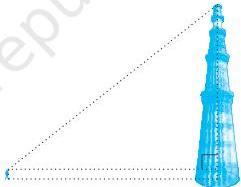 Fig. 8.1
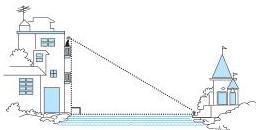 Fig. 8.2
Reprint 2025-26
MATHEMATICS
- Suppose a hot air balloon is flying in the air. A girl happens to spot the balloon in the sky and runs to her mother to tell her about it. Her mother rushes out of the house to look at the balloon. Now when the girl had spotted the balloon initially it was at point A. When both the mother and daughter came out to see it, it had already travelled to another point B. Can you find the altitude of B from the ground?
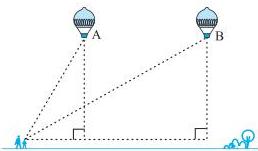 Fig. 8.3
In all the situations given above, the distances or heights can be found by using some mathematical techniques, which come under a branch of mathematics called 'trigonometry'. The word 'trigonometry' is derived from the Greek words 'tri' (meaning three), 'gon' (meaning sides) and 'metron' (meaning measure). In fact, trigonometry is the study of relationships between the sides and angles of a triangle. The earliest known work on trigonometry was recorded in Egypt and Babylon. Early astronomers used it to find out the distances of the stars and planets from the Earth. Even today, most of the technologically advanced methods used in Engineering and Physical Sciences are based on trigonometrical concepts.
In this chapter, we will study some ratios of the sides of a right triangle with respect to its acute angles, called trigonometric ratios of the angle. We will restrict our discussion to acute angles only. However, these ratios can be extended to other angles also. We will also define the trigonometric ratios for angles of measure $0^{\circ}$ and $90^{\circ}$ . We will calculate trigonometric ratios for some specific angles and establish some identities involving these ratios, called trigonometric identities.
8.2 Trigonometric Ratios
In Section 8.1, you have seen some right triangles imagined to be formed in different situations.
Let us take a right triangle ABC as shown in Fig. 8.4.
Here, $\angle$ CAB (or, in brief, angle A) is an acute angle. Note the position of the side BC with respect to angle A. It faces $\angle$ A. We call it the side opposite to angle A. AC is the hypotenuse of the right triangle and the side AB is a part of $\angle$ A. So, we call it the side adjacent to angle A.
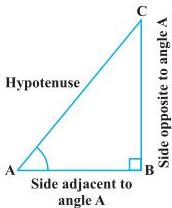 Fig. 8.4
Reprint 2025-26
INTRODUCTION TO TRIGONOMETRY
Note that the position of sides change when you consider angle C in place of A (see Fig. 8.5).
You have studied the concept of 'ratio' in your earlier classes. We now define certain ratios involving the sides of a right triangle, and call them trigonometric ratios.
The trigonometric ratios of the angle A in right triangle ABC (see Fig. 8.4) are defined as follows:
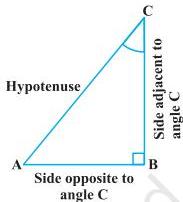 Fig. 8.5
$ \text{sine of } \angle A = \frac{\text{side opposite to angle } A}{\text{hypotenuse}} = \frac{BC}{AC} $
$ \text{cosine of } \angle A = \frac{\text{side adjacent to angle } A}{\text{hypotenuse}} = \frac{AB}{AC} $
$ \text{tangent of } \angle A = \frac{\text{side opposite to angle } A}{\text{side adjacent to angle } A} = \frac{BC}{AB} $
$ \text{cosecant of } \angle A = \frac{1}{\text{sine of } \angle A} = \frac{\text{hypotenuse}}{\text{side opposite to angle } A} = \frac{AC}{BC} $
$ \text{secant of } \angle A = \frac{1}{\text{cosine of } \angle A} = \frac{\text{hypotenuse}}{\text{side adjacent to angle } A} = \frac{AC}{AB} $
$ \text{cotangent of } \angle A = \frac{1}{\text{tangent of } \angle A} = \frac{\text{side adjacent to angle } A}{\text{side opposite to angle } A} = \frac{AB}{BC} $
The ratios defined above are abbreviated as $\sin A$, $\cos A$, $\tan A$, $\csc A$, $\sec A$ and $\cot A$ respectively. Note that the ratios $\csc A$, $\sec A$ and $\cot A$ are respectively, the reciprocals of the ratios $\sin A$, $\cos A$ and $\tan A$.
$ \text{Also, observe that } \tan A = \frac{BC}{AB} = \frac{\frac{BC}{AC}}{\frac{AB}{AC}} = \frac{\sin A}{\cos A} \text{ and } \cot A = \frac{\cos A}{\sin A}. $
So, the trigonometric ratios of an acute angle in a right triangle express the relationship between the angle and the length of its sides.
Why don't you try to define the trigonometric ratios for angle C in the right triangle? (See Fig. 8.5)
Reprint 2025-26
MATHEMATICS
The first use of the idea of ‘sine’ in the way we use it today was in the work Aryabhatiyam by Aryabhata, in A.D. 500. Aryabhata used the word ardha-jya for the half-chord, which was shortened to jya or jiva in due course. When the Aryabhatiyam was translated into Arabic, the word jiva was retained as it is. The word jiva was translated into sinus, which means curve, when the Arabic version was translated into Latin. Soon the word sinus, also used as sine, became common in mathematical texts throughout Europe. An English Professor of astronomy Edmund Gunter (1581–1626), first used the abbreviated notation ‘sin’.
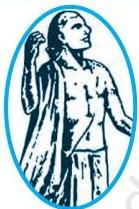 Aryabhata
C.E. 476–550
Aryabhata
C.E. 476–550
The origin of the terms ‘cosine’ and ‘tangent’ was much later. The cosine function arose from the need to compute the sine of the complementary angle. Aryabhatta called it kotijya. The name cosinus originated with Edmund Gunter. In 1674, the English Mathematician Sir Jonas Moore first used the abbreviated notation ‘cos’.
Remark: Note that the symbol sin A is used as an abbreviation for ‘the sine of the angle A’. sin A is not the product of ‘sin’ and A. ‘sin’ separated from A has no meaning. Similarly, cos A is not the product of ‘cos’ and A. Similar interpretations follow for other trigonometric ratios also.
Now, if we take a point P on the hypotenuse AC or a point Q on AC extended, of the right triangle ABC and draw PM perpendicular to AB and QN perpendicular to AB extended (see Fig. 8.6), how will the trigonometric ratios of $\angle A$ in $\Delta$ PAM differ from those of $\angle A$ in $\Delta$ CAB or from those of $\angle A$ in $\Delta$ QAN?
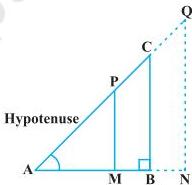 Fig. 8.6
To answer this, first look at these triangles. Is $\Delta$ PAM similar to $\Delta$ CAB? From Chapter 6, recall the AA similarity criterion. Using the criterion, you will see that the triangles PAM and CAB are similar. Therefore, by the property of similar triangles, the corresponding sides of the triangles are proportional.
So, we have
$ \frac{\mathrm{AM}}{\mathrm{AB}} = \frac{\mathrm{AP}}{\mathrm{AC}} = \frac{\mathrm{MP}}{\mathrm{BC}}. $
Reprint 2025-26
INTRODUCTION TO TRIGONOMETRY
From this, we find $\frac{\mathrm{MP}}{\mathrm{AP}} = \frac{\mathrm{BC}}{\mathrm{AC}} = \sin \mathrm{A}$
Similarly, $\frac{\mathrm{AM}}{\mathrm{AP}} = \frac{\mathrm{AB}}{\mathrm{AC}} = \cos \mathrm{A}, \frac{\mathrm{MP}}{\mathrm{AM}} = \frac{\mathrm{BC}}{\mathrm{AB}} = \tan \mathrm{A}$ and so on.
This shows that the trigonometric ratios of angle A in $\Delta$ PAM not differ from those of angle A in $\Delta$ CAB.
In the same way, you should check that the value of $\sin A$ (and also of other trigonometric ratios) remains the same in $\Delta$ QAN also.
From our observations, it is now clear that the values of the trigonometric ratios of an angle do not vary with the lengths of the sides of the triangle, if the angle remains the same.
Note: For the sake of convenience, we may write $\sin^2\mathrm{A}$ , $\cos^2\mathrm{A}$ , etc., in place of $(\sin \mathrm{A})^2$ , $(\cos \mathrm{A})^2$ , etc., respectively. But $\csc \mathrm{A} = (\sin \mathrm{A})^{-1} \neq \sin^{-1}\mathrm{A}$ (it is called sine inverse A). $\sin^{-1}\mathrm{A}$ has a different meaning, which will be discussed in higher classes. Similar conventions hold for the other trigonometric ratios as well. Sometimes, the Greek letter $\theta$ (theta) is also used to denote an angle.
We have defined six trigonometric ratios of an acute angle. If we know any one of the ratios, can we obtain the other ratios? Let us see.
If in a right triangle ABC, $\sin A = \frac{1}{3}$ , then this means that $\frac{\mathrm{BC}}{\mathrm{AC}} = \frac{1}{3}$ , i.e., the lengths of the sides BC and AC of the triangle ABC are in the ratio $1:3$ (see Fig. 8.7). So if BC is equal to $k$ , then AC will be $3k$ , where $k$ is any positive number. To determine other
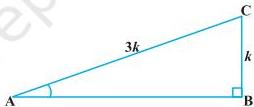 Fig. 8.7
trigonometric ratios for the angle A, we need to find the length of the third side AB. Do you remember the Pythagoras theorem? Let us use it to determine the required length AB.
$ \mathrm {A B} ^ {2} = \mathrm {A C} ^ {2} - \mathrm {B C} ^ {2} = (3 k) ^ {2} - (k) ^ {2} = 8 k ^ {2} = (2 \sqrt {2} k) ^ {2} $
Therefore, $\mathrm{AB} = \pm 2\sqrt{2} k$
So, we get $\mathrm{AB} = 2\sqrt{2} k$ (Why is AB not $-2\sqrt{2} k$ ?)
Now, $\cos A = \frac{AB}{AC} = \frac{2\sqrt{2}k}{3k} = \frac{2\sqrt{2}}{3}$
Similarly, you can obtain the other trigonometric ratios of the angle A.
Reprint 2025-26
MATHEMATICS
Remark : Since the hypotenuse is the longest side in a right triangle, the value of sin A or cos A is always less than 1 (or, in particular, equal to 1).
Let us consider some examples.
Example 1: Given $\tan \mathrm{A} = \frac{4}{3}$, find the other trigonometric ratios of the angle A.
Solution : Let us first draw a right $\Delta$ ABC (see Fig 8.8).
Now, we know that $\tan \mathrm{A} = \frac{\mathrm{BC}}{\mathrm{AB}} = \frac{4}{3}$.
Therefore, if $\mathrm{BC} = 4k$, then $\mathrm{AB} = 3k$, where $k$ is a positive number.
Now, by using the Pythagoras Theorem, we have
$ \mathrm{AC}^2 = \mathrm{AB}^2 + \mathrm{BC}^2 = (4k)^2 + (3k)^2 = 25k^2 $
So,
$ \mathrm{AC} = 5k $
Now, we can write all the trigonometric ratios using their definitions.
$ \sin \mathrm{A} = \frac{\mathrm{BC}}{\mathrm{AC}} = \frac{4k}{5k} = \frac{4}{5} $
$ \cos \mathrm{A} = \frac{\mathrm{AB}}{\mathrm{AC}} = \frac{3k}{5k} = \frac{3}{5} $
Therefore, $\cot \mathrm{A} = \frac{1}{\tan \mathrm{A}} = \frac{3}{4}$, $\csc \mathrm{A} = \frac{1}{\sin \mathrm{A}} = \frac{5}{4}$ and $\sec \mathrm{A} = \frac{1}{\cos \mathrm{A}} = \frac{5}{3}$.
Example 2: If $\angle B$ and $\angle Q$ are acute angles such that $\sin B = \sin Q$, then prove that $\angle B = \angle Q$.
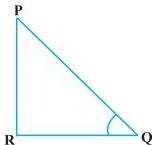
Solution : Let us consider two right triangles ABC and PQR where $\sin \mathrm{B} = \sin \mathrm{Q}$ (see Fig. 8.9).
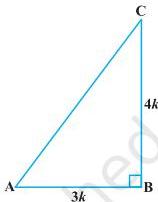 Fig. 8.8
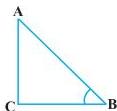 Fig. 8.9
We have
$ \sin \mathrm{B} = \frac{\mathrm{AC}}{\mathrm{AB}} $
and
$ \sin \mathrm{Q} = \frac{\mathrm{PR}}{\mathrm{PQ}} $
Reprint 2025-26
INTRODUCTION TO TRIGONOMETRY
Then
$ \frac {\mathrm {A C}}{\mathrm {A B}} = \frac {\mathrm {P R}}{\mathrm {P Q}} $
Therefore,
$ \frac {\mathrm {A C}}{\mathrm {P R}} = \frac {\mathrm {A B}}{\mathrm {P Q}} = k, \text { say} \tag {1} $
Now, using Pythagoras theorem,
$ \mathrm {B C} = \sqrt {\mathrm {A B} ^ {2} - \mathrm {A C} ^ {2}} $
and
$ \mathrm {Q R} = \sqrt {\mathrm {P Q} ^ {2} - \mathrm {P R} ^ {2}} $
So,
$ \frac {\mathrm {B C}}{\mathrm {Q R}} = \frac {\sqrt {\mathrm {A B} ^ {2} - \mathrm {A C} ^ {2}}}{\sqrt {\mathrm {P Q} ^ {2} - \mathrm {P R} ^ {2}}} = \frac {\sqrt {k ^ {2} \mathrm {P Q} ^ {2} - k ^ {2} \mathrm {P R} ^ {2}}}{\sqrt {\mathrm {P Q} ^ {2} - \mathrm {P R} ^ {2}}} = \frac {k \sqrt {\mathrm {P Q} ^ {2} - \mathrm {P R} ^ {2}}}{\sqrt {\mathrm {P Q} ^ {2} - \mathrm {P R} ^ {2}}} = k \tag {2} $
From (1) and (2), we have
$ \frac {\mathrm {A C}}{\mathrm {P R}} = \frac {\mathrm {A B}}{\mathrm {P Q}} = \frac {\mathrm {B C}}{\mathrm {Q R}} $
Then, by using Theorem 6.4, $\Delta \mathrm{ACB} \sim \Delta \mathrm{PRQ}$ and therefore, $\angle \mathrm{B} = \angle \mathrm{Q}$.
Example 3: Consider $\Delta$ ACB, right-angled at C, in which $\mathrm{AB} = 29$ units, $\mathrm{BC} = 21$ units and $\angle \mathrm{ABC} = \theta$ (see Fig. 8.10). Determine the values of
(i) $\cos^2\theta +\sin^2\theta$ (ii) $\cos^2\theta -\sin^2\theta$
Solution: In $\Delta$ ACB, we have
$ \begin{array}{l} \mathrm {A C} = \sqrt {\mathrm {A B} ^ {2} - \mathrm {B C} ^ {2}} = \sqrt {(2 9) ^ {2} - (2 1) ^ {2}} \ = \sqrt {(2 9 - 2 1) (2 9 + 2 1)} = \sqrt {(8) (5 0)} = \sqrt {4 0 0} = 2 0 \text { units} \end{array} $
So,
$ \sin \theta = \frac {\mathrm {A C}}{\mathrm {A B}} = \frac {2 0}{2 9}, \cos \theta = \frac {\mathrm {B C}}{\mathrm {A B}} = \frac {2 1}{2 9}. $
Now, (i) $\cos^2\theta +\sin^2\theta = \left(\frac{20}{29}\right)^2 +\left(\frac{21}{29}\right)^2 = \frac{20^2 + 21^2}{29^2} = \frac{400 + 441}{841} = 1,$
and (ii) $\cos^2\theta -\sin^2\theta = \left(\frac{21}{29}\right)^2 -\left(\frac{20}{29}\right)^2 = \frac{(21 + 20)(21 - 20)}{29^2} = \frac{41}{841}.$
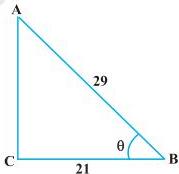 Fig. 8.10
Reprint 2025-26
MATHEMATICS
Example 4: In a right triangle ABC, right-angled at B, if $\tan A = 1$, then verify that
2 $\sin A \cos A = 1$.
Solution: In $\Delta$ ABC, $\tan A = \frac{BC}{AB} = 1$ (see Fig 8.11)
i.e.,
$ \mathrm{BC} = \mathrm{AB} $
Let $\mathrm{AB} = \mathrm{BC} = k$, where $k$ is a positive number.
Now,
$ \mathrm{AC} = \sqrt{\mathrm{AB}^2 + \mathrm{BC}^2} $
$ = \sqrt{(k)^2 + (k)^2} = k\sqrt{2} $
Therefore,
$ \sin A = \frac{BC}{AC} = \frac{1}{\sqrt{2}} \quad \text{and} \quad \cos A = \frac{AB}{AC} = \frac{1}{\sqrt{2}} $
So,
2 $\sin A \cos A = 2\left(\frac{1}{\sqrt{2}}\right)\left(\frac{1}{\sqrt{2}}\right) = 1$, which is the required value.
Example 5: In $\Delta$ OPQ, right-angled at P, $\mathrm{OP} = 7\mathrm{cm}$ and $\mathrm{OQ} \sim \mathrm{PQ} = 1\mathrm{cm}$ (see Fig. 8.12). Determine the values of $\sin Q$ and $\cos Q$.
Solution: In $\Delta$ OPQ, we have
$ \mathrm{OQ}^2 = \mathrm{OP}^2 + \mathrm{PQ}^2 $
i.e.,
$ (1 + \mathrm{PQ})^2 = \mathrm{OP}^2 + \mathrm{PQ}^2 \quad (\text{Why?}) $
i.e.,
$ 1 + \mathrm{PQ}^2 + 2\mathrm{PQ} = \mathrm{OP}^2 + \mathrm{PQ}^2 $
i.e.,
$ 1 + 2\mathrm{PQ} = 7^2 \quad (\text{Why?}) $
i.e.,
$ \mathrm{PQ} = 24\mathrm{cm} \text{ and } \mathrm{OQ} = 1 + \mathrm{PQ} = 25\mathrm{cm} $
So,
$ \sin Q = \frac{7}{25} \text{ and } \cos Q = \frac{24}{25}. $
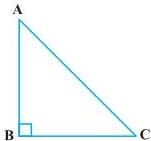 Fig. 8.11
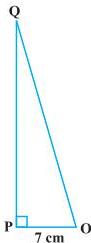 Fig. 8.12
Reprint 2025-26
INTRODUCTION TO TRIGONOMETRY
EXERCISE 8.1
In $\Delta$ ABC, right-angled at B, AB = 24 cm, BC = 7 cm. Determine: (i) sin A, cos A (ii) sin C, cos C
In Fig. 8.13, find tan P – cot R.
If $\sin A = \frac{3}{4}$, calculate cos A and tan A.
Given 15 cot A = 8, find sin A and sec A.
Given $\sec \theta = \frac{13}{12}$, calculate all other trigonometric ratios.
If $\angle A$ and $\angle B$ are acute angles such that cos A = cos B, then show that $\angle A = \angle B$.
If $\cot \theta = \frac{7}{8}$, evaluate: (i) $\frac{(1 + \sin \theta)(1 - \sin \theta)}{(1 + \cos \theta)(1 - \cos \theta)}$. (ii) $\cot^2\theta$
If 3 cot A = 4, check whether $\frac{1 - \tan^2 A}{1 + \tan^2 A} = \cos^2 A - \sin^2 A$ or not.
In triangle ABC, right-angled at B, if $\tan A = \frac{1}{\sqrt{3}}$, find the value of: (i) sin A cos C + cos A sin C (ii) cos A cos C – sin A sin C
In $\Delta$ PQR, right-angled at Q, PR + QR = 25 cm and PQ = 5 cm. Determine the values of sin P, cos P and tan P.
State whether the following are true or false. Justify your answer. (i) The value of tan A is always less than 1. (ii) $\sec A = \frac{12}{5}$ for some value of angle A. (iii) cos A is the abbreviation used for the cosecant of angle A. (iv) cot A is the product of cot and A. (v) $\sin \theta = \frac{4}{3}$ for some angle $\theta$.
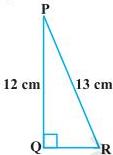 Fig. 8.13
8.3 Trigonometric Ratios of Some Specific Angles
From geometry, you are already familiar with the construction of angles of $30^{\circ}$, $45^{\circ}$, $60^{\circ}$ and $90^{\circ}$. In this section, we will find the values of the trigonometric ratios for these angles and, of course, for $0^{\circ}$.
Reprint 2025-26
MATHEMATICS
Trigonometric Ratios of $45^{\circ}$
In $\Delta$ ABC, right-angled at B, if one angle is $45^{\circ}$, then the other angle is also $45^{\circ}$, i.e., $\angle A = \angle C = 45^{\circ}$ (see Fig. 8.14).
So, $\mathrm{BC} = \mathrm{AB}$ (Why?)
Now, Suppose $\mathrm{BC} = \mathrm{AB} = a$.
Then by Pythagoras Theorem, $\mathrm{AC}^2 = \mathrm{AB}^2 + \mathrm{BC}^2 = a^2 + a^2 = 2a^2$,
and, therefore, $\mathrm{AC} = a\sqrt{2}$
Using the definitions of the trigonometric ratios, we have:
$ \sin 45^{\circ} = \frac{\text{side opposite to angle } 45^{\circ}}{\text{hypotenuse}} = \frac{\mathrm{BC}}{\mathrm{AC}} = \frac{a}{a\sqrt{2}} = \frac{1}{\sqrt{2}} $
$ \cos 45^{\circ} = \frac{\text{side adjacent to angle } 45^{\circ}}{\text{hypotenuse}} = \frac{\mathrm{AB}}{\mathrm{AC}} = \frac{a}{a\sqrt{2}} = \frac{1}{\sqrt{2}} $
$ \tan 45^{\circ} = \frac{\text{side opposite to angle } 45^{\circ}}{\text{side adjacent to angle } 45^{\circ}} = \frac{\mathrm{BC}}{\mathrm{AB}} = \frac{a}{a} = 1 $
Also, $\mathrm{cosec} 45^{\circ} = \frac{1}{\sin 45^{\circ}} = \sqrt{2}$, $\mathrm{sec} 45^{\circ} = \frac{1}{\cos 45^{\circ}} = \sqrt{2}$, $\mathrm{cot} 45^{\circ} = \frac{1}{\tan 45^{\circ}} = 1$.
Trigonometric Ratios of $30^{\circ}$ and $60^{\circ}$
Let us now calculate the trigonometric ratios of $30^{\circ}$ and $60^{\circ}$. Consider an equilateral triangle ABC. Since each angle in an equilateral triangle is $60^{\circ}$, therefore, $\angle A = \angle B = \angle C = 60^{\circ}$.
Draw the perpendicular AD from A to the side BC (see Fig. 8.15).
Now $\Delta \mathrm{ABD} \cong \Delta \mathrm{ACD}$ (Why?)
Therefore, $\mathrm{BD} = \mathrm{DC}$
and $\angle \mathrm{BAD} = \angle \mathrm{CAD}$ (CPCT)
Now observe that:
$\Delta$ ABD is a right triangle, right-angled at D with $\angle \mathrm{BAD} = 30^{\circ}$ and $\angle \mathrm{ABD} = 60^{\circ}$ (see Fig. 8.15).
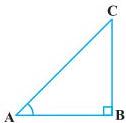 Fig. 8.14
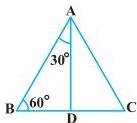 Fig. 8.15
Reprint 2025-26
INTRODUCTION TO TRIGONOMETRY
As you know, for finding the trigonometric ratios, we need to know the lengths of the sides of the triangle. So, let us suppose that $\mathrm{AB} = 2a$ .
Then, $\mathrm{BD} = \frac{1}{2}\mathrm{BC} = a$
and $\mathrm{AD}^2 = \mathrm{AB}^2 -\mathrm{BD}^2 = (2a)^2 -(a)^2 = 3a^2,$
Therefore, $\mathrm{AD} = a\sqrt{3}$
Now, we have :
$ \sin 3 0 ^ {\circ} = \frac {\mathrm {B D}}{\mathrm {A B}} = \frac {a}{2 a} = \frac {1}{2}, \cos 3 0 ^ {\circ} = \frac {\mathrm {A D}}{\mathrm {A B}} = \frac {a \sqrt {3}}{2 a} = \frac {\sqrt {3}}{2} $
$ \tan 3 0 ^ {\circ} = \frac {\mathrm {B D}}{\mathrm {A D}} = \frac {a}{a \sqrt {3}} = \frac {1}{\sqrt {3}}. $
Also, $\mathrm{cosec} 30^{\circ} = \frac{1}{\sin 30^{\circ}} = 2,$ sec $30^{\circ} = \frac{1}{\cos 30^{\circ}} = \frac{2}{\sqrt{3}}$
$ \cot 3 0 ^ {\circ} = \frac {1}{\tan 3 0 ^ {\circ}} = \sqrt {3}. $
Similarly,
$ \sin 6 0 ^ {\circ} = \frac {\mathrm {A D}}{\mathrm {A B}} = \frac {a \sqrt {3}}{2 a} = \frac {\sqrt {3}}{2}, \cos 6 0 ^ {\circ} = \frac {1}{2}, \tan 6 0 ^ {\circ} = \sqrt {3}, $
$ \cos \mathrm {e c} 6 0 ^ {\circ} = \frac {2}{\sqrt {3}}, \mathrm {s e c} 6 0 ^ {\circ} = 2 \mathrm {a n d} \cot 6 0 ^ {\circ} = \frac {1}{\sqrt {3}}. $
Trigonometric Ratios of $0^{\circ}$ and $90^{\circ}$
Let us see what happens to the trigonometric ratios of angle A, if it is made smaller and smaller in the right triangle ABC (see Fig. 8.16), till it becomes zero. As $\angle A$ gets smaller and smaller, the length of the side BC decreases. The point C gets closer to point B, and finally when $\angle A$ becomes very close to $0^{\circ}$ , AC becomes almost the same as AB (see Fig. 8.17).
 Fig. 8.16


 Fig. 8.17


Reprint 2025-26
MATHEMATICS
When $\angle A$ is very close to $0^{\circ}$, BC gets very close to 0 and so the value of $\sin A = \frac{BC}{AC}$ is very close to 0. Also, when $\angle A$ is very close to $0^{\circ}$, AC is nearly the same as AB and so the value of $\cos A = \frac{AB}{AC}$ is very close to 1.
This helps us to see how we can define the values of $\sin A$ and $\cos A$ when $A = 0^{\circ}$. We define: $\sin 0^{\circ} = 0$ and $\cos 0^{\circ} = 1$.
Using these, we have:
$\tan 0^{\circ} = \frac{\sin 0^{\circ}}{\cos 0^{\circ}} = 0, \cot 0^{\circ} = \frac{1}{\tan 0^{\circ}}$, which is not defined. (Why?)
$\sec 0^{\circ} = \frac{1}{\cos 0^{\circ}} = 1$ and $\csc 0^{\circ} = \frac{1}{\sin 0^{\circ}}$, which is again not defined. (Why?)
Now, let us see what happens to the trigonometric ratios of $\angle A$, when it is made larger and larger in $\Delta ABC$ till it becomes $90^{\circ}$. As $\angle A$ gets larger and larger, $\angle C$ gets smaller and smaller. Therefore, as in the case above, the length of the side AB goes on decreasing. The point A gets closer to point B. Finally when $\angle A$ is very close to $90^{\circ}$, $\angle C$ becomes very close to $0^{\circ}$ and the side AC almost coincides with side BC (see Fig. 8.18).


Fig. 8.18
When $\angle C$ is very close to $0^{\circ}$, $\angle A$ is very close to $90^{\circ}$, side AC is nearly the same as side BC, and so $\sin A$ is very close to 1. Also when $\angle A$ is very close to $90^{\circ}$, $\angle C$ is very close to $0^{\circ}$, and the side AB is nearly zero, so $\cos A$ is very close to 0.
So, we define: $\sin 90^{\circ} = 1$ and $\cos 90^{\circ} = 0$.
Now, why don't you find the other trigonometric ratios of $90^{\circ}$?
We shall now give the values of all the trigonometric ratios of $0^{\circ}$, $30^{\circ}$, $45^{\circ}$, $60^{\circ}$ and $90^{\circ}$ in Table 8.1, for ready reference.
Reprint 2025-26
INTRODUCTION TO TRIGONOMETRY
Table 8.1
| ∠A | 0° | 30° | 45° | 60° | 90° |
|---|---|---|---|---|---|
| sin A | 0 | 1/2 | 1/√2 | √3/2 | 1 |
| cos A | 1 | √3/2 | 1/√2 | 1/2 | 0 |
| tan A | 0 | 1/√3 | 1 | √3 | Not defined |
| cosec A | Not defined | 2 | √2 | 2/√3 | 1 |
| sec A | 1 | 2/√3 | √2 | 2 | Not defined |
| cot A | Not defined | √3 | 1 | 1/√3 | 0 |
Remark : From the table above you can observe that as $\angle A$ increases from $0^{\circ}$ to $90^{\circ}$ , sin A increases from 0 to 1 and cos A decreases from 1 to 0.
Let us illustrate the use of the values in the table above through some examples.
Example 6: In $\Delta$ ABC, right-angled at B, $\mathrm{AB} = 5\mathrm{cm}$ and $\angle \mathrm{ACB} = 30^{\circ}$ (see Fig. 8.19). Determine the lengths of the sides BC and AC.
Solution : To find the length of the side BC, we will choose the trigonometric ratio involving BC and the given side AB. Since BC is the side adjacent to angle C and AB is the side opposite to angle C, therefore
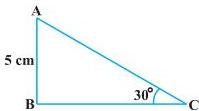 Fig. 8.19
$ \frac {\mathrm {A B}}{\mathrm {B C}} = \tan \mathrm {C} $
i.e., $\frac{5}{\mathrm{BC}} = \tan 30^{\circ} = \frac{1}{\sqrt{3}}$
which gives $\mathrm{BC} = 5\sqrt{3}\mathrm{cm}$
Reprint 2025-26
MATHEMATICS
To find the length of the side AC, we consider
$ \sin 30^\circ = \frac{\mathrm{AB}}{\mathrm{AC}} \quad \text{(Why?)} $
i.e.,
$ \frac{1}{2} = \frac{5}{\mathrm{AC}} $
i.e.,
$ \mathrm{AC} = 10\ \mathrm{cm} $
Note that alternatively we could have used Pythagoras theorem to determine the third side in the example above,
i.e.,
$ \mathrm{AC} = \sqrt{\mathrm{AB}^2 + \mathrm{BC}^2} = \sqrt{5^2 + (5\sqrt{3})^2}\ \mathrm{cm} = 10\ \mathrm{cm}. $
Example 7: In $\Delta$ PQR, right-angled at Q (see Fig. 8.20), $\mathrm{PQ} = 3\ \mathrm{cm}$ and $\mathrm{PR} = 6\ \mathrm{cm}$. Determine $\angle$ QPR and $\angle$ PRQ.
Solution: Given $\mathrm{PQ} = 3\ \mathrm{cm}$ and $\mathrm{PR} = 6\ \mathrm{cm}$.
Therefore,
$ \frac{\mathrm{PQ}}{\mathrm{PR}} = \sin \mathrm{R} $
or
$ \sin \mathrm{R} = \frac{3}{6} = \frac{1}{2} $
So,
$ \angle \mathrm{PRQ} = 30^\circ $
and therefore,
$ \angle \mathrm{QPR} = 60^\circ. \quad \text{(Why?)} $
You may note that if one of the sides and any other part (either an acute angle or any side) of a right triangle is known, the remaining sides and angles of the triangle can be determined.
Example 8: If ( \sin (A - B) = \frac{1}{2} ), ( \cos (A + B) = \frac{1}{2} ), ( 0^\circ < A + B \leq 90^\circ ), ( A > B ), find ( A ) and ( B ).
Solution: Since, $\sin (\mathrm{A} - \mathrm{B}) = \frac{1}{2}$, therefore, $\mathrm{A} - \mathrm{B} = 30^\circ$ (Why?) (1)
Also, since $\cos (\mathrm{A} + \mathrm{B}) = \frac{1}{2}$, therefore, $\mathrm{A} + \mathrm{B} = 60^\circ$ (Why?) (2)
Solving (1) and (2), we get: $\mathrm{A} = 45^\circ$ and $\mathrm{B} = 15^\circ$.
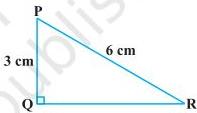 Fig. 8.20
Reprint 2025-26
INTRODUCTION TO TRIGONOMETRY
EXERCISE 8.2
- Evaluate the following:
(i) $\sin 60^{\circ}\cos 30^{\circ} + \sin 30^{\circ}\cos 60^{\circ}$
(ii) $2\tan^2 45^\circ +\cos^2 30^\circ -\sin^2 60^\circ$
(iii) $\frac{\cos 45^{\circ}}{\sec 30^{\circ} + \csc 30^{\circ}}$
(iv) $\frac{\sin 30^{\circ} + \tan 45^{\circ} - \csc 60^{\circ}}{\sec 30^{\circ} + \cos 60^{\circ} + \cot 45^{\circ}}$
(v) $\frac{5\cos^260^\circ + 4\sec^230^\circ - \tan^245^\circ}{\sin^230^\circ + \cos^230^\circ}$
- Choose the correct option and justify your choice:
(i) $\frac{2\tan 30^{\circ}}{1 + \tan^2 30^{\circ}} =$
(A) $\sin 60^{\circ}$
(B) $\cos 60^{\circ}$
(C) $\tan 60^{\circ}$
(D) $\sin 30^{\circ}$
(ii) $\frac{1 - \tan^2 45^\circ}{1 + \tan^2 45^\circ} =$
(A) $\tan 90^{\circ}$
(B) 1
(C) $\sin 45^{\circ}$
(D) 0
(iii) $\sin 2\mathrm{A} = 2\sin \mathrm{A}$ is true when $\mathrm{A} =$
(A) $0^{\circ}$
(B) $30^{\circ}$
(C) $45^{\circ}$
(D) $60^{\circ}$
(iv) $\frac{2\tan 30^{\circ}}{1 - \tan^2 30^{\circ}} =$
(A) $\cos 60^{\circ}$
(B) $\sin 60^{\circ}$
(C) $\tan 60^{\circ}$
(D) $\sin 30^{\circ}$
If ( \tan (A + B) = \sqrt{3} ) and ( \tan (A - B) = \frac{1}{\sqrt{3}} ), ( 0^\circ < A + B \leq 90^\circ ); ( A > B ), find ( A ) and ( B ).
State whether the following are true or false. Justify your answer.
(i) $\sin (\mathrm{A} + \mathrm{B}) = \sin \mathrm{A} + \sin \mathrm{B}$
(ii) The value of $\sin \theta$ increases as $\theta$ increases.
(iii) The value of $\cos \theta$ increases as $\theta$ increases.
(iv) $\sin \theta = \cos \theta$ for all values of $\theta$
(v) $\cot \mathrm{A}$ is not defined for $\mathrm{A} = 0^{\circ}$
Reprint 2025-26
MATHEMATICS
8.4 Trigonometric Identities
You may recall that an equation is called an identity when it is true for all values of the variables involved. Similarly, an equation involving trigonometric ratios of an angle is called a trigonometric identity, if it is true for all values of the angle(s) involved.
In this section, we will prove one trigonometric identity, and use it further to prove other useful trigonometric identities.
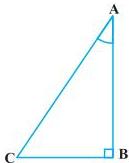 Fig. 8.21
In $\Delta$ ABC, right-angled at B (see Fig. 8.21), we have:
$ \mathrm{AB}^2 + \mathrm{BC}^2 = \mathrm{AC}^2 \tag{1} $
Dividing each term of (1) by $\mathrm{AC}^2$, we get
$ \frac{\mathrm{AB}^2}{\mathrm{AC}^2} + \frac{\mathrm{BC}^2}{\mathrm{AC}^2} = \frac{\mathrm{AC}^2}{\mathrm{AC}^2} $
i.e.,
$ \left(\frac{\mathrm{AB}}{\mathrm{AC}}\right)^2 + \left(\frac{\mathrm{BC}}{\mathrm{AC}}\right)^2 = \left(\frac{\mathrm{AC}}{\mathrm{AC}}\right)^2 $
i.e.,
$ (\cos \mathrm{A})^2 + (\sin \mathrm{A})^2 = 1 $
i.e.,
$ \cos^2 \mathrm{A} + \sin^2 \mathrm{A} = 1 \tag{2} $
This is true for all A such that $0^\circ \leq \mathrm{A} \leq 90^\circ$. So, this is a trigonometric identity. Let us now divide (1) by $\mathrm{AB}^2$. We get
$ \frac{\mathrm{AB}^2}{\mathrm{AB}^2} + \frac{\mathrm{BC}^2}{\mathrm{AB}^2} = \frac{\mathrm{AC}^2}{\mathrm{AB}^2} $
or,
$ \left(\frac{\mathrm{AB}}{\mathrm{AB}}\right)^2 + \left(\frac{\mathrm{BC}}{\mathrm{AB}}\right)^2 = \left(\frac{\mathrm{AC}}{\mathrm{AB}}\right)^2 $
i.e.,
$ 1 + \tan^2 \mathrm{A} = \sec^2 \mathrm{A} \tag{3} $
Is this equation true for $\mathrm{A} = 0^\circ$? Yes, it is. What about $\mathrm{A} = 90^\circ$? Well, $\tan \mathrm{A}$ and $\sec \mathrm{A}$ are not defined for $\mathrm{A} = 90^\circ$. So, (3) is true for all A such that $0^\circ \leq \mathrm{A} = 90^\circ$.
Let us see what we get on dividing (1) by $\mathrm{BC}^2$. We get
$ \frac{\mathrm{AB}^2}{\mathrm{BC}^2} + \frac{\mathrm{BC}^2}{\mathrm{BC}^2} = \frac{\mathrm{AC}^2}{\mathrm{BC}^2} $
Reprint 2025-26
INTRODUCTION TO TRIGONOMETRY
i.e.,
$ \left(\frac {\mathrm {A B}}{\mathrm {B C}}\right) ^ {2} + \left(\frac {\mathrm {B C}}{\mathrm {B C}}\right) ^ {2} = \left(\frac {\mathrm {A C}}{\mathrm {B C}}\right) ^ {2} $
i.e.,
$ \cot^ {2} \mathbf {A} + \mathbf {1} = \cos \sec^ {2} \mathbf {A} \tag {4} $
Note that cosec A and cot A are not defined for $\mathrm{A} = 0^{\circ}$ . Therefore (4) is true for all A such that $0^{\circ} = \mathrm{A} \leq 90^{\circ}$ .
Using these identities, we can express each trigonometric ratio in terms of other trigonometric ratios, i.e., if any one of the ratios is known, we can also determine the values of other trigonometric ratios.
Let us see how we can do this using these identities. Suppose we know that $\tan A = \frac{1}{\sqrt{3}}$ . Then, $\cot A = \sqrt{3}$ .
Since, $\sec^2 A = 1 + \tan^2 A = 1 + \frac{1}{3} = \frac{4}{3}$ , $\sec A = \frac{2}{\sqrt{3}}$ , and $\cos A = \frac{\sqrt{3}}{2}$ .
Again, $\sin A = \sqrt{1 - \cos^2 A} = \sqrt{1 - \frac{3}{4}} = \frac{1}{2}$ . Therefore, $\csc A = 2$ .
Example 9: Express the ratios cos A, tan A and sec A in terms of sin A.
Solution : Since $\cos^2 A + \sin^2 A = 1$ , therefore,
$ \cos^ {2} \mathrm {A} = 1 - \sin^ {2} \mathrm {A}, \text { i . e . , } \cos \mathrm {A} = \pm \sqrt {1 - \sin^ {2} \mathrm {A}} $
This gives
$ \cos \mathrm {A} = \sqrt {1 - \sin^ {2} \mathrm {A}} \quad (\text {Why ?}) $
Hence, $\tan A = \frac{\sin A}{\cos A} = \frac{\sin A}{\sqrt{1 - \sin^2 A}}$ and $\sec A = \frac{1}{\cos A} = \frac{1}{\sqrt{1 - \sin^2 A}}$
Example 10: Prove that $\sec A(1 - \sin A)(\sec A + \tan A) = 1$ .
Solution :
$ \mathrm {L H S} = \sec \mathrm {A} (1 - \sin \mathrm {A}) (\sec \mathrm {A} + \tan \mathrm {A}) = \left(\frac {1}{\cos \mathrm {A}}\right) (1 - \sin \mathrm {A}) \left(\frac {1}{\cos \mathrm {A}} + \frac {\sin \mathrm {A}}{\cos \mathrm {A}}\right) $
Reprint 2025-26
MATHEMATICS
$ \begin{array}{l} = \frac{(1 - \sin A)(1 + \sin A)}{\cos^2 A} = \frac{1 - \sin^2 A}{\cos^2 A} \ = \frac{\cos^2 A}{\cos^2 A} = 1 = \text{RHS} \end{array} $
Example 11: Prove that $\frac{\cot A - \cos A}{\cot A + \cos A} = \frac{\cosec A - 1}{\cosec A + 1}$
$ \begin{array}{l} \text{Solution: LHS} = \frac{\cot A - \cos A}{\cot A + \cos A} = \frac{\frac{\cos A}{\sin A} - \cos A}{\frac{\cos A}{\sin A} + \cos A} \ = \frac{\cos A \left(\frac{1}{\sin A} - 1\right)}{\cos A \left(\frac{1}{\sin A} + 1\right)} = \frac{\left(\frac{1}{\sin A} - 1\right)}{\left(\frac{1}{\sin A} + 1\right)} = \frac{\cosec A - 1}{\cosec A + 1} = \text{RHS} \end{array} $
Example 12: Prove that $\frac{\sin\theta - \cos\theta + 1}{\sin\theta + \cos\theta - 1} = \frac{1}{\sec\theta - \tan\theta}$, using the identity $\sec^2\theta = 1 + \tan^2\theta$.
Solution: Since we will apply the identity involving $\sec \theta$ and $\tan \theta$, let us first convert the LHS (of the identity we need to prove) in terms of $\sec \theta$ and $\tan \theta$ by dividing numerator and denominator by $\cos \theta$.
$ \begin{array}{l} \mathrm{LHS} = \frac{\sin \theta - \cos \theta + 1}{\sin \theta + \cos \theta - 1} = \frac{\tan \theta - 1 + \sec \theta}{\tan \theta + 1 - \sec \theta} \ = \frac{(\tan \theta + \sec \theta) - 1}{(\tan \theta - \sec \theta) + 1} = \frac{(\tan \theta + \sec \theta) - 1 (\tan \theta - \sec \theta)}{(\tan \theta - \sec \theta) + 1 (\tan \theta - \sec \theta)} \ = \frac{(\tan^2 \theta - \sec^2 \theta) - (\tan \theta - \sec \theta)}{(\tan \theta - \sec \theta + 1) (\tan \theta - \sec \theta)} \ = \frac{-1 - \tan \theta + \sec \theta}{(\tan \theta - \sec \theta + 1) (\tan \theta - \sec \theta)} \end{array} $
Reprint 2025-26
INTRODUCTION TO TRIGONOMETRY
$ = \frac {- 1}{\tan \theta - \sec \theta} = \frac {1}{\sec \theta - \tan \theta}, $
which is the RHS of the identity, we are required to prove.
EXERCISE 8.3
- Express the trigonometric ratios $\sin A$, $\sec A$ and $\tan A$ in terms of $\cot A$.
- Write all the other trigonometric ratios of $\angle A$ in terms of $\sec A$.
- Choose the correct option. Justify your choice.
(i) $9\sec^2 A - 9\tan^2 A =$
(A) 1
(B) 9
(C) 8
(D) $\theta$
(ii) $(1 + \tan \theta + \sec \theta)(1 + \cot \theta - \csc \theta) =$
(A) 0
(B) 1
(C) 2
(D) $-1$
(iii) $(\sec A + \tan A)(1 - \sin A) =$
(A) $\sec A$
(B) $\sin A$
(C) $\csc A$
(D) $\cos A$
(iv) $\frac{1 + \tan^2 A}{1 + \cot^2 A} =$
(A) $\sec^2 A$
(B) $-1$
(C) $\cot^2 A$
(D) $\tan^2 A$
- Prove the following identities, where the angles involved are acute angles for which the expressions are defined.
(i) $(\csc \theta - \cot \theta)^2 = \frac{1 - \cos \theta}{1 + \cos \theta}$
(ii) $\frac{\cos A}{1 + \sin A} + \frac{1 + \sin A}{\cos A} = 2\sec A$
(iii) $\frac{\tan \theta}{1 - \cot \theta} + \frac{\cot \theta}{1 - \tan \theta} = 1 + \sec \theta \csc \theta$
[Hint: Write the expression in terms of $\sin \theta$ and $\cos \theta$]
(iv) $\frac{1 + \sec A}{\sec A} = \frac{\sin^2 A}{1 - \cos A}$
[Hint: Simplify LHS and RHS separately]
(v) $\frac{\cos A - \sin A + 1}{\cos A + \sin A - 1} = \csc A + \cot A$, using the identity $\csc^2 A = 1 + \cot^2 A$.
(vi) $\sqrt{\frac{1 + \sin A}{1 - \sin A}} = \sec A + \tan A$
(vii) $\frac{\sin \theta - 2 \sin^3 \theta}{2 \cos^3 \theta - \cos \theta} = \tan \theta$
(viii) $(\sin A + \csc A)^2 + (\cos A + \sec A)^2 = 7 + \tan^2 A + \cot^2 A$
Reprint 2025-26
MATHEMATICS
(ix) $(\operatorname{cosec} A - \sin A)(\sec A - \cos A) = \frac{1}{\tan A + \cot A}$
[Hint: Simplify LHS and RHS separately]
(x) $\left(\frac{1 + \tan^2 A}{1 + \cot^2 A}\right) = \left(\frac{1 - \tan A}{1 - \cot A}\right)^2 = \tan^2 A$
8.5 Summary
In this chapter, you have studied the following points:
- In a right triangle ABC, right-angled at B,
$ \sin A = \frac{\text{side opposite to angle } A}{\text{hypotenuse}}, \quad \cos A = \frac{\text{side adjacent to angle } A}{\text{hypotenuse}} $
$ \tan A = \frac{\text{side opposite to angle } A}{\text{side adjacent to angle } A}. $
$\operatorname{cosec} A = \frac{1}{\sin A}; \sec A = \frac{1}{\cos A}; \tan A = \frac{1}{\cot A}, \tan A = \frac{\sin A}{\cos A}$
If one of the trigonometric ratios of an acute angle is known, the remaining trigonometric ratios of the angle can be easily determined.
The values of trigonometric ratios for angles $0^{\circ}, 30^{\circ}, 45^{\circ}, 60^{\circ}$ and $90^{\circ}$.
The value of ( sin A ) or ( cos A ) never exceeds 1, whereas the value of ( sec A ) ( (0^circ \leq A \leq 90^\circ) ) or ( \csc A ) ( (0^\circ \leq A \leq 90^\circ) ) is always greater than or equal to 1.
( \sin^2 A + \cos^2 A = 1 )
( \sec^2 A - \tan^2 A = 1 ), for ( 0^\circ \leq A \leq 90^\circ )
( \csc^2 A - 1 = \cot^2 A ), for ( 0^\circ \leq A \leq 90^\circ )6