CHAPTER 7 : COORDINATE GEOMETRY
7.1 Introduction
As learned in Class IX, establishing the location of a point within a plane necessitates the use of a coordinate axis system. The perpendicular distance of a point from the $y$-axis is defined as its $x$-coordinate, also known as the abscissa. Conversely, the perpendicular distance from the $x$-axis is termed its $y$-coordinate, or ordinate. Points situated on the $x$-axis are invariably expressed in the format $(x, 0)$, whereas those on the $y$-axis take the form $(0, y)$.
Let's engage in an activity. On a sheet of graph paper, construct a system comprising two perpendicular axes. Subsequently, accurately plot the following points and connect them according to the specified sequence: Connect point A(4, 8) to B(3, 9), then to C(3, 8), to D(1, 6), to E(1, 5), to F(3, 3), to G(6, 3), to H(8, 5), to I(8, 6), to J(6, 8), to K(6, 9), to L(5, 8), and finally back to A. Next, connect points P(3.5, 7), Q(3, 6), and R(4, 6) to delineate a triangle. Furthermore, connect points X(5.5, 7), Y(5, 6), and Z(6, 6) to establish another triangle. Proceed to connect S(4, 5), T(4.5, 4), and U(5, 5) to form a third triangle. Lastly, connect point S to (0, 5) and (0, 6), and connect point U to (9, 5) and (9, 6). What geometric representation do you observe?
Moreover, you may recall that a linear equation involving two variables, expressed in the general form $ax + by + c = 0$ (where $a$ and $b$ are not simultaneously zero), yields a straight line upon graphical depiction. Additionally, as explored in Chapter 2, the graphical representation of $y = ax^2 + bx + c$ (with $a \neq 0$) manifests as a parabola. Essentially, coordinate geometry emerged as an algebraic methodology for the analysis of geometric shapes. It facilitates the investigation of geometry through algebraic principles and conversely, the comprehension of algebra via geometric insights. Consequently, coordinate geometry finds extensive application across diverse disciplines, including physics, engineering, navigation, seismology, and artistic endeavors.
Within this chapter, the curriculum will cover the methodology for calculating the distance separating any two points for which coordinate values are provided. Furthermore, you will investigate the procedure for determining the coordinates of a point that partitions a line segment, connecting two specified points, according to a predetermined ratio.
7.2 Distance Formula
Consider the subsequent scenario:
Town B is situated 36 km to the east and 15 km to the north of Town A. How might one ascertain the linear distance between Town A and Town B without direct measurement? Let us explore this. This configuration can be visually depicted as illustrated in Fig. 7.1. The Pythagorean Theorem offers a method for computing this distance.
Next, imagine two points are positioned along the $x$-axis. Is it feasible to determine the separation between them? For example, observe points A(4, 0) and B(6, 0) in Fig. 7.2. Both A and B are located on the $x$-axis.
As evident from the diagram, OA measures 4 units, and OB measures 6 units.
Consequently, the distance from B to A, denoted as AB, is calculated as OB - OA = 6 - 4 = 2 units.
Thus, when two points are collinear on the $x$-axis, their distance can be readily ascertained.
Considering a different scenario, if two points reside on the $y$-axis, can their mutual distance be determined? Should points C(0, 3) and D(0, 8) be situated on the $y$-axis, a similar calculation reveals that CD = 8 - 3 = 5 units (refer to Fig. 7.2).
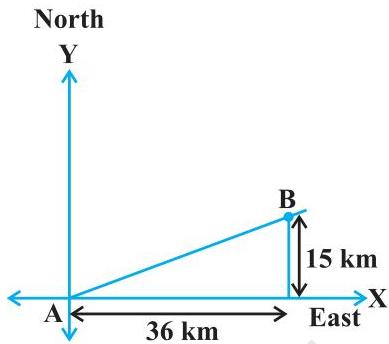 Fig. 7.1
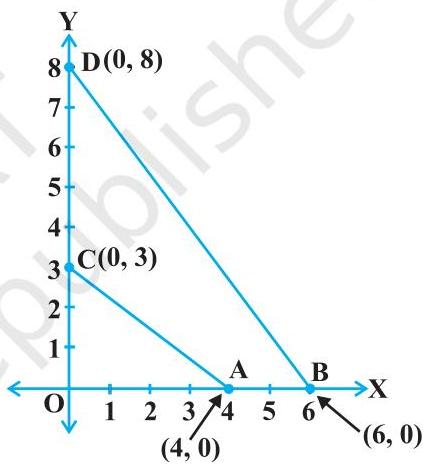 Fig. 7.2
Subsequently, is it possible to ascertain the distance between A and C (within Fig. 7.2)? Given that OA equals 4 units and OC equals 3 units, the separation between A and C, designated as AC, computes to $\sqrt{3^2 + 4^2} = 5$ units. Analogously, the distance from B to D, i.e., BD, can be found to be 10 units.
Now, considering two points not situated on either coordinate axis, can their intervening distance be determined? Indeed! The Pythagorean theorem will be employed for this purpose. Let us examine a case.
Within Fig. 7.3, points P(4, 6) and Q(6, 8) are positioned within the first quadrant. How does one apply the Pythagorean theorem to calculate the distance separating them? We proceed by drawing PR and QS as perpendiculars from P and Q, respectively, to the $x$-axis. Furthermore, a perpendicular is extended from P to meet QS at point T. Consequently, the coordinates for R and S are (4, 0) and (6, 0), respectively, rendering RS = 2 units. Additionally, QS measures 8 units, and TS, being equal to PR, is 6 units.
Thus, $\mathrm{QT} = 2$ units and $\mathrm{PT} = \mathrm{RS} = 2$ units.
Applying the Pythagorean theorem, we obtain:
$ \begin{array}{l} \mathrm {P Q} ^ {2} = \mathrm {P T} ^ {2} + \mathrm {Q T} ^ {2} \ = 2 ^ {2} + 2 ^ {2} = 8 \ \end{array} $
Hence, $\mathrm{PQ} = 2\sqrt{2}$ units.
What methodology would be employed to ascertain the distance between two points situated in distinct quadrants?
Let us consider the points $\mathrm{P}(6, 4)$ and $\mathrm{Q}(-5, -3)$ (refer to Fig. 7.4). Construct QS perpendicular to the $x$-axis. Additionally, draw a perpendicular PT from point $\mathrm{P}$ to QS (extended), intersecting the $y$-axis at point $\mathrm{R}$.
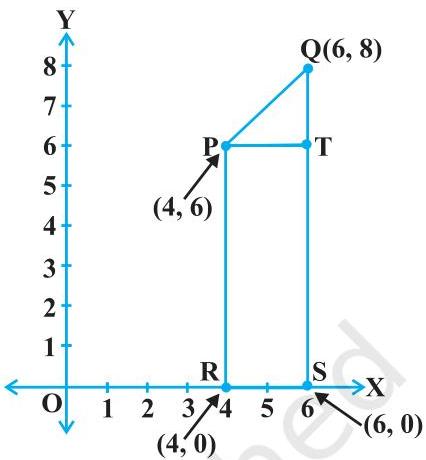 Fig. 7.3
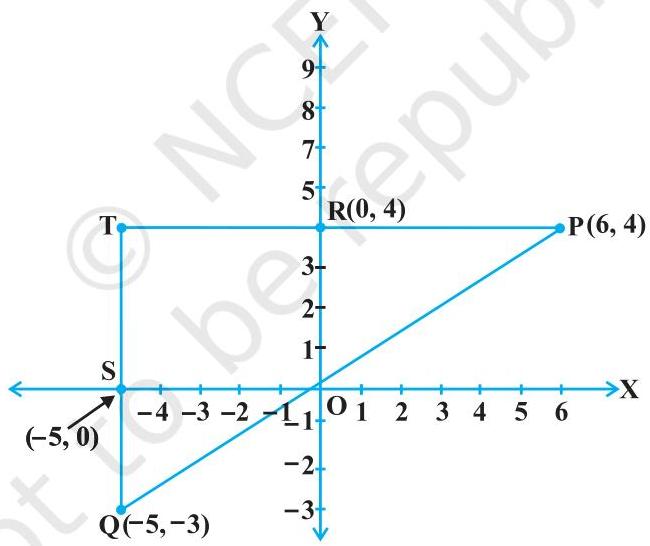 Fig. 7.4
Consequently, $\mathrm{PT} = 11$ units and $\mathrm{QT} = 7$ units. (Why?)
Applying the Pythagorean theorem to the right-angled triangle PTQ, the length of segment PQ is determined as $\mathrm{PQ} = \sqrt{11^2 + 7^2} = \sqrt{170}$ units.
Consider the process of determining the distance separating two arbitrary points, $\mathrm{P}(x_1, y_1)$ and $\mathrm{Q}(x_2, y_2)$. To facilitate this, construct lines PR and QS such that they are perpendicular to the $x$-axis. Subsequently, a line segment originating from point $\mathrm{P}$ is extended perpendicularly to intersect QS at point $\mathrm{T}$ (refer to Fig. 7.5).
It follows that $\mathrm{OR} = x_{1}$ and $\mathrm{OS} = x_{2}$. Consequently, the length of $\mathrm{RS}$ is $x_{2} - x_{1}$, which is equivalent to $\mathrm{PT}$.
Furthermore, $\mathrm{SQ} = y_{2}$ and $\mathrm{ST}$, being equal to $\mathrm{PR}$, is $y_{1}$. Therefore, $\mathrm{QT}$ can be expressed as $y_{2} - y_{1}$.
By applying the Pythagorean theorem to triangle $\Delta$ PTQ, we derive the following:
$
\begin{array}{l} \mathrm {P Q} ^ {2} = \mathrm {P T} ^ {2} + \mathrm {Q T} ^ {2} \ = (x _ {2} - x _ {1}) ^ {2} + (y _ {2} - y _ {1}) ^ {2} \ \end{array} $
Hence, the magnitude of $\mathrm{PQ}$ is given by $\
sqrt{\left(x_2 - x_1\right)^2 + \left(y_2 - y_1\right)^2}$.
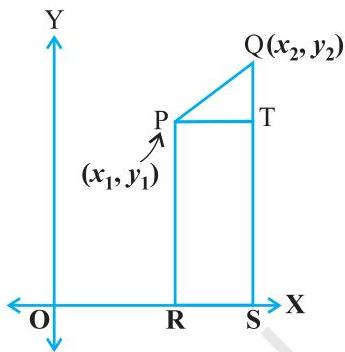 Fig. 7.5
It is important to acknowledge that distance is inherently a non-negative quantity; consequently, only the positive square root is considered. Thus, the separation between points $\mathrm{P}(x_1,y_1)$ and $\mathrm{Q}(x_2,y_2)$ is defined as:
$ \mathbf {P Q} = \sqrt {\left(x _ {2} - x _ {1}\right) ^ {2} + \left(y _ {2} - y _ {1}\right) ^ {2}}, $
This expression is formally known as the distance formula.
Remarks :
- Specifically, the separation between a point $\mathrm{P}(x,y)$ and the origin $\mathrm{O}(0,0)$ is expressed as:
$ \mathrm {O P} = \sqrt {x ^ {2} + y ^ {2}}. $
- Furthermore, the distance $\mathrm{PQ}$ can be formulated as $\sqrt{\left(x_1 - x_2\right)^2 + \left(y_1 - y_2\right)^2}$. (Why?)
Example 1: Determine if the points $(3,2)$, $(-2, -3)$, and $(2,3)$ constitute a triangle. Should they form one, identify its specific classification.
Solution: To ascertain this, we employ the distance formula to calculate the lengths of the segments PQ, QR, and PR, where P(3, 2), Q(-2, -3), and R(2, 3) represent the designated points. The computations yield:
$ \begin{array}{l} \mathrm {P Q} = \sqrt {(3 + 2) ^ {2} + (2 + 3) ^ {2}} = \sqrt {5 ^ {2} + 5 ^ {2}} = \sqrt {50} = 7.07 (\text {approx.}) \ \mathrm {Q R} = \sqrt {(- 2 - 2) ^ {2} + (- 3 - 3) ^ {2}} = \sqrt {(- 4) ^ {2} + (- 6) ^ {2}} = \sqrt {52} = 7.21 (\text {approx.}) \ \mathrm {P R} = \sqrt {(3 - 2) ^ {2} + (2 - 3) ^ {2}} = \sqrt {1 ^ {2} + (- 1) ^ {2}} = \sqrt {2} = 1.41 (\text {approx.}) \ \end{array} $
Given that the cumulative length of any two of these segments exceeds the length of the remaining segment, it is established that points $\mathrm{P}, \mathrm{Q}$, and $\mathrm{R}$ indeed delineate a triangle.
COORDINATE GEOMETRY
Furthermore, observing that $\mathrm{PQ}^2 +\mathrm{PR}^2 = \mathrm{QR}^2$, the converse of the Pythagorean theorem dictates that $\angle \mathrm{P} = 90^{\circ}$. Consequently, triangle PQR is classified as a right triangle.
Example 2: Demonstrate that the coordinates $(1,7)$, $(4,2)$, $(-1, -1)$, and $(-4,4)$ define the vertices of a square.
Solution: Assign A(1, 7), B(4, 2), C(-1, -1), and D(-4, 4) to the provided points. A method for proving that ABCD constitutes a square involves verifying that all its side lengths are identical and that its two diagonals also possess equal lengths. Proceeding with calculations:
$ \mathrm {A B} = \sqrt {(1 - 4) ^ {2} + (7 - 2) ^ {2}} = \sqrt {9 + 25} = \sqrt {34} $
$ \mathrm {B C} = \sqrt {(4 + 1) ^ {2} + (2 + 1) ^ {2}} = \sqrt {25 + 9} = \sqrt {34} $
$ \mathrm {C D} = \sqrt {(- 1 + 4) ^ {2} + (- 1 - 4) ^ {2}} = \sqrt {9 + 25} = \sqrt {34} $
$ \mathrm {D A} = \sqrt {(1 + 4) ^ {2} + (7 - 4) ^ {2}} = \sqrt {25 + 9} = \sqrt {34} $
$ \mathrm {A C} = \sqrt {(1 + 1) ^ {2} + (7 + 1) ^ {2}} = \sqrt {4 + 64} = \sqrt {68} $
$ \mathrm {B D} = \sqrt {(4 + 4) ^ {2} + (2 - 4) ^ {2}} = \sqrt {64 + 4} = \sqrt {68} $
Given that $\mathrm{AB} = \mathrm{BC} = \mathrm{CD} = \mathrm{DA}$ and $\mathrm{AC} = \mathrm{BD}$, it is evident that all four sides of quadrilateral ABCD are congruent, and its diagonals AC and BD are likewise congruent. Consequently, ABCD is identified as a square.
Alternative Solution: We initially compute the lengths of all four sides and a single diagonal, for instance, AC, in the manner previously demonstrated. In this context, we observe that $\mathrm{AD}^2 +\mathrm{DC}^2 = 34 + 34 = 68 = \mathrm{AC}^2$. Hence, applying the converse of the Pythagorean theorem, it is established that $\angle D = 90^{\circ}$. A quadrilateral possessing four equal sides and one interior angle measuring $90^{\circ}$ is, by definition, a square. Thus, ABCD is confirmed as a square.
Example 3: Figure 7.6 illustrates the layout of desks within a classroom. Ashima, Bharti, and Camella are positioned at A(3, 1), B(6, 4), and C(8, 6), respectively. Do these individuals occupy collinear positions? Provide justification for your conclusion.
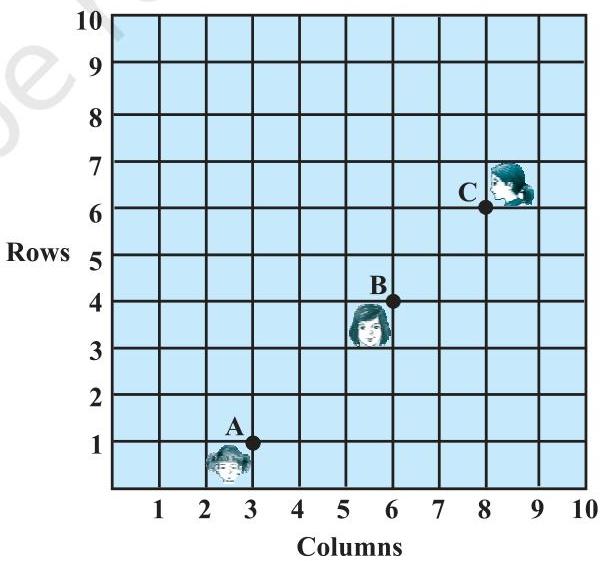 Fig. 7.6
Solution : Application of the distance formula yields the following segment lengths:
$ \mathrm {A B} = \sqrt {(6 - 3) ^ {2} + (4 - 1) ^ {2}} = \sqrt {9 + 9} = \sqrt {18} = 3 \sqrt {2} $
$ \mathrm {B C} = \sqrt {(8 - 6) ^ {2} + (6 - 4) ^ {2}} = \sqrt {4 + 4} = \sqrt {8} = 2 \sqrt {2} $
$ \mathrm {A C} = \sqrt {(8 - 3) ^ {2} + (6 - 1) ^ {2}} = \sqrt {25 + 25} = \sqrt {50} = 5 \sqrt {2} $
Given that $\mathrm{AB} + \mathrm{BC} = 3\sqrt{2} + 2\sqrt{2} = 5\sqrt{2} = \mathrm{AC}$ , it is established that points A, B, and C are collinear. Consequently, these points lie on a single straight line.
Example 4: Determine the relationship between $x$ and $y$ for a point $(x, y)$ that maintains an equal distance from the points $(7, 1)$ and $(3, 5)$ .
Solution : Let $\mathrm{P}(x,y)$ represent the point equidistant from $\mathrm{A}(7,1)$ and $\mathrm{B}(3,5)$ .
The condition of equidistance implies $\mathrm{AP} = \mathrm{BP}$ , which can be squared to $\mathrm{AP}^2 = \mathrm{BP}^2$ .
i.e.,
$ (x - 7) ^ {2} + (y - 1) ^ {2} = (x - 3) ^ {2} + (y - 5) ^ {2} $
i.e., $x^{2} - 14x + 49 + y^{2} - 2y + 1 = x^{2} - 6x + 9 + y^{2} - 10y + 25$
i.e.,
$ x - y = 2 $
This equation represents the desired relationship.
Remark : It is important to observe that the graphical representation of the equation $x - y = 2$ corresponds to a straight line. As established in prior mathematical studies, any point equidistant from two given points, A and B, must lie on the perpendicular bisector of the segment AB. Consequently, the line defined by $x - y = 2$ constitutes the perpendicular bisector of AB (refer to Fig. 7.7).
Example 5: Identify a point situated on the $y$ -axis that is equidistant from the points A(6, 5) and B(-4, 3).
Solution : A point located on the $y$ -axis can be expressed in the form $(0, y)$ . Therefore, let $\mathrm{P}(0, y)$ be the point that is equally distant from A and B. This leads to the equation:
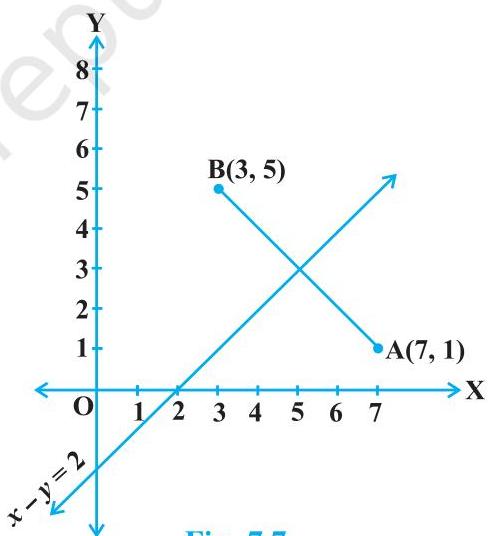
Fig. 7.7
$ (6 - 0) ^ {2} + (5 - y) ^ {2} = (- 4 - 0) ^ {2} + (3 - y) ^ {2} $
i.e., $36 + 25 + y^{2} - 10y = 16 + 9 + y^{2} - 6y$
i.e., $4y = 36$
i.e., $y = 9$
Thus, the point sought is $(0,9)$ .
To verify this solution: $\mathrm{AP} = \sqrt{(6 - 0)^2 + (5 - 9)^2} = \sqrt{36 + 16} = \sqrt{52}$
$ \mathrm {B P} = \sqrt {(- 4 - 0) ^ {2} + (3 - 9) ^ {2}} = \sqrt {16 + 36} = \sqrt {52} $
Note : As indicated by the preceding remark, the point (0, 9) represents the intersection of the $y$ -axis and the perpendicular bisector of the segment AB.
EXERCISE 7.1
- Calculate the Euclidean distance separating each of the subsequent pairs of points:
(i) $(2,3),(4,1)$
(ii) $(-5,7),(-1,3)$
(iii) $(a,b),(-a, - b)$
Determine the distance between the points $(0, 0)$ and $(36, 15)$. Subsequently, determine the distance between the two locations, A and B, as previously introduced in Section 7.2.
Ascertain whether the points $(1,5)$, $(2,3)$, and $(-2, -11)$ lie on a single straight line.
Verify if the points $(5, -2)$, $(6, 4)$, and $(7, -2)$ constitute the vertices of an isosceles triangle.
Within a classroom setting, four individuals are positioned at coordinates A, B, C, and D, as depicted in Fig. 7.8. Upon entering the room and observing the arrangement for a brief period, Champa queries Chameli, stating, "Does it not appear that ABCD forms a square?" Chameli expresses dissent. Employing the distance formula, identify which individual's assertion is accurate.
Identify the specific classification of quadrilateral, if one is indeed formed, by the subsequent sets of points, and provide justifications for your conclusion:
(i) $(-1, - 2)$ $(1,0)$ $(-1,2)$ $(-3,0)$ (ii) $(-3,5),(3,1),(0,3),(-1, - 4)$ (iii) $(4,5),(7,6),(4,3),(1,2)$
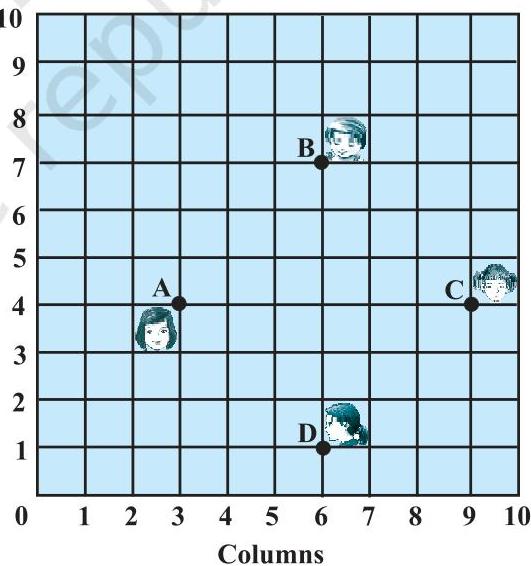 Fig. 7.8
Locate the point situated on the $x$-axis that maintains an equal distance from both $(2, -5)$ and $(-2, 9)$.
Determine the possible values for $y$ such that the spatial separation between point $\mathrm{P}(2, -3)$ and point $\mathrm{Q}(10, y)$ precisely equals 10 units.
Given that point $Q(0,1)$ is positioned at an equal distance from point $P(5, -3)$ and point $R(x, 6)$, ascertain the value(s) of $x$. Furthermore, compute the lengths of segments QR and PR.
Derive an algebraic relationship between $x$ and $y$ such that the coordinate $(x, y)$ is positioned at an equal distance from the points $(3, 6)$ and $(-3, 4)$.
7.3 Section Formula
Let us revisit the scenario presented in Section 7.2. Imagine a telephone company intends to position a relay tower at point $\mathbf{P}$ along the segment AB such that its distance from B is twice its distance from A. If P is situated on AB, it will partition the segment AB in a ratio of $1:2$ (refer to Fig. 7.9). Assuming A serves as the origin O, and each unit on both axes represents $1\mathrm{km}$, the coordinates for B would be (36, 15). To ascertain the tower's precise location, determining the coordinates of P becomes essential. How might we go about calculating these coordinates?
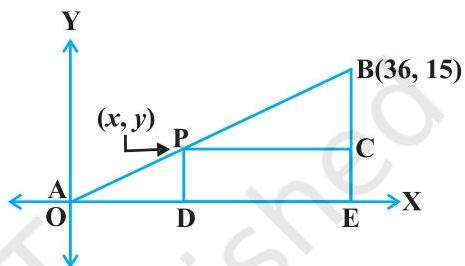 Fig. 7.9
Let $(x, y)$ denote the coordinates of $\mathrm{P}$. From points $\mathrm{P}$ and $\mathrm{B}$, construct perpendicular lines to the $x$-axis, intersecting it at $\mathrm{D}$ and $\mathrm{E}$, respectively. Furthermore, draw a line segment PC perpendicular to BE. Consequently, by applying the AA similarity criterion, as elaborated in Chapter 6, $\Delta$ POD and $\Delta$ BPC are similar triangles.
Therefore, $\frac{\mathrm{OD}}{\mathrm{PC}} = \frac{\mathrm{OP}}{\mathrm{PB}} = \frac{1}{2}$, and $\frac{\mathrm{PD}}{\mathrm{BC}} = \frac{\mathrm{OP}}{\mathrm{PB}} = \frac{1}{2}$
So, $\frac{x}{36 - x} = \frac{1}{2}$ and $\frac{y}{15 - y} = \frac{1}{2}$.
These equations give $x = 12$ and $y = 5$.
You can check that $\mathrm{P}(12, 5)$ meets the condition that $\mathrm{OP}: \mathrm{PB} = 1: 2$.
We shall now utilize the conceptual understanding acquired from this illustration to derive a general formula.
Consider any two points $\mathrm{A}(x_1, y_1)$ and $\mathrm{B}(x_2, y_2)$. Assume that a point $\mathrm{P}(x, y)$ divides the segment AB internally in the ratio $m_1 : m_2$, which implies:
$ \frac {\mathrm {P A}}{\mathrm {P B}} = \frac {m _ {1}}{m _ {2}} \text {(see Fig. 7.10)}. $
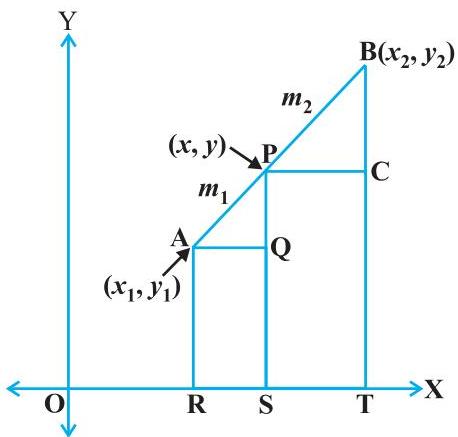 Fig. 7.10
Construct perpendiculars AR, PS, and BT to the $x$-axis. Also, draw lines AQ and PC parallel to the $x$-axis. By the AA similarity criterion, it follows that:
$ \Delta \mathrm{PAQ} \sim \Delta \mathrm{BPC} $
Therefore, $\frac{\mathrm{PA}}{\mathrm{BP}} = \frac{\mathrm{AQ}}{\mathrm{PC}} = \frac{\mathrm{PQ}}{\mathrm{BC}}$ (1)
Now, $ \mathrm{AQ} = \mathrm{RS} = \mathrm{OS} - \mathrm{OR} = x - x_1 $ $ \mathrm{PC} = \mathrm{ST} = \mathrm{OT} - \mathrm{OS} = x_2 - x $ $ \mathrm{PQ} = \mathrm{PS} - \mathrm{QS} = \mathrm{PS} - \mathrm{AR} = y - y_1 $ $ \mathrm{BC} = \mathrm{BT} - \mathrm{CT} = \mathrm{BT} - \mathrm{PS} = y_2 - y $
Substituting these values into equation (1), we obtain:
$ \frac{m_1}{m_2} = \frac{x - x_1}{x_2 - x} = \frac{y - y_1}{y_2 - y} $
Taking $ \frac{m_1}{m_2} = \frac{x - x_1}{x_2 - x}, \text{ we get } x = \frac{m_1 x_2 + m_2 x_1}{m_1 + m_2} $
Similarly, taking $ \frac{m_1}{m_2} = \frac{y - y_1}{y_2 - y}, \text{ we get } y = \frac{m_1 y_2 + m_2 y_1}{m_1 + m_2} $
Thus, the coordinates $\mathrm{P}(x,y)$ for the point that internally divides the line segment joining $\mathrm{A}(x_1,y_1)$ and $\mathrm{B}(x_2,y_2)$ in the ratio $m_1:m_2$ are:
$ \left( \frac{m_1 x_2 + m_2 x_1}{m_1 + m_2}, \frac{m_1 y_2 + m_2 y_1}{m_1 + m_2} \right) \tag{2} $
This expression is formally recognized as the section formula.
An alternative method for its derivation involves constructing perpendicular lines from points A, P, and B to the $y$-axis, following an analogous procedure to the one previously outlined.
Should the point $\mathrm{P}$ partition the line segment $\mathrm{AB}$ in the ratio $k:1$, its coordinates are consequently given by:
$ \left( \frac{k x_2 + x_1}{k + 1}, \frac{k y_2 + y_1}{k + 1} \right). $
Particular Instance: The unique characteristic of a line segment's midpoint is its division of the segment into two equal parts, corresponding to a $1:1$ ratio. Consequently, for the segment connecting points $\mathrm{A}(x_1,y_1)$ and $\mathrm{B}(x_2,y_2)$, the coordinates of its midpoint $\mathrm{P}$ are determined as:
$ \left( \frac{1 \cdot x_1 + 1 \cdot x_2}{1 + 1}, \frac{1 \cdot y_1 + 1 \cdot y_2}{1 + 1} \right) = \left( \frac{x_1 + x_2}{2}, \frac{y_1 + y_2}{2} \right). $
We shall now proceed to illustrate the application of the section formula through several worked examples.
Example 6: Determine the coordinates of the point that internally partitions the line segment connecting $(4, -3)$ and $(8, 5)$ in the ratio $3:1$.
Solution: Let the desired point be denoted by $\mathrm{P}(x, y)$. Applying the section formula yields:
$ x = \frac{3(8) + 1(4)}{3 + 1} = 7, \quad y = \frac{3(5) + 1(-3)}{3 + 1} = 3 $
Thus, the coordinates of the sought-after point are $(7, 3)$.
Example 7: Determine the ratio in which the point $(-4, 6)$ partitions the line segment connecting points $A(-6, 10)$ and $B(3, -8)$.
Solution: Assume that the point $(-4, 6)$ divides segment AB internally in the ratio $m_1 : m_2$. By applying the section formula, we obtain:
$ (-4, 6) = \left(\frac{3m_1 - 6m_2}{m_1 + m_2}, \frac{-8m_1 + 10m_2}{m_1 + m_2}\right) \tag{1} $
It is important to recall that for two ordered pairs to be equal, i.e., $(x, y) = (a, b)$, their corresponding components must be equivalent: $x = a$ and $y = b$.
Hence,
$ -4 = \frac{3m_1 - 6m_2}{m_1 + m_2} \quad \text{and} \quad 6 = \frac{-8m_1 + 10m_2}{m_1 + m_2} $
Considering the $x$-coordinate, we have:
$ -4 = \frac{3m_1 - 6m_2}{m_1 + m_2} \quad \text{leads to} $
$ -4m_1 - 4m_2 = 3m_1 - 6m_2 $
that is,
$ 7m_1 = 2m_2 $
that is,
$ m_1 : m_2 = 2 : 7 $
It is advisable to confirm that this derived ratio is also consistent with the $y$-coordinate equation.
Proceeding with the verification for the $y$-coordinate:
$ \frac{-8m_1 + 10m_2}{m_1 + m_2} = \frac{-8\frac{m_1}{m_2} + 10}{\frac{m_1}{m_2} + 1} \quad \text{(Dividing throughout by } m_2\text{)} $
$ = \frac{-8 \times \frac{2}{7} + 10}{\frac{2}{7} + 1} = 6
$
Consequently, the point $(-4, 6)$ partitions the line segment connecting $\mathrm{A}(-6, 10)$ and $\mathrm{B}(3, -8)$ in the ratio $2:7$.
Alternative Method: It is also permissible to express the ratio $m_1 : m_2$ in the form $\frac{m_1}{m_2} : 1$, or more simply as $k : 1$. Assume that $(-4, 6)$ internally divides segment AB in the ratio $k : 1$. Applying the section formula yields:
$ (-4, 6) = \left(\frac{3k - 6}{k + 1}, \frac{-8k + 10}{k + 1}\right) \tag{2} $
Thus,
$ -4 = \frac{3k - 6}{k + 1} $
that is,
$ -4k - 4 = 3k - 6 $
that is,
$ 7k = 2 $
that is,
$ k : 1 = 2 : 7 $
Verification using the $y$-coordinate is also recommended.
Therefore, the point $(-4, 6)$ partitions the line segment defined by $\mathrm{A}(-6, 10)$ and $\mathrm{B}(3, -8)$ in a $2:7$ ratio.
Note: It is also feasible to ascertain this ratio by computing the lengths of segments PA and PB and subsequently determining their proportion, contingent upon the prior knowledge that points A, P, and B are collinear.
Example 8: Determine the coordinates of the points that divide the line segment connecting points $\mathrm{A}(2, -2)$ and $\mathrm{B}(-7, 4)$ into three equal segments (i.e., points of trisection).
Solution: Consider P and Q as the points that trisect the line segment AB, implying that the lengths $\mathrm{AP}$, $\mathrm{PQ}$, and $\mathrm{QB}$ are all equal (refer to Fig. 7.11).
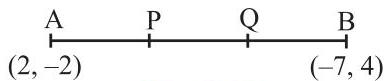 Fig. 7.11
Consequently, point P partitions the segment AB internally in a $1:2$ ratio. Applying the section formula, the coordinates of P are derived as:
$ \left(\frac{1(-7) + 2(2)}{1 + 2}, \frac{1(4) + 2(-2)}{1 + 2}\right), \text{ i.e., } (-1, 0) $
Similarly, point Q divides the segment AB internally in a $2:1$ ratio. Thus, the coordinates for Q are:
$ \left(\frac{2(-7) + 1(2)}{2 + 1}, \frac{2(4) + 1(-2)}{2 + 1}\right), \text{ i.e., } (-4, 2)
$
Hence, the coordinates of the points that trisect the line segment connecting A and B are determined to be $(-1, 0)$ and $(-4, 2)$.
Note: Alternatively, Q could have been determined by recognizing its position as the midpoint of segment PB. This would allow for the use of the midpoint formula to ascertain its coordinates.
Example 9: Determine the ratio in which the $y$-axis intersects and divides the line segment connecting the points $(5, -6)$ and $(-1, -4)$. Additionally, identify the coordinates of this point of intersection.
Solution: Assume the dividing ratio is $k:1$. According to the section formula, the coordinates of the point that partitions segment AB in this $k:1$ ratio are $\left(\frac{-k + 5}{k + 1}, \frac{-4k - 6}{k + 1}\right)$.
Since this point is situated on the $y$-axis, its abscissa (x-coordinate) must be zero.
Therefore, $\frac{-k + 5}{k + 1} = 0$
Thus, $k = 5$
Therefore, the division ratio is $5:1$. Substituting $k = 5$ yields the point of intersection as $\left(0, \frac{-13}{3}\right)$.
Example 10: Given that points A(6, 1), B(8, 2), C(9, 4), and D(p, 3) sequentially form the vertices of a parallelogram, determine the numerical value of $p$.
Solution: It is a known property that the diagonals of a parallelogram mutually bisect one another.
Consequently, the midpoint coordinates of diagonal AC must be identical to the midpoint coordinates of diagonal BD.
i.e., $\left(\frac{6 + 9}{2}, \frac{1 + 4}{2}\right) = \left(\frac{8 + p}{2}, \frac{2 + 3}{2}\right)$
i.e., $\left(\frac{15}{2}, \frac{5}{2}\right) = \left(\frac{8 + p}{2}, \frac{5}{2}\right)$
Hence, equating the x-coordinates gives $\frac{15}{2} = \frac{8 + p}{2}$
Thus, $p = 7$
EXERCISE 7.2
- Determine the coordinates of the point that partitions the line segment connecting $(-1, 7)$ and $(4, -3)$ in the ratio $2:3$.
- Ascertain the coordinates for the points that trisect the line segment bounded by $(4, -1)$ and $(-2, -3)$.
- For the purpose of organizing Sports Day events within a rectangular school ground designated ABCD, parallel lines have been marked using chalk powder, each separated by an interval of $1\mathrm{m}$. Along the side AD, 100 flower pots have been arranged, with each pot $1\mathrm{m}$ apart, as depicted in Fig. 7.12. Niharika proceeds $\frac{1}{4}$ of the total distance AD along the second line and positions a green flag. Subsequently, Preet traverses $\frac{1}{5}$ of the distance AD along the eighth line and places a red flag. Calculate the linear distance separating these two flags. Should Rashmi be required to place a blue flag precisely at the midpoint of the line segment connecting the two existing flags, what would be the coordinates of its placement?
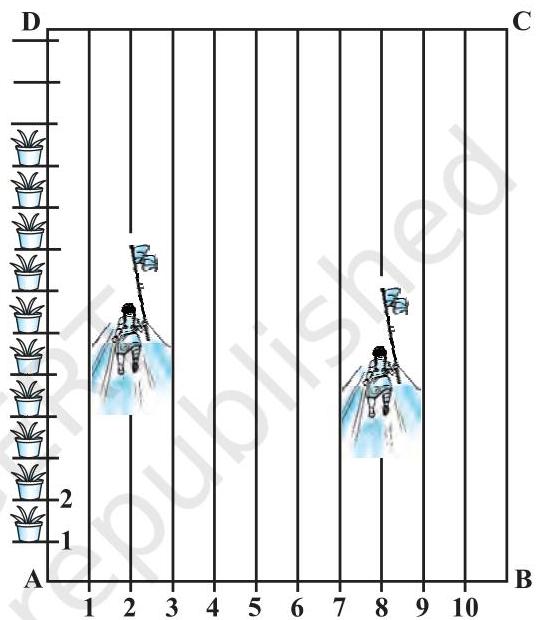 Fig. 7.12
- Determine the ratio by which the line segment connecting the points $(-3, 10)$ and $(6, -8)$ is partitioned by the point $(-1, 6)$.
- Ascertain the ratio in which the line segment connecting $\mathrm{A}(1, -5)$ and $\mathrm{B}(-4, 5)$ is intersected by the $x$-axis. Additionally, determine the coordinates of this intersection point.
- Given that $(1,2), (4,y), (x,6)$ and $(3,5)$ represent the vertices of a parallelogram, listed sequentially, calculate the values of $x$ and $y$.
- Determine the coordinates of point A, given that AB constitutes the diameter of a circle centered at $(2, -3)$ and point B is located at $(1, 4)$.
- Given points A at $(-2, -2)$ and B at $(2, -4)$, ascertain the coordinates of point P such that $\mathrm{AP} = \frac{3}{7}$ AB, where P is situated on the line segment AB.
- Identify the coordinates of the points that partition the line segment connecting $\mathrm{A}(-2, 2)$ and $\mathrm{B}(2, 8)$ into four segments of equal length.
- Calculate the area of a rhombus whose vertices are given sequentially as $(3, 0), (4, 5), (-1, 4)$ and $(-2, -1)$. [Hint: The area of a rhombus is equal to $\frac{1}{2}$ (product of its diagonals)]
7.4 Summary
In this chapter, the following fundamental concepts have been examined:
- The Euclidean distance between two points, $\mathrm{P}(x_1, y_1)$ and $\mathrm{Q}(x_2, y_2)$, is determined by the expression $\sqrt{(x_2 - x_1)^2 + (y_2 - y_1)^2}$.
- The distance of an arbitrary point $\mathrm{P}(x, y)$ from the coordinate origin $(0,0)$ is given by $\sqrt{x^2 + y^2}$.
- For a point $\mathrm{P}(x, y)$ that internally partitions the line segment connecting $\mathrm{A}(x_1, y_1)$ and $\mathrm{B}(x_2, y_2)$ in the ratio $m_1 : m_2$, its coordinates are specified as $\left( \frac{m_1 x_2 + m_2 x_1}{m_1 + m_2}, \frac{m_1 y_2 + m_2 y_1}{m_1 + m_2} \right)$.
- The coordinates of the midpoint for the line segment joining points $\mathrm{P}(x_1, y_1)$ and $\mathrm{Q}(x_2, y_2)$ are calculated as $\left(\frac{x_1 + x_2}{2}, \frac{y_1 + y_2}{2}\right)$.
A NOTE TO THE READER
As elaborated in Section 7.3, the Section Formula provides the coordinates $(x, y)$ for a point $P$ that internally divides the line segment bounded by points $A(x_1, y_1)$ and $B(x_2, y_2)$ in the specified ratio $m_1 : m_2$. This formula is presented as:
$ x = \frac {m _ {1} x _ {2} + m _ {2} x _ {1}}{m _ {1} + m _ {2}}, \quad y = \frac {m _ {1} y _ {2} + m _ {2} y _ {1}}{m _ {1} + m _ {2}} $
It is important to note that, in this context, the ratio $\mathrm{PA}:\mathrm{PB}$ corresponds to $m_1:m_2$.
Conversely, should point $\mathrm{P}$ reside on the line $\mathrm{AB}$ but outside the segment $\mathrm{AB}$, while still maintaining the ratio $\mathrm{PA} : \mathrm{PB} = m_1 : m_2$, it is then described as externally dividing the line segment connecting points $\mathrm{A}$ and $\mathrm{B}$. The Section Formula applicable to such external division scenarios will be explored in subsequent advanced coursework.