CHAPTER 2 : POLYNOMIALS
2.1 Introduction
In your previous studies in Class IX, the concept of polynomials in a single variable and their respective degrees was introduced. To reiterate, for a polynomial $p(x)$ expressed in terms of $x$, its degree is defined as the maximum exponent of $x$ present within $p(x)$. For instance, $4x + 2$ represents a polynomial in the variable $x$ with a degree of 1; $2y^2 - 3y + 4$ is a polynomial in $y$ of degree 2; $5x^3 - 4x^2 + x - \sqrt{2}$ is a polynomial in $x$ possessing a degree of 3; and $7u^6 - \frac{3}{2} u^3 + 4u^2 + u - 8$ constitutes a polynomial in $u$ with a degree of 6. Conversely, expressions such as $\frac{1}{x - 1}$, $\sqrt{x} + 2$, $\frac{1}{x^2 + 2x + 3}$, and similar forms, do not qualify as polynomials.
A polynomial characterized by a degree of 1 is termed a linear polynomial. Illustrative instances include $2x - 3$, $\sqrt{3}x + 5$, $y + \sqrt{2}$, $x - \frac{2}{11}$, $3z + 4$, and $\frac{2}{3}u + 1$, all of which are linear polynomials. Conversely, expressions like $2x + 5 - x^2$ and $x^3 + 1$ do not fall into the category of linear polynomials.
A polynomial possessing a degree of 2 is designated a quadratic polynomial. The term 'quadratic' originates from 'quadrate', signifying 'square'. Examples of quadratic polynomials (where coefficients are real numbers) encompass $2x^{2} + 3x - \frac{2}{5}$, $y^{2} - 2$, $2 - x^{2} + \sqrt{3}x$, $\frac{u}{3} - 2u^{2} + 5$, $\sqrt{5}v^{2} - \frac{2}{3}v$, and $4z^{2} + \frac{1}{7}$. Broadly, any quadratic polynomial in the variable $x$ can be expressed in the standard form $ax^{2} + bx + c$, given that $a, b, c$ are real numbers and $a \neq 0$. A polynomial with a degree of 3 is referred to as a cubic polynomial. Representative examples include
a cubic polynomial are $2 - x^{3}, x^{3}, \sqrt{2} x^{3}, 3 - x^{2} + x^{3}$, and $3x^{3} - 2x^{2} + x - 1$. Fundamentally, the overarching form for a cubic polynomial is expressed as:
$ a x ^ {3} + b x ^ {2} + c x + d, $
where $a, b, c, d$ represent real numbers, and the condition $a \neq 0$ must hold.
Let us now examine the polynomial $p(x) = x^2 - 3x - 4$. By substituting $x = 2$ into this polynomial, we derive $p(2) = 2^2 - 3 \times 2 - 4 = -6$. This resultant value, $-6$, derived from substituting $x$ with $2$ in the expression $x^2 - 3x - 4$, is designated as the value of $x^2 - 3x - 4$ when $x = 2$. In an analogous manner, $p(0)$ represents the value of $p(x)$ at $x = 0$, which is found to be $-4$.
Should $p(x)$ be a polynomial in $x$, and $k$ be any real number, the numerical outcome achieved by substituting $x$ with $k$ within $p(x)$ is termed the value of $p(x)$ at $x = k$, symbolized as $p(k)$.
To illustrate, what is the value of the polynomial $p(x) = x^2 - 3x - 4$ when $x = -1$? The computation yields:
$ p (- 1) = (- 1) ^ {2} - {3 \times (- 1) } - 4 = 0 $
Furthermore, it is observed that $p(4) = 4^2 - (3 \times 4) - 4 = 0$.
Given that $p(-1) = 0$ and $p(4) = 0$, the numbers -1 and 4 are identified as the zeroes of the quadratic polynomial $x^{2} - 3x - 4$. In a broader sense, a real number $k$ is designated a zero of a polynomial $p(x)$ if and only if $p(k) = 0$.
The methodology for determining the zeroes of a linear polynomial was previously covered in Class IX. For instance, if $k$ represents a zero of the polynomial $p(x) = 2x + 3$, then the condition $p(k) = 0$ implies $2k + 3 = 0$, which subsequently yields $k = -\frac{3}{2}$.
More comprehensively, if $k$ serves as a zero for the polynomial $p(x) = ax + b$, then setting $p(k) = ak + b = 0$ leads directly to $k = \frac{-b}{a}$. Consequently, the zero of any linear polynomial $ax + b$ is given by the expression $\frac{-b}{a}$, which can also be articulated as $\frac{-(\text{Constant term})}{\text{Coefficient of } x}$.
The relationship between a linear polynomial's zero and its coefficients has been established. This raises the question of whether similar relationships exist for polynomials of higher degrees, such as quadratic polynomials, regarding their zeroes and coefficients.
This chapter aims to address these inquiries. Additionally, we will explore the division algorithm pertinent to polynomials.
2.2 Geometrical Meaning of the Zeroes of a Polynomial
It is understood that a real number $k$ constitutes a zero of the polynomial $p(x)$ when $p(k) = 0$. The significance of polynomial zeroes, however, warrants further investigation. To elucidate this, we will initially examine the graphical depictions of linear and quadratic polynomials, alongside the geometric interpretation of their zeroes.
Let us begin by examining a linear polynomial of the form $ax + b$, where $a \neq 0$. As learned in Class IX, the graphical representation of $y = ax + b$ is a straight line. For instance, the graph corresponding to $y = 2x + 3$ is a straight line that traverses through the coordinates $(-2, -1)$ and $(2, 7)$.
| x | -2 | 2 |
|---|---|---|
| y = 2x + 3 | -1 | 7 |
Observing Fig. 2.1, it is evident that the graph of $y = 2x + 3$ crosses the $x$-axis precisely at the midpoint between $x = -1$ and $x = -2$, specifically at the point $\left(-\frac{3}{2}, 0\right)$. Furthermore, it is already established that the zero of $2x + 3$ is $-\frac{3}{2}$. Consequently, the zero of the polynomial $2x + 3$ corresponds to the $x$-coordinate of the intersection point of the graph of $y = 2x + 3$ with the $x$-axis.
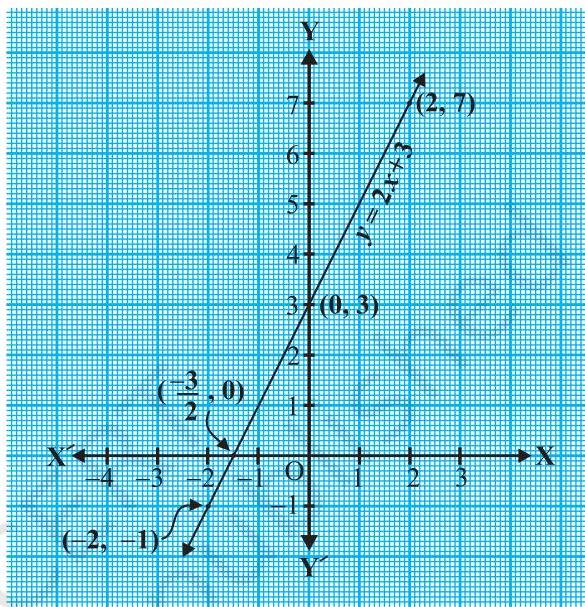 Fig. 2.1
Generally, for any linear polynomial $ax + b$ where $a \neq 0$, its corresponding graph $y = ax + b$ is a straight line that intersects the $x$-axis at precisely one location, specifically $\left(\frac{-b}{a}, 0\right)$. Hence, a linear polynomial $ax + b$, with $a \neq 0$, possesses exactly one zero, which is represented by the $x$-coordinate of the point where the graph of $y = ax + b$ crosses the $x$-axis.
Next, we will investigate the geometric interpretation of a zero for a quadratic polynomial. Take, for instance, the quadratic polynomial $x^{2} - 3x - 4$. We shall examine the graphical representation* of $y = x^{2} - 3x - 4$. To do this, we will tabulate several values of $y = x^{2} - 3x - 4$ that correspond to a selection of $x$ values, as presented in Table 2.1.
Table 2.1
| x | -2 | -1 | 0 | 1 | 2 | 3 | 4 | 5 |
|---|---|---|---|---|---|---|---|---|
| y=$x^2-3x-4$ | 6 | 0 | -4 | -6 | -6 | -4 | 0 | 6 |
Should these tabulated points be plotted on graph paper and subsequently connected, the resultant graph will resemble the illustration provided in Fig. 2.2.
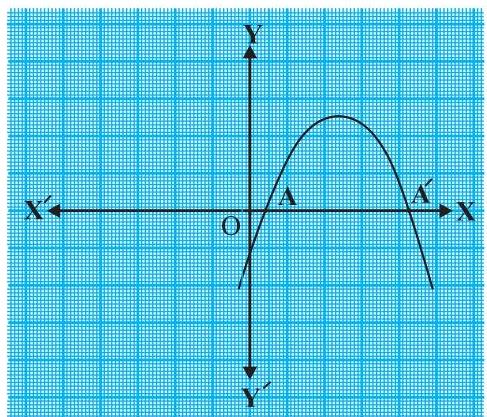
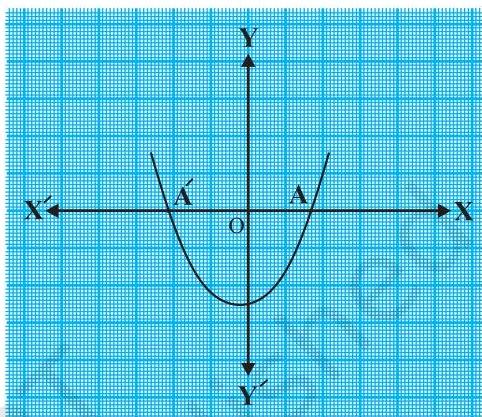
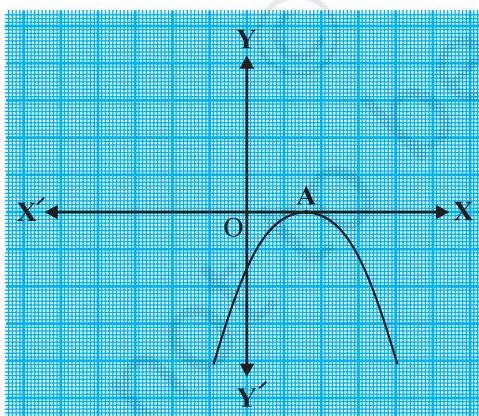
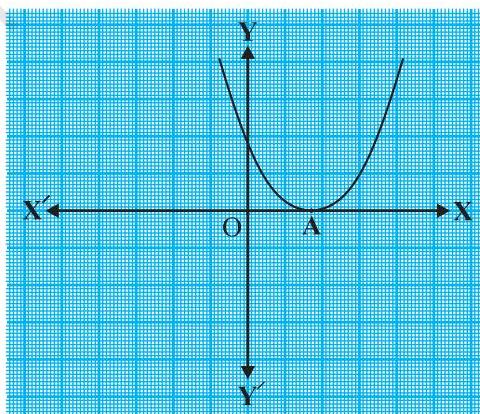
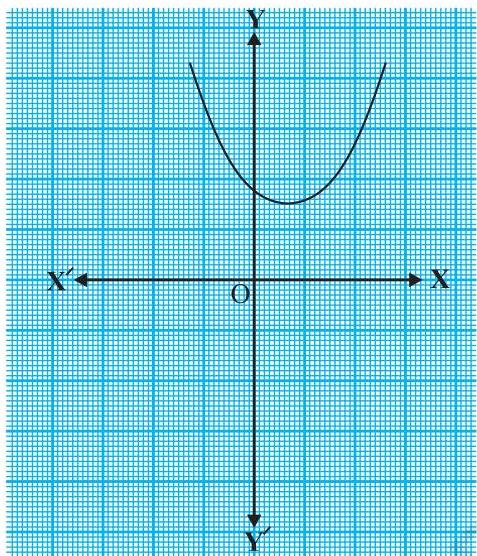
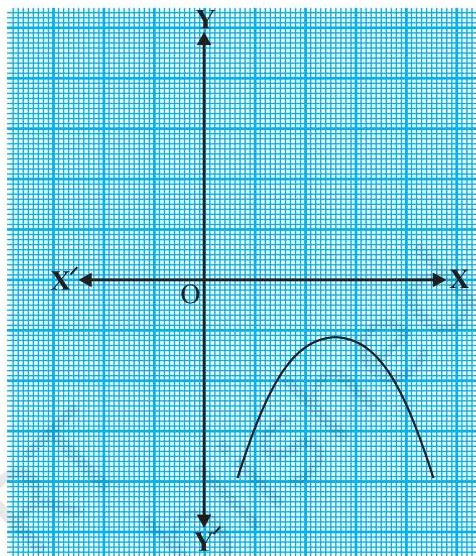
Indeed, for any quadratic polynomial $ax^2 + bx + c$ (where $a \neq 0$), the graph of its associated equation $y = ax^2 + bx + c$ assumes one of two characteristic forms: either opening upwards, akin to $\bigvee$, or opening downwards, similar to $\bigcap$. The specific orientation is determined by whether $a > 0$ or $a < 0$, respectively. Such curves are identified as parabolas.
From Table 2.1, it is discernible that $-1$ and $4$ represent the zeroes of the quadratic polynomial. Furthermore, Fig. 2.2 illustrates that $-1$ and $4$ correspond to the $x$-coordinates of the locations where the graph of $y = x^2 - 3x - 4$ intersects the $x$-axis. Consequently, the zeroes of the quadratic polynomial $x^2 - 3x - 4$ are precisely the $x$-coordinates of the points at which its graph $y = x^2 - 3x - 4$ crosses the $x$-axis.
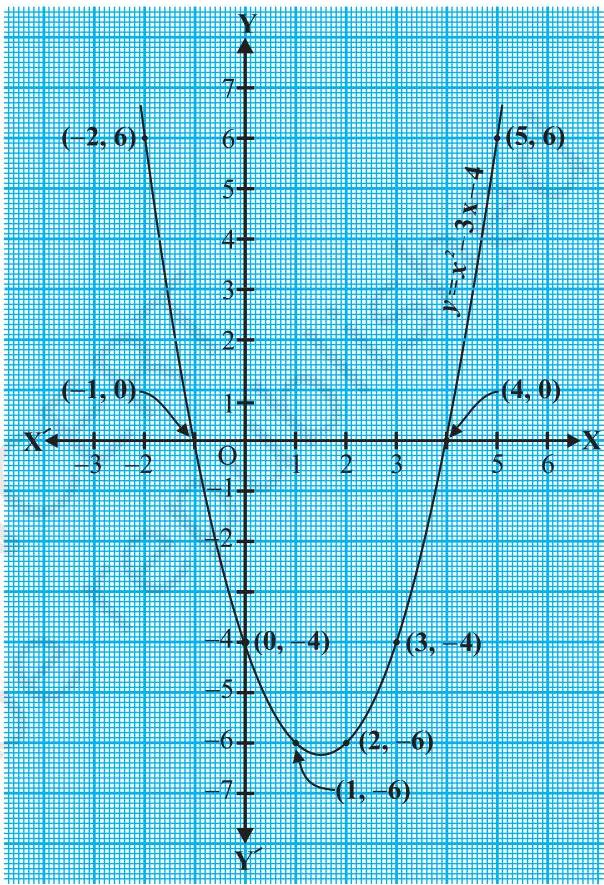 Fig. 2.2
This principle applies universally to any quadratic polynomial; specifically, the roots (or zeroes) of a quadratic polynomial expressed as $ax^2 + bx + c$, where $a \neq 0$, correspond exactly to the $x$-coordinates of the points where the parabolic graph of $y = ax^2 + bx + c$ intersects the $x$-axis.
Based on our preceding analysis concerning the morphology of the graph for $y = ax^2 + bx + c$, three distinct scenarios are possible:
Case (i): In this situation, the graphical representation intersects the $x$-axis at two separate and distinct points, labeled A and $A'$.
The $x$-coordinates associated with points A and $A'$ constitute the two zeroes of the quadratic polynomial $ax^2 + bx + c$ for this particular case (refer to Fig. 2.3).
 (i)
(i)
 (ii)
(ii)
Fig. 2.3
Case (ii): In this instance, the graph makes contact with the $x$-axis at precisely one location. This means the two points, A and $A'$, discussed in Case (i) have converged to form a singular point, A (as depicted in Fig. 2.4).
 (i)
(i)
 (ii)
(ii)
Fig. 2.4
Consequently, the $x$-coordinate of point A represents the sole zero for the quadratic polynomial $ax^2 + bx + c$ under these conditions.
Case (iii): In this
scenario, the graph resides entirely above the $x$-axis or entirely below it, thus exhibiting no intersection with the $x$-axis at any point (as illustrated in Fig. 2.5).
 (i)
(i)
 (ii)
Fig. 2.5
Consequently, the quadratic polynomial $ax^2 + bx + c$ possesses no real zeroes under these circumstances.
(ii)
Fig. 2.5
Consequently, the quadratic polynomial $ax^2 + bx + c$ possesses no real zeroes under these circumstances.
Therefore, from a geometrical perspective, a quadratic polynomial may possess either two discrete zeroes, two identical zeroes (effectively a single zero), or no real zeroes whatsoever. This implies that a polynomial of the second degree will invariably have a maximum of two zeroes.
Considering this, what would be your anticipation regarding the geometrical interpretation of the zeroes of a cubic polynomial? Let us investigate. Take, for example, the cubic polynomial $x^3 - 4x$. To visualize the form of the graph for $y = x^3 - 4x$, we shall enumerate several $y$ values corresponding to a selection of $x$ values, as presented in Table 2.2.
Table 2.2
| x | -2 | -1 | 0 | 1 | 2 |
|---|---|---|---|---|---|
| y = x³ - 4x | 0 | 3 | 0 | -3 | 0 |
Upon plotting these tabulated points onto a graph paper and subsequently rendering the curve, it becomes apparent that the graphical representation of $y = x^3 - 4x$ corresponds to the depiction in Fig. 2.6.
From the preceding table, it is evident that $-2, 0,$ and $2$ represent the zeroes of the cubic polynomial $x^3 - 4x$. Furthermore, it can be discerned that these values—$-2, 0,$ and $2$—are precisely the $x$-coordinates of the unique points at which the graph of $y = x^3 - 4x$ intersects the $x$-axis. Given that the curve engages the $x$-axis exclusively at these three locations, their respective $x$-coordinates are definitively the sole zeroes of the polynomial.
To further illustrate this concept, let us examine additional instances. Specifically, consider the cubic polynomial expressions $x^3$ and $x^3 - x^2$. Their respective graphical representations, $y = x^3$ and $y = x^3 - x^2$, are depicted in Fig. 2.7 and Fig. 2.8.
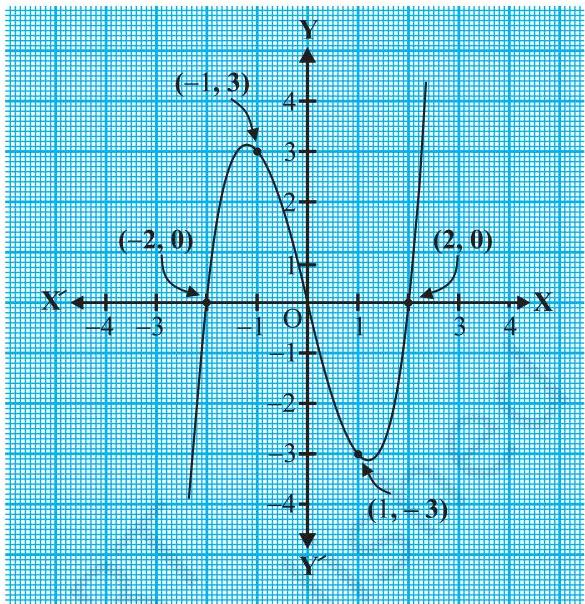 Fig. 2.6
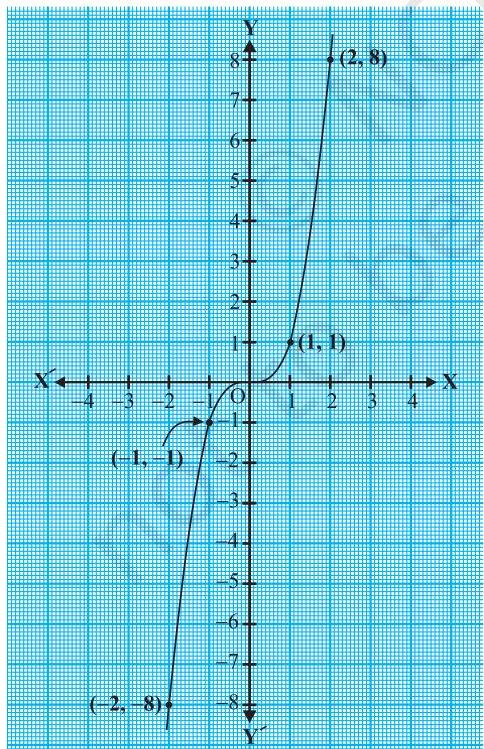 Fig. 2.7
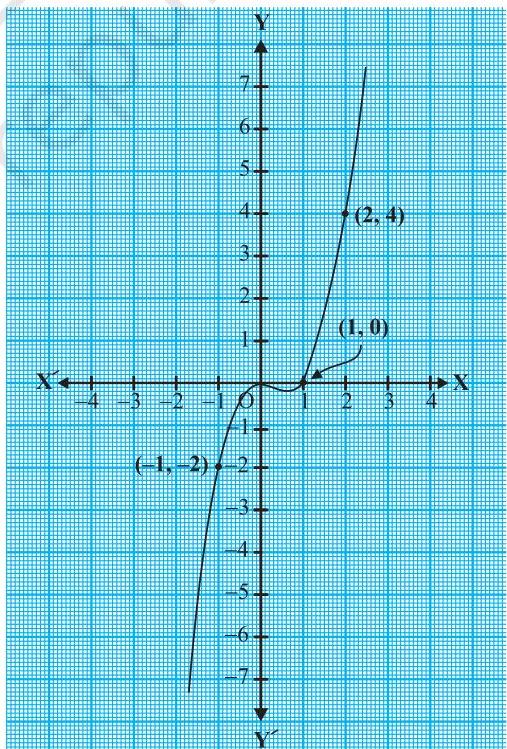 Fig. 2.8
POLYNOMIALS
It is observed that the polynomial $x^3$ possesses only one zero, which is 0. Furthermore, Fig. 2.7 clearly illustrates that 0 corresponds to the $x$-coordinate of the unique intersection point between the graph of $y = x^3$ and the $x$-axis. Analogously, given that $x^3 - x^2$ can be factored as $x^2(x - 1)$, the polynomial $x^3 - x^2$ has 0 and 1 as its sole zeroes. Correspondingly, Fig. 2.8 demonstrates that these specific values represent the $x$-coordinates of the exclusive points where the graph of $y = x^3 - x^2$ intersects the $x$-axis.
Based on the preceding examples, it can be deduced that a cubic polynomial will possess a maximum of 3 zeroes. Stated differently, any polynomial with a degree of 3 is restricted to having no more than three zeroes.
Remark : Generally, for a polynomial $p(x)$ with degree $n$, its graph, represented by $y = p(x)$, will intersect the $x$-axis at a maximum of $n$ distinct points. Consequently, a polynomial $p(x)$ of degree $n$ is characterized by having no more than $n$ zeroes.
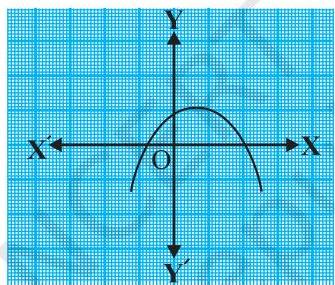
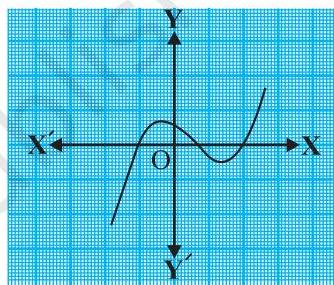
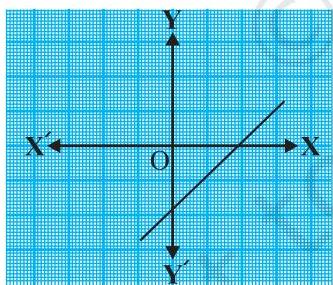
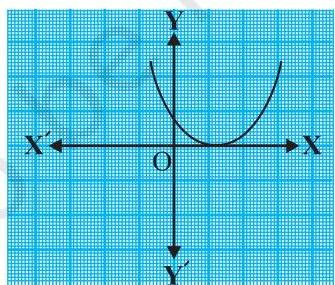
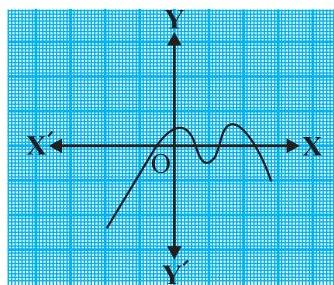
Example 1: Examine the graphical representations presented in Fig. 2
.9 below. Each illustration depicts the graph of $y = p(x)$, where $p(x)$ signifies a polynomial. For every graph provided, determine the quantity of zeroes corresponding to $p(x)$.
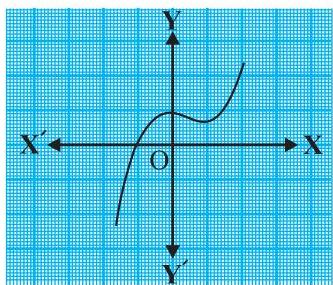 (i)
(i)
 (ii)
(ii)
 (iii)
(iii)
 (iv)
(iv)
 (v)
(v)
 (vi)
(vi)
Fig. 2.9
Solution
(i) The function exhibits a single zero, which corresponds to the solitary intersection point of its graphical representation with the $x$-axis. (ii) There are two zeroes for this function, indicated by the two distinct points where its graph crosses the $x$-axis. (iii) The polynomial possesses three zeroes. (Elaborate on the reasoning.) (iv) This function has one zero. (Provide justification.)
(v) A single zero is present in this case. (Explain why.) (vi) The function demonstrates four zeroes. (Justify this observation.)
EXERCISE 2.1
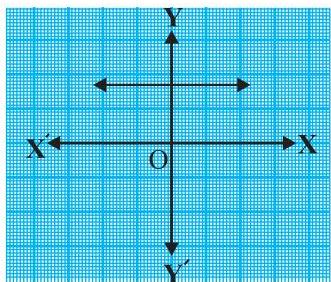
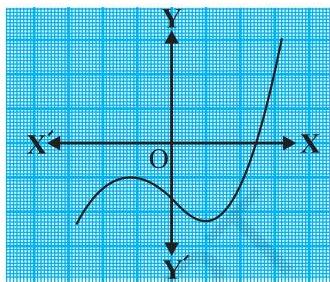
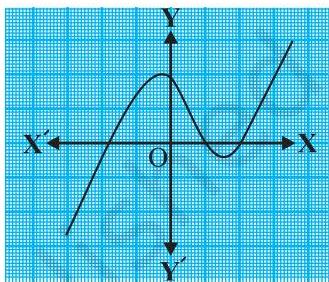
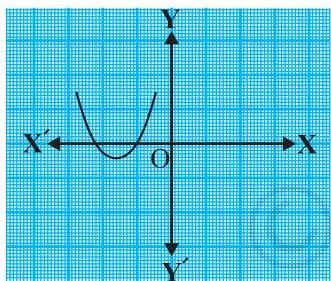
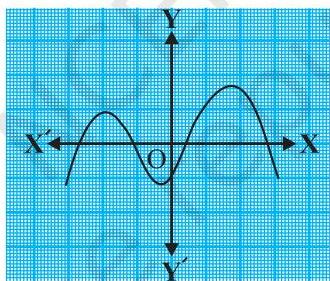
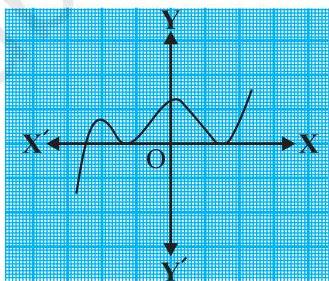
- For each polynomial $p(x)$ represented by the graphs of $y = p(x)$ in Fig. 2.10, determine the quantity of zeroes.
 (i)
(i)
 (ii)
(ii)
 (iii)
(iii)
 (iv)
(iv)
 (v)
(v)
 (vi)
Fig. 2.10
(vi)
Fig. 2.10
2.3 Relationship between Zeroes and Coefficients of a Polynomial
You have previously established that for a linear polynomial $ax + b$, its zero is given by $-\frac{b}{a}$. Our current objective is to address the inquiry posed in Section 2.1 concerning the correlation between the zeroes and coefficients of a quadratic polynomial. To illustrate this, consider a quadratic polynomial, for instance, $p(x) = 2x^2 - 8x + 6$. In Class IX, you acquired the technique of factorizing quadratic polynomials by partitioning the middle term. Consequently, in this case, we need to decompose the middle term $-8x$ into a sum of two terms such that their product equals $6 \times 2x^2 = 12x^2$. This leads to the following factorization:
$ \begin{array}{l} 2 x ^ {2} - 8 x + 6 = 2 x ^ {2} - 6 x - 2 x + 6 = 2 x (x - 3) - 2 (x - 3) \ = (2 x - 2) (x - 3) = 2 (x - 1) (x - 3) \ \end{array} $
Thus, the polynomial $p(x) = 2x^{2} - 8x + 6$ evaluates to
zero when either $x - 1 = 0$ or $x - 3 = 0$, which means $x = 1$ or $x = 3$. Therefore, the zeroes of $2x^{2} - 8x + 6$ are 1 and 3. Let us observe the following relationships:
$ \text{Sum of its zeroes} = 1 + 3 = 4 = \frac{-(-8)}{2} = \frac{-(\text{Coefficient of } x)}{\text{Coefficient of } x^{2}} $
$ \text{Product of its zeroes} = 1 \times 3 = 3 = \frac{6}{2} = \frac{\text{Constant term}}{\text{Coefficient of } x^{2}} $
Let us examine another quadratic polynomial, such as $p(x) = 3x^{2} + 5x - 2$. Employing the method of splitting the middle term, we find:
$ \begin{array}{l} 3x^{2} + 5x - 2 = 3x^{2} + 6x - x - 2 = 3x(x + 2) - 1(x + 2) \ = (3x - 1)(x + 2) \end{array} $
Accordingly, the expression $3x^{2} + 5x - 2$ equals zero if $3x - 1 = 0$ or $x + 2 = 0$, yielding $x = \frac{1}{3}$ or $x = -2$. Hence, the zeroes of $3x^{2} + 5x - 2$ are $\frac{1}{3}$ and $-2$. Notice that:
$ \text{Sum of its zeroes} = \frac{1}{3} + (-2) = \frac{-5}{3} = \frac{-(\text{Coefficient of } x)}{\text{Coefficient of } x^{2}} $
$ \text{Product of its zeroes} = \frac{1}{3} \times (-2) = \frac{-2}{3} = \frac{\text{Constant term}}{\text{Coefficient of } x^{2}} $
Generally, if $\alpha$ and $\beta$ represent the zeroes of a quadratic polynomial $p(x) = ax^2 + bx + c$, where $a \neq 0$, it is known that $x - \alpha$ and $x - \beta$ are factors of $p(x)$. Consequently, we can write:
$ \begin{array}{l} ax^{2} + bx + c = k(x - \alpha)(x - \beta), \text{ where } k \text{ is a constant} \ = k[x^{2} - (\alpha + \beta)x + \alpha \beta] \ = kx^{2} - k(\alpha + \beta)x + k \alpha \beta \end{array} $
By equating the coefficients of $x^{2}$, $x$, and the constant terms on both sides of the equation, we obtain:
$ a = k, b = -k(\alpha + \beta) \text{ and } c = k\alpha\beta. $
From these equalities, we deduce:
$ \alpha + \beta = \frac{-b}{a}, $
$ \alpha\beta = \frac{c}{a}
$
That is,
$ \text{sum of zeroes} = \alpha + \beta = -\frac{b}{a} = \frac{-(\text{Coefficient of } x)}{\text{Coefficient of } x^2}, $
$ \text{product of zeroes} = \alpha\beta = \frac{c}{a} = \frac{\text{Constant term}}{\text{Coefficient of } x^2}. $
Let us consider some examples.
Example 2: Find the zeroes of the quadratic polynomial $x^{2} + 7x + 10$, and verify the relationship between the zeroes and the coefficients.
Solution: The given expression can be factored as:
$ x^{2} + 7x + 10 = (x + 2)(x + 5) $
Consequently, the polynomial $x^{2} + 7x + 10$ evaluates to zero if either $x + 2 = 0$ or $x + 5 = 0$. This implies that the roots occur at $x = -2$ or $x = -5$. Hence, the zeroes for $x^{2} + 7x + 10$ are $-2$ and $-5$. Subsequently, we can examine their sum and product:
$ \text{sum of zeroes} = -2 + (-5) = -(7) = \frac{-(7)}{1} = \frac{-(\text{Coefficient of } x)}{\text{Coefficient of } x^2}, $
$ \text{product of zeroes} = (-2) \times (-5) = 10 = \frac{10}{1} = \frac{\text{Constant term}}{\text{Coefficient of } x^2}. $
Example 3: Find the zeroes of the polynomial $x^{2} - 3$ and verify the relationship between the zeroes and the coefficients.
Solution: We leverage the algebraic identity $a^2 - b^2 = (a - b)(a + b)$. Applying this principle, the polynomial can be expressed as:
$ x^{2} - 3 = \left(x - \sqrt{3}\right) \left(x + \sqrt{3}\right) $
Thus, $x^{2} - 3$ equals zero when $x = \sqrt{3}$ or $x = -\sqrt{3}$.
Accordingly, the zeroes of the polynomial $x^{2} - 3$ are $\sqrt{3}$ and $-\sqrt{3}$.
Next, let's analyze the sum and product of these zeroes:
$ \text{sum of zeroes} = \sqrt{3} - \sqrt{3} = 0 = \frac{-(\text{Coefficient of } x)}{\text{Coefficient of } x^2}, $
$ \text{product of zeroes} = (\sqrt{3}) (-\sqrt{3}) = -3 = \frac{-3}{1} = \frac{\text{Constant term}}{\text{Coefficient of } x^2}. $
Example 4: Find a quadratic polynomial, the sum and product of whose zeroes are $-3$ and $2$, respectively.
Solution: Assume the quadratic polynomial is represented by $ax^2 + bx + c$, with its zeroes denoted as $\alpha$ and $\beta$. From the given information, we establish the following relationships:
$ \alpha + \beta = -3 = \frac{-b}{a}, $
and
$ \alpha\beta = 2 = \frac{c}{a}. $
By setting $a = 1$, we can deduce that $b = 3$ and $c = 2$.
Therefore,
a quadratic polynomial satisfying these criteria is $x^{2} + 3x + 2$.
It can be verified that any other quadratic polynomial adhering to these conditions will take the form $k(x^{2} + 3x + 2)$, where $k$ is real.
We will now extend our examination to cubic polynomials. Is it plausible that a comparable relationship exists between the zeroes of a cubic polynomial and its corresponding coefficients?
Let's analyze the polynomial $p(x) = 2x^3 - 5x^2 - 14x + 8$.
One can verify that $p(x) = 0$ when $x = 4, -2, \frac{1}{2}$. Given that a cubic polynomial can possess a maximum of three zeroes, these values represent the zeroes of $2x^3 - 5x^2 - 14x + 8$. Let us now compute their sum and product:
$ \text{sum of the zeroes} = 4 + (-2) + \frac{1}{2} = \frac{5}{2} = \frac{-(-5)}{2} = \frac{-(\text{Coefficient of } x^2)}{\text{Coefficient of } x^3}, $
$ \text{product of the zeroes} = 4 \times (-2) \times \frac{1}{2} = -4 = \frac{-8}{2} = \frac{-\text{Constant term}}{\text{Coefficient of } x^3}. $
Nonetheless, an additional relationship is present in this context. Let's consider the sum of the products of the zeroes, taken two at a time. This yields:
$ \begin{array}{l} \left{4 \times (-2)\right} + \left{(-2) \times \frac{1}{2}\right} + \left{\frac{1}{2} \times 4\right} \ = -8 - 1 + 2 = -7 = \frac{-14}{2} = \frac{\text{Coefficient of } x}{\text{Coefficient of } x^3}. \end{array} $
Generally, it is demonstrable that for a cubic polynomial $ax^3 + bx^2 + cx + d$ with zeroes $\alpha, \beta, \gamma$, the following relationships hold:
$
\begin{array}{l} \alpha + \beta + \gamma = \frac{-b}{a}, \ \alpha\beta + \beta\gamma + \gamma\alpha = \frac{c}{a}, \ \alpha\beta\gamma = \frac{-d}{a}. \end{array} $
Example 5: Confirm that $3, -1, -\frac{1}{3}$ are the roots of the cubic polynomial $p(x) = 3x^3 - 5x^2 - 11x - 3$, and subsequently establish the relationship between these roots and the polynomial's coefficients.
Solution: By correlating the given polynomial with the general cubic form $ax^3 + bx^2 + cx + d$, we obtain:
$ \begin{array}{l} a = 3, b = -5, c = -11, d = -3. \text{ Further } \ p(3) = 3 \times 3^3 - (5 \times 3^2) - (11 \times 3) - 3 = 81 - 45 - 33 - 3 = 0, \ p(-1) = 3 \times (-1)^3 - 5 \times (-1)^2 - 11 \times (-1) - 3 = -3 - 5 + 11 - 3 = 0, \ p\left(-\frac{1}{3}\right) = 3 \times \left(-\frac{1}{3}\right)^3 - 5 \times \left(-\frac{1}{3}\right)^2 - 11 \times \left(-\frac{1}{3}\right) - 3, \ = -\frac{1}{9} - \frac{5}{9} + \frac{11}{3} - 3 = -\frac{2}{3} + \frac{2}{3} = 0 \end{array} $
Consequently, $3, -1$ and $-\frac{1}{3}$ are indeed the zeroes of $3x^3 - 5x^2 - 11x - 3$.
Let us designate the zeroes as $\alpha = 3$, $\beta = -1$, and $\gamma = -\frac{1}{3}$.
Next, we verify the relationships:
$ \begin{array}{l} \alpha + \beta + \gamma = 3 + (-1) + \left(-\frac{1}{3}\right) = 2 - \frac{1}{3} = \frac{5}{3} = \frac{-(-5)}{3} = \frac{-b}{a}, \ \alpha\beta + \beta\gamma + \gamma\alpha = 3 \times (-1) + (-1) \times \left(-\frac{1}{3}\right) + \left(-\frac{1}{3}\right) \times 3 = -3 + \frac{1}{3} - 1 = \frac{-11}{3} = \frac{c}{a}, \ \alpha\beta\gamma = 3 \times (-1) \times \left(-\frac{1}{3}\right) = 1 = \frac{-(-3)}{3} = \frac{-d}{a}. \end{array} $
EXERCISE 2.2
- Find the zeroes of the following quadratic polynomials and verify the relationship between the zeroes and the coefficients.
(i) $x^{2} - 2x - 8$
(ii) $4s^2 - 4s + 1$
(iii) $6x^{2} - 3 - 7x$
(iv) $4u^{2} + 8u$
(v) $t^2 - 15$
(vi) $3x^{2} - x - 4$
- Find a quadratic polynomial each with the given numbers as the sum and product of its zeroes respectively.
(i) $\frac{1}{4}, -1$
(ii) $\sqrt{2}, \frac{1}{3}$
(iii) $0, \sqrt{5}$
(iv) 1, 1
(v) $-\frac{1}{4}, \frac{1}{4}$
(vi) 4, 1
2.4 Summary
This chapter has covered the following principal aspects:
Polynomials possessing degrees of one, two, and three are, respectively, termed linear, quadratic, and cubic polynomials.
A quadratic polynomial involving the variable $x$, characterized by real coefficients, adheres to the general structure $ax^2 + bx + c$, where $a, b, c$ represent real numbers, and the leading coefficient $a$ is non-zero.
The zeroes (or roots) of a polynomial $p(x)$ correspond exactly to the $x$-coordinates of the intersections between the graph of $y = p(x)$ and the $x$-axis.
A quadratic polynomial is capable of possessing a maximum of two zeroes, while a cubic polynomial may exhibit up to three zeroes.
Should $\alpha$ and $\beta$ denote the zeroes of a quadratic polynomial expressed as $ax^2 + bx + c$, then the following relationships hold:
$ \alpha + \beta = - \frac {b}{a}, \quad \alpha \beta = \frac {c}{a}. $
- In the event that $\alpha, \beta, \gamma$ represent the zeroes of a cubic polynomial defined by $ax^3 + bx^2 + cx + d$, then:
$ \alpha + \beta + \gamma = \frac {- b}{a}, $
$ \alpha \beta + \beta \gamma + \gamma \alpha = \frac {c}{a}, $
and $\alpha \beta \gamma = \frac{-d}{a}$