UNIT 6
EQUILIBRIUM
Objectives
After studying this unit you will be able to
- recognize the dynamic characteristic of equilibrium within physical and chemical phenomena;
- articulate the law of equilibrium;
- elucidate the defining attributes of equilibria present in physical and chemical transformations;
- formulate mathematical representations for equilibrium constants;
- determine the correlation between $K_{p}$ and $K_{c}$;
- describe the diverse elements influencing a reaction's equilibrium state;
- categorize chemical substances as either acids or bases, adhering to the Arrhenius, Brønsted-Lowry, and Lewis theoretical frameworks;
- distinguish between strong and weak acids and bases based on their respective ionization constants;
- clarify how the extent of ionization is influenced by both the electrolyte concentration and the presence of a common ion;
- detail the pH scale's function in quantifying hydrogen ion concentration;
- elucidate the ionization process of water and its bifunctional capacity as both an acid and a base;
- characterize the ionic product $(K_{\mathrm{w}})$ and $\mathsf{p}K_{\mathrm{w}}$ specific to water;
- recognize the significance and utility of buffer solutions;
- compute the solubility product constant.
The concept of chemical equilibrium holds substantial significance across a multitude of biological and environmental systems. A pertinent illustration is the equilibrium relationship between oxygen molecules ($\mathrm{O}_2$) and the protein hemoglobin, which is fundamental to the conveyance and distribution of $\mathrm{O}_2$ from pulmonary tissues to muscular structures within the body. Analogously, the equilibrium dynamics between carbon monoxide (CO) molecules and hemoglobin underpin the observed toxicity associated with CO exposure.
When a liquid undergoes evaporation within a closed container, molecules possessing relatively higher kinetic energy depart from the liquid surface and transition into the vapor phase. Concurrently, an equivalent number of liquid molecules from the vapor phase collide with the liquid surface and are re-incorporated into the liquid phase. This leads to the establishment of a constant vapor pressure, owing to an equilibrium where the quantity of molecules exiting the liquid precisely matches the quantity returning from the vapor. At this point, the system is considered to have reached an equilibrium state. It is crucial to note, however, that this is not a static equilibrium; instead, considerable molecular activity persists at the boundary between the liquid and the vapor. Thus, at equilibrium, the rate of evaporation is precisely equal to the rate of condensation. This can be represented by:
$ \mathrm{H}{2} \mathrm{O} (\mathrm{l}) \rightleftharpoons \mathrm{H}{2} \mathrm{O} (\text{vap}) $
The presence of double half-arrows signifies that both forward and reverse processes are occurring concurrently. The resultant combination of reactants and products present within the equilibrium state is designated an equilibrium mixture.
Equilibrium is a state attainable in both physical processes and chemical reactions. The pace of such reactions can vary, being either rapid or gradual, contingent upon prevailing experimental parameters and the intrinsic properties of the reacting species. When reactants confined within a sealed container at a specific temperature undergo transformation into products, the concentrations of the reactants progressively diminish, while those of the products concurrently rise. This trend continues until a point is reached where no further net alteration in the concentrations of either reactants or products is observed. This specific condition of the system is termed dynamic equilibrium, characterized by the equivalence of the rates of the forward and reverse reactions. This phenomenon arises from
At this juncture of dynamic equilibrium, the concentrations of the diverse constituents within the reaction mixture remain constant. The progression of reactions towards the state of chemical equilibrium allows for their categorization into three distinct groups.
(i) Reactions that largely complete, leaving behind only trace quantities of reactants, which may occasionally be experimentally undetectable.
(ii) Reactions where the formation of products is minimal, with the majority of the reactants persisting in an unreacted state at equilibrium.
(iii) Reactions characterized by comparable concentrations of both reactants and products once the system attains equilibrium.
The degree to which a reaction proceeds towards equilibrium is contingent upon various experimental parameters, including reactant concentrations and temperature. Strategic optimization of operational parameters is paramount in both industrial and laboratory contexts to ensure that the equilibrium state favors the generation of the target product. This unit will explore key facets of equilibrium pertinent to both physical and chemical transformations, alongside the equilibrium phenomena involving ions in aqueous solutions, termed ionic equilibrium.
6.1 EQUILIBRIUM IN PHYSICAL PROCESSES
To gain a clearer understanding of the characteristics exhibited by systems at equilibrium, an examination of various physical processes proves beneficial. Among these, phase transformation processes stand out as particularly illustrative examples, such as:
- solid $\rightleftharpoons$ liquid
- liquid $\rightleftharpoons$ gas
- solid $\rightleftharpoons$ gas
6.1.1 Solid-Liquid Equilibrium
When ice and water are contained within a perfectly insulated thermos flask (preventing any heat exchange with the external environment) at a temperature of 273 K and atmospheric pressure, they establish an equilibrium state, which manifests several intriguing characteristic features. Macroscopically, it is observed that the quantities of both ice and water remain constant over time, and the system's temperature holds steady. Nevertheless, this equilibrium is not static; rather, it is characterized by vigorous molecular activity occurring at the interface between the two phases. Molecules from the liquid water continuously impact the ice surface and integrate into its structure, while concurrently, molecules from the ice lattice detach and transition into the liquid phase. The absence of any net change in the masses of ice and water is attributable to the precise balance where the rate at which molecules transfer from ice into water is exactly equal to the rate of the reverse transfer from water into ice, specifically under atmospheric pressure and 273 K.
It becomes evident that the equilibrium between ice and water is sustained exclusively under specific conditions of temperature and pressure. For any given pure substance, when maintained at atmospheric pressure, the temperature at which its solid and liquid phases coexist in equilibrium is designated as the normal melting point or, alternatively, the normal freezing point of that substance. Given that the system described operates under dynamic equilibrium, we can deduce the following principles:
(i) Both the opposing processes occur simultaneously.
(ii) Both the processes occur at the same rate so that the amount of ice and water remains constant.
6.1.2 Liquid-Vapour Equilibrium
To elucidate this equilibrium state, an experimental setup involving a sealed transparent enclosure fitted with a U-tube mercury manometer can be considered. Initially, a desiccant such as anhydrous calcium chloride or phosphorus pentaoxide is introduced into the box for several hours. Following its removal by tilting the container, a watch glass (or petri dish) filled with water is promptly positioned inside. An observable phenomenon is the gradual ascent of the mercury column in the manometer's right limb, eventually stabilizing at a fixed height. This indicates that the internal pressure of the enclosure rises until it achieves a constant magnitude. Concurrently, a reduction in the water volume within the watch glass is noted (Fig. 6.1). At the outset, the box contained minimal or no water vapor. As water underwent vaporization, the pressure within the box escalated as water molecules entered the gaseous phase. The rate at which this evaporation occurs remains unvarying.
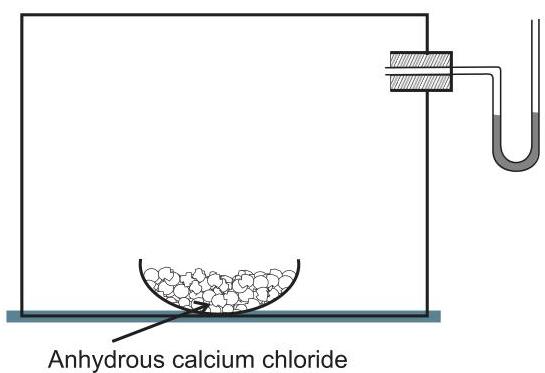 Fig. 6.1 Measuring equilibrium vapour pressure of water at a constant temperature
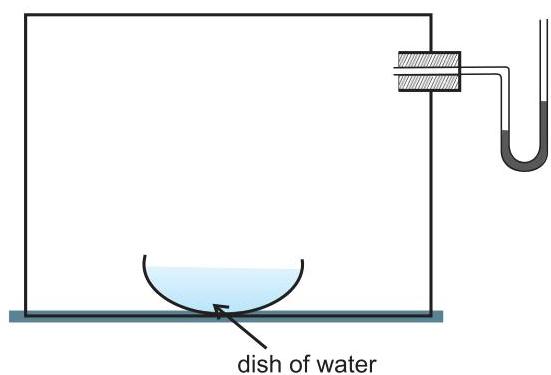
Nevertheless, the pace at which the pressure escalates diminishes over time, a consequence of vapor molecules condensing back into liquid water. Ultimately, this process culminates in an equilibrium state characterized by zero net evaporation. This signifies a concurrent rise in the rate at which water molecules transition from the gaseous phase back to the liquid phase, continuing until equilibrium is established, meaning:
rate of evaporation = rate of condensation
$ \mathrm {H} _ {2} \mathrm {O} (\mathrm {l}) \rightleftharpoons \mathrm {H} _ {2} \mathrm {O} (\text {vap}) $
Under equilibrium conditions, the partial pressure exerted by the water molecules at a specific temperature remains invariant; this is termed the equilibrium vapor pressure of water (or simply vapor pressure). It is important to note that the vapor pressure of water exhibits an increase with rising temperature. Should this experiment be replicated using alternative liquids such as methyl alcohol, acetone, and ether, it becomes evident that distinct liquids possess varying equilibrium vapor pressures at an identical temperature. A liquid demonstrating a higher vapor pressure is inherently more volatile and possesses a comparatively lower boiling point.
Consider exposing three separate watch glasses, each containing $1\mathrm{mL}$ of acetone, ethyl alcohol, and water respectively, to the ambient atmosphere. If this observation is extended to include varying volumes of these liquids within a warmer environment, it consistently reveals that the liquid eventually vanishes entirely. The duration required for this complete vaporization is contingent upon: (i) the intrinsic properties of the liquid, (ii) the initial quantity of the liquid, and (iii) the ambient temperature. When the watch glass is exposed to the atmosphere, the rate of evaporation persists at a constant level; however, the vaporized molecules dissipate throughout the extensive volume of the surrounding room. Consequently, the rate at which condensation occurs from the gaseous to the liquid state is significantly lower than the rate of evaporation. Such arrangements constitute open systems, within which the establishment of a state of equilibrium is not achievable.
Within a sealed container, water and its vapor phase achieve a state of equilibrium at atmospheric pressure (1.013 bar) when the temperature is maintained at $100^{\circ}\mathrm{C}$. This temperature, $100^{\circ}\mathrm{C}$ at 1.013 bar, defines the boiling point of water. More generally, for any pure liquid, the normal boiling point refers to the specific temperature at which its liquid and vapor states coexist in equilibrium under a standard atmospheric pressure of 1.013 bar. The boiling point of a liquid is not constant; it is contingent upon the prevailing atmospheric pressure, which, in turn, varies with geographical altitude. Consequently, liquids boil at lower temperatures in elevated regions.
6.1.3 Solid - Vapour Equilibrium
Our attention now turns to systems characterized by solids undergoing sublimation directly into the vapor phase. As an illustration, consider solid iodine enclosed within a sealed container. Over a period, the container will gradually become permeated with a violet vapor, the color intensity of which progressively strengthens. Eventually, this color intensity stabilizes, signaling the establishment of equilibrium. At this juncture, solid iodine is simultaneously sublimating into iodine vapor, and iodine vapor is condensing back into solid iodine. This dynamic equilibrium can be depicted as follows:
$ \mathrm {I} _ {2} (\text {solid}) \rightleftharpoons \mathrm {I} _ {2} (\text {vapour}) $
Additional examples demonstrating this type of equilibrium include:
$ \text {Camphor} (\text {solid}) \rightleftharpoons \text {Camphor} (\text {vapour}) $
$ \mathrm {NH} _ {4} \mathrm {Cl} (\text {solid}) \rightleftharpoons \mathrm {NH} _ {4} \mathrm {Cl} (\text {vapour}) $
6.1.4 Equilibrium Involving Dissolution of Solid or Gases in Liquids
Solids in liquids
Empirical observations demonstrate that only a finite quantity of substances like salt or sugar can be dissolved in a specific volume of water at a constant ambient temperature. Should a concentrated sugar syrup be prepared by incorporating sugar at an elevated temperature, subsequent cooling to room temperature will induce the precipitation of sugar crystals. A solution is designated as saturated when it is no longer capable of dissolving additional solute at a given temperature. The concentration of the dissolved substance within such a saturated solution is contingent upon the prevailing temperature. Within a saturated solution, a state of dynamic equilibrium is established between the solute particles present in the solid phase and those dispersed within the solution:
$ \text{Sugar (solution)} \rightleftharpoons \text{Sugar (solid)} $ and the rate at which sugar dissolves equals the rate at which sugar crystallizes.