UNIT 9
HYDROCARBONS
Objectives
After studying this unit, you will be able to
- systematically name hydrocarbons following the IUPAC guidelines;
- identify and accurately depict the structural isomers of alkanes, alkenes, alkynes, and aromatic hydrocarbons;
- gain knowledge regarding diverse synthetic pathways for hydrocarbons;
- differentiate alkanes, alkenes, alkynes, and aromatic hydrocarbons by evaluating their characteristic physical and chemical attributes;
- illustrate and contrast the distinct conformational arrangements of ethane;
- comprehend the significance of hydrocarbons as energy sources and their utility in various industrial contexts;
- forecast the generation of addition products from unsymmetrical alkenes and alkynes, grounded in their electronic reaction mechanisms;
- grasp the molecular architecture of benzene, elucidate the concept of aromaticity, and understand the mechanistic details of benzene's electrophilic substitution reactions;
- anticipate the directing effect exerted by substituents within a monosubstituted benzene ring;
- acquire knowledge concerning their carcinogenicity and toxicological properties.
Hydrocarbons are the important sources of energy.
The designation "hydrocarbon" inherently clarifies its meaning, referring exclusively to chemical compounds composed solely of carbon and hydrogen atoms. These substances hold a central position in contemporary daily existence. Many common fuels, such as Liquefied Petroleum Gas (LPG) and Compressed Natural Gas (CNG), are likely familiar. While LPG denotes liquefied petroleum gas, and CNG signifies compressed natural gas, another term, Liquefied Natural Gas (LNG), has also recently gained prominence as a fuel derived through the liquefaction of natural gas. Petroleum, extracted from subterranean reservoirs, undergoes fractional distillation to yield products like gasoline, diesel, and kerosene. Coal gas, conversely, is generated via the destructive distillation of coal. Natural gas is typically discovered in the upper geological layers during the excavation of oil wells, and its subsequent compression yields compressed natural gas. As domestic energy sources, LPG is notable for its minimal environmental impact, whereas kerosene oil, though also used in households, contributes to a degree of environmental contamination. For vehicular propulsion, fuels such as gasoline, diesel, and CNG are indispensable, with gasoline and CNG-powered automobiles exhibiting reduced pollutant emissions. Fundamentally, these diverse fuels are compositions of hydrocarbons, acting as essential energy providers. Beyond their role as fuels, hydrocarbons are integral precursors in the synthesis of polymers, including polyethylene, polypropylene, and polystyrene. Heavier hydrocarbon fractions find application as solvents in paint formulations, and they also function as foundational raw materials for the production of numerous dyes and pharmaceutical compounds. Consequently, the pervasive importance of hydrocarbons in daily life becomes readily apparent. This unit will further elaborate on the characteristics and applications of hydrocarbons.
9.1 CLASSIFICATION
Hydrocarbons exhibit diverse structural forms. Their classification is primarily determined by the nature of the carbon-carbon bonds they contain, leading to three principal categories: (i) saturated, (
ii) unsaturated, and (iii) aromatic hydrocarbons.
Saturated hydrocarbons are defined by the presence of solely carbon-carbon and carbon-hydrogen single bonds. When carbon atoms are interconnected to establish an open chain structure through single bonds, these compounds are designated as alkanes, a topic previously covered in Unit 8. Conversely, if carbon atoms form a closed chain or a ring configuration using only single bonds, they are referred to as cycloalkanes.
Unsaturated hydrocarbons are characterized by the inclusion of carbon-carbon multiple bonds, which may be double bonds, triple bonds, or a combination of both. Aromatic hydrocarbons represent a distinct class of cyclic compounds.
For pedagogical purposes, numerous molecular models of both open-chain and closed-chain types can be fabricated. It is crucial to remember that carbon is tetravalent and hydrogen is monovalent during their construction. Specifically, toothpicks serve as effective representations for bonds and plasticine spheres for atoms in alkane models. For alkenes, alkynes, and aromatic hydrocarbons, the use of spring models is recommended.
9.2 ALKANES
As previously established, alkanes are categorized as saturated open-chain hydrocarbons, characterized by the presence of exclusively carbon-carbon single bonds. Methane ($\mathrm{CH_4}$) stands as the inaugural member of this chemical class. This gaseous compound is commonly encountered in subterranean coal deposits and wetland environments. Consider a theoretical process: if one hydrogen atom within a methane molecule were to be substituted by a carbon atom, and subsequently, the requisite number of hydrogen atoms were attached to satisfy the tetravalency of this newly introduced carbon atom, what resulting molecule would be formed? The outcome would be $\mathrm{C_2H_6}$. This particular hydrocarbon, possessing the molecular formula $\mathrm{C_2H_6}$, is designated as ethane. Consequently, ethane ($\mathrm{C_2H_6}$) can be conceptualized as being derived from methane ($\mathrm{CH_4}$) through the replacement of a single hydrogen atom with a $-\mathrm{CH_3}$ group. By iteratively applying this conceptual substitution—that is, replacing a hydrogen atom with a $-\mathrm{CH_3}$ group—one can systematically construct the series of alkanes. The subsequent molecular entities in this progression would be $\mathrm{C_3H_8}$, $\mathrm{C_4H_{10}}$, and so forth.
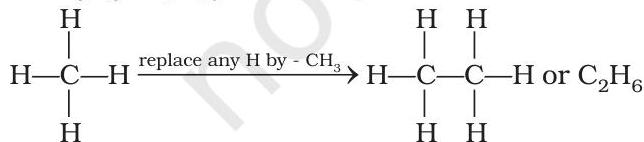
Under typical conditions, these hydrocarbons exhibit chemical inertness, demonstrating a lack of reactivity towards acids, bases, and various other chemical reagents. This characteristic inertness led to their earlier designation as paraffins (derived from Latin: parum, signifying "little," and affinis, meaning "affinity"). Can you deduce the general formula applicable to the entire alkane family or homologous series? Upon analysis of the molecular formulas of diverse alkanes, it becomes evident that the overarching formula for alkanes is $\mathrm{C_nH_{2n + 2}}$. This formula accurately represents any specific homologue within the series when an appropriate integer value is assigned to $n$. Do you recall the structural arrangement of methane? Consistent with the Valence Shell Electron Pair Repulsion (VSEPR) theory (as discussed in Unit 4), methane adopts a tetrahedral geometry (refer to Fig. 9.1). In this configuration, the central carbon atom is positioned at the nexus, while the four hydrogen atoms are situated at the vertices of a regular tetrahedron. All H-C-H bond angles in methane measure 109.5 degrees.
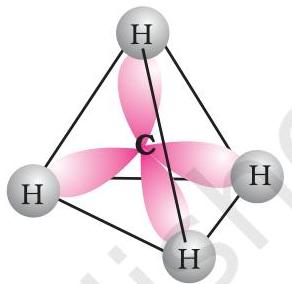 Fig. 9.1 Structure of methane
Within the broader class of alkanes, these tetrahedral units are interconnected. The characteristic carbon-carbon (C-C) bond length is approximately 154 pm, while the carbon-hydrogen (C-H) bond length is approximately 112 pm (as detailed in Unit 8). As you have previously learned, both the C-C and C-H sigma ($\sigma$) bonds are established through the direct, head-on overlap of $sp^3$ hybrid orbitals originating from carbon atoms and 1s orbitals contributed by hydrogen atoms.
9.2.1 Nomenclature and Isomerism
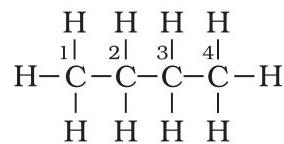
Building upon the foundational understanding of organic compound nomenclature acquired in Unit 8, the concepts of nomenclature and isomerism within alkanes can be elucidated further through additional illustrative examples. Parenthetical notations indicate common names. While the initial three alkanes—methane, ethane, and propane—each exhibit a singular structural arrangement, more complex alkanes are capable of adopting multiple distinct structures. Consider, for instance, the structural possibilities for $\mathrm{C_4H_{10}}$. The four carbon atoms comprising $\mathrm{C_4H_{10}}$ can be interconnected in two primary configurations: either as an unbranched, continuous chain or as a branched chain, as demonstrated below:
 I
Butane (n-butane), (b.p. 273 K)
I
Butane (n-butane), (b.p. 273 K)
$ \begin{array}{c} \mathrm{H} \quad \mathrm{H} \quad \mathrm{H} \ \quad | \quad \quad | \quad \quad | \ \mathrm{H - C - C - C - H} \ \quad \quad | \ \quad \quad \mathrm{C} \ \quad \quad | \ \quad \quad \mathrm{H} \end{array} $
2-Methylpropane (isobutane) (b.p. 261 K)
To explore further, consider the number of distinct arrangements possible for the five carbon atoms and twelve hydrogen atoms of $\mathrm{C}{5}\mathrm{H}{12}$. These can be configured in three separate ways, depicted in structures III–V:
$ \begin{array}{c c c c c c} \text{III} & \mathrm{H} & \mathrm{H} & \mathrm{H} & \mathrm{H} & \mathrm{H} \ & \mathrm{H} & \mathrm{C} & \mathrm{C} & \mathrm{C} & \mathrm{C} \ & | & | & | & | & | \ & \mathrm{H} & \mathrm{H} & \mathrm{H} & \mathrm{H} & \mathrm{H} \ \end{array} $
Pentane (n-pentane) (b.p. 309 K)
$ \begin{array}{c c c c c c} \text{IV} & \mathrm{H} & \mathrm{H} & \mathrm{H} & \mathrm{H} \ & \mathrm{H} & \mathrm{C} & \mathrm{C} & \mathrm{C} \ & | & | & | & | \ & \mathrm{H} & \mathrm{H} & \mathrm{C} & \mathrm{H} \ & | & | & | \ & \mathrm{H} & & & \ \end{array} $
2-Methylbutane (isopentane) (b.p. 301 K)
$ \begin{array}{c c c c c c} \text{V} & & \mathrm{H} & & \ & \mathrm{H} & \mathrm{H} & \mathrm{C} & \mathrm{H} & \mathrm{H} \ & \mathrm{C} & \mathrm{C} & \mathrm{C} & \mathrm{C} & \mathrm{C} \ & | & | & | & | \ & \mathrm{H} & \mathrm{H} & \mathrm{C} & \mathrm{H} & \mathrm{H} \ & | & & & \ & \mathrm{H} & & & \ \end{array} $
2,2-Dimethylpropane (neopentane) (b.p. 282.5 K)
It is evident that structures I and II share an identical molecular formula, yet they exhibit distinct boiling points and other physicochemical characteristics. Analogously, structures III, IV, and V, despite possessing the same molecular formula, manifest differing properties. Consequently, structures I and II are classified as isomers of butane, while structures III, IV, and V represent isomers of pentane. The divergence in properties, stemming from variations in their atomic arrangements, leads to their designation as structural isomers. Furthermore, an examination reveals that structures I and III feature an unbranched, continuous sequence of carbon atoms, whereas structures II, IV, and V incorporate a branched carbon chain. Such structural isomers, distinguished by disparities in their carbon atom connectivity, are termed chain isomers. From these illustrations, it is apparent that $\mathrm{C}{4}\mathrm{H}{10}$ yields two chain isomers, and $\mathrm{C}{5}\mathrm{H}{12}$ generates three.
Problem 9.1
Write structures of different chain isomers of alkanes corresponding to the molecular formula $\mathrm{C}{6}\mathrm{H}{14}$. Also write their IUPAC names.
Solution
(i) $\mathrm{CH}{3} - \mathrm{CH}{2} - \mathrm{CH}{2} - \mathrm{CH}{2} - \mathrm{CH}{3} - \mathrm{CH}{3}$ n-Hexane
(ii) $\mathrm{CH}{3} - \mathrm{CH} - \mathrm{CH}{2} - \mathrm{CH}{2} - \mathrm{CH}{3}$ | $\mathrm{CH_3}$
2-Methylpentane
(iii) $\mathrm{CH}{3} - \mathrm{CH}{2} - \mathrm{CH} - \mathrm{CH}{2} - \mathrm{CH}{3}$ | $\mathrm{CH_3}$
3-Methylpentane
(iv) $\mathrm{CH}{3} - \mathrm{CH} - \mathrm{CH} - \mathrm{CH}{3}$ | $\mathrm{CH_3}$ | $\mathrm{CH_3}$
2,3-Dimethylbutane
(v) $\mathrm{CH}{3} - \mathrm{C} - \mathrm{CH}{2} - \mathrm{CH}_{3}$ | $\mathrm{CH_3}$
2,2-Dimethylbutane
A carbon atom is categorized as primary (1°), secondary (2°), tertiary (3°), or quaternary (4°) depending on the quantity of other carbon atoms to which it is bonded. A primary carbon atom is defined as one bonded to either no other carbon atoms, as exemplified by methane, or to just a single other carbon atom, such as in ethane. Consequently, all terminal carbon atoms invariably qualify as primary. A secondary carbon atom is characterized by its linkage to two other carbon atoms. Conversely, a tertiary carbon atom forms bonds with three other carbon atoms, while a quaternary (or neo) carbon atom is connected to four. Can you distinguish primary, secondary, tertiary, and quaternary carbon atoms within structures I through V? Proceeding to construct structures for alkanes with a greater number of carbon atoms
reveals a progressively increasing count of isomers. For instance, $\mathrm{C_6H_{14}}$ possesses five isomers, $\mathrm{C_7H_{16}}$ has nine, and the potential number of isomers for $\mathrm{C_{10}H_{22}}$ extends to 75.
Within structures II, IV, and V, it is noticeable that a $-\mathrm{CH_3}$ group is bonded to the carbon atom designated as position 2. Similar groups, such as $-\mathrm{CH_3}$, $-\mathrm{C_2H_5}$, and $-\mathrm{C_3H_7}$, are frequently encountered as attachments to carbon atoms in various organic compounds, including alkanes. These entities, termed alkyl groups or substituents, originate from alkanes through the abstraction of a single hydrogen atom. Their general molecular formula is $\mathrm{C_nH_{2n + 1}}$ (as previously discussed in Unit 8).
We shall now review the fundamental principles of nomenclature, which were previously established in Unit 8. To further clarify the nomenclature of substituted alkanes, let us examine the subsequent problem:
| Structures of - $\mathrm{C_5H_{11}}$ group | Corresponding alcohols | Name of alcohol |
|---|---|---|
| (i) $\mathrm{CH_3 - CH_2 - CH_2 - CH_2 - CH_2}$ | $\mathrm{CH_3 - CH_2 - CH_2 - CH_2 - CH_2 - OH}$ | Pentan-1-ol |
| (ii) $\mathrm{CH_3 - CH - CH_2 - CH_2 - CH_3}$ | $\mathrm{CH_3 - CH - CH_2 - CH_2 - CH_3}$ $\mathrm{OH}$ |
Pentan-2-ol |
| (iii) $\mathrm{CH_3 - CH_2 - CH - CH_2 - CH_3}$ | $\mathrm{CH_3 - CH_2 - CH - CH_2 - CH_3}$ $\mathrm{OH}$ |
Pentan-3-ol |
| $\mathrm{CH_3}$ (iv) $\mathrm{CH_3 - CH - CH_2 - CH_2 -}$ |
$\mathrm{CH_3}$ $\mathrm{CH_3 - CH - CH_2 - CH_2 - OH}$ |
3-Methyl-butan-1-ol |
| $\mathrm{CH_3}$ (v) $\mathrm{CH_3 - CH_2 - CH - CH_2 -}$ |
$\mathrm{CH_3}$ $\mathrm{CH_3 - CH_2 - CH - CH_2 - OH}$ |
2-Methyl-butan-1-ol |
| $\mathrm{CH_3}$ (vi) $\mathrm{CH_3 - C - CH_2 - CH_3}$ |
$\mathrm{CH_3}$ $\mathrm{CH_3 - C - CH_2 - CH_3}$ $\mathrm{OH}$ |
2-Methyl-butan-2-ol |
| $\mathrm{CH_3}$ (vii) $\mathrm{CH_3 - C - CH_2 - CH_3}$ |
$\mathrm{CH_3}$ $\mathrm{CH_3 - C - CH_2 OH}$ $\mathrm{CH_3}$ |
2,2-Dimethyl-propan-1-ol |
| $\mathrm{CH_3}$ (viii) $\mathrm{CH_3 - CH - CH - CH_3}$ |
$\mathrm{CH_3 OH}$ $\mathrm{CH_3 - CH - CH - CH_3}$ |
3-Methyl-butan-2-ol |
HYDROCARBONS
Table 9.1 Nomenclature of a Few Organic Compounds
| Structure and IUPAC Name | Remarks | |
|---|---|---|
| $\mathrm{CH_3 CH_2-CH_3}$ | Substituents are assigned the lowest possible locants, and their names are arranged alphabetically. | |
| (a) $\mathrm{CH_3}$-2CH-3$\mathrm{CH_2}$-4CH-5$\mathrm{CH_2}$-6$\mathrm{CH_3}$ $\mathrm{CH_2-CH_3}$ (4 - Ethyl - 2 - methylhexane) |
||
| (b) 8$\mathrm{CH_3}$-7$\mathrm{CH_2}$-6$\mathrm{CH_2}$-5CH-4CH-3C -2$\mathrm{CH_2}$-1$\mathrm{CH_3}$ $\mathrm{CH_3 CH_2-CH_3}$ $\mathrm{CH_3 CH_3}$ $\mathrm{CH(CH_3)_2}$ (3,3-Diethyl-5-isopropyl-4-methyloctane) |
The numbering sequence ensures the lowest set of locants for all substituents, followed by alphabetical listing. | |
| (c) 1$\mathrm{CH_3}$-2$\mathrm{CH_2}$-3$\mathrm{CH_2}$-4CH-5CH-6$\mathrm{CH_2}$-7$\mathrm{CH_2}$-8$\mathrm{CH_2}$-9$\mathrm{CH_2}$-10$\mathrm{CH_3}$ $\mathrm{H_3C-CH-CH_2-CH_3}$ 5-sec-Butyl-4-isopropyldecane |
The prefixes "sec-" and "tert-" are disregarded when determining alphabetical order; however, "iso-" and "neo-" are considered part of the substituent name for alphabetization. | |
| (d) 1$\mathrm{CH_3}$-2$\mathrm{CH_2}$-3$\mathrm{CH_2}$-4$\mathrm{CH_2}$-5CH-6$\mathrm{CH_2}$-7$\mathrm{CH_2}$-8$\mathrm{CH_2}$-9$\mathrm{CH_3}$ $\mathrm{CH_2}$ $\mathrm{CH_3}$-2C-$\mathrm{CH_3}$ 3$\mathrm{CH_3}$ 5-(2,2-Dimethylpropyl)nonane |
Complex side chains are numbered independently, starting from the carbon directly attached to the main chain, and their full names (including locants) are enclosed in parentheses. | |
| (e) 1$\mathrm{CH_3}$-2$\mathrm{CH_2}$-3CH-4$\mathrm{CH_2}$-5CH-6$\mathrm{CH_2}$-7$\mathrm{CH_3}$ $\mathrm{CH_2-CH_3 CH_3}$ 3-Ethyl-5-methylheptane |
When multiple substituents are present, they are cited in alphabetical sequence. |
Problem 9.3
Write IUPAC names of the following compounds :
(i) $(\mathrm{CH_3})_3\mathrm{C}\ \mathrm{CH_2}\mathrm{C}(\mathrm{CH_3})_3$ (ii) $(\mathrm{CH_3})_2\mathrm{C}(\mathrm{C_2H_5})_2$ (iii) tetra-tert-butylmethane
Solution
(i) 2, 2, 4, 4-Tetramethylpentane (ii) 3, 3-Dimethylpentane (iii) 3,3-Di-tert-butyl-2,2,4,4-tetramethylpentane
While accurately assigning an IUPAC name to a chemical structure is crucial, the converse skill—deriving the correct structural representation from a given IUPAC name—holds comparable significance. To achieve this, the initial step involves delineating the longest continuous chain of carbon atoms, which serves as the parent alkane. Subsequently, this parent chain is systematically numbered. Following numbering, the specified substituents are appended to their respective carbon atoms. The final phase entails satisfying the valency of each carbon atom by incorporating the appropriate quantity of hydrogen atoms. The methodology can be elucidated through the construction of the structure for 3-ethyl-2,2-dimethylpentane, as demonstrated by the subsequent steps:
i) Construct a linear sequence comprising five carbon atoms: $\mathrm{C - C - C - C - C}$ ii) Assign numerical labels to the carbon atoms: $\mathrm{C}^{1} - \mathrm{C}^{2} - \mathrm{C}^{3} - \mathrm{C}^{4} - \mathrm{C}^{5}$
iii) Append an ethyl moiety to the third carbon atom and two methyl moieties to the second carbon atom:
$ \begin{array}{c} \mathrm{CH_3} \ | \ \mathrm{C^1 - ^2C - ^3C - ^4C - ^5C} \ | \quad | \ \mathrm{CH_3C_2H_5} \end{array} $
iv) Fulfill the valency requirements of each carbon atom by adding the necessary complement of hydrogen atoms:
$ \begin{array}{c} \mathrm{CH_3} \ | \ \mathrm{CH_3 - C - CH_2 - CH_3} \ | \quad | \ \mathrm{CH_3} \quad \mathrm{C_2H_5} \end{array} $
Consequently, the accurate structural representation is obtained. Should the process of constructing structures from their given systematic names be comprehended, proceed to undertake the subsequent exercises.
Problem 9.4
Illustrate the structural formulas corresponding to the following compounds:
(i) 3, 4, 4, 5-Tetramethylheptane
$ \begin{array}{ccccccccccc} & & & \mathrm{CH_3} & & & & & & & \ & & & | & & & & & & & \ \text{(i)}\quad \mathrm{CH_3} & - & \mathrm{CH_2} & - & \mathrm{CH} & - & \mathrm{C} & - & \mathrm{CH} & - & \mathrm{CH_3} \ & & & & | & & | & & | & & \ & & & & \mathrm{CH_3} & & \mathrm{CH_3} & & \mathrm{CH_3} & & \end{array} $
Problem 9.5
Depict the structural representations for each of the ensuing compounds. Furthermore, elucidate the rationale behind the inaccuracy of the provided nomenclature and subsequently furnish the appropriate IUPAC designations.
$ \begin{array}{c} \mathrm{CH_3 - CH - CH_2 - CH_2 - CH_3} \ | \ \mathrm{C_2H_5} \end{array} $
The principal carbon chain consists of six carbon atoms, rather than the five implied by the given name. Consequently, the accurate IUPAC name is 3-Methylhexane.
$ \begin{array}{c c c c c c} 7 & 6 & 5 & 4 & 3 & 2 & 1 \ \text{(ii)} \quad \mathrm{CH_3 - CH_2 - CH - CH_2 - CH - CH_2 - CH_3} \ & & | & & | \ & & \mathrm{CH_3} & & \mathrm{C_2H_5} \end{array} $
The carbon chain must be numbered from the terminus that assigns the lowest possible locant to the ethyl substituent. Therefore, the precise IUPAC nomenclature is 3-ethyl-5-methylheptane.
9.2.2 Preparation
While petroleum and natural gas constitute the principal sources of alkanes, their synthesis can also be achieved via the subsequent techniques:
1. From unsaturated hydrocarbons
Alkanes can be generated by the addition of dihydrogen gas across the double or triple bonds of alkenes and alkynes, respectively. This transformation, termed hydrogenation, is facilitated by the presence of finely dispersed metallic catalysts such as platinum, palladium, or nickel. These catalytic metals operate by adsorbing dihydrogen onto their surfaces, thereby promoting the activation of the hydrogen-hydrogen bond. While platinum and palladium are effective at ambient temperatures, nickel catalysts typically necessitate elevated temperatures and pressures for optimal reactivity.
$ \mathrm{CH_2 = CH_2 + H_2 \xrightarrow{Pt/Pd/Ni} CH_3 - CH_3} $
Ethene yields Ethane (9.1)
$ \mathrm{CH_2 - CH = CH_2 + H_2 \xrightarrow{Pt/Pd/Ni} CH_3 - CH_2CH_3} $
Propene yields Propane (9.2)
$ \mathrm{CH_3 - C \equiv C - H + 2H \xrightarrow{Pt/Pd/Ni} CH_3 - CH_2CH_3} $
Propyne yields Propane (9.3)
2. From alkyl halides
i) Alkanes can be synthesized through the reduction of alkyl halides (excluding fluorides) utilizing zinc in conjunction with dilute hydrochloric acid.
$ \mathrm{CH_3 - C1 + H_2 \xrightarrow{Zn,H^+} CH_4 + HC1} \tag{9.4} $
Chloromethane yields Methane
$ \mathrm{C}{2}\mathrm{H}{5}-\mathrm{C}1+\mathrm{H}{2} \xrightarrow{\mathrm{Zn,H}^{+}} \mathrm{C}{2}\mathrm{H}_{6}+\mathrm{HC}1 $
Chloroethane yields Ethane (9.5)
$ \mathrm{CH}{3}\mathrm{CH}{2}\mathrm{CH}{2}\mathrm{C}1 + \mathrm{H}{2} \xrightarrow{\mathrm{Zn,H}^{+}} \mathrm{CH}{3}\mathrm{CH}{2}\mathrm{CH}_{3}+\mathrm{HCl} $
1-Chloropropane yields Propane (9.6)
ii) The Wurtz reaction involves the transformation of alkyl halides, when reacted with sodium metal in an anhydrous ethereal medium, into higher alkanes. This synthetic route is specifically employed for the production of alkanes possessing an even count of carbon atoms.
$ \mathrm{CH}{3}\mathrm{Br}+2\mathrm{Na}+\mathrm{BrCH}{3} \xrightarrow{\text{dry ether}} \mathrm{CH}_{3}+2\mathrm{Na} $
Bromomethane yields Ethane (9.7)
$ \mathrm{C}{2}\mathrm{H}{5}\mathrm{Br}+2\mathrm{Na}+\mathrm{BrC}{2}\mathrm{H}{5} \xrightarrow{\text{dry ether}} \mathrm{C}{2}\mathrm{H}{5}-\mathrm{C}{2}\mathrm{H}{5} $
Bromoethane yields n-Butane (9.8)
What will happen if two different alkyl halides are taken?
3. From carboxylic acids
i) When sodium salts of carboxylic acids are heated in the presence of soda lime (a mixture comprising sodium hydroxide and calcium oxide), they yield alkanes that possess one carbon atom fewer than the original carboxylic acid. This reaction, which involves the elimination of carbon dioxide from a carboxylic acid derivative, is designated as decarboxylation.
$ \mathrm{CH}{3}\mathrm{COO}^{-}\mathrm{Na}^{+}+\mathrm{NaOH} \xrightarrow[\Delta]{\mathrm{CaO}} \mathrm{CH}{4}+\mathrm{Na}{2}\mathrm{CO}{3} $
Sodium ethanoate
Problem 9.6
Sodium salt of which acid will be needed for the preparation of propane? Write chemical equation for the reaction.
Solution
Butanoic acid.
$ \begin{array}{l} \mathrm{CH}{3}\mathrm{CH}{2}\mathrm{CH}{2}\mathrm{COO}^{-}\mathrm{Na}^{+}+\mathrm{NaOH} \xrightarrow{\mathrm{CaO}} \ \mathrm{CH}{3}\mathrm{CH}{2}\mathrm{CH}{3}+\mathrm{Na}{2}\mathrm{CO}{3} \end{array} $
ii) Kolbe's electrolytic method: The electrolysis of an aqueous solution containing a sodium or potassium salt of a carboxylic acid results in the formation of an alkane, characterized by an even number of carbon atoms, at the anode.
$ 2\mathrm{CH}{3}\mathrm{COO}^{-}\mathrm{Na}^{+} + 2\mathrm{H}{2}\mathrm{O} $
Sodium acetate
$ \downarrow \text{Electrolysis} $
$ \mathrm{CH}{3}-\mathrm{CH}{3} + 2\mathrm{CO}{2} + \mathrm{H}{2} + 2\mathrm{NaOH} \tag{9.9} $
The reaction is supposed to follow the following path :
i) $ 2\mathrm{CH}{3}\mathrm{COO}^{-}\mathrm{Na}^{+} \rightleftharpoons 2\mathrm{CH}{3}-\overset{\mathrm{O}}{\underset{\mathrm{||}}{\mathrm{C}}}-\mathrm{O}^{-} + 2\mathrm{Na}^{+} $
ii) At anode:
$ \begin{array}{c} \mathrm{O} \ \parallel \ 2\mathrm{CH}{3}-\mathrm{C}-\mathrm{O}^{-}-2\mathrm{e}^{-} \rightarrow 2\mathrm{CH}{3}-\mathrm{C}-\mathrm{O}^{-} \longrightarrow 2\mathrm{CH}{3}+2\mathrm{CO}{2} \uparrow \ \text{Acetate ion} \quad \text{Acetate free radical} \quad \text{Methyl free radical} \end{array} $
iii) $ \mathrm{H}{3}\mathrm{C} + \mathrm{CH}{3} \longrightarrow \mathrm{H}{3}\mathrm{C}-\mathrm{CH}{3} \uparrow $
iv) At cathode:
$ \begin{array}{l} \mathrm{H}{2}\mathrm{O}+\mathrm{e}^{-} \rightarrow -\mathrm{OH}+\mathrm{H} \ 2\mathrm{H} \rightarrow \mathrm{H}{2} \uparrow \end{array} $
Methane cannot be prepared by this method. Why?
9.2.3 Properties
Physical properties
Alkanes are characterized by their predominantly non-polar nature. This characteristic stems from the covalent bonding within C-C and C-H linkages, combined with the minimal electronegativity difference between carbon and hydrogen atoms. Consequently, they exhibit only weak van der Waals forces. These attenuated intermolecular forces determine their physical states: at $298,\mathrm{K}$, the initial four members, spanning from $\mathrm{C}{1}$ to $\mathrm{C}{4}$, exist as gases; those from $\mathrm{C}{5}$ to $\mathrm{C}{17}$ are liquids; and compounds possessing 18 or more carbon atoms are solids. Intrinsically, alkanes are both colourless and odourless. Given their non-polar composition, alkanes display negligible solubility in water, rendering them hydrophobic. This principle is demonstrated by petrol, a hydrocarbon blend employed as an automotive fuel, and by the use of lighter petroleum fractions in dry cleaning processes for dissolving grease stains. This observation implies that greasy substances, typically mixtures of higher alkanes, are themselves non-
polar. This aligns with the fundamental chemical tenet that polar substances dissolve in polar solvents, while non-polar substances dissolve in non-polar solvents—a concept commonly summarized as "like dissolves like."
The boiling point (b.p.) of various alkanes, as detailed in Table 9.2, demonstrates a consistent increase with rising molecular mass. This trend is attributed to the direct relationship between molecular size or surface area and the strength of intermolecular van der Waals forces, which intensify as these molecular dimensions expand.
A notable distinction can be observed when comparing the boiling points of the three isomeric pentanes: pentane, 2-methylbutane, and 2,2-dimethylpropane. As presented in Table 9.2, n-pentane, with its uninterrupted five-carbon chain, exhibits the highest boiling point at 309.1K, whereas 2,2-dimethylpropane boils at a comparatively lower 282.5K. This effect is due to the fact that as the degree of branching increases, the molecule adopts a more compact, spherical geometry. This morphological change leads to a reduced contact area between molecules, thereby weakening the intermolecular forces among these spherical entities. Consequently, less energy is required to overcome these diminished forces, resulting in lower boiling points.
Chemical properties
Alkanes, as previously noted, typically exhibit chemical inertness when exposed to acids, bases, and both oxidizing and reducing agents. Nevertheless, under specific circumstances, they can participate in the reactions detailed below.
1. Substitution reactions
Hydrogen atoms within alkane molecules are susceptible to replacement by various substituents, including halogens, nitro groups, and sulfonic acid groups. Halogenation, specifically, necessitates elevated temperatures (ranging from 573 K to 773 K) or exposure to diffuse sunlight or ultraviolet radiation. Smaller alkane molecules generally do not participate in nitration or sulfonation processes. These processes, characterized by the exchange of hydrogen atoms in alkanes, are collectively termed substitution reactions. The chlorination of methane serves as an illustrative instance of this reaction type, presented subsequently:
Halogenation
$ \mathrm{CH_4} + \mathrm{Cl_2} \xrightarrow{h\nu} \mathrm{CH_3Cl} + \mathrm{HCl} $
Chloromethane (9.10)
$ \mathrm{CH_3Cl} + \mathrm{Cl_2} \xrightarrow{h\nu} \mathrm{CH_2Cl_2} + \mathrm{HCl} $
Dichloromethane (9.11)
$ \mathrm{CH_2Cl_2} + \mathrm{Cl_2} \xrightarrow{h\nu} \mathrm{CHCl_3} + \mathrm{HCl} $
Trichloromethane (9.12)
$ \mathrm{CHCl_3} + \mathrm{Cl_2} \xrightarrow{h\nu} \mathrm{CCl_4} + \mathrm{HCl} $
Tetrachloromethane (9.13)
Table 9.2 Variation of Melting Point and Boiling Point in Alkanes
| Molecular formula | Name | Molecular mass/u | b.p./(K) | m.p./(K) |
|---|---|---|---|---|
| $\mathrm{CH_4}$ | Methane | 16 | 111.0 | 90.5 |
| $\mathrm{C_2H_6}$ | Ethane | 30 | 184.4 | 101.0 |
| $\mathrm{C_3H_8}$ | Propane | 44 | 230.9 | 85.3 |
| $\mathrm{C_4H_{10}}$ | Butane | 58 | 272.4 | 134.6 |
| $\mathrm{C_4H_{10}}$ | 2-Methylpropane | 58 | 261.0 | 114.7 |
| $\mathrm{C_5H_{12}}$ | Pentane | 72 | 309.1 | 143.3 |
| $\mathrm{C_5H_{12}}$ | 2-Methylbutane | 72 | 300.9 | 113.1 |
| $\mathrm{C_5H_{12}}$ | 2,2-Dimethylpropane | 72 | 282.5 | 256.4 |
| $\mathrm{C_6H_{14}}$ | Hexane | 86 | 341.9 | 178.5 |
| $\mathrm{C_7H_{16}}$ | Heptane | 100 | 371.4 | 182.4 |
| $\mathrm{C_8H_{18}}$ | Octane | 114 | 398.7 | 216.2 |
| $\mathrm{C_9H_{20}}$ | Nonane | 128 | 423.8 | 222.0 |
| $\mathrm{C_{10}H_{22}}$ | Decane | 142 | 447.1 | 243.3 |
| $\mathrm{C_{20}H_{42}}$ | Eicosane | 282 | 615.0 | 309.7 |
$ \mathrm{CH_3-CH_3} + \mathrm{Cl_2} \xrightarrow{h\nu} \mathrm{CH_3-CH_2Cl} + \mathrm{HCl} $ Chloroethane (9.14)
The observed reactivity trend for alkanes with halogens follows the sequence: $F_2 > \mathrm{Cl_2} > \mathrm{Br_2} > \mathrm{I_2}$. Furthermore, the propensity for hydrogen atom replacement in alkanes adheres to the order: tertiary ($3^\circ$) > secondary ($2^\circ$) > primary ($1^\circ$). Fluorination reactions are excessively vigorous and thus difficult to regulate. Conversely, iodination proceeds at a significantly slow pace and is reversible. To facilitate iodination, the reaction can be conducted in the presence of oxidizing agents such as $\mathrm{HIO_3}$ or $\mathrm{HNO_3}$.
$ \mathrm{CH_4} + \mathrm{I_2} \rightleftharpoons \mathrm{CH_3I} + \mathrm{HI} \tag{9.15} $
$ \mathrm{HIO_3} + 5\mathrm{HI} \rightarrow 3\mathrm{I_2} + 3\mathrm{H_2O} \tag{9.16} $
It is posited that halogenation reactions occur through a free radical chain mechanism. This mechanism comprises three distinct stages: initiation, propagation, and termination, which are detailed in the subsequent discussion:
Mechanism
(i) Initiation: The process commences with the homolytic scission of the chlorine molecule, requiring the input of light or thermal energy. This is primarily facilitated by the comparatively weaker Cl–Cl bond when contrasted with C–C and C–H bonds, rendering it the most susceptible to dissociation.
$ \mathrm{Cl_2} \xrightarrow{h\nu} \mathrm{Cl \cdot} + \mathrm{Cl \cdot} $ Chlorine free radicals
(ii) Propagation: A chlorine free radical engages with a methane molecule, thereby advancing the reaction sequence through the homolytic rupture of a C–H bond, which yields a methyl free radical alongside hydrogen chloride.
$ \mathrm{(a)} \mathrm{CH_4} + \mathrm{Cl \cdot} \xrightarrow{h\nu} \mathrm{CH_3 \cdot} + \mathrm{H-Cl} $
Subsequently, the generated methyl radical interacts with a second chlorine molecule, culminating in the formation of chloromethane and the concomitant release of an additional chlorine free radical, a process facilitated by the homolytic dissociation of the chlorine molecule.
$ \mathrm{(b)} \mathrm{CH_3 \cdot} + \mathrm{Cl_2} \xrightarrow{h\nu} \mathrm{CH_3-Cl} + \mathrm{Cl \cdot} $
The perpetually regenerated chlorine and methyl free radicals iteratively cycle through steps (a) and (b), thereby sustaining a reactive chain. While these designated propagation stages (a) and (b) are instrumental in the direct formation of the primary products, the potential for numerous alternative propagation pathways exists, which can account for the genesis of more extensively halogenated derivatives.
$ \mathrm{CH_3Cl} + \mathrm{Cl \cdot} \rightarrow \mathrm{CH_2Cl \cdot} + \mathrm{HCl} $
$ \mathrm{CH_2Cl \cdot} + \mathrm{Cl_2} \rightarrow \mathrm{CH_2Cl_2} + \mathrm{Cl \cdot} $
(iii) Termination: The reaction sequence eventually concludes, a phenomenon attributable either to the depletion of the reacting species or to the intervention of the subsequent subsidiary reactions.
The possible chain terminating steps are:
$ \mathrm{(a)} \mathrm{Cl \cdot} + \mathrm{Cl \cdot} \rightarrow \mathrm{Cl_2} $
$ \mathrm{(b)} \mathrm{CH_3 \cdot} + \mathrm{CH_3 \cdot} \rightarrow \mathrm{CH_3-CH_3} $
$ \mathrm{(c)} \mathrm{CH_3 \cdot} + \mathrm{Cl \cdot} \rightarrow \mathrm{CH_3-Cl} $
Notwithstanding the formation of chloromethane in step (c), this reaction effectively depletes the free radical species, thereby bringing about chain termination. This comprehensive mechanistic framework elucidates the rationale for the emergence of ethane as a secondary product during the photochlorination of methane.
2. Combustion
When alkanes are subjected to heating in an environment containing air or dioxygen, they undergo complete oxidation, yielding carbon dioxide and water, along with the release of a substantial quantity of heat.
$ \mathrm{CH_4}(g) + 2\mathrm{O_2}(g) \rightarrow \mathrm{CO_2}(g) + 2\mathrm{H_2O}(1); $
$ \mathrm{AcH^e} - 890\mathrm{kJ mol^{-1}} \tag{9.17} $
$ \mathrm{C_4H_{10}}(g) + 13/2\mathrm{O_2}(g) \rightarrow 4\mathrm{CO_2}(g) + 5\mathrm{H_2O}(1) $
$ \mathrm{AcH^e} = -2875.84\mathrm{kJ mol^{-1}} \tag{9.18} $
The generalized equation representing the combustion of any alkane is:
$ \mathrm{C_nH_{2n+2}} + \left(\frac{3n+1}{2}\right)\mathrm{O_2} \rightarrow \mathrm{nCO_2} + (n+1)\mathrm{H_2O} \tag{9.19} $
Given the considerable amount of heat generated during this combustion process, alkanes are widely utilized as fuels.
Conversely, if alkanes combust with an inadequate supply of air or dioxygen, incomplete combustion occurs, leading to the formation of carbon black. This product is employed in the manufacturing of inks, including printer ink, as black pigments, and in filter applications.
$
\mathrm{CH_4}(g) + \mathrm{O_2}(g) \xrightarrow[\text{combustion}]{\text{incomplete}} \mathrm{C}(s) + 2\mathrm{H_2O} \tag{9.20} $
3. Controlled oxidation
When subjected to heating under controlled conditions involving a regulated provision of dioxygen or atmospheric air, coupled with high pressure and the presence of appropriate catalytic agents, alkanes yield diverse oxidation products.
(i) $ 2\mathrm{CH_4} + \mathrm{O_2} \xrightarrow{\mathrm{Cu/523K/100atm}} 2\mathrm{CH_3OH} $
Methanol
(9.21)
(ii) $ \mathrm{CH_4} + \mathrm{O_2} \xrightarrow[\Delta]{\mathrm{Mo_2O_3}} \mathrm{HCHO} + \mathrm{H_2O} $
Methanal
(9.22)
(iii) $ 2\mathrm{CH_3CH_3} + 3\mathrm{O_2} \xrightarrow{(\mathrm{CH_3COO})Mn} 2\mathrm{CH_3COOH} + 2\mathrm{H_2O} $
Ethanoic acid
(9.23)
(iv) Although alkanes typically exhibit resistance to oxidation, those possessing a tertiary hydrogen atom are capable of undergoing oxidation to their respective alcohols through the action of potassium permanganate.
$ \mathrm{(CH_3)_3CH} \xrightarrow[\text{Oxidation}]{\mathrm{KMnO_4}} \mathrm{(CH_3)_3COH} $
2-Methylpropane 2-Methylpropane-2-ol
(9.24)
4. Isomerisation
When subjected to heat in the presence of anhydrous aluminium chloride and hydrogen chloride gas, n-alkanes undergo isomerization, transforming into branched-chain alkanes. The principal resulting compounds are illustrated subsequently. It is conceivable that certain minor byproducts may also form, which are typically omitted from reports on organic reactions.
$ \begin{array}{ccc} \mathrm{CH_3(CH_2)_4CH_3} & \xrightarrow{\text{Anhy. AlCl}_3 / \text{HCl}, \Delta} & \mathrm{CH_3-CH-(CH_2)_2-CH_3} + \mathrm{CH_3-CH_2-CH-CH_2-CH_3} \ \text{(n-Hexane)} & & | \quad \quad \quad \quad \quad \quad \quad \quad \quad | \ & & \mathrm{CH_3} \quad \quad \quad \quad \quad \quad \quad \quad \mathrm{CH_3} \ & & \text{(2-Methylpentane)} \quad \text{(3-Methylpentane)} \end{array} $
(9.25)
5. Aromatization
Normal alkanes comprising at least six carbon atoms, when subjected to heat at 773K under a pressure range of 10-20 atmospheres, in the presence of catalysts such as vanadium, molybdenum, or chromium oxides (typically supported on alumina), undergo both dehydrogenation and cyclization, yielding benzene and its various homologues. This chemical transformation is formally termed aromatization or, alternatively, reforming.
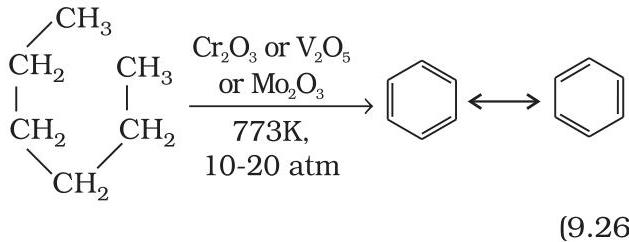
(Toluene ($\mathrm{C_7H_8}$) is methyl derivative of benzene. Which alkane do you suggest for preparation of toluene?
6. Reaction with steam
Methane undergoes a reaction with steam at a temperature of $1273,\mathrm{K}$ when a nickel catalyst is employed, resulting in the generation of carbon monoxide and dihydrogen. This process is industrially significant for the production of dihydrogen gas.
$ \mathrm{CH_4} + \mathrm{H_2O} \xrightarrow[\Delta]{\mathrm{Ni}} \mathrm{CO} + 3\mathrm{H_2} \tag{9.27} $
7. Pyrolysis
When subjected to elevated temperatures, higher molecular weight alkanes undergo decomposition into smaller molecular fragments, such as lower alkanes and alkenes. This thermal decomposition process, which yields smaller constituents, is scientifically termed pyrolysis or, alternatively, cracking.
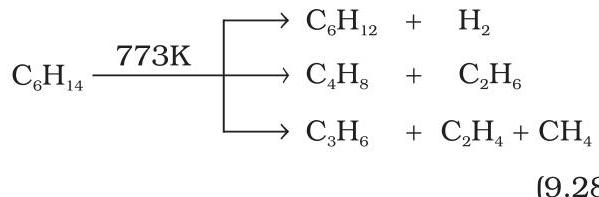
The mechanism underpinning the pyrolysis of alkanes is generally understood to involve free radical intermediates. The industrial production of oil gas or petrol gas from feedstocks like kerosene oil or petrol fundamentally relies upon the principle of pyrolysis. To illustrate, dodecane, which is a significant component of kerosene oil, when heated to 973K in the presence of catalysts such as platinum, palladium, or nickel, yields a combination of heptane and pentene.
$ \mathrm{C_{12}H_{26}} \xrightarrow[\text{973K}]{\mathrm{Pr/Pd/Ni}} \mathrm{C_7H_{16}} + \mathrm{C_5H_{10}} + \text{Other Products} $
Dodecane Heptane Pentene
(9.29)
9.2.4 Conformations
Alkanes are characterized by the presence of carbon-carbon sigma ($\sigma$) bonds. The electron density within a sigma molecular orbital exhibits symmetry around the internuclear axis of the C-C bond. This inherent symmetry means that rotation around this axis does not disrupt the electron distribution, thereby allowing for relatively free rotation about the C-C single bond. Such rotation gives rise to diverse spatial arrangements of atoms that are interconvertible. These distinct spatial configurations, which can be interchanged through rotation around a carbon-carbon single bond, are termed conformations, conformers, or rotamers. Consequently, alkanes can adopt an unlimited number of conformations via rotation about their C-C single bonds. It is important to note, however, that this rotation is not entirely unrestricted; it is impeded by a modest energy barrier, typically ranging from $1 - 20,\mathrm{kJ,mol}^{-1}$. This hindrance arises from weak repulsive interactions between adjacent bonds, a phenomenon known as torsional strain.
Conformations of Ethane: The ethane molecule ($\mathrm{C_2H_6}$) consists of a single carbon-carbon bond, with each carbon atom bonded to three hydrogen atoms. If one visualizes ethane using a ball-and-stick model, holding one carbon atom fixed while rotating the other around the C-C axis reveals an infinite spectrum of spatial orientations for the hydrogen atoms on one carbon relative to those on the other. These are referred to as conformational isomers (or conformers). Thus, ethane possesses an infinite multitude of conformations. Nevertheless, two prominent extreme conformations are recognized. The eclipsed conformation occurs when the hydrogen atoms on the two carbons are positioned as close to each other as geometrically possible. Conversely, the staggered conformation is achieved when these hydrogen atoms are maximally separated. Any intermediate arrangement is designated as a skew conformation. It is crucial to remember that throughout all these conformational changes, the bond angles and bond lengths within the molecule remain unaltered. Both eclipsed and staggered conformations are commonly depicted using Sawhorse and Newman projection formulas.
1. Sawhorse projections
Within this representational method, a molecule is observed from a perspective aligned with its molecular axis. Its depiction on paper involves rendering the central carbon-carbon bond as an elongated straight line. This line's upper extremity is typically angled slightly to either the right or the left. The carbon atom situated at the front is positioned at the line's lower terminus, while the carbon atom at the rear is placed at its upper end. Each carbon atom exhibits three attached lines, each signifying a hydrogen atom. These lines are oriented at a 120-degree angle relative to one another. Illustrative Sawhorse projections for the eclipsed and staggered conformations of ethane are presented in Fig. 9.2.
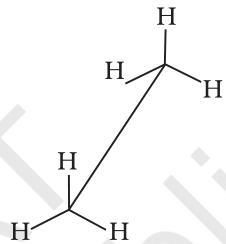 (i) Eclipsed
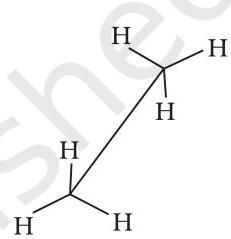 (ii) Staggered
Fig. 9.2 Sawhorse projections of ethane
(ii) Staggered
Fig. 9.2 Sawhorse projections of ethane
2. Newman projections
For this projection method, the molecule is observed directly along the carbon-carbon bond axis. The carbon atom closest to the observer is symbolized by a central point. Three hydrogen atoms bonded to this frontal carbon are indicated by three lines extending outwards, each separated by a 120-degree angle. Conversely, the carbon atom located further from the observer (the rear carbon) is denoted by a circle, with its three attached hydrogen atoms represented by shorter lines also diverging at 120-degree intervals. Examples of Newman projections are illustrated in
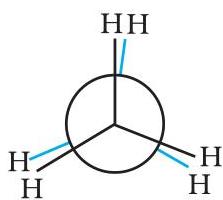 Fig. 9.3
(i) Eclipsed
Fig. 9.3 Newman's projections of ethane
Fig. 9.3
(i) Eclipsed
Fig. 9.3 Newman's projections of ethane
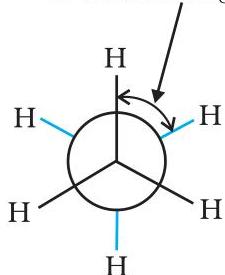 Angle of rotation or angle of tortion or dihedral angle
(ii) Staggered
Angle of rotation or angle of tortion or dihedral angle
(ii) Staggered
Regarding the relative stability of molecular conformations: As previously noted, in the staggered conformation of ethane, the electron clouds associated with the carbon-hydrogen bonds achieve maximal separation. This arrangement consequently leads to minimal repulsive forces, the lowest potential energy, and thus the highest molecular stability. Conversely, when the staggered conformation transitions into the eclipsed form, the electron clouds of the carbon-hydrogen bonds approach each other more closely, leading to an augmentation in electron cloud repulsions. To counteract these intensified repulsive forces, the molecule must acquire a greater amount of energy, resulting in reduced stability. As established, this repulsive interaction between electron clouds, which influences a conformation's stability, is termed torsional strain. The extent of torsional strain is contingent upon the angle of rotation around the C-C bond, an angle also referred to as the dihedral angle or torsional angle. Among all possible conformations of ethane, the staggered form exhibits the lowest torsional strain, while the eclipsed form displays the highest. Consequently, the staggered conformation possesses greater stability compared to the eclipsed conformation. Therefore, the molecule predominantly exists in the staggered conformation, which can be considered its energetically favored state. From this, it can be deduced that rotation around the C-C bond in ethane is not entirely unhindered. The energetic disparity between these two extreme conformational states is approximately 12.5 $\mathrm{kJ,mol}^{-1}$, a value considered quite modest. Even under ambient temperature conditions, ethane molecules acquire sufficient thermal or kinetic energy, often through intermolecular collisions, to surmount this 12.5 $\mathrm{kJ,mol}^{-1}$ energy barrier. Thus, it can be concluded that the rotation about the carbon-carbon single bond in ethane is, for most practical applications, effectively free. Furthermore, the distinct conformational isomers of ethane have not proven amenable to separation and isolation.
9.3 ALKENES
Alkenes represent a class of unsaturated hydrocarbons characterized by the presence of at least one carbon-carbon double bond. To determine their general molecular formula, consider that an alkene containing a single double bond will possess two fewer hydrogen atoms compared to its corresponding alkane. Consequently, the general formula for alkenes is established as $\mathrm{C_nH_{2n}}$. Historically, these compounds have also been designated as olefins, a term denoting "oil-forming," stemming from the observation that ethene (or ethylene, $\mathrm{C_2H_4}$), the simplest member of this series, generates an oily liquid upon reaction with chlorine.
9.3.1 Structure of Double Bond
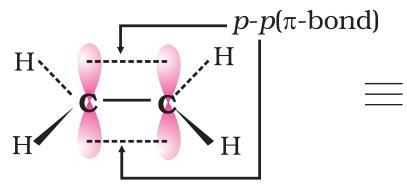
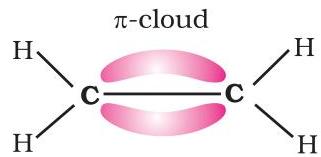
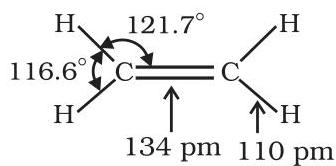
The carbon-carbon double bond found in alkenes is composed of two distinct types of bonds: a robust sigma ($\sigma$) bond and a comparatively weaker pi ($\pi$) bond. The $\sigma$ bond, characterized by a bond enthalpy of approximately $397,\mathrm{kJ,mol}^{-1}$, is formed through the direct, head-on overlap of $sp^2$ hybridized orbitals from each carbon atom. In contrast, the $\pi$ bond, with a bond enthalpy around $284,\mathrm{kJ,mol}^{-1}$, results from the lateral or sideways overlap of the two unhybridized $2p$ orbitals on the participating carbon atoms. This double bond exhibits a shorter bond length ($134,\mathrm{pm}$) compared to a carbon-carbon single bond ($154,\mathrm{pm}$). As previously discussed, the $\pi$ bond's reduced strength is attributable to the less efficient sideways overlap between the $2p$ orbitals. Consequently, the presence of this $\pi$ bond endows alkenes with accessible, mobile electrons. This electron richness renders alkenes susceptible to attack by electron-seeking species, which are known as electrophilic reagents.
The inherent weakness of the $\pi$-bond contributes to alkenes being less stable molecules when compared to alkanes. This characteristic allows alkenes to readily convert into single-bonded compounds through combination with electrophilic reagents. Despite the individual weakness of the $\pi$ bond, the combined strength of the double bond (total bond enthalpy, $681,\mathrm{kJ,mol^{-1}}$) is greater than that of a single carbon-carbon bond, such as the one found in ethane (bond enthalpy, $348,\mathrm{kJ,mol^{-1}}$). Orbital diagrams illustrating the ethene molecule are presented in Figs. 9.4 and 9.5.
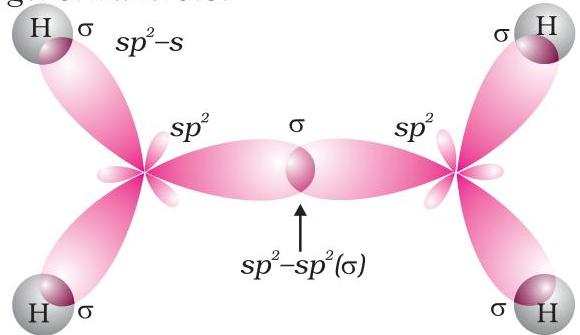 Fig. 9.4 Orbital picture of ethene depicting $\sigma$ bonds only
9.3.2 Nomenclature
In the IUPAC system for naming alkenes, the procedure involves identifying the longest continuous carbon chain that encompasses the double bond. This chain is then numbered starting from the terminus that provides the lowest locant for the double bond. The characteristic suffix 'ene' is employed in place of 'ane', typically used for alkanes.
 (a)
(a)
 (b)
(b)
 (c)
Fig. 9.5 Orbital picture of ethene showing formation of (a) $\pi$ -bond, (b) $\pi$ -cloud and (c) bond angles and bond lengths
(c)
Fig. 9.5 Orbital picture of ethene showing formation of (a) $\pi$ -bond, (b) $\pi$ -cloud and (c) bond angles and bond lengths
It is noteworthy that the hypothetical initial member of the alkene homologous series, derived by setting $n=1$ in the general formula $\mathrm{C_nH_{2n}}$, would be $\mathrm{CH_2}$, termed methene; however, this species exhibits extreme instability. Consequently, as previously stated, the first stable representative of the alkene class is $\mathrm{C_2H_4}$, conventionally known as ethylene or systematically as ethene via IUPAC nomenclature. Illustrative IUPAC designations for several alkene compounds are provided hereunder:
Structure
$\mathrm{CH_3 - CH = CH_2}$
Propene
$\mathrm{CH_3 - CH = CH_2}$
But-1-ene
$\mathrm{CH_3 - CH = CH-CH_3}$
But-2-ene
$\mathrm{CH_2 = CH - CH = CH_2}$
Buta-1,3-diene
$ \begin{array}{c} \mathrm{CH_2} = \mathrm{C} - \mathrm{CH_3} \ | \ \mathrm{CH_3} \end{array} $
2-Methylprop-1-ene
$ \begin{array}{c} \mathrm{CH_2} = \mathrm{CH} - \mathrm{CH} - \mathrm{CH_3} \ | \ \mathrm{CH_3} \end{array} $
3-Methylbut-1-ene
Problem 9.7
Provide the systematic IUPAC nomenclature for each of the subsequent chemical compounds:
(i) $(\mathrm{CH_3})_2\mathrm{CH} - \mathrm{CH} = \mathrm{CH} - \mathrm{CH_2} - \mathrm{CH}$
(ii) $ \begin{array}{c} \parallel \ \mathrm {C H} _ {3} - \mathrm {C H} - \mathrm {C H} \ \mid \ \mathrm {C} _ {2} \mathrm {H} _ {5} \end{array} $
(iii) $\mathrm{CH_2} = \mathrm{C}(\mathrm{CH_2CH_2CH_3})_2$
(iv) $ \begin{array}{c} \parallel \ \mathrm {C H} _ {3} - \mathrm {C H C H} = \mathrm {C} - \mathrm {C H} _ {2} - \mathrm {C H C H} _ {3} \ \mid \ \mathrm {C H} _ {3} \end{array} $
Answer
(i) 2,8-Dimethyl-3,6-decadiene; (ii) 1,3,5,7 Octatetraene; (iii) 2-n-Propylpent-1-ene; (iv) 4-Ethyl-2,6-dimethyl-dec-4-ene;
Problem 9.8
Determine the total count of sigma ($\sigma$) and pi ($\pi$) bonds present within the previously listed compounds (i-iv).
Answer
$\sigma$ bonds : 33, $\pi$ bonds : 2
$\sigma$ bonds : 17, $\pi$ bonds : 4
$\sigma$ bonds : 23, $\pi$ bond : 1
$\sigma$ bonds : 41, $\pi$ bond : 1
9.3.3 Isomerism
Alkenes exhibit both structural and geometrical forms of isomerism.
Regarding structural isomerism, similar to alkanes, ethene ($\mathrm{C_2H_4}$) and propene ($\mathrm{C_3H_6}$) each possess a singular structural arrangement. However, alkenes with a carbon count exceeding that of propene demonstrate the existence of multiple distinct structures. For alkenes characterized by the molecular formula $\mathrm{C_4H_8}$, three distinct structural representations are possible, as illustrated below:
I. 1 2 3 4
$\mathrm{CH_2 = CH - CH_2 - CH_3}$
But-1-ene
($\mathrm{C_4H_8}$)
II. 1 2 3 4
$\mathrm{CH_3 - CH = CH - CH_3}$
But-2-ene
($\mathrm{C_4H_8}$)
III. 1 2 3
$ \begin{array}{c} \mathrm {C H} _ {2} = \mathrm {C} - \mathrm {C H} _ {3} \ | \ \mathrm {C H} _ {3} \end{array} $
2-Methylprop-1-ene
($\mathrm{C_4H_8}$)
Specifically, structures I and III, along with structures II and III, exemplify chain isomerism. In contrast, structures I and II are classified as position isomers.
Problem 9.9
Write structures and IUPAC names of different structural isomers of alkenes corresponding to $\mathrm{C_5H_{10}}$.
Solution
The various structural isomers of alkenes with the molecular formula $\mathrm{C_5H_{10}}$, along with their respective IUPAC nomenclature, are presented below:
(a) $\mathrm{CH_2 = CH - CH_2 - CH_2 - CH_3}$
Pent-1-ene
(b) $\mathrm{CH_3 - CH = CH - CH_2 - CH_3}$
Pent-2-ene
$ \begin{array}{c} \mathrm{CH_3} - \mathrm{C} = \mathrm{CH} - \mathrm{CH_3} \ | \ \mathrm{CH_3} \end{array} $
2-Methylbut-2-ene
$ \begin{array}{c} \mathrm{CH_3} - \mathrm{CH} - \mathrm{CH} = \mathrm{CH_2} \ | \ \mathrm{CH_3} \end{array} $
3-Methylbut-1-ene
$ \begin{array}{c} \mathrm{CH_2} = \mathrm{C} - \mathrm{CH_2} - \mathrm{CH_3} \ | \ \mathrm{CH_3} \end{array} $
2-Methylbut-1-ene
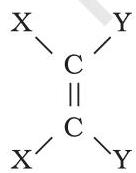
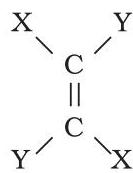
Geometrical isomerism arises when carbon atoms linked by a double bond each fulfill their remaining two valencies through attachment to distinct atoms or groups. When the two substituents on each carbon atom of the double bond are dissimilar, the general structural representation is $\mathrm{YX C = C XY}$. This $\mathrm{YX C = C XY}$ configuration can manifest spatially in two distinct arrangements:
 (a)
(a)
 (b)
(b)
In arrangement (a), the identical atoms (either both X or both Y) are situated on the same side of the double bond, whereas in arrangement (b), these identical atoms (X or Y) are positioned on opposite sides of the double bond. This distinction leads to differing spatial orientations for (a) and (b), meaning the arrangement of atoms or groups in space varies between the two configurations. Consequently, these are classified as stereoisomers. Their spatial arrangement would be identical if free rotation were possible around the $\mathrm{C} = \mathrm{C}$ bond; however, such rotation is constrained. To conceptualize this, consider two robust pieces of cardboard fastened together by two nails. If you hold one piece of cardboard and attempt to rotate the other, you will find that rotation is not possible. This restriction exemplifies how the limited rotation of atoms or groups around doubly bonded carbon atoms results in diverse spatial geometries for these compounds. Stereoisomers exhibiting this characteristic are termed geometrical isomers.
The isomer corresponding to type (a), where two identical atoms or groups are positioned on the same side of the double bond, is designated as the cis isomer. Conversely, the isomer of type (b), characterized by identical atoms or groups located on opposite sides of the double bond, is known as the trans isomer. Therefore, cis and trans isomers share the same molecular structure but possess distinct spatial configurations (i.e., different arrangements of atoms or groups in space). This variation in spatial arrangement leads to differences in their physical and chemical properties, such as melting point, boiling point, dipole moment, and solubility. Examples of geometrical or cis-trans isomers for but-2-ene are illustrated beneath:
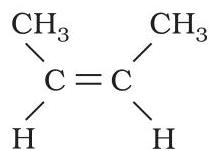 cis-But-2-ene (b.p. 277 K)
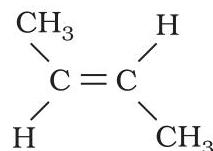 trans-But-2-ene (b.p. 274 K)
It is observed that the cis isomer of an alkene exhibits greater polarity compared to its trans counterpart. As an illustration, cis-but-2-ene possesses a dipole moment of 0.33 Debye, while the trans isomer's dipole moment is nearly negligible, effectively rendering
trans-but-2-ene non-polar. This disparity in polarity can be elucidated by examining the molecular geometries of both forms, as depicted subsequently. In trans-but-2-ene, the two methyl groups are positioned diametrically opposite to each other. Consequently, the individual bond dipole moments of the $\mathrm{C - CH_3}$ linkages effectively neutralize one another, resulting in the non-polar characteristic of the trans configuration.
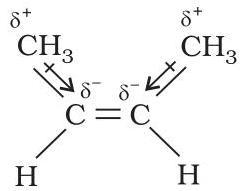 cis-But-2-ene ($\mu = 0.33,\mathrm{D}$)
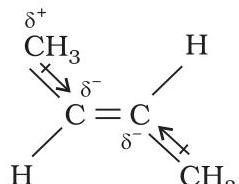 trans-But-2-ene ($\mu = 0$)
Regarding the solid state, the trans isomer is typically found to exhibit a higher melting point than the cis form.
Furthermore, geometrical, or cis-trans, isomerism is also manifested by alkenes corresponding to the structural formulae $\mathrm{XYC = CXZ}$ and $\mathrm{XYC = CZW}$.
Problem 9.10
Illustrate the cis and trans isomeric forms for the subsequent compounds. Additionally, provide their corresponding IUPAC nomenclature:
(i) $\mathrm{CHCl = CHCl}$ (ii) $\mathrm{C_2H_5C(CH_3) = C(CH_3)C_2H_5}$
Solution
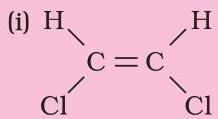 cis-1, 2-Dichloroethene
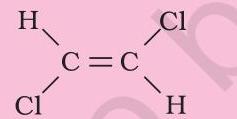 trans-1, 2-Dichloroethene
(iii) $ \begin{array}{c}\mathrm{CH}_3\ \mathrm{C} = \mathrm{C} \end{array} $ $ \begin{array}{c}\mathrm{CH}_3\ \mathrm{C}_2\mathrm{H}_5\end{array} $ $ \begin{array}{c}\mathrm{CH}_3\ \mathrm{C}_2\mathrm{H}_5\end{array} $ $ \begin{array}{c}\mathrm{C} = \mathrm{C} \end{array} $ $ \begin{array}{c}\mathrm{C}_2\mathrm{H}_5\ \mathrm{C}_2\mathrm{H}_5\end{array} $ cis-3, 4-Dimethylhex-3-ene trans-3, 4-Dimethylhex-3-ene
Problem 9.11
Identify which of the subsequent chemical entities exhibit cis-trans isomerism:
(i) $(\mathrm{CH_3})_2\mathrm{C} = \mathrm{CH} - \mathrm{C_2H_5}$
(ii) $\mathrm{CH_2 = CBr_2}$ (iii) $\mathrm{C_6H_5CH = CH - CH_3}$ (iv) $\mathrm{CH_3CH = CClCH_3}$
Solution
For structures (i) and (ii), two identical substituents are bonded to a single carbon atom within the double bond.
9.3.4 Preparation
- From alkynes: Alkenes can be synthesized from alkynes via partial hydrogenation. This involves reacting alkynes with a controlled amount of dihydrogen in the presence of a palladized charcoal catalyst that has been partially deactivated by substances like sulfur compounds or quinoline, a mixture commonly referred to as Lindlar's catalyst. The alkenes generated through this approach possess a cis geometry. In contrast, the reduction of alkynes using sodium in liquid ammonia yields trans alkenes.
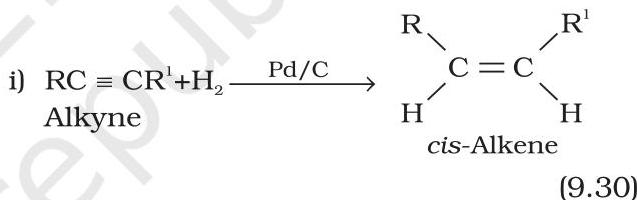
$ \mathrm{(ii)} \mathrm{RC} \equiv \mathrm{CR}^{1} + \mathrm{H}{2} \xrightarrow{\mathrm{Na} / \text{liquid } \mathrm{NH}{3}} \mathrm{CH}{2} = \mathrm{CH}{2} \tag{9.30} $
$ \mathrm{(iii)} \mathrm{CH} \equiv \mathrm{CH} + \mathrm{H}{2} \xrightarrow{\mathrm{Pd} / \mathrm{C}} \mathrm{CH}{2} = \mathrm{CH}_{2} \tag{9.32} $
$ \mathrm{(iv)} \mathrm{CH_3-C} \equiv \mathrm{CH} + \mathrm{H}_2 \xrightarrow{\mathrm{Pd} / \mathrm{C}} \mathrm{CH_3-CH} = \mathrm{CH}_2 $
Propyne Propene (9.33)
Will propene thus obtained show geometrical isomerism? Think for the reason in support of your answer.
- From alkyl halides: Alkenes can be synthesized from alkyl halides (R-X) by heating them with alcoholic potash, which is a solution of potassium hydroxide in an alcohol like
ethanol. This reaction results in the elimination of a molecule of hydrogen halide, a process known as dehydrohalogenation. Characteristically, this is a $\beta$-elimination reaction, as a hydrogen atom is removed from the $\beta$-carbon atom—the carbon adjacent to the one bonded to the halogen.
$ \begin{array}{c c c c c} & \mathrm{H} & \mathrm{H} \ \mathrm{H} - \mathrm{C} - \mathrm{C} - \mathrm{H} & \xrightarrow{\text{alc. KOH}} & \mathrm{H} & \mathrm{H} \ | & | & | & | \ | & | & | & \ \mathrm{H} & \mathrm{X} & & \mathrm{H} \ & & (\mathrm{X} = \mathrm{Cl}, \mathrm{Br}, \mathrm{I}) \end{array} \tag{9.34} $
The reaction rate is influenced by both the type of halogen atom and the structure of the alkyl group. Experimental observations indicate a reactivity order for halogens as: iodine > bromine > chlorine, and for alkyl groups as: tertiary > secondary > primary.
- From vicinal dihalides: Alkenes can also be prepared from vicinal dihalides, which are dihaloalkanes where two halogen atoms are bonded to adjacent carbon atoms. When vicinal dihalides are treated with zinc metal, they undergo dehalogenation, losing a molecule of $\mathrm{ZnX_2}$ to yield an alkene.
$ \begin{array}{l} \mathrm{CH_2Br} - \mathrm{CH_2Br} + \mathrm{Zn} \longrightarrow \mathrm{CH_2} = \mathrm{CH_2} + \mathrm{ZnBr_2} \ \mathrm{CH_3CHBr} - \mathrm{CH_2Br} + \mathrm{Zn} \longrightarrow \mathrm{CH_3CH} = \mathrm{CH_2} \
- \mathrm{ZnBr_2} \end{array} \tag{9.35} $
- Synthesis from alcohols via acidic dehydration: As established in the nomenclature of various homologous series in Unit 12, alcohols are recognized as hydroxyl derivatives of alkanes, typically denoted as R-OH, where R signifies an alkyl group with the general formula $\mathrm{C_nH_{2n+1}}$. When alcohols are subjected to heating with concentrated sulfuric acid, they undergo a reaction that yields alkenes through the removal of a single water molecule. Given that a water molecule is expelled from the alcohol structure under acidic conditions, this process is termed the acidic dehydration of alcohols. Furthermore, this reaction exemplifies a $\beta$-elimination pathway, as the hydroxyl group facilitates the abstraction of a hydrogen atom from the $\beta$-carbon position.
$ \begin{array}{c c c} & \mathrm{H} & \mathrm{H} \ \mathrm{H} - \mathrm{C} - \mathrm{C} - \mathrm{H} & \xrightarrow{\text{Conc. H}_2\text{SO}_4} & \mathrm{CH_2} = \mathrm{CH_2} + \mathrm{H_2O} \ & | & | \ & \mathrm{H} & \mathrm{OH} \ \text{Ethanol} \end{array} \tag{9.37} $
9.3.5 Properties
Physical properties
As a category, alkenes exhibit physical characteristics similar to those of alkanes, with notable distinctions arising from their different types of isomerism and variations in polar attributes. The initial three members of the alkene series exist as gases, followed by fourteen members that are liquids, and subsequent higher homologs which are solids at standard conditions. Ethene, specifically, is a colorless gas possessing a subtle sweet odor. In contrast, all other alkenes are typically colorless and odorless. They demonstrate insolubility in water but exhibit reasonable solubility in non-polar solvents, such as benzene and petroleum ether. A consistent trend of increasing boiling point is observed with an increase in molecular size, where the incorporation of each additional $-\mathrm{CH_2}$ unit elevates the boiling point by approximately 20–30 K. Analogous to alkanes, straight-chain alkenes generally possess higher boiling points compared to their isomeric branched-chain counterparts.
Chemical properties
Alkenes constitute a rich reservoir of loosely bound pi ($\pi$) electrons, which predisposes them to undergo addition reactions. In these reactions, electrophiles attach to the carbon-carbon double bond, leading to the formation of addition products. Certain reagents also participate through a free radical mechanism. Furthermore, under specific conditions, alkenes can engage in free radical substitution reactions. Oxidation and ozonolysis reactions are also notably prevalent in alkenes. A concise overview of various alkene reactions is provided below:
Addition of dihydrogen: Alkenes incorporate one molecule of dihydrogen gas when catalyzed by finely divided nickel, palladium, or platinum, thereby forming alkanes (refer to Section 9.2.2).
Addition of halogens: Halogens such as bromine or chlorine add across the alkene double bond to generate vicinal dihalides. However, iodine typically does not exhibit this addition reaction under
ambient conditions. The characteristic reddish-orange coloration of bromine solution in carbon tetrachloride is discharged upon its reaction with an unsaturated site, a phenomenon widely employed as a diagnostic test for unsaturation. The addition of halogens to alkenes represents an electrophilic addition reaction, proceeding via the transient formation of a cyclic halonium ion, a mechanism that will be explored in more advanced courses.
$
\mathrm{CH_2 = CH_2 + Br - Br} \xrightarrow{\mathrm{CCl}_4} \begin{array}{c} \mathrm{CH_2 - CH_2} \\ | \quad | \\ \mathrm{Br} \quad \mathrm{Br} \end{array} \tag{9.38}
$
Ethene
1,2 Dibromoethane

$
\mathrm{CH_3 - CH = CH_2 + Cl - Cl} \longrightarrow \begin{array}{c} \mathrm{CH_3 - CH - CH_2} \\ | \quad | \\ \mathrm{Cl} \quad \mathrm{Cl} \end{array} \tag{9.39}
$
Propene 1,2- Dichloropropane
- Addition of hydrogen halides: Hydrogen halides (HCl, HBr, HI) readily combine with alkenes to produce alkyl halides. The order of reactivity among these hydrogen halides is observed as $\mathrm{HI} > \mathrm{HBr} > \mathrm{HCl}$. Analogous to halogen addition, the reaction of hydrogen halides with alkenes is also classified as an electrophilic addition reaction. This process will be further illustrated by examining the addition of HBr to both symmetrical and unsymmetrical alkenes.
Addition reaction of HBr to symmetrical alkenes
The addition reactions of hydrogen bromide (HBr) to symmetrical alkenes (characterized by identical groups attached to each carbon atom of the double bond) proceed via an electrophilic addition mechanism.
$ \mathrm{CH_2 = CH_2 + H - Br} \longrightarrow \mathrm{CH_3 - CH_2 - Br} \tag{9.40} $
$ \mathrm{CH_3 - CH = CH - CH_3 + HBr} \longrightarrow \mathrm{CH_3 - CH}(\mathrm{Br}) - \mathrm{CH_2} - \mathrm{CH_3} \tag{9.41} $
Addition reaction of HBr to unsymmetrical alkenes (Markovnikov Rule)
Consider the addition of hydrogen bromide (HBr) to propene. Two distinct isomeric products are potentially formable, designated as I and II.
$ \mathrm{CH_3 - CH = CH_2 + H - Br} \xrightarrow{\left| \mathrm{H}^+ \right|} $
$ \mathrm{H_3C} - \mathrm{CH_2} - \mathrm{CH_2}^+ + \mathrm{Br}^- $
$ \mathrm{H_3C} - \mathrm{CH}^+ - \mathrm{CH_3} + \mathrm{Br}^- $
(a) less stable primary carbocation (b) more stable secondary carbocation
(i) The secondary carbocation (b) exhibits greater thermodynamic stability than the primary carbocation (a); consequently, its formation is kinetically favored, leading to its predominant generation.
(ii) Subsequently, the more stable carbocation (b) is subjected to nucleophilic attack by the bromide ($\mathrm{Br}^-$) ion, resulting in the formation of the product as demonstrated below:
$ \begin{array}{c} \mathrm{Br}^- \ \mathrm{H_3C} - \mathrm{CH}^+ - \mathrm{CH_3} \longrightarrow \mathrm{H_3C} - \mathrm{CH} - \mathrm{CH_3} \ | \ \mathrm{Br}^- \end{array} $
2-Bromopropane (major product)
Anti Markovnikov addition or peroxide effect or Kharash effect
In the presence of peroxides, the addition of hydrogen bromide to unsymmetrical alkenes, such as propene, occurs in a manner contrary to Markovnikov's rule. This phenomenon is observed exclusively with HBr, not with HCl or HI. M.S. Kharash and F.R. Mayo first documented this addition reaction at the University of Chicago in 1933. Consequently, it is recognized as the peroxide effect, the Kharash effect, or an addition reaction anti to Markovnikov's rule.
$ \mathrm{CH_3 - CH = CH_2 + HBr} \xrightarrow{(\mathrm{C_6H_5CO})_2\mathrm{O_2}} \mathrm{CH_3 - CH_2} \quad \mathrm{CH_2Br} $
1-Bromopropane
(9.43)
Mechanism: The peroxide effect proceeds through a free radical chain mechanism, as outlined below:
(i) $ \begin{array}{c} \mathrm{O} \ || \ \mathrm{C_6H_5 - C - O - O - C - C_6H_5} \xrightarrow{\text{Homolysis}} \end{array} $ Benzoyl peroxide $ \begin{array}{c} \mathrm{O} \ || \ 2\mathrm{C_6H_5 - C - O} \rightarrow 2\mathrm{C_6H_5 + 2CO_2} \end{array} $
(ii) $ \begin{array}{c} \mathrm{C_6H_5 + H - Br} \xrightarrow{\text{Homolysis}} \mathrm{C_6H_6 + Br} \end{array} $
(iii) $ \mathrm{CH_3 - CH = CH_2 + Br} $ $ \begin{array}{c} \downarrow \text{Homolysis} \ \mathrm{CH_3 - CH - CH_2} \ | \quad | \quad \text{Br} \ \text{(a)} \ \text{(less stable primary free radical)} \end{array} $ $ \begin{array}{c} \mathrm{CH_3 - CH - CH_2 - Br} \ \text{(h)} \ \text{(more stable secondary free radical)} \end{array} $
(iv) $ \mathrm{CH_3 - CH - CH_2Br + H - Br} \xrightarrow{\text{Homolysis}} \quad \downarrow \quad \mathrm{CH_3 - CH_2 - CH_2Br + Br} $ (Major product)
(v) $ \mathrm{CH_3 - CH - CH_2 + H - Br} \xrightarrow{\text{Homolysis}} \quad \downarrow \quad \mathrm{CH_3 - CH - CH_3 + Br} \quad \downarrow \quad \text{Br} \quad \text{(minor product)} $
The enhanced stability of the secondary free radical formed in step (iii) of the mechanism, when compared to the primary radical, accounts for the predominant formation of 1-bromopropane. It is crucial to observe that the peroxide effect is absent in the addition of HCl and HI. This can be attributed to the H–Cl bond's greater strength (430.5 $\mathrm{kJ,mol^{-1}}$) relative to the H–Br bond (363.7 $\mathrm{kJ,mol^{-1}}$), which prevents its homolytic cleavage by initiating free radicals. Conversely, while the H–I bond possesses lower energy (296.8 $\mathrm{kJ,mol^{-1}}$), iodine free radicals tend to recombine to produce molecular iodine rather than engaging in addition to the double bond.
Problem 9.12
Write IUPAC names of the products obtained by addition reactions of HBr to hex-1-ene
(i) in the absence of peroxide and (ii) in the presence of peroxide.
Solution
(i) $ \begin{array}{c} \mathrm{CH_2 = CH - CH_2 - CH_2 - CH_2 - CH_3 + H - Br} \ \text{Hex-1-ene} \ \quad \downarrow \text{No Peroxide} \ \quad \mathrm{CH_3 - CH - CH_2 - CH_2 - CH_2 - CH_3} \ \quad \quad \quad \quad \quad \quad \quad \quad \quad \quad \quad \quad \quad \quad \quad \quad \quad \quad \quad \quad \quad \quad \quad \quad \quad \quad \quad \quad \quad \quad \quad \quad \quad \quad \quad \quad \quad \quad \quad \text{Br} \ \quad 2\text{-Bromohexane} \end{array} $
(ii) $ \begin{array}{c} \mathrm{CH_2 = CH - CH_2 - CH_2 - CH_2 - CH_3 + H - Br} \ \quad \downarrow \text{Peroxide} \ \quad \mathrm{CH_2 - CH_2 - CH_2 - CH_2 - CH_2 - CH_3} \ \quad \quad \quad \quad \quad \quad \quad \quad \quad \quad \quad \quad \quad \quad \quad \quad \quad \quad \quad \quad \quad \quad \quad \quad \quad \quad \quad \quad \quad \quad \quad \quad \quad \quad \quad \quad \quad \quad \quad \text{Br} \ \quad 1\text{-Bromohexane} \end{array} $
- Addition of sulphuric acid: Alkenes undergo electrophilic addition with cold, concentrated sulfuric acid, adhering to Markovnikov's rule, to yield alkyl hydrogen sulfates.
$
\mathrm{CH_2 = CH_2 + H - O - S - O - H} \longrightarrow \mathrm{CH_3 - CH_2 - O\ SO_2 - OH} \text{ or } \mathrm{C_2H_5HSO_4} $ Ethyl hydrogen sulphate
$ \mathrm{CH_3 - CH = CH_2 + HOSO_2OH} \longrightarrow \begin{array}{c} \mathrm{CH_3 - CH - CH_3} \ | \ \mathrm{OSO_2OH} \end{array} $ Propyl hydrogen sulphate
(9.45)
- Addition of water: When subjected to hydration in the presence of a catalytic amount of concentrated sulfuric acid, alkenes produce alcohols, following Markovnikov's regioselectivity.
$ \mathrm{CH_3 - C = CH_2 + H_2O} \xrightarrow{\mathrm{H^+}} \mathrm{CH_3} \underset{\mathrm{CH_3}}{\mathrm{C - CH_3}} $ $ \mathrm{CH_3} \quad \mathrm{CH_3\ OH} $ 2-Methylpropene 2-Methylpropan-2-ol
(9.46)
- Oxidation: The treatment of alkenes with a cold, dilute, aqueous solution of potassium permanganate, known as Baeyer's reagent, results in the formation of vicinal glycols. The characteristic decolorization of the $\mathrm{KMnO_4}$ solution serves as an indicator for the presence of unsaturation.
$ \mathrm{CH_2 = CH_2 + H_2O + [O]} \xrightarrow{\text{dil. } KMnO_4} \mathrm{HO-CH_2-CH_2-OH} $
$ \mathrm{CH_2} \quad \mathrm{OH} \quad \mathrm{OH} $
Ethane-1,2-diol (Glycol)
$ \mathrm{CH_3 - CH = CH_2 + H_2O + [O]} \xrightarrow{\text{dil. } KMnO_4} \mathrm{CH_3CH(OH)CH_2OH} $
Propane-
(9.48)
b) Conversely, under acidic conditions, potassium permanganate or potassium dichromate facilitates the oxidative cleavage of alkenes, leading to the formation of ketones and/or carboxylic acids, the specific products being contingent upon the alkene's structure and the reaction parameters.
$ (\mathrm{CH_3})_2\mathrm{C = CH_2} \xrightarrow{\mathrm{KMnO_4/H^+}} (\mathrm{CH_3})_2\mathrm{C = O} + \mathrm{CO_2 + H_2O} $ 2-Methylpropene Propan-2-one
(9.49)
$ \mathrm{CH_3 - CH = CH - CH_3} \xrightarrow{\mathrm{KMnO_4/H^+}} 2\mathrm{CH_3COOH} $ But-2-ene Ethanoic acid
- Ozonolysis: The process of ozonolysis in alkenes entails the initial incorporation of an ozone molecule into the alkene structure, culminating in the formation of an ozonide. Subsequently, this ozonide undergoes scission via reaction with $\mathrm{Zn - H_2O}$, yielding smaller molecular fragments. This particular reaction holds significant utility in ascertaining the precise location of double bonds within alkenes and other unsaturated organic species.
$ \mathrm{CH_3CH=CH_2 + O_3} \xrightarrow{\mathrm{CH_3 - CH}} \mathrm{CH_2} $ Propene $ \begin{array}{c} \mathrm{O} \quad \mathrm{CH_3} \ \mathrm{CH_3CHO} + \mathrm{HCHO} \ \text{Ethanal} \quad \text{Methanal} \end{array} $
$ \mathrm{H_3C} \quad \mathrm{C = CH_2 + O_3} \longrightarrow \mathrm{H_3C} \quad \mathrm{O} \quad \mathrm{CH_2} $ $ \mathrm{H_3C} \quad \mathrm{CH_3} \quad \mathrm{O - O} \quad \mathrm{Ozonide} $ $ \begin{array}{c} \mathrm{H_3C} \quad \mathrm{C = O} + \mathrm{HCHO} \ \mathrm{CH_3} \quad \mathrm{CH_3} \ \mathrm{H_3C} \quad \mathrm{CH_3} \ \mathrm{Propan-2-one} \end{array} $
- Polymerisation: The prevalence of polythene bags and sheets is widely recognized. Polythene itself is synthesized through the aggregation of numerous ethene molecules, facilitated by elevated temperatures, high pressures, and the presence of a catalytic agent. The substantial macromolecules formed through this process are designated as polymers, and the reaction itself is termed polymerisation. The fundamental, simpler compounds serving as precursors for polymers are referred to as
monomers. It is noteworthy that other alkenes similarly exhibit the capacity for polymerisation.
$ \begin{array}{l} \mathrm {n} \left(\mathrm {C H} _ {2} = \mathrm {C H} _ {2}\right) \xrightarrow [ \text {C a t a l y s t} ]{\text {H i g h t e m p . / p r e s s u r e}} - \left{\mathrm {C H} _ {2} - \mathrm {C H} _ {2} \right} - \ \text {P o l y t h e n e} \end{array} $
$ \begin{array}{c} \mathrm {n} (\mathrm {C H} _ {3} - \mathrm {C H} = \mathrm {C H} _ {2}) \xrightarrow [ \text {C a t a l y s t} ]{\text {H i g h t e m p . / p r e s s u r e}} - \left{\mathrm {C H} - \mathrm {C H} _ {2} \right} _ {\mathrm {n}} \ | \ \mathrm {C H} _ {3} \end{array} $ Polypropene
Polymers find extensive application in the fabrication of various consumer goods, including but not limited to plastic bags, compressible bottles, refrigeration containers, playthings, conduits, and enclosures for electronic devices such as radios and televisions. Specifically, polypropene is employed in the production of items like dairy crates, plastic pails, and diverse molded products. While these synthetic substances have achieved ubiquity in modern society, the proliferation and overuse of polythene and polypropylene present significant environmental and societal challenges that warrant collective attention.
9.4 ALKYNES
Alkynes, much like alkenes, are characterized as unsaturated hydrocarbons. They are distinguished by the presence of at least one triple covalent bond connecting two carbon atoms. Consequently, the hydrogen atom count in alkynes is lower than that found in either alkenes or alkanes. Their overarching molecular formula is represented as $\mathrm{C_nH_{2n - 2}}$.
Ethyne, commonly identified as acetylene, constitutes the inaugural stable member within the alkyne homologous series. Acetylene finds application in arc welding, specifically through the oxyacetylene flame generated by its combustion with oxygen. Given their utility as precursors for synthesizing numerous organic compounds, the investigation of this particular class of organic substances is of considerable interest.
9.4.1 Nomenclature and Isomerism
Within the common nomenclature system, alkynes are designated as derivatives of acetylene. Conversely, the IUPAC system dictates their naming as derivatives of their corresponding alkanes, achieved by substituting the 'ane' suffix with 'yne'. The specific location of the triple bond is denoted by the lowest-numbered carbon atom involved in that bond. Common and IUPAC designations for selected members of the alkyne series are enumerated in Table 9.2.
It has been previously established that while ethyne and propyne each possess a singular structural arrangement, butyne exhibits two potential configurations: (i) but-1-yne and (ii) but-2-yne. Given that these compounds diverge structurally solely due to the placement of the triple bond, they are categorized as position isomers. To what extent is it feasible to devise structures for the subsequent homologue, specifically the alkyne with the molecular formula $\mathrm{C}_5\mathrm{H}_8$? Let us proceed by arranging five carbon atoms, considering both a continuous chain and the incorporation of a side chain. The potential structures are presented below:
Structure IUPAC name
I. $\mathrm{HC} = \mathrm{C} - \mathrm{CH}{2} - \mathrm{CH}{2} - \mathrm{CH}_{3}$ Pent-1-yne
II. $\mathrm{H}{3} \mathrm{C}-\mathrm{C}= \mathrm{C}- \mathrm{CH}{2}- \mathrm{CH}_{3}$ Pent-2-yne
III. $\mathrm{H}_{3} \mathrm{C}-\mathrm{CH}-\mathrm{C}= \mathrm{CH}$ 3-Methylbut-1-yne
Structures I and II exemplify position isomerism, whereas structures I and III, or alternatively II and III, represent chain isomers.
Problem 9.13
Write structures of different isomers corresponding to the $5^{\text{th}}$ member of alkyne series. Also write IUPAC names of all the isomers. What type of isomerism is exhibited by different pairs of isomers?
Solution
The fifth homologue within the alkyne series is characterized by the molecular formula $\mathrm{C_6H_{10}}$. The complete set of its structural isomers includes:
Table 9.2 Common and IUPAC Names of Alkynes ($\mathrm{C_nH_{2n - 2}}$)
| Value of n | Formula | Structure | Common name | IUPAC name |
|---|---|---|---|---|
| 2 | $\mathrm{C_2H_2}$ | $\mathrm{H-C \equiv CH}$ | Acetylene | Ethyne |
| 3 | $\mathrm{C_3H_4}$ | $\mathrm{CH_3-C \equiv CH}$ | Methylacetylene | Propyne |
| 4 | $\mathrm{C_4H_6}$ | $\mathrm{CH_3CH_2-C \equiv CH}$ | Ethylacetylene | But-1-yne |
| 4 | $\mathrm{C_4H_6}$ | $\mathrm{CH_3-C \equiv C-CH_3}$ | Dimethylacetylene | But-2-yne |
(a) $\mathrm{HC \equiv C - CH_2 - CH_2 - CH_2 - CH_3}$ Hex-1-yne (b) $\mathrm{CH_3 - C \equiv C - CH_2 - CH_2 - CH_3}$ Hex-2-yne (c) $\mathrm{CH_3 - CH_2 - C \equiv C - CH_2 - CH_3}$ Hex-3-yne
$ \begin{array}{c} \mathrm{HC \equiv C - CH - CH_2 - CH_3} \ | \ \mathrm{CH_3} \end{array} $
3-Methylpent-1-yne
$ \begin{array}{c} \mathrm{HC \equiv C - CH_2 - CH - CH_3} \ | \ \mathrm{CH_3} \end{array} $
4-Methylpent-1-yne
$ \begin{array}{c} \mathrm{CH_3 - C \equiv C - CH - CH_3} \ | \ \mathrm{CH_3} \end{array} $
4-Methylpent-2-yne
$ \begin{array}{c} \mathrm{CH_3} \ | \ \mathrm{(g)} \quad \mathrm{HC \equiv C - C - CH_3} \ | \ \mathrm{CH_3} \end{array} $
3,3-Dimethylbut-1-yne
These distinct pairs of isomers demonstrate both positional and chain isomerism.
9.4.2 Structure of Triple Bond
Ethyne represents the most fundamental molecule within the alkyne class. Its molecular structure is depicted in Fig. 9.6.
Each carbon atom in ethyne possesses two $sp$ hybridized orbitals. The carbon-carbon sigma ($\sigma$) bond results from the direct, head-on overlap of one $sp$ hybridized orbital from each of the two carbon atoms. The other $sp$ hybridized orbital on each carbon atom then overlaps along the internuclear axis with the 1s orbital of a hydrogen atom, thereby establishing two C-H sigma bonds. This arrangement dictates an H-C-C bond angle of 180 degrees, conferring linearity. Additionally, each carbon atom retains two unhybridized $p$ orbitals, oriented perpendicularly to each other and to the plane defined by the C-C sigma bond. The $2p$ orbitals of one carbon atom are parallel to the $2p$
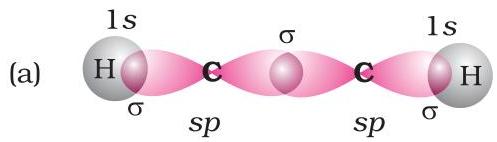
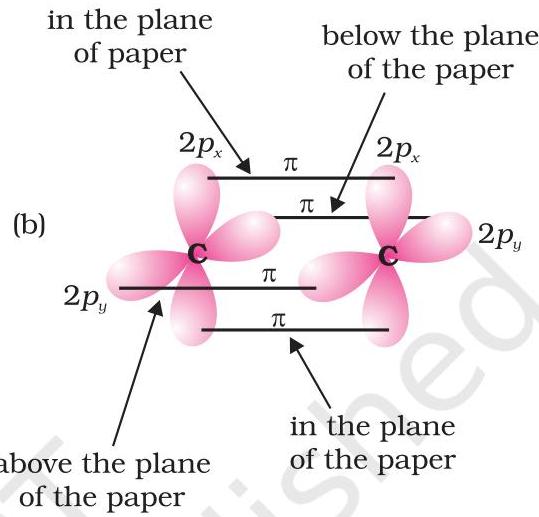 Fig. 9.6 Orbital picture of ethyne showing (a) sigma overlaps (b) pi overlaps.
orbitals of the other carbon atom, which undergo lateral, or sideways, overlapping to form two pi ($\pi$) bonds between the two carbon atoms. Consequently, an ethyne molecule is characterized by one C-C $\sigma$ bond, two C-H $\sigma$ bonds, and two C-C $\pi$ bonds. The C$\equiv$C bond exhibits a higher strength (bond enthalpy $823,\mathrm{kJ,mol}^{-1}$ ) compared to both the C=C bond (bond enthalpy $681,\mathrm{kJ,mol}^{-1}$ ) and the C-C bond (bond enthalpy $348,\mathrm{kJ,mol}^{-1}$ ). Concomitantly, the C$\equiv$C bond length is shorter (120 pm) than that of the C=C bond (133 pm) and the C-C bond (154 pm). The electron density surrounding the two carbon atoms displays cylindrical symmetry around the internuclear axis. This inherent symmetry confirms ethyne's linear molecular geometry.
9.4.3 Preparation
- Synthesis via calcium carbide: Ethyne is industrially synthesized by reacting calcium carbide with water. Calcium carbide itself is generated through the high-temperature reaction of quicklime and coke. Quicklime, in turn, is produced by the thermal decomposition of limestone, as illustrated by the sequential reactions below:
$ \mathrm {C a C O} _ {3} \xrightarrow {\Delta} \mathrm {C a O} + \mathrm {C O} _ {2} \tag {9.55} $
$
\mathrm{CaO} + 3\mathrm{C} \longrightarrow \mathrm{CaC}_2 + \mathrm{CO} \tag{9.56} $
Calcium carbide
$ \mathrm{CaC}_2 + 2\mathrm{H}_2\mathrm{O} \longrightarrow \mathrm{Ca(OH)}_2 + \mathrm{C}_2\mathrm{H}_2 \tag{9.57} $
- Production from vicinal dihalides: Vicinal dihalides can be converted to alkynes through a two-step process. Initially, dehydrohalogenation occurs when vicinal dihalides are treated with alcoholic potassium hydroxide, leading to the elimination of one hydrogen halide molecule and the formation of an alkenyl halide. Subsequent reaction of this alkenyl halide with sodamide yields the desired alkyne.
$ \begin{array}{c} \mathrm{H} \ | \ \mathrm{H}_2\mathrm{C} - \mathrm{C} - \mathrm{H} + \mathrm{KOH} \xrightarrow{\text{alcohol}} \mathrm{C} = \mathrm{C} \ | \quad | \quad | \ \text{Br Br} \quad - \mathrm{H}_2\mathrm{O} \quad \mathrm{H} \quad \text{Br} \ \text{Na}^+ \text{NH}_2^- \downarrow - \text{NaBr} \ \quad - \text{NH}_3 \ \quad \text{CH} \equiv \text{CH} \end{array} \tag{9.56} $
9.4.4 Properties
Physical properties
The physical characteristics of alkynes largely mirror those observed in alkenes and alkanes. The first three members of the alkyne series exist as gases, the subsequent eight as liquids, and higher molecular weight compounds are solids. All alkynes are devoid of color. While ethyne exhibits a distinctive odor, other members of the series are odorless. Alkynes possess a weakly polar nature. They are less dense than water and are immiscible with it, though they readily dissolve in organic solvents such as ethers, carbon tetrachloride, and benzene. Their melting points, boiling points, and densities generally increase with a rise in molar mass.
Chemical properties
Alkynes demonstrate acidic behavior, undergo addition reactions, and participate in polymerization reactions, as elaborated below:
A. Acidic character of alkyne:
Potent bases, including sodium metal and sodamide ($\mathrm{NaNH_2}$), react with ethyne to yield sodium acetylide, concomitant with the evolution of dihydrogen gas. These reactions are not observed with ethene and ethane, thereby indicating the inherently acidic nature of ethyne when compared to these other hydrocarbons. What underlies this phenomenon? Is it intrinsically linked to their molecular structures and the hybridization states of their carbon atoms? As previously discussed, hydrogen atoms in ethyne are bonded to $sp$ hybridized carbon atoms, whereas in ethene they are attached to $sp^2$ hybridized carbon atoms, and in ethane to $sp^3$ hybridized carbons. Owing to the maximal $s$ character (50%), the $sp$ hybridized orbitals of carbon atoms within ethyne molecules exhibit the highest electronegativity. Consequently, these orbitals exert a stronger attraction on the shared electron pair in the C-H bond of ethyne than do the $sp^2$ hybridized orbitals of carbon in ethene or the $sp^3$ hybridized orbital of carbon in ethane. This enhanced electron-withdrawing effect facilitates the easier dissociation of hydrogen atoms as protons in ethyne, in contrast to ethene and ethane. Therefore, the hydrogen atoms directly bonded to the triply bonded carbon atoms in ethyne are acidic. It is crucial to recognize that only the hydrogen atoms attached to the triply bonded carbons are acidic, not all hydrogen atoms present within alkynes.
$ \mathrm{HC} \equiv \mathrm{CH} + \mathrm{Na} \rightarrow \mathrm{HC} \equiv \mathrm{C}^- \mathrm{Na}^+ + \frac{1}{2} \mathrm{H}_2 $
Monosodium
ethynide
(9.59)
$ \mathrm{HC} \equiv \mathrm{C}^- \mathrm{Na}^+ + \mathrm{Na} \rightarrow \mathrm{Na}^+ \mathrm{C}^- \mathrm{Na}^+ \equiv \mathrm{C}^- \mathrm{Na}^+ + \frac{1}{2} \mathrm{H}_2 $
Disodium ethynide
(9.60)
$ \begin{array}{c} \mathrm{CH}_3 - \mathrm{C} \equiv \mathrm{C} - \mathrm{H} + \mathrm{Na}^+ \mathrm{NH}_2^- \ \downarrow \ \mathrm{CH_3} - \mathrm{C} \equiv \mathrm{C}^- \mathrm{Na}^+ + \mathrm{NH}_3 \end{array} $
Sodium propynide (9.61)
These reactions are not exhibited by alkenes and alkanes, thus providing a means for distinguishing among alkynes, alkenes, and alkanes. How would but-1-yne and but-2-yne respond to the aforementioned reactions? The acidic behavior of alkanes, alkenes, and alkynes generally follows the subsequent order:
$ \mathrm{i)} \mathrm{CH} \equiv \mathrm{CH} > \mathrm{H_2C} - \mathrm{CH_2} > \mathrm{CH_3} - \mathrm{CH_3} $
$ \mathrm{ii)} \mathrm{HC} \equiv \mathrm{CH} > \mathrm{CH_3} - \mathrm{C} \equiv \mathrm{CH} >> \mathrm{CH_3} - \mathrm{C} \equiv \mathrm{C} - \mathrm{CH_3} $
B. Addition reactions: Due to the presence of a triple bond, alkynes readily undergo addition reactions, incorporating species such as two molecules of dihydrogen, halogens, or hydrogen halides. The process of forming the addition product generally proceeds through the sequence of steps outlined below.
$ \begin{array}{c} \mathrm{H} \ | \quad \mathrm{\oplus} \
- \mathrm{C} \equiv \mathrm{C} - + \mathrm{H} - \mathrm{Z} \xrightarrow{\mathrm{H}^{+}} - \mathrm{C} = \mathrm{C} - +: \overline{\mathrm{Z}} \longrightarrow - \mathrm{C} = \mathrm{C} - \ \text{Vinylic cation} \end{array} \quad \begin{array}{c} \mathrm{H} \quad \mathrm{Z} \ | \quad | \
- \mathrm{C} = \mathrm{C} - +: \overline{\mathrm{Z}} \longrightarrow - \mathrm{C} = \mathrm{C} - \ \text{Vinylic cation} \end{array} $
The ultimate structure of the addition product is dictated by the stability of the intermediate vinylic cation. For unsymmetrical alkynes, the addition process adheres to Markovnikov's rule. Most reactions involving alkynes are classified as electrophilic addition reactions. Several illustrative addition reactions are presented subsequently:
(i) Addition of dihydrogen
$ \mathrm{HC} \equiv \mathrm{CH} + \mathrm{H}{2} \xrightarrow{\mathrm{Pt}/\mathrm{Pd}/\mathrm{Ni}} [\mathrm{H}{2}\mathrm{C} = \mathrm{CH}{2}] \xrightarrow{\mathrm{H}{2}} \mathrm{CH}{3} - \mathrm{CH}{3} \tag{9.62} $
$ \begin{array}{c} \mathrm{CH}{3} - \mathrm{C} \equiv \mathrm{CH} + \mathrm{H}{2} \xrightarrow{\mathrm{Pt}/\mathrm{Pd}/\mathrm{Ni}} [\mathrm{CH}{3} - \mathrm{CH} = \mathrm{CH}{2}] \ \text{Propyne} \ \quad \downarrow \mathrm{Br} \ \quad \mathrm{CH}{3} - \mathrm{CH}{2} - \mathrm{CH}_{3} \ \quad \quad \quad \quad \quad \text{Propane} \ \end{array} \tag{9.63} $
(ii) Addition of halogens
$ \begin{array}{c} \mathrm{CH}{3} - \mathrm{C} \equiv \mathrm{CH} + \mathrm{Br} - \mathrm{Br} \longrightarrow [\mathrm{CH}{3}\mathrm{CBr} = \mathrm{CHBr}] \ \text{1,2-Dibromopropene} \ \downarrow \mathrm{Br}{2} \ \quad \downarrow \mathrm{Br} \quad \mathrm{Br} \ \quad \quad \quad \quad | \quad | \ \quad \quad \quad \quad \mathrm{CH}{3} - \mathrm{C} - \mathrm{CH} \ \quad \quad \quad \quad | \quad | \ \quad \quad \quad \quad \mathrm{Br} \quad \mathrm{Br} \ \text{1,1,2,2-Tetrabromopropane} \ \end{array} \tag{9.64} $
The characteristic reddish-orange coloration of a bromine solution in carbon tetrachloride undergoes decolorization upon reaction, which serves as a conventional diagnostic test for the presence of unsaturation.
(iii) Addition of hydrogen halides
Alkynes react with two equivalents of hydrogen halides (such as HCl, HBr, or HI) to yield geminal dihalides, characterized by the attachment of both halogen atoms to the identical carbon center.
$ \begin{array}{c} \mathrm{H} - \mathrm{C} \equiv \mathrm{C} - \mathrm{H} + \mathrm{H} - \mathrm{Br} \longrightarrow [\mathrm{CH}{2} = \mathrm{CH} - \mathrm{Br}] \longrightarrow \mathrm{CHBr}{2} \ \text{Bromoethene} \quad | \quad | \ \quad \quad \quad \quad \quad \mathrm{CH}_{3} \ \text{1,1-Dibromoethane} \ \end{array} \tag{9.65} $
$ \begin{array}{c} \mathrm{CH}{3} - \mathrm{C} \equiv \mathrm{CH} + \mathrm{H} - \mathrm{Br} \longrightarrow [\mathrm{CH}{3} - \mathrm{C} = \mathrm{CH}{2}] \ | \ \quad \quad \quad \quad \quad \mathrm{Br} \ \quad \quad \quad \quad 2\text{-Bromopropene} \ \quad \downarrow \ \quad \quad \quad \quad \mathrm{Br} \ \quad \quad \quad \quad | \ \quad \quad \quad \quad \mathrm{CH}{3} - \mathrm{C} - \mathrm{CH}_{3} \ \quad \quad \quad \quad | \ \quad \quad \quad \quad \mathrm{Br} \ \quad \quad \quad \quad 2,2\text{-Dibromopropane} \ \end{array} \tag{9.66} $
(iv) Addition of water
Alkynes, akin to alkanes and alkenes, exhibit immiscibility with water and typically do not undergo reactions with it. Nevertheless, in the presence of mercuric sulfate and dilute sulfuric acid, and with heating to $333,\mathrm{K}$, a single molecule of water can be incorporated into alkynes, yielding carbonyl compounds.
$ \begin{array}{c} \mathrm{HC} \equiv \mathrm{CH} + \mathrm{H} - \mathrm{OH} - \frac{\mathrm{Hg}^{2+}/\mathrm{H}^{+}}{333,\mathrm{K}} \quad \mathrm{CH}{2} = \mathrm{C} - \mathrm{H} \ \text{Ethyne} \ \quad \quad \quad \quad \quad \mathrm{OH} \ \quad \quad \quad \quad \quad \downarrow \text{Isomerisation} \ \quad \quad \quad \quad \quad \mathrm{CH}{3} - \mathrm{C} - \mathrm{H} \ \quad \quad \quad \quad \quad \parallel \ \quad \quad \quad \quad \quad \mathrm{O} \ \quad \quad \quad \quad \quad \text{Ethanal} \ \end{array} \tag{9.67} $
$ \begin{array}{c} \mathrm{CH}{3} - \mathrm{C} \equiv \mathrm{CH} + \mathrm{H} - \mathrm{OH} - \frac{\mathrm{Hg}^{2+}/\mathrm{H}^{+}}{333,\mathrm{K}} \quad \mathrm{CH}{3} - \mathrm{C} = \mathrm{CH}{2} \ \text{Propyne} \ \quad \quad \quad \quad \quad \mathrm{O} - \mathrm{H} \ \quad \quad \quad \quad \quad \downarrow \ \quad \quad \quad \quad \quad \mathrm{Isomerisation} \ \quad \downarrow \ \quad \quad \quad \quad \mathrm{CH}{3} - \mathrm{C} - \mathrm{CH}_{3} \ \quad \quad \quad \quad \parallel \ \quad \quad \quad \quad \mathrm{O} \ \quad \quad \quad \quad \text{Propanone} \ \end{array} \tag{9.68} $
(v) Polymerisation
(a) Linear polymerisation: When subjected to appropriate conditions, ethyne undergoes linear polymerization, resulting in the formation of polyacetylene, also known as polyethyne. This substance is a high molecular weight polyene characterized by repeating units of $(\mathrm{CH = CH - CH = CH})$, and its structure can be depicted as $-\left(\mathrm{CH = CH - CH = CH}\right)_{n}$. Under particular circumstances, this polymer exhibits electrical conductivity.
Films of polyacetylene, when manufactured as thin layers, find utility as electrode materials in battery systems. These thin polymeric materials offer advantages over metallic conductors, being excellent electrical conductors, yet possessing lower mass and reduced cost.
(b) Cyclic polymerisation: When ethyne is passed through a red-hot iron tube maintained at $873,\mathrm{K}$, it undergoes cyclic polymerization. In this process, three molecules of ethyne polymerize to yield benzene. Benzene serves as a foundational precursor for the synthesis of various benzene derivatives, dyes, pharmaceutical agents, and a multitude of other organic compounds. This methodology represents an optimal pathway for transitioning from aliphatic to aromatic compounds, as illustrated subsequently:
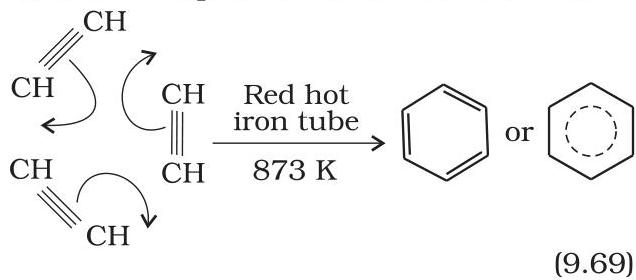
Problem 9.14
How will you convert ethanoic acid into benzene?
Solution
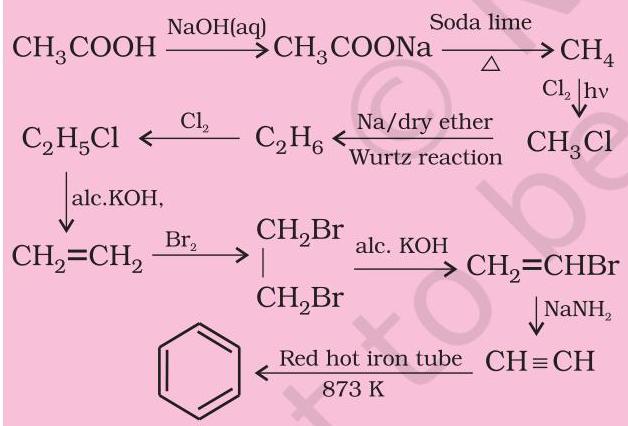
9.5 AROMATIC HYDROCARBON
Aromatic hydrocarbons are alternatively termed 'arenes'. The nomenclature 'aromatic compounds' originated from the characteristic pleasant fragrance (derived from the Greek word 'aroma', signifying pleasant smell) exhibited by a significant proportion of these substances. A predominant feature among these compounds is the presence of a benzene ring. While the benzene ring inherently possesses a high degree of unsaturation, this unsaturation is typically preserved across most chemical reactions involving aromatic compounds. Nevertheless, certain aromatic hydrocarbons exist that lack a benzene ring, instead featuring alternative highly unsaturated ring systems. Those aromatic compounds incorporating a benzene ring are classified as benzenoids, whereas those lacking such a ring are designated as non-benzenoids. Illustrative instances of arenes are presented subsequently:
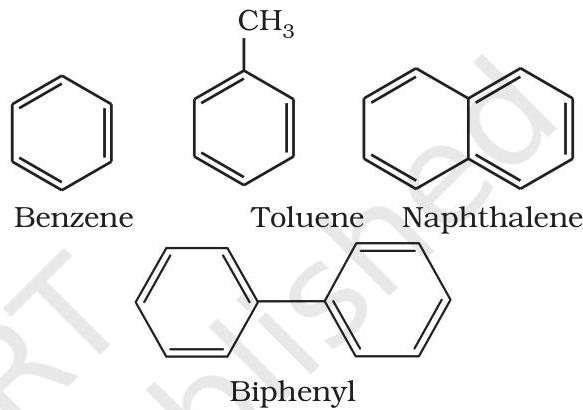
9.5.1 Nomenclature and Isomerism
The systematic naming and structural isomerism pertinent to aromatic hydrocarbons have been previously addressed in Unit 8. Benzene’s inherent symmetry ensures that all six hydrogen atoms are chemically equivalent; consequently, it yields only a single type of monosubstituted derivative. When two hydrogen atoms on the benzene ring are substituted by either identical or distinct monovalent atoms or groups, three distinct positional isomers can arise. Specifically, the 1,2- or 1,6-disubstitution pattern is designated as ortho ($o-$), the 1,3- or 1,5-pattern as meta ($m-$), and the 1,4-pattern as para ($p-$). Illustrative examples of benzene derivatives are provided below:
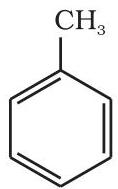 Methylbenzene (Toluene)
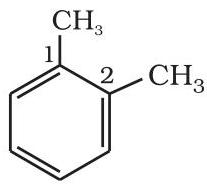 1,2-Dimethylbenzene (o-Xylene)
Friedrich August Kekulé, a German chemist, was born in 1829 in Darmstadt, Germany. His academic career saw him appointed Professor in 1856, and he was recognized as a Fellow of the Royal Society in 1875. Kekulé’s pivotal contributions to structural organic chemistry include his 1858 proposal that carbon atoms can link together to form chains. Subsequently, in 1865, he resolved the complex problem of benzene’s structure by positing that these carbon chains could cyclize to form rings. He advanced the dynamic structural formula for benzene, which laid the groundwork for its contemporary electronic structure. Kekulé later recounted the discovery of benzene’s structure:
"I was sitting writing at my textbook, but the work did not progress; my thoughts were elsewhere. I turned my chair to the fire, and dozed. Again the atoms were gambolling before my eyes. This time the smaller groups kept modestly in the background. My mental eye, rendered more acute by repeated visions of this kind, could now distinguish larger structures of manifold conformations; long rows, sometimes more closely fitted together; all twisting and turning in snake-like motion. But look! What was that? One of the snakes had seized hold of its own tail, and the form whirled mockingly before my eyes. As if by a flash of lightning I woke;... I spent the rest of the night working out the consequences of the hypothesis. Let us learn to dream, gentlemen, and then perhaps we shall learn the truth but let us beware of making our dreams public before they have been approved by the waking mind." (1890).
A century following Kekulé's birth, during his centenary celebrations, a class of compounds characterized by polybenzenoid structures was collectively named Kekulenes.
 FRIEDRICH
AUGUST KEKULÉ
(7th September
1829–13th July
1896)
FRIEDRICH
AUGUST KEKULÉ
(7th September
1829–13th July
1896)
1,3 Dimethylbenzene (m-Xylene)
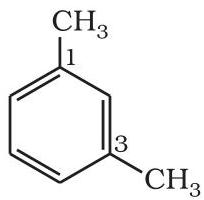
1,4-Dimethylbenzene (p-Xylene)
9.5.2 Structure of Benzene
The discovery of benzene by Michael Faraday occurred in 1825. Its molecular formula, $\mathrm{C_6H_6}$, suggested a significant level of unsaturation. However, this formula did not readily align with the characteristics of alkanes, alkenes, and alkynes previously examined in this unit. The task of determining its precise structure proved challenging over a considerable period, primarily owing to its distinctive attributes and remarkable stability. Experimental findings revealed benzene to be a highly stable compound that yielded a triozonide, thereby implying the presence of three double bonds within its structure. Furthermore, the observation that benzene exclusively formed a single monosubstituted derivative indicated the equivalence of all six carbon and six hydrogen atoms. These empirical observations formed the foundation for August Kekulé's 1865 proposition of a cyclic structure for benzene, featuring six carbon atoms arranged in a ring with alternating single and double
bonds, each carbon atom being bonded to one hydrogen atom.
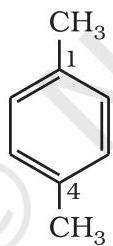
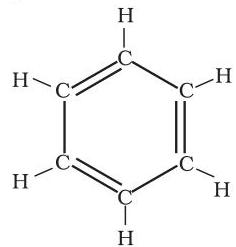
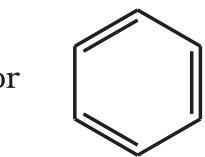
According to the Kekulé model, two distinct isomeric forms of 1,2-dibromobenzene should theoretically exist. One isomer would feature bromine substituents on carbon atoms linked by a double bond, while the other would have them positioned on carbons connected by a single bond.
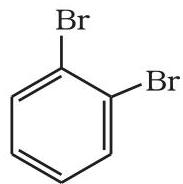
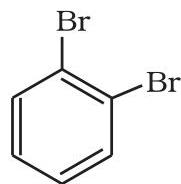
Nevertheless, experimental evidence demonstrated that benzene yields only a single ortho-disubstituted product. Kekulé addressed this discrepancy by introducing the concept of double bonds undergoing rapid oscillation within the benzene ring, as depicted below.