UNIT 7
REDOX REACTIONS
Objectives
After studying this unit you will be able to
- recognize redox reactions as a category where oxidation and reduction processes unfold concurrently;
- articulate the definitions of oxidation, reduction, oxidants (oxidizing agents), and reductants (reducing agents);
- elucidate the operational mechanism of redox reactions through electron transfer;
- employ the principle of oxidation number to discern the oxidant and reductant within a chemical reaction;
- categorize redox reactions into types such as combination (synthesis), decomposition, displacement, and disproportionation reactions;
- propose a relative ranking among different reductants and oxidants;
- achieve stoichiometric balance in chemical equations utilizing (i) the oxidation number method and (ii) the half-reaction method;
- comprehend the theoretical framework of redox reactions as manifested in electrode processes.
The occurrence of oxidation is perpetually linked with reduction; indeed, chemistry fundamentally constitutes the investigation of redox systems.
Chemistry encompasses the study of diverse forms of matter and their interconversion. Such transformations are facilitated by various reaction types. Among these, Redox Reactions represent a pivotal class. Numerous processes, spanning both physical and biological domains, are intrinsically linked to redox reactions. Their utility extends broadly across pharmaceutical, biological, industrial, metallurgical, and agricultural sectors. The profound significance of these reactions is evident from their involvement in processes such as the combustion of various fuels to generate energy for domestic, transport, and commercial needs. Furthermore, electrochemical methodologies employed for extracting highly reactive metals and non-metals, the production of chemical compounds like caustic soda, the operation of both dry and wet cell batteries, and the corrosion of metallic structures, all reside within the domain of redox phenomena. More recently, environmental concerns such as the Hydrogen Economy (which involves the utilization of liquid hydrogen as a fuel source) and the genesis of the ‘Ozone Hole’ have increasingly been examined through the lens of redox principles.
7.1 CLASSICAL IDEA OF REDOX REACTIONS – OXIDATION AND REDUCTION REACTIONS
The initial conceptualization of oxidation involved the incorporation of oxygen into an element or a compound. Given that dioxygen constitutes approximately 20% of the atmospheric composition, numerous elements react with it, leading to their prevalent existence on Earth as oxides. These subsequent reactions exemplify oxidation phenomena consistent with this circumscribed definition.
$ 2 \mathrm{Mg}(\mathrm{s}) + \mathrm{O}_2(\mathrm{g}) \rightarrow 2 \mathrm{MgO}(\mathrm{s}) \tag{7.1} $
$ \mathrm{S}(\mathrm{s}) + \mathrm{O}_2(\mathrm{g}) \rightarrow \mathrm{SO}_2(\mathrm{g}) \tag{7.2} $
Within reactions (7.1) and (7.2), both magnesium and sulfur undergo oxidation due to the incorporation of oxygen. Analogously, methane experiences oxidation through the addition of oxygen.
$ \mathrm{CH_4} (\mathrm{g}) + 2\mathrm{O_2} (\mathrm{g}) \rightarrow \mathrm{CO_2} (\mathrm{g}) + 2\mathrm{H_2O} (\mathrm{l}) \tag{7.3} $
Scrutiny of reaction (7.3), wherein hydrogen is supplanted by oxygen, led chemists to redefine oxidation as the abstraction of hydrogen. Consequently, the definition of oxidation expanded to encompass the removal of hydrogen from a given substance. The subsequent example further demonstrates a reaction where hydrogen removal is classified as an oxidation process.
$ 2\mathrm{H_2S} (\mathrm{g}) + \mathrm{O_2} (\mathrm{g}) \rightarrow 2\mathrm{S} (\mathrm{s}) + 2\mathrm{H_2O} (\mathrm{l}) \tag{7.4} $
With the progression of chemical understanding, it became logical to broaden the concept of oxidation to include reactions analogous to (7.1 to 7.4) that feature electronegative elements other than oxygen. The oxidation of magnesium by elements such as fluorine, chlorine, and sulfur proceeds via the reactions detailed below:
$ \mathrm{Mg} (\mathrm{s}) + \mathrm{F_2} (\mathrm{g}) \rightarrow \mathrm{MgF_2} (\mathrm{s}) \tag{7.5} $
$ \mathrm{Mg} (\mathrm{s}) + \mathrm{Cl_2} (\mathrm{g}) \rightarrow \mathrm{MgCl_2} (\mathrm{s}) \tag{7.6} $
$ \mathrm{Mg} (\mathrm{s}) + \mathrm{S} (\mathrm{s}) \rightarrow \mathrm{MgS} (\mathrm{s}) \tag{7.7} $
The inclusion of reactions (7.5) through (7.7) into the classification of oxidation processes prompted chemists to recognize the removal of electropositive elements, alongside hydrogen, as a form of oxidation. Thus the reaction:
$ 2,\mathrm{K_4[Fe(CN)_6]}(aq) + \mathrm{H_2O_2}(aq) \rightarrow 2,\mathrm{K_3[Fe(CN)_6]}(aq) + 2,\mathrm{KOH}(aq) $
is interpreted as oxidation due to the removal of electropositive element potassium from potassium ferrocyanide before it changes to potassium ferricyanide. In summation, the term "oxidation" is characterized by either the incorporation of oxygen or an electronegative element into a substance, or the extraction of hydrogen or an electropositive element from it.
In the beginning, reduction was considered as removal of oxygen from a compound. However, the term reduction has been
Currently, this definition has been expanded to encompass the extraction of oxygen or an electronegative element from a substance, or alternatively, the incorporation of hydrogen or an electropositive element into it.
Consistent with the aforementioned definition, the subsequent reactions serve as illustrative instances of reduction phenomena:
$ 2\mathrm{HgO} (\mathrm{s}) \xrightarrow{\Delta} 2\mathrm{Hg} (\mathrm{l}) + \mathrm{O_2} (\mathrm{g}) \tag{7.8} $
(involving the abstraction of oxygen from mercuric oxide)
$ 2\mathrm{FeCl_3} (\mathrm{aq}) + \mathrm{H_2} (\mathrm{g}) \rightarrow 2\mathrm{FeCl_2} (\mathrm{aq}) + 2\mathrm{HCl} (\mathrm{aq}) \tag{7.9} $
(demonstrating the elimination of the electronegative element, chlorine, from ferric chloride)
$ \mathrm{CH_2 = CH_2} (\mathrm{g}) + \mathrm{H_2} (\mathrm{g}) \rightarrow \mathrm{H_3C - CH_3} (\mathrm{g}) \tag{7.10} $
(signifying the incorporation of hydrogen)
$ 2\mathrm{HgCl_2} (\mathrm{aq}) + \mathrm{SnCl_2} (\mathrm{aq}) \rightarrow \mathrm{Hg_2Cl_2} (\mathrm{s}) + \mathrm{SnCl_4} (\mathrm{aq}) \tag{7.11} $
(illustrating the attachment of mercury to mercuric chloride)
Within reaction (7.11), the concurrent oxidation of stannous chloride into stannic chloride transpires, attributable to the integration of the electronegative element chlorine. It promptly became evident that oxidation and reduction invariably manifest in a concerted manner (a fact discernible upon reviewing all the aforementioned equations); consequently, the term "redox" was devised to categorize this class of chemical transformations.
Problem 7.1
For the chemical reactions presented below, pinpoint the entities that undergo oxidation and reduction:
(i) $\mathrm{H_2S} (\mathrm{g}) + \mathrm{Cl_2} (\mathrm{g}) \rightarrow 2\mathrm{HCl} (\mathrm{g}) + \mathrm{S} (\mathrm{s})$ (ii) $3\mathrm{Fe_3O_4} (\mathrm{s}) + 8\mathrm{Al} (\mathrm{s}) \rightarrow 9\mathrm{Fe} (\mathrm{s}) + 4\mathrm{Al_2O_3} (\mathrm{s})$ (iii) $2\mathrm{Na} (\mathrm{s}) + \mathrm{H_2} (\mathrm{g}) \rightarrow 2\mathrm{NaH} (\mathrm{s})$
Solution
(i) In this reaction, $\mathrm{H_2S}$ undergoes oxidation; this occurs because hydrogen, a more electropositive element, is removed from sulfur, or alternatively, chlorine, a more electronegative element, is added to hydrogen. Conversely, chlorine is reduced as hydrogen is appended to it. (ii) Aluminium experiences oxidation as it gains oxygen. Concurrently, ferrous ferric oxide
($\mathrm{Fe_3O_4}$) undergoes reduction due to the removal of oxygen from its structure. (iii) Through a meticulous application of the principle of electronegativity, one can deduce that sodium is oxidized, while hydrogen is reduced.
The inclusion of reaction (iii) serves to highlight an alternative conceptual framework for defining redox processes.
7.2 REDOX REACTIONS IN TERMS OF ELECTRON TRANSFER REACTIONS
As established previously, chemical transformations such as
$ 2 \mathrm {N a} (\mathrm {s}) + \mathrm {C l} _ {2} (\mathrm {g}) \rightarrow 2 \mathrm {N a C l} (\mathrm {s}) \tag {7.12} $
$ 4 \mathrm {N a} (\mathrm {s}) + \mathrm {O} _ {2} (\mathrm {g}) \rightarrow 2 \mathrm {N a} _ {2} \mathrm {O} (\mathrm {s}) \tag {7.13} $
$ 2 \mathrm {N a} (\mathrm {s}) + \mathrm {S} (\mathrm {s}) \rightarrow \mathrm {N a} _ {2} \mathrm {S} (\mathrm {s}) \tag {7.14} $
are categorized as redox reactions. This classification arises from the fact that in each instance, sodium undergoes oxidation through its combination with either oxygen or a more electronegative element. Concurrently, chlorine, oxygen, and sulfur experience reduction as a consequence of their interaction with the electropositive element, sodium. Our understanding of chemical bonding principles further reveals that sodium chloride, sodium oxide, and sodium sulfide are fundamentally ionic substances, more accurately represented by the formulations $\mathrm{Na^{+}Cl^{-}}$ (s), $(\mathrm{Na^{+}}){2}\mathrm{O}^{2 - }(\mathrm{s})$, and $(\mathrm{Na^{+}}){2}\mathrm{S}^{2 - }(\mathrm{s})$. The observation of charge formation on the resulting species prompts a revised representation of reactions (7.12 to 7.14), as detailed below:
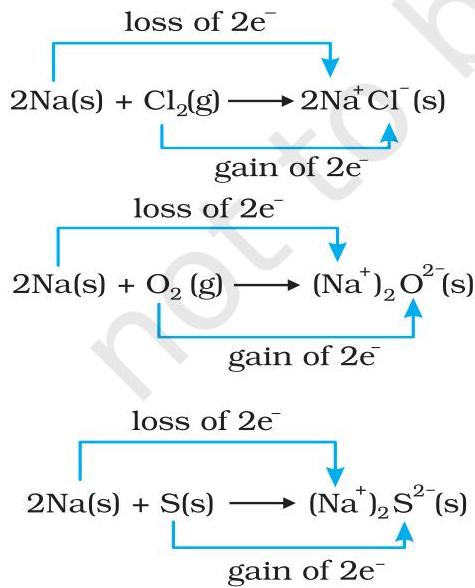
For analytical clarity, each of these aforementioned processes can be conceptualized as two distinct stages: one characterized by the relinquishment of electrons, and the other by the acquisition of electrons. To exemplify this, let us specifically examine the synthesis of sodium chloride in greater detail.
$ 2 \mathrm {N a} (\mathrm {s}) \rightarrow 2 \mathrm {N a} ^ {+} (\mathrm {g}) + 2 \mathrm {e} ^ {-} $
$ \mathrm {C l} _ {2} (\mathrm {g}) + 2 \mathrm {e} ^ {-} \rightarrow 2 \mathrm {C l} ^ {-} (\mathrm {g}) $
Each individual step presented above is termed a half-reaction, serving to explicitly delineate the participation of electrons. The summation of these half-reactions yields the complete overall reaction:
$2\mathrm{Na}(\mathrm{s}) + \mathrm{Cl}_2(\mathrm{g})\rightarrow 2\mathrm{Na}^+\mathrm{Cl}^- (\mathrm{s})$ or $2\mathrm{NaCl}$ (s). In light of reactions 7.12 through 7.14, it is evident that half-reactions characterized by the loss of electrons are designated as oxidation reactions. Conversely, those half-reactions involving the gain of electrons are classified as reduction reactions. It is pertinent to note that this contemporary definition of oxidation and reduction emerges from establishing a clear correspondence between the classical conceptualizations of species behavior and their roles in electron-transfer processes. Within the framework of reactions (7.12 to 7.14), sodium, undergoing oxidation, functions as a reducing agent by virtue of donating electrons to each of the interacting elements, thereby facilitating their reduction. Conversely, chlorine, oxygen, and sulfur, which are reduced, operate as oxidizing agents due to their acceptance of electrons from sodium. In summary, we can state that:
Oxidation : Loss of electron(s) by any species.
Reduction : Gain of electron(s) by any species.
Oxidising agent : Acceptor of electron(s).
Reducing agent : Donor of electron(s).
Problem 7.2
Justify that the reaction:
$2\mathrm{Na}(\mathrm{s}) + \mathrm{H}_2(\mathrm{g})\rightarrow 2\mathrm{NaH}(\mathrm{s})$ is a redox change.
Solution
Given that the product of the aforementioned reaction is an ionic compound, specifically $\mathrm{Na^{+}H^{-}}$ (s), it implies the existence of two distinct half-reactions within this transformation:
$ 2 \mathrm {N a} (\mathrm {s}) \rightarrow 2 \mathrm {N a} ^ {+} (\mathrm {g}) + 2 \mathrm {e} ^ {-} $
and the other half reaction is:
$ \mathrm{H}_2(\mathrm{g}) + 2\mathrm{e}^- \rightarrow 2\mathrm{H}^-(\mathrm{g}) $
Decomposing the reaction into these two constituent half-reactions unequivocally demonstrates that sodium undergoes oxidation, while hydrogen undergoes reduction; consequently, the overall reaction is classified as a redox process.
7.2.1 Competitive Electron Transfer Reactions
Immerse a metallic zinc strip into an aqueous copper nitrate solution, as depicted in Fig. 7.1, for approximately one hour. Observational evidence will likely include the zinc strip acquiring a coating of reddish metallic copper, concurrent with the fading of the solution's characteristic blue hue. The generation of $\mathrm{Zn^{2+}}$ ions as a reaction product is readily inferred once the blue coloration, attributable to $\mathrm{Cu^{2+}}$, has vanished. Further confirmation involves bubbling hydrogen sulphide gas through the now colorless solution containing $\mathrm{Zn^{2+}}$ ions, which, upon alkalinization with ammonia, will precipitate white zinc sulphide (ZnS).
The reaction between metallic zinc and the aqueous solution of copper nitrate is:
$ \mathrm{Zn(s)} + \mathrm{Cu^{2+}(aq)} \rightarrow \mathrm{Zn^{2+}(aq)} + \mathrm{Cu(s)} \tag{7.15} $
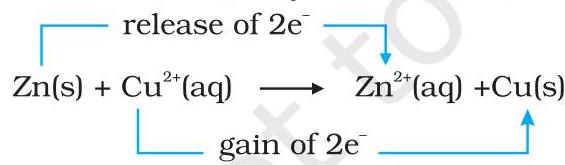
Within reaction (7.15), zinc undergoes oxidation by relinquishing electrons to yield $\mathrm{Zn^{2+}}$. Consequently, if zinc is oxidized through electron donation, another species must concurrently undergo reduction by accepting these electrons. In this context, the copper ion is reduced by acquiring electrons originating from the zinc.
Reaction (7.15) may be rewritten as:
To ascertain the equilibrium state for the reaction depicted by equation (7.15), an experimental investigation can be conducted. If a metallic copper strip is introduced into a zinc sulphate solution, no discernible reaction is observed. Furthermore, efforts to detect $\mathrm{Cu^{2+}}$ ions by introducing $\mathrm{H}_2\mathrm{S}$ gas, which would typically yield the black precipitate of cupric sulphide (CuS), prove unsuccessful. Despite the exceptionally low solubility of cupric sulphide making this a highly sensitive analytical method, the quantity of $\mathrm{Cu^{2+}}$ generated remains below detection limits. This evidence leads to the conclusion that the equilibrium position for reaction (7.15) substantially favors the formation of products over reactants.
We shall now broaden our examination of electron transfer reactions to encompass copper metal interacting with an aqueous solution of silver nitrate, utilizing the experimental setup illustrated in Fig. 7.2. The solution progressively acquires a blue coloration, indicating the generation of $\mathrm{Cu^{2+}}$ ions as a result of the ongoing reaction:
Here, solid copper ($\mathrm{Cu(s)}$) undergoes oxidation to form aqueous copper(II) ions ($\mathrm{Cu^{2+}(aq)}$), while aqueous silver ions ($\mathrm{Ag^{+}(aq)}$) are reduced to solid silver ($\mathrm{Ag(s)}$). The equilibrium state for this reaction overwhelmingly favors the formation of the products, specifically $\mathrm{Cu^{2+}(aq)}$ and $\mathrm{Ag(s)}$.
In contrast, consider the reaction involving metallic cobalt when submerged in a nickel sulfate solution. The chemical transformation that unfolds in this scenario is depicted as follows:

Fig. 7.1 Redox reaction between zinc and aqueous solution of copper nitrate occurring in a beaker.
 Fig. 7.2 Redox reaction between copper and aqueous solution of silver nitrate occurring in a beaker.
At the point of equilibrium, analytical chemical assays demonstrate that both $\mathrm{Ni}^{2+}$ (aq) and $\mathrm{Co}^{2+}$ (aq) species are present in significant, albeit moderate, concentrations. Consequently, in this particular instance, neither the initial reactants, comprising $\mathrm{Co}(\mathrm{s})$ and $\mathrm{Ni}^{2+}$ (aq), nor the resultant products, consisting of $\mathrm{Co}^{2+}$ (aq) and Ni (s), exhibit a pronounced preference for their formation or existence.
This phenomenon of competing tendencies for electron release bears an incidental resemblance to the competition among acids for proton donation. This parallel suggests the potential utility of constructing a tabular arrangement where metals and their corresponding ions are systematically ordered based on their propensity to donate electrons, analogous to how acids are ranked by their strength. Indeed, prior comparisons have already furnished certain insights. Through these comparative analyses, it has been established that zinc readily transfers electrons to copper, and copper, in turn, releases electrons to silver. This establishes the electron-releasing capacity of these metals in the sequence: $\mathrm{Zn > Cu > Ag}$. Our objective is to expand this enumeration extensively and formulate a comprehensive metal activity series, or electrochemical series. The inherent competition for electrons among diverse metals serves as the foundational principle for designing a specific category of electrochemical cells, known as Galvanic cells, wherein chemical reactions are harnessed to generate electrical energy. A more in-depth exploration of these cells will be undertaken in Class XII.
7.3 OXIDATION NUMBER
The formation of water from hydrogen and oxygen provides a less immediately apparent instance of electron transfer, as illustrated by the following reaction:
$ 2 \mathrm {H} _ {2} (\mathrm {g}) + \mathrm {O} _ {2} (\mathrm {g}) \rightarrow 2 \mathrm {H} _ {2} \mathrm {O} (\mathrm {l}) \tag {7.18} $
Despite the subtle nature of this process, one can conceptualize the hydrogen atom transitioning from a neutral (zero) state in $\mathrm{H}{2}$ to a positively charged state within $\mathrm{H}{2}\mathrm{O}$. Concurrently, the oxygen atom moves from a neutral state in $\mathrm{O}{2}$ to a dinegative state in $\mathrm{H}{2}\mathrm{O}$. This transformation is predicated on the notion of electron transfer occurring from hydrogen to oxygen, which subsequently implies that $\mathrm{H}{2}$ undergoes oxidation and $\mathrm{O}{2}$ undergoes reduction.
Nonetheless, as will be explored subsequently, the transfer of charge in such instances is merely partial; it is perhaps more accurately characterized as an electron displacement rather than a full electron forfeiture by hydrogen and acquisition by oxygen. The principles discussed concerning equation (7.18) are applicable to numerous other reactions involving covalent compounds. Illustrative examples from this category of reactions include:
$ \mathrm {H} _ {2} (\mathrm {s}) + \mathrm {C l} _ {2} (\mathrm {g}) \rightarrow 2 \mathrm {H C l} (\mathrm {g}) \tag {7.19} $
and,
$ \mathrm {C H} _ {4} (\mathrm {g}) + 4 \mathrm {C l} _ {2} (\mathrm {g}) \rightarrow \mathrm {C C l} _ {4} (\mathrm {l}) + 4 \mathrm {H C l} (\mathrm {g}) \tag {7.20} $
To systematically account for electron displacements within chemical reactions that involve the genesis of covalent compounds, a more expedient technique utilizing oxidation numbers has been devised. This methodology invariably posits a complete transfer of electrons from an atom of lower electronegativity to one of higher electronegativity. For instance, equations (7.18 to 7.20) are re-expressed below to illustrate the charge assigned to each atom participating in the reaction:
$ \begin{array}{c c c} 0 & 0 & + 1 - 2 \ 2 \mathrm {H} _ {2} (\mathrm {g}) + \mathrm {O} _ {2} (\mathrm {g}) \rightarrow 2 \mathrm {H} _ {2} \mathrm {O} (\mathrm {l}) \end{array} \tag {7.21} $
$ \begin{array}{c c c} 0 & 0 & + 1 - 1 \ \mathrm {H} _ {2} (\mathrm {s}) + \mathrm {C l} _ {2} (\mathrm {g}) \rightarrow 2 \mathrm {H C l} (\mathrm {g}) \end{array} \tag {7.22} $
$ \begin{array}{c c c c c c}
- 4 + 1 & 0 & + 4 - 1 & + 1 - 1 \ \mathrm {C H} _ {4} (\mathrm {g}) + 4 \mathrm {C l} _ {2} (\mathrm {g}) \rightarrow \mathrm {C C l} _ {4} (\mathrm {l}) + 4 \mathrm {H C l} (\mathrm {g}) \end{array} \tag {7.23} $
It is crucial to underscore that this postulation of electron transfer serves solely as an accounting convention; its utility in simplifying the characterization of redox reactions will become apparent later in this unit.
The oxidation number signifies an element's oxidation state within a compound, determined by a specific set of rules. These rules are predicated on the principle that, in a covalent bond, the electron pair
is considered to be exclusively associated with the more electronegative element.
Identifying which element possesses greater electronegativity within a given compound or ion is not always straightforward or immediately discernible. Consequently, a standardized set of guidelines has been established to ascertain the oxidation number of an element in such species. Should a molecule or ion contain multiple atoms of the same element, for instance, in $\mathrm{Na}_2\mathrm{S}_2\mathrm{O}_3$ or $\mathrm{Cr}_3\mathrm{O}_7^{3-}$, the oxidation number assigned to that element will represent the mean value of the oxidation numbers of all its constituent atoms. At this juncture, we shall present the rules governing the computation of oxidation numbers. These rules are as follows:
For elements existing in their free or uncombined form, every atom possesses an oxidation number of zero. This is clearly demonstrated by individual atoms in substances such as $\mathrm{H}_2$, $\mathrm{O}_2$, $\mathrm{Cl}_2$, $\mathrm{O}_3$, $\mathrm{P}_4$, $\mathrm{S}_8$, Na, Mg, and Al, all of which exhibit an oxidation state of zero.
When dealing with ions that consist of a single atom, the oxidation number is precisely equivalent to the charge carried by that ion. Consequently, the $\mathrm{Na}^+$ ion has an oxidation number of $+1$, the $\mathrm{Mg}^{2+}$ ion, $+2$, the $\mathrm{Fe}^{3+}$ ion, $+3$, the $\mathrm{Cl}^-$ ion, $-1$, and the $\mathrm{O}^{2-}$ ion, $-2$, among others. Within their respective compounds, all alkali metals consistently exhibit an oxidation number of $+1$, and all alkaline earth metals consistently display an oxidation number of $+2$. Furthermore, aluminum is conventionally assigned an oxidation number of $+3$ across all its compounds.
Typically, oxygen exhibits an oxidation number of $-2$ in the majority of its compounds. Nonetheless, two distinct categories of exceptions are encountered. The first category pertains to peroxides and superoxides, which are oxygen compounds characterized by direct oxygen-oxygen atomic linkages. In peroxides (e.g., $\mathrm{H}_2\mathrm{O}_2$, $\mathrm{Na}_2\mathrm{O}_2$), each oxygen atom is allocated an oxidation number of $-1$, whereas in superoxides (e.g., $\mathrm{KO}_2$, $\mathrm{RbO}_2$), each oxygen atom is assigned an oxidation number of $-(1/2)$. The second, less frequent exception occurs when oxygen forms bonds with fluorine. In compounds such as oxygen difluoride $(\mathrm{OF}_2)$ and dioxygen difluoride $(\mathrm{O}_2\mathrm{F}_2)$, oxygen is assigned oxidation numbers of $+2$ and $+1$, respectively. The specific oxidation number attributed to oxygen in these instances is contingent upon its bonding state, but crucially, this value will exclusively be a positive integer.
Hydrogen generally possesses an oxidation number of $+1$, with the notable exception of its bonding to metals within binary compounds (i.e., compounds comprising only two elements). For instance, in LiH, NaH, and $\mathrm{CaH}_2$, hydrogen's oxidation number is observed to be $-1$.
Fluorine consistently exhibits an oxidation number of $-1$ across all its compounds. The other halogens (Cl, Br, and I) similarly carry an oxidation number of $-1$ when present as halide ions within their compounds. However, when chlorine, bromine, and iodine are complexed with oxygen, such as in oxoacids and oxoanions, they assume positive oxidation numbers.
The algebraic sum of the oxidation numbers assigned to all atoms within a neutral compound must invariably equate to zero. For a polyatomic ion, the cumulative algebraic sum of the oxidation numbers of its constituent atoms must precisely correspond to the overall charge of the ion. Therefore, the sum of the oxidation numbers of three oxygen atoms and one carbon atom in the carbonate ion, $(\mathrm{CO}_2)^{2-}$, must equal $-2$.
Through the systematic application of these aforementioned principles, one can ascertain the oxidation number of a specific element within a given molecule or ion. It is discernible that metallic elements consistently possess positive oxidation numbers, whereas nonmetallic elements can exhibit either positive or negative oxidation numbers. Atoms of transition elements typically display a range of positive oxidation states. For a representative element, the highest possible oxidation number is equivalent to its group number for the first two groups, and for other groups, it is the group number minus 10 (as per the long form of the periodic table). This implies that the maximum oxidation number an element's atom can exhibit generally increases as one moves across a period in the periodic table. For instance, within the third period, the highest oxidation number progresses from 1 to 7, as illustrated by the compounds of the respective elements.
The concept of oxidation state is frequently employed synonymously with oxidation number. For instance, in the compound $\mathrm{CO}_{2}$, carbon exhibits an oxidation state of $+4$, which corresponds to its oxidation number, while oxygen similarly displays an oxidation state and oxidation number of $-2$. Consequently, the oxidation number serves as an indicator of an element's oxidation state within a given chemical species.
| Group | 1 | 2 | 13 | 14 | 15 | 16 | 17 |
|---|---|---|---|---|---|---|---|
| Element | Na | Mg | Al | Si | P | S | Cl |
| Compound | NaCl | MgSO4 | AlF3 | SiCl4 | P4O10 | SF6 | HClO |
| Highest oxidation number state of the group element | +1 | +2 | +3 | +4 | +5 | +6 | +7 |
The oxidation number or state of a metallic element within a compound is occasionally denoted using a system developed by the German chemist, Alfred Stock. This convention is widely recognized as Stock notation. In this system, the oxidation number is indicated by placing a Roman numeral, corresponding to the oxidation number, in parentheses directly after the metal's symbol in the chemical formula. Consequently, compounds like aurous chloride and auric chloride are represented as $\mathrm{Au(I)Cl}$ and $\mathrm{Au(III)Cl_3}$, respectively. Analogously, stannous chloride and stannic chloride are expressed as $\mathrm{Sn(II)Cl_2}$ and $\mathrm{Sn(IV)Cl_4}$. Such variations in the oxidation number signify a corresponding alteration in the oxidation state, which is instrumental in discerning whether a particular species exists in an oxidized or a reduced state. For example, $\mathrm{Hg_2(I)Cl_2}$ represents the reduced counterpart of $\mathrm{Hg(II)Cl_2}$.
Problem 7.3
Express the subsequent chemical compounds using Stock notation: $\mathrm{HAuCl_4}$, $\mathrm{Tl_2O}$, $\mathrm{FeO}$, $\mathrm{Fe_2O_3}$, $\mathrm{CuI}$, $\mathrm{CuO}$, $\mathrm{MnO}$, and $\mathrm{MnO_2}$.
Solution
Through the application of established guidelines for determining the oxidation state of the designated element within a compound, the oxidation number for each metallic component is ascertained as:
$\mathrm{HAuCl_4}$ → Au has 3
$\mathrm{Tl_2O}$ → Tl has 1
$\mathrm{FeO}$ → Fe has 2
$\mathrm{Fe_2O_3}$ → Fe has 3
$\mathrm{CuI}$ → Cu has 1
$\mathrm{CuO}$ → Cu has 2
$\mathrm{MnO}$ → Mn has 2
$\mathrm{MnO_2}$ → Mn has 4
Consequently, these compounds can be denoted as:
$\mathrm{HAu(III)Cl_4}$, $\mathrm{Tl_2(I)O}$, $\mathrm{Fe(II)O}$, $\mathrm{Fe_2(III)O_3}$, $\mathrm{Cu(I)I}$, $\mathrm{Cu(II)O}$, $\mathrm{Mn(II)O}$, $\mathrm{Mn(IV)O_2}$.
The concept of oxidation number is consistently employed to delineate oxidation, reduction, oxidising agents (oxidants), reducing agents (reductants), and redox reactions. To summarize these concepts, we can state that:
Oxidation: An elevation in the oxidation state of an element within a specified substance.
Reduction: A diminution in the oxidation state of an element within a specified substance.
Oxidising agent: A chemical entity capable of augmenting the oxidation state of an element present in a particular substance. Such entities are additionally referred to as oxidants.
Reducing agent: A chemical entity that diminishes the oxidation state of an element within a particular substance. These entities are likewise known as reductants.
Redox reactions: Chemical transformations characterized by a modification in the oxidation state of the participating species.
Problem 7.4
Demonstrate that the chemical transformation presented below constitutes a redox reaction. Furthermore, pinpoint the species undergoing oxidation and reduction, and subsequently identify the respective oxidizing and reducing agents.
$2\mathrm{Cu}{2}\mathrm{O}(\mathrm{s}) + \mathrm{Cu}{2}\mathrm{S}(\mathrm{s}) \rightarrow 6\mathrm{Cu}(\mathrm{s}) + \mathrm{SO}_{2}(\mathrm{g})$
Solution
To ascertain the nature of the reaction, we first determine the oxidation state for each constituent element within the given chemical process. This analysis yields the following:
$ \begin{array}{l} +1 -2 \quad +1 -2 \quad 0 \quad +4 -2 \ 2\mathrm{Cu}{2}\mathrm{O}(\mathrm{s}) + \mathrm{Cu}{2}\mathrm{S}(\mathrm{s}) \rightarrow 6\mathrm{Cu}(\mathrm{s}) + \mathrm{SO}_{2}(\mathrm{g}) \end{array} $
Consequently, it is established that copper undergoes reduction, transitioning from an oxidation state of $+1$ to $0$, while sulfur experiences oxidation, changing from an oxidation state of $-2$ to $+4$. This dual change in oxidation states confirms the reaction's classification as a redox process.
Moreover, $\mathrm{Cu}{2}\mathrm{O}$ facilitates the oxidation of sulfur within $\mathrm{Cu}{2}\mathrm{S}$, signifying that $\mathrm{Cu(I)}$ acts as the oxidizing agent. Conversely, the sulfur component of $\mathrm{Cu}{2}\mathrm{S}$ contributes to the reduction of copper, both within its own compound and in $\mathrm{Cu}{2}\mathrm{O}$, thereby establishing the sulfur in $\mathrm{Cu}_{2}\mathrm{S}$ as the reducing agent.
7.3.1 Types of Redox Reactions
1. Combination reactions
A combination reaction can be represented by the general form:
$ \mathrm{A} + \mathrm{B} \rightarrow \mathrm{C} $
For such a reaction to be categorized as a redox process, it is requisite that at least one of the reactants, A or B, or both, be present in its elemental state. All combustion reactions, which by definition utilize elemental dioxygen, along with other reactions where elements other than dioxygen are involved, are classified as redox reactions. Prominent instances within this classification include:
$ \begin{array}{c c c c} 0 & 0 & +4 -2 \ \mathrm{C}(\mathrm{s}) + \mathrm{O}_2(\mathrm{g}) \xrightarrow{\Delta} & \mathrm{CO}_2(\mathrm{g}) \end{array} \tag{7.24} $
$ \begin{array}{c c c c} 0 & 0 & +2 -3 \ 3 \mathrm{Mg}(\mathrm{s}) + \mathrm{N}_2(\mathrm{g}) \xrightarrow{\Delta} & \mathrm{Mg}_3\mathrm{N}_2(\mathrm{s}) \end{array} \tag{7.25} $
$ \begin{array}{c c c c} -4 + 1 & 0 & +4 -2 \ \mathrm{CH}_4(\mathrm{g}) + 2 \mathrm{O}_2(\mathrm{g}) \xrightarrow{\Delta} & \mathrm{CO}_2(\mathrm{g}) & +2 \mathrm{H}_2\mathrm{O}(\mathrm{l}) \end{array} \tag{7.26} $
2. Decomposition reactions
Decomposition reactions represent the inverse process of combination reactions. Specifically, a decomposition reaction involves the dissociation of a single compound into two or more constituent substances, with the prerequisite that at least one of these products exists in its elemental form. Illustrative instances of this reaction type include:
$ \begin{array}{c c c c} +1 -2 & & 0 & 0 \ 2 \mathrm{H}_2\mathrm{O}(\mathrm{l}) \xrightarrow{\Delta} & 2 \mathrm{H}_2(\mathrm{g}) + \mathrm{O}_2(\mathrm{g}) \end{array} \tag{7.27} $
$ \begin{array}{c c c c} +1 -1 & & 0 & 0 \ 2 \mathrm{NaH}(\mathrm{s}) \xrightarrow{\Delta} & 2 \mathrm{Na}(\mathrm{s}) + \mathrm{H}_2(\mathrm{g}) \end{array} \tag{7.28} $
$ \begin{array}{c c c c} +1 +5 -2 & & +1 -1 & 0 \ 2 \mathrm{KClO}_3(\mathrm{s}) \xrightarrow{\Delta} & 2 \mathrm{KCl}(\mathrm{s}) + 3 \mathrm{O}_2(\mathrm{g}) \end{array} \tag{7.29} $
It is important to observe that the oxidation state of hydrogen in methane remains unaltered during combination reactions, as does that of potassium in potassium chlorate in reaction (7.29). Furthermore, it should be recognized that not all decomposition reactions qualify as redox processes. For instance, the decomposition of calcium carbonate does not constitute a redox reaction.
$ \begin{array}{c c c c} +2 +4 -2 & & +2 -2 & +4 -2 \ \mathrm{CaCO}_3(\mathrm{s}) \xrightarrow{\Delta} & & \mathrm{CaO}(\mathrm{s}) & + \mathrm{CO}_2(\mathrm{g}) \ \end{array} \tag{7.30} $
3. Displacement reactions
A displacement reaction involves the substitution of an ion or atom within a compound by an ion or atom from a different element. This process may be represented generally as:
$ \mathrm{X} + \mathrm{YZ} \rightarrow \mathrm{XZ} + \mathrm{Y} $
These reactions are broadly classified into two principal types: metal displacement and non-metal displacement.
(a) Metal displacement
Within a compound, a metallic element can be substituted by a different metal that is in its elemental (uncombined) form. This category of reactions has been previously examined in section 7.2.1. Such displacement reactions are extensively utilized in metallurgical procedures for the extraction of unadulterated metals from their respective ore compounds. Illustrative examples include:
$ \begin{aligned} &\begin{array}{cccc} +2\ +6\ -2 & 0 & 0 & +2\ +6\ -2 \ \end{array} \ &\mathrm{CuSO_4(aq)} + \mathrm{Zn(s)} \rightarrow \mathrm{Cu(s)} + \mathrm{ZnSO_4(aq)} \end{aligned} \tag{7.31} $
$ \begin{aligned} &\begin{array}{cccc} +5\ -2 & 0 & 0 & +2\ -2 \ \end{array} \ &\mathrm{V_2O_5(s)} + 5,\mathrm{Ca(s)} \xrightarrow{\Delta} 2,\mathrm{V(s)} + 5,\mathrm{CaO(s)} \end{aligned} \tag{7.32} $
$ \begin{aligned} &\begin{array}{cccc} +4\ -1 & 0 & 0 & +2\ -1 \ \end{array} \ &\mathrm{TiCl_4(l)} + 2,\mathrm{Mg(s)} \xrightarrow{\Delta} \mathrm{Ti(s)} + 2,\mathrm{MgCl_2(s)} \end{aligned} \tag{7.33} $
$ \begin{aligned} &\begin{array}{cccc} +3\ -2 & 0 & +3\ -2 & 0 \ \end{array} \ &\mathrm{Cr_2O_3(s)} + 2,\mathrm{Al(s)} \xrightarrow{\Delta} \mathrm{Al_2O_3(s)} + 2,\mathrm{Cr(s)} \end{aligned} \tag{7.34} $ In every instance, the metal serving as the reductant possesses superior reducing power compared to the metal species undergoing reduction. This inherently signifies a greater propensity for the reductant to donate electrons than the species being reduced.
(b) Non-metal displacement
Non-metallic displacement redox reactions primarily encompass the displacement of hydrogen, alongside a less common variant involving the displacement of oxygen.
All alkali metals, along with specific alkaline earth metals (namely calcium, strontium, and barium), function as potent reducing agents capable of displacing hydrogen from cold water.
$ \begin{array}{l l l l l} 0 & + 1 - 2 & + 1 - 2 + 1 & 0 \ 2 \mathrm {N a} (\mathrm {s}) + 2 \mathrm {H} _ {2} \mathrm {O} (\mathrm {l}) & \rightarrow & 2 \mathrm {N a O H} (\mathrm {a q}) + \mathrm {H} _ {2} (\mathrm {g}) \end{array} \tag{7.35} $
$ \begin{array}{l l l l l} 0 & + 1 - 2 & + 2 - 2 + 1 & 0 \ \mathrm {C a} (\mathrm {s}) + 2 \mathrm {H} _ {2} \mathrm {O} (\mathrm {l}) & \rightarrow & \mathrm {C a} (\mathrm {O H}) _ {2} (\mathrm {a q}) + \mathrm {H} _ {2} (\mathrm {g}) \end{array} \tag{7.36} $
Metals exhibiting lower reactivity, exemplified by magnesium and iron, engage in a reaction with steam to generate dihydrogen gas:
$ \begin{array}{l l l l l} 0 & + 1 - 2 & + 2 - 2 + 1 & 0 \ \mathrm {M g} (\mathrm {s}) + 2 \mathrm {H} _ {2} \mathrm {O} (\mathrm {l}) \xrightarrow {\Delta} & \mathrm {M g} (\mathrm {O H}) _ {2} (\mathrm {s}) + \mathrm {H} _ {2} (\mathrm {g}) \end{array} \tag{7.37} $
$ \begin{array}{l l l l l} 0 & + 1 - 2 & + 3 - 2 & 0 \ 2 \mathrm {F e} (\mathrm {s}) + 3 \mathrm {H} _ {2} \mathrm {O} (\mathrm {l}) \xrightarrow {\Delta} & \mathrm {F e} _ {2} \mathrm {O} _ {3} (\mathrm {s}) + 3 \mathrm {H} _ {2} (\mathrm {g}) \end{array} \tag{7.38} $
Numerous metallic elements, even those exhibiting no reactivity with cold water or steam, possess the ability to displace hydrogen from acidic solutions. Cadmium and tin serve as illustrative examples of such metals. Several instances demonstrating the displacement of hydrogen from acids are presented below:
$ \begin{array}{l l l l} 0 & + 1 - 1 & + 2 - 1 & 0 \ \mathrm {Z n} (\mathrm {s}) + 2 \mathrm {H C l} (\mathrm {a q}) & \rightarrow & \mathrm {Z n C l} _ {2} (\mathrm {a q}) + \mathrm {H} _ {2} (\mathrm {g}) \end{array} \tag{7.39} $
$ \begin{array}{l l l l} 0 & + 1 - 1 & + 2 - 1 & 0 \ \mathrm {M g} (\mathrm {s}) + 2 \mathrm {H C l} (\mathrm {a q}) & \rightarrow & \mathrm {M g C l} _ {2} (\mathrm {a q}) + \mathrm {H} _ {2} (\mathrm {g}) \end{array} \tag{7.40} $
$ \begin{array}{l l l l} 0 & + 1 - 1 & + 2 - 1 & 0 \ \mathrm {F e} (\mathrm {s}) & + 2 \mathrm {H C l} (\mathrm {a q}) & \rightarrow & \mathrm {F e C l} _ {2} (\mathrm {a q}) + \mathrm {H} _ {2} (\mathrm {g}) \end{array} \tag{7.41} $
The reactions (7.39 to 7.41) find application in the laboratory synthesis of dihydrogen gas. The intrinsic reactivity of these metals is directly correlated with the rate at which hydrogen gas is evolved; iron (Fe), being the least reactive, exhibits the slowest evolution, while magnesium (Mg), the most reactive, shows the fastest. Conversely, highly unreactive metals, often found in their native states, such as silver (Ag) and gold (Au), do not undergo reaction even with hydrochloric acid.
As explored in section (7.2.1), the reducing capabilities of metals, specifically zinc (Zn), copper (Cu), and silver (Ag), are determined by their propensity to donate electrons, following the sequence Zn>Cu>Ag. Analogously, an activity series also characterizes the halogens. Within Group 17 of the periodic table, the oxidizing strength of these elements diminishes progressively from fluorine to iodine. Consequently, fluorine demonstrates such pronounced reactivity that it can displace chloride, bromide, and iodide ions from solution. Indeed, fluorine's extreme reactivity extends to reacting with water, leading to the displacement of oxygen:
$ \begin{array}{l l l l}
- 1 - 2 & 0 & + 1 - 1 & 0 \ 2 \mathrm {H} _ {2} \mathrm {O} (\mathrm {l}) + 2 \mathrm {F} _ {2} (\mathrm {g}) & \rightarrow 4 \mathrm {H F} (\mathrm {a q}) + \mathrm {O} _ {2} (\mathrm {g}) \end{array} \tag{7.42} $
Consequently, displacement reactions involving fluorine to replace chlorine, bromine, or iodine are typically avoided in aqueous media. In contrast, chlorine is capable of displacing both bromide and iodide ions within an aqueous solution, as illustrated by the following reactions:
$ \begin{array}{l l l l} 0 & + 1 - 1 & + 1 - 1 & 0 \ \mathrm {C l} _ {2} (\mathrm {g}) + 2 \mathrm {K B r} (\mathrm {a q}) & \rightarrow 2 \mathrm {K C l} (\mathrm {a q}) + \mathrm {B r} _ {2} (\mathrm {l}) \end{array} \tag{7.43} $
$ \begin{array}{l l l l} 0 & + 1 - 1 & + 1 - 1 & 0 \ \mathrm {C l} _ {2} (\mathrm {g}) + 2 \mathrm {K l} (\mathrm {a q}) & \rightarrow 2 \mathrm {K C l} (\mathrm {a q}) + \mathrm {I} _ {2} (\mathrm {s}) \end{array} \tag{7.44} $
Given that $\mathrm{Br}_2$ and $\mathrm{I}_2$ are colored compounds and exhibit solubility in $\mathrm{CCl}_4$, their identification is straightforward based on the resulting solution's coloration. These aforementioned reactions can also be expressed in their ionic configurations as:
$ \begin{array}{l l l l} 0 & - 1 & - 1 & 0 \ \mathrm {C l} _ {2} (\mathrm {g}) + 2 \mathrm {B r} ^ {-} (\mathrm {a q}) & \rightarrow 2 \mathrm {C l} ^ {-} (\mathrm {a q}) + \mathrm {B r} _ {2} (\mathrm {l}) \end{array} \tag{7.43a} $
$ \begin{array}{l l l l} 0 & - 1 & - 1 & 0 \ \mathrm {C l} _ {2} (\mathrm {g}) + 2 \mathrm {I} ^ {-} (\mathrm {a q}) & \rightarrow 2 \mathrm {C l} ^ {-} (\mathrm {a q}) + \mathrm {I} _ {2} (\mathrm {s}) \end{array} \tag{7.44a} $
Reactions (7.43) and (7.44) constitute the fundamental principle for identifying $\mathrm{Br}^{-}$ and $\mathrm{I}^{-}$ in laboratory settings, via the procedure commonly designated as the 'Layer Test'. Moreover, it is pertinent to observe that bromine similarly possesses the capacity to displace iodide ions when present in solution:
$ \begin{array}{c c c c} 0 & - 1 & - 1 & 0 \ \mathrm {B r} _ {2} (\mathrm {l}) & + 2 \mathrm {I} ^ {-} (\mathrm {a q}) & \rightarrow 2 \mathrm {B r} ^ {-} (\mathrm {a q}) + \mathrm {I} _ {2} (\mathrm {s}) \end{array} \tag{7.45} $
Halogen displacement reactions hold significant direct industrial applicability. The extraction of halogens from their corresponding halide forms mandates an oxidative process, which can be represented as:
$ 2 \mathrm {X} ^ {-} \rightarrow \mathrm {X} _ {2} + 2 \mathrm {e} ^ {-} \tag {7.46} $
In this context, $X$ symbolizes a halogen element. While chemical methodologies are effective for the oxidation of $\mathrm{Cl}^-$, $\mathrm{Br}^-$, and $\mathrm{I}^-$, the conversion of $\
mathrm{F}^{-}$ ions to $\mathrm{F}{2}$ through chemical routes is precluded, owing to fluorine's unparalleled strength as an oxidizing agent. Consequently, the singular approach to generate $\mathrm{F}{2}$ from $\mathrm{F}^{-}$ involves electrolytic oxidation, the specifics of which will be elaborated upon in subsequent curricular stages.
4. Disproportionation reactions
Disproportionation reactions represent a distinct category of redox processes. In such a reaction, an element, present in a single oxidation state, undergoes both simultaneous oxidation and reduction. A defining characteristic is that one of the reacting species must contain an element capable of existing in a minimum of three oxidation states. The element within the reactant occupies an intermediate oxidation state, from which both a higher and a lower oxidation state of that element are subsequently formed during the reaction. The decomposition of hydrogen peroxide serves as a common illustration of this reaction type, wherein oxygen undergoes disproportionation.
$ \begin{array}{l} +1 - 1 \quad +1 -2 \quad 0 \ 2 \mathrm{H}{2} \mathrm{O}{2} (\mathrm{aq}) \rightarrow 2 \mathrm{H}{2} \mathrm{O}(\mathrm{l}) + \mathrm{O}{2} (\mathrm{g}) \end{array} \tag{7.47} $
In this specific reaction, the oxygen originating from the peroxide, initially possessing an oxidation state of $-1$, is transformed into molecular oxygen ($\mathrm{O}_2$) with a zero oxidation state, while also being reduced to an oxidation state of $-2$ within the water molecule ($\mathrm{H}_2\mathrm{O}$).
Elements such as phosphorus, sulfur, and chlorine exhibit disproportionation behavior when subjected to an alkaline environment, as illustrated by the reactions presented below:
$ \begin{aligned} &0 \ &\mathrm{P_4(s)} + 3,\mathrm{OH^- (aq)} + 3,\mathrm{H_2O(l)} \rightarrow \mathrm{PH_3(g)} + 3,\mathrm{H_2PO_2^- (aq)} \end{aligned} \tag{7.48} $
$ \begin{aligned} &0 \ &\mathrm{S_8(s)} + 12,\mathrm{OH^- (aq)} \rightarrow 4,\mathrm{S^{2-}(aq)} + 2,\mathrm{S_2O_3^{2-}(aq)} + 6,\mathrm{H_2O(l)} \end{aligned} \tag{7.49} $
$ \begin{aligned} &0 \ &\mathrm{Cl_2(g)} + 2,\mathrm{OH^- (aq)} \rightarrow \mathrm{ClO^- (aq)} + \mathrm{Cl^- (aq)} + \mathrm{H_2O(l)} \end{aligned} \tag{7.50} $
Equation (7.50) illustrates the synthesis of common household bleaching agents. The hypochlorite ion ($\mathrm{ClO}^{-}$), produced during this reaction, functions by oxidizing the chromophoric (color-imparting) components of various substances, transforming them into compounds that lack color.
It is noteworthy that while bromine and iodine behave analogously to chlorine in reaction (7.50), fluorine exhibits a divergence from this pattern when interacting with alkaline solutions. The specific reaction involving fluorine proceeds as follows:
$ 2 \mathrm{F}{2}(\mathrm{g}) + 2 \mathrm{OH}^{-}(\mathrm{aq}) \rightarrow 2 \mathrm{F}^{-}(\mathrm{aq}) + \mathrm{OF}{2}(\mathrm{g}) + \mathrm{H}_{2} \mathrm{O}(\mathrm{l}) \tag{7.51} $
(It warrants careful consideration that fluorine, in the context of reaction (7.51), will simultaneously react with water, leading to the generation of some oxygen.) This observed atypical behavior by fluorine is not unexpected, given our understanding of its fundamental chemical constraints: as the most electronegative element, it is incapable of attaining any positive oxidation state. Consequently, among the halogen group, fluorine does not demonstrate a propensity for disproportionation.
Problem 7.5
Identify which of the listed species, $\mathrm{ClO}^{-}, \mathrm{ClO}{2}^{-}, \mathrm{ClO}{3}^{-}$, and $\mathrm{ClO}_{4}^{-}$, does not undergo a disproportionation reaction, and provide the rationale. Additionally, present the disproportionation reaction for each species that exhibits this behavior.
Solution
Considering the aforementioned chlorine oxoanions, $\mathrm{ClO}_{4}^{-}$ is the species that does not participate in a disproportionation reaction. This is attributed to the fact that chlorine within this oxoanion already exists in its maximum possible oxidation state, specifically $+7$. The chemical equations illustrating the disproportionation of the remaining three chlorine oxoanions are provided below:
$ \begin{array}{l} +1 \quad -1 \quad +5 \ 3 \mathrm{ClO}^{-} \rightarrow 2 \mathrm{Cl}^{-} + \mathrm{ClO}_{3}^{-} \end{array} \tag{7.52} $
$ \begin{array}{l} +3 \quad +5 \quad -1 \ 6 \mathrm{ClO}{2}^{-} \xrightarrow{\text{hv}} 4 \mathrm{ClO}{3}^{-} + 2 \mathrm{Cl}^{-} \end{array} \tag{7.53} $
$ \begin{array}{l} +5 \quad -1 \quad +7 \ 4 \mathrm{ClO}{3}^{-} \rightarrow \mathrm{Cl}^{-} + 3 \mathrm{ClO}{4}^{-} \end{array} \tag{7.54} $
Problem 7.6
Propose a classification scheme for the subsequent redox reactions:
(a) $\mathrm{N}{2}(\mathrm{g}) + \mathrm{O}{2}(\mathrm{g}) \rightarrow 2 \mathrm{NO}(\mathrm{g})$
(b) $2 \mathrm{Pb}(\mathrm{NO}{2}){2}(\mathrm{s}) \rightarrow 2 \mathrm{PbO}(\mathrm{s}) + 4 \mathrm{NO}{2}(\mathrm{g}) + \mathrm{O}{2}(\mathrm{g})$
(c) $\mathrm{NaH}(\mathrm{s}) + \mathrm{H}{2} \mathrm{O}(\mathrm{l}) \rightarrow \mathrm{NaOH}(\mathrm{aq}) + \mathrm{H}{2}(\mathrm{g})$
(d) $2 \mathrm{NO}{2}(\mathrm{g}) + 2 \mathrm{OH}^{-}(\mathrm{aq}) \rightarrow \mathrm{NO}{2}^{-}(\mathrm{aq}) + \mathrm{NO}{3}^{-}(\mathrm{aq}) + \mathrm{H}{2} \mathrm{O}(\mathrm{l})$
Solution
Reaction (a) exemplifies a combination redox process, as nitric oxide is generated from the union of its constituent elements, nitrogen and oxygen. Conversely, reaction (b) falls into the category of a decomposition redox reaction, given that lead nitrate disassociates into three distinct constituents.
In reaction (c), the hydrogen atom within water is substituted by a hydride ion, yielding dihydrogen gas, thus classifying it as a displacement redox reaction. Lastly, reaction (d) demonstrates a disproportionation redox reaction, where $\mathrm{NO}_2$ (in the +4 oxidation state) undergoes conversion into $\mathrm{NO}_2^-$ (with a +3 oxidation state) and $\mathrm{NO}_3^-$ (with a +5 oxidation state).
The Paradox of Fractional Oxidation Number
Occasionally, certain compounds exhibit an element with a fractional oxidation number. Illustrative instances include:
$\mathrm{C}{3}\mathrm{O}{2}$ [where the oxidation number of carbon is (4/3)],
$\mathrm{Br}{3}\mathrm{O}{8}$ [where the oxidation number of bromine is (16/3)],
and $\mathrm{Na}{2}\mathrm{S}{4}\mathrm{O}_{6}$ (where the oxidation number of sulfur is 2.5).
The concept of a fractional oxidation number inherently lacks intuitive appeal, primarily because electrons are neither shared nor transferred in fractional quantities. In actuality, this apparent fractional oxidation state represents the average oxidation state of the element in question. Structural analyses subsequently clarify that the element manifesting this fractional oxidation state is, in fact, present in diverse integral oxidation states within the compound. The bonding arrangements for the species $\mathrm{C}{3}\mathrm{O}{2}$, $\mathrm{Br}{3}\mathrm{O}{8}$ and $\mathrm{S}{4}\mathrm{O}{6}^{2-}$ are elucidated by the following structures:
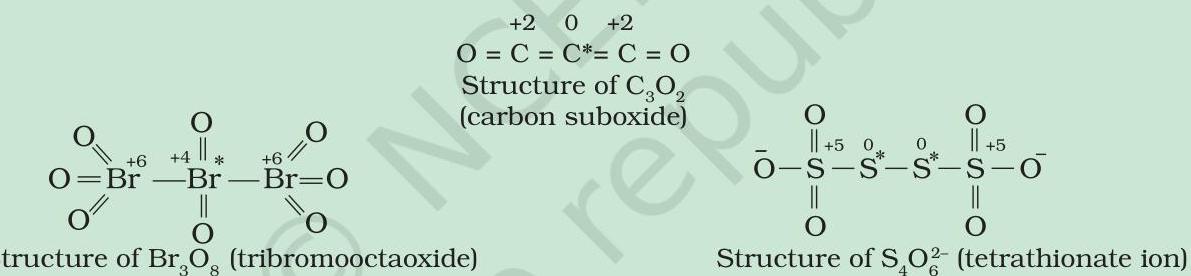
Within each species, the atom designated by an asterisk displays an oxidation state (or oxidation number) distinct from the other atoms of the same element. This implies that in $\mathrm{C}{3}\mathrm{O}{2}$, two carbon atoms each possess a +2 oxidation state, while the third carbon atom is in a zero oxidation state, resulting in an average of 4/3. However, the accurate representation reveals +2 for the two terminal carbons and zero for the central carbon. Similarly, in $\mathrm{Br}{3}\mathrm{O}{8}$, each of the two terminal bromine atoms exhibits a +6 oxidation state, and the central bromine atom is in a +4 oxidation state. Here again, the calculated average, which deviates from the actual states, is 16/3. Following this pattern, in the species $\mathrm{S}{4}\mathrm{O}{6}^{2-}$, each of the two outermost sulfur atoms displays a +5 oxidation state, and the two inner sulfur atoms are at zero. The average of the four sulfur oxidation numbers in $\mathrm{S}{4}\mathrm{O}{6}^{2-}$ is 2.5, whereas the true individual oxidation numbers are +5, 0, 0, and +5, respectively, for each sulfur atom.
Consequently, it can be generally concluded that the notion of a fractional oxidation state warrants careful interpretation, as the underlying reality is solely unveiled through structural analysis. Furthermore, when encountering a fractional oxidation state for any specific element in a given species, it is crucial to recognize that this value signifies only an average oxidation number. In truth (as confirmed by structural evidence), the element within that particular species exists in multiple distinct whole-number oxidation states. Compounds such as $\mathrm{Fe}{3}\mathrm{O}{4}$, $\mathrm{Mn}{3}\mathrm{O}{4}$, and $\mathrm{Pb}{3}\mathrm{O}{4}$ serve as additional examples of mixed oxides where fractional oxidation states for the metal atom are observed. Nevertheless, it is important to note that actual fractional oxidation states can occur, as seen in $\mathrm{O}{2}^{+}$ and $\mathrm{O}{2}^{-}$, where the values are $+\frac{1}{2}$ and $-\frac{1}{2}$, respectively.
Problem 7.7
Account for the divergence in reaction pathways observed for the following chemical transformations:
$ \begin{array}{l} \mathrm{Pb}{3}\mathrm{O}{4} + 8\mathrm{HCl} \rightarrow 3\mathrm{PbCl}{2} + \mathrm{Cl}{2} + 4\mathrm{H}{2}\mathrm{O} \quad \text{and} \ \mathrm{Pb}{3}\mathrm{O}{4} + 4\mathrm{HNO}{3} \rightarrow 2\mathrm{Pb}(\mathrm{NO}{3}){2} + \mathrm{PbO}{2} + \ 2\mathrm{H}{2}\mathrm{O} \end{array} $
Solution
Lead(II,IV) oxide, $\mathrm{Pb}{3}\mathrm{O}{4}$, is fundamentally composed of a stoichiometric combination of two moles of $\mathrm{PbO}$ and one mole of $\mathrm{PbO}{2}$. Within $\mathrm{PbO}{2}$, lead exhibits an oxidation state of +4, in contrast to the more stable +2 oxidation state found in $\mathrm{PbO}$. Consequently, $\mathrm{PbO}_{2}$ functions as an oxidizing agent, capable of oxidizing the chloride ion ($\mathrm{Cl}^{-}$) from HCl into elemental chlorine. It is also pertinent to note that $\mathrm{PbO}$ inherently possesses basic oxide characteristics.
Consequently, the overall reaction
$ \mathrm{Pb}{3}\mathrm{O}{4} + 8\mathrm{HCl} \rightarrow 3\mathrm{PbCl}{2} + \mathrm{Cl}{2} + 4\mathrm{H}_{2}\mathrm{O} $
can be disaggregated into two distinct processes:
$ 2\mathrm{PbO} + 4\mathrm{HCl} \rightarrow 2\mathrm{PbCl}{2} + 2\mathrm{H}{2}\mathrm{O} $
(acid-base reaction)
$ \begin{array}{c c c c} +4 & -1 & +2 & 0 \ \mathrm{PbO}{2} + 4\mathrm{HCl} \rightarrow & \mathrm{PbCl}{2} + \mathrm{Cl}{2} + 2\mathrm{H}{2}\mathrm{O} \ & & & \text{(redox reaction)} \end{array} $
Given that nitric acid ($\mathrm{HNO}{3}$) is inherently an oxidizing agent, a redox reaction between $\mathrm{PbO}{2}$ and $\mathrm{HNO}{3}$ is improbable. Nevertheless, an acid-base reaction readily transpires between $\mathrm{PbO}$ and $\mathrm{HNO}{3}$, as illustrated:
$ 2\mathrm{PbO} + 4\mathrm{HNO}{3} \rightarrow 2\mathrm{Pb}(\mathrm{NO}{3}){2} + 2\mathrm{H}{2}\mathrm{O} $
The inertness of $\mathrm{PbO}{2}$ towards $\mathrm{HNO}{3}$ is the determining factor that differentiates this reaction from the interaction observed with HCl.
7.3.2 Balancing of Redox Reactions
Two methods are employed to achieve stoichiometric balance in chemical equations representing redox processes. One approach relies on quantifying the alteration in the oxidation state of the reductant and the oxidant. The alternative technique involves dissecting the overall redox reaction into two constituent half-reactions: one signifying oxidation and the other reduction. Both methodologies are widely utilized, and the selection between them is at the discretion of the practitioner.
(a) Oxidation Number Method:
When formulating equations for oxidation-reduction reactions, similar to all other chemical reactions, it is imperative to ascertain the precise compositions and chemical formulas of both the reacting species and the resulting products. The application of the oxidation number method can be most effectively demonstrated through the subsequent procedural steps:
Step 1: Accurately record the chemical formula for every reactant and product.
Step 2: Determine which specific atoms experience an alteration in their oxidation state during the reaction by systematically assigning oxidation numbers to all elemental constituents present within the chemical process.
Step 3: Quantify the magnitude of the increase or decrease in oxidation number for each individual atom, and subsequently, for the entire molecular entity or ion in which that atom resides. Should these calculated changes prove unequal, apply appropriate stoichiometric coefficients to the species involved to ensure that the total increase in oxidation number precisely matches the total decrease. (A critical diagnostic check: If an observation indicates that two species are reduced without any corresponding oxidation, or vice-versa, this signals an underlying error. Such discrepancies typically arise from incorrect reactant or product formulas, or from an improper assignment of oxidation states.)
Step 4: In instances where the reaction proceeds in an aqueous medium, identify the presence of ionic species and introduce $\mathrm{H}^{+}$ or $\mathrm{OH}^{-}$ ions to the pertinent side of the equation. This addition is performed to ensure that the cumulative ionic charge on the reactant side is equivalent to that on the product side. Specifically, if the reaction environment is acidic, incorporate $\mathrm{H}^{+}$ ions; conversely, if the environment is basic, utilize $\mathrm{OH}^{-}$ ions.
Step 5: Equalize the count of hydrogen atoms present on both sides of the expression by introducing water ($\mathrm{H}_{2}\mathrm{O}$) molecules to either the reactant or product side as necessary. Following this, conduct a verification of the oxygen atom count. Should the number of oxygen atoms be identical on both the reactant and product sides, the equation is then considered to accurately represent a stoichiometrically balanced redox reaction.
We shall now elucidate the procedural steps of this method through the examination of several illustrative problems presented subsequently:
Problem 7.8
Write the net ionic equation for the reaction of potassium dichromate(VI), $\mathrm{K}{2}\mathrm{Cr}{2}\mathrm{O}{7}$ with sodium sulphite, $\mathrm{Na}{2}\mathrm{SO}_{3}$, in an acid solution to give chromium(III) ion and the sulphate ion.
Solution
Step 1: The fundamental ionic equation is outlined below:
$ \begin{aligned} &\mathrm{Cr_2O_7^{2-}(aq)} + \mathrm{SO_3^{2-}(aq)} \rightarrow \mathrm{Cr^{3+}(aq)} + \mathrm{SO_4^{2-}(aq)} \end{aligned} $
Step 2: Determine the oxidation states for Chromium (Cr) and Sulfur (S).
$ \begin{aligned} &\begin{array}{cccc} +6\ -2 & +4\ -2 & +3 & +6\ -2 \ \end{array} \ &\mathrm{Cr_2O_7^{2-}(aq)} + \mathrm{SO_3^{2-}(aq)} \rightarrow \mathrm{Cr^{3+}(aq)} + \mathrm{SO_4^{2-}(aq)} \end{aligned} $
From this assignment, it becomes apparent that the dichromate ion functions as the oxidizing agent, while the sulfite ion acts as the reducing agent.
Step 3: Quantify the changes in oxidation numbers and balance them: from Step 2, a transformation in the oxidation states of chromium and sulfur is observed. Chromium's oxidation state transitions from +6 to +3, signifying a reduction of 3 units for each chromium atom on the product side. Concurrently, sulfur's oxidation state shifts from +4 to +6, indicating an increase of 2 units for each sulfur atom on the product side. To achieve equivalence between the total increase and decrease in oxidation states, a coefficient of 2 is applied to the chromium ion on the right side, and a coefficient of 3 is assigned to the sulfate ion on the right side. This action simultaneously balances the chromium and sulfur atoms across both sides of the reaction. The resulting equation is:
$ \begin{array}{c} +6 - 2 \quad +4 - 2 \quad +3 \quad +6 - 2 \ \mathrm{Cr_2O_7^{2-}(aq)} + 3\mathrm{SO_3^{2-}(aq)} \rightarrow 2\mathrm{Cr^{3+}(aq)} + 3\mathrm{SO_4^{2-}(aq)} \end{array} $
Step 4: Given that the reaction proceeds in an acidic environment and considering the imbalance in net ionic charges between the reactant and product sides, 8 H⁺ ions are introduced to the left side to achieve charge neutrality.
$ \begin{aligned} \mathrm{Cr_2O_7^{2-}(aq)} + 3,\mathrm{SO_3^{2-}(aq)} + 8,\mathrm{H^+(aq)} \rightarrow 2,\mathrm{Cr^{3+}(aq)} + 3,\mathrm{SO_4^{2-}(aq)} \end{aligned} $
Step 5: Conclusively, enumerate the hydrogen atoms present and incorporate the requisite quantity of water molecules (specifically, 4 H₂O) onto the right side to finalize the balanced redox transformation.
$ \begin{aligned} \mathrm{Cr_2O_7^{2-}(aq)} + 3,\mathrm{SO_3^{2-}(aq)} + 8,\mathrm{H^+(aq)} \rightarrow 2,\mathrm{Cr^{3+}(aq)} + 3,\mathrm{SO_4^{2-}(aq)} + 4,\mathrm{H_2O(l)} \end{aligned} $
Problem 7.9
Permanganate ion reacts with bromide ion in basic medium to give manganese dioxide and bromate ion. Write the balanced ionic equation for the reaction.
Solution
Step 1: The skeletal ionic equation is :
$ \mathrm{MnO_4^-(aq)} + \mathrm{Br^- (aq)} \rightarrow \mathrm{MnO_2(s)} + \mathrm{BrO_3^- (aq)} $
Step 2: Assign oxidation numbers for Mn and Br
$ \begin{array}{cccc} +7 & -1 & +4 & +5 \ \mathrm{MnO_4^-(aq)} + \mathrm{Br^- (aq)} \rightarrow \mathrm{MnO_2(s)} + \mathrm{BrO_3^- (aq)} \end{array} $
This determination reveals that the permanganate ion acts as the oxidizing agent, while the bromide ion functions as the reducing agent.
Step 3: Calculate the increase and decrease of oxidation number, and make the increase equal to the decrease.
$ \begin{array}{cccc} +7 & -1 & +4 & +5 \ 2\mathrm{MnO_4^-(aq)} + \mathrm{Br^- (aq)} \rightarrow 2\mathrm{MnO_2(s)} + \mathrm{BrO_3^- (aq)} \end{array} $
Step 4: Given that the reaction proceeds in a basic environment and the net ionic charges on either side of the equation are disparate, two hydroxide ions (OH⁻) are introduced to the right-hand side to establish charge neutrality.
$ \begin{aligned} 2,\mathrm{MnO_4^-(aq)} + \mathrm{Br^-(aq)} \rightarrow 2,\mathrm{MnO_2(s)} + \mathrm{BrO_3^-(aq)} + 2,\mathrm{OH^-(aq)} \end{aligned} $
Step 5: To conclude, the hydrogen atoms are enumerated, and a suitable quantity of water molecules (specifically, one H₂O molecule) is appended to the left-hand side, thereby ensuring the complete balancing of the redox transformation.
$ \begin{aligned} 2,\mathrm{MnO_4^-(aq)} + \mathrm{Br^-(aq)} + \mathrm{H_2O(l)} \rightarrow 2,\mathrm{MnO_2(s)} + \mathrm{BrO_3^-(aq)} + 2,\mathrm{OH^-(aq)} \end{aligned} $
(b) Half-Reaction Method: This approach involves independently balancing the two constituent half-equations, which are subsequently combined to yield the complete balanced equation.
Consider the process of balancing the equation that depicts the oxidation of ferrous (Fe²⁺) ions to ferric (Fe³⁺) ions by dichromate (Cr₂O₇)²⁻ ions within an acidic environment, where the Cr₂O₇²⁻ ions are simultaneously reduced to Cr³⁺ ions. The subsequent stages outline the procedure for accomplishing this.
Step 1: Produce unbalanced equation for the reaction in ionic form :
$ \mathrm{Fe^{2+}(aq)} + \mathrm{Cr_2O_7^{2-}(aq)} \rightarrow \mathrm{Fe^{3+}(aq)} + \mathrm{Cr^{3+}(aq)} \tag{7.55} $
Step 2: Separate the equation into half-reactions:
$ \text{Oxidation half: } \mathrm{Fe}^{2+} (\mathrm{aq}) \rightarrow \mathrm{Fe}^{3+} (\mathrm{aq}) \tag{7.56} $
$ \begin{array}{c} +6 -2 \quad +3 \ \text{Reduction half: } \mathrm{Cr}_2\mathrm{O}_7^{2-} (\mathrm{aq}) \rightarrow \mathrm{Cr}^{3+} (\mathrm{aq}) \end{array} \tag{7.57} $
Step 3: Proceed to balance all atoms, excluding oxygen and hydrogen, within each half-reaction independently. In this specific instance, the oxidation half-reaction is already balanced concerning the iron (Fe) atoms. For the reduction half-reaction, the $\mathrm{Cr}^{3+}$ species is multiplied by a factor of two to achieve a balance of chromium (Cr) atoms.
$ \mathrm{Cr}_2\mathrm{O}_7^{2-} (\mathrm{aq}) \rightarrow 2 \mathrm{Cr}^{3+} (\mathrm{aq}) \tag{7.58} $
Step 4: In scenarios where reactions transpire in an acidic environment, water molecules ($\mathrm{H}_2\mathrm{O}$) are introduced to equalize oxygen atoms, and hydrogen ions ($\mathrm{H}^+$) are added to balance hydrogen atoms.
Consequently, we obtain:
$ \mathrm{Cr}_2\mathrm{O}_7^{2-} (\mathrm{aq}) + 14\mathrm{H}^+ (\mathrm{aq}) \rightarrow 2 \mathrm{Cr}^{3+} (\mathrm{aq}) + 7\mathrm{H}_2\mathrm{O} (\mathrm{l}) \tag{7.59} $
Step 5: Introduce electrons to one side of each half-reaction to achieve charge balance. Subsequently, if required, the electron count in both half-reactions should be equalized through multiplication of one or both by an appropriate numerical factor.
Consequently, the oxidation half-reaction is re-expressed to achieve charge equilibrium:
$ \mathrm{Fe}^{2+} (\mathrm{aq}) \rightarrow \mathrm{Fe}^{3+} (\mathrm{aq}) + \mathrm{e}^{-} \tag{7.60} $
Upon examining the reduction half-reaction, a net positive charge of twelve units is observed on the left-hand side, contrasting with only six positive units on the right-hand side. Consequently, six electrons are incorporated into the left side.
$ \begin{array}{l} \mathrm{Cr}_2\mathrm{O}_7^{2-} (\mathrm{aq}) + 14\mathrm{H}^+ (\mathrm{aq}) + 6\mathrm{e}^{-} \rightarrow 2\mathrm{Cr}^{3+} (\mathrm{aq}) + \ \quad 7\mathrm{H}_2\mathrm{O} (\mathrm{l}) \end{array} \tag{7.61} $
To equilibrate the number of electrons present in both half-reactions, the oxidation half-reaction is scaled by a factor of 6, yielding:
$ 6\mathrm{Fe}^{2+} (\mathrm{aq}) \rightarrow 6\mathrm{Fe}^{3+} (\mathrm{aq}) + 6\mathrm{e}^{-} \tag{7.62} $
Step 6: The two half-reactions are then combined to produce the overall reaction, with electrons present on both sides being canceled. This procedure results in the following net ionic equation:
$ \begin{array}{l} 6\mathrm{Fe}^{2+} (\mathrm{aq}) + \mathrm{Cr}_2\mathrm{O}_7^{2-} (\mathrm{aq}) + 14\mathrm{H}^+ (\mathrm{aq}) \rightarrow 6 \mathrm{Fe}^{3+} (\mathrm{aq}) + \ 2\mathrm{Cr}^{3+} (\mathrm{aq}) + 7\mathrm{H}_2\mathrm{O} (\mathrm{l}) \end{array} \tag{7.63} $
Step 7: Confirm that the equation possesses an identical type and quantity of atoms, alongside equivalent charges, on both its reactant and product sides. This concluding verification indicates that the equation has been comprehensively balanced concerning both atomic populations and electrical charges.
For reactions transpiring in a basic medium, the initial step involves balancing the atoms using the same procedure as for an acidic medium. Subsequently, for each $\mathrm{H}^+$ ion, an equivalent quantity of $\mathrm{OH}^-$ ions should be appended to both sides of the equation. Should $\mathrm{H}^+$ and $\mathrm{OH}^-$ ions co-exist on the same side of the equation, they are to be combined to produce $\mathrm{H}_2\mathrm{O}$.
Problem 7.10
Permanganate (VII) ion, $\mathrm{MnO}_4^-$ in basic solution oxidises iodide ion, $\mathrm{I}^-$ to produce molecular iodine $(\mathrm{I}_2)$ and manganese (IV) oxide $(\mathrm{MnO}_2)$. Write a balanced ionic equation to represent this redox reaction.
Solution
Step 1: The initial step involves formulating the skeletal ionic equation, presented as:
$ \mathrm{MnO}_4^- (\mathrm{aq}) + \mathrm{I}^- (\mathrm{aq}) \rightarrow \mathrm{MnO}_2 (\mathrm{s}) + \mathrm{I}_2 (\mathrm{s}) $
Step 2: The reaction can be decomposed into two constituent half-reactions:
$ \text{Oxidation half: } \mathrm{I}^- (\mathrm{aq}) \rightarrow \mathrm{I}_2 (\mathrm{s}) $
$ \begin{array}{c} +7 \quad +4 \ \text{Reduction half: } \mathrm{MnO}_4^- (\mathrm{aq}) \rightarrow \mathrm{MnO}_2 (\mathrm{s}) \end{array} $
Step 3: To achieve atomic balance for iodine within the oxidation half-reaction, the expression is modified to:
$ 2\mathrm{I}^- (\mathrm{aq}) \rightarrow \mathrm{I}_2 (\mathrm{s}) $
Step 4: For the reduction half-reaction, oxygen atom stoichiometry is addressed by introducing two water molecules to the product side:
$ \mathrm{MnO}_4^- (\mathrm{aq}) \rightarrow \mathrm{MnO}_2 (\mathrm{s}) + 2 \mathrm{H}_2\mathrm{O} (\mathrm{l}) $
Subsequently, hydrogen atom balance is achieved by incorporating four $\mathrm{H}^+$ ions on the reactant side:
$ \mathrm{MnO}_4^- (\mathrm{aq}) + 4 \mathrm{H}^+ (\mathrm{aq}) \rightarrow \mathrm{MnO}_2 (\mathrm{s}) + 2 \mathrm{H}_2\mathrm{O} (\mathrm{l}) $
Considering the reaction's occurrence in a basic medium, four $\mathrm{OH}^-$ ions are consequently appended to both termini of the equation to neutralize the $\mathrm{H}^+$ species:
$ \begin{array}{l} \mathrm{MnO}_4^- (\mathrm{aq}) + 4\mathrm{H}^+ (\mathrm{aq}) + 4\mathrm{OH}^- (\mathrm{aq}) \rightarrow \ \mathrm{MnO}_2 (\mathrm{s}) + 2 \mathrm{H}_2\mathrm{O} (\mathrm{l}) + 4\mathrm{OH}^- (\mathrm{aq}) \end{array} $
By combining the $\mathrm{H}^+$ and $\mathrm{OH}^-$ ions to form water, the resulting equation becomes:
$ \mathrm{MnO}{4}^{-}(\mathrm{aq}) + 2\mathrm{H}{2}\mathrm{O}(\mathrm{l}) \rightarrow \mathrm{MnO}_{2}(\mathrm{s}) + 4\mathrm{OH}^{-}(\mathrm{aq}) $
Step 5: This stage focuses on equilibrating the electrical charges within each half-reaction, as illustrated below:
$ 2,\mathrm{I^-(aq)} \rightarrow \mathrm{I_2(s)} + 2,\mathrm{e^-} $
$ \begin{aligned} \mathrm{MnO_4^-(aq)} + 2,\mathrm{H_2O(l)} + 3,\mathrm{e^-} \rightarrow \mathrm{MnO_2(s)} + 4,\mathrm{OH^-(aq)} \end{aligned} $
To ensure an equivalent count of electrons transferred, the oxidation half-reaction is scaled by a factor of 3, and the reduction half-reaction by a factor of 2.
$ 6\mathrm{I}^{-}(\mathrm{aq}) \rightarrow 3\mathrm{I}_{2}(\mathrm{s}) + 6\mathrm{e}^{-} $
$ \begin{aligned} 2,\mathrm{MnO_4^-(aq)} + 4,\mathrm{H_2O(l)} + 6,\mathrm{e^-} \rightarrow 2,\mathrm{MnO_2(s)} + 8,\mathrm{OH^-(aq)} \end{aligned} $
Step 6: The two half-reactions are then combined to derive the overall net reaction, with electrons being eliminated from both sides.
$ \begin{aligned} 6,\mathrm{I^-(aq)} + 2,\mathrm{MnO_4^-(aq)} + 4,\mathrm{H_2O(l)}
\rightarrow 3,\mathrm{I_2(s)} + 2,\mathrm{MnO_2(s)} + 8,\mathrm{OH^-(aq)} \end{aligned} $
Step 7: A conclusive check confirms the equation's balance concerning both atomic quantities and electrical charges across its components.
7.3.3 Redox Reactions as the Basis for Titrations
Just as acid-base systems employ titration with pH-sensitive indicators to ascertain the concentration of one solution relative to another, redox systems utilize an analogous titration methodology. This approach, employing a redox-sensitive indicator, serves to quantify the strength of either a reducing or an oxidizing agent. The various ways indicators function in redox titrations are detailed subsequently:
(i) In certain instances, the titrant itself possesses a vibrant coloration, such as the permanganate ion, $\mathrm{MnO}{4}^{-}$. In these scenarios, $\mathrm{MnO}{4}^{-}$ functions as its own indicator. The discernible endpoint is reached when the entirety of the reductant (e.g., $\mathrm{Fe}^{2+}$ or $\mathrm{C}{2}\mathrm{O}{4}^{2-}$) has been oxidized, marked by the persistent appearance of a faint pink hue. This color change becomes perceptible at $\mathrm{MnO}_{4}^{-}$ concentrations as minute as $10^{-6}\mathrm{mol\ dm}^{-3}$ ($10^{-6}\mathrm{mol\ L}^{-1}$). Such sensitivity guarantees a negligible 'overshoot' in coloration past the equivalence point, which is defined as the stage where the reducing and oxidizing agents are stoichiometrically equivalent.
(ii) Should a spontaneous, pronounced color alteration not occur within the titrant itself (unlike in $\mathrm{MnO}{4}^{-}$ titrations), specific indicators exist that undergo oxidation instantaneously upon the complete consumption of the analyte, resulting in a striking color transformation. A prime illustration involves $\mathrm{Cr}{2}\mathrm{O}_{7}^{2-}$, which does not act as a self-indicator. Instead, it oxidizes the indicator compound diphenylamine immediately following the equivalence point, generating an intense blue coloration that effectively signals the reaction's completion.
(iii) A third, distinct, and widely employed technique exists. This approach is specifically applicable to reagents capable of oxidizing $\mathrm{I}^{-}$ ions, such as $\mathrm{Cu(II)}$, for instance:
$ 2\mathrm{Cu}^{2+}(\mathrm{aq}) + 4\mathrm{I}^{-}(\mathrm{aq}) \rightarrow \mathrm{Cu}{2}\mathrm{I}{2}(\mathrm{s}) + \mathrm{I}_{2}(\mathrm{aq}) \tag{7.64} $
The foundation of this methodology rests upon two key principles: firstly, iodine itself produces a vivid blue complex in the presence of starch; and secondly, it undergoes a highly specific redox reaction with thiosulphate ions ($\mathrm{S}{2}\mathrm{O}{3}^{2-}$), as shown:
$ \mathrm{I}{2}(\mathrm{aq}) + 2\mathrm{S}{2}\mathrm{O}{3}^{2-}(\mathrm{aq}) \rightarrow 2\mathrm{I}^{-}(\mathrm{aq}) + \mathrm{S}{4}\mathrm{O}_{6}^{2-}(\mathrm{aq}) \tag{7.65} $
Despite its limited solubility in water, $\mathrm{I}{2}$ persists in solution when potassium iodide ($\mathrm{KI}$) is present, forming the soluble triiodide complex, $\mathrm{KI}{3}$. Once iodine is released from the interaction of $\mathrm{Cu}^{2+}$ ions with iodide ions, the subsequent introduction of starch elicits a deep blue coloration. This distinctive color vanishes precisely when the iodine has been entirely consumed by the thiosulphate ions. Consequently, the reaction's endpoint is readily observable, simplifying the subsequent stoichiometric calculations.
7.3.4 Limitations of Concept of Oxidation Number
As previously noted, the understanding of redox mechanisms has undergone a continuous developmental trajectory. This ongoing progression has led to contemporary interpretations where oxidation is conceptualized as a diminution in electron density, while reduction is perceived as an augmentation in electron density surrounding the atom(s) participating in the chemical transformation.
7.4 REDOX REACTIONS AND ELECTRODE PROCESSES
The phenomenon corresponding to reaction (7.15) can similarly be observed when a zinc rod is immersed in a copper sulfate solution. A redox reaction ensues, during
which zinc undergoes oxidation to form zinc ions, and copper ions are simultaneously reduced to metallic copper. This transformation occurs via a direct transfer of electrons from the zinc to the copper ions, and concurrently, heat is generated. We can now modify this experimental setup to facilitate the same redox reaction but with an indirect transfer of electrons. This approach necessitates physically separating the zinc metal from the copper sulfate solution. To achieve this, a beaker containing copper sulfate solution is prepared, into which a copper strip or rod is placed. Concurrently, another beaker holds a zinc sulfate solution with a zinc rod or strip immersed within it. In this configuration, at the interface between the metal and its corresponding salt solution within each beaker, both the reduced and oxidized forms of the same chemical species are present. These constitute the species involved in the reduction and oxidation half-reactions. A redox couple is formally defined as the combined oxidized and reduced forms of a substance participating in either an oxidation or a reduction half-reaction.
This relationship is conventionally denoted by separating the oxidized form from the reduced form with a vertical line or a slash, symbolizing an interface (e.g., solid/solution). For instance, in the context of this experiment, the two redox couples are expressed as
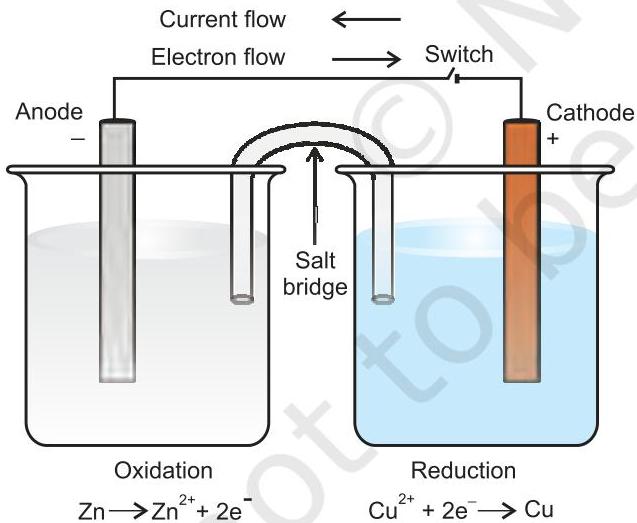 Fig.7.3 The set-up for Daniell cell. Electrons produced at the anode due to oxidation of Zn travel through the external circuit to the cathode where these reduce the copper ions. The circuit is completed inside the cell by the migration of ions through the salt bridge. It may be noted that the direction of current is opposite to the direction of electron flow.
$\mathrm{Zn^{2 + } / Zn}$ and $\mathrm{Cu^{2 + } / Cu}$. In both instances, the oxidized species precedes the reduced species. Subsequently, the beaker containing copper sulfate solution and the beaker containing zinc sulfate solution are positioned adjacent to each other (refer to Fig. 7.3). The solutions within these two beakers are then interconnected by a salt bridge. This salt bridge typically comprises a U-tube filled with a solution of potassium chloride or ammonium nitrate, which is commonly solidified into a jelly-like substance by heating with agar-agar and subsequent cooling. This device establishes an electrical connection between the two solutions while preventing their direct mixing. The zinc and copper rods are externally linked by a metallic wire, which incorporates provisions for an ammeter and a switch. The configuration depicted in Fig. 7.3 is designated as a Daniell cell. When the switch remains in the 'off' position, no chemical reaction proceeds within either beaker, and no electrical current flows through the metallic wire. Upon actuating the switch to the 'on' position, the following observations are made:
Electron transfer no longer occurs directly between zinc and $\mathrm{Cu^{2+}}$ ions; instead, it proceeds via the metallic conductor linking the two electrodes, as indicated by the current flow arrow. Electrical charge is conveyed between the solutions in separate containers through the ionic migration facilitated by the salt bridge. It is established that electrical current can only traverse if a potential differential exists between the copper and zinc electrodes.
The electrical potential exhibited by an individual electrode is termed its electrode potential. When all participating species in an electrode reaction possess a concentration of unity (with any gaseous reactants or products maintained at 1 atmosphere of pressure) and the reaction proceeds at $298\mathrm{K}$, the resultant potential of that electrode is designated as the Standard Electrode Potential. Conventionally, the hydrogen electrode's standard electrode potential $(\mathbf{E}^{\circ})$ is assigned a value of 0.00 volts. For any given electrode process, its electrode potential quantifies the relative propensity of the involved active chemical species to exist in either its oxidized or reduced state. An $\mathbf{E}^{\circ}$ value that is negative indicates that the associated redox couple functions as a more potent
reducing agent compared to the $\mathrm{H^{+} / H_{2}}$ couple. Conversely, a positive $\mathbf{E}^{\circ}$ signifies that the redox couple exhibits a weaker reducing capacity than the $\mathrm{H^{+} / H_{2}}$ couple. Standard electrode potentials hold considerable significance, furnishing a wealth of additional pertinent data. Table 7.1 presents the standard electrode potential values for a selection of electrode processes (specifically, reduction reactions). Further details regarding electrode reactions and electrochemical cells will be explored in Class XII.
Table 7.1 Standard Electrode Potentials at 298 K. Ions are depicted as aqueous species, $\mathrm{H}_2\mathrm{O}$ as liquid; gases and solids are denoted by 'g' and 's' respectively.
| Reaction (Oxidised form + ne- | → Reduced form) | E° / V | |
|---|---|---|---|
| Increasing strength of oxidising agent | F2(g) + 2e- | → 2F- | 2.87 |
| Co3+ + e- | → Co2+ | 1.81 | |
| H2O2+ 2H+ + 2e- | → 2H2O | 1.78 | |
| MnO4- + 8H+ + 5e- | → Mn2+ + 4H2O | 1.51 | |
| Au3+ + 3e- | → Au(s) | 1.40 | |
| Cl2(g) + 2e- | → 2Cl- | 1.36 | |
| Cr2O72- + 14H+ + 6e- | → 2Cr3+ + 7H2O | 1.33 | |
| O2(g) + 4H+ + 4e- | → 2H2O | 1.23 | |
| MnO2(s) + 4H+ + 2e- | → Mn2+ + 2H2O | 1.23 | |
| Br2 + 2e- | → 2Br- | 1.09 | |
| NO3- + 4H+ + 3e- | → NO(g) + 2H2O | 0.97 | |
| 2Hg2+ + 2e- | → Hg2^2+ | 0.92 | |
| Ag+ + e- | → Ag(s) | 0.80 | |
| Fe3+ + e- | → Fe2+ | 0.77 | |
| O2(g) + 2H+ + 2e- | → H2O2 | 0.68 | |
| I2(s) + 2e- | → 2I- | 0.54 | |
| Cu^+ + e- | → Cu(s) | 0.52 | |
| Cu2+ + 2e- | → Cu(s) | 0.34 | |
| AgCl(s) + e- | → Ag(s) + Cl- | 0.22 | |
| AgBr(s) + e- | → Ag(s) + Br- | 0.10 | |
| 2H^+ + 2e- | → H2(g) | 0.00 | |
| Pb2+ + 2e- | → Pb(s) | -0.13 | |
| Sn^2+ + 2e- | → Sn(s) | -0.14 | |
| Ni^2+ + 2e- | → Ni(s) | -0.25 | |
| Fe^2+ + 2e- | → Fe(s) | -0.44 | |
| Cr^3+ + 3e- | → Cr(s) | -0.74 | |
| Zn^2+ + 2e- | → Zn(s) | -0.76 | |
| 2H2O + 2e- | → H2(g) + 2OH- | -0.83 | |
| Al^3+ + 3e- | → Al(s) | -1.66 | |
| Mg^2+ + 2e- | → Mg(s) | -2.36 | |
| Na^+ + e- | → Na(s) | -2.71 | |
| Ca^2+ + 2e- | → Ca(s) | -2.87 | |
| K^+ + e- | → K(s) | -2.93 | |
| Li^+ + e- | → Li(s) | -3.05 |
- A negative standard electrode potential ($E^{\circ}$) indicates that the associated redox pair functions as a more potent reducing agent compared to the $\mathrm{H^{+} / H_{2}}$ system.
- Conversely, a positive standard electrode potential ($E^{\circ}$) suggests that the redox couple possesses a weaker reducing capability than the $\mathrm{H^{+} / H_{2}}$ system.
SUMMARY
Oxidation-reduction (redox) reactions constitute a significant category of chemical transformations, characterized by the concurrent processes of oxidation and reduction. The common three-tiered conceptual framework — encompassing classical, electronic, and oxidation number perspectives — typically found in academic literature, is elucidated comprehensively herein. The definitions of oxidation, reduction, oxidizing agents (oxidants), and reducing agents (reductants) are examined through the lens of each of these conceptualizations. A standardized set of guidelines dictates the assignment of oxidation numbers. Both the oxidation number method and the ion-electron method serve as effective approaches for formulating balanced redox reaction equations. Redox processes are categorized into four principal types: combination, decomposition, displacement, and disproportionation reactions. This discussion introduces the fundamental concepts of redox couples and electrode processes. Redox reactions hold extensive significance in the investigation of electrode mechanisms and electrochemical cells.
EXERCISES
7.1 Determine the oxidation state for each underlined element within the subsequent chemical species:
(a) $\mathrm{NaH_2PO_4}$ (b) $\mathrm{NaHSO_4}$ (c) $\mathrm{H_4P_2O_7}$ (d) $\mathrm{K_2MnO_4}$ (e) $\mathrm{CaO_2}$ (f) $\mathrm{NaBH_4}$ (g) $\mathrm{H_2S_2O_7}$ (h) $\mathrm{KAl(SO_4)_2 \cdot 12H_2O}$
7.2 For each of the following, identify the oxidation state of the underlined elements and provide a justification for your determinations.
(a) $\mathrm{KI_3}$ (b) $\mathrm{H_2S_4O_6}$ (c) $\mathrm{Fe_3O_4}$ (d) $\mathrm{CH_3CH_2OH}$ (e) $\mathrm{CH_3COOH}$
7.3 Demonstrate why each of the ensuing reactions qualifies as a redox process:
(a) $\mathrm{CuO(s)} + \mathrm{H_2(g)} \rightarrow \mathrm{Cu(s)} + \mathrm{H_2O(g)}$
(b) $\mathrm{Fe_2O_3(s)} + 3,\mathrm{CO(g)} \rightarrow 2,\mathrm{Fe(s)} + 3,\mathrm{CO_2(g)}$
(c) $4,\mathrm{BCl_3(g)} + 3,\mathrm{LiAlH_4(s)} \rightarrow 2,\mathrm{B_2H_6(g)} + 3,\mathrm{LiCl(s)} + 3,\mathrm{AlCl_3(s)}$
(d) $2,\mathrm{K(s)} + \mathrm{F_2(g)} \rightarrow 2,\mathrm{KF(s)}$
(e) $4,\mathrm{NH_3(g)} + 5,\mathrm{O_2(g)} \rightarrow 4,\mathrm{NO(g)} + 6,\mathrm{H_2O(g)}$
7.4 When fluorine interacts with ice, the following transformation occurs:
$ \mathrm{H_2O(s) + F_2(g)\rightarrow HF(g) + HOF(g)} $
Provide a rationale for classifying this reaction as a redox reaction.
7.5 Compute the oxidation states of sulfur, chromium, and nitrogen in $\mathrm{H_2SO_5}$, $\mathrm{Cr_2O_7^{2-}}$, and $\mathrm{NO_3^-}$, respectively. Propose plausible structural representations for these compounds. Additionally, identify any potential inconsistencies or 'fallacies' in the calculated oxidation numbers relative to the proposed structures.
7.6 Provide the chemical formulas corresponding to the following compounds:
(a) Mercury(II) chloride (b) Nickel(II) sulphate (c) Tin(IV) oxide (d) Thallium(I) sulphate (e) Iron(III) sulphate (f) Chromium(III) oxide
7.7 Enumerate examples of chemical substances in which carbon can display oxidation states ranging from $-4$ to $+4$, and nitrogen can exhibit oxidation states from $-3$ to $+5$.
7.8 Explain the underlying reasons why sulfur dioxide and hydrogen peroxide are capable of functioning as both oxidizing and reducing agents in chemical reactions, whereas ozone and nitric acid exclusively serve as oxidants. Why?
7.9 Examine the following chemical transformations:
(a) $6,\mathrm{CO_2(g)} ;+; 6,\mathrm{H_2O(l)} ;\rightarrow; \mathrm{C_6H_{12}O_6(aq)} ;+; 6,\mathrm{O_2(g)}$
(b)$ \mathrm{O_3(g)} ;+; \mathrm{H_2O_2(l)} ;\rightarrow; \mathrm{H_2O(l)} ;+; 2,\mathrm{O_2(g)} $
Elucidate why it is more chemically precise to represent these reactions as:
(a) $ 6,\mathrm{CO_2(g)} ;+; 12,\mathrm{H_2O(l)} ;\rightarrow; \mathrm{C_6H_{12}O_6(aq)} ;+; 6,\mathrm{H_2O(l)} ;+; 6,\mathrm{O_2(g)} $
(b) $ \mathrm{O_3(g)} ;+; \mathrm{H_2O_2(l)} ;\rightarrow; \mathrm{H_2O(l)} ;+; \mathrm{O_2(g)} ;+; \mathrm{O_2(g)} $
Furthermore, propose an experimental methodology to trace the reaction pathways for both redox processes (a) and (b).
7.10 Although $\mathrm{AgF}_2$ is an inherently unstable compound, if it were to be synthesized, it would behave as a highly potent oxidizing agent. Account for this characteristic.
7.11 Substantiate the assertion that in a chemical reaction involving an oxidizing agent and a reducing agent, a product with a lower oxidation state is generated when the reducing agent is present in excess, conversely, a product with a higher oxidation state results from an excess of the oxidizing agent. Provide three illustrative examples to support your justification.
7.12 Provide explanations for the subsequent observations:
(a) Alkaline and acidic potassium permanganate are both recognized oxidizing agents. However, in the industrial synthesis of benzoic acid from toluene, alcoholic potassium permanganate is specifically employed as the oxidant. Elucidate the rationale behind this choice. Furthermore, provide a balanced redox equation representing this chemical transformation. (b) Upon the introduction of concentrated sulfuric acid to an inorganic blend comprising chloride ions, a colorless, acrid gas identified as HCl is produced. Conversely, if the mixture contains bromide ions, a red vapor of bromine is observed. Account for this differential outcome.
7.13 For each of the reactions enumerated below, pinpoint the species that undergoes oxidation, the species that undergoes reduction, the oxidizing agent, and the reducing agent:
(a) $2\mathrm{AgBr}(\mathrm{s}) + \mathrm{C}{6}\mathrm{H}{6}\mathrm{O}{2}(\mathrm{aq}) \rightarrow 2\mathrm{Ag(s)} + 2\mathrm{HBr}(\mathrm{aq}) + \mathrm{C}{6}\mathrm{H}{4}\mathrm{O}{2}(\mathrm{aq}) $
(b) $\mathrm{HCHO(l)} + 2[\mathrm{Ag}(\mathrm{NH}_3)_2]^{+}(\mathrm{aq}) + 3\mathrm{OH}^{-}(\mathrm{aq}) \rightarrow 2\mathrm{Ag(s)} + \mathrm{HCOO}^{-}(\mathrm{aq}) + 4\mathrm{NH}_3(\mathrm{aq}) + 2\mathrm{H}_2\mathrm{O(l)}$
(c) $\mathrm{HCHO(l)} + 2\mathrm{Cu}^{2+}(\mathrm{aq}) + 5\mathrm{OH}^{-}(\mathrm{aq}) \rightarrow \mathrm{Cu}_2\mathrm{O}(\mathrm{s}) + \mathrm{HCOO}^{-}(\mathrm{aq}) + 3\mathrm{H}_2\mathrm{O}(\mathrm{l})$
(d) $\mathrm{N}_2\mathrm{H}_4(\mathrm{l}) + 2\mathrm{H}_2\mathrm{O}_2(\mathrm{l}) \rightarrow \mathrm{N}_2(\mathrm{g}) + 4\mathrm{H}_2\mathrm{O}(\mathrm{l})$
(e) $ \mathrm{Pb(s)} + \mathrm{PbO}_3(\mathrm{s}) + 2\mathrm{H}_2\mathrm{SO}_4(\mathrm{aq}) \rightarrow 2\mathrm{PbSO}_4(\mathrm{s}) + 2\mathrm{H}_2\mathrm{O}(\mathrm{l})$
7.14 Examine the following reaction sequences:
$ 2 \mathrm{S}_2\mathrm{O}_3^{2-}(\mathrm{aq}) + \mathrm{I}_2(\mathrm{s}) \rightarrow \mathrm{S}_4\mathrm{O}_6^{2-}(\mathrm{aq}) + 2\mathrm{I}^-(\mathrm{aq}) $
$ \mathrm{S}_2\mathrm{O}_3^{2-}(\mathrm{aq}) + 2\mathrm{Br}_2(\mathrm{l}) + 5\mathrm{H}_2\mathrm{O}(\mathrm{l}) \rightarrow 2\mathrm{SO}_4^{2-}(\mathrm{aq}) + 4\mathrm{Br}^-(\mathrm{aq}) + 10\mathrm{H}^+(\mathrm{aq}) $
Account for the disparate reactivity exhibited by thiosulfate, functioning as a reductant, when interacting with iodine versus bromine.
7.15 Provide a chemical justification, supported by relevant reactions, for the assertion that fluorine represents the strongest oxidizing agent within the halogen group, while hydroiodic acid stands as the most potent reducing agent among the hydrohalic compounds.
7.16 Explain the spontaneity of the subsequent reaction:
$ \mathrm{XeO}_6^{4-}(\mathrm{aq}) + 2\mathrm{F}^-(\mathrm{aq}) + 6\mathrm{H}^+(\mathrm{aq}) \rightarrow \mathrm{XeO}_3(\mathrm{g}) + \mathrm{F}_2(\mathrm{g}) + 3\mathrm{H}_2\mathrm{O}(\mathrm{l}) $
From this reaction, what deduction can be made regarding the chemical nature of the compound $\mathrm{Na}_4\mathrm{XeO}_6$, given that $\mathrm{XeO}_6^{4-}$ is a constituent ion?
7.17 Examine the following chemical transformations:
(a) $ \mathrm{H}_3\mathrm{PO}_2(\mathrm{aq}) + 4\mathrm{AgNO}_3(\mathrm{aq}) + 2\mathrm{H}_2\mathrm{O}(\mathrm{l}) \rightarrow \mathrm{H}_3\mathrm{PO}_4(\mathrm{aq}) + 4\mathrm{Ag}(\mathrm{s}) + 4\mathrm{HNO}_3(\mathrm{aq}) $
(b) $ \mathrm{H}_3\mathrm{PO}_2(\mathrm{aq}) + 2\mathrm{CuSO}_4(\mathrm{aq}) + 2\mathrm{H}_2\mathrm{O}(\mathrm{l}) \rightarrow \mathrm{H}_3\mathrm{PO}_4(\mathrm{aq}) + 2\mathrm{Cu}(\mathrm{s}) + \mathrm{H}_2\mathrm{SO}_4(\mathrm{aq}) $
(c) $ \mathrm{C}_6\mathrm{H}_5\mathrm{CHO}(\mathrm{l}) + 2[\mathrm{Ag}(\mathrm{NH}_3)_2]^{+}(\mathrm{aq}) + 3\mathrm{OH}^{-}(\mathrm{aq}) \rightarrow \mathrm{C}_6\mathrm{H}_5\mathrm{COO}^{-}(\mathrm{aq}) + 2\mathrm{Ag}(\mathrm{s}) + 4\mathrm{NH}_3(\mathrm{aq}) + 2\mathrm{H}_2\mathrm{O}(\mathrm{l}) $
(d) $ \mathrm{C}_6\mathrm{H}_5\mathrm{CHO}(\mathrm{l}) + 2\mathrm{Cu}^{2+}(\mathrm{aq}) + 5\mathrm{OH}^{-}(\mathrm{aq}) \rightarrow \mathrm{No} \text{ change observed.} $
Based on these reactions, what conclusions can be made regarding the chemical conduct of $\mathrm{Ag^{+}}$ and $\mathrm{Cu^{2 + }}$?
7.18 Utilize the ion–electron method to achieve balance for the subsequent redox reactions:
(a) $ \mathrm{MnO}_4^- (\mathrm{aq}) + \mathrm{I}^- (\mathrm{aq}) \rightarrow \mathrm{MnO}_2 (\mathrm{s}) + \mathrm{I}_2(\mathrm{s}) \text{ (in basic medium)} $
(b) $ \mathrm{MnO}_4^- (\mathrm{aq}) + \mathrm{SO}_2 (\mathrm{g}) \rightarrow \mathrm{Mn}^{2+} (\mathrm{aq}) + \mathrm{HSO}_4^- (\mathrm{aq}) \text{ (in acidic solution)} $
(c) $ \mathrm{H}_2\mathrm{O}_2 (\mathrm{aq}) + \mathrm{Fe}^{2+} (\mathrm{aq}) \rightarrow \mathrm{Fe}^{3+} (\mathrm{aq}) + \mathrm{H}_2\mathrm{O} (\mathrm{l}) \text{ (in acidic solution)} $
(d) $ \mathrm{Cr}_2\mathrm{O}_7^{2-} + \mathrm{SO}_2(\mathrm{g}) \rightarrow \mathrm{Cr}^{3+} (\mathrm{aq}) + \mathrm{SO}_4^{2-} (\mathrm{aq}) \text{ (in acidic solution)} $
7.19 For the subsequent equations, achieve balance in a basic medium using both the ion-electron method and the oxidation number method, subsequently pinpointing the oxidizing agent and the reducing agent.
(a) $ \mathrm{P_4(s) + OH^-} (\mathrm{aq}) \rightarrow \mathrm{PH_3(g) + HPO_2^-} (\mathrm{aq}) $
(b) $ \mathrm{N}_2\mathrm{H}_4(\mathrm{l}) + \mathrm{ClO}_3^- (\mathrm{aq}) \rightarrow \mathrm{NO(g) + Cl^-} (\mathrm{g}) $
(c) $ \mathrm{Cl}_2\mathrm{O}_7(\mathrm{g}) + \mathrm{H}_2\mathrm{O}_2(\mathrm{aq}) \rightarrow \mathrm{ClO}_2^- (\mathrm{aq}) + \mathrm{O}_2(\mathrm{g}) + \mathrm{H}^+ $
7.20 What types of insights or data can be deduced from the subsequent reaction?
$ (\mathrm{CN})_2(\mathrm{g}) + 2\mathrm{OH}^-(\mathrm{aq}) \rightarrow \mathrm{CN}^-(\mathrm{aq}) + \mathrm{CNO}^-(\mathrm{aq}) + \mathrm{H}_2\mathrm{O}(\mathrm{l}) $
7.21 The $\mathrm{Mn}^{2+}$ ion exhibits instability when in solution, subsequently undergoing disproportionation to yield $\mathrm{Mn}^{2+}$, $\mathrm{MnO}_2$, and the $\mathrm{H}^+$ ion. Formulate a balanced ionic equation that represents this reaction. 7.22 Consider the elements:
Cs, Ne, I and F
(a) Pinpoint the element exclusively displaying a negative oxidation state. (b) Pinpoint the element exclusively displaying a positive oxidation state. (c) Pinpoint the element capable of displaying both positive and negative oxidation states. (d) Pinpoint the element that demonstrates neither a negative nor a positive oxidation state.
7.23 Chlorine serves the purpose of purifying potable water. However, an overabundance of chlorine is detrimental. This surplus chlorine is remediated through treatment with sulfur dioxide. Provide a balanced chemical equation depicting this redox transformation occurring within an aqueous medium. 7.24 Consult the periodic table provided in your textbook and subsequently address the ensuing questions:
(a) Choose the non-metallic elements that are capable of undergoing a disproportionation reaction. (b) Choose three metallic elements that are capable of undergoing a disproportionation reaction.
7.25 Within the Ostwald process for the production of nitric acid, the initial stage entails the oxidation of gaseous ammonia by gaseous oxygen, yielding nitric oxide gas and steam. Determine the maximal mass of nitric oxide procurable, initiating solely with 10.00 g of ammonia and $20.00\mathrm{g}$ of oxygen. 7.26 Employing the standard electrode potentials provided in Table 7.1, forecast the feasibility of the reactions occurring between the subsequent species:
(a) $\mathrm{Fe}^{3+}(\mathrm{aq})$ and $\mathrm{I}^-(\mathrm{aq})$ (b) $\mathrm{Ag^{+}(aq)}$ and $\mathrm{Cu(s)}$ (c) $\mathrm{Fe}^{3+}(\mathrm{aq)}$ and $\mathrm{Cu(s)}$ (d) $\mathrm{Ag(s)}$ and $\mathrm{Fe}^{3+}(\mathrm{aq)}$ (e) $\mathrm{Br}_2(\mathrm{aq)}$ and $\mathrm{Fe}^{2+}(\mathrm{aq)}$
7.27 Enumerate the products generated during electrolysis for each of the subsequent conditions: (i) An aqueous solution of $\mathrm{AgNO}_3$ with silver electrodes (ii) An aqueous solution $\mathrm{AgNO}_3$ with platinum electrodes (iii) A dilute solution of $\mathrm{H}_2\mathrm{SO}_4$ with platinum electrodes (iv) An aqueous solution of $\mathrm{CuCl}_2$ with platinum electrodes.
7.28 Sequence the following metallic elements according to their relative ability to displace one another from aqueous solutions of their salts.
Al, Cu, Fe, Mg and Zn.
7.29 Considering the following standard electrode potentials,
$ \mathrm{K}^{+} / \mathrm{K} = -2.93\mathrm{V}, \quad \mathrm{Ag}^{+} / \mathrm{Ag} = 0.80\mathrm{V}, $
$ \mathrm{Hg}^{2+} / \mathrm{Hg} = 0.79\mathrm{V} $
$ \mathrm{Mg}^{2+} / \mathrm{Mg} = -2.37\mathrm{V}. \quad \mathrm{Cr}^{3+} / \mathrm{Cr} = -0.74\mathrm{V} $
sequence these metals according to their increasing reducing power.
7.30 Illustrate the galvanic cell configuration in which the reaction $ \mathrm{Zn(s)} + 2\mathrm{Ag^{+}(aq)} \rightarrow \mathrm{Zn^{2 + }(aq)} + 2\mathrm{Ag(s)} $ proceeds. Additionally, provide the following information:
(i) the identity of the negatively charged electrode, (ii) the charge carriers responsible for current flow within the cell, and (iii) the specific half-reaction occurring at each electrode.