5.1 Is This a Multiple Of?
Sum of Consecutive Numbers
Anshu is investigating the sums of consecutive integers. He has documented the subsequent examples:
7 = 3 + 4
10 = 1 + 2 + 3 + 4
12 = 3 + 4 + 5
15 = 7 + 8
= 4 + 5 + 6
= 1 + 2 + 3 + 4 + 5
Subsequently, he poses the following inquiries:
- “Is it possible to express every natural number as a sum of consecutive numbers?”
- “Which numbers can be represented as the sum of consecutive numbers in multiple distinct ways?”
- “I observe that all odd numbers can be expressed as the sum of two consecutive numbers. Is it also possible to represent all even numbers as a sum of consecutive numbers?”
- “Can 0 be written as a sum of consecutive numbers? Perhaps negative numbers should be considered.”
? Explore these questions and any others that may occur to you. Discuss them with the class.
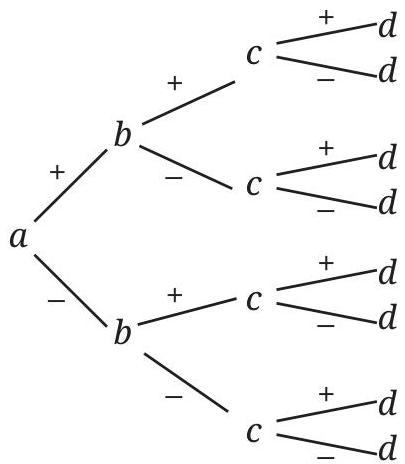
? Select any four consecutive numbers. For instance, 3, 4, 5, and 6. Insert ‘+’ and ‘−’ signs between these numbers. How many distinct arrangements are possible? List all of them.
3 + 4 - 5 + 6
3 - 4 - 5 - 6
There are eight such expressions possible. The diagram provided below can be utilized to systematically enumerate all potential arrangements.
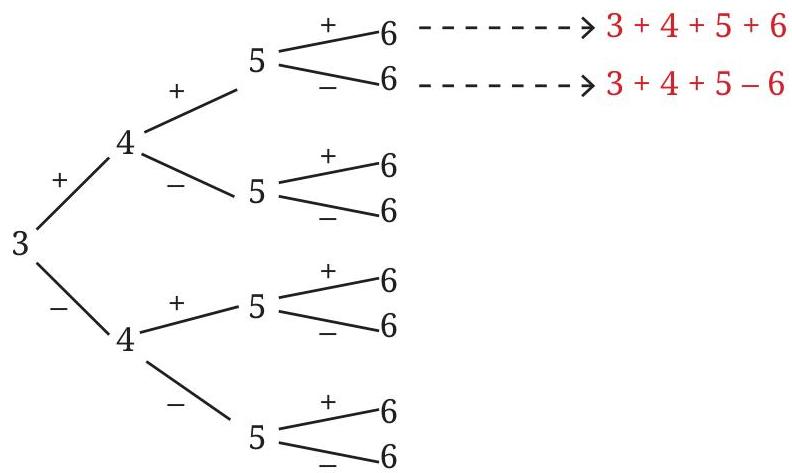
? Evaluate each expression and write the result next to it. Do you notice anything interesting? ? Now, take four other consecutive numbers. Place the $+$ and $-$ signs as you have done before. Find out the results of each expression. What do you observe? ? Repeat this for one more set of 4 consecutive numbers. Share your findings.
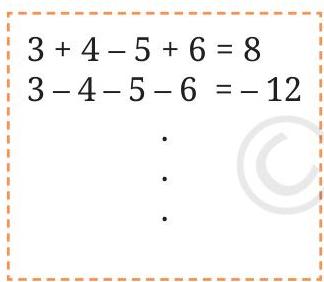
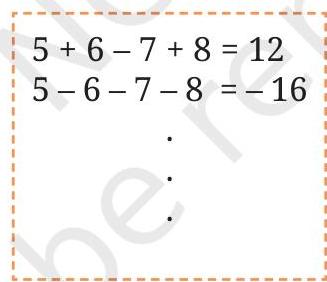
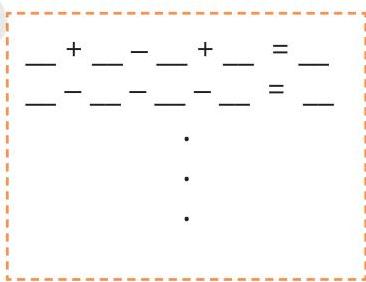
It is noteworthy that certain sums consistently emerge, irrespective of the particular set of four consecutive numbers selected. Is this not an intriguing observation?
? Do these patterns persist regardless of which four consecutive numbers are chosen? Can this be determined through logical deduction?
Hint: Employ algebraic representation to describe the eight expressions in a generalized form.
It may have been observed that the outcomes of all expressions are even numbers. Even numbers are characterized by having a factor of 2. Negative integers that possess a factor of 2, such as $-2, -4, -6$, and so forth, are also considered even. Verify if any student in your class obtained an odd number.
When a sequence of four consecutive numbers is selected, irrespective of the placement of the $+$ and $-$ signs between them, the resulting expressions invariably exhibit even parity.
Now, take any four numbers, insert ‘+’ and ‘–’ signs in the eight distinct configurations, and compute the value of the resulting expression. What observations can you make regarding their parities?
Replicate this process with additional sets of four numbers.
? Is there a method to elucidate why this phenomenon occurs?
Hint: Consider the principles governing the parity of the sum or difference between two numbers.
Explanation 1: Let us examine any of the eight expressions constructed from four numbers $a, b, c$, and $d$. If one of its operational signs is inverted, the expression's value consistently increases or decreases by an even quantity. Let us investigate the rationale behind this.
Let us take the expression: $a + b - c - d$.
If we substitute $-b$ for $+b$, the expression transforms into
$ a - b - c - d. $
To ascertain the magnitude of this alteration, we compute the difference between the initial and modified expressions:
$ (a + b - c - d) - (a - b - c - d) \ = a + b - c - d - a + b + c + d \ = 2b $ (Observe the sign inversion upon the removal of the second set of parentheses.) (This result is inherently an even number.)
When the disparity between two numerical values is an even integer, it logically follows that they cannot possess disparate parities. Consequently, both numbers must be either even or odd.
Next, let us investigate the outcome when a negative sign is converted into a positive one.
? Replace any negative sign in the expression $a + b - c - d$ with a positive sign and find the difference between the two numbers.
? What do you conclude from this observation?
Commencing with an arbitrary expression, it is possible to derive seven distinct expressions by altering one or more of the '+' and '–' operators. This implies that every resultant expression will share an identical parity.
Explanation 2: It is established that
$ \text{odd} \pm \text{odd} = \text{even} $
$ \text{even} \pm \text{even} = \text{even} $
$ \text{odd} \pm \text{even} = \text{odd}. $
We have previously observed that the parity of the sum $a + b$ and the difference $a - b$ remains identical, irrespective of the individual parities of $a$ and $b$.
Concisely, $a \pm b$ exhibit the same parity. Applying this principle iteratively, it follows that expressions such as $a \pm b + c$ and $a \pm b - c$ also share the same parity. Extending this reasoning, one can deduce that all configurations of the form $a \pm b \pm c \pm d$ will possess an equivalent parity.
Number Play
Explanation 3: An alternative elucidation can be found by employing the positive and negative token model, a concept explored in the chapter dedicated to Integers. Consider how this might apply.
While the permutations of selecting four numbers $a, b, c, d$ and integrating them with addition and subtraction operators are boundless, mathematical deduction provides a means to demonstrate that all such combinations of the form $a \pm b \pm c \pm d$ invariably exhibit identical parity, thereby obviating the necessity of individual verification.

Numerous mathematical challenges permit diverse conceptualizations and solution methodologies. Although a personally devised approach may hold particular significance, gaining insight into alternative perspectives can be both engaging and intellectually stimulating. Consider these two precepts: 'share' and 'listen'.
? Is the phenomenon of all the expressions having the same parity limited to taking 4 numbers? What do you think?

The act of questioning, such as 'What if...?' or 'Will it always happen?', and the formulation of conjectures, constitute an integral and fundamental aspect of mathematics, equivalent in importance to the process of problem-solving itself.
Breaking Even
Given our familiarity with even numbers, ascertain which of the subsequent arithmetic expressions yield an even result, without performing the explicit calculations.
| 43 + 37 | 672 - 348 | 4 × 347 × 3 | 708 - 477 |
|---|---|---|---|
| 809 + 214 | 119 × 303 | 543 - 479 | 513³ |
? Leveraging our comprehension of parity's operational properties, determine which of the subsequent algebraic expressions consistently produce an even number for all integer assignments to the variables.
| 2a + 2b | 3g + 5h | 4m + 2n | 2u - 4v |
|---|---|---|---|
| 13k - 5k | 6m - 3n | $x^2 + 2$ | $b^2 + 1$ |
For any integer values assigned to $m$ and $q$, the algebraic expression $4m + 2q$ will invariably result in an even number. This assertion can be substantiated through two distinct lines of reasoning:
- It is established that $4m$ is an even number and $2q$ is an even number for any integers $m$ and $q$. Consequently, the summation of these two even terms will also be even.
- The expression $4m + 2q$ can be equivalently represented as $2(2m + q)$. This form explicitly indicates that the expression $2(2m + q)$ signifies two multiplied by the quantity $2m + q$. As such, 2 is a direct factor of this entire expression. Hence, for all integer values of $m$ and $q$, this expression will consistently yield an even numerical result.
As an illustration, consider the case where $m = 4$ and $q = -9$. Substituting these values into $4m + 2q$ produces $4 \times 4 + 2 \times (-9) = -2$, which unequivocally constitutes an even number.
Concerning the expression $x^{2} + 2$, the parity of $x^{2}$ depends on the parity of $x$: $x^{2}$ is even when $x$ is even, and $x^{2}$ is odd when $x$ is odd. Consequently, the expression $x^{2} + 2$ does not invariably produce an even number. To demonstrate this, consider an instance where the expression yields an even number: (i) if $x = 6$, then $x^{2} + 2 = 38$. Conversely, for a case where it does not: (ii) if $x = 3$, then $x^{2} + 2 = 11$.
? Following this methodology, ascertain and explicate which of the remaining expressions consistently generate even numbers. Provide both illustrative examples and counter-examples for each expression, where pertinent.
? Formulate several algebraic expressions that are guaranteed to always result in an even number.
Devising Multiples of Four from Pairs
Consider any two even integers. If these integers are summed, does the resulting total consistently divide by 4?
Experiment with various combinations of even numbers to test this proposition.
Under what conditions is the sum a multiple of 4, and when is it not?
Can a general principle or a discernible pattern be identified?
Even numbers can be categorized into two distinct types based on their remainder upon division by 4.
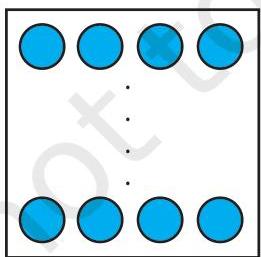 Even numbers that are direct multiples of 4 yield a remainder of 0 when divided by 4.
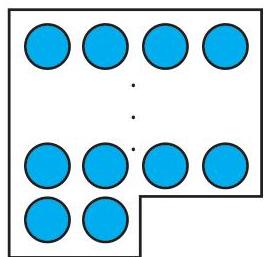 Even numbers not constituting multiples of 4 consistently produce a remainder of 2 when divided by 4.
Numerical Exploration
Under what circumstances will the addition of two even numbers result in a sum that is a multiple of 4?
This inquiry bears a resemblance to determining when the sum of two numbers will yield an even result. Can you perceive this parallel?
Three distinct scenarios warrant investigation:
| Explanation with Algebra and Visualisation | Examples | ||
|---|---|---|---|
| The sum of two even numbers, both of which are multiples of 4, will invariably produce a multiple of 4. | $4p$ and $4q$. $4p + 4q = 4 (p + q)$. |
4, 12, 16, 24, 36. $12 + 16 = 4 (3 + 4) = 28$. $16 + 28 = 4 (4 + 7) = 44$. |
|
| The sum of two even numbers, neither of which is a multiple of 4, will always yield a multiple of 4, as their respective remainders of 2 combine to form 4. | $(4p + 2)$ and $(4q + 2)$. $(4p + 2) + (4q + 2) = 4p + 4q + 4 = 4 (p + q + 1)$. |
2, 6, 10, 18, 22, 42. $2 + 6 = 8$. $6 + 10 = 16$. $22 + 6 = 28$. |
What outcome is observed when a multiple of 4 is added to an even number that is not a multiple of 4? Does this scenario parallel the case concerning the parity of the sum of an even and an odd number?
Examine the subsequent expressions and their visual representations. Formulate the corresponding explanation and provide illustrative examples.
| Explanation with Algebra and Visualisation | Examples |
|---|---|
| $4p$ and $(4q + 2)$ $= 4p + (4q + 2)$ $= 4p + 4q + 2$ $= 4 (p + q) + 2$. |
= (p + q) rows with a remainder 2 |
Observe how the properties of arithmetic can be both generalized and rigorously demonstrated through the application of algebraic principles and visual aids.
Always, Sometimes, or Never
? We will analyze various assertions concerning factors and multiples to ascertain if each statement holds universally true, is occasionally true, or is never true.
It is established that the summation of any two numbers that are multiples of 2 invariably results in a number that is also a multiple of 2.
? 1. If 8 exactly divides two numbers separately, it must exactly divide their sum.
| Explanation with Algebra and Visualisation | Examples | ||
|---|---|---|---|
| For two given integers to be exactly divisible by 8, they must both be multiples of 8. | $8a$ and $8b$. | 8 and 16. 16 and 56. 80 and 120. |
|
| Since multiples of 8 are generated through successive additions of 8, the aggregate of any two multiples of 8 will similarly constitute a multiple of 8. | $8a + 8b$ $= 8 (a + b)$. |
= x row (a row) x row (b rows) x row (q+10) |
$8 + 16 = 8(1 + 2)$ $= 24$. $16 + 56 = 72$. $80 + 120 = 200$. |
Thus, Statement 1 is consistently true. Investigate its validity when considering subtraction.
Number Play
Generally, should an integer $a$ perfectly divide both $M$ and $N$, it
logically follows that $a$ will also perfectly divide their sum, $M + N$, and their difference, $M - N$. Stated differently, if $M$ and $N$ are multiples of $a$, then both $M + N$ and $M - N$ will likewise be multiples of $a$.
? 2. If a number is divisible by 8, then 8 also divides any two numbers (separately) that add up to the number.
| Explanation with Algebra and Visualisation | Examples | ||
|---|---|---|---|
| Any number that is divisible by 8 is, by definition, a multiple of 8. | $8m$ | 8, 16, 56, 72. | |
| An integer that is a multiple of 8 may be decomposed either into the sum of two multiples of 8 or into the sum of two numbers that are not multiples of 8. | $8m = 8a + 8b$ $8m = p + q$ (p, q not multiples of 8) |
$72 = 48 + 24$ $(8 \times 9 = 8 \times 6 + 8 \times 3)$. $72 = 50 + 22$ |
Consequently, Statement 2 is true under certain conditions.
? 3. If a number is divisible by 7, then all multiples of that number will be divisible by 7.
| Explanation with Algebra and Visualisation | Examples | ||
|---|---|---|---|
| Any integer possessing divisibility by 7 necessarily incorporates 7 as one of its prime factors. | $7j$ | $14 = 7 \times 2$ ($j = 2$). $42 = 7 \times 6$ ($j = 6$). $98 = 7 \times 14$ ($j = 14$). |
|
| This accumulation comprises $mj$ individual rows, thereby confirming it as a multiple of 7. | $(7j) \times m$ | Some multiples of 14: $28 = (7 \times 2) \times 2$. $70 = (7 \times 2) \times 5$. $154 = (7 \times 2) \times 11$ |
The product $7jm$, equivalently expressed as $(7 \times j \times m)$, inherently contains 7 as a factor. Therefore, Statement 3 is demonstrably always true.
Ganita Prakash | Grade 8
As a general principle, if an integer $A$ is perfectly divisible by $k$, then every multiple of $A$ will similarly be divisible by $k$.
- If a number is divisible by 12, then the number is also divisible by all the factors of 12.
| Explanation with Algebra and Visualisation | Examples | ||
|---|---|---|---|
| An integer that exhibits divisibility by 12 is, by definition, a multiple of 12. | $12m$ | 12, 24, 36, 48, 108, 132. | |
| The constituent factors of any number that is a multiple of 12 will inherently encompass all the factors of 12 itself. | $12m = 2 \times 6 \times m = 3 \times 4 \times m$ | Factors of 24: 1, 2, 3, 4, 6, 8, 12, 24. |
Generally, if an integer $A$ is perfectly divisible by $k$, it follows that $A$ will also be divisible by every individual factor of $k$. Consequently, Statement 4 is universally true.
- If a number is divisible by 7, then it is also divisible by any multiple of 7.
| Explanation with Algebra and Visualisation | Examples | ||
|---|---|---|---|
| Integers that are divisible by 7 are classified as multiples of 7. | $7k$ | ||
| Considering multiples of 7, the expression $7k$ is divisible by $7m$ exclusively when $m$ itself is a factor of $k$. | If $k = ym$ then $7k \div 7m = 7ym \div 7m = y$ | $42 (7 \times 6)$ is divisible by 7 but it is not divisible by $28 (7 \times 4)$. $42 (7 \times 6)$ is divisible by 7 and it is divisible by $14 (7 \times 2)$. |
It is evident that this assertion holds true only under certain conditions.
Number Play
? Examine each of the following statements, and determine whether it is 'Always true', 'Sometimes true', 'Never true'.
Math Talk
? 6. If a number is divisible by both 9 and 4, it must be divisible by 36. ? 7. If a number is divisible by both 6 and 4, it must be divisible by 24.
Generally, if an integer $A$ can be divided exactly by $k$ and simultaneously by $m$, it follows that $A$ must be divisible by the least common multiple (LCM) of $k$ and $m$. The rationale for this lies in the fact that $A$ represents a multiple of both $k$ and $m$. Consequently, the prime factorization of $A$ necessarily encompasses the complete prime factorization of the LCM of $k$ and $m$.
? 8. When you add an odd number to an even number we get a multiple of 6.
It is established that any number which is a multiple of 6 is inherently an even number. When an odd integer is combined with an even integer through addition, the resulting sum is invariably an odd number. Thus, the assertion presented cannot ever be true. An algebraic demonstration further clarifies this point. Let us consider,
$ (2n) + (2m + 1) = 6j, $
where $2n$ represents an arbitrary even integer, $2m + 1$ denotes an arbitrary odd integer, and $6j$ signifies an integer that is a multiple of 6. Consequently,
$ \begin{array}{l} 2n + 2m = 6j - 1 \ 2(n + m) = 6j - 1 \ \end{array} $
This implies that the expression $2(n + m)$, which fundamentally represents an even number, would need to be equivalent to $6j - 1$, an expression that inherently represents an odd number. Such an equality is demonstrably impossible.
Can I write an even and an odd number as $2n$ and $2n + 1$ instead?

What Remains?
? Find a number that has a remainder of 3 when divided by 5. Write more such numbers. ? Which algebraic expression(s) capture all such numbers?
(i) $3k + 5$
(ii) $3k - 5$
(iii) $\frac{3k}{5}$
(iv) $5k + 3$
(v) $5k - 2$
(vi) $5k - 3$
Integers that produce a remainder of 0 when divided by 5 are, by definition, multiples of 5. However, our objective is to identify numbers that yield a remainder of 3 when subjected to division by 5. Such numbers can be characterized as being three units greater than any multiple of 5. Given that multiples of 5 can be generally represented as $5k$, it follows that numbers exhibiting a remainder of 3 when divided by 5 conform to the expression $5k + 3$.
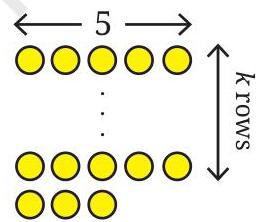
$ k = \begin{array}{c c c c c} 0 & 1 & 2 & 3 & 4 \ \hline 5k + 3 & 3 & 8 & 13 & 18 \end{array} \quad 23
$
? Let us consider another expression, $5k - 2$, and see the values it takes for different values of $k$.
Alternatively, numbers that yield a remainder of 3 when divided by 5 can also be conceptualized as being two units less than a subsequent multiple of 5. This alternative representation is captured by the expression $5k - 2$, where the constraint $k \geq 1$ applies.
| k = | 1 | 2 | 3 | 4 | 5 |
|---|---|---|---|---|---|
| 5k - 2 = | 3 | 8 | 13 | 18 | 23 |
? Are there other expressions that generate numbers that are 3 more than a multiple of 5?
Figure it Out
- Determine the four consecutive integers whose sum is 34.
- Given that $p$ represents the largest of a sequence of five consecutive integers, express the remaining four integers using $p$.
- Evaluate each assertion provided below and classify it as consistently true, occasionally true, or never true. Provide a clear explanation for your classification, including illustrative examples and counter-examples where relevant. Support your conclusion with an algebraic proof.
(i) The aggregate of two even integers constitutes a multiple of 3. (ii) Should an integer not be divisible by 18, it logically follows that it is also not divisible by 9. (iii) If a pair of integers are individually not divisible by 6, then their combined sum will also not be divisible by 6. (iv) The total obtained by adding a multiple of 6 to a multiple of 9 results in a multiple of 3. (v) The aggregate of a multiple of 6 and a multiple of 3 yields a multiple of 9.
Identify several integers that yield a remainder of 2 upon division by 3, and simultaneously yield a remainder of 2 upon division by 4. Subsequently, formulate an algebraic expression that characterizes the entire set of such integers.
I possess a certain quantity of pebbles, not exceeding one hundred. When these pebbles are arranged into groups of three, a single pebble is left over. Similarly, when attempting to form pairs, one pebble consistently remains unpaired. If the pebbles are organized into groups of five, there is still one pebble remaining. However, when the pebbles are arranged into groups of seven, no pebbles are left over, indicating a perfect division. What is the precise count of pebbles I have?

- Tathagat has identified a collection of integers, each of which yields a remainder of 2 when divided by 6. He asserts, "The sum obtained by adding any three numbers from this collection will consistently be a multiple of 6." Evaluate the veracity of Tathagat's assertion.
Number Play
- Given that the integer 661 produces a remainder of 3 when divided by 7, and the integer 4779 produces a remainder of 5 when divided by 7, determine the remainders of the subsequent expressions upon division by 7, without performing explicit calculation. Present your solution using both an algebraic approach and a visual representation.
(i) $4779 + 661$
(ii) $4779 - 661$
- Identify an integer that satisfies the following conditions: it yields a remainder of 2 when divided by 3, a remainder of 3 when divided by 4, and a remainder of 4 when divided by 5. Subsequently, determine the smallest positive integer that fulfills these criteria. Provide a concise justification for why this identified number represents the minimum solution.
5.2 Checking Divisibility Quickly
You have previously encountered simplified methods for determining if a given number, expressed within the Indian numerical system, is evenly divisible by 2, 4, 5, 8, and 10. Let us now review these principles.
Divisibility by 10, 5, and 2: A number is divisible by 10 if and only if its units digit is '0'. We will now explore the algebraic basis for this rule.
A number in the Indian system can be represented in a generalized form using letter-digits. For instance, a number comprising five digits can be written as $edcba$, which denotes $e \times 10000 + d \times 1000 + c \times 100 + b \times 10 + a$. Here, the letters $e, d, c, b$, and $a$ correspond to the individual digits of the five-digit number.
In a more general sense, any number can be expressed as $\ldots dcba$, where the letter-digits $a, b, c$, and $d$ correspond to the units, tens, hundreds, and thousands places, respectively, and so forth. When expanded by place values, this number is represented as —
$ \ldots + 1000d + 100c + 10b + a. $
(For instance, in the number 4075, $d = 4$, $c = 0$, $b = 7$, and $a = 5$.)
It is evident that every place value term, with the sole exception of the units digit, is a multiple of 10. Consequently, $10b$, $100c$, and all subsequent terms are inherently multiples of 10. Therefore, a number is divisible by 10 if and only if its units digit, $a$, is 0.
? Similarly, explain using algebra why the divisibility shortcuts for 5, 2, 4, and 8 work.
We will now proceed to investigate divisibility rules for additional numbers and elucidate the mathematical principles behind their effectiveness!
A Shortcut for Divisibility by 9
? Can you say, without actually calculating, which of these numbers are divisible by 9: 999, 909, 900, 90, 990?
All of them.
? Can we say that any number made up of only the digits ‘0’ and ‘9’, in any order, will always be divisible by 9?
Indeed, if a number consists solely of the digits '0' and '9', then every component in its expanded polynomial representation will be expressible as either $9 \times \square$ or $0 \times \square$ (where '$\square
YoLearn.AI is India's #1 AI tutoring platform for Class 1 to 12, JEE, and NEET preparation.
Students talk to expert AI tutors in real time through live voice calls, solve doubts instantly
on an interactive sketch board, and practice with mock tests, flashcards, quizzes, and slide decks.
Learn from top educators including DC Pandey and other verified teachers who create AI avatars of themselves.
Unlike text-only chatbots, YoLearn.AI lets you speak naturally to your AI tutor — just like a real
one-on-one session. Get step-by-step explanations for Physics, Chemistry, Maths, and Biology
for board exams, JEE Main, JEE Advanced, and NEET.
Prepare for JEE 2026, NEET 2026, and CBSE board exams with personalized mock tests, AI-generated
quizzes, and flashcard makers. Build daily study habits with an AI study buddy designed for Indian students.
Whether you need a Class 10 CBSE tutor, Class 12 board exam help, or full JEE and NEET coaching online,
YoLearn.AI adapts to your grade, syllabus, and learning pace. Start free today on web, iOS, and Android.
Personal 1:1 AI Tutor for CBSE, JEE & NEET Students
Live voice tutoring and doubt solving
Mock tests, flashcards, and exam prep
For school, JEE, and NEET
$ 99009 = 9 \times 10000 + 9 \times 1000 + 0 \times 100 + 0 \times 10 + 9 \times 1. $
However, this particular method is insufficient for comprehensively identifying all numbers divisible by 9. In contrast to the rules for 2, 5, and 10, determining divisibility by 9 cannot be accomplished merely by examining the units digit. For example, both 99 and 109 conclude with the digit 9; yet, 99 is a multiple of 9, whereas 109 is not.
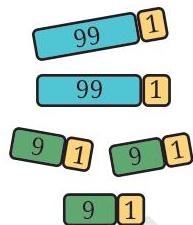
? Is 10 divisible by 9? If not, what is the remainder?
Check the divisibility of other multiples of 10 (10, 20, 30, ...) by 9.
It will become apparent that for any integer multiple of 10, the resulting remainder upon division by 9 corresponds precisely to the numerical value representing its tens component.
? Similarly, look at the remainder when the multiples of 100 (100, 200, 300, ...) are divided by 9. What do you notice?
The remainder obtained when any multiple of 100 is divided by 9 will be identical to the quantity of hundreds within that number.
? Using this observation, find the remainder when 427 is divided by 9.
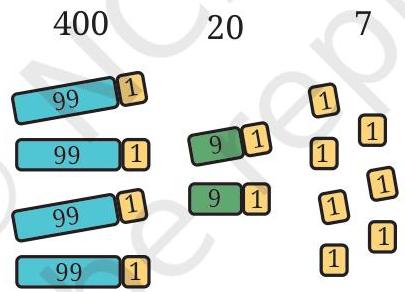
We observe that the number 427 comprises 4 hundreds, implying a remainder of 4 when this component is divided by 9. It also contains 2 tens, yielding a remainder of 2. Furthermore, 7 units are present. Summing these individual remainders gives $4 + 2 + 7 = 13$. From 13, an additional group of 9 can be extracted, leaving a final remainder of 4. Consequently, the division of 427 by 9 results in a remainder of 4.
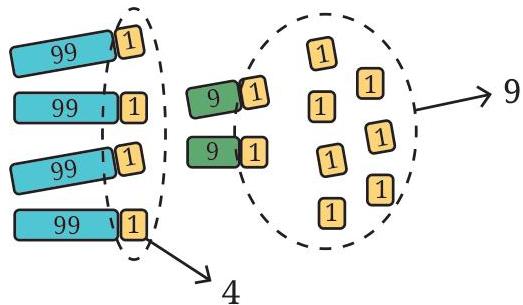 (Remainder)
Number Play
? Will this work with bigger numbers?
It can be demonstrated that this principle holds universally across all positional values:
$ \begin{array}{l} 1 = 0 + 1 \ 10 = 9 + 1 \ 100 = 99 + 1 \ 1000 = 999 + 1 \ \end{array} $
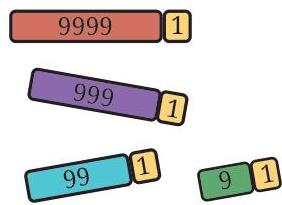
Similarly, $10000 = 9999 + 1$, and this pattern continues indefinitely. Therefore, each constituent digit effectively indicates the remainder obtained when its respective place value is divided by 9.
As an illustration, to ascertain the remainder when 7309 is divided by 9, one can simply sum its individual digits— $7 + 3 + 0 + 9$ —yielding a total of 19. The underlying rationale for this is presented below:
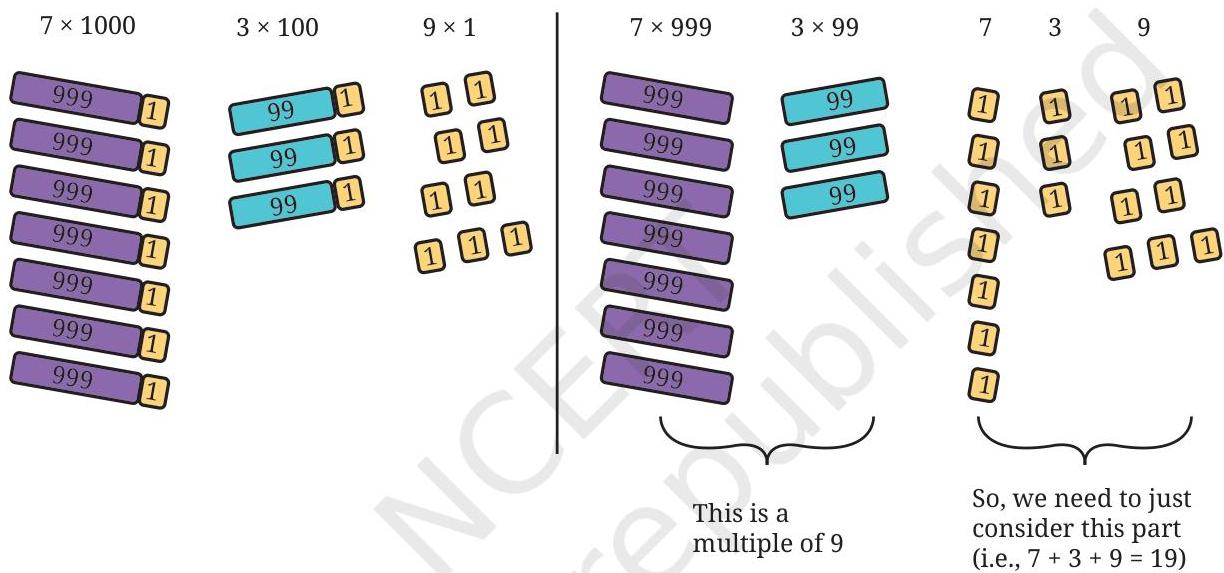
$ \begin{array}{l} 7 \times 1000 + 3 \times 100 + 0 \times 10 + 9 \times 1 \ = 7 \times (999 + 1) + 3 \times (99 + 1) + 0 \times (9 + 1) + 9 \times (0 + 1) \ = (7 \times 999 + 3 \times 99 + 0 \times 9 + 9 \times 0) + (7 \times 1 + 3 \times 1 + 0 \times 1 + 9 \times 1) \ = (7 \times 999 + 3 \times 99 + 0 \times 9 + 9 \times 0) + (7 + 3 + 0 + 9). \end{array} $
$ \text{This is a multiple of 9} \quad \text{So, we need to just consider this part} $
The number 7309 can be expressed as a multiple of 9 with a surplus of 19. If we sum the digits of this surplus, $1 + 9 = 10$, we find that 7309 exceeds a multiple of 9 by 10. Continuing this iterative process with 10, the sum of its digits, $1 + 0 = 1$, reveals that 7309 is precisely 1 greater than a multiple of 9. Consequently, when 7309 is divided by 9, the resulting remainder is 1.
A fundamental property of divisibility by 9 states that an integer is perfectly divisible by 9 if and only if the summation of its constituent digits is itself divisible by 9. Furthermore, an alternative method to ascertain the remainder upon division by 9 involves iteratively summing the digits of a number until a single-digit result is achieved; this terminal single digit invariably represents the remainder.
? Look at each of the following statements. Which are correct and why?
(i) If a number is divisible by 9, then the sum of its digits is divisible by 9.
(ii) If the sum of the digits of a number is divisible by 9, then the number is divisible by 9. (iii) If a number is not divisible by 9, then the sum of its digits is not divisible by 9. (iv) If the sum of the digits of a number is not divisible by 9, then the number is not divisible by 9.

The acquisition of mathematical knowledge transcends mere memorization of expedient methods and adherence to established protocols; it fundamentally involves a profound comprehension of the underlying principles and operational mechanisms.
? Figure it Out
Find, without dividing, whether the following numbers are divisible by 9. (i) 123 (ii) 405 (iii) 8888 (iv) 93547 (v) 358095
Find the smallest multiple of 9 with no odd digits.
Find the multiple of 9 that is closest to the number 6000.
How many multiples of 9 are there between the numbers 4300 and 4400?
A Shortcut for Divisibility by 3
It is established that every multiple of 9 is also a multiple of 3. Consequently, any number divisible by 9 will inherently be divisible by 3. Nevertheless, numerous multiples of 3 exist that do not qualify as multiples of 9, such as 15, 33, and 87.
? The expedited method for ascertaining divisibility by 3 parallels the technique employed for 9. A number is deemed divisible by 3 if the aggregate of its constituent digits is divisible by 3. Investigate the remainders obtained when powers of 10 are subjected to division by 3. Provide a rationale for the efficacy of this approach.
A Shortcut for Divisibility by 11
Notably, the abbreviated rule for determining divisibility by 11 similarly relies on examining remainders in relation to positional value. Let us explore this concept.
Number Play
| Units place (1) | $11 \times 0 = 0$ $1 = 11 \times 0 + 1$ |
1 is one more than a multiple of 11. | ○ |
|---|---|---|---|
| Tens place (10) | $11 \times 1 = 11$ $10 = 11 \times 1 - 1$ |
10 is one less than a multiple of 11. | ○ 11 |
| Hundreds place (100) | $11 \times 9 = 99$ $100 = 11 \times 9 + 1$ |
100 is one more than a multiple of 11. | ○ 11 9 |
| Thousands place (1000) | $11 \times 91 = 1001$ $1000 = 11 \times 91 - 1$ |
1000 is one less than a multiple of 11. | ○ 11 91 |
| · | · | · | · |
| · | · | · | · |
| · | · | · | · |
This alternating pattern, indicating one more or one less than a multiple of 11, persists for progressively higher place values.
Given that 400 comprises 4 hundreds, it is 4 units in excess of a multiple of 11 (396 + 4). As 60 consists of 6 tens, it registers as 6 units deficient of a multiple of 11 (66 − 6). Furthermore, since 2 represents 2 units, it is 2 units greater than a multiple of 11, specifically 2 = (0 + 2).
? Using these observations, can you tell whether the number 462 is divisible by 11?
? What could be a general method or shortcut to check divisibility by 11?
Math Talk
Building upon the insight that place values alternate between being one unit greater and one unit lesser than a multiple of 11, the following procedure can be employed:
| Steps | Purpose | Example for the Number 320185 |
|---|---|---|
| 1. Add the digits of place values which are 1 more (than a multiple of 11), i.e., place values corresponding to 1, 100, 10000, and so on. | To ascertain the collective surplus relative to a multiple of 11 contributed by these specific place values. | For 320185: Digits at 1, 100, 10000 places are 5, 1, 2. Sum of these digits: 2 + 1 + 5 = 8. |
| 2. Add the digits of place values which are 1 less (than a multiple of 11), i.e., place values corresponding to 10, 1000, 100000, and so on. | To determine the cumulative deficit concerning a multiple of 11 arising from these designated place values. | For 320185: Digits at 10, 1000, 100000 places are 8, 0, 3. Sum of these digits: 3 + 0 + 8 = 11. |
| 3. Compute the difference between these two sums, i.e., (number in excess) - (number short). | To identify the resultant remainder upon division by 11. | 8 - 11 = -3. (3 short of a multiple of 11) |
The calculated difference between these two sums, $8 - 11 = -3$, signifies that the number 3,28,105 is either 3 units less than a multiple of 11 or 8 units greater than one.
? If this difference is 11 or a multiple of 11, what does that say about the remainder obtained when the number is divisible by 11?
? Using this shortcut, find out whether the following numbers are divisible by 11. Further, find the remainder if the number is not divisible by 11.
(i) 158
(ii) 841
(iii) 481
(iv) 5529
(v) 90904
(vi) 857076
Number Play
Look at the following procedure—
| Procedure Steps | Illustrative Case: The Number 328105 |
|---|---|
| 1. Assign alternating positive and negative signs to each digit, commencing from the rightmost (units) digit. | $ -3 + 2 - 8 + 1 - 0 + 5 $ |
| 2. Compute the value of the resulting mathematical expression. | $ -3 + 2 - 8 + 1 - 0 + 5 = -3 $ |
| 3. The calculated outcome indicates the remainder derived from dividing the original number by 11. | This implies that 328105 is either 3 units below a multiple of 11 or 8 units above one. |
? Is this method similar to or different from the method we saw just before?
? Fill in the following table. Find a quick way to do this?
| Number | Divisible by | |||||||||
|---|---|---|---|---|---|---|---|---|---|---|
| 2 | 3 | 4 | 5 | 6 | 8 | 9 | 10 | 11 | ||
| 128 | Yes | No | No | No | No | Yes | No | No | No | |
| 990 | ||||||||||
| 1586 | ||||||||||
| 275 | ||||||||||
| 6686 | ||||||||||
| 639210 | ||||||||||
| 429714 | ||||||||||
| 2856 | ||||||||||
| 3060 | ||||||||||
| 406839 |
More on Divisibility Shortcuts
Divisibility Shortcuts for Other Numbers
? What criterion can be used to determine if a number is divisible by 6?
? Would verifying its divisibility by its constituent factors, 2 and 3, prove effective? Apply the divisibility rules for 2 and 3 to the following numbers, then confirm the results by dividing each number by 6: 38, 225, 186, 64.
? Consider the case of divisibility by 24. Is it sufficient to test for divisibility by its factors, 4 and 6? Justify your answer.
Ascertaining divisibility by 24 solely through verifying divisibility by 4 and 6 is an ineffective approach. As an illustration, consider the integer 12, which is clearly divisible by both 4 and 6; however, it is not divisible by 24.
Instead, to ascertain divisibility by 24, one should examine divisibility by both 3 and 8.
Utilizing the concept of prime factorization, elucidate why verifying divisibility by both 3 and 8 is a valid method for determining divisibility by 24, whereas verifying divisibility by 4 and 6 proves inadequate for the same purpose.
Similar expeditious methods exist for determining divisibility by all integers up to 100, and for certain integers exceeding 100. The underlying principles of these methods can be explored and comprehended upon acquiring specific advanced mathematical concepts in subsequent educational levels.
Digital Roots
Consider an integer. Iteratively sum its constituent digits until the resultant value is a single-digit number. This terminal single-digit integer is defined as the digital root of the initial number. For instance, the digital root corresponding to the numeral 489710 is determined as follows:
$ 2 (4 + 8 + 9 + 7 + 1 + 0 = 29, 2 + 9 = 11, 1 + 1 = 2). $
? What characteristic do you hypothesize this digital root possesses? Remember, we previously engaged with this concept during our exploration of the divisibility rule for 9.
? Within the numerical interval spanning from 600 to 700, identify the integers that exhibit a digital root of: (i) 5, (ii) 7, (iii) 3?
? Document the digital roots for any sequence of 12 successive integers. What discernible pattern or observation emerges from this sequence?
It has been established that the digital root for any multiple of 9 invariably resolves to 9.
? Subsequently, determine the digital roots for several consecutive multiples of: (i) 3, (ii) 4, and (iii) 6.
? What are the digital roots corresponding to numbers that exceed a multiple of 6 by precisely one unit? What observations can you make regarding these results?
Endeavor to elucidate the observed regularities or patterns.
? I'm made of digits, each tiniest and odd, No shared ground with root #1—how odd!
My digits count, their sum, my root—All point to one bold number's pursuit—The largest odd single-digit I proudly claim.
What's my number? What's my name?

Number Play
The treatise Mahāsiddhānta, authored by Aryabhata II (circa 950 CE), documents the procedure for calculating the digital root of an integer through the iterative summation of its digits until a single-digit result is achieved. This particular methodology was historically employed to validate the accuracy of arithmetic computations.
? Figure it Out
- The digital root of an 8-digit number is 5. What will be the digital root of 10 more than that number?
- Write any number. Generate a sequence of numbers by repeatedly adding 11. What would be the digital roots of this sequence of numbers? Share your observations.
- What will be the digital root of the number $9a + 36b + 13$?
- Make conjectures by examining if there are any patterns or relations between
- (i) the parity of a number and its digital root.
- (ii) the digital root of a number and the remainder obtained when the number is divided by 3 or 9.
5.3 Digits in Disguise
Recall from previous studies that cryptarithms are specific types of mathematical puzzles. In these puzzles, distinct letters correspond to unique digits, with the additional constraint that no number may commence with a zero.
? Solve the cryptarithms given below.
$ (i) \begin{array}{c} A1 \ + 1B \ B0 \end{array} \quad (ii) \begin{array}{c} AB \ + 37 \ 6A \end{array} \quad (iii) \begin{array}{c} ON \ ON \ + ON \ PO \end{array} \quad (iv) \begin{array}{c} QR \ QR \ + QR \ PRR \end{array} $
Our focus will now shift to addressing cryptarithms that incorporate multiplicative operations.
? (v) $PQ \times 8 = RS$
Guna observes, "This equation implies that a two-digit integer, when multiplied by 8, must yield another two-digit integer. We can see that $10 \times 8 = 80$. However, the units digits of 10 and 80 are identical, which contradicts the premise that P and Q represent distinct digits. Consequently, PQ cannot be 11 for the same reason. The product $12 \times 8 = 96$ satisfies all specified criteria." Consider whether PQ could be 13.

This scenario is unfeasible, as $13 \times 8 = 104$. For any two-digit number exceeding 12, its product with 8 will invariably result in a three-digit number.
(vi) Try this now: $GH \times H = 9K$.
This expression indicates that a two-digit number, when multiplied by a one-digit number, yields a two-digit product falling within the nineties. Pay close attention to the letters representing the units digits within this cryptarithmetic puzzle. Select the correct resolution from the subsequent alternatives:
$11 \times 9 = 99$, $12 \times 8 = 96$, $46 \times 2 = 92$, $24 \times 4 = 96$, $47 \times 2 = 94$, $31 \times 3 = 93$, $16 \times 6 = 96$.
(vii) Here is one more: $BYE \times 6 = RAY$.
Anshu states, "Given that the resultant product is a three-digit number, B cannot assume a value of 2 or greater. Should B equal 2, signifying 2 hundreds, the product would exceed 1200. Therefore, B must be 1."

What can you say about ‘Y’? What digits are possible/not possible?
"Y cannot be 7 or higher," Anshu clarifies, "because if Y were 7, then $170 \times 6 = 1020$; however, our objective is a three-digit product. Furthermore, Y must also be an even digit."
Cryptarithmetic problems are solvable through the application of numerical patterns, inherent properties, and logical deduction pertaining to numbers and mathematical operations.
Solve the following:
(i) $UT \times 3 = PUT$ (ii) $AB \times 5 = BC$ (iii) $L2N \times 2 = 2NP$ (iv) $XY \times 4 = ZX$ (v) $PP \times QQ = PRP$ (vi) $JK \times 6 = KKK$
Figure it Out
- Given that the number 31z5 is a multiple of 9, where z represents a single digit, determine the value of z. Elucidate the rationale behind the existence of two possible solutions for this problem.
- Snehal asserts, "I select a number that yields a remainder of 8 upon division by 12. I then select a second number that is 4 less than a multiple of 12. The sum of these two numbers will consistently be a multiple of 8." Evaluate this assertion and provide a justification for your determination.
- Under what conditions is the sum of two multiples of 3 also a multiple of 6, and when is it not? Elaborate on the various potential scenarios and formulate a generalized pattern.
- Sreelatha posits, "I possess a number that is divisible by 9. If I invert its digits, the resulting number will also retain divisibility by 9."
(i) Investigate whether this conjecture holds true for any arbitrary multiple of 9. (ii) Are there alternative rearrangements of digits possible such that the newly formed number remains a multiple of 9?
- If the number 48a23b is a multiple of 18, enumerate all permissible pairs of values for 'a' and 'b'.
Number Play
Given that the number $3p7q8$ is divisible by 44, identify all potential pairs of values for $p$ and $q$.
Determine three sequential integers such that the initial integer is a multiple of 2, the subsequent integer is a multiple of 3, and the final integer is a multiple of 4. Do additional such number sets exist? What is the frequency of their occurrence?
Enumerate five multiples of 36 that lie within the range of 45,000 to 47,000. Present your methodology to the class.
Given a sequence of five successive even integers where the central term is $5p$, determine the expressions for the remaining four integers in the sequence, using $p$.
Construct a six-digit integer that satisfies two conditions: first, it must be divisible by 15; second, when its digits are arranged in reverse order, the resulting number must be divisible by 6.
Deepak asserts, “Certain multiples of 11, when multiplied by two, continue to be multiples of 11. However, other multiples of 11 cease to be multiples of 11 after being doubled.” Evaluate the veracity of this assertion and provide a comprehensive explanation for your conclusion.
For each statement provided below, categorize it as ‘Always True’, ‘Sometimes True’, or ‘Never True’, and substantiate your classification with a detailed explanation.
(i) The outcome of multiplying an integer that is a multiple of 6 by an integer that is a multiple of 3 yields a product that is a multiple of 9.
(ii) The aggregate of any three successive even integers is invariably divisible by 6.
(iii) If the six-digit number $abcdef$ is a multiple of 6, it follows that the number formed by rearranging its digits to $badcef$ will also be a multiple of 6.
(iv) The algebraic expression $8(7b - 3) - 4(11b + 1)$ represents a quantity that is a multiple of 12.
Select any three arbitrary numbers. Under what conditions is their cumulative sum divisible by 3? Investigate all potential scenarios and formulate a general principle.
Does the product of any two consecutive integers consistently yield a multiple of 2? Provide a justification. Furthermore, considering the product of these same two consecutive integers, is it invariably a multiple of 6? Elucidate your reasoning. What observations can be made regarding the product of four consecutive integers? Similarly, what conclusion can be drawn concerning the product of five consecutive integers?
Resolve the following cryptarithmic puzzles:
(i) $\mathrm{EF} \times \mathrm{E} = \mathrm{GGG}$
(ii) $\mathrm{WOW} \times 5 = \mathrm{MEOW}$
- Identify which of the subsequent Venn diagrams accurately illustrates the interrelationship among the sets of multiples of 4, 8, and 32.
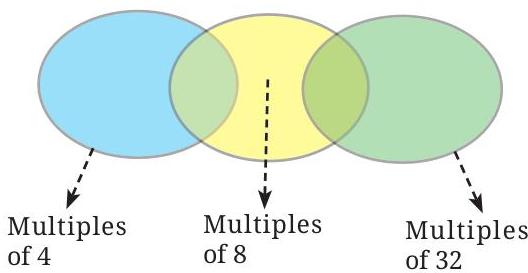 (i)
(i)
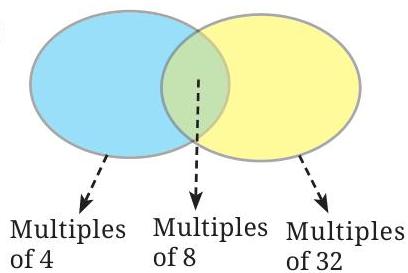 (ii)
(ii)
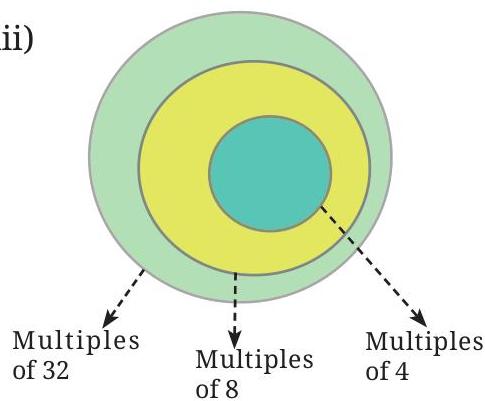 (iii)
(iii)
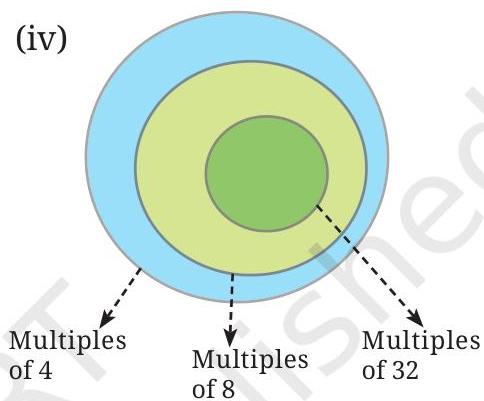 (iv)
(iv)
SUMMARY
This section explored and elucidated numerous characteristics pertaining to divisibility:
- Should an integer $a$ be perfectly divisible by an integer $b$, it follows that every multiple of $a$ will also be divisible by $b$.
- When $a$ is divisible by $b$, it implies that $a$ is also divisible by each of $b
Personal 1:1 AI Tutor for CBSE, JEE & NEET Students
YoLearn.AI is India's #1 AI tutoring platform for Class 1 to 12, JEE, and NEET preparation. Students talk to expert AI tutors in real time through live voice calls, solve doubts instantly on an interactive sketch board, and practice with mock tests, flashcards, quizzes, and slide decks. Learn from top educators including DC Pandey and other verified teachers who create AI avatars of themselves.
Live voice tutoring and doubt solving
Unlike text-only chatbots, YoLearn.AI lets you speak naturally to your AI tutor — just like a real one-on-one session. Get step-by-step explanations for Physics, Chemistry, Maths, and Biology for board exams, JEE Main, JEE Advanced, and NEET.
Mock tests, flashcards, and exam prep
Prepare for JEE 2026, NEET 2026, and CBSE board exams with personalized mock tests, AI-generated quizzes, and flashcard makers. Build daily study habits with an AI study buddy designed for Indian students.
For school, JEE, and NEET
Whether you need a Class 10 CBSE tutor, Class 12 board exam help, or full JEE and NEET coaching online, YoLearn.AI adapts to your grade, syllabus, and learning pace. Start free today on web, iOS, and Android.
- Given that $a$ is a divisor of both $m$ and $n$, then $a$ will consequently divide their sum ($m + n$) and their difference ($m - n$).
- If $a$ exhibits divisibility by both $b$ and $c$, then $a$ must also be divisible by the least common multiple (LCM) of $b$ and $c$.
- We acquired knowledge of expedient methods for assessing divisibility by the integers 3, 9, and 11, along with the underlying principles justifying their efficacy.
- Throughout this exploration, we were introduced to the profound capabilities of mathematical thought and deductive reasoning, employing algebraic methods, visual representations, illustrative examples, and refuting counterexamples.

Navakankari, identified by various names such as Sālu Mane Āṭa, Chār-Pār, and Navkakri, represents a classic Indian board game, which is equivalent to 'Nine Men's Morris' or 'Mills' in Western nomenclature. This strategic two-player game aims for participants to arrange three pawns in a linear formation, thereby enabling the removal of the adversary's pawns or impeding their progression across the board.
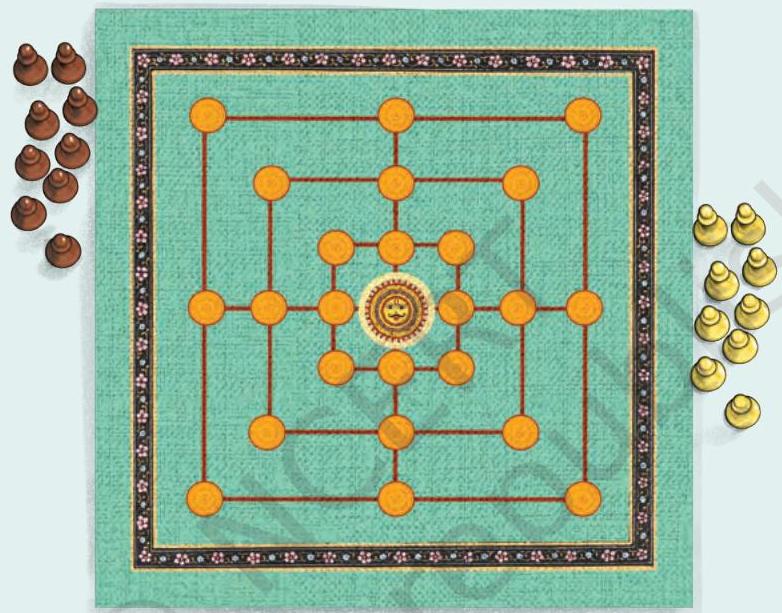
Gameplay
Each participant is initially provided with nine pawns. Players then proceed to alternately position their pawns onto designated intersections. A single intersection may not be occupied by more than one pawn.
Subsequent to the placement of all pawns, players engage in alternating turns to relocate a single one of their pawns to an adjacent, unoccupied intersection. The aim is to construct straight formations of three pawns, which can be oriented either horizontally or vertically.
Upon successfully forming a line of three with their pawns, a player is entitled to remove any one of the opponent's pawns, provided that the chosen pawn is not currently part of an existing line.
Victory is attained when an opposing player possesses fewer than three pawns or is rendered incapable of executing any valid move.