2 POWER PLAY

2.1 Experiencing the Power Play …
An Impossible Venture!
Obtain a sheet of paper, selecting the largest available. Perform a single fold. Then, fold it repeatedly.
? How many times can you fold it over and over?
Estu remarks, “It’s commonly said that a single sheet of paper cannot be folded beyond seven times.”
Roxie responds, “Would this limit change if we were to utilize a thinner material, such as newsprint or tissue?”
Experiment with various paper types to observe the outcomes.
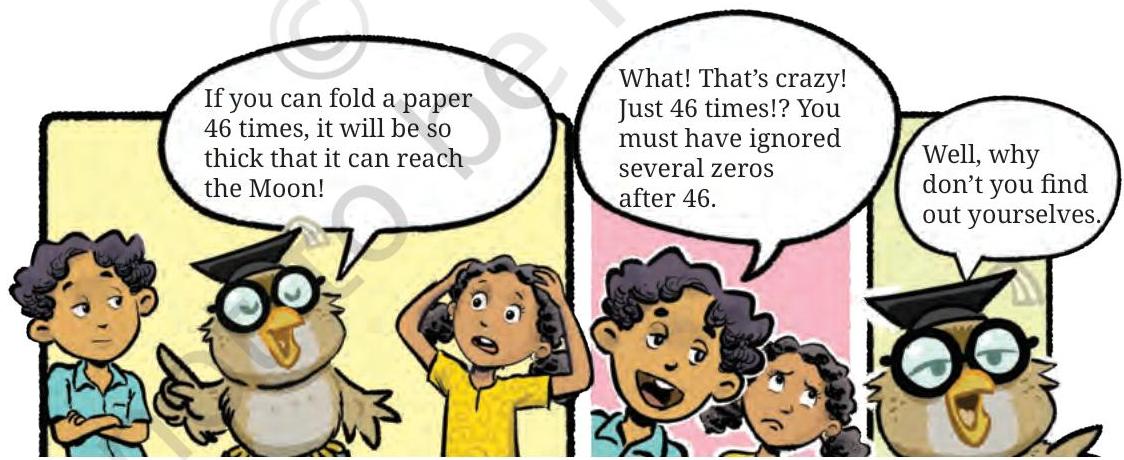
? Suppose you had the ability to fold a sheet of paper an arbitrary number of times. What might its resultant thickness be following 30 folds? Formulate an estimation.
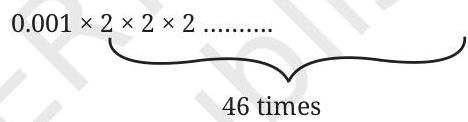
We shall now determine the thickness of a paper sheet after 46 folds. For this exercise, let the initial thickness of the sheet be 0.001 cm.
The subsequent table presents the thickness achieved after each successive fold. It is noteworthy that the thickness consistently doubles with every fold.
| Fold | Thickness | Fold | Thickness | Fold | Thickness |
|---|---|---|---|---|---|
| 1 | 0.002 cm | 7 | 0.128 cm | 13 | 8.192 cm |
| 2 | 0.004 cm | 8 | 0.256 cm | 14 | 16.384 cm |
| 3 | 0.008 cm | 9 | 0.512 cm | 15 | 32.768 cm |
| 4 | 0.016 cm | 10 | 1.024 cm | 16 | 65.536 cm |
| 5 | 0.032 cm | 11 | 2.048 cm | 17 | ≈ 131 cm |
| 6 | 0.064 cm | 12 | 4.096 cm |
(The symbol ‘=’ is employed here to denote ‘approximately equal to’.) Following 10 folds, the material’s thickness slightly exceeds 1 cm, specifically 1.024 cm. Upon completing 17 folds, the thickness reaches approximately 131 cm, which is somewhat greater than 4 feet.
? Considering this, what do you anticipate the thickness would become after 30 folds? Or after 45 folds? Offer your conjecture.
? Fill the table below.
| Fold | Thickness | Fold | Thickness | Fold | Thickness |
|---|---|---|---|---|---|
| 18 | ≈ 262 cm | 21 | 24 | ||
| 19 | ≈ 524 cm | 22 | 25 | ||
| 20 | ≈ 10.4 m | 23 | 26 |
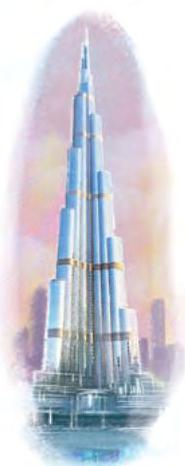
Subsequent to 26 folds, the thickness measures roughly 670 meters. For context, the Burj Khalifa in Dubai, recognized as the world’s tallest edifice, stands at 830 meters.
| Fold | Thickness | Fold | Thickness |
|---|---|---|---|
| 27 | ≈ 1.3 km | 29 | |
| 28 | 30 |
Upon reaching 30 folds, the paper’s thickness extends to approximately 10.7 km, a height commonly associated with commercial aircraft flight. By comparison, the Mariana Trench, the most profound oceanic abyss known, descends to a depth of 11 km.
| Fold | Thickness | Fold | Thickness | Fold | Thickness |
|---|---|---|---|---|---|
| 31 | 36 | 41 | |||
| 32 | 37 | 42 | |||
| 33 | 38 | 43 | |||
| 34 | 39 | 44 | |||
| 35 | 40 | 45 |
Power Play
It may be challenging to fully comprehend that following merely 46 folds, the resulting thickness surpasses 700,000 km. This phenomenon exemplifies the potency of multiplicative growth, alternatively termed exponential growth. We will now proceed to analyze this growth pattern, having already observed that the thickness undergoes a doubling with each successive fold.
| Fold 4 | 0.016 cm |
|---|---|
| Fold 5 | 0.032 cm |
| Fold 9 | 0.512 cm |
| --- | --- |
| Fold 10 | 1.024 cm |
Observe the variation in thickness following two folds. What is the extent of this increment?
| Fold 4 | 0.016 cm |
|---|---|
| Fold 6 | 0.064 cm |
Subsequent to any three folds, the thickness is augmented by an eightfold factor (equivalent to 2 × 2 × 2). Verify this observation. Analogously, regardless of the initial state, the thickness after ten folds magnifies by a factor of 1024 (which is 2 multiplied by itself ten times), as depicted in the table that follows.
| Fold | Thickness | Times increased by |
|---|---|---|
| 0 to 10 | 1.024 cm – 0.001 cm = 1.023 cm | 1.024 ÷ 0.001 = 1024 |
| 10 to 20 | 10.485 m – 1.024 cm ≈ 10.474 m | 10.485 m ÷ 1.024 cm = 1024 |
| 20 to 30 | 10.737 km – 10.485 m ≈ 10.726 km | 10.737 km ÷ 10.485 m = 1024 |
| 30 to 40 | 10995 km – 10.737 km ≈ 10984.2 km | 10995 km ÷ 10.737 km = 1024 |
2.2 Exponential Notation and Operations
Initially, the paper possessed a thickness of 0.001 cm.
Following a single fold, its thickness advanced to 0.001 cm × 2 = 0.002 cm.
When subjected to two folds, its thickness transformed to — 0.001 cm × 2 × 2 = 0.004 cm, alternatively expressed as 0.001 cm × $2^2$ = 0.004 cm (using concise notation).
Subsequent to a third fold, its thickness registered as — 0.001 cm × 2 × 2 × 2, or 0.001 cm × $2^3$ = 0.008 cm.
With four folds applied, the thickness attained — 0.001 cm × 2 × 2 × 2 × 2, which simplifies to 0.001 cm × $2^4$ = 0.016 cm.
In a comparable manner, the formula representing the paper's thickness after seven folds would be 0.001 cm × 2 × 2 × 2 × 2 × 2 × 2 × 2, or succinctly, 0.001 cm × $2^7$ = 0.128 cm.
It has been observed that numbers which are perfect squares can be denoted as $n^2$, and perfect cubes as $n^3$.
$n \times n = n^2$ (pronounced as ‘n squared’ or ‘n elevated to the power of 2’)
$n \times n \times n = n^3$ (pronounced as ‘$n$ cubed’ or ‘$n$ elevated to the power of 3’)
$n \times n \times n \times n = n^4$ (pronounced as ‘$n$ elevated to the power of 4’ or ‘the fourth power of $n$’)
$n \times n \times n \times n \times n \times n \times n = n^7$ (pronounced as ‘$n$ elevated to the power of 7’ or ‘the seventh power of $n$’) and so forth.
Generally, the notation $n^a$ signifies $n$ multiplied by itself $a$ number of times.
$ 5^4 = 5 \times 5 \times 5 \times 5 = 625. $
$5^4$ constitutes the exponential representation of 625. In this expression, 4 functions as the exponent or power, while 5 serves as the base. Exponents structured as $5^n$ are termed powers of 5, exemplified by $5^1, 5^2, 5^3, 5^4$, and so on. The product $2 \times 2 \times 2 \times 2 \times 2 \times 2 \times 2 \times 2 \times 2 \times 2$ equals $2^{10}$, which is 1024. Does the number 1024 resonate from previous discussions? In that context, it denoted that following every ten folds, the thickness augmented by a factor of 1024.
The expression $5^4$ can be articulated as:
‘5 raised to the power 4’ or
‘5 to the power 4’ or
‘5 power 4’ or
‘4th power of 5’
? Which mathematical expression accurately characterizes the thickness of a paper sheet subsequent to being folded ten times? The initial thickness is symbolized by the letter-number $\nu$.
(i) $10\nu$
(iii) $10 + \nu$
(iv) $2^{10}$
(v) $2^{10}\nu$
(vi) $2 \times 10 \times \nu$
(vii) $10^2\nu$
Further illustrations of exponential notation are provided below:
$4 \times 4 \times 4$ evaluates to $4^3$, which equals 64.
Correspondingly, $(-4) \times (-4) \times (-4)$ results in $(-4)^3$, yielding -64.
Likewise,
The product $a \times a \times a \times b \times b$ is denoted as $a^3 b^2$, which is verbally rendered as "$a$ cubed $b$ squared." Similarly, $a \times a \times b \times b \times b \times b$ can be written in exponential form as $a^2 b^4$, pronounced as "$a$ squared $b$ to the power of 4."
It is important to note the distinction: $4 + 4 + 4$ equals $3 \times 4$, resulting in $12$, while $4 \times 4 \times 4$ is equivalent to $4^3$, yielding $64$.
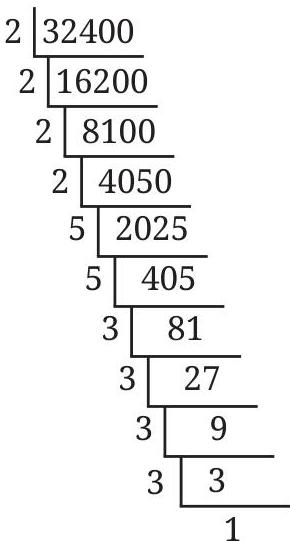
? Decompose the number 32400 into its prime factors and present these prime factors using exponential notation.
$ 32400 = 2 \times 2 \times 2 \times 2 \times 5 \times 5 \times 3 \times 3 \times 3. $
Expressed in exponential form, this becomes
$ 32400 = 2^4 \times 5^2 \times 3^4. $
? Determine the value of $(-1)^5$. Will the result be positive or negative? Furthermore, consider the outcome for $(-1)^{56}$.
? Does $(-2)^4$ equal $16$? Provide substantiation for your answer.
? Exercises
- Convert the subsequent expressions into their exponential forms:
(i) $6 \times 6 \times 6 \times 6$ (ii) $b \times b \times b \times b$ (iii) $y \times y$ (iv) $5 \times 5 \times 7 \times 7 \times 7$ (v) $2 \times 2 \times a \times a$ (vi) $a \times a \times a \times c \times c \times c \times c \times d$
Power Play
- For each of the numbers listed below, represent it as a product of its prime factors, expressed in exponential notation.
(i) 648 (ii) 405 (iii) 540 (iv) 3600
- Calculate the numerical value for each of the subsequent expressions:
(i) $2 \times 10^{3}$ (ii) $7^{2} \times 2^{3}$ (iii) $3 \times 4^{4}$ (iv) $(-3)^{2} \times (-5)^{2}$ (v) $3^{2} \times 10^{4}$ (vi) $(-2)^{5} \times (-10)^{6}$
The Stones that Shine ...
? Three daughters with curious eyes, Each got three baskets—a kingly prize. Each basket had three silver keys, Each opens three big rooms with ease. Each room had tables—one, two, three, With three bright necklaces on each, you see. Each necklace had three diamonds so fine... Can you count these stones that shine?
Hint: Find out the number of baskets and rooms.
? How many rooms were there altogether? The provided information can be visually represented as shown below.

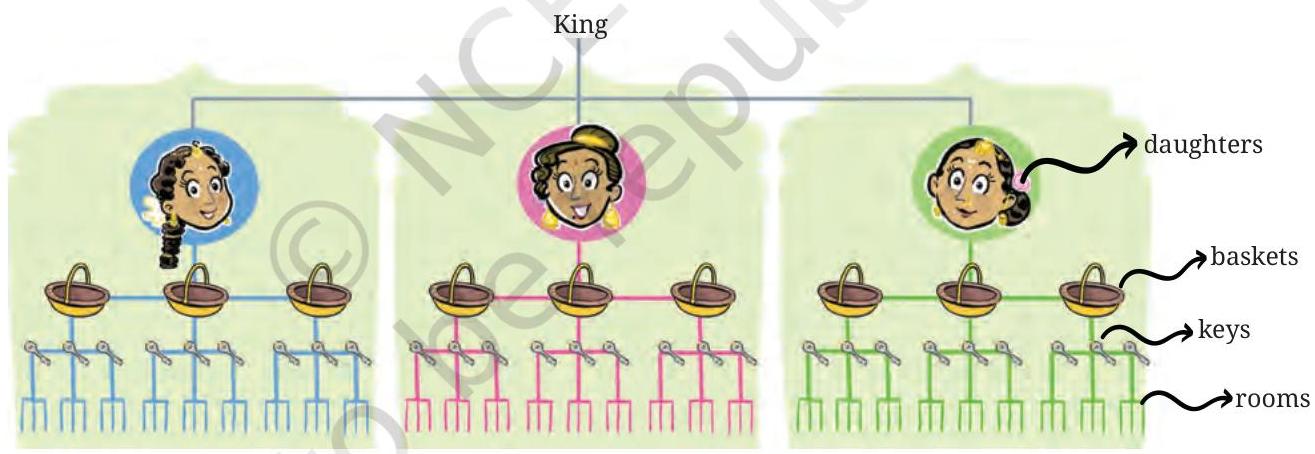
Based on the diagram, the total count of rooms is $3^4$. This value is obtainable by successively multiplying 3 by itself:
$3 \times 3 = 9$ $9 \times 3 = 27$ $27 \times 3 = 81$ $81 \times 3 = 243$
? How many diamonds were there in total? Can we find out by just one multiplication using the products above?
The overall quantity of diamonds is $3 \times 3 \times 3 \times 3 \times 3 \times 3 \times 3 = 3^7$.
One can express this as:
$ 3 ^ {7} = (3 \times 3 \times 3 \times 3) \times (3 \times 3 \times 3) $
Our previous calculation extended up to $3^4$. To determine $3^7$, we can simply multiply $3^4 (= 81)$ by $3^3 (= 27)$.
$ \begin{array}{l} = 3 ^ {4} \times 3 ^ {3} \ = 81 \times 27 = 2187 \ \end{array} $
$ \underbrace {3 \times 3 \times 3 \times 3} _ {3 ^ {4}} \times \underbrace {3 \times 3 \times 3} _ {3 ^ {3}} $
$3^7$ can also be expressed as $3^2 \times 3^5$. Can you reason out why?
This principle is readily applicable to products where the exponents involve literal variables.
Express the product $p^4 \times p^6$ in its exponential form.
$ p ^ {4} \times p ^ {6} = (p \times p \times p \times p) \times (p \times p \times p \times p \times p \times p) = p ^ {10}. $
We can thus generalize this observation as —
$n^a \times n^b = n^{a + b}$, where $a$ and $b$ are counting numbers.
Utilize this insight to compute the following values.
(i) $2^{9}$
(ii) $5^{7}$
(iii) $4^{6}$
$4^6$ can be computed using these two distinct approaches:
| $(4 \times 4 \times 4) \times (4 \times 4 \times 4) = 4^3 \times 4^3$ = $64 \times 64$ = $4096.$ The expression $4^3 \times 4^3$ represents the square of $4^3$, which is to say, $4^3 \times 4^3$ can also be denoted as $(4^3)^2$. | $(4 \times 4) \times (4 \times 4) \times (4 \times 4) = 4^2 \times 4^2 \times 4^2$ = $16 \times 16 \times 16$ = $4096.$ The expression $4^2 \times 4^2 \times 4^2$ signifies the cube of $4^2$, meaning, $4^2 \times 4^2 \times 4^2$ can alternatively be written as $(4^2)^3$. |
|---|
In a similar vein, $7^4 = (7 \times 7) \times (7 \times 7) = 7^2 \times 7^2 = (7^2)^2$, and
$ \begin{array}{l} 2 ^ {10} = (2 \times 2) \times (2 \times 2) \times (2 \times 2) \times (2 \times 2) \times (2 \times 2) \ = (2 ^ {2}) \times (2 ^ {2}) \times (2 ^ {2}) \times (2 ^ {2}) \times (2 ^ {2}) \ = (2 ^ {2}) ^ {5}. \ \end{array} $
Is $2^{10}$ also equal to $(2^{5})^{2}$? Write it as a product.
$ \begin{array}{l} 2 ^ {10} = (2 \times 2 \times 2 \times 2 \times 2) \times (2 \times 2 \times 2 \times 2 \times 2) \ = (2 ^ {5}) \times (2 ^ {5}) \ = (2 ^ {5}) ^ {2}. \ \end{array} $
Generally, the relationship between powers can be expressed as:
$(n^a)^b = (n^b)^a = n^{a \times b} = n^{ab}$, where $a$ and $b$ are counting numbers.
Express each of the subsequent exponential forms as a power raised to another power, demonstrating at least two distinct methods:
(i) $8^{6}$
(ii) $7^{15}$
(iii) $9^{14}$
(iv) $5^{8}$
Power Play
Magical Pond
? Within a beautiful, enchanted pond, a vibrant pink lotus resides. The quantity of lotuses in this pond multiplies by two each day. After a duration of 30 days, the pond becomes entirely filled with lotuses. On what specific day was the pond precisely half-filled?
Given that the pond reaches full lotus coverage on the 30th day, what proportion of the pond was covered by lotuses on the 29th day?

Considering that the lotus population experiences daily doubling, it logically follows that the pond would have been half-covered on the 29th day.
? Express the count of lotuses (in exponential notation) when the pond reached the following states:
(i) fully covered
(ii) half covered
? Consider an additional pond where the lotus population triples daily. Initially, both ponds were devoid of flowers. Damayanti introduced a single lotus into the pond where lotuses double. After a duration of 4 days, she transferred all the lotuses from this doubling pond into the tripling pond. How many lotuses will be present in the tripling pond after an additional 4 days?
Following the initial 4 days, the quantity of lotuses is $1 \times 2 \times 2 \times 2 \times 2 = 2^4$.
Subsequent to the next 4 days, the quantity of lotuses becomes $2^4 \times 3 \times 3 \times 3 \times 3 = 2^4 \times 3^4$.
? Supposing Damayanti had altered the sequence of placing the flowers in the respective ponds, what would be the resulting number of lotuses?
$ 1 \times 3^4 \times 2^4 = (3 \times 3 \times 3 \times 3) \times (2 \times 2 \times 2 \times 2). $
? Is it possible to represent this product as a single exponent $m^n$, where $m$ and $n$ are positive integers?
Through the process of reordering the factors, we obtain:
$ \begin{array}{l} = (3 \times 2) \times (3 \times 2) \times (3 \times 2) \times (3 \times 2) \ = (3 \times 2)^4 = 6^4. \end{array} $
In its generalized form, this principle states:
$m^a \times n^a = (mn)^a$, where $a$ is a counting number.
Utilize this observation to ascertain the numerical value of $2^5 \times 5^5$.
? Simplify the expression $\frac{10^4}{5^4}$ and render it in exponential format.
Generally, it can be demonstrated that $\frac{m^a}{n^a} = \left(\frac{m}{n}\right)^a$.
Ganita Prakash | Grade 8
How Many Combinations
? Estu possesses 4 dresses and 3 caps. In how many distinct ways can Estu pair these dresses and caps?
Considering each cap, Estu has 4 dress selections available. Thus, for 3 caps, the total number of possible pairings is calculated as $4 + 4 + 4 = 4 \times 3 = 12$. Alternatively, viewing it from the perspective of dresses, for each dress, Estu can choose any of the 3 caps. Consequently, across 4 dresses, $3 + 3 + 3 + 3 = 3 \times 4 = 12$ distinct combinations are achievable.
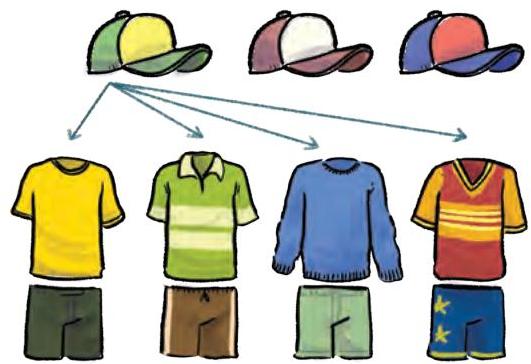
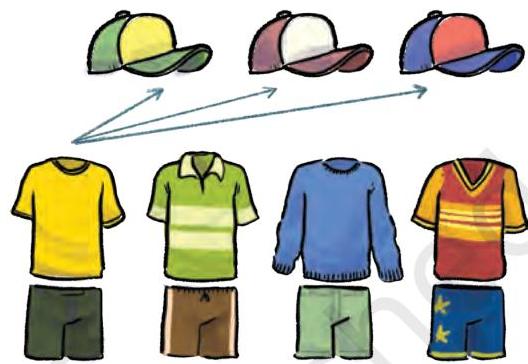
? Roxie owns 7 dresses, 2 hats, and 3 pairs of shoes. How many unique outfits can Roxie assemble?
Hint: Try drawing a diagram like the one above.
? Estu and Roxie discovered a safe filled with antique stamps and coins, a collection of their great-grandfather. The safe was secured by a 5-digit password. Lacking knowledge of the correct password, their only recourse was to systematically attempt every possible password until it unlocked. Unfortunately, the mechanism only yielded to the very last password after they had exhausted all potential combinations. How many passwords did they ultimately test?
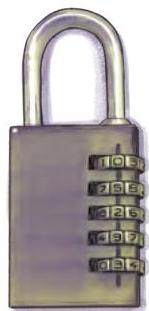

When faced with an intractable problem, it is often beneficial to seek out a simplified version that can be resolved. This problem-solving strategy frequently proves valuable.
Instead of a 5-digit locking mechanism, let us consider a 2-digit lock to determine the total number of possible passwords.
For the initial digit, there are 10 available choices (ranging from 0 to 9). For each of these initial choices, there are also 10 options for the second digit (for instance, if the first digit is 0, then 00, 01, 02, 03, ..., 09 are all valid possibilities). Therefore, the cumulative number of combinations for a 2-digit lock amounts to $10 \times 10 = 100$.
Now, let us postulate a 3-digit lock. For every one of the preceding 100 (2-digit) passwords, there are 10 additional selections for the third digit. Consequently, a 3-digit lock permits $100 \times 10 = 1000$ combinations. These can be comprehensively listed as: 000, 001, 002, ..., 997, 997, 999.
Power Play
How many 5-digit passwords are possible?

For a 5-digit password, each of the five positions can be filled by any of the ten available digits (0 through 9). Consequently, the total number of distinct passwords achievable for such a lock is determined by multiplying the number of choices for each position:
$10 \times 10 \times 10 \times 10 \times 10 = 10^{5} = 1,00,000$ passwords. This count encompasses every numerical sequence from 00000 up to 99999, including examples such as 00000, 00001, 00002, ..., 00010, 00011, ..., 00100, 00101, ..., 00999, ..., 30456, ..., 99998, and 99999.
Estu says, "Next time, I will buy a lock that has 6 slots with the letters A to Z. I feel it is safer."
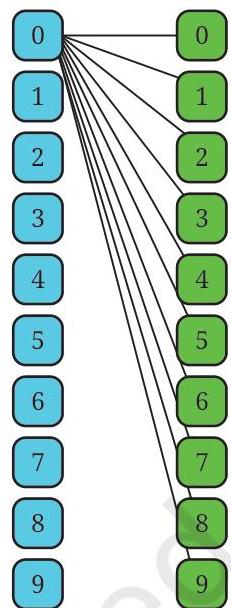
? How many passwords are possible with such a lock?
? Think about how many combinations are possible in different contexts. Some examples are—
(i) Pincodes of places in India—The Pincode of Vidisha in Madhya Pradesh is 464001. The Pincode of Zemabawk in Mizoram is 796017. (ii) Mobile numbers. (iii) Vehicle registration numbers.
Try to find out how these numbers or codes are allotted/generated.
2.3 The Other Side of Powers
Consider a segment with a length of 16 units. If we reduce its length by half, the outcome is:
$ 2^{4} \div 2 = \frac{2 \times 2 \times 2 \times 2}{2} = 2 \times 2 \times 2 = 2^{3} = 8 \text{ units}. $
Further reducing the remaining length by half once more yields:
$ (2^{4} \div 2) \div 2 = 2^{4} \div 2^{2} = \frac{2 \times 2 \times 2 \times 2}{2 \times 2} = 2 \times 2 = 2^{2} = 4 \text{ units}. $
The process of halving a 16-unit length three consecutive times can be expressed as:
$ 2^{4} \div 2^{3} = \frac{2 \times 2 \times 2 \times 2}{2 \times 2 \times 2} = 2 = 2^{1} = 2 \text{ units}. $
This observation leads to the deduction that:
$ 2^{4} \div 2^{3} = 2^{4 - 3} = 2^{1}. $
? What is $2^{100} \div 2^{25}$ in powers of 2?
Expressed in a more generalized form, the rule for division of powers states:
$ n^{a} \div n^{b} = n^{a - b}, $
where $n$ must not be equal to 0, and $a$ and $b$ represent counting numbers such that $a$ is greater than $b$.
? Why can't $n$ be 0?
? We have not covered the case when the exponent is 0; for example, what is $2^0$?
Let us establish a definition for $2^0$ that ensures consistency with the generalized form previously introduced.
$ 2^0 = 2^{4-4} = 2^4 \div 2^4 = \frac{2 \times 2 \times 2 \times 2}{2 \times 2 \times 2 \times 2} = 1. $
Indeed, for any positive integer $a$:
$ 2^0 = 2^{a-a} = 2^a \div 2^a = 1. $
More broadly, it follows that:
$ x^a \div x^a = x^{a-a} = x^0, \text{ and consequently} $
$ 1 = x^0, $
where $x$ is any non-zero value and $a$ is a counting number.
When Zero is in Power!
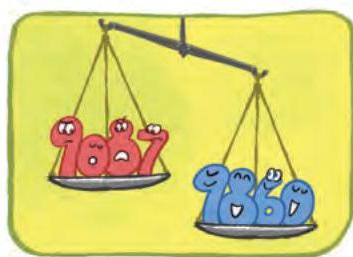


Consider a line segment initially measuring $2^4$ units in length. If this segment undergoes division by two a total of 5 times, the resulting length can be expressed as:
$ 2^4 \div 2^5 = \frac{2 \times 2 \times 2 \times 2}{2 \times 2 \times 2 \times 2 \times 2} = \frac{1}{2} \text{ units}. $
Applying the established exponential rule for division, $2^4 \div 2^5$ simplifies to $2^{(4-5)}$, which equals $2^{-1}$. Thus, it is evident that $2^{-1} = \frac{1}{2}$.
Extending this principle, if a line segment with an initial length of $2^4$ units is subjected to 10 successive halvings, the final length is given by $2^4 \div 2^{10} = 2^{(4-10)} = 2^{-6}$ units. When this expression is fully expanded, $2^4 \div 2^{10}$ yields $\frac{2 \times 2 \times 2 \times 2}{2 \times 2 \times 2 \times 2 \times 2 \times 2 \times 2 \times 2 \times 2 \times 2} = \frac{1}{2^6} = \frac{1}{64}$, an outcome that is equivalently represented as $2^{-6}$.
Power Play
In a similar vein, we observe that $10^{-3} = \frac{1}{10^3}$ and $7^{-2} = \frac{1}{7^2}$, among other instances.
? Is it permissible to express $10^{3}$ as $\frac{1}{10^{-3}}$?
Let us verify this relationship:
$ \frac{1}{10^{-3}} = \frac{1}{1/10^3} = 1 \div \frac{1}{10^3} = 1 \times 10^3 = 10^3. $
Following this pattern, $7^{2} = \frac{1}{7^{-2}}$ and $4^{a} = \frac{1}{4^{-a}}$.
Consequently, in a generalized formulation, we establish:
$ n^{-a} = \frac{1}{n^{a}} \quad \text{and} \quad n^{a} = \frac{1}{n^{-a}}, \quad \text{where} \quad n \neq 0. $
Consider the following fundamental exponential identities that have been established:
| $n^{a} \times n^{b} = n^{a + b}$ | $(n^{a})^{b} = (n^{b})^{a} = n^{a \times b}$ | $n^{a} \div n^{b} = n^{a - b}$ |
|---|
? Initially, we restricted $a$ and $b$ to be counting numbers. Can these exponents, $a$ and $b$, now encompass any integer values? Will the generalized forms maintain their validity under this broader condition?
? Provide the equivalent forms for each of the following expressions.
(i) $2^{-4}$
(ii) $10^{-5}$
(iii) $(-7)^{-2}$
(iv) $(-5)^{-3}$
(v) $10^{-100}$
? Simplify the subsequent expressions and present the results in exponential notation.
(i) $2^{-4} \times 2^{7}$
(ii) $3^{2} \times 3^{-5} \times 3^{6}$
(iii) $p^{3} \times p^{-10}$
(iv) $2^{4} \times (-4)^{-2}$
(v) $8^{p} \times 8^{q}$
Power Lines
Consider the arrangement of powers of 4 sequentially on a linear representation.
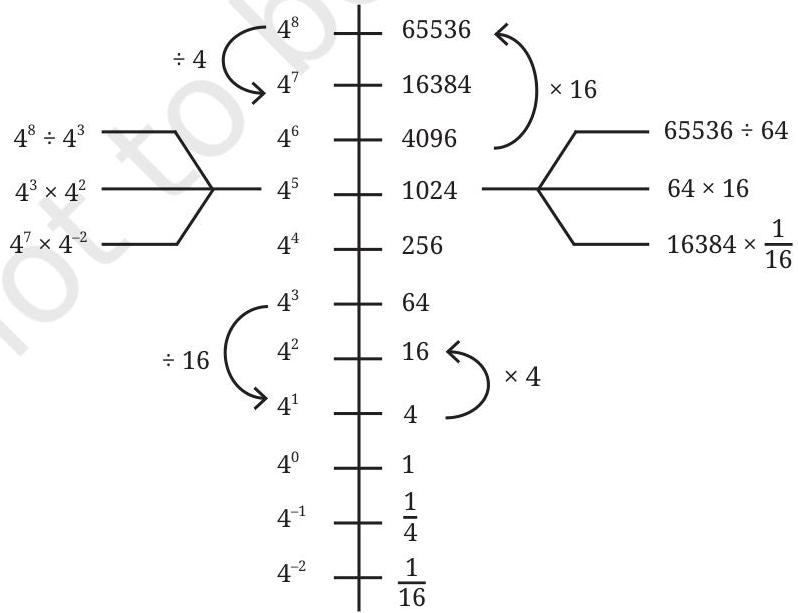
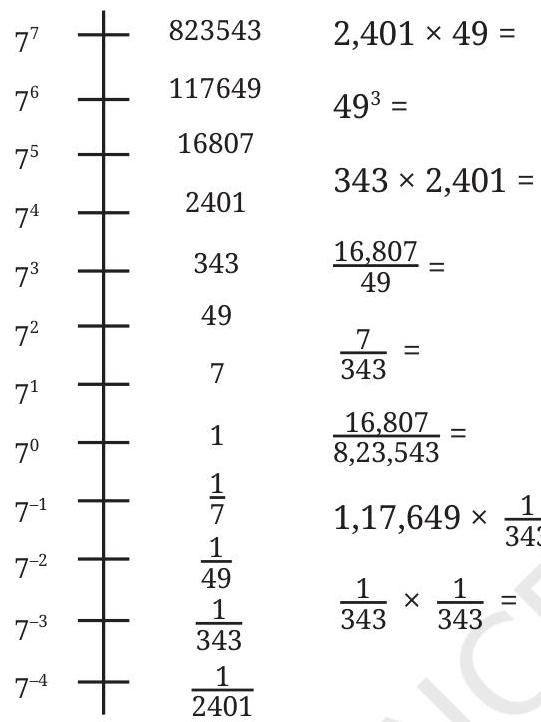
? Is it accurate to state that 16384 (represented as $4^7$) is 16 (or $4^2$) times greater than 1,024 (which is $4^5$)? Affirmative, as demonstrated by the division $4^7 \div 4^5 = 4^2$. ? By what factor does $4^2$ exceed $4^{-2}$? ? Referencing the power line for the base 7, address the subsequent inquiries.
2.4 Powers of 10
In the expanded representation of Indian numerals, quantities such as 10, 100, 1000, and subsequent powers have been employed. For instance,
$ 47561 = (4 \times 10000) + (7 \times 1000) + (5 \times 100) + (6 \times 10) + 1. $
This expression is convertible into a form utilizing powers of 10, as follows:
$ (4 \times 10^4) + (7 \times 10^3) + (5 \times 10^2) + (6 \times 10^1) + (1 \times 10^0). $
? Express the subsequent numerical values in an analogous format: (i) 172, (ii) 5642, (iii) 6374. ? What is the appropriate method for representing the number 561.903?
$ 561.903 = (5 \times 100) + (6 \times 10) + 1 + (9 \times \frac{1}{10}) + (0 \times \frac{1}{100}) + (3 \times \frac{1}{1000}). $
When expressed through the application of powers of 10, the result is:
$ 561.903 = (5 \times 10^2) + (6 \times 10^1) + (1 \times 10^0) + (9 \times 10^{-1}) + (0 \times 10^{-2}) + (3 \times 10^{-3}). $
Power Play
Scientific Notation
Consider these facts that involve exceptionally large numerical values—
(i) The Sun is situated at a distance of 30,00,00,00,00,00,00,00,00,000 meters from the core of our Milky Way galaxy. (ii) The total count of stars within our galaxy stands at 1,00,00,00,00,000. (iii) The Earth's mass is registered as 59,76,00,00,00,00,00,00,00,00,000 kg.
As the numerical string expands, accurately interpreting these figures becomes challenging. There's a propensity to miscount zeros or incorrectly place commas, leading to an erroneous interpretation of the value. This is comparable to receiving ₹5,000 when the intended amount was ₹50,000. In numerous instances, the quantity of zeros holds greater significance than the initial digits.
Is it possible to leverage exponential notation to streamline the representation and facilitate the correct reading of these immensely large numbers?
For instance, the integer 5900 can be articulated as follows—
$ \begin{array}{l} 5900 = 590 \times 10 = 590 \times 10^{1} \ = 59 \times 100 = 59 \times 10^{2} \ = 5.9 \times 1000 = 5.9 \times 10^{3} \ = 0.59 \times 10000 = 0.59 \times 10^{4}. \end{array} $
Any given number can be expressed as the product of a value between 1 and 10 (inclusive of 1, exclusive of 10) and an integer power of 10. For example,
$ 5900 = 5.9 \times 10^{3} $
$ 20800 = 2.08 \times 10^{4} $
$ 80,00,000 = 8 \times 10^{6} $
? Write the large-number facts we read just before in this form.
In scientific notation, also referred to as standard form or scientific form, numbers are represented as $x \times 10^y$. Here, $x$ is the coefficient, satisfying the condition $1 \leq x < 10$, and $y$ is the exponent, which can be any integer. Frequently, the exponent $y$ carries more weight than the coefficient $x$. When the population of Mumbai, which is 2 crore, is rendered as $2 \times 10^7$, the exponent 7 is more critical than the coefficient 2. Indeed, if the coefficient 2 were altered to 3, the population would increase by half (from 2 crore to 3 crore); however, if the exponent 7 were changed to 8, the population would increase tenfold (from 2 crores to 20 crores). Consequently, the standard form explicitly highlights the exponent, which intrinsically indicates the scale or number of digits.
If we state the population of Kohima as 1,42,395, it conveys an impression of precise knowledge down to the units place. However, when dealing with substantial numbers, our primary concern often revolves around the magnitude or scale of a quantity or measurement, rather than its precise numerical value. If our certainty only extends to approximately 1 lakh 42 thousand, we can denote it as $1.42 \times 10^{5}$. Should our confidence merely encompass roughly 1 lakh 40 thousand, we would represent it as $1.4 \times 10^{5}$. The number of digits included in the coefficient serves to reflect the degree of certainty or precision with which we know the number. The most significant component of any number expressed in scientific form is the exponent, followed by the leading digit of the coefficient. The subsequent digits in the coefficient represent minor refinements to this initial digit.
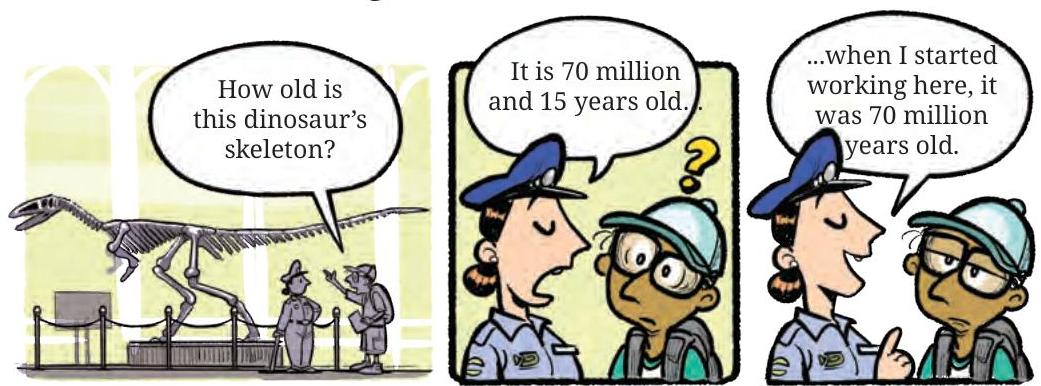
These values typically constitute rounded estimates, averages, or approximations; in most scenarios, they adequately fulfill the immediate requirement.
The distance separating the Sun and Saturn is 14,33,50,00,00,000 m = $1.4335 \times 10^{12}$ m.
The separation between Saturn and Uranus measures $1.439 \times 10^{12}$ m. The distance separating the Sun and Earth is $1.496 \times 10^{11}$ m.
? Among these three stated distances, which one is the smallest?

? The number line provided below illustrates the distance from the Sun to Saturn ($1.4335 \times 10^{12}$ m). Indicate the Earth's relative position on this number line. The Sun-Earth distance is $1.496 \times 10^{11}$ m.
? Convert the subsequent numerical values into standard scientific notation.
(i) 59,853 (ii) 65,950 (iii) 34,30,000 (iv) 70,04,00,00,000
Power Play
2.5 Did You Ever Wonder?
Our exploration of intriguing thought experiments from the 'Large Numbers' chapter continues from the previous year.
Nanjundappa intends to contribute jaggery equivalent to Roxie's mass and wheat equivalent to Estu's mass. He is contemplating the potential expense.
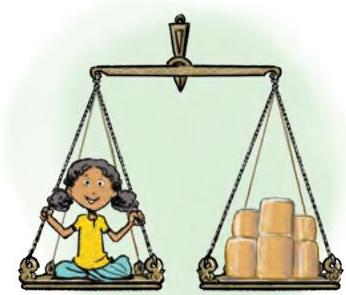
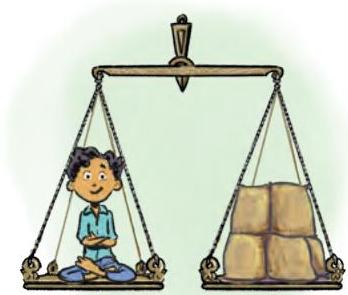
? What would be the monetary value (in rupees) of the donated jaggery? What would be the monetary value (in rupees) of the donated wheat?
To ascertain this, we must first delineate the interrelationships among the pertinent quantities.
Value of jaggery (in rupees) = Roxie’s weight in kg × cost of 1 kg jaggery. Value of wheat (in rupees) = Estu’s weight in kg × cost of 1 kg wheat.
? Formulate the necessary and justifiable assumptions for any unknown variables and subsequently determine the solutions. Recall that Roxie is 13 years old, and Estu is 11 years old.
Assuming Roxie's mass to be 45 kg and the price of 1 kg of jaggery to be ₹70, the value of the contributed jaggery amounts to 45 × 70 = ₹3150. Similarly, if Estu's mass is taken as 50 kg and the price of 1 kg of wheat is ₹50, the value of the contributed wheat is 50 × 50 = ₹2500.
The historical practice of donating commodities equivalent to an individual's body weight, known as
Tulābhāra or Tulābhāram, persists in numerous regions of Southern India. This act symbolizes devotion (bhakti), serving as an expression of gratitude, and concurrently offers support to the community.
? Roxie ponders, "If, instead of jaggery, we were to use 1-rupee coins, how many coins would be required to match my weight?" How might one go about determining this?
For inquiries of this nature, the following procedural steps are suggested for consideration.
Guessing: Formulate an initial, intuitive estimate of the potential outcome, without engaging in any preliminary calculations.
Calculation utilizing estimation and approximation —
(i) Articulate the interdependencies among the variables essential for deriving the solution. (ii) Institute plausible assumptions and approximations where requisite information is not readily available. (iii) Execute the computation to ascertain the answer (and assess the proximity of your initial guess).
? Would the quantity of coins be in the order of hundreds, thousands, lakhs, crores, or an even greater magnitude? Propose an instinctive estimation. ? Ascertain the answer by implementing the necessary and reasonable assumptions and approximations for the unknown factors. It is important to note that the objective is not an exact figure, but rather a reasonably close approximation.
How about measuring to find out the weight of a 1-rupee coin?

It is quite normal for your initial estimations to diverge significantly from the actual value; this is entirely acceptable. Proficiency in this skill will naturally enhance with repeated application across varied contexts. Engaging in processes of conjecture and approximation is instrumental in cultivating an intuitive understanding of numerical values and diverse magnitudes.
Estu asks, “What if we use 5-rupee coins or 10-rupee notes instead? How much money could it be?”
? Make an instinctive guess first. Then find out (make necessary and reasonable assumptions about the unknown details and find the answers).
Estu says, “When I become an adult, I would like to donate notebooks worth my weight every year”. Roxie says, “When I grow up, I would like to do annadāna (offering grains or meals) worth my weight every year”.
? How many people might benefit from each of these offerings in a year? Again, guess first before finding out.
Roxie and Estu chanced upon a conversation where an individual recounted, “We undertook a pādayātra covering approximately 400 km to arrive at this location! Our arrival occurred in the early hours of this morning.”
? How long ago would they have started their journey? ? Ascertain the solutions by formulating essential assumptions and approximations. Prioritize an initial estimation before undertaking calculations to evaluate the congruence of your conjecture.
Note to the Educator: The premises adopted can frequently exhibit substantial divergence, consequently leading to variability in the resultant computed answers. This outcome is entirely permissible. The judicious formulation of the situational model is paramount, an endeavor that can, at times, be approached through diverse methodologies. The precision of the posited numerical values or quantities is amenable to enhancement through sustained exposure and iterative practice.
Power Play
Pādayātra denotes the venerable custom of traversing extensive distances on foot, undertaken as an integral component of religious or spiritual endeavors. Adherents of diverse faiths within our nation engage in analogous forms of pilgrimage or spiritual perambulation, notwithstanding potential variations in nomenclature or underlying objectives.
Illustrative instances of such pilgrimages encompass the Ajmer Sharif Dargah Ziyarat, Pandharpur Wari, Kānwar Yatra, Sabarimala Yatra, Sammed Shikharji Yatra, and the journey from Lumbini to Sarnath.

Prior to the advent of contemporary transportation systems, human movement between locations was predominantly accomplished on foot. It was not uncommon for merchants, venerable sages, and erudite scholars to traverse distances spanning thousands of kilometers across diverse global topographies, including arid deserts, formidable mountains, and flowing rivers.
? Assuming continuous pedestrian locomotion, what is the maximum number of times an individual could circumnavigate (traverse the circumference of) the Earth within an average lifespan? For this calculation, consider the Earth's approximate equatorial circumference to be 40,000 km.
Linear Growth vs. Exponential Growth
Roxie recounts to Estu a science-fiction narrative she is reading, in which a ladder is constructed to reach the moon. She muses, “... I wonder if we actually had a ladder like that, how many steps would it have?”.
? What do you think? Make an instinctive guess first.
? Would the number of steps be in thousands, lakhs, crores, or even more?

To ascertain this, one would need to determine the interval separating successive rungs of the ladder. Let us posit a practical inter-step distance of 20 cm. When envisioning the scenario as depicted,
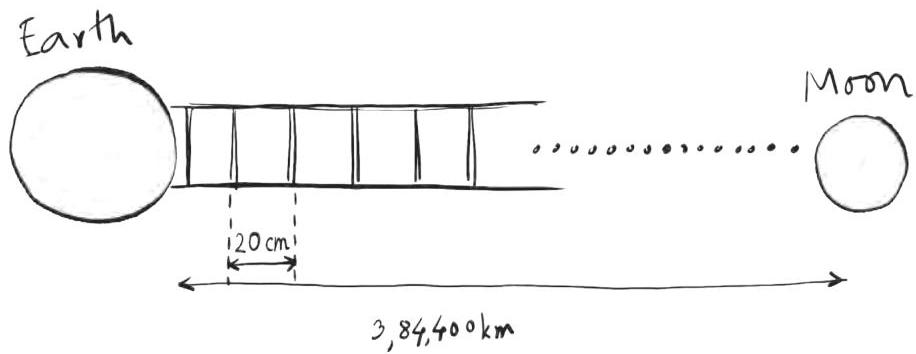
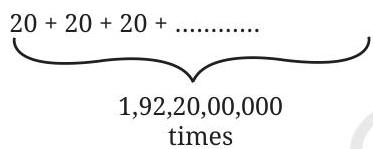
? We need to calculate how many segments of 20 cm constitute 3,84,400 km.
Upon performing this calculation, the outcome is 1,92,20,00,000 steps, which translates to 192 crore and 20 lakh steps, or 1 billion 922 million steps. This consistent increment in the distance from Earth with each step (an additional 20 cm gained per step) is termed linear growth.
To traverse the distance between the Earth and the Moon, a prodigious 1,92,20,00,000 steps are required under a linear growth model, whereas a mere 46 folds of a single sheet of paper suffice with exponential growth! Linear growth is characterized by addition, while exponential growth is defined by multiplication.
Prior instances of exponential growth examined within this chapter include 'The Stones that Shine', 'Magical Pond', and 'How Many Combinations'. Further compelling instances will be investigated in a subsequent chapter and in the curriculum for the next academic grade.
? Can you formulate some examples illustrating linear growth and exponential growth?
Getting a Sense for Large Numbers
In the preceding year, we familiarized ourselves with numerical denominations such as lakhs and crores, alongside millions and billions. Specifically, a lakh is equivalent to $10^{5}$ (1,00,000), a crore represents $10^{7}$ (1,00,00,000), and an arab denotes $10^{9}$ (1,00,00,00,000). Concurrently, a million is defined as $10^{6}$ (1,000,000), and a billion corresponds to $10^{9}$ (1,000,000,000).
While the approximate size of the global human populace is commonly known, have you ever contemplated the sheer number of ants across the planet or the temporal span since humanity's inception? This segment will delve into magnitudes considerably exceeding arabs and billions. Our approach will involve employing powers of 10 for the consistent representation and comparative analysis of these numerical quantities.
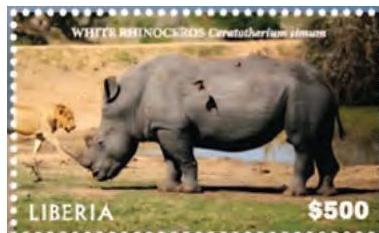
$10^{0}$ As of mid-2025, the worldwide count of northern white rhinos is limited to just two, both female, residing within Kenya's Ol Pejeta Conservancy ($= 2 \times 10^{0}$).
Power Play
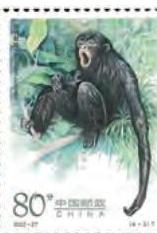
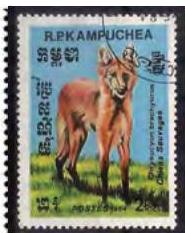
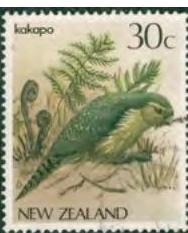
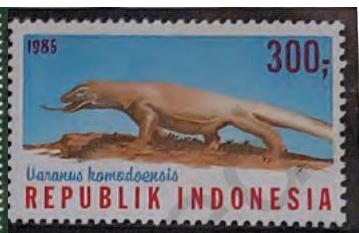
$10^{1}$ By early 2024, the collective populace of Hainan gibbons stood at a mere 42 individuals ($\approx 4 \times 10^{1}$). $10^{2}$ Only 242 Kakapo are recorded as living in mid-2025 ($\approx 2 \times 10^{2}$). $10^{3}$ The global population of Komodo dragons, exclusively found in Indonesia, is fewer than 3000 ($\approx 3 \times 10^{3}$). $10^{4}$ An assessment from 2005 indicated that the maned wolf population surpassed 17000, with the majority concentrated in Brazil ($1.7 \times 10^{4}$).
$10^{5}$ As of 2018, approximately 4.15 lakh African elephants were recorded ($\approx 4 \times 10^{5}$). $10^{6}$ The American alligator population is estimated at 50 lakh / 5 million by 2025 ($5 \times 10^{6}$). $10^{7}$ The worldwide camel population is projected to exceed 3.5 crore / 35 million ($3.5 \times 10^{7}$). India accounts for only about 2.5 lakhs of these. For horses, the global population stands around 5.8 crore / 58 million ($5.8 \times 10^{7}$), with roughly half residing in America. $10^{8}$ Over 20 crore / 200 million ($2 \times 10^{8}$) water buffaloes are estimated globally, predominantly located in Asia. $10^{9}$ The global starling population is estimated at approximately 1.3 arab / 1.3 billion ($1.3 \times 10^{9}$). By 2025, the world's human population is projected to be 8.2 arab / 8.2 billion ($8.2 \times 10^{9}$).
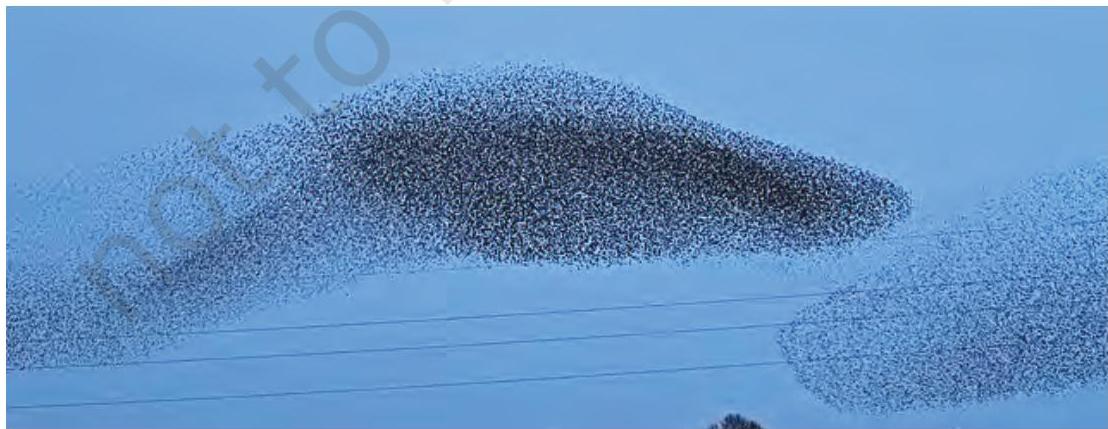 This image depicts a starling murmuration above a farm in the UK. A starling murmuration is a captivating aerial spectacle where thousands of starlings fly in synchronized, swirling formations. It is frequently characterized as a 'choreographed dance'.
? Given a global human population of approximately $8 \times 10^{9}$ and an African elephant population of about $4 \times 10^{5}$, is it
accurate to state that there are nearly 20,000 people for each African elephant?
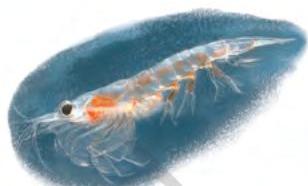
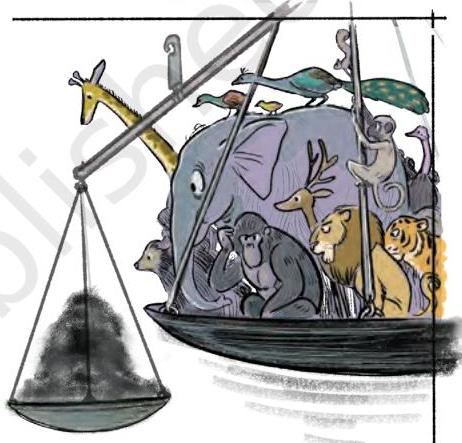
$10^{10}$ It is estimated that the global population of chickens alive at any given moment approximates $\approx 33$ billion ($3.3 \times 10^{10}$). $10^{12}$ Globally, the projected count of trees (as of 2023) reaches 30 kharab/3 trillion ($3 \times 10^{12}$). A single kharab corresponds to 100 arab, while one trillion equates to 1000 billion. $10^{14}$ Worldwide, the estimated number of mosquitoes (in 2023) totals 11 neel/110 trillion (______). Furthermore, an extrapolated figure for the Antarctic krill population indicates approximately 50 neel/500 trillion ($5 \times 10^{14}$). $10^{15}$ Estimates place the global beetle population at 1 padma/1 quadrillion ($1 \times 10^{15}$). Similarly, the earthworm population is also estimated to be approximately 1 padma/1 quadrillion. $10^{16}$ Globally, the ant population is estimated to comprise 20 padma/20 quadrillion ($2 \times 10^{16}$). Remarkably, the collective biomass of ants surpasses that of all wild avian and mammalian species combined.
$10^{21}$ The total quantity of sand grains across Earth's beaches and deserts is posited to be approximately $10^{21}$. This volume of sand would suffice to provide each individual ant with 10 miniature sand dwellings.
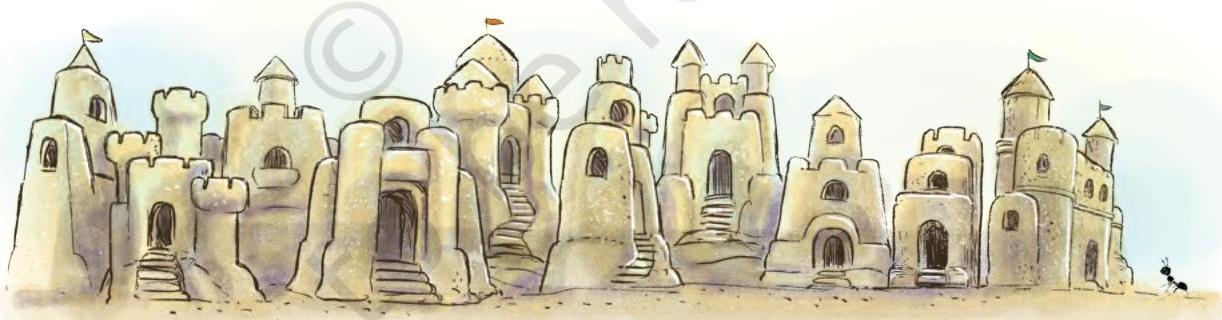
$10^{23}$ Within the observable universe, the estimated count of stars is approximately $2 \times 10^{23}$. $10^{25}$ Earth is estimated to contain $2 \times 10^{25}$ water droplets, based on an assumption of 16 drops per millilitre.
? Calculate and write the answer using scientific notation:
(i) How many ants are there for every human in the world? (ii) If a flock of starlings contains 10,000 birds, how many flocks could there be in the world?
Power Play
(iii) If each tree had about $10^4$ leaves, find the total number of leaves on all the trees in the world. (iv) If you stacked sheets of paper on top of each other, how many would you need to reach the Moon?
A different way to say your age!
"How old are you?" asked Estu. "I completed 13 years a few weeks ago!" said Roxie. "How old are you?" asked Estu again. "I'm 4840 days old today!" said Roxie. "How old are you?" asked Estu again. "I'm ______ hours old!" said Roxie. Make an estimate before finding this number. Estu: "I am 4070 days old today. Can you find out my date of birth?"
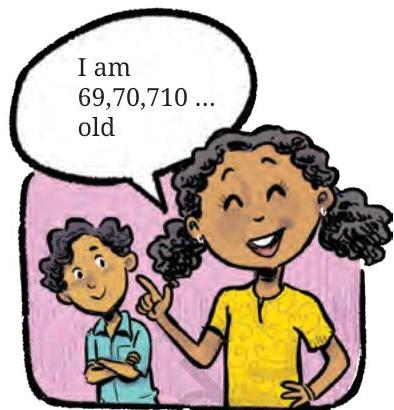 What could this number mean? Find out!
? If you have lived for a million seconds, how old would you be?
This section will explore the approximate durations and chronological sequences of various events and phenomena, employing powers of 10 for their representation and comparative analysis.
| Time in seconds | Comparison to real-world events/phenomena |
|---|---|
| $10^{0} = 1$ second | - The duration for an object projected vertically to return to its initial elevation (generally a few seconds). |
| $10^{1} = 10$ seconds | - The interval required for blood to perform a complete circuit through the circulatory system: 10–20 seconds ($1 \times 10^1 - 2 \times 10^1$ seconds). - Customary waiting period at a traffic light. |

It is indeed remarkable how estimations, such as the global ant population or the duration of complete blood circulation, can be derived. This sense of wonder can be retained when encountering similar data. Such estimations are commonly encountered in academic disciplines like Science and Social Science.
$10^{2}$ seconds $\approx 1.6$ minutes
- The interval required for preparing a cup of tea: 5–10 minutes ($\approx 4 \times 10^{2} - 8 \times 10^{2}$ seconds).
- The duration for solar light to traverse the distance to Earth: approximately 8 minutes ($\approx 5 \times 10^{2}$ seconds).

$10^{3}$ seconds $\approx 16.6$ minutes
- Satellites operating in low Earth orbits require between 90 minutes ($\approx 5.5 \times 10^{3}$ seconds) and 2 hours to accomplish a complete orbital circuit around the Earth.
$10^{4}$ seconds $\approx 2.7$ hours
- The duration typically required for meal digestion: approximately 2–4 hours for gastric transit.
- The approximate lifespan of a mature mayfly: roughly one day ($\approx 9 \times 10^{4}$ seconds).
? $10^{5}$ seconds $\approx 1.16$ days and $10^{6}$ seconds $\approx 11.57$ days. Think of some events or phenomena whose time is of the order of (i) $10^{5}$ seconds and (ii) $10^{6}$ seconds. Write them in scientific notation.
$10^{7}$ seconds $\approx 115.7$ days / $\approx 3.8$ months
- Annual sleep duration: approximately 4 months.
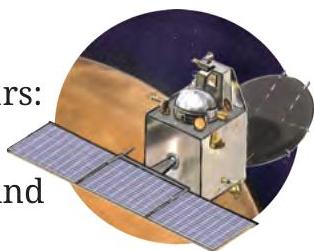
- The duration of the Mangalyaan mission's transit to Mars: 298 days ($\approx 2.65 \times 10^{7}$ seconds).
- The period for Mars to complete a single orbit around the Sun: 687 Earth-days/1.88 Earth-years ($\approx 6 \times 10^{7}$ seconds).
$10^{8}$ seconds $\approx 3.17$ years
- The characteristic lifespan for the majority of canine species ranges from 3 to 15 years.
$10^{9}$ seconds $\approx 31.7$ years
- Halley's comet possesses an orbital period of 75–79 years, with its subsequent predicted reappearance scheduled for the year 2061 ($\approx 2.4 \times 10^{9}$ seconds).
- The time required for Neptune to complete a single revolution around the Sun: 60,190 Earth-days/~165 Earth-years, or alternatively, 89,666 Neptunian days/1 Neptunian-year ($\approx 5.2 \times 10^{9}$ seconds). A Neptunian day spans approximately 16.1 hours.
Power Play
Observe the rapid nature of exponential growth—while $10^{6}$ seconds amounts to less than a fortnight, $10^{9}$ seconds constitutes a substantial 31 years, approximately half a typical human life expectancy.
$10^{10}$ seconds $\approx 317$ years
- The Chola dynasty maintained its rule for over 900 years (approximately $3 \times 10^{10}$ seconds) from the 3rd Century BCE to the 12th Century CE.
$10^{11}$ seconds $\approx 3,170$ years
- The estimated age of the oldest known living tree is about 5,000 years (roughly $1.57 \times 10^{11}$ seconds).
- The interval since the peak of the last ice age spans 19,000 to 26,000 years ago (approximately $6 \times 10^{11}$ seconds to $8.2 \times 10^{11}$ seconds).
$10^{12}$ seconds $\approx 31,700$ years
- Early Homo sapiens first emerged between 200,000 and 300,000 years ago (equating to about $7 \times 10^{12}$ to $9 \times 10^{12}$ seconds). The entire population at that period could have been accommodated within a large cricket stadium.
$10^{13}$ seconds $\approx 3.17$ lakh years
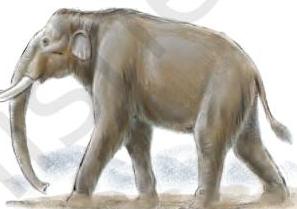
- The Steppe Mammoth is thought to have appeared approximately 800,000 to 1.8 million years ago.
$10^{14}$ seconds $\approx 3.17$ million years
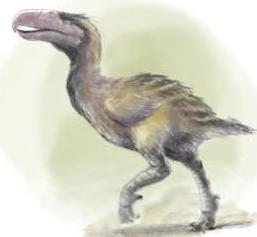
- A fossil of Kelenken Guillermoi, a species of terror bird, has been dated to 15 million years ago ($\approx$ ________ seconds).
$10^{15}$ seconds $\approx 3.17$ crore years
- The age of the Himalayas is 55 million years (or 5.5 crore years), which is approximately $1.7 \times 10^{15}$ seconds; these mountains continue to grow by a few millimeters annually.
- Dinosaurs became extinct 66 million years ago (6.6 crore years ago), corresponding to roughly $2 \times 10^{15}$ seconds.
- Dinosaurs initially appeared more than 200 million years ago (20 crore years ago), or about $6 \times 10^{15}$ seconds.
- The Sun completes one full orbit around the Milky Way in approximately 230 million years (23 crore years), which is roughly $7 \times 10^{15}$ seconds.
$10^{16}$ seconds $\approx 31.7$ crore years
$10^{17}$ seconds $\approx 3.17$ billion years
- Terrestrial plant life originated 470 million years ago (47 crore years ago) ($\approx$ __________ seconds).
- The earliest fossil evidence indicates that bacteria first emerged approximately 3.7 billion years ago.
- The Earth's age is estimated at 4.5 billion years.
- The Milky Way galaxy formed 13.6 billion years ago, and the universe itself originated 13.8 billion years ago.
It is notable that $10^{9}$ seconds is comparable to the duration of a human lifespan, whereas $10^{18}$ seconds ago, the universe, according to contemporary physics, did not exist. This demonstrates the capacity of exponential notation to represent extremely large quantities in a concise manner.
? Calculate and write the answer using scientific notation:
(i) If one star is counted every second, how long would it take to count all the stars in the universe? Answer in terms of the number of seconds using scientific notation. (ii) If one could drink a glass of water (200 ml) every 10 seconds, how long would it take to finish the entire volume of water on Earth?


Extremely large quantities frequently surpass our capacity for experience and understanding. To contextualize these, we can draw parallels and comparisons with magnitudes that are more familiar to us. This approach helps to convey the true scale of a particular number or measurement.
2.6 A Pinch of History
The Buddhist philosophical text, Lalitavistara, originating from the first century BCE, presents nomenclature for odd powers of ten, extending up to $10^{53}$. This enumeration is embedded within a discourse between the mathematician Arjuna and Prince Gautama, who would become the Bodhisattva.
"Hundred kotis are called an ayuta ($10^{9}$), hundred ayutas a niyuta ($10^{11}$), hundred niyutas a kankara ($10^{13}$), ..., hundred sarva-balas a visamjna-gati ($10^{47}$), hundred visamjna-gatis a sarvajna ($10^{49}$), hundred sarvajnas a vibhutangama ($10^{51}$), a hundred vibhutangamas is a tallakshana ($10^{53}$)."
Mahaviracharya's work, the Ganita-sara-sangraha, enumerates 24 distinct terms, corresponding to values up to $10^{23}$. Furthermore, an unnamed Jaina text, the Amalasiddhi, provides a comprehensive list assigning a unique name to each power of ten, reaching $10^{96}$ (dasha-ananta). The Pali grammar text by Kāccāyana extends this tradition, cataloging number-names up to $10^{140}$, referred to as asaṅkhyeya.
Power Play
In their formulation of large powers of ten, Jaina and Buddhist scriptures frequently employed foundational units such as sahassa (thousand) and koṭi (ten million). An illustrative example is prayuta ($10^{6}$), which would be expressed as dasa sata sahassa (ten hundred thousand).
Contemporary nomenclature exhibits parallels to this system, as demonstrated by the following:
| A hundred thousand is a lakh | 100 × 1000 = 1,00,000 | $10^2 \times 10^3 = 10^5$ |
|---|---|---|
| A hundred lakhs is a crore | 100 × 1,00,000 = 1,00,00,000 | $10^2 \times 10^5 = 10^7$ |
| A hundred crores is an arab | 100 × 1,00,00,000 = 1,00,00,00,000 | $10^2 \times 10^7 = 10^9$ |
| A hundred arab is a kharab | 100 × 1,00,00,00,000 = 1,00,00,00,00,000 | $10^2 \times 10^9 = 10^{11}$ |
Extending this sequence, one hundred kharab corresponds to a neel ($10^{13}$), one hundred neel to a padma ($10^{15}$), one hundred padma to a shankh ($10^{17}$), and one hundred shankh to a maha shankh ($10^{19}$).
Within the American/International numeral system, the conventions are as follows:
| A thousand thousand is a million | 1000 × 1000 = 1,000,000 | $10^3 \times 10^3 = 10^6$ |
|---|---|---|
| A thousand million is a billion | 1000 × 1,000,000 = 1,000,000,000 | $10^3 \times 10^6 = 10^9$ |
| A thousand billion is an trillion | 1000 × 1,000,000,000 = 1,00,000,000,000 | $10^3 \times 10^9 = 10^{12}$ |
Following this progression, a thousand trillion constitutes a quadrillion ($10^{15}$). This systematic nomenclature extends further. Note the sequence of terms: million ($10^{6}$), billion ($10^{9}$), trillion ($10^{12}$), quadrillion ($10^{15}$), quintillion ($10^{18}$), sextillion ($10^{21}$), septillion ($10^{24}$), octillion ($10^{27}$), nonillion ($10^{30}$), and decillion ($10^{33}$).
? What does the first part of each name denote?
The numerical value $10^{100}$ is commonly referred to as a googol. The approximate count of atoms within the observable universe ranges from $10^{78}$ to $10^{82}$. A googolplex is designated as 10ⁱᵍᵍᵍᵍ. The sheer magnitude of this number is exceedingly difficult to conceptualize.
India's highest-denomination currency note at present is 2000 rupees. Consider the highest denomination ever produced globally. The banknote with the largest numerical value ever printed was a unique note from Hungary in 1946, denominated at 1 sextillion pengő ($10^{21}$ or 1 milliard bilpengő); however, it was never circulated. In 2009, Zimbabwe issued a 100 trillion ($10^{14}$) Zimbabwean dollar note, which held an approximate value of $30 at its time of issuance.
Ganita Prakash | Grade 8
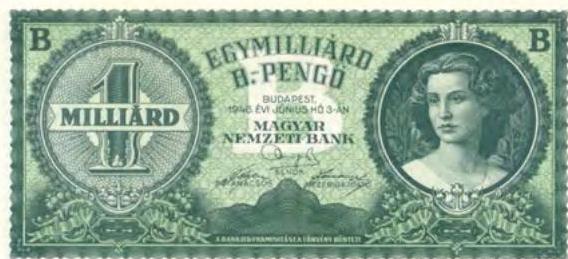
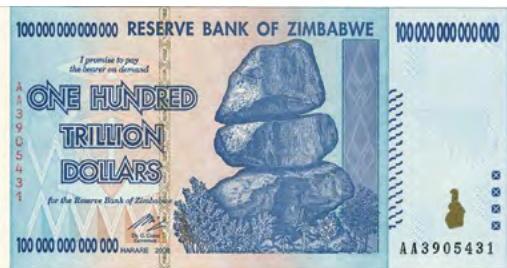
Figure it Out
Determine the digit in the units place when calculating the value of $2^{224} \div 4^{32}$. [Guidance: Note that $4 = 2^2$]
A container initially holds 5 bottles. If an additional container is introduced daily, how many bottles will accumulate after a period of 40 days?
Express each of the following numbers as a product involving two or more distinct powers, presenting three unique representations for each. The exponents utilized may be any integers.
(i) $64^3$
(ii) $192^8$
(iii) $32^{-5}$
- For each assertion provided below, ascertain whether it is 'Always True', 'Only Sometimes True', or 'Never True', and provide a comprehensive justification for your determination.
(i) Numbers that are perfect cubes are also perfect squares.
(ii) Numbers expressed as fourth powers are simultaneously perfect squares.
(iii) The result of raising a number to its fifth power is divisible by the cube of that same number.
(iv) The multiplication of two distinct cube numbers yields a resultant cube number.
(v) The expression $q^{46}$ represents both a fourth power and a sixth power, given that $q$ denotes a prime number.
- Reduce the following expressions to their simplest exponential form.
(i) $10^{-2} \times 10^{-5}$
(ii) $5^7 \div 5^4$
(iii) $9^{-7} \div 9^4$
(iv) $(13^{-2})^{-3}$
(v) $m^5 n^{12}(mn)^9$
- Given that $12^2 = 144$, ascertain the value of:
(i) $(1.2)^2$
(ii) $(0.12)^2$
(iii) $(0.012)^2$
(iv) $120^2$
Power Play
- Identify and encircle the numerical expressions that possess equivalent values from the list below:
$ 2^4 \times 3^6 $
$ 6^4 \times 3^2 $
$ 6^{10} $
$ 18^2 \times 6^2 $
$ 6^{24} $
- For each pair presented below, determine which number holds a greater magnitude:
(i) $4^3$ or $3^4$
(ii) $2^8$ or $8^2$
(iii) $100^2$ or $2^{100}$
A dairy operation intends to manufacture 8.5 billion milk packets within a single year. To assign a distinct identification code to each packet, and assuming only the digits 0 through 9 are available for use, what is the minimum number of digits required for each code?
The integer 64 is notable for being both a perfect square ($8^2$) and a perfect cube ($4^3$). Investigate whether additional numbers exist that exhibit this dual property of being simultaneously a perfect square and a perfect cube. Furthermore, formulate a general characterization for numbers possessing this attribute.
A digital locker employs an alphanumeric passcode of five characters in length, which permits the inclusion of both numerical digits and alphabetical letters. Illustrative examples of such codes include G89P0, 38098, BRJKW, and 003AZ. Determine the total quantity of distinct codes that can be generated under these conditions.
As of 2024, the global ovine (sheep) population is estimated to be approximately $10^9$, with the caprine (goat) population being of comparable magnitude. Calculate the aggregate population of sheep and goats combined.
(i) $20^9$ (ii) $10^{11}$ (iii) $10^{10}$ (iv) $10^{18}$ (v) $2 \times 10^9$ (vi) $10^9 + 10^9$
- Compute the following quantities and express each result using scientific notation:
(i) Assuming every individual globally possesses 30 articles of clothing, determine the cumulative quantity of clothing items.
(ii) Given approximately 100 million bee colonies worldwide, ascertain the total count of honeybees if each colony comprises roughly 50,000 bees.
(iii) Considering that the average human body contains approximately 38 trillion bacterial cells, calculate the aggregate bacterial population inhabiting all humans across the globe.
(iv) The cumulative duration, in seconds, dedicated to eating over an entire human lifespan.
- What was the date 1 arab/1 billion seconds ago?

Ganita Prakash | Grade 8
SUMMARY
- We engaged with various scenarios, formulated inquiries, and subsequently derived solutions. This process involved an initial estimation phase, followed by the development of a problem model, and finally, the application of assumptions and approximations to facilitate computational procedures.
- The distinction between exponential growth, also known as multiplicative growth, and additive growth was explored, highlighting the accelerated nature of the former.
- The expression $n^a$ denotes $n$ multiplied by itself $a$ times ($n \times n \times n \times \ldots \times n$), and its reciprocal form is given by $n^{-a} = \frac{1}{n^a}$.
- Exponentials adhere to the following operational rules:
- $n^a \times n^b = n^{a + b}$
- $(n^a)^b = (n^b)^a = n^{a \times b}$
- $n^a \div n^b = n^{a - b} \ (n \neq 0)$
- $n^a \times m^a = (n \times m)^a$
- $n^a \div m^a = (n \div m)^a \ (m \neq 0)$
- $n^0 = 1 \ (n \neq 0)$
- The scientific representation of the number 308,100,000 is $3.081 \times 10^{8}$. In its standard form, scientific notation for any number is expressed as $x \times 10^{y}$, with the condition that $x$ is greater than or equal to 1 and less than or equal to 10, and $y$ represents an integer.
- Employing compelling thought experiments serves as an effective methodology for comprehending the magnitude of a number or quantity.

Locate a companion to participate in this activity. Within a 10-second interval, the individual who constructs a number or an expression, utilizing solely the digits 0-9 and fundamental arithmetic operations, such that their resulting value surpasses that of their opponent, is declared the victor of the round.
10000000000000
999999 × 999999
During Round 1, Roxie presented the value 10,000,000,000,000, while Estu offered $999999 \times 999999$. Of these two, Roxie's value holds the greater magnitude. The reason for this is that Roxie's number corresponds to $10^{13}$, whereas Estu's expression evaluates to a value less than $(10^{6})^{2}$.
For Round 2, Roxie formulated $10^{1000} + 10^{1000} + 10^{1000} + 10^{1000}$, and Estu produced $(10^{1000000}) \times 9000$. Can you determine which of these holds the larger value?
$10^{1000} + 10^{1000} + 10^{1000}$
$10^{1000000000000000000000000000000000000000000000000000000000000000000}$
The subsequent list outlines several conditions that could be adopted for various iterations of the game.
(i) Exponents are prohibited; only addition operations are permitted. (ii) Exponents are disallowed; only addition and multiplication operations are permissible. (iii) Exponents are permitted; only addition operations are allowed. (iv) Exponents are permitted; all arithmetic operations are allowed.
Participants are encouraged to devise their own rulesets and/or expand the game to include additional players.