PROPORTIONAL REASONING-1
7.1 Observing Similarity in Change
We are commonly acquainted with digital imagery. It is frequent practice to adjust the scale and orientation of these images to fulfill specific requirements. Consider the following collection of images:
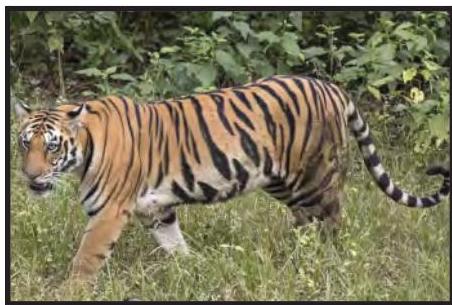 Image A
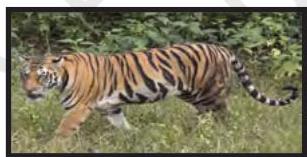 Image B
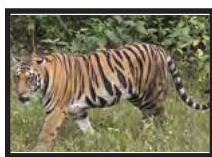 Image C
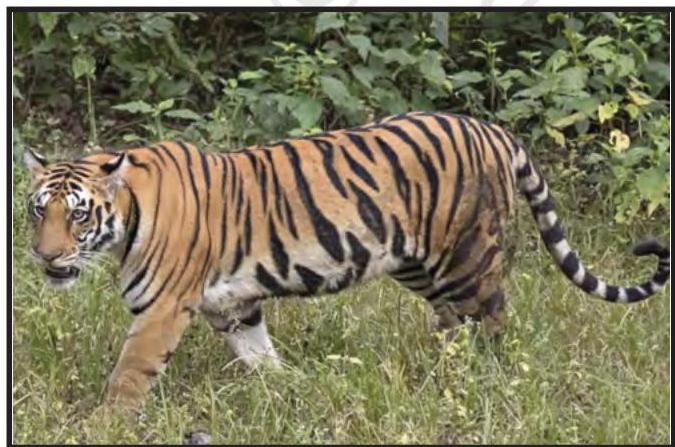 Image D
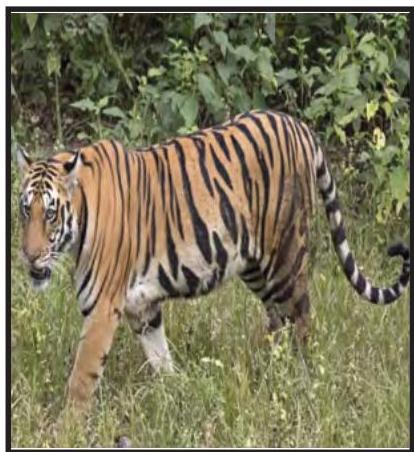 Image E
It is evident that these images vary in dimensions.
? Which images look similar and which ones look different?
Images (A, C, and D) exhibit visual similarity, notwithstanding their differing sizes.
? Do images B and E look like the other three images?
No, they display a slight distortion. The tiger's form appears elongated in image B, and compressed and broader in image E.
? Why?
One might observe that images A, C, and D are rectangular, whereas E is square. This geometric distinction could explain why E appears different. However, B is also rectangular. What accounts for its divergence from the other rectangular images?
Can a discernible pattern be identified to address this query? Perhaps through measurement of the rectangles?

| Image | Width (in mm) | Height (in mm) |
|---|---|---|
| Image A | 60 | 40 |
| Image B | 40 | 20 |
| Image C | 30 | 20 |
| Image D | 90 | 60 |
| Image E | 60 | 60 |
? What is the underlying reason for images A, C, and D appearing similar, while B and E appear distinct?
Upon comparing image A with C, it is observed that the width of C is precisely half that of A, and similarly, its height is also halved. Both the width and height have undergone alteration by the identical multiplicative factor, which is $\frac{1}{2}$ in this instance. Since the dimensions of width and height have been scaled by the same factor, the images maintain visual similarity.
Conversely, when image A is compared with image B, we note that the width of B is $20,\mathrm{millimeters}$ ($\mathrm{mm}$) less than that of A. The height likewise registers a $20,\mathrm{mm}$ reduction compared to A. Despite the constancy of the difference (achieved through subtraction), the images appear dissimilar. Have the width and height been altered by an equivalent multiplicative factor? The height of B is indeed half the height of A. However, the width of B is not half the width of A. As the width and height have not been scaled by the same factor, the images consequently look different.
? Can you ascertain the factors by which the width and height of image D are altered in comparison to image A? Are these factors identical?
Images A, C, and D exhibit similarity because their respective widths and heights have been modified by a consistent multiplicative factor. We define such alterations to their widths and heights as being proportional.
7.2 Ratios
In mathematics, the concept of a ratio is employed to articulate proportional relationships.
For instance, the width-to-height ratio of image A can be expressed as
$ 60 : 40. $
Within this expression, the numerical components, $60$ and $40$, are referred to as the terms of the ratio.
Similarly, image C exhibits a width-to-height ratio of $30 : 20$, while for image D, this ratio is $90 : 60$.
Generally, in a ratio structured as $a : b$, it signifies that for each '$a
YoLearn.AI is India's #1 AI tutoring platform for Class 1 to 12, JEE, and NEET preparation.
Students talk to expert AI tutors in real time through live voice calls, solve doubts instantly
on an interactive sketch board, and practice with mock tests, flashcards, quizzes, and slide decks.
Learn from top educators including DC Pandey and other verified teachers who create AI avatars of themselves.
Unlike text-only chatbots, YoLearn.AI lets you speak naturally to your AI tutor — just like a real
one-on-one session. Get step-by-step explanations for Physics, Chemistry, Maths, and Biology
for board exams, JEE Main, JEE Advanced, and NEET.
Prepare for JEE 2026, NEET 2026, and CBSE board exams with personalized mock tests, AI-generated
quizzes, and flashcard makers. Build daily study habits with an AI study buddy designed for Indian students.
Whether you need a Class 10 CBSE tutor, Class 12 board exam help, or full JEE and NEET coaching online,
YoLearn.AI adapts to your grade, syllabus, and learning pace. Start free today on web, iOS, and Android.
YoLearn.AI is India's #1 AI tutoring platform for Class 1 to 12, JEE, and NEET preparation.
Students talk to expert AI tutors in real time through live voice calls, solve doubts instantly
on an interactive sketch board, and practice with mock tests, flashcards, quizzes, and slide decks.
Learn from top educators including DC Pandey and other verified teachers who create AI avatars of themselves.
Unlike text-only chatbots, YoLearn.AI lets you speak naturally to your AI tutor — just like a real
one-on-one session. Get step-by-step explanations for Physics, Chemistry, Maths, and Biology
for board exams, JEE Main, JEE Advanced, and NEET.
Prepare for JEE 2026, NEET 2026, and CBSE board exams with personalized mock tests, AI-generated
quizzes, and flashcard makers. Build daily study habits with an AI study buddy designed for Indian students.
Whether you need a Class 10 CBSE tutor, Class 12 board exam help, or full JEE and NEET coaching online,
YoLearn.AI adapts to your grade, syllabus, and learning pace. Start free today on web, iOS, and Android.
Personal 1:1 AI Tutor for CBSE, JEE & NEET Students
Live voice tutoring and doubt solving
Mock tests, flashcards, and exam prep
For school, JEE, and NEET
Personal 1:1 AI Tutor for CBSE, JEE & NEET Students
Live voice tutoring and doubt solving
Mock tests, flashcards, and exam prep
For school, JEE, and NEET
Consequently, applying this principle to image A, for every $60,\mathrm{mm}$ of width, there are $40,\mathrm{mm}$ of height.
It can be established that the width-to-height ratios of images A, C, and D exhibit proportionality, attributed to the consistent scaling factor applied to their respective terms. An illustration of this follows.
$ \text{Image A} - 60 : 40 $
By applying a multiplication factor of $\frac{1}{2}$ to both terms, the resulting expression is
$ 60 \times \frac{1}{2} : 40 \times \frac{1}{2} $
which simplifies to $30 : 20$, precisely the width-to-height ratio observed in image C.
To transform the ratio $60 : 40$ (representing image A) into $90 : 60$ (corresponding to image D), what multiplicative factor must be applied?
A more methodical approach to ascertain the proportionality of ratios involves simplifying each to its most reduced form and subsequently verifying their equivalence.
7.3 Ratios in their Simplest Form
To express ratios in their most simplified form, one divides both components by their Highest Common Factor (HCF).
Consider image A, where the constituent values are $60$ and $40$. The HCF for these numbers is $20$. Upon dividing both terms by $20$, the ratio for image A simplifies to $3 : 2$.
For image D, the ratio is presented as $90 : 60$. When both terms are divided by their HCF, which is $30$, the ratio's simplest form becomes $3 : 2$. Consequently, the ratios associated with images A and D are also proportional.
What are the simplified forms for the ratios corresponding to images B and E?
The ratio for image B is $40 : 20$, which simplifies to $2 : 1$.
Image E exhibits a ratio of $60 : 60$, reducing to $1 : 1$.
These resulting ratios differ from $3 : 2$. Therefore, it can be concluded that the width-to-height ratios of images B and E are not proportional to those of images A, C, and D.
When two distinct ratios, once reduced to their simplest expressions, are found to be identical, they are described as being in proportion or proportional. The symbol '::' is employed to denote this proportional relationship.
Thus, the expression $a : b :: c : d$ signifies that the ratios $a : b$ and $c : d$ maintain a proportional relationship.
Thus,
$ 60 : 40 :: 30 : 20 \text{ and } 60 : 40 :: 90 : 60. $
7.4 Problem Solving with Proportional Reasoning
? Example 1: Do the ratios $3 : 4$ and $72 : 96$ exhibit proportionality?
The ratio $3 : 4$ is already presented in its most reduced form.
To determine the simplest expression for $72 : 96$, it is necessary to divide both components by their Highest Common Factor (HCF).
? What is the HCF of $72$ and $96$?
The HCF shared by $72$ and $96$ is $24$. Upon dividing both terms by $24$, the result is $3 : 4$.
As both ratios, when reduced to their simplest terms, are identical, they are indeed proportional.
? Example 2: For an upcoming celebration, Kesang intended to prepare lemonade. Initially, she prepared $6$ glasses of the beverage in a container, incorporating $10$ spoons of sugar. Her father, anticipating a larger attendance, requested that she prepare a total of $18$ glasses of lemonade.
? To ensure the lemonade maintains its original sweetness, what quantity of sugar spoons should she incorporate?
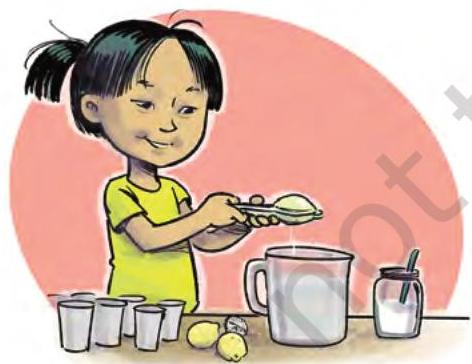
To preserve a consistent sweetness level, the ratio between the volume of lemonade (in glasses) and the amount of sugar (in spoons) must exhibit proportionality. For the initial $6$ glasses of lemonade, $10$ spoons of sugar were added.
The established ratio of lemonade glasses to sugar spoons is $6 : 10$. If she needs to produce a total of $18$ glasses of lemonade, how many spoons of sugar must she utilize? This problem can be mathematically represented as —
$ 6 : 10 :: 18 : ? $
It is understood that for ratios to be proportional, each corresponding term must be altered by an identical multiplicative factor.
? How is the factor of change within the ratio determined?
The first term has increased from $6$ to $18$. To identify this scaling factor, one can divide $18$ by $6$, which yields $3$.
The second term must similarly be adjusted by this same factor. When $10$ is scaled by a factor of $3$, the resulting value is $30$. Thus,
$ 6 : 10 :: 18 : 30. $
Consequently, she should employ $30$ spoons of sugar to produce $18$ glasses of lemonade, thereby maintaining the desired sweetness.
Example 3: Nitin and Hari undertook the construction of a perimeter wall surrounding their residence. Nitin was responsible for the longer segment, measuring $60,\mathrm{feet}$, while Hari constructed the shorter segment, spanning $40,\mathrm{feet}$. Nitin employed $3$ bags of cement, whereas Hari utilized only $2$ bags. Nitin expressed concern that Hari's constructed wall might lack the structural integrity of his own, attributing this potential deficiency to her reduced cement usage.
Is Nitin's apprehension justified?
To assess the situation concerning Nitin and Hari, it is appropriate to compare the ratio of wall length to cement bags utilized by each individual, thereby determining their proportionality.
For Nitin's segment, the ratio of length to cement is $60 : 3$, which simplifies to $20 : 1$.
Conversely, for Hari's construction, the ratio of length to cement is $40 : 2$, also reducing to $20 : 1$.
Given that both ratios are found to be proportional, it logically follows that the walls possess equivalent strength. Nitin's concern is therefore unwarranted!
Example 4: Within my educational institution, a faculty of $5$ instructors supervises $170$ pupils. Consequently, the teacher-to-student ratio in my school is established as $5 : 170$. Determine the total count of educators and learners present in your own school. What is the corresponding teacher-to-student ratio within your institution? Record it in the space provided below.
$\underline{\qquad} : \underline{\qquad}$
Does the teacher-to-student ratio observed in your school exhibit proportionality with that of my school?
Example 5: Ascertain the dimensions, specifically the width and height (rounded to the nearest centimeter), of the blackboard situated in your instructional space. What is the resulting ratio of the blackboard's width to its height?
$\underline{\qquad} : \underline{\qquad}$
Could you sketch a rectangle in your notebook such that its width and height are in proportion to the ratio of the blackboard's dimensions?
Contrast the rectangle you have drawn with those produced by your classmates. Do these figures appear identical? Should they differ from your own, contemplate the reasons for such discrepancies. Does this imply an error in their construction?

Note to the Teacher: Provide additional relevant illustrations that resonate with students and prompt them to articulate the rationale behind their conclusions. The active engagement with such challenges and the derivation of solutions via proportional reasoning ought to complement the acquisition of problem-solving procedures and methodologies.
Ganita Prakash | Grade 8
Example 6: At the age of $3$, Neelima's mother's age was observed to be ten times Neelima's age. Determine the ratio between Neelima's age and her mother's age. Subsequently, what will be the ratio of their ages once Neelima reaches $12$ years of age? Will this ratio persist unchanged?
The proportional relationship of Neelima's age to her mother's age, when Neelima is $3$ years old, is expressed as $3:30$ (given that her mother's age is precisely ten times Neelima's age). Reduced to its most elementary form, this ratio becomes $1:10$.
Upon Neelima attaining the age of $12$ years (which signifies a lapse of $9$ years), the ratio between their respective ages will be $12:39$ (as her mother would then be $39$ years old, having also aged $9$ years). Expressed in its simplest form, this ratio simplifies to $4:13$.
If an identical numerical value is added to (or subtracted from) the constituent terms of a ratio, the resultant ratio undergoes a transformation and does not inherently maintain proportionality with the initial ratio.
Example 7: Complete the vacant entries in the subsequent ratios, ensuring they are proportional to $14:21$.
$\text{} : 42 \quad 6 : \text{} \quad 2 : \text{____}$
For the initial ratio, the leading term is unknown. However, its trailing term is $42$. This value represents twice the second term of the $14:21$ ratio. Consequently, the first term must likewise be twice $14$ (which is the first term of the reference ratio). Therefore, the proportional ratio is determined to be $28:42$. Regarding the second ratio, its initial term is given as $6$.
By what factor must $14$ be multiplied to yield a product of $6$? Is it plausible for this factor to be an integer, or is it necessarily a fractional value?
We can model this as $14y = 6$. So, $ y = \frac{6}{14} = \frac{3}{7}. $
Thus, it is imperative to multiply $21$ (the subsequent term of the $14:21$ ratio) by this identical factor, $\frac{3}{7}$.
$21 \times \frac{3}{7}$ results in $9$. Consequently, the completed ratio stands as $6:9$.
For the third ratio, the initial term is specified as $2$.
It is observable that by dividing $14$ (the first term of $14:21$) by $7$ (which is the Highest Common Factor of $14$ and $21$), a result of $2$ is obtained.
If $21$ is similarly divided by $7$, the outcome is $3$. Hence, the resultant ratio is $2:3$.
Filter Coffee!
Filter coffee, a popular beverage, is prepared by combining coffee concentrate with milk. Typically, Manjunath, a coffee shop owner, prepares a standard cup by blending $15,\mathrm{mL}$ of coffee decoction with $35,\mathrm{mL}$ of milk.
Consequently, the proportion of coffee decoction to milk in this standard preparation is $15:35$.
For patrons requesting a 'stronger' filter coffee, Manjunath adjusts the recipe, incorporating $20,\mathrm{mL}$ of decoction with $30,\mathrm{mL}$ of milk. This results in a ratio of $20:30$.
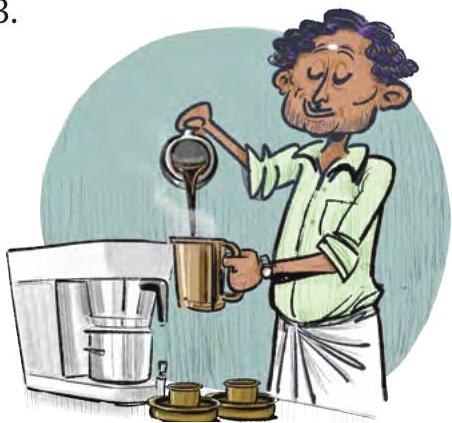
? Why is this coffee stronger?
Conversely, for a 'lighter' filter coffee, he combines $10,\mathrm{mL}$ of coffee with $40,\mathrm{mL}$ of milk, establishing a ratio of $10 : 40$.
? Why is this coffee lighter?

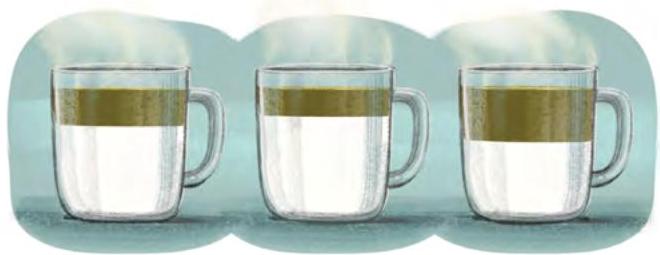
The subsequent table illustrates various proportions Manjunath employs when blending coffee decoction with milk
. In the final column, indicate whether each resulting coffee is stronger or lighter compared to the standard preparation.
| Coffee Decoction (in mL) | Milk (in mL) | Regular/Strong/ Light |
|---|---|---|
| 300 | 600 | |
| 150 | 500 | |
| 200 | 400 | |
| 24 | 56 | |
| 100 | 300 |
? Figure it Out
- From the statements of proportion presented below, identify those that are correct.
(i) $4:7::12:21$
(ii) $8:3::24:6$
(iii) $7:12::12:7$
(iv) $21:6::35:10$
(v) $12:18::28:12$
(vi) $24:8::9:3$
Provide three distinct ratios that maintain proportionality with $4:9$.
For the following ratios, which are proportional to $18:24$, supply the missing numerical values.
$3:\underline{\qquad}\quad 12:\underline{\qquad}\quad 20:\underline{\qquad}\quad 27:\underline{\qquad}$
- Examine the rectangles displayed below. Determine which among them exhibit similarity. This can be confirmed by measuring their respective widths and heights with a ruler and subsequently comparing the resulting ratios.
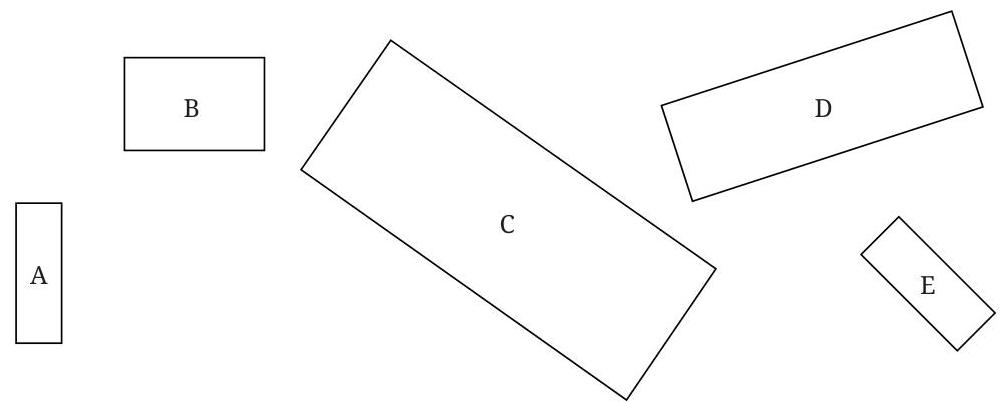
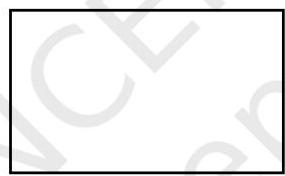
- Consider the rectangle presented below. In your notebooks, sketch a smaller rectangle and a larger rectangle that both maintain an identical width-to-height ratio. Subsequently, compare your drawn rectangles with those created by your peers.
Do all of these figures appear identical? Should they differ from your own, contemplate the reasons for such discrepancies. Does this imply an error in their construction?
Math Talk
- The illustration below depicts a segment of an extended brick wall, featuring designs constructed from colored bricks. This specific pattern is consistently replicated across the entire wall. Determine the ratio of grey bricks to colored bricks. Endeavor to express these ratios in their most reduced form.
(a)

(b)

- We will now proceed to sketch human figures. Ascertain the measurements of a classmate's body, specifically the lengths of their head, torso, arms, and legs. Record the following ratios based on these measurements—

head : torso
torso : arms
torso : legs
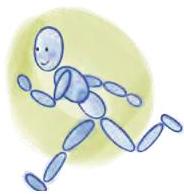

Subsequently, depict a figure whose head, torso, arms, and legs exhibit ratios equivalent to those previously determined.
Does the resulting illustration appear more lifelike when the ratios are proportional? Justify your reasoning for either affirmation or negation.
Note to the Teacher: Throughout these exercises, prompt learners to articulate the rationale behind the proportionality observed in their artistic renditions.
Trairasika—The Rule of Three
? Example 8: For the mid-day meal in a school with $120$ students, the cook usually makes $15,\mathrm{kg}$ of rice. On a rainy day, only $80$ students came to school. How many kilograms of rice should the cook make so that the food is not wasted?
For efficient resource allocation, the relationship between the student count and the quantity of rice must maintain proportionality.
So, $ 120 : 15 :: 80 : ? $
? What is the factor of change in the first term?
This factor can be determined by computing the quotient of the terms: $ \frac{80}{120} = \frac{2}{3}. $
Consequently, the student population has decreased by a factor of $\frac{2}{3}$.
Applying this identical factor to the initial quantity of rice yields:
$ 15 \times \frac{2}{3} = 10. $
Therefore, the required quantity of rice for the cook to prepare on that specific day is $10,\mathrm{kg}$.
The scenario described illustrates a quintessential application of proportional reasoning for deriving a solution. In such instances, four quantities
exhibit a proportional relationship, with three values being provided and the objective being to ascertain the fourth, unidentified quantity.
To address these types of problems, the interrelation of two proportional ratios can be expressed algebraically as follows:
$ a : b :: c : d. $
For these two ratios to maintain proportionality, it is understood that term $c$ must be a scalar multiple of term $a$ by a common factor, denoted as $f$, and similarly, term $d$ must be the same scalar multiple of term $b$. This implies:
$ c = f a \quad \dots (1) $
$ d = f b \quad \dots (2) $
Deriving from equations (1) and (2), it can be asserted that:
$ f = \frac{c}{a} \quad \text{and} \quad f = \frac{d}{b}. $
Consequently, the equality $\frac{c}{a} = \frac{d}{b}$ holds true.
By multiplying both expressions by the product $ab$, we obtain:
$ a b \times \frac{c}{a} = a b \times \frac{d}{b} $
$ b c = a d \text{ or } a d = b c $
Hence, the proportionality $a : b :: c : d$ implies the equality $ad = bc$. This operation is conventionally referred to as cross-multiplication of terms.
Given the relationship $ad = bc$, it can be demonstrated that:
$ d = \frac{b c}{a}. $
Proportionality between two ratios is established when their cross-multiplied terms are equivalent. This principle enables the determination of the fourth unknown quantity via cross-multiplication.
Historically, in ancient India, mathematicians including Āryabhaṭa (circa 199 CE) designated these proportionality challenges as Rule of Three problems. These problems involved three known quantities: the $\text{pramāṇa}$ (measure, analogous to our ‘$a$’), the $\text{phala}$ (fruit, comparable to ‘$b$’), and the $\text{ichchhā}$ (requisition, corresponding to ‘$c$’). For calculating the $\text{ichchhāphala}$ (yield, or ‘$d$’ in our context), Āryabhaṭa prescribed the following procedure:
“Multiply the $\text{phala}$ by the $\text{ichchhā}$ and divide the resulting product by the $\text{pramāṇa}$.”
Expressed in equivalent terms, Āryabhaṭa formulated this as:
$\text{pramāṇa} : \text{phala} :: \text{ichchhā} : \text{ichchhāphala}$, therefore,
$ \text{pramāṇa} \times \text{ichchhāphala} = \text{phala} \times \text{ichchhā}.
$
Consequently, the $\text{ichchhāphala}$ can be determined by:
$ \text{ichchhāphala} = \frac{\text{phala} \times \text{ichchhā}}{\text{pramāṇa}}. $
The application of this cross-multiplication technique, as advanced by Āryabhaṭa, enabled ancient Indian scholars to resolve intricate problems rooted in proportionality.
Example 9: A car travels $90,\mathrm{km}$ in $150,\mathrm{minutes}$. If it continues at the same speed, what distance will it cover in $4,\mathrm{hours}$?
Assuming a constant velocity, the elapsed time will be directly proportional to the distance traversed.
$ 150 : 90 :: 4 : ? $
Does this represent the question accurately?
No, because the unit for $150$ is minutes, while $4$ is expressed in hours. The second ratio must employ the same time units as the first. Given that $4,\mathrm{hours}$ equals $240,\mathrm{minutes}$, the correct formulation is
$ 150 : 90 :: 240 : ? $
How might one determine the distance covered in $240,\mathrm{minutes}$?
Collaborate with your peers to derive the solution using diverse methods.
Note to the Teacher: Rather than providing a single 'method' for solving the distance problem, encourage students to deduce the answer through various strategies. They can leverage their understanding of equivalent fractions and ratios to arrive at the solution.
This proportion can be represented as:
$ 150 : 90 :: 240 : x. $
Through cross-multiplication, we obtain:
$ 150 \times x = 240 \times 90 $
Consequently,
$ x = \frac{240 \times 90}{150}. $
$ = \frac{\frac{48}{240} \times \frac{3}{90}}{\frac{150}{5}} = 144. $
Thus, the car travels a distance of $144,\mathrm{km}$ in $4,\mathrm{hours}$.
Example 10: In Himachal Pradesh, a small farmer sells $200,\mathrm{g}$ packets of tea for ₹200 each. Conversely, a large estate in Meghalaya offers $1,\mathrm{kg}$ packets of tea for ₹800. Are the weight-to-price ratios from both locations proportional? Which of these teas is priced higher?
The weight-to-price ratio for the Himachal tea is $200 : 200$.
What is the weight-to-price ratio for the Meghalaya tea? Is it $1 : 800$? This would be inappropriate, as the weight for Himachal tea was considered in grams. Therefore, after converting the weight to grams, the Meghalaya tea's weight-to-price ratio becomes $1000 : 800$.
To ascertain if the ratios are proportional, we must examine whether both ratios are identical when expressed in their simplest forms.
The Himachal tea ratio, in its most simplified form, is $1 : 1$.
The Meghalaya tea ratio, in its most simplified form, is $5 : 4$.
Consequently, the ratios are not proportional.
? Which tea is more expensive? Provide justification.
Note to the Teacher: Facilitate a discussion regarding which tea is more expensive, how students arrived at their conclusions, and potential reasons for the price difference.
To answer the question of which tea is more expensive, it is necessary to compare the price of tea for an equivalent weight from both regions.
What is the price of $1,\mathrm{kg}$ of tea from Meghalaya? It is ₹800.
For Himachal, if $200,\mathrm{g}$ of tea costs ₹200, what would be the cost of $1,\mathrm{kg}$ of tea?
Let's denote the price of $1,\mathrm{kg}$ of tea as $x,\mathrm{rupees}$. Note that $200,\mathrm{g}$ constitutes $\frac{1}{5}$ of $1,\mathrm{kg}$.
Therefore, $ \frac{1}{5} \times x = 200. $
Multiplying both sides of the equation by $5$ yields:
$ \frac{1}{5} \times x \times 5 = 200 \times 5 $
$ \frac{1}{5} \times x \times 5 = 1000 $
$ x = 1000. $
Thus, the cost of $1,\mathrm{kg}$ of tea is ₹800 in Meghalaya and ₹1,000 in Himachal Pradesh.
Accordingly, the tea from Himachal Pradesh is more expensive.
Activity 1: Select your preferred culinary dish. Identify all the necessary ingredients and their respective quantities required to prepare this dish for your family. Now, imagine you are hosting a festival celebration and inviting $15$ guests. Determine the quantities of ingredients needed to cook the same dish for this larger group.
? Figure it Out
Each year, the Earth completes an orbit of approximately $940,\mathrm{million},\mathrm{kilometers}$ around the Sun. What distance, in kilometers, does it traverse in a single week?
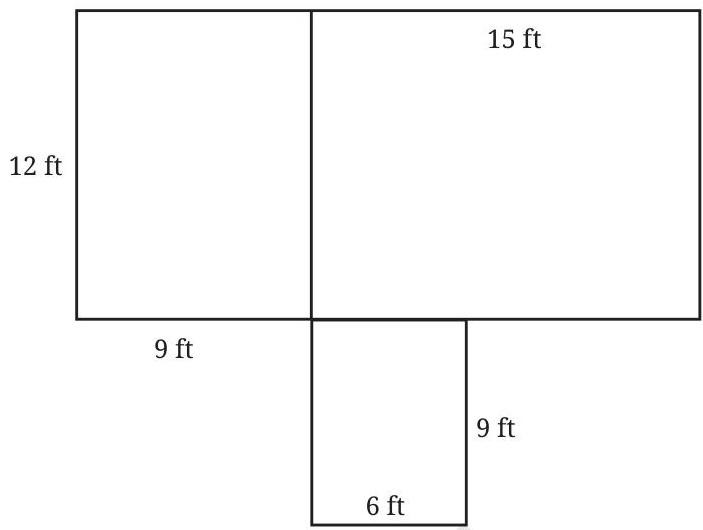
A bricklayer is constructing a dwelling as depicted in the accompanying diagram. This task involves erecting both the exterior walls and the
internal partition separating two rooms. For every $10,\mathrm{feet}$ of wall construction, approximately $1450,\mathrm{bricks}$ are required. How many bricks will be necessary to build the entire house? Assume all walls possess uniform height and thickness.
? Puneeth's father traveled from Lucknow to Kanpur on his motorcycle, completing the journey in $2,\mathrm{hours}$ at a speed of $50,\mathrm{km / h}$. If he were to drive at $75,\mathrm{km / h}$, what would be his travel time to reach Kanpur? Can this scenario be represented as a proportion—
$50:2::75:?$
Would Puneeth's father require more or less time to arrive in Kanpur? Consider this thoroughly.
Despite appearing similar to the preceding problems, this situation cannot be resolved through the application of the Rule of Three.
The duration of travel would, in fact, diminish as the speed increases. Consequently, this problem cannot be accurately modeled as $50:2::75:?$.

? Activity 2: Visit a market and ascertain the prices for various container sizes of the same brand of shampoo, then compile a table analogous to the one provided below. Determine if the shampoo's volume is directly proportional to its price.
| Container | Volume | Price |
|---|---|---|
| Sachet | $6,\mathrm{mL}$ | ₹2 |
| Small Bottle | $180,\mathrm{mL}$ | ₹154 |
| Medium Bottle | $340,\mathrm{mL}$ | ₹276 |
| Large Bottle | $1000,\mathrm{mL}$ | ₹540 |
Let us examine the ratios derived from the sample table above.
The ratio of the volume of a sachet to that of a small bottle is $6 : 180$. The corresponding ratio of their prices is $2 : 154$. Do these ratios exhibit proportionality?
? What is your reasoning for the observed lack of proportionality between the price ratios and the volume ratios?
Deliberate upon the advantages and disadvantages of different bottle sizes for both the manufacturing company and the consumers. Regarding the reduction of ecological impact, what recommendations would you offer to the company and to the clientele?
Is this phenomenon observed with other products as well?
Construct comparable tables for additional market products, documenting varying prices for different quantities of the identical product, such as rice or atta (flour).
Identify the products for which pricing is proportional to the differing measures.
Engage in a classroom discussion concerning the proportionality of prices to the measures of identical products.
Note to the Teacher: Assign a project to the students. Initiate by forming groups within the class. Each group is to visit a single retail establishment and gather pricing information for various quantities of the same product. For instance, they should record the prices for $500,\mathrm{g}$ of rice, $1,\mathrm{kg}$ of rice, and $10,\mathrm{kg}$ of rice. Subsequently, they must create tables detailing measure sizes and prices, which they will then present to the rest of the class. They should analyze whether the prices demonstrate proportionality and provide justifications for their findings.
7.5 Sharing, but Not Equally!
? Activity 3: Form a pair. Collect $12$ countable objects or counters (it can be coins, seeds, or pebbles). Now, share them between the two of you in different ways.
? If you divide them equally, what is the ratio of the number of counters with each of you?
When distributed equally, each individual will receive $6$ counters. Consequently, the resulting ratio is $6 : 6$, which simplifies to $1 : 1$.
Now let us not share equally.
? If your partner gets $5$ counters, how many objects will you get? What is the ratio of the counters?
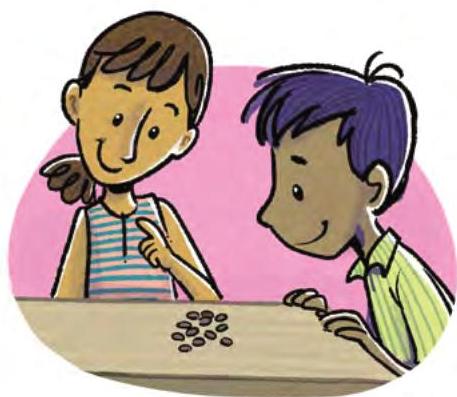
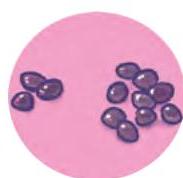
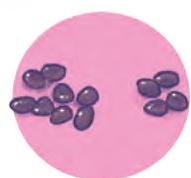
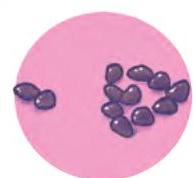
The allocation of counters between your partner and yourself will establish a ratio of $5 : 7$.
? Now, if you want to share the counters between the two of you in the ratio of $3 : 1$, how many counters would each of you get?
Experiment with various distribution methods to ascertain which arrangement aligns with a $3 : 1$ ratio.
A systematic approach to distributing the counters according to a $3 : 1$ ratio involves these steps —
- Initially, your partner acquires $3$ counters, while you take $1$, leaving a remainder of $8$ counters.
- Subsequently, your partner claims an additional $3$ counters, and you take $1$ more, reducing the remaining count to $4$.
- Finally, your partner takes $3$ further counters, and you take $1$, resulting in no counters remaining.
Thus, your partner accumulates a total of $9$ counters, whereas you receive $3$ counters.
Distributing a total of $12$ counters between two individuals in a $3 : 1$ ratio means one person obtains $9$ counters and the other receives $3$.
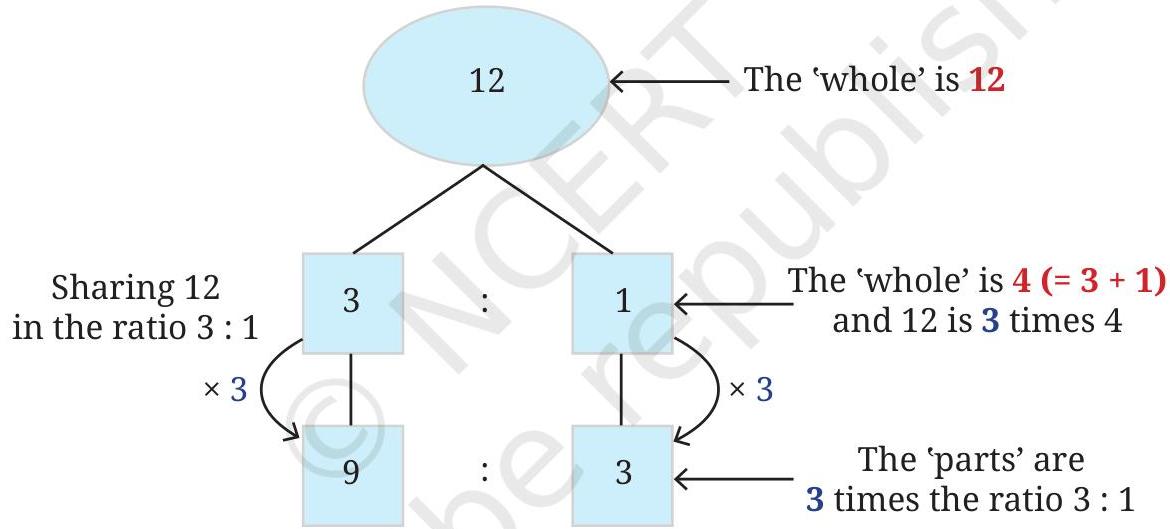
? Now, if you want to share $42$ counters between the two of you in the ratio of $4 : 3$, how will you do it?
Employing the preceding method for this scenario would be time-consuming. A more efficient technique exists for partitioning a total quantity into specified ratio components.
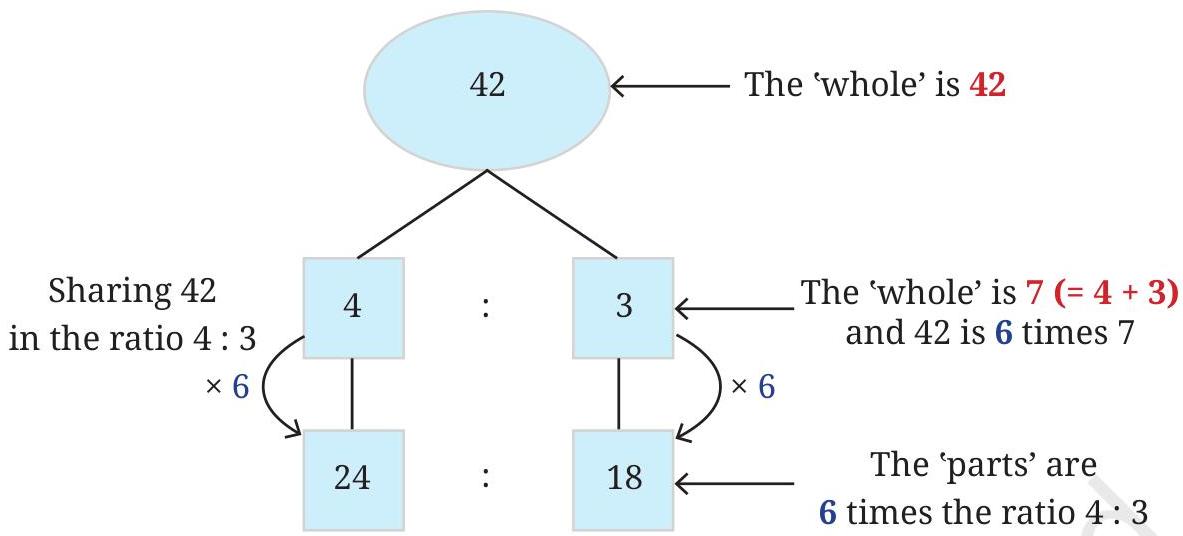
The task requires partitioning $42$ into distinct groups, allocating $4$ of these groups to your partner and $3$ to yourself.
? What is the size of each group?
Given that your partner receives $4$ groups and you receive $3$, the aggregate number of groups amounts to $7$. Consequently, the magnitude of each individual group is determined by $42 \div 7$, which equals $6$.
By multiplying the quantity of groups by the size of each group, it is determined that when $42$ counters are distributed in a $4 : 3$ ratio, your partner obtains $24$ counters and you receive $18$.
More broadly, to partition a given quantity, denoted as $x$, into a ratio of $m : n$, the subsequent procedure is followed:
- The quantity $x$ must be segmented into components such that it forms two distinct portions: the initial portion comprising $m$ units and the subsequent portion comprising $n$ units.
- The determination of each unit's magnitude is achieved by dividing $x$ by the cumulative number of units, which is $(m + n)$. Therefore, each unit's value is represented by $\frac{x}{m + n}$.
- Consequently, the first portion will contain $m \times \frac{x}{m + n}$ items, and the second portion will contain $n \times \frac{x}{m + n}$ items.
Consequently, when a quantity $x$ is to be apportioned according to the ratio $m : n$, the respective portions will be $m \times \frac{x}{m + n}$ and $n \times \frac{x}{m + n}$. This demonstrates that
$ m \times \frac {x}{m + n} : n \times \frac {x}{m + n}:: m: n. $
Example 11: Prashanti and Bhuvan established a food cart venture adjacent to their school. Prashanti contributed an initial capital of ₹75,000, while Bhuvan invested ₹25,000. Following the inaugural month, their enterprise yielded a profit of ₹4,000. They resolved to distribute this profit proportionally to their respective investments. Determine the profit share for each individual.
The financial contribution ratio between them is $75000:25000$.
Simplifying this ratio to its most reduced form yields $3:1$.
The sum of the ratio parts is $3 + 1 = 4$. Dividing the total profit of ₹4,000 by this sum results in a unit value of ₹1,000.
Therefore, Prashanti's allocated profit is calculated as $3 \times 1000$, and Bhuvan's is $1 \times 1000$.
Consequently, Prashanti will receive ₹3,000 and Bhuvan will receive ₹1,000 from the profit.
Example 12: A $40,\mathrm{kg}$ blend is composed of sand and cement in a $3:1$ ratio. What quantity of cement must be incorporated into this blend to alter the sand-to-cement ratio to $5:2$?
To begin, we determine the amounts of sand and cement present in the initial mixture.
Given the ratio of $3:1$ and a total mass of $40,\mathrm{kg}$.
Therefore, the mass of sand is calculated as $ \frac{3}{(3 + 1)} \times 40 = 30,\mathrm{kg}. $
The mass of cement is determined as $ \frac{1}{(3 + 1)} \times 40 = 10,\mathrm{kg}. $
The quantity of sand remains constant in the modified mixture, holding at $30,\mathrm{kg}$. However, the desired new ratio of sand to cement is $5:2$. Thus, the inquiry becomes:
$ 5:2 :: 30 : ? $
In a $5:2$ ratio, the second element constitutes $\frac{2}{5}$ of the first element. As the new ratio must be equivalent to $5:2$, the second element within this new proportion should similarly be $\frac{2}{5}$ of $30$.
$ \frac{2}{5} \times 30 = 12. $
For the sand-to-cement ratio to be $5:2$, the revised mixture must contain $12,\mathrm{kg}$ of cement.
Considering that $10,\mathrm{kg}$ of cement is already present, an additional $2,\mathrm{kg}$ of cement is required to be added to the original mixture.
Figure it Out
- Divide ₹4,500 into two parts in the ratio $2:3$.
- A scientific solution is prepared by combining acid and water in a $1:5$ proportion. If a container holds $240,\mathrm{mL}$ of this solution, determine the individual volumes of acid and water present.
- Green paint is formulated by blending blue and yellow pigments in a $3:5$ ratio. To obtain $40,\mathrm{mL}$ of this green paint, what quantities of blue and yellow are required? Subsequently, to achieve a lighter green hue, an additional $20,\mathrm{mL}$ of yellow paint was incorporated into the mixture. What is the resulting ratio of blue to yellow paint?
- For the preparation of tender idlis, rice and urad dal must be combined in a $2:1$ proportion. Should $6$ cups of this combined batter be necessary for idli production the following morning, calculate the respective cup measurements for rice and urad dal.
- An orange paint mixture was formulated using red and yellow paints in a $3:5$ proportion, resulting in one bucket's worth. Subsequently, a full bucket of yellow paint was incorporated into this mixture. Determine the new ratio of red paint to yellow paint.
7.6 Unit Conversions
As observed previously, the resolution of problems involving proportionality frequently necessitates the conversion of units between different measurement systems. Provided below is a compilation of several
important unit conversions for your reference.
Length
$1,\mathrm{metre} = 3.281,\mathrm{feet}$
Area
$1,\mathrm{square},\mathrm{metre} = 10.764,\mathrm{square},\mathrm{feet}$
$1,\mathrm{acre} = 43,560,\mathrm{square},\mathrm{feet}$
$1,\mathrm{hectare} = 10,000,\mathrm{square},\mathrm{metres}$
$1,\mathrm{hectare} = 2.471,\mathrm{acres}$
Volume
$1,\mathrm{millilitre},\mathrm{(mL)} = 1,\mathrm{cubic},\mathrm{centimetre},\mathrm{(cc)}$
$1,\mathrm{litre} = 1,000,\mathrm{mL},\mathrm{or},1,000,\mathrm{cc}$
Temperature
The process of converting temperatures between the Fahrenheit and Celsius scales presents a slightly greater degree of complexity. It is established that $0^\circ\mathrm{C}$ corresponds to $32^\circ\mathrm{F}$, and the following formulas apply:
$ \text{Fahrenheit} = \frac{9}{5} \times \text{Celsius} + 32 $
and
$ \text{Celsius} = \frac{5}{9} \times (\text{Fahrenheit} - 32) $
For example, $25^\circ\mathrm{C}$ is $77^\circ\mathrm{F}$.
? Figure it Out
- Anagh mixes $600,\mathrm{mL}$ of orange juice with $900,\mathrm{mL}$ of apple juice to make a fruit drink. Write the ratio of orange juice to apple juice in its simplest form.
- Last year, we hired $3$ buses for the school trip. We had a total of $162$ students and teachers who went on that trip and all the buses were full. This year we have $204$ students. How many buses will we need? Will all the buses be full?
- The area of Delhi is $1,484,\mathrm{sq.},\mathrm{km}$ and the area of Mumbai is $550,\mathrm{sq.},\mathrm{km}$. The population of Delhi is approximately $30,\mathrm{million}$ and that of Mumbai is $20,\mathrm{million},\mathrm{people}$. Which city is more crowded? Why do you say so?
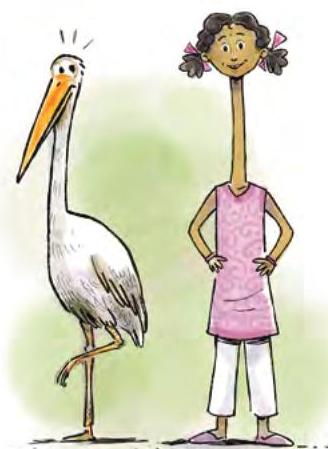
- A crane of height $155,\mathrm{cm}$ has its neck and the rest of its body in the ratio $4 : 6$. For your height, if your neck and the rest of the body also had this ratio, how tall would your neck be?
- Let us try an ancient problem from Lilavati. At that time weights were measured in a unit named $\text{palas}$ and $\text{niskas}$ was a unit of money. "If $2 \frac{1}{2},\text{palas}$ of saffron
costs $\frac{3}{7},\text{niskas}$, O expert businessman! tell me quickly what quantity of saffron can be bought for $9,\text{niskas}$?"
Harmain is a $1$-year-old girl. Her elder brother is $5$-years-old. What will be Harmain’s age when the ratio of her age to her brother’s age is $1:2$?
The mass of equal volumes of gold and water are in the ratio $37:2$. If $1,\mathrm{litre}$ of water is $1,\mathrm{kg}$ in mass, what is the mass of $1,\mathrm{litre}$ of gold?
It is good farming practice to apply $10,\mathrm{tonnes}$ of cow manure for $1,\mathrm{acre}$ of land. A farmer is planning to grow tomatoes in a plot of size $200,\mathrm{ft},\mathrm{by},500,\mathrm{ft}$. How much manure should he buy? (Please refer to the section on Unit Conversions earlier in this chapter).
A tap takes $15,\mathrm{seconds}$ to fill a mug of water. The volume of the mug is $500,\mathrm{mL}$. How much time does the same tap take to fill a bucket of water if the bucket has a $10\text{-}\mathrm{litre}$ capacity?
One $\text{acre}$ of land costs ₹15,00,000. What is the cost of $2,400,\mathrm{square},\mathrm{feet}$ of the same land?
A tractor can plough the same area of a field $4,\mathrm{times},\mathrm{faster}$ than a pair of oxen. A farmer wants to plough his $20\text{-}\mathrm{acre}$ field. A pair of oxen takes $6,\mathrm{hours}$ to plough an $\text{acre}$ of land. How much time would it take if the farmer used a pair of oxen to plough the field? How much time would it take him if he decides to use a tractor instead?
A ₹10 coin is composed of a cupro-nickel alloy, which consists of copper and nickel combined in a $3:1$ proportion. The total mass of this coin is $7.74,\mathrm{grams}$. Given that copper is priced at ₹906 per kilogram and nickel at ₹1,341 per kilogram, determine the collective value of the constituent metals within a single ₹10 coin.
SUMMARY
A ratio expressed as $a:b$ signifies that for each quantity of ‘$a$’ from the initial component, there corresponds a quantity of ‘$b$’ from the subsequent component. The elements ‘$a$’ and ‘$b$’ are referred to as the ratio's terms.
The relationship between two ratios, $a:b$ and $c:d$, is defined as proportional (represented as $a:b::c:d$) when their respective terms maintain an equivalent scaling factor, which mathematically translates to the condition $ad = bc$.
When a quantity $x$ is partitioned into two segments according to the ratio $m : n$, the magnitude of the initial segment is calculated as $m \times \frac{x}{m + n}$, and the magnitude of the subsequent segment is determined by $n \times \frac{x}{m + n}$.
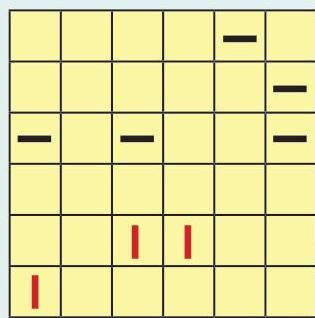
Binairo, alternatively termed Takuzu, constitutes a logic puzzle characterized by straightforward regulations. This game is typically conducted on a square grid of arbitrary dimensions. An initial configuration presents certain cells pre-populated with two distinct symbols—specifically, horizontal and vertical lines—while the remaining cells are vacant. The objective involves populating these cells adhering to the following criteria:
- An equivalent count of horizontal and vertical lines must be present in every row and every column.
- No more than two horizontal or vertical lines are permitted to be in adjacent positions.
- Every row must be distinct, and similarly, every column must be distinct.
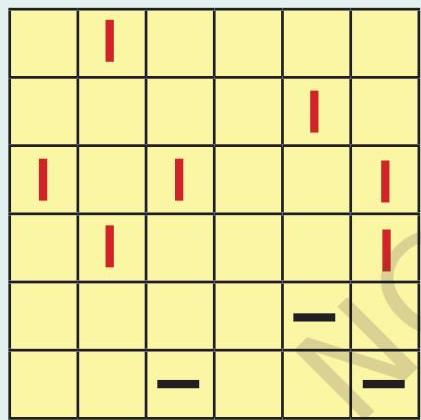 Puzzle
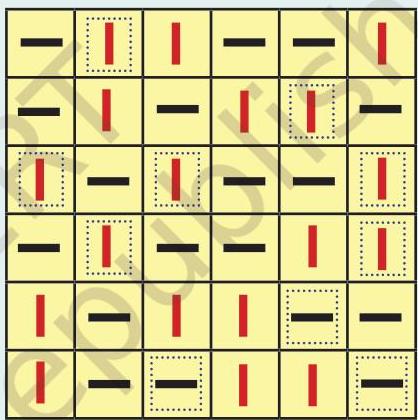 Solution
Solve the following Binairo puzzles:
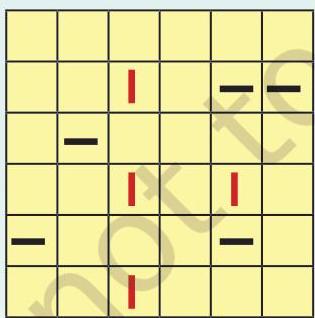
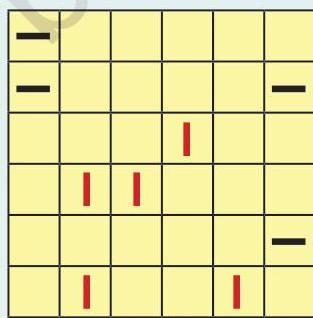
Dot Grid

Dot Grid