QUADRILATERALS
In this chapter, we will study some interesting types of four-sided figures and solve problems based on them. Such figures are commonly known as quadrilaterals. The word 'quadrilateral' is derived from Latin words — quadri meaning four, and latus referring to sides.
Observe the following figures.
Figs. (i), (ii), and (iii) are quadrilaterals, and the others are not. Why?
The angles of a quadrilateral are the angles between its sides, as marked in Figs. (i), (ii), and (iii).
We will start with the most familiar quadrilaterals—rectangles and squares.
4.1 Rectangles and Squares
We know what rectangles are. Let us define them.
Rectangle: A rectangle is a quadrilateral in which—
(i) The angles are all right angles $(90^\circ)$, and (ii) The opposite sides are of equal length.
The definition precisely states the conditions a quadrilateral has to satisfy to be called a rectangle.
? Are there other ways to define a rectangle?
Let us consider the following problem related to the construction of rectangles.
A Carpenter's Problem
? A carpenter needs to put together two thin strips of wood, as shown in Fig. 1, so that when a thread is passed through their endpoints, it forms a rectangle.
She already has one 8 cm long strip. What should be the length of the other strip? Where should they both be joined?
Let us first model the structure that the carpenter has to make. The
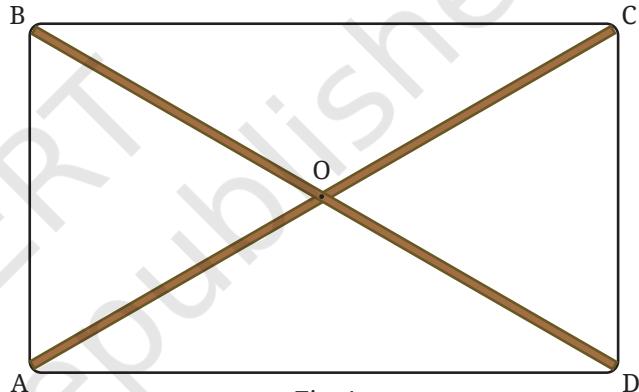
Fig.1
strips can be modelled as line segments. They are the diagonals of the quadrilateral formed by their endpoints. For the quadrilateral to be a rectangle, we need to answer the following questions —
What is the length of the other diagonal?
What is the point of intersection of the two diagonals?
What should the angle be between the diagonals?
Let us answer these questions using geometric reasoning (deduction). If that is challenging, try to construct/ measure some rectangles.
To find the answers to these questions, let us suppose that we have placed the diagonals such that their endpoints form the vertices of a rectangle, as shown in Fig. 2.
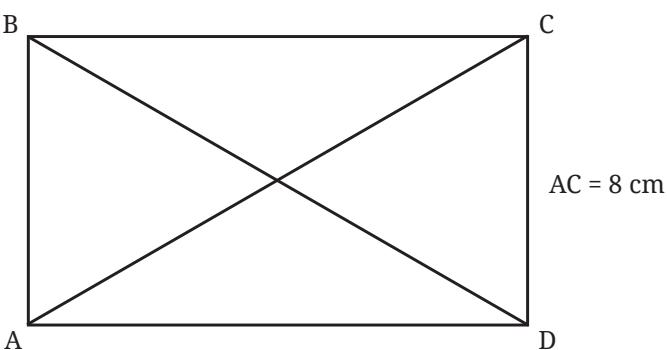
Fig. 2
Deduction 1— What is the length of the other diagonal?
This can be deduced using congruence as follows—
Since ABCD is a rectangle, we have
$\mathrm{AB} = \mathrm{CD}$
$\angle \mathrm{BAD} = \angle \mathrm{CDA} = 90^\circ$
AD is common to both triangles.
So, $\Delta \mathrm{ADC} \cong \Delta \mathrm{DAB}$ by the SAS congruence condition.
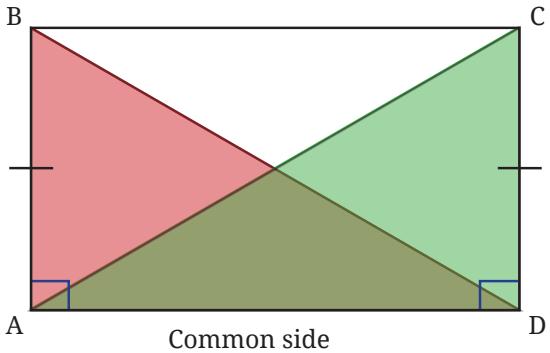
Therefore, $\mathrm{AC} = \mathrm{BD}$, since they are corresponding parts of congruent triangles. This shows that the diagonals of a rectangle always have the same length.
So the other diagonal must also be 8 cm long. You can verify this property by constructing/measuring some rectangles.
Deduction 2—What is the point of intersection of the two diagonals?
This can also be found using congruence. Since we need to know the relation between OA and OC, and OB and OD, which two triangles of the rectangle ABCD should we consider?
B A
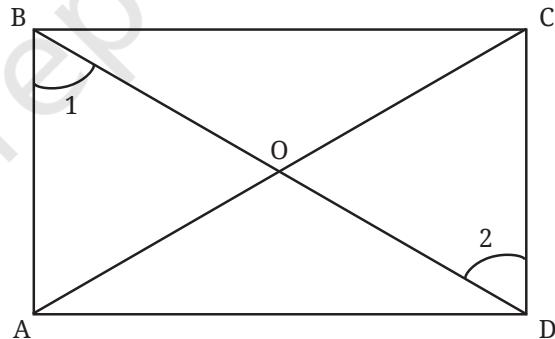
The blue angles are equal since they are vertically opposite angles.
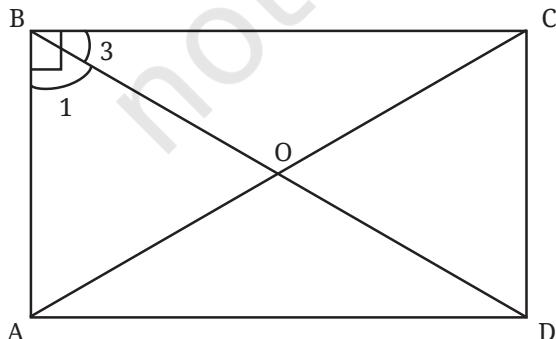
Since $\angle \mathrm{B} = 90^\circ$, $\angle 3 + \angle 1 = 90^\circ$.
In order to show congruence, consider $\angle 1$ and $\angle 2$ Are they equal?
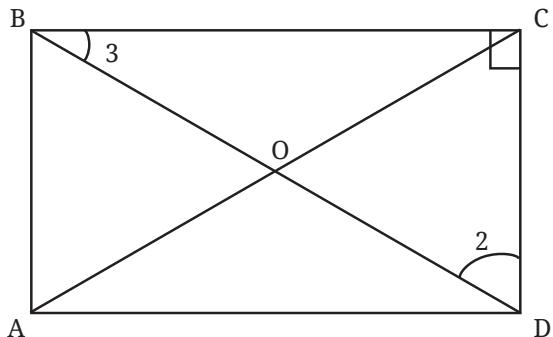
In ∆BCD, since $\angle 3 + \angle 2 + 90^\circ = 180^\circ$, $\angle 3 + \angle 2 = 90^\circ$.
So, $\angle 1 = \angle 2 (= 90^\circ - \angle 3)$.
Thus, by the AAS condition for congruence, $\Delta \mathrm{AOB} \cong \Delta \mathrm{COD}$.
Hence $\mathrm{OA} = \mathrm{OC}$ and $\mathrm{OB} = \mathrm{OD}$, since they are corresponding parts of congruent triangles. So, O is the midpoint of AC and BD.
This shows that the diagonals of a rectangle always intersect at their midpoints.
Therefore, to get a rectangle, the diagonals must be drawn so that they are equal and intersect at their midpoints.
When the diagonals cross at their midpoints, we say that the diagonals bisect each other. Bisecting a quantity means dividing it into two equal parts.
Verify this property by constructing some rectangles and measuring their diagonals and the points of intersection.
Can the following equalities be used to establish that $\Delta \mathrm{AOD} \cong \Delta \mathrm{COB}$?
$\mathrm{AO} = \mathrm{CO}$ (proved above)
$\angle \mathrm{AOB} = \angle \mathrm{COD}$ (vertically opposite angles)
$\mathrm{AD} = \mathrm{CB}$
Deduction 3— What are the angles between the diagonals?
Let us check what quadrilateral we get if we draw the two diagonals such that their lengths are equal, they bisect each other and have an arbitrary angle, say $60^\circ$, between them as shown in the figure to the right.
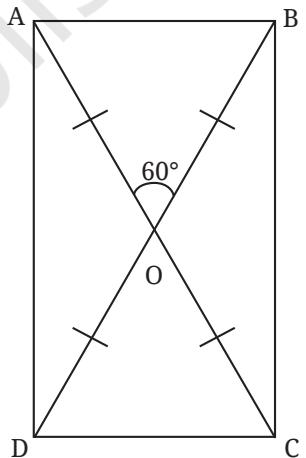
$\frac { 3 } { 2 }$ Can you find all the remaining angles?
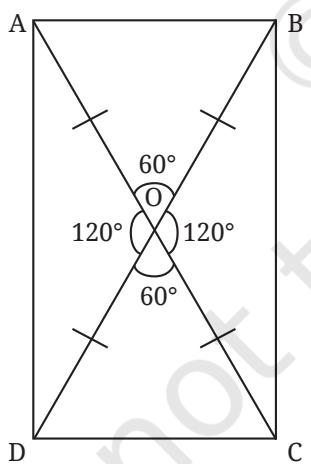
We can find the remaining angles between the diagonals using our understanding of vertically opposite angles and linear pairs.
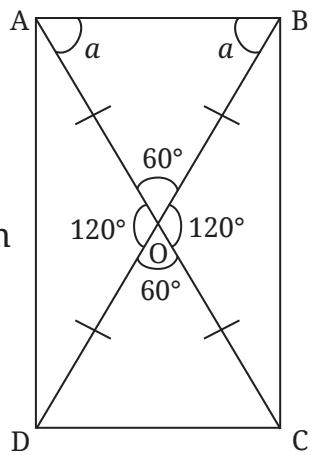
In $\Delta \mathrm{AOB}$, since $\mathrm{OA} = \mathrm{OB}$, the angles opposite them are equal, say $a$.
$\cdot$ Can you find the value of a?
In ∆AOB, we have,
$a + a + 60 = 180$ (interior angles of a triangle). Therefore $2a = 120$.
Thus $a = 60$.
Similarly, we can find the values of all the other angles.
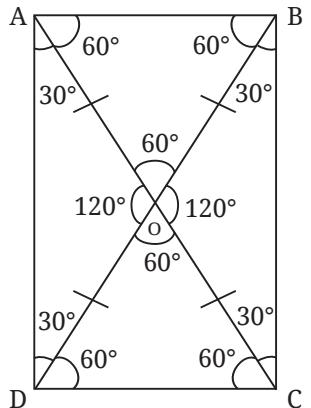
$\textcircled{7}$ Can we now identify what type of quadrilateral ABCD is? Notice that its angles all add up to $90^\circ (30^\circ + 60^\circ)$.
$\frac { 3 } { 2 }$ What can we say about its sides?
We can see that $\Delta \mathrm{AOB} \cong \Delta \mathrm{COD}$ and $\Delta \mathrm{AOD} \cong \Delta \mathrm{COB}$ Hence, $\mathrm{AB} = \mathrm{CD}$, and $\mathrm{AD} = \mathrm{CB}$, since they are corresponding parts of congruent triangles.
Therefore, ABCD is a rectangle since it satisfies the definition of a rectangle.
$\textcircled{7}$ Will ABCD remain a rectangle if the angles between the diagonals are changed? Can we generalise this?
Take one of the angles between the diagonals as x.
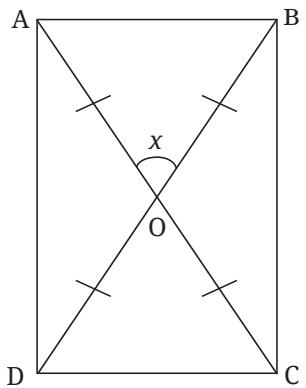
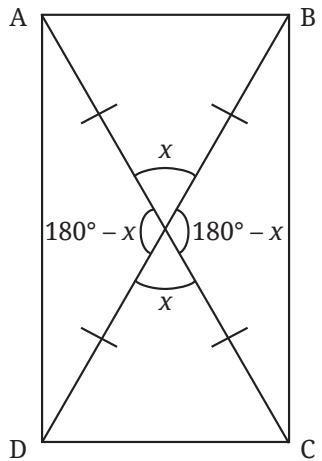
We can compute the four angles between the diagonals to be $x, x, 180 - x,$ and $180 - x$.
$\frac { 3 } { 2 }$ Can you find the other angles?
Since we know that $\Delta \mathrm{AOB}$ is isosceles, we can denote the measures of both of its base angles by $a$.
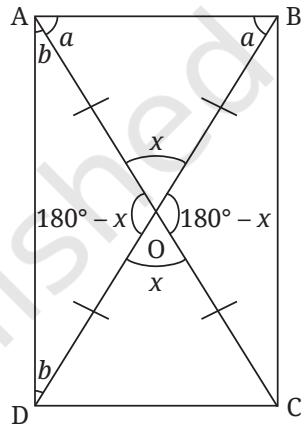
$\cdot$ What is the value of $a$ (in degrees) in terms of $x$? We have,
$ a + a + x = 180 $
(sum of the interior angles of a triangle)
$ 2a = 180 - x $
$ a = {\frac{(180 - x)}{2}} = 90 - {\frac{x}{2}}. $
Similarly, in the isosceles $\Delta \mathrm{AOD}$ let the base angles be $b$.
$ \begin{array}{c} b + b + 180 - x = 180 \ \ 2b = 180 - (180 - x) \ \ 2b = 180 - 180 + x \ \ 2b = x \ \ b = \frac{x}{2}. \end{array} $
All the angles of the quadrilateral are $a + b$, which is
$ 90 - {\frac{x}{2}} + {\frac{x}{2}} = 90. $
Thus, all four angles of the quadrilateral ABCD are $90^\circ$.
What can we say about AB and CD, and AD and BC?
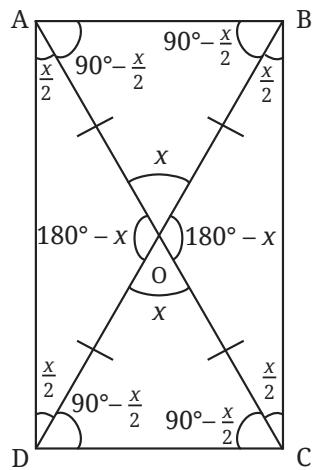
We have $\Delta \mathrm{AOB} \cong \Delta \mathrm{COD}$ and $\Delta \mathrm{AOD} \cong \Delta \mathrm{COB}$. Hence, $\mathrm{AB} = \mathrm{CD}$, and $\mathrm{AD} = \mathrm{CB}$ since they are the corresponding parts of congruent triangles.
Hence, no matter what the angles between the diagonals are, if the diagonals are equal and they bisect each other, then the angles of the quadrilateral formed are $90^\circ$ each, and the opposite sides are equal. Thus, the quadrilateral is a rectangle.
Now we know how the wooden strips have to be put together to form the vertices of a rectangle! They should be equal and connected at their midpoints.
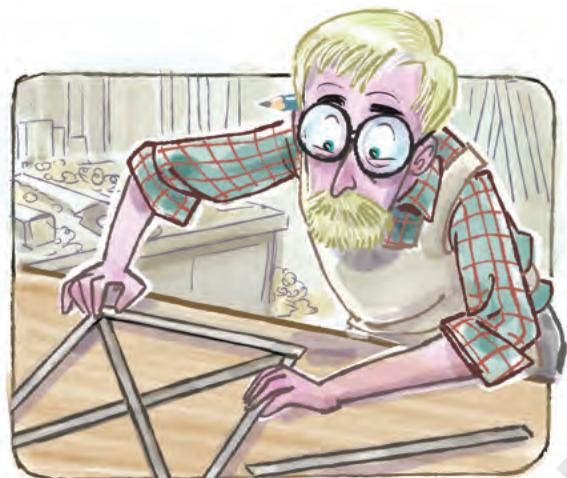
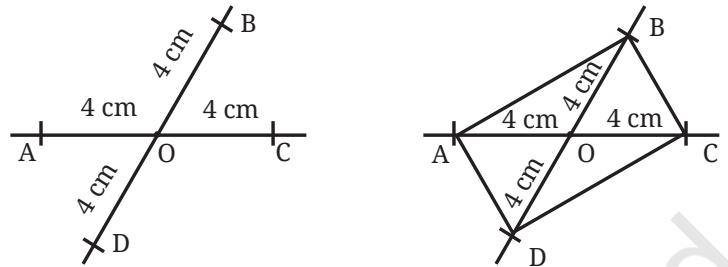
This method is actually used in practice to make rectangles. Carpenters in Europe use this method to get a rectangular frame. It is also known that farmers in Mozambique, a country in Africa, use this method while constructing houses to get the base of the house in a rectangular shape.
The Process of Finding Properties
As we have been seeing from lower grades, properties of geometric objects such as parallel lines, angles, and triangles can be deduced through geometric reasoning. We will continue to deduce properties of special types of quadrilaterals in this chapter.
Once you have deduced a property of a quadrilateral, it is good to verify it with a real-world quadrilateral, either the quadrilateral constructed on paper or simply a surface having the shape of the quadrilateral.
If you are not able to figure out the property using deduction, you could experiment by taking real-world quadrilaterals and observing the property through measurement. Note that these observations give useful insights about the property, but with them, we can only form a conjecture, that is, a statement about which we are highly confident, but not yet sure if it always holds true. For example, constructing a few rectangles and observing through measurement that their diagonals bisect each other does not necessarily mean that this will always be the case—can we be sure that the 1000th rectangle we construct will also have this property? The only way we can be sure of this property is by justifying or proving the statement, just as we did in Deduction 2.
Note to the Teacher: Gently encourage students to deduce or justify properties. Whenever students face challenges in doing it, encourage them to experiment and observe, and use their intuition to figure out the properties.
The Carpenter's Problem shows that rectangles can also be defined as follows—
Rectangle: A rectangle is a quadrilateral whose diagonals are equal and bisect each other.
Observe how different this definition is from the earlier one. Yet, both capture the same class of quadrilaterals. Further, it turns out that the first definition can be simplified.
? In the earlier definition, we stated that a rectangle has (a) opposite sides of equal length, and (b) all angles equal to $90^\circ$. Would we be wrong if we just define a rectangle as a quadrilateral in which all the angles are $90^\circ$?
? If you think that this definition is incomplete, try constructing a quadrilateral in which the angles are all $90^\circ$ but the opposite sides are not equal.
Are you able to construct such a quadrilateral? Let us prove why this is impossible.
Deduction 4—What is the shape of a quadrilateral with all the angles equal to $\mathbf{90^\circ}$?
$\textcircled{7}$ Consider a quadrilateral ABCD with all angles measuring $90^\circ$. What can we say about the opposite sides of such a quadrilateral?
Join BD. $\Delta$BAD and ∆DCB seem congruent. Can we justify this claim?
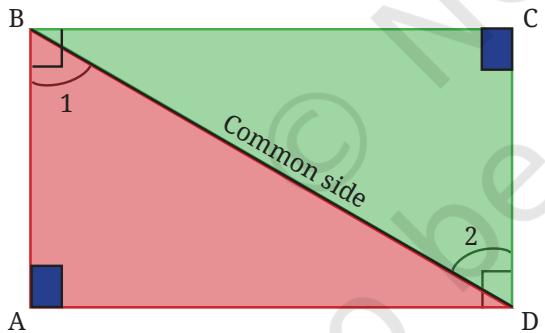
Two equalities can be directly seen in the triangles. What can we say about $\angle 1$ and $\angle 2$?
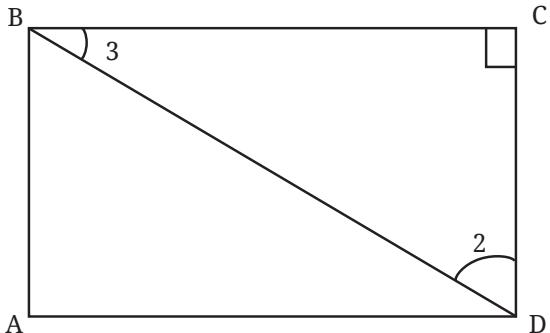
Recall that we tackled a very similar problem in Deduction 2. We can use the same reasoning here.
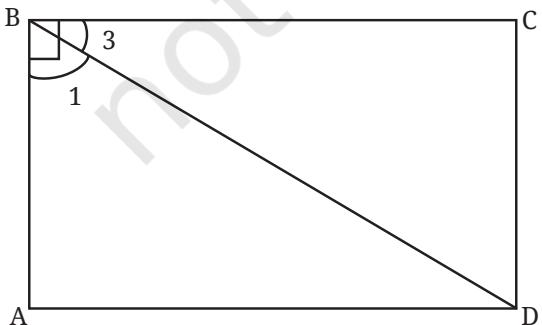
Since $\angle \mathrm{B} = 90^\circ$, $\angle 3 + \angle 1 = 90^\circ$.
In ∆BCD, since $\angle 3 + \angle 2 + 90^\circ = 180^\circ$, $\angle 3 + \angle 2 = 90^\circ$.
So, $\angle 1 = \angle 2$
Thus, by the AAS congruence condition, $\Delta \mathrm{BAD} \cong \Delta \mathrm{DCB}$.
Therefore, $\mathrm{AD} = \mathrm{CB}$, and $\mathrm{DC} = \mathrm{BA}$, since these are corresponding sides of congruent triangles.
Is it wrong to write $\Delta \mathrm{BAD} \cong \Delta \mathrm{CDB}$? Why?
Thus, we have established that if all the angles of a quadrilateral are right angles, then the opposite sides have equal lengths. Therefore, the quadrilateral is a rectangle. Thus, a rectangle can simply be defined as follows —
Rectangle: A rectangle is a quadrilateral in which the angles are all $90^\circ$.
Let us list the properties of a rectangle.
Property 1: All the angles of a rectangle are $90^\circ$.
Property 2: The opposite sides of a rectangle are equal.
Are the opposite sides of a rectangle parallel?
They definitely seem so. This fact can be justified using one of the transversal properties.
Notice that AB acts as a transversal to AD and BC, and that $\angle A + \angle B = 90^\circ + 90^\circ = 180^\circ$.
When the sum of the internal angles on the same side of the transversal is $180^\circ$, the lines are parallel. We can use this fact to conclude that the lines AD and BC are parallel, which we represent as AD || BC.
Can you similarly show that AB is parallel to DC (AB || DC)?
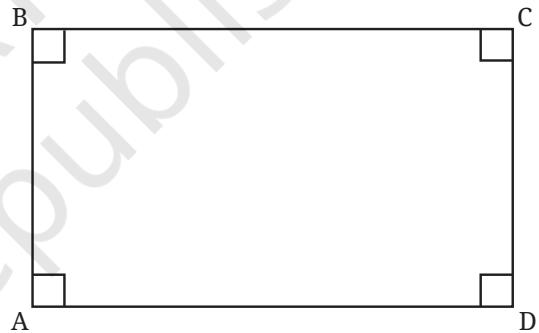
Property 3: The opposite sides of a rectangle are parallel to each other.
Property 4: The diagonals of a rectangle are of equal length and they bisect each other.
A Special Rectangle
In the quadrilaterals below, are there any non-rectangles?
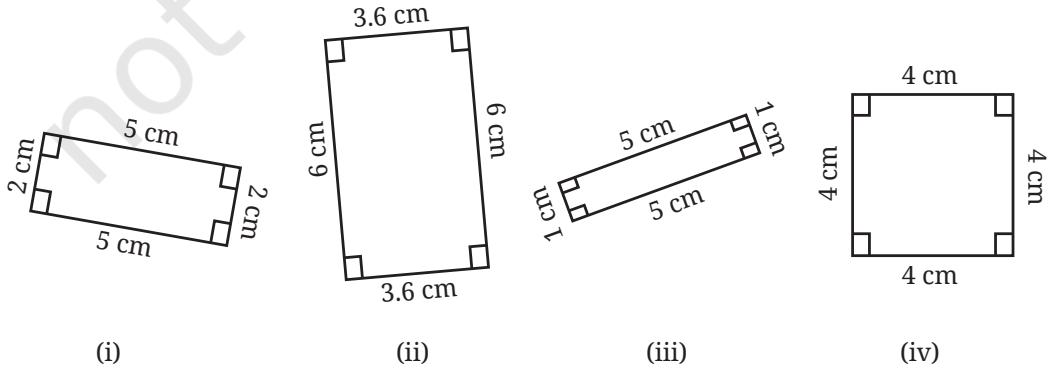
All these quadrilaterals are rectangles, including (iv). Quadrilateral (iv) is a rectangle because all its angles are $90^\circ$ However, it is a special kind of rectangle with all sides of equal length. We know that this quadrilateral is also called a square.
Square: A square is a quadrilateral in which all the angles are equal to $90^\circ$ and all the sides are of equal length.
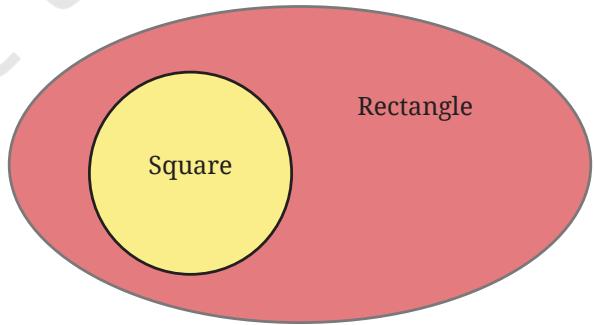
Thus, every square is also a rectangle, but clearly every rectangle is not a square.

This relation can be pictorially represented using a Venn diagram. We have seen these diagrams before. In a Venn diagram, a set of objects is represented as points inside a closed curve. Typically, these closed curves are ovals or circles.
For example, the set of all squares is represented as
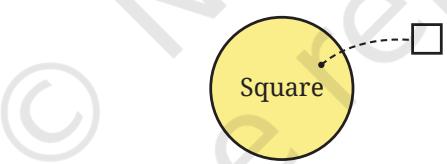
Each point in the region represents a square, thereby covering all the possible squares.
Since every square is a rectangle, the Venn diagram representation of these two sets would be as follows —
? Let us consider the Carpenter's Problem again. If the wooden strips have to be placed such that the thread passing through their endpoints forms a square, what must be done?
As in the previous case, let us try to construct a square, one of whose diagonals is of length 8 cm.
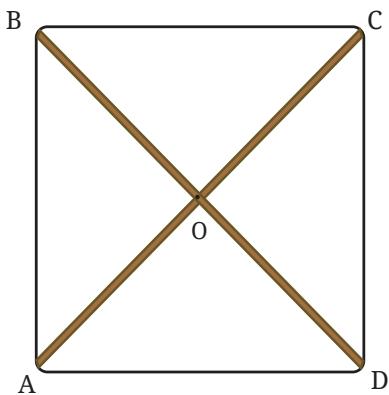
While solving the Carpenter's Problem for the case of a rectangle, we have seen that to get a quadrilateral with all angles $90^\circ$ (and opposite sides of equal length), the diagonals have to be drawn such that —
(i) they are of equal lengths, and (ii) they bisect each other.
$\frac { 3 } { 2 }$ What more needs to be done to get equal side lengths as well? Can this be achieved by properly choosing the angle between the diagonals? See if you can reason and/or experiment to figure this out!
Deduction 5— What should be the angle formed by the diagonals?
The angle between the diagonals can be found using the notion of congruence! Suppose we join the equal diagonals such that they bisect each other and result in a square. Let us label the square ABCD.
To find the angle formed by the diagonals, what are the two triangles we should consider for congruence?
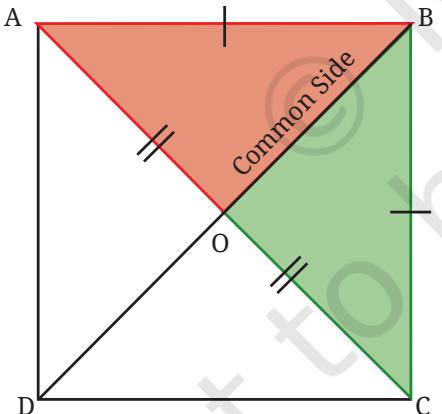
By the SSS condition for congruence, $\Delta \mathrm{BOA} \cong \Delta \mathrm{BOC}$
$\frac { 3 } { 2 }$ Can this be used to find the angles $\angle \mathrm{BOA}$ and $\angle \mathrm{BOC}$ formed by the diagonals?
Since these angles are corresponding parts of congruent triangles, they are equal. Further, these angles together form a straight angle. So $\angle \mathrm{BOA} + \angle \mathrm{BOC} = 180^\circ$. Thus, these angles have to be $90^\circ$ each.
This shows that the diagonals of a square bisect each other at right angles. This means that the diagonals have to be drawn such that they are of equal lengths and bisect each other at right angles. Since the endpoints of the diagonals uniquely determine the vertices of a quadrilateral, we will get a square when the diagonals are joined this way.
Using this fact, construct a square with a diagonal of length 8 cm.
Properties of a Square
Since a square is a special type of rectangle, all the properties of a rectangle hold true for a square.
? Verify if this is true by going through geometric reasoning in Deduction 1 and Deduction 2, and see if they apply to a square as well.
Property 1: All the sides of a square are equal to each other.
Property 2: The opposite sides of a square are parallel to each other.
Property 3: The angles of a square are all $90^\circ$.
Property 4: The diagonals of a square are of equal length and they bisect each other at $90^\circ$.
There is one more special property of a square.
What are the measures of $\angle 1, \angle 2, \angle 3,$ and $\angle 4$? See if you can reason and/or experiment to figure this out!
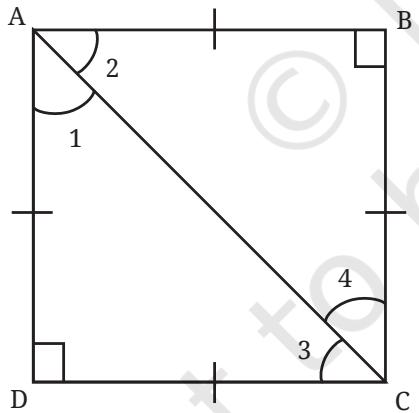
In ∆ADC, we have,
$\angle 1 + \angle 3 + 90 = 180$
Since $\mathrm{AD} = \mathrm{DC}$ we have $\angle 1 = \angle 3$. Thus, $\angle 1 = \angle 3 = 45^\circ$.
Similarly, find $\angle 2$ and $\angle 4$.
Thus, we have another property of a square —
Property 5: The diagonals of a square divide the angles of the square into equal halves. This can also be expressed as—The diagonals of a square bisect the angles of the square.
Figure it Out
- Find all the other angles inside the following rectangles.
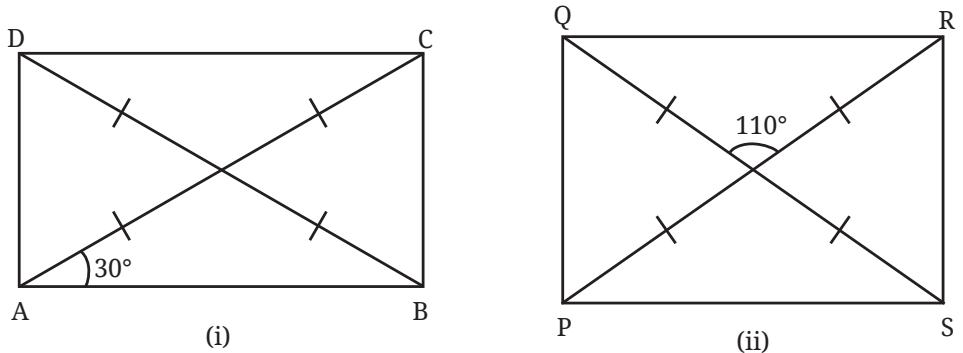
- Draw a quadrilateral whose diagonals have equal lengths of 8 cm that bisect each other, and intersect at an angle of
(i) $30^\circ$ (ii) $40^\circ$ (iii) $90^\circ$ (iv) $140^\circ$
Consider a circle with centre O. Line segments PL and AM are two perpendicular diameters of the circle. What is the figure APML? Reason and/or experiment to figure this out.
We have seen how to get $90^\circ$ using paper folding. Now, suppose we do not have any paper but two sticks of equal length, and a thread. How do we make an exact $90^\circ$ using these?
We saw that one of the properties of a rectangle is that its opposite sides are parallel. Can this be chosen as a definition of a rectangle? In other words, is every quadrilateral that has opposite sides parallel and equal, a rectangle?
4.2 Angles in a Quadrilateral
Is it possible to construct a quadrilateral with three angles equal to $90^\circ$ and the fourth angle not equal to $90^\circ$?
You might have observed through constructions that this may not be possible.
? But why not?
This is due to a general property of quadrilaterals related to their angles.
We have seen that the sum of the angles of a triangle is $180^\circ$. There is a similar regularity in the sum of the angles of a quadrilateral.
Consider a quadrilateral SOME.
Draw a diagonal SM. We get two triangles ∆SEM and ∆SOM.
In ∆SEM, we have $\angle 1 + \angle 2 + \angle 3 = 180^\circ$.
And in ∆SOM, $\angle 4 + \angle 5 + \angle 6 = 180^\circ$.
What do we get when we add all six angles?
We will have
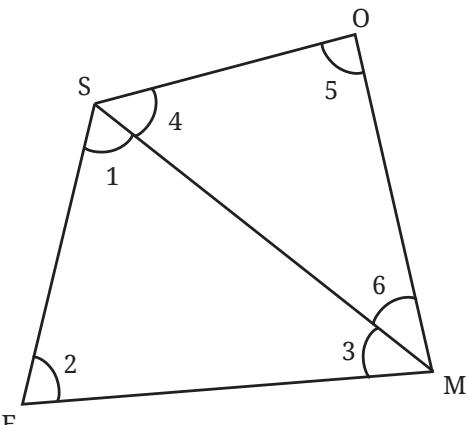
$ (\angle 1 + \angle 4) + (\angle 3 + \angle 6) + \angle 2 + \angle 5 = 360^\circ $
Since $(\angle 1 + \angle 4), (\angle 3 + \angle 6), \angle 2$ and $\angle 5$ are the angles of this quadrilateral, we have the following result—
The sum of all angles in any quadrilateral is $\mathbf{360^\circ}$.
This explains why it is impossible for a quadrilateral to have three right angles, with the fourth angle not right angle.
4.3 More Quadrilaterals with Parallel Opposite Sides
Rectangles (and therefore squares) have parallel opposite sides.
Are there quadrilaterals that have parallel opposite sides that are not rectangles?
Let us try constructing one.
This can be easily done by drawing two pairs of parallel lines, ensuring that they do not meet at right angles.
? Construct such a figure by recalling how parallel lines can be constructed using a ruler and a set-square, or a compass and a ruler.
Observe the quadrilateral ABCD. It has parallel opposite sides but is not a rectangle.
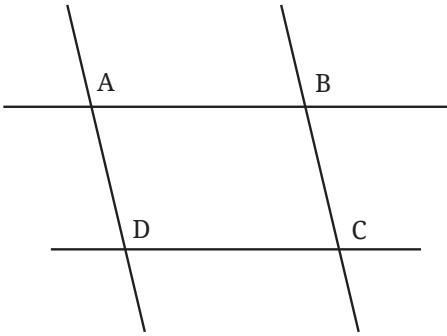
Thus, a larger set of quadrilaterals exists in which the opposite sides are parallel. Such quadrilaterals are called parallelograms.
Is a rectangle a parallelogram?
A rectangle has opposite sides parallel. So, it satisfies the parallelogram's definition. Hence, it is indeed a parallelogram. More specifically, a rectangle is a special kind of parallelogram with all its angles equal to $90^\circ$.
Let us represent this relation using a Venn diagram.
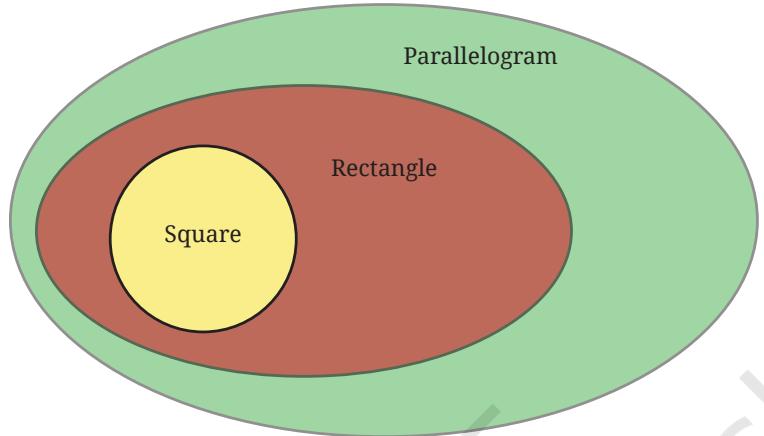
To understand the relations between the sides and the angles of a parallelogram, let us construct the following figure.
Draw a parallelogram with adjacent sides of lengths 4 cm and 5 cm, and an angle of $30^\circ$ between them.

Step 1: Draw line segments $\mathrm{AB} = 4$ cm and $\mathrm{AD} = 5$ cm with an angle of $30^\circ$ between them.
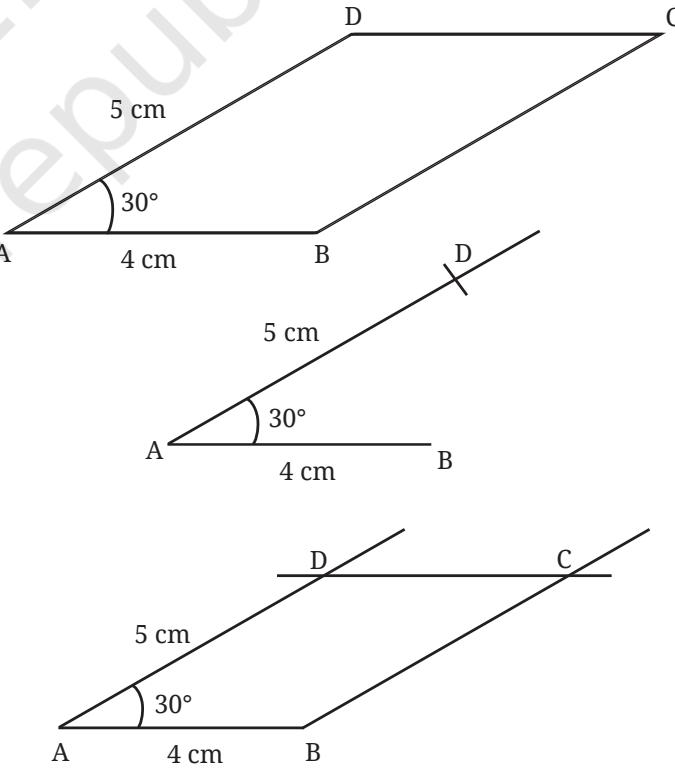
Step 2: Draw a line parallel to AB through the point D, and a line parallel to AD through B. Mark the point at which these lines intersect as C.
ABCD is the required parallelogram.
What are the remaining angles of the parallelogram? What are the lengths of the remaining sides? See if you can reason out and/or experiment to figure these out.
? Deduction 6—What can we say about the angles of a parallelogram?
In the parallelogram ABCD, AB || CD, and AD is a transversal to them.
$\angle \mathrm{A} + \angle \mathrm{D} = 180^\circ$ (sum of the internal angles on the same side of a transversal).
Therefore, $\angle \mathrm{D} = 180 - \angle \mathrm{A} = 180 - 30 = 150^\circ$.
Similarly, AD || BC, and AB and CD are transversals to them.
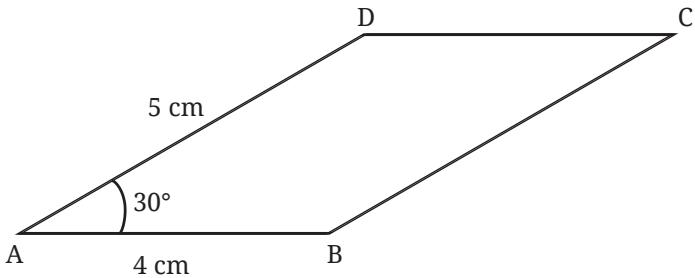
So, $\angle \mathrm{C} + \angle \mathrm{D} = 180^\circ$
Using these equations, we get $\angle \mathrm{B} = 150^\circ$ and $\angle \mathrm{C} = 30^\circ$.
We see that in this parallelogram, the adjacent pairs of angles add up to $\mathbf{180^\circ}$ and opposite pairs of angles are equal.
Thus,
$\angle \mathrm{A} + \angle \mathrm{B} = 180^\circ, \angle \mathrm{A} + \angle \mathrm{D} = 180^\circ, \angle \mathrm{C} + \angle \mathrm{D} = 180^\circ$ and $\angle \mathrm{B} + \angle \mathrm{C} = 180^\circ$.
And,
$ \angle \mathrm{A} = \angle \mathrm{C}, \text{and} \angle \mathrm{B} = \angle \mathrm{D}. $
Since the adjacent angles are the interior angles on the same side of a transversal to a pair of parallel lines, they must add up to $180^\circ$.
What about the opposite angles? Will they be equal in all parallelograms? If yes, how can we be sure?
Let us take one of the angles to be x.
What are the other angles?
Since $\angle \mathrm{P} + \angle \mathrm{R} = 180^\circ$,
$\angle \mathrm{R} = 180 - \angle \mathrm{P} = 180 - x.$
Similarly, since $\angle \mathrm{A} + \angle \mathrm{R} = 180^\circ;$,
$\angle \mathrm{A} = 180 - \angle \mathrm{R} = 180 - (180 - x) = 180 - 180 + x = x$. Thus, $\angle \mathrm{P} = \angle \mathrm{A} = x.$
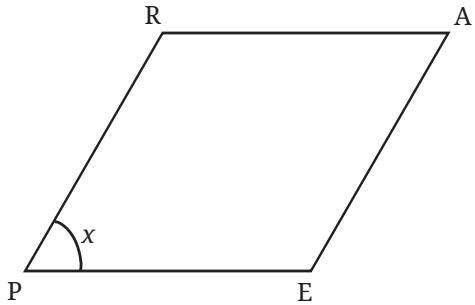
Similarly, we can deduce that $\angle \mathrm{R} = \angle \mathrm{E} = 180 - x$.
Therefore, this shows that the opposite angles of a parallelogram are always equal.
Deduction 7— What can we say about the sides of a parallelogram?
By looking at a parallelogram, it appears that the opposite sides are equal.
Can we again use congruence to show this? Which two triangles can be considered for this?
In ∆ABD and ∆CDB, the angles marked with a single arc are equal as they are the opposite angles of a parallelogram.
Since AD || BC, and BD is a transversal to it, the angles marked with double arcs are equal as they are alternate angles.
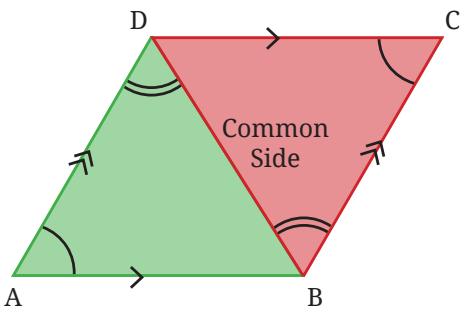
So, by the AAS condition, the triangles are congruent, that is, $\Delta \mathrm{ABD} \cong \Delta \mathrm{CDB}$.
Therefore, $\mathrm{AD} = \mathrm{CB}$, and $\mathrm{AB} = \mathrm{CD}$
Thus, the opposite sides of a parallelogram are equal.
Is it wrong to write $\Delta \mathrm{ABD} \cong \Delta \mathrm{CBD}$? Why?
From these deductions we can find the remaining sides and angles of the parallelogram.
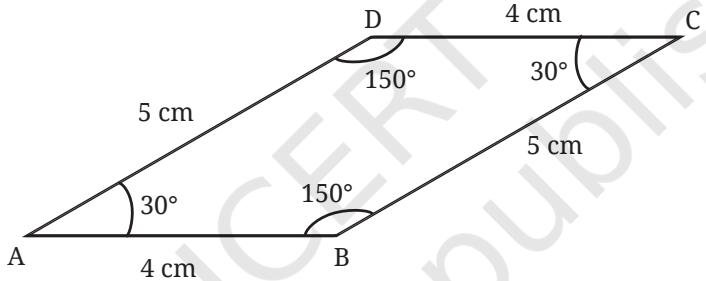
Let us list the properties of a parallelogram.
Property 1: The opposite sides of a parallelogram are equal.
Property 2: The opposite sides of a parallelogram are parallel.
Property 3: In a parallelogram, the adjacent angles add up to $180^\circ$, and the opposite angles are equal.
Are the diagonals of a parallelogram always equal? Check with the parallelogram that you have constructed. We see that the diagonals of a parallelogram need not be equal.
? Do they bisect each other (do they intersect at their midpoints)? Reason and/or experiment to figure this out.
Deduction 8— What is the point of intersection of the two diagonals in a parallelogram?
As in the case of a rectangle, we can find out if the diagonals bisect each other by examining the congruence of ∆AOE and ∆YOS in the parallelogram EASY.
$\mathrm{AE} = \mathrm{YS}$ (as they are the opposite sides of the parallelogram)
A S C E Y
The angles marked using a single arc are equal, and so are the angles marked using a double arc, since they are alternate angles of parallel lines.
Thus, by the ASA condition, the triangles are congruent, that is, $\Delta \mathrm{AOE} \cong \Delta \mathrm{YOS}$.
Therefore, $\mathrm{OA} = \mathrm{OY},$ and $\mathrm{OE} = \mathrm{OS}$, since they are corresponding parts of congruent triangles.
Thus, O is the midpoint of both diagonals.
Is it wrong to write $\Delta \mathrm{AOE} \cong \Delta \mathrm{SOY}$? Why?
Property 4: The diagonals of a parallelogram bisect each other.
Do the diagonals of a parallelogram intersect at a particular angle?
4.4 Quadrilaterals with Equal Side lengths
? Are squares the only quadrilaterals that have equal side lengths? Let us explore this question through construction.
Draw two equal sides AD and AB, that are not perpendicular to each other.
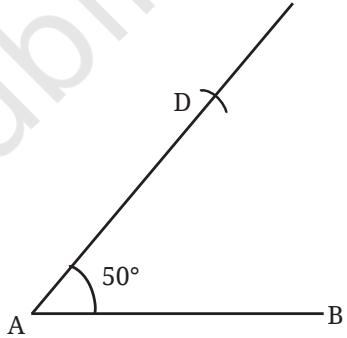
? Can we complete this quadrilateral so that all its sides are of the same length?
Mark a point C whose distance from B and D is equal to AB (or AD). To do this, measure AB using a compass. Keeping this length as the radius, cut arcs from B and D.
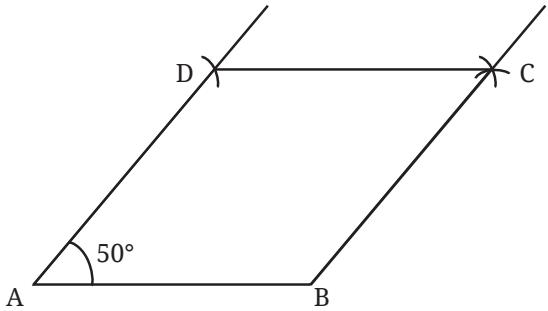
Now we have a quadrilateral with equal side lengths and one of its angles $50^\circ$. Note that we could have constructed such a quadrilateral by taking any angle less than $180^\circ$ (in place of $50^\circ$).
A quadrilateral in which all the sides have the same length is a rhombus.
What are the other angles of the rhombus ABCD that we have constructed? Reason and/or experiment to figure this out.
Deduction 9— What can we say about the angles in a rhombus?
Consider a rhombus GAME. In ∆GAE, since $\mathrm{GE} = \mathrm{GA}$, $a = d$. Similarly, in ∆MAE, since $\mathrm{ME} = \mathrm{MA}$, $b = c$.
$\textcircled{7}$ It can be seen that $\Delta \mathrm{GAE} \cong \Delta \mathrm{MAE}$ (How?)
So, $a = b$, $c = d$ and $\angle G = \angle M$ (since they are corresponding parts of congruent triangles). Thus, we have, $a = b = c = d$,
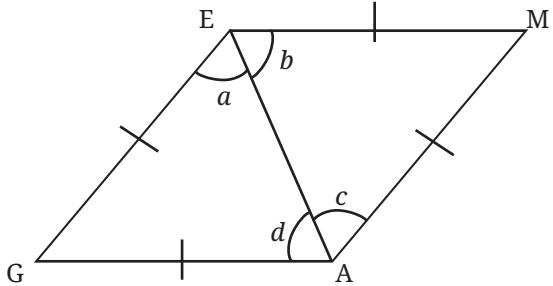
These facts hold for any rhombus. Let us apply them to the rhombus
ABCD that we constructed earlier. Let the four equal angles formed by
the diagonal be $a$, as shown in the figure
In ∆ADB, we have $a + a + 50 = 180^\circ$. So, $a = 65^\circ$.
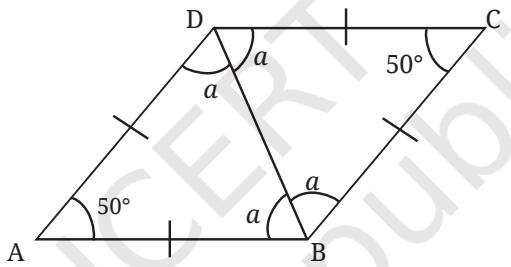
Thus, the angles of the rhombus ABCD are $50^\circ$, $130^\circ$, $50^\circ$ and $130^\circ$.
So, in a rhombus opposite angles are equal to each other.
Interestingly, there is one more way by which we could have figured out the other angles of the rhombus ABCD. We have shown that in a general rhombus GAME, the four angles formed by a diagonal are equal to each other.
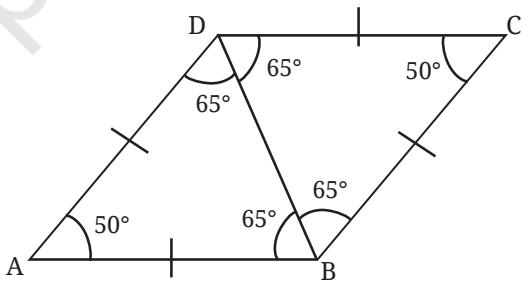
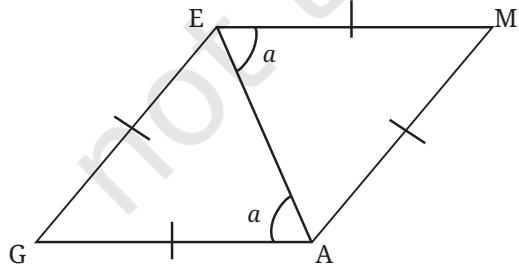
Consider the lines EM and GA and its transversal AE. Since the alternate angles are equal, EM || GA.
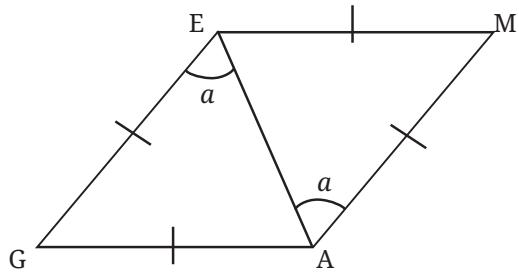
Similarly consider the lines GE and AM and its transversal AE. Since the alternate angles are equal, GE || AM.
As opposite sides are parallel, GAME is also a parallelogram. Thus, every rhombus is a parallelogram, and the properties of a parallelogram hold true for a rhombus as well. Thus, the adjacent angles of a rhombus add up to $180^\circ$ and the opposite angles are equal (verify that the arguments in Deduction 6 can be applied to a rhombus as well!).
Thus, in rhombus ABCD,
$ \angle \mathrm{D} = \angle \mathrm{B} = 180^\circ - 50 = 130^\circ. $
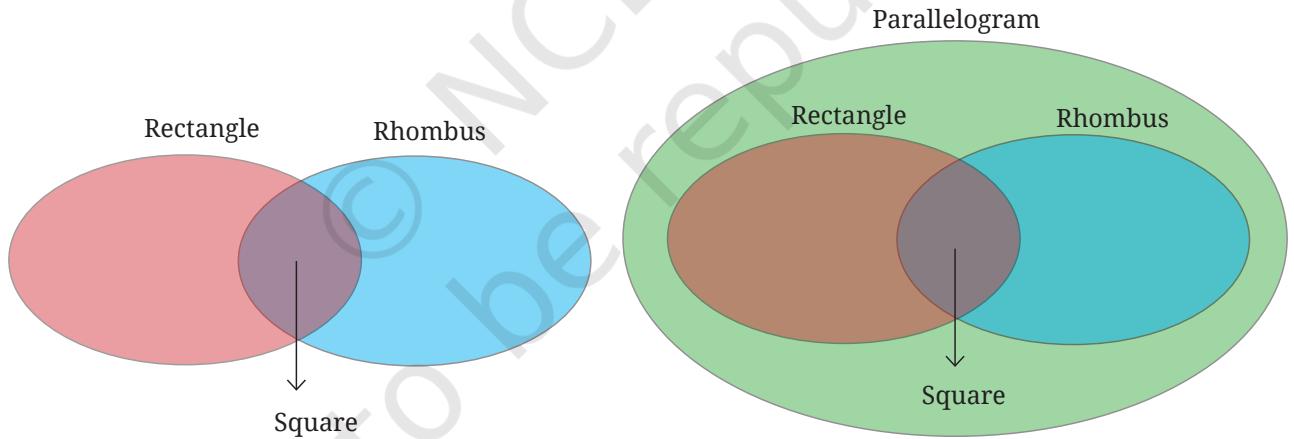
? So a rhombus is a parallelogram, and a rectangle is also a parallelogram. How can this be represented using a Venn diagram?
Where will the set of squares occur in this diagram?
We know that a square is a rectangle. Since the opposite sides of a square are parallel, a square is also a parallelogram. Further, since all the sides of a square have the same length, a square is also a rhombus. Thus, the Venn diagram will be as follows.
Let us list the properties of a rhombus.
Property 1: All the sides of a rhombus are equal to each other.
Property 2: The opposite sides of a rhombus are parallel to each other.
Property 3: In a rhombus, the adjacent angles add up to $180^\circ$ and the opposite angles are equal.
Are the diagonals of a rhombus equal?
Property 4: The diagonals of a rhombus bisect each other.
Property 5: The diagonals of a rhombus bisect its angles.
Do the diagonals of a rhombus intersect at any particular angle? Reason out and/or experiment to figure this out!
Deduction 10—What can we say about the angles formed by the diagonals of a rhombus at their point of intersection?
$\frac { 3 } { 2 }$ In the rhombus GAME, we have $\Delta \mathrm{GEO} \cong \Delta \mathrm{MEO}$ (why?).
So, $\angle \mathrm{GOE} = \angle \mathrm{MOE}$ as they are corresponding parts of congruent triangles. As they add up to $180^\circ$, they should be $90^\circ$ each.

Property 6: Diagonals of a rhombus intersect each other at an angle of $90^\circ$.
Figure it Out
- Find the remaining angles in the following quadrilaterals.
Using the diagonal properties, construct a parallelogram whose diagonals are of lengths 7 cm and 5 cm, and intersect at an angle of $140^\circ$.
Using the diagonal properties, construct a rhombus whose diagonals are of lengths 4 cm and 5 cm.
4.5 Playing with Quadrilaterals
Geoboard Activity
Take a geoboard and some rubber bands. If you do not have these, you could just use the dot grid papers given at the end of the book for this activity.

Place two rubber bands perpendicular to each other, forming diagonals of equal length. Join the ends.
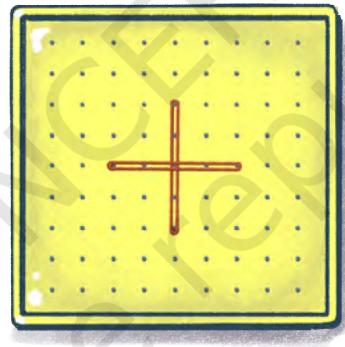
What is the quadrilateral that you get? Justify your answer.
Extend one of the diagonals on both sides by 2 cm.
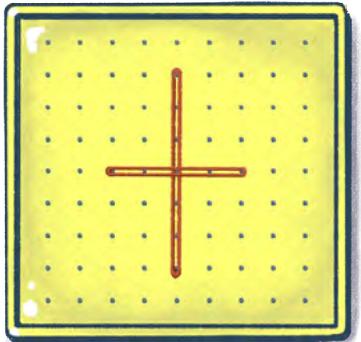
? What quadrilateral will you get now? Justify your answer.
Joining Triangles
- Take two cardboard cutouts of an equilateral triangle of side length 8 cm.
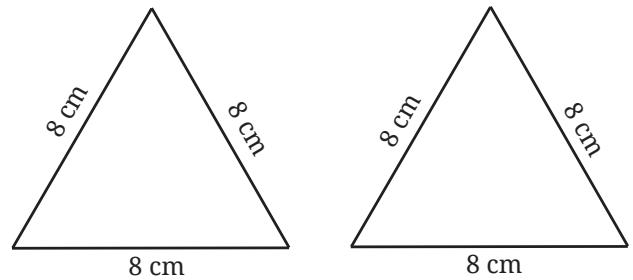
? Can you join them to get a quadrilateral?
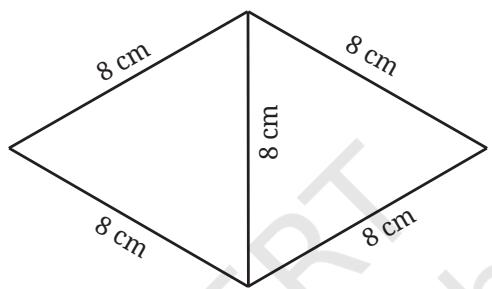
? What type of a quadrilateral is this? Justify your answer.
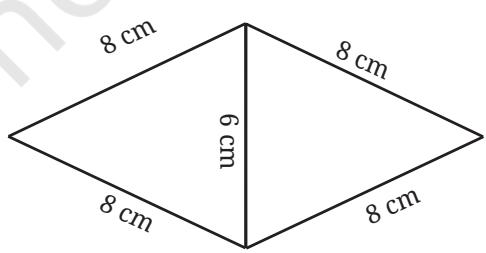
- Take two cardboard cutouts of an isosceles triangle with side lengths 8 cm, 8 cm, and 6 cm.
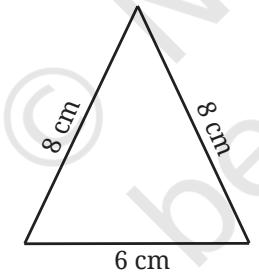
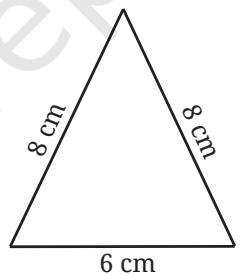
? What are the different ways they can be joined to get a quadrilateral?
Joining them in this way you get
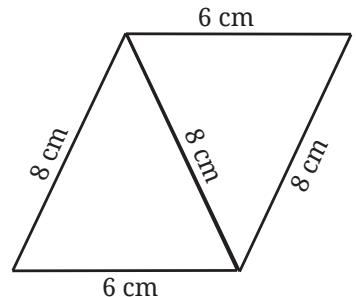
Joining them in this way you get
What quadrilaterals are these? Justify your answers.
- Take two cardboard cutouts of a scalene triangle with sides 6 cm, 9 cm, and 12 cm.

What are the different ways they can be joined to get a quadrilateral?
? Are you able to identify the different quadrilaterals that are obtained by joining the triangles? Justify your answer whenever you identify a quadrilateral.
4.6 Kite and Trapezium
Kite
One of the ways the two triangles of sides 6 cm, 9 cm and 12 cm can be joined together is as follows —
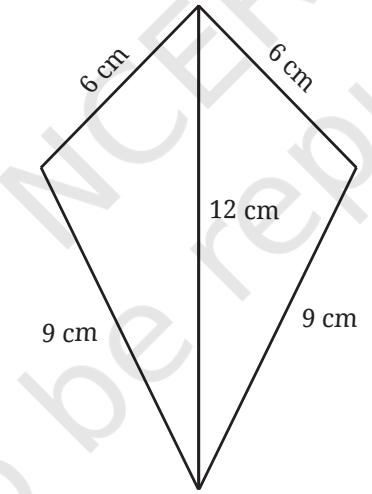
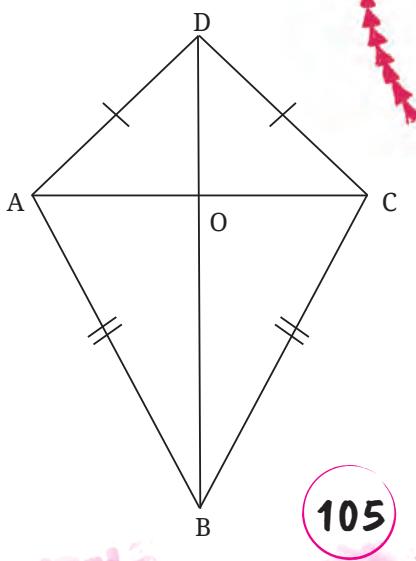
This quadrilateral looks like a kite. Observe that the adjacent sides are of the same length.
Kite: A kite is a quadrilateral that can be labelled ABCD such that $\mathrm{AB} = \mathrm{BC}$, and $\mathrm{CD} = \mathrm{DA}$.
Property 1: In the kite, show that the diagonal BD (i) bisects $\angle$ABC and $\angle$ADC, (ii) bisects the diagonal AC, that is, $\mathrm{AO} = \mathrm{OC}$, and is perpendicular to it.
Hint: Is $\Delta \mathrm{AOB} \cong \Delta \mathrm{COB}$?
Trapezium
Parallelograms are quadrilaterals that have parallel opposite sides. We get a new type of quadrilateral if we relax this condition.
Trapezium: A trapezium is a quadrilateral with at least one pair of parallel opposite sides.
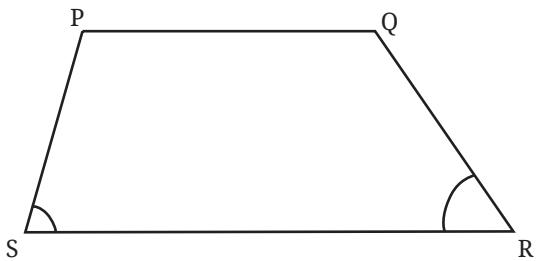
Construct a trapezium. Measure the base angles (marked in the figure).
$\frac { 3 } { 2 }$ Can you find the remaining angles without measuring them? Since PQ || SR, we have
Property 1: $\angle \mathrm{S} + \angle \mathrm{P} = 180^\circ$ and $\angle \mathrm{R} + \angle \mathrm{Q} = 180^\circ$.
Using these facts, the remaining angles can easily be found. Verify your answer after finding them.
When the non-parallel sides of a trapezium have the same lengths, the trapezium is called an isosceles trapezium.
How do we construct an isosceles trapezium?
Construct an isosceles trapezium UVWx, with UV || XW. Measure $\angle \mathrm{U}$.
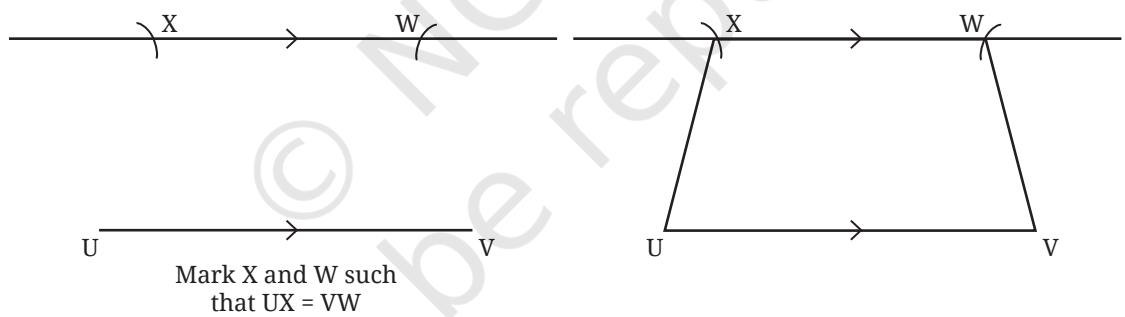
Can you find the remaining angles without measuring them?
Does it appear that the angles opposite to the equal sides— $\angle \mathrm{U}$ and $\angle \mathrm{V}$ —are also equal? Can we find congruent triangles here? Consider line segments XY and WZ perpendicular to UV.
$\frac { 3 } { 2 }$ What type of quadrilateral is XWZY?
Since XW || UV,
$a = 180^\circ - \angle \mathrm{XYZ} = 90^\circ$ and
$b = 180^\circ - \angle \mathrm{WZY} = 90^\circ$ (since the internal angles on the same side of a transversal add up to $180^\circ$.)
Hence, XWZY is a rectangle.
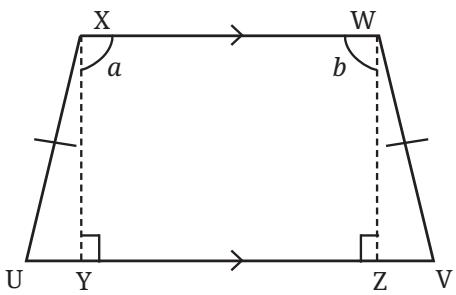
$\textcircled{7}$ Now, it can be shown that ∆UXY ≅ ∆VWZ. (How?) Thus, $\angle \mathrm{U} = \angle \mathrm{V}$.
Using this fact, the remaining angles of the isosceles trapezium can be determined. Verify the angles by measurement.
Property 2: In an isosceles trapezium, the angles opposite to the equal sides are equal.
Figure it Out
Find all the sides and the angles of the quadrilateral obtained by joining two equilateral triangles with sides 4 cm.
Construct a kite whose diagonals are of lengths 6 cm and 8 cm.
Find the remaining angles in the following trapeziums—
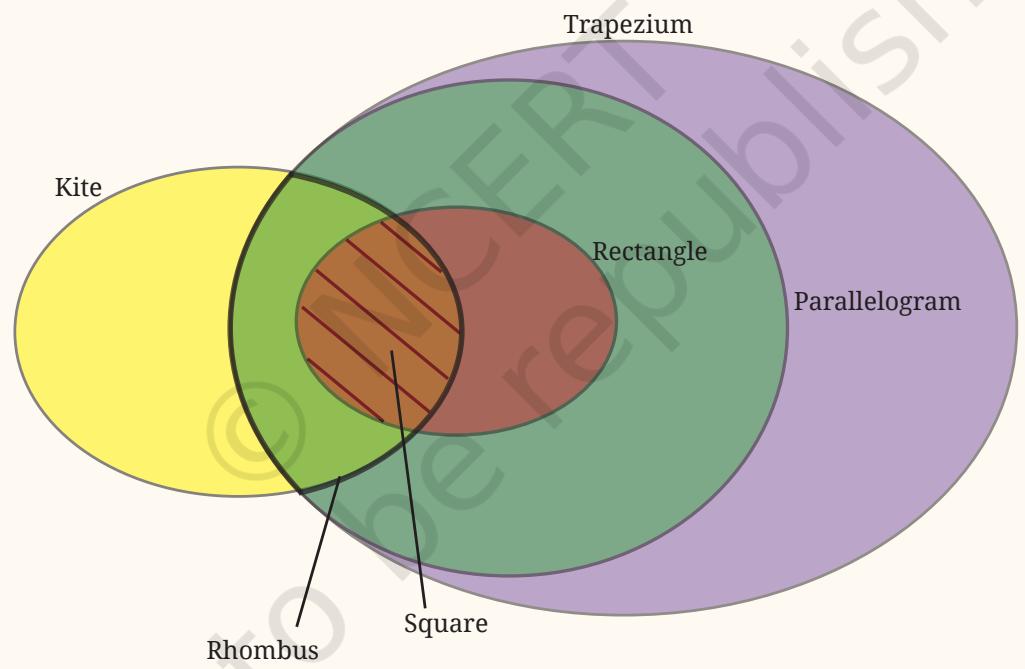
- Draw a Venn diagram showing the set of parallelograms, kites, rhombuses, rectangles, and squares. Then, answer the following questions—
(i) What is the quadrilateral that is both a kite and a parallelogram?
(ii) Can there be a quadrilateral that is both a kite and a rectangle?
(iii) Is every kite a rhombus? If not, what is the correct relationship between these two types of quadrilaterals?
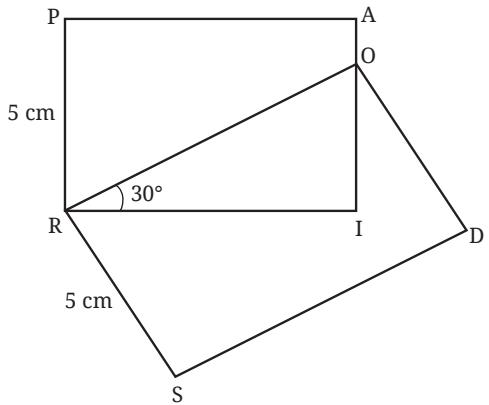
- If PAIR and RODS are two rectangles, find $\angle \mathrm{IOD}$.
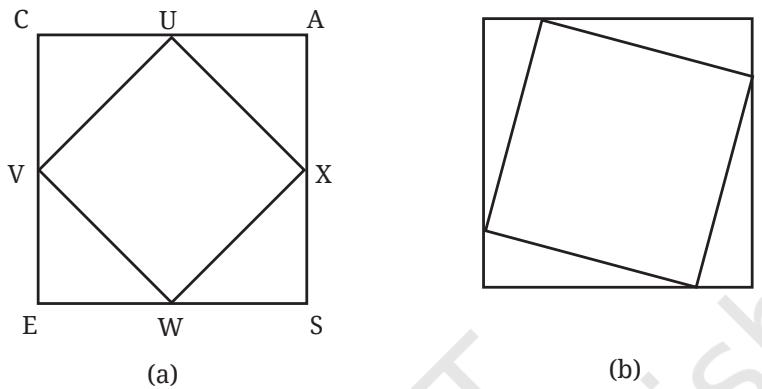
Construct a square with diagonal 6 cm without using a protractor.
CASE is a square. The points U, V, W and X are the midpoints of the sides of the square. What type of quadrilateral is UVWx? Find this by using geometric reasoning, as well as by construction and measurement. Find other ways of constructing a square within a square such that the vertices of the inner square lie on the sides of the outer square, as shown in Figure (b).
If a quadrilateral has four equal sides and one angle of $90^\circ$, will it be a square? Find the answer using geometric reasoning as well as by construction and measurement.
What type of a quadrilateral is one in which the opposite sides are equal? Justify your answer.
Hint: Draw a diagonal and check for congruent triangles.
- Will the sum of the angles in a quadrilateral such as the following one also be $360^\circ$? Find the answer using geometric reasoning as well as by constructing this figure and measuring.
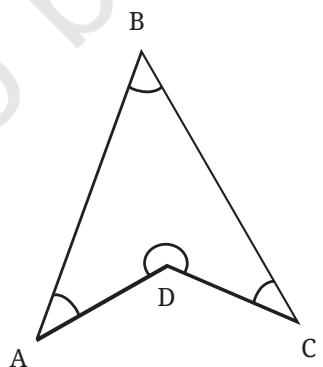
- State whether the following statements are true or false. Justify your answers.
(i) A quadrilateral whose diagonals are equal and bisect each other must be a square.
(ii) A quadrilateral having three right angles must be a rectangle.
(iii) A quadrilateral whose diagonals bisect each other must be a parallelogram.
(iv) A quadrilateral whose diagonals are perpendicular to each other must be a rhombus.
(v) A quadrilateral in which the opposite angles are equal must be a parallelogram.
(vi) A quadrilateral in which all the angles are equal is a rectangle.
(vii) Isosceles trapeziums are parallelograms.
SUMMARY
A rectangle is a quadrilateral in which the angles are all $90^\circ$.
Properties of a rectangle —
- Opposite sides of a rectangle are equal.
- Opposite sides of a rectangle are parallel to each other.
- Diagonals of a rectangle are of equal length and they bisect each other.
A square is a quadrilateral in which all the angles are $90^\circ$ and all the sides are of equal length.
Properties of a square —
- The opposite sides of a square are parallel to each other.
- The diagonals of a square are of equal lengths and they bisect each other at $90^\circ$.
- The diagonals of a square bisect the angles of the square.
A parallelogram is a quadrilateral in which opposite sides are parallel.
Properties of a parallelogram —
- The opposite sides of a parallelogram are equal.
- In a parallelogram, the adjacent angles add up to $180^\circ$, and the opposite angles are equal.
- The diagonals of a parallelogram bisect each other.
A rhombus is a quadrilateral in which all the sides have the same length.
Properties of a rhombus —
- The opposite sides of a rhombus are parallel to each other.
- In a rhombus, the adjacent angles add up to $180^\circ$ and the opposite angles are equal.
- The diagonals of a rhombus bisect each other at right angles.
- The diagonals of a rhombus bisect its angles.
A kite is a quadrilateral with two non-overlapping adjacent pairs of sides having the same length.
A trapezium is a quadrilateral having at least one pair of parallel opposite sides.
The sum of the angle measures in a quadrilateral is $360^\circ$.
PUZZLE TIME!
Which Quad?
Gameplay
- Fold a sheet into half.
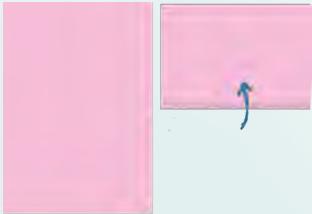
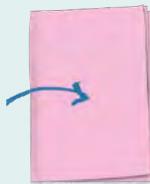
Now, fold it once more into a quarter.
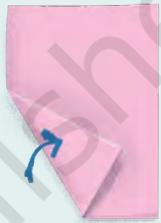
Make a triangular crease at the corner that is at the middle of the paper.
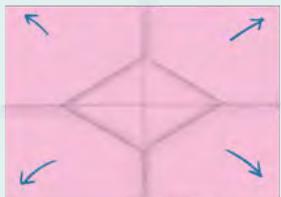
Open the sheet. What is the shape formed by the creases?
How would you fold the quarter paper to get the kinds of creases shown in the following image.
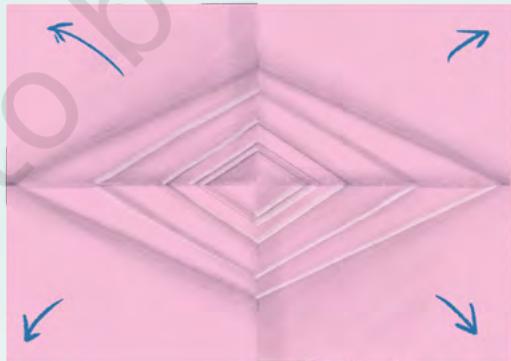
- How would you fold the quarter paper such that a square is formed?
