Recall that algebra employs symbolic representation to express general principles of patterns and relationships succinctly. Beyond this, algebra serves as a tool for substantiating assertions and hypotheses (such as the numerous properties encountered in the preceding chapter), as well as for resolving diverse problems.
The distributive property, which links multiplication and addition, finds a concise algebraic expression. This chapter will delve into various multiplication patterns, demonstrating how they can be articulated within the algebraic framework through the application of distributivity.
6.1 Some Properties of Multiplication
Increments in Products
Let us examine the product of two specific numbers, for instance, $23 \times 27$.
- What is the increment in the product if the initial factor (23) is augmented by one unit?
- How does the product change if the second factor (27) is increased by one?
- What occurs when both factors are each augmented by one?
- Can a discernible pattern be identified that would enable the generalization of these findings to the product of any arbitrary pair of numbers?
Initially, let us address a more straightforward inquiry: determining the product's augmentation when 27 is incremented by 1. Based on the fundamental definition of multiplication (and its commutative characteristic), it is evident that the product will grow by 23. This outcome is also demonstrable via the distributive property of multiplication. For any three numbers
, $a$, $b$, and $c$, the following holds:
$ \widehat{a(b + c)} = ab + ac $
This characteristic can be effectively illustrated graphically:
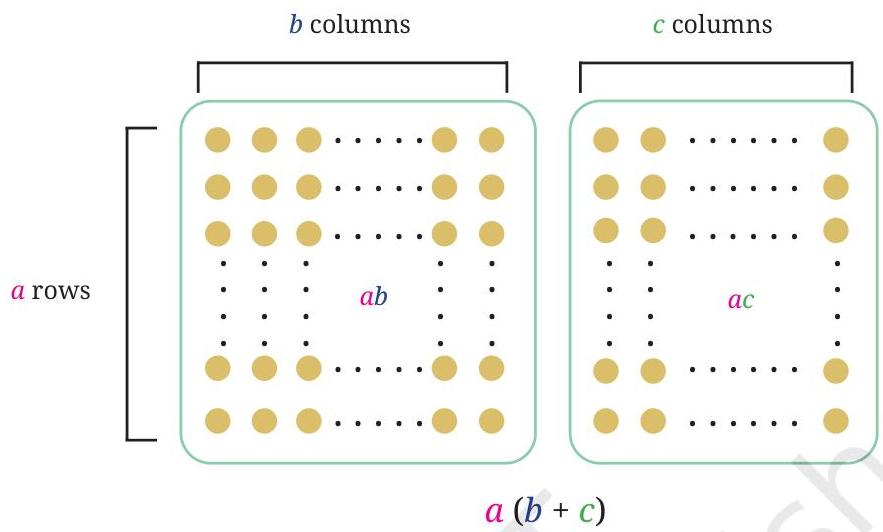
This is conventionally termed the distributive property of multiplication with respect to addition. Applying the identity $a(b + c) = ab + ac$, substituting $a = 23$, $b = 27$, and $c = 1$, yields:
$ 23(27 + 1) = 23 \times 27 + 23 $
It is important to recall that in this context, expressions such as $a(b + c)$ and $23(27 + 1)$ implicitly denote $a \times (b + c)$ and $23 \times (27 + 1)$, respectively. The multiplication symbol '×' is typically omitted when preceding or following parentheses, consistent with conventions seen in terms like $5a$, $xy$, and similar algebraic notations.
Analogously, the expression $(a + b)c$ can be expanded by employing the distributive property in the following manner:
$ \begin{array}{l} (a + b)c = c(a + b) \text{ (commutativity of multiplication)} \ = ca + cb \text{ (distributivity)} \ = ac + bc \text{ (commutativity of multiplication)} \end{array} $
The distributive property enables us to determine, in a general sense, the extent to which a product escalates if either one or both of its constituent numbers are incremented by unity. Assuming the initial pair of numbers is $a$ and $b$, if one of these numbers, for example $b$, is augmented by 1, then we derive:
$ a(b + 1) = ab + a $
Next, let us investigate the scenario where both factors in a product are augmented by one. If, within a product $ab$, both $a$ and $b$ are each incremented by 1, the resulting expression is $(a + 1)(b + 1)$.
How exactly is this expression expanded?
By treating $(a + 1)$ as a singular entity, the application of the distributive property yields:
$ (a + 1)(b + 1) = (a + 1)b + (a + 1)1 $
Reapplying the distributive property subsequently results in
$ \begin{array}{l} (a + 1)(b + 1) = \boxed{(a + 1)b + (a + 1)1} \ = ab + \boxed{(b + a + 1)} \ \text{Increase} \end{array} $
If $a = 23$, and $b = 27$, we get
$ \begin{array}{l} (23 + 1)(27 + 1) = (23 + 1)\boxed{27 + (23 + 1)1} \ = 23 \times 27 + \boxed{(27 + 23 + 1)} \ \text{Increase} \end{array} $
Consequently, when both $a$ and $b$ are augmented by 1, the initial product $ab$ experiences an increment of $a + b + 1$.
? What would we get if we had expanded $(a + 1)(b + 1)$ by first taking $(b + 1)$ as a single term? Try it?
? What happens when one of the numbers in a product is increased by 1 and the other is decreased by 1? Will there be any change in the product?
Consider once more the product $ab$ of two quantities, $a$ and $b$. Should $a$ be incremented by 1 and $b$ be decremented by 1, their resulting product becomes $(a + 1)(b - 1)$. The expansion of this expression yields:
$ \begin{array}{l} (a + 1)(b - 1) = (a + 1)b - (a + 1)1 \ = ab + \boxed{b - (a + 1)} \ = ab + \boxed{\boxed{b - a - 1}} \ \text{Increase} \end{array} $
For the specific values $a = 23$ and $b = 27$, we derive:
$ \begin{array}{l} (23 + 1)(27 - 1) = (23 + 1)\boxed{27 - (23 + 1)1} \ = 23 \times 27 + \boxed{27 - (23 + 1)} \ = 23 \times 27 + \boxed{\boxed{27 - 23 - 1}} \ \text{Increase} \end{array} $
? Will the product always increase? Find 3 examples where the product decreases.
? What happens when $a$ and $b$ are negative integers?
Validate this by substituting various values for $a$ and $b$ into each of the aforementioned scenarios. Illustrative examples include $a = -5$, $b = 8$; $a = -4$, $b = -5$; and so forth.
It has been established that integers conform to the distributive property; specifically, for any three integers $x, y,$ and $z$, the relation $x(y + z) = xy + xz$ is valid.
Consequently, the derived expressions concerning product increments remain applicable even when the symbolic variables assume negative integer values.
An algebraic expression is deemed equivalent to another if they yield identical numerical results upon the substitution of their variables with numbers. These
numbers can be any integers. Mathematical assertions that declare the equivalence of two algebraic expressions, such as
$ a (b + 8) = ab + 8a, $
$ (a + 1)(b - 1) = ab + b - a - 1, \text{ etc.}, $
are formally termed identities.
? By how much will the product of two numbers change if one of the numbers is increased by $m$ and the other by $n$?
Given $a$ and $b$ as the original factors, they transform into $a + m$ and $b + n$ respectively.
$ \begin{array}{l} (a + m)(b + n) = (a + m)b + (a + m)n \ = ab + mb + an + mn \end{array} $
The resultant augmentation in the product is $an + bm + mn$.
Observe that the total product is formed by summing the products of every term from $(a + m)$ with every term from $(b + n)$.
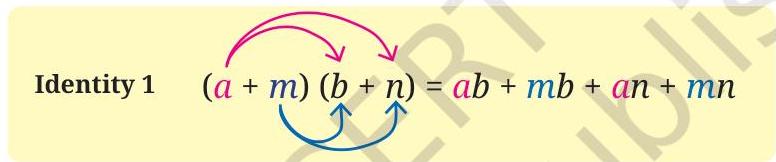
This algebraic identity permits a visual representation, as illustrated below—
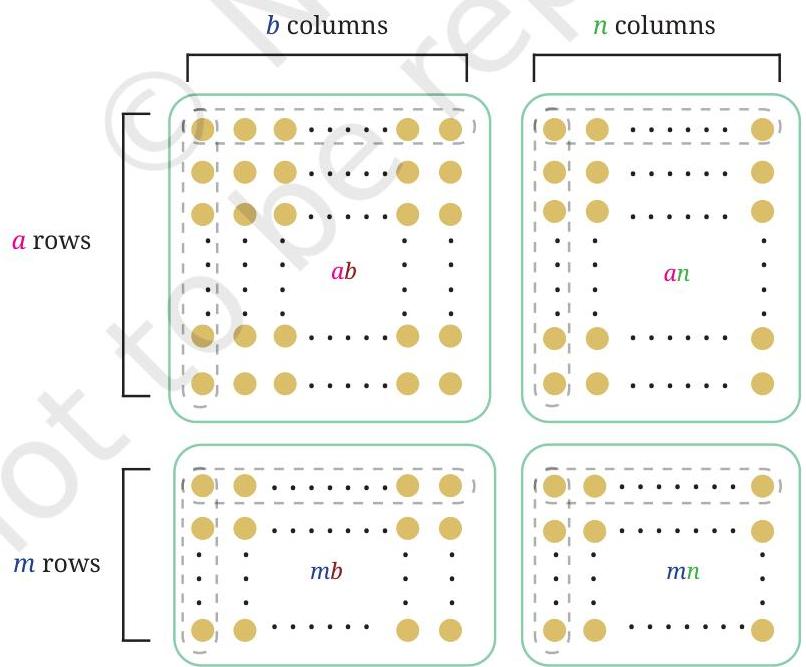
$(a + m)(b + n)$
? This identity can be used to find how products change when the numbers being multiplied are increased or decreased by any amount. Can you see how this identity can be used when one or both numbers are decreased?
To illustrate, let's revisit the scenario where one quantity is augmented by 1 and another is diminished by 1. The product $(a + 1)(b - 1)$ can be expressed as $(a + 1)(b + (-1))$. By substituting $m = 1$ and $n = -1$ into Identity 1, we derive:
$ ab + (1) \times b + a \times (-1) + (1) \times (-1) = ab + b - a - 1, $
This result matches the expression previously determined.
? Use Identity 1 to find how the product changes when
(i) one number is decreased by 2 and the other increased by 3; (ii) both numbers are decreased, one by 3 and the other by 4.
? Verify the answers by finding the products without converting the subtractions to additions.
Extending this principle, the product $(a + u)(b - v)$ can be derived in the following manner:
$ \begin{array}{l} (a + u)(b - v) = (a + u)b - (a + u)v \ = ab + ub - (av + uv) \ = ab + ub - av - uv. \end{array} $
Confirm that this outcome is consistent with substituting $m = u$ and $n = -v$ into Identity 1.
Analogous to Identity 1, the expansion of $(a + u)(b - v)$ represents the aggregate of the products formed by each constituent term of $a + u$ (specifically, $a$ and $u$) with each constituent term of $b - v$ (namely, $b$ and $(-v)$). It is important to observe that the algebraic signs of the resulting terms are established by applying the standard conventions for integer multiplication.
? See how the rules of integer multiplication allows us to handle multiple cases using a single identity!
? Expand (i) $(a - u)(b + v)$, (ii) $(a - u)(b - v)$.
The resulting expressions are:
$ \begin{array}{l} (a - u)(b + v) = ab - ub + av - uv, \text{ and} \ (a - u)(b - v) = ab - ub - av + uv. \end{array} $
The application of the distributive property is not confined solely to binomial expressions within parentheses.
? Example 1: Expand $\frac{3a}{2} (a - b + \frac{1}{5})$.
$ \frac{3a}{2} (a - b + \frac{1}{5}) = (\frac{3a}{2} \times a) - (\frac{3a}{2} \times b) + (\frac{3a}{2} \times \frac{1}{5}). $
Each constituent term can be further simplified as follows—
We Distribute, Yet Things Multiply
Employing exponential notation, we can represent $\frac{3}{2} \times (a \times a)$ as $\frac{3}{2} a^2$.
$ \frac{3a}{2} \times b = \frac{3}{2} \times (a \times b) = \frac{3}{2} ab. $
$ \frac{3a}{2} \times \frac{1}{5} = \left(\frac{3}{2} \times \frac{1}{5}\right) a = \frac{3}{10} a $
Consequently, the expanded expression becomes:
$ \frac{3a}{2} (a - b + \frac{1}{5}) = \frac{3}{2} a^2 - \frac{3}{2} ab + \frac{3}{10} a. $
? Can any two terms be added to get a single term?
For example, can $\frac{3}{2} a^2$ and $\frac{3}{10} a$ be added to get a single term?
It is evident that none of the terms possess identical literal coefficients (letter-numbers), which is a prerequisite for their combination into a singular term. Therefore, no additional simplification of this expression can be performed.
As a reminder, terms characterized by identical literal coefficients are designated as like terms.
? Example 2: Expand $(a + b)(a + b)$.
The expansion proceeds as follows: $(a + b)(a + b) = (a + b)a + (a + b)b = a \times a + b \times a + ab + b \times b$
$ = a^2 + ba + ab + b^2 $
Given that $ba = ab$, we observe the presence of two terms, $ba$ and $ab$, which share the same literal coefficients (i.e., they are like terms); these can thus be combined:
$ ba + ab = ab + ab = 2ab $
Consequently, the final expanded form is:
$ (a + b)(a + b) = a^2 + 2ab + b^2. $
? Example 3: Expand $(a + b)(a^2 + 2ab + b^2)$.
$ \begin{aligned} (a + b)(a^2 + 2ab + b^2) &= (a + b)a^2 + (a + b) \times 2ab + (a + b)b^2 \ &= (a \times a^2) + ba^2 + (a \times 2ab) + (b \times 2ab) + ab^2 + (b \times b^2) \end{aligned} $
Each constituent term can be individually simplified as detailed below:
$ a \times a^2 = a^3 \text{ (why?)} $
$ ba^2 = a^2b $
$ a \times 2ab = 2 \times a \times a \times b = 2a^2b $
$ b \times 2ab = 2 \times a \times b \times b = 2ab^2 $
$ b \times b^2 = b^3 $
Consequently, $(a + b)(a^2 + 2ab + b^2) = a^3 + a^2b + 2a^2b + 2ab^2 + ab^2 + b^3$.
Upon examination, it is evident that $a^2b$ and $2a^2b$ constitute like terms, possessing identical literal coefficients, thereby permitting their summation:
$ a^{2}b + 2a^{2}b = (1 + 2)a^{2}b = 3a^{2}b. $
In a similar fashion, $ab^2$ and $2ab^2$ are also like terms, allowing for their consolidation:
$ ab^2 + 2ab^2 = (1 + 2)ab^2 = 3ab^2. $
Thus, we have
$ (a + b) \times (a^2 + 2ab + b^2) = a^3 + 3a^2b + 3ab^2 + b^3. $
A Pinch of History
The principle of distributing multiplication across addition was embedded within the computational practices of mathematicians across various ancient civilizations, notably those in ancient Egypt, Mesopotamia, Greece, China, and India. Illustratively, figures such as Euclid, employing a geometric perspective, and Āryabhāṭa, through an algebraic lens, routinely applied the distributive law implicitly throughout their extensive mathematical and scientific treatises. The earliest unambiguous articulation of the distributive property is attributed to Brahmagupta, appearing in his magnum opus, the Brahmasphūṭasiddhānta (Verse 12.55). He designated the application of this property for multiplication as khanda-guṇanam, meaning 'multiplication by parts'. This particular verse posits that “The multiplier is disaggregated into two or more components whose aggregate equals the original; the multiplicand is subsequently multiplied by each component, and these partial products are then summed”. Expressed symbolically, for a scenario involving two such parts, this principle is formally equivalent to the identity $(a + b)c = ac + bc$. Furthermore, in the subsequent verse (Verse 12.56), Brahmagupta delineates a technique for expedited multiplication that leverages this distributive characteristic, a method which will be elaborated upon in the ensuing section.
Figure it Out
- Examine the multiplication grid provided below. Within this grid, every entry results from the product of two integers. Given that the central value of a $3 \times 3$ sub-grid is designated as the expression $pq$, as illustrated, articulate the algebraic formulations for the other elements composing this sub-grid.
| x | 1 | 2 | 3 | 4 | 5 | 6 | 7 | 8 | 9 | 10 |
|---|---|---|---|---|---|---|---|---|---|---|
| 1 | 1 | 2 | 3 | 4 | 5 | 6 | 7 | 8 | 9 | 10 |
| 2 | 2 | 4 | 6 | 8 | 10 | 12 | 14 | 16 | 18 | 20 |
| 3 | 3 | 6 | 9 | 12 | 15 | 18 | 21 | 24 | 27 | 30 |
| 4 | 4 | 8 | 12 | 16 | 20 | 24 | 28 | 32 | 36 | 40 |
| 5 | 5 | 10 | 15 | 20 | 25 | 30 | 35 | 40 | 45 | 50 |
| 6 | 6 | 12 | 18 | 24 | 30 | 36 | 42 | 48 | 54 | 60 |
| 7 | 7 | 14 | 21 | 28 | 35 | 42 | 49 | 56 | 63 | 70 |
| 8 | 8 | 16 | 24 | 32 | 40 | 48 | 56 | 64 | 72 | 80 |
| 9 | 9 | 18 | 27 | 36 | 45 | 54 | 63 | 72 | 81 | 90 |
| 10 | 10 | 20 | 30 | 40 | 50 | 60 | 70 | 80 | 90 | 100 |
| 3 × 5 | 3 × 6 | 3 × 7 |
|---|---|---|
| 4 × 5 | 4 × 6 | 4 × 7 |
| 5 × 5 | 5 × 6 | 5 × 7 |
| $pq$ | ||
We Distribute, Yet Things Multiply
Determine the expanded forms of the subsequent products.
(i) $(3 + u)(v - 3)$ (ii) $\frac{2}{3}(15 + 6a)$ (iii) $(10a + b)(10c + d)$ (iv) $(3 - x)(x - 6)$ (v) $(-5a + b)(c + d)$ (vi) $(5 + z)(y + 9)$
Identify three scenarios where the product of two numbers persists without alteration, even when one number is augmented by 2 and the other is diminished by 4.
Perform the expansion for the following expressions: (i) $(a + ab - 3b^2)(4 + b)$, and (ii) $(4y + 7)(y + 11z - 3)$.
Determine the expanded forms of the following products: (i) $(a - b)(a + b)$, (ii) $(a - b)(a^2 + ab + b^2)$, and (iii) $(a - b)(a^3 + a^2b + ab^2 + b^3)$. Can you discern a recurring pattern? Based on the observed pattern, what algebraic identity would logically succeed these? Validate this proposed identity through algebraic expansion.
Fast Multiplications Using the Distributive Property
When one of the numbers is 11, 101, 1001, ...
? Use the following multiplications to find the product of a number with 11 in a single step.
(a) $3874 \times 11$ (b) $5678 \times 11$
Consider the initial multiplication example.
$ 3874 \times 11 = 3874(10 + 1) = 38740 + 3874 $
$
- \begin{array}{c} 38740 \ 3874 \end{array} $
Observe the pattern in which the digits are summed.
Let's represent a four-digit number as $dcba$, where $d$ occupies the thousands position, $c$ the hundreds, $b$ the tens, and $a$ the units.
$ dcba \times (10 + 1) = dcba \times 10 + dcba. $
The operation thus yields: $ \begin{array}{cccc} \frac{d}{d} & \frac{c}{c+d} & \frac{b}{b+c} & \frac{a}{a+b} \ \hline \frac{d}{d} & c+d & b+c & a+b \end{array} $
\end{array} $
This methodology facilitates the derivation of the product in a single computational line.
Step 1 $ \frac{3874 \times 11}{4} $
Step 2 $ \frac{3874 + 11}{14} $
Step 3 $ \frac{3874 + 11}{614} $
Step 4 $ \frac{3874}{2614} $
Step 5 $ \frac{3874}{42614} $
? Describe a general rule to multiply a number (of any number of digits) by 11 and write the product in one line.
Evaluate (i) $94 \times 11$, (ii) $495 \times 11$, (iii) $3279 \times 11$, (iv) $4791256 \times 11$.
? Can we come up with a similar rule for multiplying a number by 101?
? Multiply 3874 by 101.
Consider a four-digit integer denoted as $dcba$.
$ dcba \times 101 = dcba \times (100 + 1) = dcba \times 100 + dcba. $
This expression transforms into:
$ \frac{+}{d} \quad \frac{c}{c} \quad \frac{b}{b + d} \quad \frac{a}{a} \quad \frac{c}{c} \quad \frac{b}{b} \quad \frac{a}{a} $
? Use this to multiply $3874 \times 101$ in one line.
? What could be a general rule to multiply a number by 101 and write the product in one line? Extend this rule for multiplication by 1001, 10001, ...
? Use this to find (i) $89 \times 101$, (ii) $949 \times 101$, (iii) $265831 \times 1001$, (iv) $1111 \times 1001$, (v) $9734 \times 99$ and (vi) $23478 \times 999$.
Techniques involving the application of the distributive property for the facile multiplication of numerical pairs received considerable treatment within the classical mathematical treatises of Brahmagupta (628 CE), Sridharacharya (750 CE), and Bhaskaracharya (Lilavati, 1150 CE). Specifically, Brahmagupta, in his seminal text Brahmasphutasiddhānta (Verse 12.56), designates these expedited multiplication strategies, which leverage the distributive property, as ista-gunana.
6.2 Special Cases of the Distributive Property
Square of the Sum/Difference of Two Numbers
? Given that a square with side length 60 units has an area of 3600 square units (60²), and one with side length 5 units has an area of 25 square units (5²), can these facts be utilized to determine the area of a square with side length 65 units?
A square of side length 65 can be partitioned into four distinct sections, as illustrated in the accompanying diagram: one square with a side length of 60, another square with a side length of 5, and two rectangular regions, each measuring 60 by 5 units. The total area of the 65-unit square is equivalent to the sum of the areas of these individual components. Could you calculate the areas of the four segments depicted in the figure?
The calculation yields:
$ \begin{array}{l} 65^2 = (60 + 5)^2 = 60^2 + 5^2 + 2 \times (60 \times 5). \ = 3600 + 25 + 600 = 4225 \text{ sq. units}. \end{array} $
Consider the product $(60 + 5) \times (60 + 5)$, applying the distributive property for its expansion.
$ \begin{array}{l} (60 + 5) \times (60 + 5) = 60 \times 60 + 5 \times 60 + 60 \times 5 + 5 \times 5 \ = 60^2 + 2 \times (60 \times 5) + 5^2. \end{array} $
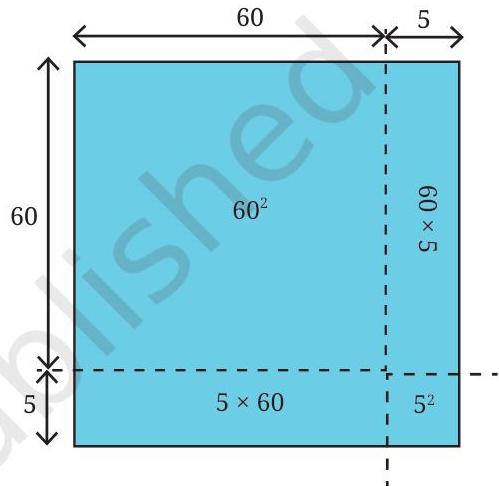
? What would be the outcome if $65^2$ were expressed as $(30 + 35)^2$ or $(52 + 13)^2$? Illustrate these scenarios with diagrams and verify the resulting area.
Let's now examine the generalized algebraic expression for the square of the sum of two variables, $(a + b)^2$.

By employing the distributive property, the expression $(a + b)^2$ can be expanded into the following form:
$ \begin{array}{l} (a + b) \times (a + b) = a \times a + a \times b + b \times a + b \times b \ = a^2 + 2ab + b^2, \end{array} $
as previously demonstrated in Example 2.
Identity 1A $(a + b)^2 = a^2 + 2ab + b^2$
? Given any two integers, $a$ and $b$, does the inequality $(a + b)^2 > a^2 + b^2$ consistently hold true? If this is not universally the case, under what conditions does this inequality apply?
? Employ Identity 1A to calculate the values of $104^2$ and $37^2$. (Suggestion: Express 104 and 37 as sums or differences of numbers whose squares are readily calculable.)
? Utilize Identity 1A to formulate the expressions for the subsequent items.
(i) $(m + 3)^2$
(ii) $(6 + p)^2$
? Expand $(6x + 5)^2$.
| Using the Distributive Property | Using the Identity |
|---|---|
| The expression $(6x + 5)^2$ is equivalent to $(6x + 5)$ multiplied by $(6x + 5)$. | Applying the identity, $(6x + 5)^2$ is expanded as $(6x)^2 + 5^2 + 2 \times (6x \times 5)$. |
| This expands further to $(6x \times 6x) + (5 \times 6x) + (6x \times 5) + 5 \times 5$. | The calculation yields $(6x \times 5)^2 = 36x^2 + 25 + 60x$. |
| This simplifies to $(6x)^2 + 2(6x \times 5) + 5^2$. | |
| The final result is $(6x^2 + 60x + 25)$. |

Should recalling or applying the generalized formula prove challenging, one may simply utilize the distributive property for multiplication to arrive at the required outcome.
? Expand $(3j + 2k)^2$ using both the identity and by applying the distributive property.
? Is it feasible to utilize the values of $60^2 (=3600)$ and $5^2 (=25)$ to determine $(60 - 5)^2$, or equivalently, $55^2$? Let's investigate this question geometrically by envisioning a square with a side length of 55 contained within a larger square of side length 60.
Consider the area of a square with a side length of 55, which can be represented as $(60 - 5)^2 = 55^2$.
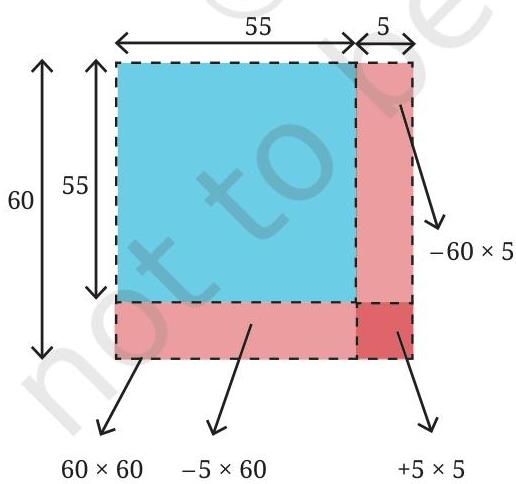
One approach to determine the area of a square with side length 55 involves beginning with the area of a square having a side length of 60, and subsequently deducting the areas of two rectangles, each with dimensions 60 by 5. This calculation is expressed as $60^2 - (60 \times 5) - (5 \times 60)$. However, this method inadvertently subtracts the area of the smaller square of side length 5 twice. How can this expression be adjusted to yield the correct area?
To rectify this, the area of the square with side length 5 must be added back into the expression. This ensures that its area is only subtracted a single time, accurately reflecting the geometric decomposition.
We Distribute, Yet Things Multiply
Hence,
$ \begin{array}{l} (60 - 5)^2 = 60^2 - (60 \times 5) - (5 \times 60) + 5^2 \ = 3600 - 300 - 300 + 25 \ = 3025. \end{array} $
Thus, the area of a square with a side length of 55 units is calculated to be 3025 square units.
Having examined the expansion of $(a + b)^2$, let us now investigate the algebraic expansion of $(a - b)^2$.
By applying the distributive property of multiplication over subtraction, we can derive:
$ \begin{array}{l} (a - b)^2 = (a - b) \times (a - b) \ = (a)^2 - ba - ab + (b)^2 \ = a^2 - 2ab + b^2. \end{array} $
? An alternative method for determining the expansion of $(a - b)^2$ involves leveraging the known expansion of $(a + b)^2$. Consider how this might be achieved.
Hint: Recognize that $(a - b)^2$ can be conceptualized as $(a + (-b))^2$.
With this substitution, we can directly apply the formula for the expansion of $(a + b)^2$.
$ (a + (-b)^2 = (a)^2 + (-b)^2 + 2 \times (a) \times (-b) $
Identity 1B $(a - b)^2 = a^2 + b^2 - 2ab$
? Determine the general expansion of $(a - b)^2$ using a geometric approach, analogous to the method applied for $55^2$.
? Utilize Identity 1B, $(a - b)^2 = a^2 + b^2 - 2ab$, to calculate the values of (a) $99^2$ and (b) $58^2$.
? Expand the following expressions using both Identity 1B and by directly applying the distributive property:
(i) $(b - 6)^2$
(ii) $(-2a + 3)^2$
(iii) $(7y - \frac{3}{4z})^2$
Investigating Patterns
Pattern 1
Observe the pattern presented below.
$ \begin{array}{l} 2(2^2+1^2)=3^2+1^2\ 2(3^2+1^2)=4^2+2^2\ 2(6^2+5^2)=11^2+1^2\ 2(5^2+3^2)=8^2+2^2 \end{array} $
\end{array} $
? Consider selecting two natural numbers. Compute the total of their squares. Is it possible to express double this sum as the sum of two distinct squares?
Attempt this procedure with additional numerical pairs. Have you discerned a consistent regularity?
Observe that $2(5^2 + 6^2) = (6 + 5)^2 + (6 - 5)^2$ holds true.
? Do the algebraic identities presented subsequently contribute to elucidating the previously noted pattern?
$ (a + b)^2 = a^2 + 2ab + b^2 $
$ (a - b)^2 = a^2 - 2ab + b^2 $
$ (a + b)^2 + (a - b)^2 = (a^2 + 2ab + b^2) + (a^2 - 2ab + b^2) $
Upon combining homologous terms, specifically $a^2 + a^2 = 2a^2$, $b^2 + b^2 = 2b^2$, and $2ab - 2ab = 0$, the resultant expression is:
$ 2(a^2 + b^2) = (a + b)^2 + (a - b)^2. $
Pattern 2
? Presented here is a kindred pattern. Endeavor to articulate this pattern algebraically to ascertain its universal validity.
$ \begin{array}{l} 9 \times 9 - 1 \times 1 = 10 \times 8 \ 8 \times 8 - 6 \times 6 = 14 \times 2 \ 7 \times 7 - 2 \times 2 = 9 \times 5 \ 10 \times 10 - 4 \times 4 = 14 \times 6 \ \end{array} $
The inherent structure of this pattern suggests the form $a^2 - b^2 = (a + b) \times (a - b)$.
Does this constitute a verifiable identity? By applying the distributive property, we derive:
$ (a + b) \times (a - b) = a^2 - ab + ba - b^2. $
When the similar terms, $ab + (-ab) = 0$, are aggregated, it becomes evident that:
Identity 1C $(a + b) \times (a - b) = a^2 - b^2.$
This particular identity was previously encountered in Figure it Out 5 (i).
? Employ Identity 1C to compute the products $98 \times 102$ and $45 \times 55$.
? Demonstrate the identity $(a + b) \times (a - b) = a^2 - b^2$ through a geometric representation.

We Distribute, Yet Things Multiply
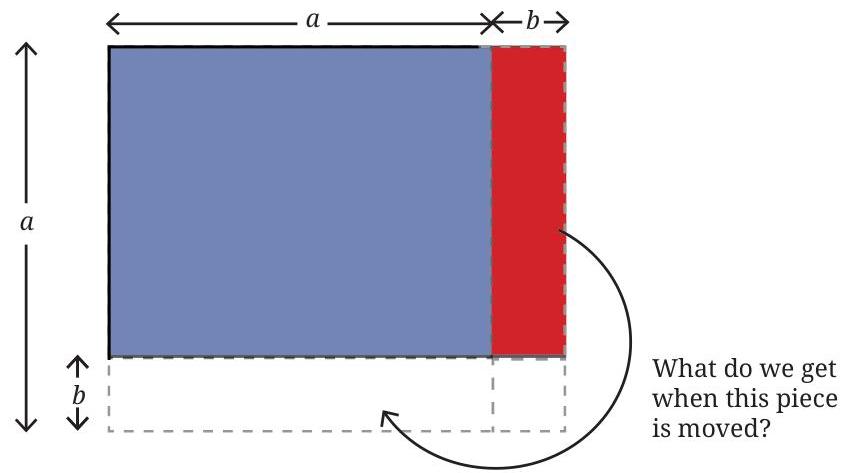 Hint:
Hint:
Sridharacharya (circa 750 CE) devised an intriguing approach for rapidly calculating numerical squares by leveraging Identity 1C. Examine the subsequent altered expression of this identity:
$ a^{2} = (a + b)(a - b) + b^{2} $
? What is the rationale behind the veracity of this identity?
For instance, the square of 31, $31^2$, can be ascertained by assigning $a = 31$ and $b = 1$.
$ \begin{array}{l} 31^{2} = (31 + 1)(31 - 1) + 1^{2} \ = 32 \times 30 + 1 \ = 961. \end{array} $
Similarly, $197^{2}$ can be determined by setting $a = 197$ and $b = 3$.
$ \begin{array}{l} 197^{2} = (197 + 3)(197 - 3) + 3^{2} \ = 200 \times 194 + 9 \ = 38809. \end{array} $
? Figure it Out
- Between $(a - b)^2$ and $(b - a)^2$, which expression yields a larger value? Provide substantiation for your conclusion.
- Represent the number 100 as the disparity between two squared terms.
- Compute the values of $406^2$, $72^2$, $145^2$, $1097^2$, and $124^2$ employing the algebraic identities acquired thus far.
- Are Patterns 1 and 2 exclusively applicable to natural numbers? Do they extend to negative integers? Furthermore, how do they behave with fractional values? Substantiate your responses.
Math Talk
6.3 Mind the Mistake, Mend the Mistake
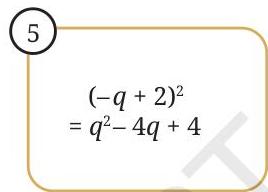
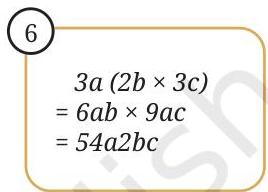
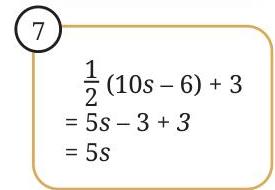
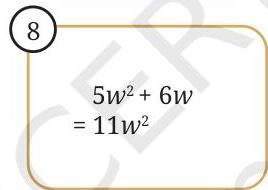
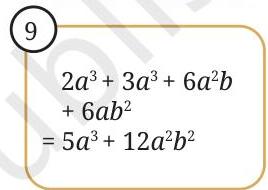
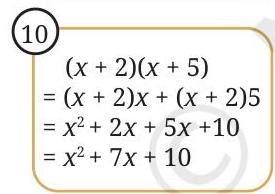
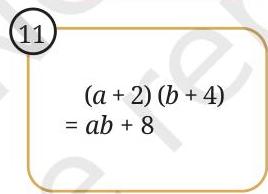
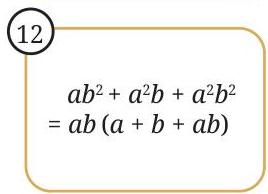
The following section displays several algebraic expressions, each having been expanded and then reduced to its most simplified form.
(i) Check each of the simplifications and see if there is a mistake. (ii) If there is a mistake, try to explain what could have gone wrong. (iii) Then write the correct expression.
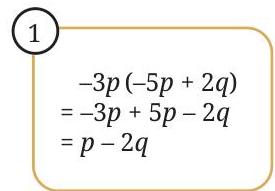
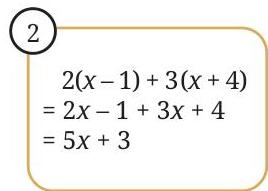
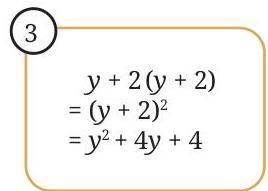
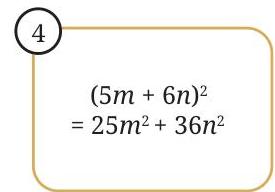
6.4 This Way or That Way, All Ways Lead to the Bay
Examine the visual progression presented in the following illustration. Construct the subsequent element within this series. Determine the number of circles contained within it. Ascertain the cumulative count of circles present at Step 10. Formulate an algebraic expression representing the quantity of circles at any given Step $k$.
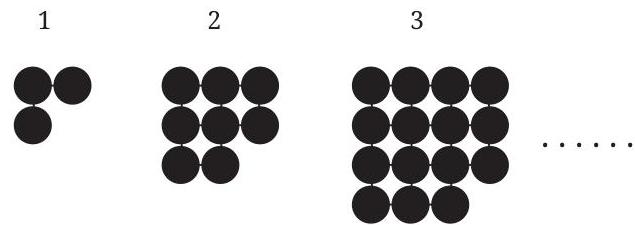
This pattern lends itself to diverse interpretations. Several potential analytical approaches are outlined below:
Segmentation and Proliferation
Method 1
Step 1
Step 2
Step 3
Step 4
...
Step k

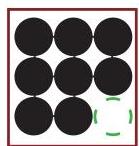
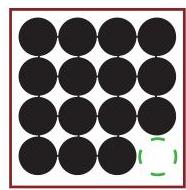
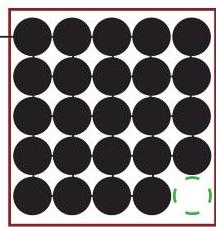
$ \begin{array}{l} 2 ^ {2} - 1 \ = (1 + 1) ^ {2} - 1 \end{array} $
$ 3 ^ {2} - 1 = (2 + 1) ^ {2} - 1 $
$ 4 ^ {2} - 1 = (3 + 1) ^ {2} - 1 $
$ 5 ^ {2} - 1 = (4 + 1) ^ {2} - 1 $
$ \dots $
$ (k + 1) ^ {2} - 1 $
Method 2
Step 1
Step 2
Step 3
Step 4
...
Step k
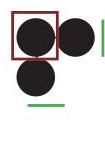
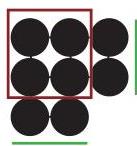
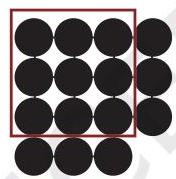
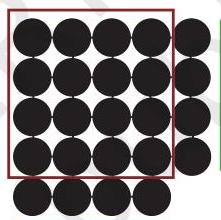
$ \begin{array}{l} 1 + 2 \times 1 \ = 1 ^ {2} + 2 \times 1 \end{array} $
$ 2 ^ {2} + 2 \times 2 = 2 ^ {2} + 2 \times 2 $
$ 3 ^ {2} + 2 \times 3 = 3 ^ {2} + 2 \times 3 $
$ 4 ^ {2} + 2 \times 4 = 4 ^ {2} + 2 \times 4 $
$ \dots $
$ k ^ {2} + 2 \times k $
Method 3
Step 1
Step 2
Step 3
Step 4
...
Step k
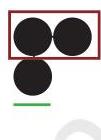
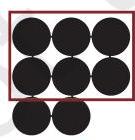
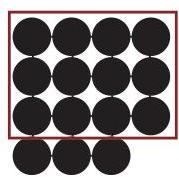
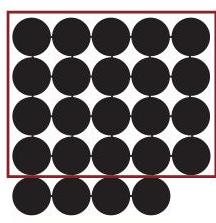
$ \dots $
$ \begin{array}{l} 1 \times 2 + 1 \ = 1 \times (1 + 1) + 1 \end{array} $
$ 2 \times 3 + 2 = 2 \times (2 + 1) + 2 $
$ 3 \times 4 + 3 = 3 \times (3 + 1) + 3 $
$ 4 \times 5 + 4 = 4 \times (4 + 1) + 4 $
$ \dots $
$ k \times (k + 1) + k
$
Method 4
Step 1
Step 2
Step 3
Step 4
Step $k$
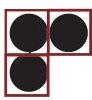
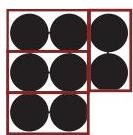
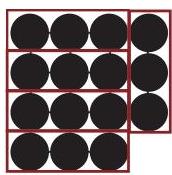
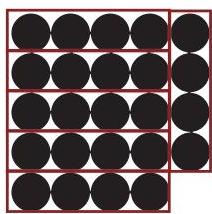
$ 1 \times 3 = 1 \times (1 + 2) $
$ 2 \times 4 = 2 \times (2 + 2) $
$ 3 \times 5 = 3 \times (3 + 2) $
$ 4 \times 6 = 4 \times (4 + 2) $
$ \dots $
$ k \times (k + 2) $
Does your method match any of these, or is it different? Each expression that we have identified appears different, but are they really different? Since they describe the same pattern, they should all be the same. Let us simplify each expression and find out.
$ \begin{array}{l} (k + 1)^2 - 1 \ = k^2 + 1 + 2k - 1 \ = k^2 + 2k \end{array} $
$ k^2 + 2 \times k $
$ = k^2 + 2k $
$ k \times (k + 1) + k $
$ = k^2 + k + k $
$ = k^2 + 2k $
$ k \times (k + 2) $
$ = k^2 + 2k $
When carried out correctly, all methods lead to the same answer; $k^2 + 2k$. The expression $k^2 + 2k$ gives the number of circles at Step $k$ of this pattern.

In Mathematics, there are often multiple ways of looking at a pattern, and different ways of approaching and solving the same problem. Finding such ways often requires a great deal of creativity and imagination! While one or two of the ways might be your favourite(s), it can be amusing and enriching to explore other ways as well.
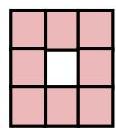
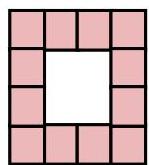
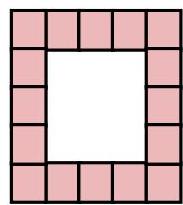
? Use this formula to find the number of circles in Step 15. ? Consider the pattern made of square tiles in the picture below.
···
We Distribute, Yet Things Multiply
? How many square tiles are there in each figure? ? How many are there in Step 4 of the sequence? What about Step 10? ? Write an algebraic expression for the number of tiles in Step $n$. Share your methods with the class. Can you find more than one method to arrive at the answer?
? Find the area of the (interior) shaded region in the figure below. All four rectangles have the same dimensions.
Tadang's method:
The entire geometric area constitutes a square whose side length is $(m + n)$, resulting in a total area of $(m + n)^2$.
The area of the internal shaded portion can be ascertained by deducting the combined area of four rectangles from this overall area. Specifically, this calculation yields $(m + n)^2 - 4mn$.
Yusuf's method:
The shaded area is defined as a square possessing a side length of $(n - m)$. Consequently, its area is given by $(n - m)^2$.
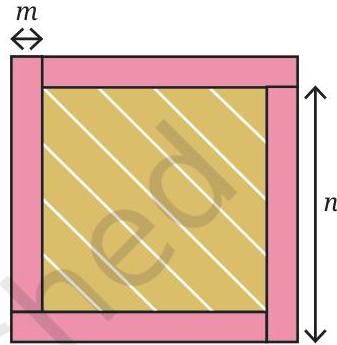
? Through algebraic expansion of both expressions, confirm the identity $(m + n)^2 - 4mn = (n - m)^2$. ? Determine the area of the diagonally striped section depicted in the accompanying figure. It is noted that all three rectangular components share identical dimensions (Refer to Fig. 1).
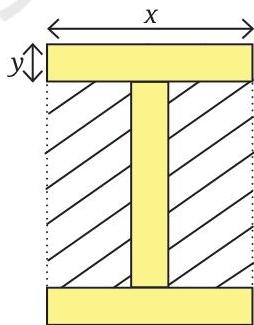 Fig. 1
Anusha's method:
The area sought is calculated by subtracting the area of region EFGH from the area of region ABCD.
The area pertaining to $\mathrm{ABCD}$ is $x^2$.
The area corresponding to EFGH is $xy$.
Therefore, the desired area is expressed as $x^{2} - xy$.
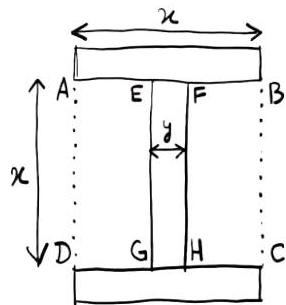
Vaishnavi's method:
$ Q S = y + x + y $
$ = x + 2 y. $
The area of the region PQSR is determined by the expression $x(x + 2y)$.
The target area is computed by subtracting the sum of the areas of the three rectangles from the area of PQSR.
$ = x (x + 2 y) - 3 x y. $
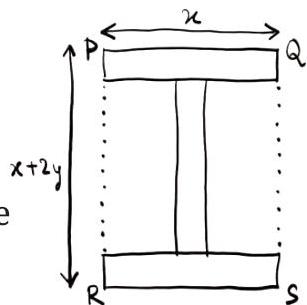
Aditya's method:
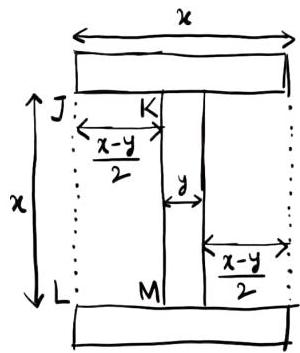
The area in question is precisely twice the area of the quadrilateral JKLM.
$ J K = \frac {x - y}{2}, K M = x $
The area of JKML is found by the product $x\left(\frac{x - y}{2}\right)$.
The total area sought is equivalent to $2 \times$ the area of JKML.
$ \begin{array}{l} = 2 x \left(\frac {x - y}{2}\right) \ = x (x - y). \ \end{array} $
? By expanding the expressions, verify that all three expressions are equivalent. If $x = 8$ and $y = 3$, find the area of the shaded region.
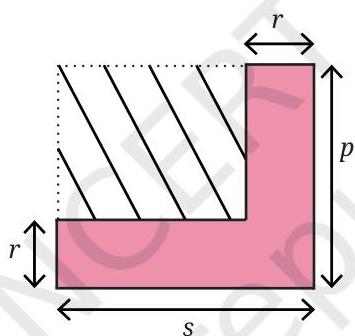
? Write an expression for the area of the dashed region in the figure below. Use more than one method to arrive at the answer. Substitute $p = 6$, $r = 3.5$, and $s = 9$, and calculate the area.
? Figure it Out
Determine the value of these products by employing the specified algebraic identity.
(i) $46^{2}$ using Identity 1A for $(a + b)^2$ (ii) $397 \times 403$ using Identity 1C for $(a + b)(a - b)$ (iii) $91^{2}$ using Identity 1B for $(a - b)^2$ (iv) $43 \times 45$ using Identity 1C for $(a + b)(a - b)$
Ascertain the outcome of each product listed below, utilizing either an appropriate algebraic identity or the distributive law.
(i) $(p - 1)(p + 11)$ (ii) $(3a - 9b)(3a + 9b)$ (iii) $-(2y + 5)(3y + 4)$ (iv) $(6x + 5y)^2$ (v) $(2x - \frac{1}{2})^2$ (vi) $(7p) \times (3r) \times (p + 2)$
We Distribute, Yet Things Multiply
For every assertion provided, select the corresponding algebraic expression(s).
(i) Two more than a square number.
$ 2 + s \quad (s + 2) ^ {2} \quad s ^ {2} + 2 \quad s ^ {2} + 4 \quad 2 s ^ {2} \quad 2 ^ {2} s $
(ii) The sum of the squares of two consecutive numbers
$ m ^ {2} + n ^ {2} \quad (m + n) ^ {2} \quad m ^ {2} + 1 \quad m ^ {2} + (m + 1) ^ {2} $
$ m ^ {2} + (m - 1) ^ {2} \quad (m + (m + 1)) ^ {2} \quad (2 m) ^ {2} + (2 m + 1) ^ {2} $
Examine an arbitrary 2x2 grid of numbers within a calendar, as illustrated in the provided diagram.
| February | ||||||
|---|---|---|---|---|---|---|
| Su | M | Tu | W | Th | F | Sa |
| 1 | ||||||
| 2 | 3 | 4 | 5 | 6 | 7 | 8 |
| 9 | 10 | 11 | 12 | 13 | 14 | 15 |
| 16 | 17 | 18 | 19 | 20 | 21 | 22 |
| 23 | 24 | 25 | 26 | 27 | 28 |
Calculate the products of the numbers positioned along each diagonal — for instance, $4 \times 12 = 48$ and $5 \times 11 = 55$. Replicate this procedure for additional 2x2 squares.
What pattern do you discern regarding these diagonal products? Provide an explanation for this phenomenon.
**Matt Talk**

Suggestion: Designate the numerical entries within each 2x2 square as follows:
| a | (a + 1) |
|---|---|
| a + 7 | (a + 8) |
Ascertain the veracity of each of the subsequent assertions.
(i) $(k + 1)(k + 2) - (k + 3)$ consistently evaluates to 2. (ii) $(2q + 1)(2q - 3)$ represents a multiple of 4. (iii) The square of an even integer is always a multiple of 4, whereas the square of an odd integer is always 1 greater than a multiple of 8. (iv) $(6n + 2)^{2} - (4n + 3)^{2}$ is equivalent to a perfect square reduced by 5.
Consider a number that yields a remainder of 3 upon division by 7, and a second number that yields a remainder of 5 when divided by 7. Determine the remainder obtained when their sum, their difference, and their product are each divided by 7.
Select any three successive integers. Square the central integer, then deduct the product of the remaining two. Replicate this process using different sequences of numbers. What regularity do you observe? How can this observation be formalized as an algebraic equation? Expand both expressions of the equation to confirm its validity as an identity.
Formulate the algebraic expression that represents the subsequent sequence of operations: sum any two numbers, then multiply this sum by half of the sum of those same two numbers. Demonstrate that the outcome of this process equates to half of the square of the sum of the initial two numbers.
Identify the larger value in each pair without performing a complete calculation of the product.
(i) $14 \times 26$ or $16 \times 24$ (ii) $25 \times 75$ or $26 \times 74$
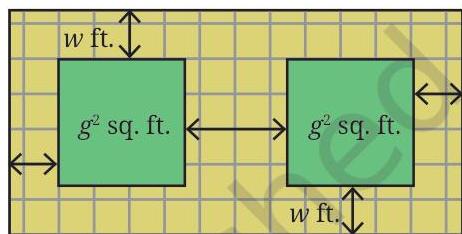
A small park is being developed in Dhauli, with its layout depicted in the accompanying figure. Within this design, two square sections, each encompassing an an area of $g^2$ square feet, are designated for greenery. The entirety of the remaining space constitutes a walking path, with a uniform width of $w$ feet, which requires tiling. Formulate an expression representing the total area designated for tiling.
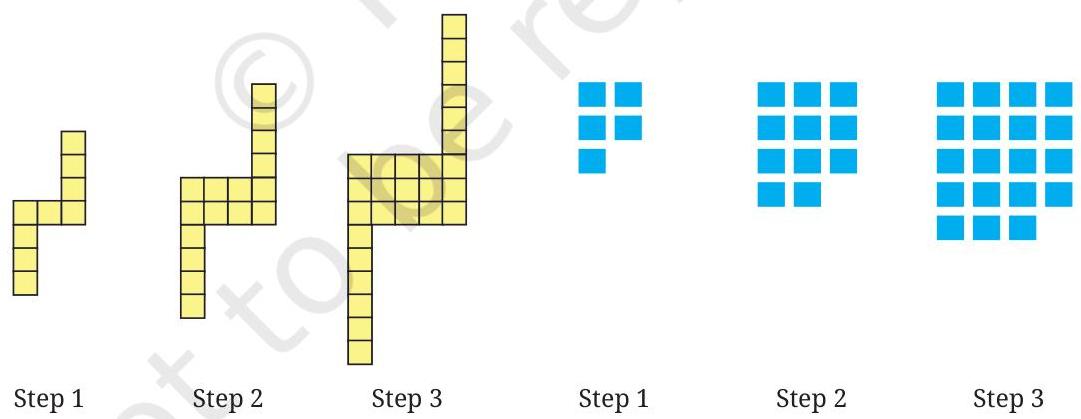
For each pattern shown below,
(i) Draw the next figure in the sequence. (ii) How many basic units are there in Step 10? (iii) Write an expression to describe the number of basic units in Step y.
We Distribute, Yet Things Multiply
SUMMARY
The application of the distributive property was broadened to determine the product of two expressions, each comprising two terms. This is generically represented as $(a + b) \times (c + d) = ac + ad + bc + bd$.
Several specific instances of this identity were also explored.
- $(a + b)^2 = a^2 + 2ab + b^2$
- $(a - b)^2 = a^2 - 2ab + b^2$
- $(a + b)(a - b) = a^2 - b^2$.
Various patterns were examined, and their underlying structures were investigated through algebraic principles. It was observed that problems frequently admit multiple pathways to reach the correct solution. The development of distinct methodologies for tackling and resolving a given problem constitutes a creative endeavor.

Coin Conjoin
Position 10 coins to form a triangle, as depicted in the figure on the left below. The challenge involves reorienting this triangle to an inverted position by moving one coin at a time. Determine the number of moves required, and specifically, what is the minimum number of moves needed?
An arrangement of three coins forming a triangle can be inverted with a solitary move, while a six-coin triangle requires two moves for its inversion.
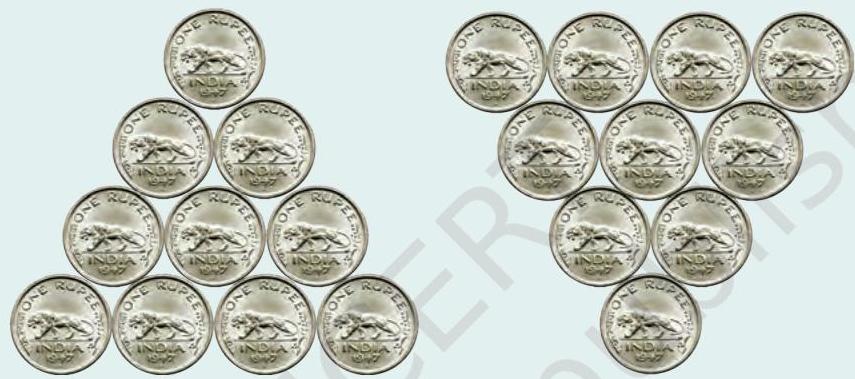
The 10-coin triangle can be inverted using only three moves; were you able to determine the strategy? Proceed to identify the minimum number of moves necessary to invert the subsequent larger triangular arrangement, which comprises 15 coins. Continue this exploration for progressively larger triangular numbers.
Is there an uncomplicated method for computing the minimum number of coin movements necessary for any such triangular arrangement?