Chapter 7
INTEGRALS
Just as a mountaineer climbs a mountain – because it is there, so a good mathematics student studies new material because it is there. — JAMES B. BRISTOL
7.1 Introduction
Integral Calculus primarily addresses the challenge of conceptualizing and quantifying the area encompassed by a function's graph. In contrast, Differential Calculus revolves around the concept of the derivative, which was initially developed to define tangent lines to function graphs and determine their gradients.
When a function $f$ possesses differentiability across an interval $I$ – meaning its derivative $f'$ exists at every point within $I$ – a fundamental inquiry emerges: can the original function $f$ be ascertained if its derivative $f'$ is known throughout $I$? Functions for which a given function serves as their derivative are termed antiderivatives (or primitives). Moreover, the expression that yields all such antiderivatives is known as the indefinite integral of the function, and the methodology for discovering these antiderivatives is designated as integration. Scenarios of this nature frequently manifest in real-world contexts. For example, if the instantaneous velocity of an object is known at any given moment, a pertinent question is whether its position at that same instant can be determined. Numerous practical and theoretical contexts necessitate the application of integration. The evolution of integral calculus stems from endeavors to resolve problems falling into these categories:
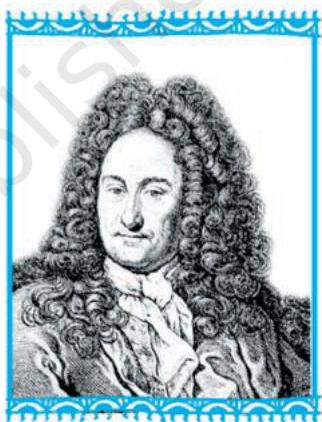 G.W. Leibnitz (1646-1716)
(a) identifying a function when its derivative is provided, (b) calculating the area enclosed by the graph of a function under specified criteria.
These two distinct problems give rise to the twin forms of integrals – namely, indefinite and definite integrals – which collectively form the discipline of Integral Calculus.
A significant relationship, established as the Fundamental Theorem of Calculus, links the indefinite and definite integrals, thereby rendering the definite integral an invaluable instrument in scientific and engineering applications. Furthermore, the definite integral serves to resolve numerous compelling challenges across diverse fields such as economics, finance, and probability theory.
Within this Chapter, our focus will be directed towards an examination of indefinite and definite integrals, their fundamental characteristics, and an introduction to various integration methodologies.
7.2 Integration as an Inverse Process of Differentiation
Integration serves as the inverse operation to differentiation. Rather than determining the derivative of a given function, the objective is to start with a function's derivative and ascertain its primitive, which is the original function. This procedure is termed integration or antidifferentiation.
Let us consider the following examples:
We know that $\frac{d}{dx} (\sin x) = \cos x$ ... (1)
$ \frac {d}{d x} \left(\frac {x ^ {3}}{3}\right) = x ^ {2} \tag {2} $
and $\frac{d}{dx} (e^x) = e^x$ ... (3)
From example (1), it is evident that $\cos x$ is the derivative of $\sin x$. Consequently, $\sin x$ is identified as an antiderivative (or integral) of $\cos x$. Likewise, for examples (2) and (3), $\frac{x^3}{3}$ and $e^x$ serve as antiderivatives (or integrals) for $x^2$ and $e^x$, respectively. It is important to recognize that the derivative of any real constant $C$ is zero. This allows us to extend equations (1), (2), and (3) as follows:
$ \frac {d}{d x} (\sin x + C) = \cos x, \frac {d}{d x} (\frac {x ^ {3}}{3} + C) = x ^ {2} \text{ and } \frac {d}{d x} (e ^ {x} + C) = e ^ {x} $
This demonstrates that antiderivatives (or integrals) of a given function are not singular. In reality, an infinite number of antiderivatives exist for each function, generated by assigning any real value to $C$. For this reason, $C$ is conventionally termed the arbitrary constant. Essentially, $C$ acts as a parameter whose variation yields distinct antiderivatives (or integrals) for the specified function.
To generalize, if a function $\mathrm{F}$ exists such that its derivative $\frac{d}{dx} \mathrm{F}(x)$ equals $f(x)$ for all $x$ within an interval $\mathrm{I}$, then for any arbitrary real number $\mathrm{C}$ (referred to as the constant of integration), the following holds:
$ \frac {d}{d x} \left[ \mathrm {F} (x) + \mathrm {C} \right] = f (x), x \in \mathrm {I}
$
Therefore, the expression ${\mathrm{F} + \mathrm{C},\mathrm{C}\in \mathbf{R}}$ represents the complete family of antiderivatives for $f$.
Remark: Functions possessing identical derivatives diverge only by a constant value. To demonstrate this, consider two functions, $g$ and $h$, which share the same derivative across an interval $\mathrm{I}$.
Let us define a new function $f = g - h$, such that $f(x) = g(x) - h(x)$ for all $x \in \mathbf{I}$.
Consequently, its derivative is $\frac{df}{dx} = f' = g' - h'$, which implies $f'(x) = g'(x) - h'(x)$ for all $x \in \mathbf{I}$.
Given the initial hypothesis that $g'(x) = h'(x)$, it follows that $f^{\prime}(x) = 0$ for all $x \in \mathrm{I}$.
This signifies that the rate of change of $f$ with respect to $x$ is zero throughout $\mathrm{I}$, thereby establishing that $f$ must be a constant.
Considering this observation, it is reasonable to conclude that the set ${\mathrm{F} + \mathrm{C},\mathrm{C}\in \mathbf{R}}$ encompasses all potential antiderivatives of $f$.
A new symbol, $\int f(x)dx$, is introduced to denote the complete collection of antiderivatives. This is read as the indefinite integral of $f$ with respect to $x$.
In symbolic form, we express this as $\int f(x)dx = \mathrm{F}(x) + \mathrm{C}$.
Notation: If $\frac{dy}{dx} = f(x)$ is given, then we denote $y = \int f(x) dx$.
To facilitate understanding, the subsequent table (Table 7.1) enumerates key symbols, terms, and phrases along with their corresponding definitions.
Table 7.1
| Symbols/Terms/Phrases | Meaning |
|---|---|
| ∫f(x)dx | Integral of f with respect to x |
| f(x) in ∫f(x)dx | Integrand |
| x in ∫f(x)dx | Variable of integration |
| Integrate | Find the integral |
| An integral of f | A function F such that F'(x) = f(x) |
| Integration | The process of finding the integral |
| Constant of Integration | Any real number C, considered as constant function |
Possessing prior knowledge of differentiation formulas for numerous significant functions, we can directly deduce the analogous integration formulas. These derived expressions, herein termed 'standard formulae,' are presented subsequently and will serve as foundational tools for determining the integrals of other functions.
Derivatives
Integrals (Antiderivatives)
(i) $\frac{d}{dx}\left(\frac{x^{n + 1}}{n + 1}\right) = x^n$
Particularly, we note that $\frac {d}{d x} (x) = 1;$ $ \int d x = x + C $
(ii) $\frac{d}{dx} (\sin x) = \cos x$ $ \int \cos x d x = \sin x + C $
(iii) $\frac{d}{dx} (-\cos x) = \sin x$ $ \int \sin x d x = - \cos x + C $
(iv) $\frac{d}{dx} (\tan x) = \sec^2 x$ $ \int \sec^2 x d x = \tan x + C $
(v) $\frac{d}{dx} (-\cot x) = \csc^2 x$ $ \int \csc^2 x d x = - \cot x + C $
(vi) $\frac{d}{dx} (\sec x) = \sec x \tan x$ $ \int \sec x \tan x d x = \sec x + C $
(vii) $\frac{d}{dx} (-\csc x) = \csc x \cot x$ $ \int \csc x \cot x d x = - \csc x + C $
(viii) $\frac{d}{dx} (-\cos x) = \cos x \cot x$ $ \int \csc x \cos x , dx + C $
(ix) $\frac{d}{dx} (\sin^{-1}x) = \frac{1}{\sqrt{1 - x^2}}$ $ \int \frac{dx}{\sqrt{1 - x^2}} = \sin^{-1} x + C $
(x) $\frac{d}{dx} \left(- \cos^{-1} x\right) = \frac{1}{\sqrt{1 - x^2}}$ $ \int \frac{dx}{\sqrt{1 - x^2}} = - \cos^{-1} x + C $
(xi) $\frac{d}{dx} \left( \tan^{-1} x \right) = \frac{1}{1 + x^2}$; $ \int \frac{dx}{1 + x^2} = \tan^{-1} x + C $
(xii) $\frac{d}{dx} (e^x) = e^x$ $ \int e^x dx = e^x + C
$
(xiii) $\frac{d}{dx} (\log |x|) = \frac{1}{x}; \quad \int \frac{1}{x} dx = \log |x| + C$
(xiv) $\frac{d}{dx} \left(\frac{a^x}{\log a}\right) = a^x; \quad \int a^x dx = \frac{a^x}{\log a} + C$
Note Customarily, the explicit specification of the domain for different functions is often omitted. Nevertheless, it is imperative to consider these intervals within the context of any particular problem.
7.2.1 Some properties of indefinite integral
This subsection will explore and establish several key properties pertinent to indefinite integrals.
(I) Differentiation and integration operate as inverse processes to one another, as demonstrated by the subsequent results:
$ \frac{d}{dx} \int f(x) , dx = f(x) $
and $\int f'(x) , dx = f(x) + C$, where $C$ denotes an arbitrary constant.
Proof Let $F$ represent any antiderivative of $f$; specifically,
$ \frac{d}{dx} F(x) = f(x) $
Consequently, $\int f(x) , dx = F(x) + C$.
Therefore, differentiating the integral yields $\frac{d}{dx} \int f(x) , dx = \frac{d}{dx} (F(x) + C)$.
$ = \frac{d}{dx} F(x) = f(x) $
Similarly, it is observed that
$ f'(x) = \frac{d}{dx} f(x) $
thus, $\int f'(x) , dx = f(x) + C$,
where $C$ is an arbitrary constant referred to as the constant of integration.
(II) If two indefinite integrals possess the same derivative, they correspond to the same collection of curves and are thus considered equivalent.
Proof Suppose $f$ and $g$ are two functions such that their indefinite integrals have identical derivatives:
$ \frac {d}{d x} \int f (x) d x = \frac {d}{d x} \int g (x) d x $
This can be re-expressed as
$ \frac {d}{d x} \left[ \int f (x) d x - \int g (x) d x \right] = 0 $
It follows that $\int f(x)dx - \int g(x)dx = C$, where $C$ is an arbitrary real number (Why?).
Alternatively, this relationship can be written as
$ \int f (x) d x = \int g (x) d x + C $
Hence, the families of curves represented by $\left{\int f(x)dx + C_1,C_1\in \mathbf{R}\right}$ and $\left{\int g(x)dx + C_2,C_2\in \mathbf{R}\right}$ are indeed identical.
Therefore, within this context, $\int f(x)dx$ and $\int g(x)dx$ are considered equivalent.
Note The equivalence between the families $\left{\int f(x)dx + C_1,C_1\in \mathbf{R}\right}$ and $\left{\int g(x)dx + C_2,C_2\in \mathbf{R}\right}$ is conventionally indicated by simply writing $\int f(x)dx = \int g(x)dx$, without explicitly mentioning the arbitrary constants.
(III) $\int [f(x) + g(x)]dx = \int f(x)dx + \int g(x)dx$
Proof According to Property (I), we establish that
$ \frac {d}{d x} \left[ \int [ f (x) + g (x) ] d x \right] = f (x) + g (x) \tag {1} $
Conversely, we determine that
$ \begin{array}{l} \frac {d}{d x} \left[ \int f (x) d x + \int g (x) d x \right] = \frac {d}{d x} \int f (x) d x + \frac {d}{d x} \int g (x) d x \ = f (x) + g (x) \tag {2} \ \end{array} $
Consequently, by invoking Property (II), equations (1) and (2) lead to the conclusion that
$ \int (f (x) + g (x)) d x = \int f (x) d x + \int g (x) d x. $
(IV) For any real scalar $k$, $\int k f(x)dx = k\int f(x)dx$
Proof As per Property (I), we have $\frac{d}{dx}\int k f(x)dx = k f(x)$.
Furthermore, the derivative of the right-hand side is $\frac{d}{dx}\left[k\int f(x)dx\right] = k\frac{d}{dx}\int f(x)dx = k f(x)$.
Thus, by applying Property (II), it follows that
$\int k f(x)dx = k\int f(x)dx$.
(V) Properties (III) and (IV) can be extended to encompass a finite collection of functions $f_{1}, f_{2}, \ldots, f_{n}$ and corresponding real coefficients $k_{1}, k_{2}, \ldots, k_{n}$, resulting in the general form:
$ \begin{array}{l} \int \left[ k _ {1} f _ {1} (x) + k _ {2} f _ {2} (x) + \dots + k _ {n} f _ {n} (x) \right] d x \ = k _ {1} \int f _ {1} (x) d x + k _ {2} \int f _ {2} (x) d x + \dots + k _ {n} \int f _ {n} (x) d x. \end{array} $
To determine an antiderivative for a given function, one intuitively seeks a function whose derivative matches the input function. This method of identifying the required function to find an antiderivative is termed integration by inspection. We will illustrate this technique using several examples.
Example 1 Write an antiderivative for each of the following functions using the method of inspection:
(i) $\cos 2x$
(ii) $3x^{2} + 4x^{3}$
(iii) $\frac{1}{x}, x \neq 0$
Solution
(i) To determine an antiderivative for $\cos 2x$, we identify a function whose differentiation yields this expression. We recall that
$ \frac {d}{d x} \sin 2 x = 2 \cos 2 x $
or $\cos 2x = \frac{1}{2}\frac{d}{dx} (\sin 2x) = \frac{d}{dx}\left(\frac{1}{2}\sin 2x\right)$
Consequently, a function whose derivative is $\cos 2x$ is $\frac{1}{2}\sin 2x$.
(ii) Our objective is to find a function whose derivative corresponds to $3x^{2} + 4x^{3}$. Observe that
$ \frac {d}{d x} \left(x ^ {3} + x ^ {4}\right) = 3 x ^ {2} + 4 x ^ {3}. $
Hence, an antiderivative for $3x^{2} + 4x^{3}$ is $x^{3} + x^{4}$.
(iii) It is established that
$ \frac {d}{
d x} (\log x) = \frac {1}{x}, x > 0 \text{ and } \frac {d}{d x} [ \log (- x) ] = \frac {1}{- x} (- 1) = \frac {1}{x}, x < 0
$
By synthesizing these results, we obtain $\frac{d}{dx} (\log |x|) = \frac{1}{x}, x \neq 0$.
Thus, $\int \frac{1}{x} dx = \log |x|$ represents an antiderivative of $\frac{1}{x}$.
Example 2 Find the following integrals:
(i) $\int \frac{x^3 - 1}{x^2} dx$
(ii) $\int (x^{\frac{2}{3}} + 1)dx$
(iii) $\int (x^{\frac{3}{2}} + 2e^{x} - \frac{1}{x})dx$
Solution
(i) The calculation proceeds as follows:
$ \begin{array}{l} \int \frac {x ^ {3} - 1}{x ^ {2}} d x = \int x d x - \int x ^ {- 2} d x \quad (\text{by Property V}) \ = \left(\frac {x ^ {1 + 1}}{1 + 1} + C _ {1}\right) - \left(\frac {x ^ {- 2 + 1}}{- 2 + 1} + C _ {2}\right); \quad C _ {1}, C _ {2} \text{ are constants of integration} \ = \frac {x ^ {2}}{2} + C _ {1} - \frac {x ^ {- 1}}{- 1} - C _ {2} = \frac {x ^ {2}}{2} + \frac {1}{x} + C _ {1} - C _ {2} \ = \frac {x ^ {2}}{2} + \frac {1}{x} + C, \text{ where } C = C _ {1} - C _ {2} \text{ is another constant of integration.} \ \end{array} $
A point of clarification: Henceforth, a singular constant of integration will be presented in the ultimate solution.
(ii) The integration is performed as:
$ \begin{array}{l} \int \left(x ^ {\frac {2}{3}} + 1\right) d x = \int x ^ {\frac {2}{3}} d x + \int d x \ = \frac {x ^ {\frac {2}{3} + 1}}{\frac {2}{3} + 1} + x + C = \frac {3}{5} x ^ {\frac {5}{3}} + x + C \ \end{array} $
(iii) The expression $\int (x^{\frac{3}{2}} + 2e^{x} - \frac{1}{x})dx$ can be decomposed into individual integrals as $\int x^{\frac{3}{2}}dx + \int 2e^{x}dx - \int \frac{1}{x}dx$.
$ \begin{array}{l} = \frac {x ^ {\frac {3}{2} + 1}}{\frac {3}{2} + 1} + 2 e ^ {x} - \log | x | + C \ = \frac {2}{5} x ^ {\frac {5}{2}} + 2 e ^ {x} - \log | x | + C \ \end{array} $
Example 3 Find the following integrals:
(i) $\int (\sin x + \cos x)dx$
(ii) $\int \csc x(\csc x + \cot x)dx$
(iii) $\int \frac{1 - \sin x}{\cos^2 x} dx$
Solution
(i) The integral is evaluated as:
$ \begin{array}{l} \int (\sin x + \cos x) d x = \int \sin x d x + \int \cos x d x \ = - \cos x + \sin x + C \ \end{array} $
(ii) The computation is as follows:
$ \begin{array}{l} \int (\csc x (\csc x + \cot x) d x = \int \csc^ {2} x d x + \int \csc x \cot x d x \ = - \cot x - \csc x + C \ \end{array} $
(iii) The integral is determined by:
$ \begin{array}{l} \int \frac {1 - \sin x}{\cos^ {2} x} d x = \int \frac {1}{\cos^ {2} x} d x - \int \frac {\sin x}{\cos^ {2} x} d x \ = \int \sec^ {2} x d x - \int \tan x \sec x d x \ = \tan x - \sec x + C \ \end{array} $
Example 4 Find the antiderivative $F$ of $f$ defined by $f(x) = 4x^3 - 6$ , where $F(0) = 3$ .
Solution A particular antiderivative for the function $f(x)$ is $x^4 - 6x$, given that
$ \frac {d}{d x} \left(x ^ {4} - 6 x\right) = 4 x ^ {3} - 6 $
Consequently, the general antiderivative $\mathrm{F}$ can be expressed as
$ \mathrm {F} (x) = x ^ {4} - 6 x + \mathrm {C}, \text { where } \mathrm {C} \text { is constant}. $
Applying the initial condition, we have
$ \mathrm{F}(0) = 3, \text{ which yields,} $
$ 3 = 0 - 6 \times 0 + \mathrm{C} \quad \text{or} \quad \mathrm{C} = 3 $
Thus, the specific antiderivative sought is the unique function $\mathrm{F}$, defined by the relation:
$ \mathrm{F}(x) = x^4 - 6x + 3. $
Remarks
(i) It is observed that if $\mathrm{F}$ constitutes an antiderivative of $f$, then any function of the form $\mathrm{F} + \mathrm{C}$ (where $\mathrm{C}$ represents an arbitrary constant) also serves as an antiderivative. Consequently, possessing knowledge of a single antiderivative $\mathrm{F}$ for a function $f$ allows us to enumerate an unbounded collection of antiderivatives for $f$ by simply appending any constant to $\mathrm{F}$, represented as $\mathrm{F}(x) + \mathrm{C}$, where $\mathrm{C} \in \mathbf{R}$. Within practical contexts, it is frequently imperative to fulfill an auxiliary condition; this condition subsequently fixes a particular value for $\mathrm{C}$, thereby yielding a singular antiderivative for the specified function.
(ii) In certain instances, the antiderivative $\mathrm{F}$ cannot be articulated using elementary functions, such as polynomials, logarithms, exponentials, trigonometric functions, or their inverses, among others. This limitation impedes our ability to determine $\int f(x) , dx$. For instance, direct inspection does not permit the determination of $\int e^{-x^2} , dx$, as there is no elementary function whose derivative precisely matches $e^{-x^2}$.
(iii) Should the integration variable deviate from $x$, the corresponding integral formulas undergo appropriate adjustments. Consider, for example:
$ \int y^4 , dy = \frac{y^{4+1}}{4+1} + \mathrm{C} = \frac{1}{5} y^5 + \mathrm{C} $
EXERCISE 7.1
Determine an antiderivative (or indefinite integral) for each of the subsequent functions using the inspection method.
- $\sin 2x$
- $\cos 3x$
- $e^{2x}$
- $(ax + b)^2$
- $\sin 2x - 4 e^{3x}$
Compute the following integrals for problems 6 through 20:
$\int (4 e^{3x} + 1) , dx$
$\int x^2 (1 - \frac{1}{x^2}) , dx$
$\int (ax^2 + bx + c) , dx$
$\int (2x^2 + e^x) , dx$
$\int \left(\sqrt{x} - \frac{1}{\sqrt{x}}\right)^2 , dx$
$\int \frac{x^3 + 5x^2 - 4}{x^2} , dx$
$\int \frac{x^3 + 3x + 4}{\sqrt{x}} , dx$
$\int \frac{x^3 - x^2 + x - 1}{x - 1} , dx$
$\int (1 - x)\sqrt{x} , dx$
$\int \sqrt{x} (3x^{2} + 2x + 3)dx$
$\int (2x - 3\cos x + e^x)dx$
$\int (2x^{2} - 3\sin x + 5\sqrt{x})dx$
$\int \sec x (\sec x + \tan x) dx$
$\int \frac{\sec^2 x}{\csc^2 x} dx$
$\int \frac{2 - 3\sin x}{\cos^2 x} dx.$
Select the appropriate response for problems 21 and 22.
- The antiderivative of the expression $\left(\sqrt{x} + \frac{1}{\sqrt{x}}\right)$ corresponds to
(A) $\frac{1}{3} x^{\frac{1}{3}} + 2x^{\frac{1}{2}} + C$
(B) $\frac{2}{3} x^{\frac{2}{3}} + \frac{1}{2} x^{2} + C$
(C) $\frac{2}{3} x^{\frac{3}{2}} + 2x^{\frac{1}{2}} + C$
(D) $\frac{3}{2} x^{\frac{3}{2}} + \frac{1}{2} x^{\frac{1}{2}} + C$
- Given that $\frac{d}{dx} f(x) = 4x^3 - \frac{3}{x^4}$ and the condition $f(2) = 0$, identify $f(x)$.
(A) $x^{4} + \frac{1}{x^{3}} -\frac{129}{8}$
(B) $x^{3} + \frac{1}{x^{4}} +\frac{129}{8}$
(C) $x^{4} + \frac{1}{x^{3}} +\frac{129}{8}$
(D) $x^{3} + \frac{1}{x^{4}} -\frac{129}{8}$
7.3 Methods of Integration
Earlier sections covered the integration of functions whose antiderivatives could be directly identified through inspection. This approach involved discerning a function $F$ whose derivative matched $f$, thereby yielding the integral of $f$. Nevertheless, this inspection-based technique proves inadequate for a broad range of functions. Consequently, the development of further strategies or methodologies becomes essential for computing integrals by converting them into established forms. Key methodologies include those founded on:
- Integration by Substitution
- Integration using Partial Fractions
- Integration by Parts
7.3.1 Integration by substitution
In this section, we consider the method of integration by substitution.
The integral $\int f(x)dx$ can be re-expressed by altering the independent variable from $x$ to $t$ through the substitution $x = g(t)$.
Let $\mathrm{I} = \int f(x)dx$.
By setting $x = g(t)$, we obtain $\frac{dx}{dt} = g'(t)$.
Consequently, we express $dx = g'(t)dt$.
Therefore, $\mathrm{I} = \int f(x)dx = \int f(g(t))g'(t)dt$.
This formula for changing variables represents a fundamental instrument at our disposal, known as integration by substitution. Determining an effective substitution frequently requires intuition. Typically, a substitution is performed for a component of the integrand whose derivative is also present within the expression, as demonstrated by the subsequent examples.
Example 5 Integrate the following functions w.r.t. $x$:
(i) $\sin mx$
(ii) $2x\sin (x^{2} + 1)$
(iii) $\frac{\tan^4\sqrt{x}\sec^2\sqrt{x}}{\sqrt{x}}$
(iv) $\frac{\sin(\tan^{-1}x)}{1 + x^2}$
Solution
(i) Recognizing that the derivative of $mx$ is $m$, we implement the substitution $mx = t$, which implies $mdx = dt$.
Consequently, $\int \sin mx dx$ transforms into $\frac{1}{m} \int \sin t dt$, yielding $-\frac{1}{m} \cos t + C$, which, upon back-substitution, becomes $-\frac{1}{m} \cos mx + C$.
(ii) Given that the derivative of $x^{2} + 1$ is $2x$, we apply the substitution $x^{2} + 1 = t$, leading to $2x , dx = dt$.
Hence, $\int 2x\sin (x^2 +1)dx$ simplifies to $\int \sin tdt$, which evaluates to $-\cos t + C$, or $-\cos (x^2 +1) + C$ after reverting the substitution.
(iii) The derivative of $\sqrt{x}$ is known to be $\frac{1}{2} x^{-\frac{1}{2}}$, or $\frac{1}{2\sqrt{x}}$. We therefore introduce the substitution $\sqrt{x} = t$, from which it follows that $\frac{1}{2\sqrt{x}} dx = dt$, implying $dx = 2t dt$.
Consequently, the integral $\int \frac{\tan^4\sqrt{x}\sec^2\sqrt{x}}{\sqrt{x}} dx$ transforms into $\int \frac{2t\tan^4t\sec^2tdt}{t}$, simplifying to $2\int \tan^4 t\sec^2 tdt$.
Subsequently, we perform a second substitution, letting $\tan t = u$, which yields $\sec^2 t dt = du$.
Therefore, $2\int \tan^4 t\sec^2 t , dt$ becomes $2\int u^4 , du$, which evaluates to $2\frac{u^5}{5} + C$.
$ \begin{array}{l} = \frac {2}{5} \tan^ {5} t + C \text{ (since } u = \tan t) \ = \frac {2}{5} \tan^ {5} \sqrt {x} + C \text{ (since } t = \sqrt {x}) \ \end{array} $
Thus, the final result for $\int \frac{\tan^4\sqrt{x}\sec^2\sqrt{x}}{\sqrt{x}} dx$ is $\frac{2}{5}\tan^5\sqrt{x} +C$.
As an alternative approach, one could directly substitute $\tan \sqrt{x} = t$.
(iv) Knowing that the derivative of $\tan^{-1}x$ is $\frac{1}{1 + x^2}$, we employ the substitution
$ \tan^ {- 1} x = t \text{ so that } \frac {d x}{1 + x ^ {2}} = d t, $
Consequently, $\int \frac{\sin(\tan^{-1}x)}{1 + x^2} dx$ simplifies to $\int \sin t , dt$, resulting in $-\cos t + C$, which is equivalent to $-\cos (\tan^{-1}x) + C$ upon reverting the substitution.
We now proceed to examine several significant integrals of trigonometric functions, along with their standard forms derived through the substitution method. These established results will subsequently be applied without explicit derivation.
(i) $\int \tan x , dx = \log |\sec x| + C$
Consider the integral
$ \int \tan x , dx = \int \frac {\sin x}{\cos x} , dx $
By setting $\cos x = t$, we derive $\sin x , dx = -dt$.
The integral $\int \tan x , dx$ then transforms into $-\int \frac{dt}{t}$, which evaluates to $-\log |t| + C$, or $-\log |\cos x| + C$.
Alternatively, this can be written as $\int \tan x , dx = \log |\sec x| + C$.
(ii) $\int \cot x , dx = \log |\sin x| + C$
For the integral $\int \cot x , dx$, we can rewrite it as $\int \frac{\cos x}{\sin x} , dx$.
Introducing the substitution $\sin x = t$ implies $\cos x , dx = dt$.
The integral $\int \cot x , dx$ subsequently becomes $\int \frac{dt}{t}$, yielding $\log |t| + C$, which simplifies to $\log |\sin x| + C$.
(iii) $\int \sec x , dx = \log |\sec x + \tan x| + C$
To evaluate $\int \sec x , dx$, we multiply the integrand by $\frac{\sec x + \tan x}{\sec x + \tan x}$, resulting in
$ \int \sec x , dx = \int \frac{\sec x (\sec x + \tan x)}{\sec x + \tan x} , dx $
Setting $\sec x + \tan x = t$ leads to the differential $\sec x (\tan x + \sec x) , dx = dt$.
Consequently, $\int \sec x , dx$ simplifies to $\int \frac{dt}{t}$, which evaluates to $\log |t| + C$, or $\log |\sec x + \tan x| + C$.
(iv) $\int \csc x , dx = \log |\csc x - \cot x| + C$
For $\int \csc x , dx$, we can manipulate the integrand by multiplying by $\frac{\csc x + \cot x}{\csc x + \cot x}$, giving
$ \int \csc x , dx = \int \frac{\csc x (\csc x + \cot x)}{(\csc x + \cot x)} , dx $
By introducing the substitution $\csc x + \cot x = t$, we find that $-\csc x (\csc x + \cot x) , dx = dt$.
Therefore, $\int \csc x , dx$ becomes $-\int \frac{dt}{t}$, which evaluates to $-\log |t|$, or $-\log |\csc x + \cot x| + C$.
$ \begin{array}{l} = -\log \left| \frac{\csc^2 x - \cot^2 x}{\csc x - \cot x} \right| + C \ = \log |\csc x - \cot x| + C \ \end{array} $
Example 6 Consider the task of evaluating the subsequent integrals:
(i) $\int \sin^3 x \cos^2 x , dx$
(ii) $\int \frac{\sin x}{\sin(x + a)} , dx$
(iii) $\int \frac{1}{1 + \tan x} , dx$
Solution
(i) Addressing the initial integral, our approach is as follows:
$ \begin{array}{l} \int \sin^3 x \cos^2 x , dx = \int \sin^2 x \cos^2 x (\sin x) , dx \ = \int (1 - \cos^2 x) \cos^2 x (\sin x) , dx \ \end{array} $
A substitution is employed: let $t = \cos x$, which implies $dt = -\sin x , dx$.
Consequently, $\int \sin^2 x \cos^2 x (\sin x) , dx = -\int (1 - t^2) t^2 , dt$
$ \begin{array}{l} = -\int (t^2 - t^4) , dt = -\left(\frac{t^3}{3} - \frac{t^5}{5}\right) + C \ = -\frac{1}{3} \cos^3 x + \frac{1}{5} \cos^5 x + C \ \end{array} $
(ii) For the second integral, we introduce the substitution $t = x + a$, which yields $dx = dt$. Thus,
$ \begin{array}{l} \int \frac{\sin x}{\sin (x + a)} , dx = \int \frac{\sin (t - a)}{\sin t} , dt \ = \int \frac{\sin t \cos a - \cos t \sin a}{\sin t} , dt \ = \cos a \int dt - \sin a \int \cot t , dt \ = (\cos a) t - (\sin a) \left[ \log |\sin t| + C_1 \right] \ = (\cos a) (x + a) - (\sin a) \left[ \log |\sin (x + a)| + C_1 \right] \ = x \cos a + a \cos a - (\sin a) \log |\sin (x + a)| - C_1 \sin a \ \end{array} $
In conclusion, $\int \frac{\sin x}{\sin (x + a)} , dx = x \cos a - \sin a \log |\sin (x + a)| + C$,
where $C = -C_1 \sin a + a \cos a$ represents an arbitrary constant.
(iii) The evaluation of the third integral commences with the transformation: $\int \frac{dx}{1 + \tan x} = \int \frac{\cos x , dx}{\cos x + \sin x}$
$ \begin{array}{l} = \frac{1}{2} \int \frac{(\cos x + \sin x + \cos x - \sin x) , dx}{\cos x + \sin x} \ = \frac{1}{2} \int dx + \frac{1}{2} \int \frac{\cos x - \sin x}{\cos x + \sin x} , dx \ = \frac{x}{2} + \frac{C_1}{2} + \frac{1}{2} \int \frac{\cos x - \sin x}{\cos x + \sin x} , dx \tag{1} \end{array} $
Let us now evaluate the auxiliary integral $\mathrm{I}$ defined as: $\mathrm{I} = \int \frac{\cos x - \sin x}{\cos x + \sin x} dx$
A substitution is applied here: set $t = \cos x + \sin x$, which leads to $(\cos x - \sin x)dx = dt$.
Consequently, $\mathrm{I} = \int \frac{dt}{t} = \log |t| + \mathrm{C}_2 = \log |\cos x + \sin x| + \mathrm{C}_2$.
Substituting this result back into equation (1) yields:
$ \begin{array}{l} \int \frac {d x}{1 + \tan x} = \frac {x}{2} + \frac {\mathrm {C} _ {1}}{2} + \frac {1}{2} \log | \cos x + \sin x | + \frac {\mathrm {C} _ {2}}{2} \ = \frac {x}{2} + \frac {1}{2} \log | \cos x + \sin x | + \frac {\mathrm {C} _ {1}}{2} + \frac {\mathrm {C} _ {2}}{2} \ = \frac {x}{2} + \frac {1}{2} \log | \cos x + \sin x | + C. \left(C = \frac {C _ {1}}{2} + \frac {C _ {2}}{2}\right) \ \end{array} $
EXERCISE 7.2
For problems 1 through 37, evaluate the integral of each provided function:
$\frac{2x}{1 + x^2}$
$\frac{(\log x)^2}{x}$
$\frac{1}{x + x\log x}$
$\sin x\sin (\cos x)$
$\sin (ax + b)\cos (ax + b)$
$\sqrt{ax + b}$
$x\sqrt{x + 2}$
$x\sqrt{1 + 2x^2}$
$(4x + 2)\sqrt{x^2 + x + 1}$
$\frac{1}{x - \sqrt{x}}$
$\frac{x}{\sqrt{x + 4}}, x > 0$
$(x^{3} - 1)^{\frac{1}{3}}x^{5}$
$\frac{x^2}{(2 + 3x^3)^3}$
$\frac{1}{x(\log x)^m}, x > 0, m \neq 1$
$\frac{x}{9 - 4x^2}$
$e^{2x + 3}$
$\frac{x}{e^{x^2}}$
$\frac{e^{\tan^{-1}x}}{1 + x^2}$
$\frac{e^{2x} - 1}{e^{2x} + 1}$
$\frac{e^{2x} - e^{-2x}}{e^{2x} + e^{-2x}}$
$\tan^2 (2x - 3)$
$\sec^2 (7 - 4x)$
$\frac{\sin^{-1}x}{\sqrt{1 - x^2}}$
$\frac{2\cos x - 3\sin x}{6\cos x + 4\sin x}$
$\frac{1}{\cos^2 x(1 - \tan x)^2}$
$\frac{\cos\sqrt{x}}{\sqrt{x}}$
$\sqrt{\sin 2x}\cos 2x$
$\frac{\cos x}{\sqrt{1 + \sin x}}$
$\cot x \log \sin x$
$\frac{\sin x}{1 + \cos x}$
$\frac{\sin x}{(1 + \cos x)^2}$
$\frac{1}{1 + \cot x}$
$\frac{1}{1 - \tan x}$
$\frac{\sqrt{\tan x}}{\sin x \cos x}$
$\frac{(1 + \log x)^2}{x}$
$\frac{(x + 1)(x + \log x)^2}{x}$
$\frac{x^3\sin\left(\tan^{-1}x^4\right)}{1 + x^8}$
For Exercises 38 and 39, select the correct option.
- $\int \frac{10x^9 + 10^x\log_e10dx}{x^{10} + 10^x}$ is equivalent to
(A) $10^{x} - x^{10} + C$ (B) $10^{x} + x^{10} + C$ (C) $(10^{x} - x^{10})^{-1} + C$ (D) $\log (10^x + x^{10}) + C$
- $\int \frac{dx}{\sin^2 x \cos^2 x}$ is equivalent to
(A) $\tan x + \cot x + C$ (B) $\tan x - \cot x + C$ (C) $\tan x \cot x + C$ (D) $\tan x - \cot 2x + C$
7.3.2 Integration using trigonometric identities
In instances where the expression to be integrated comprises trigonometric functions, specific established identities are employed to determine the integral, as demonstrated in the subsequent example.
Example 7 Find (i) $\int \cos^2 x , dx$ (ii) $\int \sin 2x \cos 3x , dx$ (iii) $\int \sin^3 x , dx$
Solution
(i) Utilizing the trigonometric identity $\cos 2x = 2\cos^2 x - 1$, we can derive:
$ \cos^2 x = \frac{1 + \cos 2x}{2} $
Consequently, the integration of $\cos^2 x$ proceeds as follows: $\int \cos^2 x , dx = \frac{1}{2} \int (1 + \cos 2x) , dx = \frac{1}{2} \int dx + \frac{1}{2} \int \cos 2x , dx = \frac{x}{2} + \frac{1}{4} \sin 2x + C$
(ii) We invoke the identity $\sin x \cos y = \frac{1}{2} [\sin (x + y) + \sin (x - y)]$ (A fundamental trigonometric product-to-sum identity).
Applying this, the integral of $\sin 2x \cos 3x$ is determined as: $\int \sin 2x \cos 3x , dx = \frac{1}{2} \left[ \int \sin 5x , dx - \int \sin x , dx \right] = \frac{1}{2} \left[ -\frac{1}{5} \cos 5x + \cos x \right] + C = -\frac{1}{10} \cos 5x + \frac{1}{2} \cos x + C$
(iii) Starting with the identity $\sin 3x = 3\sin x - 4\sin^3 x$, we can isolate $\sin^3 x$ to obtain:
$ \sin^3 x = \frac{3 \sin x - \sin 3x}{4} $
Thus, the integral of $\sin^3 x$ is computed as: $\int \sin^3 x , dx = \frac{3}{4} \int \sin x , dx - \frac{1}{4} \int \sin 3x , dx = -\frac{3}{4} \cos x + \frac{1}{12} \cos 3x + C$
As an alternative approach, we can express $\int \sin^3 x , dx$ as $\int \sin^2 x \sin x , dx = \int (1 - \cos^2 x) \sin x , dx$.
Let $\cos x = t$, which implies that $-\sin x , dx = dt$.
Thus, the integral becomes: $\int \sin^3 x , dx = -\int (1 - t^2) , dt = -\int dt + \int t^2 , dt = -t + \frac{t^3}{3} + C = -\cos x + \frac{1}{3} \cos^3 x + C$.
Remark It can be shown using trigonometric identities that both answers are equivalent.
EXERCISE 7.3
Evaluate the indefinite integrals for the functions presented in Exercises 1 to 22:
- $\sin^2 (2x + 5)$
- $\sin 3x\cos 4x$
- $\cos 2x\cos 4x\cos 6x$
- $\sin^3 (2x + 1)$
- $\sin^3 x\cos^3 x$
- $\sin x\sin 2x\sin 3x$
- $\sin 4x\sin 8x$
- $\frac{1 - \cos x}{1 + \cos x}$
- $\frac{\cos x}{1 + \cos x}$
- $\sin^4 x$
- $\cos^4 2x$
- $\frac{\sin^2 x}{1 + \cos x}$
- $\frac{\cos 2x - \cos 2\alpha}{\cos x - \cos \alpha}$
- $\frac{\cos x - \sin x}{1 + \sin 2x}$
- $\tan^3 2x\sec 2x$
- $\tan^4 x$
- $\frac{\sin^3 x + \cos^3 x}{\sin^2 x \cos^2 x}$
- $\frac{\cos 2x + 2\sin^2 x}{\cos^2 x}$
- $\frac{1}{\sin x \cos^3 x}$
- $\frac{\cos 2x}{(\cos x + \sin x)^2}$
- $\sin^{-1}(\cos x)$
- $\frac{1}{\cos(x - a)\cos(x - b)}$
For Exercises 23 and 24, identify the correct solution among the given alternatives.
- $\int \frac{\sin^2 x - \cos^2 x}{\sin^2 x \cos^2 x} dx$ is equivalent to
(A) $\tan x + \cot x + C$ (B) $\tan x + \csc x + C$ (C) $-\tan x + \cot x + C$ (D) $\tan x + \sec x + C$
- $\int \frac{e^x(1 + x)}{\cos^2(e^x x)} dx$ yields
(A) $-\cot (e x^{x}) + C$ (B) $\tan (x e ^ {x}) + C$ (C) $\tan (e^{x}) + C$ (D) $\cot (e^{x}) + C$
7.4 Integrals of Some Particular Functions
This section outlines several significant integral formulas and demonstrates their application in the integration of numerous related standard expressions:
(1) $\int \frac{dx}{x^2 - a^2} = \frac{1}{2a}\log \left|\frac{x - a}{x + a}\right| + C$
(2) $\int \frac{dx}{a^2 - x^2} = \frac{1}{2a}\log \left|\frac{a + x}{a - x}\right| + \mathbf{C}$ (3) $\int \frac{dx}{x^2 + a^2} = \frac{1}{a}\tan^{-1}\frac{x}{a} +\mathbf{C}$ (4) $\int \frac{dx}{\sqrt{x^2 - a^2}} = \log \left|x + \sqrt{x^2 - a^2}\right| + \mathbf{C}$ (5) $\int \frac{dx}{\sqrt{a^2 - x^2}} = \sin^{-1}\frac{x}{a} +\mathbf{C}$ (6) $\int \frac{dx}{\sqrt{x^2 + a^2}} = \log \left|x + \sqrt{x^2 + a^2}\right| + \mathbf{C}$
The derivations for these results are outlined below:
(1) Consider the expression $\frac{1}{x^2 - a^2}$, which can be factored as $\frac{1}{(x - a)(x + a)}$.
$ = \frac {1}{2 a} \left[ \frac {(x + a) - (x - a)}{(x - a) (x + a)} \right] = \frac {1}{2 a} \left[ \frac {1}{x - a} - \frac {1}{x + a} \right] $
Consequently, the integral of $\frac{dx}{x^2 - a^2}$ can be expressed as $\frac{1}{2a}\left[\int \frac{dx}{x - a} -\int \frac{dx}{x + a}\right]$.
$ \begin{array}{l} = \frac {1}{2 a} \left[ \log | (x - a) | - \log | (x + a) | \right] + C \ = \frac {1}{2 a} \log \left| \frac {x - a}{x + a} \right| + C \ \end{array} $
(2) Following the approach demonstrated in the derivation of (1), we establish:
$ \frac {1}{a ^ {2} - x ^ {2}} = \frac {1}{2 a} \left[ \frac {(a + x) + (a - x)}{(a + x) (a - x)} \right] = \frac {1}{2 a} \left[ \frac {1}{a - x} + \frac {1}{a + x} \right]
$
Thus, the integral $\int \frac{dx}{a^2 - x^2}$ is equivalent to $\frac{1}{2a}\left[\int \frac{dx}{a - x} +\int \frac{dx}{a + x}\right]$.
$ \begin{array}{l} = \frac {1}{2 a} \left[ - \log | a - x | + \log | a + x | \right] + C \ = \frac {1}{2 a} \log \left| \frac {a + x}{a - x} \right| + C \ \end{array} $
Remark: The methodological approach employed in the derivation of (1) will be elaborated upon in Section 7.5.
(3) By substituting $x = a \tan \theta$, it follows that $dx = a \sec^2 \theta , d\theta$.
Consequently, the integral $\int \frac{dx}{x^2 + a^2}$ transforms into $\int \frac{a\sec^2\theta d\theta}{a^2\tan^2\theta + a^2}$.
$ = \frac {1}{a} \int d \theta = \frac {1}{a} \theta + C = \frac {1}{a} \tan^ {- 1} \frac {x}{a} + C $
(4) Introduce the substitution $x = a \sec \theta$, which implies $dx = a \sec \theta \tan \theta , d\theta$.
Thus, the integral $\int \frac{dx}{\sqrt{x^2 - a^2}}$ becomes $\int \frac{a\sec\theta\tan\theta , d\theta}{\sqrt{a^2\sec^2\theta - a^2}}$.
$ \begin{array}{l} = \int \sec \theta , d \theta = \log | \sec \theta + \tan \theta | + C _ {1} \ = \log \left| \frac {x}{a} + \sqrt {\frac {x ^ {2}}{a ^ {2}} - 1} \right| + C _ {1} \ = \log | x + \sqrt {x ^ {2} - a ^ {2}} | - \log | a | + C _ {1} \ = \log | x + \sqrt {x ^ {2} - a ^ {2}} | + C, \text{ where } C = C _ {1} - \log | a | \ \end{array} $
(5) Consider the substitution $x = a \sin \theta$, which yields $dx = a \cos \theta , d\theta$.
Hence, the integral $\int \frac{dx}{\sqrt{a^2 - x^2}}$ is transformed into $\int \frac{a\cos\theta , d\theta}{\sqrt{a^2 - a^2\sin^2\theta}}$.
$ = \int d \theta = \theta + C = \sin^ {- 1} \frac {x}{a} + C $
(6) By employing the substitution $x = a \tan \theta$, we derive $dx = a \sec^2 \theta , d\theta$.
Therefore, $\int \frac{dx}{\sqrt{x^2 + a^2}} = \int \frac{a\sec^2\theta , d\theta}{\sqrt{a^2\tan^2\theta + a^2}}$
$ = \int \sec \theta , d \theta = \log | (\sec \theta + \tan \theta) | + C _ {1} $
$
\begin{array}{l} = \log \left| \frac {x}{a} + \sqrt {\frac {x ^ {2}}{a ^ {2}} + 1} \right| + C _ {1} \ = \log \left| x + \sqrt {x ^ {2} + a ^ {2}} \right| - \log | a | + C _ {1} \ = \log \left| x + \sqrt {x ^ {2} + a ^ {2}} \right| + C, \text{ where } C = C _ {1} - \log | a | \end{array} $
Leveraging these fundamental integration formulas, we can derive additional useful expressions that are directly applicable for solving various other integral problems.
(7) For the purpose of evaluating an integral of the form $\int \frac{dx}{ax^2 + bx + c}$, the expression is first rewritten as:
$ a x ^ {2} + b x + c = a \left[ x ^ {2} + \frac {b}{a} x + \frac {c}{a} \right] = a \left[ \left(x + \frac {b}{2 a}\right) ^ {2} + \left(\frac {c}{a} - \frac {b ^ {2}}{4 a ^ {2}}\right) \right] $
By introducing the substitution $t = x + \frac{b}{2a}$, which implies $dt = dx$, and defining $\pm k^2 = \frac{c}{a} - \frac{b^2}{4a^2}$, the integral transforms into the form $\frac{1}{a}\int \frac{dt}{t^2\pm k^2}$. Its solvability then depends on the algebraic sign of the term $\left(\frac{c}{a} -\frac{b^2}{4a^2}\right)$.
(8) When confronted with an integral resembling $\int \frac{dx}{\sqrt{ax^2 + bx + c}}$, the methodology outlined in point (7) can be applied to simplify the expression, allowing its evaluation via standard formulas.
(9) For integrals of the configuration $\int \frac{px + q}{ax^2 + bx + c} dx$, where $p, q, a, b, c$ represent constants, the objective is to determine real coefficients A and B that satisfy the relationship:
$ p x + q = A \frac {d}{d x} \left(a x ^ {2} + b x + c\right) + B = A (2 a x + b) + B $
The values for A and B are established by equating the coefficients of $x$ and the constant terms on both sides of the equation. Once A and B are determined, the integral is consequently simplified to one of the recognizable standard forms.
(10) To evaluate integrals structured as $\int \frac{(px + q)dx}{\sqrt{ax^2 + bx + c}}$, the approach mirrors that described in point (9), thereby converting the integral into established standard forms.
The aforementioned methodologies will now be elucidated through a series of illustrative examples.
Example 8 Find the following integrals:
(i) $\int \frac{dx}{x^2 - 16}$
(ii) $\int \frac{dx}{\sqrt{2x - x^2}}$
Solution
(i) The integral can be expressed as $\int \frac{dx}{x^2 - 16} = \int \frac{dx}{x^2 - 4^2}$, which, by applying formula 7.4 (1), yields $\frac{1}{8} \log \left| \frac{x - 4}{x + 4} \right| + C$.
(ii) $\int \frac{dx}{\sqrt{2x - x^2}} = \int \frac{dx}{\sqrt{1 - (x - 1)^2}}$
Let $x - 1 = t$, which implies $dx = dt$.
Consequently, the integral $\int \frac{dx}{\sqrt{2x - x^2}}$ transforms into $\int \frac{dt}{\sqrt{1 - t^2}}$, which, according to formula 7.4 (5), evaluates to $\sin^{-1}(t) + C$.
$ = \sin^{-1}(x - 1) + C $
Example 9 Find the following integrals:
(i) $\int \frac{dx}{x^2 - 6x + 13}$
(ii) $\int \frac{dx}{3x^2 + 13x - 10}$
(iii) $\int \frac{dx}{\sqrt{5x^2 - 2x}}$
Solution
(i) The quadratic expression $x^2 - 6x + 13$ can be reconfigured by completing the square as $x^2 - 6x + 3^2 - 3^2 + 13$, simplifying to $(x - 3)^2 + 4$.
Thus, the integral $\int \frac{dx}{x^2 - 6x + 13}$ becomes $\int \frac{1}{(x - 3)^2 + 2^2} dx$.
Introducing the substitution $t = x - 3$, we have $dt = dx$.
Consequently, the integral $\int \frac{dx}{x^2 - 6x + 13}$ transforms into $\int \frac{dt}{t^2 + 2^2}$, which, according to formula 7.4 (3), evaluates to $\frac{1}{2} \tan^{-1} \frac{t}{2} + C$.
$ = \frac{1}{2} \tan^{-1} \frac{x - 3}{2} + C $
(ii) The integral under consideration corresponds to the form specified in 7.4 (7). We proceed by restructuring the denominator of the integrand:
$ \begin{array}{l} 3 x ^ {2} + 13 x - 10 = 3 \left(x ^ {2} + \frac {13 x}{3} - \frac {10}{3}\right) \ = 3 \left[ \left(x + \frac {13}{6}\right) ^ {2} - \left(\frac {17}{6}\right) ^ {2} \right] \text{ (completing the square)} \end{array} $
Consequently, the integral $\int \frac{dx}{3x^2 + 13x - 10}$ becomes $\frac{1}{3}\int \frac{dx}{\left(x + \frac{13}{6}\right)^2 - \left(\frac{17}{6}\right)^2}$.
By introducing the substitution $x + \frac{13}{6} = t$, we obtain $dx = dt$.
This transformation leads to: $\int \frac{dx}{3x^2 + 13x - 10} = \frac{1}{3}\int \frac{dt}{t^2 - \left(\frac{17}{6}\right)^2}$.
$ \begin{array}{l} = \frac {1}{3 \times 2 \times \frac {17}{6}} \log \left| \frac {t - \frac {17}{6}}{t + \frac {17}{6}} \right| + C _ {1} \quad \text{[utilizing formula 7.4 (i)]} \ = \frac {1}{17} \log \left| \frac {x + \frac {13}{6} - \frac {17}{6}}{x + \frac {13}{6} + \frac {17}{6}} \right| + C _ {1} \ = \frac {1}{17} \log \left| \frac {6 x - 4}{6 x + 30} \right| + C _ {1} \ = \frac {1}{17} \log \left| \frac {3 x - 2}{x + 5} \right| + C _ {1} + \frac {1}{17} \log \frac {1}{3} \ = \frac {1}{17} \log \left| \frac {3 x - 2}{x + 5} \right| + C, \text{ where } C = C _ {1} + \frac {1}{17} \log \frac {1}{3} \end{array} $
(iii) Consider the integral: $\int \frac{dx}{\sqrt{5x^2 - 2x}} = \int \frac{dx}{\sqrt{5\left(x^2 - \frac{2x}{5}\right)}}$.
$ = \frac {1}{\sqrt {5}} \int \frac {d x}{\sqrt {\left(x - \frac {1}{5}\right) ^ {2} - \left(\frac {1}{5}\right) ^ {2}}} \quad (\text{completing the square}) $
A substitution of $x - \frac{1}{5} = t$ implies $dx = dt$.
Hence, the integral transforms to: $\int \frac{dx}{\sqrt{5x^2 - 2x}} = \frac{1}{\sqrt{5}}\int \frac{dt}{\sqrt{t^2 - \left(\frac{1}{5}\right)^2}}$.
$ = \frac {1}{\sqrt {5}} \log \left| t + \sqrt {t ^ {2} - \left(\frac {1}{5}\right) ^ {2}} \right| + C \quad [\text{in accordance with formula 7.4 (4)}] $
$ = \frac {1}{\sqrt {5}} \log \left| x - \frac {1}{5} + \sqrt {x ^ {2} - \frac {2 x}{5}} \right| + C $
Illustrative Problem 10 Determine the subsequent integrals:
(i) $\int \frac{x + 2}{2x^2 + 6x + 5} dx$
(ii) $\int \frac{x + 3}{\sqrt{5 - 4x - x^2}} dx$
Resolution
(i) Applying formula 7.4 (9), we represent the numerator as a linear combination of the derivative of the denominator and a constant:
$ x + 2 = \mathrm {A} \frac {d}{d x} \left(2 x ^ {2} + 6 x + 5\right) + \mathrm {B} = \mathrm {A} (4 x + 6) + \mathrm {B} $
By comparing the coefficients of $x$ and the constant terms on both sides of the equation, we deduce:
$ 4 A = 1 \text{ and } 6 A + B = 2 \quad \text{or} \quad A = \frac {1}{4} \text{ and } B = \frac {1}{2}. $
Consequently, the integral $\int \frac{x + 2}{2x^2 + 6x + 5}$ can be decomposed as:
$ \int \frac{x + 2}{2x^2 + 6x + 5} = \frac{1}{4}\int \frac{4x + 6}{2x^2 + 6x + 5} dx + \frac{1}{2}\int \frac{dx}{2x^2 + 6x + 5} = \frac {1}{4} I _ {1} + \frac {1}{2} I _ {2} \quad (\text{say}) \tag {1} $
For the integral $\mathrm{I}_1$, we employ the substitution $2x^2 + 6x + 5 = t$, which implies $(4x + 6)dx = dt$.
Thus,
$ \begin{array}{l} \mathrm{I}_1 = \int \frac{dt}{t} = \log |t| + \mathrm{C}_1 \ = \log |2x^2 + 6x + 5| + \mathrm{C}_1 \tag{2} \end{array} $
The calculation for the second integral, denoted as $\mathrm{I}_2$, proceeds as follows:
$ \begin{array}{l} \mathrm{I}_2 = \int \frac{dx}{2x^2 + 6x + 5} = \frac{1}{2} \int \frac{dx}{x^2 + 3x + \frac{5}{2}} \ = \frac{1}{2} \int \frac{dx}{\left(x + \frac{3}{2}\right)^2 + \left(\frac{1}{2}\right)^2} \end{array} $
By substituting $x + \frac{3}{2} = t$, which implies $dx = dt$, the expression transforms into:
$ \mathrm{I}_2 = \frac{1}{2} \int \frac{dt}{t^2 + \left(\frac{1}{2}\right)^2} = \frac{1}{2 \times \frac{1}{2}} \tan^{-1} 2t + \mathrm{C}_2 \tag{3} $
Incorporating results from (2) and (3) into (1) yields the final integral:
$ \int \frac{x + 2}{2x^2 + 6x + 5} dx = \frac{1}{4} \log |2x^2 + 6x + 5| + \frac{1}{2} \tan^{-1}(2x + 3) + \mathrm{C} $
Here, the constant of integration $\mathrm{C}$ is defined as:
$ \mathrm{C} = \frac{\mathrm{C}_1}{4} + \frac{\mathrm{C}_2}{2} $
(ii) This particular integral aligns with the form presented in 7.4 (10). We commence by expressing the numerator as a linear combination of the derivative of the quadratic term in the denominator and a constant:
$ x + 3 = \mathrm{A} \frac{d}{dx} (5 - 4x - x^2) + \mathrm{B} = \mathrm{A} (-4 - 2x) + \mathrm{B} $
By equating the coefficients of $x$ and the constant terms on both sides of the equation, we derive:
$ -2\mathrm{A} = 1 \text{ and } -4\mathrm{A} + \mathrm{B} = 3, \text{ i.e., } \mathrm{A} = -\frac{1}{2} \text{ and } \mathrm{B} = 1 $
Consequently, the integral can be decomposed into two separate integrals:
$ \int \frac{x + 3}{\sqrt{5 - 4x - x^2}} dx = -\frac{1}{2}\int \frac{(-4 - 2x)dx}{\sqrt{5 - 4x - x^2}} +\int \frac{dx}{\sqrt{5 - 4x - x^2}} = -\frac{1}{2} I_1 + I_2 \tag{1} $
For the first integral, $I_1$, we employ the substitution $5 - 4x - x^2 = t$, which implies $(-4 - 2x)dx = dt$. This yields:
$ \begin{array}{l} I_1 = \int \frac{(-4 - 2x)dx}{\sqrt{5 - 4x - x^2}} = \int \frac{dt}{\sqrt{t}} = 2\sqrt{t} + C_1 \ = 2\sqrt{5 - 4x - x^2} + C_1 \tag{2} \end{array} $
Next, we evaluate $I_2$:
$ I_2 = \int \frac{dx}{\sqrt{5 - 4x - x^2}} = \int \frac{dx}{\sqrt{9 - (x + 2)^2}} $
A substitution of $x + 2 = t$, leading to $dx = dt$, transforms $I_2$ into:
$ \begin{array}{l} I_2 = \int \frac{dt}{\sqrt{3^2 - t^2}} = \sin^{-1} \frac{t}{3} + C_2 \quad \text{[by 7.4 (5)]} \ = \sin^{-1} \frac{x + 2}{3} + C_2 \tag{3} \end{array} $
By substituting the results from equations (2) and (3) back into equation (1), the complete integral is found to be:
$ \int \frac{x + 3}{\sqrt{5 - 4x - x^2}} = -\sqrt{5 - 4x - x^2} + \sin^{-1} \frac{x + 2}{3} + C, \text{ where } C = C_2 - \frac{C_1}{2} $
EXERCISE 7.4
Determine the antiderivatives for the functions presented in problems 1 through 23.
$\frac{3x^2}{x^6 + 1}$
$\frac{1}{\sqrt{1 + 4x^2}}$
$\frac{1}{\sqrt{(2 - x)^2 + 1}}$
$\frac{1}{\sqrt{9 - 25x^2}}$
$\frac{3x}{1 + 2x^4}$
$\frac{x^2}{1 - x^6}$
$\frac{x - 1}{\sqrt{x^2 - 1}}$
$\frac{x^2}{\sqrt{x^6 + a^6}}$
$\frac{\sec^2 x}{\sqrt{\tan^2 x + 4}}$
$\frac{1}{\sqrt{x^2 + 2x + 2}}$
$\frac{1}{9x^2 + 6x + 5}$
$\frac{1}{\sqrt{7 - 6x - x^2}}$
$\frac{1}{\sqrt{(x - 1)(x - 2)}}$
$\frac{1}{\sqrt{8 + 3x - x^2}}$
$\frac{1}{\sqrt{(x - a)(x - b)}}$
$\frac{4x + 1}{\sqrt{2x^2 + x - 3}}$
$\frac{x + 2}{\sqrt{x^2 - 1}}$
$\frac{5x - 2}{1 + 2x + 3x^2}$
$\frac{6x + 7}{\sqrt{(x - 5)(x - 4)}}$
$\frac{x + 2}{\sqrt{4x - x^2}}$
$\frac{x + 2}{\sqrt{x^2 + 2x + 3}}$
$\frac{x + 3}{x^2 - 2x - 5}$
$\frac{5x + 3}{\sqrt{x^2 + 4x + 10}}$
Select the appropriate answer for Exercises 24 and 25.
- $\int \frac{dx}{x^2 + 2x + 2}$ equals
(A) $x\tan^{-1}(x + 1) + C$ (B) $\tan^{-1}(x + 1) + C$ (C) $(x + 1)\tan^{-1}x + C$ (D) $\tan^{-1}x + C$
- $\int \frac{dx}{\sqrt{9x - 4x^2}}$ equals
(A) $\frac{1}{9}\sin^{-1}\left(\frac{9x - 8}{8}\right) + C$ (B) $\frac{1}{2}\sin^{-1}\left(\frac{8x - 9}{9}\right) + C$ (C) $\frac{1}{3}\sin^{-1}\left(\frac{9x - 8}{8}\right) + C$ (D) $\frac{1}{2}\sin^{-1}\left(\frac{9x - 8}{9}\right) + C$
7.5 Integration by Partial Fractions
A rational function is formally defined as the quotient of two polynomials, expressed as $\frac{\mathrm{P}(x)}{\mathrm{Q}(x)}$, where $\mathrm{P}(x)$ and $\mathrm{Q}(x)$ are polynomials in the variable $x$, and $\mathrm{Q}(x)$ is non-zero. A rational function is deemed 'proper' if the degree of $\mathrm{P}(x)$ is strictly less than the degree of $\mathrm{Q}(x)$; otherwise, it is classified as 'improper'. Improper rational functions can be transformed into proper ones through the application of polynomial
long division. Consequently, if $\frac{\mathrm{P}(x)}{\mathrm{Q}(x)}$ represents an improper rational function, it can be expressed in the form $\frac{\mathrm{P}(x)}{\mathrm{Q}(x)} = \mathrm{T}(x) + \frac{\mathrm{P}_1(x)}{\mathrm{Q}(x)}$, where $\mathrm{T}(x)$ is a polynomial in $x$, and $\frac{\mathrm{P}_1(x)}{\mathrm{Q}(x)}$ is a proper rational function. Given our familiarity with integrating polynomials, the task of integrating any rational function simplifies to integrating a proper rational function. For the scope of integration discussed herein, we will focus on rational functions whose denominators are factorable into linear and/or quadratic components. Suppose we aim to compute $\int \frac{\mathrm{P}(x)}{\mathrm{Q}(x)} dx$, where $\frac{\mathrm{P}(x)}{\mathrm{Q}(x)}$ is a proper rational function. It is consistently feasible to express this integrand as a sum of simpler rational functions via a technique known as partial fraction decomposition. Subsequent to this decomposition, the integration process can be readily completed utilizing established integration techniques. Table 7.2 below illustrates the various forms of simpler partial fractions corresponding to different types of rational functions.
Table 7.2
| S.No. | Form of the rational function | Form of the partial fraction |
|---|---|---|
| 1. | $\frac{px+q}{(x-a)(x-b)}$, a≠b | $\frac{A}{x-a} + \frac{B}{x-b}$ |
| 2. | $\frac{px+q}{(x-a)^2}$ | $\frac{A}{x-a} + \frac{B}{(x-a)^2}$ |
| 3. | $\frac{px^2+qx+r}{(x-a)(x-b)(x-c)}$ | $\frac{A}{x-a} + \frac{B}{x-b} + \frac{C}{x-c}$ |
| 4. | $\frac{px^2+qx+r}{(x-a)^2(x-b)}$ | $\frac{A}{x-a} + \frac{B}{(x-a)^2} + \frac{C}{x-b}$ |
| 5. | $\frac{px^2+qx+r}{(x-a)(x^2+bx+c)}$, where $x^2+bx+c$ cannot be factorised further |
$\frac{A}{x-a} + \frac{Bx+C}{x^2+bx+c}$ |
In the above table, A, B and C are real numbers to be determined suitably.
Example 11 Find $\int \frac{dx}{(x + 1)(x + 2)}$
Solution The given integrand constitutes a proper rational function. Consequently, by applying the appropriate partial fraction form [as indicated in Table 7.2 (i)], we can express it as:
$ \frac {1}{(x + 1) (x + 2)} = \frac {\mathrm {A}}{x + 1} + \frac {\mathrm {B}}{x + 2} \tag {1} $
Here, the real constants A and B must be determined appropriately. This leads to:
$ 1 = \mathrm {A} (x + 2) + \mathrm {B} (x + 1). $
By equating the coefficients of $x$ and the constant term, the following system of equations is derived:
$ \mathrm {A} + \mathrm {B} = 0 $
and $2\mathrm{A} + \mathrm{B} = 1$
Solving this system of equations yields $\mathrm{A} = 1$ and $\mathrm{B} = -1$ .
Consequently, the integrand can be expressed as:
$ \frac {1}{(x + 1) (x + 2)} = \frac {1}{x + 1} + \frac {- 1}{x + 2} $
Thus, the integral is evaluated as: $\int \frac{dx}{(x + 1)(x + 2)} = \int \frac{dx}{x + 1} -\int \frac{dx}{x + 2}$
$ \begin{array}{l} = \log | x + 1 | - \log | x + 2 | + C \ = \log \left| \frac {x + 1}{x + 2} \right| + C \ \end{array} $
Remark The equation (1) above represents an identity, meaning it holds true for all permissible values of $x$ . Certain authors adopt the symbol $\equiv$ to signify an identity, while reserving the symbol $=$ to denote an equation, which is valid only for particular values of $x$ .
Example 12 Find $\int \frac{x^2 + 1}{x^2 - 5x + 6} dx$
Solution In this instance, the integrand $\frac{x^2 + 1}{x^2 - 5x + 6}$ does not constitute a proper rational function. Therefore, we perform polynomial division of $x^2 + 1$ by $x^2 - 5x + 6$ to determine that:
$
\frac {x ^ {2} + 1}{x ^ {2} - 5 x + 6} = 1 + \frac {5 x - 5}{x ^ {2} - 5 x + 6} = 1 + \frac {5 x - 5}{(x - 2) (x - 3)} $
Let
$ \frac {5 x - 5}{(x - 2) (x - 3)} = \frac {\mathrm {A}}{x - 2} + \frac {\mathrm {B}}{x - 3} $
So that
$ 5 x - 5 = \mathrm {A} (x - 3) + \mathrm {B} (x - 2) $
Comparing the coefficients of $x$ and the constant terms on both sides, we establish the equations $A + B = 5$ and $3A + 2B = 5$ . Solving these equations, we deduce that $A = -5$ and $B = 10$ .
Hence,
$ \frac {x ^ {2} + 1}{x ^ {2} - 5 x + 6} = 1 - \frac {5}{x - 2} + \frac {1 0}{x - 3} $
Consequently,
$ \begin{array}{l} \int \frac {x ^ {2} + 1}{x ^ {2} - 5 x + 6} d x = \int d x - 5 \int \frac {1}{x - 2} d x + 1 0 \int \frac {d x}{x - 3} \ = x - 5 \log | x - 2 | + 1 0 \log | x - 3 | + C. \ \end{array} $
Example 13 Find $\int \frac{3x - 2}{(x + 1)^2(x + 3)} dx$
Solution The integrand corresponds to the type illustrated in Table 7.2 (4). We proceed by expressing it in the following partial fraction decomposition:
$ \frac {3 x - 2}{(x + 1) ^ {2} (x + 3)} = \frac {\mathrm {A}}{x + 1} + \frac {\mathrm {B}}{(x + 1) ^ {2}} + \frac {\mathrm {C}}{x + 3} $
So that
$ \begin{array}{l} 3 x - 2 = \mathrm {A} (x + 1) (x + 3) + \mathrm {B} (x + 3) + \mathrm {C} (x + 1) ^ {2} \ = \mathrm {A} (x ^ {2} + 4 x + 3) + \mathrm {B} (x + 3) + \mathrm {C} (x ^ {2} + 2 x + 1) \ \end{array} $
By comparing the coefficients of $x^2$ , $x$ , and the constant term on both sides, we derive the system of equations: $A + C = 0$ , $4A + B + 2C = 3$ , and $3A + 3B + C = -2$ . The solution to these equations yields $A = \frac{11}{4}$ , $B = \frac{-5}{2}$ , and $C = \frac{-11}{4}$ . Consequently, the integrand can be formulated as:
$ \frac {3 x - 2}{(x + 1) ^ {2} (x + 3)} = \frac {1 1}{4 (x + 1)} - \frac {5}{2 (x + 1) ^ {2}} - \frac {1 1}{4 (x + 3)} $
Hence,
$ \begin{array}{l} \int \frac {3 x - 2}{(x + 1) ^ {2} (x + 3)} = \frac {1 1}{4} \int \frac {d x}{x + 1} - \frac {5}{2} \int \frac {d x}{(x + 1) ^ {2}} - \frac {1 1}{4} \int \frac {d x}{x + 3} \ = \frac {1 1}{4} \log | x + 1 | + \frac {5}{2 (x + 1)} - \frac {1 1}{4} \log | x + 3 | + C \ = \frac {1 1}{4} \log \left| \frac {x + 1}{x + 3} \right| + \frac {5}{2 (x + 1)} + C \ \end{array} $
Example 14 Find $\int \frac{x^2}{(x^2 + 1)(x^2 + 4)} dx$
Solution The solution begins by considering the rational function $\frac{x^2}{(x^2 + 1)(x^2 + 4)}$, for which the substitution $x^2 = y$ is applied.
Then $\frac{x^2}{(x^2 + 1)(x^2 + 4)} = \frac{y}{(y + 1)(y + 4)}$
This expression is then decomposed into partial fractions as $\frac{y}{(y + 1)(y + 4)} = \frac{\mathrm{A}}{y + 1} +\frac{\mathrm{B}}{y + 4}$
So that $y = \mathrm{A}(y + 4) + \mathrm{B}(y + 1)$
By equating the coefficients of $y$ and the constant terms from both sides of the equation, a system of linear equations is derived: $A + B = 1$ and $4A + B = 0$. Solving this system yields the values:
$ \mathrm{A} = - \frac {1}{3} \quad \text {and} \quad \mathrm{B} = \frac {4}{3} $
Consequently, the original rational function can be expressed in its partial fraction form as $\frac{x^2}{(x^2 + 1)(x^2 + 4)} = -\frac{1}{3(x^2 + 1)} +\frac{4}{3(x^2 + 4)}$
Hence, the integration of the given expression proceeds as follows: $\int \frac{x^2 dx}{(x^2 + 1)(x^2 + 4)} = -\frac{1}{3} \int \frac{dx}{x^2 + 1} + \frac{4}{3} \int \frac{dx}{x^2 + 4}$
$ \begin{array}{l} = - \frac {1}{3} \tan^{-1} x + \frac {4}{3} \times \frac {1}{2} \tan^{-1} \frac {x}{2} + C \ = - \frac {1}{3} \tan^{-1} x + \frac {2}{3} \tan^{-1} \frac {x}{2} + C \ \end{array} $
It is noteworthy that in the preceding illustration, the substitution was exclusively applied during the partial fraction decomposition phase, rather than for the integration itself. We now proceed to examine an instance where the integration process necessitates the combined application of both the substitution method and the partial fraction method.
Example 15 Find $\int \frac{(3\sin\phi - 2)\cos\phi}{5 - \cos^2\phi - 4\sin\phi} d\phi$
Solution The solution commences by introducing the substitution $y = \sin \phi$
Then $dy = \cos \phi d\phi$
Consequently, the integral transforms into: $\int \frac{(3\sin\phi - 2)\cos\phi}{5 - \cos^2\phi - 4\sin\phi} d\phi = \int \frac{(3y - 2)dy}{5 - (1 - y^2) - 4y}$
$ \begin{array}{l} = \int \frac{3y - 2}{y^2 - 4y + 4} dy \ = \int \frac{3y - 2}{(y - 2)^2} = \mathrm{I} (\text{say}) \end{array} $
The resulting rational function, $\frac{3y - 2}{(y - 2)^2}$, is then expressed in its partial fraction form, based on Table 7.2 (2), as $\frac{A}{y - 2} + \frac{B}{(y - 2)^2}$
Therefore, $3y - 2 = A(y - 2) + B$
By comparing the coefficients of $y$ and the constant terms on both sides of the identity, the equations $A = 3$ and $B - 2A = -2$ are obtained. Solving these equations yields $A = 3$ and $B = 4$.
Consequently, the evaluation of the integral proceeds as follows:
$ \begin{array}{l} \mathrm{I} = \int \left[ \frac{3}{y - 2} + \frac{4}{(y - 2)^2} \right] dy = 3 \int \frac{dy}{y - 2} + 4 \int \frac{dy}{(y - 2)^2} \ = 3 \log |y - 2| + 4 \left(- \frac{1}{y - 2}\right) + C \ = 3 \log |\sin\phi - 2| + \frac{4}{2 - \sin\phi} + C \ = 3 \log (2 - \sin\phi) + \frac{4}{2 - \sin\phi} + C \quad (\text{since}, 2 - \sin\phi \text{ is always positive}) \end{array} $
Example 16 Find $\int \frac{x^2 + x + 1 , dx}{(x + 2)(x^2 + 1)}$
Solution The integrand constitutes a proper rational function. Its decomposition into partial fractions is performed in accordance with Table 2.2(5), expressed as:
$ \frac{x^2 + x + 1}{(x^2 + 1)(x + 2)} = \frac{A}{x + 2} + \frac{Bx + C}{(x^2 + 1)} $
Therefore, $x^2 + x + 1 = A(x^2 + 1) + (Bx + C)(x + 2)$
By equating the coefficients of $x^2$, $x$, and the constant term on both sides of the identity, a system of equations is established: $A + B = 1$, $2B + C = 1$, and $A + 2C = 1$. The resolution of this system yields:
$ \mathrm{A} = \frac {3}{5}, \mathrm{B} = \frac {2}{5} \text{ and } \mathrm{C} = \frac {1}{5} $
The integrand can thus be expressed as:
$ \frac {x ^ {2} + x + 1}{(x ^ {2} + 1) (x + 2)} = \frac {3}{5 (x + 2)} + \frac {\frac {2}{5} x + \frac {1}{5}}{x ^ {2} + 1} = \frac {3}{5 (x + 2)} + \frac {1}{5} \left(\frac {2 x + 1}{x ^ {2} + 1}\right) $
Consequently, the integration of $\frac{x^2 + x + 1}{(x^2 + 1)(x + 2)}$ with respect to $x$ yields: $\int \frac{x^2 + x + 1}{(x^2 + 1)(x + 2)} dx = \frac{3}{5}\int \frac{dx}{x + 2} +\frac{1}{5}\int \frac{2x}{x^2 + 1} dx + \frac{1}{5}\int \frac{1}{x^2 + 1} dx$
$ = \frac {3}{5} \log | x + 2 | + \frac {1}{5} \log | x ^ {2} + 1 | + \frac {1}{5} \tan^ {- 1} x + C $
EXERCISE 7.5
Integrate the rational functions in Exercises 1 to 21.
$\frac{x}{(x + 1)(x + 2)}$
$\frac{1}{x^2 - 9}$
$\frac{3x - 1}{(x - 1)(x - 2)(x - 3)}$
$\frac{x}{(x - 1)(x - 2)(x - 3)}$
$\frac{2x}{x^2 + 3x + 2}$
$\frac{1 - x^2}{x(1 - 2x)}$
$\frac{x}{(x^2 + 1)(x - 1)}$
$\frac{x}{(x - 1)^2(x + 2)}$
$\frac{3x + 5}{x^3 - x^2 - x + 1}$
$\frac{2x - 3}{(x^2 - 1)(2x + 3)}$
$\frac{5x}{(x + 1)(x^2 - 4)}$
$\frac{x^3 + x + 1}{x^2 - 1}$
$\frac{2}{(1 - x)(1 + x^2)}$
$\frac{3x - 1}{(x + 2)^2}$
$\frac{1}{x^4 - 1}$
$\frac{1}{x(x^n + 1)}$ [Hint: multiply numerator and denominator by $x^{n - 1}$ and put $x^n = t$]
$\frac{\cos x}{(1 - \sin x)(2 - \sin x)}$ [Hint: Put $\sin x = t$]
$\frac{(x^2 + 1)(x^2 + 2)}{(x^2 + 3)(x^2 + 4)}$
$\frac{2x}{(x^2 + 1)(x^2 + 3)}$
$\frac{1}{x(x^4 - 1)}$
$\frac{1}{(e^x - 1)}$ [Hint: Put $e^x = t$]
Choose the correct answer in each of the Exercises 22 and 23.
- $\int \frac{x , dx}{(x - 1)(x - 2)}$ equals
(A) $\log \left|\frac{(x - 1)^2}{x - 2}\right| + C$ (B) $\log \left|\frac{(x - 2)^2}{x - 1}\right| + C$ (C) $\log \left|\left(\frac{x - 1}{x - 2}\right)^2\right| + C$ (D) $\log \left| (x - 1)(x - 2) \right| + C$
- $\int \frac{dx}{x(x^2 + 1)}$ equals
(A) $\log |x| - \frac{1}{2}\log (x^2 + 1) + C$ (B) $\log |x| + \frac{1}{2}\log (x^2 + 1) + C$ (C) $-\log |x| + \frac{1}{2}\log (x^2 + 1) + C$ (D) $\frac{1}{2}\log |x| + \log (x^2 + 1) + C$
7.6 Integration by Parts
This section introduces an additional integration technique, particularly valuable for evaluating integrals involving products of functions.
Consider two arbitrary differentiable functions, $u$ and $v$, both dependent on a single variable $x$. Application of the product rule for differentiation yields:
$ \frac {d}{d x} (u v) = u \frac {d v}{d x} + v \frac {d u}{d x} $
By integrating both sides of this expression, we obtain:
$ u v = \int u \frac {d v}{d x} d x + \int v \frac {d u}{d x} d x $
which can be rearranged as:
$ \int u \frac {d v}{d x} d x = u v - \int v \frac {d u}{d x} d x \tag {1} $
Let
$ u = f (x) \text{ and } \frac {d v}{d x} = g (x). \text{ Then} $
$ \frac {d u}{d x} = f ^ {\prime} (x) \text{ and } v = \int g (x) d x
$
Consequently, equation (1) may be reformulated as follows:
$ \int f (x) g (x) d x = f (x) \int g (x) d x - \int [ \int g (x) d x ] f ^ {\prime} (x) d x $
or equivalently,
$ \int f (x) g (x) d x = f (x) \int g (x) d x - \int [ f ^ {\prime} (x) \int g (x) d x ] d x $
Designating $f$ as the first function and $g$ as the second function, the principle embodied by this formula can be articulated as:
"The integral of a product of two functions equals (the first function) multiplied by (the integral of the second function), minus the integral of the product of (the derivative of the first function) and (the integral of the second function)."
Example 17 Find $\int x\cos x , dx$
Solution Let $f(x) = x$ (designated as the first function) and $g(x) = \cos x$ (designated as the second function). Applying the integration by parts formula yields:
$ \begin{array}{l} \int x \cos x d x = x \int \cos x d x - \int [ \frac {d}{d x} (x) \int \cos x d x ] d x \ = x \sin x - \int \sin x d x = x \sin x + \cos x + C \ \end{array} $
Conversely, if we were to select $f(x) = \cos x$ and $g(x) = x$, then the application of the formula would result in:
$ \begin{array}{l} \int x \cos x d x = \cos x \int x d x - \int [ \frac {d}{d x} (\cos x) \int x d x ] d x \ = (\cos x) \frac {x ^ {2}}{2} + \int \sin x \frac {x ^ {2}}{2} d x \ \end{array} $
This demonstrates that attempting to integrate $\int x\cos x , dx$ with this alternative assignment leads to a considerably more intricate integral, characterized by an increased power of $x$. Consequently, judicious selection of the first and second functions is paramount.
Remarks
(i) It is pertinent to note that the technique of integration by parts cannot be universally applied to all products of functions. For example, this method proves ineffectual for expressions such as $\int \sqrt{x} \sin x , dx$. The underlying rationale is the absence of an elementary function whose derivative yields $\sqrt{x} \sin x$.
(ii) It should be noted that when determining the integral of the second function, no constant of integration was included. Should we, however, express the integral of the second function, $\cos x$,
as $\sin x + k$, where $k$ represents an arbitrary constant, then the computation proceeds as follows:
$ \begin{array}{l} \int x \cos x , dx = x (\sin x + k) - \int (\sin x + k) , dx \ = x (\sin x + k) - \int (\sin x , dx) - \int k , dx \ = x (\sin x + k) - \cos x - kx + C = x \sin x + \cos x + C \end{array} $
This demonstration indicates that the inclusion of an arbitrary constant within the integral of the second function is redundant with respect to the ultimate outcome when employing the integration by parts technique.
(iii) Typically, when a function comprises a power of $x$ or a polynomial in $x$, it is designated as the first function in the integration by parts procedure. Nevertheless, in scenarios involving inverse trigonometric functions or logarithmic functions, these are customarily assigned as the first function.
Example 18 Find $\int \log x , dx$
Solution Initially, identifying a function whose derivative is $\log x$ directly proves challenging. Consequently, we designate $\log x$ as the first function and the constant function 1 as the second function. The integral of this second function is therefore $x$.
Hence,
$ \begin{array}{l} \int (\log x. 1) , dx = \log x \int 1 , dx - \int \left[ \frac{d}{dx} (\log x) \int 1 , dx \right] dx \ = (\log x) \cdot x - \int \frac{1}{x} , x , dx = x \log x - x + C. \end{array} $
Example 19 Find $\int x e^x , dx$
Solution We assign $x$ as the first function and $e^x$ as the second function. The integral of the second function remains $e^x$.
Therefore,
$ \int x e^x , dx = x e^x - \int 1 \cdot e^x , dx = x e^x - e^x + C. $
Example 20 Find $\int \frac{x \sin^{-1} x}{\sqrt{1 - x^2}} , dx$
Solution Designate $\sin^{-1} x$ as the first function and $\frac{x}{\sqrt{1 - x^2}}$ as the second function.
Initially, we evaluate the integral of the second function, specifically $\int \frac{x , dx}{\sqrt{1 - x^2}}$.
Put $t = 1 - x^2$. Then $dt = -2x , dx$
Therefore, $\int \frac{x,dx}{\sqrt{1 - x^2}} = -\frac{1}{2}\int \frac{dt}{\sqrt{t}} = -\sqrt{t} = -\sqrt{1 - x^2}$
Hence, $\int \frac{x\sin^{-1}x}{\sqrt{1 - x^2}} dx = (\sin^{-1}x)\left(-\sqrt{1 - x^2}\right) - \int \frac{1}{\sqrt{1 - x^2}} (-\sqrt{1 - x^2}) dx = -\sqrt{1 - x^2}\sin^{-1}x + x + C = x - \sqrt{1 - x^2}\sin^{-1}x + C$
As an alternative approach, this integral may also be solved by applying the substitution $\sin^{-1}x = \theta$ prior to integrating by parts.
Example 21 Find $\int e^{x}\sin x,dx$
Solution We consider $e^x$ as the first function and $\sin x$ as the second function. Subsequently, applying integration by parts yields:
$ \begin{aligned} I = \int e^{x} \sin x , dx &= e^{x} (-\cos x) + \int e^{x} \cos x , dx \ &= -e^{x} \cos x + I_{1} \text{ (say)} \tag{1} \end{aligned} $
Applying integration by parts to $I_1$, considering $e^x$ as the first function and $\cos x$ as the second, yields:
$ I_{1} = e^{x} \sin x - \int e^{x} \sin x , dx $
By substituting this expression for $I_1$ into equation (1), we derive:
$ I = -e^{x} \cos x + e^{x} \sin x - I \quad \text{or} \quad 2I = e^{x} (\sin x - \cos x) $
Consequently, the integral $I = \int e^{x} \sin x , dx$ is determined to be $\frac{e^{x}}{2} (\sin x - \cos x) + C$.
It is also possible to evaluate this integral by designating $\sin x$ as the first function and $e^x$ as the second in an alternative application of the integration by parts method.
7.6.1 Integral of the type $\int e^{x}[f(x) + f'(x)],dx$
Consider the integral $I = \int e^{x}[f(x) + f'(x)],dx$. This expression can be decomposed into two separate integrals: $\int e^{x}f(x),dx + \int e^{x}f'(x),dx$.
$ = I_{1} + \int e^{x} f'(x) , dx, \text{ where } I_{1} = \int e^{x} f(x) , dx \tag{1} $
By applying integration by parts to $I_1$, treating $f(x)$ as the first function and $e^x$ as the second, we obtain $I_1 = f(x)e^{x} - \int f'(x)e^{x}dx + C$.
When this result for $I_1$ is substituted back into equation (1), the following simplification occurs:
$ I = e^{x} f(x) - \int f'(x) e^{x} dx + \int e^{x} f'(x) , dx + C = e^{x} f(x) + C $
Thus, $ \int e^{x} [ f(x) + f'(x) ] dx = e^{x} f(x) + \mathbf{C} $
Example 22 Find (i) $\int e^{x}(\tan^{-1}x + \frac{1}{1 + x^2})dx$ (ii) $\int \frac{(x^2 + 1)e^x}{(x + 1)^2} dx$
Solution
(i) Let the integral be $\mathrm{I} = \int e^{x}(\tan^{-1}x + \frac{1}{1 + x^2})dx$.
If we define $f(x) = \tan^{-1}x$, it follows that its derivative is $f'(x) = \frac{1}{1 + x^2}$.
Hence, the expression inside the integral conforms to the structure $e^x [f(x) + f'(x)]$.
Consequently, applying the established integration formula, we find that $\mathrm{I} = \int e^{x}(\tan^{-1}x + \frac{1}{1 + x^2})dx = e^{x}\tan^{-1}x + \mathbf{C}$.
(ii) For this integral, denoted as $\mathrm{I} = \int \frac{(x^2 + 1)e^x}{(x + 1)^2} dx$, we can algebraically manipulate the fraction to reveal the desired form: $\int e^x\left[\frac{x^2 - 1 + 1 + 1}{(x + 1)^2}\right]dx$.
$ = \int e^{x} \left[ \frac {x ^ {2} - 1}{(x + 1) ^ {2}} + \frac {2}{(x + 1) ^ {2}} \right] d x = \int e^{x} \left[ \frac {x - 1}{x + 1} + \frac {2}{(x + 1) ^ {2}} \right] d x $
By setting $f(x) = \frac{x - 1}{x + 1}$, its derivative is calculated to be $f'(x) = \frac{2}{(x + 1)^2}$.
This confirms that the integrand is structured as $e^{x}[f(x) + f'(x)]$.
Thus, $ \int \frac {x ^ {2} + 1}{(x + 1) ^ {2}} e ^ {x} d x = \frac {x - 1}{x + 1} e ^ {x} + \mathbf {C} $
EXERCISE 7.6
Integrate the functions in Exercises 1 to 22.
$x\sin x$
$x\sin 3x$
$x^{2}e^{x}$
$x\log x$
$x\log 2x$
$x^{2}\log x$
$x\sin^{-1}x$
$x\tan^{-1}x$
$x\cos^{-1}x$
$(\sin^{-1}x)^2$
$\frac{x\cos^{-1}x}{\sqrt{1 - x^2}}$
$x\sec^2 x$
$\tan^{-1}x$
$x(\log x)^2$
$(x^{2} + 1)\log x$
$e^x (\sin x + \cos x)$
$\frac{x e^x}{(1 + x)^2}$
$e^x\left(\frac{1 + \sin x}{1 + \cos x}\right)$
$e^x\left(\frac{1}{x} - \frac{1}{x^2}\right)$
$\frac{(x - 3) e^x}{(x - 1)^3}$
$e^{2x}\sin x$
$\sin^{-1}\left(\frac{2x}{1 + x^2}\right)$
Choose the correct answer in Exercises 23 and 24.
- $\int x^{2} e^{x^{3}} dx$ equals
(A) $\frac{1}{3} e^{x^3} + C$ (B) $\frac{1}{3} e^{x^2} + C$ (C) $\frac{1}{2} e^{x^2} + C$ (D) $\frac{1}{2} e^{x^2} + C$
- $\int e^{x}\sec x(1 + \tan x)dx$ equals
(A) $e^x\cos x + C$ (B) $e^x\sec x + C$ (C) $e^{x}\sin x + C$ (D) $e^{x}\tan x + C$
7.6.2 Integrals of some more types
This section explores several distinct forms of standard integrals, which are typically evaluated using the integration by parts method:
(i) $\int \sqrt{x^2 - a^2} dx$ (ii) $\int \sqrt{x^2 + a^2} dx$ (iii) $\int \sqrt{a^2 - x^2} dx$ (i) Let $I = \int \sqrt{x^2 - a^2} dx$
Proceeding with integration by parts, where 1 is designated as the second function, yields:
$ \begin{array}{l} I = x \sqrt {x ^ {2} - a ^ {2}} - \int \frac {1}{2} \frac {2 x}{\sqrt {x ^ {2} - a ^ {2}}} x d x \ = x \sqrt {x ^ {2} - a ^ {2}} - \int \frac {x ^ {2}}{\sqrt {x ^ {2} - a ^ {2}}} d x = x \sqrt {x ^ {2} - a ^ {2}} - \int \frac {x ^ {2} - a ^ {2} + a ^ {2}}{\sqrt {x ^ {2} - a ^ {2}}} d x \ \end{array} $
$
\begin{array}{l} = x \sqrt {x ^ {2} - a ^ {2}} - \int \sqrt {x ^ {2} - a ^ {2}} , dx - a ^ {2} \int \frac {dx}{\sqrt {x ^ {2} - a ^ {2}}} \ = x \sqrt {x ^ {2} - a ^ {2}} - \mathrm {I} - a ^ {2} \int \frac {dx}{\sqrt {x ^ {2} - a ^ {2}}} \ \end{array} $
or
$ 2 \mathrm {I} = x \sqrt {x ^ {2} - a ^ {2}} - a ^ {2} \int \frac {dx}{\sqrt {x ^ {2} - a ^ {2}}} $
or
$ \mathbf {I} = \int \sqrt {x ^ {2} - a ^ {2}} , dx = \frac {x}{2} \sqrt {x ^ {2} - a ^ {2}} - \frac {a ^ {2}}{2} \log \left| x + \sqrt {x ^ {2} - a ^ {2}} \right| + \mathbf {C} $
By employing an analogous integration by parts approach for the remaining two integrals, again assigning the constant function 1 as the second term, the following results are obtained:
(ii) $\int \sqrt{x^2 + a^2} , dx = \frac{1}{2} x\sqrt{x^2 + a^2} +\frac{a^2}{2}\log \left|x + \sqrt{x^2 + a^2}\right| + \mathbf{C}$ (iii) $\int \sqrt{a^2 - x^2} , dx = \frac{1}{2} x\sqrt{a^2 - x^2} +\frac{a^2}{2}\sin^{-1}\frac{x}{a} +\mathbf{C}$
As an alternative approach, these integrals — (i), (ii), and (iii) — can also be evaluated through trigonometric substitutions: specifically, $x = a \sec \theta$ for (i), $x = a \tan \theta$ for (ii), and $x = a \sin \theta$ for (iii).
Example 23 Find $\int \sqrt{x^2 + 2x + 5} , dx$
Solution: Observe that the integrand can be manipulated as follows:
$ \int \sqrt {x ^ {2} + 2 x + 5} , dx = \int \sqrt {(x + 1) ^ {2} + 4} , dx $
Let $x + 1 = y$, which implies $dx = dy$. Consequently,
$ \begin{array}{l} \int \sqrt {x ^ {2} + 2 x + 5} , dx = \int \sqrt {y ^ {2} + 2 ^ {2}} , dy \ = \frac {1}{2} y \sqrt {y ^ {2} + 4} + \frac {4}{2} \log \left| y + \sqrt {y ^ {2} + 4} \right| + \mathbf {C} \quad [\text{using } 7.6.2 \text{ (ii)}] \ = \frac {1}{2} (x + 1) \sqrt {x ^ {2} + 2 x + 5} + 2 \log \left| x + 1 + \sqrt {x ^ {2} + 2 x + 5} \right| + \mathbf {C} \ \end{array} $
Example 24 Find $\int \sqrt{3 - 2x - x^2} , dx$
Solution: The expression under the integral sign can be rewritten as: $\int \sqrt{3 - 2x - x^2} , dx = \int \sqrt{4 - (x + 1)^2} , dx$
Substitute $x + 1 = y$, which implies $dx = dy$.
Therefore, $ \begin{array}{l} \int \sqrt{3 - 2x - x^2} , dx = \int \sqrt{4 - y^2} , dy \ = \frac{1}{2} y \sqrt{4 - y^2} + \frac{4}{2} \sin^{-1} \frac{y}{2} + C \quad \text{[using 7.6.2 (iii)]} \ = \frac{1}{2} (x + 1) \sqrt{3 - 2x - x^2} + 2 \sin^{-1} \left(\frac{x + 1}{2}\right) + C \ \end{array} $
EXERCISE 7.7
Determine the antiderivatives of the expressions presented in problems 1 through 9.
- $\sqrt{4 - x^2}$
- $\sqrt{1 - 4x^2}$
- $\sqrt{x^2 + 4x + 6}$
- $\sqrt{x^2 + 4x + 1}$
- $\sqrt{1 - 4x - x^2}$
- $\sqrt{x^2 + 4x - 5}$
- $\sqrt{1 + 3x - x^2}$
- $\sqrt{x^2 + 3x}$
- $\sqrt{1 + \frac{x^2}{9}}$
For items 10 and 11, select the mathematically correct option.
- $\int \sqrt{1 + x^2} , dx$ is equal to
(A) $\frac{x}{2} \sqrt{1 + x^2} + \frac{1}{2} \log \left| \left(x + \sqrt{1 + x^2}\right) \right| + C$ (B) $\frac{2}{3} (1 + x^2)^{\frac{3}{2}} + C$ (C) $\frac{2}{3} x (1 + x^2)^{\frac{3}{2}} + C$ (D) $\frac{x^2}{2} \sqrt{1 + x^2} + \frac{1}{2} x^2 \log \left| x + \sqrt{1 + x^2} \right| + C$
- $\int \sqrt{x^2 - 8x + 7} , dx$ is equal to
(A) $\frac{1}{2} (x - 4) \sqrt{x^2 - 8x + 7} + 9 \log \left| x - 4 + \sqrt{x^2 - 8x + 7} \right| + C$ (B) $\frac{1}{2} (x + 4) \sqrt{x^2 - 8x + 7} + 9 \log \left| x + 4 + \sqrt{x^2 - 8x + 7} \right| + C$ (C) $\frac{1}{2} (x - 4) \sqrt{x^2 - 8x + 7} - 3 \sqrt{2} \log \left| x - 4 + \sqrt{x^2 - 8x + 7} \right| + C$ (D) $\frac{1}{2} (x - 4) \sqrt{x^2 - 8x + 7} - \frac{9}{2} \log \left| x - 4 + \sqrt{x^2 - 8x + 7} \right| + C$
7.7 Definite Integral
In preceding sections, our focus was on indefinite integrals and various methodologies for their determination, encompassing integrals of specific function categories. This current section will delve into the definite integral of a function. The definite integral possesses a unique numerical outcome. It is symbolized by $\int_{a}^{b}f(x)dx$, where $a$ is designated as the integral
's
lower limit and $b$ as its upper limit. The definite integral is conceptualized either as the limiting value of a sum or, if an antiderivative $\mathbf{F}$ is present within the interval $[a,b]$.