Chapter 11
THREE DIMENSIONAL GEOMETRY
The moving power of mathematical invention is not reasoning but imagination. – A. DEMORGAN
11.1 Introduction
In Class XI, our exploration of Analytical Geometry in two dimensions, along with the preliminary insights into three-dimensional geometry, was exclusively restricted to Cartesian methodologies. Having covered fundamental vector concepts in the preceding chapter of this book, we will now integrate vector algebra into the study of three-dimensional geometry. The rationale behind employing this vector-based approach to 3D geometry is its capacity to render the subject matter both straightforward and refined*.
Within this chapter, we will delve into the direction cosines and direction ratios pertinent to a line connecting two points. Furthermore, we shall examine the equations governing lines and planes in space under varying circumstances, the angular relationships between two lines, two planes, and a line and a plane, the shortest distance separating two skew lines, and the distance of a point from a plane. While the majority of these findings will be primarily formulated in vector notation, we will nonetheless render these outcomes into their Cartesian counterparts, which occasionally offer a more distinct geometric and analytical perspective of the situation.
 Leonhard Euler (1707-1783)
11.2 Direction Cosines and Direction Ratios of a Line
As established in Chapter 10, the direction cosines of a directed line $L$ that originates from the coordinate system's origin are defined as the cosines of the angles it forms with the positive $x$, $y$, and $z$-axes. These angles, denoted $\alpha$, $\beta$, and $\gamma$ respectively, are referred to as the direction angles; thus, $\cos \alpha$, $\cos \beta$, and $\cos \gamma$ collectively represent the direction cosines of $L$.
Should the orientation of $L$ be inverted, its direction angles transform into their supplementary counterparts, specifically $\pi - \alpha$, $\pi - \beta$, and $\pi - \gamma$. This inversion consequently leads to a sign reversal in the values of the direction cosines.
- For various activities in three dimensional geometry, one may refer to the Book “A Handbook for designing Mathematics Laboratory in Schools”, NCERT, 2005
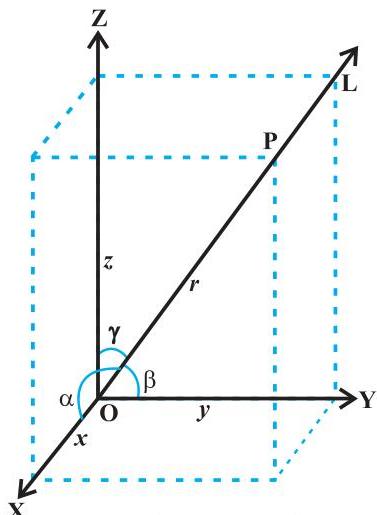 Fig 11.1
It is important to recognize that any line existing in three-dimensional space inherently possesses two opposing orientations, which implies the existence of two distinct sets of direction cosines. To establish a singular, unambiguous set of direction cosines for a particular line, it is imperative to conceptualize it as a directed line. The conventional symbols for these unique direction cosines are $l$, $m$, and $n$.
Remark When confronted with a line in space that does not intersect the origin, its direction cosines can be ascertained by constructing a parallel line that does pass through the origin. Subsequently, one must select a specific orientation for this newly constructed line originating from the origin and determine its direction cosines; this is permissible because parallel lines share identical sets of direction cosines.
The direction ratios of a line are defined as any three numerical values that maintain proportionality to its direction cosines. Consequently, if $l, m, n$ represent the direction cosines and $a, b, c$ denote the direction ratios of a given line, their relationship can be expressed as $a = \lambda l$, $b = \lambda m$, and $c = \lambda n$, where $\lambda$ is any non-zero real scalar, $\lambda \in \mathbf{R}$.
Note Some authors also call direction ratios as direction numbers.
Consider a line for which $a, b, c$ are its direction ratios and $l, m, n$ are its direction cosines (d.c.'s). Based on their proportional relationship, we can state:
$ \frac {l}{a} = \frac {m}{b} = \frac {n}{c} = k \text {(say), } k \text { being a constant.} $
This proportionality implies $l = ak, m = bk, n = ck$ ... (1)
However, it is a fundamental property that the sum of the squares of direction cosines equals unity: $l^2 +m^2 +n^2 = 1$
Substituting the expressions from (1) into this identity yields $k^2 (a^2 +b^2 +c^2) = 1$
$ \text{or } k = \pm \frac{1}{\sqrt{a^2 + b^2 + c^2}}
$
Consequently, by substituting the derived value of $k$ back into equation (1), the d.c.'s of the line are determined as:
$ \begin{aligned} l &= \pm \frac{a}{\sqrt{a^2 + b^2 + c^2}} \ m &= \pm \frac{b}{\sqrt{a^2 + b^2 + c^2}} \ n &= \pm \frac{c}{\sqrt{a^2 + b^2 + c^2}} \end{aligned} $ It is crucial to note that the choice of sign for $k$ dictates whether a positive or negative value is assigned to $l$, $m$, and $n$.
Furthermore, for any given line, if $a, b, c$ represent a set of its direction ratios, then $ka, kb, kc$ (where $k \neq 0$) also constitutes a valid set of direction ratios. This implies that any two distinct sets of direction ratios for a line are inherently proportional. Therefore, it follows that an infinite number of direction ratio sets exist for any single line.
11.2.1 Direction cosines of a line passing through two points
Given that a unique line is defined by two distinct points, the direction cosines for a line segment connecting points $\mathrm{P}(x_1,y_1,z_1)$ and $\mathrm{Q}(x_2,y_2,z_2)$ can be ascertained as detailed below (refer to Fig 11.2 (a)).
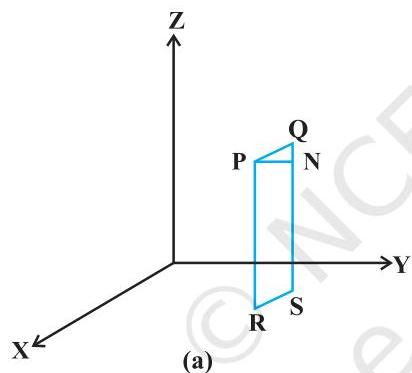 Fig 11.2
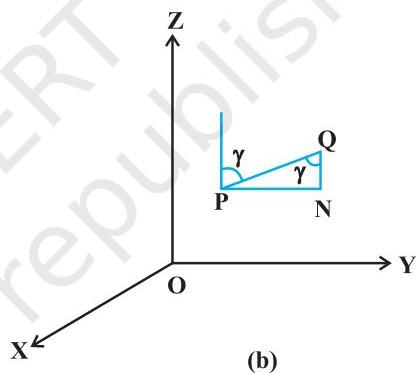
Suppose $l, m, n$ represent the direction cosines of the line segment PQ, forming angles $\alpha, \beta,$ and $\gamma$ with the positive $x, y,$ and $z$-axes, respectively.
From points $\mathrm{P}$ and $\mathrm{Q}$, drop perpendiculars to the XY-plane, intersecting it at $\mathrm{R}$ and $\mathrm{S}$, respectively. Subsequently, construct a perpendicular from $\mathrm{P}$ to the line segment QS, designating the intersection point as $\mathrm{N}$. Within the right-angled triangle PNQ, the angle $\angle \mathrm{PQN}$ is equal to $\gamma$ (as depicted in Fig 11.2 (b)).
$ \text{Consequently, } \cos \gamma = \frac{\mathrm{NQ}}{\mathrm{PQ}} = \frac{z_2 - z_1}{\mathrm{PQ}} $
$ \text{Analogously, } \cos \alpha = \frac{x_2 - x_1}{\mathrm{PQ}} \text{ and } \cos \beta = \frac{y_2 - y_1}{\mathrm{PQ}} $
Thus, the direction cosines for the line segment connecting points $\mathrm{P}(x_1,y_1,z_1)$ and $\mathrm{Q}(x_2,y_2,z_2)$ are given by:
$ \frac {x _ {2} - x _ {1}}{\mathrm {P Q}}, \frac {y _ {2} - y _ {1}}{\mathrm {P Q}}, \frac {z _ {2} - z _ {1}}{\mathrm {P Q}} $
where
$ \mathrm {P Q} = \sqrt {\left(x _ {2} - x _ {1}\right) ^ {2} + \left(y _ {2} - y _ {1}\right) ^ {2} + \left(z _ {2} - z _ {1}\right) ^ {2}} $
Note The direction ratios associated with the line segment connecting $\mathrm{P}(x_1, y_1, z_1)$ and $\mathrm{Q}(x_2, y_2, z_2)$ can be expressed as:
$ x _ {2} - x _ {1}, y _ {2} - y _ {1}, z _ {2} - z _ {1} \text{ or } x _ {1} - x _ {2}, y _ {1} - y _ {2}, z _ {1} - z _ {2} $
Example 1 Determine the direction cosines of a line that forms angles of $90^{\circ}$, $60^{\circ}$, and $30^{\circ}$ with the positive $x, y,$ and $z$-axes, respectively.
Solution Designate the direction cosines ($d.c.'s$) of the line as $l, m, n$. It follows that $l = \cos 90^{\circ} = 0$, $m = \cos 60^{\circ} = \frac{1}{2}$, and $n = \cos 30^{\circ} = \frac{\sqrt{3}}{2}$.
Example 2 Given a line with direction ratios $2, -1, -2$, ascertain its corresponding direction cosines.
Solution The direction cosines are calculated as:
$ \begin{aligned} &\frac{2}{\sqrt{2^2 + (-1)^2 + (-2)^2}} \ &\frac{-1}{\sqrt{2^2 + (-1)^2 + (-2)^2}} \ &\frac{-2}{\sqrt{2^2 + (-1)^2 + (-2)^2}} \end{aligned} $
or
$ \frac {2}{3}, \frac {- 1}{3}, \frac {- 2}{3} $
Example 3 Compute the direction cosines of the line that traverses the two points $(-2, 4, -5)$ and $(1, 2, 3)$.
Solution Recall that the direction cosines for a line connecting two points $\mathrm{P}(x_1, y_1, z_1)$ and $\mathrm{Q}(x_2, y_2, z_2)$ are specified by:
$ \frac {x _ {2} - x _ {1}}{\mathrm {P Q}}, \frac {y _ {2} - y _ {1}}{\mathrm {P Q}}, \frac {z _ {2} - z _ {1}}{\mathrm {P Q}} $
where
$ \mathrm {P Q} = \sqrt {\left(x _ {2} - x _ {1}\right) ^ {2} + \left(y _ {2} - y _ {1}\right) ^ {2} + \left(z _ {2} - z _ {1}\right) ^ {2}} $
Here $\mathrm{P}$ is $(-2, 4, -5)$ and $\mathrm{Q}$ is $(1, 2, 3)$.
So
$ \mathrm {P Q} = \sqrt {\left(1 - (- 2)\right) ^ {2} + (2 - 4) ^ {2} + \left(3 - (- 5)\right) ^ {2}} = \sqrt {7 7} $
Thus, the direction cosines of the line joining two points is
$ \frac {3}{\sqrt {7 7}}, \frac {- 2}{\sqrt {7 7}}, \frac {8}{\sqrt {7 7}}
$
Example 4 Find the direction cosines of $x, y$ and $z$-axis.
Solution The $x$-axis makes angles $0^{\circ}$, $90^{\circ}$ and $90^{\circ}$ respectively with $x, y$ and $z$-axis. Therefore, the direction cosines of $x$-axis are $\cos 0^{\circ}$, $\cos 90^{\circ}$, $\cos 90^{\circ}$ i.e., $1,0,0$. Similarly, direction cosines of $y$-axis and $z$-axis are $0, 1, 0$ and $0, 0, 1$ respectively.
Example 5 Show that the points A (2, 3, -4), B (1, -2, 3) and C (3, 8, -11) are collinear.
Solution Direction ratios of line joining A and B are
$1 - 2, -2 - 3, 3 + 4$ i.e., $-1, -5, 7$.
The direction ratios of line joining B and C are
$3 - 1, 8 + 2, -11 - 3$, i.e., $2, 10, -14$.
It is clear that direction ratios of AB and BC are proportional, hence, AB is parallel to BC. But point B is common to both AB and BC. Therefore, A, B, C are collinear points.
EXERCISE 11.1
- If a line makes angles $90^{\circ}$, $135^{\circ}$, $45^{\circ}$ with the $x, y$ and $z$-axes respectively, find its direction cosines.
- Find the direction cosines of a line which makes equal angles with the coordinate axes.
- If a line has the direction ratios $-18, 12, -4$, then what are its direction cosines?
- Show that the points $(2, 3, 4), (-1, -2, 1), (5, 8, 7)$ are collinear.
- Find the direction cosines of the sides of the triangle whose vertices are $(3, 5, -4), (-1, 1, 2)$ and $(-5, -5, -2)$.
11.3 Equation of a Line in Space
Having previously examined equations of lines within a two-dimensional framework in Class XI, our current focus will be on exploring the vector and Cartesian representations of a line in three-dimensional space.
A line can be uniquely specified under two conditions:
(i) it traverses a particular point and possesses a specified direction, or (ii) it extends through two distinct, designated points.
11.3.1 Equation of a line passing through a specified point and parallel to a given vector $\vec{b}$.
Consider $\vec{a}$ as the position vector corresponding to the designated point A, relative to the origin O of the Cartesian coordinate system. Let $l$ represent the line that extends through point A and maintains parallelism with a specified vector $\vec{b}$. Furthermore, let $\vec{r}$ denote the position vector of any general point P situated on this line (Fig 11.3).
Consequently, the vector $\overline{\mathrm{AP}}$ is parallel to vector $\vec{b}$, which can be expressed as $\overline{\mathrm{AP}} = \lambda \vec{b}$, where $\lambda$ signifies an arbitrary real scalar.
But $\overline{\mathrm{AP}} = \overline{\mathrm{OP}} - \overline{\mathrm{OA}}$
$ \text{i.e. } \lambda \vec{b} = \vec{r} - \vec{a} $
Conversely, every distinct value assigned to the scalar parameter $\lambda$ yields the position vector of a point P lying on the line. Consequently, the vector formulation for the line's equation is provided by
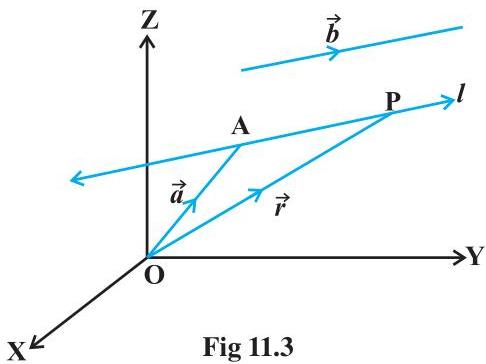 Fig 11.3
$ \vec{r} = \vec{a} + \lambda \vec{b} \tag{1} $
Remark: Should $\vec{b}$ be expressed as $a\hat{i} + b\hat{j} + c\hat{k}$, then $a, b, c$ represent the direction ratios of the line. Conversely, if $a, b, c$ constitute the direction ratios of a line, then the vector $\vec{b} = a\hat{i} + b\hat{j} + c\hat{k}$ will be parallel to that line. It is important to note that the scalar component $b$ here must not be mistaken for the magnitude of vector $\vec{b}$, denoted as $|\vec{b}|.$
Derivation of Cartesian form from vector form
Let the coordinates of the given point $A$ be $(x_1, y_1, z_1)$ and the direction ratios of the line be $a, b, c$. Consider the coordinates of any point $P$ be $(x, y, z)$. Then
$ \vec{r} = x \hat{i} + y \hat{j} + z \hat{k}; \vec{a} = x_1 \hat{i} + y_1 \hat{j} + z_1 \hat{k} $
$ \text{and } \vec{b} = a \hat{i} + b \hat{j} + c \hat{k} $
Substituting these values in (1) and equating the coefficients of $\hat{i}$, $\hat{j}$ and $\hat{k}$, we get
$ x = x_1 + \lambda a; \quad y = y_1 + \lambda b; \quad z = z_1 + \lambda c \tag{2} $
These are parametric equations of the line. Eliminating the parameter $\lambda$ from (2), we get
$ \frac{x - x_1}{a} = \frac{y - y_1}{b} = \frac{z - z_1}{c} \tag{3} $
This is the Cartesian equation of the line.
Note If $l, m, n$ are the direction cosines of the line, the equation of the line is
$ \frac{x - x_1}{l} = \frac{y - y_1}{m} = \frac{z - z_1}{n} $
Example 6 Find the vector and the Cartesian equations of the line through the point $(5, 2, -4)$ and which is parallel to the vector $3\hat{i} + 2\hat{j} - 8\hat{k}$.
Solution We have
$ \vec{a} = 5\hat{i} + 2\hat{j} - 4\hat{k} \quad \text{and} \quad \vec{b} = 3\hat{i} + 2\hat{j} - 8\hat{k}
$
Therefore, the vector equation of the line is
$ \ddot {r} = 5 \hat {i} + 2 \hat {j} - 4 \hat {k} + \lambda (3 \hat {i} + 2 \hat {j} - 8 \hat {k}) $
Now, $\ddot{r}$ is the position vector of any point $\mathrm{P}(x,y,z)$ on the line.
$ \text{Therefore, } x\hat{i} + y\hat{j} + z\hat{k} = 5\hat{i} + 2\hat{j} - 4\hat{k} + \lambda (3\hat{i} + 2\hat{j} - 8\hat{k}) $
$ = (5 + 3 \lambda) \hat {i} + (2 + 2 \lambda) \hat {j} + (- 4 - 8 \lambda) \hat {k} $
Eliminating $\lambda$, we get
$ \frac {x - 5}{3} = \frac {y - 2}{2} = \frac {z + 4}{- 8} $
which is the equation of the line in Cartesian form.
11.4 Angle between Two Lines
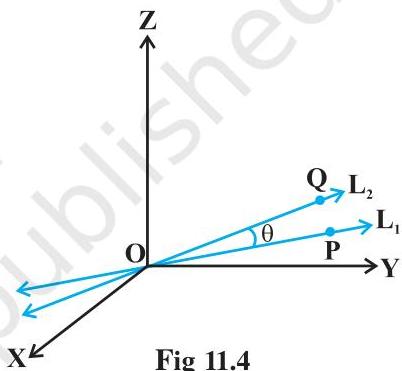
Let $\mathrm{L}_1$ and $\mathrm{L}_2$ be two lines passing through the origin and with direction ratios $a_1, b_1, c_1$ and $a_2, b_2, c_2$, respectively. Let $\mathrm{P}$ be a point on $\mathrm{L}_1$ and $\mathrm{Q}$ be a point on $\mathrm{L}_2$. Consider the directed lines OP and OQ as given in Fig 11.6. Let $\theta$ be the acute angle between OP and OQ. Now recall that the directed line segments OP and OQ are vectors with components $a_1, b_1, c_1$ and $a_2, b_2, c_2$, respectively. Therefore, the angle $\theta$ between them is given by
$ \cos \theta = \left| \frac {a _ {1} a _ {2} + b _ {1} b _ {2} + c _ {1} c _ {2}}{\sqrt {a _ {1} ^ {2} + b _ {1} ^ {2} + c _ {1} ^ {2}} \sqrt {a _ {2} ^ {2} + b _ {2} ^ {2} + c _ {2} ^ {2}}} \right| \tag {1} $
The angle between the lines in terms of $\sin \theta$ is given by $ \begin{aligned} \sin \theta &= \sqrt{1 - \cos^2 \theta} \ \ &= \sqrt{ 1 - \frac{(a_1 a_2 + b_1 b_2 + c_1 c_2)^2} {(a_1^2 + b_1^2 + c_1^2)(a_2^2 + b_2^2 + c_2^2)} } \ \ &= \frac{ \sqrt{ (a_1^2 + b_1^2 + c_1^2)(a_2^2 + b_2^2 + c_2^2)
- (a_1 a_2 + b_1 b_2 + c_1 c_2)^2 } }{ \sqrt{a_1^2 + b_1^2 + c_1^2} ;\sqrt{a_2^2 + b_2^2 + c_2^2} } \ \ &= \frac{ \sqrt{ (a_1 b_2 - a_2 b_1)^2
- (b_1 c_2 - b_2 c_1)^2
- (c_1 a_2 - c_2 a_1)^2 } }{ \sqrt{a_1^2 + b_1^2 + c_1^2} ;\sqrt{a_2^2 + b_2^2 + c_2^2} } \tag{2} \end{aligned} $
Note In case the lines $\mathbf{L}_1$ and $\mathbf{L}_2$ do not pass through the origin, we may take lines $\mathbf{L}_1^{\prime}$ and $\mathbf{L}_2^{\prime}$ which are parallel to $\mathbf{L}_1$ and $\mathbf{L}_2$ respectively and pass through the origin.
If instead of direction ratios for the lines $\mathbf{L}_1$ and $\mathbf{L}_2$, direction cosines, namely, $l_1, m_1, n_1$ for $\mathbf{L}_1$ and $l_2, m_2, n_2$ for $\mathbf{L}_2$ are given, then (1) and (2) takes the following form:
$ \cos \theta = \left| l _ {1} l _ {2} + m _ {1} m _ {2} + n _ {1} n _ {2} \right| \quad (\text{as } l _ {1} ^ {2} + m _ {1} ^ {2} + n _ {1} ^ {2} = 1 = l _ {2} ^ {2} + m _ {2} ^ {2} + n _ {2} ^ {2}) \tag {3} $
$ \text{and } \sin \theta = \sqrt{\left(l_1m_2 - l_2m_1\right)^2 - (m_1n_2 - m_2n_1)^2 + (n_1l_2 - n_2l_1)^2} \tag{4} $
Two lines with direction ratios $a_1, b_1, c_1$ and $a_2, b_2, c_2$ are
(i) perpendicular i.e. if $\theta = 90^{\circ}$ by (1)
$ a _ {1} a _ {2} + b _ {1} b _ {2} + c _ {1} c _ {2} = 0 $
(ii) parallel i.e. if $\theta = 0$ by (2)
$ \frac {a _ {1}}{a _ {2}} = \frac {b _ {1}}{b _ {2}} = \frac {c _ {1}}{c _ {2}} $
We now proceed to determine the angle between two lines, given their respective equations. Should $\theta$ represent the acute angle separating the lines
$ \vec {r} = \vec {a} _ {1} + \lambda b _ {1} \quad \text{and} \quad \vec {r} = \vec {a} _ {2} + \mu \vec {b} _ {2} $
then its cosine is expressed as
$ \cos \theta = \left| \frac {\vec {b} _ {1} \cdot \vec {b} _ {2}}{| \vec {b} _ {1} | | \vec {b} _ {2} |} \right| $
When expressed in Cartesian coordinates, if $\theta$ denotes the angle formed by the lines
$ \frac {x - x _ {1}}{a _ {1}} = \frac {y - y _ {1}}{b _ {1}} = \frac {z - z _ {1}}{c _ {1}} \tag {1} $
and
$ \frac {x - x _ {2}}{a _ {2}} = \frac {y - y _ {2}}{b _ {2}} = \frac {z - z _ {2}}{c _ {2}} \tag {2} $
where $a_1, b_1, c_1$ and $a_2, b_2, c_2$ correspond to the direction ratios for lines (1) and (2), respectively, then the cosine of this angle is given by
$ \cos \theta = \left| \frac {a _ {1} a _ {2} + b _ {1} b _ {2} + c _ {1} c _ {2}}{\sqrt {a _ {1} ^ {2} + b _ {1} ^ {2} + c _ {1} ^ {2}} \sqrt {a _ {2} ^ {2} + b _ {2} ^ {2} + c _ {2} ^ {2}}} \right| $
Example 7 Determine the angle between the following pair of lines, expressed in vector form:
$ \vec {r} = 3 \hat {i} + 2 \hat {j} - 4 \hat {k} + \lambda (\hat {i} + 2 \hat {j} + 2 \hat {k})
$
and
$ \vec {r} = 5 \hat {i} - 2 \hat {j} + \mu (3 \hat {i} + 2 \hat {j} + 6 \hat {k}) $
Solution For the given lines, the direction vectors are identified as $\vec{b}_1 = \hat{i} + 2\hat{j} + 2\hat{k}$ and $\vec{b}_2 = 3\hat{i} + 2\hat{j} + 6\hat{k}$.
The angle $\theta$ separating these two lines can be computed using the formula:
$ \begin{array}{l} \cos \theta = \left| \frac {\vec {b} _ {1} \cdot \vec {b} _ {2}}{\left| \vec {b} _ {1} \right| \left| \vec {b} _ {2} \right|} \right| = \left| \frac {(\hat {i} + 2 \hat {j} + 2 \hat {k}) \cdot (3 \hat {i} + 2 \hat {j} + 6 \hat {k})}{\sqrt {1 + 4 + 4} \sqrt {9 + 4 + 36}} \right| \ = \left| \frac {3 + 4 + 12}{3 \times 7} \right| = \frac {19}{21} \ \end{array} $
Therefore, the angle $\theta$ is found to be $\cos^{-1}\left(\frac{19}{21}\right)$.
Example 8 Calculate the angle between the pair of lines given in Cartesian form:
$ \frac {x + 3}{3} = \frac {y - 1}{5} = \frac {z + 3}{4} $
$ \text{and } \frac{x + 1}{1} = \frac{y - 4}{1} = \frac{z - 5}{2} $
Solution The direction ratios for the initial line are 3, 5, 4, and for the subsequent line, they are 1, 1, 2. If $\theta$ represents the angle between these lines, its cosine is determined by:
$ \begin{aligned} \cos \theta &= \left| \frac{3\cdot1 + 5\cdot1 + 4\cdot2} {\sqrt{3^2 + 5^2 + 4^2};\sqrt{1^2 + 1^2 + 2^2}} \right| \ \ &= \frac{16}{\sqrt{50};\sqrt{6}} \ &= \frac{16}{5\sqrt{2};\sqrt{6}} \ &= \frac{8\sqrt{3}}{15} \end{aligned} $
Thus, the desired angle is $\cos^{-1}\left(\frac{8\sqrt{3}}{15}\right)$.
11.5 Shortest Distance between Two Lines
When two lines in three-dimensional space converge at a single point, their minimal separation is by definition zero. Conversely, if two lines in space are parallel, their shortest distance is precisely the perpendicular length measured from any point on one line to the other.
Moreover, within a three-dimensional domain, certain lines exist that are neither concurrent nor parallel. These specific pairs of lines are inherently non-coplanar and are designated as skew lines. To illustrate, imagine a room with dimensions of 1, 3, and 2 units aligned with the $x$, $y$, and $z$ axes, respectively, as depicted in Fig 11.5.
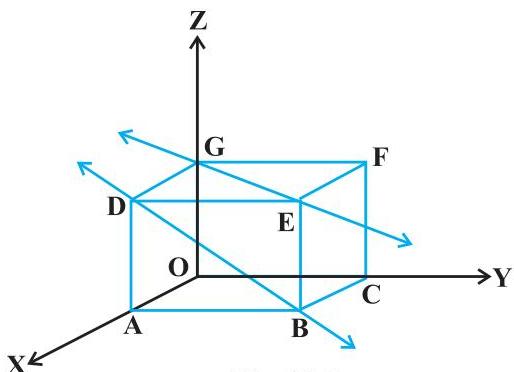 Fig 11.5
Consider line GE, which traverses the ceiling diagonally, and line DB, which originates from a ceiling corner directly above point A and descends diagonally along an adjacent wall. These lines exemplify skew lines, as they are neither parallel nor do they ever intersect.
The shortest distance separating two lines is formally defined as the length of the minimal segment connecting a point on the first line to a point on the second line.
In the specific case of skew lines, the segment representing the shortest distance will inherently be orthogonal to both lines.
11.5.1 Distance between two skew lines
We now determine the shortest distance between two skew lines in the following way: Let $l_{1}$ and $l_{2}$ be two skew lines with equations (Fig. 11.6)
$ \vec {r} = \vec {a} _ {1} + \lambda \vec {b} _ {1} \tag {1} $
and
$ \vec {r} = \vec {a} _ {2} + \mu \vec {b} _ {2} \tag {2} $
Take any point $S$ on $l_{1}$ with position vector $\vec{a}{1}$ and $T$ on $l{2}$, with position vector $\vec{a}_{2}$. Then the magnitude of the shortest distance vector will be equal to that of the projection of $\overline{ST}$ along the direction of the line of shortest distance (See 10.6.2).
If $\overline{\mathrm{PQ}}$ is the shortest distance vector between $l_{1}$ and $l_{2}$, then it being perpendicular to both $\vec{b}{1}$ and $\vec{b}{2}$, the unit vector $\hat{n}$ along $\overline{\mathrm{PQ}}$ would therefore be
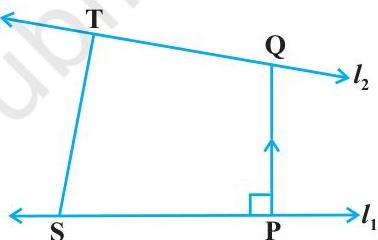 Fig 11.6
$ \hat {n} = \frac {\vec {b} _ {1} \times \vec {b} _ {2}}{| \vec {b} _ {1} \times \vec {b} _ {2} |} \tag {3} $
Then
$ \overline {{\mathrm {P Q}}} = d \hat {n} $
where, $d$ is the magnitude of the shortest distance vector. Let $\theta$ be the angle between $\overline{\mathrm{ST}}$ and $\overline{\mathrm{PQ}}$. Then
$ \mathrm {P Q} = \mathrm {S T} | \cos \theta | $
But
$ \cos \theta = \left| \frac {\overline {{\mathrm {P Q}}} \cdot \overline {{\mathrm {S T}}}}{| \overline {{\mathrm {P Q}}} | | \overline {{\mathrm {S T}}} |} \right| $
$ = \left| \frac {d \hat {n} \cdot (\vec {a} _ {2} - \vec {a} _ {1})}{d \mathrm {S T}} \right| \quad (\text {since} \ \overline {{\mathrm {S T}}} = \vec {a} _ {2} - \vec {a} _ {1}) $
$ = \left| \frac {(\vec {b} _ {1} \times \vec {b} _ {2}) \cdot (\vec {a} _ {2} - \vec {a} _ {1})}{\mathrm {S T} | \vec {b} _ {1} \times \vec {b} _ {2} |} \right| \quad [ \text {From} \ (3) ]
$
Hence, the required shortest distance is
$ d = \mathrm {P Q} = \mathrm {S T} | \cos \theta | $
or
$ d = \left| \frac {\left(\vec {b} _ {1} \times \vec {b} _ {2}\right) . \left(\vec {a} _ {2} \times \vec {a} _ {1}\right)}{\left| \vec {b} _ {1} \times \vec {b} _ {2} \right|} \right| $
Cartesian form
For two lines defined in Cartesian coordinates, the shortest distance between them, where the lines are given by:
$ l _ {1} \colon \frac {x - x _ {1}}{a _ {1}} = \frac {y - y _ {1}}{b _ {1}} = \frac {z - z _ {1}}{c _ {1}} $
and
$ l _ {2} \colon \frac {x - x _ {2}}{a _ {2}} = \frac {y - y _ {2}}{b _ {2}} = \frac {z - z _ {2}}{c _ {2}} $
is expressed by the following formula:
$ d = \frac{\left| \begin{vmatrix} x _ {2} - x _ {1} & y _ {2} - y _ {1} & z _ {2} - z _ {1} \ a _ {1} & b _ {1} & c _ {1} \ a _ {2} & b _ {2} & c _ {2} \end{vmatrix} \right|}{\sqrt {\left(b _ {1} c _ {2} - b _ {2} c _ {1}\right) ^ {2} + \left(c _ {1} a _ {2} - c _ {2} a _ {1}\right) ^ {2} + \left(a _ {1} b _ {2} - a _ {2} b _ {1}\right) ^ {2}}} $
11.5.2 Distance between parallel lines
When two lines, denoted as $l_{1}$ and $l_{2}$, are parallel, they inherently lie within the same plane (i.e., they are coplanar). Consider these lines to be represented by the following vector equations:
$ \vec {r} = \vec {a} _ {1} + \lambda \vec {b} \tag {1} $
and
$ \vec {r} = \vec {a} _ {2} + \mu \vec {b} \tag {2} $
Here, $\vec{a}_1$ denotes the position vector of a specific point S located on line $l_1$, while $\vec{a}_2$ represents the position vector of a point T situated on line $l_2$, as illustrated in Fig 11.7.
Given that $l_{1}$ and $l_{2}$ are coplanar, the distance separating these two lines is defined as the length of the perpendicular segment from point T to line $l_{1}$. If P is the foot of this perpendicular from T onto $l_{1}$, then this distance is given by $|\mathrm{TP}|$.
Let $\theta$ be the angle formed between the vector $\overrightarrow{\mathrm{ST}}$ and the direction vector $\vec{b}$. Consequently, the cross product can be expressed as:
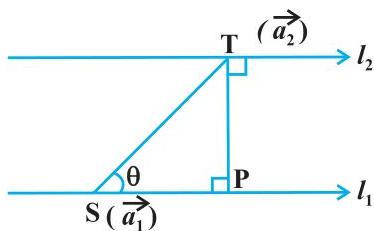 Fig 11.7
$ \vec {b} \times \overrightarrow {\mathrm {S T}} = (| \vec {b} | | \overrightarrow {\mathrm {S T}} | \sin \theta) \hat {n} \dots \tag {3} $
where $\hat{n}$ signifies the unit vector oriented perpendicularly to the plane containing both lines $l_{1}$ and $l_{2}$.
Furthermore, the vector $\overrightarrow{\mathrm{ST}}$ can be written as:
$ \overrightarrow {\mathrm {S T}} = \vec {a} _ {2} - \vec {a} _ {1}
$
Substituting this into equation (3), we obtain:
$ \vec {b} \times (\vec {a} _ {2} - \vec {a} _ {1}) = \vec {b} | \mathrm {P T} \hat {n} \quad (\text {s i n c e P T} = \mathrm {S T} \sin \theta) $
Taking the magnitude of both sides yields: $|\vec{b}\times (\vec{a}_2 - \vec{a}_1)| = |\vec{b} |\mathrm{PT}\cdot 1$ (as $|\hat{n} | = 1$).
Therefore, the distance, $d$, between the two parallel lines is given by:
$ d = \left| \overrightarrow {\mathrm {P T}} \right| = \left| \frac {\vec {b} \times (\vec {a} _ {2} - \vec {a} _ {1})}{| \vec {b} |} \right| $
Example 9 Determine the shortest distance separating lines $l_{1}$ and $l_{2}$, which are defined by the following vector equations:
$ \vec {r} = \hat {i} + \hat {j} + \lambda (2 \hat {i} - \hat {j} + \hat {k}) \tag {1} $
$ \text{and } \vec{r} = 2\hat{i} +\hat{j} -\hat{k} +\mu (3\hat{i} -5\hat{j} +2\hat{k}) \tag{2} $
Solution By comparing equations (1) and (2) to the general forms $\vec{r} = \vec{a}_1 + \lambda \vec{b}_1$ and $\vec{\mathbf{r}} = \vec{\mathbf{a}}_2 + \mu \vec{\mathbf{b}}_2$, respectively, we can identify the corresponding vectors:
We find that $\vec{\mathbf{a}}_1 = \hat{i} +\hat{j}$ and $\vec{b}_1 = 2\hat{i} -\hat{j} +\hat{k}$.
Similarly, $\vec{\mathbf{a}}2 = 2\hat{i} +\hat{j} -\hat{k}$ and $\vec{b}{2} = 3\hat{i} -5\hat{j} +2\hat{k}$.
$ \text{Therefore } \vec{a}_2 - \vec{a}_1 = \hat{i} -\hat{k} $
$ \text{and } \vec{b}_1\times \vec{b}_2 = (2\hat{i} -\hat{j} +\hat{k})\times (3\hat{i} -5\hat{j} +2\hat{k}) $
$ = \left| \begin{vmatrix} \hat {i} & \hat {j} & \hat {k} \ 2 & - 1 & 1 \ 3 & - 5 & 2 \end{vmatrix} \right| = 3 \hat {i} - \hat {j} - 7 \hat {k} $
$ \text{So } |\vec{b}_1 \times \vec{b}_2| = \sqrt{9 + 1 + 49} = \sqrt{59} $
Hence, the shortest distance between the given lines is given by
$ d = \left| \frac {\left(\vec {b} _ {1} \times \vec {b} _ {2}\right) . \left(\vec {a} _ {2} - \vec {a} _ {1}\right)}{\left| \vec {b} _ {1} \times \vec {b} _ {2} \right|} \right| = \frac {| 3 - 0 + 7 |}{\sqrt {5 9}} = \frac {1 0}{\sqrt {5 9}} $
Example 10 Find the distance between the lines $l_{1}$ and $l_{2}$ given by
$ \vec {r} = \hat {i} + 2 \hat {j} - 4 \hat {k} + \lambda (2 \hat {i} + 3 \hat {j} + 6 \hat {k}) $
$ \text{and } \vec{r} = 3\hat{i} +3\hat{j} -5\hat{k} +\mu (2\hat{i} +3\hat{j} +6\hat{k})
$
Solution The two lines are parallel (Why?) We have
$ \vec {\mathrm {a}} _ {1} = \hat {i} + 2 \hat {j} - 4 \hat {k}, \vec {\mathrm {a}} _ {2} = 3 \hat {i} + 3 \hat {j} - 5 \hat {k} \text { and } \vec {b} = 2 \hat {i} + 3 \hat {j} + 6 \hat {k} $
Therefore, the distance between the lines is given by
$ d = \left| \frac {\begin{vmatrix} \hat {i} & \hat {j} & \hat {k} \ 2 & 3 & 6 \ 2 & 1 & - 1 \end{vmatrix}}{\sqrt {4 + 9 + 3 6}} \right| $
or
$ = \frac {\left| - 9 \hat {i} + 1 4 \hat {j} - 4 \hat {k} \right|}{\sqrt {4 9}} = \frac {\sqrt {2 9 3}}{\sqrt {4 9}} = \frac {\sqrt {2 9 3}}{7} $
EXERCISE 11.2
Demonstrate the mutual perpendicularity of the three lines defined by the following direction cosines: $\frac{12}{13}, \frac{-3}{13}, \frac{-4}{13}; \frac{4}{13}, \frac{12}{13}, \frac{3}{13}; \frac{3}{13}, \frac{-4}{13}, \frac{12}{13}$.
Verify that the line segment connecting points $(1, -1, 2)$ and $(3, 4, -2)$ is orthogonal to the line segment joining $(0, 3, 2)$ and $(3, 5, 6)$.
Prove the parallelism between the line passing through $(4, 7, 8)$ and $(2, 3, 4)$ and the line passing through $(-1, -2, 1)$ and $(1, 2, 5)$.
Determine the equation of the line that traverses point $(1, 2, 3)$ and maintains a direction parallel to the vector $3\hat{i} + 2\hat{j} - 2\hat{k}$.
Ascertain both the vector and Cartesian equations for the line originating from the point defined by the position vector $2\hat{i} - \hat{j} + 4\hat{k}$ and oriented along the direction vector $\hat{i} + 2\hat{j} - \hat{k}$.
Derive the Cartesian equation for the line that contains the point $(-2, 4, -5)$ and runs parallel to the line expressed as $\frac{x + 3}{3} = \frac{y - 4}{5} = \frac{z + 8}{6}$.
Given the Cartesian equation of a line as $\frac{x - 5}{3} = \frac{y + 4}{7} = \frac{z - 6}{2}$, translate it into its equivalent vector form.
Calculate the angle subtended between each of the subsequent pairs of lines:
(i) $ \vec{r} = 2\hat{i} -5\hat{j} +\hat{k} +\lambda (3\hat{i} +2\hat{j} +6\hat{k}) $ and $ \vec {r} = 7 \hat {i} - 6 \hat {k} + \mu (\hat {i} + 2 \hat {j} + 2 \hat {k}) $
(ii) $ \vec{r} = 3\hat{i} + \hat{j} - 2\hat{k} + \lambda (\hat{i} - \hat{j} - 2\hat{k}) $ and $ \vec {r} = 2 \hat {i} - \hat {j} - 56 \hat {k} + \mu (3 \hat {i} - 5 \hat {j} - 4 \hat {k}) $
Determine the angle separating the following pairs of lines:
(i) $ \frac{x - 2}{2} = \frac{y - 1}{5
} = \frac{z + 3}{-3} \text{ and } \frac{x + 2}{-1} = \frac{y - 4}{8} = \frac{z - 5}{4} $ (ii) $ \frac{x}{2} = \frac{y}{2} = \frac{z}{1} \text{ and } \frac{x - 5}{4} = \frac{y - 2}{1} = \frac{z - 3}{8} $
Ascertain the specific values of $p$ for which the lines defined by the equations $\frac{1 - x}{3} = \frac{7y - 14}{2p} = \frac{z - 3}{2}$ and $\frac{7 - 7x}{3p} = \frac{y - 5}{1} = \frac{6 - z}{5}$ are mutually orthogonal.
Demonstrate the orthogonality between the lines given by $\frac{x - 5}{7} = \frac{y + 2}{-5} = \frac{z}{1}$ and $\frac{x}{1} = \frac{y}{2} = \frac{z}{3}$.
Compute the minimum separation between the lines specified by:
$ \begin{array}{l} \vec {r} = (\hat {i} + 2 \hat {j} + \hat {k}) + \lambda (\hat {i} - \hat {j} + \hat {k}) \text{ and} \ \vec {r} = 2 \hat {i} - \hat {j} - \hat {k} + \mu (2 \hat {i} + \hat {j} + 2 \hat {k}) \end{array} $
Calculate the shortest separation existing between the lines:
$ \frac {x + 1}{7} = \frac {y + 1}{- 6} = \frac {z + 1}{1} \quad \text{and} \quad \frac {x - 3}{1} = \frac {y - 5}{- 2} = \frac {z - 7}{1} $
Determine the minimum distance separating the lines whose vector formulations are provided as:
$ \begin{array}{l} \vec {r} = (\hat {i} + 2 \hat {j} + 3 \hat {k}) + \lambda (\hat {i} - 3 \hat {j} + 2 \hat {k}) \ \text{and} \quad \vec {r} = 4 \hat {i} + 5 \hat {j} + 6 \hat {k} + \mu (2 \hat {i} + 3 \hat {j} + \hat {k}) \end{array} $
Find the shortest distance between the lines whose vector equations are
$ \begin{array}{l} \vec {r} = (1 - t) \hat {i} + (t - 2) \hat {j} + (3 - 2 t) \hat {k} \text{ and} \ \vec {r} = (s + 1) \hat {i} + (2 s - 1) \hat {j} - (2 s + 1) \hat {k} \end{array} $
Miscellaneous Exercise on Chapter 11
Find the angle between the lines whose direction ratios are $a, b, c$ and $b - c, c - a, a - b$.
Find the equation of a line parallel to $x$-axis and passing through the origin.
If the lines $\frac{x - 1}{-3} = \frac{y - 2}{2k} = \frac{z - 3}{2}$ and $\frac{x - 1}{3k} = \frac{y - 1}{1} = \frac{z - 6}{-5}$ are perpendicular, find the value of $k$.
Find the shortest distance between lines $\vec{r} = 6\hat{i} + 2\hat{j} + 2\hat{k} + \lambda (\hat{i} - 2\hat{j} + 2\hat{k})$ and $\vec{r} = -4\hat{i} - \hat{k} + \mu (3\hat{i} - 2\hat{j} - 2\hat{k})$.
Find the vector equation of the line passing through the point $(1, 2, -4)$ and perpendicular to the two lines:
$ \frac{x - 8}{3} = \frac{y + 19}{-16} = \frac{z - 10}{7} \quad \text{and} \quad \frac{x - 15}{3} = \frac{y - 29}{8} = \frac{z - 5}{-5}. $
Summary
- Direction cosines of a line are the cosines of the angles made by the line with the positive directions of the coordinate axes.
- If $l, m, n$ are the direction cosines of a line, then $l^2 + m^2 + n^2 = 1$.
- Direction cosines of a line joining two points $\mathrm{P}(x_1, y_1, z_1)$ and $\mathrm{Q}(x_2, y_2, z_2)$ are $\frac{x_2 - x_1}{\mathrm{PQ}}, \frac{y_2 - y_1}{\mathrm{PQ}}, \frac{z_2 - z_1}{\mathrm{PQ}}$ where $\mathrm{PQ} = \sqrt{(x_2 - x_1)^2 + (y_2 - y_1)^2 + (z_2 - z_1)^2}$.
- Direction ratios of a line are the numbers which are proportional to the direction cosines of a line.
- If $l, m, n$ are the direction cosines and $a, b, c$ are the direction ratios of a line then
$ \begin{aligned} l &= \frac{a}{\sqrt{a^2 + b^2 + c^2}} \ m &= \frac{b}{\sqrt{a^2 + b^2 + c^2}} \ n &= \frac{c}{\sqrt{a^2 + b^2 + c^2}} \end{aligned} $
- Skew lines are lines in space which are neither parallel nor intersecting. They lie in different planes.
- Angle between skew lines is the angle between two intersecting lines drawn from any point (preferably through the origin) parallel to each of the skew lines.
- If $l_1, m_1, n_1$ and $l_2, m_2, n_2$ are the direction cosines of two lines; and $\theta$ is the acute angle between the two lines; then
$ \cos \theta = |l_1 l_2 + m_1 m_2 + n_1 n_2| $
$\diamond$ If $a_1, b_1, c_1$ and $a_2, b_2, c_2$ are the direction ratios of two lines and $\theta$ is the acute angle between the two lines; then
$ \cos \theta = \left| \frac {a _ {1} a _ {2} + b _ {1} b _ {2} + c _ {1} c _ {2}}{\sqrt {a _ {1} ^ {2} + b _ {1} ^ {2} + c _ {1} ^ {2}} \sqrt {a _ {2} ^ {2} + b _ {2} ^ {2} + c _ {2} ^ {2}}} \right| $
$\diamond$ Vector equation of a line that passes through the given point whose position vector is $\vec{a}$ and parallel to a given vector $\vec{b}$ is $\vec{r} = \vec{a} + \lambda \vec{b}$.
$\diamond$ Equation of a line through a point $(x_{1},y_{1},z_{1})$ and having direction cosines $l,m,n$ is
$ \frac {x - x _ {1}}{l} = \frac {y - y _ {1}}{m} = \frac {z - z _ {1}}{n} $
$\diamond$ The vector equation of a line which passes through two points whose position vectors are $\vec{a}$ and $\vec{b}$ is $\vec{r} = \vec{a} + \lambda (\vec{b} - \vec{a})$.
$\diamond$ If $\theta$ is the acute angle between $\vec{r} = \vec{a}_1 + \lambda \vec{b}_1$ and $\vec{r} = \vec{a}_2 + \lambda \vec{b}_2$, then
$ \cos \theta = \left| \frac {\vec {b} _ {1} \cdot \vec {b} _ {2}}{| \vec {b} _ {1} | | \vec {b} _ {2} |} \right| $
$\diamond$ If $ \frac{x - x_1}{l_1} = \frac{y - y_1}{m_1} = \frac{z - z_1}{n_1} \text{ and } \frac{x - x_2}{l_2} = \frac{y - y_2}{m_2} = \frac{z - z_2}{n_2} $ are the equations of two lines, then the acute angle between the two lines is given by $\cos \theta = |l_1l_2 + m_1m_2 + n_1n_2|$.
$\diamond$ Shortest distance between two skew lines is the line segment perpendicular to both the lines.
$\diamond$ Shortest distance between $\vec{r} = \vec{a}_1 + \lambda \vec{b}_1$ and $\vec{r} = \vec{a}_2 + \mu \vec{b}_2$ is
$ \left| \frac {(\vec {b} _ {1} \times \vec {b} _ {2}) \cdot (\vec {a} _ {2} - \vec {a} _ {1})}{| \vec {b} _ {1} \times \vec {b} _ {2} |} \right| $
$\diamond$ The shortest distance separating two lines, expressed as $\frac{x - x_1}{a_1} = \frac{y - y_1}{b_1} = \frac{z - z_1}{c_1}$ and
$ \frac {x - x _ {2}}{a _ {2}} = \frac {y - y _ {2}}{b _ {2}} = \frac {z - z _ {2}}{c _ {2}} \text{ is}
$
$ d = \frac{\left| \begin{vmatrix} x _ {2} - x _ {1} & y _ {2} - y _ {1} & z _ {2} - z _ {1} \ a _ {1} & b _ {1} & c _ {1} \ a _ {2} & b _ {2} & c _ {2} \end{vmatrix} \right|}{\sqrt {\left(b _ {1} c _ {2} - b _ {2} c _ {1}\right) ^ {2} + \left(c _ {1} a _ {2} - c _ {2} a _ {1}\right) ^ {2} + \left(a _ {1} b _ {2} - a _ {2} b _ {1}\right) ^ {2}}} $
The separation between two parallel lines, defined by $\vec{r} = \vec{a}_1 + \lambda \vec{b}$ and $\vec{r} = \vec{a}_2 + \mu \vec{b}$, is determined by:
$ \left| \frac {\vec {b} \times (\vec {a} _ {2} - \vec {a} _ {1})}{| \vec {b} |} \right| $