Chapter 1
RELATIONS AND FUNCTIONS
There is no permanent place in the world for ugly mathematics ... . It may be very hard to define mathematical beauty but that is just as true of beauty of any kind, we may not know quite what we mean by a beautiful poem, but that does not prevent us from recognising one when we read it. — G. H. HARDY
1.1 Introduction
In Class XI, fundamental concepts such as relations, functions, domain, codomain, and range were introduced, alongside various specific real-valued functions and their graphical representations. The mathematical understanding of a 'relation' originates from its everyday English usage, where two entities or quantities are considered related if a discernible connection or link exists between them. Consider $\mathbf{A}$ as the set of students in Class XII of a particular school, and $\mathbf{B}$ as the set of students in Class XI of the same institution. Illustrative examples of relations from $\mathbf{A}$ to $\mathbf{B}$ include:
(i) ${(a,b)\in \mathrm{A}\times \mathrm{B}:a$ is brother of $b}$ (ii) ${(a,b)\in \mathrm{A}\times \mathrm{B}:a$ is sister of $b}$ (iii) ${(a,b)\in \mathrm{A}\times \mathrm{B}$ : age of $a$ is greater than age of $b}$ (iv) ${(a,b)\in \mathrm{A}\times \mathrm{B}$ : total marks obtained by $a$ in the final examination is less than the total marks obtained by $b$ in the final examination}, (v) ${(a,b)\in \mathrm{A}\times \mathrm{B}:a$ lives in the same locality as $b}$ . Transcending these specific instances, a relation R from set A to set B is formally defined in mathematics as any arbitrary subset of the Cartesian product $\mathbf{A}\times \mathbf{B}$ .
When an ordered pair $(a, b)$ is an element of a relation $\mathbb{R}$, it signifies that $a$ is related to $b$ via $\mathbb{R}$, and this is denoted by $a \in \mathbb{R}$. Generally, for an element $(a, b) \in \mathbb{R}$, the presence of a discernible connection or link between $a$ and $b$ is not a prerequisite for its inclusion in the relation. As previously established in Class XI, functions represent a particular class of relations.
This chapter will delve into various classifications of relations and functions, the composition of functions, invertible functions, and binary operations.
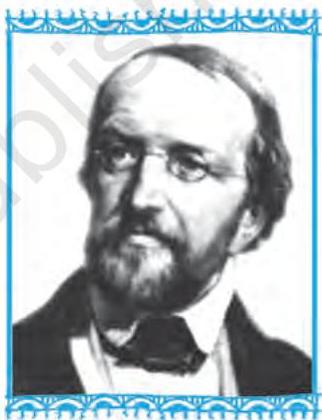 Lejeune Dirichlet (1805-1859)
1.2 Types of Relations
This section is dedicated to exploring various categories of relations. Recall that a relation within a set $A$ is fundamentally a subset of its Cartesian product, $A \times A$. Consequently, the empty set $\phi$ and the set $A \times A$ itself represent two boundary cases for relations. To illustrate, consider a relation $R$ defined on the set $A = {1, 2, 3, 4}$ as $R = {(a, b) : a - b = 10}$. This relation constitutes the empty set, given that no ordered pair $(a, b)$ from $A$ fulfills the specified condition $a - b = 10$. Conversely, if we define $R' = {(a, b) : |a - b| \geq 0}$, this relation encompasses the entirety of $A \times A$, since every pair $(a, b)$ in $A \times A$ inherently satisfies the condition $|a - b| \geq 0$. These two illustrative extremes naturally precede the formal definitions presented below.
Definition 1 An empty relation on a set $A$ is defined as a relation $R$ where no element of $A$ is associated with any other element of $A$; formally, $R = \phi \subset A \times A$.
Definition 2 A universal relation on a set $A$ is characterized as a relation $R$ in which every element of $A$ is related to every other element of $A$; that is, $R = A \times A$.
Both the empty relation and the universal relation are occasionally referred to as trivial relations.
Example 1 Let $A$ be the set of all students of a boys school. Show that the relation $R$ in $A$ given by $R = {(a, b) : a \text{ is sister of } b}$ is the empty relation and $R' = {(a, b) : \text{ the difference between heights of } a \text{ and } b \text{ is less than 3 meters}}$ is the universal relation.
Solution Given that the institution is a boys' school, it follows that no student within the school can be the sister of any other student. Consequently, $R = \phi$, thereby demonstrating that $R$ is an empty relation. Furthermore, it is self-evident that the height difference between any two students in the school will invariably be less than 3 meters. This establishes that $R' = A \times A$, confirming it as the universal relation.
Remark In previous studies (Class XI), methods for representing relations, specifically the roster method and set-builder notation, were introduced. It is worth noting that a relation $R$ on the set ${1,2,3,4}$, for instance, defined as $R = {(a,b):b = a + 1}$, is frequently denoted by authors as $aRb$ if and only if $b = a + 1$. This alternative notation may be employed in our discussions as deemed appropriate.
When an ordered pair $(a, b)$ belongs to $R$, we state that $a$ is related to $b$, and this can be symbolically represented as $aRb$.
Among the relations of particular significance in Mathematics, the equivalence relation holds a prominent position. To thoroughly understand equivalence relations, it is necessary to first examine three fundamental types of relations: reflexive, symmetric, and transitive.
Definition 3 A relation $R$ defined on a set $A$ is characterized as:
(i) $\text{reflexive}$, if for every element $a \in A$, the pair $(a, a)$ is an element of $R$.
(ii) $\text{symmetric}$, if for all elements $a_1, a_2 \in A$, the presence of $(a_1, a_2) \in R$ necessarily implies that $(a_2, a_1) \in R$.
(iii) $\text{transitive}$, if for all elements $a_1, a_2, a_3 \in A$, the conditions $(a_1, a_2) \in R$ and $(a_2, a_3) \in R$ jointly imply that $(a_1, a_3) \in R$.
Definition 4 A relation $R$ on a set $A$ is designated an equivalence relation if it simultaneously satisfies the properties of being reflexive, symmetric, and transitive.
Example 2 Let $\mathrm{T}$ be the set of all triangles in a plane with $\mathrm{R}$ a relation in $\mathrm{T}$ given by $\mathrm{R} = \left{ \left( {\mathrm{T}}{1},{\mathrm{;T}}{2}\right) : {\mathrm{T}}{1}\right.$ is congruent to $\left.{\mathrm{T}}{2}\right}$. Show that $\mathrm{R}$ is an equivalence relation.
The relation R demonstrates reflexivity, given that any triangle is congruent to itself. For symmetry, if $(\mathrm{T}_1,\mathrm{T}_2)\in \mathbb{R}$, this implies $\mathrm{T}_1$ is congruent to $\mathrm{T}_2$. Consequently, $\mathrm{T}_2$ is congruent to $\mathrm{T}_1$, which establishes that $(\mathrm{T}_2,\mathrm{T}_1)\in \mathbb{R}$. Thus, R is symmetric. Regarding transitivity, if $(\mathrm{T}_1,\mathrm{T}_2)\in \mathbb{R}$ and $(\mathrm{T}_2,\mathrm{T}_3)\in \mathbb{R}$, it signifies that $\mathrm{T}_1$ is congruent to $\mathrm{T}_2$ and $\mathrm{T}_2$ is congruent to $\mathrm{T}_3$. This necessarily means $\mathrm{T}_1$ is congruent to $\mathrm{T}_3$, leading to $(\mathrm{T}_1,\mathrm{T}_3)\in \mathbb{R}$. Therefore, R constitutes an equivalence relation.
Example 3 Let $\mathrm{L}$ be the collection of all lines within a given plane, and let $\mathrm{R}$ be a relation defined on $\mathrm{L}$ such that $\mathrm{R} = \left{ \left( {\mathrm{L}}{1},{\mathrm{L}}{2}\right) : {\mathrm{L}}{1} \text{ is perpendicular to } {\mathrm{L}}{2} \right}$. The objective is to demonstrate that $\mathrm{R}$ is symmetric, yet neither reflexive nor transitive.
Solution The relation $\mathrm{R}$ lacks reflexivity, since no line $\mathrm{L}_1$ can be perpendicular to itself; consequently, $(\mathrm{L}_1, \mathrm{L}_1) \notin \mathbb{R}$. Conversely, $\mathrm{R}$ exhibits symmetry: if $(\mathrm{L}_1, \mathrm{L}_2) \in \mathbb{R}$, this implies that $\mathrm{L}_1$ is perpendicular to $\mathrm{L}_2$. By definition of perpendicularity, $\mathrm{L}_2$ must also be perpendicular to $\mathrm{L}_1$, thereby establishing that $(\mathrm{L}_2,\mathrm{L}_1)\in \mathbb{R}$.
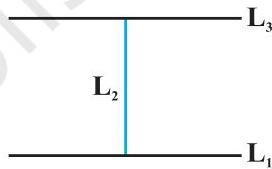 Fig 1.1
However, $\mathrm{R}$ fails to be transitive. Specifically, if $\mathrm{L}_1$ is perpendicular to $\mathrm{L}_2$ and $\mathrm{L}_2$ is perpendicular to $\mathrm{L}_3$, it logically follows that $\mathrm{L}_1$ cannot be perpendicular to $\mathrm{L}_3$. Instead, $\mathrm{L}_1$ will be parallel to $\mathrm{L}_3$. This situation is exemplified by $(\mathrm{L}_1, \mathrm{L}_2) \in \mathbb{R}$ and $(\mathrm{L}_2, \mathrm{L}_3) \in \mathbb{R}$, yet $(\mathrm{L}_1, \mathrm{L}_3) \notin \mathbb{R}$.
Example 4 Demonstrate that the relation $\mathbf{R}$ defined on the set ${1,2,3}$ as $\mathrm{R} = {(1,1),(2,2), (3,3),(1,2),(2,3)}$ possesses reflexivity, but lacks both symmetry and transitivity.
Solution The relation $\mathrm{R}$ is reflexive because all elements $(1, 1), (2, 2)$, and $(3, 3)$ are present within $\mathrm{R}$. However, $\mathrm{R}$ is not symmetric, as evidenced by the inclusion of $(1, 2) \in \mathbb{R}$ while $(2, 1) \notin \mathbb{R}$. Likewise, transitivity is absent from $\mathrm{R}$, given that $(1, 2) \in \mathbb{R}$ and $(2, 3) \in \mathbb{R}$ exist, but $(1, 3) \notin \mathbb{R}$.
Example 5 Demonstrate that the relation $\mathbf{R}$ defined on the set of integers $\mathbf{Z}$ as
$ \mathrm {R} = {(a, b): 2 \text{ divides } a - b } $
constitutes an equivalence relation.
Solution The relation $\mathrm{R}$ is reflexive, considering that $2$ divides $(a - a) = 0$ for every $a \in \mathbf{Z}$. For symmetry, if $(a, b) \in \mathbb{R}$, it follows that $2$ divides $a - b$. Consequently, $2$ must also divide $-(a - b)$, which is $b - a$. This implies $(b, a) \in \mathbb{R}$, thereby confirming $\mathrm{R}$ as symmetric. To establish transitivity, assume $(a, b) \in \mathbb{R}$ and $(b, c) \in \mathbb{R}$. This means both $a - b$ and $b - c$ are divisible by $2$. The sum of two even numbers is even, so $a - c = (a - b) + (b - c)$ must also be divisible by $2$. Therefore, $(a - c)$ is divisible by $2$, which implies $(a, c) \in \mathbb{R}$. Hence, $\mathrm{R}$ is transitive. Based on these properties, $\mathrm{R}$ is an equivalence relation on $\mathbf{Z}$.
In the context of Example 5, it is observable that all even integers bear a relation to zero, as evidenced by pairs such as $(0, \pm 2)$ and $(0, \pm 4)$ being members of $\mathbf{R}$. Conversely, no odd integer is related to 0, given that pairs like $(0, \pm 1)$ and $(0, \pm 3)$ are not elements of $\mathbf{R}$. Analogously, every odd integer is related to one, whereas no even integer shares a relation with one. Consequently, the collection $\mathbf{E}$ comprising all even integers and the collection $\mathbf{O}$ encompassing all odd integers constitute subsets of $\mathbf{Z}$ that satisfy the subsequent conditions:
(i) All constituents within $\mathbf{E}$ are mutually related, and similarly, all constituents within $\mathbf{O}$ are mutually related. (ii) No constituent of $\mathbf{E}$ is related to any constituent of $\mathbf{O}$, and the reverse is also true. (iii) $\mathbf{E}$ and $\mathbf{O}$ are disjoint sets, and their union forms $\mathbf{Z} = \mathrm{E} \cup \mathrm{O}$.
The subset $\mathrm{E}$ is designated as the equivalence class containing zero and is symbolically represented as [0]. Likewise, $\mathrm{O}$ represents the equivalence class containing 1, denoted by [1]. It is important to note that $[0] \neq [1]$, and more generally, $[0] = [2r]$ while $[1] = [2r + 1]$ for any $r \in \mathbf{Z}$. Indeed, the principles elucidated above extend to any arbitrary equivalence relation $\mathrm{R}$ defined on an arbitrary set $\mathrm{X}$. When an equivalence relation $\mathrm{R}$ is established on a set $\mathrm{X}$, it partitions $\mathrm{X}$ into a collection of mutually disjoint subsets $\mathrm{A}_i$, often referred to as partitions or subdivisions of $\mathrm{X}$, which adhere to the following criteria:
(i) All elements within each subset $\mathrm{A}_i$ are mutually related, for every $i$. (ii) No element from any subset $\mathrm{A}_i$ is related to any element from a distinct subset $\mathrm{A}_j$, where $i \neq j$. (iii) The union of all subsets $\cup \mathrm{A}_j$ reconstitutes $\mathrm{X}$, and the intersection of any two distinct subsets is empty, i.e., $\mathrm{A}_i \cap \mathrm{A}_j = \emptyset$ for $i \neq j$.
These subsets $\mathrm{A}_i$ are termed equivalence classes. An intriguing aspect of this framework is the possibility of working in reverse. For instance, consider a subdivision of the set of integers $\mathbf{Z}$ into three mutually disjoint subsets $\mathrm{A}_1, \mathrm{A}_2$, and $\mathrm{A}_3$, whose collective union forms $\mathbf{Z}$, defined as:
$ \begin{array}{l} \mathrm{A}_1 = {x \in \mathbf{Z} : x \text{ is a multiple of } 3} = {\dots, -6, -3, 0, 3, 6, \dots} \ \mathrm{A}_2 = {x \in \mathbf{Z} : x - 1 \text{ is a multiple of } 3} = {\dots, -5, -2, 1, 4, 7, \dots} \ \mathrm{A}_3 = {x \in \mathbf{Z} : x - 2 \text{ is a multiple of } 3} = {\dots, -4, -1, 2, 5, 8, \dots} \end{array} $
One can then define a relation $\mathbf{R}$ on $\mathbf{Z}$ as $\mathrm{R} = {(a, b) : 3 \text{ divides } a - b}$. By employing reasoning analogous to that in Example 5, it can be demonstrated that $\mathbf{R}$ constitutes an equivalence relation. Furthermore, $\mathrm{A}_1$ corresponds precisely to the set of all integers in $\mathbf{Z}$ that are related to zero, $\mathrm{A}_2$ aligns with the set of all integers related to 1, and $\mathrm{A}_3$ matches the set of all integers in $\mathbf{Z}$ related to 2. Thus, we have $\mathrm{A}_1 = [0], \mathrm{A}_2 = [1]$, and $\mathrm{A}_3 = [2]$. In essence, $\mathrm{A}_1 = [3r], \mathrm{A}_2 = [3r + 1]$, and $\mathrm{A}_3 = [3r + 2]$ for all integers $r \in \mathbf{Z}$.
Example 6 Let $\mathbf{R}$ be the relation defined in the set $\mathrm{A} = {1, 2, 3, 4, 5, 6, 7}$ by $\mathbf{R} = {(a, b) : \text{both } a \text{ and } b \text{ are either odd or even}}$. Show that $\mathbf{R}$ is an equivalence relation. Further, show that all the elements of the subset ${1, 3, 5, 7}$ are related to each other and all the elements of the subset ${2, 4, 6}$ are related to each other, but no element of the subset ${1, 3, 5, 7}$ is related to any element of the subset ${2, 4, 6}$.
Solution To demonstrate that $\mathbf{R}$ is an equivalence relation, we must verify its reflexivity, symmetry, and transitivity.
Reflexivity: For any element $a \in \mathrm{A}$, the assertion that both $a$ and $a$ are either odd or even is self-evidently true. Consequently, $(a, a) \in \mathbf{R}$, which confirms that $\mathbf{R}$ is reflexive.
Symmetry: Suppose that $(a, b) \in \mathbf{R}$. This implies that $a$ and $b$ share the same parity (i.e., both are odd or both are even). Given this condition, it is equally true that $b$ and $a$ possess the same parity, which means $(b, a) \in \mathbf{R}$. Therefore, $\mathbf{R}$ is symmetric.
Transitivity: Consider two pairs $(a, b) \in \mathbf{R}$ and $(b, c) \in \mathbf{R}$. The first condition signifies that $a$ and $b$ have identical parity. The second condition indicates that $b$ and $c$ also have identical parity. It logically follows that $a$, $b$, and $c$ must all belong to the same parity class (all odd or all even). Hence, $a$ and $c$ necessarily share the same parity, leading to $(a, c) \in \mathbf{R}$. This establishes the transitivity of $\mathbf{R}$.
Since $\mathbf{R}$ satisfies all three properties—reflexivity, symmetry, and transitivity—it is an equivalence relation.
Proceeding to the second part of the problem: All elements within the subset ${1, 3, 5, 7}$ are odd. By the definition of $\mathbf{R}$, any pair of elements selected from this subset will both be odd, thus fulfilling the relation's criterion. Hence, all elements within ${1, 3, 5, 7}$ are related to one another.
Similarly, all elements within the subset ${2, 4, 6}$ are even. Therefore, any pair of elements from this subset will both be even, satisfying the condition for $\mathbf{R}$. Consequently, all elements within ${2, 4, 6}$ are related to one another.
Conversely, no element from the subset ${1, 3, 5, 7}$ can be related to any element from the subset ${2, 4, 6}$. This is because elements of ${1, 3, 5, 7}$ are exclusively odd, while elements of ${2, 4, 6}$ are exclusively even. An odd number and an even number do not share the same parity, thus failing to satisfy the definition of the relation $\mathbf{R}$.
EXERCISE 1.1
- For each of the subsequent relations, ascertain its properties concerning reflexivity, symmetry, and transitivity:
(i) Consider the relation R defined on the set $\mathrm{A} = {1, 2, 3, \dots, 13, 14}$ as follows:
$ \mathrm{R} = {(x, y): 3x - y = 0} $
(ii) Examine the relation R within the set $\mathbf{N}$ of natural numbers, specified by:
$ \mathrm{R} = {(x, y): y = x + 5 \text{ and } x < 4} $
(iii) Investigate the relation R on the set $\mathrm{A} = {1, 2, 3, 4, 5, 6}$, where:
$ \mathrm{R} = {(x, y): y \text{ is divisible by } x} $
(iv) Analyze the relation R within the set $\mathbf{Z}$ of all integers, given by:
$ \mathrm{R} = {(x, y): x - y \text{ is an integer}} $
(v) Consider the relation R, defined on the set A comprising human inhabitants of a particular town at a specific juncture, as presented below:
(a) $\mathrm{R} = {(x,y):x \text{ and } y \text{ are employed at the identical location}}$
(b) $\mathrm{R} = {(x, y): x \text{ and } y \text{ reside within the same geographical area}}$
(c) $\mathrm{R} = {(x, y): x \text{ surpasses } y \text{ in height by precisely 7 cm}}$
(d) $\mathrm{R} = {(x, y): x \text{ is the female marital partner of } y}$
(e) $\mathrm{R} = {(x, y): x \text{ is the paternal parent of } y}$
Demonstrate that the relation R, established within the set $\mathbf{R}$ of real numbers and characterized by $\mathrm{R} = {(a,b): a \leq b^2}$, lacks the properties of reflexivity, symmetry, and transitivity.
Ascertain if the relation R, specified on the set ${1, 2, 3, 4, 5, 6}$ as $\mathrm{R} = {(a,b): b = a + 1}$, exhibits reflexivity, symmetry, or transitivity.
Prove that the relation R, established on $\mathbf{R}$ and given by $\mathrm{R} = {(a, b) : a \leq b}$, possesses reflexivity and transitivity, yet it is not symmetric.
Examine whether the relation R, defined within $\mathbf{R}$ as $\mathrm{R} = {(a, b) : a \leq b^3}$, is reflexive, symmetric, or transitive.
Demonstrate that the relation R, specified on the set ${1, 2, 3}$ as $R = {(1, 2), (2, 1)}$, is symmetric, but it is neither reflexive nor transitive.
Prove that the relation R, defined on the set A of all books within a college library as $R = {(x, y) : x \text{ and } y \text{ possess an identical quantity of pages}}$, constitutes an equivalence relation.
Demonstrate that the relation R, established on the set $A = {1, 2, 3, 4, 5}$ by the condition $R = {(a, b) : |a - b| \text{ is an even number}}$, is an equivalence relation. Furthermore, illustrate that all members of the set ${1, 3, 5}$ are mutually related, and similarly, all members of ${2, 4}$ are mutually related. However, no element from ${1, 3, 5}$ bears a relation to any element from ${2, 4}$.
Prove that each of the following relations R, defined on the set $A = {x \in \mathbf{Z} : 0 \leq x \leq 12}$, represents an equivalence relation:
(i) $R = {(a, b) : |a - b| \text{ is a multiple of } 4}$
(ii) $R = {(a, b) : a = b}$
For each instance, determine the set of all elements that are related to 1.
- Provide an illustrative example of a relation possessing the following characteristics:
(i) Symmetric, but neither reflexive nor transitive.
(ii) Transitive, but neither reflexive nor symmetric.
(iii) Reflexive and symmetric, but not transitive.
(iv) Reflexive and transitive, but not symmetric.
(v) Symmetric and transitive, but not reflexive.
Demonstrate that the relation R, defined on the set A of points within a plane as $R = { (P, Q) : \text{the distance of point } P \text{ from the origin is identical to the distance of point } Q \text{ from the origin}}$, constitutes an equivalence relation. Additionally, prove that the collection of all points related to a point $P \neq (0, 0)$ forms a circle that traverses $P$ and is centered at the origin.
Demonstrate that the relation $R$ on the set $A$ of all triangles, defined as $R = {(T_1, T_2) : T_1 \text{ is similar to } T_2}$, constitutes an equivalence relation. Subsequently, consider three right-angled triangles: $T_1$ with side lengths 3, 4, 5; $T_2$ with side lengths 5, 12, 13; and $T_3$ with side lengths 6, 8, 10. Identify which of these triangles, $T_1$, $T_2$, and $T_3$, are related under $R$.
Establish that the relation $R$, defined on the set $A$ of all polygons as $R = {(P_1, P_2) : P_1 \text{ and } P_2 \text{ have same number of sides}}$, is an equivalence relation. Furthermore, determine the collection of all elements within $A$ that are related to the right-angled triangle $T$ having sides of lengths 3, 4, and 5.
Consider $L$ as the set encompassing all lines within the XY-plane, and let $R$ be a relation defined on $L$ such that $R = {(L_1, L_2) : L_1 \text{ is parallel to } L_2}$. Demonstrate that $R$ is an equivalence relation. Subsequently, identify the set comprising all lines that are related to the line expressed by the equation $y = 2x + 4$.
Given the relation $R$ defined on the set ${1, 2, 3, 4}$ as $R = {(1, 2), (2, 2), (1, 1), (4, 4), (1, 3), (3, 3), (3, 2)}$. Select the accurate statement regarding $R$.
(A) R is reflexive and symmetric but not transitive. (B) R is reflexive and transitive but not symmetric. (C) R is symmetric and transitive but not reflexive. (D) R is an equivalence relation.
- Consider the relation $R$ defined on the set $N$ (natural numbers) as $R = {(a, b) : a = b - 2, b > 6
}$. Identify
the correct ordered pair that belongs to $R$.
(A) $(2,4)\in \mathbb{R}$
(B) $(3,8)\in \mathbb{R}$
(C) $(6,8)\in \mathbb{R}$
(D) $(8,7)\in \mathbb{R}$
1.3 Types of Functions
The fundamental concept of a function, encompassing specific types such as identity, constant, polynomial, rational, modulus, and signum functions, together with their graphical representations, was introduced in Class XI.
Operations involving functions, including their addition, subtraction, multiplication, and division, have also been previously examined. Given the critical significance of the function concept within mathematics and across various other fields, our objective is to further our exploration of functions from our prior stopping point. This particular section will focus on investigating distinct categories of functions.
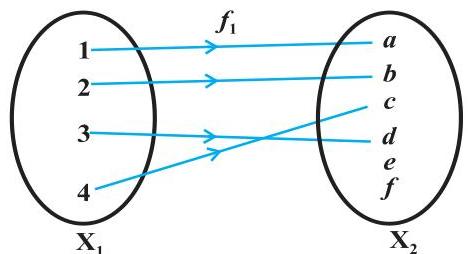
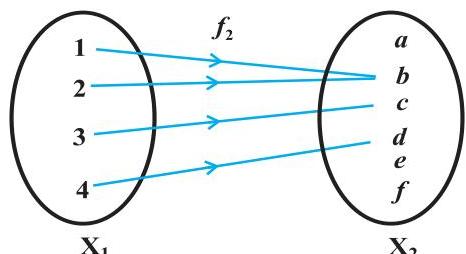
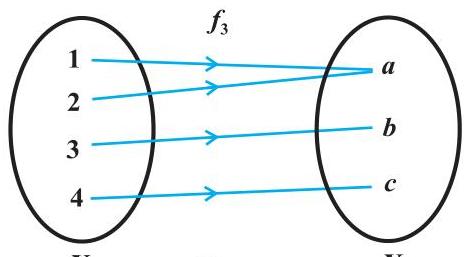
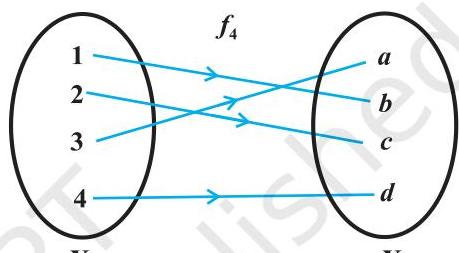
Let us examine the functions $f_{1}, f_{2}, f_{3}$, and $f_{4}$ as depicted in the subsequent diagrams.
From Fig 1.2, it is evident that for function $f_1$, unique elements in $X_1$ map to unique images. Conversely, for $f_2$, two distinct elements, 1 and 2 from $X_1$, share the identical image $b$. Moreover, certain elements within $X_2$, such as $e$ and $f$, do not correspond to any image of an element from $X_1$ via $f_1$. In contrast, every element in $X_3$ is an image of at least one element from $X_1$ through $f_3$. These preceding observations form the basis for the definitions presented below:
Definition 5 A function $f \colon X \to Y$ is designated as one-to-one (or injective) if separate elements in $X$ possess distinct images under $f$. Formally, for any $x_1, x_2 \in X$, the condition $f(x_1) = f(x_2)$ necessitates that $x_1 = x_2$. Should this condition not be met, $f$ is termed many-to-one.
Functions $f_{1}$ and $f_{4}$, illustrated in Fig 1.2 (i) and (iv) respectively, are one-to-one, while functions $f_{2}$ and $f_{3}$, shown in Fig 1.2 (ii) and (iii), are many-to-one.
Definition 6 A function $f \colon X \to Y$ is referred to as onto (or surjective) if each element within the codomain $Y$ corresponds to the image of at least one element from the domain $X$ under $f$. Stated precisely, for every $y \in Y$, there must exist an $x \in X$ such that $f(x) = y$.
Functions $f_{3}$ and $f_{4}$ in Fig 1.2 (iii) and (iv) are onto. Conversely, function $f_{1}$ in Fig 1.2 (i) is not onto, because elements such as $e$ and $f$ in $X_{2}$ do not represent the image of any element from $X_{1}$ under $f_{1}$.
 (i)
(i)
 (ii)
(ii)
 (iii)
Fig 1.2 (i) to (iv)
(iii)
Fig 1.2 (i) to (iv)
 (iv)
(iv)
Remark A function $f\colon \mathrm{X}\to \mathrm{Y}$ is surjective if and only if its range is equivalent to its codomain $\mathrm{Y}$.
Definition 7 A function $f \colon \mathrm{X} \to \mathrm{Y}$ is defined as one-to-one and onto (or bijective) if it simultaneously satisfies the conditions of being both one-to-one and onto.
The function $f_{4}$ in Fig 1.2 (iv) exemplifies a one-to-one and onto mapping.
Example 7 Consider $A$ as the collection of 50 students enrolled in Class $X$ at a particular school. Define a function $f \colon A \to \mathbf{N}$ such that $f(x)$ represents the roll number assigned to student $x$. Demonstrate that this function $f$ is one-to-one but not onto.
For a given class, distinct students are assigned distinct roll numbers, which inherently means the function $f$ mapping students to their roll numbers is injective (one-to-one). If we consider the set of natural numbers $\mathbf{N}$ as the codomain for roll numbers, and assume students' roll numbers range from 1 to 50, then a number like 51 (which is in $\mathbf{N}$) would not correspond to any student's roll number. Consequently, 51 cannot be the image of any element in the domain $\mathbf{X}$ under $f$, demonstrating that $f$ is not surjective (onto).
Example 8 Show that the function $f \colon \mathbf{N} \to \mathbf{N}$, given by $f(x) = 2x$, is one-one but not onto.
Solution The function $f$ exhibits injectivity because if $f(x_{1}) = f(x_{2})$, it implies $2x_{1} = 2x_{2}$, which in turn leads to $x_{1} = x_{2}$. Furthermore, $f$ is not surjective, as an element like $1 \in \mathbf{N}$ (in the codomain) cannot be expressed as $f(x) = 2x$ for any $x$ belonging to the domain $\mathbf{N}$.
Example 9 Prove that the function $f \colon \mathbf{R} \to \mathbf{R}$, given by $f(x) = 2x$, is one-one and onto.
Solution The function $f$ is injective, as the condition $f(x_{1}) = f(x_{2})$ directly implies $2x_{1} = 2x_{2}$, which simplifies to $x_{1} = x_{2}$. Furthermore, for any arbitrary real number $y$ belonging to the codomain $\mathbf{R}$, a corresponding element $\frac{y}{2}$ exists within the domain $\mathbf{R}$ such that $f\left(\frac{y}{2}\right) = 2 \cdot \left(\frac{y}{2}\right) = y$. This establishes that $f$ is surjective.
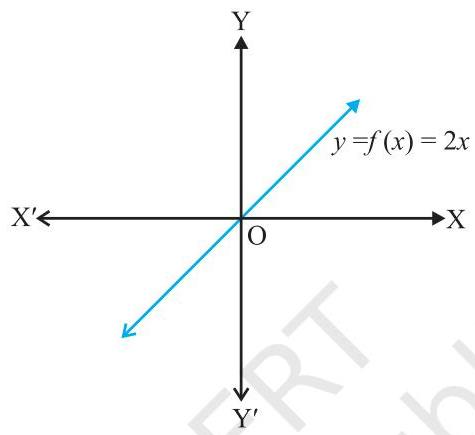 Fig 1.3
Example 10 Show that the function $f \colon \mathbf{N} \to \mathbf{N}$, given by $f(1) = f(2) = 1$ and $f(x) = x - 1$, for every $x > 2$, is onto but not one-one.
Solution The function $f$ lacks injectivity, as evidenced by $f(1) = f(2) = 1$, where distinct domain elements map to the same codomain element. Conversely, $f$ is surjective: for any $y \in \mathbf{N}$ where $y \neq 1$, we can select $x = y + 1$ such that $f(y + 1) = (y + 1) - 1 = y$. Additionally, for the element $1 \in \mathbf{N}$ in the codomain, we observe that $f(1) = 1$.
Example 11 Show that the function $f \colon \mathbf{R} \to \mathbf{R}$, defined as $f(x) = x^2$, is neither one-one nor onto.
Solution The function $f$ is not injective because $f(-1) = 1 = f(1)$, indicating that different inputs yield the same output. Furthermore, $f$ is not surjective, as an element like $-2$ in the codomain $\mathbf{R}$ does not correspond to the image of any element $x$ in the domain $\mathbf{R}$ (Why is this the case?).
Example 12 Show that $f \colon \mathbf{N} \to \mathbf{N}$, given by
$ f (x) = \begin{array}{l} x + 1, \text { if } x \text{ is odd,} \ x - 1, \text { if } x \text{ is even} \end{array} $
is both one-one and onto.
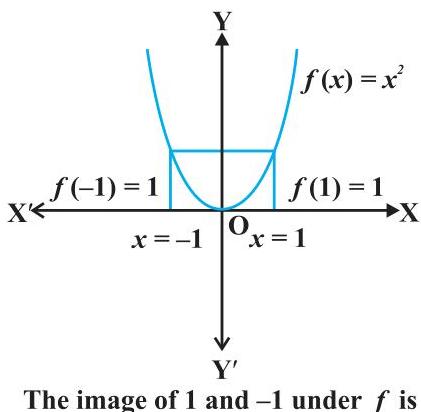 Fig 1.4
Solution To establish injectivity, suppose $f(x_{1}) = f(x_{2})$. Consider the case where $x_{1}$ is odd and $x_{2}$ is even; this would lead to $x_{1} + 1 = x_{2} - 1$, implying $x_{2} - x_{1} = 2$. This outcome is impossible, as the difference between an even and an odd number must be odd. A similar line of reasoning eliminates the possibility of $x_{1}$ being even and $x_{2}$ being odd. Therefore, $x_{1}$ and $x_{2}$ must belong to the same parity (both odd or both even). If both $x_{1}$ and $x_{2}$ are odd, then $f(x_{1}) = f(x_{2})$ means $x_{1} + 1 = x_{2} + 1$, which simplifies to $x_{1} = x_{2}$. Likewise, if both $x_{1}$ and $x_{2}$ are even, then $f(x_{1}) = f(x_{2})$ implies $x_{1} - 1 = x_{2} - 1$, also yielding $x_{1} = x_{2}$. Thus, $f$ is injective. For surjectivity, observe that any odd number $2r + 1$ in the codomain $\mathbf{N}$ is the image of $2r + 2$ (an even number) from the domain $\mathbf{N}$ (since $f(2r+2) = (2r+2)-1 = 2r+1$). Similarly, any even number $2r$ in the codomain $\mathbf{N}$ is the image of $2r - 1$ (an odd number) from the domain $\mathbf{N}$ (since $f(2r-1) = (2r-1)+1 = 2r$). Consequently, $f$ is surjective.
Example 13 Show that an onto function $f \colon {1, 2, 3} \to {1, 2, 3}$ is always one-one.
Solution Assume, for contradiction, that $f$ is not injective (one-one). This implies that there exist at least two distinct elements in the domain, for instance, 1 and 2, which map to the same element in the codomain. The image of the third element, 3, must also be a single element within the codomain. Consequently, the range of $f$ can contain at most two distinct elements from the codomain ${1, 2, 3}$. This demonstrates that $f$ is not surjective (onto), which contradicts our initial assumption. Hence, $f$ must be injective.
Example 14 Show that a one-one function $f \colon {1, 2, 3} \to {1, 2, 3}$ must be onto.
Solution Given that $f$ is injective (one-one), each of the three distinct elements in the domain ${1, 2, 3}$ must correspond to a unique element within the codomain ${1, 2, 3}$. As the codomain also consists of precisely three elements, this mapping inherently covers all elements in the codomain. Consequently, $f$ must be surjective (onto).
Remark The findings presented in Examples 13 and 14 are generalizable to any arbitrary finite set $X$. That is to say, for a function $f: X \to X$ where $X$ is a finite set, an injective (one-one) mapping is necessarily surjective (onto), and conversely, a surjective (onto) mapping is necessarily injective (one-one). In stark contrast, as demonstrated in Examples 8 and 10, these equivalences do not hold for infinite sets. Indeed, this represents a defining characteristic distinguishing finite sets from infinite sets.
EXERCISE 1.2
Demonstrate that the function $f \colon \mathbf{R}{\bullet} \to \mathbf{R}{\bullet}$, given by $f(x) = \frac{1}{x}$, is both injective and surjective, where $\mathbf{R}{\bullet}$ signifies the collection of all non-zero real numbers. Furthermore, ascertain whether this conclusion remains valid if the domain $\mathbf{R}{\bullet}$ is substituted with $\mathbf{N}$, while the codomain remains $\mathbf{R}_{\bullet}$.
Evaluate the injectivity and surjectivity for each of the subsequent functions:
(i) $f\colon \mathbf{N}\to \mathbf{N}$ given by $f(x) = x^{2}$ (ii) $f\colon \mathbf{Z}\to \mathbf{Z}$ given by $f(x) = x^{2}$ (iii) $f\colon \mathbf{R}\to \mathbf{R}$ given by $f(x) = x^{2}$ (iv) $f\colon \mathbf{N}\to \mathbf{N}$ given by $f(x) = x^{3}$ (v) $f\colon \mathbf{Z}\to \mathbf{Z}$ given by $f(x) = x^{3}$
Establish that the Greatest Integer Function, denoted $f \colon \mathbf{R} \to \mathbf{R}$ and defined as $f(x) = [x]$, is neither injective nor surjective. Here, $[x]$ represents the largest integer that is less than or equal to $x$.
Demonstrate that the Modulus Function, $f \colon \mathbf{R} \to \mathbf{R}$, specified by $f(x) = |x|$, is neither injective nor surjective. The absolute value $|x|$ is defined as $x$ when $x$ is non-negative, and as $-x$ when $x$ is negative.
Demonstrate that the Signum Function, $f \colon \mathbf{R} \to \mathbf{R}$, defined as follows, is neither injective nor surjective:
$ f(x) = \begin{cases} 1, & \text{if } x > 0 \ 0, & \text{if } x = 0 \ 1, & \text{if } x < 0 \end{cases} $
Given the sets $A = {1, 2, 3}$ and $B = {4, 5, 6, 7}$, and the function $f = {(1, 4), (2, 5), (3, 6)}$ mapping from $A$ to $B$, verify that $f$ is injective.
For each of the subsequent cases, indicate whether the function exhibits injectivity, surjectivity, or bijectivity. Provide a comprehensive justification for your determination.
(i) $f \colon \mathbf{R} \to \mathbf{R}$ defined by $f(x) = 3 - 4x$
(ii) $f \colon \mathbf{R} \to \mathbf{R}$ defined by $f(x) = 1 + x^2$
Consider arbitrary sets $A$ and $B$. Prove that the function $f \colon A \times B \to B \times A$, defined by the mapping $f(a, b) = (b, a)$, is a bijective function.
Let the function $f \colon \mathbf{N} \to \mathbf{N}$ be specified by $f(n) = \begin{cases} \dfrac{n + 1}{2}, & \text{if } n \text{ is odd} \ \dfrac{n}{2}, & \text{if } n \text{ is even} \end{cases}$ for all $n \in \mathbf{N}$. Determine if this function $f$ is bijective and provide a rationale for your conclusion.
Given the sets $A = \mathbf{R} - {3}$ and $B = \mathbf{R} - {1}$, analyze the function $f \colon A \to B$ defined as $f(x) = \left( \dfrac{x - 2}{x - 3} \right)$. Ascertain whether $f$ is injective and surjective, and substantiate your findings.
Given the function $f \colon \mathbf{R} \to \mathbf{R}$ defined by $f(x) = x^4$, select the appropriate option.
(A) $f$ is one-one onto
(B) $f$ is many-one onto
(C) $f$ is one-one but not onto
(D) $f$ is neither one-one nor onto.
- For the function $f \colon \mathbf{R} \to \mathbf{R}$ defined by $f(x) = 3x$, identify the correct statement.
(A) $f$ is one-one onto
(B) $f$ is many-one onto
(C) $f$ is one-one but not onto
(D) $f$ is neither one-one nor onto.
1.4 Composition of Functions and Invertible Function
Definition 8 Given two functions, $f \colon \mathrm{A} \to \mathrm{B}$ and $g \colon \mathrm{B} \to \mathrm{C}$, their composition, symbolized as $gof$, is formally defined as the function $gof \colon \mathrm{A} \to \mathrm{C}$, such that:
$ \operatorname {g o f} (x) = g (f (x)), \forall x \in \mathrm {A}. $
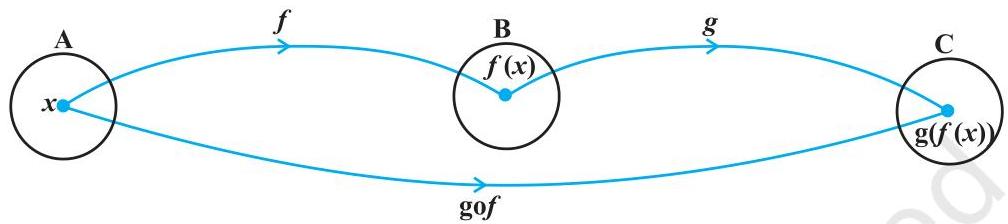 Fig 1.5
Example 15 Consider two functions, $f \colon {2, 3, 4, 5} \to {3, 4, 5, 9}$ and $g \colon {3, 4, 5, 9} \to {7, 11, 15}$, characterized by the mappings: $f(2) = 3$, $f(3) = 4$, $f(4) = f(5) = 5$, and $g(3) = g(4) = 7$, $g(5) = g(9) = 11$. Determine the composite function $gof$.
Solution The evaluation of $gof$ proceeds as follows: $gof(2) = g(f(2)) = g(3) = 7$, $gof(3) = g(f(3)) = g(4) = 7$, $gof(4) = g(f(4)) = g(5) = 11$, and $gof(5) = g(5) = 11$.
Example 16 Given the functions $f: \mathbf{R} \to \mathbf{R}$ defined by $f(x) = \cos x$ and $g: \mathbf{R} \to \mathbf{R}$ defined by $g(x) = 3x^2$, calculate both $gof$ and $fog$. Subsequently, demonstrate that $gof \neq fog$.
Solution To compute the composite function $gof(x)$, we substitute $f(x)$ into $g(x)$: $gof(x) = g(f(x)) = g(\cos x) = 3 (\cos x)^2 = 3 \cos^2 x$. For $fog(x)$, we substitute $g(x)$ into $f(x)$: $fog(x) = f(g(x)) = f(3x^2) = \cos (3x^2)$. It is important to observe that $3\cos^2 x \neq \cos 3x^2$. For instance, when $x = 0$, $3\cos^2(0) = 3(1)^2 = 3$, whereas $\cos(3(0)^2) = \cos(0) = 1$. Since $3 \neq 1$, it is evident that $gof \neq fog$.
Definition 9 A function $f \colon \mathrm{X} \to \mathrm{Y}$ is deemed invertible if a corresponding function $g \colon \mathrm{Y} \to \mathrm{X}$ exists, satisfying the conditions $gof = \mathrm{I}{\mathrm{X}}$ and $fog = \mathrm{I}{\mathrm{Y}}$. This function $g$ is referred to as the inverse of $f$ and is represented by the symbol $f^{-1}$.
Consequently, a function $f$ is invertible if and only if it is both injective (one-one) and surjective (onto). This fundamental equivalence offers a substantial advantage when establishing the invertibility of a function $f$, particularly in scenarios where explicitly determining the inverse function is not required.
Example 17 Consider the function $f \colon \mathbf{N} \to \mathbf{Y}$, specified by the rule $f(x) = 4x + 3$, where the codomain $\mathbf{Y}$ is defined as:
$\mathbf{Y} = {y \in \mathbf{N} : y = 4x + 3 \text{ for some } x \in \mathbf{N}}$. Demonstrate the invertibility of $f$ and identify its inverse function.
Solution To begin the solution, let an arbitrary element $y$ be chosen from the set $Y$. According to the definition of $Y$, it follows that $y = 4x + 3$ for some $x$ belonging to the domain $N$. Rearranging this expression to solve for $x$ yields $x = \frac{(y - 3)}{4}$. Based on this, we define a function $g: Y \to N$ as follows:
$ g(y) = \frac{(y - 3)}{4}. \text{ Now, } gof(x) = g(f(x)) = g(4x + 3) = \frac{(4x + 3 - 3)}{4} = x \text{ and } $
$ fog(y) = f(g(y)) = f\left(\frac{(y - 3)}{4}\right) = \frac{4(y - 3)}{4} + 3 = y - 3 + 3 = y. \text{ This shows that } gof = I_N $
and $fog = I_Y$. This confirms that $f$ possesses invertibility, and the function $g$ serves as its inverse.
Miscellaneous Examples
Example 18 If $R_1$ and $R_2$ represent equivalence relations within a set $A$, demonstrate that their intersection, $R_1 \cap R_2$, also constitutes an equivalence relation.
Solution Given that $R_1$ and $R_2$ are both equivalence relations, it follows that for every element $a \in A$, the pair $(a, a)$ is an element of $R_1$, and simultaneously, $(a, a)$ is an element of $R_2$. Consequently, $(a, a)$ must belong to the intersection $R_1 \cap R_2$ for all $a \in A$, thereby establishing that $R_1 \cap R_2$ is reflexive. Furthermore, if $(a, b) \in R_1 \cap R_2$, this implies that $(a, b) \in R_1$ and $(a, b) \in R_2$. Due to the symmetric property of $R_1$ and $R_2$, we can deduce that $(b, a) \in R_1$ and $(b, a) \in R_2$. This, in turn, means $(b, a) \in R_1 \cap R_2$, proving that $R_1 \cap R_2$ is symmetric. In a similar vein, if $(a, b) \in R_1 \cap R_2$ and $(b, c) \in R_1 \cap R_2$, then $(a, b) \in R_1$ and $(b, c) \in R_1$, which implies $(a, c) \in R_1$ by transitivity of $R_1$. Concurrently, $(a, b) \in R_2$ and $(b, c) \in R_2$, implying $(a, c) \in R_2$ by transitivity of $R_2$. Therefore, $(a, c) \in R_1 \cap R_2$, demonstrating the transitive property for $R_1 \cap R_2$. As $R_1 \cap R_2$ satisfies reflexivity, symmetry, and transitivity, it is an equivalence relation.
Example 19 Consider a relation $R$ defined on the set $A$ of ordered pairs of positive integers. The relation is specified as $(x, y) R(u, v)$ if and only if $xv = yu$. Verify that $R$ is an equivalence relation.
Solution To establish reflexivity, observe that for any $(x, y) \in A$, we have $(x, y) R(x, y)$, because $xy = yx$ is always true. This confirms $R$ is reflexive. For symmetry, assume $(x, y) R(u, v)$. This definition implies $xv = yu$. Rearranging this equality yields $uy = vx$, which by the definition of $R$, means $(u, v) R(x, y)$. Hence, $R$ is symmetric. For transitivity, suppose $(x, y) R(u, v)$ and $(u, v) R(a, b)$. These conditions translate to $xv = yu$ and
$ ub = va \Rightarrow xv \frac{a}{u} = yu \frac{a}{u} \Rightarrow xv \frac{b}{v} = yu \frac{a}{u} \Rightarrow xb = ya \text{ and hence } (x, y) R(a, b). \text{ Thus, } R $
is transitive. Since $R$ exhibits reflexivity, symmetry, and transitivity, it is an equivalence relation.
Example 20 Let $X = {1, 2, 3, 4, 5, 6, 7, 8, 9}$. Define $R_1$ as a relation on $X$ such that $R_1 = {(x, y) : x - y \text{ is divisible by } 3}$. Let $R_2$ be another relation on $X$ given by $R_2 = {(x, y) : {x, y} \subset {1, 4, 7}}$ or ${x, y} \subset {2, 5, 8}$ or ${x, y} \subset {3, 6, 9}}$. Demonstrate that $R_1 = R_2$.
Solution It is important to recognize that the distinguishing property of the sets ${1, 4, 7}$, ${2, 5, 8}$, and ${3, 6, 9}$ is that the difference between any two elements within each set is a multiple of 3. Therefore, if $(x, y) \in R_1$, it signifies that $x - y$ is a multiple of $3$. This condition implies that ${x, y}$ must be a subset of ${1, 4, 7}$, or ${x, y}$ must be a subset of ${2, 5, 8}$, or ${x, y}$ must be a subset of ${3, 6, 9}$. By the definition of $R_2$, this means $(x, y) \in R_2$. Consequently, we have established that $R_1 \subset R_2$. Conversely, if ${x, y} \in R_2$, then ${x, y}$
$\subset {1, 4, 7}$ or ${x, y} \subset {2, 5, 8}$ or ${x, y} \subset {3, 6, 9}$. This condition directly implies that $x - y$ is divisible by $3$, which, by the definition of $R_1$, means ${x, y} \in \mathbb{R}_1$. This demonstrates that $\mathbb{R}_2 \subset \mathbb{R}_1$. Since both $R_1 \subset R_2$ and $R_2 \subset R_1$ have been proven, it follows that $\mathbb{R}_1 = \mathbb{R}_2$.
Example 21 Let $f \colon \mathrm{X} \to \mathrm{Y}$ be a given function. Define a relation $\mathbf{R}$ on the set $\mathrm{X}$ as $\mathbf{R} = {(a, b) \colon f(a) = f(b)}$. Determine whether $\mathbf{R}$ is an equivalence relation.
Solution For any element $a \in \mathrm{X}$, the condition $f(a) = f(a)$ holds true, which means that the pair $(a, a)$ is an element of $\mathrm{R}$. This establishes that $\mathrm{R}$ is reflexive. Next, consider if $(a, b) \in \mathrm{R}$. By the definition of $\mathrm{R}$, this implies $f(a) = f(b)$. Since equality is symmetric, $f(b) = f(a)$, which in turn means $(b, a) \in \mathrm{R}$. Thus, $\mathrm{R}$ is symmetric. Finally, for transitivity, suppose $(a, b) \in \mathrm{R}$ and $(b, c) \in \mathrm{R}$. These conditions imply that $f(a) = f(b)$ and $f(b) = f(c)$. From these equalities, we can deduce that $f(a) = f(c)$, which signifies that $(a, c) \in \mathrm{R}$. Therefore, $\mathrm{R}$ is transitive. As $\mathrm{R}$ satisfies all three properties—reflexivity, symmetry, and transitivity—it is indeed an equivalence relation.
Example 22 Determine the count of all injective mappings from the set $\mathrm{A} = {1, 2, 3}$ to itself.
Solution An injective function mapping the set ${1, 2, 3}$ onto itself is equivalent to a permutation of the three distinct elements $1, 2, 3$. Consequently, the total quantity of such one-to-one mappings from ${1, 2, 3}$ to itself corresponds precisely to the total number of permutations achievable with three symbols, which is calculated as $3! = 6$.
Example 23 Let $\mathrm{A} = {1, 2, 3}$. Demonstrate that precisely three relations exist on $\mathrm{A}$ that include the ordered pairs (1, 2) and (2, 3), satisfying reflexivity and transitivity, yet failing to exhibit symmetry.
Solution The minimal relation, denoted $\mathbf{R}_1$, that incorporates (1, 2) and (2, 3) while being reflexive and transitive, but not symmetric, is found to be ${(1, 1), (2, 2), (3, 3), (1, 2), (2, 3), (1, 3)}$. Subsequently, if the ordered pair (2, 1) is appended to $\mathbf{R}_1$, forming $\mathbf{R}_2$, this resultant relation $\mathbf{R}_2$ will remain reflexive and transitive while still lacking symmetry. Analogously, a third relation, $\mathbf{R}_3$, can be derived by appending (3, 2) to $\mathbf{R}_1$, fulfilling the specified criteria. Nevertheless, it is impermissible to simultaneously augment $\mathbf{R}_1$ with either both pairs (2, 1) and (3, 2), or with the single pair (3, 1). Such additions would necessitate the inclusion of further pairs to preserve transitivity, inevitably leading to the relation becoming symmetric, which contravenes the problem's condition. Hence, the total count of relations meeting the stated requirements is three.
Example 24 Demonstrate that there are two equivalence relations on the set ${1, 2, 3}$ that include the ordered pairs $(1, 2)$ and $(2, 1)$.
Solution The most restricted equivalence relation, designated $\mathbf{R}_1$, that encompasses (1, 2) and (2, 1) is ${(1, 1), (2, 2), (3, 3), (1, 2), (2, 1)}$. At this point, four potential ordered pairs remain: (2, 3), (3, 2), (1, 3), and (3, 1). Should any one of these, for instance (2, 3), be incorporated into $\mathbf{R}_1$, then to preserve symmetry, (3, 2) must also be included. Furthermore, to uphold transitivity, the inclusion of (1, 3) and (3, 1) becomes mandatory. Consequently, the only equivalence relation that is a proper superset of $\mathbf{R}_1$ is the universal relation. This analysis establishes that precisely two equivalence relations contain the pairs (1, 2) and (2, 1).
Example 25 Let us consider the identity function $\mathrm{I}{\mathbf{N}}: \mathbf{N} \to \mathbf{N}$, which is formally defined as $\mathrm{I}{\mathbf{N}}(x) = x$ for all $x \in \mathbf{N}$. Demonstrate that while $\mathrm{I}{\mathbf{N}}$ is a surjective function, the composite function $\mathrm{I}{\mathbf{N}} + \mathrm{I}_{\mathbf{N}}: \mathbf{N} \to \mathbf{N}$, defined by
$ \left(\mathrm {I} _ {\mathrm {N}} + \mathrm {I} _ {\mathrm {N}}\right) (x) = \mathrm {I} _ {\mathrm {N}} (x) + \mathrm {I} _ {\mathrm {N}} (x) = x + x = 2 x \text
{ is not onto.} $
Solution It is evident that $\mathrm{I_N}$ is surjective. However, the function $\mathrm{I_N} + \mathrm{I_N}$ fails to be surjective. This is demonstrated by the existence of an element, such as 3, within the codomain $\mathbf{N}$ for which no corresponding element $x$ exists in the domain $\mathbf{N}$ such that $(\mathrm{I_N} + \mathrm{I_N})(x) = 2x = 3$.
Example 26 Let $f: \left[0, \frac{\pi}{2}\right] \to \mathbf{R}$ be a function defined by $f(x) = \sin x$, and let $g: \left[0, \frac{\pi}{2}\right] \to \mathbf{R}$ be defined by $g(x) = \cos x$. Establish that both $f$ and $g$ are injective, but their sum, $f + g$, is not injective.
Solution Considering any two distinct values, $x_1$ and $x_2$, within the interval $\left[0, \frac{\pi}{2}\right]$, the conditions $\sin x_1 \neq \cos x_2$ and $\cos x_1 \neq \cos x_2$ lead to the conclusion that both functions $f$ and $g$ are one-to-one. However, evaluating the sum function yields $(f + g)(0) = \sin 0 + \cos 0 = 1$, and similarly, $(f + g)\left(\frac{\pi}{2}\right) = \sin \frac{\pi}{2} + \cos \frac{\pi}{2} = 1$. Consequently, the function $f + g$ is not injective.
Miscellaneous Exercise on Chapter 1
Show that the function $f \colon \mathbf{R} \to {x \in \mathbf{R} : -1 < x < 1}$ defined by $f(x) = \frac{x}{1 + |x|}$, $x \in \mathbf{R}$ is one-one and onto function.
Show that the function $f \colon \mathbf{R} \to \mathbf{R}$ given by $f(x) = x^3$ is injective.
Given a non-empty set X, consider P(X) which is the set of all subsets of X. Define the relation R in P(X) as follows: For subsets A, B in P(X), ARB if and only if $\mathrm{A} \subset \mathrm{B}$. Is R an equivalence relation on P(X)? Justify your answer.
Find the number of all onto functions from the set ${1,2,3,\dots,n}$ to itself.
Let $\mathrm{A} = {-1, 0, 1, 2}$, $\mathrm{B} = {-4, -2, 0, 2}$ and $f, g: \mathrm{A} \to \mathrm{B}$ be functions defined by $f(x) = x^2 - x$, $x \in \mathrm{A}$ and $g(x) = 2\left|x - \frac{1}{2}\right| - 1$, $x \in \mathrm{A}$. Are $f$ and $g$ equal? Justify your answer. (Hint: One may note that two functions $f: \mathrm{A} \to \mathrm{B}$ and $g: \mathrm{A} \to \mathrm{B}$ such that $f(a) = g(a) \forall a \in \mathrm{A}$, are called equal functions).
Let $A = {1, 2, 3}$. Then number of relations containing $(1, 2)$ and $(1, 3)$ which are reflexive and symmetric but not transitive is
(A) 1
(B) 2
(C) 3
(D) 4
- Let $A = {1, 2, 3}$. Then number of equivalence relations containing $(1, 2)$ is
(A) 1
(B) 2
(C) 3
(D) 4
Summary
This chapter explored various categories of relations, including the concept of an equivalence relation, alongside the composition of functions, invertible functions, and binary operations. The principal concepts discussed within this chapter are summarized below:
- The empty relation is defined as a relation $R$ on set $X$ such that $R = \phi \subset X \times X$.
- The universal relation is characterized as a relation $R$ on set $X$ where $R = X \times X$.
- A reflexive relation $R$ on set $X$ is one where every element $a$ in $X$ is related to itself, meaning $(a, a) \in R$ for all $a \in X$.
- A symmetric relation $R$ on set $X$ holds if, whenever $(a, b)$ is an element of $R$, then $(b, a)$ must also be an element of $R$.
- A transitive relation $R$ on set $X$ is characterized by the property that if $(a, b) \in R$ and $(b, c) \in R$, then it necessarily follows that $(a, c) \in R$.
- An equivalence relation $R$ on set $X$ is a relation that concurrently exhibits the properties of being reflexive, symmetric, and transitive.
- For an equivalence relation $R$ on set $X$, the equivalence class $[a]$ associated with an element $a \in X$ comprises the subset of $X$ consisting of all elements $b$ that are related to $a$.
- A function $f: X \to Y$ is termed one-to-one (or injective) if distinct elements in its domain map to distinct elements in its codomain, formally expressed as:
$ f(x_1) = f(x_2) \Rightarrow x_1 = x_2 \quad \forall x_1, x_2 \in X. $
- A function $f: X \to Y$ is considered onto (or surjective) if for every element $y$ in the codomain $Y$, there exists at least one element $x$ in the domain $X$ such that $f(x) = y$.
- A function $f: X \to Y$ is classified as one-to-one and onto (or bijective) when it simultaneously satisfies the conditions for being both injective and surjective.
- For any finite set $X$, a function $f: X \to X$ possesses the property of being injective (one-to-one) if and only if it is surjective (onto), and vice versa. This unique characteristic is specific to finite sets and does not extend to infinite sets.
Historical Note
The concept of a function has undergone a protracted evolutionary process, commencing with R. Descartes (1596-1650). In his 1637 manuscript, “Geometrie,” Descartes employed the term ‘function’ to denote a positive integral power, specifically $x^n$, of a variable $x$, while engaged in the study of geometric curves such as the hyperbola, parabola, and ellipse. James Gregory (1636-1675), in his 1667 treatise “Vera Circuli et Hyperbolae Quadratura,” conceived of a function as a quantity derived from other quantities through the sequential application of algebraic or other operational procedures.
Subsequently, G. W. Leibnitz (1646-1716), in his 1673 manuscript “Methodus tangentium inversa, seu de functionibus,” utilized the word ‘function’ to characterize a quantity exhibiting variation across points on a curve. This included, for instance, the coordinates of a point on the curve, the gradient of the curve, or the tangent and normal lines at a particular point. However, in his 1714 manuscript “Historia,” Leibnitz refined his definition of ‘function’ to signify quantities that are dependent upon a variable. He is recognized as the originator of the phrase ‘function of $x$’.
John Bernoulli (1667-1748) first introduced the notation $\phi x$ in 1718 to represent a function of $x$. Nonetheless, the widespread adoption of symbols such as $f$, $F$, $\phi$, $\psi$ ... for the representation of functions was popularized by Leonhard Euler (1707-1783) in 1734, appearing in the initial part of his work “Analysis Infinitorium.” Later, Joseph Louis Lagrange (1736-1813) published his manuscripts titled “Theorie des functions analytiques” in 1793, wherein he explored analytic functions and employed notations like $f(x)$, $F(x)$, $\phi(x)$, etc., for distinct functions of $x$.
Following these developments, Lejeune Dirichlet (1805-1859) provided a definition of function that remained in use until the advent of the set-theoretic definition. The latter emerged after Georg Cantor (1845-1918) developed set theory. The contemporary set-theoretic definition of a function, as it is presently understood, is essentially a rigorous abstraction derived from Dirichlet's earlier formulation.