A PEEK BEYOND
THE POINT
3.1 The Need for Smaller Units
Sonu observed his mother attempting to repair a toy by connecting two parts using a screw. He watched intently as she struggled to join them. When Sonu inquired about the difficulty, his mother explained that the screw was incorrectly sized.

Upon retrieving a different screw from her toolbox, she successfully repaired the toy. Although both screws appeared identical to Sonu initially, a closer inspection revealed a minor variance in their lengths.
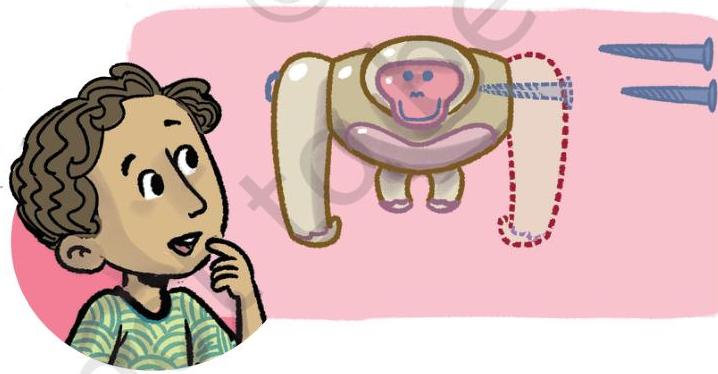
Sonu was intrigued by the significant impact of such a minute length discrepancy. He became eager to ascertain the precise difference in their dimensions, especially given their striking visual similarity.
The subsequent illustration displays screws positioned against a measuring scale. Determine their respective lengths and record them in the designated area.
A Peek Beyond the Point
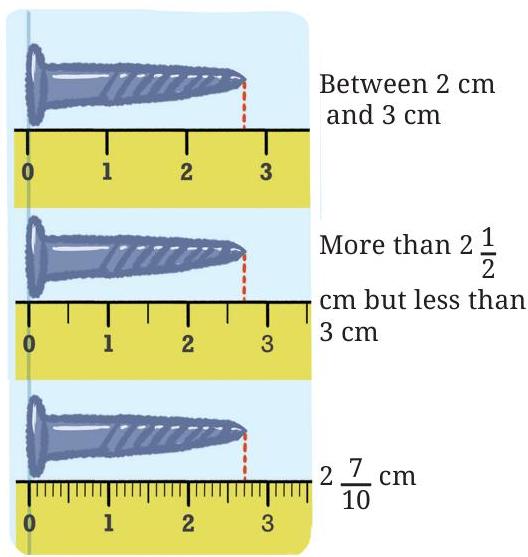
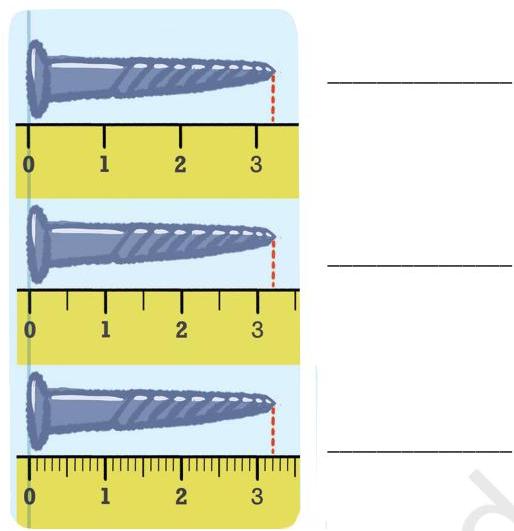
? Which scale helped you measure the length of the screws accurately? Why?
? What is the meaning of $2\frac{7}{10}$ cm (the length of the first screw)?
Observing the ruler, one notes that the segment between any two successive numerical markings is segmented into 10 equivalent divisions. To derive a length of $2\frac{7}{10}$ cm, one proceeds from the 0 mark to 2, subsequently incorporating seven increments, each equivalent to $\frac{1}{10}$. Thus, the screw's length is $2$ cm plus an additional $\frac{7}{10}$ cm. A comparable interpretation applies to the length $3\frac{2}{10}$ cm.
The measurement $2\frac{7}{10}$ cm is articulated as "two and seven-tenths centimeters," while $3\frac{2}{10}$ cm is expressed as "three and two-tenths centimeters."
? Can you explain why the unit was divided into smaller parts to measure the screws?
? Measure the following objects using a scale and write their measurements in centimeters (as shown earlier for the lengths of the screws): pen, sharpener, and any other object of your choice.
? Write the measurements of the objects shown in the picture:
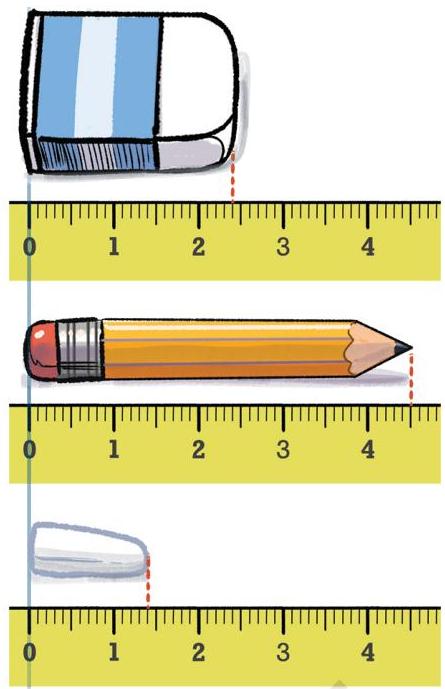
This illustrates that when precision in measurement is paramount, the utilization of finer units becomes essential.
3.2 A Tenth Part
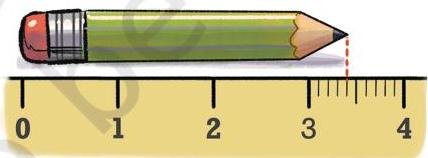
The pencil depicted in the accompanying illustration measures $3\frac{4}{10}$ units. This measurement can be articulated as three whole units and four one-tenths of a unit, expressed mathematically as $(3 \times 1) + \left(4 \times \frac{1}{10}\right)$ units.
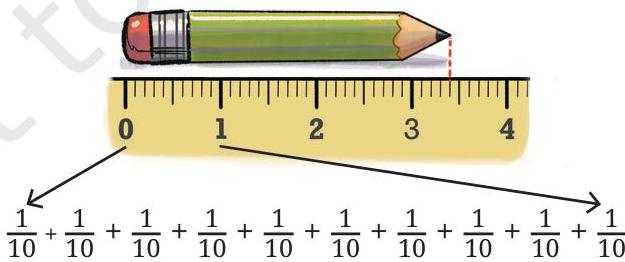
$ = 10 \text{ times } \frac{1}{10} = 10 \times \frac{1}{10} = 1 \text{ unit} $
This dimension is equivalent to thirty-four one-tenth units, given that ten one-tenth units constitute a single whole unit.
$ \begin{array}{l} 34 \times \frac{1}{10} = \frac{34}{10} = \frac{10}{10} + \frac{10}{10} + \frac{10}{10} + \frac{4}{10} \text{ (34 one-tenths)} \ = 1 + 1 + 1 + \frac{4}{10} \text{ (3 and 4 one-tenths)} \end{array} $
Several numerical expressions involving fractional units are presented below, accompanied by their corresponding verbal interpretations.
4 $\frac{1}{10}$ → ‘four and one-tenth’
$\frac{4}{10}$ → ‘four one-tenths’ or ‘four-tenths’
$\frac{41}{10}$ → ‘forty-one one-tenths’ or ‘forty-one tenths’
41 $\frac{1}{10}$ → ‘forty-one and one-tenth’
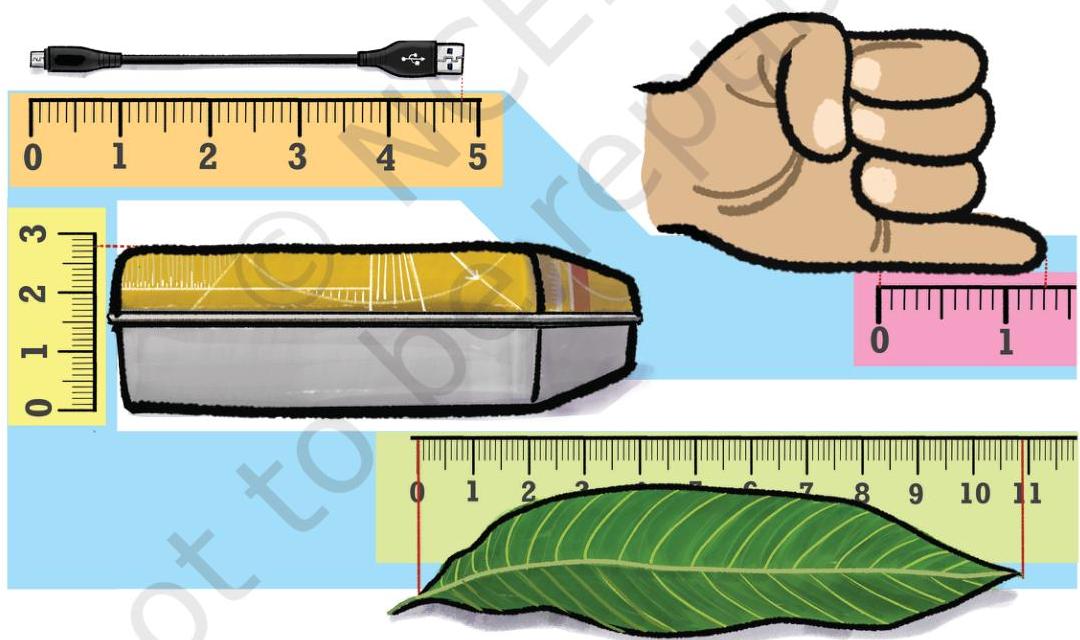
For each object illustrated subsequently, express its length using two distinct representations and articulate them verbally. An illustrative example is provided for the USB cable. (It is important to note that the standard unit of length varies across the individual diagrams).
The USB cable's measurement is 4 and $\frac{8}{10}$ units, alternatively expressible as $\frac{48}{10}$ units.
? Arrange these lengths in increasing order:
- $\frac{9}{10}$
- $1\frac{7}{10}$
- $\frac{130}{10}$
- $13\frac{1}{10}$
- $10\frac{5}{10}$
- $7\frac{6}{10}$
- $6\frac{
7}{10}$ 8. $\frac{4}{10}$
? Arrange the following lengths in increasing order: 4 $\frac{1}{10}, \frac{4}{10}, \frac{41}{10}, 41\frac{1}{10}$ .
? Sonu is engaged in the measurement of various anatomical segments. His lower arm measures $2\frac{7}{10}$ units, while his upper arm extends to $3\frac{6}{10}$ units. Determine the aggregate length of his arm.
To ascertain the cumulative length, consider the lower arm's dimension as two whole units and seven one-tenths, and the upper arm's as three whole units and six one-tenths, respectively.
Consequently, this yields a sum of $(2 + 3)$ units and $(7 + 6)$ one-tenths. Combined, these constitute five units and thirteen one-tenths. However, thirteen one-tenths can be re-expressed as one unit and three one-tenths. Therefore, the overall length amounts to six units and three one-tenths.
$ \begin{array}{l} (2 + 3) + \left(\frac{7}{10} + \frac{6}{10}\right) \ = (2 + 3) + \left(\frac{13}{10}\right) \ = 5 + \frac{13}{10} \ = 5 + \frac{10}{10} + \frac{3}{10} = 5 + 1 + \frac{3}{10} \ = 6 + \frac{3}{10} \ = 6 \frac{3}{10} \ \end{array} $
$ \begin{array}{l} 2\frac{7}{10} \ + 3\frac{6}{10} \ = 5\frac{13}{10} \ = 6\frac{3}{10} \ \end{array} $
Alternatively, both measurements may be transformed into tenths prior to summation:
The sum of twenty-seven one-tenths and thirty-five one-tenths results in sixty-two one-tenths
$ \frac{27}{10} + \frac{35}{10} = \frac{62}{10} $
The fraction $\frac{62}{10}$ can be decomposed into 60 one-tenths $\left(\frac{60}{10}\right)$ and an additional 2 one-tenths $\left(\frac{2}{10}\right)$. This decomposition results in a value equivalent to 6 whole units and 2 one-tenths, represented as the mixed number $6\frac{2}{10}$.
A Peek Beyond the Point
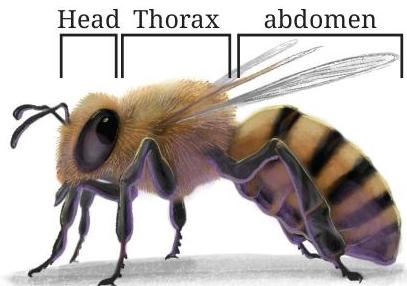
? Consider the provided measurements for the body segments of a honeybee. Determine the overall length of the honeybee.
- Head: $2\frac{3}{10}$ units
- Thorax: $5\frac{4}{10}$ units
- Abdomen: $7\frac{5}{10}$ units
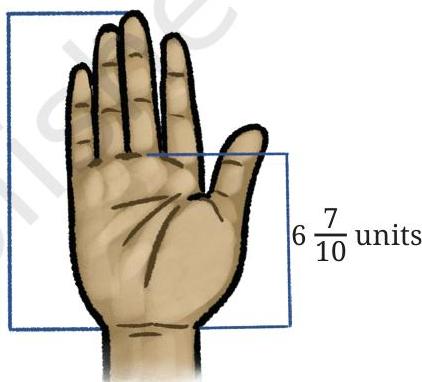
? As depicted in the illustration, Shylaja's hand measures $12\frac{4}{10}$ units in length, while her palm measures $6\frac{7}{10}$ units. What is the measurement of her longest (middle) finger?
To ascertain the finger's length, one must compute the difference $\left(12 + \frac{4}{10}\right) - \left(6 + \frac{7}{10}\right)$. Several approaches can be employed for this calculation. For instance:
$ \begin{array}{l} (1 2 - 6) + \left(\frac {4}{1 0} - \frac {7}{1 0}\right) \ = 6 - \frac {3}{1 0} \ = 5 + 1 - \frac {3}{1 0} \ = 5 + \frac {1 0}{1 0} - \frac {3}{1 0} \ = 5 + \frac {7}{1 0} = 5 \frac {7}{1 0} \ \end{array} $
$ \begin{array}{l}
12\frac{4}{10} \ - 6 \frac {7}{1 0} \ = 5 \frac {7}{1 0} \end{array} \longrightarrow \begin{array}{l} 1 1 \frac {1 4}{1 0} \ - 6 \frac {7}{1 0} \ = 5 \frac {7}{1 0} \end{array} $
Similar to the procedure for whole number subtraction, it is practical to commence the subtraction process with the fractional (tenths) component. Since 7 one-tenths cannot be directly subtracted from 4 one-tenths, we perform a regrouping step: one whole unit is borrowed from the 12 units, which is then converted into 10 one-tenths. This transformation results in the minuend becoming 11 whole units and 14 one-tenths. Subsequently, 7 one-tenths
are subtracted from 14 one-tenths, and 6 whole units are subtracted from 11 whole units.
? Attempt to calculate the difference by first converting both given lengths into their equivalent form expressed solely in tenths. ? A Celestial Pearl Danio measures $2\frac{4}{10}$ cm in length, whereas a Philippine Goby has a length of $\frac{9}{10}$ cm. Determine the disparity in their respective lengths. ? How do the sizes of these fish compare to the length of your finger?
 Celestial Pearl Danio
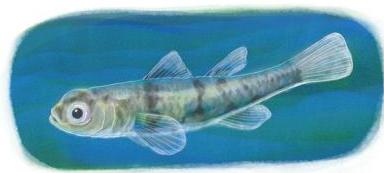 Philippine Goby
? Examine the following numerical sequences. Ascertain the incremental or decremental value between successive terms and then extrapolate each pattern by providing the next four terms:
- $4, 4\frac{3}{10}, 4\frac{6}{10},$ __________, __________, __________, __________
- $8\frac{2}{10}, 8\frac{7}{10}, 9\frac{2}{10},$ __________, __________, __________, __________
- $7\frac{6}{10}, 8\frac{7}{10},$ __________, __________, __________, __________
- $5\frac{7}{10}, 5\frac{3}{10},$ __________, __________, __________, __________
- $13\frac{5}{10}, 13, 12\frac{5}{10},$ __________, __________, __________, __________
- $11\frac{5}{10}, 10\frac{4}{10}, 9\frac{3}{10},$ __________, __________, __________, __________
3.3 A Hundredth Part
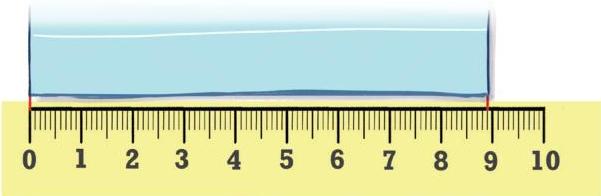
A sheet of paper measured 8 $\frac{9}{10}$ units in length, a dimension that can also be articulated as 8 units and 9 one-tenths. When this sheet is folded precisely in half along its length, what is its new length?
A Peek Beyond the Point
The length can be established as falling between $4\frac{4}{10}$ units and $4\frac{5}{10}$ units. Nevertheless, its precise measurement remains indeterminate due to the absence of finer scale markings. Previously, a unit was segmented into 10 one-tenths to facilitate the measurement of smaller dimensions. A comparable approach involves subdividing each one-tenth into 10 constituent parts.
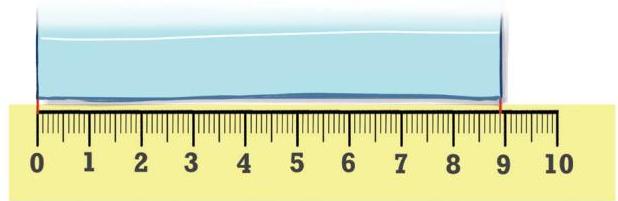
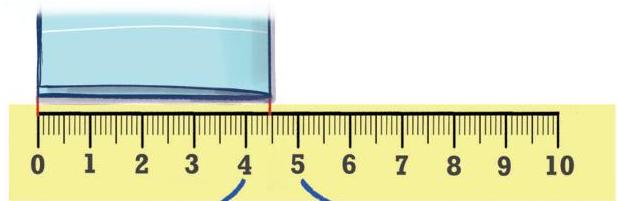
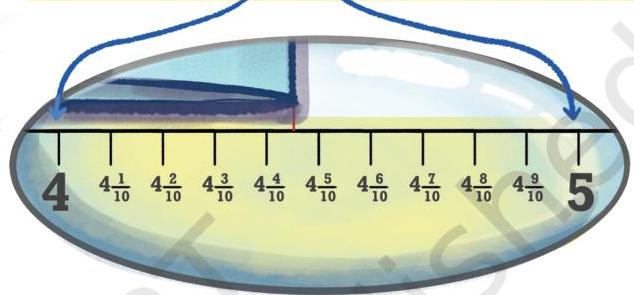
? What is the length of this smaller part? How many such smaller parts make a unit length?
The accompanying illustration demonstrates that each one-tenth segment comprises 10 smaller subdivisions. Given that a full unit consists of 10 one-tenth segments, it follows that a unit will contain 100 of these smaller subdivisions. Consequently, the length of a single such subdivision is $\frac{1}{100}$ of a unit.
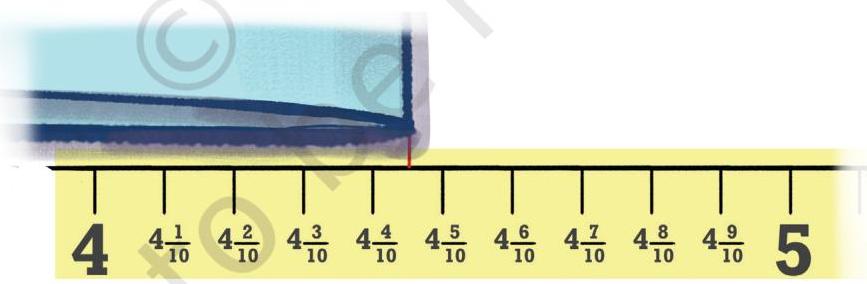
Returning to our question, what is the length of the folded paper?
Observation reveals the folded paper's length terminates at $4\frac{45}{100}$. This value is verbally expressed as 4 units, 4 one-tenths, and 5 one-hundredths.
? How many one-hundredths make one-tenth? Can we also say that the length is 4 units and 45 one-hundredths?
Examine the illustration provided below. Identify the demarcations and the associated lengths specified within the boxes, measured relative to the origin (0). Populate the vacant boxes with the appropriate length values.

The measurement of the wire depicted in the initial image is presented through three distinct representations. Can you discern how these representations signify an identical length?

1 $\frac{14}{100}$ One and one-tenth and four-hundredths 1 $\frac{14}{100}$ One and fourteen-hundredths $\frac{114}{100}$ One hundred and fourteen-hundredths
? For the lengths shown below write the measurements and read out the measures in words.


A Peek Beyond the Point
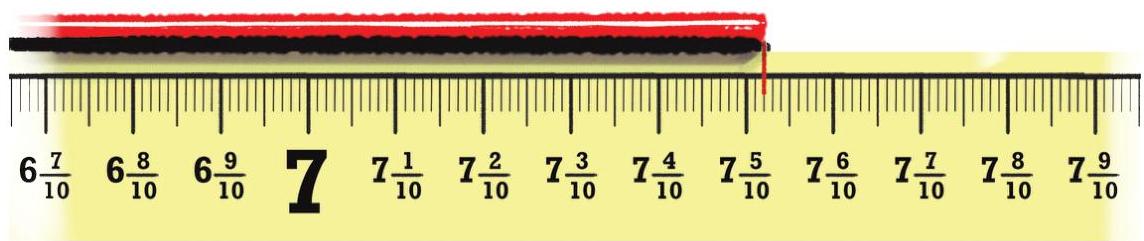

Within each respective grouping, ascertain the maximal and minimal lengths. Indicate every length on the provided scale.
- $\frac{3}{10}, \frac{3}{100}, \frac{33}{100}$

- $3\frac{1}{10},\frac{30}{10},1\frac{3}{10}$

- $\frac{45}{100}, \frac{54}{100}, \frac{5}{10}, \frac{4}{10}$

- $3\frac{6}{10}, 3\frac{6}{100}, 3\frac{66}{100}$

- $\frac{82}{100}, \frac{9}{100}, 1 \frac{8}{100}$

- $7\frac{35}{100}, 7\frac{5}{10}, 7\frac{41}{100}$

- $6\frac{65}{100}, 5 \frac{87}{100}, 5 \frac{7}{100}$

? Determine the total value of 15 $\frac{34}{100}$ combined with 2 $\frac{68}{100}$ ?
Multiple approaches exist for calculating this sum. Several are illustrated subsequently.
Method 1
$ \begin{array}{l} (15 + 2) + \left(\frac {3}{10} + \frac {6}{10}\right) + \left(\frac {4}{100} + \frac {8}{100}\right) \ = 17 + \frac {9}{10} + \frac {12}{100} \ = 17 + \frac {9}{10} + \frac {1}{10} + \frac {2}{100} \ = 17 + \frac {10}{10} + \frac {2}{100} \ = 18 \frac {2}{100}. \ \end{array} $
Method 2
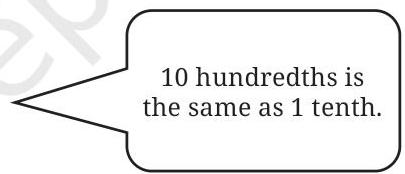
15 $\frac{34}{100}$
$ \begin{array}{l} + \quad 2 \quad \frac {68}{100} \ = \quad 17 \quad \frac {9}{10} \quad \frac {12}{100} \ = \quad 17 \quad \frac {10}{10} \quad \frac {2}{100} \ = \quad 18 \quad \frac {2}{100} \ \end{array}
$
Further Explorations
? Do these two methods exhibit distinct characteristics?
? Examine the subsequent addition of $483 + 268$. Can any parallels be drawn to the previously demonstrated methods?
Math Talk
$ \begin{array}{l} (400 + 80 + 3) + (200 + 60 + 8) \ = (400 + 200) + (80 + 60) + (3 + 8) \ = 600 + 140 + 11 \ = 600 + 150 + 1 \ = 700 + 50 + 1 \ = 751 \ \end{array} $
Alternatively, the sum $15 \frac{34}{100} + 2 \frac{68}{100}$ may be computed by transforming the components into hundredths, as demonstrated below.
$(15 + 2) + \left(\frac{34}{100} + \frac{68}{100}\right)$
$ \begin{array}{l} = 17 + \frac{102}{100} \ = 17 + 1 + \frac{2}{100} \ = 18 \frac{2}{100} \ \end{array} $
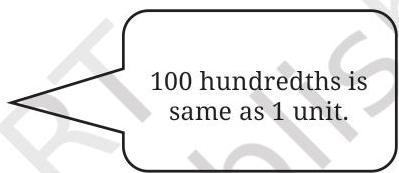
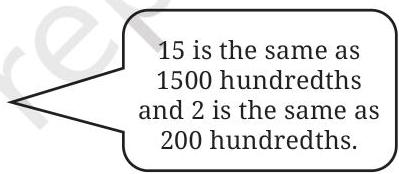
$\left(\frac{1534}{100}\right) + \left(\frac{268}{100}\right)$
$ \begin{array}{l} = \frac{1802}{100} \ = 18 + \frac{2}{100} \ = 18 \frac{2}{100} \ \end{array} $
? What is the difference: $25 \frac{9}{10} - 6 \frac{47}{100}$?
An approach to solve this calculation is presented below:
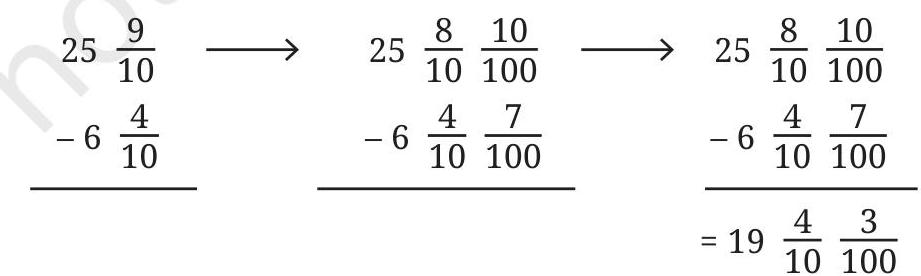
? Solve this by converting to hundredths.
What is the difference $15 \frac{34}{100} - 2 \frac{68}{100}$ ?
The following demonstrates a method for solving this:
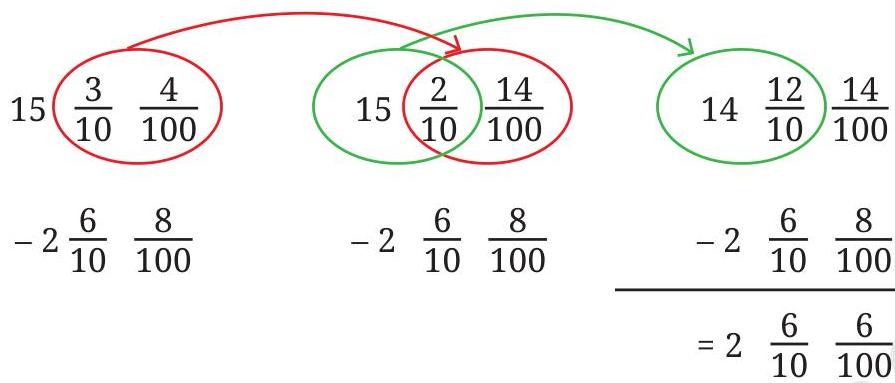
Examine the subtraction operation performed below for 653 - 268. Do you perceive any parallels with the methodologies demonstrated earlier?
Math Talk
$ \begin{array}{l} (600 + 50 + 3) - (200 + 60 + 8) \ = (600 - 200) + (50 - 60) + (3 - 8) \ = (600 - 200) + (40 - 60) + (13 - 8) \ = (600 - 200) + (40 - 60) + 5 \ = (500 - 200) + (140 - 60) + 5 \ = 300 + 80 + 5 \ = 385 \ \end{array} $
? Mathematical Challenges
Compute the sums
- $5.3 + 2.6$
- $18 + 8.8$
- $2.15 + 5.26$
- $9.01 + 9.10$
- $29.19 + 9.91$
- $0.934 + 0.6$
- $0.75 + 0.03$
- $6.236 + 0.487$
Determine the differences
- $5.6 - 2.3$
- $18 - 8.8$
- $10.4 - 4.5$
- $17 - 16.198$
- $17 - 0.05$
- $34.505 - 18.1$
- $9.9 - 9.09$
- $6.236 - 0.487$
Exploring Decimal Progressions
Examine the following progression of decimal values and ascertain the increment or decrement between successive elements.
4.4, 4.8, 5.2, 5.6, 6.0, ...
It is evident that each subsequent term is generated by the addition of 0.4 to its preceding term.
? Extend this progression by providing the subsequent three terms.
? Following a similar approach, identify the underlying change in each of the sequences presented below and then state the next three terms. Endeavor to perform these calculations without external aids.
- 4.4, 4.45, 4.5, ...
- 25.75, 26.25, 26.75, ...
- 10.56, 10.67, 10.78, ...
- 13.5, 16, 18.5, ...
- 8.5, 9.4, 10.3, ...
- 5, 4.95, 4.90, ...
- 12.45, 11.95, 11.45, ...
- 36.5, 33, 29.5, ...
? Construct original decimal sequences and invite your peers to extrapolate their respective patterns.
Estimating Sums and Differences
Sonu, having observed the sums and differences of decimal numbers, posits the following: "When two decimal numbers are added, their sum will invariably exceed the combined total of their whole number components. Furthermore, this sum will always be less than the combined total of their whole number components augmented by two."
To clarify the implications of this assertion, let's consider a practical instance:
If the two numbers intended for addition are 25.936 and 8.202, the proposition states that their cumulative total will be larger than the sum of their whole number portions ($25 + 8$) and, conversely, smaller than the sum ($25 + 1 + 8 + 1$).
? How do you evaluate this assertion? Confirm its validity using the given figures. Does this principle extend to any pair of decimal numbers? Math Talk
? Considering the sum of 25.93603259 and 8.202, what observations can be made?
? In a similar vein, devise a method to delineate the integral range within which the disparity between two decimal numbers would be situated. Try This
Note to the Instructor: Preliminary estimation of the outcome prior to formal computation can aid in detecting potential errors in the calculation process.
3.8 More on the Decimal System
Decimal and Measurement Disasters
Although errors related to decimal points and unit conversions may occasionally appear inconsequential, they are capable of instigating severe repercussions. Presented below are several documented incidents where such inaccuracies led to considerable difficulties.
A Peek Beyond the Point
- In 2013, the finance department of the Amsterdam City Council (Netherlands) inadvertently dispersed €188 million in housing benefits, rather than the intended €1.8 million. This discrepancy arose from a programming error that processed payments in euro cents instead of euros (where 1 euro-cent equals 1/100 of a euro).
- A decimal miscalculation in 1983 almost resulted in a catastrophic event for an Air Canada Boeing 767. Ground crew members incorrectly calculated the fuel load, putting 22,300 pounds onto the aircraft instead of the required kilograms—this constituted roughly half of the necessary amount ($(1 \text{ pound} \approx 0.453 \text{ kg})$). The aircraft subsequently ran out of fuel during its flight, compelling the pilots to execute an emergency landing at a decommissioned airfield. Fortunately, all individuals on board survived.
A number of incidents have occurred due to the incorrect interpretation of decimal figures during the dispensing of medication. For instance, mistaking 0.05 mg for 0.5 mg can result in the administration of a drug dosage ten times greater than prescribed. It is therefore crucial to exercise careful observation regarding units and the precise positioning of the decimal point.
Deceptive Decimal Notation
Consider a notification received by Sarayu: "The bus is scheduled to arrive at the station 4.5 hours after midday." At what specific time is the bus expected to arrive: 4:05 p.m., 4:50 p.m., or 4:25 p.m.?
The correct answer is none of the above. In this context, "0.5 hours" does not imply fifty minutes. Instead, it signifies half an hour. To elaborate, if an hour (60 minutes) is conceptually divided into ten equal segments, each segment would correspond to 6 minutes (60 minutes ÷ 10). Consequently, five such segments total 30 minutes. Therefore, the bus's arrival time is 4:30 p.m.
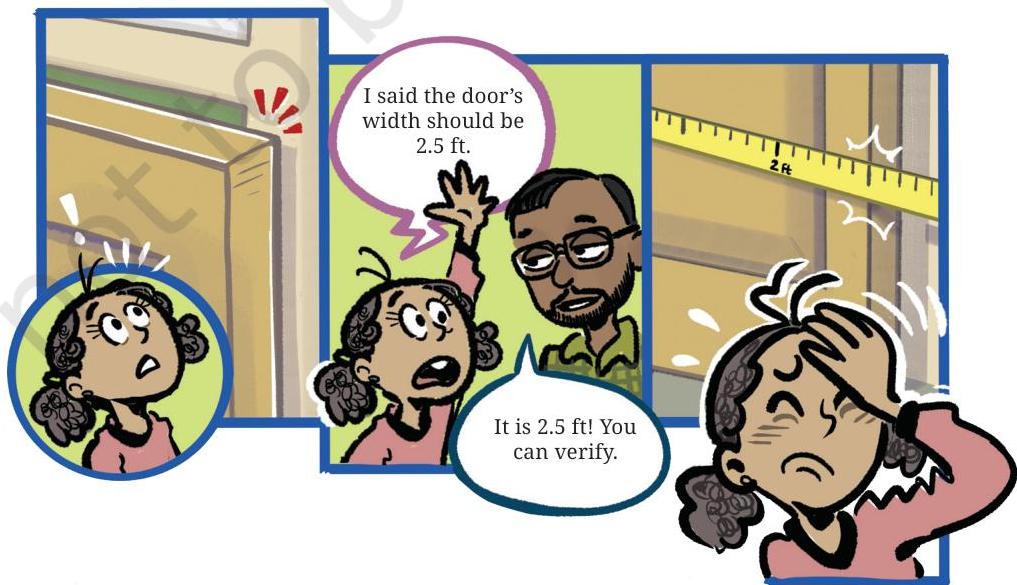
Consider an illustrative anecdote concerning a decimal misinterpretation: A young woman determined the breadth of a doorway to be 2 feet and 5 inches. However, when communicating this measurement to the carpenter, she mistakenly specified a door width of "2.5 ft". Interpreting "0.5 ft" as half a foot, the carpenter fabricated a door measuring 2 feet and 6 inches (given that 1 foot comprises 12 inches, 0.5 feet equates to 6 inches). As a result, the door did not fit the opening correctly.
For enthusiasts of cricket, a common observation is the display of numerical values resembling decimals, such as 'Overs left: 5.5'. This raises the question: does this notation signify 5 overs and 5 balls, or 5 overs and 3 balls? In this specific sporting context, '5.5 overs' denotes $5\frac{5}{6}$ overs (since one over consists of 6 balls), which precisely translates to 5 overs and 5 balls.
? Where else can we see such 'non-decimals' with a decimal-like notation?
Math Talk
A Pinch of History–Decimal Notation Over Time
Fractions expressed with denominators that are powers of ten (e.g., $\frac{1}{10}$, $\frac{1}{100}$, $\frac{1}{1000}$, and so forth) were incorporated into the mathematical and astronomical treatises of various ancient Indian scholars. Notable among these is Shridharāchārya's significant 8th-century work on arithmetic and algebra. The systematic description of decimal notation, largely mirroring its contemporary form, was elaborated upon by the Arab mathematician Abūl Ḥassan al-Uqlīdīsī around 950 CE in his volume, Kitāb al-Fuṣūl fī al-Ḥisāb al Hindī (The Book of Chapters on Indian Arithmetic). For instance, he rendered the value 0.059375 as 0059375.
During the 15th century, a variety of conventions were employed to distinguish the integral part of a number from its fractional component:
- a vertical mark positioned after the final digit of the whole number segment (as depicted previously),
- the application of distinct colors, and
- a numerical superscript indicating the count of fractional decimal places (e.g., 0.36 would be represented as 36).
In the ensuing 16th century, the Scottish mathematician John Napier and the German mathematician Christopher Clavius independently adopted the point or period ('.') to delineate the integer from the fractional portions. Conversely, the French mathematician François Viète favored the comma (',') for the same purpose.
Presently, several nations utilize the comma to demarcate the integer and fractional parts. In such territories, a number like 1,000.5 is frequently presented as 1 000,5 (where a space functions as a thousands separator). Nevertheless, the decimal point has persisted as the predominant convention for expressing numbers with fractional components within the Indian place value system.
? Figure it Out
- Express the subsequent fractions as their decimal equivalents:
- $\frac{5}{100}$
- $\frac{16}{1000}$
- $\frac{12}{10}$
- $\frac{254}{1000}$
A Peek Beyond the Point
Deconstruct each of the following decimal numbers into a summation of tenths, hundredths, and thousandths components:
- 0.34
- 1.02
- 0.8
- 0.362
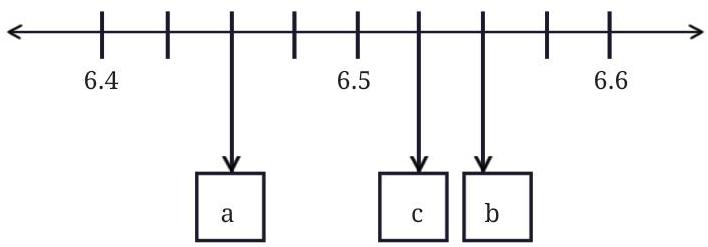
Identify the decimal value corresponding to each letter designated on the number line presented below:
Organize the subsequent quantities in a sequence from largest to smallest:
- 11.01, 1.011, 1.101, 11.10, 1.01
- 2.567, 2.675, 2.768, 2.499, 2.698
- $4.678\mathrm{g}, 4.595\mathrm{g}, 4.600\mathrm{g}, 4.656\mathrm{g}, 4.666\mathrm{g}$
- $33.13\mathrm{m}, 33.31\mathrm{m}, 33.133\mathrm{m}, 33.331\mathrm{m}, 33.313\mathrm{m}$
Utilizing the digits 1, 4, 0, 8, and 6, construct:
- the decimal number that approximates 30 most closely
- the minimum possible decimal number situated within the range of 100 and 1000.
Does a decimal number possessing a greater quantity of digits invariably exceed a decimal number with a lesser quantity of digits?
Mahi procures $0.25\mathrm{kg}$ of beans, $0.3\mathrm{kg}$ of carrots, $0.5\mathrm{kg}$ of potatoes, $0.2\mathrm{kg}$ of capsicums, and $0.05\mathrm{kg}$ of ginger. Determine the aggregate mass of the purchased commodities.
Pinto delivers 3.79 L, 4.2 L, and 4.25 L of milk to a dairy during the initial three-day period. Over a six-day span, his total milk contribution is 25 litres. Ascertain the cumulative volume of milk provided to the dairy during the subsequent three days.
Tinku's mass was recorded as $35.75\mathrm{kg}$ in January and $34.50\mathrm{kg}$ in February. Did his body mass increase or decrease? Quantify the magnitude of this alteration.
Continue the numerical sequence: 5.5, 6.4, 6.39, 7.29, 7.28, 6.18, 6.17, __, __
What number of millimeters constitutes one kilometer?
Indian Railways provides an elective travel insurance scheme for individuals reserving e-tickets. The premium is 45 paise per traveler. Should 1 lakh individuals elect this insurance within a single day, what would be the aggregate insurance revenue collected?
Determine which value is numerically superior:
$\frac{10}{1000}$ or $\frac{1}{10}$ ?
One-hundredth versus ninety thousandths?
One-thousandth versus ninety hundredths?
Express the specified quantities in their decimal representations (an illustrative example is provided):
- 87 ones, 5 tenths and 60 hundredths = 88.10
- 12 tens and 12 tenths
- 10 tens, 10 ones, 10 tenths, and 10 hundredths
- 25 tens, 25 ones, 25 tenths, and 25 hundredths
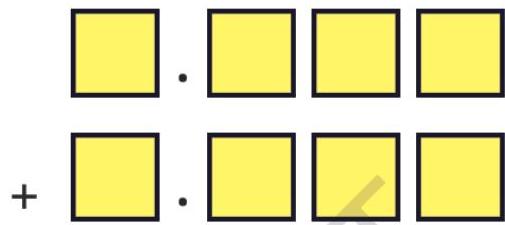
Employing each digit from 0 to 9 at most a single time, populate the boxes below such that their resultant sum most closely approximates 10.5:
- Render the subsequent fractions as decimal numbers:
- $\frac{1}{2}$
- $\frac{3}{2}$
- $\frac{1}{4}$
- $\frac{3}{4}$
- $\frac{1}{5}$
- $\frac{4}{5}$
SUMMARY
The subdivision of a unit into smaller components facilitates the attainment of more precise measurements.
Our exploration involved an extension of the Indian place value system, revealing the following relationships:
- 1 unit = 10 one-tenths,
- 1 tenth = 10 one-hundredths,
- 1 hundredth = 10 one-thousandths,
- 10 one-hundredths = 1 tenth,
- 100 one-hundredths = 1 unit.
Within the framework of the Indian place value system, a decimal point ('.') serves to delineate the integral component of a number from its corresponding fractional component.
Additionally, the curriculum encompassed the techniques for comparing decimal numbers, their accurate representation on a number line, and the execution of additive and subtractive operations involving them.