PARALLEL AND INTERSECTING LINES
5.1 Across the Line
Obtain a piece of square paper and fold it repeatedly in various ways. Subsequently, utilize a pencil and a ruler to draw lines along the creases that have been formed. You will discern distinct linear formations on the paper. Select any two of these lines and meticulously examine their interrelationship. Do they converge? Should they not converge within the confines of the paper, contemplate whether they would ultimately meet if their trajectories were extended beyond its boundaries.
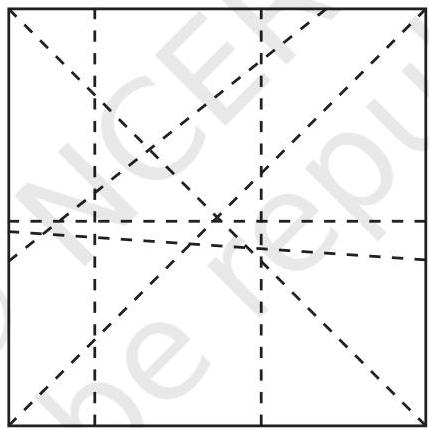 Fig. 5.1
Within this chapter, our focus will be on investigating the spatial relationships between lines situated on a planar surface. Examples of such surfaces include a tabletop, your sheet of paper, a blackboard, and a bulletin board.
Let us direct our attention to a pair of lines that come together. It will be observed that their meeting occurs at a single point. When two lines converge at a specific point on a planar surface, they are described as intersecting lines. We shall now proceed to analyze the geometric implications when two lines intersect.
? How many angles do they form?
As illustrated in Fig. 5.2, where line $l$ and line $m$ intersect, it is evident that four distinct angles are generated.
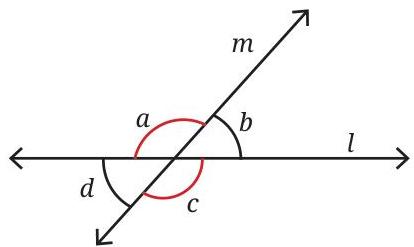 Fig. 5.2
? Can two straight lines intersect at more than one point?
Activity 1
On a blank sheet of paper, sketch two lines that cross each other. Using a protractor, determine the measures of the four angles created at their intersection. Repeat this exercise by drawing four additional sets of intersecting lines and measuring the angles at each crossing point.
? What patterns do you observe among these angles?
? In Fig. 5.2, if $\angle a$ is $120^{\circ}$, can you figure out the measurements of $\angle b$, $\angle c$ and $\angle d$, without drawing and measuring them?
It is established that the sum of $\angle a$ and $\angle b$ equals $180^{\circ}$, as their combined configuration constitutes a straight angle. Consequently, if $\angle a$ is given as $120^{\circ}$, then $\angle b$ is necessarily $60^{\circ}$.
Following the same principle, $\angle b$ and $\angle c$ also sum to $180^{\circ}$. Thus, with $\angle b$ at $60^{\circ}$, $\angle c$ must be $120^{\circ}$. Furthermore, $\angle c$ and $\angle d$ similarly total $180^{\circ}$, implying that if $\angle c$ is $120^{\circ}$, then $\angle d$ must be $60^{\circ}$.
Hence, within the context of Fig. 5.2, it is deduced that $\angle a$ and $\angle c$ each measure $120^{\circ}$, while $\angle b$ and $\angle d$ each measure $60^{\circ}$.
Upon the intersection of two lines, resulting in four angles designated as a, b, c, and d, as depicted in Fig. 5.2, it is observed that $\angle a$ and $\angle c$ are congruent, and likewise, $\angle b$ and $\angle d$ are congruent!
? Is this always true for any pair of intersecting lines?
Verify this principle using various initial measures for $\angle a$. Based on these empirical observations, can you formulate a logical argument to ascertain if this characteristic invariably applies regardless of the specific measure of $\angle a$?
Our deductive process, as applied to Fig. 5.2, can be extended to a general case, thereby negating the necessity of predetermined values for $\angle a$.
Given that straight angles invariably measure $180^{\circ}$, it logically follows that $\angle a + \angle b = 180^{\circ}$ and $\angle a + \angle d = 180^{\circ}$. This implies that $\angle b$ and $\angle d$ are consistently equal. Analogously, since $\angle b + \angle a = 180^{\circ}$ and $\angle b + \angle c = 180^{\circ}$, it is therefore necessary that $\angle a$ and $\angle c$ are equal.
Angles that are adjacent, such as $\angle a$ and $\angle b$, which are generated by the intersection of two lines, are termed linear pairs. The sum of angles within a linear pair consistently equals $180^{\circ}$.
Angles positioned opposite each other, for instance $\angle b$ and $\angle d$, which arise from the intersection of two lines, are designated as vertically opposite angles. These vertically opposite angles are invariably congruent.
Based on the aforementioned logical deductions, we can assert that in any instance where two lines intersect, the vertically opposite angles will be equal
. A formal substantiation of this nature is referred to as a proof within the discipline of mathematics.
? Figure it Out
List all the linear pairs and vertically opposite angles you observe in Fig. 5.3:
| Linear Pairs | $\angle a$ and $\angle b$, ... |
|---|---|
| Pairs of Vertically Opposite Angles | $\angle b$ and $\angle d$, ... |
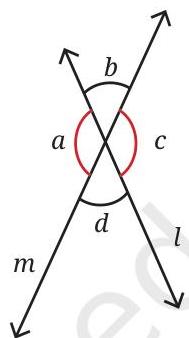 Fig. 5.3
Measurements and Geometry
Observations from practical measurement often reveal discrepancies, where linear pairs do not precisely sum to $180^{\circ}$, or vertically opposite angles are not exactly equal. Several factors can account for these variations:
- Inaccuracies arising from the incorrect application of measuring tools, such as a protractor.
- Discrepancies stemming from the variable thickness of drawn lines. Geometrical constructs, by definition, possess no thickness, yet practical representation necessitates a perceptible width.
Geometry involves the conceptualization of idealized forms of observed shapes and lines, enabling the analytical study of their interrelationships. For instance, the inherent property of a straight line dictates an angle of $180^{\circ}$. Consequently, if another line bisects this angle, the sum of the resultant two parts is theoretically $180^{\circ}$. This conclusion is derived through logical deduction rather than empirical measurement. While practical measurements may not yield exact conformity due to the aforementioned reasons, their close approximation to theoretical predictions underpins geometry's extensive utility across various fields, including physics, art, engineering, and architecture.
5.2 Perpendicular Lines
? Can you draw a pair of intersecting lines such that all four angles are equal? Can you figure out what will be the measure of each angle?
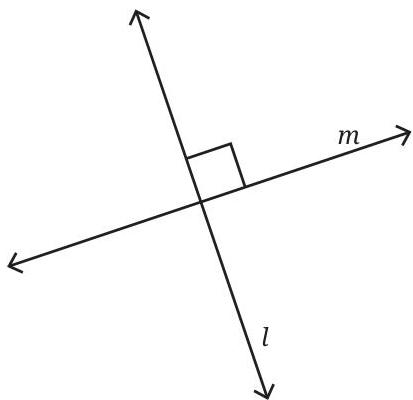 Fig. 5.4
When two lines intersect in such a manner that all four resultant angles are congruent, each of these angles is necessarily a right angle (90°).
Two lines are defined as perpendicular if their intersection forms right angles (90°). As depicted in Fig. 5.4, lines $l$ and $m$ exemplify this relationship, being perpendicular to one another.
5.3 Between Lines
Examine Fig. 5.5 and articulate how the various line segments converge or cross, utilizing precise mathematical terminology (such as a point, an endpoint, the midpoint, meet, or intersect) and specifying the angular measurement for each instance.
For instance, line segments FG and FH converge at their shared endpoint F, forming an angle of $115.3^{\circ}$.
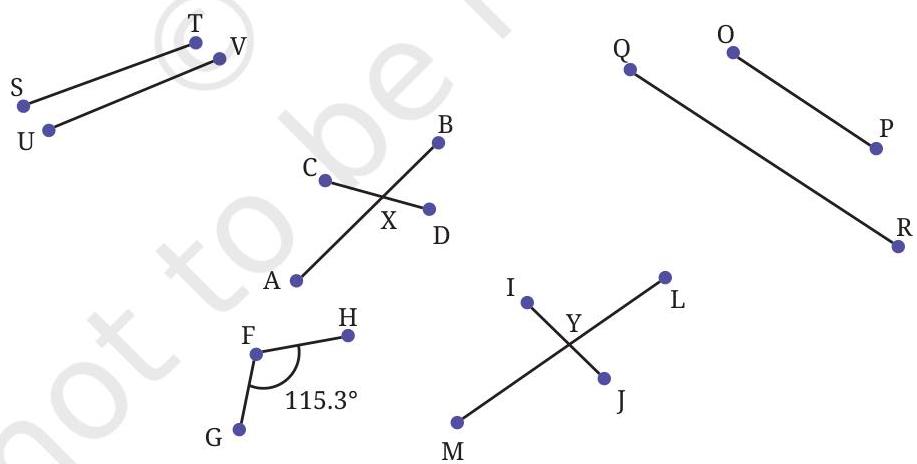 Fig. 5.5
Consider whether line segments ST and UV would converge if extrapolated. Similarly, assess the probability of line segments OP and QR intersecting upon extension. Presented below are several instances of lines observed in our environment.
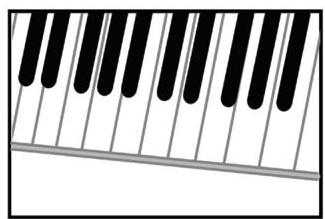
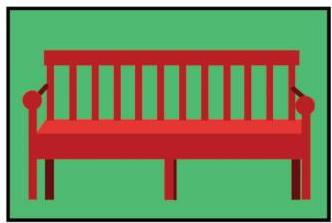
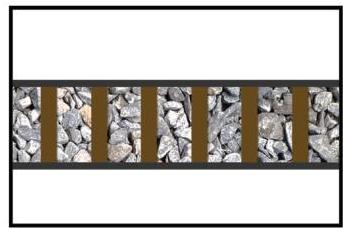
What characteristic is shared by the lines depicted in the preceding images? A prominent feature is their apparent non-intersection. Lines exhibiting this property are designated as parallel lines.
Parallel lines are defined as two lines situated within the same plane that never converge, irrespective of their infinite extension in either direction.
Name some parallel lines you can spot in your classroom.
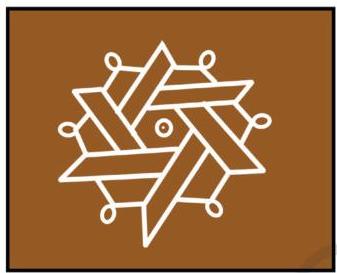
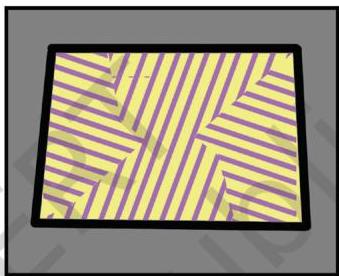
In artistic contexts, parallel lines frequently serve as elements in compositions and shading techniques.
? Which pairs of lines appear to be parallel in Fig. 5.6 below?
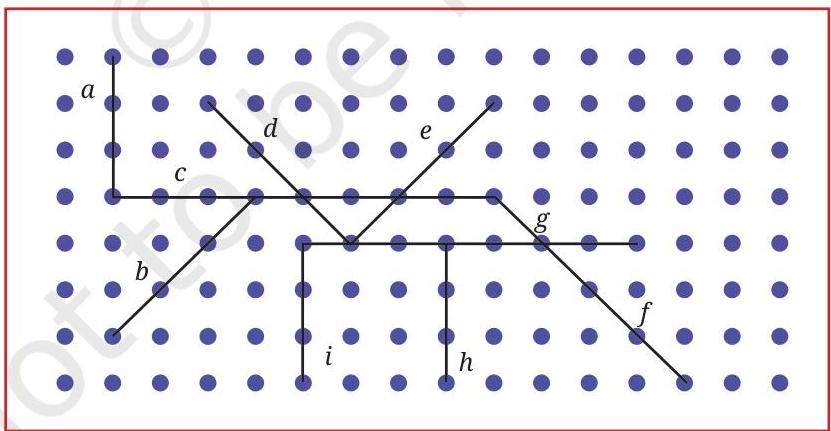 Fig. 5.6
Note to the Teacher: Emphasize the crucial condition that parallel lines must reside within the same plane. For instance, a line inscribed on a table surface and another on a whiteboard, though non-intersecting, do not qualify as parallel due to their distinct spatial planes.
5.4 Parallel and Perpendicular Lines in Paper Folding
Activity 2
Obtain a square sheet of paper; a newspaper can be utilized for this exercise.
- Characterize the relationship between the sheet's opposing edges. They are _______________.
- How do the adjacent edges of the sheet relate? These edges are _______________. They converge at a single point, forming right angles.
- Execute a horizontal fold through the center of the sheet. This action will generate a new crease line (consult Fig. 5.7).
- Determine the number of parallel lines now visible. Describe the relationship of this newly formed line segment to the sheet's vertical boundaries.
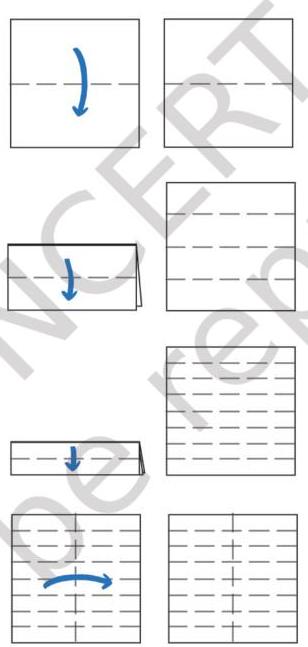 Fig. 5.7
- Perform an additional horizontal fold on the already folded sheet. How many parallel lines can you now identify?
- Consider the outcome of repeating this action. What quantity of parallel lines will result? Does a discernible pattern emerge? Investigate whether this pattern persists with an additional horizontal fold.
- Introduce a vertical fold into the square sheet. This recently created vertical line stands __________ to the existing horizontal lines.
- Execute a fold along one of the sheet's diagonals. Can you identify a subsequent fold that generates a line segment parallel to this diagonal?
Consider the following supplementary activity.
- Acquire a square sheet of paper, fold it centrally, then restore it to its original unfolded state.
- Bring the outer edges inward to align with the central crease, then unfold them again.
- Manipulate the top-right and bottom-left corners such that they meet the established crease line, thereby forming triangular shapes. Consult Fig. 5.8.
- Ensure that these triangular formations do not extend beyond the confines of the crease lines.
- Evaluate whether lines $a, b,$ and $c$ exhibit parallelism with lines $p, q,$ and $r$, in the corresponding order. Justify your conclusion.
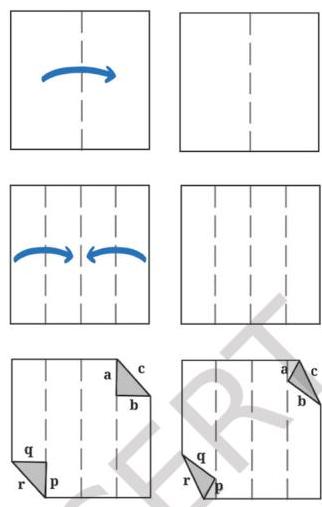 Fig. 5.8
Notations
Within the domain of mathematics, the symbol of an arrow (>) is employed to signify that a given collection of lines exhibits parallelism. Should multiple sets of parallel lines be present, as depicted in Figure 5.9, subsequent sets are delineated using additional arrow marks, such as a double arrow, and this pattern continues. Lines that are perpendicular to one another are conventionally indicated by a square symbol positioned at their intersection point.
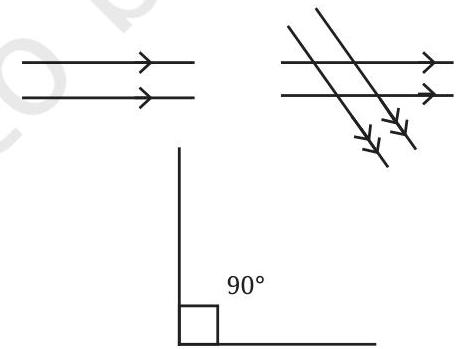 Fig. 5.9
Parallel and Intersecting Lines
Figure it Out
- On the provided dot paper in Figure 5.10, construct several lines that are perpendicular to the existing lines.
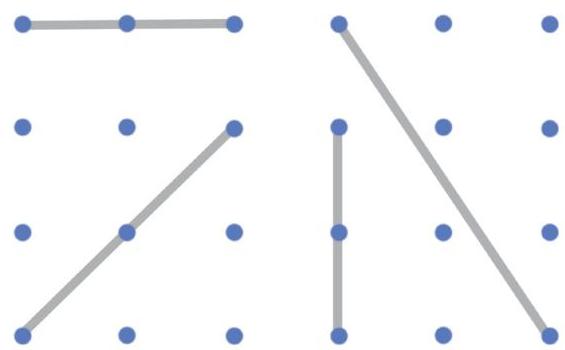 Fig. 5.10
- Within Figure 5.11, indicate the parallel lines utilizing the previously described notation (e.g., single arrow, double arrow). Denote the angle formed by perpendicular lines with the designated square symbol.
- By what method did you identify the perpendicular lines?
- What criteria did you employ to discern the parallel lines?
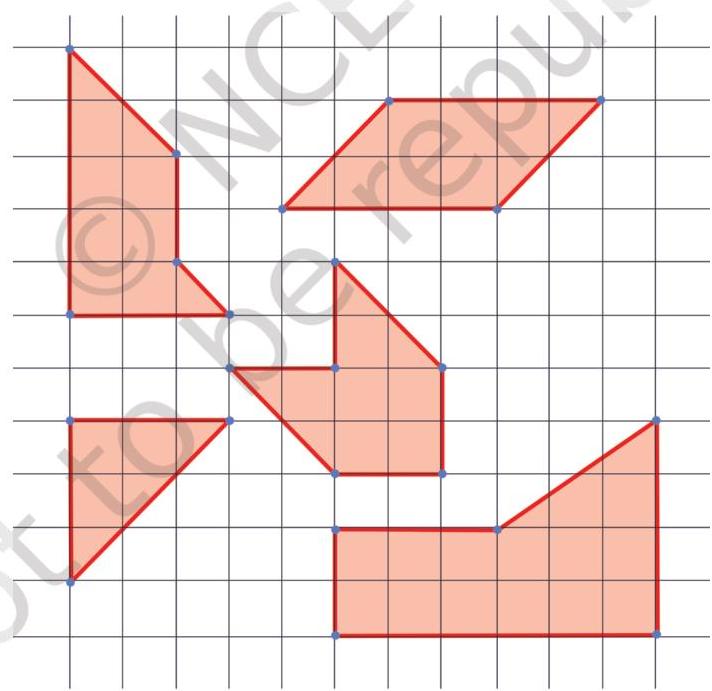 Fig. 5.11
On the subsequent dot paper, construct various collections of parallel line segments. While these line segments may vary in length, their terminal points must invariably coincide with dots on the grid.
Employing your intuitive understanding of the appearance of parallel lines, attempt to sketch lines that are parallel to the given line segments on this dot paper.
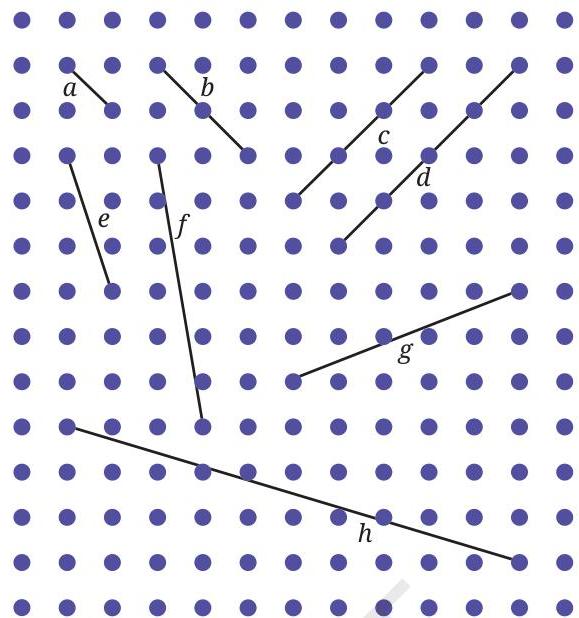 Fig. 5.12
*   Were certain instances of drawing these lines particularly arduous?
*   Specifically, which examples presented difficulty?
*   Describe the methodology you utilized to accomplish this task.
- Referring to Figure 5.13, determine which line, $b$ or $c$, is parallel to line $a$. Justify your decision.
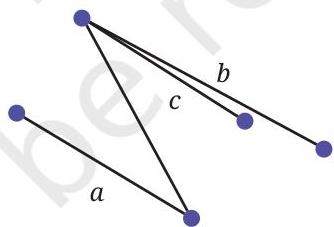 Fig. 5.13
Note to the Teacher: While the construction of vertical, horizontal, and $45^{\circ}$ inclined lines on rectangular dot grids presents relative ease, generating a parallel line to one possessing an alternative orientation proves marginally more challenging. Encourage students to leverage their inherent intuitive understanding in such scenarios.
Observations derived from preceding exercises indicate that ascertaining the parallelism of two lines can, at times, be challenging. To definitively establish this geometric relationship, the concept of transversals is employed.
5.5 Transversals
Having examined the outcomes of various two-line intersections, we now investigate the scenario where a single line intercepts two distinct lines.
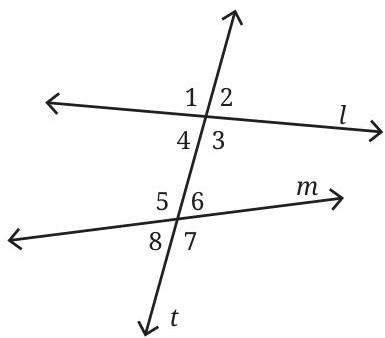 Fig. 5.14
As depicted in Fig. 5.14, line $t$ crosses lines $l$ and $m$. Line $t$ is designated as a transversal. It is
observable that eight angles are generated when one line traverses a pair of other lines.
? Is it possible for all the eight angles to have different measurements? Why, why not?
? What about five different angles—6, 5, 4, 3 and 2?
Within Fig. 5.14, angles $\angle 1$ and $\angle 3$ are vertically opposite, thus possessing equal measures. Are additional pairs of vertically opposite angles present? Indeed, we can identify a total of four such pairs, with each pair comprising angles of identical magnitude.
Consequently, the intersection of a transversal with two lines results in the creation of eight angles, which exhibit a maximum of four unique angular measurements.
5.6 Corresponding Angles
Referring to Fig. 5.14, it is evident that the transversal $t$ generates two collections of angles: one associated with line $l$ and another with line $m$. Within these collections, certain angles from the initial set bear a positional resemblance to angles in the second set. For instance, $\angle 1$ and $\angle 5$ are designated as corresponding angles. Analogously, $\angle 2$ and $\angle 6$, $\angle 3$ and $\angle 7$, and $\angle 4$ and $\angle 8$ constitute the corresponding angle pairs produced when transversal $t$ bisects lines $l$ and $m$.
? Activity 3
Construct a pair of lines and an intersecting transversal such that only two unique angle measures are generated.
Step 1: Construct a line $l$ and a transversal $t$ such that it intersects line $l$ at point $X$.
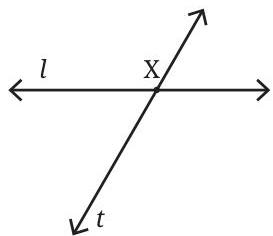 Fig. 5.15
Step 2: Determine the measure of $\angle a$, which is defined by lines $l$ and $t$ (for illustrative purposes, assume this measure is $60^{\circ}$).
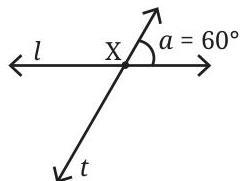 Fig. 5.16
How many distinct angles have formed now?
Given one angle measures $60^{\circ}$, its linear pair complement must measure $120^{\circ}$. Consequently, two distinct angle measures are already established.
Therefore, upon introducing a second line that intersects the transversal $t$, our objective is to produce solely two angle values: $60^{\circ}$ and $120^{\circ}$.
Step 3: Designate a point Y along line $t$.
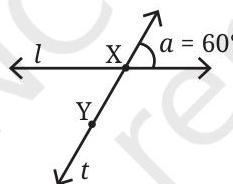 Fig. 5.17
Step 4: Construct a line $m$ passing through point Y such that it forms a $60^{\circ}$ angle with line $t$. This can be accomplished either by replicating $\angle a$ using tracing paper or by employing a protractor for angle measurement.
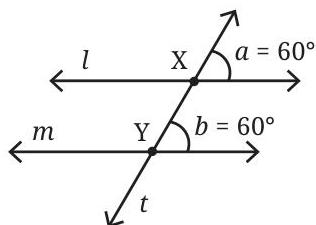 Fig. 5.18
What do you observe about lines $l$ and $m$? Do they appear to be parallel to each other?
Indeed, they exhibit the characteristic appearance of parallel lines.
Angles $\angle a$ and $\angle b$ represent corresponding angles, which are generated by the transversal $t$ across lines $l$ and $m$. These corresponding angles possess equivalent measures.
Parallel and Intersecting Lines
From this we can observe:
If a transversal intersects two lines such that their corresponding angles are congruent, then those two lines are parallel.
Consider a scenario where a transversal cuts across two lines that are parallel. In this situation, what property do the corresponding angles possess?
? Activity 4
Within Figure 5.19, there are two parallel lines, denoted as $l$ and $m$ (identify the symbol in the diagram signifying their parallelism). Line $t$ functions as the transversal intersecting these two lines. $\angle a$ and $\angle b$ are presented as corresponding angles. Use tracing paper to replicate $\angle a$. Subsequently, position this tracing over $\angle b$ to ascertain if they precisely coincide. You will find that the angles are identical. Verify the congruence of the remaining corresponding angles in the illustration by employing a protractor. Do all corresponding angles exhibit equality?
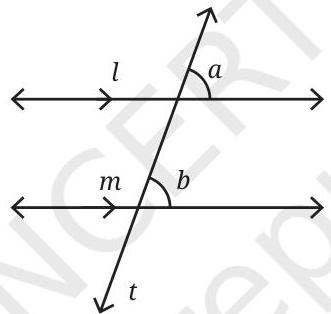 Fig. 5.19
When a transversal intersects two parallel lines, the corresponding angles that are created are invariably congruent.
? Activity 5
Referring to Fig. 5.20, sketch a transversal line, $t$, intersecting lines $l$ and $m$, ensuring that one set of corresponding angles has identical measures. A protractor can be utilized to ascertain the angular measurements.
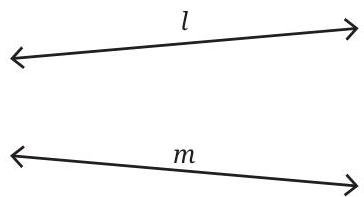 Fig. 5.20
Do you encounter difficulty in sketching a transversal such that the corresponding angles are equal?
If two lines are not parallel, the corresponding angles formed when a transversal cuts across them will never be equal.
5.7 Drawing Parallel Lines
Are you able to construct a pair of parallel lines using only a ruler and a set square?
Fig. 5.21 shows how you can do it.
Using a ruler, draw a line, $l$. Then, by manipulating your set square, you can create two lines that are both perpendicular to line $l$.
Are these two lines parallel? How can we be certain of their parallelism? What specific angles are formed where these lines intersect line $l$?
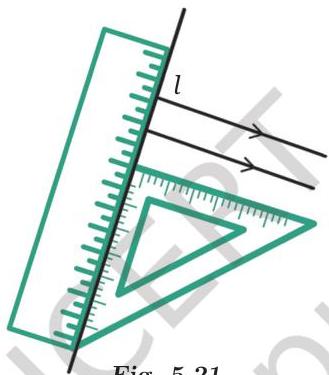 Fig. 5.21
Because we utilized a set square, the angles formed are $90^{\circ}$. Even though the lines are positioned differently, they both create the same angle with line $l$. If line $l$ is considered a transversal cutting across these two new lines, then the corresponding angles will each measure $90^{\circ}$.
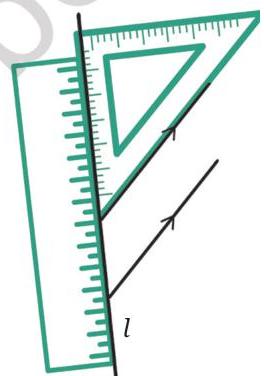 Fig. 5.22
Since these angles are identified as corresponding angles and are found to be equal, we can confirm the parallelism of the lines.
Using the longer edge of your set square, as illustrated in Fig. 5.22, construct two additional parallel lines.
Parallel and Intersecting Lines
By what means can you ascertain that these two lines are parallel? Are you able to confirm whether their corresponding angles are equal?
Note to the Teacher: Learners ought to be prompted to confirm the congruence of corresponding angles, employing both the tracing technique and direct measurement with protractors. Emphasize the precise terminology when articulating the connection between corresponding angles and parallel lines. The equivalence of corresponding angles serves as both a necessary and sufficient condition for two lines to be parallel.
? Figure it Out
Is it possible to construct a line parallel to line $l$ that also passes through point A? Using the instruments found in a standard geometry kit, how would you execute this construction? Detail the procedural steps you would follow.
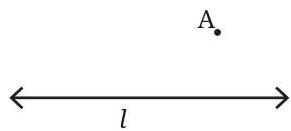 Fig. 5.23
Making Parallel Lines through Paper Folding
Let us now attempt to achieve this objective using the technique of paper folding. Given a line $l$, represented by an existing crease, what is the procedure to create a line parallel to $l$ that distinctly traverses point A?
Our prior knowledge includes the method for folding a sheet of paper to produce a line perpendicular to $l$. Proceed by folding a line perpendicular to $l$ in such a way that it intersects point A. Designate this resulting crease as $t$.
Subsequently, create another fold that forms a line perpendicular to $t$, ensuring it also passes through point A. Label this newly formed line $m$. It will be observed that lines $l$ and $m$ exhibit parallelism.
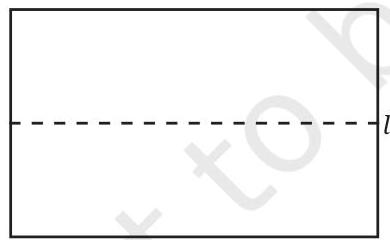
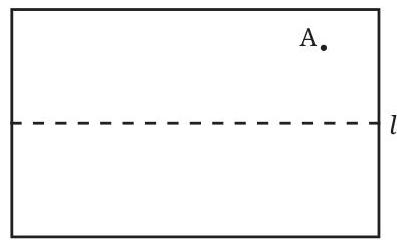
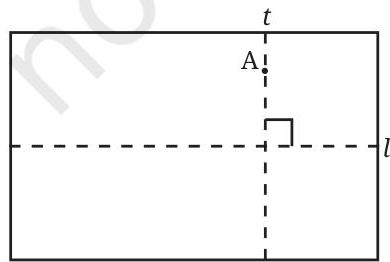 Fig. 5.24
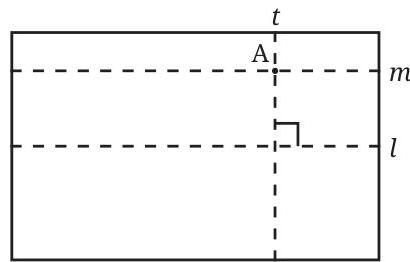
What is the geometric rationale for lines $l$ and $m$ being parallel?
5.8 Alternate Angles
Within the context of Fig. 5.25, $\angle d$ is identified as the alternate angle corresponding to $\angle f$, while $\angle c$ is designated as the alternate angle for $\angle e$.
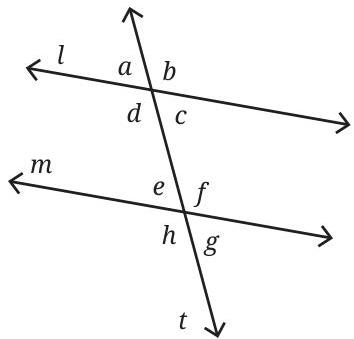 Fig. 5.25
To determine the alternate angle for a specific angle, such as $\angle f$, one can initially locate its corresponding angle, which is $\angle b$, and subsequently identify the vertically opposite angle to $\angle b$, resulting in $\angle d$.
Activity 6
Considering Fig. 5.25, if $\angle f$ measures $120^{\circ}$, what is the magnitude of its alternate angle, $\angle d$?
The measure of $\angle d$ can be ascertained if the value of $\angle b$ is known, as these angles are vertically opposite. It is important to recall that vertically opposite angles possess equal measures.
What is the measurement of $\angle b$? Its value is $120^{\circ}$, given that it is the corresponding angle to $\angle f$.
Consequently, $\angle d$ similarly registers a measure of $120^{\circ}$.
Indeed, the equality $\angle f = \angle b$ holds true regardless of the specific measure of $\angle f$. This is attributed to $\angle b$ being the corresponding angle of $\angle f$.
Likewise, $\angle b = \angle d$ holds universally, irrespective of $\angle b
YoLearn.AI is India's #1 AI tutoring platform for Class 1 to 12, JEE, and NEET preparation.
Students talk to expert AI tutors in real time through live voice calls, solve doubts instantly
on an interactive sketch board, and practice with mock tests, flashcards, quizzes, and slide decks.
Learn from top educators including DC Pandey and other verified teachers who create AI avatars of themselves.
Unlike text-only chatbots, YoLearn.AI lets you speak naturally to your AI tutor — just like a real
one-on-one session. Get step-by-step explanations for Physics, Chemistry, Maths, and Biology
for board exams, JEE Main, JEE Advanced, and NEET.
Prepare for JEE 2026, NEET 2026, and CBSE board exams with personalized mock tests, AI-generated
quizzes, and flashcard makers. Build daily study habits with an AI study buddy designed for Indian students.
Whether you need a Class 10 CBSE tutor, Class 12 board exam help, or full JEE and NEET coaching online,
YoLearn.AI adapts to your grade, syllabus, and learning pace. Start free today on web, iOS, and Android.
Personal 1:1 AI Tutor for CBSE, JEE & NEET Students
Live voice tutoring and doubt solving
Mock tests, flashcards, and exam prep
For school, JEE, and NEET
$ \angle f = \angle d $
By leveraging our comprehension of corresponding angles, and without recourse to specific numerical measurements, we have substantiated that alternate angles consistently exhibit equality.
When a transversal line intersects two parallel lines, the alternate angles thus formed are invariably congruent.
Example 1: Referring to Fig. 5.26, parallel lines $l$ and $m$ are bisected by transversal $t$. Given that $\angle 6$ measures $135^{\circ}$, determine the measures of the remaining angles.
Parallel and Intersecting Lines
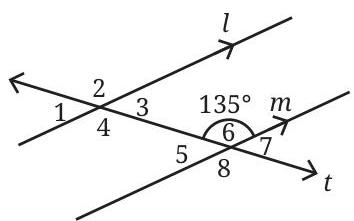 Fig. 5.26
Solution: Given $\angle 6$ as $135^{\circ}$, it follows that $\angle 2$ also measures $135^{\circ}$, since it is the corresponding angle to $\angle 6$ and lines $l$ and $m$ are established as parallel.
$\angle 8$ measures $135^{\circ}$ due to its relationship as the vertically opposite angle to $\angle 6$. Furthermore, $\angle 4$ is also $135^{\circ}$, being the corresponding angle to $\angle 8$.
$\angle 2$ is $135^{\circ}$ as it constitutes the vertically opposite angle to $\angle 4$. Thus, angles $\angle 2$, $\angle 4$, $\angle 6$, and $\angle 8$ all possess a measure of $135^{\circ}$.
Angles $\angle 5$ and $\angle 6$ form a linear pair, collectively summing to $180^{\circ}$. Given that $\angle 6$ is $135^{\circ}$, then
$ \angle 5 = 180 - 135 = 45^{\circ} $
Through analogous calculations, it can be determined that $\angle 1$, $\angle 3$, and $\angle 7$ each measure $45^{\circ}$.
Example 2: Within Fig. 5.27, lines $l$ and $m$ are traversed by line $t$. If $\angle a$ measures $120^{\circ}$ and $\angle f$ is $70^{\circ}$, do lines $l$ and $m$ exhibit parallelism?
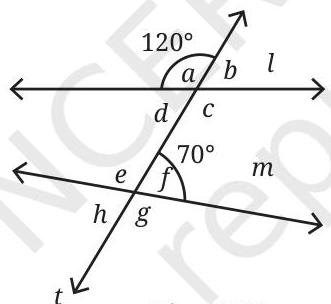 Fig. 5.27
Solution: Given $\angle a$ as $120^{\circ}$, $\angle b$ must be $60^{\circ}$ since $\angle a$ and $\angle b$ constitute a linear pair. $\angle b$ serves as a corresponding angle to $\angle f$. For lines $l$ and $m$ to be parallel, $\angle b$ would necessarily be congruent to $\angle f$; however, their measures are disparate.
Consequently, lines $l$ and $m$ are not parallel to each other, as the corresponding angles formed by the transversal $t$ are not congruent.
Example 3: Refer to Fig. 5.28. A transversal $t$ intersects two parallel lines, $l$ and $m$. If the measure of $\angle 3$ is $50^{\circ}$, determine the measure of $\angle 6$.
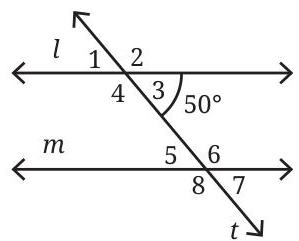 Fig. 5.28
Solution: Given that $\angle 3$ measures $50^{\circ}$, it follows that $\angle 2$ measures $130^{\circ}$. This deduction is based on the principle that $\angle 2$ and $\angle 3$ constitute a linear pair, whose angles invariably sum to $180^{\circ}$.
Angles $\angle 2$ and $\angle 6$ are corresponding angles. Since lines $l$ and $m$ are parallel, these corresponding angles must be congruent.
Hence, $\angle 6$ measures $130^{\circ}$.
Angles $\angle 3$ and $\angle 6$ are classified as interior angles.
What relationship exists between $\angle 3$ and $\angle 6$? One could investigate this by assigning various values to $\angle 3$ and observing the resulting measure of $\angle 6$. Upon discovering a pattern, the next step would be to provide a justification or proof for its consistent validity.
Through this exploration, it will be ascertained that the interior angles situated on the same side of the transversal invariably sum to $180^{\circ}$.
Example 4: As depicted in Fig. 5.29, line segment AB is parallel to CD, and AD is parallel to BC. Given that $\angle DAC$ measures $65^{\circ}$ and $\angle ADC$ measures $60^{\circ}$, determine the measures of $\angle CAB$, $\angle ABC$, and $\angle BCD$.
Solution: Consider the parallel lines AB and CD. The line segment AD functions as a transversal intersecting these two lines.
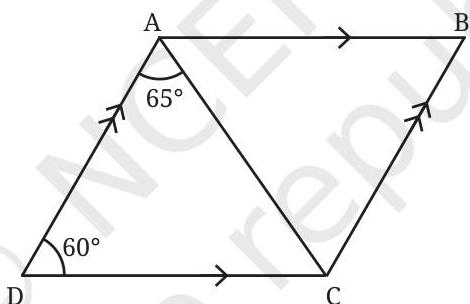 Fig. 5.29
It is a fundamental principle that the sum of the interior angles created by a transversal intersecting a pair of parallel lines totals $180^{\circ}$. Thus,
$ \begin{array}{l} \angle ADC + \angle DAB = 180^{\circ} \ 60^{\circ} + \angle DAB = 180^{\circ}. \ \end{array} $
$ \begin{array}{l} \text{So } \angle DAB = 120^{\circ}. \ \end{array} $
From this, can we deduce the measure of $\angle CAB$?
$ \begin{array}{l} \angle DAB = \angle DAC + \angle CAB. \ \text{So } 120^{\circ} = 65^{\circ} + \angle CAB. \ \text{So } \angle CAB = 55^{\circ}. \ \end{array} $
Next, let us consider the parallel line segments AD and BC, which are intersected by the transversal CD. Consequently, $\angle ADC + \angle BCD = 180^{\circ}$, as these are interior angles located on the same side of the transversal. Given that $\angle ADC$ is $60^{\circ}$, it follows that $\angle BCD = 120^{\circ}$.
Following a similar method, we ascertain that $\angle ABC = 60^{\circ}$.
Thus, in reference to Fig. 5.29, the measures are determined as $\angle CAB = 55^{\circ}$, $\angle ABC = 60^{\circ}$, and $\angle BCD = 120^{\circ}$.
Parallel and Intersecting Lines
Figure it Out
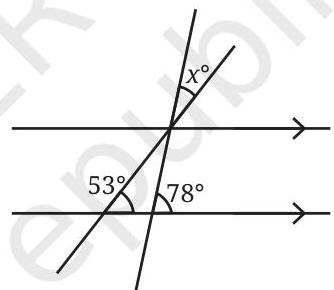
- Determine the measures of the angles indicated in the diagrams provided.
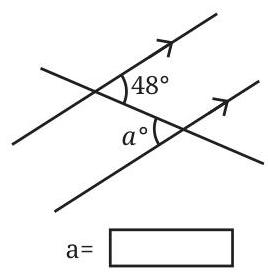
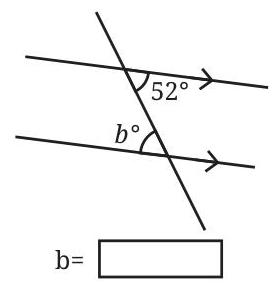
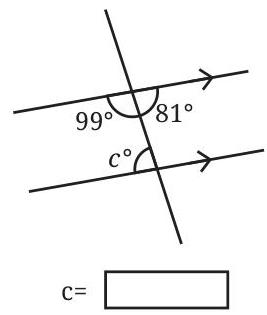
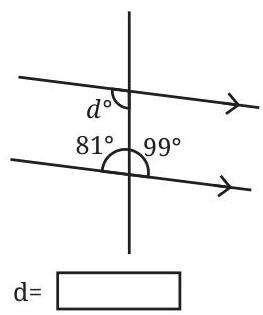
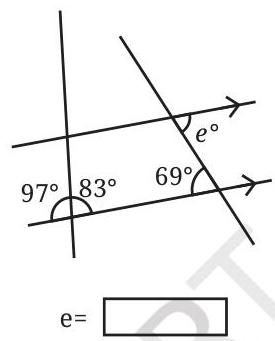
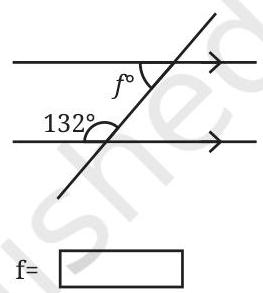
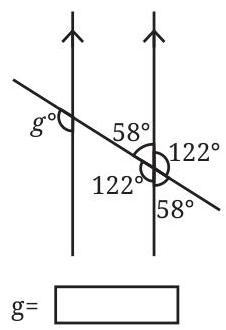
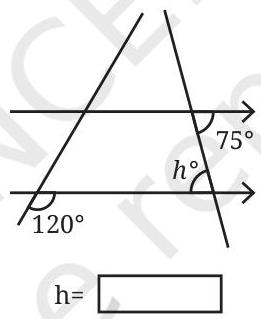
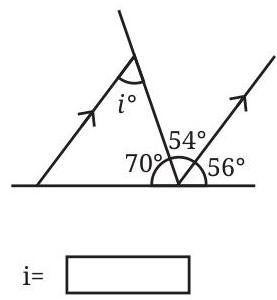
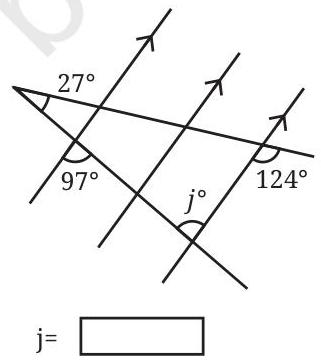 Fig. 5.30
- Calculate the measure of the angle designated as $a$.
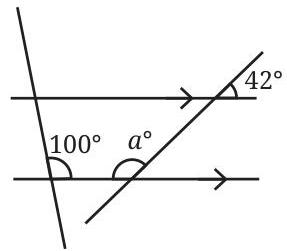
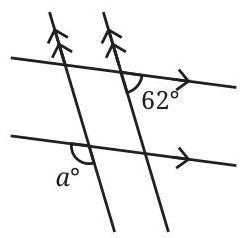
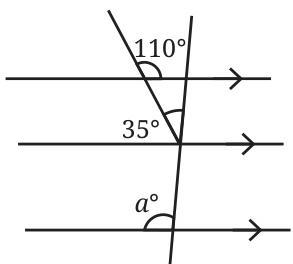 Fig. 5.31
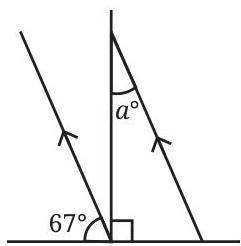
- In the subsequent diagrams, ascertain the angular values corresponding to $x$ and $y$.
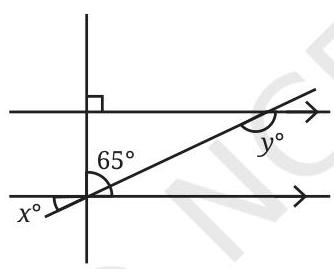 Fig. 5.32
- Given Fig. 5.33, where $\angle ABC = 45^{\circ}$ and $\angle IKJ = 78^{\circ}$, compute the measures of angles $\angle GEH$, $\angle HEF$, and $\angle FED$.
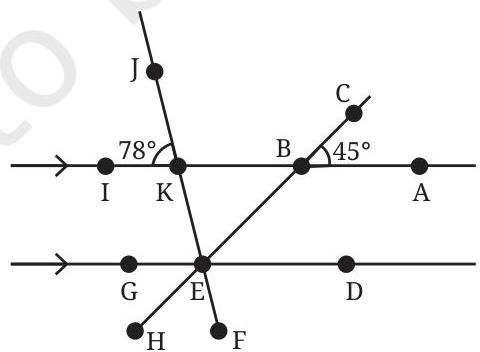 Fig. 5.33
- Considering Fig. 5.34, where line segment $AB$ is parallel to $CD$, and $CD$ is parallel to $EF$. Additionally, $EA$ is perpendicular to $AB$. If $\angle BEF$ measures $55^\circ$, determine the numerical values for $x$ and $y$.
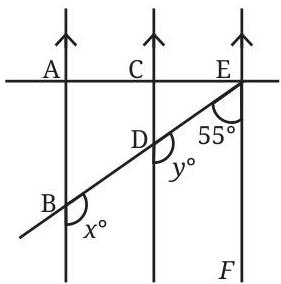 Fig. 5.34
- Ascertain the magnitude of angle $\angle NOP$ within Fig. 5.35.
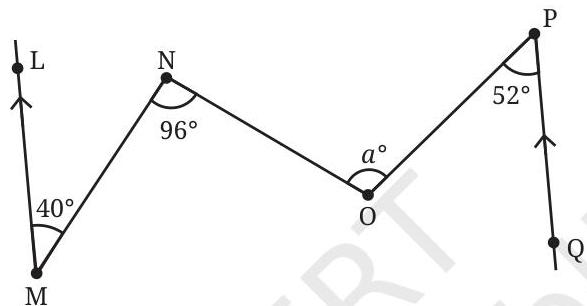 Fig. 5.35
[Guidance: Construct lines that are parallel to $LM$ and $PQ$, passing through points $N$ and $O$ respectively.]
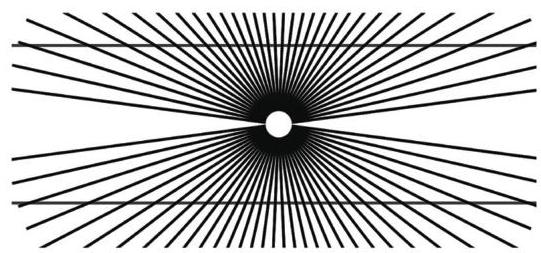
5.9 Parallel Illusions
Observe these figures. Do any truly parallel lines exist within them?
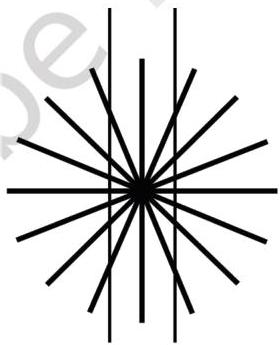
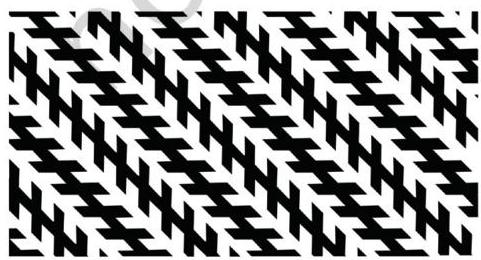 What is the underlying cause of these perceptual deceptions?
SUMMARY
- The intersection of two lines results in the formation of four angles. Among these, vertically opposite angles possess equal measures, while angles forming a linear pair sum to 180°.
- When two lines intersect such that all four resultant angles measure 90°, these lines are designated as perpendicular to one another.
- Lines situated within the same plane that never converge are defined as parallel lines.
- A line 't' that intersects two distinct lines is termed a transversal. This interaction generates two distinct sets, each comprising four angles. Within these sets, each angle in the first group corresponds to a specific angle in the second group.
- If a transversal line intersects two parallel lines, their corresponding angles are congruent. Conversely, if a transversal intersects two lines and their corresponding angles are found to be equal, then the two lines must be parallel.
- When a transversal intersects two parallel lines, the alternate interior angles are equivalent in measure.
- The sum of the measures of the interior angles located on the same side of a transversal, when it intersects a pair of parallel lines, consistently equals 180°.