A TALE OF THREE INTERSECTING LINES
A triangle is the most basic closed shape. As we know, it consists of:
- three corner points, that we call the vertex of the triangle, and
- three line segments or the sides of the triangle that join the pairs of vertices.
Triangles come in various shapes. Some of them are shown below.
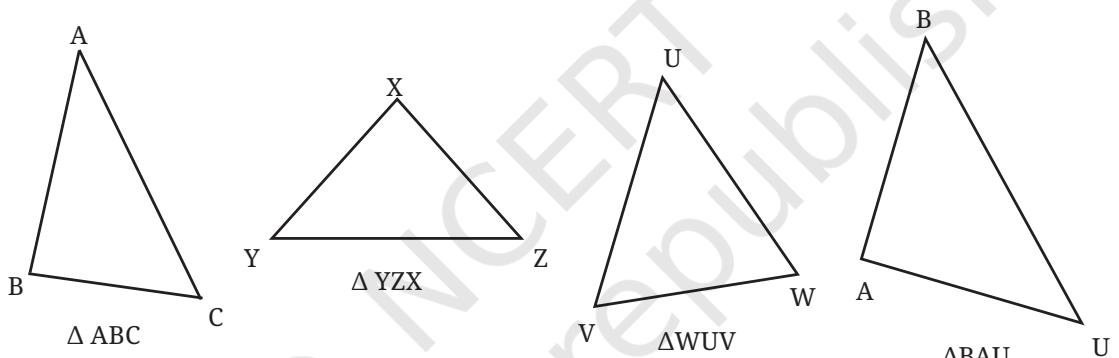
Observe the symbol used to denote a triangle and how the triangles are named using their vertices. While naming a triangle, the vertices can come in any order.
The three sides meeting at the corners give rise to three angles that we call the angles of the triangle. For example, in ∆ABC, these angles are $\angle \mathrm{CAB}$ , ∠ABC, $\angle \mathrm{BCA}$ , which we simply denote as $\angle \mathrm{A}$ , $\angle \mathrm{B}$ and $\angle \mathsf{C}$ , respectively.
$\textcircled{7}$ What happens when the three vertices lie on a straight line?
7.1 Equilateral Triangles
Among all the triangles, the equilateral triangles are the most symmetric ones. These are triangles in which all the sides are of equal lengths. Let us try constructing them.
Construct a triangle in which all the sides are of length 4 cm.
How did you construct this triangle and what tools did you use? Can this construction be done only using a marked ruler (and a pencil)?
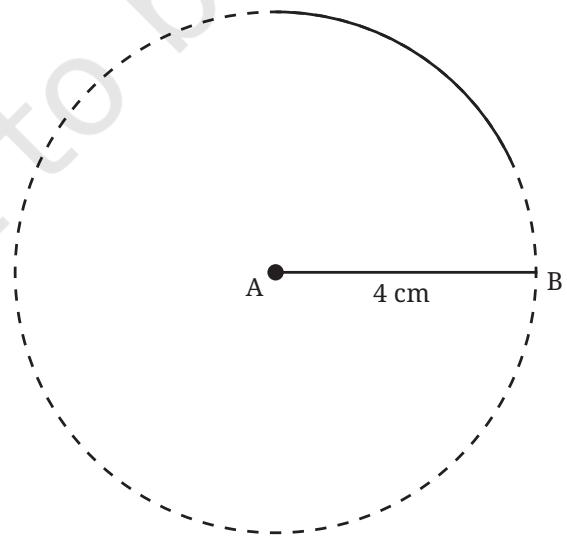
Constructing this triangle using just a ruler is certainly possible. But this might require several trials. Say we draw the base—let us call it AB— of length $4 \mathrm{cm}$ (see the figure below), and mark the third point C using a ruler such that $\mathrm{AC} = 4$ cm. This may not lead to BC also having a length of $4 \mathrm{cm}$ long.

How do we make this construction more efficient?
Recall solving a similar problem in the previous year using a compass (in the Chapter 'Playing with Constructions'). We had to mark the top point of a house' which is $5 \mathrm{cm}$ from two other points. The method we used to get that point can also be used here.
After constructing $\mathrm{AB} = 4 ~ \mathrm{cm}$ , we can do the following.
Step 1: Using a compass, construct a sufficiently long arc of radius $4 \mathrm{cm}$ from A, as shown in the figure. The point C is somewhere on this arc. How do we mark it?
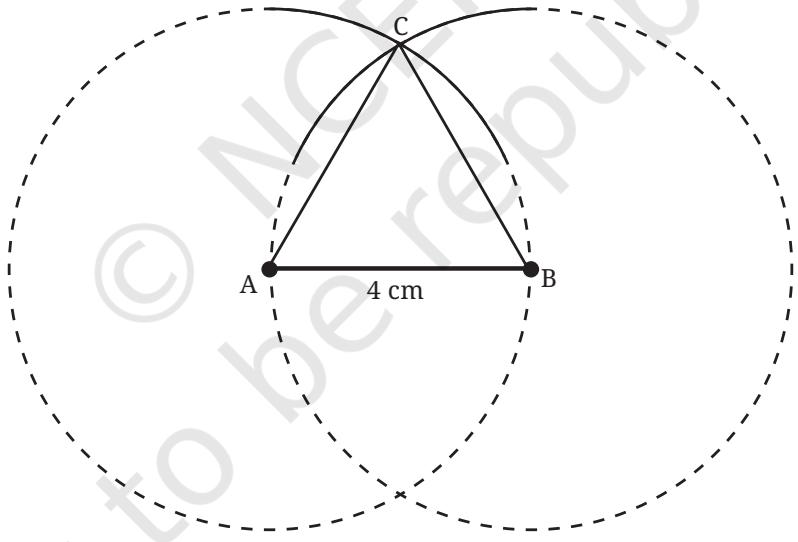
Step 2: Construct another arc of radius $4 \mathrm{cm}$ from B.

Let C be the point of intersection of the arcs.
$\frac { 3 } { 2 }$ The construction ensures that both AC and BC are of length 4 cm. Can you see why?
Step 3: Join AC and BC to get the required equilateral triangle.
7.2 Constructing a Triangle When its Sides are Given
How do we construct triangles that are not equilateral?
Construct a triangle of side length $4 \mathrm{cm}$ , 5 cm and $6 \mathrm{cm}$ .
As in the previous case, this triangle can also be constructed using just a marked ruler. But it will involve several trials.
How do we construct this triangle more efficiently?
Choose one of the given lengths to be the base of the triangle: say 4 cm. Draw the base. Let A and B be the base vertices, and call the third vertex C. Let AC $= 5$ cm and $\mathrm{BC} = 6 ~ \mathrm{cm}$ .
 Fig. 7.1
Like we did in the case of equilateral triangles, let us first get all the points that are at a 5 cm distance from A. These points lie on the circle whose centre is A and has radius $5 \mathrm{cm}$ The point C must lie somewhere on this circle. How do we find it?
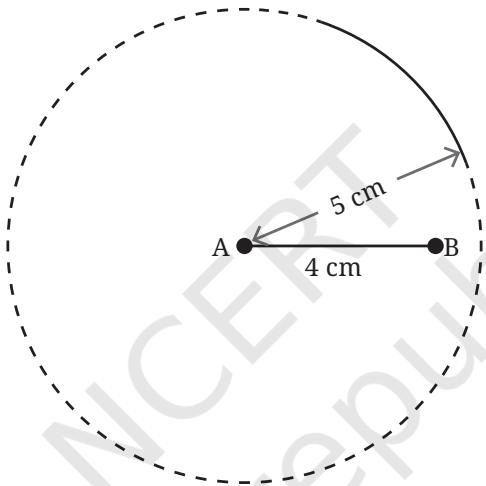 Fig. 7.2
We will make use of the fact that the point C is 6 cm away from B. Construct an arc of radius 6 cm from B.
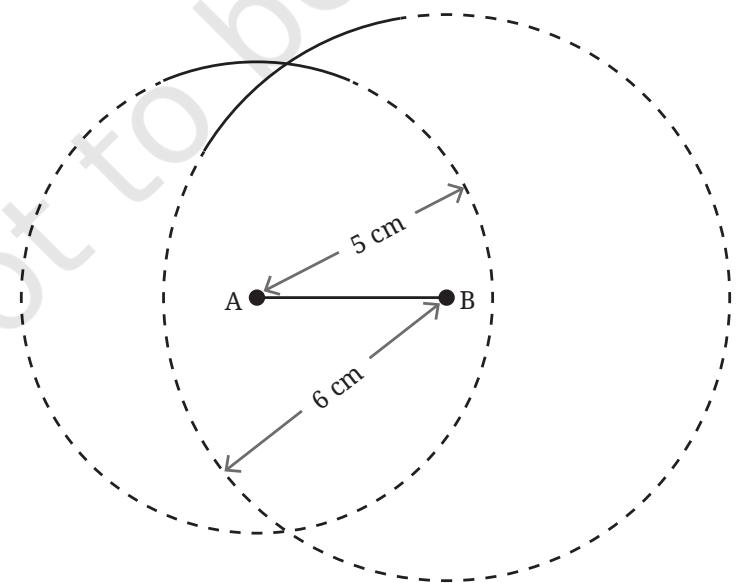 Fig. 7.3
The required point C is one of the points of intersection of the two circles.
The reason why the point of intersection is the third vertex is the same as for equilateral triangles. This point lies on both the circles. Hence its distance from A is the radius of the circle centred at A (5 cm) and its distance from B is the same as the radius of the circle centred at B (6 cm).
Let us summarise the steps of construction, noting that constructing full circles is not necessary to get the third vertex (see Fig. 7.2 and 7.3).
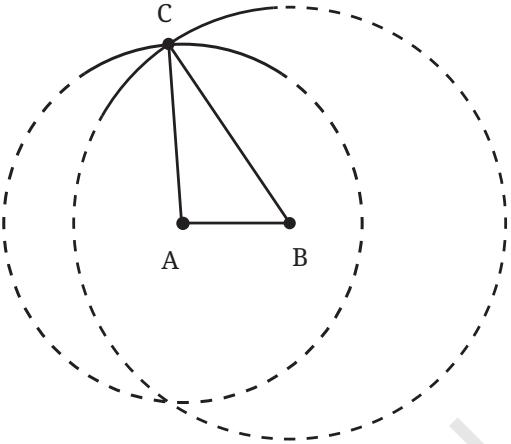
Step 1: Construct the base AB with one of the side lengths. Let us choose $\mathrm{AB} = 4 \mathrm{cm}$ (see Fig. 7.1). Step 2: From A, construct a sufficiently long arc of radius 5 cm (see Fig. 7.2). Step 3: From B, construct an arc of radius 6 cm such that it intersects the first arc (see Fig. 7.3). Step 4: The point where both the arcs meet is the required third vertex C. Join AC and BC to get ∆ABC.
Construct
- Construct triangles having the following side lengths (all the units are in cm):
(a) 4,4,6 (b) 3,4, 5 (c) 1,5,5 (d) 4,6,8 (e) 3.5, 3.5, 3.5
We have seen that triangles having all three equal sides are called equilateral triangles. Those having two equal sides are called isosceles triangles.
$\textcircled{7}$ Figure it Out
- Use the points on the circle and/or the centre to form isosceles triangles.
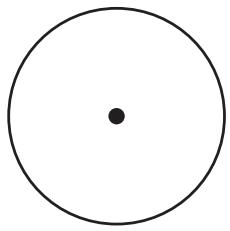
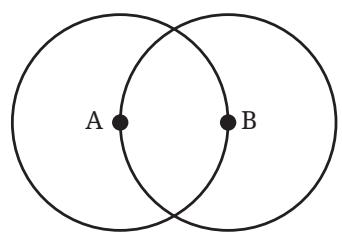
- Use the points on the circles and/or their centres to form isosceles and equilateral triangles. The circles are of the same size.
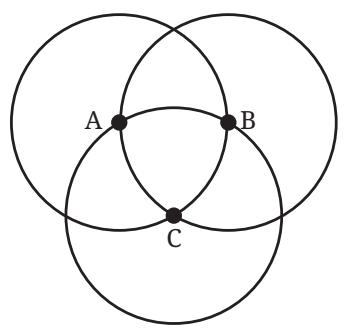 A, B, and C are the centres of circles of the same size
A and B are the centres of circles of the same size
Are Triangles Possible for any Lengths?
Can one construct triangles having any given side lengths? Are there lengths for which it is impossible to construct a triangle? Let us explore this.
![](https://yolearn-assets.s3.us-west-2
.amazonaws.com/CBSE/7/Mathematics/
1/gegp107_images/1a3bb341db0593ed5c064d1c