1 LARGE NUMBERS AROUND US
1.1 A Lakh Varieties!
Eshwarappa is a farmer in Chintamani, a town in Karnataka. He visits the market regularly to buy seeds for his rice field. During one such visit he overheard a conversation between Ramanna and Lakshmamma. Ramanna said, "Earlier our country had about a lakh varieties of rice. Farmers used to preserve different varieties of seeds and use them to grow rice. Now, we only have a handful of varieties. Also, farmers have to come to the market to buy seeds".
Lakshmamma said, "There is a seed bank near my house. So far, they have collected about a hundred indigenous varieties of rice seeds from different places.You can also buy seeds from there."

You may have heard the word lakh' before. Do you know how big one lakh is? Let us find out.
Eshwarappa shared this incident with his daughter Roxie and son Estu .
Estu was surprised to know that there were about one lakh varieties of rice in this country. He wondered "One lakh! So far I have only tasted 3 varieties. If we tried a new variety each day, would we even come close to tasting all the varieties in a lifetime of 100 years?"
What do you think? Guess.
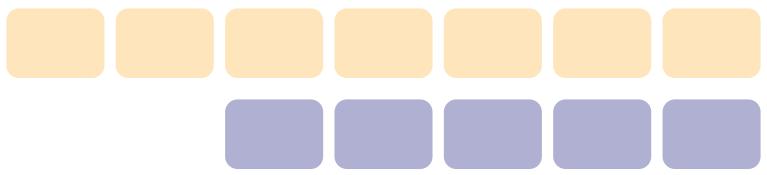
But how much is one lakh? Observe the pattern and fill in the boxes given below.
 1,00,000 is read as "One Lakh"
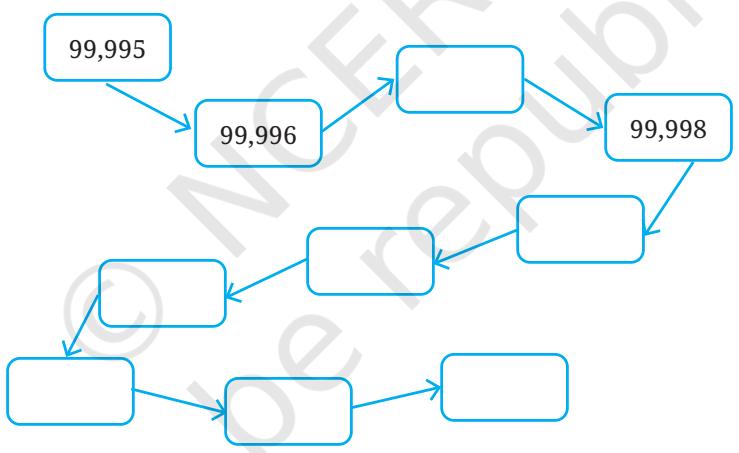

Roxie and Estu found that if they ate one variety of rice a day, they would come nowhere close to a lakh in a lifetime! Roxie suggests, "What if we ate 2 varieties of rice every day? Would we then be able to eat 1 lakh varieties of rice in 100 years?"

What if a person ate 3 varieties of rice every day? Will they be able to taste all the lakh varieties in a 100 year lifetime? Find out.
Estu said, "We know how many days there are in a year—365, if we ignore leap years. If we live for y years, the number of days in our lifetime will be $3 6 5 \times y$ ."
$\cdot$ Choose a number for y. How close to one lakh is the number of days in y years, for the y of your choice?
Figure it Out
- According to the 2011 Census, the population of the town of Chintamani was about 75,000. How much less than one lakh is 75,000?
- The estimated population of Chintamani in the year 2024 is 1,06,000. How much more than one lakh is 1,06,000?
- By how much did the population of Chintamani increase from 2011 to 2024?
Getting a Feel of Large Numbers
You may have come across interesting facts like these:
The world's tallest statue is the 'Statue of Unity' in Gujarat depicting Sardar Vallabhbhai Patel. Its height is about 180 metres. Kunchikal waterfall in Karnataka is said to drop from a height of about 450 metres.
It is not always easy to get a sense of how big these measurements are. But, we can get a better sense of their size when we compare them with something familiar. Let us see an example.
Look at the picture on the right. Somu is 1 metre tall. If each floor is about four times his height, what is the approximate height of the building?
Which is taller —The Statue of Unity or this building? How much taller? m.
We can see that the height of the Statue of Unity is close to 4 times the height of Somu's building.
How much taller is the Kunchikal waterfall than Somu's building? m.
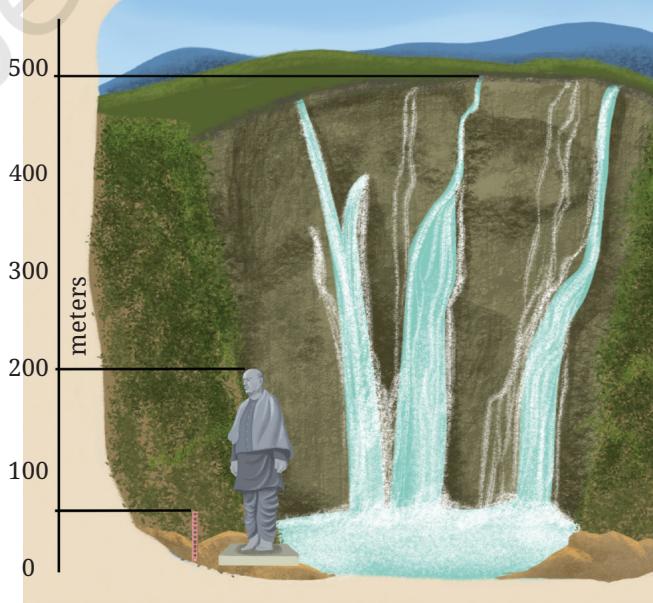
$\cdot$ How many floors should Somu's building have to be as high as the waterfall?
Is One Lakh a Very Large Number?
Eshwarappa asked Roxie and Estu, "Is a lakh big or small?"

years —that is a really long time!" "If 1 lakh people stood shoulder to shoulder in a line they could stretch as far as 38 kilometres."
Estu, however thinks it is not that big:
"Do you know that the cricket stadium in Ahmedabad has a seating capacity of more than 1 lakh? One lakh people in such a small area!" "Most humans have 80,000 to 1,20,000 hairs on their heads. Imagine, 1 lakh hairs fit in such a tiny space!" "I heard that there are some species of fish where a female fish can lay almost one lakh eggs at once very comfortably. Some even lay tens of lakhs of eggs at a time."

How do you view a lakh is a lakh big or small?
Reading and Writing Numbers
We have already been using commas for 5-digit numbers like 45,830 in the Indian place value system. As numbers grow bigger, using commas helps in reading the numbers easily. We use a comma in between the digits representing the "ten thousands" place and the "one lakh" place as you have seen just before (1,00,000).
The number name of 12,78,830 is twelve lakh seventy eight thousand eight hundred thirty.
Similarly, the number 15,75,000 in words is fifteen lakh seventy five thousand.
Write each of the numbers given below in words:
(a) 3,00,600 (b) 5,04,085 (c) 27,30,000 (d) 70,53,138
Write the corresponding number in the Indian place value system for each of the following:
(a) One lakh twenty three thousand four hundred and fifty six (b) Four lakh seven thousand seven hundred and four (c) Fifty lakhs five thousand and fifty (d) Ten lakhs two hundred and thirty five
Note to the Teacher: Encourage students to make connections between these facts. For example, can the whole population of Chintamani fit in the stadium? How can we imagine the line of $3 8 ~ \mathrm { k m }$ , having a lakh people, sitting next to each other in the stadium?
1.2 Land of Tens
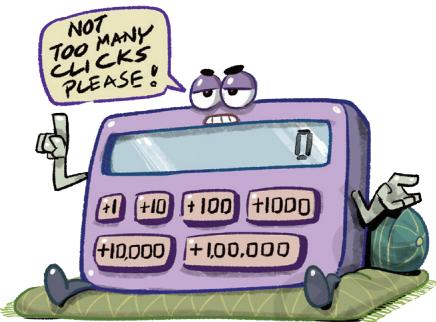
In the Land of Tens, there are special calculators with special buttons.
- The Thoughtful Thousands only has a $+ 1 0 0 0$ button. How many times should it be pressed to show:
(a) Three thousand? 3 times (b) 10,000? L (c) Fifty three thousand? (d) 90,000? (e) One Lakh? (f) ? 153 times (g) How many thousands are required
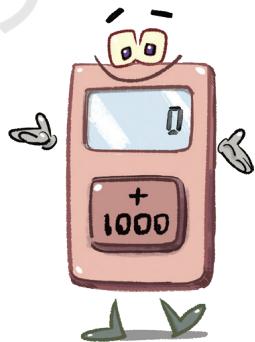
- The Tedious Tens only has a $+ 1 0$ button. How many times should it be pressed to show:
(a) Five hundred? (b) 780? (c) 1000? (d) 3700? (e) 10,000? (f) One lakh? (g) ? 435 times
- The Handy Hundreds only has a $+ 1 0 0$ button. How many times should it be pressed to show:
(a) Four hundred? times (b) 3,700?
(c) 10,000? (d) Fifty three thousand? (e) 90,000? (f) 97,600? (g) 1,00,000? (h) ? 582 times (i) How many hundreds are required to make ten thousand? (j) How many hundreds are required to make one lakh? (k) Handy Hundreds says, "There are some numbers which Tedious Tens and Thoughtful Thousands can't show but I can." Is this statement true? Think and explore.
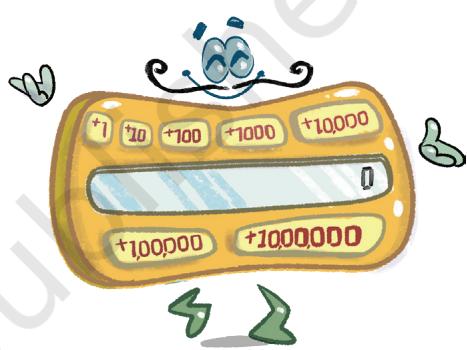
Creative Chitti is a different kind of calculator. It has the following buttons: $+ 1$ , $+ 1 0$ , $+ 1 0 0$ , $+ 1 0 0 0$ , $+ 1 0 0 0 0$ , $+ 1 0 0 0 0 0$ and $+ 1 0 0 0 0 0 0$ . It always has multiple ways of doing things. "How so?", you might ask. To get the number 321, it presses $+ 1 0$ thirty two times and $+ 1$ once. Will it get 321? Alternatively, it can press $+ 1 0 0$ two times and $+ 1 0$ twelve times and $+ 1$ once.
Two of the many different ways to get 5072 are shown below: These two ways can be expressed as: (a) $( 5 0 \times 1 0 0 ) + ( 7 \times 1 0 ) + ( 2 \times 1 ) = 5 0 7 2$ (b) $( 3 { \times } 1 0 0 0 ) + ( 2 0 { \times } 1 0 0 ) + ( 7 2 { \times } 1 ) = 5 0 7 2$ Find a different way to get 5072 and write an expression for the same.
Figure it Out
For each number given below, write expressions for at least two different ways to obtain the number through button clicks. Think like Chitti and be creative.
| Buttons | 5072 | |
| +10,00,000 | ||
| +1,00,000 | ||
| +10,000 | ||
| +1,000 | 3 | |
| +100 | 50 | 20 |
| +10 | 7 | |
| +1 | 2 | 72 |
(a) 8300 (b) 40629 (c) 56354 (d) 66666 (e) 367813
Creative Chitti has some questions for you— (a) You have to make exactly 30 button presses. What is the largest 3-digit number you can make? What is the smallest 3-digit number you can make?
(b) 997 can be made using 25 clicks. Can you make 997 with a different number of clicks?
Create questions like these and challenge your classmates.
Systematic Sippy is a different kind of calculator. It has the following buttons: $+ 1$ , $+ 1 0$ , $+ 1 0 0$ , $+ 1 0 0 0$ , $+ 1 0 0 0 0$ , $+ 1 0 0 0 0 0$ . It wants to be used as minimally as possible.

How can we get the numbers (a) 5072, (b) 8300 using as few button clicks as possible?
Find out which buttons should be clicked and how many times to get the desired numbers given in the table. The aim is to click as few buttons as possible.
Here is one way to get the number 5072. This method uses 23 button clicks in total.
Is there another way to get 5072 using less than 23 button clicks? Write the expression for the same.
Figure it Out
- For the numbers in the previous exercise, find out how to get each number by making the smallest number of button clicks and write the expression.
| Buttons | 5072 |
| +10,00,000 | |
| +1,00,000 | |
| +10,000 | |
| +1,000 | 5 |
| +100 | 0 |
| +10 | 6 |
| +1 | 12 |
Do you see any connection between each number and the corresponding smallest number of button clicks?
If you notice, the expressions for the least button clicks also give the Indian place value notation of the numbers. Think about why this is so.
What if we press the $+ 1 0 , 0 0 , 0 0 0$ button ten times? What number will come up? How many zeroes will it have? What should we call it? The number will be 100 lakhs, which is also called a crore. 1 crore is written as 1,00,00,000—it is 1 followed by seven zeroes.
1.3 Of Crores and Crores!
The table below shows some numbers according to both the Indian system and the American system (also called the International system) of naming numerals and placing commas. Observe the placement of commas in both systems.
| Indian System | American System | ||
| 1,000 | One thousand 1,000 | One thousand | |
| 10,000 | Ten thousand | 10,000 | Ten thousand |
| 1,00,000 | One lakh | 100,000 | Hundredthousand |
| 10,00,000 | Ten lakhs | 1,000,000 | One million |
| 1,00,00,000 | One crore | 10,000,000 | Ten million |
| 10,00,00,000 | Ten crores | 100,000,000 | Hundredmillion |
| 1,00,00,00,000 | One arab or Onehundred crores | 1,000,000,000 | One billion |
Notice that in the Indian system, commas are placed to group the digits in a 3-2-2-2.. pattern from right to left (thousands, lakhs, crores, etc.). In the American system, the digits are grouped uniformly in a 3-3-3-3.. pattern from right to left (thousands, millions, billions, etc.).
The Indian system of naming numbers is also followed in Bhutan, Nepal, Sri Lanka, Pakistan, Bangladesh, Maldives, Afghanistan, and Myanmar. The words lakh and crore originate from the Sanskrit words laksha (लक&ष) and koti (कोe). The American system is also used in many countries.
Observe the number of zeroes in 1 lakh and 1 crore.
1 lakh, written in numbers would be 1 followed by 5 zeroes
1 crore, written in numbers would be 1 followed by 7 zeroes.
A lakh is a hundred times a thousand, a crore is a hundred times a lakh and an arab is a hundred times a crore (i.e., a hundred thousand is 1 lakh, 100 lakhs is 1 crore, and 100 crores is 1 arab).
$\cdot$ How many zeros does a thousand lakh have?
$\textcircled{7}$ How many zeros does a hundred thousand have?
The number 9876501234 can be easily read by placing commas first:
(a) $9 , 8 7 , 6 5 , 0 1 , 2 3 4$ arab 87 crore 65 lakhs 1 thousand and 234 or 987 crore 65 lakh 1 thousand 234 (in the Indian system). (b) $9 , 8 7 6 , 5 0 1 , 2 3 4 \to 9$ billion 876 million 501 thousand 234 (in the American system).
Figure it Out
- Read the following numbers in Indian place value notation and write their number names in both the Indian and American systems:
(a) 4050678 (b) 48121620 (c) 20022002 (d) 246813579 (e) 345000543 (f) 1020304050
- Write the following numbers in Indian place value notation:
(a) One crore one lakh one thousand ten (b) One billion one million one thousand one isr (c) Ten crore twenty lakh thirty thousand forty (d) Nine billion eighty million seven hundred thousand six hundred
- Compare and write
Personal 1:1 AI Tutor for CBSE, JEE & NEET Students
YoLearn.AI is India's #1 AI tutoring platform for Class 1 to 12, JEE, and NEET preparation. Students talk to expert AI tutors in real time through live voice calls, solve doubts instantly on an interactive sketch board, and practice with mock tests, flashcards, quizzes, and slide decks. Learn from top educators including DC Pandey and other verified teachers who create AI avatars of themselves.
Live voice tutoring and doubt solving
Unlike text-only chatbots, YoLearn.AI lets you speak naturally to your AI tutor — just like a real one-on-one session. Get step-by-step explanations for Physics, Chemistry, Maths, and Biology for board exams, JEE Main, JEE Advanced, and NEET.
Mock tests, flashcards, and exam prep
Prepare for JEE 2026, NEET 2026, and CBSE board exams with personalized mock tests, AI-generated quizzes, and flashcard makers. Build daily study habits with an AI study buddy designed for Indian students.
For school, JEE, and NEET
Whether you need a Class 10 CBSE tutor, Class 12 board exam help, or full JEE and NEET coaching online, YoLearn.AI adapts to your grade, syllabus, and learning pace. Start free today on web, iOS, and Android.
Personal 1:1 AI Tutor for CBSE, JEE & NEET Students
YoLearn.AI is India's #1 AI tutoring platform for Class 1 to 12, JEE, and NEET preparation. Students talk to expert AI tutors in real time through live voice calls, solve doubts instantly on an interactive sketch board, and practice with mock tests, flashcards, quizzes, and slide decks. Learn from top educators including DC Pandey and other verified teachers who create AI avatars of themselves.
Live voice tutoring and doubt solving
Unlike text-only chatbots, YoLearn.AI lets you speak naturally to your AI tutor — just like a real one-on-one session. Get step-by-step explanations for Physics, Chemistry, Maths, and Biology for board exams, JEE Main, JEE Advanced, and NEET.
Mock tests, flashcards, and exam prep
Prepare for JEE 2026, NEET 2026, and CBSE board exams with personalized mock tests, AI-generated quizzes, and flashcard makers. Build daily study habits with an AI study buddy designed for Indian students.
For school, JEE, and NEET
Whether you need a Class 10 CBSE tutor, Class 12 board exam help, or full JEE and NEET coaching online, YoLearn.AI adapts to your grade, syllabus, and learning pace. Start free today on web, iOS, and Android.
(a) 30 thousand 3 lakhs (b) 500 lakhs 5 million (c) 800 thousand 8 million (d) 640 crore 60 billion
We shall come across even bigger numbers in later grades.
1.4 Exact and Approximate Values
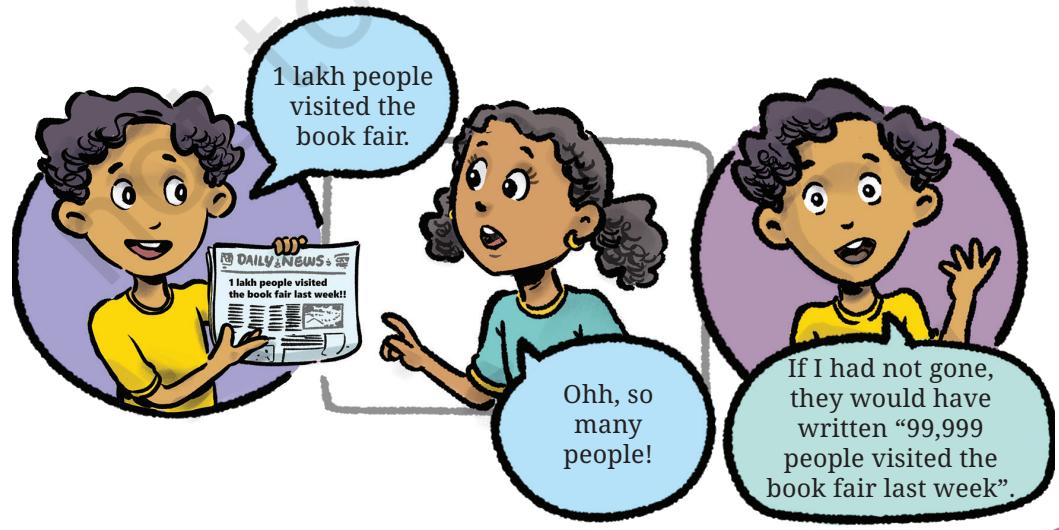
What do you think of this conversation? Have you read or heard such headlines or statements?
Very often, exact numbers are not required and just an approximation is sufficient. For example, according to the 2011 census, the population of Chintamani town is 76,068. Instead, saying that the population is about 75,000 is enough to give an idea of how big the quantity is.
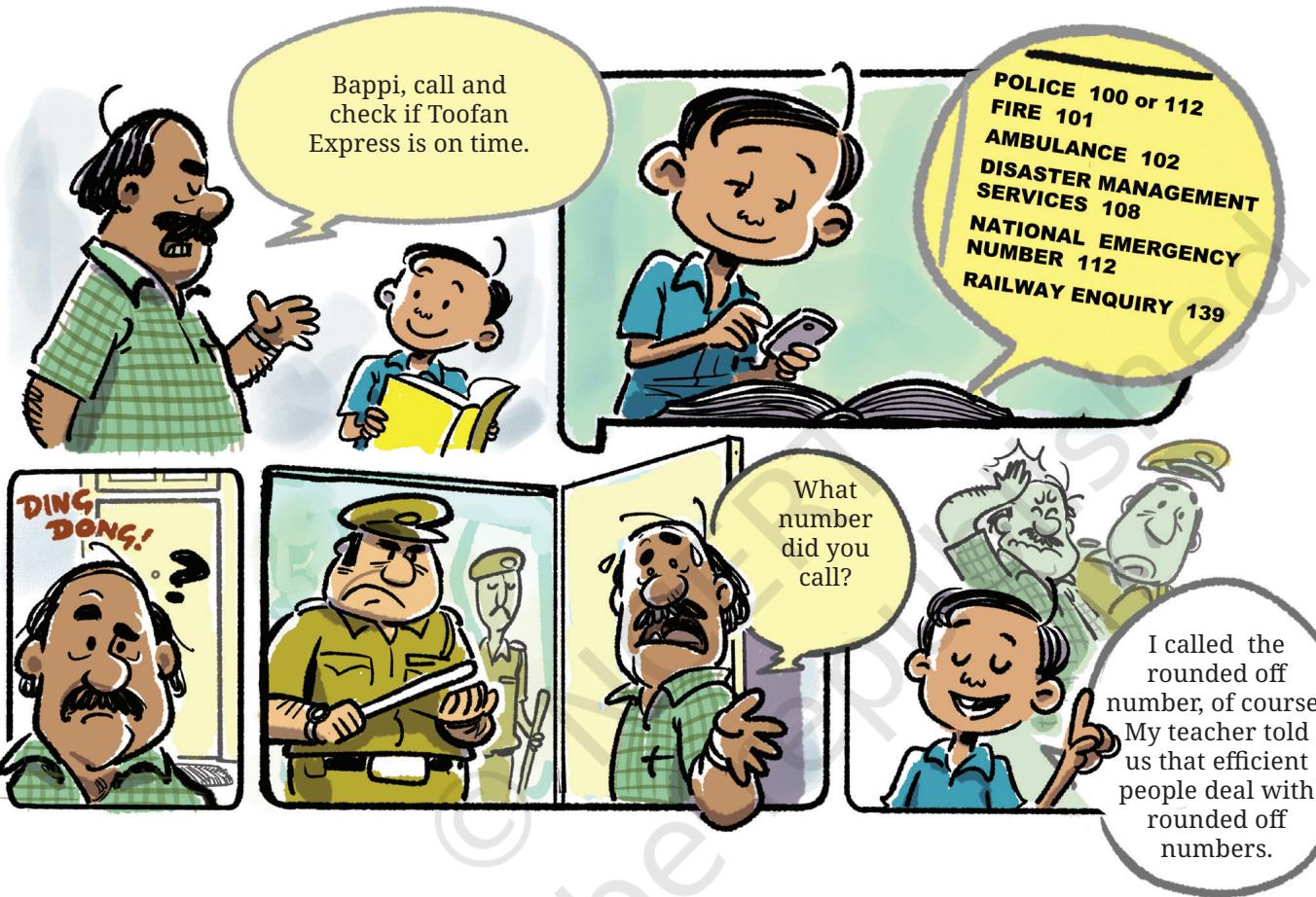
There are situations where it makes sense to round up a number (rounding up is when the approximated number is more than the actual number). For example, if a school has 732 people including students, teachers and staff: the principal might order 750 sweets instead of 700 sweets.
There are situations where it is better to round down (rounding down is when the approximated number is less than the actual number). For example, if the cost of an item is ₹470, the shopkeeper may say that the cost is around ₹450 instead of saying it is around ₹500 .
$\textcircled{7}$ Think and share situations where it is appropriate to (a) round up, (b) round down, (c) either rounding up or rounding down is okay and (d) when exact numbers are needed.
Nearest Neighbours
With large numbers it is useful to know the nearest thousand, lakh or crore. For example, the nearest neighbours of the number 6,72,85,183 are shown in the table below.
| Nearest thousand | 6,72,85,000 |
| Nearest ten thousand | 6,72,90,000 |
| Nearest lakh | 6,73,00,000 |
| Nearest ten lakh | 6,70,00,000 |
| Nearest crore | 7,00,00,000 |
$\textcircled{7}$ Similarly, write the five nearest neighbours for these numbers:
(a) 3,87,69,957 (b) 29,05,32,481
$\textcircled{7}$ I have a number for which all five nearest neighbours are 5,00,00,000. What could the number be? How many such numbers are there?
Roxie and Estu are estimating the values of simple expressions.
- $4 , 6 3 , 1 2 8 + 4 , 1 9 , 6 8 2 ,$ ,
Roxie: "The sum is near 8,00,000 and is more than 8,00,000."
Estu: "The sum is near 9,00,000 and is less than 9,00,000."
(a) Are these estimates correct? Whose estimate is closer to the sum? (b) Will the sum be greater than 8,50,000 or less than 8,50,000? Why do you think so? (c) Will the sum be greater than 8,83,128 or less than 8,83,128? Why do you think so? (d) Exact value of $4 , 6 3 , 1 2 8 + 4 , 1 9 , 6 8 2 =$
- 14,63,128 -4,90,020
Roxie: "The difference is near 10,00,000 and is less than 10,00,000.' Estu: "The difference is near 9,00,000 and is more than 9,00,000."
(a) Are these estimates correct? Whose estimate is closer to the difference? (b) Will the difference be greater than 9,50,000 or less than 9,50,000? Why do you think so?
(c) Will the difference be greater than 9,63,128 or less than 9,63,128? Why do you think so? (d) Exact value of 14,63,128 - 4,90,020 =
Note to the Teacher: Ask students questions like —"what could the numbers be if the sum had to be less than 8,50,000."
Populations of Cities
Observe the populations of some Indian cities in the table below.
| Rank | City | Population (2011) | Population (2001) |
| 1 | Mumbai | 1,24,42,373 | 1,19,78,450 |
| 2 | New Delhi | 1,10,07,835 | 98,79,172 |
| 3 | Bengaluru | 84,25,970 | 43,01,326 |
| 4 | Hyderabad | 68,09,970 | 36,37,483 |
| 5 | Ahmedabad | 55,70,585 | 35,20,085 |
| 6 | Chennai | 46,81,087 | 43,43,645 |
| 7 | Kolkata | 44,86,679 | 45,72,876 |
| 8 | Surat | 44,67,797 | 24,33,835 |
| 9 | Vadodara | 35,52,371 | 16,90,000 |
| 10 | Pune | 31,15,431 | 25,38,473 |
| 11 | Jaipur | 30,46,163 | 23,22,575 |
| 12 | Lucknow | 28,15,601 | 21,85,927 |
| 13 | Kanpur | 27,67,031 | 25,51,337 |
| 14 | Nagpur | 24,05,665 | 20,52,066 |
| 15 | Indore | 19,60,631 | 14,74,968 |
| 16 | Thane | 18,18,872 | 12,62,551 |
| 17 | Bhopal | 17,98,218 | 14,37,354 |
| 18 | Visakhapatnam | 17,28,128 | 13,45,938 |
| 19 | Pimpri-Chinchwad | 17,27,692 | 10,12,472 |
| 20 | Patna | 16,84,222 | 13,66,444 |
$\cdot$ From the information given in the table, answer the following questions by approximation:
- What is your general observation about this data? Share it with the class.
- What is an appropriate title for the above table?
- How much is the population of Pune in 2011? Approximately, by how much has it increased compared to 2001?
- Which city's population increased the most between 2001 and 2011?
- Are there cities whose population has almost doubled? Which are they?
- By what number should we multiply Patna's population to get a number/population close to that of Mumbai?
1.5 Patterns in Products
Roxie and Estu are playing with multiplication. They encounter an interesting technique for multiplying a number by 10, 100, 1000, and so on.
A Multiplication Shortcut
Roxie evaluated $1 1 6 \times 5$ as follows:
$ 116 \times 5 = 116 \times \frac{10}{2} = 58 \times 10 = 580 $
Estu evaluated $824 \times 25$ as follows:
$ 824 \times 25 = 824 \times \frac{100}{4} = 206 \times 100 = 20600 $
$\textcircled{7}$ Using the meaning of multiplication and division, can you explain why multiplying by 5 is the same as dividing by 2 and multiplying by 10?
Figure it Out
- Find quick ways to calculate these products:
(a) $2 \times 1 7 6 8 \times 5 0$ (b) $7 2 \times 1 2 5 ~ [ \mathbf { Hint } ; 1 2 5 = \frac { 1 0 0 0 } { 8 } ]$ (c) $1 2 5 \times 4 0 \times 8 \times 2 5$
- Calculate these products quickly.
$ \begin{array} { r l } & { 2 5 \times 1 2 = } \ & { 2 5 \times 2 4 0 = } \ & { 2 5 0 \times 1 2 0 = } \ & { 2 5 0 0 \times 1 2 = } \ & { } \end{array} $
How Long is the Product?
In each of the following boxes, the multiplications produce interesting patterns. Evaluate them to find the pattern. Extend the multiplications based on the observed pattern.
11 × 11= 111 × 111 = 1111 × 1111 = 66 × 61 = 666× 661 = 6666 × 6661 =
$3 \times 5 =$ 33 × 35 = 333 × 335 =
101 × 101 = 102 × 102 = 103 × 103 =
$\cdot$ Observe the number of digits in the two numbers being multiplied and their product in each case. Is there any connection between the numbers being multiplied and the number of digits in their product?
$\textcircled{7}$ Roxie says that the product of two 2-digit numbers can only be a 3- or a 4-digit number. Is she correct?
$\textcircled{7}$ Should we try all possible multiplications with 2-digit numbers to tell whether Roxie's claim is true? Or is there a better way to find out?
She explains her reasoning: "We want to know about the number of digits in the product of two 2-digit numbers. To know the smallest such product I took $1 0 \times 1 0$ , so all other products will be greater than 100.

To know the greatest such product I multiplied the smallest 3-digit numbers (100 $\times \ 1 0 0 )$ to get 10,000; so the product of all the 2-digit multiplications will be less than 10,000."
Can multiplying a 3-digit number with another 3-digit number give a 4-digit number?
$\cdot$ Can multiplying a 4-digit number with a 2-digit number give a 5-digit number?
$\textcircled{7}$ Observe the multiplication statements below. Do you notice any patterns? See if this pattern extends for other numbers as well.
1-digit × 1-digit 1-digit or 2-digit 2-digit × 1-digit = 2-digit or 3-digit 2-digit x 2-digit = 3-digit or 4-digit 3-digit x 3-digit = 5-digit or 6-digit 5-digit × 5-digit = or 8-digit × 3-digit = or 12-digit x 13-digit = or
Fascinating Facts about Large Numbers
Some interesting facts about large numbers are hidden below. Calculate the product or quotient to uncover the facts. Once you find the product or quotient, read the number in both Indian and American naming systems. Share your thoughts and questions about the fact with the class after you discover each number.
$1 2 5 0 \times 3 8 0$
is the number of kirtanas composed by Purandaradasa according to legends.
Purandaradasa was a composer and singer in the 15th century. His kirtanas spanned social reform, bhakti and spirituality. He systematised methods for teaching Carnatic music which is followed to the present day.
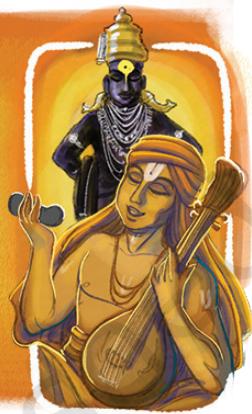

How many years did he live to compose so many songs? At what age did he start composing songs?
If he composed 4,75,000 songs, how many songs per year did he have to compose?
2100 × 70,000
is the approximate distance in kilometers, between the Earth and the Sun.
This distance keeps varying throughout the year. The farthest distance is about 152 million kilometers.

the distance between the How did they measure Earth and the Sun?
6400 × 62,500
is the average number of litres of water the Amazon river discharges into the Atlantic Ocean every second.
The river's flow into the Atlantic is so much that drinkable freshwater is found even 160 kilometers into the open sea.
As you did before, divide the given numbers to uncover interesting facts about division. Share your thoughts and questions with the class after you uncover each number.
Adult blue whales can weigh more than 10,50,00,000 ÷ 700 kilograms. A newborn blue whale weighs around $2 { , } 7 0 0 \ \mathrm { k g } ,$ which is similar to the weight of an adult hippopotamus. The heart of a blue whale was recorded to be nearly $7 0 0 ~ \mathrm { k g }$ The tongue of a blue whale weighs as much as an elephant. Blue whales can eat up to $3 5 0 0 ~ \mathrm { k g }$ of krill every day. The largest known land animal, Argentinosaurus, is estimated to weigh 90,000 kgs.
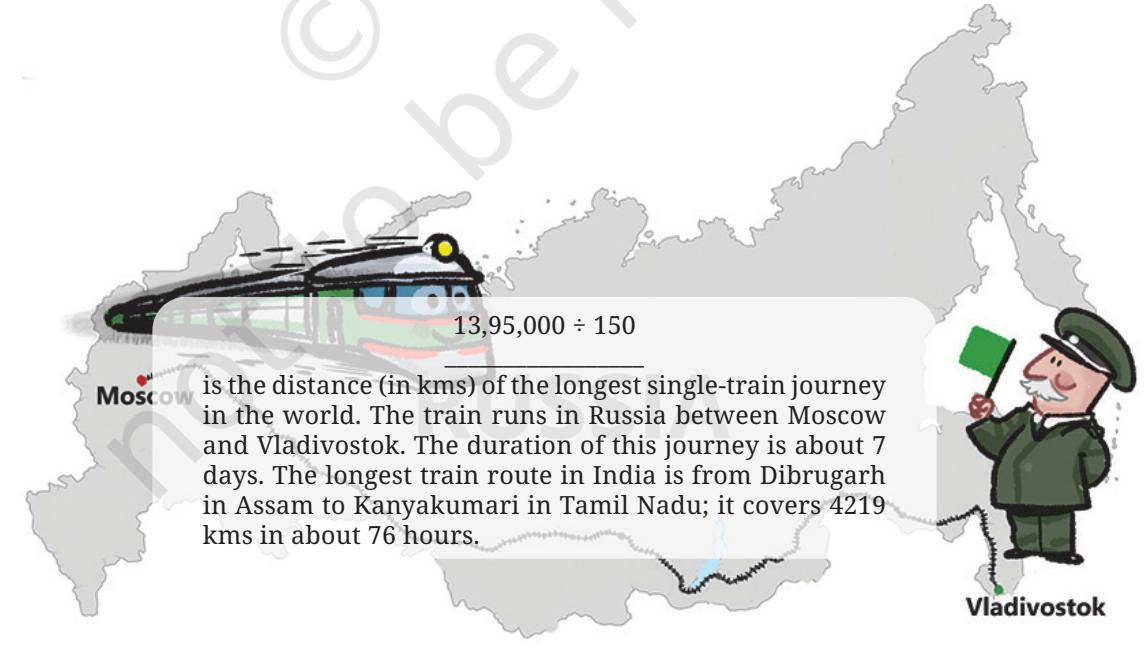
52,00,00,00,000 ÷ 130
was the weight, in tonnes, of global plastic waste generated in the year 2021.
Large Number Fact
In a single gram of healthy soil there can be 100 million to 1 billion bacteria and 1 lakh to 1 million fungi, which can support plants'growth and health.
Share such large-number facts you know / come across with your class.
1.6 Did You Ever Wonder...?
Estu is amused by all these interesting facts about large numbers. While thinking about these, he came up with an unusual question, "Could the entire population of Mumbai fit into 1 lakh buses?"
What do you think?
How can we find out?
Let us assume a bus can accommodate 50 people. Then 1 lakh buses can accommodate 1 lakh $\times 5 0 = 5 0$ lakh people.
The population of Mumbai is more than 1 crore 24 lakhs (we saw this in an earlier table). So, the entire population of Mumbai cannot fit in 1 lakh buses.
$\textcircled{7}$ The RMS Titanic ship carried about 2500 passengers. Can the population of Mumbai fit into 5000 such ships?

Inspired by this strange question, Roxie wondered, "If I could travel 100 kilometers every day, could I reach the Moon in 10 years?" (The distance between the Earth and the Moon is 3,84,400 km.)
How far would she have travelled in a year?
How far would she have travelled in 10 years?
Is it not easier to perform these calculations in stages? You can use this method for all large calculations.
$\textcircled{7}$ Find out if you can reach the Sun in a lifetime, if you travel 1000 kilometers every day. (You had written down the distance between the Earth and the Sun in a previous exercise.)
$\cdot$ Make necessary reasonable assumptions and answer the questions below:
(a) If a single sheet of paper weighs 5 grams, could you lift one lakh sheets of paper together at the same time? (b) If 250 babies are born every minute across the world, will a million babies be born in a day? (c) Can you count 1 million coins in a day? Assume you can count 1 coin every second.
$\cdot$ Think and create more such fun questions and share them with your class.
Figure it Out
- Using all digits from 0–9 exactly once (the first digit cannot be 0) to create a 10-digit number, write the —
(a) Largest multiple of 5 (b) Smallest even number
The number 10,30,285 in words is Ten lakhs thirty thousand two hundred eighty five, which has 43 letters. Give a 7-digit number name which has the maximum number of letters.
Write a 9-digit number where exchanging any two digits results in a bigger number. How many such numbers exist?
Strike out 10 digits from the number 12345123451234512345 so that the remaining number is as large as possible.
The words 'zero' and 'one' share letters 'e' and 'o'. The words 'one' and 'two' share a letter 'o', and the words 'two' and 'three' also share a letter 't. How far do you have to count to find two consecutive numbers which do not share an English letter in common?
Suppose you write down all the numbers 1, 2, 3, 4, …., 9, 10, 11, The tenth digit you write is '1' and the eleventh digit is '0', as part of the number 10.
(a) What would the 1000th digit be? At which number would it occur? (b) What number would contain the millionth digit? (c) When would you have written the digit '5' for the 5000th time?
- A calculator has only $+ 10,000$ and $+ 100$ buttons. Write an expression describing the number of button clicks to be made for the following numbers:
(a) 20,800 (b) 92,100 (c) 1,20,500 (d) 65,30,000 (e) 70,25,700
How many lakhs make a billion?
You are given two sets of number cards numbered from 1–9. Place a number card in each box below to get the (a) largest possible sum (b) smallest possible difference of the two resulting numbers.
- You are given some number cards; 4000, 13000, 300, 70000, 150000, 20, 5. Using the cards get as close as you can to the numbers below using any operation you want. Each card can be used only once for making a particular number.
(a) 1,10,000: Closest I could make is $4 0 0 0 \times ( 2 0 + 5 ) + 1 3 0 0 0$ $= 1 { , } 1 3 { , } 0 0 0$ (b) 2,00,000: (c) 5,80,000: (d) 12,45,000: (e) 20,90,800:
Find out how many coins should be stacked to match the height of the Statue of Unity. Assume each coin is 1 mm thick.
Grey-headed albatrosses have a roughly 7-feet wide wingspan. They are known to migrate across several oceans. Albatrosses can cover about 900-1000 km in a day. One of the longest single trips recorded is about $1 2 , 0 0 0 ~ \mathrm { k m }$ . How many days would such a trip take to cross the Pacific Ocean approximately?
A bar-tailed godwit holds the record for the longest recorded non-stop flight. It travelled 13,560 km from Alaska to Australia without stopping. Its journey started on 13 October 2022 and continued for about 11 days. Find out the approximate distance it covered every day. Find out the approximate distance it covered every hour.
Bald eagles are known to fly as high as $4 5 0 0 - 6 0 0 0 \mathrm { ~ m ~ }$ above the ground level. Mount Everest is about $8 8 5 0 \mathrm { m }$ high. Aeroplanes can fly as high as $1 0 , 0 0 0 - 1 2 , 8 0 0 \mathrm { ~ m }$ How many times bigger are these heights compared to Somu's building?
SUMMARY
We came across large numbers—lakhs, crores and arabs; millions and billions. We learnt how to read and write these numbers in the Indian and American/International naming systems.
(a) 1 lakh is 1 followed by 5 zeroes: 1,00,000 (b) 1 crore is 1 followed by 7 zeroes: 1,00,00,000 (c) 1 million is 1 followed by 6 zeroes: 1,000,000 (which is also ten lakhs) (d) 1 arab is 1 followed by 9 zeroes: 1,000,000,000 (which is also 100 crore or 1 billion)
We generally round up or round down large numbers. Many times it is enough just to know roughly how big or small something is.
To get a sense of large numbers or quantities, we can check how many times bigger they are compared to numbers or quantities that are more familiar. We saw how to factorise numbers and regroup them to make multiplications simpler. We carried out interesting thought experiments such as —"Would one be able to watch 1000 movies in a year?"
PUZZLE TIME
Toothpick Digits
We can write digits as shown in the image below: # DEEHEEE
You can either use toothpicks or matchsticks, or just write the digits in this way, using lines to represent sticks. To make the digit 7, three sticks are needed.
Write or make the number 5108. How many sticks are required?
Make or write the number 42,019. It would require exactly 23 sticks.
Starting with 42,019, add or write two more sticks, and make a bigger number. One example is 42,078. What other numbers bigger than 42,019 can you make in this way?
Preetham wants to insert the digit '1' somewhere among the digits '4, '2, '0',1' and 9. Where should he place the digit '1' to get the biggest possible number?
What other numbers can he make by placing the digit '1?
Make or write the number 63,890.
Starting with 63,890, rearrange exactly four sticks and make a bigger number. One example is 88,078. What other numbers bigger than 63,890 can you make in this way?
Make any number using exactly 24 sticks or lines.
What is the biggest number that can be made using 24 sticks or lines?
What is the smallest number that can be made using 24 sticks or lines?
Make your own questions and challenge each other.