2 ARITHMETIC EXPRESSIONS
0774CH02
2.1 Simple Expressions
Mathematical constructs such as $13 + 2$, $20 - 4$, $12 \times 5$, and $18 \div 3$ are commonly encountered. These constructs are formally known as arithmetic expressions.
Each arithmetic expression inherently possesses a numerical value, representing the outcome of its computation. For instance, the expression $13 + 2$ yields a value of 15. This particular expression can be articulated as ‘13 plus 2’ or alternatively as ‘the sum of 13 and 2’.
The equality symbol ‘=’ is employed to signify the correspondence between an arithmetic expression and its determined value. For instance:
$ 13 + 2 = 15. $
Example 1: Mallika allocates ₹25 daily for her school lunch. Formulate the arithmetic expression representing the cumulative expenditure on lunch over a week, spanning from Monday through Friday.
The resultant expression for the aggregate expenditure is $5 \times 25$.
The expression $5 \times 25$ is verbally rendered as “5 times 25” or as “the product of 5 and 25”.
It is possible for distinct expressions to yield an identical value. Presented below are various methods to represent the numeral 12, utilizing two numbers and any of the four fundamental operations: addition ($+$), subtraction ($-$), multiplication ($\times$), and division ($\div$):
$ 10 + 2, 15 - 3, 3 \times 4, 24 \div 2. $
Select a preferred number and construct as many expressions as possible that resolve to that specific value.
Comparing Expressions
Just as numerical quantities are compared using the ‘equal to’ (=), ‘less than' (<), and 'greater than' (>) symbols, algebraic expressions can also be juxtaposed. The comparison of expressions is fundamentally based on evaluating their respective numerical outcomes, and the appropriate relational symbol is then assigned. For instance:
$ 10 + 2 > 7 + 1 $
This relationship holds true because the computed value of $10 + 2 = 12$ demonstrably exceeds the value obtained from $7 + 1 = 8$. In a similar vein:
$ 13 - 2 < 4 \times 3. $
Figure it Out
Fill in the blanks to make the expressions equal on both sides of the = sign:
(a) $13 + 4 = _ + 6$
(b) $22 + _ = 6 \times 5$
(c) $8 \times _ = 64 \div 2$
(d) $34 - _ = 25$
Arrange the following expressions in ascending (increasing) order of their values.
(a) $67 - 19$
(b) $67 - 20$
(c) $35 + 25$
(d) $5 \times 11$
(e) $120 \div 3$
Example 2: Which is greater? $1023 + 125$ or $1022 + 128$?
A conceptual scenario can facilitate the determination of the greater expression without necessitating explicit calculation of their sums. Consider Raja, who initially possessed 1023 marbles and acquired an additional 125 today, resulting in a total of $1023 + 125$ marbles. Conversely, Joy started with 1022 marbles and received 128 more today, bringing his total to $1022 + 128$ marbles. The query is: who possesses a larger quantity?
This contextualized problem can be visualized as depicted in the accompanying image. Initially, Raja held one more marble than Joy. However, Joy subsequently gained three more marbles than Raja on the current day. Consequently, it becomes evident that Joy now possesses a net surplus of (two) marbles compared to Raja.
Thus, the comparative relationship is:
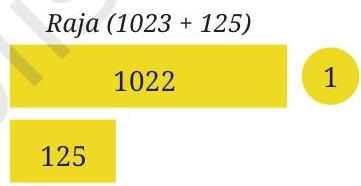
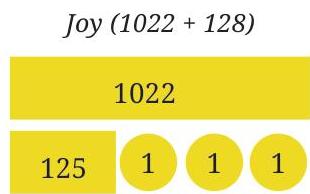
$ 1023 + 125 < 1022 + 128. $
Example 3: Which is greater? $113 - 25$ or $112 - 24$?
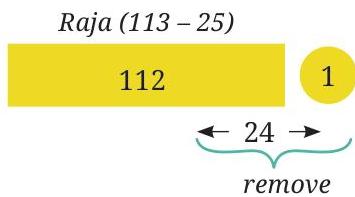
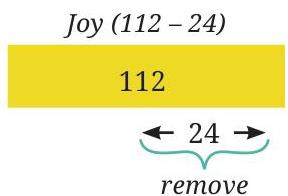
Consider a scenario: Raja possessed 113 marbles and subsequently lost 25, resulting in $113 - 25$ marbles remaining. Concurrently, Joy started with 112 marbles and forfeited 24 on the same day, leaving him with $112 - 24$ marbles. The question arises: who retains a larger quantity of marbles?
Initially, Raja's marble count exceeded Joy's by a single marble. However, Raja's loss also surpassed Joy's by one marble. Consequently, their current marble holdings are identical.
That is,
$ 113 - 25 = 112 - 24. $
Ganita Prakash | Grade 7
? For each of the ensuing expressions, insert ‘>’, ‘<’, or ‘=’ to establish a comparison. Is it possible to accomplish this without resorting to intricate computations? Justify your reasoning for each instance.
(a) 245 + 289 ☐ 246 + 285 (b) 273 - 145 ☐ 272 - 144 (c) 364 + 587 ☐ 363 + 589 (d) 124 + 245 ☐ 129 + 245 (e) 213 - 77 ☐ 214 - 76
2.2 Reading and Evaluating Complex Expressions
Occasionally, an expression presented without an accompanying context may permit multiple interpretations regarding its value. Under these circumstances, a defined set of tools and regulations becomes essential to precisely dictate the method of its evaluation.
To illustrate this concept using linguistic examples, consider the subsequent sentences:
(a) Statement: “Shalini sat next to a friend with toys”.
Interpretation: The friend possesses the toys, and Shalini occupied a position adjacent to her.



(b) Statement: “Shalini sat next to a friend, with toys”.
Interpretation: Shalini is in possession of the toys, and she positioned herself with them beside her friend.
Lacking proper punctuation, this particular sentence could have been construed in two distinct manners. The judicious application of a comma unequivocally defines the intended comprehension of the statement.
Let us now examine an expression amenable to multiple methods of evaluation.
? Illustrative Case 4: Mallesh conveyed 30 marbles to the recreational area. Arun, in parallel, transported 5 bags, each containing 4 marbles. What is the cumulative quantity of marbles brought to the playground by Mallesh and Arun?
Mallesh encapsulated this scenario by formulating the mathematical expression —
$ 30 + 5 \times 4. $
Arithmetic Expressions
Lacking awareness of the contextual background for this expression, Purna determined its value to be 140. His process involved initially summing 30 and 5, yielding 35, and subsequently multiplying this result by 4 to arrive at 140.
Conversely, Mallesh ascertained the expression's value as 50. He commenced by multiplying 5 by 4, obtaining 20, and then augmented 30 with this product to achieve 50.
In this particular instance, Mallesh's calculation is correct. However, what accounts for Purna's erroneous outcome?
Solely by observing the expression $30 + 5 \times 4$, the precedence of operations—whether addition or multiplication should be performed first—is ambiguous.
Analogous to how punctuation marks serve to clarify ambiguities in linguistic constructs, parentheses and the concept of terms are employed in mathematics to dispel uncertainties during the evaluation of expressions.
Brackets in Expressions
To determine the total count of marbles, represented by the expression $30 + 5 \times 4$, it was necessary to first compute the product of 5 and 4, subsequently adding this result to 30. The application of parentheses serves to explicitly define this operational sequence, as illustrated below:
$ 30 + (5 \times 4). $
When assessing an algebraic expression that incorporates parentheses, the initial step involves calculating the values contained within these parentheses prior to executing any other operations. Consequently, in the given expression, one must first ascertain the product of $5 \times 4$, followed by the addition. Hence, this expression accurately represents the marble quantity:
$ 30 + (5 \times 4) = 30 + 20 = 50. $
Example 5: Irfan purchased a packet of biscuits for ₹15 and a packet of toor dal for ₹56. He presented ₹100 to the vendor. Formulate an expression that facilitates the computation of the change Irfan is due from the vendor.
Irfan's expenditure amounted to ₹15 for the biscuits and ₹56 for the toor dal. Therefore, the aggregate cost in rupees totals $15 + 56$. He tendered ₹100 to the vendor. Consequently, he ought to receive 100 less the cumulative cost. Is it permissible to represent this expression as—
$ 100 - 15 + 56? $
Should we initially deduct 15 from 100 and subsequently add 56 to the resulting figure? Doing so would yield 141. It is illogical for him to receive an amount greater than what he initially paid the vendor!
In such a scenario, the inclusion of parentheses is appropriate:
$ 100 - (15 + 56). $
By first evaluating the terms enclosed within the parentheses, we obtain 100 diminished by 71, which results in 29. Thus, Irfan will receive ₹29 as change.
Terms in Expressions
Consider the algebraic expression $30 + 5 \times 4$, presented without explicit parentheses. Is such an expression inherently ambiguous or devoid of interpretability?
In instances where expressions encompass a multiplicity of operations, and the sequential execution of these operations is not delineated by grouping symbols, the concept of terms is employed to establish the precedence of calculations.
A term is defined as a constituent component of an expression, demarcated by a positive addition operator. For instance, within the expression $12 + 7$, the individual terms are 12 and 7, as visually indicated below.
$ 12 + 7 = \boxed{12} + \boxed{7} $
For pedagogical clarity, we shall continue to delineate each term within an expression in the aforementioned manner. It should be noted that this specific method of term demarcation is not standard practice in general mathematical notation but is utilized here to facilitate comprehension of the concept.
Subsequently, let us consider the identification of terms within the expression $83 - 14$. It is a fundamental principle that the operation of subtracting a number is mathematically equivalent to the addition of its additive inverse. To reiterate, the additive inverse of a given number possesses the opposite sign; for instance, the additive inverse of 14 is -14, and conversely, the additive inverse of -14 is 14. Consequently, the act of subtracting 14 from 83 can be rephrased as the addition of -14 to 83. This can be represented as:
$ 83 - 14 = \boxed{83} + \boxed{-14} $
Therefore, the constituent terms of the expression $83 - 14$ are determined to be 83 and -14.
? Verify, through the examination of diverse examples, that the substitution of subtraction with addition via the additive inverse mechanism preserves the numerical value of the expression.
? Elucidate the rationale behind the equivalence of subtracting a number and adding its additive inverse, specifically leveraging the Token Model of integers as introduced in the Class 6 mathematics curriculum.

To facilitate the identification of terms, every instance of subtraction within an expression is systematically transformed into an addition operation, adhering to the methodology previously described.
Presented below are additional illustrations showcasing expressions and their corresponding terms:
$ \begin{array}{l} -18 - 3 = \boxed{-18} + \boxed{-3} \ 6 \times 5 + 3 = \boxed{6 \times 5} + \boxed{3} \ 2 - 10 + 4 \times 6 = \boxed{2} + \boxed{-10} + \boxed{4 \times 6} \ \end{array} $
It is important to observe that products such as $6 \times 5$ and $4 \times 6$ constitute singular terms, owing to the absence of an explicit addition operator within their structure. The subsequent table provides a series of expressions; your task is to complete the table accordingly.
Arithmetic Expressions
| Expression | Expression as the sum of its terms | Terms |
|---|---|---|
| 13 - 2 + 6 | 13 + -2 + 6 | 13, -2, 6 |
| 5 + 6 × 3 | ||
| 4 + 15 - 9 | ||
| 23 - 2 × 4 + 16 | ||
| 28 + 19 - 8 |
Our subsequent focus will be on elucidating the methodology by which terms are instrumental in establishing the correct sequence of operations, thereby enabling the accurate evaluation of an expression's numerical value.
We shall commence our examination with expressions that exclusively involve addition operations, specifically after all subtraction operations have been appropriately transformed into their additive equivalents.
? Does an alteration in the sequence by which the individual terms are summed result in a modification of the expression's aggregate value?
Swapping and Grouping
We begin by considering a basic expression containing only two terms.
? Example 6: Madhu operates a drone from a rooftop. The drone ascends 6 meters and subsequently descends 4 meters. Construct an expression that represents the drone's ultimate height relative to the terrace.
The drone's final elevation is $6 - 4 = 2\mathrm{m}$ above the terrace. Expressed as a sum of terms:
$ 6 + -4 = 2 $
Does altering the order of these terms affect their sum?
$ -4 + 6 = 2 $
In this particular instance, it does not.
It is already established that interchanging the positions of terms does not alter the sum when both terms are positive integers.
? Does this principle remain valid when expressions include negative numbers? Investigate this by evaluating additional expressions.
? Utilizing the Token Model of integers, as introduced in the Class 6 mathematics textbook, can you elucidate the underlying reason for this phenomenon?

Consequently, for an expression composed of two terms, their interchangeability does not affect the overall value.
$ \boxed{\text{Term 1}} + \boxed{\text{Term 2}} = \boxed{\text{Term 2}} + \boxed{\text{Term 1}} $
Next, let us examine an expression with three terms: $(-7) + 10 + (-11)$. We will compute the sum of these terms using two distinct sequences of operation:
$ \boxed{-7} + \boxed{10} + \boxed{-11} $
(by first summing the initial two terms, and subsequently adding this partial sum to the third term)
$ \boxed{-7} + \boxed{10} + \boxed{-11} $
(by first summing the final two terms, and then adding this partial sum to the first term)
What observation can be made? The resulting sums are identical in both scenarios.
It is already established that when performing addition with positive numbers, arranging them into groups in either of the aforementioned manners yields an identical sum.
? Does this property extend to expressions that include negative numbers? Test this hypothesis with additional examples.
? Can you provide an explanation for this occurrence by referring to the Token Model of integers, as presented in the Class 6 mathematics textbook?

Therefore, organizing the terms within an expression according to either of the subsequent methods results in an identical value.
$ \boxed{\text{Term 1}} + \boxed{\text{Term 2}} + \boxed{\text{Term 3}} = \boxed{\text{Term 1}} + \boxed{\text{Term 2}} + \boxed{\text{Term 3}} $
Let's revisit the expression $(-7) + 10 + (-11)$. What outcome arises if we alter the sequence of operations, initially summing $-7$ and $-11$, and then adding this result to $10$? Will the sum obtained be consistent with the previous calculations?
It is observed that combining the terms of the expression $(-7) + 10 + (-11)$ in any arbitrary sequence invariably yields the same total of $-8$.
Arithmetic Expressions
? Is it true that arranging the terms of an expression in any sequence still results in an identical final value? Explore this by examining additional expressions, including those containing more than three terms.
? Referring to the Token Model of integers, which was introduced in the Class 6 mathematics textbook, can you provide a rationale for this phenomenon?

The Order of Addition Does Not Alter the Sum
Consequently, for any expression composed exclusively of additive operations, the sequence in which its constituent terms are combined is inconsequential; the resultant sum invariably remains constant.
Next, we shall examine expressions that incorporate both multiplication and division, in contexts where the operational hierarchy is not explicitly dictated by parentheses. The numerical outcome of such expressions is ascertained by initially assessing each individual term. Subsequent to the complete evaluation of all terms, these computed values are then aggregated.
Consider, for instance, the expression $30 + 5 \times 4$, which is computed in the following manner:
$ 30 + 5 \times 4 = \boxed{30} + \boxed{5 \times 4} = \boxed{30} + \boxed{20} = \boxed{50} $
The calculation of the expression $5 \times (3 + 2) + 7 \times 8 + 3$ proceeds as follows:
$ 5 \times (3 + 2) + 7 \times 8 + 3 = \boxed{5 \times (3 + 2)} + \boxed{7 \times 8} + \boxed{3} $
Here, the parenthetical component $(3 + 2)$ is initially computed, and its resultant sum is subsequently multiplied by 5, yielding 25. Concurrently, the product $7 \times 8$ is determined, resulting in 56. This process simplifies the overall expression to $25 + 56 + 3$, which totals 84.
? Consider the scenario: Manasa is compiling a lengthy numerical list. After investing five minutes to sum these figures, she arrived at a total of 11749. Subsequently, she discovered an omission, specifically the fourth number, 9055. Is it necessary for her to recommence the entire summation process?
1342 774 8611 9055 1022
Within mathematical discourse, the concept that "interchanging the positions of terms does not alter the sum" is formally designated as the commutative property of addition. Analogously, the principle that "the manner in which terms are grouped for summation does not affect the total" is referred to as the associative property of addition.
Swapping the Order of Things in Everyday Life
? Manasa is preparing to go play outdoors. Her mother instructs her, “Put on your hat and shoes!” Which item should she put on first? She has the option to don her hat before her shoes, or she can put on her shoes first, then her hat.
In either sequence, Manasa's appearance will be identical. Consider a different scenario: Manasa’s mother tells her, “Wear your socks and shoes!” In this instance, the

sequence is crucial. She must wear her socks prior to her shoes. If she were to put on her shoes before her socks, Manasa would experience significant discomfort and her appearance would be markedly different.
More Expressions and Their Terms
Example 7: Amu, Charan, Madhu, and John visited a restaurant and ordered four dosas. Each dosa had a price of ₹23, and they decided to give a ₹5 tip to the waiter. Construct an expression that represents the total expenditure.
$ \text{Cost of 4 dosas} = 4 \times 23 $
Can the overall sum, including the tip, be represented as $4 \times 23 + 5$? Upon evaluation, we derive:
$ 4 \times 23 + 5 = \boxed{4 \times 23} + \boxed{5} = \boxed{92} + \boxed{5} = \boxed{97} $
Consequently, $4 \times 23 + 5$ constitutes a valid representation for this expression.
Should the total number of companions increase to 7, while the gratuity remains unchanged, what would be their total payment? Devise an expression for this circumstance and identify its constituent terms.
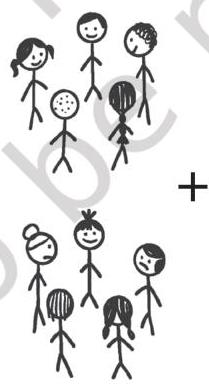
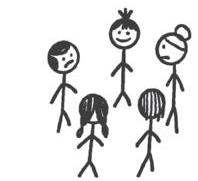
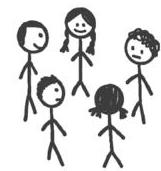
Example 8: Students in a classroom are engaged in a game called "Fire in the mountain, run, run, run!". Whenever the instructor announces a number, the students are required to form groups corresponding to that numerical value. Any student who does not become part of an appropriately sized group is eliminated from the game.
Ruby chose to rest, sitting apart from the activity. The remaining 33 students in the class were participating in the game.
The instructor called out '5'. After the children had arranged themselves, Ruby recorded $6 \times 5 + 3$
(which signifies 3 more than the product of $6 \times 5$)
Ponder and discuss the rationale behind her notation.
The expression, articulated as a sum of its components, is—
$ \boxed{6 \times 5} + \boxed{3}. $

Arithmetic Expressions
? For each of the cases below, write the expression and identify its terms: If the teacher had called out '4', Ruby would write __________ If the teacher had called out '7', Ruby would write __________ Write expressions like the above for your class size.
? Example 9: Raghu acquired 100 kg of rice from a wholesale vendor and subsequently packaged it into 2 kg packets. He already possessed four 2 kg packets. Formulate an expression representing the current quantity of 2 kg rice packets he owns, and specify its terms.
He had 4 packets. The number of new 2 kg packets of rice is 100 ÷ 2, which we also write as $\frac{100}{2}$.
The number of 2 kg packets he has now is $4 + \frac{100}{2}$. The terms are—
$ \boxed{4} + \boxed{\frac{100}{2}}. $
? Example 10: Kannan has to pay ₹432 to a shopkeeper using coins of ₹1 and ₹5, and notes of ₹10, ₹20, ₹50 and ₹100. How can he do it?
There is more than one possibility. For example,
$ 432 = 4 \times 100 + 1 \times 20 + 1 \times 10 + 2 \times 1 $
Meaning: 4 notes of ₹100, 1 note of ₹20, 1 note of ₹10 and 2 notes of ₹1
$ 432 = 8 \times 50 + 1 \times 10 + 4 \times 5 + 2 \times 1 $
Meaning: 8 notes of ₹50, 1 note of ₹10, 4 notes of ₹5 and 2 notes of ₹1
? Identify the terms in the two expressions above.
? Can you think of some more ways of giving ₹432 to someone?
? Example 11: Here are two pictures. Which of these two arrangements matches with the expression $5 \times 2 + 3$?
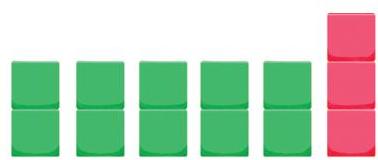

Let us write this expression as a sum of terms.
$ (5 \times 2) + (3) = (10) + (3) = (13) $
This expression $5 \times 2 + 3$ can be understood as 3 more than $5 \times 2$, which describes the arrangement on the left.
? What is the expression for the arrangement in the right making use of the number of yellow and blue squares?
Do you recall the use of brackets? We need to use brackets for this.
$ 2 \times (5 + 3) $
Notice that this arrangement can also be described using—
$ \begin{array}{c} 5 + 3 + 5 + 3 \ \text{OR} \ 5 \times 2 + 3 \times 2 \end{array} $
Figure it Out
Find the values of the following expressions by writing the terms in each case.
(a) $28 - 7 + 8$
(b) $39 - 2 \times 6 + 11$
(c) $40 - 10 + 10 + 10$
(d) $48 - 10 \times 2 + 16 \div 2$
(e) $6 \times 3 - 4 \times 8 \times 5$
Write a story/situation for each of the following expressions and find their values.
(a) $89 + 21 - 10$
(b) $5 \times 12 - 6$
(c) $4 \times 9 + 2 \times 6$
For each of the following situations, write the expression describing the situation, identify its terms and find the value of the expression.
(a) Queen Alia gave 100 gold coins to Princess Elsa and 100 gold coins to Princess Anna last year. Princess Elsa used the coins to start a business and doubled her coins. Princess Anna bought jewellery and has only half of the coins left. Write an expression describing how many gold coins Princess Elsa and Princess Anna together have.
(b) A metro train ticket between two stations is ₹40 for an adult and ₹20 for a child. What is the total cost of tickets:
(i) for four adults and three children?
(ii) for two groups having three adults each?
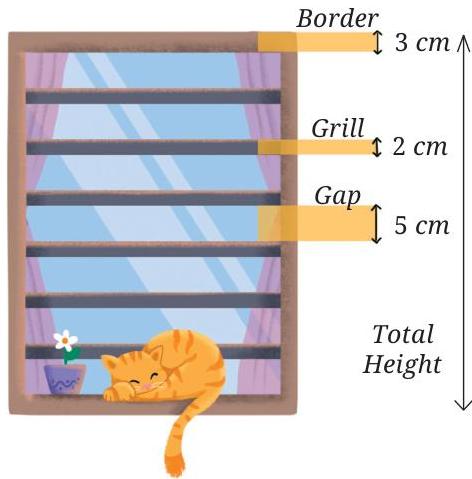
(c) Find the total height of the window by writing an expression describing the relationship among the measurements shown in the picture.
Removing Brackets—I
Let us determine the value of the following expression:
$ 200 - (40 + 3). $
One method involves first computing the sum inside the bracket, 43, and then subtracting this from 200. An alternative, often more direct, approach is to sequentially subtract the components. First, subtract 40 from 200:
$ 200 - 40 = 160. $
Next, subtract 3 from the result, 160:
$ 160 - 3 = 157. $
The procedure employed here was $200 - 40 - 3$. It is important to observe that this is distinct from performing the operation as
$ 200 - 40 + 3. $
Thus, we establish the relationship:
$ 200 - (40 + 3) = 200 - 40 - 3. $
? Example 12: This principle was previously illustrated in the scenario where Irfan acquired a biscuit packet (₹15) and a toor dal packet (₹56). Upon tendering ₹100, the monetary change he received is represented by:
$ 100 - (15 + 56) = 29. $
The calculation of this change can also be approached in the following manner:
(a) Initially, deduct the cost of the biscuit packet (15) from the ₹100 paid:
$ 100 - 15 = 85. $
This sum represents the amount the vendor would owe Irfan had he exclusively purchased the biscuits. Since toor dal was also bought, its expense must be deducted from this residual amount of 85.
(b) Consequently, to ascertain the final change, the cost of the toor dal is subtracted from 85:
$ 85 - 56 = 29. $
The operations performed here are $100 - 15 - 56$. Hence, the equivalence is established as:
$ 100 - (15 + 56) = 100 - 15 - 56. $
It is noteworthy that when parentheses are removed following a negative sign, the algebraic signs of the constituent terms within those parentheses are inverted. Observe:
the signs of 40 and 3 in the initial illustration, and similarly for 15 and 56 in the subsequent one.
Example 13: Let us examine the expression $500 - (250 - 100)$. Can this expression be rewritten without the use of parentheses?
To determine the value of this expression, it is necessary to subtract the result of $250 - 100 = 150$ from $500$:
$ 500 - (250 - 100) = 500 - 150 = 350. $
Should one proceed by directly subtracting 250 from 500, an excess of 100 would have been subtracted beyond what was required. Therefore, it becomes essential to re-introduce that 100 by adding it back to the result of $500 - 250$ to ensure the expression retains its original value, which is $500 - (250 - 100)$. This sequence of arithmetic operations is $500 - 250 + 100$. Consequently,
$ 500 - (250 - 100) = 500 - 250 + 100. $
Verify that $500 - (250 - 100)$ is not equivalent to $500 - 250 - 100$.
Once more, observe that when parentheses are removed, and they are preceded by a negative sign, the signs of the terms enclosed within them are altered. Specifically, in this instance, the signs of 250 and -100 transform into -250 and 100, respectively.
Example 14: Hira possesses a collection of rare coins. She stores 28 coins in one container and 35 coins in a separate container. She then bestows 10 coins from the second container upon a friend. Formulate an expression that represents the total number of coins Hira retains.
This scenario can be represented mathematically as $28 + (35 - 10)$.
It is understood that this expression is equivalent to $28 + (35 + (-10))$. Given the commutative property of addition, allowing terms to be summed in any sequence, this expression can be straightforwardly rendered as $28 + 35 + (-10)$, or more simply, $28 + 35 - 10$. Consequently,
$ 28 + (35 - 10) = 28 + 35 - 10 = 53. $
Crucially, when parentheses are not preceded by a negative sign, the algebraic signs of the terms enclosed within them remain unaltered when the parentheses are removed. Observe the signs of the terms 35 and -10 in the expression provided above.
Instead of merely memorizing conventions regarding sign alteration, one can deduce these principles by contemplating the underlying meaning of the mathematical expressions.
Tinker the Terms I
How does altering a single term within an algebraic expression—either by incrementing or decrementing its value—affect the overall outcome of that expression?
Observe the expressions presented across the subsequent three columns. Within each column, one or more components of the initial expression have been modified. Review the provided example (located in the first column) and complete the empty fields, striving to minimize direct calculation.
Arithmetic Expressions
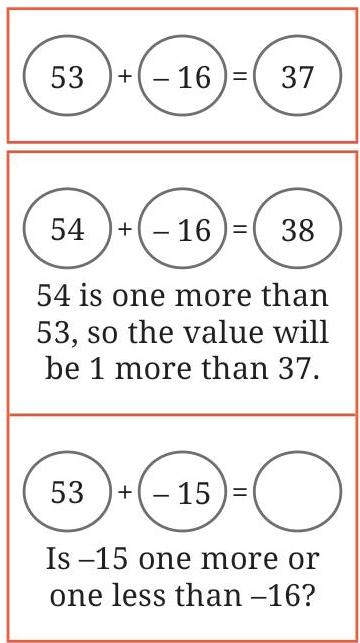
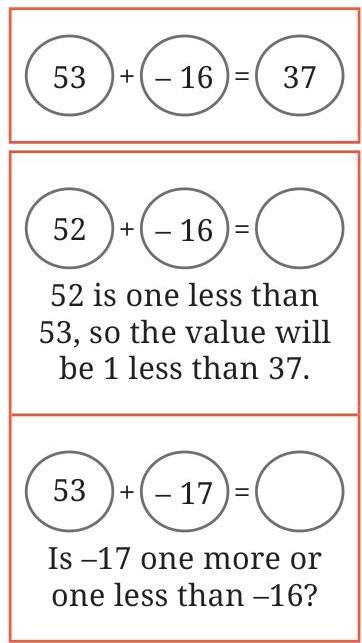
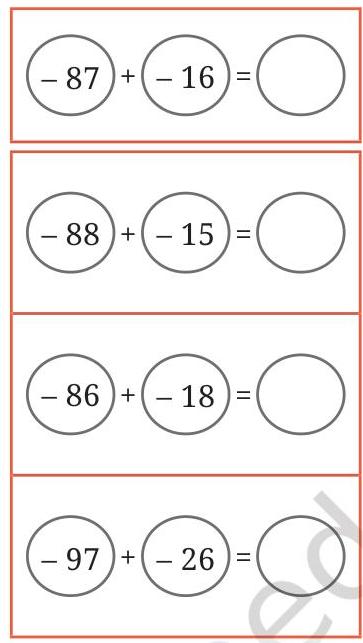
Figure it Out
Complete the empty spaces with appropriate numerical values and the boxes with suitable arithmetic operators to ensure equivalence between the expressions on both sides of the equality.
(a) $24 + (6 - 4) = 24 + 6$ (b) $38 + (\underline{\quad}) = 38 + 9 - 4$ (c) $24 - (6 + 4) = 24 \text{ [op] } 6 \text{ [op] } 4$ (d) $24 - 6 - 4 = 24 - 6$ (e) $27 - (8 + 3) = 27 \text{ [op] } 8 \text{ [op] } 3$ (f) $27 - (\underline{\quad}) = 27 - 8 + 3$
Eliminate the parenthetical groupings and reformulate each expression to retain its equivalent numerical value.
(a) $14 + (12 + 10)$ (b) $14 - (12 + 10)$ (c) $14 + (12 - 10)$ (d) $14 - (12 - 10)$ (e) $-14 + 12 - 10$ (f) $14 - (-12 - 10)$
Ascertain the numerical outcomes for the subsequent expressions. For each given pair, initially hypothesize if their values are identical. Under what conditions do these two expressions yield equivalent results?
(a) $(6 + 10) - 2$ and $6 + (10 - 2)$ (b) $16 - (8 - 3)$ and $(16 - 8) - 3$ (c) $27 - (18 + 4)$ and $27 + (-18 - 4)$
Within each collection of expressions provided below, discern those that possess equivalent values. Refrain from direct computation; instead, leverage your comprehension of algebraic terms and their properties.
(a) $319 + 537, 319 - 537, -537 + 319, 537 - 319$ (b) $87 + 46 - 109, 87 + 46 - 109, 87 + 46 - 109, 87 - 46 + 109, 87 - (46 + 109), (87 - 46) + 109$
Insert parentheses strategically within the given expressions to ensure they resolve to the specified target values.
(a) $34 - 9 + 12 = 13$ (b) $56 - 14 - 8 = 34$ (c) $-22 - 12 + 10 + 22 = -22$
Employing solely an understanding of how individual terms influence overall expression values, complete the empty spaces to establish equivalence between the expressions flanking the equality symbol $(=)$.
(a) $423 + _ = 419 + _$ (b) $207 - 68 = 210 - _$
Construct various expressions utilizing the numerals 2, 3, and 5, along with the arithmetic operators $+$ and $-$ , incorporating parentheses as required, to yield the maximum possible number of distinct numerical outcomes. Illustrative examples include $2 - 3 + 5 = 4$ and $3 - (5 - 2) = 0$ .
When Jasoda needs to perform a subtraction of 9 from any given number, her method involves first subtracting 10 and subsequently adding 1 to the result. An instance of this approach is $36 - 9 = 26 + 1$ .
(a) Do you think she always gets the correct answer? Why? (b) Can you think of other similar strategies? Give some examples.
Examine the pair of expressions: a) $73 - 14 + 1$ , and b) $73 - 14 - 1$ . For each of these, select the equivalent expressions from the subsequent list.
(a) $73 - (14 + 1)$ (b) $73 - (14 - 1)$ (c) $73 + (-14 + 1)$ (d) $73 + (-14 - 1)$
Removing Brackets—II
? Example 15: Lhamo and Norbu visited a hotel. Each individual ordered a vegetable cutlet and a rasgulla. A vegetable cutlet is priced at ₹43, and a rasgulla costs ₹24. Formulate an expression representing the total amount they are required to pay.
Given that each person consumed one vegetable cutlet and one rasgulla, their respective expenditure can be expressed as $43 + 24$.
? Considering the aggregate amount they are obligated to pay, would the expression: $2 \times 43 + 24$ accurately represent this total?
Decomposing this into a summation of terms yields:
$ \boxed{2 \times 43} + \boxed{24} $
This particular expression signifies a value that is 24 greater than $2 \times 43$. However, our objective is to formulate an expression that denotes precisely twice the quantity of $43 + 24$.
To construct such an expression, the utilization of parentheses is appropriate:
$ 2 \times (43 + 24). $
Consequently, their collective payment can be articulated as $2 \times (43 + 24)$. This is equivalently represented by the cost associated with purchasing two vegetable cutlets and two rasgullas:
$ 2 \times 43 + 2 \times 24. $
Thus, it follows that:
$ 2 \times (43 + 24) = 2 \times 43 + 2 \times 24. $
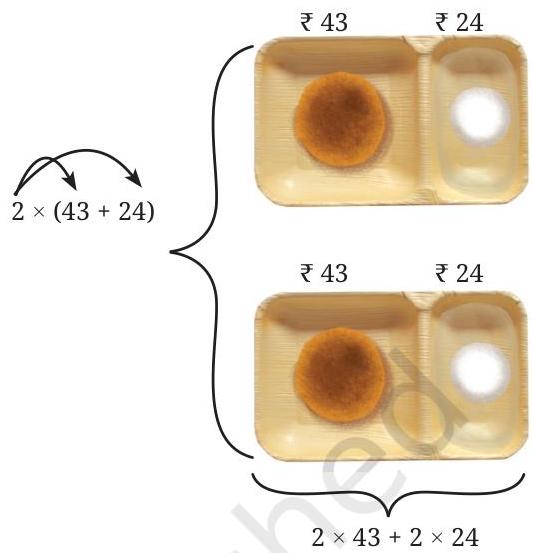
? Should an additional companion, Sangmu, join the group and procure identical items, what mathematical expression would represent the revised total expenditure?
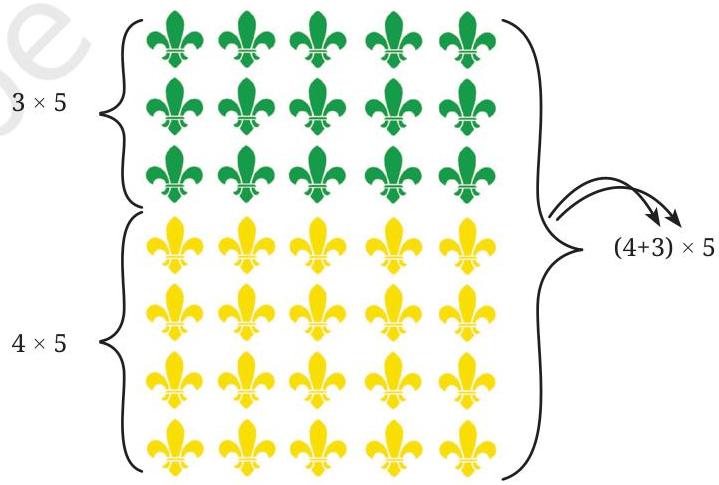
? Example 16: During the Republic Day parade, boy scouts and girl guides participate collectively. The scouts are arranged in 4 rows, each comprising 5 scouts. Concurrently, the guides form 3 rows, with 5 guides in each (refer to the illustration provided). Determine the total count of scouts and guides participating in this parade.
The contingent of boy scouts marching totals $4 \times 5$. Similarly, the number of girl guides marching amounts to $3 \times 5$.
The aggregate count of scouts and guides will therefore be $4 \times 5 + 3 \times 5$.
Alternatively, this sum can be ascertained by initially calculating the cumulative number of rows, specifically $4 + 3$, and subsequently multiplying this collective sum by the consistent number of children present in each row. Hence, the combined count of boys and girls can be determined via $(4 + 3) \times 5$.
Consequently, it holds that $4 \times 5 + 3 \times 5 = (4 + 3) \times 5$.
Upon evaluating these expressions, we obtain:
$ 4 \times 5 + 3 \times 5 = \boxed{4 \times 5} + \boxed{3 \times 5} = \boxed{20} + \boxed{15} = \boxed{35} $
$ (4 + 3) \times 5 = 7 \times 5 = 35 $
? Is it possible to elucidate why $5 \times 4 + 3 \neq 5 \times (4 + 3)$?
$ \operatorname {Is} 5 \times (4 + 3) = 5 \times (3 + 4) = (3 + 4) \times 5? $
The insights derived from the preceding two illustrative instances can be conceptualized in a generalized manner as presented below.
Let us examine the expression $10 \times 98 + 3 \times 98$. This implicitly signifies the aggregation of 10 multiplied by 98 and 3 multiplied by 98.

Evidently, this is equivalent to $10 + 3 = 13$ times 98. Consequently,
$ 10 \times 98 + 3 \times 98 = (10 + 3) \times 98. $
Inverting the presentation of this equality, we arrive at:
$ (10 + 3) 98 = 10 \times 98 + 3 \times 98. $
This property, demonstrating how multiplication interacts with addition and subtraction, can be formalized as follows:
$ 98 \times 10 + 98 \times 3 = 98 (10 + 3), \text { and} $
$ 98 (10 + 3) = 98 \times 10 + 98 \times 3. $
Consider, by analogy, the expression $14 \times 10 - 6 \times 10$. This operation involves deducting the product of 6 and 10 from the product of 14 and 10.

It is clear that this simplifies to $(14 - 6)$ multiplied by 10. Hence, we establish:
$ 14 \times 10 - 6 \times 10 = (14 - 6) \times 10, $
or conversely,
$ (14 - 6) \times 10 = 14 \times 10 - 6 \times 10 $
This characteristic can be precisely summarized:
The multiple of a sum (or difference) is equivalent to the sum (or difference) of the individual multiples.
Tinker the Terms II
We shall now investigate the implications of altering the numerical components within a product.
Arithmetic Expressions
Example 17: Given $53 \times 18 = 954$. Determine the value of $63 \times 18$.
Considering that $63 \times 18$ represents 63 multiplied by 18, we can proceed as follows:
$ \begin{array}{l} 63 \times 18 = (53 + 10) \times 18 \ = 53 \times 18 + 10 \times 18 \ = 954 + 180 \ = 1134. \end{array} $
Example 18: Devise an efficient method for evaluating $97 \times 25$.
The expression $97 \times 25$ denotes the product of 97 and 25.
This can be re-expressed as $(100 - 3) \times 25$.
It is understood that this is equivalent to the difference between the product of 100 and 25 and the product of 3 and 25:
$ 97 \times 25 = 100 \times 25 - 3 \times 25 $
Calculate this value.
Employ this approach to compute the following products:
(a) $95 \times 8$ (b) $104 \times 15$ (c) $49 \times 50$
Does this technique offer a more rapid calculation than your customary multiplication procedure?
What other products might lend themselves to quicker evaluation using a similar strategy?
Math Talk
Figure it Out
Complete the given expressions by inserting appropriate numerical values into the blank spaces and operational symbols into the designated boxes, ensuring mathematical equivalence between the left-hand and right-hand sides of each statement.
(a) $3 \times (6 + 7) = 3 \times 6 + 3 \times 7$ (b) $(8 + 3) \times 4 = 8 \times 4 + 3 \times 4$ (c) $3 \times (5 + 8) = 3 \times 5 \quad 3 \times$ (d) $(9 + 2) \times 4 = 9 \times 4 \quad 2 \times$ (e) $3 \times (_ + 4) = 3 _ + _$ (f) $(_ + 6) \times 4 = 13 \times 4 + _$ (g) $3 \times (_ + _) = 3 \times 5 + 3 \times 2$ (h) $(_ + _) \times _ = 2 \times 4 + 3 \times 4$ (i) $5 \times (9 - 2) = 5 \times 9 - 5 \times$ (j) $(5 - 2) \times 7 = 5 \times 7 - 2 \times$ (k) $5 \times (8 - 3) = 5 \times 8 \quad 5 \times$ (l) $(8 - 3) \times 7 = 8 \times 7 \quad 3 \times 7$ (m) $5 \times (12 - \underline{\hspace{1cm}}) = \underline{\hspace{1cm}}$ 5 × (n) $(15 - \underline{\hspace{1cm}}) \times 7 = \underline{\hspace{1cm}}$ 6 × 7 (o) $5 \times (\underline{\hspace{1cm}} - \underline{\hspace{1cm}}) = 5 \times 9 - 5 \times 4$ (p) $(\underline{\hspace{1cm}} - \underline{\hspace{1cm}}) \times \underline{\hspace{1cm}} = 17 \times 7 - 9 \times 7$
For each pair of expressions presented, insert the appropriate relational symbol ('<', '>', or '=') into the designated box. This determination should be based on a thorough analysis of the expressions' structural properties, including the order of operations and the role of parentheses, rather than through direct numerical computation.
(a) $(8 - 3) \times 29$ ☐ $(3 - 8) \times 29$ (b) $15 + 9 \times 18$ $\quad$ $(15 + 9) \times 18$ (c) $23 \times (17 - 9)$ $\quad$ $23 \times 17 + 23 \times 9$ (d) $(34 - 28) \times 42$ $\quad$ $34 \times 42 - 28 \times 42$
An illustrative method for achieving the sum of 14 is provided: $\underline{2} \times (\underline{1} + \underline{6}) = 14$. Identify and record additional distinct approaches to arrive at the same numerical outcome in the spaces provided.
(a) $\underline{\hspace{1cm}} \times (\underline{\hspace{1cm}} + \underline{\hspace{1cm}}) = 14$ (b) $\underline{\hspace{1cm}} \times (\underline{\hspace{1cm}} + \underline{\hspace{1cm}}) = 14$ (c) $\underline{\hspace{1cm}} \times (\underline{\hspace{1cm}} + \underline{\hspace{1cm}}) = 14$ (d) $\underline{\hspace{1cm}} \times (\underline{\hspace{1cm}} + \underline{\hspace{1cm}}) = 14$
Determine the total sum of the numerical values depicted in each subsequent image through a minimum of two distinct computational methodologies. Articulate the solution process for each method by formulating corresponding mathematical expressions.
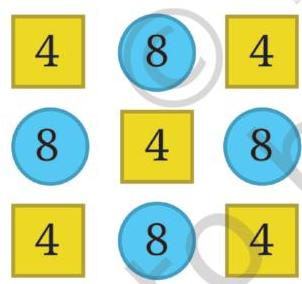
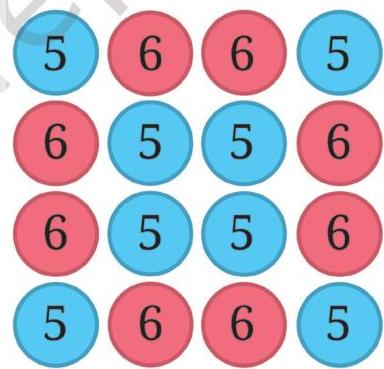
Figure it Out
Analyze the following scenarios. For each, formulate a suitable mathematical expression and subsequently determine its numerical result.
(a) The Begur district market operates daily throughout the week. Rahim delivers $9\mathrm{kg}$ of mangoes from his orchard each day, while Shyam provides $11\mathrm{kg}$ of mangoes daily from his orchard to the same market. Calculate the total quantity of mangoes they collectively supply to the local district market over one week.
(b) Binu's monthly income is ₹20,000. Her monthly expenditures include ₹5,000 for rent, ₹5,000 for food, and ₹2,000 for miscellaneous costs. Determine Binu's total savings over a period of one year.
(c) A snail ascends a post by 3 cm during daylight hours but inadvertently slides down 2 cm each night while dormant. The post measures 10 cm in height, with an enticing delicacy positioned at its apex. Calculate the number of days required for the snail to reach the treat.
Melvin reads a two-page narrative daily, excluding Tuesdays and Saturdays. Over an 8-week period, how many narratives will he have finished? Identify which of the subsequent expressions accurately models this situation.
(a) $5 \times 2 \times 8$ (b) $(7 - 2) \times 8$ (c) $8 \times 7$ (d) $7 \times 2 \times 8$ (e) $7 \times 5 - 2$ (f) $(7 + 2) \times 8$ (g) $7 \times 8 - 2 \times 8$ (h) $(7 - 5) \times 8$
Determine alternative methodologies for computing the values of the subsequent expressions:
(a) $1 - 2 + 3 - 4 + 5 - 6 + 7 - 8 + 9 - 10$ (b) $1 - 1 + 1 - 1 + 1 - 1 + 1 - 1 + 1 - 1$
Juxtapose the ensuing pairs of expressions, employing the relational operators
Personal 1:1 AI Tutor for CBSE, JEE & NEET Students
YoLearn.AI is India's #1 AI tutoring platform for Class 1 to 12, JEE, and NEET preparation. Students talk to expert AI tutors in real time through live voice calls, solve doubts instantly on an interactive sketch board, and practice with mock tests, flashcards, quizzes, and slide decks. Learn from top educators including DC Pandey and other verified teachers who create AI avatars of themselves.
Live voice tutoring and doubt solving
Unlike text-only chatbots, YoLearn.AI lets you speak naturally to your AI tutor — just like a real one-on-one session. Get step-by-step explanations for Physics, Chemistry, Maths, and Biology for board exams, JEE Main, JEE Advanced, and NEET.
Mock tests, flashcards, and exam prep
Prepare for JEE 2026, NEET 2026, and CBSE board exams with personalized mock tests, AI-generated quizzes, and flashcard makers. Build daily study habits with an AI study buddy designed for Indian students.
For school, JEE, and NEET
Whether you need a Class 10 CBSE tutor, Class 12 board exam help, or full JEE and NEET coaching online, YoLearn.AI adapts to your grade, syllabus, and learning pace. Start free today on web, iOS, and Android.
Personal 1:1 AI Tutor for CBSE, JEE & NEET Students
YoLearn.AI is India's #1 AI tutoring platform for Class 1 to 12, JEE, and NEET preparation. Students talk to expert AI tutors in real time through live voice calls, solve doubts instantly on an interactive sketch board, and practice with mock tests, flashcards, quizzes, and slide decks. Learn from top educators including DC Pandey and other verified teachers who create AI avatars of themselves.
Live voice tutoring and doubt solving
Unlike text-only chatbots, YoLearn.AI lets you speak naturally to your AI tutor — just like a real one-on-one session. Get step-by-step explanations for Physics, Chemistry, Maths, and Biology for board exams, JEE Main, JEE Advanced, and NEET.
Mock tests, flashcards, and exam prep
Prepare for JEE 2026, NEET 2026, and CBSE board exams with personalized mock tests, AI-generated quizzes, and flashcard makers. Build daily study habits with an AI study buddy designed for Indian students.
For school, JEE, and NEET
Whether you need a Class 10 CBSE tutor, Class 12 board exam help, or full JEE and NEET coaching online, YoLearn.AI adapts to your grade, syllabus, and learning pace. Start free today on web, iOS, and Android.
(a) $49 - 7 + 8$ ☐ $49 - 7 + 8$ (b) $83 \times 42 - 18$ ☐ $83 \times 40 - 18$ (c) $145 - 17 \times 8$ ☐ $145 - 17 \times 6$ (d) $23 \times 48 - 35$ ☐ $23 \times (48 - 35)$ (e) $(16 - 11) \times 12$ ☐ $-11 \times 12 + 16 \times 12$ (f) $(76 - 53) \times 88$ ☐ $88 \times (53 - 76)$ (g) $25 \times (42 + 16)$ ☐ $25 \times (43 + 15)$ (h) $36 \times (28 - 16)$ ☐ $35 \times (27 - 15)$
Without performing any calculations, ascertain which of the subsequent expressions are equivalent to the provided expression. It is permissible to rephrase the expressions by manipulating terms or eliminating parentheses. Multiple expressions might possess the same value as the original.
(a) $83 - 37 - 12$
(i) $84 - 38 - 12$ (ii) $84 - (37 + 12)$ (iii) $83 - 38 - 13$ (iv) $-37 + 83 - 12$
(b) $93 + 37 \times 44 + 76$
(i) $37 + 93 \times 44 + 76$ (ii) $93 + 37 \times 76 + 44$ (iii) $(93 + 37) \times (44 + 76)$ (iv) $37 \times 44 + 93 + 76$
Select an arbitrary numerical value and then construct ten distinct expressions that resolve to that chosen value.
SUMMARY
- Our prior engagement involved interpreting and calculating straightforward expressions. This section commenced with a review of the definitions and numerical results of such basic expressions.
- We acquired proficiency in comparing specific expressions using logical deduction, thereby circumventing direct computation.
- To facilitate the comprehension and calculation of intricate expressions, we employ the conventions of terms and parentheses.
- In instances where an expression is formulated as a summation of terms, altering the sequence of these terms or re-grouping them does not affect the expression's overall value. This principle is attributed to the “commutative property of addition” and the “associative property of addition,” respectively.
- Pertaining to the evaluation of expressions enclosed in brackets, it was observed that when parentheses are removed following a negative sign, the algebraic signs of the enclosed terms are inverted.
- Furthermore, we explored the “distributive property,” which dictates that multiplying a numerical factor by an expression contained within brackets yields the same result as multiplying that factor by each individual term inside the brackets.

Diverse arithmetic expressions can be formulated by employing three instances of the digit 3, in conjunction with
the four fundamental operations (addition, subtraction, multiplication, and division) and parentheses as required. Illustrative examples include $(3 + 3)/3 = 2$, $3 + 3 - 3 = 3$, $3 \times 3 + 3 = 12$, among others.
Construct expressions utilizing four occurrences of the digit 4 to derive every integer value spanning the range from 1 to 20.
Employing the numbers 1, 2, 3, 4, and 5 precisely once each, in any sequence, determine the maximum feasible number of values situated between $-10$ and $+10$.
By utilizing each digit from 0 to 9 precisely once, in any arrangement, formulate an expression that evaluates to 100.
What additional intriguing questions, analogous to these, might be posed?