WORKING WITH FRACTIONS
0774CH08
8.1 Multiplication of Fractions
Consider Aaron, who covers a distance of 3 kilometers in a single hour. What total distance would he traverse over a period of 5 hours?
This scenario presents a straightforward calculation. To ascertain the total distance, one must compute the product of 5 and 3, signifying a direct multiplication.
Distance covered in 1 hour = 3 km.
Therefore,
$ \begin{array}{l} \text{Distance covered in 5 hours} \ = 5 \times 3 \text{ km} \ = 3 + 3 + 3 + 3 + 3 \text{ km} \ = 15 \text{ km}. \end{array} $
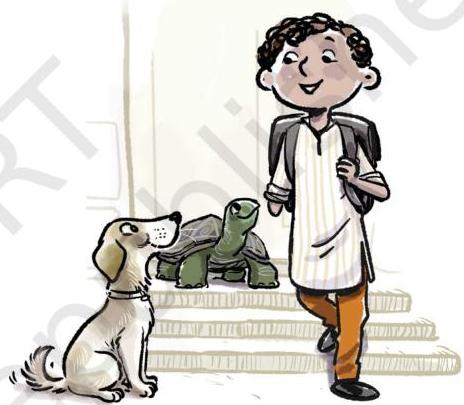
? Now, consider Aaron's pet tortoise, which moves considerably slower. It manages to cover merely $\frac{1}{4}$ of a kilometer in one hour. What distance would this tortoise travel over a duration of 3 hours?
In this instance, the hourly distance is expressed as a fraction. However, this distinction is inconsequential; the overall distance traversed is still determined through the identical method of multiplication.
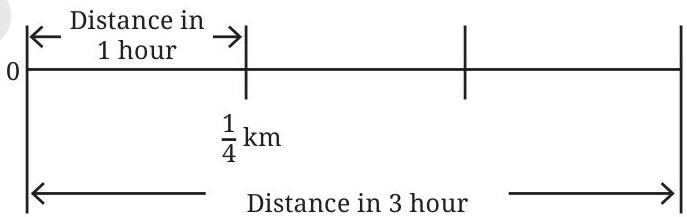
Distance covered in 1 hour = $\frac{1}{4}$ km.
Therefore, distance covered in 3 hours = $3 \times \frac{1}{4}$ km
$ \begin{array}{l} = \frac{1}{4} + \frac{1}{4} + \frac{1}{4} \text{ km} \ = \frac{3}{4} \text{ km}. \end{array} $
Thus, the tortoise is capable of covering a distance of $\frac{3}{4}$ km within 3 hours.
Now, let us examine a scenario where the duration of movement is itself a fractional part of an hour.
? Recall that Aaron traverses 3 kilometers in a single hour. What distance would he cover if he walked for only $\frac{1}{5}$ of an hour?
The methodology for determining the total distance remains consistent; it is still computed via multiplication.
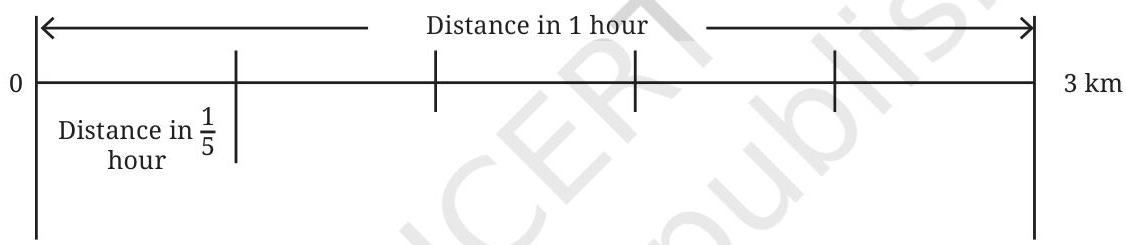
Distance covered in $\frac{1}{5}$ hours = $\frac{1}{5} \times 3$ km.
Determining the Product:
Given that the distance covered in one hour is 3 km.
For a duration of $\frac{1}{5}$ hours, the distance traversed is equivalent to partitioning $3\text{ km}$ into 5 equal segments, which yields $\frac{3}{5}\text{ km}$.
This demonstrates that $\frac{1}{5} \times 3 = \frac{3}{5}$.
? How far can Aaron walk in $\frac{2}{5}$ hours?
Working with Fractions
Our objective is to calculate the distance traversed:
Distance covered = $\frac{2}{5} \times 3$ km.
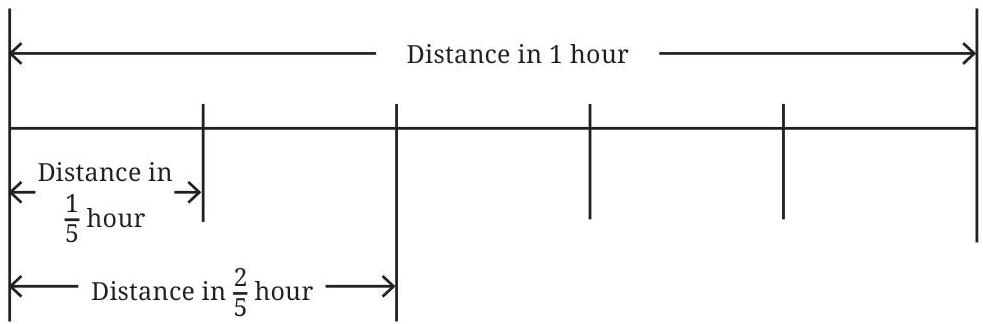
Determining the Product:
- First, we can calculate the distance traveled in $\frac{1}{5}$ of an hour.
- Since $\frac{2}{5}$ of an hour is twice the duration of $\frac{1}{5}$ of an hour, we will multiply this initial distance by 2 to find the total distance covered.
The calculation proceeds as follows.
Distance covered in 1 hour = 3 km.
Distance covered in $\frac{1}{5}$ hour
- This is the length obtained by dividing 3 km into 5 equal parts.
- $\frac{3}{5}$ km.
Multiplying this distance by 2 yields:
$ 2 \times \frac{3}{5} = \frac{6}{5} \text{ km}. $
Thus, it is apparent that
$ \frac{2}{5} \times 3 = \frac{6}{5}. $
Discussion
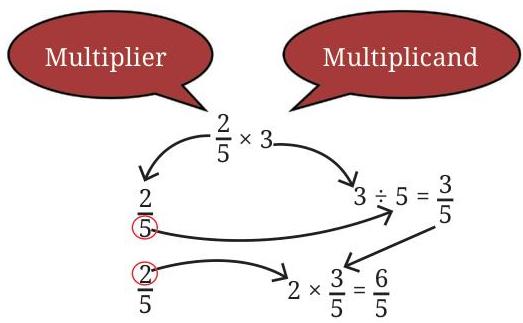
We performed this multiplication in the following manner:
- Initially, the multiplicand, which is 3, was divided by the denominator of the multiplier, 5, yielding $\frac{3}{5}$.
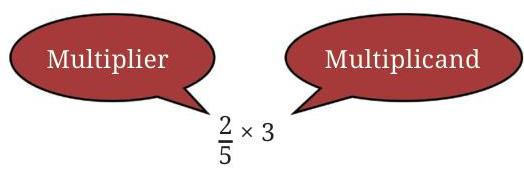
- Subsequently, this outcome was multiplied by the numerator of the multiplier, specifically 2, resulting in $\frac{6}{5}$.
Consequently, the procedure outlined above is applied whenever the multiplication of a fraction by a whole number is required.
? Illustration 1: A farmer possessed five grandchildren. She allocated $\frac{2}{3}$ acre of land to each of them.
What was the total acreage of land distributed to her grandchildren?
$ 5 \times \frac{2}{3} = \frac{2}{3} + \frac{2}{3} + \frac{2}{3} + \frac{2}{3} + \frac{2}{3} = \frac{10}{3}. $
? Illustration 2: One hour of internet access incurs a charge of ₹8. What would be the total expense for $1\frac{1}{4}$ hours of internet usage?
$1\frac{1}{4}$ hours can be expressed as $\frac{5}{4}$ hours, obtained by converting the mixed fraction.
The monetary value for $\frac{5}{4}$ hour of internet time is calculated as: $\frac{5}{4} \times 8$
$ \begin{array}{l} = 5 \times \frac{8}{4} \ = 5 \times 2 \ = 10. \end{array} $
Therefore, the total cost for $1\frac{1}{4}$ hours of internet time amounts to ₹10.
? Figure it Out
Each day, Tenzin consumes $\frac{1}{2}$ glass of milk. Determine the total quantity of milk he drinks over the course of a week. Additionally, calculate his total milk consumption for the entire month of January.
A construction crew is capable of building 1 kilometer of a water canal over an 8-day period. Consequently, in a single day, this team can complete ___ km of the water canal. Should they be operational for 5 days each week, what length of the water canal can they construct within one week?
Manju, along with two of her neighboring households, purchases 5 liters of cooking oil weekly, distributing it evenly among the three families. What volume of oil does each family receive per week? Furthermore, what total amount of oil would a single family obtain over a 4-week duration?
Safia observed the Moon setting at 10 p.m. on Monday. Her mother, a scientist, informed her that the Moon's setting time advances by $\frac{5}{6}$ of an hour each subsequent day. Calculate
how many hours past 10 p.m. the Moon will set on Thursday.
- Perform the multiplication and subsequently express the result as a mixed fraction:
(a) $7 \times \frac{3}{5}$ (b) $4 \times \frac{1}{3}$ (c) $\frac{9}{7} \times 6$ (d) $\frac{13}{11} \times 6$
To this point, our study has encompassed the multiplication of a whole number by a fraction, as well as a fraction by a whole number. What outcome transpires when both operands in a multiplication operation are fractions?
Multiplying Two Fractions
? Aaron's pet tortoise can travel only $\frac{1}{4}$ km in a single hour. What distance can it cover in half an hour?
Employing our standard method of multiplication to resolve such problems, we determine:
Distance covered in $\frac{1}{2}$ hour $= \frac{1}{2} \times \frac{1}{4} \mathrm{~km}$ .
| Hour | Distance |
|---|---|
| 1 | 1/4 |
| 1/2 | ? |
Finding the product:
The distance traversed in one hour is $\frac{1}{4}$ km.
Consequently, the distance covered in half an hour is equivalent to the length obtained by partitioning $\frac{1}{4}$ into two equal segments.
To visualize this operation, it is beneficial to represent fractions through the use of a unit square, which symbolizes a "whole".
 Unit square as a "whole"
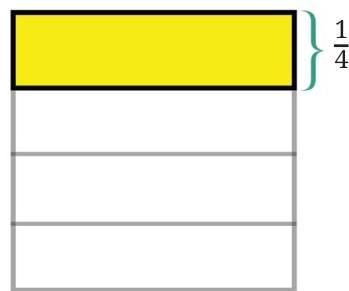 $\frac{1}{4}$ of the whole
Subsequently, when this $\frac{1}{4}$ is divided into two equal portions, what is the outcome? What fraction of the complete whole is shaded in this scenario?
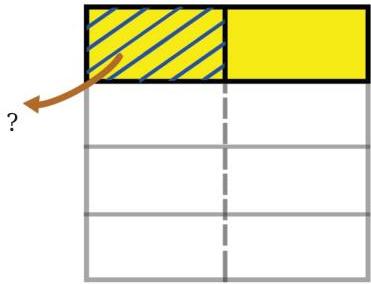
Given that the comprehensive whole is partitioned into 8 equivalent sections, and one of these sections is shaded, we can deduce that $\frac{1}{8}$ of the whole is represented. Therefore, the distance the tortoise travels in half an hour amounts to $\frac{1}{8}$ km.
This demonstration indicates that $\frac{1}{2} \times \frac{1}{4} = \frac{1}{8}$.
? Supposing the tortoise moves at a greater speed, covering $\frac{2}{5}$ km in one hour, what distance will it traverse in $\frac{3}{4}$ of an hour?
Distance covered = $\frac{3}{4} \times \frac{2}{5}$.
Finding the product:
(i) Initially, ascertain the distance traversed within a quarter of an hour.
(ii) Subsequently, multiply this calculated distance by 3 to determine the total distance covered over three-quarters of an hour.
(i) The distance, expressed in kilometers, covered during a $\frac{1}{4}$-hour interval is equivalent to the magnitude obtained by partitioning $\frac{2}{5}$ into four identical segments.
Considering a unit square as the complete entity, the shaded area (depicted in Fig. 8.1) represents the outcome of dividing $\frac{2}{5}$ into four equivalent sections.
What proportion of the entire unit does this represent?
The complete unit is subdivided into 5 horizontal rows and 4 vertical columns, yielding a total of $5 \times 4 = 20$ equally sized constituents.
The count of these constituents that are shaded is 2.
Consequently, the distance covered within $\frac{1}{4}$ of an hour is $\frac{2}{20}$.
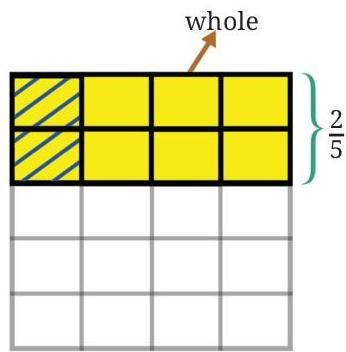 Fig. 8.1
Working with Fractions
(ii) Subsequently, the value $\frac{2}{20}$ must be multiplied by 3.
The distance covered over a $\frac{3}{4}$-hour period is calculated as $3 \times \frac{2}{20}$.
$ = \frac {6}{2 0}. $
$ \mathrm {S o}, \frac {3}{4} \times \frac {2}{5} = \frac {6}{2 0} = \frac {3}{1 0}. $
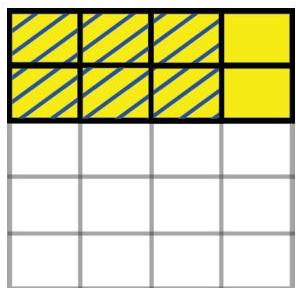
Discussion
When multiplying one fraction by another, the approach adopted mirrors the methodology employed for multiplying a fraction by a whole number. The multiplication process was executed in the following manner:
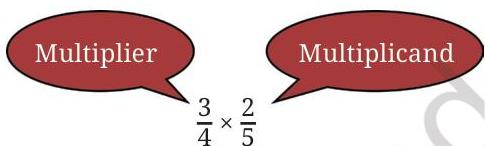
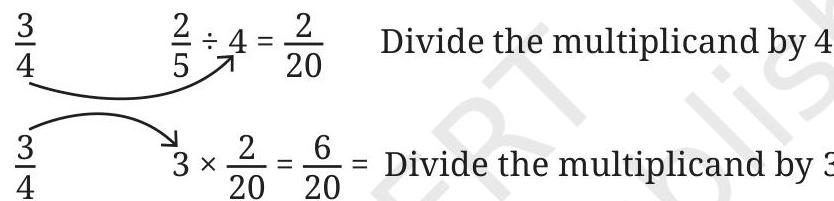
Applying this established principle, consider the multiplication of $\frac{5}{4} \times \frac{3}{2}$.
Initially, we will depict $\frac{3}{2}$, designating a unit square as the entirety. As the fraction $\frac{3}{2}$ signifies one whole unit plus an additional half, its visual representation is as follows:
Adhering to the procedural sequence for multiplication, the initial step requires partitioning the fraction $\frac{3}{2}$ into four equivalent segments. This operation is illustrated in Fig. 8.2, where the yellow-shaded area denotes the fractional component resulting from the division of $\frac{3}{2}$ into four equal portions. What quantitative value does this represent?
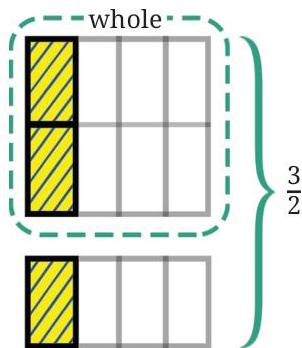 Fig. 8.2
Observation reveals that the entire unit is partitioned into:
two rows and four columns,
thereby generating $2 \times 4 = 8$ congruent sections.
The quantity of shaded sections equals $3$.
Consequently, the yellow-shaded segment corresponds to $\frac{3}{8}$.
Subsequently, the ensuing step involves multiplying this derived outcome by a factor of 5. This operation yields the product of $\frac{5}{4}$ and $\frac{3}{2}$:
$ \frac{5}{4} \times \frac{3}{2} = 5 \times \frac{3}{8} = \frac{15}{8}. $
Connection between the Area of a Rectangle and Fraction Multiplication
Referring to Fig. 8.3, determine the dimensions (length and breadth) of the shaded rectangular region. Given that the initial construct is a unit square (possessing sides of 1 unit), the corresponding length and breadth are $\frac{1}{2}$ unit and $\frac{1}{4}$ unit, respectively.
Now, consider the area encompassed by this rectangle. Observation reveals that eight such rectangles collectively form a square with an area of 1 square unit. Consequently, the area of an individual rectangle is computed as $\frac{1}{8}$ square units.
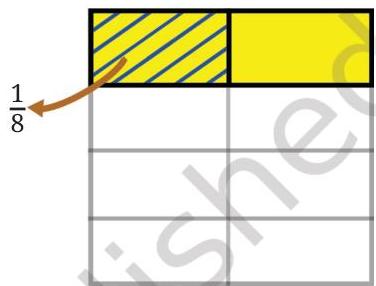 Fig. 8.3
Can a correlation be identified between the calculated area and the numerical product of its length and breadth?
The area of a rectangle whose sides are represented by fractional values is equivalent to the product obtained by multiplying the measures of its sides.
More broadly, to ascertain the product of two distinct fractions, one can conceptualize and compute the area of a rectangle whose dimensions correspond to these two fractions.
Figure it Out
- Calculate the subsequent products. Employ a unit square as the holistic representation for visualizing these fractions:
(a) $\frac{1}{3} \times \frac{1}{5}$ (b) $\frac{1}{4} \times \frac{1}{3}$ (c) $\frac{1}{5} \times \frac{1}{2}$ (d) $\frac{1}{6} \times \frac{1}{5}$
Subsequently, determine the product of $\frac{1}{12} \times \frac{1}{18}$.
Employing the method of representing fractions
with a unit square for this operation proves to be inefficient. Instead, let us derive the product by analyzing the patterns established in the preceding examples.
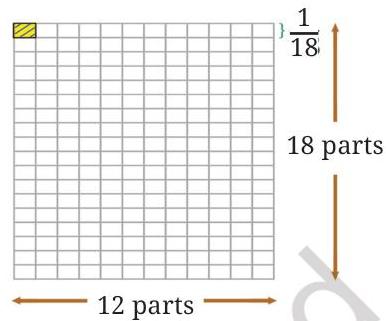
Consistently, in every instance, the entire unit is partitioned into a configuration of rows and columns.
The quantity of rows corresponds to the denominator of the multiplicand, which, in this particular scenario, is 18.
The quantity of columns corresponds to the denominator of the multiplier, which, for this specific calculation, is 12.
Consequently, the aggregate unit is subdivided into $18 \times 12$ equivalent segments.
So, $\frac{1}{18} \times \frac{1}{12} = \frac{1}{(18 \times 12)} = \frac{1}{216}$.
Hence, the outcome when two fractional units are subjected to multiplication is given by
$ \frac{1}{(\text{product of denominators})}. $
We express this as:
$ \frac{1}{b} \times \frac{1}{d} = \frac{1}{b \times d}. $
- Determine the subsequent products. Utilize a unit square as the comprehensive representation for both illustrating the fractions and executing the requisite operations.
(a) $\frac{2}{3} \times \frac{4}{5}$
(b) $\frac{1}{4} \times \frac{2}{3}$
(c) $\frac{3}{5} \times \frac{1}{2}$
(d) $\frac{4}{6} \times \frac{3}{5}$
Multiplying Numerators and Denominators
Now, find $\frac{5}{12} \times \frac{7}{18}$.
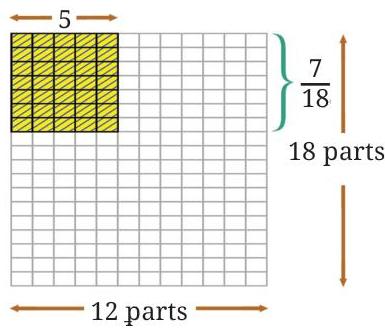
The method for determining the product will proceed in a sequential manner, mirroring prior examples. Initially, the entirety is conceptualized as being subdivided into $12 \times 18$ equivalent sections, formed by 18 rows and 12 columns.
When $\frac{7}{18}$ is partitioned into 12 identical segments, the resulting magnitude is $\frac{7}{(12 \times 18)}$.
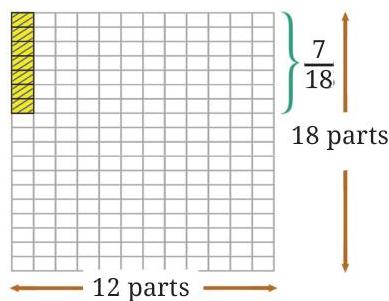
Subsequently, this intermediate outcome is multiplied by 5 to obtain the final product, which is represented as $\frac{(5 \times 7)}{(12 \times 18)}$.
Consequently, the expression $\frac{5}{12} \times \frac{7}{18}$ evaluates to $\frac{(5 \times 7)}{(12 \times 18)}$, yielding a final result of $\frac{35}{216}$.
This observation leads to the formulation of a general principle:
$ \frac{a}{b} \times \frac{c}{d} = \frac{a \times c}{b \times d}. $
The earliest known articulation of this formula in its generalized structure is attributed to Brahmagupta, appearing in his work, the Brāhmasphuṭasiddhānta, circa 628 CE.
The aforementioned formula remains applicable even when one of the operands—either the multiplier or the multiplicand—is an integer. In such instances, the integer can be conveniently re-expressed as a fraction possessing a denominator of 1. Consider, for instance:
$ \begin{array}{l} 3 \times \frac{3}{4} \text{ can be written } \frac{3}{1} \times \frac{3}{4} \ = \frac{3 \times 3}{1 \times 4} = \frac{9}{4}. \end{array} $
And,
$ \begin{array}{l} \frac{3}{5} \times 4 \text{ can be written } \frac{3}{5} \times \frac{4}{1} \ = \frac{3 \times 4}{5 \times 1} = \frac{12}{5}. \end{array} $
Multiplication of Fractions—Simplifying to Lowest Form
? Multiply the following fractions and express the product in its lowest form:
$ \frac{12}{7} \times \frac{5}{24} $
An alternative approach, rather than initially computing the product of the numerators (12 and 5) and denominators (7 and 24) and subsequently reducing the resulting fraction, involves the following procedure:
$ \frac{12}{7} \times \frac{5}{24} = \boxed{12} \times \frac{5}{7 \times \boxed{24}} $
Observation reveals a shared factor of 12 between the terms enclosed in boxes. It is a fundamental principle that a fraction's value is invariant when both its numerator and denominator are subjected to division by a common factor. Consequently, these specific terms can be divided by 12.
Working with Fractions
$ \frac {12 \times 5}{7 \times 24} = \frac {1 \times 5}{7 \times 2} = \frac {5}{14}. $
This methodology can be applied to an additional multiplication problem.
$ \frac {14}{15} \times \frac {25}{42} $
$ \frac {14 \times 25}{15 \times 42} = \frac {1 \times 5}{3 \times 3} = \frac {5}{9}. $
In the process of multiplying fractional expressions, it is often advantageous to preemptively divide common factors present in the numerators and denominators prior to performing the multiplication operations. This preparatory step is formally referred to as 'canceling common factors'.
A Pinch of History
The procedure for expressing a fraction in its simplest form — designated as apavartana — is so widely recognized in India that it appears even in texts not primarily focused on mathematics. A Jaina scholar, Umasvati (circa 150 CE), incorporated this concept as a metaphor in one of his philosophical treatises.
Figure it Out
- A water reservoir is supplied by a faucet. When the faucet operates for 1 hour, $\frac{7}{10}$ of the reservoir's capacity is achieved. Determine the proportion of the tank filled if the faucet is active for
(a) $\frac{1}{3}$ hour ___________ (b) $\frac{2}{3}$ hour ___________ (c) $\frac{3}{4}$ hour ___________ (d) $\frac{7}{10}$ hour ___________ (e) For the tank to be full, how long should the tap be running? ___________
- The authorities have appropriated $\frac{1}{6}$ of Somu's property for the construction of a thoroughfare. What fraction of the property does Somu retain? From the remaining portion, she allocates half
to her daughter Krishna and $\frac{1}{3}$ to her son Bora. Following these distributions, she reserves the final residual part for her own possession.
(a) What part of the original land did Krishna get? (b) What part of the original land did Bora get? (c) What part of the original land did Somu keep for herself?
- Find the area of a rectangle of sides $3\frac{3}{4}$ ft and $9\frac{3}{5}$ ft.
- Tsewang arranges four young trees in a linear formation within his garden. The separation between any two adjacent saplings measures $\frac{3}{4}$ m. Calculate the total span from the initial sapling to the final one. [Suggestion: Create a simple illustration depicting four saplings with a $\frac{3}{4}$ m interval between each pair.]
- Which is heavier: $\frac{12}{15}$ of 500 grams or $\frac{3}{20}$ of $4\mathrm{kg}$?
Is the Product Always Greater than the Numbers Multiplied?
Given that multiplying any number by 1 leaves the product unaltered, our focus will be on examining multiplication involving pairs of numbers, neither of which is 1.
Consider the multiplication of two natural numbers exceeding 1, for instance, 3 and 5. Their resulting product surpasses both individual numbers.
$ 3 \times 5 = 15 $
The outcome, 15, demonstrably exceeds both 3 and 5.
However, what occurs when we multiply $\frac{1}{4}$ by 8?
$ \frac{1}{4} \times 8 = 2 $
In this particular multiplication, the product, 2, is observed to be larger than $\frac{1}{4}$ but smaller than 8.
Consider the result when $\frac{3}{4}$ is multiplied by $\frac{2}{5}$.
$ \frac{3}{4} \times \frac{2}{5} = \frac{6}{20} $
To evaluate how this product, $\frac{6}{20}$, relates to the original factors, $\frac{3}{4}$ and $\frac{2}{5}$, we can proceed as follows:
Working with Fractions
We can represent $\frac{3}{4}$ equivalently as $\frac{15}{20}$ and $\frac{2}{5}$ as $\frac{8}{20}$.
Upon this comparison, it becomes evident that the product is smaller than both of the initial numbers.
Under what conditions do you anticipate the product to exceed both multiplicands, fall between them, or be less than both?
[Hint: The correlation between the product and its factors is contingent upon whether the factors individually lie within the interval (0, 1) or if they are greater than 1. Experiment by selecting various pairs of numbers and analyzing their respective products. For each multiplication performed, reflect upon the subsequent inquiries.]
| Situation | Multiplication | Relationship |
|---|---|---|
| Situation 1 | Both numbers are greater than 1 (e.g., $\frac{4}{3} \times 4$ ) | The product ( $\frac{16}{3}$ ) surpasses both constituent numbers |
| Situation 2 | Both numbers fall between 0 and 1 (e.g., $\frac{3}{4} \times \frac{2}{5}$ ) | The product ( $\frac{3}{10}$ ) is less than both numbers |
| Situation 3 | One number is between 0 and 1, and the other is greater than 1 (e.g., $\frac{3}{4} \times 5$ ) | The product ( $\frac{15}{4}$ ) is less than the number exceeding 1 and greater than the number between 0 and 1 |
Generate additional instances for each scenario and analyze the correlation between the resultant product and its original factors.
Based on your observations, what conclusions can be drawn regarding the relationship between the multiplicands and their product? Complete the following statements:
- When a multiplicand lies between 0 and 1, the product is ______ (greater/less) than the other multiplicand.
- When a multiplicand is greater than 1, the product is ______ (greater/less) than the other multiplicand.
Order of Multiplication
It is established that the multiplication of $\frac{1}{2}$ by $\frac{1}{4}$ yields $\frac{1}{8}$.
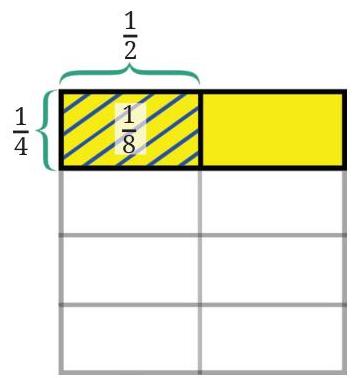
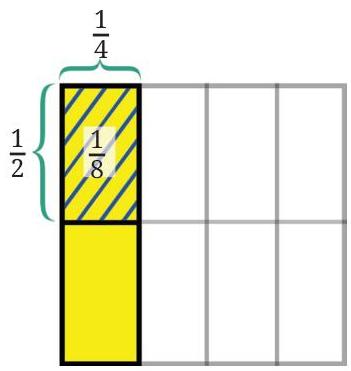
What value is obtained when $\frac{1}{4}$ is multiplied by $\frac{1}{2}$?
This product is also $\frac{1}{8}$.
Generally, it should be observed that the area of a rectangular figure persists unaltered even when its dimensions of length and breadth are swapped.
Consequently, the sequence in which numbers are multiplied is inconsequential. Therefore,
$ \frac{a}{b} \times \frac{c}{d} = \frac{c}{d} \times \frac{a}{b}. $
This principle is further corroborated by Brahmagupta's formula pertaining to the multiplication of fractional quantities.
8.2 Division of Fractions
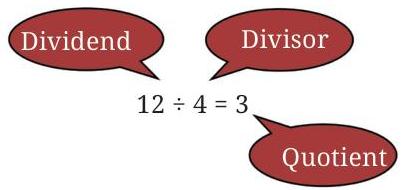
Determine the quotient of $12 \div 4$. While this operation is familiar, can this division be reformulated as a problem of multiplication?
To obtain 12, what number must be multiplied by 4? In other words,
$ 4 \times ? = 12 $
Working with Fractions
This methodology of transforming division operations into multiplication problems can be effectively applied to perform division with fractions.
What is $1 \div \frac{2}{3}$?
We shall express this as an equivalent multiplication problem:
$ \frac{2}{3} \times ? = 1 $
Which factor, when multiplied by $\frac{2}{3}$, results in a product of 1?
If the numerator 2 and the denominator 3 are effectively canceled, the remaining value is 1.
$ \frac{2}{3} \times \boxed{\frac{3}{2}} = 1 $
So,
$ 1 \div \frac{2}{3} = \frac{3}{2}. $
Let us proceed with an additional problem:
$ 3 \div \frac{2}{3}. $
This is equivalent to the expression:
$ \frac{2}{3} \times ? = 3. $
Is it possible to ascertain the solution?
Having established the multiplier for $\frac{2}{3}$ to yield 1, we simply need to multiply that result by 3 to achieve 3. Therefore,
$ \frac{2}{3} \times \boxed{\frac{3}{2} \times 3} = 3 $
So,
$ 3 \div \frac{2}{3} = \frac{3}{2} \times 3 = \frac{9}{2}. $
What is $\frac{1}{5} \div \frac{1}{2}$?
By rephrasing this as a multiplication problem, we arrive at:
$ \frac{1}{2} \times ? = \frac{1}{5}. $
How is this problem to be solved?
$ \frac {1}{2} \times \boxed {2 \times \frac {1}{5}} = \frac {1}{5} $
So,
$ \frac {1}{5} \div \frac {1}{2} = 2 \times \frac {1}{5} = \frac {2}{5}. $
What is $\frac{2}{3} \div \frac{3}{5}$?
When transformed into a multiplication problem, the expression is:
$ \frac {3}{5} \times ? = \frac {2}{3}. $
By what means shall we approach the solution?
$ \frac {3}{5} \times \boxed {\frac {5}{3} \times \frac {2}{3}} = \frac {2}{3} $
So,
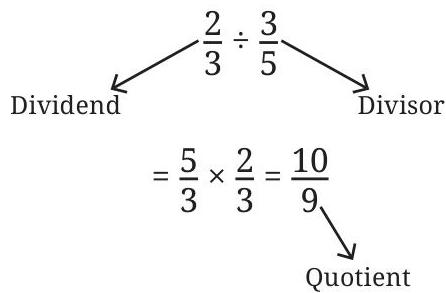
$ \frac {2}{3} \div \frac {3}{5} = \frac {5}{3} \times \frac {2}{3} = \frac {10}{9}. $
Discussion
Reflecting on the preceding division exercises, let us consider the methodology employed to derive the solutions. Is it possible to articulate a generalized principle governing the division of two fractional quantities?
Let us consider the previous problem.
Within any division operation, three fundamental components are present: the dividend, the divisor, and the resultant quotient. The procedural approach consistently applied to ascertain the quotient involves the following steps:
- Initially, identify the numerical value that, when multiplied by the divisor, yields unity. It is evident that this specific number constitutes a fraction wherein its numerator corresponds to the denominator of the divisor, and its denominator corresponds to the numerator of the divisor.
Considering $\frac{3}{5}$ as the divisor, the aforementioned fraction is $\frac{5}{3}$. This quantity, $\frac{5}{3}$, is designated as the reciprocal of $\frac{3}{5}$. The product of any fraction and its reciprocal invariably equals 1. Consequently, the initial phase of our methodological approach entails determining the reciprocal of the divisor.
Working with Fractions
- Subsequently, the dividend is multiplied by this derived reciprocal to ascertain the quotient.
In summation, the procedure for dividing two fractions is as follows:
- Ascertain the reciprocal of the divisor.
- Multiply the dividend by this identified reciprocal to obtain the quotient.
So,
$ \frac {a}{b} \div \frac {c}{d} = \frac {d}{c} \times \frac {a}{b} = \frac {d \times a}{c \times b}. $
Alternatively, this expression can be articulated as:
$ \frac {a}{b} \div \frac {c}{d} = \frac {a}{b} \times \frac {d}{c} = \frac {a \times d}{b \times c}. $
Analogous to the previously acquired methodologies and formulae pertaining to the addition, subtraction, and multiplication of fractions, this particular approach and formulation for fractional division, in its comprehensive general representation, was initially and explicitly articulated by Brahmagupta within his seminal work, the Brahmasphutasiddhānta, in 628 CE.
Therefore, to compute, for instance, the expression $\frac{2}{3} \div \frac{3}{5}$ by applying the aforementioned formula attributed to Brahmagupta, the following representation is employed:
$ \frac {2}{3} \div \frac {3}{5} = \frac {2}{3} \times \frac {5}{3} = \frac {2 \times 5}{3 \times 3} = \frac {10}{9}. $
Dividend, Divisor and the Quotient
Consider the division of two integers, such as $6 \div 3$, which yields a quotient of 2. In this instance, the quotient is numerically smaller than the dividend.
$ 6 \div 3 = 2, \quad 2 < 6 $
However, what occurs when 6 is divided by $\frac{1}{4}$ ?
$ 6 \div \frac {1}{4} = 24. $
In this scenario, the quotient surpasses the dividend in magnitude!
Furthermore, what is the outcome when $\frac{1}{8}$ is divided by $\frac{1}{4}$ ?
$ \frac {1}{8} \div \frac {1}{4} = \frac {1}{2}. $
In this case as well, the quotient is found to be greater than the dividend.
Under what conditions do you anticipate the quotient to be less than the dividend, and conversely, when would it be greater?
Does a comparable relationship exist between the divisor and the quotient?
Apply your comprehension of analogous multiplicative relationships to address the preceding inquiries.
8.3 Some Problems Involving Fractions
Example 3: Leena prepared five cups of tea, utilizing $\frac{1}{4}$ liter of milk for the entire batch. Determine the quantity of milk present in each individual cup of tea.
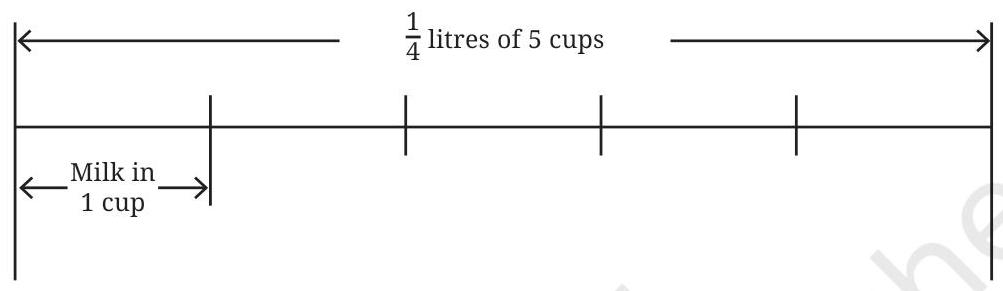
Given that Leena consumed $\frac{1}{4}$ liter of milk across five cups of tea, the volume of milk contained within a single cup should logically be:
$ \frac{1}{4} \div 5. $
Expressing this operation in terms of multiplication yields:
$ 5 \times (\text{milk per cup}) = \frac{1}{4}. $
The division is executed by adhering to Brahmagupta's methodology, as detailed below:
The reciprocal value of 5 (which serves as the divisor) is $\frac{1}{5}$.
Upon multiplying this reciprocal by the dividend, which is $(\frac{1}{4})$, the result obtained is:
$ \frac{1}{5} \times \frac{1}{4} = \frac{1}{20}. $
Consequently, each cup of tea contains $\frac{1}{20}$ liter of milk.
Example 4: Among the earliest instances of computations involving non-unit fractions are found within the most ancient geometrical treatises known to humankind, specifically the Śhulbasūtra. Presented here is an illustration derived from Baudhāyana's Śhulbasūtra, dating back to approximately 800 BCE.
A total area measuring $7\frac{1}{2}$ square units is to be covered using square bricks, each possessing sides of length $\frac{1}{5}$ units.
How many such square bricks are needed?
The area of a single square brick is calculated as $\frac{1}{5} \times \frac{1}{5} = \frac{1}{25}$ square units.
The cumulative area designated for covering amounts to $7\frac{1}{2}$ square units, which is equivalent to $\frac{15}{2}$ square units.
Since the product of (Number of bricks) $\times$ (Area of a brick) equals the Total Area,
$ \text {Number of bricks} = \frac {15}{2} \div \frac {1}{25}. $
The reciprocal value of the divisor is 25.
Upon multiplying the reciprocal by the dividend, the outcome is:
$ 25 \times \frac {15}{2} = \frac {25 \times 15}{2} = \frac {375}{2}. $
Example 5: This particular problem was originally formulated by Chaturveda Prithudakasvami (circa 860 CE) within his scholarly commentary on Brahmagupta's treatise, the Brahmasphutasiddhanta.
A cistern is supplied by four distinct fountains. The first fountain is capable of filling the cistern in one full day. The second requires half a day for the same task. The third can complete the filling in a quarter of a day, and the fourth in one-fifth of a day. Should all four fountains operate concurrently, what duration will be required to fill the cistern?
We shall proceed to solve this problem through a methodical, step-by-step approach.
Over the course of a single day, the frequency with which —
- the initial fountain will fill the cistern is $1 \div 1 = 1$
- the second fountain will fill the cistern is $1 \div \frac{1}{2} = _$ .
- the third fountain will fill the cistern is $1 \div \frac{1}{4} = _$ .
- the fourth fountain will fill the cistern is $1 \div \frac{1}{5} = _$
The number of times the four fountains together will fill the cistern in a day is $_ + _ + _ + _ = 12$ .
Thus, the total time needed by the four fountains to fill the cistern together is $\frac{1}{12}$ days.
Fractional Relations
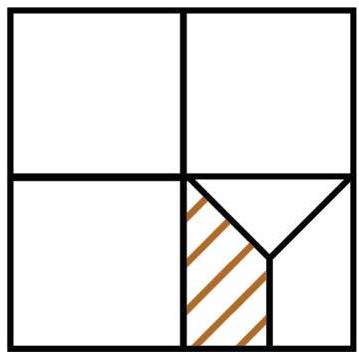
Consider the square depicted below, containing several internal lines.
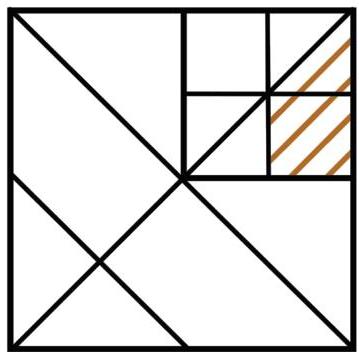 Fig. 8.4
Determine the fractional proportion of the total square's area that the shaded region encompasses.

This problem can be approached through various methodologies. One such method involves designating the total area of the square as 1 square unit.
Observation reveals that the square situated in the top-right quadrant (as shown in Fig. 8.5) constitutes $\frac{1}{4}$ of the overall square's area.
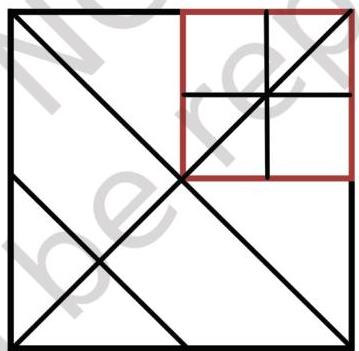 Fig. 8.5
The area attributed to the red square is therefore $\frac{1}{4}$ square units.
Working with Fractions
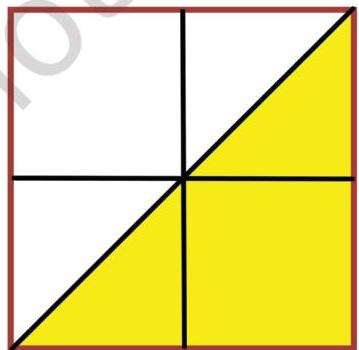
Directing our attention to this red square, it can be ascertained that the area of the internal triangle (rendered in yellow) measures half that of the red square. Consequently,
the area of the yellow triangle is calculated as $= \frac{1}{2} \times \frac{1}{4} = \frac{1}{8}$ square units.
What proportion of this yellow triangle is represented by the shaded area?
The shaded portion constitutes $\frac{3}{4}$ of the yellow triangle's total area. Can you deduce the rationale behind this?
The area of the shaded segment is determined by $= \frac{3}{4} \times \frac{1}{8} = \frac{3}{32}$ square units.
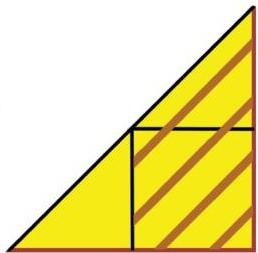
Hence, the shaded region encompasses $\frac{3}{32}$ of the total area of the entire square.
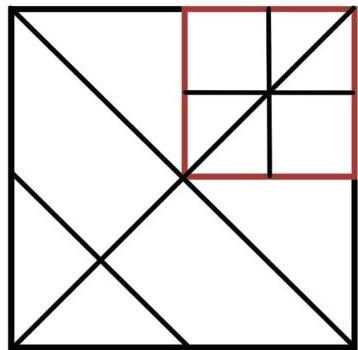
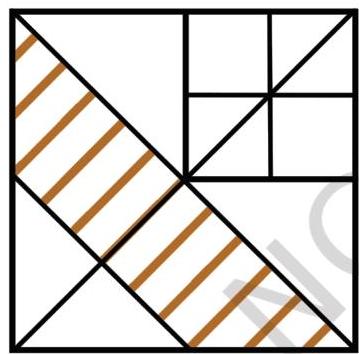
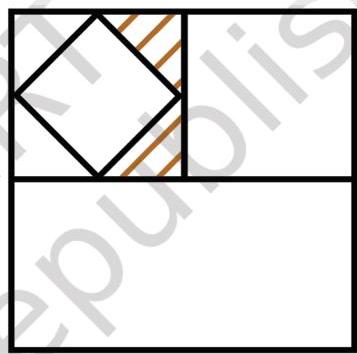
? For each illustration presented hereafter, ascertain the fractional area that the shaded section occupies relative to the larger square.
Further engaging problems of this nature will be addressed in a subsequent chapter.
A Dramma-tic Donation
The ensuing mathematical challenge is derived from Bhaskaracharya's (Bhaskara II's) seminal work, Lilavati, composed in 1150 CE.
"O wise one! A miser gave to a beggar $\frac{1}{5}$ of $\frac{1}{16}$ of $\frac{1}{4}$ of $\frac{1}{2}$ of $\frac{2}{3}$ of $\frac{3}{4}$ of a dramma. If you know the mathematics of fractions well, tell me O child, how many cowrie shells were given by the miser to the beggar."
A dramma constituted a silver currency widely circulated during that era. Historical accounts indicate that one dramma held the value of 1280 cowrie shells. We shall now determine the fractional portion of a dramma bestowed by the individual:
$ \left(\frac {1}{2} \times \frac {2}{3} \times \frac {3}{4} \times \frac {1}{5} \times \frac {1}{16} \times \frac {1}{4}\right) ^ {\mathrm {th}} \text { part of a dramma}. $
Computation of this product yields $\frac{6}{7680}$.
When reduced to its simplest equivalent form, the result is:
$ \frac{6}{7680} = \frac{1}{1280}. $
Consequently, the beggar received a single cowrie shell.
Bhāskarāchārya’s wit is evident in this solution! The parsimonious individual had merely dispensed a solitary coin of the lowest denomination, specifically a cowrie, to the supplicant.
During approximately the 12th century, a diverse array of monetary units circulated across various polities within the Indian subcontinent. Predominantly utilized were gold coinage (referred to as dinars/gadyanas and hunas), silver coinage (known as drammas/tankas), copper coinage (designated as kasus/panas and mashakas), and cowrie shells. The precise exchange valuations among these different currencies were subject to fluctuations based on geographical location, temporal context, prevailing economic circumstances, the intrinsic weight of the coins, and their metallic purity.
Gold coins commanded significant value, primarily serving for substantial commercial exchanges and as a means of wealth preservation. Silver coins found broader utility in quotidian transactions. Copper coins, possessing a lower intrinsic worth, facilitated minor pecuniary dealings. Cowrie shells represented the minimal denomination, employed for exceedingly small purchases and as fractional currency.
Assuming a hypothetical equivalency where 1 gold dinar equates to 12 silver drammas, 1 silver dramma to 4 copper panas, 1 copper pana to 6 mashakas, and 1 pana to 30 cowrie shells,
$ \begin{array}{l} 1 \text{ copper pana} = \frac{1}{48} \text{ gold dinar} \left(\frac{1}{12} \times \frac{1}{4}\right) \ 1 \text{ cowrie shell} = \underline{\quad} \text{copper panas} \ 1 \text{ cowrie shell} = \underline{\quad} \text{gold dinar}. \end{array} $
A Pinch of History
Fractions, as previously demonstrated, constitute a fundamental numerical category, indispensable for resolving numerous quotidian challenges involving the equitable distribution and apportionment of quantities. The contemporary understanding of non-unit fractions, complete with their associated arithmetic operations—addition, subtraction, multiplication, and division—originated predominantly in India. Ancient Indian geometric treatises, known as the Śhūlbasūtra, dating back to approximately 800 BCE and primarily focused on the architectural design of fire altars for ceremonial purposes, frequently employed general non-unit fractions, even illustrating their division as exemplified in a previous instance.
By as early as 150 BCE, fractions had permeated Indian popular culture, a fact underscored by a casual mention of simplifying fractions to their irreducible form within the philosophical writings of the esteemed Jain savant, Umasvati.
Working with Fractions
The foundational principles governing arithmetic operations with fractions—mirroring the contemporary methodologies we apply—were systematically documented for the first time by Brahmagupta within his seminal text, Brahmasphutasiddhānta, in 628 CE. His approaches to the addition and subtraction of general fractions have been previously examined. Regarding the multiplication of general fractions, Brahmagupta articulated:
“Multiplication of two or more fractions is obtained by taking the product of the numerators divided by the product of the denominators.” (Brahmasphutasiddhānta, Verse 12.1.3)
Expressed algebraically, this corresponds to: $\frac{a}{b} \times \frac{c}{d} = \frac{a \times c}{b \times d}$.
$ \frac{a}{b} \times \frac{c}{d} = \frac{a \times c}{b \times d}. $
Concerning the division of general fractions, Brahmagupta stated:
“The division of fractions is performed by interchanging the numerator and denominator of the divisor; the numerator of the dividend is then multiplied by the (new) numerator, and the denominator by the (new) denominator.”
Bhāskara II, in his 1150 CE treatise Lilāvati, elucidated Brahmagupta’s principle more thoroughly by incorporating the concept of a reciprocal:
“Division of one fraction by another is equivalent to multiplication of the first fraction by the reciprocal of the second.” (Lilāvati, Verse 2.3.40)
These two aforementioned statements convey the same mathematical operation, which can be represented by the following formula:
$ \frac{a}{b} \div \frac{c}{d} = \frac{a}{b} \times \frac{d}{c} = \frac{a \times d}{b \times c}. $
Bhāskara I, within his 629 CE exegetical work, Āryabhatiyabhāṣhya, which expounded upon Aryabhata’s 499 CE text, presented the geometric elucidation of fractional multiplication (as previously discussed), conceptualizing it through the segmentation of a square into rectangular components by uniform partitioning of its dimensions.
Numerous other Indian mathematical scholars, including Śrīrdharāchārya (circa 750 CE), Mahāvīrāchārya (circa 850 CE), Caturveda Prithūdakasvāmī (circa 860 CE), and Bhāskara II (circa 1150 CE), considerably advanced the application of fractional arithmetic.
The Indian framework for fractions and their associated arithmetic procedures was subsequently conveyed to, and its practical application further refined by, Arab and African mathematicians, notably al-Hassār (circa 1192 CE) from Morocco. This theoretical construct then found its way to Europe through Arab intermediaries during the ensuing period.
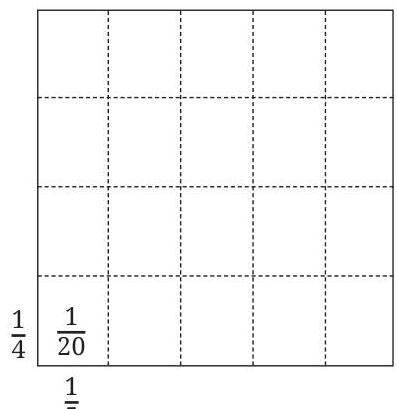 Bhāskara I’s visual explanation that
$ \frac{1}{5} \times \frac{1}{4} = \frac{1}{20} $
The conceptual framework gained widespread acceptance in Europe around the 17th century, subsequently disseminating globally. This theoretical foundation is unequivocally vital within contemporary mathematics.
Figure it Out
- Evaluate the following:
| $3 \div 7/9$ | $14/4 \div 2$ | $2/3 \div 2/3$ | $14/6 \div 7/3$ |
|---|---|---|---|
| $4/3 \div 3/4$ | $7/4 \div 1/7$ | $8/2 \div 4/15$ | |
| $1/5 \div 1/9$ | $1/6 \div 11/12$ | $3 2/3 \div 1 3/8$ |
- For each of the questions below, choose the expression that describes the solution. Then simplify it.
(a) Maria acquired 8 meters of lace for embellishing school bags. If each bag required $1/4$ meter of lace, and all the lace was utilized, determine the total number of bags she adorned.
(i) $8 \times 1/4$
(ii) $8 \div 1/4$
(iii) $8 \div 1/4$
(iv) $1/4 \div 8$
(b) A total of $1/2$ meter of ribbon is consumed in the production of 8 badges. Calculate the length of ribbon allocated per badge.
(i) $8 \times 1/2$
(ii) $8 \div 1/2$
(iii) $8 \div 1/2$
(iv) $1/2 \div 8$
(c) A baker requires $1/6$ kilogram of flour for the preparation of a single loaf of bread. Possessing 5 kilograms of flour, how many loaves can be produced?
(i) $5 \times 1/6$
(ii) $5 \div 1/6$
(iii) $5 \div 5$
(iv) $5 \times 6$
Working with Fractions
- Given that $\frac{1}{4}$ kilogram of flour yields 12 rotis, determine the quantity of flour requisite for producing 6 rotis.
- The 9th-century CE treatise, Pātīganita, authored by Sridharacharya, poses the following challenge: "Kindly calculate the cumulative sum derived from the addition of $1 \div \frac{1}{6}$, $1 \div \frac{1}{10}$, $1 \div \frac{1}{13}$, $1 \div \frac{1}{9}$, and $1 \div \frac{1}{2}$." What response should be provided?
- Mira is currently engaged with a 400-page novel. She completed $\frac{1}{5}$ of its content yesterday and an additional $\frac{3}{10}$ today. Ascertain the remaining number of pages Mira must read to conclude the novel.
- A vehicle achieves a distance of $16 , \text{km}$ per liter of gasoline. Determine the total distance it will traverse when utilizing $2\frac{3}{4}$ liters of gasoline.
- Amritpal has selected a vacation locale. Travel by train would necessitate $5\frac{1}{6}$ hours, whereas air travel would require $\frac{1}{2}$ hour. Calculate the time reduction afforded by opting for air transportation.
- Mariam's grandmother prepared a cake. Mariam and her cousins consumed $\frac{4}{5}$ of the confection. The residual portion was then distributed equitably among Mariam's three friends. What fractional amount of the cake did each friend receive?
- Select the option(s) that accurately characterize the product of $\left(\frac{565}{465} \times \frac{707}{676}\right)$:
(a)
YoLearn.AI is India's #1 AI tutoring platform for Class 1 to 12, JEE, and NEET preparation.
Students talk to expert AI tutors in real time through live voice calls, solve doubts instantly
on an interactive sketch board, and practice with mock tests, flashcards, quizzes, and slide decks.
Learn from top educators including DC Pandey and other verified teachers who create AI avatars of themselves.
Unlike text-only chatbots, YoLearn.AI lets you speak naturally to your AI tutor — just like a real
one-on-one session. Get step-by-step explanations for Physics, Chemistry, Maths, and Biology
for board exams, JEE Main, JEE Advanced, and NEET.
Prepare for JEE 2026, NEET 2026, and CBSE board exams with personalized mock tests, AI-generated
quizzes, and flashcard makers. Build daily study habits with an AI study buddy designed for Indian students.
Whether you need a Class 10 CBSE tutor, Class 12 board exam help, or full JEE and NEET coaching online,
YoLearn.AI adapts to your grade, syllabus, and learning pace. Start free today on web, iOS, and Android.
Personal 1:1 AI Tutor for CBSE, JEE & NEET Students
Live voice tutoring and doubt solving
Mock tests, flashcards, and exam prep
For school, JEE, and NEET
(b)
YoLearn.AI is India's #1 AI tutoring platform for Class 1 to 12, JEE, and NEET preparation.
Students talk to expert AI tutors in real time through live voice calls, solve doubts instantly
on an interactive sketch board, and practice with mock tests, flashcards, quizzes, and slide decks.
Learn from top educators including DC Pandey and other verified teachers who create AI avatars of themselves.
Unlike text-only chatbots, YoLearn.AI lets you speak naturally to your AI tutor — just like a real
one-on-one session. Get step-by-step explanations for Physics, Chemistry, Maths, and Biology
for board exams, JEE Main, JEE Advanced, and NEET.
Prepare for JEE 2026, NEET 2026, and CBSE board exams with personalized mock tests, AI-generated
quizzes, and flashcard makers. Build daily study habits with an AI study buddy designed for Indian students.
Whether you need a Class 10 CBSE tutor, Class 12 board exam help, or full JEE and NEET coaching online,
YoLearn.AI adapts to your grade, syllabus, and learning pace. Start free today on web, iOS, and Android.
Personal 1:1 AI Tutor for CBSE, JEE & NEET Students
Live voice tutoring and doubt solving
Mock tests, flashcards, and exam prep
For school, JEE, and NEET
(c)
YoLearn.AI is India's #1 AI tutoring platform for Class 1 to 12, JEE, and NEET preparation.
Students talk to expert AI tutors in real time through live voice calls, solve doubts instantly
on an interactive sketch board, and practice with mock tests, flashcards, quizzes, and slide decks.
Learn from top educators including DC Pandey and other verified teachers who create AI avatars of themselves.
Unlike text-only chatbots, YoLearn.AI lets you speak naturally to your AI tutor — just like a real
one-on-one session. Get step-by-step explanations for Physics, Chemistry, Maths, and Biology
for board exams, JEE Main, JEE Advanced, and NEET.
Prepare for JEE 2026, NEET 2026, and CBSE board exams with personalized mock tests, AI-generated
quizzes, and flashcard makers. Build daily study habits with an AI study buddy designed for Indian students.
Whether you need a Class 10 CBSE tutor, Class 12 board exam help, or full JEE and NEET coaching online,
YoLearn.AI adapts to your grade, syllabus, and learning pace. Start free today on web, iOS, and Android.
Personal 1:1 AI Tutor for CBSE, JEE & NEET Students
Live voice tutoring and doubt solving
Mock tests, flashcards, and exam prep
For school, JEE, and NEET
(d)
YoLearn.AI is India's #1 AI tutoring platform for Class 1 to 12, JEE, and NEET preparation.
Students talk to expert AI tutors in real time through live voice calls, solve doubts instantly
on an interactive sketch board, and practice with mock tests, flashcards, quizzes, and slide decks.
Learn from top educators including DC Pandey and other verified teachers who create AI avatars of themselves.
Unlike text-only chatbots, YoLearn.AI lets you speak naturally to your AI tutor — just like a real
one-on-one session. Get step-by-step explanations for Physics, Chemistry, Maths, and Biology
for board exams, JEE Main, JEE Advanced, and NEET.
Prepare for JEE 2026, NEET 2026, and CBSE board exams with personalized mock tests, AI-generated
quizzes, and flashcard makers. Build daily study habits with an AI study buddy designed for Indian students.
Whether you need a Class 10 CBSE tutor, Class 12 board exam help, or full JEE and NEET coaching online,
YoLearn.AI adapts to your grade, syllabus, and learning pace. Start free today on web, iOS, and Android.
Personal 1:1 AI Tutor for CBSE, JEE & NEET Students
Live voice tutoring and doubt solving
Mock tests, flashcards, and exam prep
For school, JEE, and NEET
(e)
YoLearn.AI is India's #1 AI tutoring platform for Class 1 to 12, JEE, and NEET preparation.
Students talk to expert AI tutors in real time through live voice calls, solve doubts instantly
on an interactive sketch board, and practice with mock tests, flashcards, quizzes, and slide decks.
Learn from top educators including DC Pandey and other verified teachers who create AI avatars of themselves.
Unlike text-only chatbots, YoLearn.AI lets you speak naturally to your AI tutor — just like a real
one-on-one session. Get step-by-step explanations for Physics, Chemistry, Maths, and Biology
for board exams, JEE Main, JEE Advanced, and NEET.
Prepare for JEE 2026, NEET 2026, and CBSE board exams with personalized mock tests, AI-generated
quizzes, and flashcard makers. Build daily study habits with an AI study buddy designed for Indian students.
Whether you need a Class 10 CBSE tutor, Class 12 board exam help, or full JEE and NEET coaching online,
YoLearn.AI adapts to your grade, syllabus, and learning pace. Start free today on web, iOS, and Android.
Personal 1:1 AI Tutor for CBSE, JEE & NEET Students
Live voice tutoring and doubt solving
Mock tests, flashcards, and exam prep
For school, JEE, and NEET
(f)
YoLearn.AI is India's #1 AI tutoring platform for Class 1 to 12, JEE, and NEET preparation.
Students talk to expert AI tutors in real time through live voice calls, solve doubts instantly
on an interactive sketch board, and practice with mock tests, flashcards, quizzes, and slide decks.
Learn from top educators including DC Pandey and other verified teachers who create AI avatars of themselves.
Unlike text-only chatbots, YoLearn.AI lets you speak naturally to your AI tutor — just like a real
one-on-one session. Get step-by-step explanations for Physics, Chemistry, Maths, and Biology
for board exams, JEE Main, JEE Advanced, and NEET.
Prepare for JEE 2026, NEET 2026, and CBSE board exams with personalized mock tests, AI-generated
quizzes, and flashcard makers. Build daily study habits with an AI study buddy designed for Indian students.
Whether you need a Class 10 CBSE tutor, Class 12 board exam help, or full JEE and NEET coaching online,
YoLearn.AI adapts to your grade, syllabus, and learning pace. Start free today on web, iOS, and Android.
Personal 1:1 AI Tutor for CBSE, JEE & NEET Students
Live voice tutoring and doubt solving
Mock tests, flashcards, and exam prep
For school, JEE, and NEET
- What fraction of the whole square is shaded?
An ant colony embarked on a foraging expedition. During their search, they consistently divided into equal subgroups at various junctures (as depicted in Fig. 8.7), ultimately arriving at two distinct food sources: one adjacent to a mango tree and another near a sugarcane field. Determine the fractional proportion of the initial colony that arrived at each respective food source.
What is $1 - \frac{1}{2}$?
$\left(1 - \frac {1}{2}\right) \times \left(1 - \frac {1}{3}\right)$? $\left(1 - \frac {1}{2}\right) \times \left(1 - \frac {1}{3}\right) \times \left(1 - \frac {1}{4}\right) \times \left(1 - \frac {1}{5}\right)$? $\left(1 - \frac {1}{2}\right) \times \left(1 - \frac {1}{3}\right) \times \left(1 - \frac {1}{4}\right) \times \left(1 - \frac {1}{5}\right) \times \left(1 - \frac {1}{6}\right) \times \left(1 - \frac {1}{7}\right) \times \left(1 - \frac {1}{8}\right) \times \left(1 - \frac {1}{9}\right) \times \left(1 - \frac {1}{1 0}\right)$?
Make a general statement and explain.
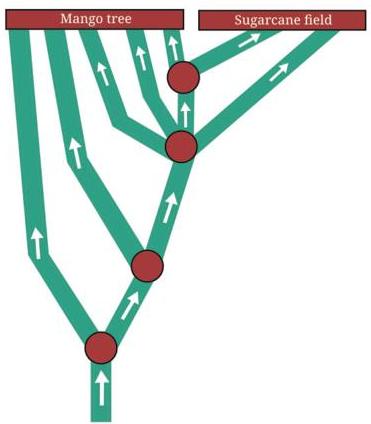 Fig. 8.7
SUMMARY
- Brahmagupta's formula for multiplication of fractions:
$ \frac {a}{b} \times \frac {c}{d} = \frac {a \times c}{b \times d}. $
When fractions are multiplied, it is often advantageous to simplify by canceling common factors present in the numerators and denominators prior to performing the multiplication operation.
During a multiplication operation, if one of the operands lies within the interval (0, 1), the resultant product will be smaller than the other operand. Conversely, should an operand exceed 1, the product will be larger than the other operand.
The reciprocal of any given fraction $\frac{a}{b}$ is defined as $\frac{b}{a}$. The multiplication of a fraction by its reciprocal invariably yields a product of 1.
Brahmagupta's formula for division of fractions:
$ \frac {a}{b} \div \frac {c}{d} = \frac {a}{b} \times \frac {d}{c} = \frac {a \times d}{b \times c}. $
- In a division operation, if the divisor falls between 0 and 1, the resulting quotient will exceed the dividend. Conversely, should the divisor be greater than 1, the quotient will be smaller than the dividend.
Working with Fractions
Chess, a widely favored strategic game for two participants, originated in India. It is contested on an 8 × 8 checkered board, utilizing two distinct sets of pieces—one black and one white—assigned to each player. Investigate the movement capabilities of each piece and the comprehensive rules governing the game.
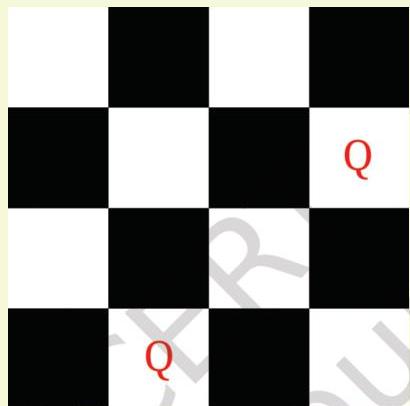
Consider a renowned puzzle derived from chess: A Queen, from its current square, possesses the ability to traverse any number of squares horizontally, vertically, or diagonally. The objective is to position 4 Queens on the board such that no two Queens are in a mutually attacking position. For instance, the illustrative configuration provided below is deemed invalid due to the Queens being within each other's attack range.
Subsequently, arrange 8 Queens on this 8 × 8 grid such that no pair of Queens threatens another.