Chapter 4
COMPLEX NUMBERS AND QUADRATIC EQUATIONS
$\diamond$ Mathematics is the Queen of Sciences and Arithmetic is the Queen of Mathematics. – GAUSS $\diamond$
4.1 Introduction
Previous coursework has covered linear equations involving one and two variables, as well as quadratic equations with a single variable. It has been established that the equation $x^{2} + 1 = 0$ lacks a real number solution, given that $x^{2} + 1 = 0$ implies $x^{2} = -1$, and the square of any real number is inherently non-negative. Consequently, an expansion of the real number system into a more encompassing framework is necessary to enable the determination of solutions for $x^{2} = -1$. Fundamentally, the primary aim is to address equations of the form $ax^{2} + bx + c = 0$ where the discriminant $D = b^{2} - 4ac$ is less than zero, a scenario for which solutions do not exist within the real number system.
 W. R. Hamilton
(1805-1865)
W. R. Hamilton
(1805-1865)
4.2 Complex Numbers
We define the symbol $i$ to represent $\sqrt{-1}$. From this definition, it follows that $i^2 = -1$. This implies that $i$ serves as a solution to the equation $x^2 + 1 = 0$.
A complex number is formally defined as an expression of the type $a + ib$, where $a$ and $b$ represent real numbers. Illustrative examples include $2 + i3$, $(-1) + i\sqrt{3}$, and $4 + i\left(\frac{-1}{11}\right)$.
Considering a complex number $z = a + ib$, the component $a$ is referred to as the real part, symbolized by $\operatorname{Re} z$, while $b$ is designated as the imaginary part, symbolized by $\operatorname{Im} z$. For instance, if $z = 2 + i5$, then $\operatorname{Re} z = 2$ and $\operatorname{Im} z = 5$.
The equality of two complex numbers, $z_{1} = a + ib$ and $z_{2} = c + id$, holds if and only if their respective real parts are equal ($a = c$) and their respective imaginary parts are equal ($b = d$).
Example 1: Determine the values of $x$ and $y$, given that they are real numbers, such that $4x + i(3x - y) = 3 + i(-6)$.
Solution: The given equation is:
$ 4x + i(3x - y) = 3 + i(-6) \tag{1} $
By equating the corresponding real and imaginary components of Equation (1), we derive the following system:
$ 4x = 3, \quad 3x - y = -6, $
Solving these simultaneous equations yields $x = \frac{3}{4}$ and $y = \frac{33}{4}$.
4.3 Algebra of Complex Numbers
Within this section, the fundamental algebraic principles governing complex numbers will be delineated.
4.3.1 Addition of two complex numbers
Consider any two complex numbers, denoted as $z_1 = a + ib$ and $z_2 = c + id$. The summation $z_1 + z_2$ is formally defined as follows:
$z_1 + z_2 = (a + c) + i(b + d)$, and the resultant quantity is also a complex number.
An illustrative instance is: $(2 + i3) + (-6 + i5) = (2 - 6) + i(3 + 5) = -4 + i8$
The operation of complex number addition conforms to the subsequent properties:
(i) Closure Property The aggregation of any two complex numbers yields a complex number; specifically, for all complex numbers $z_1$ and $z_2$, their sum $z_1 + z_2$ is itself a complex number.
(ii) Commutative Property For any arbitrary pair of complex numbers $z_1$ and $z_2$, their order of addition does not affect the result, meaning $z_1 + z_2 = z_2 + z_1$.
(iii) Associative Property Given any three complex numbers $z_1, z_2, z_3$, the grouping of terms in their sum does not alter the final outcome, as demonstrated by $(z_1 + z_2) + z_3 = z_1 + (z_2 + z_3)$.
(iv) Existence of Additive Identity There exists a unique complex number, $0 + i0$ (symbolized as 0), which functions as the additive identity or the zero complex number. Its characteristic is that for any complex number $z$, the equation $z + 0 = z$ holds true.
(v) Existence of Additive Inverse For every complex number $z = a + ib$, there corresponds a complex number $-a + i(-b)$ (represented as $-z$), which is termed its additive inverse or negative. It is observable that the sum of a complex number and its additive inverse yields the additive identity: $z + (-z) = 0$.
4.3.2 Difference of two complex numbers
For any pair of complex numbers, $z_1$ and $z_2$, their difference, denoted $z_1 - z_2$, is formally established through the following expression:
$ z_1 - z_2 = z_1 + (-z_2). $
Illustrative examples include: $(6 + 3i) - (2 - i) = (6 + 3i) + (-2 + i) = 4 + 4i$
and $(2 - i) - (6 + 3i) = (2 - i) + (-6 - 3i) = -4 - 4i$
4.3.3 Multiplication of two complex numbers
Let us consider two arbitrary complex numbers, $z_1 = a + ib$ and $z_2 = c + id$. Their product, $z_1 z_2$, is formally defined by the following relation:
$ z _ {1} z _ {2} = (a c - b d) + i (a d + b c) $
For instance, computing the product $(3 + i5)(2 + i6)$ yields $(3 \times 2 - 5 \times 6) + i(3 \times 6 + 5 \times 2) = -24 + i28$.
The operation of multiplication involving complex numbers exhibits the subsequent properties, which are presented here without formal proofs.
(i) The closure law: The product of any two complex numbers invariably results in another complex number. Specifically, for any $z_1$ and $z_2 \in \mathbb{C}$, their product $z_1 z_2$ is also a complex number.
(ii) The commutative law: For any given pair of complex numbers $z_1$ and $z_2$, their order of multiplication does not affect the outcome:
$ z _ {1} z _ {2} = z _ {2} z _ {1}. $
(iii) The associative law: When multiplying three complex numbers $z_1, z_2, z_3$, the grouping of factors does not alter the product: $(z_1 z_2)z_3 = z_1(z_2 z_3)$.
(iv) The existence of multiplicative identity: There exists a unique complex number, $1 + i0$ (frequently represented as $1$), which serves as the multiplicative identity. This means that for any complex number $z$, the property $z \cdot 1 = z$ holds true.
(v) The existence of multiplicative inverse: For any non-zero complex number $z = a + ib$ (where $a \neq 0$ or $b \neq 0$), there exists a corresponding complex number, $\frac{a}{a^2 + b^2} + i \frac{-b}{a^2 + b^2}$ (denoted as $\frac{1}{z}$ or $z^{-1}$), known as its multiplicative inverse. This inverse satisfies the condition:
$ z \cdot \frac {1}{z} = 1 \text{ (the multiplicative identity)}. $
(vi) The distributive law: For any three complex numbers $z_1, z_2, z_3$, the distributive property applies as follows:
(a) $z_{1}(z_{2} + z_{3}) = z_{1}z_{2} + z_{1}z_{3}$ (b) $(z_{1} + z_{2})z_{3} = z_{1}z_{3} + z_{2}z_{3}$
4.3.4 Division of two complex numbers
Considering any two complex numbers, $z_1$ and $z_2$, the operation of division to obtain the quotient $\frac{z_1}{z_2}$ is defined, provided that $z_2 \neq 0$, as the product of $z_1$ with the multiplicative inverse of $z_2$:
$ \frac {z _ {1}}{z _ {2}} = z _ {1} \frac {1}{z _ {2}} $
As an illustration, let $z_1 = 6 + 3i$ and $z_2 = 2 - i$.
Consequently, the division proceeds as follows:
$ \frac {z _ {1}}{z _ {2}} = \left((6 + 3 i) \times \frac {1}{2 - i}\right) = (6 + 3 i) \left(\frac {2}{2 ^ {2} + (- 1) ^ {2}} + i \frac {- (- 1)}{2 ^ {2} + (- 1) ^ {2}}\right)
= (6 + 3i)\left(\frac{2 + i}{5}\right) = \frac{1}{5} \left[12 - 3 + i(6 + 6)\right] = \frac{1}{5} (9 + 12i) $
4.3.5 The powers of $i$
$ i^3 = i^2i = (-1)i = -i, \quad i^4 = (i^2)^2 = (-1)^2 = 1 i^5 = (i^2)^2i = (-1)^2i = i, \quad i^6 = (i^2)^3 = (-1)^3 = -1, \text{ etc.} $
Furthermore, negative powers of $i$ can be expressed as follows: $i^{-1} = \frac{1}{i} \times \frac{i}{i} = \frac{i}{-1} = -i$, and $i^{-2} = \frac{1}{i^2} = \frac{1}{-1} = -1$.
$ i^{-3} = \frac{1}{i^3} = \frac{1}{-i} \times \frac{i}{i} = \frac{i}{1} = i, \quad i^{-4} = \frac{1}{i^4} = \frac{1}{1} = 1 $
Generally, for any integer $k$, the powers of $i$ follow a cyclical pattern: $i^{4k} = 1$, $i^{4k + 1} = i$, $i^{4k + 2} = -1$, and $i^{4k + 3} = -i$.
4.3.6 The square roots of a negative real number
It is important to observe that both $i^2 = -1$ and $(-i)^2 = i^2 = -1$.
Consequently, the values $i$ and $-i$ are the square roots of $-1$. Nonetheless, the notation $\sqrt{-1}$ is conventionally understood to denote only $i$.
Thus, it becomes apparent that $i$ and $-i$ constitute the solutions to the equation $x^2 + 1 = 0$, which can also be written as $x^2 = -1$.
Following a similar logic, we find that $\left(\sqrt{3}i\right)^2 = \left(\sqrt{3}\right)^2 i^2 = 3(-1) = -3$.
$ \left(-\sqrt{3}i\right)^2 = \left(-\sqrt{3}\right)^2 i^2 = -3 $
Hence, the square roots of $-3$ are identified as $\sqrt{3}i$ and $-\sqrt{3}i$.
As before, the notation $\sqrt{-3}$ is designated to signify only $\sqrt{3}i$; that is, $\sqrt{-3} = \sqrt{3}i$.
In a more general context, when $a$ is a positive real number, the expression $\sqrt{-a}$ is defined as $\sqrt{a} \sqrt{-1}$, which simplifies to $\sqrt{a}i$.
It is a known property that $\sqrt{a} \times \sqrt{b} = \sqrt{ab}$ when both $a$ and $b$ are positive real numbers. This relationship also remains valid if one of the numbers is positive and the other is negative (i.e., $a > 0, b < 0$ or $a < 0, b > 0$). However, a question arises when both $a$ and $b$ are negative ($a < 0, b < 0$); let us investigate this scenario.
Consider the following:
$
\begin{array}{l} i^{2} = \sqrt{-1} \sqrt{-1} = \sqrt{(-1)(-1)} \quad \text{(by assuming } \sqrt{a} \times \sqrt{b} = \sqrt{ab} \text{ for all real numbers)} \ = \sqrt{1} = 1, \text{ which is a contradiction to the fact that } i^{2} = -1. \end{array} $
Consequently, it is established that $\sqrt{a} \times \sqrt{b} \neq \sqrt{ab}$ when both $a$ and $b$ are negative real numbers.
Moreover, should either $a$ or $b$ be zero, it is evident that $\sqrt{a} \times \sqrt{b} = \sqrt{ab} = 0$.
4.3.7 Identities
We will demonstrate the validity of the subsequent identity:
$ (z_1 + z_2)^2 = z_1^2 + z_2^2 + 2z_1z_2, \text{ for all complex numbers } z_1 \text{ and } z_2. $
Proof The expression $(z_1 + z_2)^2$ can be expanded as $(z_1 + z_2)(z_1 + z_2)$,
$ \begin{array}{l} = (z_1 + z_2) z_1 + (z_1 + z_2) z_2 \quad \text{(By applying the distributive property)} \ = z_1^2 + z_2 z_1 + z_1 z_2 + z_2^2 \quad \text{(Utilizing the distributive property again)} \ = z_1^2 + z_1 z_2 + z_1 z_2 + z_2^2 \quad \text{(Through the commutative property of multiplication)} \ = z_1^2 + 2z_1 z_2 + z_2^2 \end{array} $
Analogously, the following identities can also be established:
(i) $(z_1 - z_2)^2 = z_1^2 - 2z_1z_2 + z_2^2$ (ii) $(z_1 + z_2)^3 = z_1^3 + 3z_1^2 z_2 + 3z_1 z_2^2 + z_2^3$ (iii) $(z_1 - z_2)^3 = z_1^3 - 3z_1^2 z_2 + 3z_1 z_2^2 - z_2^3$ (iv) $z_1^2 - z_2^2 = (z_1 + z_2)(z_1 - z_2)$
Indeed, numerous other identities that hold true for all real numbers are demonstrable to be equally valid for all complex numbers.
Example 2 Convert the subsequent expressions into the standard form $a + bi$:
(i) $(-5i)\left(\frac{1}{8}i\right)$ (ii) $(-i)(2i)\left(-\frac{1}{8}i\right)^3$
Solution (i) For part (i): The product $(-5i)\left(\frac{1}{8}i\right)$ simplifies to $\frac{-5}{8}i^2$. Substituting $i^2 = -1$, this becomes $\frac{-5}{8}(-1) = \frac{5}{8}$. In the form $a+bi$, this is $\frac{5}{8} + i0$. (ii) For part (ii): The expression $(-i)(2i)\left(-\frac{1}{8}i\right)^3$ evaluates to: $ (-i)(2i)\left(-\frac{1}{8}i\right)^3 = 2 \times \frac{1}{512} \times i^5 = \frac{1}{256}i^5 = \frac{1}{256}i.
$
Example 3 Render the expression $(5 - 3i)^{3}$ in the canonical form $a + ib$.
Solution The solution proceeds as follows: We expand $(5 - 3i)^{3}$ using the binomial theorem for $(a-b)^3$, yielding $5^{3} - 3 \times 5^{2} \times (3i) + 3 \times 5(3i)^{2} - (3i)^{3}$.
$ = 125 - 225i - 135 + 27i = -10 - 198i. $
Example 4 Transform the product $\left(-\sqrt{3} + \sqrt{-2}\right)\left(2\sqrt{3} - i\right)$ into the $a + ib$ format.
Solution To solve, we first rewrite $\sqrt{-2}$ as $\sqrt{2}i$. Thus, the expression becomes $\left(-\sqrt{3} + \sqrt{2}i\right)\left(2\sqrt{3} - i\right)$.
$ = -6 + \sqrt{3}i + 2\sqrt{6}i - \sqrt{2}i^{2} = \left(-6 + \sqrt{2}\right) + \sqrt{3}\left(1 + 2\sqrt{2}\right)i $
4.4 The Modulus and the Conjugate of a Complex Number
Consider a complex number expressed as $z = a + ib$. The modulus of $z$, symbolized as $|z|$, is formally defined as the non-negative real value $\sqrt{a^2 + b^2}$; thus, we have $|z| = \sqrt{a^2 + b^2}$. Concurrently, the conjugate of $z$, represented by $\overline{z}$, is the complex number $a - ib$, meaning $\overline{z} = a - ib$.
Illustrative examples include: $|3 + i| = \sqrt{3^2 + 1^2} = \sqrt{10}$ and $|2 - 5i| = \sqrt{2^2 + (-5)^2} = \sqrt{29}$.
Furthermore, we observe that $\overline{3 + i} = 3 - i$, $\overline{2 - 5i} = 2 + 5i$, and $\overline{-3i - 5} = -5 + 3i$.
It can be observed that the multiplicative inverse for any non-zero complex number $z$ is expressed as:
$ z^{-1} = \frac{1}{a + ib} = \frac{a}{a^2 + b^2} + i \frac{-b}{a^2 + b^2} = \frac{a - ib}{a^2 + b^2} = \frac{\overline{z}}{|z|^2} $
This relationship also implies $z\overline{z} = |z|^2$.
Moreover, the subsequent results are readily derivable.
For any pair of complex numbers, $z_{1}$ and $z_{2}$, the following identities hold:
(i) $\left| z_{1} z_{2} \right| = \left| z_{1} \right| \left| z_{2} \right|$
(ii) $\left| \frac{z_1}{z_2} \right| = \frac{|z_1|}{|z_2|}$ provided $|z_2| \neq 0$
(iii) $\overline{z_1 z_2} = \overline{z_1} \overline{z_2}$
(iv) $\overline{z_1 \pm z_2} = \overline{z_1} \pm \overline{z_2}$
(v) $\overline{\left( \frac{z_1}{z_2} \right)} = \frac{\overline{z_1}}{\overline{z_2}}$ provided $z_2 \neq 0$.
Example 5 Determine the multiplicative inverse of $2 - 3i$.
Solution Let $z = 2 - 3i$.
Consequently, $\overline{z} = 2 + 3i$ and $|z|^2 = 2^2 + (-3)^2 = 13$.
Hence, the multiplicative inverse of $2 - 3i$ is calculated as:
$ z^{-1} = \frac{\overline{z}}{|z|^2} = \frac{2 + 3i}{13} = \frac{2}{13} + \frac{3}{13}i $
This computation can alternatively be performed as follows:
$ \begin{array}{l} z^{-1} = \frac{1}{2 - 3i} = \frac{2 + 3i}{(2 - 3i)(2 + 3i)} \ = \frac{2 + 3i}{2^2 - (3i)^2} = \frac{2 + 3i}{13} = \frac{2}{13} + \frac{3}{13}i \end{array} $
Example 6 Convert the following expressions into the standard form $a + ib$:
(i) $\frac{5 + \sqrt{2}i}{1 - \sqrt{2}i}$
(ii) $i^{-35}$
Solution (i) We proceed with the expression: $\frac{5 + \sqrt{2}i}{1 - \sqrt{2}i} = \frac{5 + \sqrt{2}i}{1 - \sqrt{2}i} \times \frac{1 + \sqrt{2}i}{1 + \sqrt{2}i} = \frac{5 + 5\sqrt{2}i + \sqrt{2}i - 2}{1 - (\sqrt{2}i)^2}$
$ = \frac{3 + 6\sqrt{2}i}{1 + 2} = \frac{3(1 + 2\sqrt{2}i)}{3} = 1 + 2\sqrt{2}i. $
(ii) For the expression $i^{-35}$, we compute: $i^{-35} = \frac{1}{i^{35}} = \frac{1}{(i^2)^{17}i} = \frac{1}{-i} \times \frac{i}{i} = \frac{i}{-i^2} = i$
EXERCISE 4.1
For Exercises 1 through 10, transform each given complex number into the standard form $a + ib$.
$(5i)\left(-\frac{3}{5}i\right)$
$i^9 + i^{19}$
$i^{-39}$
$3(7 + i7) + i(7 + i7)$
$(1 - i) - (-1 + i6)$
$\left(\frac{1}{5} + i\frac{2}{5}\right) - \left(4 + i\frac{5}{2}\right)$
$\left[\left(\frac{1}{3} + i\frac{7}{3}\right) + \left(4 + i\frac{1}{3}\right)\right] - \left(-\frac{4}{3} + i\right)$
$(1 - i)^{4}$
$\left(\frac{1}{3} + 3i\right)^{3}$
$\left(-2 - \frac{1}{3} i\right)^{3}$
Determine the multiplicative inverse for each complex number provided in Exercises 11 to 13.
- $4 - 3i$
- $\sqrt{5} + 3i$
- $-i$
- Convert the ensuing expression into the form $a + ib$:
$ \frac {\left(3 + i \sqrt {5}\right) \left(3 - i \sqrt {5}\right)}{\left(\sqrt {3} + \sqrt {2} i\right) - \left(\sqrt {3} - i \sqrt {2}\right)} $
4.5 Argand Plane and Polar Representation
It is established that every ordered pair of real numbers $(x, y)$ uniquely corresponds to a specific point within the XY-plane, and conversely, relative to a system of orthogonal axes termed the $x$-axis and $y$-axis. This principle extends to complex numbers, where a complex number $x + iy$ is geometrically depicted as the distinct point $\mathrm{P}(x, y)$ in the XY-plane, and vice-versa.
Illustrative complex numbers, including $2 + 4i, -2 + 3i, 0 + 1i, 2 + 0i, -5 - 2i$, and $1 - 2i$, correspond to the ordered pairs (2, 4), (-2, 3), (0, 1), (2, 0), (-5, -2), and (1, -2), respectively. These are geometrically depicted by the points A, B, C, D, E, and F, as shown in Fig 4.1.
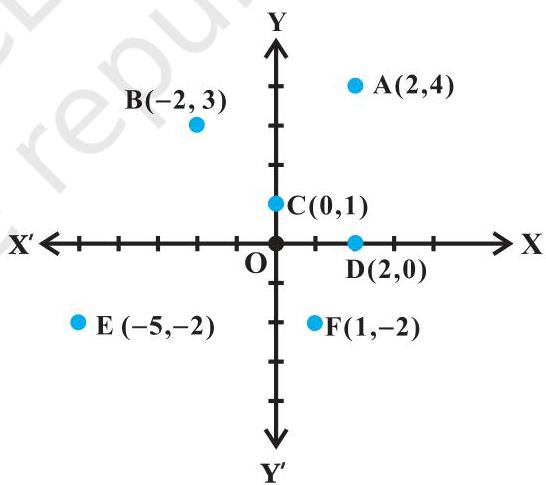 Fig 4.1
MATHEMATICS
Within the Argand plane
, it is clear that the modulus of a complex number $x + iy$, defined as $\sqrt{x^2 + y^2}$, represents the Euclidean distance separating the point $\mathrm{P}(x,y)$ from the origin $\mathrm{O}(0,0)$ (refer to Fig 4.2). Furthermore, points situated on the $x$-axis correspond to complex numbers expressed as $a + i0$, while those on the $y$-axis are associated with complex numbers of the form $0 + i b$. Consequently, the $x$-axis and $y$-axis within the Argand plane are respectively termed the real axis and the imaginary axis.
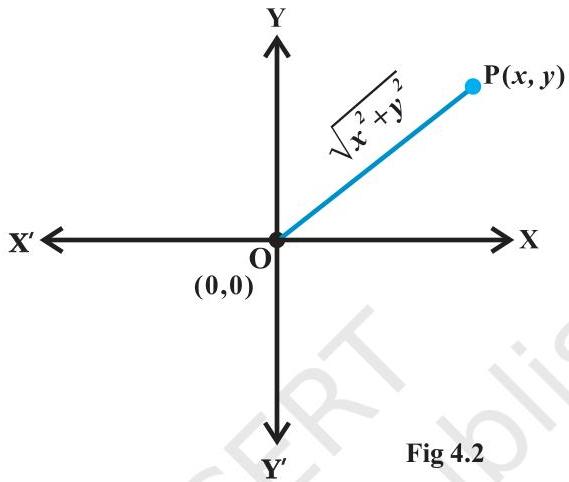
In the Argand plane, a complex number $z = x + iy$ and its conjugate $\overline{z} = x - iy$ are depicted as the points $\mathrm{P}(x,y)$ and $\mathrm{Q}(x, -y)$, respectively.
From a geometric perspective, the point $(x, -y)$ functions as the reflection of the point $(x, y)$ across the real axis (Fig 4.3).
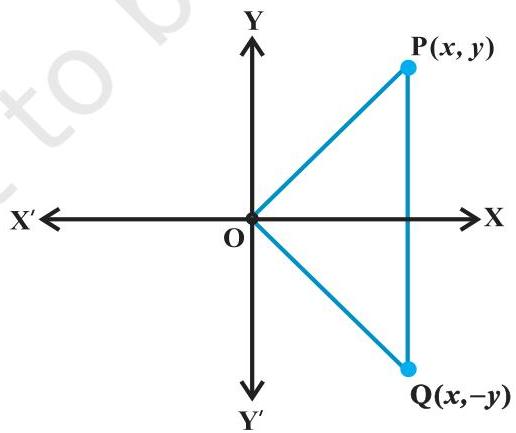 Fig 4.3
Miscellaneous Examples
Example 7 Determine the complex conjugate of the expression $\frac{(3 - 2i)(2 + 3i)}{(1 + 2i)(2 - i)}$.
Solution Consider the given expression: $ \begin{aligned} &= \frac{6 + 9i - 4i + 6}{2 - i + 4i + 2} = \frac{12 + 5i}{4 + 3i} \times \frac{4 - 3i}{4 - 3i} \ &= \frac{48 - 36i + 20i + 15}{16 + 9} = \frac{63 - 16i}{25} = \frac{63}{25} - \frac{16}{25}i \end{aligned} $ Consequently, the complex conjugate of $\frac{(3 - 2i)(2 + 3i)}{(1 + 2i)(2 - i)}$ is $\frac{63}{25} + \frac{16}{25}i$.
Example 8 Given that $x + iy = \frac{a + ib}{a - ib}$, establish that $x^2 + y^2 = 1$.
Solution Beginning with the provided equation: $ x + iy = \frac{(a + ib)(a + ib)}{(a - ib)(a + ib)} = \frac{a^2 - b^2 + 2abi}{a^2 + b^2} = \frac{a^2 - b^2}{a^2 + b^2} + \frac{2ab}{a^2 + b^2}i $ This implies that the complex conjugate is $x - iy = \frac{a^2 - b^2}{a^2 + b^2} - \frac{2ab}{a^2 + b^2}i$.
It follows that: $ x^2 + y^2 = (x + iy)(x - iy) = \frac{(a^2 - b^2)^2}{(a^2 + b^2)^2} + \frac{4a^2b^2}{(a^2 + b^2)^2} = \frac{(a^2 + b^2)^2}{(a^2 + b^2)^2} = 1 $
Miscellaneous Exercise on Chapter 4
Compute the value of: $\left[i^{18} + \left(\frac{1}{i}\right)^{25}\right]^3$.
Demonstrate that for any two complex numbers $z_1$ and $z_2$, the following identity holds: $\operatorname{Re}(z_1 z_2) = \operatorname{Re} z_1 \operatorname{Re} z_2 - \operatorname{Im} z_1 \operatorname{Im} z_2$.
Express $\left(\frac{1}{1 - 4i} - \frac{2}{1 + i}\right)\left(\frac{3 - 4i}{5 + i}\right)$ in its standard complex number form.
Given $x - iy = \sqrt{\frac{a - ib}{c - id}}$, establish that $\left(x^{2} + y^{2}\right)^{2} = \frac{a^{2} + b^{2}}{c^{2} + d^{2}}$.
Given $z_{1} = 2 - i$ and $z_{2} = 1 + i$, determine the value of $\left|\frac{z_1 + z_2 + 1}{z_1 - z_2 + 1}\right|$.
Suppose $a + ib = \frac{(x + i)^2}{2x^2 + 1}$. Show that $a^2 + b^2 = \frac{(x^2 + 1)^2}{(2x^2 + 1)^2}$.
Let $z_{1} = 2 - i$ and $z_{2} = -2 + i$. Determine the values of: (i) $\operatorname{Re}\left(\frac{z_1z_2}{\overline{z}_1}\right)$, (ii) $\operatorname{Im}\left(\frac{1}{\overline{z_1\overline{z}_1}}\right)$.
Determine the real numbers $x$ and $y$ such that $(x - iy)(3 + 5i)$ is the conjugate of $-6 - 24i$.
Calculate the modulus of $\frac{1 + i}{1 - i} - \frac{1 - i}{1 + i}$.
Given $(x + iy)^{3} = u + iv$, demonstrate that $\frac{u}{x} + \frac{v}{y} = 4(x^{2} - y^{2})$.
Suppose $\alpha$ and $\beta$ are distinct complex numbers such that $|\beta| = 1$. Determine the value of $\left|\frac{\beta - \alpha}{1 - \overline{\alpha}\beta}\right|$.
Determine the number of non-zero integer solutions for the equation $\left|1 - i\right|^x = 2^x$.
Given that $(a + ib)(c + id)(e + if)(g + ih) = A + iB$, prove that $ (a^2 + b^2)(c^2 + d^2)(e^2 + f^2)(g^2 + h^2) = A^2 + B^2 $
Given $\left(\frac{1 + i}{1 - i}\right)^m = 1$, determine the smallest positive integer value for $m$.
Summary
A complex number is defined as an entity expressed in the form $a + ib$, where $a$ and $b$ are real numbers. In this representation, $a$ designates the real component, while $b$ represents the imaginary component of the complex number.
Given two complex numbers, $z_1 = a + ib$ and $z_2 = c + id$, their fundamental operations are defined as follows:
(i) Their sum is $z_1 + z_2 = (a + c) + i(b + d)$ (ii) Their product is $z_1z_2 = (ac - bd) + i(ad + bc)$
For any complex number $z = a + ib$ where $a \neq 0$ and $b \neq 0$, its multiplicative inverse, symbolized as $\frac{1}{z}$ or $z^{-1}$, is given by the complex number $\frac{a}{a^2 + b^2} + i \frac{-b}{a^2 + b^2}$. This inverse satisfies the property that $(a + ib) - \frac{a}{a^2 + b^2} + i \frac{-b}{a^2 + b^2} = 1 + i0 = 1$.
For an arbitrary integer $k$, the powers of the imaginary unit $i$ follow a cyclical pattern: $i^{4k} = 1$, $i^{4k + 1} = i$, $i^{4k + 2} = -1$, and $i^{4k + 3} = -i$.
The complex conjugate of a number $z = a + ib$, represented by $\overline{z}$, is determined as $\overline{z} = a - ib$.
Historical Note
The recognition that the square root of a negative number has no existence within the real number system dates back to the Greeks. However, the Indian mathematician Mahavira (circa 850 CE) is credited with articulating this challenge with clarity. In his treatise, ‘Ganitasara Sangraha’, he observed that ‘by its very nature, a negative (quantity) is not a square (quantity)’, and consequently, ‘it possesses no square root’. Similarly, Bhaskara, another Indian mathematician, noted in his 1150 CE work, Bijaganita, that ‘there is no square root of a negative quantity, for it is not a square’. Cardan, in 1545, investigated the problem of determining solutions for the system of equations:
$ x + y = 10, xy = 40. $
His findings yielded $x = 5 + \sqrt{-15}$ and $y = 5 - \sqrt{-15}$ as the solutions; however, he dismissed these results, labeling such numbers as ‘useless’. Albert Girard, around 1625, endorsed the concept of square roots of negative numbers, asserting that their inclusion would allow for finding a number of roots equivalent to the degree of a polynomial equation. Euler subsequently pioneered the use of the symbol $i$ to represent $\sqrt{-1}$. Later, approximately in 1830, W.R. Hamilton conceptualized the complex number $a + ib$ as an ordered pair of real numbers $(a, b)$, thereby furnishing a rigorously mathematical definition and circumventing reliance on the term ‘imaginary numbers’.