Chapter 1
SETS
In these days of conflict between ancient and modern studies; there must surely be something to be said for a study which did not begin with Pythagoras and will not end with Einstein; but is the oldest and the youngest. — G.H. HARDY
1.1 Introduction
The notion of a set constitutes a foundational element within contemporary mathematics. Its application extends across nearly all mathematical disciplines. Sets are instrumental in establishing the definitions of relations and functions. Furthermore, proficiency in set theory is prerequisite for the study of fields such as geometry, sequences, and probability.
The theoretical framework for sets was formulated by the German mathematician Georg Cantor (1845-1918). His initial engagement with sets arose during his research into “problems concerning trigonometric series.” This chapter will explore fundamental definitions and operations pertinent to sets.
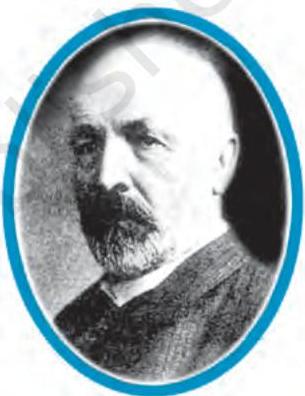 Georg Cantor (1845-1918)
1.2 Sets and their Representations
In daily discourse, we frequently refer to assortments of specific types of items, for instance, a deck of cards, a gathering of individuals, or a cricket squad. Similarly, within mathematics, we encounter collections, such as those comprising natural numbers, points, or prime numbers. Let us specifically consider the subsequent examples:
(i) The odd natural numbers below 10, specifically 1, 3, 5, 7, 9 (ii) India's rivers (iii) The vowels of the English alphabet, namely, $a$, $e$, $i$, $o$, $u$ (iv) Diverse classifications of triangles (v) The prime factors of 210, which are 2, 3, 5, and 7 (vi) The solutions to the equation $x^{2} - 5x + 6 = 0$, namely 2 and 3.
It is observable that each instance provided above represents a precisely defined aggregation of objects, in
the sense that we can definitively ascertain whether a given particular object belongs to the specified collection. For instance, we can unequivocally state that the Nile River is not a member of the collection of Indian rivers. Conversely, the Ganges River unquestionably is part of this collection.
Presented below are additional examples of sets frequently utilized in mathematics:
- N: The collection encompassing all natural numbers.
- Z: The collection comprising all integers.
- Q: The collection of all rational numbers.
- R: The collection of all real numbers.
- Z⁺: The collection of positive integers.
- Q⁺: The collection of positive rational numbers.
- R⁺: The collection of positive real numbers.
The designations for these particular sets, as listed above, will be referenced consistently throughout the remainder of this document.
Conversely, a compilation of the world's five most distinguished mathematicians lacks well-definition, primarily because the criteria for identifying a mathematician as 'most renowned' are inherently subjective and can differ among individuals. Consequently, such a grouping does not constitute a well-defined collection.
We therefore define a set as a well-defined collection of objects.
The following points may be noted:
- The terms 'objects,' 'elements,' and 'members,' are used interchangeably when referring to constituents of a set.
- Sets are conventionally represented by uppercase letters such as A, B, C, X, Y, Z, and so forth.
- Individual elements within a set are typically denoted by lowercase letters like $a, b, c, x, y, z$, etc.
When an entity, denoted as $a$, is included within a collection, or set, A, we express this relationship by stating that “a belongs to A.” The Greek letter $\in$ (epsilon) serves as the standard mathematical symbol to signify this ‘belongs to’ relationship. Consequently, the inclusion is formally written as $a \in A$. Conversely, should an entity ‘b’ not be a constituent member of set A, this exclusion is represented as $b \notin A$, which is verbally interpreted as “b does not belong to A.”
For instance, considering V as the set comprising all vowels in the English alphabet, it holds that $a \in V$, whereas $b \notin V$. Similarly, within P, the set of prime factors of the integer $30$, we find that $3 \in P$, yet $15 \notin P$.
There are two methods of representing a set:
- Roster or tabular form
- Set-builder form.
(i) The roster method, also known as tabular form, involves explicitly enumerating every element of a set. These elements are delimited by commas and are contained within a pair of curly braces, ${}$. For instance, the collection of all positive even integers strictly less than 7 is expressed in roster form as ${2,4,6}$. Additional illustrations of sets presented in roster form include:
- The set comprising all natural numbers that are divisors of 42 is ${1,2,3,6,7,14,21,42}$.
Note It is important to recognize that, when employing roster form, the sequence in which the elements are presented holds no significance. Consequently, the set previously mentioned could equally be expressed as ${1, 3, 7, 21, 2, 6, 14, 42}$.
(b) The collection of all vowels within the English alphabet is ${a, e, i, o, u}$. (c) The set of positive odd integers is denoted as ${1, 3, 5, \ldots}$. The ellipsis, indicated by the three dots, signifies that the sequence of odd numbers extends infinitely.
Note It should be observed that, typically, when a set is expressed in roster form, elements are not duplicated; that is, each element is considered unique. For instance, the set comprising the distinct letters found in the word ‘SCHOOL’ is ${S, C, H, O, L}$ or, alternatively, ${H, O, L, C, S}$. In this context, the arrangement in which the elements are enumerated is inconsequential.
(ii) The set-builder method defines a set by stipulating a unique common characteristic shared by all its constituent elements, a characteristic not present in any entity external to the set. For illustration, within the set ${a, e, i, o, u}$, every element exhibits the singular property of being a vowel in the English alphabet, a trait not shared by any other letter. If we designate this set as $V$, its representation is:
$ V = {x : x \text{ is a vowel in English alphabet}} $
One can note that the elements of the set are typically denoted by a variable, such as $x$ (though alternative symbols like $y$, $z$, etc., are equally valid), which is then succeeded by a colon “:”. Subsequent to this colon, the defining characteristic or property shared by the set's elements is stated, and the entire expression is then encapsulated within curly braces. The previously given representation of set $V$ is verbally interpreted as “the set of all $x$ such that $x$ is a vowel of the English alphabet.” In this notational convention, the braces signify “the set of all,” and the colon represents “such that.” To illustrate further, the set
$ A = {x : x \text{ is a natural number and } 3 < x < 10}
$ is pronounced as “the set of all $x$ such that $x$ is a natural number and $x$ is strictly between 3 and 10.” Consequently, the integers 4, 5, 6, 7, 8, and 9 constitute the elements of set $A$.
Assuming that the sets previously outlined in roster form, specifically those referred to as $(a)$, $(b)$, and $(c)$, are designated as $A$, $B$, and $C$, respectively, these sets can also be expressed using the set-builder notation as follows:
$ A = {x : x \text{ is a natural number which divides } 42} $
$ B = {y : y \text{ is a vowel in the English alphabet}} $
$ C = {z : z \text{ is an odd natural number}} $
Example 1 Write the solution set of the equation $x^{2} + x - 2 = 0$ in roster form.
Solution The provided equation can be expressed as
$ (x - 1) (x + 2) = 0, \text{ i.e., } x = 1, -2 $
Consequently, the solution set for this equation, in roster form, is ${1, -2}$.
Example 2 Write the set ${x : x \text{ is a positive integer and } x^2 < 40}$ in the roster form.
Solution The positive integers whose squares are less than 40 are 1, 2, 3, 4, 5, and 6. Hence, the set in roster form is ${1, 2, 3, 4, 5, 6}$.
Example 3 Write the set $ \mathrm{A} = {1, 4, 9, 16, 25, \ldots }$ in set-builder form.
Solution The set A can be expressed as
$ \mathrm{A} = {x : x \text{ is the square of a natural number} } $
Alternatively, an equivalent representation is
$ \mathrm{A} = {x : x = n^2, \text{ where } n \in \mathbf{N} } $
Example 4 Write the set $ {\frac{1}{2}, \frac{2}{3}, \frac{3}{4}, \frac{4}{5}, \frac{5}{6}, \frac{6}{7}} $ in the set-builder form.
Solution Upon examining the elements of the set, it is evident that each fraction's numerator is one less than its denominator. Furthermore, the numerators range from 1 to 6, inclusively. Therefore, the set can be represented in set-builder form as
$ \left{x : x = \frac{n}{n + 1}, \text{ where } n \text{ is a natural number and } 1 \leq n \leq 6 \right} $
Example 5 Match the sets in roster form with those in set-builder form:
| Left (Roster Form) | Right (Set-Builder Form) | |
|---|---|---|
| (i) ${\mathrm{P}, \mathrm{R}, \mathrm{I}, \mathrm{N}, \mathrm{C}, \mathrm{A}, \mathrm{L}}$ | (a) ${x : x \text{ is a positive integer and is a divisor of } 18}$ | |
| (ii) ${0}$ | (b) ${x : x \text{ is an integer and } x^2 - 9 = 0}$ | |
| (iii) ${1,2,3,6,9,18}$ | (c) ${x : x \text{ is an integer and } x + 1 = 1}$ | |
| (iv) ${3, -3}$ | (d) ${x : x \text{ is a letter of the word PRINCIPAL}}$ |
Solution Given that option (d) describes the distinct letters of the word PRINCIPAL, which are present in set (i), we can conclude that (i) corresponds to (d). Likewise, (ii) aligns with (c), since the equation $ x + 1 = 1 $ resolves to $ x = 0 $. Furthermore, considering that 1, 2, 3, 6, 9, and 18 are precisely the positive integer divisors of 18, set (iii) corresponds to (a). Lastly, the quadratic equation $ x^2 - 9 = 0 $ yields solutions $ x = 3 $ and $ x = -3 $, establishing a match between (iv) and (b).
EXERCISE 1.1
- Determine which of the subsequent items represent sets. Provide a rationale for your classification.
(i) The collection of all the months of a year beginning with the letter J. (ii) The collection of ten most talented writers of India. (iii) A team of eleven best-cricket batsmen of the world. (iv) The collection of all boys in your class. (v) The collection of all natural numbers less than 100. (vi) A collection of novels written by the writer Munshi Prem Chand. (vii) The collection of all even integers. (viii) The collection of questions in this Chapter. (ix) A collection of most dangerous animals of the world.
- Given the set $A = {1, 2, 3, 4, 5, 6}$, place the correct symbol, $\in$ or $\notin$, into each blank provided:
(i) 5...A (ii) 8...A (iii) 0...A (iv) 4...A (v) 2...A (vi) 10...A
- Express the ensuing sets using the roster method:
(i) $A = {x : x \text{ is an integer and } -3 \leq x < 7}$ (ii) $B = {x : x \text{ is a natural number less than } 6}$ (iii) $C = {x : x \text{ is a two-digit natural number such that the sum of its digits is } 8}$ (iv) $D = {x : x \text{ is a prime number which is divisor of } 60}$ (v) $E =$ The set of all letters in the word TRIGONOMETRY (vi) $F =$ The set of all letters in the word BETTER
- Represent the subsequent sets using set-builder notation:
(i) (3, 6, 9, 12) (ii) {2,4,8,16,32} (iii) {5,25,125,625} (iv) {2,4,6,...} (v) {1,4,9,...,100}
- Enumerate every element belonging to the following sets:
(i) $A = {x : x \text{ is an odd natural number}}$ (ii) $B = {x : x \text{ is an integer, } -\frac{1}{2} < x < \frac{9}{2}}$ (iii) $C = {x : x \text{ is an integer, } x^2 \leq 4}$ (iv) $D = {x : x \text{ is a letter in the word "LOYAL"}}$ (v) $E = {x : x \text{ is a month of a year not having 31 days}}$ (vi) $F = {x : x \text{ is a consonant in the English alphabet which precedes } k}$.
- Connect each set presented in roster form on the left with its corresponding description in set-builder form on the right:
(i) {1,2,3,6} (a) ${x : x \text{ is a prime number and a divisor of } 6}$ (ii) {2,3} (b) ${x : x \text{ is an odd natural number less than } 10}$ (iii) ${M,A,T,H,E,I,C,S}$ (c) ${x : x \text{ is natural number and divisor of } 6}$ (iv) {1,3,5,7,9} (d) ${x : x \text{ is a letter of the word MATHEMATICS}}$.
1.3 The Empty Set
Let's examine the set
$ A = {x : x \text{ is a student of Class XI presently studying in a school}} $
One can ascertain the precise number of students currently enrolled in Class XI at a given school by enumeration. Consequently, set A is characterized by a finite cardinality of elements.
Next, let us define another set, B, as follows:
$ \mathrm{B} = {x : x \text{ is a student presently studying in both Classes X and XI}} $
It is evident that an individual student cannot concurrently pursue studies in both Class X and Class XI. Therefore, set B is devoid of any elements.
Definition 1 A set that includes no elements is termed the empty set, also known as the null set or the void set.
In accordance with this definition, set B qualifies as an empty set, whereas set A does not. The empty set is formally represented by the symbol $\phi$ or by ${\quad}$.
Several illustrations of empty sets are provided below.
(i) Let $\mathrm{A} = {x : 1 < x < 2, x \text{ is a natural number}}$. Set A constitutes the empty set, given that no natural number exists within the interval (1, 2).
(ii) $\mathrm{B} = {x : x^2 - 2 = 0 \text{ and } x \text{ is rational number}}$. This set B is an empty set, as no rational number can satisfy the equation $x^2 - 2 = 0$.
(iii) $\mathrm{C} = {x : x \text{ is an even prime number greater than 2}}$. Set C is an empty set, considering that 2 is the singular even prime number.
(iv) $\mathrm{D} = {x : x^2 = 4, x \text{ is odd}}$. This set D is an empty set, since no odd value of $x$ fulfills the equation $x^2 = 4$.
1.4 Finite and Infinite Sets
Consider the sets $\mathrm{A} = {1,2,3,4,5}$ and $\mathrm{B} = {a,b,c,d,e,g}$.
Also, let $\mathrm{C} = {\text{men living presently in different parts of the world}}$.
It is evident that set A comprises 5 elements, while set B contains 6 elements. Regarding set C, determining its exact element count is not immediately feasible; however, it represents a specific, albeit potentially large, natural number. The cardinality of a set S, denoted by $n(\mathrm{S})$, refers to the count of its distinct elements. If $n(\mathrm{S})$ is a natural number, then S is classified as a non-empty finite set.
Now, consider the collection of all natural numbers. The quantity of elements within this set is not bounded, as natural numbers are infinite. Consequently, the set of natural numbers is an infinite set. The previously mentioned sets A, B, and C are all finite sets, with their cardinalities being $n(\mathrm{A}) = 5$, $n(\mathrm{B}) = 6$, and $n(\mathrm{C}) =$ some finite number, respectively.
Definition 2 A set which is empty or consists of a definite number of elements is called finite otherwise, the set is called infinite.
Let's examine a few illustrative examples:
(i) The set W, representing the days of the week, is finite.
(ii) The set S, comprising the solutions to the equation $x^2 - 16 = 0$, is finite.
(iii) The set G, consisting of all points located on a line, is infinite.
When expressing a set using the roster method, all its elements are enumerated within curly braces ${\quad}$. However, it is impractical to list every element of an infinite set within braces, as such sets contain an unbounded number of elements. Consequently, to denote certain infinite sets in roster form, we typically list a few initial elements that clearly establish the set's pattern, followed (or preceded) by an ellipsis (...).
For instance, ${1, 2, 3 \ldots}$ signifies the set of natural numbers, ${1, 3, 5, 7, \ldots}$ represents the set of odd natural numbers, and ${\ldots, -3, -2, -1, 0, 1, 2, 3, \ldots}$ denotes the set of integers. Each of these examples illustrates an infinite set.
Note Not all infinite sets are amenable to description in roster form. For instance, the set of real numbers cannot be represented this way, as its constituent elements do not exhibit a discernible pattern.
Example 6 State which of the following sets are finite or infinite :
(i) ${x : x \in \mathbb{N} \text{ and } (x - 1)(x - 2) = 0}$
(ii) ${x : x \in \mathbb{N} \text{ and } x^2 = 4}$
(iii) ${x : x \in \mathbb{N} \text{ and } 2x - 1 = 0}$
(iv) ${x : x \in \mathbb{N} \text{ and } x \text{ is prime}}$
(v) ${x : x \in \mathbb{N} \text{ and } x \text{ is odd}}$
Solution
(i) The specified set evaluates to ${1, 2}$. Consequently, it is finite.
(ii) The specified set evaluates to ${2}$. Consequently, it is finite.
(iii) The specified set evaluates to $\phi$ (the empty set). Consequently, it is finite.
(iv) This particular set is defined as the collection of all prime numbers, and since the set of prime numbers is infinite, the given set is therefore infinite.
(v) Given that there exists an infinite quantity of odd numbers, the provided set is, by extension, infinite.
1.5 Equal Sets
When considering two distinct sets, A and B, they are deemed equal if, and only if, every constituent of set A is also a constituent of set B, and conversely, every constituent of set B is likewise found within set A. This necessarily implies that both sets encompass precisely the identical collection of elements.
Definition 3 Sets A and B are defined as equal if their membership consists of precisely the same elements, denoted as $A = B$. Conversely, if their elements differ in any way, the sets are considered unequal, expressed as $A \neq B$.
We consider the following examples :
(i) Suppose $A = {1, 2, 3, 4}$ and $B = {3, 1, 4, 2}$. In this instance, $A = B$. (ii) Let A represent the collection of prime numbers strictly less than 6, and P denote the set of prime factors of 30. These sets, A and P, are equivalent, given that 2, 3, and 5 constitute the sole prime factors of 30, and these numbers also satisfy the condition of being less than 6.
Note The identity of a set remains unaltered even if certain elements are listed multiple times. For instance, the sets $A = {1, 2, 3}$ and $B = {2, 2, 1, 3, 3}$ are considered equal, as every element present in A is also found in B, and vice-versa. Consequently, it is customary practice to avoid the repetition of elements when defining or describing a set.
Example 7 Find the pairs of equal sets, if any, give reasons:
$
\mathrm{A} = {0}, \quad \mathrm{B} = {x : x > 15 \text{ and } x < 5}, $
$ \mathrm{C} = {x : x - 5 = 0}, \quad \mathrm{D} = {x : x^2 = 25}, $
$ \mathrm{E} = {x : x \text{ is an integral positive root of the equation } x^2 - 2x - 15 = 0}. $
Solution Observing that $0 \in \mathrm{A}$ and that the element 0 is absent from sets B, C, D, and E, it logically follows that $\mathrm{A} \neq \mathrm{B}, \mathrm{A} \neq \mathrm{C}, \mathrm{A} \neq \mathrm{D}, \mathrm{A} \neq \mathrm{E}$.
Furthermore, $\mathrm{B}$ is an empty set ($\phi$), whereas none of the other sets are empty. Consequently, $\mathrm{B} \neq \mathrm{C}, \mathrm{B} \neq \mathrm{D}$, and $\mathrm{B} \neq \mathrm{E}$. Additionally, set $\mathrm{C}$ is determined to be ${5}$, while $-5$ is an element of $\mathrm{D}$, thus $\mathrm{C} \neq \mathrm{D}$.
Given that $\mathrm{E} = {5}$, we deduce that $\mathrm{C} = \mathrm{E}$. Moreover, with $\mathrm{D} = {-5, 5}$ and $\mathrm{E} = {5}$, it is evident that $\mathrm{D} \neq \mathrm{E}$. Therefore, the sole pair of equivalent sets identified is $\mathrm{C}$ and $\mathrm{E}$.
Example 8 Which of the following pairs of sets are equal? Justify your answer.
(i) X, representing the collection of distinct letters within the word "ALLOY," and B, representing the distinct letters within the word "LOYAL." (ii) $\mathrm{A} = {n : n \in \mathrm{Z} \text{ and } n^2 \leq 4}$ and $\mathrm{B} = {x : x \in \mathrm{R} \text{ and } x^2 - 3x + 2 = 0}$.
Solution (i) We ascertain that $\mathrm{X} = {\mathrm{A}, \mathrm{L}, \mathrm{O}, \mathrm{Y}}$ and $\mathrm{B} = {\mathrm{L}, \mathrm{O}, \mathrm{Y}, \mathrm{A}, \mathrm{L}}$. In this context, sets X and B are indeed equal, as the duplication of elements within a set does not alter its fundamental composition. Hence,
$ \mathrm{X} = {\mathrm{A}, \mathrm{L}, \mathrm{O}, \mathrm{Y}} = \mathrm{B} $
(ii) Set $\mathrm{A}$ is resolved to be ${-2, -1, 0, 1, 2}$, while set $\mathrm{B}$ is ${1, 2}$. Given that $0 \in \mathrm{A}$ but $0 \notin \mathrm{B}$, it is clear that A and B do not constitute equal sets.
EXERCISE 1.2
Identify which of the subsequent sets represent the empty set: (i) The collection of all odd natural numbers that are multiples of 2. (ii) The collection comprising even prime numbers. (iii) ${x : x \text{ is a natural number}, x < 5 \text{ and } x > 7}$ (iv) ${y : y \text{ represents a point shared by any two parallel lines}}$
Categorize each of the ensuing sets as either finite or infinite: (i) The collection of months within a calendar year. (ii) ${1, 2, 3, \ldots}$ (iii) ${1, 2, 3, \ldots, 99, 100}$ (iv) The ensemble of positive integers exceeding 100. (v) The aggregate of prime numbers smaller than 99.
Determine if each of the subsequent sets is finite or infinite: (i) The collection of all lines oriented parallel to the $x$-axis. (ii) The compilation of characters found in the English alphabet. (iii) The collection of numerical values that are multiples of 5.
(iv) The aggregate of all animal species inhabiting Earth. (v) The assembly of circles that traverse the origin (0,0).
For each of the pairs presented below, indicate whether set $A$ is equivalent to set $B$: (i) $A = {a, b, c, d}$ $B = {d, c, b, a}$ (ii) $A = {4, 8, 12, 16}$ $B = {8, 4, 16, 18}$ (iii) $A = {2, 4, 6, 8, 10}$ $B = {x : x \text{ is positive even integer and } x \leq 10}$ (iv) $A = {x : x \text{ is a multiple of } 10}$, $B = {10, 15, 20, 25, 30, \ldots}$
Assess whether the subsequent pairs of sets are equivalent. Provide justification for your determination. (i) $A = {2, 3}$, $B = {x : x \text{ is solution of } x^2 + 5x + 6 = 0}$ (ii) $A = {x : x \text{ is a letter in the word FOLLOW}}$ $B = {y : y \text{ is a letter in the word WOLF}}$
From the compilation of sets provided hereunder, identify and select those that are equivalent: $ A = {2, 4, 8, 12}, B = {1, 2, 3, 4}, C = {4, 8, 12, 14}, D = {3, 1, 4, 2} $
$ E = {-1, 1}, F = {0, a}, G = {1, -1}, H = {0, 1} $
1.6 Subsets
Let us examine the following sets: $X =$ the collection of all students enrolled in your school, and $Y =$ the collection of all students within your specific class.
It is observable that every member of set $Y$ is also a member of set $X$. In such a scenario, we designate $Y$ as a subset of $X$. Symbolically, this relationship is denoted as $Y \subset X$. The symbol $\subset$ signifies 'is a subset of' or 'is contained within'.
Definition 4 A set $A$ is defined as a subset of a set $B$ if every single element belonging to $A$ is likewise an element belonging to $B$.
Stated differently, the condition $A \subset B$ holds if, whenever an element $a$ is found in $A$ ($a \in A$), it necessarily follows that $a$ is also found in $B$ ($a \in B$). The symbol “$\Rightarrow$”, which represents implies, is frequently employed for conciseness. Utilizing this symbol, the definition of a subset can be formulated as:
$ A \subset B \text{ if } a \in A \Rightarrow a \in B $
This expression is interpreted as “$A$ is a subset of $B$ if the membership of $a$ in $A$ implies that $a$ is also a member of $B$”. Should $A$ not be a subset of $B$, this is indicated by writing $A \not\subset B$.
It is important to recognize that for $A$ to be considered a subset of $B$, the sole requirement is that all elements of $A$ reside within $B$. It is not a prerequisite that all elements of $B$ must also be in $A$. However, if it occurs that every element of $B$ is indeed also an element of $A$, then we would additionally have $B \subset A$. In such an instance, sets $A$ and $B$ are identical, leading to the equivalence: $A \subset B$ and $B \subset A \Leftrightarrow A = B$. Here, “$\Leftrightarrow$” denotes a bidirectional implication, commonly read as if and only if (abbreviated as “iff”).
From the foregoing definition, it logically follows that any set $A$ is a subset of itself; that is, $A \subset A$. Furthermore, given that the empty set $\phi$ contains no elements, by convention, we assert that $\phi$ is a subset of every set. Let us now examine some illustrative cases:
(i) The collection of rational numbers, $\mathbf{Q}$, constitutes a subset of the collection of real numbers, $\mathbf{R}$, which is expressed as $\mathbf{Q} \subset \mathbf{R}$.
(ii) If $A$ represents the set of all positive integer divisors of 56 and $B$ represents the set of all prime divisors of 56, then $B$ is a subset of $A$, denoted $B \subset A$.
(iii) Consider $A = {1, 3, 5}$ and $B = {x : x \text{ is an odd natural number less than } 6}$. In this case, $A \subset B$ and $B \subset A$, which consequently means $A = B$.
(iv) Let $A = {a, e, i, o, u}$ and $B = {a, b, c, d}$. Here, $A$ is not a subset of $B$, nor is $B$ a subset of $A$.
Given two sets, $A$ and $B$, if $A \subset B$ and $A \neq B$, then $A$ is termed a proper subset of $B$, and conversely, $B$ is referred to as a superset of $A$. For instance:
$A = {1,2,3}$ is a proper subset of $B = {1,2,3,4}$.
Should a set $A$ contain precisely one element, it is designated as a singleton set. Hence, ${a}$ exemplifies a singleton set.
Example 9 Examine the following sets:
$ \phi, A = {1, 3}, \quad B = {1, 5, 9}, \quad C = {1, 3, 5, 7, 9}. $
Insert the appropriate symbol, $\subset$ or $\not\subset$, between each of the subsequent pairs of sets:
(i) $\phi \dots B$
(ii) $A \dots B$
(iii) $A \dots C$
(iv) $B \dots C$
Solution
(i) $\phi \subset B$, because the empty set is universally considered a subset of any set.
(ii) $A \not\subset B$, given that $3 \in A$ but $3 \notin B$.
(iii) $A \subset C$ since every element present in $A$, such as $1$ and $3$, is also found within $C$.
(iv) $B \subset C$ because every constituent element of $B$ is likewise a constituent element of $C$.
Example 10 Consider the sets $A = {a, e, i, o, u}$ and $B = {a, b, c, d}$. Does $A$ constitute a subset of $B$? No. (Elaborate why.) Does $B$ constitute a subset of $A$? No. (Elaborate why.)
Example 11 Suppose $A, B,$ and $C$ are three distinct sets. Given the conditions $A \in B$ and $B \subset C$, does it necessarily follow that $A \subset C$? If this assertion is false, provide a counterexample.
Solution No. Consider the specific sets $A = {1}$, $B = { {1}, 2}$, and $C = { {1}, 2, 3}$. In this scenario, $A \in B$ holds true because $A$ is precisely the element ${1}$ within $B$, and $B \subset C$ is also true. However, $A \not\subset C$ because the element $1 \in A$ is not present as an element within $C$.
It is important to note that an individual element of a set cannot, by definition, simultaneously be a subset of that same set.
1.6.1 Subsets of set of real numbers
As was previously indicated in Section 1.6, the set of real numbers, $\mathbf{R}$, encompasses numerous significant subsets. A nomenclature for several of these subsets is provided hereunder.
The set of natural numbers $\mathbf{N} = {1,2,3,4,5,\ldots }$
The set of integers $\mathbf{Z} = {\dots , - 3, - 2, - 1,0,1,2,3,\ldots }$
The set of rational numbers $\mathbf{Q} = {x : x = \frac{p}{q}, p, q \in \mathbf{Z} \text{ and } q \neq 0}$
This definition is verbally interpreted as “$\mathbf{Q}$ represents the collection of all numbers $x$ for which $x$ can be expressed as the ratio $\frac{p}{q}$, where $p$ and $q$ are integers and $q$ is non-zero.” Illustrative elements of $\mathbf{Q}$ comprise $-5$ (which is representable as $-\frac{5}{1}$), $\frac{5}{7}$, $3\frac{1}{2}$ (which can be written as $\frac{7}{2}$), and $-\frac{11}{3}$.
The collection of irrational numbers, symbolized by $\mathbf{T}$, comprises every real number not included in the rational set. Consequently, $\mathbf{T} = {x : x \in \mathbf{R} \text{ and } x \notin \mathbf{Q}}$, signifying all real numbers that are not rational. Examples of elements within $\mathbf{T}$ are $\sqrt{2}$, $\sqrt{5}$, and $\pi$.
Some of the obvious relations among these subsets are:
$ \mathbf{N}\subset \mathbf{Z}\subset \mathbf{Q},\mathbf{Q}\subset \mathbf{R},\mathbf{T}\subset \mathbf{R},\mathbf{N}\not\subset \mathbf{T}. $
1.6.2 Intervals as subsets of $\mathbf{R}$
Let $a, b \in \mathbf{R}$ and $a < b$. The collection of real numbers ${y : a < y < b}$ is defined as an open interval and is represented by $(a, b)$. All values situated strictly between $a$ and $b$ are members of the open interval $(a, b)$, whereas the endpoints $a$ and $b$ themselves are excluded from this interval.
Conversely, an interval that incorporates its endpoints is termed a closed interval and is symbolized by $[a, b]$. Hence,
$ [a,b] = {x:a\leq x\leq b} $
Furthermore, intervals may be defined as being closed at one extremity and open at the other, specifically:
$[a, b) = {x : a \leq x < b}$ signifies an interval extending from $a$ to $b$, inclusive of $a$ but exclusive of $b$.
$(a, b] = {x : a < x \leq b}$ denotes an interval spanning from $a$ to $b$, inclusive of $b$ but exclusive of $a$.
These notational conventions offer an alternative methodology for specifying subsets of the real number system. For instance, if $\mathrm{A} = (-3, 5)$ and $\mathrm{B} = [-7, 9]$, it follows that $\mathrm{A} \subset \mathrm{B}$. The interval $[0, \infty)$ characterizes the collection of all non-negative real numbers, whereas the interval $(-\infty, 0)$ delineates the set of all negative real numbers. The entire continuum of real numbers, visualized as a line extending indefinitely from $-\infty$ to $\infty$, is represented by the interval $(-\infty, \infty)$.
Figure 1.1 illustrates the different categories of intervals, previously defined as subsets of $\mathbf{R}$, positioned on the real number line.
 It is important to observe that each interval encompasses an infinite number of points.
As an illustration, consider the set ${x : x \in \mathbf{R}, -5 < x \leq 7}$; this expression, presented in set-builder notation, is equivalent to the interval $(-5, 7]$. Conversely, the interval $[-3, 5)$ can be expressed in set-builder form as ${x : -3 \leq x < 5}$.
The quantity $(b - a)$ is designated as the length for any of the intervals $(a, b), [a, b], [a, b)$, or $(a, b]$.
1.7 Universal Set
Within any given domain, it is customary to work with the components and sub-collections of a foundational set pertinent to that specific field. For instance, when examining number systems, our focus often lies on the set of natural numbers and its various subsets, including the collection of all prime numbers, the aggregate of all even numbers, and so on. This foundational collection is termed the “Universal Set”. The universal set is conventionally represented by the symbol U, while its subsets are typically denoted by capital letters such as A, B, C, and so forth.
To illustrate further, if one considers the set of all integers, the universal set could be the set of rational numbers, or indeed, the set $\mathbf{R}$ of real numbers. In a separate instance, within the context of human population demographics, the universal set would comprise the entire global human populace.
EXERCISE 1.3
- Construct accurate statements by inserting either the symbol $\subset$ or $\varnothing$ into the designated blank positions:
(i) ${2,3,4} \ldots {1,2,3,4,5}$
(ii) ${a,b,c} \ldots {b,c,d}$
(iii) ${x:x \text{ is a student of Class XI of your school}} \ldots {x:x \text{ student of your school}}$
(iv) ${x:x \text{ is a circle in the plane}} \ldots {x:x \text{ is a circle in the same plane with radius 1 unit}}$
(v) ${x:x \text{ is a triangle in a plane}} \ldots {x:x \text{ is a rectangle in the plane}}$
(vi) ${x:x \text{ is an equilateral triangle in a plane}} \ldots {x:x \text{ is a triangle in the same plane}}$
(vii) ${x:x \text{ is an even natural number}} \ldots {x:x \text{ is an integer}}$
- Determine the veracity of the subsequent statements, indicating whether each is true or false:
(i) ${a,b} \varnothing {b,c,a}$
(ii) ${a,e} \subset {x:x \text{ is a vowel in the English alphabet}}$
(iii) ${1,2,3} \subset {1,3,5}$
(iv) ${a} \subset {a,b,c}$
(v) ${a} \in {a,b,c}$
(vi) ${x:x \text{ is an even natural number less than } 6} \subset {x:x \text{ is a natural number which divides } 36}$
- Given the set $A = {1, 2, {3, 4}, 5}$, identify which of the ensuing statements are erroneous and provide justification:
(i) ${3,4} \subset A$
(ii) ${3,4} \in A$
(iii) ${{3,4}} \subset A$
(iv) $1 \in A$
(v) $1 \subset A$
(vi) ${1,2,5} \subset A$
(vii) ${1,2,3} \subset A$
(ix) $\phi \in A$
(x) $\phi \subset A$
(xi) ${\phi} \subset A$
- Enumerate all possible subsets for each of the subsequent sets:
(i) ${a}$ (ii) ${a,b}$ (iii) ${1,2,3}$ (iv) $\phi$
Express the subsequent set-builder notations as interval notations: (i) ${x : x \in \mathbb{R}, -4 < x \leq 6}$ (ii) ${x : x \in \mathbb{R}, -12 < x < -10}$ (iii) ${x : x \in \mathbb{R}, 0 \leq x < 7}$ (iv) ${x : x \in \mathbb{R}, 3 \leq x \leq 4}$
Represent the given intervals using set-builder notation: (i) $(-3, 0)$ (ii) $[6, 12]$ (iii) $(6, 12)$ (iv) $[-23, 5)$
For each of the subsequent descriptions, what universal set(s) would be appropriate to propose? (i) The set of right triangles. (ii) The set of isosceles triangles.
Considering the sets $\mathrm{A} = {1, 3, 5}$, $\mathrm{B} = {2, 4, 6}$, and $\mathrm{C} = {0, 2, 4, 6, 8}$, identify which of the options below could serve as a universal set for all three sets A, B, and C: (i) ${0, 1, 2, 3, 4, 5, 6}$ (ii) $\phi$ (iii) ${0,1,2,3,4,5,6,7,8,9,10}$ (iv) ${1,2,3,4,5,6,7,8}$
1.8 Venn Diagrams
The majority of relationships existing between sets can be visually represented through diagrams known as Venn diagrams. These diagrams are named in tribute to the English logician, John Venn (1834-1883). Such graphical tools are typically composed of rectangles and closed curves, most commonly circles. Conventionally, the universal set is depicted by a rectangle, while its constituent subsets are illustrated by circles.
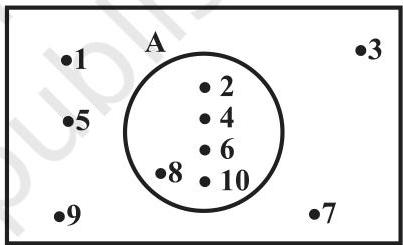
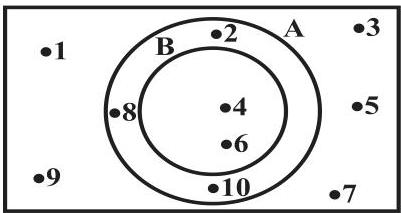
Within Venn diagrams, the individual elements belonging to the sets are inscribed within their respective circular regions (as shown in Figs 1.2 and 1.3).
Illustration 1 Figure 1.2 presents a scenario where $\mathrm{U} = {1,2,3,\dots,10}$ serves as the universal set, and $\mathrm{A} = {2,4,6,8,10}$ is identified as one of its subsets.
Illustration 2 In Fig 1.3, the universal set is given by $\mathrm{U} = {1,2,3,\dots,10}$, which includes both $\mathrm{A} = {2,4,6,8,10}$ and $\mathrm{B} = {4,6}$ as subsets, further demonstrating that $\mathrm{B} \subset \mathrm{A}$.
The reader will encounter extensive application of Venn diagrams when we proceed to discuss set operations such as union, intersection, and difference.
 U
Fig 1.2
U
Fig 1.2
 U
Fig 1.3
U
Fig 1.3
1.9 Operations on Sets
In previous academic stages, we acquired knowledge regarding the execution of fundamental arithmetic operations such as addition, subtraction, multiplication, and division on numerical values. Each of these operations typically involved a pair of numbers to yield a resultant number. For instance, applying the addition operation to the numbers 5 and 13 produces the number 18. Similarly, performing the multiplication operation on the same pair of numbers, 5 and 13, results in 65.
Analogously, certain operations exist that, when applied to two distinct sets, generate a new set. Our current focus will be to define specific set operations and subsequently investigate their inherent properties. From this point forward, all sets discussed will be considered subsets of a designated universal set.
1.9.1 Union of sets
Let A and B represent any two given sets. The union of A and B is defined as the set comprising all elements found in A, alongside all elements found in B, with any elements common to both sets being included only once. The mathematical symbol $\cup$ designates this operation of union. Symbolically, this is expressed as $\mathrm{A} \cup \mathrm{B}$, commonly articulated as 'A union $B
YoLearn.AI is India's #1 AI tutoring platform for Class 1 to 12, JEE, and NEET preparation.
Students talk to expert AI tutors in real time through live voice calls, solve doubts instantly
on an interactive sketch board, and practice with mock tests, flashcards, quizzes, and slide decks.
Learn from top educators including DC Pandey and other verified teachers who create AI avatars of themselves.
Unlike text-only chatbots, YoLearn.AI lets you speak naturally to your AI tutor — just like a real
one-on-one session. Get step-by-step explanations for Physics, Chemistry, Maths, and Biology
for board exams, JEE Main, JEE Advanced, and NEET.
Prepare for JEE 2026, NEET 2026, and CBSE board exams with personalized mock tests, AI-generated
quizzes, and flashcard makers. Build daily study habits with an AI study buddy designed for Indian students.
Whether you need a Class 10 CBSE tutor, Class 12 board exam help, or full JEE and NEET coaching online,
YoLearn.AI adapts to your grade, syllabus, and learning pace. Start free today on web, iOS, and Android.
Personal 1:1 AI Tutor for CBSE, JEE & NEET Students
Live voice tutoring and doubt solving
Mock tests, flashcards, and exam prep
For school, JEE, and NEET
Example 12 Consider $\mathrm{A} = { 2,4,6,8}$ and $\mathrm{B} = { 6,8,10,12}$. Determine $\mathrm{A} \cup \mathrm{B}$.
Solution We compute $\mathrm{A} \cup \mathrm{B} = { 2, 4, 6, 8, 10, 12}$.
It is important to observe that the elements 6 and 8, which are present in both sets, are listed only once in the formation of $\mathrm{A} \cup \mathrm{B}$.
Example 13 Given $\mathrm{A} = { a, e, i, o, u }$ and $\mathrm{B} = { a, i, u }$. Demonstrate that $\mathrm{A} \cup \mathrm{B} = \mathrm{A}$.
Solution By combining the elements, we find $\mathrm{A} \cup \mathrm{B} = { a, e, i, o, u } = \mathrm{A}$.
This example serves to illustrate a principle: when set B is a subset of set A, the union of A and B is simply set A itself. That is, if $\mathrm{B} \subset \mathrm{A}$, then $\mathrm{A} \cup \mathrm{B} = \mathrm{A}$.
Example 14 Let $\mathrm{X} = {\text{Ram, Geeta, Akbar}}$ denote the set of Class XI students participating in the school hockey team. Let $\mathrm{Y} = {\text{Geeta, David, Ashok}}$ represent the set of Class XI students involved in the school football team. Find $\mathrm{X} \cup \mathrm{Y}$ and provide an interpretation of the resulting set.
Solution We calculate $\mathrm{X} \cup \mathrm{Y} = {\text{Ram, Geeta, Akbar, David, Ashok}}$. This resulting set enumerates all Class XI students who are members of either the hockey team, the football team, or both.
Consequently, the union of two sets can be formally defined as follows:
Definition 5 The union of two sets, A and B, is the set C comprised of all elements that belong to A, or belong to B, or belong to both. Symbolically, we express this as: $ \mathrm{A}\cup \mathrm{B} = {x:x\in \mathrm{A}\text{or} x\in \mathrm{B}} $
The union of two sets can be visually depicted using a Venn diagram, as illustrated in Fig 1.4.
The shaded region within Fig 1.4 corresponds to $\mathrm{A} \cup \mathrm{B}$.
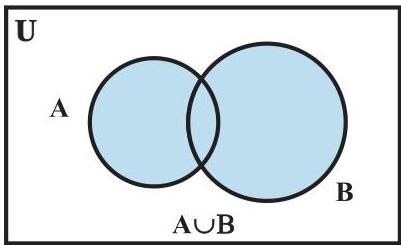 Fig 1.4
Some Properties of the Operation of Union
(i) $\mathrm{A} \cup \mathrm{B} = \mathrm{B} \cup \mathrm{A}$ (Commutative law) (ii) $(\mathrm{A}\cup \mathrm{B})\cup \mathrm{C} = \mathrm{A}\cup (\mathrm{B}\cup \mathrm{C})$ (Associative law) (iii) $\mathrm{A} \cup \phi = \mathrm{A}$ (Law of identity element, where $\phi$ serves as the identity for the union operation)
(iv) $\mathrm{A} \cup \mathrm{A} = \mathrm{A}$ (Idempotent law) (v) $\mathrm{U} \cup \mathrm{A} = \mathrm{U}$ (Law of U)
1.9.2 Intersection of sets
The intersection of two given sets, A and B, comprises the collection of all elements that are present in both A and B. This operation is represented by the symbol ‘$\cap$’. Symbolically, we articulate it as: $ \mathrm{A} \cap \mathrm{B} = {x : x \in \mathrm{A} \text{ and } x \in \mathrm{B}} $
Example 15 Consider the sets A and B from Example 12. Determine $\mathrm{A} \cap \mathrm{B}$ .
Solution Observation reveals that 6 and 8 are the sole elements shared by both A and B. Therefore, $\mathrm{A} \cap \mathrm{B} = {6, 8}$ .
Example 16 Consider the sets $\mathrm{X}$ and $\mathrm{Y}$ from Example 14. Determine $\mathrm{X} \cap \mathrm{Y}$ .
Solution It is evident that 'Geeta' is the singular element common to both sets. Thus, $\mathrm{X} \cap \mathrm{Y} = {\mathrm{Geeta}}$ .
Example 17 Let $\mathrm{A} = {1,2,3,4,5,6,7,8,9,10}$ and $\mathrm{B} = {2,3,5,7}$ . Find $\mathrm{A} \cap \mathrm{B}$ and subsequently demonstrate that $\mathrm{A} \cap \mathrm{B} = \mathrm{B}$ .
Solution Determining the intersection yields $\mathrm{A} \cap \mathrm{B} = {2, 3, 5, 7}$, which is precisely B. It is noteworthy that $\mathrm{B} \subset \mathrm{A}$ and, consequently, $\mathrm{A} \cap \mathrm{B} = \mathrm{B}$ .
Definition 6 The intersection of any two sets, denoted A and B, encompasses precisely those elements that are members of both A and B. Symbolically, we write:
$ \mathrm{A} \cap \mathrm{B} = {x : x \in \mathrm{A} \text{ and } x \in \mathrm{B}} $
Figure 1.5 visually represents the intersection of A and B through its shaded region.
Should two sets, A and B, possess no common elements, meaning their intersection $\mathrm{A} \cap \mathrm{B} = \phi$ , they are referred to as disjoint sets.
Consider, for instance, sets $\mathrm{A} = {2, 4, 6, 8}$ and $\mathrm{B} = {1, 3, 5, 7}$. These sets are disjoint, as they share no common elements. Such disjoint sets can be illustrated using a Venn diagram, as depicted in Figure 1.6, where A and B are shown as separate entities.
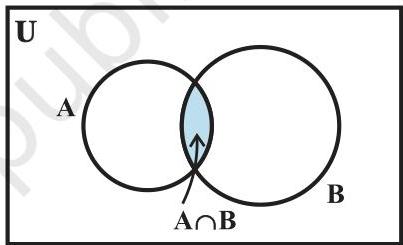 Fig 1.5
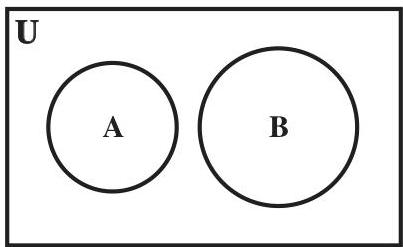 Fig 1.6
Some Properties of Operation of Intersection
(i) $\mathrm{A} \cap \mathrm{B} = \mathrm{B} \cap \mathrm{A}$ (Commutative law). (ii) $(\mathrm{A} \cap \mathrm{B}) \cap \mathrm{C} = \mathrm{A} \cap (\mathrm{B} \cap \mathrm{C})$ (Associative law). (iii) $\phi \cap \mathrm{A} = \phi, \mathrm{U} \cap \mathrm{A} = \mathrm{A}$ (Law of $\phi$ and U). (iv) $\mathrm{A} \cap \mathrm{A} = \mathrm{A}$ (Idempotent law)
(v) $\mathrm{A} \cap (\mathrm{B} \cup \mathrm{C}) = (\mathrm{A} \cap \mathrm{B}) \cup (\mathrm{A} \cap \mathrm{C})$ (Distributive law) i.e., $\cap$ distributes over $\cup$
These properties can be readily visualized through the accompanying Venn diagrams [Figs 1.7 (i) to (v)].
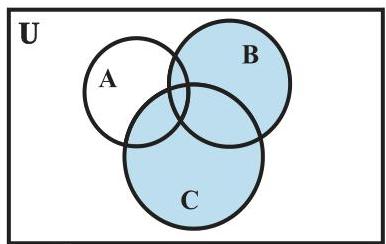 (i) $(\mathbf{B}\cup \mathbf{C})$
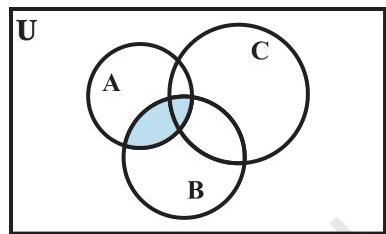 (iii) $(\mathbf{A}\cap \mathbf{B})$
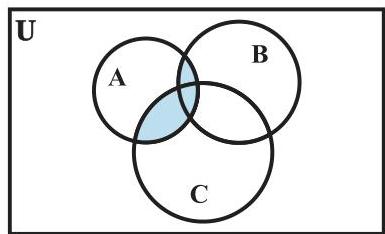 (ii) $\mathbf{A}\cap (\mathbf{B}\cup \mathbf{C})$
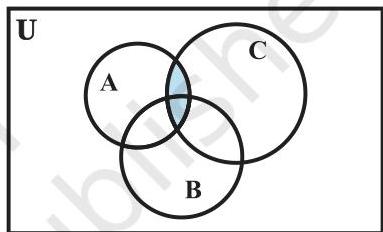 (iv) $(\mathbf{A}\cap \mathbf{C})$
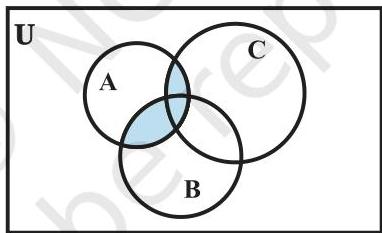 (v) $(\mathbf{A}\cap \mathbf{B})\cup (\mathbf{A}\cap \mathbf{C})$
Figs 1.7 (i) to (v)
(v) $(\mathbf{A}\cap \mathbf{B})\cup (\mathbf{A}\cap \mathbf{C})$
Figs 1.7 (i) to (v)
1.9.3 Difference of sets
The operation known as the difference between set A and set B, when considered in that specific order, yields a collection of elements exclusively found in A and not present in B. This concept is denoted by the expression $\mathrm{A} - \mathrm{B}$ and is verbally rendered as "A minus B".
Example 18 Let $\mathrm{A} = { 1,2,3,4,5,6}$, $\mathrm{B} = { 2,4,6,8}$. Find $\mathrm{A} - \mathrm{B}$ and $\mathrm{B} - \mathrm{A}$.
Solution Calculating the difference, we determine that $\mathrm{A} - \mathrm{B} = {1, 3, 5}$, as these specific elements are constituents of A yet are absent from B. Conversely, $\mathrm{B} - \mathrm{A} = {8}$, given that the element 8 is a member of B but not A. It is important to observe that $\mathrm{A} - \mathrm{B}$ is not equivalent to $\mathrm{B} - \mathrm{A}$.
Example 19 Let $V = {a, e, i, o, u}$ and $B = {a, i, k, u}$. Find $V - B$ and $B - V$.
Solution Upon computation, $V - B = {e, o}$ is obtained, because elements $e$ and $o$ are members of set $V$ but not of set $B$. Similarly, $B - V = {k}$ is derived, as element $k$ is present in set $B$ but not in set $V$.
It is important to recognize that $V - B$ is not equal to $B - V$. The definition of set difference can also be articulated using set-builder notation as follows:
$ A - B = {x: x \in A \text{ and } x \notin B} $
The visual representation of the difference between two sets, A and B, is effectively illustrated through a Venn diagram, as depicted in Fig 1.8.
The region highlighted by shading within the diagram signifies the resultant set from the difference between A and B.
Remark It is noteworthy that the sets $A - B$, $A \cap B$, and $B - A$ constitute a collection of mutually disjoint sets. This implies that the intersection of any pair from these three sets results in the null set, as visually presented in Fig 1.9.
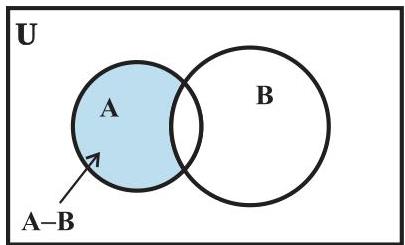 Fig 1.8
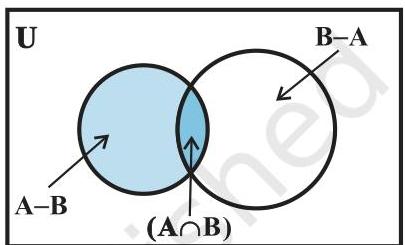 Fig 1.9
EXERCISE 1.4
Determine the union for each of the subsequent set pairs:
(i) $X = {1, 3, 5}$ $Y = {1, 2, 3}$ (ii) $A = [a, e, i, o, u]$ $B = {a, b, c}$ (iii) $A = {x : x \text{ is a natural number and multiple of } 3}$ $B = {x : x \text{ is a natural number less than } 6}$ (iv) $A = {x : x \text{ is a natural number and } 1 < x \leq 6}$ $B = {x : x \text{ is a natural number and } 6 < x < 10}$ (v) $A = {1, 2, 3}, B = \phi$
Consider the sets $A = {a, b}$ and $B = {a, b, c}$. Ascertain if $A$ is a subset of $B$. Furthermore, identify the union of $A$ and $B$.
Given two sets, A and B, where A is a subset of B ($A \subset B$), what is the resulting set from their union ($A \cup B$)?
Provided the sets $A = {1, 2, 3, 4}$, $B = {3, 4, 5, 6}$, $C = {5, 6, 7, 8}$, and $D = {7, 8, 9, 10}$, compute the following unions:
(i) $A \cup B$ (ii) $A \cup C$ (iii) $B \cup C$ (iv) $B \cup D$ (v) $A \cup B \cup C$ (vi) $A \cup B \cup D$ (vii) $B \cup C \cup D$
For each pair of sets presented in question 1, determine their intersection.
Given the sets $A = {3, 5, 7, 9, 11}$, $B = {7, 9, 11, 13}$, $C = {11, 13, 15}$, and $D = {15, 17}$, calculate the following set operations:
(i) $A \cap B$ (ii) $B \cap C$ (iii) $A \cap C \cap D$ (iv) $A \cap C$ (v) $B \cap D$ (vi) $A \cap (B \cup C)$ (vii) $A \cap D$ (viii) $A \cap (B \cup D)$ (ix) $(A \cap B) \cap (B \cup C)$ (x) $(A \cup D) \cap (B \cup C)$
Assuming $A$ represents the set of all natural numbers, $B$ denotes the set of all even natural numbers, $C$ signifies the set of all odd natural numbers, and $D$ comprises all prime numbers, ascertain the following intersections:
(i) $A \cap B$
(ii) $A \cap C$
(iii) $A \cap D$
(iv) $B \cap C$
(v) $B \cap D$
(vi) $C \cap D$
Identify which of the subsequent set pairs are disjoint:
(i) ${1, 2, 3, 4}$ and ${x : x \text{ is a natural number and } 4 \leq x \leq 6}$
(ii) ${a, e, i, o, u}$ and ${c, d, e, f}$
(iii) ${x : x \text{ is an even integer}}$ and ${x : x \text{ is an odd integer}}$
Given the sets $A = {3, 6, 9, 12, 15, 18, 21}$, $B = {4, 8, 12, 16, 20}$, $C = {2, 4, 6, 8, 10, 12, 14, 16}$, and $D = {5, 10, 15, 20}$, determine the results of the following set differences:
(i) $A - B$
(ii) $A - C$
(iii) $A - D$
(iv) $B - A$
(v) $C - A$
(vi) $D - A$
(vii) $B - C$
(viii) $B - D$
(ix) $C - B$
(x) $D - B$
(xi) $C - D$
(xii) $D - C$
Considering the sets $X = {a, b, c, d}$ and $Y = {f, b, d, g}$, compute the following:
(i) $X - Y$
(ii) $Y - X$
(iii) $X \cap Y$
Supposing $\mathbf{R}$ denotes the set of all real numbers and $\mathbf{Q}$ represents the set of all rational numbers, what set results from the operation $\mathbf{R} - \mathbf{Q}$?
Indicate whether each of the subsequent statements is true or false, providing justification for your response:
(i) ${2, 3, 4, 5}$ and ${3, 6}$ are disjoint sets.
(ii) ${a, e, i, o, u}$ and ${a, b, c, d}$ are disjoint sets.
(iii) ${2, 6, 10, 14}$ and ${3, 7, 11, 15}$ are disjoint sets.
(iv) ${2, 6, 10}$ and ${3, 7, 11}$ are disjoint sets.
1.10 Complement of a Set
Consider $U$ as the universal set comprising all prime numbers, and let $A$ be a subset of $U$ containing prime numbers that are not factors of 42. Consequently, $A = {x : x \in U \text{ and } x \text{ is not a divisor of } 42}$. Observing the elements, we find that $2 \in U$ yet $2 \notin A$, as 2 is a divisor of 42. Analogously, $3 \in U$ but $3 \notin A$, and $7 \in U$ but $7 \notin A$. These three prime numbers—2, 3, and 7—represent the sole elements within $U$ that are not members of $A$. The collection of these three prime numbers, specifically the set ${2, 3, 7}$, is designated as the Complement of $A$ relative to $U$, symbolized by $A'$. Hence, we establish $A' = {2, 3, 7}$. From this, it becomes evident that:
$ A' = {x : x \in U \text{ and } x \notin A}. \text{ Obviously } A' = U - A $ This observation naturally leads to the subsequent definition.
Definition 7 Given $U$ as the universal set and $A$ as a subset of $U$, the complement of $A$ is defined as the collection of all elements belonging to $U$ that are not members of $A$. Conventionally, $A'$ is used to represent the complement of $A$ concerning $U$. Thus,
$ A' = {x : x \in U \text{ and } x \notin A}. \text{ Obviously } A' = U - A $
It is important to recognize that the complement of a set $A$ can also be conceptualized as the set difference between the universal set $U$ and the set $A$.
Example 20 Let $U = {1, 2, 3, 4, 5, 6, 7, 8, 9, 10}$ and $A = {1, 3, 5, 7, 9}$. Determine $A'$.
Solution We observe that $2, 4, 6, 8, 10$ are the exclusive elements within $U$ that are not present in $A$. Therefore, $A' = {2, 4, 6, 8, 10}$.
Example 21 Let U represent the universal set comprising all students in Class XI of a coeducational institution, and A denote the set of all female students in Class XI. Ascertain $A'$.
Solution Given that A constitutes the set of all female students, $A'$ is unequivocally the set of all male students within the class.
Note Should A be a subset of the universal set U, its complement $A'$ will similarly be a subset of U.
Referring back to Example 20, we established $A' = {2, 4, 6, 8, 10}$.
Consequently, $ (A')' = {x : x \in U \text{ and } x \notin A'} $
$ = {1, 3, 5, 7, 9} = A $
It is self-evident from the definition of the complement that for any subset A within the universal set U, the double complement $(A')'$ is equivalent to A.
Next, we aim to determine the outcomes for $(A \cup B)'$ and $A' \cap B'$ through the subsequent illustration.
Example 22 Let $U = {1, 2, 3, 4, 5, 6}$, $A = {2, 3}$ and $B = {3, 4, 5}$.
Calculate $A', B'$, $A' \cap B'$, $A \cup B$, and subsequently demonstrate that $(A \cup B)' = A' \cap B'$.
Solution Evidently, $A' = {1, 4, 5, 6}$ and $B' = {1, 2, 6}$. Consequently, $A' \cap B' = {1, 6}$.
Furthermore, $A \cup B = {2, 3, 4, 5}$, which implies that $(A \cup B)' = {1, 6}$.
$ (A \cup B)' = {1, 6} = A' \cap B' $
This outcome can be generally proven to hold true. For any two subsets A and B of the universal set U, the following identities are valid:
$(A \cup B)' = A' \cap B'$. Likewise, $(A \cap B)' = A' \cup B'$. These two principles are articulated verbally as follows:
The complement of the union of two sets corresponds to the intersection of their respective complements, and the complement of the intersection of two sets corresponds to the union of their respective complements. These principles are collectively known as De Morgan's laws, named in honor of the mathematician De Morgan.
Figure 1.10 illustrates the complement $A'$ of a set $A$ within a Venn diagram. The region depicted with shading visually denotes the complement of set A.
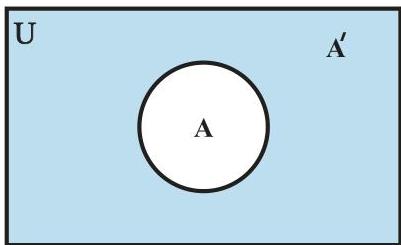 Fig 1.10
Some Properties of Complement Sets
Laws of Complement: (i) $\mathrm{A} \cup \mathrm{A}' = \mathrm{U}$ (ii) $\mathrm{A} \cap \mathrm{A}' = \phi$
De Morgan's Laws: (i) $(\mathrm{A} \cup \mathrm{B})' = \mathrm{A}' \cap \mathrm{B}'$ (ii) $(\mathrm{A} \cap \mathrm{B})' = \mathrm{A}' \cup \mathrm{B}'$
Double Complementation Law: $(\mathrm{A}')' = \mathrm{A}$
Laws Pertaining to the Empty Set and Universal Set: $\phi' = \mathrm{U}$ and $\mathrm{U}' = \phi$.
The validity of these principles can be demonstrated through the application of Venn diagrams.
EXERCISE 1.5
Let $\mathrm{U} = {1,2,3,4,5,6,7,8,9}$, $\mathrm{A} = {1,2,3,4}$, $\mathrm{B} = {2,4,6,8}$ and $\mathrm{C} = {3,4,5,6}$. Find (i) $\mathrm{A}'$ (ii) $\mathrm{B}'$ (iii) $(\mathrm{A} \cup \mathrm{C})'$ (iv) $(\mathrm{A} \cup \mathrm{B})'$ (v) $(\mathrm{A}')'$ (vi) $(\mathrm{B} - \mathrm{C})'$
If $\mathrm{U} = {a, b, c, d, e, f, g, h}$, find the complements of the following sets: (i) $\mathrm{A} = {a, b, c}$ (ii) $\mathrm{B} = {d, e, f, g}$ (iii) $\mathrm{C} = {a, c, e, g}$ (iv) $\mathrm{D} = {f, g, h, a}$
Taking the set of natural numbers as the universal set, write down the complements of the following sets: (i) ${x : x \text{ is an even natural number}}$ (ii) ${x : x \text{ is an odd natural number}}$ (iii) ${x : x \text{ is a positive multiple of 3}}$ (iv) ${x : x \text{ is a prime number}}$ (v) ${x : x \text{ is a natural number divisible by 3 and 5}}$ (vi) ${x : x \text{ is a perfect square}}$ (vii) ${x : x \text{ is a perfect cube}}$ (viii) ${x : x + 5 = 8}$ (ix) ${x : 2x + 5 = 9}$ (x) ${x : x \geq 7}$
(xi) ${x : x \in \mathbb{N} \text{ and } 2x + 1 > 10}$
If $\mathrm{U} = {1,2,3,4,5,6,7,8,9}$, $\mathrm{A} = {2,4,6,8}$ and $\mathrm{B} = {2,3,5,7}$. Verify that (i) $(\mathrm{A} \cup \mathrm{B})' = \mathrm{A}' \cap \mathrm{B}'$ (ii) $(\mathrm{A} \cap \mathrm{B})' = \mathrm{A}' \cup \mathrm{B}'$
Draw appropriate Venn diagram for each of the following: (i) $(\mathrm{A} \cup \mathrm{B})'$, (ii) $\mathrm{A}' \cap \mathrm{B}'$, (iii) $(\mathrm{A} \cap \mathrm{B})'$, (iv) $\mathrm{A}' \cup \mathrm{B}'$
Let $\mathrm{U}$ be the set of all triangles in a plane. If $\mathrm{A}$ is the set of all triangles with at least one angle different from $60^\circ$, what is $\mathrm{A}'$?
Fill in the blanks to make each of the following a true statement: (i) $\mathrm{A} \cup \mathrm{A}' = \ldots$ (ii) $\phi' \cap \mathrm{A} = \ldots$ (iii) $\mathrm{A} \cap \mathrm{A}' = \ldots$ (iv) $\mathrm{U}' \cap \mathrm{A} = \ldots$
Miscellaneous Examples
Example 23 Demonstrate the equivalence between the collection of distinct letters comprising the word “CATARACT” and that forming the word “TRACT”.
Solution Define $\mathrm{X}$ as the set containing the unique letters found in “CATARACT”. Consequently, $ \mathrm{X} = {\mathrm{C}, \mathrm{A}, \mathrm{T}, \mathrm{R}} $
Similarly, let Y represent the set of distinct letters present in “TRACT”. Thus,
$ Y = {T, R, A, C, T} = {T, R, A, C} $
Given that all elements within set X are also members of set Y, and conversely, all elements within set Y are also members of X, it logically follows that X and Y are identical sets.
Example 24 Enumerate every subset pertaining to the set ${-1, 0, 1}$.
Solution Consider the set $A = {-1, 0, 1}$. The unique subset of A containing no elements is the null set, denoted by $\phi$. Subsets of A comprising a single element are ${-1}$, ${0}$, and ${1}$. Those subsets of A containing precisely two elements are ${-1, 0}$, ${-1, 1}$, and ${0, 1}$. The sole subset of A encompassing all three of its elements is A itself. Consequently, the complete collection of subsets for A consists of $\phi$, ${-1}$, ${0}$, ${1}$, ${-1, 0}$, ${-1, 1}$, ${0, 1}$, and ${-1, 0, 1}$.
Example 25 Prove that if the union of sets A and B is equivalent to their intersection, then sets A and B must be identical.
Solution Assume an arbitrary element $a$ belongs to set A ($a \in A$). This implies that $a$ is also a member of the union $A \cup B$. Given the premise that $A \cup B = A \cap B$, it follows that $a \in A \cap B$. Consequently, $a$ must belong to set B ($a \in B$). This line of reasoning establishes that A is a subset of B ($A \subset B$). By analogous argumentation, if an arbitrary element $b$ is a member of set B ($b \in B$), then $b$ is necessarily an element of $A \cup B$. Since
$A \cup B = A \cap B$, we deduce that $b \in A \cap B$, which in turn means $b \in A$. This demonstrates that B is a subset of A ($B \subset A$). From the established facts that $A \subset B$ and $B \subset A$, it is concluded that A and B are equal sets ($A = B$).
Miscellaneous Exercise on Chapter 1
- For the given collection of sets, determine the subset relationships that exist between them: $ A = {x : x \in \mathbf{R} \text{ and } x \text{ satisfy } x^2 - 8x + 12 = 0}, $
$ B = {2, 4, 6}, C = {2, 4, 6, 8, \ldots}, D = {6}. $
- For each statement presented below, ascertain its truth value (true or false). Provide a formal proof if the statement holds true, or furnish a counterexample if it is false.
(i) If $x \in A$ and $A \in B$, then $x \in B$.
(ii) If $A \subset B$ and $B \in C$, then $A \in C$.
(iii) If $A \subset B$ and $B \subset C$, then $A \subset C$.
(iv) If $A \not\subset B$ and $B \not\subset C$, then $A \not\subset C$.
(v) If $x \in A$ and $A \not\subset B$, then $x \in B$.
(vi) If $A \subset B$ and $x \notin B$, then $x \notin A$.
Given three sets A, B, and C, assume that their union with A is identical ($A \cup B = A \cup C$) and their intersection with A is also identical ($A \cap B = A \cap C$). Demonstrate that B must be equal to C.
Establish the equivalence of the subsequent four conditions:
(i) $A \subset B$ (ii) $A - B = \phi$ (iii) $A \cup B = B$ (iv) $A \cap B = A$
Prove that if set A is a subset of set B, then the relative complement of B with respect to C is a subset of the relative complement of A with respect to C ($C - B \subset C - A$).
Demonstrate that for arbitrary sets A and B, the following identities hold:
$ A = (A \cap B) \cup (A - B) \text{ and } A \cup (B - A) = (A \cup B). $
- Employing fundamental properties of sets, prove the following statements:
(i) $A \cup (A \cap B) = A$ (ii) $A \cap (A \cup B) = A$.
Illustrate that the equality of intersections, $A \cap B = A \cap C$, does not necessarily entail the equality of sets B and C.
Consider sets A and B. If there exists a set X such that their intersections with X are empty ($A \cap X = B \cap X = \phi$) and their unions with X are equal ($A \cup X = B \cup X$), then demonstrate that A must be equal to B.
(Hints $A = A \cap (A \cup X)$, $B = B \cap (B \cup X)$ and use Distributive law)
- Identify three sets A, B, and C such that their pairwise intersections ($A \cap B$, $B \cap C$, and $A \cap C$) are all non-empty, yet their common intersection ($A \cap B \cap C$) is the empty set.
Summary
This chapter introduces fundamental definitions and operations pertaining to sets. These core concepts are outlined below:
- A set is defined as a precisely delineated collection of distinct entities.
- The empty set is characterized by its lack of any constituent elements.
- A set comprising a quantifiable, limited number of elements is termed a finite set; conversely, a set lacking such a definite count is designated an infinite set.
- Sets A and B are considered equal if and only if their respective elements are identical.
- Set A constitutes a subset of set B when every element present in A is also found within B. Notably, various intervals serve as subsets of $\mathbf{R}$.
- The union of sets A and B encompasses all elements that belong to either A or B.
- The intersection of sets A and B is defined as the collection of all elements shared by both sets. Furthermore, the difference between set A and set B (in that specific order) comprises those elements that are members of A but not of B.
- For a subset A within a universal set U, its complement is defined as the collection of all elements residing in U that are not members of A.
- For any arbitrary sets A and B, the following identities hold true: $(A \cup B)' = A' \cap B'$ and $(A \cap B)' = A' \cup B'$
Historical Note
The foundational development of modern set theory is widely attributed to the German mathematician Georg Cantor (1845-1918). His significant contributions to set theory were disseminated through publications spanning the period from 1874 to 1897. Cantor's initial engagement with set-theoretic concepts arose from his investigations into trigonometric series, specifically those expressed in the form $a_1 \sin x + a_2 \sin 2x + a_3 \sin 3x + \ldots$. In 1874, he notably demonstrated that a one-to-one correspondence between the set of real numbers and the set of integers was impossible. Subsequent to 1879, he continued to publish numerous works detailing diverse characteristics of abstract sets.
Cantor's contributions garnered favorable reception from the renowned mathematician Richard Dedekind (1831-1916). Conversely, Kronecker (1810-1893) vehemently criticized Cantor's approach of treating infinite sets with the same conceptual framework as finite sets. As the century concluded, Gottlob Frege, another German mathematician, advanced set theory by framing it within the principles of logic. Prior to this, the prevailing understanding of set theory rested on the premise that a universal set, encompassing all sets, could exist. However, in 1902, the eminent English philosopher Bertrand Russell (1872-1970) conclusively demonstrated that this very assumption inevitably resulted in a logical contradiction, famously known as Russell’s Paradox. Paul R. Halmos succinctly captures the essence of this dilemma in his work ‘Naïve Set Theory’ with the statement: “nothing contains everything”.
Russell’s Paradox proved to be merely one instance among numerous logical inconsistencies that emerged within set theory. Subsequently, a multitude of paradoxes were formulated by various mathematicians and logicians. These accumulating contradictions necessitated the formal axiomatization of set theory; consequently, Ernst Zermelo published the inaugural such system in 1908. Abraham Fraenkel then advanced an alternative proposal in 1922. John Von Neumann, in 1925, explicitly incorporated the axiom of regularity. Further refinements were introduced by Paul Bernays in 1937, who presented a more robust axiomatization. Kurt Gödel later modified these axioms in his 1940 monograph, leading to what became recognized as Von Neumann-Bernays (VNB) or Gödel-Bernays (GB) set theory.
Notwithstanding these historical challenges and foundational dilemmas, Cantor’s set theory remains an indispensable tool in contemporary mathematics. Indeed, a predominant portion of mathematical concepts and results today are articulated through the precise language of set theory.