Chapter 10
CONIC SECTIONS
Let the relation of knowledge to real life be very visible to your pupils and let them understand how by knowledge the world could be transformed. – BERTRAND RUSSELL
10.1 Introduction
Having explored various forms of linear equations in the preceding Chapter 10, the current chapter shifts focus to a distinct family of curves: circles, ellipses, parabolas, and hyperbolas. These geometric figures, often referred to as conic sections or simply conics, derive their nomenclature for parabola and hyperbola from Apollonius. Their fundamental characteristic is their formation as the intersection of a plane with a double-napped right circular cone. The practical utility of these curves is extensive, spanning diverse domains such as the mechanics of planetary orbits, the engineering of telescopes and antennas, and the design of reflective surfaces in flashlights and vehicle headlamps. The subsequent sections will systematically demonstrate how varying the angle of intersection between a plane and a double-napped right circular cone gives rise to these distinct curve types.
 Apollonius (262 B.C. -190 B.C.)
10.2 Sections of a Cone
Consider a stationary vertical line, denoted $l$, and another line, $m$, that intersects $l$ at a fixed point $V$. Line $m$ is inclined at a constant angle $\alpha$ relative to line $l$ (Fig10.1).
If line $m$ is revolved around line $l$ such that the angle $\alpha$ remains unchanged, the resulting three-dimensional surface is a double-napped right circular hollow cone.
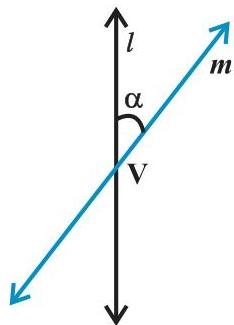 Fig 10.1
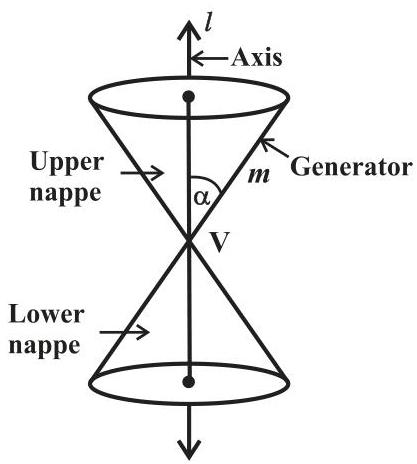 Fig 10.2
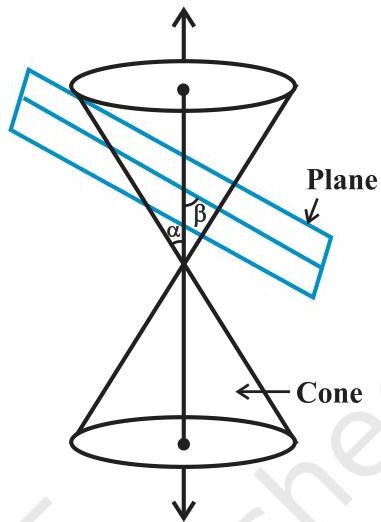 Fig 10.3
This conical structure extends indefinitely in both directions (Fig10.2). The fixed point $V$ is identified as the vertex, and the line $l$ serves as the axis of the cone. The rotating line $m$ is termed a generator of the cone. The vertex divides the cone into two distinct parts, each referred to as a nappe.
A conic section is formed when a plane intersects a cone. Specifically, these are the curves generated by the intersection of a plane with a double-napped right circular cone.
The specific type of conic section obtained depends on the orientation of the intersecting plane relative to the cone, particularly the angle it forms with the cone's vertical axis. Let $\beta$ represent the angle between the intersecting plane and the cone's vertical axis (Fig10.3).
The plane may intersect the cone either at its vertex or through any other region of a nappe, whether above or below the vertex.
10.2.1 Circle, ellipse, parabola and hyperbola
When the intersecting plane cuts through a nappe (excluding the vertex), the following geometric figures are observed:
(a) Should the plane be perpendicular to the axis, meaning $\beta = 90^{\circ}$, the resulting cross-section is a circle (Fig10.4). (b) If the angle of the plane, $\beta$, is strictly between $\alpha$ and $90^{\circ
}$ (
i.e., $\alpha < \beta < 90^{\circ}$), an ellipse is formed (Fig10.5). (c) When the plane's angle $\beta$ precisely matches the cone's generating angle $\alpha$ (i.e., $\beta = \alpha$), the intersection yields a parabola (Fig10.6).
(In each of these three scenarios, the plane traverses entirely through a single nappe of the cone).
(d) If the angle $\beta$ is greater than or equal to $0$ and strictly less than $\alpha$ (i.e., $0 \leq \beta < \alpha$), the plane intersects both nappes, producing a hyperbola (Fig10.7).
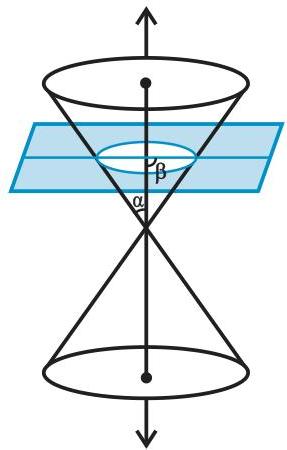 Fig 10.4
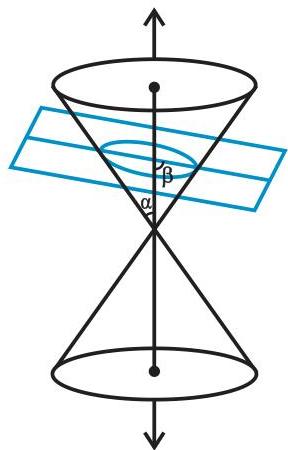 Fig 10.5
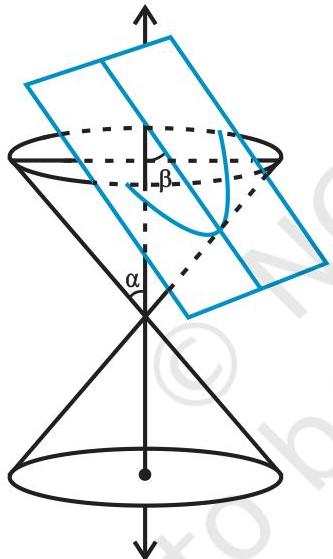 Fig 10.6
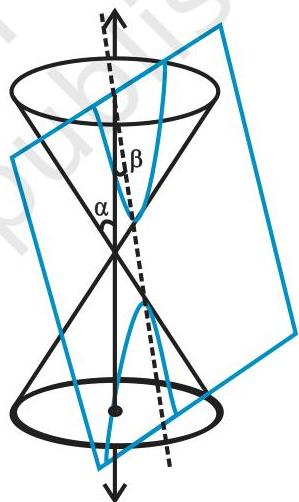 Fig 10.7
10.2.2 Degenerated conic sections
Should the intersecting plane pass directly through the apex of the cone, distinct outcomes arise as follows:
(a) If the angle $\alpha$ is less than $\beta$, and $\beta$ is less than or equal to $90^{\circ}$ ($\alpha < \beta \leq 90^{\circ}$), the resulting cross-section is a single point (Fig 10.8).
(b) When $\beta = \alpha$, the plane aligns with one of the cone's generators, yielding a straight line as the section (Fig 10.9). This configuration represents the degenerate form of a parabola.
(c) When the condition $0 \leq \beta < \alpha$ holds, the intersection produces a pair of straight lines that intersect (Fig 10.10). This scenario constitutes the degenerate instance of a hyperbola.
In the following sections, we shall obtain the equations of each of these conic sections in standard form by defining them based on geometric properties.
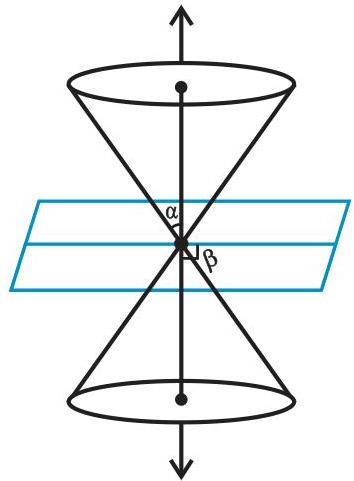 Fig 10.8
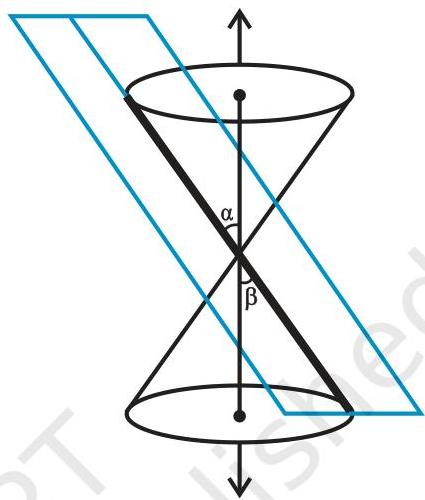 Fig 10.9
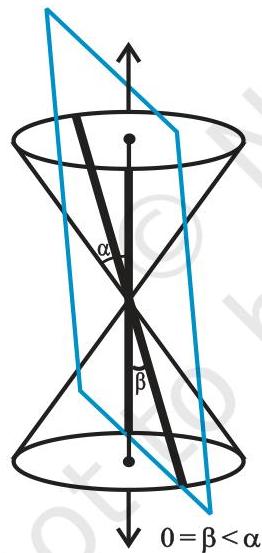 (a)
(a)
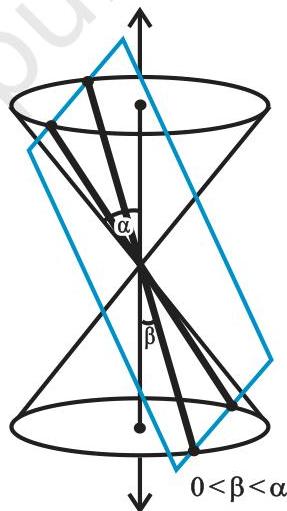 (b)
(b)
10.3 Circle
Definition 1 In a two-dimensional plane, a circle is defined as the locus of all points that maintain a constant distance from a specific, unchanging point within that plane.
The designated fixed point is referred to as the circle's center, while the uniform distance from this center to any point lying on the circle's perimeter is known as its radius (Fig 10.11).
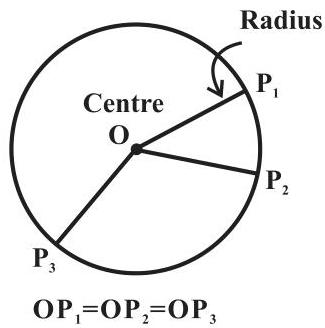 Fig 10.11
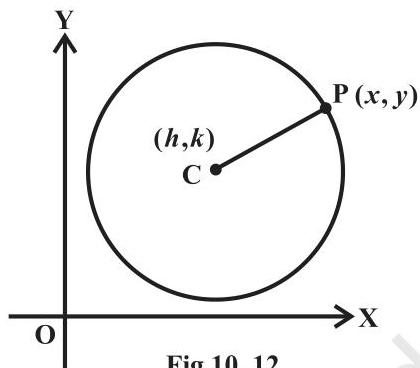 Fig 10.12
While the algebraic representation of a circle is most straightforward when its center coincides with the origin, we will proceed to formulate the equation for a circle defined by an arbitrary center and a specified radius (Fig 10.12).
Let $C(h, k)$ denote the coordinates of the circle's center and $r$ its radius. Consider an arbitrary point $P(x, y)$ situated on the circumference of this circle (Fig 10.12). According to the fundamental definition, the distance between the center and any point on the circle, $|CP|$, must equal the radius $r$. Applying the distance formula, we obtain:
$ \sqrt {(x - h) ^ {2} + (y - k) ^ {2}} = r $
which simplifies to:
$ (x - h) ^ {2} + (y - k) ^ {2} = r ^ {2} $
This expression represents the standard equation for a circle centered at $(h,k)$ with a radius of $r$.
Example 1 Determine the equation of a circle whose center is located at the origin $(0,0)$ and possesses a radius of $r$.
Solution In this specific instance, $h = 0$ and $k = 0$. Consequently, the equation representing this circle is $x^{2} + y^{2} = r^{2}$.
Example 2 Formulate the equation for the circle having its center at $(-3, 2)$ and a radius of 4 units.
Solution Given the parameters, $h = -3$, $k = 2$, and $r = 4$. Therefore, the equation for the desired circle is expressed as:
$ (x + 3) ^ {2} + (y - 2) ^ {2} = 1 6 $
Example 3 Determine the coordinates of the center and the length of the radius for the circle represented by the equation $x^{2} + y^{2} + 8x + 10y - 8 = 0$.
Solution The provided equation is:
$ (x ^ {2} + 8 x) + (y ^ {2} + 1 0 y) = 8 $
By applying the method of completing the square to the terms within each set of parentheses, we arrive at:
$ (x ^ {2} + 8 x + 1 6) + (y ^ {2} + 1 0 y + 2 5) = 8 + 1 6 + 2 5 $
which simplifies to:
$ (x + 4) ^ {2} + (y + 5) ^ {2} = 4 9 $
This can be expressed in the standard form as:
$ {x - (- 4) } ^ {2} + {y - (- 5) } ^ {2} = 7 ^ {2} $
From this standard form, it is evident that the given circle possesses a center at $(-4, -5)$ and a radius of 7 units.
Example 4 Determine the equation of a circle that traverses the points $(2, -2)$ and $(3, 4)$, and whose center is situated on the line defined by $x + y = 2$.
Solution We begin by assuming the general equation of the circle to be $(x - h)^2 + (y - k)^2 = r^2$.
Given that the circle intersects both points $(2, -2)$ and $(3, 4)$, we can substitute these coordinates into the general equation, yielding:
$ (2 - h)^2 + (-2 - k)^2 = r^2 \quad \dots (1) $
and
$ (3 - h)^2 + (4 - k)^2 = r^2 \quad \dots (2) $
Furthermore, because the center of the circle lies on the line $x + y = 2$, its coordinates $(h, k)$ must satisfy this linear equation:
$ h + k = 2 \quad \dots (3) $
By concurrently solving the system of equations (1), (2), and (3), we ascertain the values:
$ h = 0.7, \quad k = 1.3 \quad \text{and} \quad r^2 = 12.58 $
Consequently, the equation for the desired circle is:
$ (x - 0.7)^2 + (y - 1.3)^2 = 12.58. $
EXERCISE 10.1
In each of the following Exercises 1 to 5, find the equation of the circle with
- a center at $(0,2)$ and a radius of 2 units
- its center located at $(-2,3)$ and a radius of 4 units
- a center situated at $\left(\frac{1}{2}, \frac{1}{4}\right)$ and a radius of $\frac{1}{12}$
- its center at $(1,1)$ and a radius measuring $\sqrt{2}$
- a center positioned at $(-a, -b)$ and a radius equivalent to $\sqrt{a^2 - b^2}$.
In each of the following Exercises 6 to 9, find the center and radius of the circles.
$(x + 5)^2 + (y - 3)^2 = 36$
$x^2 + y^2 - 4x - 8y - 45 = 0$
$x^2 + y^2 - 8x + 10y - 12 = 0$
$2x^2 + 2y^2 - x = 0$
Ascertain the equation of the circle that includes the points $(4,1)$ and $(6,5)$, and whose center is situated on the line $4x + y = 16$.
Establish the equation of the circle which intersects the points $(2,3)$ and $(-1,1)$, and for which its center resides on the line $x - 3y - 11 = 0$.
Determine the equation of a circle possessing a radius of 5 units, with its center positioned on the $x$-axis, and which passes through the point $(2,3)$.
Ascertain the equation for the circle that includes the origin $(0,0)$ and generates intercepts of $a$ and $b$ on the respective coordinate axes.
Obtain the equation of the circle that has its center at $(2,2)$ and extends through the point $(4,5)$.
Ascertain whether the point $(-2.5, 3.5)$ is situated within, outside, or precisely upon the circumference of the circle defined by $x^2 + y^2 = 25$.
10.4 Parabola
Definition 2: A parabola is defined as the locus of all points within a given plane that maintain an equal distance from a specified fixed line and a designated fixed point (which does not lie on the line) within that same plane.
The fixed line is designated as the directrix of the parabola, while the fixed point $\mathbf{F}$ is referred to as the focus (Fig 10.13). (Etymologically, 'para' signifies 'for' and 'bola' denotes 'throwing', illustrating the trajectory formed when an object is projected into the air).
Note: In the scenario where the fixed point is situated on the fixed line, the collection of points in the plane that are equidistant from both the fixed point and the fixed line forms a straight line passing through the fixed point and oriented perpendicularly to the fixed line. This particular straight line is identified as a degenerate instance of the parabola.
The line that passes through the focus and is perpendicular to the directrix is termed the axis of the parabola. The specific point where the parabola intersects this axis is known as the vertex of the parabola (Fig10.14).
10.4.1 Standard equations of parabola
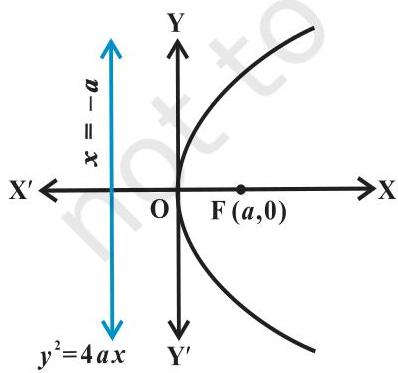
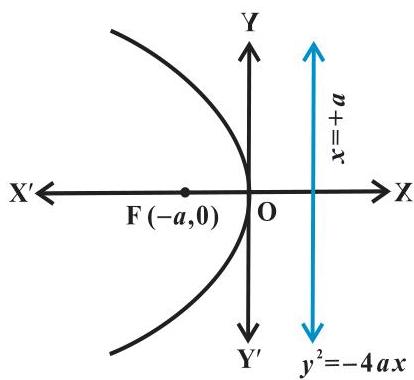
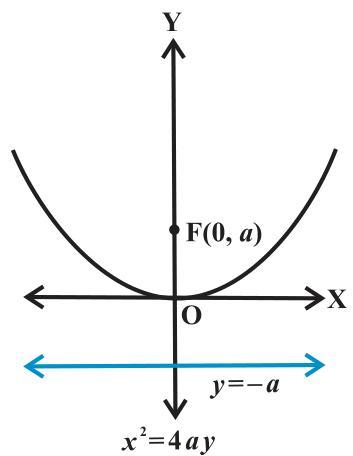
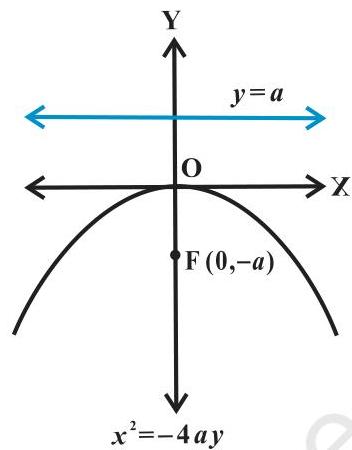
The mathematical representation of a parabola achieves its most straightforward form when its vertex is positioned at the origin and its axis of symmetry aligns with either the $x$-axis or the $y$-axis. The four distinct configurations of such parabolas are illustrated subsequently in Fig10.15 (a) through (d).
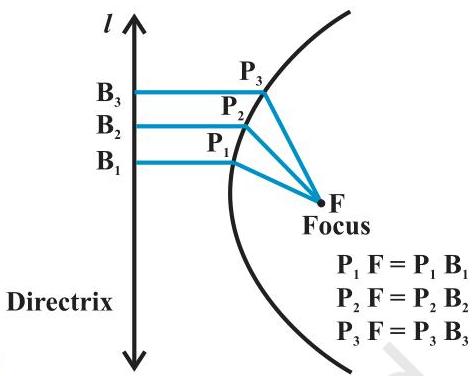 Fig 10.13
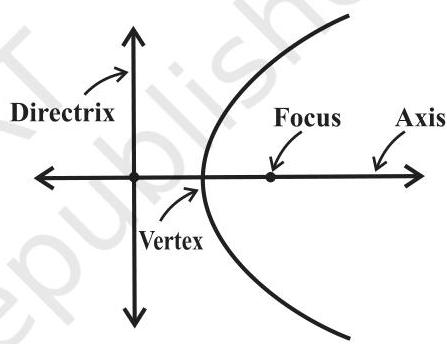 Fig 10.14
 (a)
(a)
 (b)
(b)
 (c)
(c)
 (d)
(d)
The derivation of the equation for the parabola depicted in Fig 10.15 (a), characterized by a focus located at $(a, 0)$ where $a > 0$, and a directrix defined by $x = -a$, proceeds as follows:
Consider $F$ as the focus and $l$ as the directrix. Construct a line segment $FM$ perpendicular to the directrix, and let $O$ be the midpoint of $FM$. Extend the segment $MO$ to form the line $X$. In accordance with the definition of a parabola, the midpoint $O$
lies on the parabola and is designated as its vertex. Let $O$ serve as the origin, with $OX$ representing the $x$-axis and $OY$, perpendicular to $OX$, representing the $y$-axis. Suppose the distance separating the directrix from the focus is $2a$. Consequently, the coordinates of the focus
are $(a, 0)$, and
the equation for the directrix is $x + a = 0$, as illustrated in Fig10.16. Let $P(x, y)$ denote an arbitrary point situated on the parabola, such that:
$ \mathrm{PF} = \mathrm{PB}, $
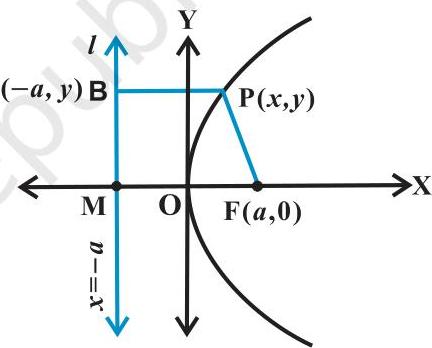 Fig 10.16
$ \dots (1) $
where the segment $PB$ is orthogonal to $l$. The coordinates for point $B$ are $(-a, y)$. Utilizing the distance formula, we obtain:
$ \mathrm{PF} = \sqrt{(x - a)^2 + y^2} \quad \text{and} \quad \mathrm{PB} = \sqrt{(x + a)^2} $
Given that $\mathrm{PF} = \mathrm{PB}$, it follows that:
$ \sqrt{(x - a)^2 + y^2} = \sqrt{(x + a)^2} $
i.e. $(x - a)^2 + y^2 = (x + a)^2$
or $x^2 - 2ax + a^2 + y^2 = x^2 + 2ax + a^2$
or $y^2 = 4ax$ ($a > 0$).
Consequently, any point situated on the parabola adheres to the relation:
$ y^{2} = 4ax. \tag{2} $
Conversely, consider a point $P(x,y)$ that satisfies Equation (2).
$ \begin{array}{l} \mathrm{PF} = \sqrt{(x - a)^2 + y^2} = \sqrt{(x - a)^2 + 4ax} \ = \sqrt{(x + a)^2} = \mathrm{PB} \tag{3} \end{array} $
Thus, the point $P(x,y)$ is located on the parabola.
Therefore, by combining the insights from (2) and (3), it is established that the equation representing a parabola with its vertex positioned at the origin, its focus at $(a,0)$, and its directrix defined by $x = -a$ is $y^2 = 4ax$.
Discussion Within Equation (2), given that $a > 0$, the variable $x$ can take on any non-negative value (including zero) but cannot be negative. This implies the curve extends infinitely into the first and fourth quadrants. The parabola's axis of symmetry aligns with the positive $x$-axis.
In a similar fashion, the equations for other parabolic orientations can be derived:
Fig 11.15 (b) as $y^2 = -4ax$,
Fig 11.15 (c) as $x^2 = 4ay$,
Fig 11.15 (d) as $x^2 = -4ay$,
These four mathematical expressions are designated as the standard equations for parabolas.
Note The standard parabolic equations feature a focus located on one of the coordinate axes, a vertex situated at the origin, and consequently, a directrix that runs parallel to the other coordinate axis. However, the examination of parabolic equations where the focus is an arbitrary point and the directrix is any given line falls outside the scope of this discussion.
Based on the standard equations of parabolas, as depicted in Fig10.15, the following observations can be made:
A parabola exhibits symmetry with respect to its own axis. If the equation includes a $y^2$ term, the axis of symmetry is along the $x$-axis; conversely, if an $x^2$ term is present, the axis of symmetry lies along the $y$-axis.
When the axis of symmetry is aligned with the $x$-axis, the parabola opens towards the:
(a) right, if the coefficient of $x$ is positive.
(b) left, if the coefficient of $x$ is negative.
When the axis of symmetry is aligned with the $y$-axis, the parabola opens:
(c) upwards, if the coefficient of $y$ is positive.
(d) downwards, if the coefficient of $y$ is negative.
10.4.2 Latus rectum
Definition 3 The latus rectum of a parabola is defined as a line segment that is perpendicular to the parabola's axis, passes through its focus, and has its endpoints situated on the parabola itself (Fig 10.17).
To determine the length of the latus rectum for the parabola described by the equation $y^{2} = 4ax$ (Fig 10.18).
According to the fundamental definition of a parabola, the distance from any point on the parabola to the focus is equal to its perpendicular distance to the directrix. Therefore, we have $\mathrm{AF} = \mathrm{AC}$.
Furthermore, by geometric properties, the segment $\mathrm{AC}$ is equivalent in length to $\mathrm{FM}$, which is $2a$.
Consequently, it follows that $\mathrm{AF} = 2a$.
Given that the parabola exhibits symmetry with respect to the $x$-axis, the segment $\mathrm{AF}$ is equal in length to $\mathrm{FB}$. Therefore,
The total length of the latus rectum, $\mathrm{AB}$, is $4a$.
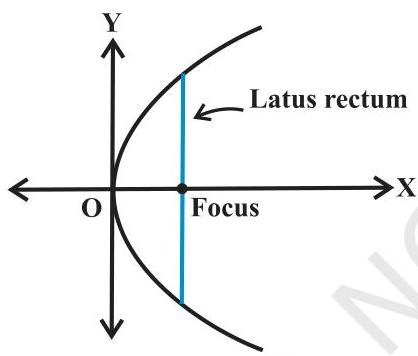 Fig 10.17
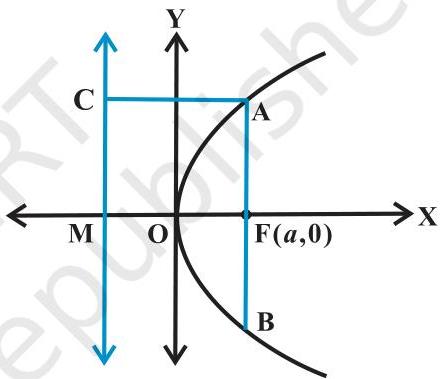 Fig 10.18
Example 5 Determine the coordinates of the focus, the axis of symmetry, the equation of the directrix, and the length of the latus rectum for the parabola $y^{2} = 8x$.
Solution The provided equation contains a $y^2$ term, indicating that its axis of symmetry is aligned with the $x$-axis.
Since the coefficient of $x$ is positive, the parabola opens towards the right. By comparing the given equation $y^{2} = 8x$ with the standard form $y^{2} = 4ax$, we deduce that $4a = 8$, which implies $a = 2$.
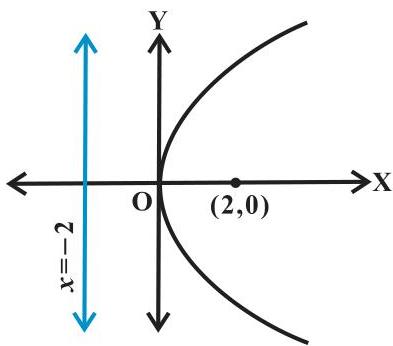 Fig 10.19
Thus, the focus of this parabola is located at $(2, 0)$, and the equation representing its directrix is $x = -2$ (Fig 10.19).
The length of the latus rectum is calculated as $4a = 4 \times 2 = 8$.
Example 6 Establish the equation of the parabola whose focus is at $(2,0)$ and whose directrix is given by $x = -2$.
Solution As the focus $(2,0)$ lies on the $x$-axis, the $x$-axis itself constitutes the axis of the parabola. Consequently, the parabola's equation must take the form $y^2 = 4ax$ or $y^2 = -4ax$. Given that the directrix is $x = -2$ and the focus is $(2,0)$, it is evident that the parabola conforms to the structure $y^2 = 4ax$, with the parameter $a = 2$. Therefore, the desired equation is
$ y^2 = 4(2)x = 8x $
Example 7 Find the equation of the parabola that has its vertex at $(0,0)$ and its focus at $(0,2)$.
Solution With the vertex situated at $(0,0)$ and the focus at $(0,2)$ (which lies on the $y$-axis), it follows that the $y$-axis serves as the parabola's axis. Hence, the equation of the parabola is of the form $x^2 = 4ay$. Given $a=2$, we have
$ x^2 = 4(2)y, \text{ i.e., } x^2 = 8y. $
Example 8 Determine the equation of the parabola that is symmetric about the $y$-axis and passes through the point $(2,-3)$.
Solution Since the parabola exhibits symmetry about the $y$-axis and its vertex is at the origin, its equation will either be $x^2 = 4ay$ or $x^2 = -4ay$. The specific sign depends on whether the parabola opens upward or downward. However, the fact that the parabola passes through the point $(2,-3)$, which is located in the fourth quadrant, dictates that it must open downwards. Therefore, the appropriate form of the equation is $x^2 = -4ay$.
Given that the parabola traverses the point $(2,-3)$, we substitute these coordinates into the equation:
$ 2^2 = -4a(-3), \text{ i.e., } a = \frac{1}{3} $
Thus, the equation of the parabola is
$ x^2 = -4\left(\frac{1}{3}\right)y, \text{ i.e., } 3x^2 = -4y. $
EXERCISE 10.2
For Exercises 1 through 6 presented below, identify the focus's coordinates, the parabola's axis, the directrix's equation, and the length of the latus rectum.
- $y^2 = 12x$
- $x^2 = 6y$
- $y^2 = -8x$
- $x^2 = -16y$
- $y^2 = 10x$
- $x^2 = -9y$
For each of Exercises 7 to 12, derive the equation of the parabola corresponding to the specified conditions:
- Focus $(6,0)$; directrix $x = -6$
- Focus $(0,-3)$; directrix $y = 3$
- Vertex $(0,0)$; focus $(3,0)$
- Vertex $(0,0)$; focus $(-2,0)$
- Vertex $(0,0)$ passing through $(2,3)$ and axis is along $x$-axis.
- Vertex $(0,0)$, passing through $(5,2)$ and symmetric with respect to $y$-axis.
10.5 Ellipse
Definition 4 An ellipse is defined as the locus of all points within a plane where the cumulative distance from two designated fixed points in that plane remains invariant.
These two specified fixed points are termed the foci (the plural form of 'focus') of the ellipse (Refer to Fig 10.20).
Note It is important to observe that the constant value, representing the sum of the distances from any point on the ellipse to its two fixed foci, invariably exceeds the distance separating these two focal points.
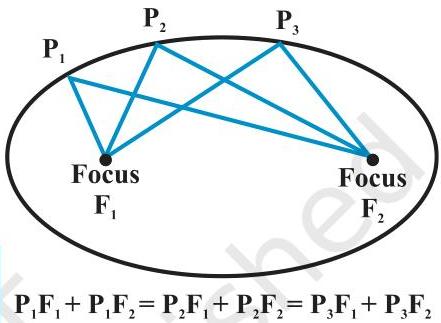 Fig 10.20
The midpoint of the line segment connecting the foci is designated as the ellipse's center. The linear segment passing through the foci of the ellipse constitutes its major axis, while the segment that traverses the center and is orthogonal to the major axis is known as the minor axis. The extremities of the major axis are referred to as the vertices of the ellipse (See Fig 10.21).
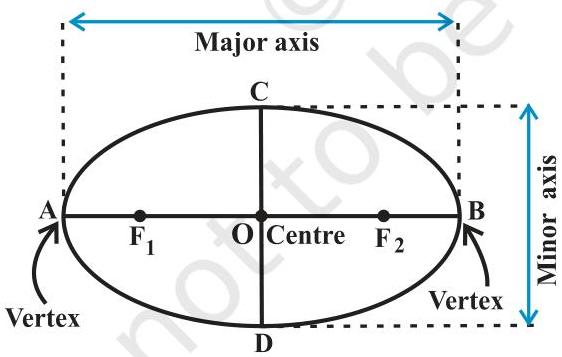 Fig 10.21
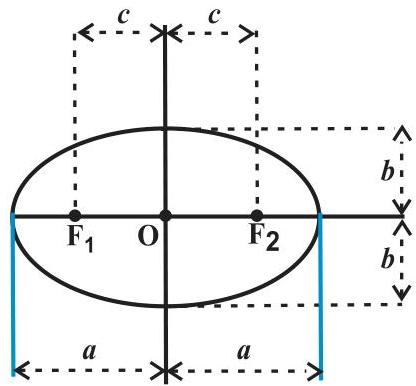 Fig 10.22
The major axis's length is conventionally represented by $2a$, the minor axis's length by $2b$, and the separation between the foci by $2c$. Consequently, the semi-major axis possesses a length of $a$, and the semi-minor axis a length of $b$ (Illustrated in Fig 10.22).
10.5.1 Interrelationship among the semi-major axis, semi-minor axis, and the focal distance from the ellipse's center (Refer to Fig 10.23).
Consider a point $\mathrm{P}$ situated at one extremity of the major axis. The cumulative distance from point $\mathrm{P}$ to the foci is expressed as $\mathrm{F}_1\mathrm{P} + \mathrm{F}_2\mathrm{P} = \mathrm{F}_1\mathrm{O} + \mathrm{OP} + \mathrm{F}_2\mathrm{P}$
(Given that $\mathrm{F}_1\mathrm{P} = \mathrm{F}_1\mathrm{O} + \mathrm{OP}$ )
$ = c + a + a - c = 2 a $
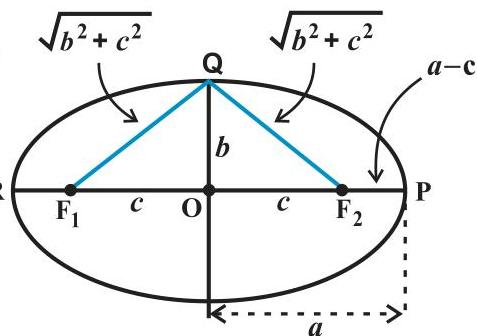 Fig 10.23
Now, let us consider a point $\mathrm{Q}$ positioned at an extremity of the minor axis.
The aggregate of the distances from point $\mathrm{Q}$ to the foci is calculated as:
$ \mathrm {F} _ {1} \mathrm {Q} + \mathrm {F} _ {2} \mathrm {Q} = \sqrt {b ^ {2} + c ^ {2}} + \sqrt {b ^ {2} + c ^ {2}} = 2 \sqrt {b ^ {2} + c ^ {2}} $
Given that both points $\mathrm{P}$ and $\mathrm{Q}$ reside on the ellipse.
In accordance with the definition of an ellipse, it follows that:
$ 2 \sqrt {b ^ {2} + c ^ {2}} = 2 a, \text {i . e .}, \quad a = \sqrt {b ^ {2} + c ^ {2}} $
This implies that $a^2 = b^2 + c^2$, from which $c = \sqrt{a^2 - b^2}$.
10.5.2 Eccentricity
Definition 5: The eccentricity of an ellipse, symbolized by $e$, is defined as the quotient derived from dividing the distance from the ellipse's center to one of its foci by the distance from the center to one of its vertices; thus, $e = \frac{c}{a}$.
Consequently, given that a focus is situated at a distance $c$ from the center, its position can equivalently be expressed as $ae$ from the center when considering the eccentricity.
10.5.3 Standard equations of an ellipse
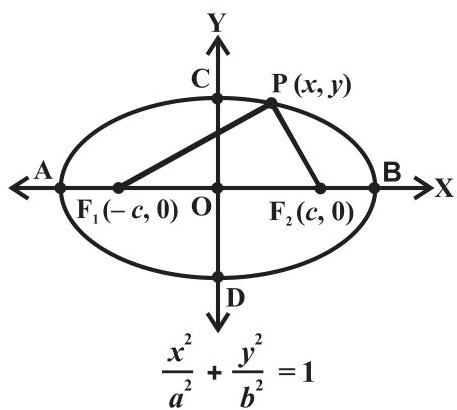
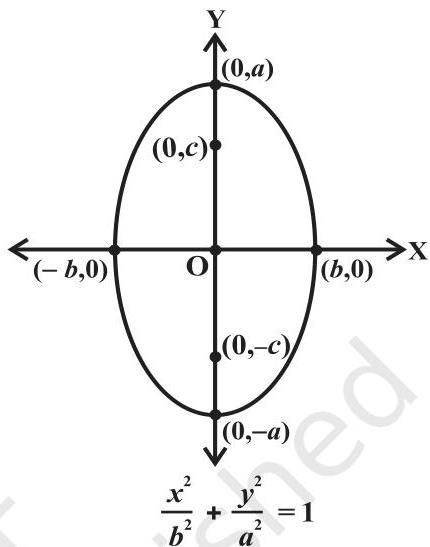
The most straightforward form of an ellipse's equation is achieved when its center coincides with the origin and its foci are positioned along either the $x$-axis or the $y$-axis. Figure 10.24 illustrates these two fundamental orientations.
Our subsequent derivation will focus on the equation for the ellipse depicted in Figure 10.24 (a), which features its foci situated on the $x$-axis.
 (a)
Fig 10.24
(a)
Fig 10.24
 (b)
(b)
Consider $\mathrm{F}_1$ and $\mathrm{F}_2$ as the foci, with $\mathrm{O}$ representing the midpoint of the line segment connecting $\mathrm{F}_1$ and $\mathrm{F}_2$. We designate $\mathrm{O}$ as the origin. The line extending from $\mathrm{O}$ through $\mathrm{F}_2$ will define the positive $x$-axis, while the line passing through $\mathrm{F}_1$ from $\mathrm{O}$ will establish the negative $x$-axis. Furthermore, the line passing through $\mathrm{O}$ and orthogonal to the $x$-axis will be defined as the $y$-axis. Based on this setup, the coordinates for $\mathrm{F}_1$ are $(-c, 0)$ and for $\mathrm{F}_2$ are $(c, 0)$ (refer to Figure 10.25).
Consider an arbitrary point $\mathrm{P}(x,y)$ situated on the ellipse, where the sum of its distances to the two foci is defined as $2a$. This yields:
$ \mathrm{PF}_1 + \mathrm{PF}_2 = 2a. \tag{1} $
Applying the distance formula, we obtain:
$ \sqrt{(x + c)^2 + y^2} + \sqrt{(x - c)^2 + y^2} = 2a $
This can be rearranged as: $\sqrt{(x + c)^2 + y^2} = 2a - \sqrt{(x - c)^2 + y^2}$
Upon squaring both expressions, we derive:
$ (x + c)^2 + y^2 = 4a^2 - 4a \sqrt{(x - c)^2 + y^2} + (x - c)^2 + y^2 $
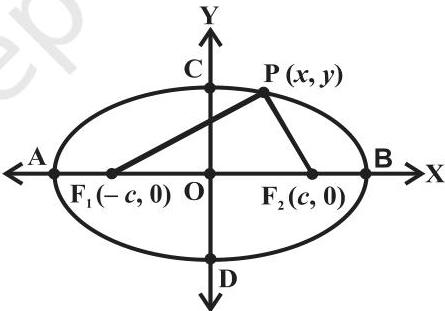 Fig 10.25
$ \frac{x^2}{a^2} + \frac{y^2}{b^2} = 1 $
Further simplification yields:
$ \sqrt{(x - c)^2 + y^2} = a - \frac{c}{a} x $
By squaring the equation once more and performing subsequent simplifications, we arrive at:
$ \frac{x^2}{a^2} + \frac{y^2}{a^2 - c^2} = 1 $
Which means:
$ \frac{x^2}{a^2} + \frac{y^2}{b^2} = 1 \quad \text{(Since } c^2 = a^2 - b^2\text{)} $
Thus, any given point on the ellipse adheres to the equation:
$ \frac{x^2}{a^2} + \frac{y^2}{b^2} = 1. \tag{2} $
In the reverse direction, suppose that a point $P(x,y)$ that fulfills equation (2), given the
condition $0 < c < a$. In this scenario:
$ y^2 = b^2 \left(1 - \frac{x^2}{a^2}\right) $
Consequently, $\mathrm{PF}_1$ can be expressed as: $\mathrm{PF}_1 = \sqrt{(x + c)^2 + y^2}$
$ = \sqrt{(x + c)^2 + b^2 \left(\frac{a^2 - x^2}{a^2}\right)} $
$ = \sqrt{(x + c)^2 + (a^2 - c^2) \left(\frac{a^2 - x^2}{a^2}\right)} \quad \text{(since } b^2 = a^2 - c^2\text{)} $
$ = \sqrt{\left(a + \frac{cx}{a}\right)^2} = a + \frac{c}{a} x $
Similarly
$ \mathrm{PF}_2 = a - \frac{c}{a} x $
Hence
$ \mathrm{PF}_1 + \mathrm{PF}_2 = a + \frac{c}{a} x + a - \frac{c}{a} x = 2a \tag{3} $
Consequently, any point $\mathrm{P}(x, y)$ that fulfills the equation $\frac{x^2}{a^2} + \frac{y^2}{b^2} = 1$ simultaneously satisfies the defined geometric condition, thereby confirming its position on the ellipse.
Thus, by integrating results from (2) and (3), it has been established that the equation representing an ellipse centered at the origin, with its major axis aligned with the $x$-axis, is given by:
$ \frac {x ^ {2}}{a ^ {2}} + \frac {y ^ {2}}{b ^ {2}} = 1. $
Discussion Analyzing the derived equation of the ellipse reveals that for any arbitrary point $\mathrm{P}(x,y)$ located on its perimeter, the following relationship holds:
$ \frac {x ^ {2}}{a ^ {2}} = 1 - \frac {y ^ {2}}{b ^ {2}} \leq 1, \text{ i.e., } x ^ {2} \leq a ^ {2}, \text{ so } - a \leq x \leq a. $
Consequently, the elliptical curve is bounded by, and tangent to, the vertical lines $x = -a$ and $x = a$.
In an analogous manner, the ellipse is confined between, and touches, the horizontal lines $y = -b$ and $y = b$.
A parallel derivation yields the equation for the ellipse depicted in Fig 10.24 (b) as $\frac{x^2}{b^2} + \frac{y^2}{a^2} = 1$ .
These two formulations are recognized as the standard equations for ellipses.
Note It is important to recognize that the standard equations for ellipses presuppose a center at the origin, with their major and minor axes coincident with the coordinate axes. Nevertheless, the examination of ellipses whose centers are displaced from the origin, or whose major and minor axes are oriented along arbitrary lines passing through their center and perpendicular to each other, falls outside the purview of the current discussion.
Based on the standard equations of the ellipses (Fig10.24), the subsequent observations can be made:
- The ellipse exhibits symmetry concerning both coordinate axes; this is evident because if $(x, y)$ is a coordinate pair lying on the ellipse, then the points $(-x, y)$, $(x, -y)$, and $(-x, -y)$ similarly reside on the curve.
- The focal points are consistently situated on the major axis. The orientation of the major axis can be ascertained by evaluating the intercepts along the axes of symmetry. Specifically, the major axis is aligned with the $x-axis$ when the $x^2$ term possesses the greater denominator, and it is aligned with the $y-axis$ when the $y^2$ term has the greater denominator.
10.5.4 Latus rectum
Definition 6 The latus rectum of an ellipse is defined as a line segment that passes perpendicularly through one of the foci, intersecting the major axis, with its extremities located on the ellipse itself (refer to Fig 10.26).
To determine the length of the latus rectum for an ellipse described by the equation $\frac{x^2}{a^2} + \frac{y^2}{b^2} = 1$:
Consider the segment $\mathrm{AF}_2$ to have a length designated as $l$. Consequently, the coordinates of point A can be expressed as $(c, l)$, which is equivalent to $(ae, l)$. Given that point A is situated on the ellipse, defined by the equation $\frac{x^2}{a^2} + \frac{y^2}{b^2} = 1$, the following relationship holds:
$ \frac{(ae)^2}{a^2} + \frac{l^2}{b^2} = 1 $
$ \Rightarrow l^2 = b^2 (1 - e^2) $
However,
$ e^2 = \frac{c^2}{a^2} = \frac{a^2 - b^2}{a^2} = 1 - \frac{b^2}{a^2} $
Therefore,
$ l^2 = \frac{b^4}{a^2}, \text{ i.e., } l = \frac{b^2}{a} $
Due to the inherent symmetry of the ellipse concerning the $y$-axis (and indeed, both coordinate axes), it follows that the length $\mathrm{AF}_2$ is equal to $\mathrm{F}_2\mathrm{B}$. Therefore, the total length of the latus rectum is given by $\frac{2b^2}{a}$.
Example 9 Determine the coordinates of the foci and vertices, as well as the lengths of the major and minor axes, the eccentricity, and the latus rectum for the ellipse defined by the equation:
$ \frac{x^2}{25} + \frac{y^2}{9} = 1 $
Solution Given that the denominator associated with $\frac{x^2}{25}$ exceeds that of $\frac{y^2}{9}$, it can be deduced that the major axis aligns with the $x$-axis. By equating the provided equation to the standard form $\frac{x^2}{a^2} + \frac{y^2}{b^2} = 1$, we establish the following values:
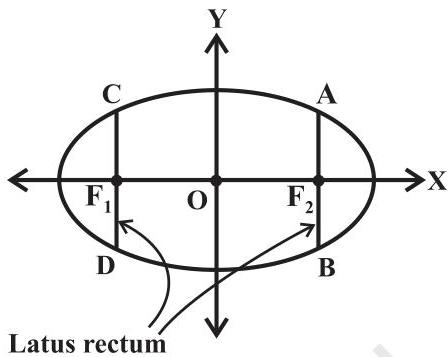 Fig 10.26
$ a = 5 \text{ and } b = 3. \text{ Also} $
$ c = \sqrt{a^2 - b^2} = \sqrt{25 - 9} = 4 $
Consequently, the foci are located at $(-4,0)$ and $(4,0)$, and the vertices are positioned at $(-5,0)$ and $(5,0)$. The major axis spans 10 units, the minor axis ($2b$) measures 6 units, the eccentricity is $\frac{4}{5}$, and the latus rectum has a length of $\frac{2b^2}{a} = \frac{18}{5}$.
Example 10 Identify the coordinates of the foci and vertices, along with the lengths of the major and minor axes and the eccentricity, for the ellipse described by $9x^2 + 4y^2 = 36$.
Solution The provided elliptical equation can be re-expressed in its canonical form as:
$ \frac{x^2}{4} + \frac{y^2}{9} = 1 $
As the denominator of $\frac{y^2}{9}$ is greater than that of $\frac{x^2}{4}$, the major axis is oriented along the $y$-axis. By comparing the given equation to the standard form
$ \frac{x^2}{b^2} + \frac{y^2}{a^2} = 1, \text{ we have } b = 2 \text{ and } a = 3. $
Also $c = \sqrt{a^2 - b^2} = \sqrt{9 - 4} = \sqrt{5}$
and $e = \frac{c}{a} = \frac{\sqrt{5}}{3}$
Consequently, the foci are located at $(0, \sqrt{5})$ and $(0, -\sqrt{5})$, the vertices are at $(0, 3)$ and $(0, -3)$, the major axis measures 6 units, the minor axis spans 4 units, and the eccentricity of the ellipse is $\frac{\sqrt{5}}{3}$.
Example 11 Determine the equation of an ellipse having vertices at $(\pm 13, 0)$ and foci at $(\pm 5, 0)$.
Solution Given that the vertices are situated on the $x$-axis, the ellipse's equation will conform to the structure:
$ \frac{x^2}{a^2} + \frac{y^2}{b^2} = 1, \text{ where } a \text{ is the semi-major axis}. $
MATHEMATICS
Considering the parameters $ a = 13 $ and $ c = \pm 5 $.
Utilizing the fundamental relationship for an ellipse, $ c^2 = a^2 - b^2 $, we derive:
$ 25 = 169 - b^2, \text{ implying } b = 12 $
Consequently, the elliptical equation is determined to be $ \frac{x^2}{169} + \frac{y^2}{144} = 1 $.
Example 12 Determine the equation of the ellipse having a major axis length of 20 and foci located at $ (0, \pm 5) $.
Solution As the foci are positioned on the $ y $-axis, it signifies that the major axis aligns with the $ y $-axis. Hence, the ellipse's equation takes the general form $ \frac{x^2}{b^2} + \frac{y^2}{a^2} = 1 $.
From the provided information:
$ a = \text{ semi-major axis } = \frac{20}{2} = 10 $
Furthermore, applying the relationship $ c^2 = a^2 - b^2 $ yields:
$ 5^2 = 10^2 - b^2 \quad \text{ which simplifies to } b^2 = 75 $
Accordingly, the equation representing this ellipse is:
$ \frac{x^2}{75} + \frac{y^2}{100} = 1 $
Example 13 Determine the equation of an ellipse whose major axis lies along the $ x $-axis and which traverses the points (4, 3) and (–1, 4).
Solution The canonical representation of an ellipse is $ \frac{x^2}{a^2} + \frac{y^2}{b^2} = 1 $. Given that the points (4, 3) and (–1, 4) are on the ellipse, we can establish the following system of equations:
$ \frac{16}{a^2} + \frac{9}{b^2} = 1 \tag{1} $
and
$ \frac{1}{a^2} + \frac{16}{b^2} = 1 \tag{2} $
By simultaneously solving equations (1) and (2), we ascertain that $ a^2 = \frac{247}{7} $ and $ b^2 = \frac{247}{15} $.
Thus, the desired equation for the ellipse is:
$ \frac {x ^ {2}}{\left(\frac {247}{7}\right)} + \frac {y ^ {2}}{\frac {247}{15}} = 1, \text{ which simplifies to } 7x^2 + 15y^2 = 247. $
EXERCISE 10.3
For each of the ellipses presented in Exercises 1 through 9, determine the coordinates of its foci and vertices, as well as the measures of its major axis, minor axis, eccentricity, and latus rectum.
$\frac{x^2}{36} + \frac{y^2}{16} = 1$
$\frac{x^2}{4} + \frac{y^2}{25} = 1$
$\frac{x^2}{16} + \frac{y^2}{9} = 1$
$\frac{x^2}{25} + \frac{y^2}{100} = 1$
$\frac{x^2}{49} + \frac{y^2}{36} = 1$
$\frac{x^2}{100} + \frac{y^2}{400} = 1$
$36x^{2} + 4y^{2} = 144$
$16x^{2} + y^{2} = 16$
$4x^{2} + 9y^{2} = 36$
For each of the subsequent problems, numbered 10 through 20, derive the standard equation for the ellipse corresponding to the specified criteria:
- Given vertices at $(\pm 5, 0)$ and foci at $(\pm 4, 0)$.
- Given vertices at $(0, \pm 13)$ and foci at $(0, \pm 5)$.
- Given vertices at $(\pm 6, 0)$ and foci at $(\pm 4, 0)$.
- The major axis terminates at $(\pm 3, 0)$, and the minor axis terminates at $(0, \pm 2)$.
- The major axis terminates at $(0, \pm \sqrt{5})$, and the minor axis terminates at $(\pm 1, 0)$.
- The major axis has a length of 26 units, with foci located at $(\pm 5, 0)$.
- The minor axis has a length of 16 units, with foci situated at $(0, \pm 6)$.
- Foci are at $(\pm 3, 0)$, and the semi-major axis length $a$ is 4.
- The semi-minor axis $b$ is 3, the focal distance $c$ is 4, the center is at the origin, and the foci lie on the x-axis.
- The ellipse is centered at $(0,0)$, its major axis is aligned with the y-axis, and it traverses the points $(3, 2)$ and $(1, 6)$.
- The major axis is aligned with the x-axis, and the ellipse passes through the points $(4,3)$ and $(6,2)$.
10.6 Hyperbola
Definition 7 A hyperbola constitutes the collection of all points situated in a plane such that the disparity between their respective distances from two specified fixed points within that plane consistently maintains a constant value.
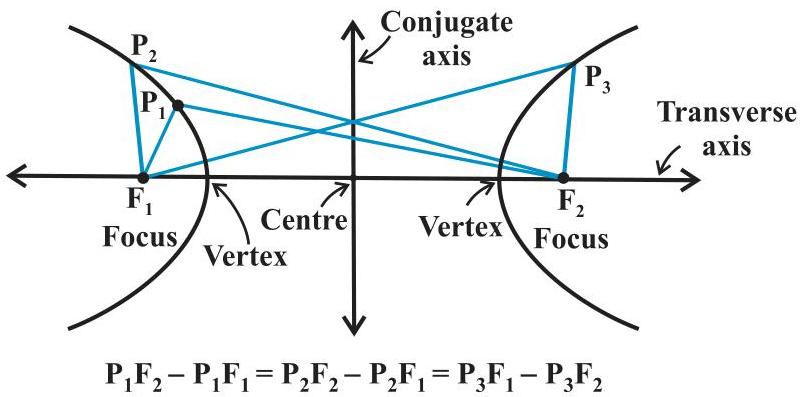 Fig 10.27
The term "difference" as utilized in the definition refers to the magnitude obtained by subtracting the distance to the nearer point from the distance to the farther point. The pair of fixed points are designated as the foci of the hyperbola. The midpoint of the line segment connecting these foci is termed the center of the hyperbola. The straight line traversing through the foci is identified as the transverse axis, while the line passing through the center and oriented perpendicularly to the transverse axis is known as the conjugate axis. The points at which the hyperbola intersects its transverse axis are defined as the vertices of the hyperbola (Fig 10.27).
We conventionally denote the separation between the two foci by $2c$, the distance spanning the two vertices (which corresponds to the length of the transverse axis) by $2a$, and we establish the quantity $b$ through the following relation:
$ b = \sqrt {c ^ {2} - a ^ {2}} $
Furthermore, the length of the conjugate axis is given by $2b$ (Fig 10.28).
To find the constant $\mathbf{P}_1\mathbf{F}_2 - \mathbf{P}_1\mathbf{F}_1$ ..
Considering point $\mathrm{P}$ to coincide with vertices $\mathrm{A}$ and $\mathrm{B}$ as depicted in Fig 10.28, we derive:
$\mathrm{BF}_1 - \mathrm{BF}_2 = \mathrm{AF}_2 - \mathrm{AF}_1$ (by the definition of the hyperbola)
$\mathrm{BA} + \mathrm{AF}_1 - \mathrm{BF}_2 = \mathrm{AB} + \mathrm{BF}_2 - \mathrm{AF}_1$
i.e., $\mathrm{AF}_1 = \mathrm{BF}_2$
So that, $\mathrm{BF}_1 - \mathrm{BF}_2 = \mathrm{BA} + \mathrm{AF}_1 - \mathrm{BF}_2 = \mathrm{BA} = 2a$
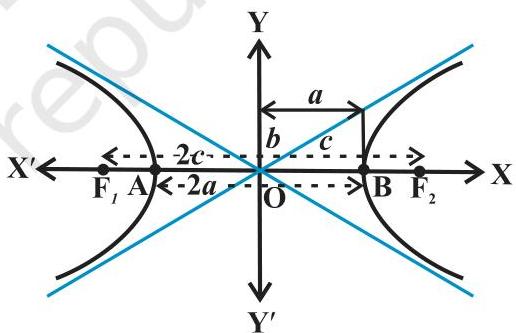 Fig 10.28
10.6.1 Eccentricity
Definition 8 Analogous to an ellipse, the eccentricity of a hyperbola is defined by the ratio $e = \frac{c}{a}$. Given that $c \geq a$, the eccentricity $e$ is invariably greater than or equal to one. Expressed through the eccentricity, the foci are situated at a distance of $ae$ from the central point.
10.6.2 Standard equation of Hyperbola
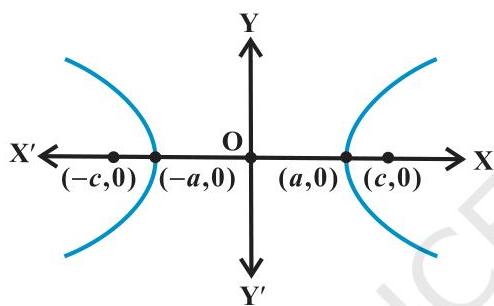
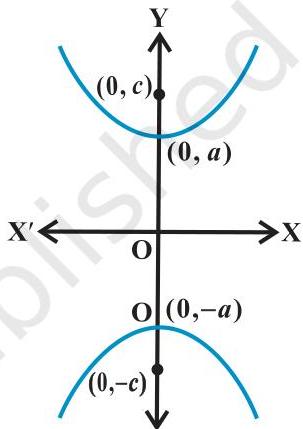
The most straightforward representation of a hyperbola's equation occurs when its center is positioned at the origin and its foci lie along either the $x$-axis or the $y$-axis. These two potential configurations are illustrated in Fig 10.29.
 (a)
(a)
 (b)
(b)
$ \frac {x ^ {2}}{a ^ {2}} - \frac {y ^ {2}}{b ^ {2}} = 1 $
$ \frac {y ^ {2}}{a ^ {2}} - \frac {x ^ {2}}{b ^ {2}} = 1 $
Our derivation will focus on the equation for the hyperbola depicted in Fig 10.29(a), where its foci are situated on the $x$-axis.
Assume $\mathrm{F}_1$ and $\mathrm{F}_2$ represent the foci, with $\mathrm{O}$ designating the midpoint of the segment $\mathrm{F}_1\mathrm{F}_2$. We establish $\mathrm{O}$ as the origin. The line passing through $\mathrm{O}$ and $\mathrm{F}_2$ defines the positive $x$-axis, while the line passing through $\mathrm{O}$ and $\mathrm{F}_1$ defines the negative $x$-axis. The axis perpendicular to the $x$-axis and passing through $\mathrm{O}$ is designated as the $y$-axis. Consequently, the coordinates of $\mathrm{F}_1$ are $(-c,0)$ and $\mathrm{F}_2$ are $(c,0)$ (refer to Fig 10.30).
Consider an arbitrary point $\mathrm{P}(x,y)$ on the hyperbola. By definition, the difference of the distances from $\mathrm{P}$ to the farther focus minus the closer focus is a constant value, $2a$. Thus, we have $\mathrm{PF}_1 - \mathrm{PF}_2 = 2a$.
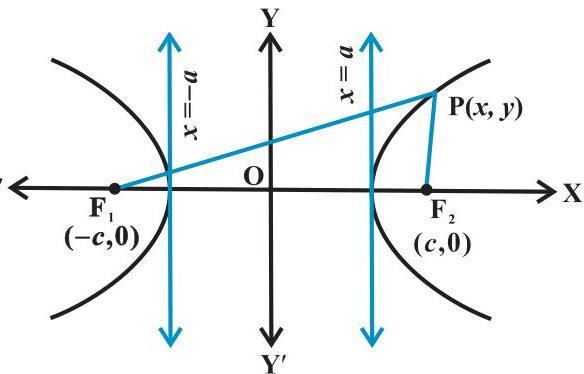 Fig 10.29
Fig 10.30
Fig 10.29
Fig 10.30
Applying the distance formula, the relationship becomes:
$ \sqrt{(x + c)^2 + y^2} - \sqrt{(x - c)^2 + y^2} = 2a $
i.e.,
$ \sqrt{(x + c)^2 + y^2} = 2a + \sqrt{(x - c)^2 + y^2} $
Upon squaring both sides, we obtain:
$ (x + c)^2 + y^2 = 4a^2 + 4a \quad \sqrt{(x - c)^2 + y^2} + (x - c)^2 + y^2 $
Subsequent simplification yields:
$ \frac{cx}{a} - a = \sqrt{(x - c)^2 + y^2} $
Squaring once more and performing additional simplification leads to:
$ \frac{x^2}{a^2} - \frac{y^2}{c^2 - a^2} = 1 $
i.e.,
$ \frac{x^2}{a^2} - \frac{y^2}{b^2} = 1 \quad \text{(Since } c^2 - a^2 = b^2\text{)} $
Consequently, any point residing on the hyperbola adheres to this equation:
$ \frac{x^2}{a^2} - \frac{y^2}{b^2} = 1 $
Conversely, consider a point $P(x,y)$ that fulfills the aforementioned equation, given that $0 < a < c$. From this, we can express $y^2$ as:
$ y^2 = b^2 \left(\frac{x^2 - a^2}{a^2}\right) $
Consequently, the distance $\mathrm{PF}_1$ can be determined as:
$ \mathrm{PF}_1 = + \sqrt{(x + c)^2 + y^2} $
$ = + \sqrt{(x + c)^2 + b^2 \left(\frac{x^2 - a^2}{a^2}\right)} = a + \frac{c}{a} x $
By analogous derivation, the distance $\mathrm{PF}_2$ is initially expressed as:
$ \mathrm{PF}_2 = a - \frac{a}{c} x $
However, considering the properties of a hyperbola where $c > a$, and for a point $P$ situated to the right of the line $x = a$ (implying $x > a$), it holds that $\frac{c}{a} x > a$. Consequently, the expression $a - \frac{c}{a} x$ would yield a negative value. To represent the positive distance $\mathrm{PF}_2$ in this region, it is taken as:
$ \mathrm{PF}_2 = \frac{c}{a} x - a. $
Consequently, the difference between these focal distances is: $\mathrm{PF}_1 - \mathrm{PF}_2 = a + \frac{c}{a} x - \frac{cx}{a} + a = 2a$.
It is also important to observe that if point $\mathrm{P}$ is situated to the left of the line $x = -a$, then the focal distances are expressed as:
$ \mathrm{PF
}{1} = - \left(a + \frac {c}{a} x\right), \quad \mathrm{PF}{2} = a - \frac {c}{a} x. $
In this specific scenario, the difference $\mathrm{PF}_2 - \mathrm{PF}_1 = 2a$. Therefore, any point satisfying the equation $\frac{x^2}{a^2} - \frac{y^2}{b^2} = 1$ is indeed located on the hyperbola.
Thus, it has been demonstrated that the equation for a hyperbola centered at the origin $(0,0)$ with its transverse axis aligned with the $x$-axis is $\frac{x^2}{a^2} - \frac{y^2}{b^2} = 1$.
Note A hyperbola where $a = b$ is termed an equilateral hyperbola.
Discussion Based on the derived equation of the hyperbola, it is evident that for any point $(x,y)$ situated on the hyperbola, the following relationship holds: $\frac{x^2}{a^2} = 1 + \frac{y^2}{b^2} \geq 1$.
This inequality implies that $\left|\frac{x}{a}\right| \geq 1$, which further means $x \leq -a$ or $x \geq a$. Consequently, no segment of the curve exists within the region bounded by the lines $x = +a$ and $x = -a$. (This signifies the absence of real intercepts on the conjugate axis).
In a similar manner, the equation for the hyperbola depicted in Fig 11.31 (b) can be derived as $\frac{y^2}{a^2} - \frac{x^2}{b^2} = 1$. These two expressions are recognized as the standard equations for hyperbolas.
Note The standard equations for hyperbolas feature the transverse and conjugate axes aligned with the coordinate axes, and their center is positioned at the origin. However, hyperbolas can exist with any two perpendicular lines serving as their transverse and conjugate axes; the exploration of such configurations is reserved for more advanced studies.
From the standard equations of hyperbolas (Fig10.27), the subsequent observations can be made:
A hyperbola exhibits symmetry with respect to both its axes. This is because if a point $(x,y)$ lies on the hyperbola, then the points $(-x,y)$, $(x,-y)$, and $(-x,-y)$ also satisfy the hyperbola's equation.
The foci are invariably located on the transverse axis. The transverse axis is identified by the positive term whose denominator defines it. For instance, in the equation $\frac{x^2}{9} - \frac{y^2}{16} = 1$, the transverse axis lies along the $x$-axis and has a length of 6. Conversely, for the equation $\frac{y^2}{25} - \frac{x^2}{16} = 1$, the transverse axis is along the $y$-axis with a length of 10.
10.6.3 Latus rectum
Definition 9 The latus rectum of a hyperbola is defined as a line segment that passes perpendicularly through either focus and has its extremities situated on the hyperbola itself.
Analogous to the ellipse, the length of the latus rectum for a hyperbola can be readily demonstrated to be $\frac{2b^2}{a}$.
Example 14 Determine the coordinates of the foci and vertices, the eccentricity, and the length of the latus rectum for the following hyperbolas:
(i) $\frac{x^2}{9} - \frac{y^2}{16} = 1$ , (ii) $y^2 - 16x^2 = 16$
Solution (i) By contrasting the given equation $\frac{x^2}{9} - \frac{y^2}{16} = 1$ with the general form of a hyperbola's equation:
$ \frac {x ^ {2}}{a ^ {2}} - \frac {y ^ {2}}{b ^ {2}} = 1 $
In this instance, we identify $a = 3$, $b = 4$, and consequently, $c = \sqrt{a^2 + b^2} = \sqrt{9 + 16} = 5$.
Thus, the foci are located at $(\pm 5,0)$ and the vertices at $(\pm 3,0)$. Furthermore, the eccentricity $e$ is determined as $\frac{c}{a} = \frac{5}{3}$, and the length of the latus rectum is calculated as $\frac{2b^2}{a} = \frac{32}{3}$.
(ii) Upon dividing the entire equation by 16, we obtain the form $\frac{y^2}{16} - \frac{x^2}{1} = 1$.
By aligning this equation with the standard form $\frac{y^2}{a^2} - \frac{x^2}{b^2} = 1$, it is observed that:
$ a = 4, b = 1 \text{ and } c = \sqrt {a ^ {2} + b ^ {2}} = \sqrt {16 + 1} = \sqrt {17}.
$
Consequently, the foci are located at $(0, \pm \sqrt{17})$ and the vertices at $(0, \pm 4)$. Additionally,
The eccentricity $e$ is calculated as $\frac{c}{a} = \frac{\sqrt{17}}{4}$, and the length of the latus rectum is found to be $\frac{2b^2}{a} = \frac{1}{2}$.
Example 15 Determine the equation of the hyperbola given foci at $(0, \pm 3)$ and vertices at $(0, \pm \frac{\sqrt{11}}{2})$.
Solution Given that the foci lie on the $y$-axis, the hyperbola's equation will assume the standard form:
$ \frac{y^2}{a^2} - \frac{x^2}{b^2} = 1 $
As the vertices are located at $(0, \pm \frac{\sqrt{11}}{2})$, it follows that $a = \frac{\sqrt{11}}{2}$.
Moreover, with the foci at $(0, \pm 3)$, we have $c = 3$, which allows us to calculate $b^2 = c^2 - a^2 = \frac{25}{4}$.
Consequently, the equation representing this hyperbola is:
$ \frac{y^2}{\left(\frac{11}{4}\right)} - \frac{x^2}{\left(\frac{25}{4}\right)} = 1, \text{ i.e., } 100y^2 - 44x^2 = 275. $
Example 16 Find the equation of the hyperbola whose foci are at $(0, \pm 12)$ and for which the length of the latus rectum is 36.
Solution Given that the foci are situated at $(0, \pm 12)$, we deduce that $c = 12$.
The length of the latus rectum is given as $\frac{2b^2}{a} = 36$, which simplifies to $b^2 = 18a$.
Applying the relationship $c^2 = a^2 + b^2$, we derive:
$ 144 = a^2 + 18a $
which means $a^2 + 18a - 144 = 0$.
Consequently, the possible values for $a$ are $-24$ and $6$.
As the semi-transverse axis length $a$ must be positive, we select $a = 6$, yielding $b^2 = 108$.
Hence, the equation for the hyperbola in question is $\frac{y^2}{36} - \frac{x^2}{108} = 1$, which can be rearranged to $3y^2 - x^2 = 108$.
EXERCISE 10.4
For each of the problems numbered 1 through 6, determine the coordinates of the foci and the vertices, alongside the eccentricity and the length of the latus rectum for the given hyperbolas.
$\frac{x^2}{16} - \frac{y^2}{9} = 1$
$\frac{y^2}{9} - \frac{x^2}{27} = 1$
$9y^{2} - 4x^{2} = 36$
$16x^{2} - 9y^{2} = 576$
$5y^{2} - 9x^{2} = 36$
$49y^{2} - 16x^{2} = 784$
In the subsequent problems, numbered 7 to 15, derive the equations of the hyperbola that satisfy the specified conditions.
Vertices $(\pm 2,0)$ , foci $(\pm 3,0)$
Vertices $(0, \pm 5)$ , foci $(0, \pm 8)$
Vertices $(0, \pm 3)$ , foci $(0, \pm 5)$
Foci $(\pm 5,0)$ , the transverse axis is of length 8.
Foci $(0, \pm 13)$ , the conjugate axis is of length 24.
Foci $(\pm 3\sqrt{5},0)$ , the latus rectum is of length 8.
Foci $(\pm 4,0)$ , the latus rectum is of length 12
vertices $(\pm 7,0)$ , $e = \frac{4}{3}$ .
Foci $(0, \pm \sqrt{10})$ , passing through $(2,3)$
Miscellaneous Examples
Example 17 Consider a parabolic mirror, as depicted in Figure 10.31, where its focus is situated $5\mathrm{cm}$ away from its vertex. Given that the mirror has a depth of $45\mathrm{cm}$, determine the length of the segment AB (refer to Figure 10.31).
Solution: As the focal distance from the vertex is $5\mathrm{cm}$, we establish that $a = 5$. By positioning the origin at the vertex and aligning the mirror's axis with the positive $x$-axis, the governing equation for the parabolic cross-section becomes:
Given that $x = 45$, it follows that:
$y^{2} = 900$
Therefore $y = \pm 30$
Hence $\mathrm{AB} = 2y = 2\times 30 = 60\mathrm{cm}$
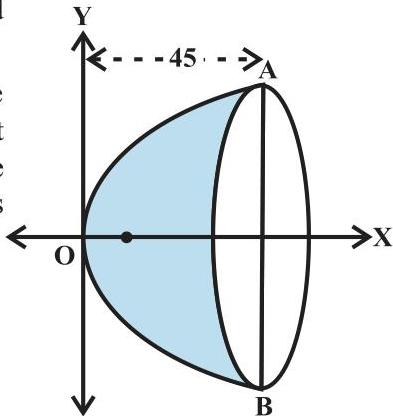 Fig 10.31
Example 18 A structural beam is horizontally sustained at its extremities by two supports positioned 12 meters apart. Given that the applied load is centrally concentrated, a significant deflection of $3\mathrm{cm}$ occurs at its midpoint, causing the beam to assume a parabolic profile. The question asks: at what horizontal distance from the center will the
deflection measure $1\mathrm{cm}$?
Solution We define the vertex as the lowest point of the parabola and orient its axis vertically. The coordinate system is established as illustrated in Figure 10.32.
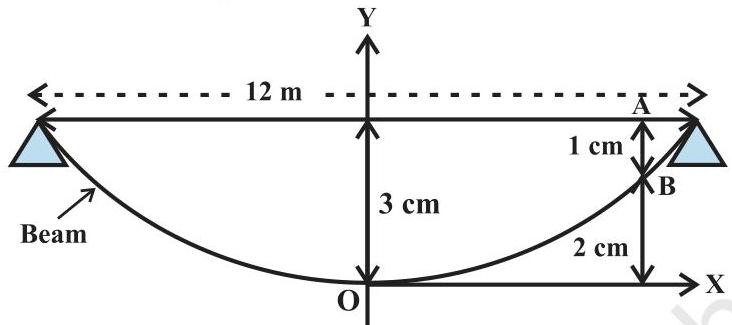 Fig 10.32
The parabolic equation can be expressed as $x^{2} = 4ay$. As the parabola traverses the point $\left(6, \frac{3}{100}\right)$, substituting these coordinates yields $(6)^{2} = 4a\left(\frac{3}{100}\right)$, from which we deduce that $a = \frac{36 \times 100}{12} = 300\mathrm{m}$.
Suppose AB represents the beam's deflection, which is specified as $\frac{1}{100} \mathrm{~m}$. Consequently, the coordinates of point B are $(x, \frac{2}{100})$.
Thus, substituting these values into the parabolic equation, we obtain $x^{2} = 4\times 300\times \frac{2}{100} = 24$.
This implies that $x = \sqrt{24} = 2\sqrt{6}$ metres.
Example 19 Consider a rod, designated AB, measuring $15\mathrm{cm}$ in length, positioned such that its end A is situated on the $x$-axis and its end B is located on the $y$-axis. A point $\mathrm{P}(x,y)$ is marked on this rod such that the segment $\mathrm{AP}$ measures $6\mathrm{cm}$. Demonstrate that the path traced by point $\mathrm{P}$ forms an ellipse.
Solution Consider a rod, designated AB, positioned such that it forms an angle $\theta$ with the positive x-axis, as depicted in Fig 10.33. Let P $(x,y)$ be a specific point on this rod, located such that the segment $\mathrm{AP}$ measures $6\mathrm{cm}$.
Given that the total length of the rod, $\mathrm{AB}$, is $15\mathrm{cm}$, it follows directly that the length of the segment PB is:
$ \mathrm{PB} = 9\mathrm{cm}. $
From point P, construct perpendiculars to the y-axis (denoted as PQ) and the x-axis (denoted as PR), respectively.
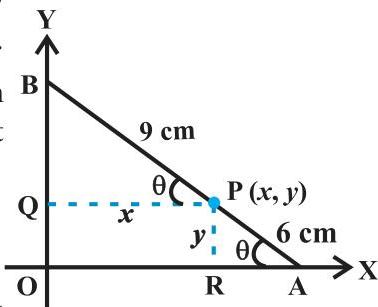 Fig 10.33
Within the right-angled triangle $\Delta \mathrm{PBQ}$, the cosine of the angle $\theta$ is expressed as $\cos \theta = \frac{x}{9}$.
Similarly, in the right-angled triangle $\Delta \mathrm{PRA}$, the sine of the angle $\theta$ is given by $\sin \theta = \frac{y}{6}$.
Utilizing the fundamental trigonometric identity $\cos^2\theta +\sin^2\theta = 1$, we substitute the derived expressions:
$ \left(\frac {x}{9}\right) ^ {2} + \left(\frac {y}{6}\right) ^ {2} = 1 $
This expression simplifies to $\frac{x^2}{81} +\frac{y^2}{36} = 1$.
Consequently, the locus traced by point $\mathbf{P}$ is identified as an ellipse.
Miscellaneous Exercise on Chapter 10
- If a parabolic reflector is $20\mathrm{cm}$ in diameter and $5\mathrm{cm}$ deep, find the focus.
- An arch is in the form of a parabola with its axis vertical. The arch is $10\mathrm{m}$ high and $5\mathrm{m}$ wide at the base. How wide is it $2\mathrm{m}$ from the vertex of the parabola?
- The cable of a uniformly loaded suspension bridge hangs in the form of a parabola. The roadway which is horizontal and $100\mathrm{m}$ long is supported by vertical wires attached to the cable, the longest wire being $30\mathrm{m}$ and the shortest being $6\mathrm{m}$. Find the length of a supporting wire attached to the roadway $18\mathrm{m}$ from the middle.
- An arch is in the form of a semi-ellipse. It is $8\mathrm{m}$ wide and $2\mathrm{m}$ high at the center. Find the height of the arch at a point $1.5\mathrm{m}$ from one end.
- A rod of length $12\mathrm{cm}$ moves with its ends always touching the coordinate axes. Determine the equation of the locus of a point $\mathbf{P}$ on the rod, which is $3\mathrm{cm}$ from the end in contact with the x-axis.
- Find the area of the triangle formed by the lines joining the vertex of the parabola $x^{2} = 12y$ to the ends of its latus rectum.
- A man running a racecourse notes that the sum of the distances from the two flag posts from him is always $10\mathrm{m}$ and the distance between the flag posts is $8\mathrm{m}$. Find the equation of the posts traced by the man.
- An equilateral triangle is inscribed in the parabola $y^{2} = 4ax$, where one vertex is at the vertex of the parabola. Find the length of the side of the triangle.
Summary
In this Chapter the following concepts and generalizations are studied.
- A circle is the locus of points in a plane that maintain a constant distance from a designated fixed point within that plane.
- The equation of a circle with center $(h, k)$ and the radius $r$ is
$ (x - h)^2 + (y - k)^2 = r^2. $
- A parabola is defined as the collection of all points in a plane that are equidistant from a specific fixed line and a particular fixed point within the plane.
- The equation of the parabola with focus at $(a, 0)$ $a > 0$ and directrix $x = -a$ is
$ y^2 = 4ax. $
The latus rectum of a parabola denotes a line segment that is oriented perpendicularly to the parabola's axis, passes through its focus, and has its extremities situated on the parabola itself.
Length of the latus rectum of the parabola $y^2 = 4ax$ is $4a$.
An ellipse constitutes the set of all points within a plane where the aggregate of their distances from two distinct fixed points in that plane remains invariant.
The equation of an ellipse with foci on the $x$-axis is $\frac{x^2}{a^2} + \frac{y^2}{b^2} = 1$.
For an ellipse, the latus rectum is characterized as a line segment orthogonal to the major axis, extending through either of the foci, with its terminal points resting on the ellipse.
Length of the latus rectum of the ellipse $\frac{x^2}{a^2} + \frac{y^2}{b^2} = 1$ is $\frac{2b^2}{a}$.
The eccentricity of an ellipse is quantified as the ratio between the distance from the ellipse's center to one of its foci and the distance from the ellipse's center to one of its vertices.
A hyperbola is comprised of all points in a plane such that the absolute difference of their distances from two designated fixed points within that plane is a constant value.
The equation of a hyperbola with foci on the $x$-axis is $\frac{x^2}{a^2} - \frac{y^2}{b^2} = 1$
The latus rectum of a hyperbola refers to a line segment perpendicular to the transverse axis, passing through either focus, and having its endpoints on the hyperbola.
Length of the latus rectum of the hyperbola: $\frac{x^2}{a^2} - \frac{y^2}{b^2} = 1$ is: $\frac{2b^2}{a}$.
The eccentricity of a hyperbola represents the ratio derived from the distance between the hyperbola's center and one of its foci, divided by the distance between its center and one of its vertices.
Historical Note
Mathematics encompasses geometry as one of its most venerable disciplines. Ancient Greek geometers delved into the characteristics of numerous curves, acknowledging their theoretical and practical significance. Euclid authored his seminal treatise on geometry around 300 B.C., becoming the first to systematize geometric configurations through axioms derived from empirical observations. Geometry, as initially explored by the ancient Indians and Greeks, largely eschewed algebraic methodologies. This synthetic methodology, exemplified by Euclid and the Sulbasutras, persisted for approximately thirteen centuries. During the 2nd century B.C., Apollonius penned a work titled 'The Conic,' dedicated entirely to conic sections and containing profound discoveries that stood unrivaled for eighteen centuries.
Contemporary analytic geometry bears the appellation 'Cartesian,' attributed to René Descartes (1596-1650), whose pertinent work, 'La Géométrie,' was published in 1637. However, the foundational tenets and methodology of analytical geometry had been independently conceived by Pierre de Fermat (1601-1665). Regrettably, Fermat's scholarly work on the subject, Ad Locus Planos et Solidos Isagoge (Introduction to Plane and Solid Loci), saw publication solely after his demise in 1679. Consequently, Descartes garnered recognition as the singular progenitor of analytical geometry.
Isaac Barrow deliberately eschewed the Cartesian approach. Newton employed the technique of undetermined coefficients to ascertain curve equations, incorporating various coordinate systems, notably polar and bipolar schemes. Leibniz introduced the nomenclature 'abscissa,' 'ordinate,' and 'coordinate.' L'Hôpital authored a significant textbook on analytical geometry around the turn of the 18th century.
In 1729, Clairaut pioneered the distance formula, albeit in a somewhat unwieldy formulation. He additionally presented the intercept representation for linear equations. Cramer, in 1750
, formalized the application of two axes and articulated the equation of a circle as
$ (y - a)^2 + (b - x)^2 = r $
His work constituted the most comprehensive exposition of analytical geometry of that era. Monge, in 1781, introduced the contemporary ‘point-slope’ equation for a line as
$ y - y' = a (x - x') $
along with the criterion for perpendicularity between two lines, expressed as $aa' + 1 = 0$.
S.F. Lacroix (1765–1843), a prolific author of textbooks, disseminated his contributions to analytical geometry across various works. He formulated the ‘two-point’ equation for a line as
$ y - \beta = \frac{\beta' - \beta}{\alpha' - \alpha} (x - \alpha) $
and determined the length of the perpendicular from a point $(\alpha, \beta)$ to the line $y = ax + b$ as $\frac{(\beta - a - b)}{\sqrt{1 + a^2}}$.
The formula he provided for calculating the angle between two lines was $\tan \theta = \left(\frac{a' - a}{1 + aa'}\right)$. It is indeed remarkable that over 150 years elapsed following the advent of analytical geometry before this fundamental formula was established. In 1818, civil engineer C. Lamé proposed $m\mathrm{E} + m'\mathrm{E}' = 0$ as the equation for a curve traversing the intersection points of two loci, $\mathrm{E} = 0$ and $\mathrm{E}' = 0$.
The significance of conic sections extends to numerous pivotal discoveries across both mathematical and scientific domains. Ancient Greek scholars, notably Archimedes (287–212 B.C.) and Apollonius (200 B.C.), investigated these geometric figures, drawn by their intrinsic aesthetic appeal. Currently, these curves serve as indispensable instruments for venturing into space and for probing the characteristics of atomic particles.