Chapter 9
STRAIGHT LINES
$\diamond$ H. Freudenthal observed that geometry, when viewed as a logical framework, serves as a potent, indeed perhaps the most potent, instrument for enabling children to apprehend the profound capabilities of the human intellect, particularly their own inherent mental prowess. $\diamond$
9.1 Introduction
Our prior educational experiences have introduced us to the principles of two-dimensional coordinate geometry. Fundamentally, this discipline represents a synthesis of algebraic and geometric concepts. The formal application of algebra to the study of geometry was initially undertaken by the renowned French philosopher and mathematician, René Descartes, in his seminal 1637 publication, 'La Géométrie'. This treatise was instrumental in establishing the concept of a curve's equation and integrating analytical methodologies into geometric inquiry. The resultant amalgamation of analytical techniques and geometry is presently termed analytical geometry. Our preliminary explorations in coordinate geometry encompassed topics such as coordinate axes, the coordinate plane, the representation of points within a plane, the calculation of distances between points, and the application of section formulae. These elements constitute the foundational tenets of coordinate geometry.
 René Descartes
(1596 -1650)
René Descartes
(1596 -1650)
We shall now undertake a concise review of the coordinate geometry topics covered in preceding academic levels. By way of illustration, the positions of the points $(6, -4)$ and $(3, 0)$ within the XY-plane are depicted in Figure 9.1.
It can be observed that the point $(6, -4)$ is situated 6 units from the $y$-axis, as measured along the positive $x$-axis, and 4 units from the $x$-axis, measured along the negative $y$-axis. Correspondingly, the point $(3, 0)$ lies 3 units from the $y$-axis, positioned along the positive $x$-axis, and exhibits no displacement from the $x$-axis.
Additionally, the subsequent fundamental formulae were introduced in earlier discussions:
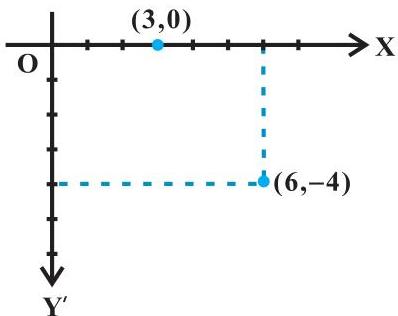 Fig 9.1
I. The Euclidean distance separating two points, $\mathrm{P}(x_1, y_1)$ and $\mathrm{Q}(x_2, y_2)$, is calculated as:
$ \mathrm{PQ} = \sqrt{(x_2 - x_1)^2 + (y_2 - y_1)^2} $
For instance, the distance between the points $(6, -4)$ and $(3, 0)$ is determined by:
$ \sqrt{(3 - 6)^2 + (0 + 4)^2} = \sqrt{9 + 16} = 5 \text{ units}. $
II. When a point partitions the line segment connecting $(x_1, y_1)$ and $(x_2, y_2)$ internally in the ratio $m:n$, its coordinates are given by $\left(\frac{m x_2 + n x_1}{m + n}, \frac{m y_2 + n y_1}{m + n}\right)$.
As an illustration, the coordinates of the point that internally divides the segment joining A $(1, -3)$ and B $(-3, 9)$ in the ratio $1:3$ are calculated as $x = \frac{1.(-3) + 3.1}{1 + 3} = 0$ and $y = \frac{1.9 + 3.(-3)}{1 + 3} = 0$.
III. Specifically, should the ratio $m:n$ become $1:1$ (i.e., $m=n$), the coordinates for the midpoint of the line segment connecting $(x_1, y_1)$ and $(x_2, y_2)$ are expressed as $\left(\frac{x_1 + x_2}{2}, \frac{y_1 + y_2}{2}\right)$.
IV. The area of a triangular region defined by vertices $(x_1, y_1)$, $(x_2, y_2)$, and $(x_3, y_3)$ is computed using the formula:
$ \left. \frac{1}{2} \right| x_1(y_2 - y_3) + x_2(y_3 - y_1) + x_3(y_1 - y_2) \Bigg|. $
Consider, for instance, a triangle with vertices located at the coordinates $(4, 4)$, $(3, -2)$, and $(-3, 16)$. Its area is calculated as follows:
$ \left. \frac{1}{2} \right| 4(-2 - 16) + 3(16 - 4) + (-3)(4 + 2) = \frac{|-54|}{2} = 27. $
Remark Should the area of triangle ABC be found to be zero, it implies that the three points A, B, and C are situated on a single straight line, thus rendering them collinear.
This chapter extends our exploration of coordinate geometry to delve into the characteristics of the most fundamental geometric entity: the straight line. Notwithstanding its apparent simplicity, the line constitutes a foundational concept in geometry and manifests in countless intriguing and practical applications within our everyday existence. The primary objective herein is to articulate the line algebraically, with its slope emerging as a critically important parameter.
9.2 Slope of a Line
Within a coordinate plane, any given line generates two angles with the $x$-axis, these angles invariably being supplementary.
The specific angle, conventionally denoted as $\theta$, that a line $l$ forms with the positive $x$-axis, when measured in a counter-clockwise direction, is termed the inclination of the line. It is evident that this inclination $\theta$ satisfies the condition $0^{\circ} \leq \theta \leq 180^{\circ}$ (refer to Fig 9.2).
It is noteworthy that lines running parallel to or coincident with the $x$-axis possess an inclination of $0^{\circ}$. Conversely, a vertical line (one parallel to or coincident with the $y$-axis) exhibits an inclination of $90^{\circ}$.
Definition 1 If $\theta$ represents the inclination of a line $l$, then the tangent of this angle, $\tan \theta$, is designated as the slope or gradient of the line $l$.
A line possessing an inclination of $90^{\circ}$ does not have a defined slope.
The symbol $m$ is typically used to represent the slope of a line.
Consequently, the slope $m$ is given by $m = \tan \theta$, provided that $\theta \neq 90^{\circ}$.
One can discern that the $x$-axis itself has a slope of zero, whereas the slope of the $y$-axis remains undefined.
9.2.1 Slope of a line when coordinates of any two points on the line are given
The unique definition of a line is established by two distinct points lying upon it. Consequently, our objective is to determine the line's slope as a function of the coordinates of these two defining points.
Consider two arbitrary points, $\mathrm{P}(x_1, y_1)$ and $\mathrm{Q}(x_2, y_2)$, situated on a non-vertical line $l$, which possesses an inclination of $\theta$. It is imperative that $x_1 \neq x_2$; otherwise, the line would be orthogonal to the $x$-axis, rendering its slope undefined. The inclination $\theta$ of line $l$ can be either acute or obtuse; we shall examine both scenarios.
Construct a perpendicular segment QR from Q to the $x$-axis, and another perpendicular segment PM from P to RQ, as depicted in Figures 9.3 (i) and (ii).
Case 1 When angle $\theta$ is acute:
Referring to Figure 9.3 (i), the angle $\angle MPQ$ is equivalent to $\theta$. ... (1)
Hence, the slope of line $l$, denoted by $m$, is equal to $\tan \theta$.
However, within triangle $\Delta MPQ$, we observe that $\tan \theta$ can be expressed as the ratio $\frac{MQ}{MP}$, which simplifies to $\frac{y_2 - y_1}{x_2 - x_1}$. ... (2)
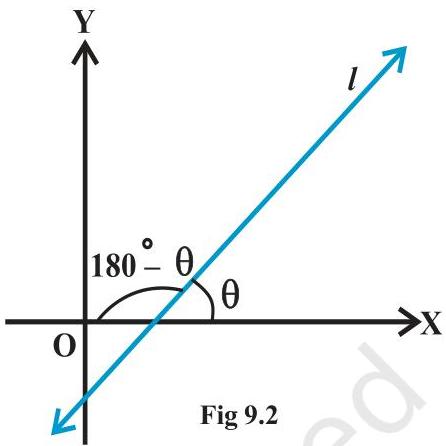
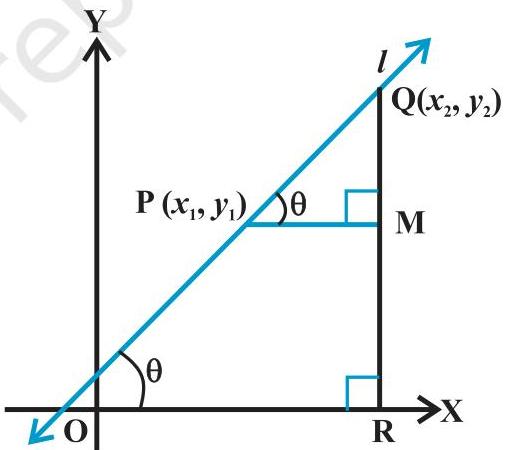 Fig 9.2
By synthesizing information from equations (1) and (2), we deduce the following:
$ m = \frac {y _ {2} - y _ {1}}{x _ {2} - x _ {1}}. $
Case II When angle $\theta$ is obtuse:
As illustrated in Figure 9.3 (ii), we establish:
$ \angle \mathrm {M P Q} = 1 8 0 ^ {\circ} - \theta . $
Consequently, $\theta = 180^{\circ} - \angle \mathrm{MPQ}$
At this juncture, considering the slope of line $l$:
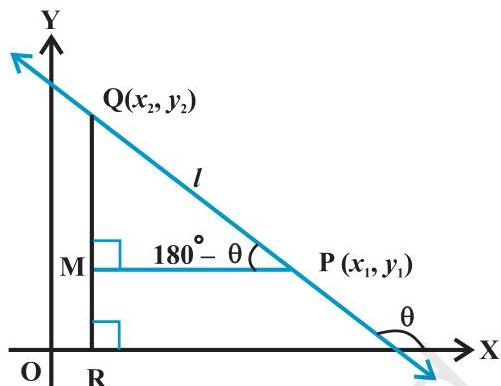 Fig 9.3 (ii)
$ \begin{array}{l} m = \tan \theta \ = \tan (1 8 0 ^ {\circ} - \angle \mathrm {M P Q}) = - \tan \angle \mathrm {M P Q} \ = - \frac {\mathrm {M Q}}{\mathrm {M P}} = - \frac {y _ {2} - y _ {1}}{x _ {1} - x _ {2}} = \frac {y _ {2} - y _ {1}}{x _ {2} - x _ {1}}. \ \end{array} $
Thus, it is evident that regardless of whether the angle is acute or obtuse, the slope $m$ of the line passing through the points $(x_{1},y_{1})$ and $(x_{2},y_{2})$ is consistently represented by the formula $m = \frac{y_2 - y_1}{x_2 - x_1}$ .
9.2.2 Conditions for parallelism and perpendicularity of lines in terms of their slopes
Within a Cartesian coordinate system, let us postulate that two non-vertical lines, $l_1$ and $l_2$, possess slopes designated as $m_1$ and $m_2$, respectively. Furthermore, let their respective inclinations be denoted by $\alpha$ and $\beta$.
Should line $l_1$ be parallel to line $l_2$ (as illustrated in Figure 9.4), it follows that their inclinations must be identical, specifically:
$\alpha = \beta$ , and hence, tan $\alpha = \tan \beta$
Consequently, $m_{1} = m_{2}$, which signifies the equality of their slopes.
Conversely, consider the scenario where the slopes of two lines, $l_1$ and $l_2$, are identical, meaning:
$ m _ {1} = m _ {2}. $
Then $\tan \alpha = \tan \beta$
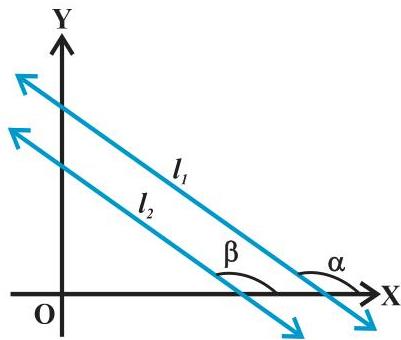 Fig 9.4
Utilizing the intrinsic property of the tangent function (specifically within the interval of $0^{\circ}$ to $180^{\circ}$), it is established that $\alpha = \beta$.
Hence, the lines are confirmed to be parallel.
STRAIGHT LINES
Consequently, for two non-vertical lines, designated $l_{1}$ and $l_{2}$, the condition for them to be parallel is precisely that their respective slopes are identical.
Should lines $l_{1}$ and $l_{2}$ be mutually perpendicular (as illustrated in Fig 9.5), their angles of inclination will satisfy the relationship $\beta = \alpha + 90^{\circ}$. This angular relationship implies that $\tan \beta = \tan (\alpha + 90^{\circ})$, which simplifies to:
$ = - \cot \alpha = - \frac {1}{\tan \alpha} $
This establishes the condition $m_{2} = -\frac{1}{m_{1}}$ or, equivalently, $m_{1} m_{2} = -1$.
Conversely, if the product of their slopes, $m_{1} m_{2}$, equals $-1$, this signifies that $\tan \alpha \tan \beta = -1$. This, in turn, allows us to deduce that $\tan \alpha = -\cot \beta$, which can be expressed as $\tan (\beta + 90^{\circ})$ or $\tan (\beta - 90^{\circ})$. Therefore, the angles $\alpha$ and $\beta$ must differ by $90^{\circ}$, confirming that lines $l_{1}$ and $l_{2}$ are indeed perpendicular.
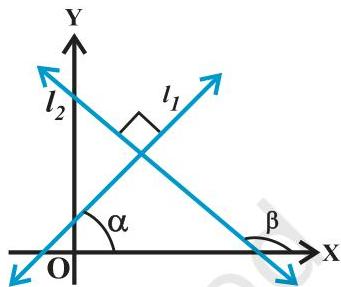 Fig 9.5
In summary, two non-vertical lines are perpendicular if and only if their slopes are negative reciprocals of one another; that is, the relationship $m_{2} = -\frac{1}{m_{1}}$ or $m_{1} m_{2} = -1$ must hold.
Let us examine the subsequent example.
Example 1 Find the slope of the lines:
(a) Passing through the points $(3, -2)$ and $(-1, 4)$, (b) Passing through the points $(3, -2)$ and $(7, -2)$, (c) Passing through the points $(3, -2)$ and $(3, 4)$, (d) Making inclination of $60^{\circ}$ with the positive direction of $x$-axis.
Solution (a) The gradient of the line connecting the points $(3, -2)$ and $(-1, 4)$ is computed as:
$ m = \frac {4 - (- 2)}{- 1 - 3} = \frac {6}{- 4} = - \frac {3}{2}. $
(b) For the line segment defined by the points $(3, -2)$ and $(7, -2)$, its slope is determined by:
$ m = \frac {- 2 - (- 2)}{7 - 3} = \frac {0}{4} = 0. $
(c) Calculating the slope for the line passing through $(3, -2)$ and $(3, 4)$ yields:
$
m = \frac {4 - (- 2)}{3 - 3} = \frac {6}{0}, \text{ which is not defined}. $
(d) Given that the line's inclination, $\alpha$, is $60^{\circ}$, its slope is consequently found by:
$ m = \tan 60^{\circ} = \sqrt{3}. $
9.2.3 Angle between two lines
In the context of planar geometry, a pair of lines can either intersect or maintain a parallel orientation. This section focuses on determining the angle formed by two such lines, expressed through their respective slopes.
Consider two distinct non-vertical lines, denoted $\mathrm{L}_1$ and $\mathrm{L}_2$, possessing slopes $m_1$ and $m_2$ in that order. If $\alpha_1$ and $\alpha_2$ denote the angles of inclination for lines $\mathrm{L}_1$ and $\mathrm{L}_2$, respectively, then the following relationships hold:
$ m_1 = \tan \alpha_1 \text{ and } m_2 = \tan \alpha_2. $
It is established that the intersection of two lines generates two sets of vertically opposite angles, where the sum of any two contiguous angles equates to $180^{\circ}$. Designate $\theta$ and $\phi$ as the adjacent angles formed between lines $\mathrm{L}_1$ and $\mathrm{L}_2$, as depicted in Figure 9.6. Consequently:
$ \theta = \alpha_2 - \alpha_1 \text{ and } \alpha_1, \alpha_2 \neq 90^{\circ}. $
Hence, the tangent of $\theta$ can be expressed as $\tan \theta = \tan (\alpha_2 - \alpha_1)$. Applying the tangent subtraction formula, this simplifies to $\frac{\tan \alpha_2 - \tan \alpha_1}{1 + \tan \alpha_1 \tan \alpha_2}$, which, by substituting the slope definitions, becomes $\frac{m_2 - m_1}{1 + m_1 m_2}$ (provided that $1 + m_1 m_2 \neq 0$).
Furthermore, since $\phi = 180^{\circ} - \theta$, it follows that
$ \tan \phi = \tan (180^{\circ} - \theta) = - \tan \theta = - \frac{m_2 - m_1}{1 + m_1 m_2}, \text{ as } 1 + m_1 m_2 \neq 0 $
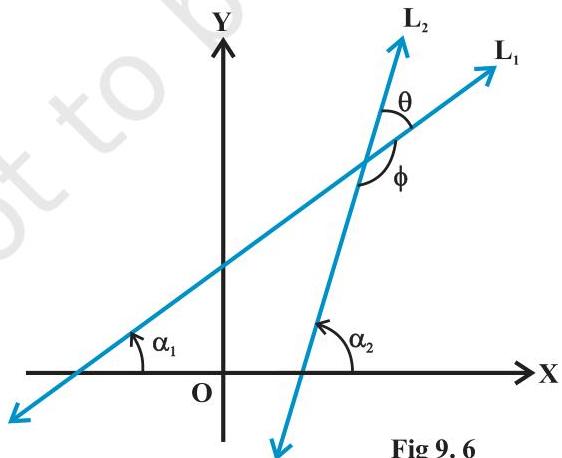 Fig 9.6
Now, there arise two cases:
Case I: Should the expression $\frac{m_2 - m_1}{1 + m_1m_2}$ yield a positive value, then $\tan \theta$ will be positive and $\tan \phi$ will be negative. This implies that $\theta$ represents an acute angle, while $\phi$ corresponds to an obtuse angle.
Case II: Conversely, if $\frac{m_2 - m_1}{1 + m_1m_2}$ is negative, then $\tan \theta$ will be negative and $\tan \phi$ will be positive. This signifies that $\theta$ will be an obtuse angle, whereas $\phi$ will be an acute angle.
Consequently, the acute angle (designated as $\theta$) formed between lines $L_1$ and $L_2$, having slopes $m_1$ and $m_2$ respectively, can be determined using the following formula:
$ \tan \theta = \left| \frac{m_2 - m_1}{1 + m_1m_2} \right|, \text{ as } 1 + m_1m_2 \neq 0 \tag{1} $
The corresponding obtuse angle (denoted as $\phi$) can subsequently be derived from the relationship $\phi = 180^\circ - \theta$.
Example 2 If the angle between two lines is $\frac{\pi}{4}$ and slope of one of the lines is $\frac{1}{2}$, find the slope of the other line.
Solution: It is established that the acute angle $\theta$ between two lines, characterized by slopes $m_1$ and $m_2$, is expressed by the formula $\tan \theta = \left| \frac{m_2 - m_1}{1 + m_1m_2} \right|$ (Equation 1).
Assign $m_1 = \frac{1}{2}$, let $m_2 = m$, and set $\theta = \frac{\pi}{4}$.
Substituting these assigned values into Equation (1) yields:
$ \tan \frac{\pi}{4} = \left| \frac{m - \frac{1}{2}}{1 + \frac{1}{2}m} \right| \quad \text{or} \quad 1 = \left| \frac{m - \frac{1}{2}}{1 + \frac{1}{2}m} \right|, $
This equation implies two possibilities: either $\frac{m - \frac{1}{2}}{1 + \frac{1}{2}m} = 1$ or $\frac{m - \frac{1}{2}}{1 + \frac{1}{2}m} = -1$.
Consequently, solving for $m$ yields $m = 3$ or $m = -\frac{1}{3}$. Thus, the slope of the second line is either 3 or $-\frac{1}{3}$. Figure 9.7 elucidates the rationale behind these two distinct solutions.
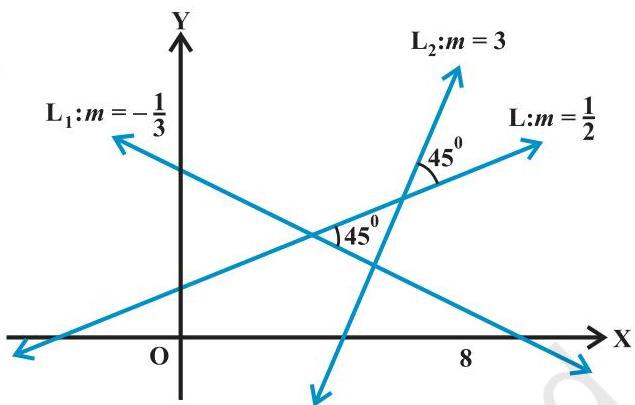 Fig 9.7
Example 3: Determine the value of $x$ given that the line connecting points $(-2,6)$ and $(4,8)$ is orthogonal to the line passing through $(8,12)$ and $(x,24)$.
Solution: The gradient of the line segment joining $(-2,6)$ and $(4,8)$ is calculated as:
$ m _ {1} = \frac {8 - 6}{4 - (- 2)} = \frac {2}{6} = \frac {1}{3} $
The gradient of the line segment connecting $(8,12)$ and $(x,24)$ is given by:
$ m _ {2} = \frac {24 - 12}{x - 8} = \frac {12}{x - 8} $
Given that the two lines are perpendicular, their gradients must satisfy the condition:
$m_{1}m_{2} = -1$, which yields
$ \frac {1}{3} \times \frac {12}{x - 8} = - 1 \text { or } x = 4. $
EXERCISE 9.1
Plot a quadrilateral in the Cartesian coordinate system with vertices located at $(-4, 5)$, $(0, 7)$, $(5, -5)$, and $(-4, -2)$. Subsequently, compute its enclosed area.
An equilateral triangle, possessing sides of length $2a$, has its base positioned along the $y$-axis, with the midpoint of this base coinciding with the origin. Identify the coordinates of the triangle's vertices.
Determine the spatial separation between points $\mathrm{P}(x_1, y_1)$ and $\mathrm{Q}(x_2, y_2)$ under two conditions: (i) the segment PQ is parallel to the $y$-axis, (ii) the segment PQ is parallel to the $x$-axis.
Locate a point situated on the $x$-axis that maintains an equal distance from the coordinates (7, 6) and (3, 4).
Calculate the gradient of the line that traverses both the origin and the midpoint of the segment connecting points $\mathrm{P}(0, -4)$ and $\mathrm{B}(8, 0)$.
Demonstrate, without employing the Pythagorean theorem, that the coordinates (4, 4), (3, 5), and $(-1, -1)$ constitute the vertices of a right-angled triangle.
Determine the gradient of the line that forms an angle of $30^{\circ}$ with the positive $y$-axis, when measured in the counter-clockwise direction.
Prove, without utilizing the distance formula, that the points $(-2, -1)$, $(4, 0)$, $(3, 3)$, and $(-3, 2)$ define the vertices of a parallelogram.
Compute the angle formed between the $x$-axis and the line segment connecting the points $(3, -1)$ and $(4, -2)$.
One line possesses a gradient that is twice the gradient of a second line. If the tangent of the angle separating these two lines is $\frac{1}{3}$, ascertain the gradients of both lines.
Given a line that traverses points $(x_1, y_1)$ and $(h, k)$, and its gradient is $m$, prove the relationship $k - y_1 = m(h - x_1)$.
9.3 Various Forms of the Equation of a Line
A line within a plane is inherently composed of an infinite set of points. This fundamental characteristic prompts a key inquiry: how can one ascertain if a particular point resides on a specified line? The resolution to this query involves establishing a precise condition that points on the line must satisfy. Consider an arbitrary point $\mathrm{P}(x, y)$ in the XY-plane and a given line $\mathrm{L}$. Our objective in formulating the equation for $\mathrm{L}$ is to devise a statement or criterion for point $\mathrm{P}$ that holds true if $\mathrm{P}$ is situated on $\mathrm{L}$, and false otherwise. This statement, naturally, will manifest as an algebraic equation incorporating the variables $x$ and $y$. We shall now explore the equations of a line derived under various geometric constraints.
9.3.1 Horizontal and vertical lines
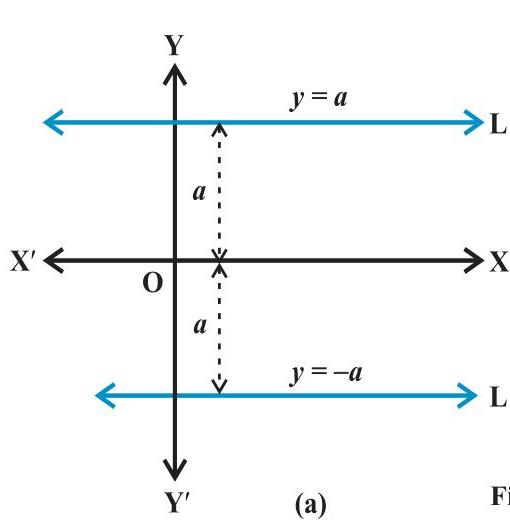
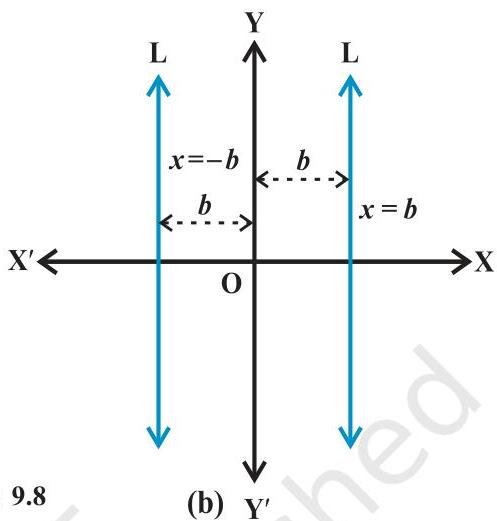
Should a horizontal line $\mathrm{L}$ be positioned at a distance $a$ from the $x$-axis, the $y$-coordinate (ordinate) of every point located on this line will uniformly be either $a$ or $-a$ [Fig 9.8 (a)]. Consequently, the equation representing line $\mathrm{L}$ will be either $y = a$ or $y = -a$. The selection of the appropriate sign is determined by whether the line lies above or below the $x$-axis. Analogously, for a vertical line situated at a distance $b$ from the $y$-axis, its equation is expressed as either $x = b$ or $x = -b$ [Fig 9.8(b)].
Example 4 Find the equations of the lines parallel to axes and passing through $(-2,3)$.
Solution Position of the lines is shown in the Fig 9.9. The $y$-coordinate of every point on the line parallel to $x$-axis is 3, therefore, equation of the line parallel to $x$-axis and passing through $(-2, 3)$ is $y = 3$. Similarly, equation of the line parallel to $y$-axis and passing through $(-2, 3)$ is $x = -2$.
9.3.2 Point-slope form
Consider $\mathrm{P}_0(x_0, y_0)$ as a specific, unmoving point situated on a non-vertical line $\mathrm{L}$, which possesses a slope denoted by $m$. Let $\mathrm{P}(x, y)$ represent any general point also located on $\mathrm{L}$ (Fig 9.10). According to the fundamental definition of slope, the inclination of $\mathrm{L}$ is expressed as:
$ m = \frac {y - y _ {0}}{x - x _ {0}}, \text{ i.e., } y - y _ {0} = m (x - x _ {0}) \tag {1} $
Given that the fixed point $\mathrm{P}_0(x_0, y_0)$, in conjunction with all other points $(x, y)$ lying on $\mathrm{L}$, fulfills condition (1), and conversely, no point external to $\mathrm{L}$ satisfies this condition, it is established that Equation (1) precisely represents the algebraic expression for the specified line $\mathrm{L}$.
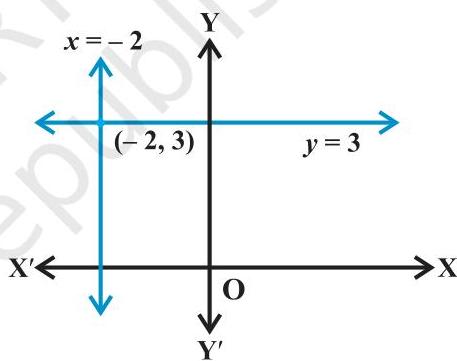 Fig 9.9
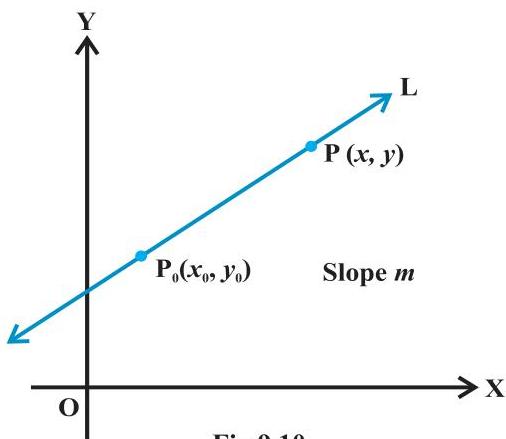 Fig 9.10
Consequently, a point $(x,y)$ is positioned on the line characterized by slope $m$ and passing through the designated point $(x_0,y_0)$ if, and only if, its coordinates conform to the following equation:
$ y - y_0 = m (x - x_0) $
Example 5 Find the equation of the line through $(-2, 3)$ with slope $-4$.
In this instance, the slope $m$ is $-4$, and the specified point $(x_0, y_0)$ is $(-2, 3)$.
Applying the point-slope form formula (1) presented earlier, the equation for the specified line is $y - 3 = -4(x + 2)$ or $4x + y + 5 = 0$, which represents the required linear equation.
9.3.3 Two-point form
Consider a line $L$ that traverses two designated points, $P_1(x_1, y_1)$ and $P_2(x_2, y_2)$. Let $P(x, y)$ denote an arbitrary point situated on $L$ (refer to Fig 9.11).
Given that the three points $P_1$, $P_2$, and $P$ lie on the same straight line, it logically follows that the slope of the segment $P_1P$ must be equivalent to the slope of the segment $P_1P_2$.
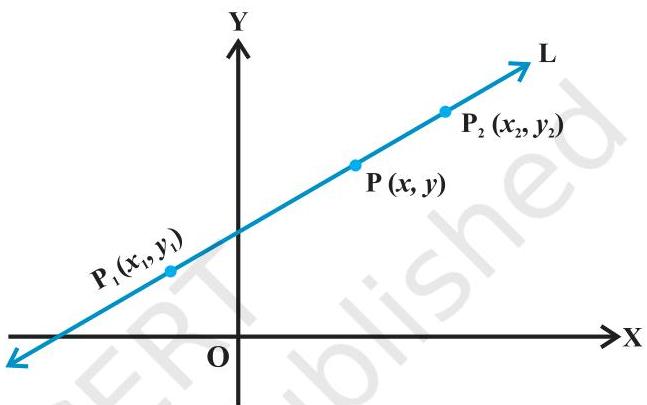 Fig 9.11
This implies that $\frac{y - y_1}{x - x_1} = \frac{y_2 - y_1}{x_2 - x_1}$, which can also be expressed as $y - y_1 = \frac{y_2 - y_1}{x_2 - x_1}(x - x_1)$.
Consequently, the equation defining the line that traverses the points $(x_1, y_1)$ and $(x_2, y_2)$ is formally expressed as:
$ y - y_1 = \frac{y_2 - y_1}{x_2 - x_1}(x - x_1) \tag{2} $
Example 6 Write the equation of the line through the points $(1, -1)$ and $(3, 5)$.
Solution For this problem, we identify $x_1 = 1, y_1 = -1, x_2 = 3$, and $y_2 = 5$. Applying the two-point form (2) presented earlier to determine the line's equation, we obtain:
$ y - (-1) = \frac{5 - (-1)}{3 - 1}(x - 1) $
This expression simplifies to $-3x + y + 4 = 0$, which is the desired equation.
9.3.4 Slope-intercept form
In certain scenarios, a line's characteristics are defined by its gradient and an intercept on either the x-axis or y-axis. Our subsequent objective is to derive the equations for lines possessing these attributes.
Case I Consider a line $L$ possessing a slope $m$, which intersects the $y$-axis at a vertical displacement $c$ from the origin (as depicted in Fig 9.12). This value $c$ is conventionally termed the $y$-intercept of line $L$. Evidently, the coordinates of the point where the line intersects the $y$-axis are $(0, c)$. Consequently, line $L$ is characterized by its slope $m$ and its passage through the specific point $(0, c)$. Therefore, employing the point-slope form, the equation for $L$ is determined as:
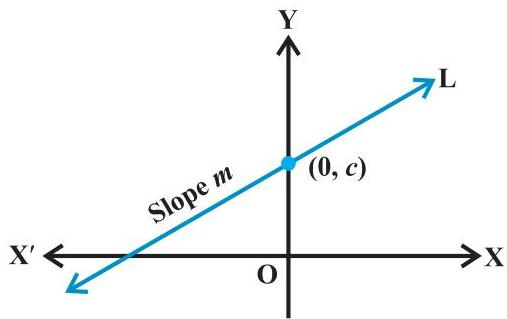 Fig 9.12
$ y - c = m (x - 0) \quad \text{or} \quad y = m x + c $
Hence, any point $(x,y)$ belonging to the line, which has a slope $m$ and a $y$-intercept $c$, satisfies the condition if and only if:
$ y = m x + c \tag{3} $
It is important to observe that the numerical value of $c$ will be positive or negative, contingent upon whether the intercept occurs on the positive or negative region of the $y$-axis, respectively.
Case II Assume a line $L$ with a slope $m$ creates an $x$-intercept at $d$. In this situation, the equation for $L$ is given by:
$ y = m (x - d) \tag{4} $
Learners are encouraged to independently derive this particular equation using an analogous methodology to that employed in Case I.
Example 7 Write the equation of the lines for which $\tan \theta = \frac{1}{2}$, where $\theta$ is the inclination of the line and (i) $y$-intercept is $-\frac{3}{2}$ (ii) $x$-intercept is 4.
Solution (i) In this scenario, the line's slope is determined as $m = \tan \theta = \frac{1}{2}$, and its $y$-intercept $c$ is $-\frac{3}{2}$. Consequently, applying the slope-intercept form (3) presented earlier, the equation for this line is:
$ y = \frac{1}{2} x - \frac{3}{2} \quad \text{or} \quad 2 y - x + 3 = 0, $
This represents the sought-after equation.
(ii) For this part, we are given $m = \tan \theta = \frac{1}{2}$ and an $x$-intercept $d = 4$. Thus, employing the slope-intercept form (4) previously defined, the equation for the line is:
$ y = \frac{1}{2} (x - 4) \quad \text{or} \quad 2 y - x + 4 = 0, $
which is the required equation.
STRAIGHT LINES
9.3.5 Intercept - form
Consider a line denoted as $L$ that intersects the coordinate axes such that its $x$-intercept is $a$ and its $y$-intercept is $b$. It is evident that $L$ intersects the $x$-axis at the coordinates $(a, 0)$ and the $y$-axis at $(0, b)$ (refer to Fig. 9.13). Applying the two-point form for the equation of a line, we obtain:
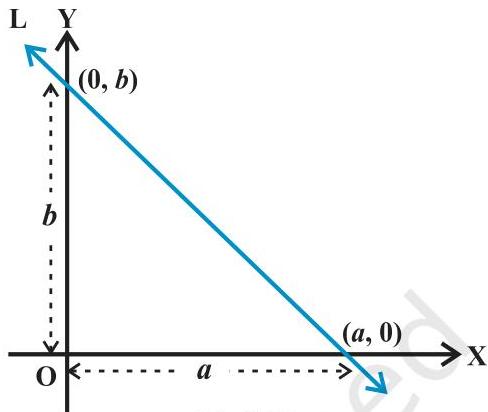 Fig. 9.13
$ y - 0 = \frac {b - 0}{0 - a} (x - a) \quad \text {or} \quad a y = - b x + a b, $
i.e., $\frac{x}{a} +\frac{y}{b} = 1.$
Thus, the equation of a line that creates intercepts $a$ and $b$ on the $x$-axis and $y$-axis, respectively, is given by:
$ \frac {x}{a} + \frac {y}{b} = 1 \tag {5} $
Example 8 Determine the equation for the line that has intercepts of $-3$ on the $x$-axis and $2$ on the $y$-axis.
Solution In this case, we are given $a = -3$ and $b = 2$. Utilizing the intercept form (5) presented previously, the equation of the line is found to be:
$ \frac {x}{- 3} + \frac {y}{2} = 1 \quad \text {or} \quad 2 x - 3 y + 6 = 0. $
An equation conforming to the structure $\mathrm{Ax} + \mathrm{By} + \mathrm{C} = 0$, provided that coefficients $\mathrm{A}$ and $\mathrm{B}$ are not both zero concurrently, is designated as the general linear equation or, alternatively, the general equation of a line.
EXERCISE 9.2
In Exercises 1 to 8, find the equation of the line which satisfy the given conditions:
Furnish the equations corresponding to the $x$-axis and the $y$-axis.
A line traversing the point $(-4, 3)$ and possessing a gradient of $\frac{1}{2}$.
A line extending through the origin $(0, 0)$ and having a slope of $m$.
A line that traverses $\left(2, 2\sqrt{3}\right)$ and forms an angle of $75^{\circ}$ with the positive $x$-axis.
A line that crosses the $x$-axis at a point 3 units to the left of the origin and exhibits a slope of $-2$.
A line intersecting the $y$-axis 2 units above the origin and creating an angle of $30^{\circ}$ with the positive $x$-axis direction.
A line traversing the points $(-1, 1)$ and $(2, -4)$.
Given the vertices of $\Delta$ PQR as P (2, 1), Q (-2, 3), and R (4, 5), determine the equation of the median originating from vertex R.
Ascertain the equation of the line that passes through the point $(-3, 5)$ and is orthogonal to the line connecting the points (2, 5) and $(-3, 6)$.
Consider a line that is orthogonal to the segment connecting the points (1, 0) and (2, 3) and partitions this segment in the ratio 1: $n$. Determine the equation of this line.
Obtain the equation of a line which forms equal intercepts on the coordinate axes and extends through the point (2, 3).
Determine the equation of the line that traverses the point (2, 2) and generates intercepts on the axes such that their sum totals 9.
Ascertain the equation of the line that passes through the point $(0, 2)$ and creates an angle of $\frac{2\pi}{3}$ with the positive $x$-axis. Additionally, find the equation of a line that is parallel to this line and intersects the $y$-axis 2 units below the origin.
A perpendicular segment dropped from the origin to a certain line intersects it at the point $(-2, 9)$. Determine the equation of this line.
The dimension $L$ (expressed in centimetres) of a copper rod exhibits a linear dependence on its Celsius temperature $C$. During an experimental observation, if $L = 124.942$ when $C = 20$ and $L = 125.134$ when $C = 110$, formulate $L$ as a function of $C$.
A proprietor of a dairy establishment observes that 980 litres of milk can be sold per week at a price of Rs 14 per litre, and 1220 litres per week at Rs 16 per litre. Postulating a linear correlation between the selling price and the quantity demanded, calculate the weekly milk sales volume if the price is Rs 17 per litre.
Let $P(a, b)$ represent the midpoint of a line segment delimited by the coordinate axes. Demonstrate that the equation of this line is $\frac{x}{a} + \frac{y}{b} = 2$.
A point R $(h, k)$ partitions a line segment located between the coordinate axes in the ratio 1: 2. Determine the equation of this line.
Employing the principles associated with the equation of a line, establish that the three points (3, 0), $(-2, -2)$, and (8, 2) lie on the same straight line.
9.4 Distance of a Point From a Line
The spatial separation of a specific point from a given line is quantified by the length of the orthogonal segment extending from that point to the line. Consider a line $L$ defined by the equation $Ax + By + C = 0$, and a point $P(x_1, y_1)$. The distance from $P$ to $L$ is denoted by $d$. A perpendicular segment, PM, is constructed from point $P$ to line $L$ (refer to Fig 9.14). Should the
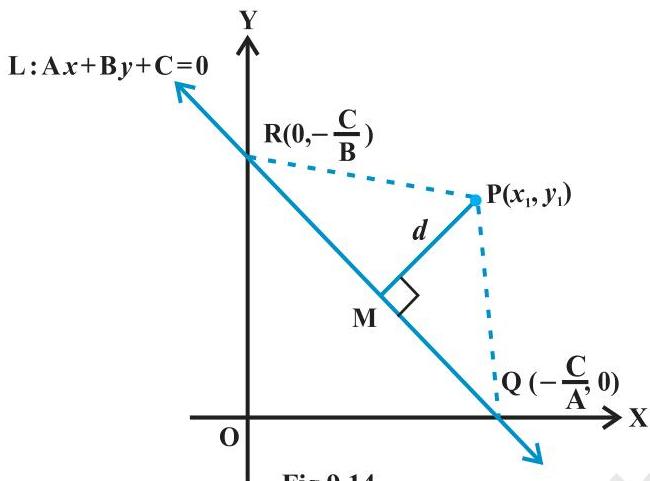 Fig 9.14
line intersect the $x$-axis and $y$-axis at points $Q$ and $R$, respectively, their coordinates are determined as $Q\left(-\frac{C}{A}, 0\right)$ and $R\left(0, -\frac{C}{B}\right)$. Consequently, the area of the triangle PQR can be expressed as
$ \text {area} (\Delta \mathrm {P Q R}) = \frac {1}{2} \mathrm {P M . Q R}, \text { which gives } \mathrm {P M} = \frac {2 \text { area } (\Delta \mathrm {P Q R})}{\mathrm {Q R}} \tag {1} $
Additionally, the area of $\Delta \mathrm{PQR}$ is determined by the coordinate formula: area $(\Delta \mathrm{PQR}) = \frac{1}{2}\left|x_1\left(0 + \frac{\mathrm{C}}{\mathrm{B}}\right) + \left(-\frac{\mathrm{C}}{\mathrm{A}}\right)\left(-\frac{\mathrm{C}}{\mathrm{B}} -y_1\right) + 0\left(y_1 - 0\right)\right|$
$ = \frac {1}{2} \left| x _ {1} \frac {\mathrm {C}}{\mathrm {B}} + y _ {1} \frac {\mathrm {C}}{\mathrm {A}} + \frac {\mathrm {C} ^ {2}}{\mathrm {A B}} \right| $
or, equivalently, twice the area of $\Delta \mathrm{PQR}$ is given by $\left|\frac{\mathrm{C}}{\mathrm{AB}}\right|.\left|\mathrm{A}x_1 + \mathrm{B}y_1 + \mathrm{C}\right|$, and
$ \mathrm {Q R} = \sqrt {\left(0 + \frac {\mathrm {C}}{\mathrm {A}}\right) ^ {2} + \left(\frac {\mathrm {C}}{\mathrm {B}} - 0\right) ^ {2}} = \left| \frac {\mathrm {C}}{\mathrm {A B}} \right| \sqrt {\mathrm {A} ^ {2} + \mathrm {B} ^ {2}} $
By substituting the derived expressions for the area of $\Delta \mathrm{PQR}$ and the length QR into Equation (1), we obtain:
$ \mathrm {P M} = \frac {\left| \mathrm {A} x _ {1} + \mathrm {B} y _ {1} + \mathrm {C} \right|}{\sqrt {\mathrm {A} ^ {2} + \mathrm {B} ^ {2}}} $
or
$ d = \frac {\left| \mathrm {A} x _ {1} + \mathrm {B} y _ {1} + \mathrm {C} \right|}{\sqrt {\mathrm {A} ^ {2} + \mathrm {B} ^ {2}}}. $
Consequently, the orthogonal distance $(d)$ from a point $(x_{1},y_{1})$ to a line defined by the equation $\mathrm{Ax} + \mathrm{By} + \mathrm{C} = 0$ is expressed as:
$ d = \frac {\left| \mathrm {A} x _ {1} + \mathrm {B} y _ {1} + \mathrm {C} \right|}{\sqrt {\mathrm {A} ^ {2} + \mathrm {B} ^ {2}}}. $
9.4.1 Distance between two parallel lines
It is established that parallel lines are characterized by having identical slopes.
Accordingly, two parallel lines may be represented in the form:
$ y = m x + c_1 \quad \dots (1) $
and $y = m x + c_2$ ... (2)
Line (1) intersects the x-axis at point A $\left(-\frac{c_1}{m}, 0\right)$, as depicted in Fig 9.15.
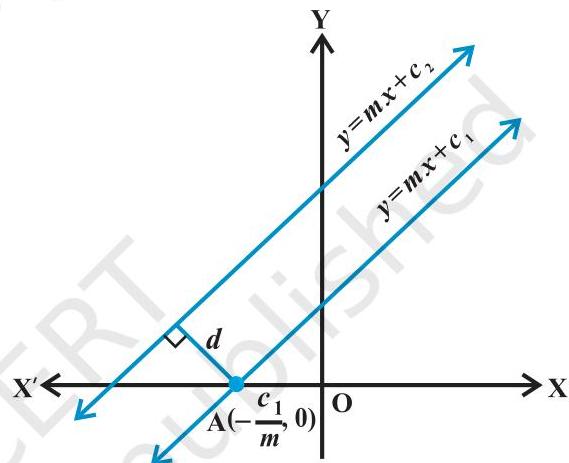 Fig 9.15
The distance separating the two lines is equivalent to the length of the perpendicular segment from point A to line (2). Thus, the distance between lines (1) and (2) is determined by:
$ \frac {\left| (- m) \left(- \frac {c_1}{m}\right) + (- c_2) \right|}{\sqrt {1 + m^2}} \quad \text {or} \quad d = \frac {\left| c_1 - c_2 \right|}{\sqrt {1 + m^2}}. $
Therefore, the distance $d$ between two parallel lines, expressed as $y = mx + c_{1}$ and $y = mx + c_{2}$, is provided by:
$ d = \frac {\left| c_1 - c_2 \right|}{\sqrt {1 + m^2}}. $
When the lines are specified in their general form, namely $\mathrm{Ax} + \mathrm{By} + \mathrm{C}_1 = 0$ and $\mathrm{Ax} + \mathrm{By} + \mathrm{C}_2 = 0$, the preceding formula adapts to $d = \frac{\left| C_1 - C_2 \right|}{\sqrt{A^2 + B^2}}$.
Students may derive this result independently.
Example 9 Find the distance of the point $(3, -5)$ from the line $3x - 4y - 26 = 0$.
Solution The provided line is $3x - 4y - 26 = 0$ ... (1)
Upon comparing equation (1) with the general form of a linear equation, $\mathrm{Ax} + \mathrm{By} + \mathrm{C} = 0$, we find:
$ \mathrm{A} = 3, \mathrm{B} = -4 \text{ and } \mathrm{C} = -26. $
The specified point is $(x_{1},y_{1}) = (3, -5)$. The distance from this point to the provided line is calculated as:
$ d = \frac {\left| \mathrm {A} x_1 + \mathrm {B} y_1 + \mathrm {C} \right|}{\sqrt {\mathrm {A}^2 + \mathrm {B}^2}} = \frac {\left| 3 \cdot 3 + (- 4) (- 5) - 2 6 \right|}{\sqrt {3^2 + (- 4)^2}} = \frac {3}{5}. $
Example 10 Find the distance between the parallel lines $3x - 4y + 7 = 0$ and
$ 3 x - 4 y + 5 = 0 $
Solution In this scenario, we have $\mathrm{A} = 3$, $\mathrm{B} = -4$, $\mathrm{C}_1 = 7$, and $\mathrm{C}_2 = 5$. Consequently, the desired distance is:
$ d = \frac {\left| 7 - 5 \right|}{\sqrt {3^2 + (- 4)^2}} = \frac {2}{5}. $
EXERCISE 9.3
- Convert each of the subsequent equations into the slope-intercept format, subsequently identifying their gradients and y-intercepts.
(i) $x + 7y = 0$
(ii) $6x + 3y - 5 = 0$
(iii) $y = 0$
- Express the given equations in intercept form, then ascertain their points of intersection with the coordinate axes.
(i) $3x + 2y - 12 = 0$
(ii) $4x - 3y = 6$
(iii) $3y + 2 = 0$
Determine the spatial separation between the point $(-1, 1)$ and the linear relation $12(x + 6) = 5(y - 2)$.
Identify the coordinates on the $x$-axis that are situated precisely 4 units away from the line defined by $\frac{x}{3} + \frac{y}{4} = 1$.
Calculate the separation between the following pairs of parallel lines:
(i) $15x + 8y - 34 = 0$ and $15x + 8y + 31 = 0$
(ii) $l(x + y) + p = 0$ and $l(x + y) - r = 0$
Derive the equation for the line that is parallel to $3x - 4y + 2 = 0$ and traverses through the point $(-2, 3)$.
Determine the equation of the line that is orthogonal to $x - 7y + 5 = 0$ and possesses an $x$-intercept of 3.
Ascertain the angular separation between the lines $\sqrt{3} x + y = 1$ and $x + \sqrt{3} y = 1$.
A line segment connecting the points $(h, 3)$ and $(4, 1)$ intersects the line $7x - 9y - 19 = 0$ perpendicularly. Determine the numerical value of $h$.
Demonstrate that the equation of a line passing through the point $(x_{1},y_{1})$ and running parallel to $Ax + By + C = 0$ is given by $A(x - x_1) + B(y - y_1) = 0$.
Two distinct lines originate from the point (2, 3) and form an angle of $60^{\circ}$ between them. Given that one line has a gradient of 2, determine the equation of the second line.
Ascertain the equation of the perpendicular bisector for the line segment connecting the points (3, 4) and $(-1, 2)$.
Locate the coordinates of the base of the perpendicular drawn from the point $(-1, 3)$ to the line $3x - 4y - 16 = 0$.
A perpendicular segment from the origin intersects the line $y = mx + c$ at the point $(-1, 2)$. Determine the numerical values of $m$ and $c$.
Given that $p$ and $q$ represent the lengths of the perpendiculars dropped from the origin onto the lines $x\cos \theta - y\sin \theta = k\cos 2\theta$ and $x\sec \theta + y\csc \theta = k$, respectively, establish the identity $p^2 + 4q^2 = k^2$.
For triangle ABC, having vertices A (2, 3), B (4, -1), and C (1, 2), determine both the equation and the magnitude of the altitude originating from vertex A.
Assuming $p$ denotes the length of the perpendicular from the origin to a line whose axial intercepts are $a$ and $b$, demonstrate that the relationship $\frac{1}{p^2} = \frac{1}{a^2} + \frac{1}{b^2}$ holds true.
Example 11 If the lines $2x + y - 3 = 0$, $5x + ky - 3 = 0$ and $3x - y - 2 = 0$ are concurrent, find the value of $k$.
Solution Lines are considered concurrent when they intersect at a single common point; this implies that the intersection point of any two of these lines must also lie on the third line. The given linear equations are:
$ \begin{array}{l} 2x + y - 3 = 0 \quad \dots (1) \ 5x + ky - 3 = 0 \quad \dots (2) \ 3x - y - 2 = 0 \quad \dots (3) \end{array} $
Employing the cross-multiplication method to solve equations (1) and (3) yields:
$ \frac{x}{-2 - 3} = \frac{y}{-9 + 4} = \frac{1}{-2 - 3} \quad \text{or} \quad x = 1, y = 1. $
Consequently, the intersection point of these two lines is determined to be (1, 1). Given that all three lines are concurrent, this specific point (1, 1) must satisfy equation (2), leading to:
$ 5.1 + k.1 - 3 = 0 \text{ or } k = -2. $
Example 12 Find the distance of the line $4x - y = 0$ from the point P (4, 1) measured along the line making an angle of $135^{\circ}$ with the positive $x$-axis.
Solution The initial line is given by $4x - y = 0$. To determine the distance from line (1) to point P (4, 1) when measured along a distinct line, it is necessary to identify the intersection point of these two lines. To achieve this, we will first derive the equation of the second line (refer to Fig 9.16). The gradient of this second line is calculated as $\tan 135^{\circ} = -1$. Therefore, the equation for the line passing through point P (4, 1) with a slope of $-1$ is:
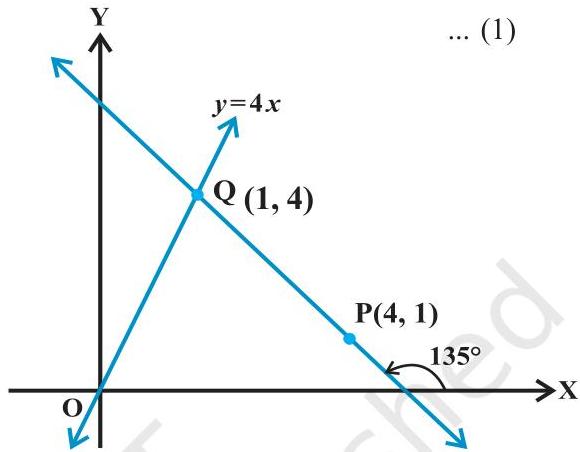 Fig 9.16
$ y - 1 = -1 (x - 4) \text{ or } x + y - 5 = 0 \tag{2} $
By concurrently solving equations (1) and (2), we obtain $x = 1$ and $y = 4$, which establishes the intersection point of the two lines as Q (1, 4). Consequently, the distance from line (1) to point P (4, 1), measured along line (2), corresponds to:
$ \begin{array}{l} = \text{the distance between the points P (4, 1) and Q (1, 4).} \ = \sqrt{(1 - 4)^2 + (4 - 1)^2} = 3\sqrt{2} \text{ units}. \end{array} $
Example 13 Assuming that straight lines work as the plane mirror for a point, find the image of the point (1, 2) in the line $x - 3y + 4 = 0$.
Solution Let $\mathrm{Q}(h, k)$ represent the image of point $\mathrm{P}(1, 2)$ with respect to the line defined by:
$ x - 3y + 4 = 0 \tag{1} $
Consequently, line (1) acts as the perpendicular bisector of the line segment PQ (as illustrated in Fig 9.17).
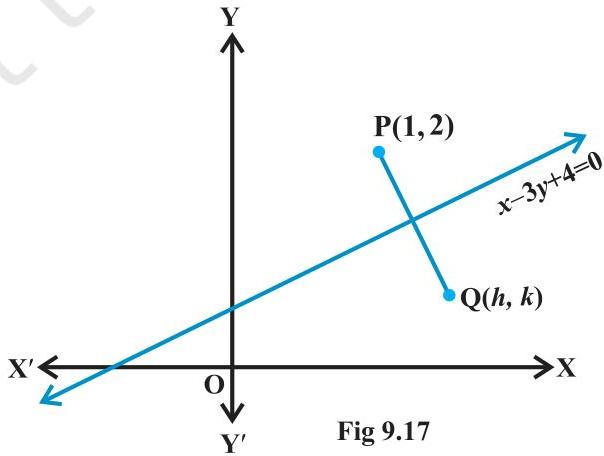
Thus, the gradient of line $\mathrm{PQ}$ is determined by the negative reciprocal of the gradient of the line $x - 3y + 4 = 0$,
so that $\frac{k - 2}{h - 1} = \frac{-1}{\frac{1}{3}}$ or $3h + k = 5$ ... (2)
Furthermore, the midpoint of segment PQ, specifically the point $\left(\frac{h + 1}{2},\frac{k + 2}{2}\right)$, must lie on and satisfy equation (1), which implies:
$ \frac {h + 1}{2} - 3 \left(\frac {k + 2}{2}\right) + 4 = 0 \text { or } h - 3 k = - 3 \tag {3} $
Upon solving the system of equations (2) and (3) simultaneously, we derive the values $h = \frac{6}{5}$ and $k = \frac{7}{5}$.
Therefore, the coordinates of the image of point $(1,2)$ with respect to line (1) are determined to be $\left(\frac{6}{5},\frac{7}{5}\right)$.
Example 14 Show that the area of the triangle formed by the lines
The area of the triangle defined by the lines $y = m_{1}x + c_{1}$, $y = m_{2}x + c_{2}$, and $x = 0$ is $\frac{\left(c_{1} - c_{2}\right)^{2}}{2\left|m_{1} - m_{2}\right|}$.
Solution The lines under consideration are presented as:
$ y = m _ {1} x + c _ {1} \quad \dots (1) $
$ y = m _ {2} x + c _ {2} \quad \dots (2) $
$ x = 0 \quad \dots (3) $
It is a known fact that a line described by the equation $y = mx + c$ intersects the line $x = 0$ (which represents the y-axis) at the specific point $(0, c)$. Consequently, two of the vertices of the triangle formed by lines (1) through (3) are $P(0, c_1)$ and $Q(0, c_2)$ (as depicted in Fig 9.18).
The third vertex can be ascertained by determining the intersection point of equations (1) and (2). Solving these two equations simultaneously yields:
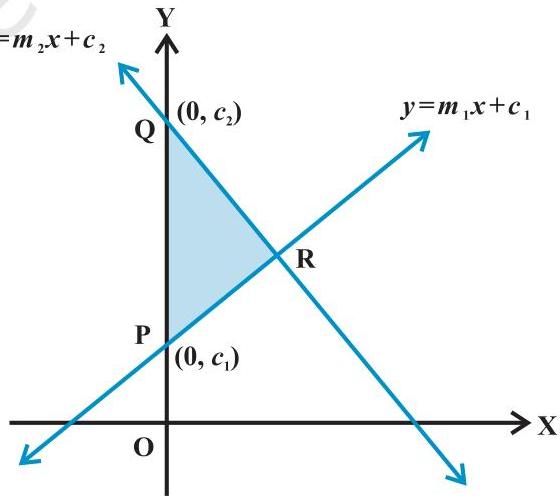 Fig 9.18
$ x = \frac {\left(c _ {2} - c _ {1}\right)}{\left(m _ {1} - m _ {2}\right)} \quad \text{and} \quad y = \frac {\left(m _ {1} c _ {2} - m _ {2} c _ {1}\right)}{\left(m _ {1} - m _ {2}\right)} $
Therefore, the third vertex of the triangle is $R\left(\frac{\left(c_2 - c_1\right)}{\left(m_1 - m_2\right)}, \frac{\left(m_1c_2 - m_2c_1\right)}{\left(m_1 - m_2\right)}\right)$.
The area of this triangle is subsequently calculated using the determinant formula for area:
$ = \frac {1}{2} \left| 0 \left(\frac {m _ {1} c _ {2} - m _ {2} c _ {1}}{m _ {1} - m _ {2}} - c _ {2}\right) + \frac {c _ {2} - c _ {1}}{m _ {1} - m _ {2}} \left(c _ {2} - c _ {1}\right) + 0 \left(c _ {1} - \frac {m _ {1} c _ {2} - m _ {2} c _ {1}}{m _ {1} - m _ {2}}\right) \right| = \frac {\left(c _ {2} - c _ {1}\right) ^ {2}}{2 \left| m _ {1} - m _ {2} \right|} $
Example 15 Determine the equation of a line such that the segment it forms between the lines $5x - y + 4 = 0$ and $3x + 4y - 4 = 0$ is bisected at the point (1, 5).
Solution The specified lines are:
$ 5 x - y + 4 = 0 \quad \dots (1) $
$ 3 x + 4 y - 4 = 0 \quad \dots (2) $
Let the sought-after line intersect line (1) at point $(\alpha_{1},\beta_{1})$ and line (2) at point $(\alpha_{2},\beta_{2})$, respectively (as illustrated in Fig 9.19). Consequently, these points must satisfy their respective line equations:
$ 5 \alpha_ {1} - \beta_ {1} + 4 = 0 \text{ and} $
$ 3 \alpha_ {2} + 4 \beta_ {2} - 4 = 0 $
These relationships can be rearranged to express $\beta_1$ and $\beta_2$ in terms of $\alpha_1$ and $\alpha_2$:
$ \beta_ {1} = 5 \alpha_ {1} + 4 \text{ and } \beta_ {2} = \frac {4 - 3 \alpha_ {2}}{4}. $
The problem states that the midpoint of the segment connecting $(\alpha_{1},\beta_{1})$ and $(\alpha_{2},\beta_{2})$ is (1, 5). Applying the midpoint formula, we get:
$ \frac {\alpha_ {1} + \alpha_ {2}}{2} = 1 \text{ and } \frac {\beta_ {1} + \beta_ {2}}{2} = 5, $
This simplifies to:
$ \alpha_ {1} + \alpha_ {2} = 2 \text{ and } 20 \alpha_ {1} - 3 \alpha_ {2} = 20 \quad \dots (3) $
Further algebraic manipulation yields the following system of equations:
$ \alpha_ {1} + \alpha_ {2} = 2 \text{ and } 20 \alpha_ {1} - 3 \alpha_ {2} = 20 \quad \dots (3) $
Solving the system of equations designated as (3) for $\alpha_{1}$ and $\alpha_{2}$, we find:
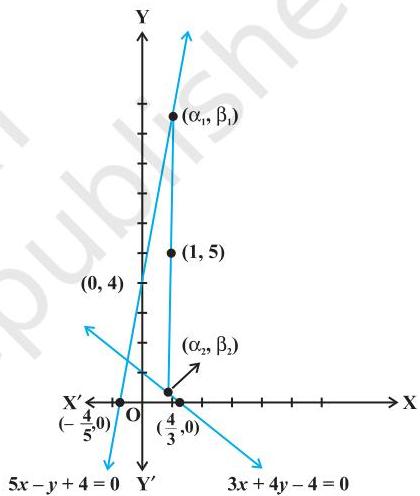 Fig 9.19
$
\alpha_ {1} = \frac {26}{23} \text{ and } \alpha_ {2} = \frac {20}{23} \text{ and hence, } \beta_ {1} = 5, \frac {26}{23} + 4 = \frac {222}{23}. $
Equation of the required line passing through (1, 5) and $(\alpha_{1},\beta_{1})$ is
$ y - 5 = \frac {\beta_ {1} - 5}{\alpha_ {1} - 1} (x - 1) \text{ or } y - 5 = \frac {\frac {222}{23} - 5}{\frac {26}{23} - 1} (x - 1) $
or
$ 107x - 3y - 92 = 0, $
This equation represents the desired line.
Example 16 Prove that the locus of a point, for which its perpendicular distances from the lines $3x - 2y = 5$ and $3x + 2y = 5$ are equal, is a straight line.
Solution The specified lines are:
$ 3x - 2y = 5 \quad \dots (1) $
and
$ 3x + 2y = 5 \quad \dots (2) $
Let $(h, k)$ be an arbitrary point whose distances from lines (1) and (2) are equivalent. Consequently,
$ \frac {\left| 3h - 2k - 5 \right|}{\sqrt{9 + 4}} = \frac {\left| 3h + 2k - 5 \right|}{\sqrt{9 + 4}} \text{ or } \left| 3h - 2k - 5 \right| = \left| 3h + 2k - 5 \right|, $
This relationship yields two possibilities: $3h - 2k - 5 = 3h + 2k - 5$ or $-(3h - 2k - 5) = 3h + 2k - 5$.
Solving these two conditions yields $k = 0$ or $h = \frac{5}{3}$. Therefore, the point $(h, k)$ satisfies the equations $y = 0$ or $x = \frac{5}{3}$, which are characteristic of straight lines. Hence, the trajectory of the point equidistant from lines (1) and (2) is indeed a straight line.
Miscellaneous Exercise on Chapter 9
- Determine the values of $k$ for which the linear equation $(k-3)x - (4 - k^2)y + k^2 - 7k + 6 = 0$ describes a line that is:
(a) Parallel to the $x$-axis, (b) Parallel to the $y$-axis, (c) Passing through the origin.
Determine the equations of the straight lines that form intercepts on the coordinate axes such that their sum is 1 and their product is $-6$.
Identify the points situated on the $y$-axis that are
precisely 4 units away from the line defined by the equation $\frac{x}{3} + \frac{y}{4} = 1$.
Calculate the perpendicular distance from the origin to the line segment connecting the points $(\cos \theta, \sin \theta)$ and $(\cos \phi, \sin \phi)$.
Determine the equation of the line that is parallel to the $y$-axis and passes through the intersection point of the lines $x - 7y + 5 = 0$ and $3x + y = 0$.
Find the equation of a line constructed perpendicularly to the line $\frac{x}{4} + \frac{y}{6} = 1$, and passing through the specific point where this line intersects the $y$-axis.
Compute the area of the triangular region enclosed by the lines $y - x = 0$, $x + y = 0$, and $x - k = 0$.
Ascertain the value of $p$ such that the three lines given by $3x + y - 2 = 0$, $px + 2y - 3 = 0$, and $2x - y - 3 = 0$ all intersect at a single common point.
Given three lines with equations $y = m_{1}x + c_{1}$, $y = m_{2}x + c_{2}$, and $y = m_{3}x + c_{3}$, demonstrate that if they are concurrent, then the following condition holds: $m_{1}(c_{2} - c_{3}) + m_{2}(c_{3} - c_{1}) + m_{3}(c_{1} - c_{2}) = 0$.
Determine the equations of the lines that pass through the point (3, 2) and form an angle of $45^{\circ}$ with the line $x - 2y = 3$.
Obtain the equation of the line that traverses the intersection point of the lines $4x + 7y - 3 = 0$ and $2x - 3y + 1 = 0$, and creates equal intercepts on the coordinate axes.
Establish that the equation of a line originating from the origin and forming an angle $\theta$ with the line $y = mx + c$ is given by $\frac{y}{x} = \frac{m \pm \tan}{1 \mp m \tan}$.
In what proportion does the line $x + y = 4$ divide the line segment connecting the points $(-1, 1)$ and $(5, 7)$?
Calculate the distance from the line $4x + 7y + 5 = 0$ to the point $(1, 2)$, measured along the direction of the line $2x - y = 0$.
Identify the orientation in which a straight line must be drawn through the point $(-1, 2)$ so that its intersection point with the line $x + y = 4$ is located 3 units away from $(-1, 2)$.
The hypotenuse of a right-angled triangle has its endpoints at $(1, 3)$ and $(-4, 1)$. Determine an equation for each of the perpendicular sides (legs) of the triangle that are aligned with the coordinate axes.
Compute the image coordinates of the point (3, 8) with respect to the line $x + 3y = 7$, treating this line as a planar mirror.
If the lines $y = 3x + 1$ and $2y = x + 3$ are equally inclined relative to the line $y = mx + 4$, ascertain the value of $m$.
If the sum of the perpendicular distances of a variable point $\mathrm{P}(x, y)$ from the lines $x + y - 5 = 0$ and $3x - 2y + 7 = 0$ consistently equals 10, demonstrate that $\mathrm{P}$ must traverse a straight line.
Determine the equation of the line that maintains an equal distance from the parallel lines $9x + 6y - 7 = 0$ and $3x + 2y + 6 = 0$.
A light ray originating from the point (1, 2) strikes the $x$-axis at point A and subsequently travels through the point (5, 3). Determine the coordinates of A.
Demonstrate that the product of the perpendicular distances from the points $\left(\sqrt{a^2 - b^2}, 0\right)$ and $\left(-\sqrt{a^2 - b^2}, 0\right)$ to the line $\frac{x}{a} \cos \theta + \frac{y}{b} \sin \theta = 1$ equals $b^2$.
A person positioned at the intersection of two linear paths, defined by the equations $2x - 3y + 4 = 0$ and $3x + 4y - 5 = 0$, seeks to reach a third path, given by $6x - 7y + 8 = 0$, in the minimum possible time. Determine the equation of the trajectory this person should take.
Summary
The gradient $(m)$ for a line that is not vertical, connecting the points $(x_1, y_1)$ and $(x_2, y_2)$, is defined as $m = \frac{y_2 - y_1}{x_2 - x_1} = \frac{y_1 - y_2}{x_1 - x_2}$, with the condition that $x_1 \neq x_2$.
Should a line form an angle $\alpha$ with the positive $x$-axis, its slope is expressed as $m = \tan \alpha$, where $\alpha \neq 90^\circ$.
A horizontal line possesses a slope of zero, whereas a vertical line has an undefined slope.
The acute angle (denoted as $\theta$) formed between two lines, $L_1$ and $L_2$, having slopes $m_1$ and $m_2$ respectively, is determined by the formula $\tan \theta = \left| \frac{m_2 - m_1}{1 + m_1 m_2} \right|$, provided that $1 + m_1 m_2 \neq 0$.
Lines are parallel if and only if their respective slopes are identical.
Lines are perpendicular if and only if the product of their slopes equals $-1$.
Three points, A, B, and C, are collinear if and only if the slope of the segment AB is equal to the slope of the segment BC.
The equation for a horizontal line situated at a distance $a$ from the $x$-axis is either $y = a$ or $y = -a$.
The equation for a vertical line positioned at a distance $b$ from the $y$-axis is either $x = b$ or $x = -b$.
A point $(x, y)$ resides on a line with slope $m$ that passes through a fixed point $(x_0, y_0)$ if and only if its coordinates fulfill the equation $y - y_0 = m(x - x_0)$.
The equation of the line that traverses the points $(x_1, y_1)$ and $(x_2, y_2)$ is expressed as $y - y_1 = \frac{y_2 - y_1}{x_2 - x_1}(x - x_1)$.
A point $(x, y)$ located on a line characterized by slope $m$ and $y$-intercept $c$ is on that line if and only if its coordinates satisfy $
y = mx + c$.
- If a line with slope $m$ has an $x$-intercept of $d$, then its equation is $y = m(x - d)$.
- The equation for a line that forms intercepts $a$ on the $x$-axis and $b$ on the $y$-axis, respectively, is $\frac{x}{a} + \frac{y}{b} = 1$.
- An equation structured as $Ax + By + C = 0$, where A and B are not both zero simultaneously, is termed the general linear equation or the general equation of a line.
- The perpendicular distance $(d)$ from a point $(x_1, y_1)$ to a line $Ax + By + C = 0$ is calculated using the formula $d = \frac{|Ax_1 + By_1 + C|}{\sqrt{A^2 + B^2}}$.
- The distance between two parallel lines, $Ax + By + C_1 = 0$ and $Ax + By + C_2 = 0$, is determined by the formula $d = \frac{|C_1 - C_2|}{\sqrt{A^2 + B^2}}$.