Chapter 11
INTRODUCTION TO THREE DIMENSIONAL GEOMETRY
Mathematics is both the queen and the handmaiden of all sciences – E.T. BELL
11.1 Introduction
You may recall that to locate the position of a point in a plane, we need two intersecting mutually perpendicular lines in the plane. These lines are called the coordinate axes and the two numbers are called the coordinates of the point with respect to the axes. In actual life, we do not have to deal with points lying in a plane only. For example, consider the position of a ball thrown in space at different points of time or the position of an aeroplane as it flies from one place to another at different times during its flight.
 Leonhard Euler (1707-1783)
Similarly, if we were to locate the position of the lowest tip of an electric bulb hanging from the ceiling of a room or the position of the central tip of the ceiling fan in a room, we will not only require the perpendicular distances of the point to be located from two perpendicular walls of the room but also the height of the point from the floor of the room. Therefore, we need not only two but three numbers representing the perpendicular distances of the point from three mutually perpendicular planes, namely the floor of the room and two adjacent walls of the room. The three numbers representing the three distances are called the coordinates of the point with reference to the three coordinate planes. So, a point in space has three coordinates. In this Chapter, we shall study the basic concepts of geometry in three dimensional space. *
11.2 Coordinate Axes and Coordinate Planes in Three Dimensional Space
Consider three planes intersecting at a point O such that these three planes are mutually perpendicular to each other (Fig 11.1). These three planes intersect along the lines X'OX, Y'OY and $Z ^ { \prime } \mathrm { O } Z _ { \mathrm { i } }$ called the $x , y$ and z-axes, respectively. We may note that these lines are mutually perpendicular to each other. These lines constitute the rectangular coordinate system. The planes XOY, YOZ and ZOX, called, respectively the XY-plane, YZ-plane and the ZX-plane, are known as the three coordinate planes. We take the XOY plane as the plane of the paper and the line $Z ^ { \prime } \mathrm { O Z }$ as perpendicular to the plane XOY. If the plane of the paper is considered as horizontal, then the line $Z ^ { \prime } 0 Z$ will be vertical. The distances measured from XY-plane upwards in the direction of OZ are taken as positive and those measured downwards in the direction of $\mathrm { O Z ^ { \prime } }$ are taken as negative. Similarly, the distance measured to the right of ZX-plane along OY are taken as positive, to the left of ZX-plane and along $\mathrm { O Y ^ { \prime } }$ as negative, in front of the YZ-plane along OX as positive and to the back of it along $\mathrm { O X ^ { \prime } }$ as negative. The point O is called the origin of the coordinate system. The three coordinate planes divide the space into eight parts known as octants. These octants could be named as XOYZ X'OYZ, X'OY'Z, XOY'Z, XOYZ', X'OYZ', $\mathrm { X } ^ { \prime } \mathrm { O Y } ^ { \prime } \mathrm { Z } ^ { \prime }$ and XOY'Z'. and denoted by I, II, II, …., VII , respectively.
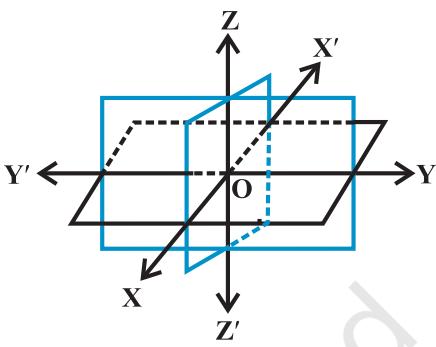 Fig 11.1
11.3 Coordinates of a Point in Space
Having chosen a fixed coordinate system in the space, consisting of coordinate axes, coordinate planes and the origin, we now explain, as to how, given a point in the space, we associate with it three coordinates $( x , y , z )$ and conversely, given a triplet of three numbers $( x , y , z )$ how, we locate a point in the space.
Given a point $\mathrm { P }$ in space, we drop a X perpendicular PM on the XY-plane with M as the
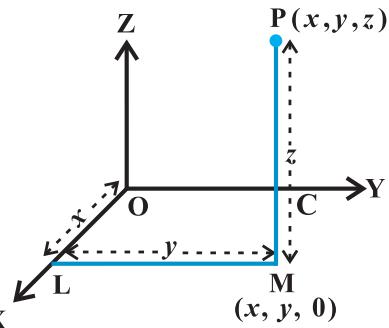 Fig 11.2
foot of this perpendicular (Fig 11.2). Then, from the point M, we draw a perpendicular ML to the $x \cdot$ axis, meeting it at L. Let OL be $x ,$ LM be $y$ and MP be $z .$ Then $x , y$ and $z$ are called the $x , y$ and $z$ coordinates, respectively, of the point $\mathrm { P }$ in the space. In Fig 11.2, we may note that the point $\mathrm { P } \left( x , y , z \right)$ lies in the octant XOYZ and so all $x , y ,$ $z$ are positive. If $\mathrm { P }$ was in any other octant, the signs of $x , y$ and $z$ would change
accordingly. Thus, to each point $\mathrm { P }$ in the space there corresponds an ordered triplet $( x , y , z )$ of real numbers.
Conversely, given any triplet $( x , y , z )$ , we would first fix the point L on the $x \cdot$ axis corresponding to $x$ then locate the point $\mathbf { M }$ in the XY-plane such that $( x , y )$ are the coordinates of the point $\mathbf { M }$ in the XY-plane. Note that LM is perpendicular to the $x$ axis or is parallel to the y-axis. Having reached the point M, we draw a perpendicular MP to the XY-plane and locate on it the point $\mathrm { P }$ corresponding to $z .$ The point $\mathrm { P }$ so obtained has then the coordinates $( x , y , z )$ . Thus, there is a one to one correspondence between the points in space and ordered triplet $( x , y , z )$ of real numbers.
Alternatively, through the point $\mathrm { P }$ in the space, we draw three planes parallel to the coordinate planes, meeting the $x$ axis, $y .$ axis and $z$ axis in the points A, B and C, respectively (Fig 11.3). Let $\mathrm { O A } = x ,$ ${ \mathrm { O B } } = y$ and $\mathrm { O C } = z$ . Then, the point P will have the coordinates $x$ y and $z$ and we write $\mathrm { P } \left( x , y , z \right)$ Conversely, given $x , y$ and $z$ we locate the three points A, B and C on the three coordinate axes. Through the points A, B and C we draw planes parallel to the YZ-plane, ZX-plane and XY-plane, respectively. The point of intersection of these three planes, namely, ADPF, BDPE and CEPF is obviously the point P, corresponding to the ordered triplet $( x , y , z )$ .We observe that if $\mathrm { ~ P ~ } ( x , y , z )$ is any point in the space, then $x , y$ and $z$ are perpendicular distances from YZ, ZX and XY planes, respectively.
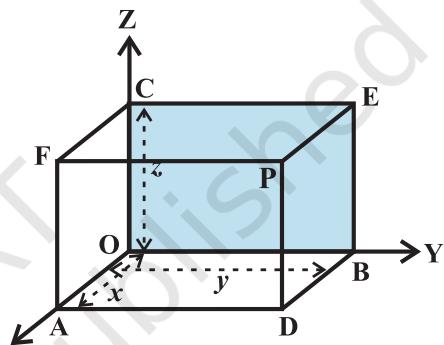 Fig 11.3
NoteThe coordinates of the origin O are (0,0,0). The coordinates of any point on the $x$ axis will be as $( x , 0 , 0 )$ and the coordinates of any point in the YZ-plane will be as $( 0 , y , z )$ .
RemarkThe sign of the coordinates of a point determine the octant in which the point lies. The following table shows the signs of the coordinates in eight octants.
Table 11.1
| OctantsCoordinates | I | II | III | IV | V | VI | VII | VIII |
| x | + | + | + | X | ||||
| y | + | + | t | |||||
| z | + | + | × |
Example 1 In Fig 11.3, if P is (2,4,5), find the coordinates of F.
Solution For the point F, the distance measured along OY is zero. Therefore, the coordinates of F are (2,0,5).
Example 2 Find the octant in which the points (−3,1,2) and (−3,1,−2) lie.
Solution From the Table 11.1, the point (−3,1, 2) lies in second octant and the point $( - 3 , 1 , - 2 )$ lies in octant VI.
EXERCISE 11.1
- A point is on the $x$ -axis. What are its $y .$ coordinate and $z$ coordinates?
- A point is in the XZ-plane. What can you say about its $y .$ coordinate?
- Name the octants in which the following points lie: (1, 2, 3), (4, −2, 3), (4, −2, −5), (4, 2, –5), (−4, 2, −5), (−4, 2, 5), $( - 3 , - 1 , 6 ) ( - 2 , - 4 , - 7 )$ .
- Fill in the blanks: (i) The $x$ axis and $y$ axis taken together determine a plane known as (ii) The coordinates of points in the XY-plane are of the form (iii) Coordinate planes divide the space into octants.
11.4 Distance between Two Points
We have studied about the distance between two points in two-dimensional coordinate system. Let us now extend this study to three-dimensional system.
Let $\mathrm { P } ( x _ { 1 } , y _ { 1 } , z _ { 1 } )$ and Q $( x _ { _ 2 } , y _ { _ 2 } , z _ { 2 } )$ be two points referred to a system of rectangular axes OX, OY and OZ. Through the points $\mathrm { P }$ and Q draw planes parallel to the coordinate planes so as to form a rectangular parallelepiped with one diagonal PQ (Fig 11.4).
Now, since $\angle \mathrm { P A Q }$ is a right angle, it follows that, in triangle PAQ,
$ \mathrm { P Q } ^ { 2 } = \mathrm { P A } ^ { 2 } + \mathrm { A Q } ^ { 2 } $
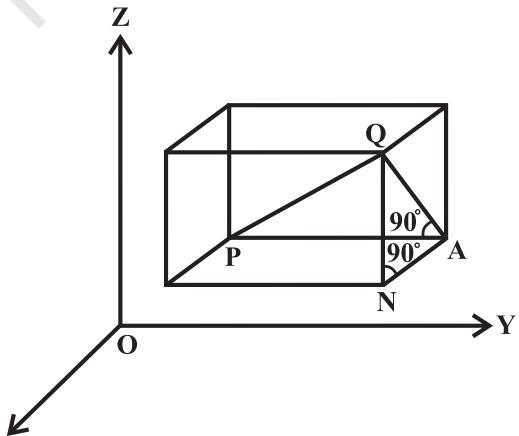 Fig 11.4
Also, triangle ANQ is right angle triangle with $\angle \mathrm { A N Q }$ a right angle.
Therefore
$ \mathrm { A Q } ^ { 2 } = \mathrm { A N } ^ { 2 } + \mathrm { N Q } ^ { 2 } $
From (1) and (2), we have
$ \mathrm { P Q } ^ { 2 } = \mathrm { P A } ^ { 2 } + \mathrm { A N } ^ { 2 } + \mathrm { N Q } ^ { 2 } $
Now
$ \begin{array} { c } { { \mathrm { \bf { F } } { \bf { \breve { U } } } ^ { - } = { \bf { F } } { \bf { A } } ^ { - } + { \bf { A } } { \bf { N } } ^ { - } + { \bf { N } } { \bf { \breve { U } } } ^ { - } } } \ { { { \mathrm { \bf { P } } } { \bf { A } } = y _ { 2 } - y _ { 1 } , { \bf { A } } { \bf { N } } = x _ { 2 } - x _ { 1 } \mathrm { ~ a n d ~ } { \bf { N } } { \bf { Q } } = z _ { 2 } - z _ { 1 } } } \ { { { \mathrm { \bf { P } } } { \bf { Q } } ^ { 2 } = ( x _ { 2 } - x _ { 1 } ) ^ { 2 } + ( y _ { 2 } - y _ { 1 } ) ^ { 2 } + ( z _ { 2 } - z _ { 1 } ) ^ { 2 } } } \end{array} $
Hence
$ \begin{array} { r } { \mathrm { P Q } = \sqrt { ( x _ { 2 } - x _ { 1 } ) ^ { 2 } + ( y _ { 2 } - y _ { 1 } ) ^ { 2 } + ( z _ { 2 } - z _ { 1 } ) ^ { 2 } } } \end{array} $
Therefore
This gives us the distance between two points $( x _ { 1 } , y _ { 1 } , z _ { 1 } )$ and $( x _ { 2 } , y _ { 2 } , z _ { 2 } )$ .
In particular, if $x _ { { } _ { 1 } } = y _ { { } _ { 1 } } = z _ { { } _ { 1 } } = 0$ i.e., point $\mathrm { P }$ is origin O, then $O Q = \sqrt { { x _ { 2 } } ^ { 2 } + { y _ { 2 } } ^ { 2 } + { z _ { 2 } } ^ { 2 } }$ which gives the distance between the origin O and any point Q $( x _ { _ 2 } , y _ { _ 2 } , z _ { _ 2 } )$
Example 3 Find the distance between the points $\mathrm { P } ( 1 , - 3 , 4 )$ and $Q \left( - 4 , 1 , 2 \right)$ .
Solution The distance PQ between the points ${ \mathrm { P } } \left( 1 , - 3 , 4 \right)$ and Q $( - 4 , 1 , 2 )$ is
$ { \begin{array} { r l } & { { \mathrm { P Q } } = { \sqrt { ( - 4 - 1 ) ^ { 2 } + ( 1 + 3 ) ^ { 2 } + ( 2 - 4 ) ^ { 2 } } } } \ & { \qquad = { \sqrt { 2 5 + 1 6 + 4 } } } \ & { \qquad = { \sqrt { 4 5 } } = 3 { \sqrt { 5 } } { \mathrm { ~ u n i t s } } } \end{array} } $
Example 4 Show that the points $\mathrm { P } ( - 2 , 3 , 5 ) , \mathrm { Q } ( 1 , 2 , 3 )$ and R $( 7 , 0 , - 1 )$ are collinear.
Solution We know that points are said to be collinear if they lie on a line.
Now,
$ \mathrm { P Q } = { \sqrt { ( 1 + 2 ) ^ { 2 } + ( 2 - 3 ) ^ { 2 } + ( 3 - 5 ) ^ { 2 } } } = { \sqrt { 9 + 1 + 4 } } = { \sqrt { 1 4 } } $
$ \operatorname { Q R } = { \sqrt { ( 7 - 1 ) ^ { 2 } + ( 0 - 2 ) ^ { 2 } + ( - 1 - 3 ) ^ { 2 } } } = { \sqrt { 3 6 + 4 + 1 6 } } = { \sqrt { 5 6 } } = 2 { \sqrt { 1 4 } } $
and
$ \mathrm { P R } = { \sqrt { ( 7 + 2 ) ^ { 2 } + ( 0 - 3 ) ^ { 2 } + ( - 1 - 5 ) ^ { 2 } } } = { \sqrt { 8 1 + 9 + 3 6 } } = { \sqrt { 1 2 6 } } = 3 { \sqrt { 1 4 } } $
Thus, $\mathrm { P Q } + \mathrm { Q R } = \mathrm { P R } .$ Hence, P, Q and R are collinear.
Example 5 Are the points A (3, 6, 9), B (10, 20, 30) and C (25, −41, 5), the vertices of a right angled triangle?
Solution By the distance formula, we have
$ { \begin{array} { r l } { \mathbf { A B ^ { 2 } } } & { = ( 1 0 - 3 ) ^ { 2 } + ( 2 0 - 6 ) ^ { 2 } + ( 3 0 - 9 ) ^ { 2 } } \ & { = 4 9 + 1 9 6 + 4 4 1 = 6 8 6 } \ { \mathbf { B C ^ { 2 } } } & { = ( 2 5 - 1 0 ) ^ { 2 } + ( - 4 1 - 2 0 ) ^ { 2 } + ( 5 - 3 0 ) ^ { 2 } } \ & { = 2 2 5 + 3 7 2 1 + 6 2 5 = 4 5 7 1 } \end{array} } $
$
\begin{array} { r l } { \mathrm { C A } ^ { 2 } } & { { } = ( 3 - 2 5 ) ^ { 2 } + ( 6 + 4 1 ) ^ { 2 } + ( 9 - 5 ) ^ { 2 } } \ { \phantom { \mathrm { C A } ^ { 2 } } } & { { } = 4 8 4 + 2 2 0 9 + 1 6 = 2 7 0 9 } \end{array} $
We find that $\mathrm { C A } ^ { 2 } + \mathrm { A B } ^ { 2 } \neq \mathrm { B C } ^ { 2 } .$
Hence, the triangle ABC is not a right angled triangle.
Example 6 Find the equation of set of points $\mathrm { P }$ such that $\mathrm { P A } ^ { 2 } + \mathrm { P B } ^ { 2 } = 2 k ^ { 2 } .$ where A and B are the points (3, 4, 5) and $( - 1 , 3 , - 7 )$ , respectively.
Solution Let the coordinates of point $\mathrm { P }$ be $( x , y , z )$ .
Here
$ \mathrm { P A } ^ { 2 } = ( x - 3 ) ^ { 2 } + ( y - 4 ) ^ { 2 } + ( z - 5 ) ^ { 2 } $
$ \mathrm { P B } ^ { 2 } = ( x + 1 ) ^ { 2 } + ( y - 3 ) ^ { 2 } + ( z + 7 ) ^ { 2 } $
By the given condition $\mathrm { P A } ^ { 2 } + \mathrm { P B } ^ { 2 } = 2 k ^ { 2 }$ we have
$ \begin{array} { l } { { ( x - 3 ) ^ { 2 } + ( y - 4 ) ^ { 2 } + ( z - 5 ) ^ { 2 } + ( x + 1 ) ^ { 2 } + ( y - 3 ) ^ { 2 } + ( z + 7 ) ^ { 2 } = 2 k ^ { 2 } } } \ { { 2 x ^ { 2 } + 2 y ^ { 2 } + 2 z ^ { 2 } - 4 x - 1 4 y + 4 z = 2 k ^ { 2 } - 1 0 9 . } } \end{array} $
EXERCISE 11.2
Find the distance between the following pairs of points: (i) (2, 3, 5) and (4, 3, 1) (ii) $( - 3 , 7 , 2 )$ and (2, 4, −1) (iii) $( - 1 , 3 , - 4 )$ and $( 1 , - 3 , 4 )$ (iv) $( 2 , - 1 , 3 )$ and (−2, 1, 3).
Show that the points (−2, 3, 5), (1, 2, 3) and $( 7 , 0 , - 1 )$ are collinear.
Verify the following: (i) $( 0 , 7 , - 1 0 ) , ( 1 , 6 , - 6 )$ and $( 4 , 9 , - 6 )$ are the vertices of an isosceles triangle. (ii) $( 0 , 7 , 1 0 ) , ( - 1 , 6 , 6 )$ and $( - 4 , 9 , 6 )$ are the vertices of a right angled triangle. (iii) $( - 1 , 2 , 1 ) , ( 1 , - 2 , 5 ) , ( 4 , - 7 , 8 ) \mathrm { a n d } ( 2 , - 3 , 4 )$ are the vertices of a parallelogram.
Find the equation of the set of points which are equidistant from the points (1, 2, 3) and $( 3 , 2 , - 1 )$ .
Find the equation of the set of points P, the sum of whose distances from A $\phantom { + } , ( 4 , 0 , 0 )$ and B $( - 4 , 0 , 0 )$ is equal to 10.
Miscellaneous Examples
Example 7 Show that the points A (1, 2, 3), B $( - 1 , - 2 , - 1 )$ , C (2, 3, 2) and D (4, 7, 6) are the vertices of a parallelogram ABCD, but it is not a rectangle.
Solution To show ABCD is a parallelogram we need to show opposite side are equal Note that.
$ { \begin{array} { r l } & { { \mathrm { A B ~ } } = { \sqrt { ( - 1 - 1 ) ^ { 2 } + ( - 2 - 2 ) ^ { 2 } + ( - 1 - 3 ) ^ { 2 } \ } } = { \sqrt { 4 + 1 6 + 1 6 } } = 6 } \ & { { \mathrm { B C ~ } } = { \sqrt { ( 2 + 1 ) ^ { 2 } + ( 3 + 2 ) ^ { 2 } + ( 2 + 1 ) ^ { 2 } \ } } = { \sqrt { 9 + 2 5 + 9 } } = { \sqrt { 4 3 } } } \ & { { \mathrm { C D ~ } } = { \sqrt { ( 4 - 2 ) ^ { 2 } + ( 7 - 3 ) ^ { 2 } + ( 6 - 2 ) ^ { 2 } \ } } = { \sqrt { 4 + 1 6 + 1 6 } } = 6 } \ & { { \mathrm { D A ~ } } = { \sqrt { ( 1 - 4 ) ^ { 2 } + ( 2 - 7 ) ^ { 2 } + ( 3 - 6 ) ^ { 2 } \ } } = { \sqrt { 9 + 2 5 + 9 } } = { \sqrt { 4 3 } } } \end{array} } $
Since $\mathrm { A B } \ = \mathrm { C D }$ and $\mathrm { B C } = \mathrm { A D }$ ABCD is a parallelogram.
Now, it is required to prove that ABCD is not a rectangle. For this, we show that diagonals AC and BD are unequal. We have
$ \begin{array} { r l } { \mathrm { A C } \quad } & { { } = { \sqrt { ( 2 - 1 ) ^ { 2 } + ( 3 - 2 ) ^ { 2 } + ( 2 - 3 ) ^ { 2 } } } = { \sqrt { 1 + 1 + 1 } } = { \sqrt { 3 } } } \ { \mathrm { B D } \quad } & { { } = { \sqrt { ( 4 + 1 ) ^ { 2 } + ( 7 + 2 ) ^ { 2 } + ( 6 + 1 ) ^ { 2 } } } = { \sqrt { 2 5 + 8 1 + 4 9 } } = { \sqrt { 1 5 5 } } . } \end{array} $
Since $\mathrm { A C } \neq \mathrm { B D }$ ABCD is not a rectangle.
Note We can also show that ABCD is a parallelogram, using the property that diagonals AC and BD bisect each other.
Example 8 Find the equation of the set of the points P such that its distances from the points A $( 3 , 4 , - 5 )$ and B $( - 2 , 1 , 4 )$ are equal.
Solution If P $( x , y , z )$ be any point such that $\mathrm { P A } = \mathrm { P B }$
Now ${ \begin{array} { r l } & { { \sqrt { ( x - 3 ) ^ { 2 } + ( y - 4 ) ^ { 2 } + ( z + 5 ) ^ { 2 } } } \ = \ { \sqrt { ( x + 2 ) ^ { 2 } + ( y - 1 ) ^ { 2 } + ( z - 4 ) ^ { 2 } } } } \ & { ( x - 3 ) ^ { 2 } + ( y - 4 ) ^ { 2 } + ( z + 5 ) ^ { 2 } \ = \ ( x + 2 ) ^ { 2 } + ( y - 1 ) ^ { 2 } + ( z - 4 ) ^ { 2 } } \end{array} }$ or or $1 0 x + 6 y - 1 8 z - 2 9 = 0 .$
Example 9 The centroid of a triangle ABC is at the point $( 1 , 1 , 1 )$ . If the coordinates of A and B are $( 3 , - 5 , 7 )$ and $( - 1 , 7 , - 6 )$ respectively, find the coordinates of the point C.
Solution Let the coordinates of C be $( x , y , z )$ and the coordinates of the centroid G be (1, 1, 1). Then
$ \frac { x + 3 - 1 } { 3 } = 1 , { \mathrm { i . e . , } } x = 1 ; \frac { y - 5 + 7 } { 3 } = 1 , { \mathrm { i . e . , } } y = 1 ; \frac { z + 7 - 6 } { 3 } = 1 , { \mathrm { i . e . , } } z = 2 . $
Hence, coordinates of C are (1, 1, 2).
Miscellaneous Exercise on Chapter 11
Three vertices of a parallelogram ABCD are $\mathrm { A } ( 3 , - 1 , 2 )$ , B (1, 2, − 4) and ${ \mathrm { C } } \left( - 1 , 1 , 2 \right)$ Find the coordinates of the fourth vertex.
Find the lengths of the medians of the triangle with vertices $\mathrm { A } ( 0 , 0 , 6 ) , \mathrm { B } \left( 0 , 4 , 0 \right)$ and (6, 0, 0).
If the origin is the centroid of the triangle PQR with vertices I $\mathrm { ~ P ~ } ( 2 a , 2 , 6 )$ , $\mathrm { ~ Q ~ } ( - 4 , 3 b , - 1 0 )$ and $\mathrm { R } ( 8 , 1 4 , 2 c )$ , then find the values of $a$ , $b$ and $c$
If A and B be the points (3, 4, 5) and $( - 1 , 3 , - 7 )$ , respectively, find the equation of the set of points $\mathrm { P }$ such that $\mathrm { P A } ^ { 2 } + \mathrm { P B } ^ { 2 } = k ^ { 2 } ,$ where $k$ is a constant.
Summary
$\diamond$ In three dimensions, the coordinate axes of a rectangular Cartesian coordinate system are three mutually perpendicular lines. The axes are called the $x$ , , $y$ and $z$ axes. The three planes determined by the pair of axes are the coordinate planes, called XY, YZ and ZX-planes.
$\spadesuit$ The three coordinate planes divide the space into eight parts known as octants.
The coordinates of a point P in three dimensional geometry is always written in the form of triplet like $( x , y , z )$ . Here $x , y$ and $z$ are the distances from the YZ, ZX and XY-planes. (i) Any point on $x \cdot$ axis is of the form $( x , 0 , 0 )$ (ii) Any point on $y .$ axis is of the form $( 0 , y , 0 )$ (iii) Any point on $z \cdot$ axis is of the form $( 0 , 0 , z )$ .
Distance between two points $\mathrm { P } ( x _ { 1 } , y _ { 1 } , z _ { 1 } )$ and Q $\mid ( x _ { _ 2 } , y _ { _ 2 } , z _ { _ 2 } )$ is given by
$ \scriptstyle \mathrm { P Q } = { \sqrt { ( x _ { 2 } - x _ { 1 } ) ^ { 2 } + ( y _ { 2 } - y _ { 1 } ) ^ { 2 } + ( z _ { 2 } - z _ { 1 } ) ^ { 2 } } } $
Historical Note
René Descartes (1596–1650), the father of analytical geometry, essentially dealt with plane geometry only in 1637. The same is true of his co-inventor Pierre Fermat (1601-1665) and La Hire (1640-1718). Although suggestions for the three dimensional coordinate geometry can be found in their works but no details. Descartes had the idea ofcoordinates in three dimensions but did not develop it. J.Bernoulli (1667-1748) in a letter of 1715 to Leibniz introduced the three coordinate planes which we use today. It was Antoine Parent (1666-1716), who gave a systematic development of analytical solid geometry for the first time in a paper presented to the French Academy in 1700.
L.Euler (1707-1783) took up systematically the three dimensional coordinate geometry, in Chapter 5 of the appendix to the second volume of his "Introduction to Geometry" in 1748.
It was not until the middle of the nineteenth century that geometry was extended to more than three dimensions, the well-known application of which is in the Space-Time Continuum of Einstein's Theory of Relativity.